EP1832376A2 - Système et procédé de surveillance des paramètres de procédé de forage et de contrôle de forage - Google Patents
Système et procédé de surveillance des paramètres de procédé de forage et de contrôle de forage Download PDFInfo
- Publication number
- EP1832376A2 EP1832376A2 EP07103534A EP07103534A EP1832376A2 EP 1832376 A2 EP1832376 A2 EP 1832376A2 EP 07103534 A EP07103534 A EP 07103534A EP 07103534 A EP07103534 A EP 07103534A EP 1832376 A2 EP1832376 A2 EP 1832376A2
- Authority
- EP
- European Patent Office
- Prior art keywords
- laser
- laser drilling
- drilling process
- process parameters
- monitored
- Prior art date
- Legal status (The legal status is an assumption and is not a legal conclusion. Google has not performed a legal analysis and makes no representation as to the accuracy of the status listed.)
- Withdrawn
Links
Images




Classifications
-
- B—PERFORMING OPERATIONS; TRANSPORTING
- B23—MACHINE TOOLS; METAL-WORKING NOT OTHERWISE PROVIDED FOR
- B23K—SOLDERING OR UNSOLDERING; WELDING; CLADDING OR PLATING BY SOLDERING OR WELDING; CUTTING BY APPLYING HEAT LOCALLY, e.g. FLAME CUTTING; WORKING BY LASER BEAM
- B23K26/00—Working by laser beam, e.g. welding, cutting or boring
- B23K26/36—Removing material
- B23K26/38—Removing material by boring or cutting
- B23K26/382—Removing material by boring or cutting by boring
-
- B—PERFORMING OPERATIONS; TRANSPORTING
- B23—MACHINE TOOLS; METAL-WORKING NOT OTHERWISE PROVIDED FOR
- B23K—SOLDERING OR UNSOLDERING; WELDING; CLADDING OR PLATING BY SOLDERING OR WELDING; CUTTING BY APPLYING HEAT LOCALLY, e.g. FLAME CUTTING; WORKING BY LASER BEAM
- B23K26/00—Working by laser beam, e.g. welding, cutting or boring
- B23K26/02—Positioning or observing the workpiece, e.g. with respect to the point of impact; Aligning, aiming or focusing the laser beam
- B23K26/03—Observing, e.g. monitoring, the workpiece
- B23K26/032—Observing, e.g. monitoring, the workpiece using optical means
-
- B—PERFORMING OPERATIONS; TRANSPORTING
- B23—MACHINE TOOLS; METAL-WORKING NOT OTHERWISE PROVIDED FOR
- B23K—SOLDERING OR UNSOLDERING; WELDING; CLADDING OR PLATING BY SOLDERING OR WELDING; CUTTING BY APPLYING HEAT LOCALLY, e.g. FLAME CUTTING; WORKING BY LASER BEAM
- B23K26/00—Working by laser beam, e.g. welding, cutting or boring
- B23K26/02—Positioning or observing the workpiece, e.g. with respect to the point of impact; Aligning, aiming or focusing the laser beam
- B23K26/03—Observing, e.g. monitoring, the workpiece
- B23K26/034—Observing the temperature of the workpiece
-
- B—PERFORMING OPERATIONS; TRANSPORTING
- B23—MACHINE TOOLS; METAL-WORKING NOT OTHERWISE PROVIDED FOR
- B23K—SOLDERING OR UNSOLDERING; WELDING; CLADDING OR PLATING BY SOLDERING OR WELDING; CUTTING BY APPLYING HEAT LOCALLY, e.g. FLAME CUTTING; WORKING BY LASER BEAM
- B23K26/00—Working by laser beam, e.g. welding, cutting or boring
- B23K26/02—Positioning or observing the workpiece, e.g. with respect to the point of impact; Aligning, aiming or focusing the laser beam
- B23K26/04—Automatically aligning, aiming or focusing the laser beam, e.g. using the back-scattered light
- B23K26/046—Automatically focusing the laser beam
-
- B—PERFORMING OPERATIONS; TRANSPORTING
- B23—MACHINE TOOLS; METAL-WORKING NOT OTHERWISE PROVIDED FOR
- B23K—SOLDERING OR UNSOLDERING; WELDING; CLADDING OR PLATING BY SOLDERING OR WELDING; CUTTING BY APPLYING HEAT LOCALLY, e.g. FLAME CUTTING; WORKING BY LASER BEAM
- B23K26/00—Working by laser beam, e.g. welding, cutting or boring
- B23K26/36—Removing material
- B23K26/40—Removing material taking account of the properties of the material involved
-
- B—PERFORMING OPERATIONS; TRANSPORTING
- B23—MACHINE TOOLS; METAL-WORKING NOT OTHERWISE PROVIDED FOR
- B23K—SOLDERING OR UNSOLDERING; WELDING; CLADDING OR PLATING BY SOLDERING OR WELDING; CUTTING BY APPLYING HEAT LOCALLY, e.g. FLAME CUTTING; WORKING BY LASER BEAM
- B23K2103/00—Materials to be soldered, welded or cut
- B23K2103/02—Iron or ferrous alloys
-
- B—PERFORMING OPERATIONS; TRANSPORTING
- B23—MACHINE TOOLS; METAL-WORKING NOT OTHERWISE PROVIDED FOR
- B23K—SOLDERING OR UNSOLDERING; WELDING; CLADDING OR PLATING BY SOLDERING OR WELDING; CUTTING BY APPLYING HEAT LOCALLY, e.g. FLAME CUTTING; WORKING BY LASER BEAM
- B23K2103/00—Materials to be soldered, welded or cut
- B23K2103/08—Non-ferrous metals or alloys
-
- B—PERFORMING OPERATIONS; TRANSPORTING
- B23—MACHINE TOOLS; METAL-WORKING NOT OTHERWISE PROVIDED FOR
- B23K—SOLDERING OR UNSOLDERING; WELDING; CLADDING OR PLATING BY SOLDERING OR WELDING; CUTTING BY APPLYING HEAT LOCALLY, e.g. FLAME CUTTING; WORKING BY LASER BEAM
- B23K2103/00—Materials to be soldered, welded or cut
- B23K2103/08—Non-ferrous metals or alloys
- B23K2103/10—Aluminium or alloys thereof
-
- B—PERFORMING OPERATIONS; TRANSPORTING
- B23—MACHINE TOOLS; METAL-WORKING NOT OTHERWISE PROVIDED FOR
- B23K—SOLDERING OR UNSOLDERING; WELDING; CLADDING OR PLATING BY SOLDERING OR WELDING; CUTTING BY APPLYING HEAT LOCALLY, e.g. FLAME CUTTING; WORKING BY LASER BEAM
- B23K2103/00—Materials to be soldered, welded or cut
- B23K2103/08—Non-ferrous metals or alloys
- B23K2103/14—Titanium or alloys thereof
-
- B—PERFORMING OPERATIONS; TRANSPORTING
- B23—MACHINE TOOLS; METAL-WORKING NOT OTHERWISE PROVIDED FOR
- B23K—SOLDERING OR UNSOLDERING; WELDING; CLADDING OR PLATING BY SOLDERING OR WELDING; CUTTING BY APPLYING HEAT LOCALLY, e.g. FLAME CUTTING; WORKING BY LASER BEAM
- B23K2103/00—Materials to be soldered, welded or cut
- B23K2103/08—Non-ferrous metals or alloys
- B23K2103/15—Magnesium or alloys thereof
-
- B—PERFORMING OPERATIONS; TRANSPORTING
- B23—MACHINE TOOLS; METAL-WORKING NOT OTHERWISE PROVIDED FOR
- B23K—SOLDERING OR UNSOLDERING; WELDING; CLADDING OR PLATING BY SOLDERING OR WELDING; CUTTING BY APPLYING HEAT LOCALLY, e.g. FLAME CUTTING; WORKING BY LASER BEAM
- B23K2103/00—Materials to be soldered, welded or cut
- B23K2103/30—Organic materials
- B23K2103/42—Plastics other than composite materials
-
- B—PERFORMING OPERATIONS; TRANSPORTING
- B23—MACHINE TOOLS; METAL-WORKING NOT OTHERWISE PROVIDED FOR
- B23K—SOLDERING OR UNSOLDERING; WELDING; CLADDING OR PLATING BY SOLDERING OR WELDING; CUTTING BY APPLYING HEAT LOCALLY, e.g. FLAME CUTTING; WORKING BY LASER BEAM
- B23K2103/00—Materials to be soldered, welded or cut
- B23K2103/50—Inorganic materials other than metals or composite materials
-
- B—PERFORMING OPERATIONS; TRANSPORTING
- B23—MACHINE TOOLS; METAL-WORKING NOT OTHERWISE PROVIDED FOR
- B23K—SOLDERING OR UNSOLDERING; WELDING; CLADDING OR PLATING BY SOLDERING OR WELDING; CUTTING BY APPLYING HEAT LOCALLY, e.g. FLAME CUTTING; WORKING BY LASER BEAM
- B23K2103/00—Materials to be soldered, welded or cut
- B23K2103/50—Inorganic materials other than metals or composite materials
- B23K2103/52—Ceramics
Definitions
- This invention broadly relates to a system and method for monitoring one or more laser drilling process parameters other than only breakthrough using a plurality of sensors. This invention further broadly relates to a system and method for using the one or more monitored process parameters to control a laser drilling operation.
- a gas turbine e.g., jet
- air is drawn into the front of the engine, compressed by a shaft-mounted compressor, and mixed with fuel.
- the mixture is burned, and the hot exhaust gases are passed through a turbine mounted on the same shaft.
- the flow of combustion gas turns the turbine by impingement against an airfoil portion of the turbine blades and vanes, which turns the shaft and provides power to the compressor.
- Turbine blades used in compressors, turbines, vanes, blisks, etc. comprise an airfoil. These turbine airfoils may have one or more internal cooling passages with openings or holes at the external surface(s) of the airfoil for the passage of cooling air out to remove heat from the interior of the airfoil and, in some cases, to provide a boundary layer of cooler air at the external surface of the airfoil. See, for example, commonly assigned U.S. Pat. No. 5,609,779 (Crow et al), issued March 11, 1997 ; and U.S. Pat. No. 6,339,208 (Rockstroh et al.), issued January 15, 2002 .
- turbine shrouds often have cooling holes formed therein that may extend from the back surface of the base of the shroud and through to the forward or leading edge of the shroud, the bottom or inner surface of the base of the shroud in contact with the main (hot) gas stream, as well as the side panels or rails of the shroud, to provide both convection cooling inside the holes, as well as impingement and film cooling.
- cooling holes formed therein that may extend from the back surface of the base of the shroud and through to the forward or leading edge of the shroud, the bottom or inner surface of the base of the shroud in contact with the main (hot) gas stream, as well as the side panels or rails of the shroud, to provide both convection cooling inside the holes, as well as impingement and film cooling.
- These cooling holes may be formed in turbine components such as airfoils, shrouds, etc., by aiming a laser at a selected point on the component for a predetermined period of time to bum a hole through the component. The laser may then be aimed at another selected point on the component for a predetermined period of time to bum another hole in the component. This process may be repeated to form all the cooling holes in the component. The period of time during which the laser is aimed at particular points may be determined by evaluating holes made previously in other components. See Background section of U.S. Pat. No. 6,339,208 , supra.
- Simple techniques have been used to detect laser drilling process parameters for controlling the laser drilling operation.
- One such simple technique is to use breakthrough detectors to determine when the drilled hole has been completed (by achieving breakthrough).
- flashes of radiation occur from each laser pulse interacting with the component being drilled.
- Optical and/or acoustical sensors and techniques have used to detect these radiation flashes to determine when breakthrough occurs so that laser drilling may be halted. See, for example, commonly assigned U.S. Pat. No. 4,960,970 (Schneiter), issued October 2, 1990 (acoustical breakthrough detection); U.S. Pat. No.
- Controlling laser drilled hole quality may affect the effectiveness of the cooling provided, and thus potentially impact on the overall performance of the gas turbine engine, specific fuel consumption of the engine, engine emissions, component(s) life, etc.
- Control of laser drilling by using very simple techniques such as those used for detecting breakthrough may not be sufficient for effectively and efficiently monitoring laser drilled hole quality which tends to be a very complex parameter to measure.
- such simple techniques often result in false positives or negatives that may create significant time and labor issues to verify whether control of laser drilled hole quality has actually been achieved.
- a monitoring system and method that: (1) has the ability to effectively and efficiently monitor laser drilling process parameters, such as laser drilled hole quality, that involve more complex parameters to measure; (2) with a greater assurance of minimizing false positives or negatives as to whether the desired quality has been achieved with regard to the monitored laser drilling process parameter.
- An embodiment of this invention is broadly directed at a system comprising: a plurality of sensors for monitoring one or more relevant laser drilling process parameters other than only breakthrough during operation of a laser drill.
- workpiece refers generally to an item, article, element, part, machine, equipment, structure, component, etc., that may be subjected to laser drilling in an embodiment of the system or method of this invention.
- Workpieces may include but are not limited to buildings and the various constituents parts thereof (e.g., girders, gutters, trusses, etc.), machine tools, various other mechanical and/or electrical devices or parts thereof (e.g., valves, etc.), vehicles of various types, for examples, automobiles and the various constituent parts thereof such as automobile engines, automobile frames, etc., ships and the various constituent parts thereof such as the hull, superstructure, etc., airplanes and the various constituent parts thereof such as the wings, fuselage, engines, etc.
- Turbine components gas turbine engine components
- Representative examples of turbine components that may be laser drilled include airfoils (e.g., turbine blades, turbine vanes, turbine blisks, etc.), turbine shrouds, turbine nozzles, combustors, augmentor hardware of gas turbine engines, exhaust nozzles, etc.
- These workpieces may comprise any reasonably solid material capable of transmitting laser drilling-induced vibrations when impulse excited, including metals, e.g., aluminum, chromium, zirconium, nickel, cobalt, iron, titanium, yttrium, magnesium, platinum group metals (e.g., platinum, palladium, rhodium, iridium, etc.), hafnium, silicon, tantalum, lanthanum, etc., or alloys of any of these metals, plastics, etc.
- These workpieces may be fixed or stationary, or may be in motion, e.g., moving, shifting, rotating, revolving, turning, pivoting, articulating, traveling, etc.
- laser drill refers to a device that uses a laser to remove material from a workpiece, for example, by repeatedly pulsing focused laser energy, to form, cut, trepan, create, generate, construct, craft, shape, fashion, produce, etc., a complete or partial (incomplete) aperture, opening, orifice, hole, cavity, bore, etc.
- Many laser drills comprise or may be associated with computer controlled multi-axis machine tools that may translate and/or rotate workpieces with respect to the laser drill, and may have, for example, 3 to 6 axes in various combinations of linear and rotational stages.
- Lasers suitable for drilling holes may include but are not limited to pulsed lasers, Q-switched lasers, continuous wave lasers, etc.
- pulsed Nd:YAG, carbon dioxide, or excimer lasers or any other type of laser capable of cutting (trepanning) or percussion drilling holes
- Representative laser drills suitable for use herein are disclosed in, for example, commonly assigned U.S. Pat. No. 4,960,970 (Schneiter), issued October 2, 1990 ; U.S. Pat. No. 5,026,964 (Somers et al.), issued June 25, 1991 ; and U.S Pat. No. 5,045,669 (Ortiz, Jr. et al.), issued September 3, 1991 , the relevant disclosures of which on laser drills and laser drilling are herein incorporated by reference.
- the term "laser drilling operation” refers to the use of a laser drill to perform one or more operations on a workpiece, including but not limited to forming, creating, cutting, drilling, producing, etc., a complete or partial (incomplete) aperture, opening orifice, hole, cavity, bore, etc., in a workpiece.
- the laser drilling operation may form a hole by cutting or trepanning a semi-circular aperture in a workpiece, form a partial or incomplete hole by controlling the depth of the drilling operation, form a non-symmetric hole, or form a non-circular (e.g., oval shaped) but symmetric hole that may be partially formed or completely formed, e.g., into or through a component wall, etc.
- the term "sensor” refers to any sensing device that may be used to monitor one or more laser drill process parameters. Suitable sensors for use herein include but are not limited to photodetectors (e.g., photodiodes), radiation detectors, acoustical detectors (e.g., microphone), optical detectors, spectral detectors, etc. These sensors may detect one or more of the following: sound, visible, infrared and ultraviolet light, microwaves, x-rays, etc.
- the term "plurality of sensors” refers to the use of two or more sensors to monitor (e.g., detect, sense, identify, etc.), the same laser drilling process parameter or related laser drilling process parameters.
- a plurality of sensors may be used herein in embodiments of the system and method of this invention to provide the same or different information, data feedback, etc., to provide parallel or redundant monitoring of the same or related laser drilling process parameters for verifying the accuracy or correctness of the monitored parameter(s) for the purpose of minimizing or avoiding false positives or negatives, and for ensuring that the same or related laser drilling process parameters are accurately or correctly monitored, etc.
- sensing technique refers to any technique, method, process, etc., using one or more sensors for monitoring (e.g., detecting, sensing, identifying, etc.) one or more laser drilling process parameters.
- a plurality of sensing techniques may be used herein to provide parallel or redundant sensing of the same or related laser drilling process parameters for verifying the accuracy or correctness of the monitored parameter(s) for the purpose of minimizing or avoiding false positives or negatives, and for ensuring that the same or related laser drilling process parameters are accurately or correctly monitored).
- These sensing techniques may include automated visual inspections of the workpiece during or immediately after completion of the laser drilling operation, etc.
- Sensed characteristics refers to any characteristic that may be detected by a sensor and/or sensing technique. Sensed characteristics may include, but are not limited to, one or more of the following: energy, light, radiation, sounds, etc.
- data refers to any information generated, obtained, collected, gathered, accumulated, provided, calculated, determined, supplied, furnished, produced, etc., by a sensor and/or sensing technique.
- breakthrough refers to when a laser drilling operation has completed a laser drilling operation, e.g., has completed the drilling of a hole.
- laser drilling process parameter refers to any laser drilling process parameter that may be monitored by a sensor or sensing technique detecting one or more sensed characteristics of a laser drilling operation.
- Relevant laser drilling process parameters include but are not limited to, one or more of the following: whether or not breakthrough has been achieved; whether the focus position of the laser is correct or appropriate; how efficiently the laser drilling operation is being carried out, e.g., how efficiently is a hole being drilled; the quality of a laser drilled hole; whether the laser drilling operation has reached non-metallic materials, such as filler materials (e.g., wax); whether changes may have occurred in the duration or amplitude of a laser pulse sensed, relative to prior sensed pulses, during the laser drilling operation (interaction time), thus indicating (e.g., indirectly) another change in the condition of the workpiece, the laser drilling operation, etc., may also have occurred; whether changes in laser drilling conditions may have occurred because particular materials are detected (for example, suggesting a need to change from laser drilling conditions for
- All of these sensed parameters may be measured or monitored either directly to assess the drilling process parameter (e.g., quality thereof), or these drilling process parameters may be measured or monitored indirectly, for example, by comparison of measured parameters to prior specifications, templates (including electronic templates), etc., to assess differences in drilling characteristics and qualities from hole-to-hole, from workpiece-to-workpiece, etc.
- a laser drilling process parameter other than solely breakthrough refers to a laser drilling process parameter that may include (or many not include) breakthrough, but must include at least one other laser drilling process parameter, such as laser drilled hole quality, laser focus position, etc.
- monitored laser drilling process parameter refers to any laser drilling process parameter that is being monitored by an appropriate sensor(s) and/or sensing technique(s).
- focus refers to a point at which a beam of a laser converges, as well the relative position of the beam to the workpiece surface, and may be at, below or above the workpiece surface.
- Manufacturing operation refers to an action, function, etc., carried out by a machine, tool, equipment, apparatus, instrument, appliance, engine, device, mechanism, etc., in a manufacturing system.
- Manufacturing operations that may be carried out by a machine, tool, equipment, apparatus, instrument, appliance, engine, device, mechanism, etc., include, but are not limited to one or more of machining (e.g., mechanical machining, electrochemical machining (ECM), electrical/electrode discharge machining (EDM), etc.), drilling (e.g., mechanical drilling, laser drilling, etc.), boring, milling (e.g., mechanical milling, chemical milling, etc.), grinding, reaming, cutting, finishing, fabricating, assembling, shaping, forging, casting, welding, coating (e.g., applying a protective coating, etc.), testing, evaluating, etc. Manufacturing operations may be carried out chemically, mechanically, electrically, or any combination thereof.
- machining e.g., mechanical machining, electrochemical machining (ECM), electrical
- Manufacturing step refers to any procedure, process, practice, etc., carried out in a manufacturing method.
- Manufacturing steps include, but are not limited to one or more of machining (e.g., mechanical machining, electrochemical machining (ECM), electrical/electrode discharge machining (EDM), etc.), drilling (e.g., mechanical drilling, laser drilling, etc.), boring, milling (e.g., mechanical milling, chemical milling, etc.), grinding, reaming, cutting, finishing, fabricating, assembling, shaping, forging, casting, welding, coating (e.g., applying a protective coating), testing, evaluating, etc. Manufacturing steps may be carried out chemically, mechanically, electrically, or any combination thereof.
- manufacturing system refers to a system comprising one or more manufacturing operations.
- manufacturing method refers to a method of comprising one or more manufacturing steps.
- the term “manufacturing station” refers to a given point, place, position, etc., in the manufacturing system where one or more manufacturing operations are carried out.
- transmission refers to any type, manner, etc. of providing, supplying, inputting or otherwise transmitting data.
- Transmission of data herein may be carried out electronically, including the use of wired electronic methods, wireless electronic methods or combinations thereof.
- Electronic transmissions may be carried out by a variety of local or remote electronic transmission methods, such as by using Local or Wide Area Network (LAN or WAN)-based, Internet-based, or web-based transmission methods, cable television or wireless telecommunications networks, or any other suitable local or remote transmission method.
- LAN or WAN Local or Wide Area Network
- ⁇ may refer to a personal computer (portable or desktop), server, mainframe computer, etc.
- the term “comprising” means various operations, steps, data, stations, components, parts, devices, techniques, parameters, etc., may be conjointly employed in this invention. Accordingly, the term “comprising” encompasses the more restrictive terms “consisting essentially of” and “consisting of.”
- An embodiment of the system of this invention broadly comprises: (a) a plurality of sensors for monitoring one or more relevant laser drilling process parameters other than only breakthrough during operation of a laser drill; and (b) optionally a controller that uses the one or more monitored laser drilling process control parameters to control the laser drill during operation thereof.
- An embodiment of the method of this invention broadly comprises: (a) providing a plurality of sensing techniques capable of monitoring one or more relevant laser drilling process parameters other than only breakthrough during a laser drilling operation; (b) monitoring with the plurality of sensing techniques one or more relevant laser drilling process parameters other than only breakthrough during the laser drilling operation; and (c) optionally using the one or more monitored laser drilling process parameters to control the laser drilling operation.
- the embodiments of the system and method of this invention are based on the discovery that sensed data obtained during laser drilling operations has previously been insufficiently or inadequately utilized in controlling the operation of laser drilling, and usually only to monitor relatively simple laser drilling process parameters such as breakthrough.
- the sensed data has been previously obtained primarily by limited a number of sensors or sensing techniques (often one sensor or sensing technique) that may lead to false positives or negatives that may make it difficult and time consuming to verify whether control of the laser drilling process has been achieved.
- the embodiments of the system and method of this invention solve these problems by using a plurality of sensors or sensing techniques to monitor one or more relevant laser drilling process parameters during the laser drilling operation that may include breakthrough, but not only breakthrough, for example, a complex laser drilling process parameter such as the quality of the laser drilled hole, the position of the focus of the laser beam, etc.
- the sensed data obtained by this plurality of sensors or sensing techniques also improves the ability to more effectively control a laser drilling operation, especially one involving such complex laser drilling parameters.
- embodiments of the system and method of this invention may be used to effectively monitor the quality of laser drilled hole, to improve the overall quality of the component being drilled, etc.
- the improved sensed data obtained may be incorporated as part of the control system for the laser drilling operation to change laser drilling parameters during, for example, each laser drilling of a hole, as well as to change laser drilling parameters before successive holes are drilled in the component, to average laser drilling process parameters, to make coarser parameter changes as the laser drills groups of holes, to change drilling process parameters between one completed component and a subsequent component during the drilling cycle, etc.
- These changes or alterations in laser drilling parameters may include but are not limited to changing or altering the laser pulse duration, changing or altering the sequence of pulses used to drill subsequent holes (e.g., using different combinations of short and/or long pulses within a sequence), changing or altering the spot size and/or focus location of the laser beam to change the diameter and/or other characteristics of the drilled hole (e.g., make it larger or smaller), etc.
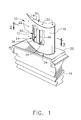
- FIG. 1 shows a gas turbine engine component comprising an airfoil in the form of a turbine blade identified generally as 10.
- Blade 10 comprises an airfoil 12 against which hot combustion gases are directed during operation of the gas turbine engine, and whose surfaces may therefore be subjected to high temperature environments.
- Airfoil 12 has a "high-pressure side” indicated as 14 that is concavely shaped; and a suction side indicated as 16 that is convexly shaped and may sometimes known as the "low-pressure side” or “back side.” In the operation of a gas turbine engine, the hot combustion gas is directed against the high-pressure side 14.
- Blade 10 may be anchored to a turbine disk (not shown) with a dovetail 18 that extends from platform 20 of blade 10 and may be received by slots along the periphery of the disk.
- openings or holes indicated as 22 are formed in convexly shaped low-pressure suction-side 16; a similar plurality of openings or holes 22 may also be formed in concavely-shaped high-pressure side 14. These openings or holes 22 may be formed in sides 16 and 14 to connect with one or more internal cooling passages extending through the interior indicated generally as 24 of the airfoil 12, from the root end indicated as 26 adjacent to dovetail 18, to the opposite distal tip end indicated as 30 remote from dovetail 18 that may also have openings or holes 22 that connect to the interior 24 of airfoil 12.
- FIG. 1 and especially FIG. 2 show interior 24 of airfoil 12 as having a plurality of such passages indicated as leading edge passage 34, central passage 38 and trailing edge passage 42 that are separated, respectively, by forward internal wall 46 and rearward internal wall 50, and that have internal surfaces indicated, respectively, as 54, 58 and 62.
- Airfoil 12 may also be provided with a protective coating (not shown) such as an aluminide diffusion coating that may be applied to the external surfaces of sides 14 and 16, as well as to internal surfaces 54, 58 and 62.
- Blade 10 may be provided as a cast airfoil form (also referred to as a cast blade form or as a turbine blade blank) having internal cooling passages (e.g., passages 34, 38 and 42) formed in interior 24 of airfoil 12, but without the plurality of opening or holes 22 formed in sides 14 and 16, and with a blank root portion extending from platform 20, but without dovetail shape 18 formed therein.
- the cast airfoil form of blade 10 is also often provided without the protective coating on the external surfaces of sides 14 or 16, as well as internal surfaces 54, 58 and 62.
- FIG. 3 An illustrative manufacturing system for making blade 10 of FIGS. 1 and 2 is illustrated by the flowchart shown in FIG. 3 where the blade manufacturing system is indicated generally as 100. As shown in FIG. 3, the rectangles (101, 103, 105, 107 and 109) represent the various sequential manufacturing operations/steps of manufacturing system 100 for manufacturing blade 10.
- Each of the manufacturing operations/steps of manufacturing system 100 may be carried out sequentially at the same manufacturing station (e.g., blade 10 does not move from manufacturing station to manufacturing station but may be sequentially subjected to more than one manufacturing operation/step at the same manufacturing station), may be carried out sequentially at different manufacturing stations (e.g., blade 10 may be moved sequentially from manufacturing station to manufacturing station as it is processed), or a combination thereof (e.g., more than one manufacturing operation/step is carried out at one or more of the manufacturing stations, while a single manufacturing operation/step is carried out at one or more of the other manufacturing stations). It should also be understood that the manufacturing operations/steps shown for manufacturing system 100 of FIG.
- the initial step in manufacturing system 100 provides the cast airfoil form (hereafter referred to as "cast form").
- the cast form from step 101 may be sequentially moved, transferred, advanced or otherwise subjected in manufacturing system 100, as indicated by arrow 102, to a first manufacturing operation/step indicated generally as 103 to, for example, form dovetail shape 18 in the cast form (hereafter referred to as "ground component").
- Operation/step 103 may be carried out, for example, by grinding the blank root portion of the cast form extending from airfoil 12.
- Operation/step 105 comprises a laser drilling operation/step.
- This laser drilling operation/step 110 may form a plurality of openings or holes 22 through sides 14 and 16 (as well as tip end 30) so as to connect to internal passages 34, 38 and 42. See, e.g., commonly assigned U.S. Pat. No. 5,609,779 (Crow et al), issued March 11, 1997 and U.S. Pat. No.
- the resulting drilled component may be sequentially moved, transferred, advanced or otherwise subjected to a third manufacturing operation/step indicated generally 107.
- operation/step 107 may involve evaluating the in process air flow of the drilled component.
- operation/step 109 may involve applying a coating, for example, a protective aluminide diffusion coating, to the external surfaces of sides 14 and 16, as well as to the internal surfaces 54, 58 and 62. See, e.g., commonly assigned U.S. Pat. No. 6,332,926 (Pfaendtner et al), issued December 25, 2001 and U.S. Pat. No.
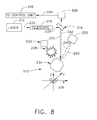
- laser drilling operation/step 105 is represented generally by a laser drilling system, indicated generally as 210, that includes a laser 212, a telescope 216, and a mirror 218.
- System 210 further includes a plurality of optical sensors, indicated as 222 and 226.
- laser 212 directs a laser pulse 232 through telescope 216, where pulse 232 is then reflected by mirror 218 onto part 234.
- the positioning of part 234 may be controlled by a multi-axis computer numerical control (CNC) machine tool 236 and may be automatically positioned prior activation of laser 212.
- sensors 222 and 226 may be used to measure the visible spectrum light emitted in radiation flash 238.
- Sensors 222 and 226 may be any type of radiation sensing device, for example, a simple photodiode, a line filtered or otherwise filtered photodiode, a high gain device such as a photomultiplier tube, filtered, unfiltered or spectrally separated light, etc.
- optical sensor 222 may be positioned to the side of laser pulse 232 to indirectly monitor and gather data from laser pulse 232, as indicated by dashed lines 240.
- optical sensor 226 may be positioned above mirror 218, to directly monitor and gather data, as indicated by dashed arrow 242, from laser pulse 232 that creates radiation flash 238.
- the collected visual data, as indicated by arrow 244, gathered by sensors 222 and 226 may be received by a control unit 246 and may then be converted into a graph, such as the one illustrated in FIGS. 5 and 6.
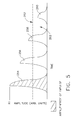
- the graph represented in FIG. 5 shows the optical (e.g., photodiode) response over several laser pulses 232 that may be required to drill a complete hole into and through part 234, with the breakthrough threshold being indicated by broken horizontal line 252.
- initial pulse 254 carries the most energy, with second pulse 256 and third pulse 258 having decreasing energy, and with breakthrough, indicated by 262, occurring prior to fourth pulse 260.
- the fourth pulse 260 is below breakthrough threshold 252.
- FIG. 6 a series of less efficient pulses 360, 362, 364, 366 and 368 are illustrated (the breakthrough threshold being indicated by broken horizontal line 370), with breakthrough, indicated by 372, occurring just prior to the fifth pulse 368.
- the first or initial pulse 360 carries the most energy
- the decrease in energy in second pulse 362 and third pulse 364 does not decrease in the same ratio as second pulse 256 and third pulse 258 of FIG. 5.
- the fourth pulse 366 of FIG. 6 has approximately the same energy as the third pulse 258 of FIG. 5 with breakthrough 372 (FIG. 6) and 262 (FIG. 5) occurring prior to the subsequent pulse fifth pulse 368, and fourth pulse 260, respectively.
- system 210 of FIG. 4 and the sensor responses shown in FIGS. 5 and 6 were primarily used to measure when the response dropped below the threshold level 252 (FIG. 5) and 370 (FIG. 6) so as to indicate a relatively simple laser drilling process parameter such as breakthrough 262 (FIG. 5) and breakthrough 372 (FIG. 6).
- control unit 246 would inhibit further laser 212 firing, for example, by either by shuttering the laser beam of laser 212, or electronically disabling laser 212 from flashing.
- FIG. 7 shows the difference in hole quality between a properly set (in) focus and an improperly set (out of) focus of the laser beam during laser drilling.
- a of FIG. 6 the focus of the laser beam that drilled hole 480 is properly set onto the part 234, resulting in a relatively clean hole with little or no debris attached around hole entrance 482 or exit 484 and producing a graph similar to that of FIG. 5.
- B and C of FIG. 6 an improperly set focus of laser beam 232 onto part 234 results in hole 490 showing around both the entrance 492 and exit 494 a substantial amount of debris, indicated by 496.
- the amplitude and energy within the initial pulse 254 are directly proportional to the focus location.
- a properly set focus position may result in some nominal amplitude and total energy in the initial pulse 254 response.
- a focus set or positioned too far into part 234 may result in initial pulse 254 containing most of the energy, but second pulse 256, third pulse 258 and fourth pulse 260 may have increased energy, and above the optimal settings of FIG. 5, due to more material being removed during drilling.
- a focus set or positioned too far out from part 234 may result in the signals decreasing due to less material being removed.
- control unit 246 When an improper focus is recognized by control unit 246, based upon the amplitude and energy of the first pulse, the focus may be properly repositioned for subsequent holes.
- the focus may be adjusted several ways, including moving mirror 218 relative to the surface of part 234, moving part 234 or changing the settings of an optical system such as adjustable telescope 216 back upstream from the final focus lens. These changes may be done automatically, for example, by CNC machine 236, or manually, depending upon the configuration of system 210.
- the efficiency of laser system 210 in drilling a given hole may also be determined by the peaks and areas of initial pulse 254 and second pulse 256 or the entire series of pulses. For example, if breakthrough nominally occurs at the fourth pulse 260 response (see FIG. 5), then when a fourth pulse 366 (see FIG. 6) exceeds the breakthrough threshold 370, requiring a fifth pulse to achieve breakthrough 372, the process may have become less efficient. Using the graph of FIG. 5, system 210 may be used to recognize and correct processing efficiency by adjusting the parameters of laser 212, such as energy, to achieve more optimal processing conditions in drilling the hole(s).
- control unit 246 for example, increasing the amount of power supplied to laser 212. This increase in power may be accomplished without changing the number of pulses or pulse duration as an increase in pulse duration may risk damage to part 234 outside desired or allowable ranges.
- control unit 246 may provide predictive data for subsequent laser drilling operations. For example, numerical transfer functions based on amplitudes, areas, changes in amplitudes and areas, etc., may be established and correlated to the resulting hole quality characteristics desired.
- system 510 may be provided with parallel optical sensors, indicated as 522 and 526. Besides parallel optical sensors 522 and 526, system 510 may incorporate different sensing capability to measure other characteristics of the laser drilling process to augment the data received and processed.
- a system 510 may include acoustical sensing capability in the form of an acoustical sensor 532 (e.g., microphone) to provide a monitoring redundancy in addition to that provided by optical sensors 522 and 526 in monitoring radiation flash 238. Acoustical sensor 532 may be placed, as shown in FIG.
- Acoustical sensor 532 may also be placed a suitable distance from part 234 to protect microphone 532 from splatter and debris created by the laser drilling.
- the acoustical response from microphone 532 may serve as a redundant but independent measurement to optical sensors 522 and 526, thus minimizing or eliminating false positive or false negative responses/analyses.
- the two forms of sensors/sensing techniques i.e., optical and acoustical
- each form of sensor or sensing technique may extend one end of the response range limits to enhance the usefulness of control system 246.
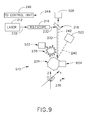
- FIG. 9 Another embodiment of the system of this invention is illustrated in FIG. 9 wherein system 610 (where components the same as those of system 210 of FIG. 4 and system 510 of FIG. 8 are identified with the same numbers).
- system 610 may have the same laser 212, as well as the same optical sensors 522/526 and acoustical sensor 532 of the embodiments illustrated in FIGS. 4 and 8, but may also be provided with a second acoustical sensor, indicated as 654, attached to part 234.
- second acoustical sensor 654 such as a second microphone, may directly measure the frequency spectrum response of part 234 during the drilling process.
- the signature of part 234 as each hole is drilled may also change as a result of the additional sensing capability provided by system 610.
- the individual response and/or the accumulated responses of system 610 may also provide another indicator of the quality of part 234.
- the responses provided by system 610 may also be correlated to individual hole quality and overall airflow quality of part 234.
- systems 210, 510 and 610 illustrate various forms and combinations of optical sensors (e.g., photodiodes) and acoustical sensors (e.g., microphones) that may be used
- other combinations of optical sensors and acoustical sensors may also be used, including single acoustical sensors with a plurality of (e.g., dual) optical sensors; a plurality of acoustical sensors with a plurality of optical sensors; a plurality of acoustical sensors with a single optical sensor, etc.
- These optical/acoustical sensors may also be combined with other forms of sensors, for example a vibrational sensor, etc., to provide other types of monitoring systems.
- control unit 246 may, over several drilling operation cycles (e.g., several parts, shifts, days, etc.) determine whether laser 212 or other equipment maintenance is required prior to continuing with the drilling operation. Examples of maintenance issues that may be determined by control unit 246 may include adjustments of the cover slide, lens or mirrors that transmit and focus the laser beam from laser 212 onto part 234, etc.
- control unit 246 may receive the information or data from control unit 246 in parallel with the one or more of the sensors (e.g., acoustical sensors 532 and 654 and optical sensors 222/522 and 226/526), as well as the internal diagnostics common to most industrial laser systems (resonator optics, power supplies, water sources, etc.) may be used to resolve external efficiency loss versus internal efficiency loss.
- the sensors e.g., acoustical sensors 532 and 654 and optical sensors 222/522 and 226/526
- the internal diagnostics common to most industrial laser systems resonator optics, power supplies, water sources, etc.
- Control unit 246, may, up to a certain point, automatically increase or decrease the above parameters before any maintenance intervention is required.
- control unit 246 may be achieved through the use of a plurality (e.g., multiple) of optical sensors.
- the additional sensors may sense the same or different wavelengths (frequencies) between vacuum ultraviolet, visible, infrared, microwave and x-rays.
- Additional optical sensors e.g., photodiodes
- acoustical sensors e.g., 532 and 654
- optical sensors e.g., 222/522 and 226/526
- the additional optical sensors may be used to override or compensate for a faulty measurement from a corresponding sensor (e.g., acoustical sensors 532 and 654 and/or optical sensors 222/522 and 226/526) due to electrical noise or other aberrations in a given response or series of responses.
- Optical fibers may also be used to deliver data back to an optical sensor (e.g., a photodetector(s)), thereby enabling, for example, the monitoring of the backside of a laser drilled airfoil shroud.
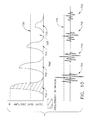
- FIG. 10 illustrates potential acoustical pulse readouts that may be received from acoustical sensors 532 and 654 that are graphically presented below corresponding nominal optical pulse readouts received from optical sensors 222/522 and 226/526.
- optical first pulse 702 and acoustical first pulse 704 both may contain the greatest level of energy which decreases with optical second pulse 708 and acoustical second pulse 710 decreasing and optical third pulse 714 and acoustical third pulse 716.
- breakthrough 728 occurs prior to the fourth optical pulse 720 and fourth acoustical pulse 722, neither of which approach the breakthrough threshold, indicated by broken horizontal line 730.
- the responses from the acoustical and/or optical sensors may be used to detect metal to wax (e.g., filler materials for over drill protection) transitions, and vice versa, as, for example, changes in the emission signature and/or signal of the sound, light, x-rays, etc., sensed or detected.
- the wax or filler material may be doped with a material having a distinctive spectral emission that may be detected with a narrow spectral filter, etc.
- the temporal response may also be monitored and may produce a similar graph to that illustrated in FIG. 5.
- the x-axis duration of each pulse versus the y-axis amplitudes shown in Fig 5 may be used.
- the initial metal spectral information received by control unit 246 may be identical to that of a waxed part, but because less material may be vaporized/melted the interaction time may be shorter.
- the interaction time change during the drilling of holes may also be monitored to provide similar advantages to the monitoring of power responses.
- Systems 210/510/610 may provide further benefits in the control of thermal barrier coating (TBC) drilling.
- TBC thermal barrier coating
- a parameter favorable to drilling TBC/ceramics/non-metallics may be entered into control unit 246.
- systems 210/510/610 may detect a different line response from the returned data.
- laser 212 may then be switched to metal drilling parameters, may just drill all of the coating starter cavities and then come back and drill the already started holes into the metal, etc.
- Systems 210/510/610 may further provide the ability to warn the operator if the energy levels drift or change in during the drilling process.
- the energy levels may be set at control unit 246 at a predetermined nominal level.
- control unit 246 may detect variations from this predetermined level and, if applicable, may make any adjustments to laser 212 automatically. For example, if one of the lamps is not flashing, there may be a dramatic loss of energy, leading to a lower reference value in the breakthrough detection data.
- systems 210/510/610 is not automated to the extent that system 210/510/610 may make these adjustments, the operator may also be informed and the adjustments may be made manually.
- a tertiary monitoring system 210/510/610 may also pressurize blades 10 with air or another gaseous fluid to improve the expulsion of debris, particularly when drilling without wax. This may enable the use of real time airflow during drilling to monitor progress, in addition to the previously mentioned sensors. In systems 210/510/610 where the sensors and/or sensing techniques may detect small incremental changes, a simple pressure drop may be detected, signaling, for example, a breakthrough.
Landscapes
- Physics & Mathematics (AREA)
- Optics & Photonics (AREA)
- Engineering & Computer Science (AREA)
- Plasma & Fusion (AREA)
- Mechanical Engineering (AREA)
- Laser Beam Processing (AREA)
- Numerical Control (AREA)
Applications Claiming Priority (1)
| Application Number | Priority Date | Filing Date | Title |
|---|---|---|---|
| US36753906A | 2006-03-06 | 2006-03-06 |
Publications (2)
| Publication Number | Publication Date |
|---|---|
| EP1832376A2 true EP1832376A2 (fr) | 2007-09-12 |
| EP1832376A3 EP1832376A3 (fr) | 2010-04-28 |
Family
ID=38123813
Family Applications (1)
| Application Number | Title | Priority Date | Filing Date |
|---|---|---|---|
| EP07103534A Withdrawn EP1832376A3 (fr) | 2006-03-06 | 2007-03-05 | Système et procédé de surveillance des paramètres de procédé de forage et de contrôle de forage |
Country Status (5)
| Country | Link |
|---|---|
| EP (1) | EP1832376A3 (fr) |
| JP (1) | JP2007237295A (fr) |
| BR (1) | BRPI0700870A (fr) |
| CA (1) | CA2580102A1 (fr) |
| SG (2) | SG135168A1 (fr) |
Cited By (7)
| Publication number | Priority date | Publication date | Assignee | Title |
|---|---|---|---|---|
| US8710392B2 (en) | 2011-06-29 | 2014-04-29 | United Technologies Corporation | Electric discharge machining hole drilling |
| US9676058B2 (en) | 2014-01-27 | 2017-06-13 | General Electric Company | Method and system for detecting drilling progress in laser drilling |
| WO2021064255A1 (fr) * | 2019-10-03 | 2021-04-08 | Orvinum Ag | Appareil pour créer un trou dans un récipient en verre |
| DE102020127575A1 (de) | 2020-10-20 | 2022-04-21 | Trumpf Laser Gmbh | Laserbearbeitungsmaschine mit wenigstens einer Schutzeinrichtung gegen Röntgenabschattung |
| DE102018200033B4 (de) | 2018-01-03 | 2024-03-21 | Trumpf Laser- Und Systemtechnik Gmbh | Laserbearbeitungskopf und -maschine mit einem Röntgensensor sowie Verfahren zum röntgensicheren Betrieb der Laserbearbeitungsmaschine |
| EP4527539A1 (fr) * | 2023-09-21 | 2025-03-26 | General Electric Technology GmbH | Système et procédé de détection de percée de forage de trou laser |
| DE102023211852A1 (de) | 2023-11-28 | 2025-05-28 | Robert Bosch Gesellschaft mit beschränkter Haftung | Bearbeitungsvorrichtung, mit zumindest einer Bearbeitungseinheit, insbesondere Laserbohreinheit |
Families Citing this family (8)
| Publication number | Priority date | Publication date | Assignee | Title |
|---|---|---|---|---|
| GB2467296B (en) * | 2009-01-22 | 2012-06-20 | Cav Advanced Technologies Ltd | Apparatus and method for perforating material |
| EP2768627A4 (fr) * | 2011-10-21 | 2016-01-13 | American Laser Entpr Llc | Système configuré pour éliminer un revêtement d'un substrat à l'aide d'un rayonnement électromagnétique |
| US20140263211A1 (en) * | 2013-03-15 | 2014-09-18 | Apple Inc. | Methods for Trimming Display Polarizers Using Lasers |
| US9662743B2 (en) * | 2014-01-27 | 2017-05-30 | General Electric Company | Method for drilling a hole in an airfoil |
| US9468991B2 (en) * | 2014-01-27 | 2016-10-18 | General Electric Company | Method determining hole completion |
| US11292081B2 (en) * | 2015-01-08 | 2022-04-05 | General Electric Company | Method and system for confined laser drilling |
| US10589385B2 (en) * | 2015-01-08 | 2020-03-17 | General Electric Company | Method and system for confined laser drilling |
| US20160199943A1 (en) * | 2015-01-08 | 2016-07-14 | General Electric Company | Method and system for confined laser drilling |
Family Cites Families (19)
| Publication number | Priority date | Publication date | Assignee | Title |
|---|---|---|---|---|
| US4504727A (en) * | 1982-12-30 | 1985-03-12 | International Business Machines Corporation | Laser drilling system utilizing photoacoustic feedback |
| JPS619986A (ja) * | 1984-06-27 | 1986-01-17 | Matsushita Electric Ind Co Ltd | レ−ザ加工モニタ装置 |
| JPS61296980A (ja) * | 1985-06-25 | 1986-12-27 | Toshiba Corp | 加工検査方法 |
| US5026964A (en) * | 1986-02-28 | 1991-06-25 | General Electric Company | Optical breakthrough sensor for laser drill |
| US4789770A (en) * | 1987-07-15 | 1988-12-06 | Westinghouse Electric Corp. | Controlled depth laser drilling system |
| US4960970A (en) * | 1989-08-11 | 1990-10-02 | General Electric Company | Method and apparatus for acoustic breakthrough detection |
| US5045669A (en) * | 1990-03-02 | 1991-09-03 | General Electric Company | Method and apparatus for optically/acoustically monitoring laser materials processing |
| DE4012927C2 (de) * | 1990-04-24 | 1995-10-12 | Daimler Benz Aerospace Ag | Meß-Verfahren und -Vorrichtung zur dreidimensionalen Lageregelung des Brennpunktes eines Hochenergie-Laserstrahls |
| GB2246733A (en) * | 1990-08-09 | 1992-02-12 | Cmb Foodcan Plc | Apparatus and method for monitoring laser material processing |
| US5059761A (en) * | 1990-12-21 | 1991-10-22 | General Electric Company | Inductive depth sensing and controlling method and system for laser drilling |
| US5169287A (en) * | 1991-05-20 | 1992-12-08 | General Electric Company | Shroud cooling assembly for gas turbine engine |
| JPH06182572A (ja) * | 1992-12-17 | 1994-07-05 | Komatsu Ltd | レーザ加工機におけるピアス孔加工条件補正装置 |
| US5609779A (en) * | 1996-05-15 | 1997-03-11 | General Electric Company | Laser drilling of non-circular apertures |
| US6332926B1 (en) * | 1999-08-11 | 2001-12-25 | General Electric Company | Apparatus and method for selectively coating internal and external surfaces of an airfoil |
| US6339208B1 (en) * | 2000-01-19 | 2002-01-15 | General Electric Company | Method of forming cooling holes |
| US6354795B1 (en) * | 2000-07-27 | 2002-03-12 | General Electric Company | Shroud cooling segment and assembly |
| JP2002328017A (ja) * | 2001-05-01 | 2002-11-15 | Canon Inc | 加工深さモニタ方法 |
| JP4174267B2 (ja) * | 2002-08-21 | 2008-10-29 | 日立ビアメカニクス株式会社 | レーザ加工方法 |
| DE102005027363A1 (de) * | 2005-06-14 | 2006-12-21 | Robert Bosch Gmbh | Vorrichtung und Verfahren zur Überwachung eines Fertigungsverfahrens zur Herstellung einer Durchgangsbohrung |
-
2007
- 2007-03-01 CA CA002580102A patent/CA2580102A1/fr not_active Abandoned
- 2007-03-02 SG SG200701545-6A patent/SG135168A1/en unknown
- 2007-03-02 SG SG200905465-1A patent/SG155224A1/en unknown
- 2007-03-05 EP EP07103534A patent/EP1832376A3/fr not_active Withdrawn
- 2007-03-05 BR BRPI0700870-8A patent/BRPI0700870A/pt not_active IP Right Cessation
- 2007-03-05 JP JP2007053627A patent/JP2007237295A/ja active Pending
Cited By (8)
| Publication number | Priority date | Publication date | Assignee | Title |
|---|---|---|---|---|
| US8710392B2 (en) | 2011-06-29 | 2014-04-29 | United Technologies Corporation | Electric discharge machining hole drilling |
| US9676058B2 (en) | 2014-01-27 | 2017-06-13 | General Electric Company | Method and system for detecting drilling progress in laser drilling |
| DE102018200033B4 (de) | 2018-01-03 | 2024-03-21 | Trumpf Laser- Und Systemtechnik Gmbh | Laserbearbeitungskopf und -maschine mit einem Röntgensensor sowie Verfahren zum röntgensicheren Betrieb der Laserbearbeitungsmaschine |
| WO2021064255A1 (fr) * | 2019-10-03 | 2021-04-08 | Orvinum Ag | Appareil pour créer un trou dans un récipient en verre |
| US12383983B2 (en) | 2019-10-03 | 2025-08-12 | Orvinum Ag | Apparatus for creating a hole in a glass container |
| DE102020127575A1 (de) | 2020-10-20 | 2022-04-21 | Trumpf Laser Gmbh | Laserbearbeitungsmaschine mit wenigstens einer Schutzeinrichtung gegen Röntgenabschattung |
| EP4527539A1 (fr) * | 2023-09-21 | 2025-03-26 | General Electric Technology GmbH | Système et procédé de détection de percée de forage de trou laser |
| DE102023211852A1 (de) | 2023-11-28 | 2025-05-28 | Robert Bosch Gesellschaft mit beschränkter Haftung | Bearbeitungsvorrichtung, mit zumindest einer Bearbeitungseinheit, insbesondere Laserbohreinheit |
Also Published As
| Publication number | Publication date |
|---|---|
| BRPI0700870A (pt) | 2007-11-13 |
| EP1832376A3 (fr) | 2010-04-28 |
| JP2007237295A (ja) | 2007-09-20 |
| SG155224A1 (en) | 2009-09-30 |
| SG135168A1 (en) | 2007-09-28 |
| CA2580102A1 (fr) | 2007-09-06 |
Similar Documents
| Publication | Publication Date | Title |
|---|---|---|
| CA2580102A1 (fr) | Systeme et methode permettant de controler les parametres de forage et de commander le forage | |
| EP1510283B1 (fr) | Usinage adaptatif automatisé de passages obstrués | |
| CA2462846C (fr) | Procede de retrait d'un materiau de revetement d'un orifice de refroidissement d'un composant de turbine a gaz | |
| EP2467230B1 (fr) | Système et procédé automatisé de réparation | |
| US6075593A (en) | Method for monitoring and controlling laser shock peening using temporal light spectrum analysis | |
| EP1118419B1 (fr) | Methode de perçage de perforations de ventilation | |
| US6333488B1 (en) | Method for setting up and controlling confinement media flow in laser shock peening | |
| EP1349695B1 (fr) | Usinage laser de trous de refroidissement dans des composants de turbine a gaz | |
| EP1419847A1 (fr) | Perçage au laser de trous profilés | |
| EP2855033B1 (fr) | Revêtement pour des trous d'air de refroidissement | |
| JP6641086B2 (ja) | レーザドリルの貫通を判定する方法 | |
| EP3059044B1 (fr) | Réparation de composants à l'aide de forage laser confiné | |
| RU2395070C2 (ru) | Способ определения механических характеристик металлического материала | |
| EP1525941A1 (fr) | Méthode d'usinage laser d'un article avec un revêtement protecteur | |
| US6281473B1 (en) | Apparatus and method for controlling confinement media thickness in laser shock peening | |
| EP4552791A1 (fr) | Procédé de réparation d'une aube ayant des passages de refroidissement d'extrémité | |
| EP4520470A1 (fr) | Usinage avec surveillance en temps réel de l'interaction entre un faisceau laser et une pièce à usiner | |
| CN112292512A (zh) | 用于对发动机执行操作的系统和方法 | |
| Gonumakulapalle Lodi et al. | Experimental Investigation on the Annular Drilling of Acute Angle Micro-Holes in Nickel Based Superalloy With Femtosecond Laser | |
| Keevil | Geometric quality aspects of Nd: YAG laser drilled holes in high carbon steel |
Legal Events
| Date | Code | Title | Description |
|---|---|---|---|
| PUAI | Public reference made under article 153(3) epc to a published international application that has entered the european phase |
Free format text: ORIGINAL CODE: 0009012 |
|
| AK | Designated contracting states |
Kind code of ref document: A2 Designated state(s): AT BE BG CH CY CZ DE DK EE ES FI FR GB GR HU IE IS IT LI LT LU LV MC MT NL PL PT RO SE SI SK TR |
|
| AX | Request for extension of the european patent |
Extension state: AL BA HR MK YU |
|
| PUAL | Search report despatched |
Free format text: ORIGINAL CODE: 0009013 |
|
| AK | Designated contracting states |
Kind code of ref document: A3 Designated state(s): AT BE BG CH CY CZ DE DK EE ES FI FR GB GR HU IE IS IT LI LT LU LV MC MT NL PL PT RO SE SI SK TR |
|
| AX | Request for extension of the european patent |
Extension state: AL BA HR MK RS |
|
| RIC1 | Information provided on ipc code assigned before grant |
Ipc: B23K 26/04 20060101ALI20100325BHEP Ipc: B23K 26/38 20060101ALI20100325BHEP Ipc: B23K 26/03 20060101AFI20070626BHEP |
|
| AKY | No designation fees paid | ||
| REG | Reference to a national code |
Ref country code: DE Ref legal event code: 8566 |
|
| STAA | Information on the status of an ep patent application or granted ep patent |
Free format text: STATUS: THE APPLICATION IS DEEMED TO BE WITHDRAWN |
|
| 18D | Application deemed to be withdrawn |
Effective date: 20101029 |