EP1832415B1 - Kunststoffverbund - Google Patents
Kunststoffverbund Download PDFInfo
- Publication number
- EP1832415B1 EP1832415B1 EP07103719A EP07103719A EP1832415B1 EP 1832415 B1 EP1832415 B1 EP 1832415B1 EP 07103719 A EP07103719 A EP 07103719A EP 07103719 A EP07103719 A EP 07103719A EP 1832415 B1 EP1832415 B1 EP 1832415B1
- Authority
- EP
- European Patent Office
- Prior art keywords
- plastic
- layer
- transparent
- layers
- composite according
- Prior art date
- Legal status (The legal status is an assumption and is not a legal conclusion. Google has not performed a legal analysis and makes no representation as to the accuracy of the status listed.)
- Not-in-force
Links
Images
Classifications
-
- B—PERFORMING OPERATIONS; TRANSPORTING
- B32—LAYERED PRODUCTS
- B32B—LAYERED PRODUCTS, i.e. PRODUCTS BUILT-UP OF STRATA OF FLAT OR NON-FLAT, e.g. CELLULAR OR HONEYCOMB, FORM
- B32B33/00—Layered products characterised by particular properties or particular surface features, e.g. particular surface coatings; Layered products designed for particular purposes not covered by another single class
-
- B—PERFORMING OPERATIONS; TRANSPORTING
- B32—LAYERED PRODUCTS
- B32B—LAYERED PRODUCTS, i.e. PRODUCTS BUILT-UP OF STRATA OF FLAT OR NON-FLAT, e.g. CELLULAR OR HONEYCOMB, FORM
- B32B27/00—Layered products comprising a layer of synthetic resin
- B32B27/06—Layered products comprising a layer of synthetic resin as the main or only constituent of a layer, which is next to another layer of the same or of a different material
- B32B27/08—Layered products comprising a layer of synthetic resin as the main or only constituent of a layer, which is next to another layer of the same or of a different material of synthetic resin
-
- B—PERFORMING OPERATIONS; TRANSPORTING
- B32—LAYERED PRODUCTS
- B32B—LAYERED PRODUCTS, i.e. PRODUCTS BUILT-UP OF STRATA OF FLAT OR NON-FLAT, e.g. CELLULAR OR HONEYCOMB, FORM
- B32B27/00—Layered products comprising a layer of synthetic resin
- B32B27/18—Layered products comprising a layer of synthetic resin characterised by the use of special additives
-
- B—PERFORMING OPERATIONS; TRANSPORTING
- B32—LAYERED PRODUCTS
- B32B—LAYERED PRODUCTS, i.e. PRODUCTS BUILT-UP OF STRATA OF FLAT OR NON-FLAT, e.g. CELLULAR OR HONEYCOMB, FORM
- B32B27/00—Layered products comprising a layer of synthetic resin
- B32B27/30—Layered products comprising a layer of synthetic resin comprising vinyl (co)polymers; comprising acrylic (co)polymers
- B32B27/302—Layered products comprising a layer of synthetic resin comprising vinyl (co)polymers; comprising acrylic (co)polymers comprising aromatic vinyl (co)polymers, e.g. styrenic (co)polymers
-
- B—PERFORMING OPERATIONS; TRANSPORTING
- B32—LAYERED PRODUCTS
- B32B—LAYERED PRODUCTS, i.e. PRODUCTS BUILT-UP OF STRATA OF FLAT OR NON-FLAT, e.g. CELLULAR OR HONEYCOMB, FORM
- B32B27/00—Layered products comprising a layer of synthetic resin
- B32B27/30—Layered products comprising a layer of synthetic resin comprising vinyl (co)polymers; comprising acrylic (co)polymers
- B32B27/308—Layered products comprising a layer of synthetic resin comprising vinyl (co)polymers; comprising acrylic (co)polymers comprising acrylic (co)polymers
-
- B—PERFORMING OPERATIONS; TRANSPORTING
- B32—LAYERED PRODUCTS
- B32B—LAYERED PRODUCTS, i.e. PRODUCTS BUILT-UP OF STRATA OF FLAT OR NON-FLAT, e.g. CELLULAR OR HONEYCOMB, FORM
- B32B2250/00—Layers arrangement
- B32B2250/24—All layers being polymeric
-
- B—PERFORMING OPERATIONS; TRANSPORTING
- B32—LAYERED PRODUCTS
- B32B—LAYERED PRODUCTS, i.e. PRODUCTS BUILT-UP OF STRATA OF FLAT OR NON-FLAT, e.g. CELLULAR OR HONEYCOMB, FORM
- B32B2255/00—Coating on the layer surface
- B32B2255/10—Coating on the layer surface on synthetic resin layer or on natural or synthetic rubber layer
-
- B—PERFORMING OPERATIONS; TRANSPORTING
- B32—LAYERED PRODUCTS
- B32B—LAYERED PRODUCTS, i.e. PRODUCTS BUILT-UP OF STRATA OF FLAT OR NON-FLAT, e.g. CELLULAR OR HONEYCOMB, FORM
- B32B2255/00—Coating on the layer surface
- B32B2255/26—Polymeric coating
-
- B—PERFORMING OPERATIONS; TRANSPORTING
- B32—LAYERED PRODUCTS
- B32B—LAYERED PRODUCTS, i.e. PRODUCTS BUILT-UP OF STRATA OF FLAT OR NON-FLAT, e.g. CELLULAR OR HONEYCOMB, FORM
- B32B2307/00—Properties of the layers or laminate
- B32B2307/40—Properties of the layers or laminate having particular optical properties
-
- B—PERFORMING OPERATIONS; TRANSPORTING
- B32—LAYERED PRODUCTS
- B32B—LAYERED PRODUCTS, i.e. PRODUCTS BUILT-UP OF STRATA OF FLAT OR NON-FLAT, e.g. CELLULAR OR HONEYCOMB, FORM
- B32B2307/00—Properties of the layers or laminate
- B32B2307/40—Properties of the layers or laminate having particular optical properties
- B32B2307/402—Coloured
- B32B2307/4026—Coloured within the layer by addition of a colorant, e.g. pigments, dyes
-
- B—PERFORMING OPERATIONS; TRANSPORTING
- B32—LAYERED PRODUCTS
- B32B—LAYERED PRODUCTS, i.e. PRODUCTS BUILT-UP OF STRATA OF FLAT OR NON-FLAT, e.g. CELLULAR OR HONEYCOMB, FORM
- B32B2307/00—Properties of the layers or laminate
- B32B2307/40—Properties of the layers or laminate having particular optical properties
- B32B2307/412—Transparent
-
- B—PERFORMING OPERATIONS; TRANSPORTING
- B32—LAYERED PRODUCTS
- B32B—LAYERED PRODUCTS, i.e. PRODUCTS BUILT-UP OF STRATA OF FLAT OR NON-FLAT, e.g. CELLULAR OR HONEYCOMB, FORM
- B32B2307/00—Properties of the layers or laminate
- B32B2307/40—Properties of the layers or laminate having particular optical properties
- B32B2307/416—Reflective
-
- B—PERFORMING OPERATIONS; TRANSPORTING
- B32—LAYERED PRODUCTS
- B32B—LAYERED PRODUCTS, i.e. PRODUCTS BUILT-UP OF STRATA OF FLAT OR NON-FLAT, e.g. CELLULAR OR HONEYCOMB, FORM
- B32B2307/00—Properties of the layers or laminate
- B32B2307/40—Properties of the layers or laminate having particular optical properties
- B32B2307/422—Luminescent, fluorescent, phosphorescent
-
- B—PERFORMING OPERATIONS; TRANSPORTING
- B32—LAYERED PRODUCTS
- B32B—LAYERED PRODUCTS, i.e. PRODUCTS BUILT-UP OF STRATA OF FLAT OR NON-FLAT, e.g. CELLULAR OR HONEYCOMB, FORM
- B32B2479/00—Furniture
-
- B—PERFORMING OPERATIONS; TRANSPORTING
- B32—LAYERED PRODUCTS
- B32B—LAYERED PRODUCTS, i.e. PRODUCTS BUILT-UP OF STRATA OF FLAT OR NON-FLAT, e.g. CELLULAR OR HONEYCOMB, FORM
- B32B37/00—Methods or apparatus for laminating, e.g. by curing or by ultrasonic bonding
- B32B37/0007—Methods or apparatus for laminating, e.g. by curing or by ultrasonic bonding involving treatment or provisions in order to avoid deformation or air inclusion, e.g. to improve surface quality
- B32B37/003—Methods or apparatus for laminating, e.g. by curing or by ultrasonic bonding involving treatment or provisions in order to avoid deformation or air inclusion, e.g. to improve surface quality to avoid air inclusion
-
- B—PERFORMING OPERATIONS; TRANSPORTING
- B32—LAYERED PRODUCTS
- B32B—LAYERED PRODUCTS, i.e. PRODUCTS BUILT-UP OF STRATA OF FLAT OR NON-FLAT, e.g. CELLULAR OR HONEYCOMB, FORM
- B32B37/00—Methods or apparatus for laminating, e.g. by curing or by ultrasonic bonding
- B32B37/12—Methods or apparatus for laminating, e.g. by curing or by ultrasonic bonding characterised by using adhesives
Definitions
- the present invention relates to plastic composites consisting of plastic layers, in particular a first plastic layer (A) consisting of a transparent colorless plastic, a second plastic layer (B) consisting of a transparent plastic containing a soluble fluorescent dye and a further third layer (C), selected from a (i) reflective layer (C1), a (ii) plastic layer (C2) consisting of a transparent colorless plastic, or optionally a (iii) lacquer layer (C3), wherein the layers in said order (A), (B) and (C) are connected and the plastic layers (A) and (B) and optionally (C) are fixed to the eye bubble-free to each other by hot bonding substantially.
- a first plastic layer (A) consisting of a transparent colorless plastic
- B consisting of a transparent plastic containing a soluble fluorescent dye
- C further third layer
- C selected from a (i) reflective layer (C1), a (ii) plastic layer (C2) consisting of a transparent colorless plastic, or optional
- fluorescent dyes such as Lumogen F Orange 240, Lumogen F Yellow 083, Lumogen F Red 305 or Hostasol Yellow 3G are used in plastic.
- plastics have a homogeneous fluorescent appearance. All the above-mentioned dyes belong to the type of plastic Plexiglas® Fluorescent from Röhm GmbH & Co. KG, Plexiglas® is a registered trademark.
- JP-A-418346 describes light-scattering multilayer plates with a layer of methyl methacrylate, which contains 1-2 wt.% Crosslinked styrene particles having an average particle size of 1 to 30 microns.
- EP-A-533 301 describes, for example, disc-shaped light distribution body of light-scattering and transparent material, wherein the emission surface and / or the opposite surface over its entire surface or part of an at least partially reflective, the total reflection-interrupting coating, lamination, roughening or structure to improve the active light distribution in the light distribution body.
- Characteristic feature of this device is the introduction of light, which in turn leads to an increase in brilliance.
- the DE-GBM 8913036 includes light guide plates into which light from a light source is coupled via a smooth edge surface, that floats invisibly through the light guide plate and becomes visible in the region of rough ornamental surfaces of the light guide plate due to refraction of light.
- a plastic composite characterized by increased color brilliance, with under defined locations, but without the need for active incorporation of light that is easy to manufacture, economical with fluorescent or others Dyes bypasses and can be easily processed.
- an object of the present invention was to provide a plastic composite which is characterized by definable and high color brilliance.
- the invention relates to a plastic composite, with the following layers, a first plastic layer (A) of a transparent, colorless plastic, which at least 40% visible transmission selected from the group consisting of extruded polymethyl methacrylate plastic, cast polymethyl methacrylate plastic, impact modifier polymethyl methacrylate plastic, polycarbonate plastic, polystyrene plastic, styrene-acrylonitrile plastic, polyethylene terephthalate plastic, glycol-modified polyethylene terephthalate Plastic, polyvinyl chloride plastic, transparent polyolefin plastic, acrylonitrile-butadiene-styrene (ABS) plastic and a mixture (blend) of said plastics, a second plastic layer (B) of a transparent plastic selected from the group comprising extruded polymethylmethacrylate Plastic, cast polymethyl methacrylate plastic, impact-modified polymethyl methacrylate plastic, polycarbonate plastic, polystyrene plastic, styrene-acrylonitrile plastic, poly
- the plastic layers (A) and (B), substantially free of bubbles for the eye are firmly bonded together by bonding.
- the plastic composite Due to the layering according to the invention in the region of the layer (B), the plastic composite has a particular color intensity or color brilliance.
- the layer (B) shines in a manner that gives the viewer the impression that light has been introduced into the plastic cladding by means of a special lighting device, for example by means of LEDs, or light comes out of the plastic layer. From other points of view, the viewer is given the impression that each of these layers emits light by means of a special lighting device. This is not the case here.
- the light effect to be observed and the color brilliance to be observed are fundamentally dependent on the fact that there is light per se. However, this light need not be introduced directly at a certain point in the molding. Characteristic of the invention is therefore that the layering according to the invention leads to particular color brilliance at certain points, the inventions certain uses, which will be mentioned in more detail below. Even little ambient light is sufficient to achieve the effect mentioned.
- the reflective layer of the further layer (C) is selected from the group consisting of a white color layer, a metallic layer and a mirror layer, photos optionally on paper, paper or other films with the proviso that these corresponding white surfaces and / or have corresponding brightness levels, as already described above, the further third layer (C) be selected from a (i) reflective layer (C1), a (ii) plastic layer (C2) and a (iii) lacquer layer (C3).
- this third layer is preferably selected from the above-mentioned group. Not all materials are suitable as third layer (C). If the third layer is a reflective layer, white is preferred as the color layer. Particularly preferred is pure white. The inventors have found that the color brilliance increases with the purity of the white.
- the plastic layers (A) and (C2) have a greater thickness than the fluorescent layer (B).
- the plastic layers (A) and (C2) have a thickness between 2 mm and 3 cm, wherein the second fluorescent plastic layer (B) has a smaller thickness between 0.2 and 6 mm, preferably 3 mm and 6 mm.
- the ratios of the plastics to one another have an influence on the color brilliance of the middle layer.
- the outermost plastic layers are thicker than the fluorescent middle layer. If the plastic layers are used in the field of architecture, then the dimensions are correspondingly larger by a multiple. That is, preferably, the plastic layers (A) and (C2) have a thickness greater than 2 mm, and the fluorescent plastic layer has a thickness greater than 0.2 mm, more preferably greater than 3 mm.
- the plastic layer (A) is a highly transparent plastic. In a preferred embodiment, this highly transparent plastic has a transmission of more than 80%. Highly transparent plastics, for example, can be used in DE 102 52 006 A1 described. According to one aspect of the present invention, the plastic layer (A) at a layer thickness of 3 mm has a light transmission of greater than or equal to 25%, in particular 40% and particularly preferably greater than or equal to 50%, most preferably greater than or equal to 80%.
- the highly transparent plastic of the plastic layer (A) according to the invention consists of a molding composition which has a fracture stress of greater than or equal to 75 MPa according to ISO 527 (5 mm / min) and thus high rigidity.
- the molding compound of the present plastic layer (A) is preferably processed by thermoplastic molding methods such as injection molding or extrusion.
- the transmission (D65 / 2%) can be determined according to DIN 5036 with a Lambda 19 measuring instrument from Perkin-Elmer.
- the yellowness value D65 / 10% can be determined according to DIN 6167 with a Lambda 19 measuring instrument from Perkin-Elmer.
- the plastic layer (B) consists of a transparent plastic which contains a soluble fluorescent dye. Such plastics are in DE 102 44 706 described. Fluorescent dyes for plastic layer (B) are described in WO 99/16847 ,
- the plastic layer (B) consists for example of polycarbonate, polymethyl methacrylate, polyvinylidine fluoride or mixtures of polymethyl methacrylate and polyvinylidine fluoride.
- the fluorescent dyes are, for example, mixtures of N, N'-disubstituted 3,4: 9,10 perylene (bis) dicarboxymid) and yellow fluorescent dyes with defined color coordinate ranges according to the CIE 1931 standard, colorimetric system and fluorescence luminescence factors larger 5.
- Suitable for the plastics layer (B) are plastics that commercially available fluorescent dyes, for example, Lumogen ® F Orange 240, Lumogen ® F Yellow 083, Lumogen ® F Red include 240th -Lumogen ® are registered trademarks of BASF AG, Ludwigshafen, Germany. Applicable as a fluorescent dye is also Hostasol ® Yellow 3G. Essential for the present invention is a certain transmission property of the plastic layer (B).
- the fluorescent dyes are preferably not in combination with other colorants, since this is the transmission properties could adversely affect. Other colorants may occur, provided that they do not adversely affect the transmission properties. Other colorants are in DE 102 44 706 on page 2 mentioned in the last paragraph.
- Particularly preferred plastic layers (B) are those which the company Röhm GmbH & Co. KG sells under the brand name "Plexiglas®". In particular, those sold under the name "Plexiglas® Fluorescent".
- the third layer (C) may be a lacquer layer (C3).
- the lacquer layer according to the invention has a certain transparency.
- the lacquer layer makes it possible to apply structural features to the third layer (C).
- the lacquer layer (C3) makes possible a facilitated partial coating of the second plastic layer (B).
- a lacquer layer may be, for example, an acrylic lacquer layer, a synthetic resin lacquer layer, a H 2 O-soluble lacquer layer or a lacquer layer consisting of a transparent adhesive.
- a transparent adhesive may be, for example, the adhesive available under the trade name "UHU".
- the synthetic resin paint is preferred.
- the layer can be applied in parts to the plastic layer (B) or as a whole cover the plastic layer (B).
- the lacquer layer (C3) can be patterned on the plastic layer (B) or without a recurring pattern. It is particularly preferred if this lacquer layer is applied in the spraying process, so that the "waste" of the spraying process (the "blasted") triggers the diffuse light effect.
- the plastic layer (C) is a reflective layer (C2).
- this reflective layer (C2) is a white color layer and the white pigment level is high.
- This white pigment fraction can be brought about by means of TiO 2 , ZnO, ZnS or barium sulfate.
- Preferred white colors are acrylic paint, synthetic resin paint, water-soluble paint such as emulsion paint, water color, chalk, tempera, even mixed color such as egg / oil / turpentine / pigment or Newton's oil paint or similar such as zinc white (ZnO)].
- the plastic layer (B) has a different refractive index than the other surface at at least one point on the border to the plastic layer (C). This can be done by roughening or scratching the plastic layer (B) at the boundary to the layer (C).
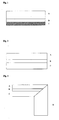
- FIG. 1, FIG. 2 and FIG. 3 Inventive embodiments of the plastic composite are in FIG. 1, FIG. 2 and FIG. 3 shown.
- the layer (C) is a reflective layer (C1) or a lacquer layer (C3).
- the color brilliance according to the invention is shown to the viewer in different ways. If the observer only looks at the plastic layer (A), ie from a viewing angle which optically makes the plastic layer (B) and the third layer (C) light-accessible, the layer (A) appears in the color in which the layer the fluorescent layer (B) is designed.
- the present invention also encompasses embodiments in which the plastic layer A is composed, for example, of a plurality of identical plastic layers or bonded together. Also conceivable would be an arbitrary repetition of the layers, for example layer sequence ABABA.
- the plastic layers are glued together.
- Suitable adhesives are known to the person skilled in the art.
- the bonding should essentially be bubble-free for the eye. This can be achieved by methods known to those skilled in the art.
- Suitable adhesives and methods for bonding plastic layers are, for example, from the published patent application DE 102 33 684 known. The most preferred are adhesives that, after processing, are highly transparent and bubble-free, joining the plastic layers together without being visible to the user.
- suitable plastics are named in the aforementioned patent application. Most preferably, the plastics are polyacrylates, commercially available under the trade name ® Plexiglass from Röhm GmbH. The Kunststoffplaiten, whose properties and embodiments are described in DE 102 33 684 ,
- the plastic layers can also be pressed against each other unglued and are then held by the framing.
- FIG. 1 shows an embodiment of the invention, in which the third layer (C) over the entire surface of the layer (B) is configured.
- the third layer lies only partially behind or on the layer (B). It is preferred that the third layer (C) is present over the entire surface of the layer (B),
- FIG. 2 shows an embodiment in which the third layer (C) is a plastic layer (C2).
- This plastic layer (C2) is a transparent colorless plastic layer which has at least 40% transmission in the visible range. It is particularly preferred if this transmission has more than 80%.
- the FIG. 3 shows an embodiment as it may for example be used for designer furniture or other three-dimensional objects.
- the inventive plastic composite is connected via fermentation with a plastic (D), which is equally highly transparent.
- the brilliant plastic composite assembly according to the invention can be connected to a completely transparent part so that the viewer has the impression that in parts the color brilliance is found in the plastic part (D) again.
- (D) may be a colorless transparent part or a colored plastic part.
- the plastic composite according to the invention is used for vehicle bodies, designer furniture, signs or parts thereof, lighting technology, illuminated advertising systems, conservatories, aquariums, furniture and accessories, shower cubicles, picture glazing and architecture. Preference is given to the use of the plastic composite according to the invention for furniture.
- FIG. 3 shows an embodiment in which the plastic composite according to the invention has been glued, another material (D), in this further material may be to another plastic or another transparent material.
- this further material is the same plastic as that of the layer (A).
Landscapes
- Laminated Bodies (AREA)
- Compositions Of Macromolecular Compounds (AREA)
Description
- Die vorliegende Erfindung betrifft Kunststoffverbünde bestehend aus Kunststoffschichten, insbesondere einer ersten Kunststoffschicht (A) bestehend aus einem transparenten farblosen Kunststoff, einer zweiten Kunststoffschicht (B) bestehend aus einem transparenten Kunststoff enthaltend einen löslichen Fluoreszenzfarbstoff und einer weiteren dritten Schicht (C), ausgewählt aus einer (i) reflektierenden Schicht (C1), einer (ii) Kunststoffschicht (C2) bestehend aus einem transparenten farblosen Kunststoff, oder optional einer (iii) Lackschicht (C3), wobei die Schichten in der genannten Reihenfolge (A), (B) und (C) verbunden sind und die Kunststoffschichten (A) und (B) sowie optional (C) im wesentlichen für das Auge blasenfrei miteinander durch Heißverklebung fest verbunden sind.
- Für verschiedene Zwecke, beispielsweise zur Herstellung von Beleuchtungskörpern, Möbeln, Designermöbeln, insbesondere für Wolmungsgegenstände aller Art werden Kunststoffe mit hoher Farbbrillanz verwendet.
- So beschreibt
DE 102 44 706 A1 Formkörper aus einer Kunststoff-Matrix aus einem transparenten Kunststoff, enthaltend einen löslichen Fluoreszenzfarbstoff und einem Streumittel mit einem Brechungsindex von +/- 0,003 bis 0,2 zur Kunststoffmatrix, dadurch gekennzeichnet, dass zusätzlich bestimmte Weißpigmente zugegeben sind. Hier liegt die Aufgabe zugrunde, die Farbbrillanz zu steigern beziehungsweise bestimmte Farbeffekte zu erzielen. - Bekannt ist weiterhin die Verwendung von fluoreszenten Farbstoffen in Kunststoffen. So werden in Kunststoff fluoreszente Farbstoffe wie Lumogen F Orange 240, Lumogen F Gelb 083, Lumogen F Rot 305 oder Hostasol Gelb 3G verwendet. Derlei Kunststoffe haben ein homogenfluoreszierendes Erscheinungsbild. Alle vorgenannten Farbstoffe gehören zu der Kunststoffsorte Plexiglas ® Fluorescent der Firma Röhm GmbH & Co. KG, Plexiglas ® ist eine eingetragene Marke.
- In der
japanischen Offenlegungsschrift JP-A-418346 - Der Stand der Technik kennt verschiedenste Methoden, um zu gleichmäßig ausgeleuchteten Lichtleiterplatten zu kommen. Bei diesen Methoden wird die Farbbrillanz nicht durch Einbringung von chemischen Substanzen erzielt, sondern durch zusätzliches Einleiten von Licht in die Vorrichtung.
EP-A-533 301 - Die
DE-GBM-8913036 - Aus dem Stand der Technik ist kein Kunststoffverbund bekannt, der die vorstehend beschriebene Anforderung in ausreichendem Maß erfüllt. In Anbetracht der zuvor angegebenen und diskutierten Probleme des Standes der Technik bestand eine Aufgabe der vorliegenden Erfindung darin, einen Kunststoffverbund bereit zu stellen, der geprägt ist durch definierbare und hohe farbliche Brillanz.
- Die Erfindung betrifft einen Kunststoffverbund, mit den folgend genannten Schichten, einer ersten Kunststoffschicht (A) aus einem transparenten, farblosen Kunststoff, welcher mindestens 40% Transmission im sichtbaren Bereich aufweist, ausgewählt aus der Gruppe umfassend extrudierter Polymethylmethacrylat-Kunststoff, gegossener Polymethylmethacrylat-Kunststoff, schlagzählmodifizierter Polymethylmethacrylat-Kunststoff, Polycarbonat-Kunststoff, Polystyrol-Kunststoff, Styrol-Acryl-Nitril-Kunststoff, Polyethylenterephthalat-Kunststoff, glykolmodifizierter Polyethyleneterephthalat-Kunststoff, Polyvinylchlorid-Kunststoff, transparenter Polyolefin-Kunststoff, Acrylnitril-butadien-Styrol(ABS)-Kunststoff und eine Mischung (Blend) der genannten Kunststoffe,einer zweiten Kunststoffschicht (B) aus einem transparenten Kunststoff ausgewählt aus der Gruppe umfassend extrudierter Polymethylmethacrylat-Kunststoff, gegossener Polymethylmethacrylat-Kunststoff, schlagzählmodifizierter Polymethylmethacrylat-Kunststoff, Polycarbonat-Kunststoff, Polystyrol-Kunststoff, Styrol-Acryl-Nitril-Kunststoff, Polyethylenterephthalat-Kunststoff, glykolmodifizierter Polyethyleneterephthalat-Kunststoff, Polyvinylchlorid-Kunststoff, transparenter Polyolefin-Kunststoff, Acrylnitril-butadien-Styrol(ABS)-Kunststoff und eine Mischung (Blend) der genannten Kunststoffe, enthaltend einen Fluoreszenzfarbstoff und einer weiteren Schicht (C), ausgewählt aus (i) einer reflektierenden Schicht (C1), (ii) ausgewählt aus der Gruppe umfassend eine weiße Farbschicht, eine metallische Schicht und eine Spiegelschicht, einer Kunststoff-Schicht (C2) bestehend aus einem transparenten, farblosen Kunststoff, welcher mindestens 40% Transmission im sichtbaren Bereich aufweist und (iii) einer Lackschicht (C3), wobei die Schichten in der Reihenfolge (A), (B) und (C) verbunden sind und je nach Auswahl der dritten Schicht (C), (C1) direkt auf (B) aufgetragen ist und zwar, auf die der Kunststoffschicht (A) abgewandten Seite, oder (C2) bevorzugt im wesentlichen für das Auge blasenfrei mit (B) durch Verklebung fest verbunden ist oder (C3) direkt auf (B) aufgetragen ist und zwar auf die der Kunststoffschicht (A) abgewandten Seite, wobei im Kunststoffverbund gemäß Ausführungsform (ii) die äußeren Kunststoffschichten (A) und (C2) eine Dicke von mehr als 2mm aufweisen, und wobei im Kunststoffverbund gemäß Ausführungsform (ii) die mittlere Kunststoffschicht (B) eine Dicke von mehr als 0,2 mm aufweist, und wobei die Kunststoffschichten (A) und (C) dicker sind als die Kunststoffschicht (B)..
- In einer besonderen Ausführungsform sind die Kunststoffschichten (A) und (B), im Wesentlichen für das Auge blasenfrei miteinander durch Verklebung fest verbunden.
- Der Kunststoffverbund weist durch die erfindungsgemäße Schichtung im Bereich der Schicht (B) eine besondere Farbintensität bzw. Farbbrillanz aus. Je nach Blickwinkel leuchtet insbesondere die Schicht (B) in einer Weise, die für den Betrachter den Eindruck erweckt als ob mittels einer besonderen Beleuchtungsvorrichtung beispielsweise mittels LEDs Licht in die Kunststoffsclaichten eingebracht worden wäre oder Licht aus der Kunststoffschicht heraus kommt. Aus anderen Blickwinkeln wird für den Betrachter der Eindruck erweckt, als ob jede dieser Schichten mittels einer besonderen Beleuchtungsvorrichtung Licht ausstrahlt. Dies ist vorliegend nicht der Fall. Naturgemäß ist der zu beobachtende Lichteffekt und die zu beobachtende Farbbrillanz grundsätzlich davon abhängig, dass per se Licht vorhanden ist. Dieses Licht muss jedoch nicht direkt an einer bestimmten Stelle in den Formkörper eingebracht werden. Kennzeichnend für die Erfindung ist daher, dass die erfindungsgemäße Schichtung zu besonderer Farbbrillanz an bestimmte Stellen führt, die erfindungsgemäß bestimmte Verwendungen, die unten näher genannt werden ermöglichen. Schon wenig Umgebungslicht ist ausreichend, um den genannten Effekt zu erzielen.
- In einer besonderen Ausführungsform ist die reflektierende Schicht der weiteren Schicht (C) ausgewählt aus der Gruppe umfassend, eine weiße Farbschicht, eine metallische Schicht und eine Spiegelschicht, Fotos wahlweise auf Papier, kunststaflhaltigern Papier oder sonstigen Folien mit der Maßgabe, dass diese entsprechende weiße Flächen und/oder entsprechende Helligkeitsstufen aufweisen, Wie bereits oben beschrieben kann die weitere dritte Schicht (C) ausgewählt sein aus einer (i) reflektierenden Schicht (C1), einer (ii) Kunststoffschicht (C2) und einer (iii) Lackschicht (C3). Je nach Verwendung, ob beispielsweise eine Verwendung angestrebt ist im Designbereich oder aber im Möbelbereich kann es sinnvoll sein, die dritte Schicht (C) materialmäßig zu variieren. Die Erfinder haben festgestellt, dass diese dritte Schicht jedoch bevorzugt ausgewählt ist, aus der oben genannten Gruppe. Nicht alle Materialien eignen sich als dritte Schicht (C). Sofern es sich bei der dritten Schicht, um eine reflektierende Schicht handelt, wird weiß als Farbschicht bevorzugt. Besonders bevorzugt ist reinweiß. Die Erfinder haben festgestellt, dass die Farbbrillanz mit der Reinheit des Weißes zunimmt.
- Besonders überraschend war die Brillanz der Farbe und die Farbintensität, wenn der oben genannte Kunststoffverbund eine Kunststoff Schicht (C2) aufweist bestehend aus einem transparenten, farblosen Kunststoff, welcher mindestens 40% Transmission im sichtbaren Bereich aufweißt. Diese Ausführungsform eignet sich insbesondere gut für die Verwendung bei Möbeln und anderen dreidimensionalen Objekten.
- In einer Ausführungsform weisen die Kunststoffschichten (A) und (C2) eine größere Dicke auf, als die fluoreszierende Schicht (B). Bevorzugterweise haben die Kunststoffschichten (A) und (C2) dabei eine Dicke zwischen 2 mm und 3 cm, wobei die zweite fluoreszierende Kunststoffschicht (B) eine geringere Dicke zwischen 0,2 und 6 mm, bevorzugt 3 mm und 6 mm aufweist. Die Erfinder haben festgestellt, dass die Verhältnisse der Kunststoffe zueinander einen Einfluss auf die Farbbrillanz der Mittelschicht haben. So ist es bevorzugt, dass die außenständigen Kunststoffschichten dicker sind als die fluoreszierende Mittelschicht. Werden die Kunststoffschichten im Bereich der Architektur eingesetzt, dann werden die Dimensionen entsprechend um ein Vielfaches größer. Das heißt, bevorzugt haben die Kunststoffschichten (A) und (C2) eine Dicke von größer als 2 mm, und die fluoreszierende Kunststoffschicht hat eine Dicke größer als 0,2 mm, besonders bevorzugt größer als 3 mm.
- Ausgewählt aus der Gruppe umfassend extrudierter Polymethylmethacrylat-Kunststoff, gegossener Polymethylmethacrylat-Kunststoff, schlagzählmodifizierter Polymethylmethacrylat-Kunststoff, Polycarbonat-Kunststoff, Polystyrol-Kunststoff, Styrol-Acryl-Nitril-Kunststoff, Polyethylenterephthalat-Kunststoff, glykolmodifizierter Polyethyleneterephthalat-Kunststoff, Polyvinylchlorid-Kunststoff, transparenter Polyolefin-Kunststoff, Acrylnitril-butadien-Styrol(ABS)-Kunststoff und eine Mischung (Blend) der genannten Kunststoffe.
- In einer weiteren Ausführungsform handelt es sich bei der Kunststoffschicht (A) um einen hochtransparenten Kunststoff. In einer bevorzugten Ausführungsform hat dieser hochtransparente Kunststoff eine Transmission von mehr als 80%. Hochtransparente Kunststoffe wie sie beispielsweise angewandt werden können, werden in
DE 102 52 006 A1 beschrieben. Gemäß einem Aspekt der vorliegende Erfindung hat die Kunststoffschicht (A) bei einer Schichtdicke von 3 mm eine Lichttransmission von größer oder gleich 25%, insbesondere 40% und besonders bevorzugt größer oder gleich 50%, am bevorzugtesten größer oder gleich 80%. - Der hochtransparente Kunststoff der Kunststoffschicht (A) besteht erfindungsgemäß aus einer Formmasse, die eine Bruchspannung von größer gleich 75 MPa gemäß ISO 527 (5 mm/min) und damit hohe Steifigkeit besitzt. Die Formmasse der vorliegenden Kunststoffschicht (A) wird vorzugsweise durch thermoplastische Formgebungsverfahren, wie Spritzgießen oder Extrusion verarbeitet. Die Transmission (D65/2%) kann gemäß DIN 5036 mit einem Messgerät Lambda 19 der Firma Perkin-Elmer bestimmt werden. Der Gelbwert D65/10% kann gemäß DIN 6167 mit einem Messgerät Lambda 19 der Firma Perkin-Elmer bestimmt werden.
- Die Kunststoffschicht (B) besteht aus einem transparenten Kunststoff, welcher einen löslichen Fluoreszenzfarbstoff enthält. Solche Kunststoffe sind in
DE 102 44 706 beschrieben. Fluoreszenzfarbstoffe für Kunststoffschicht (B) werden beschrieben inWO 99/16847 DE 102 44 706 auf Seite 2 im letzten Absatz genannte. Besonders bevorzugte Kunststoffschichten (B) sind jene, die die Firma Röhm GmbH & Co. KG unter dem Markennamen "Plexiglas®" vertreibt. Insbesondere jene, die unter dem Namen "Plexiglas® Fluorescent" vertrieben werden. - Wie oben ausgeführt, kann die dritte Schicht (C) eine Lackschicht (C3) sein. Die erfindungsgemäße Lackschicht hat eine gewisse Transparenz. Im Gegensatz zur Kunststoffschicht (C2) ermöglich die Lackschicht das Aufbringen von Strukturmerkmalen in die dritte Schicht (C). Weiter ermöglicht die Lackschicht (C3) eine erleichterte partielle Beschichtung der zweiten Kunststoffschicht (B). Eine Lackschicht kann beispielsweise sein, eine Acryllackschicht, eine Kunstharzlackschicht, eine H2O-lösliche Lackschicht oder eine Lackschicht bestehend aus einem transparenten Kleber. Ein solcher transparenter Kleber kann zum Beispiel der unter dem Markenname "UHU" erhältliche Kleber sein. Bevorzugt wird der Kunstharzlack. Erfindungsgemäß kann die Schicht in Teilen auf die Kunststoffschicht (B) aufgebracht werden oder aber im Ganzen die Kunststoffschicht (B) bedecken. Die Lackschicht (C3) kann musterförmig auf die Kunststoffschicht (B) aufgebracht werden oder ohne wiederkehrendes Muster. Insbesondere bevorzugt ist, wenn diese Lackschicht im Sprühvorgang aufgebracht wird, so dass der "Abfall" des Sprühprozesses (das "Verwehte") die diffuse Lichtwirkung auslöst.
- In einer Ausführungsform der vorliegenden Erfindung handelt es sich bei der Kunststoffschicht (C) um eine reflektierende Schicht (C2). In einer bevorzugten Ausführungsform ist diese reflektierende Schicht (C2) eine weiße Farbschicht und der weiße Pigmentanteil ist hoch. Dieser weiße Pigmentanteil kann mittels TiO2, ZnO, ZnS oder Bariumsulfat herbeigeführt werden. Bevorzugte weiße Farben sind Acryllack, Kunstharzlack, wasserlösliche Farbe wie Dispersionsfarbe, Aquarellfarbe, Fettkreide, Tempera, selbst gemischte Farbe wie Ei/Öl/Terpentin/Pigment oder Ölfarbe der Fa Newton oder ähnliche wie z.B. Zinkweiß(Zn0)]. Besondere Brillanz- und Lichteffekte lassen sich dadurch erzielen, dass die Kunststoffschicht (B) an wenigstens einer Stelle an der Grenze zur Kunststoffschicht (C) einen von der übrigen Fläche unterschiedlichen Brechungsindex aufweist. Dies lässt sich durch aufrauen oder aufkratzen der Kunststoffschicht (B) an der Grenze zur Schicht (C) bewerkstelligen.
- Erfindungsgemäße Ausführungsformen des Kunststoffverbundes werden in
Figur 1, Figur 2 und Figur 3 gezeigt. Bei derFigur 1 handelt es sich bei der Schicht (C) um eine reflektierende Schicht (C1) oder eine Lackschicht (C3). Die erfindungsgemäße Farbbrillanz zeigt sich für den Betrachter auf unterschiedliche Weise. Blickt der Betrachter nur auf die Kunststoffschicht (A), d.h. aus einem Blickwinkel, der optisch die Kunststoffschicht (B) sowie die dritte Schicht (C) Licht-zugänglich macht, so erscheint die Schicht (A) in der Farbe, in der die Schicht die fluoreszente Schicht (B) gestaltet ist. - Von der vorliegenden Erfindung sind auch Ausführungsformen umfasst, bei denen die Kunststoffschicht A beispielsweise aus mehreren gleichen Kunststoffschichten zusammengesetzt beziehungsweise gemeinsam verklebt werden. Vorstellbar wäre auch eine beliebige Wiederholung der Schichten beispielsweise Schichtenfolge ABABA.
- In einer Ausführungsform der Erfindung werden die Kunststoffschichten miteinander verklebt. Geeigneter Klebstoffe sind dem Fachmann bekannt. Die Verklebung soll im Wesentlichen für das Auge blasenfrei erfolgen. Dies kann durch dem Fachmann bekannte Verfahren erreicht werden. Geeignete Klebstoffe und Verfahren zur Verklebung von Kunststoffschichten sind beispielsweise aus der Offenlegungsschrift
DE 102 33 684 bekannt. Ab bevorzugsten sind Klebstoffe, die nach Verarbeitung hochtransparent und blasenfrei die Kunststoffschichten miteinander verbinden ohne selbst sichtbar zu sein. Des Weiteren werden geeignete Kunststoffe in der vorbenannten Offenlegungsschrift benannt. Am bevorzugsten sind die Kunststoffe Polyacrylate, unter dem Handelsnamen ®Plexiglass von der Fa. Röhm GmbH kommerziell erhältlich. Die Kunststoffplaiten, deren Eigenschaften und Ausführungsformen sind beschrieben inDE 102 33 684 . - Bei der Verwendung solcher Kunststoffschichten in Bildern, können die Kunststoffschichten auch unverklebt aneinandergepresst werden und werden dann durch die Rahmung gehalten.
-
Figur 1 zeigt eine Ausführungsform der Erfindung, bei der die dritte Schicht (C) über die gesamte Fläche der Schicht (B) ausgestaltet ist. Vorstellbar ist jedoch auch, dass die dritte Schicht nur in Teilen hinter bzw. auf der Schicht (B) liegt. Bevorzugt wird, dass die dritte Schicht (C) über die gesamte Fläche der Schicht (B) vorhanden ist, -
Figur 2 zeigt eine Ausführungsform, bei der die dritte Schicht (C) eine Kunststoffschicht (C2) ist. Bei dieser Kunststoffschicht (C2) handelt es sich um eine transparente farblose Kunststoffschicht, die mindestens 40% Transmission im sichtbaren Bereich aufweist. Besonders bevorzugt ist, wenn diese Transmission mehr als 80% aufweist. - Die
Figur 3 zeigt eine Ausführungsform wie sie beispielsweise für Designermöbel oder andere dreidimensionale Objekte zur Anwendung kommen kann. Hier wird der erfinderische Kunststoffverbund über Gärung verbunden mit einem Kunststoff (D), welcher gleichermaßen hochtransparent ist. In dieser Ausführungsform kann die erfindungsgemäße brillante Kunststoffverbundanordnung mit einem gänzlich transparenten Teil so verbunden werden, dass der Betrachter den Eindruck hat, dass in Teilen die farbliche Brillanz sich im Kunststoffteil (D) wieder findet. Bei dieser Ausführungsform, die insbesondere für Möbel bevorzugt ist, kann (D) ein farbloses transparentes Teil sein oder aber ein gefärbtes Kunststoffteil. Der erfindungsgemäße Kunststoffverbund findet Anwendung für Fahrzeugkarosserien, Designermöbel, Hinweisschilder oder Teilen davon, Beleuchtungstechnik, Lichtwerbeanlagen, Wintergärten, Aquarien, Möbel und Accessoires, Duschkabinen, Bildverglasung und Architektur. Bevorzugt wird die Verwendung des erfindungsgemäßen Kunststoffverbundes für Möbel. Der erfindungsgemäße Kunststoffverbund kann jedoch auch für Kunstgegenstände Anwendung finden. DieFigur 3 zeigt eine Ausführungsform, bei der der erfindungsgemäße Kunststoffverbund verklebt wurde, einem weiteren Material (D), bei diesem weiteren Material kann es sich handeln, um einen weiteren Kunststoff oder um ein anderes transparentes Material. Bevorzugt ist dieses weitere Material der gleiche Kunststoff wie jener der Schicht (A).
Claims (10)
- Kunststoffverbund, mit den folgend genannten Schichten, einer ersten Kunststoffschicht (A) aus einem transparenten, farblosen Kunststoff, welcher mindestens 40% Transmission im sichtbaren Bereich aufweist, ausgewählt aus der Gruppe umfassend extrudierter Polymethylmethacrylat-Kunststoff, gegossener Polymethylmethacrylat-Kunststoff, schlagzäh modifizierter Polymethylmethacrylat-Kunststoff, Polycarbonat-Kunststoff, Polystyrol-Kunststoff, Styrol-Acryl-Nitril-Kunststoff, Polyethyleneterephthalat-Kunststoff, glykolmodifizierter Polyethyleneterephathalat-Kunststoff, Polyvinylchlorid-Kunststoff, transparenter Polyolefin-Kunststoff, Acrylnitril-Butadien-Styrol(ABS)-Kunststoff und eine Mischung (Blend) der genannten Kunststoffe, einer zweiten Kunststoffschicht (B) aus einem transparenten Kunststoff ausgewählt aus der Gruppe umfassend extrudierter Polymethylmethacrylat-Kunststoff, gegossener Polymethylmethacrylat-Kunststoff, schlagzäh modifizierter Polymethylmethacrylat-Kunststoff, Polycarbonat-Kunststoff, Polystyrol-Kunststoff, Styrol-Acryl-Nitril-Kunststoff, Polyethyleneterephihalat-Kunststoff, glykolmodifizierter Polyethyleneterephathalat-Kunststoff, Polyvinylchlorid-Kunststoff, transparenter Polyolefin-Kunststoff, Acrylnitril-Butadien-Styrol(ABS)-Kunststoff und eine Mischung (Blend) der genannten Kunststoffe, enthaltend einen Fluoreszenzfarbstoff und einer weiteren Schicht (C), ausgewählt aus(i) einer reflektierenden Schicht (C1), ausgewählt aus der Gruppe umfassend, eine weiße Farbschicht, eine metallische Schicht und eine Spiegelschicht,(ii) einer Kunststoff-Schicht (C2) bestehend aus einem transparenten, farblosen Kunststoff, welcher mindestens 40% Transmission im sichtbaren Bereich aufweist und(iii) einer Lackschicht (C3),wobei die Schichten in der Reihenfolge (A), (B) und (C) verbunden sind und je nach Auswahl der dritten Schicht (C), (C1) direkt auf (B) aufgetragen ist und zwar, auf die der Kunststoffschicht (A) abgewandten Seite, oder (C2) bevorzugt im wesentlichen für das Auge blasenfrei mit (B) durch Verklebung fest verbunden ist oder (C3) direkt auf (B) aufgetragen ist und zwar auf die der Kunststoffschicht (A) abgewandten Seite, wobei im Kunststoffverbund gemäß Ausführungsform (ii) die äußeren Kunststoffschichten (A) und (C2) eine Dicke von mehr als 2 mm aufweisen, und wobei im Kunststoffverbund gemäß Ausführungsform (ii) die mittlere Kunststoffschicht (B) eine Dicke von mehr als 0,2 mm aufweist, und wobei die Kunststoffschichten (A) und (C) dicker sind als die Kunststoffschicht (B).
- Kunststoffverbund gemäß Anspruch 1, wobei die Kunststoffschichten (A) und (B), im Wesentlichen für das Auge blasenfrei miteinander durch Verklebung fest verbunden sind.
- Kunststoffverbund gemäß den Ansprüchen 1 oder 2 wobei die Kunststoffschichten (A) und (C2) eine größere Dicke aufweisen als die fluoreszierende Schicht (B), die Kunststoffschichten (A) und (C2) dabei eine Dicke zwischen 2 mm und 3 cm aufweisen, die zweite fluoreszierende Kunststoffschicht (B) eine geringere Dicke zwischen 0,2 mm und 6 mm bevorzugt 3 mm und 6 mm aufweist.
- Kunststoffverbund nach Anspruch 1 bis 3, wobei die Kunststoffschicht (A) ein hochtransparenter Kunststoff ist mit einer Transmission von mehr als 80%.
- Kunststoffverbund gemäß einem der Ansprüche 1 bis 4, wobei die Kunststoffschicht (B) einen löslichen Fluoreszenzfarbstoff enthält, der ausgewählt ist aus der Gruppe umfassend einen Fluoreszenzfarbstoff basierend auf der chemischen Klasse der Perylene, Mischungen aus N,N'-disubstituierten Perylen-3,4:9,10 bis (dicarboximid) und gelb fluoreszierenden Farbstoffen, Lumogen® F Orange 240, Lumogen® F Gelb 083, Lumogen® F Rot 240 und Hostasol® Gelb 3G ist.
- Kunststoffverbund gemäß Anspruch 1 bis 5, wobei die Lackschicht (C3) ausgewählt ist aus der Gruppe umfassend Acryllack, Kunstharzlack, H2O-löslicher Lack und transparenter Kleber.
- Kunststoffverbund gemäß Anspruch 1 bis 6, wobei die reflektierende Schicht (C2) eine weiße Farbschicht ist und der weiße Pigmentanteil hoch ist wobei dieser mittels TiO2, ZnO, ZnS oder BaSO4 herbeigeführt wird.
- Kunststoffverbund gemäß einem der Ansprüche 1 bis 7, wobei die Kunststoffschicht (B) an wenigstens einer Stelle an der Grenze zur Schicht (C) einen von der übrigen Fläche unterschiedlichen Brechungsindex aufweist und dies z.B. durch Aufrauung oder Aufkratzen der Kunststoffschicht (B) an der Grenze zur Schicht (C) zustande kommt.
- Verwendung des Kunststoffverbundes nach einem der Ansprüche 1 bis 8 für Fahrzeugkarosserien, Designmöbel, Hinweisschilder oder Teilen davon, Beleuchtungstechnik, Lichtwerbeanlagen, Wintergärten, Aquarien, Möbel und Accessoires, Duschkabinen, Bildverglasung und Architektur.
- Verwendung nach Anspruch 9 für Möbel und Designermöbel wobei, der Kunststoffverbund so verarbeitet wird, dass die Teile auf Gehrung geschnitten sind.
Applications Claiming Priority (1)
| Application Number | Priority Date | Filing Date | Title |
|---|---|---|---|
| DE102006011436A DE102006011436A1 (de) | 2006-03-07 | 2006-03-07 | Kunststoffverbund |
Publications (2)
| Publication Number | Publication Date |
|---|---|
| EP1832415A1 EP1832415A1 (de) | 2007-09-12 |
| EP1832415B1 true EP1832415B1 (de) | 2011-05-04 |
Family
ID=38110372
Family Applications (1)
| Application Number | Title | Priority Date | Filing Date |
|---|---|---|---|
| EP07103719A Not-in-force EP1832415B1 (de) | 2006-03-07 | 2007-03-07 | Kunststoffverbund |
Country Status (3)
| Country | Link |
|---|---|
| EP (1) | EP1832415B1 (de) |
| AT (1) | ATE507967T1 (de) |
| DE (2) | DE102006011436A1 (de) |
Families Citing this family (3)
| Publication number | Priority date | Publication date | Assignee | Title |
|---|---|---|---|---|
| CN103552329B (zh) * | 2013-10-10 | 2015-12-23 | 宁波东旭成新材料科技有限公司 | 一种高性能反射膜及其制备方法 |
| DE102020202156A1 (de) | 2020-02-19 | 2021-08-19 | Volkswagen Aktiengesellschaft | Ermitteln von Wankgeschwindigkeit und Nickgeschwindigkeit aus Winkelgrößen und Beschleunigungsgrößen eines Kraftfahrzeugs |
| DE102020202154A1 (de) | 2020-02-19 | 2021-08-19 | Volkswagen Aktiengesellschaft | Ermitteln von Dynamikgrößen eines Fahrzeugs mit verteilt angeordneten Sensoren |
Citations (1)
| Publication number | Priority date | Publication date | Assignee | Title |
|---|---|---|---|---|
| DE10244706A1 (de) * | 2002-09-24 | 2004-03-25 | Röhm GmbH & Co. KG | Formkörper aus Kunststoff, enthaltend einen Fluoreszenzfarbstoff |
Family Cites Families (17)
| Publication number | Priority date | Publication date | Assignee | Title |
|---|---|---|---|---|
| GB1429597A (en) * | 1975-07-21 | 1976-03-24 | Okikiolu G O | Transparent luminescent materials for screens and lenses |
| DE8113747U1 (de) * | 1981-05-09 | 1982-01-21 | Röhm GmbH, 6100 Darmstadt | "koextrudiertes lichtdurchlaessiges kunststoffprofil" |
| AU2924884A (en) * | 1984-06-08 | 1985-12-12 | Simeone, M. | Decorative artefact |
| EP0228041A3 (de) * | 1985-12-31 | 1988-12-07 | General Electric Company | Gefüllte Kernmaterialien mit daran gebundenen, ungefüllten, äusserlichen Schichten |
| DE8913036U1 (de) | 1989-11-04 | 1990-01-18 | Hoebermann, Hans-Georg, 2120 Lueneburg | Schaustellungsvorrichtung mit einer transparenten Platte |
| JP2994687B2 (ja) | 1990-05-11 | 1999-12-27 | 株式会社クラレ | アクリル樹脂多層板 |
| DE59209775D1 (de) | 1991-09-03 | 2000-01-13 | Willing Gmbh Dr Ing | Hinweisleuchte |
| EP0597391B1 (de) * | 1992-11-09 | 1998-09-09 | Central Glass Company, Limited | Glasplatte mit einem ultraviolett absorbierenden mehrschichtigen Überzug |
| DE9216001U1 (de) * | 1992-11-25 | 1993-01-14 | Röhm GmbH, 6100 Darmstadt | UV-geschützte Kunststoffplatte oder -folie mit UV-absorbierender Deckschicht |
| US5920429A (en) | 1995-09-29 | 1999-07-06 | Minnesota Mining And Manufacturing Company | Fluorescent dye blends |
| WO2000024580A1 (en) * | 1998-10-23 | 2000-05-04 | General Electric Company | Thermoplastic article which exhibits angular metamerism |
| US6514594B1 (en) * | 2000-11-09 | 2003-02-04 | Avery Dennison Corporation | Fluorescent polymeric articles having screening layer formed from U.V. light absorbing polymer |
| KR100446864B1 (ko) * | 2002-02-06 | 2004-09-04 | 에이티엔써플라이 주식회사 | 축광성 차량 번호판과 그 제조방법 |
| US7264880B2 (en) * | 2002-04-30 | 2007-09-04 | Avery Dennison Corporation | Fluorescent articles having multiple film layers |
| DE10233684A1 (de) | 2002-07-24 | 2004-02-12 | Röhm GmbH & Co. KG | Verfahren zum Verkleben von mindestens zwei Kunststoffplatten sowie Vorrichtung zur Durchführung des Verfahrens |
| DE10252006A1 (de) | 2002-11-06 | 2004-05-27 | Röhm GmbH & Co. KG | Hochtransparenter Kunststoff für optische Materialien |
| DE10306358A1 (de) * | 2003-02-15 | 2004-09-23 | Basf Coatings Ag | Farb- und/oder Effekt gebende, deckende Folien zur Beschichtung von dreidimensionalen Substraten, deren Herstellung und deren Verwendung |
-
2006
- 2006-03-07 DE DE102006011436A patent/DE102006011436A1/de not_active Withdrawn
-
2007
- 2007-03-07 AT AT07103719T patent/ATE507967T1/de active
- 2007-03-07 EP EP07103719A patent/EP1832415B1/de not_active Not-in-force
- 2007-03-07 DE DE502007007095T patent/DE502007007095D1/de active Active
Patent Citations (1)
| Publication number | Priority date | Publication date | Assignee | Title |
|---|---|---|---|---|
| DE10244706A1 (de) * | 2002-09-24 | 2004-03-25 | Röhm GmbH & Co. KG | Formkörper aus Kunststoff, enthaltend einen Fluoreszenzfarbstoff |
Also Published As
| Publication number | Publication date |
|---|---|
| EP1832415A1 (de) | 2007-09-12 |
| DE102006011436A1 (de) | 2007-09-13 |
| ATE507967T1 (de) | 2011-05-15 |
| DE502007007095D1 (de) | 2011-06-16 |
Similar Documents
| Publication | Publication Date | Title |
|---|---|---|
| DE69912125T2 (de) | Verlustarme flächige diffusionsfolien für eine hintergrundbeleuchtete anzeige und verfahren für deren anwendung | |
| DE2355362C3 (de) | Retroreflektierendes Material aus transparentem Kunststoff | |
| WO2000029785A1 (de) | Fluoreszierende, strukturierte formkörper | |
| EP3802218A1 (de) | Hinterleuchtbares zierelement für ein fahrzeug | |
| CA2186888A1 (en) | Illuminated display using ambient natural or artificial light | |
| DE10239579A1 (de) | Kraftfahrzeugzierelement | |
| DE102016211074A1 (de) | Leuchtelement zur Verwendung in einem Fahrzeuginnenraum | |
| DE102019001333A1 (de) | Beleuchtungsvorrichtung | |
| EP1832415A1 (de) | Kunststoffverbund | |
| DE102005017639B4 (de) | Lichtleiteranordnung sowie Verfahren zur Herstellung einer solchen | |
| DE102015016719A1 (de) | Dekorelement, insbesondere für Leuchteffekte im Innenraum eines Fahrzeuges | |
| US8158241B2 (en) | Article displaying edgewise, angular multi-chromatic characteristics | |
| DE102016214805A1 (de) | Verfahren zum Herstellen eines Bauteils zur Verwendung in einem Fahrzeuginnenraum und Bauteil | |
| DE20107336U1 (de) | Möbelplatte | |
| EP2744372A1 (de) | Profilleiste | |
| DE915522C (de) | Schild mit Teilen untereinander verschiedener Lichtdurchlaessigkeit | |
| EP1390935B1 (de) | Vorrichtung zum indirekten ausleuchten eines informationsträgers | |
| DE102019001952A1 (de) | Anordnung zur Darstellung einer Abbildung | |
| DE8604363U1 (de) | Schild mit aufgebrachten Zeichen | |
| DE9113445U1 (de) | Beleuchtetes, dekoratives Bau- oder Gestaltungselement | |
| DE3433110C2 (de) | ||
| DE202021106355U1 (de) | Leuchtmatte | |
| AT405807B (de) | Nummerntafel mit leuchtkennzeichen | |
| DE202005003941U1 (de) | Multidekorform | |
| DE20316288U1 (de) | Tisch mit einer Tischplatte |
Legal Events
| Date | Code | Title | Description |
|---|---|---|---|
| PUAI | Public reference made under article 153(3) epc to a published international application that has entered the european phase |
Free format text: ORIGINAL CODE: 0009012 |
|
| AK | Designated contracting states |
Kind code of ref document: A1 Designated state(s): AT BE BG CH CY CZ DE DK EE ES FI FR GB GR HU IE IS IT LI LT LU LV MC MT NL PL PT RO SE SI SK TR |
|
| AX | Request for extension of the european patent |
Extension state: AL BA HR MK YU |
|
| 17P | Request for examination filed |
Effective date: 20080312 |
|
| AKX | Designation fees paid |
Designated state(s): AT BE BG CH CY CZ DE DK EE ES FI FR GB GR HU IE IS IT LI LT LU LV MC MT NL PL PT RO SE SI SK TR |
|
| 17Q | First examination report despatched |
Effective date: 20100604 |
|
| GRAJ | Information related to disapproval of communication of intention to grant by the applicant or resumption of examination proceedings by the epo deleted |
Free format text: ORIGINAL CODE: EPIDOSDIGR1 |
|
| GRAP | Despatch of communication of intention to grant a patent |
Free format text: ORIGINAL CODE: EPIDOSNIGR1 |
|
| GRAP | Despatch of communication of intention to grant a patent |
Free format text: ORIGINAL CODE: EPIDOSNIGR1 |
|
| GRAS | Grant fee paid |
Free format text: ORIGINAL CODE: EPIDOSNIGR3 |
|
| GRAA | (expected) grant |
Free format text: ORIGINAL CODE: 0009210 |
|
| AK | Designated contracting states |
Kind code of ref document: B1 Designated state(s): AT BE BG CH CY CZ DE DK EE ES FI FR GB GR HU IE IS IT LI LT LU LV MC MT NL PL PT RO SE SI SK TR |
|
| REG | Reference to a national code |
Ref country code: GB Ref legal event code: FG4D Free format text: NOT ENGLISH |
|
| REG | Reference to a national code |
Ref country code: CH Ref legal event code: EP |
|
| REG | Reference to a national code |
Ref country code: IE Ref legal event code: FG4D Free format text: LANGUAGE OF EP DOCUMENT: GERMAN |
|
| REF | Corresponds to: |
Ref document number: 502007007095 Country of ref document: DE Date of ref document: 20110616 Kind code of ref document: P |
|
| REG | Reference to a national code |
Ref country code: DE Ref legal event code: R096 Ref document number: 502007007095 Country of ref document: DE Effective date: 20110616 |
|
| REG | Reference to a national code |
Ref country code: NL Ref legal event code: VDEP Effective date: 20110504 |
|
| REG | Reference to a national code |
Ref country code: CH Ref legal event code: NV Representative=s name: ISLER & PEDRAZZINI AG |
|
| PG25 | Lapsed in a contracting state [announced via postgrant information from national office to epo] |
Ref country code: PT Free format text: LAPSE BECAUSE OF FAILURE TO SUBMIT A TRANSLATION OF THE DESCRIPTION OR TO PAY THE FEE WITHIN THE PRESCRIBED TIME-LIMIT Effective date: 20110905 Ref country code: SE Free format text: LAPSE BECAUSE OF FAILURE TO SUBMIT A TRANSLATION OF THE DESCRIPTION OR TO PAY THE FEE WITHIN THE PRESCRIBED TIME-LIMIT Effective date: 20110504 Ref country code: LT Free format text: LAPSE BECAUSE OF FAILURE TO SUBMIT A TRANSLATION OF THE DESCRIPTION OR TO PAY THE FEE WITHIN THE PRESCRIBED TIME-LIMIT Effective date: 20110504 |
|
| PG25 | Lapsed in a contracting state [announced via postgrant information from national office to epo] |
Ref country code: IS Free format text: LAPSE BECAUSE OF FAILURE TO SUBMIT A TRANSLATION OF THE DESCRIPTION OR TO PAY THE FEE WITHIN THE PRESCRIBED TIME-LIMIT Effective date: 20110904 Ref country code: LV Free format text: LAPSE BECAUSE OF FAILURE TO SUBMIT A TRANSLATION OF THE DESCRIPTION OR TO PAY THE FEE WITHIN THE PRESCRIBED TIME-LIMIT Effective date: 20110504 Ref country code: CY Free format text: LAPSE BECAUSE OF FAILURE TO SUBMIT A TRANSLATION OF THE DESCRIPTION OR TO PAY THE FEE WITHIN THE PRESCRIBED TIME-LIMIT Effective date: 20110504 Ref country code: GR Free format text: LAPSE BECAUSE OF FAILURE TO SUBMIT A TRANSLATION OF THE DESCRIPTION OR TO PAY THE FEE WITHIN THE PRESCRIBED TIME-LIMIT Effective date: 20110805 Ref country code: SI Free format text: LAPSE BECAUSE OF FAILURE TO SUBMIT A TRANSLATION OF THE DESCRIPTION OR TO PAY THE FEE WITHIN THE PRESCRIBED TIME-LIMIT Effective date: 20110504 Ref country code: ES Free format text: LAPSE BECAUSE OF FAILURE TO SUBMIT A TRANSLATION OF THE DESCRIPTION OR TO PAY THE FEE WITHIN THE PRESCRIBED TIME-LIMIT Effective date: 20110815 Ref country code: FI Free format text: LAPSE BECAUSE OF FAILURE TO SUBMIT A TRANSLATION OF THE DESCRIPTION OR TO PAY THE FEE WITHIN THE PRESCRIBED TIME-LIMIT Effective date: 20110504 |
|
| REG | Reference to a national code |
Ref country code: IE Ref legal event code: FD4D |
|
| PG25 | Lapsed in a contracting state [announced via postgrant information from national office to epo] |
Ref country code: NL Free format text: LAPSE BECAUSE OF FAILURE TO SUBMIT A TRANSLATION OF THE DESCRIPTION OR TO PAY THE FEE WITHIN THE PRESCRIBED TIME-LIMIT Effective date: 20110504 |
|
| PG25 | Lapsed in a contracting state [announced via postgrant information from national office to epo] |
Ref country code: EE Free format text: LAPSE BECAUSE OF FAILURE TO SUBMIT A TRANSLATION OF THE DESCRIPTION OR TO PAY THE FEE WITHIN THE PRESCRIBED TIME-LIMIT Effective date: 20110504 Ref country code: IE Free format text: LAPSE BECAUSE OF FAILURE TO SUBMIT A TRANSLATION OF THE DESCRIPTION OR TO PAY THE FEE WITHIN THE PRESCRIBED TIME-LIMIT Effective date: 20110504 Ref country code: CZ Free format text: LAPSE BECAUSE OF FAILURE TO SUBMIT A TRANSLATION OF THE DESCRIPTION OR TO PAY THE FEE WITHIN THE PRESCRIBED TIME-LIMIT Effective date: 20110504 |
|
| PG25 | Lapsed in a contracting state [announced via postgrant information from national office to epo] |
Ref country code: RO Free format text: LAPSE BECAUSE OF FAILURE TO SUBMIT A TRANSLATION OF THE DESCRIPTION OR TO PAY THE FEE WITHIN THE PRESCRIBED TIME-LIMIT Effective date: 20110504 Ref country code: SK Free format text: LAPSE BECAUSE OF FAILURE TO SUBMIT A TRANSLATION OF THE DESCRIPTION OR TO PAY THE FEE WITHIN THE PRESCRIBED TIME-LIMIT Effective date: 20110504 Ref country code: PL Free format text: LAPSE BECAUSE OF FAILURE TO SUBMIT A TRANSLATION OF THE DESCRIPTION OR TO PAY THE FEE WITHIN THE PRESCRIBED TIME-LIMIT Effective date: 20110504 Ref country code: DK Free format text: LAPSE BECAUSE OF FAILURE TO SUBMIT A TRANSLATION OF THE DESCRIPTION OR TO PAY THE FEE WITHIN THE PRESCRIBED TIME-LIMIT Effective date: 20110504 |
|
| PLBE | No opposition filed within time limit |
Free format text: ORIGINAL CODE: 0009261 |
|
| STAA | Information on the status of an ep patent application or granted ep patent |
Free format text: STATUS: NO OPPOSITION FILED WITHIN TIME LIMIT |
|
| 26N | No opposition filed |
Effective date: 20120207 |
|
| PG25 | Lapsed in a contracting state [announced via postgrant information from national office to epo] |
Ref country code: IT Free format text: LAPSE BECAUSE OF FAILURE TO SUBMIT A TRANSLATION OF THE DESCRIPTION OR TO PAY THE FEE WITHIN THE PRESCRIBED TIME-LIMIT Effective date: 20110504 |
|
| REG | Reference to a national code |
Ref country code: DE Ref legal event code: R097 Ref document number: 502007007095 Country of ref document: DE Effective date: 20120207 |
|
| BERE | Be: lapsed |
Owner name: WAGNER-QUINTE, SIBYLLE Effective date: 20120331 |
|
| PG25 | Lapsed in a contracting state [announced via postgrant information from national office to epo] |
Ref country code: MC Free format text: LAPSE BECAUSE OF NON-PAYMENT OF DUE FEES Effective date: 20120331 |
|
| GBPC | Gb: european patent ceased through non-payment of renewal fee |
Effective date: 20120307 |
|
| REG | Reference to a national code |
Ref country code: FR Ref legal event code: ST Effective date: 20121130 |
|
| PG25 | Lapsed in a contracting state [announced via postgrant information from national office to epo] |
Ref country code: FR Free format text: LAPSE BECAUSE OF NON-PAYMENT OF DUE FEES Effective date: 20120402 Ref country code: GB Free format text: LAPSE BECAUSE OF NON-PAYMENT OF DUE FEES Effective date: 20120307 Ref country code: BE Free format text: LAPSE BECAUSE OF NON-PAYMENT OF DUE FEES Effective date: 20120331 |
|
| PG25 | Lapsed in a contracting state [announced via postgrant information from national office to epo] |
Ref country code: BG Free format text: LAPSE BECAUSE OF FAILURE TO SUBMIT A TRANSLATION OF THE DESCRIPTION OR TO PAY THE FEE WITHIN THE PRESCRIBED TIME-LIMIT Effective date: 20110804 |
|
| PG25 | Lapsed in a contracting state [announced via postgrant information from national office to epo] |
Ref country code: MT Free format text: LAPSE BECAUSE OF FAILURE TO SUBMIT A TRANSLATION OF THE DESCRIPTION OR TO PAY THE FEE WITHIN THE PRESCRIBED TIME-LIMIT Effective date: 20110504 |
|
| PG25 | Lapsed in a contracting state [announced via postgrant information from national office to epo] |
Ref country code: TR Free format text: LAPSE BECAUSE OF FAILURE TO SUBMIT A TRANSLATION OF THE DESCRIPTION OR TO PAY THE FEE WITHIN THE PRESCRIBED TIME-LIMIT Effective date: 20110504 |
|
| PG25 | Lapsed in a contracting state [announced via postgrant information from national office to epo] |
Ref country code: LU Free format text: LAPSE BECAUSE OF NON-PAYMENT OF DUE FEES Effective date: 20120307 |
|
| PG25 | Lapsed in a contracting state [announced via postgrant information from national office to epo] |
Ref country code: HU Free format text: LAPSE BECAUSE OF FAILURE TO SUBMIT A TRANSLATION OF THE DESCRIPTION OR TO PAY THE FEE WITHIN THE PRESCRIBED TIME-LIMIT Effective date: 20070307 |
|
| PGFP | Annual fee paid to national office [announced via postgrant information from national office to epo] |
Ref country code: AT Payment date: 20220517 Year of fee payment: 16 |
|
| REG | Reference to a national code |
Ref country code: CH Ref legal event code: PL |
|
| REG | Reference to a national code |
Ref country code: AT Ref legal event code: MM01 Ref document number: 507967 Country of ref document: AT Kind code of ref document: T Effective date: 20230307 |
|
| PG25 | Lapsed in a contracting state [announced via postgrant information from national office to epo] |
Ref country code: LI Free format text: LAPSE BECAUSE OF NON-PAYMENT OF DUE FEES Effective date: 20230331 Ref country code: CH Free format text: LAPSE BECAUSE OF NON-PAYMENT OF DUE FEES Effective date: 20230331 Ref country code: AT Free format text: LAPSE BECAUSE OF NON-PAYMENT OF DUE FEES Effective date: 20230307 |
|
| PG25 | Lapsed in a contracting state [announced via postgrant information from national office to epo] |
Ref country code: CH Free format text: LAPSE BECAUSE OF NON-PAYMENT OF DUE FEES Effective date: 20230331 |
|
| PGFP | Annual fee paid to national office [announced via postgrant information from national office to epo] |
Ref country code: CH Payment date: 20240104 Year of fee payment: 17 |
|
| PGRI | Patent reinstated in contracting state [announced from national office to epo] |
Ref country code: CH Effective date: 20240119 |
|
| PGFP | Annual fee paid to national office [announced via postgrant information from national office to epo] |
Ref country code: DE Payment date: 20240930 Year of fee payment: 18 |
|
| REG | Reference to a national code |
Ref country code: CH Ref legal event code: PL |
|
| PG25 | Lapsed in a contracting state [announced via postgrant information from national office to epo] |
Ref country code: CH Free format text: LAPSE BECAUSE OF NON-PAYMENT OF DUE FEES Effective date: 20240331 |
|
| REG | Reference to a national code |
Ref country code: DE Ref legal event code: R119 Ref document number: 502007007095 Country of ref document: DE |
|
| PG25 | Lapsed in a contracting state [announced via postgrant information from national office to epo] |
Ref country code: DE Free format text: LAPSE BECAUSE OF NON-PAYMENT OF DUE FEES Effective date: 20251001 |