EP1832479B1 - Procédé et dispositif destinés à la commande d'un système de protection de personnes - Google Patents
Procédé et dispositif destinés à la commande d'un système de protection de personnes Download PDFInfo
- Publication number
- EP1832479B1 EP1832479B1 EP07100652A EP07100652A EP1832479B1 EP 1832479 B1 EP1832479 B1 EP 1832479B1 EP 07100652 A EP07100652 A EP 07100652A EP 07100652 A EP07100652 A EP 07100652A EP 1832479 B1 EP1832479 B1 EP 1832479B1
- Authority
- EP
- European Patent Office
- Prior art keywords
- acceleration signal
- value
- acceleration
- absolute
- protection system
- Prior art date
- Legal status (The legal status is an assumption and is not a legal conclusion. Google has not performed a legal analysis and makes no representation as to the accuracy of the status listed.)
- Active
Links
Images


Classifications
-
- B—PERFORMING OPERATIONS; TRANSPORTING
- B60—VEHICLES IN GENERAL
- B60R—VEHICLES, VEHICLE FITTINGS, OR VEHICLE PARTS, NOT OTHERWISE PROVIDED FOR
- B60R21/00—Arrangements or fittings on vehicles for protecting or preventing injuries to occupants or pedestrians in case of accidents or other traffic risks
- B60R21/01—Electrical circuits for triggering passive safety arrangements, e.g. airbags, safety belt tighteners, in case of vehicle accidents or impending vehicle accidents
- B60R21/013—Electrical circuits for triggering passive safety arrangements, e.g. airbags, safety belt tighteners, in case of vehicle accidents or impending vehicle accidents including means for detecting collisions, impending collisions or roll-over
- B60R21/0132—Electrical circuits for triggering passive safety arrangements, e.g. airbags, safety belt tighteners, in case of vehicle accidents or impending vehicle accidents including means for detecting collisions, impending collisions or roll-over responsive to vehicle motion parameters, e.g. to vehicle longitudinal or transversal deceleration or speed value
- B60R21/01332—Electrical circuits for triggering passive safety arrangements, e.g. airbags, safety belt tighteners, in case of vehicle accidents or impending vehicle accidents including means for detecting collisions, impending collisions or roll-over responsive to vehicle motion parameters, e.g. to vehicle longitudinal or transversal deceleration or speed value by frequency or waveform analysis
-
- B—PERFORMING OPERATIONS; TRANSPORTING
- B60—VEHICLES IN GENERAL
- B60R—VEHICLES, VEHICLE FITTINGS, OR VEHICLE PARTS, NOT OTHERWISE PROVIDED FOR
- B60R21/00—Arrangements or fittings on vehicles for protecting or preventing injuries to occupants or pedestrians in case of accidents or other traffic risks
- B60R21/01—Electrical circuits for triggering passive safety arrangements, e.g. airbags, safety belt tighteners, in case of vehicle accidents or impending vehicle accidents
- B60R21/013—Electrical circuits for triggering passive safety arrangements, e.g. airbags, safety belt tighteners, in case of vehicle accidents or impending vehicle accidents including means for detecting collisions, impending collisions or roll-over
- B60R21/0132—Electrical circuits for triggering passive safety arrangements, e.g. airbags, safety belt tighteners, in case of vehicle accidents or impending vehicle accidents including means for detecting collisions, impending collisions or roll-over responsive to vehicle motion parameters, e.g. to vehicle longitudinal or transversal deceleration or speed value
- B60R21/01332—Electrical circuits for triggering passive safety arrangements, e.g. airbags, safety belt tighteners, in case of vehicle accidents or impending vehicle accidents including means for detecting collisions, impending collisions or roll-over responsive to vehicle motion parameters, e.g. to vehicle longitudinal or transversal deceleration or speed value by frequency or waveform analysis
- B60R21/01336—Electrical circuits for triggering passive safety arrangements, e.g. airbags, safety belt tighteners, in case of vehicle accidents or impending vehicle accidents including means for detecting collisions, impending collisions or roll-over responsive to vehicle motion parameters, e.g. to vehicle longitudinal or transversal deceleration or speed value by frequency or waveform analysis using filtering
-
- B—PERFORMING OPERATIONS; TRANSPORTING
- B60—VEHICLES IN GENERAL
- B60R—VEHICLES, VEHICLE FITTINGS, OR VEHICLE PARTS, NOT OTHERWISE PROVIDED FOR
- B60R21/00—Arrangements or fittings on vehicles for protecting or preventing injuries to occupants or pedestrians in case of accidents or other traffic risks
- B60R21/34—Protecting non-occupants of a vehicle, e.g. pedestrians
Definitions
- the present invention relates to a method and a device for controlling a personal protection system, in particular a passenger protection system for pedestrians.
- a first strategy involves changing the body to create crumple zones for the pedestrian. This is u. a. the front surface and in particular the bumper in their arrangement and structure adapted.
- the second strategy is to provide the pedestrian with active personal safety equipment, e.g. To catch outside airbags or lifting the bonnet before hitting the A-pillar or engine block.
- suitable sensors which detect a collision of a pedestrian on the vehicle.
- various sensor principles can be used, including acceleration, pressure, knock, piezoelectric and / or optical sensors.
- the active personal protection devices such as e.g. the outer airbag
- the sensor evaluation should be able to distinguish a collision with a pedestrian safely from other collisions.
- the momentum transfer from a pedestrian to the vehicle can be estimated from the speed of the vehicle and the typical body weight of persons. From the signals of the acceleration sensors expediently the momentum transfer is determined. If the momentum transfer is within a typical range for a pedestrian, the personal protection system will be triggered.
- the typical range of the momentum transfer is u. a. determined by the typical mass of the pedestrian and the vehicle speed.
- the pedestrian has no airspeed or only a negligible airspeed of a few kilometers per hour.
- An advantage of the method according to the invention with the features of claim 1 and the apparatus with the features of claim 10 is that an impact of an object with own speed can be distinguished from a pedestrian with negligible airspeed.
- the inventive method for controlling a personal protection system provides for detecting an acceleration signal, an automatic Determining an absolute minimum value and an absolute maximum value of the acceleration signal and outputting a control signal for activating the personal protection system as a function of the ratio of the absolute minimum value to the absolute maximum value, in particular if an absolute ratio of the minimum value to the maximum value exceeds a predetermined threshold value.
- the acceleration sensors When an object impacts a vehicle, the acceleration sensors record an oscillatory acceleration signal. This has several temporally consecutive extremes and then attenuates. According to the invention, it has been recognized that the ratio of the absolute minimum to the absolute maximum of the oscillations depends on whether the object has an airspeed or not. In a collision with a pedestrian this ratio is greater than in a collision with the light but fast football.
- the acceleration signals are signed.
- a positive acceleration refers to an acceleration in the direction of travel, corresponding to a negative acceleration in a direction opposite to the direction of travel.
- the absolute maximum is therefore an acceleration in the direction of travel and the absolute minimum of acceleration in the opposite direction. Especially the latter is associated with the impact of a pedestrian or the impact of another object. The minimum follows the impact of the object with the vehicle. The following maximum is a consequence of the body excited to oscillate or of the acceleration sensor.
- the minimum occurring first has the absolute minimum value.
- the maximum following the first minimum usually has the absolute maximum value when the acceleration sensor is located near the impact point. If the acceleration sensor is arranged at the edge of the body and the impact takes place in the middle of the body, a leading maximum results before the first minimum. The leading maximum then usually has the absolute maximum value.
- the acceleration signal is filtered, and the automatic determination of the maximum value and the minimum value is performed based on the filtered acceleration signal.
- the filtering may be performed by integrating the acceleration signal or by averaging based on a sliding window filter. As a result, short-term fluctuations of the acceleration signal are suppressed.
- the absolute minimum value is determined after the absolute value of the acceleration signal or the filtered acceleration signal exceeds a first lower threshold value. This can be done an initialization. An initial noise of the acceleration signal is thereby effectively suppressed.
- the determination of the absolute minimum and the maximum may be terminated when a predetermined period of time has passed since the beginning of the determination. The predetermined period of time arises among other things by the time at which the personal protection system is to be triggered at the latest in order to achieve an effect.
- the acceleration signal is detected by an acceleration sensor or a knock sensor.
- An acceleration sensor 1 is mounted on the front of a motor vehicle 10. Upon collision of this vehicle with a pedestrian results in an acceleration signal a, which is recorded by the sensor 1.
- An exemplary acceleration signal a is over time t in Fig. 2 shown. In this case, only a relevant for the invention temporal section of the acceleration signal a is shown.
- the signal has a minimum P1 at a first time t1 and a maximum P2 at a subsequent time t2. The maximum which initially occurs at a time t0 is not considered due to its low height and below a predetermined threshold value T.
- the extremal value or peak V is determined.
- the maximum value B of the maximum of P2 is determined.
- the magnitude ratio of V to B is greater than a predetermined threshold value S in the event of a pedestrian impact. According to the invention, this is exploited by activating a control signal 200 for triggering a personal protection system only if the ratio is greater than the threshold value S.
- Fig. 3 the acceleration signal a plotted against the time t when a fast football collides with the same vehicle.
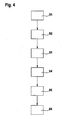
- an acceleration signal is detected (S1). If this exceeds a minimum threshold value, the analysis of the acceleration signal a (S2) begins. During the analysis, the minimum P1, is determined. Preferably, the incoming acceleration signal a is not used directly for this, but rather the accumulated or integrated values of the acceleration signal a. Initializing the integral to the value 0 can be done with step S2. The integration compensates for short-term fluctuations of the acceleration signal a. It thus has the effect of a filter and contributes to the robustness of the process. From the minimum, the minimum value V is determined (S3). From the then occurring maximum P2 in Fig. 1 , the extreme value B is also determined (S4).
- the amount of the minimum value V is set in relation to the maximum value B and compared with the predetermined threshold value S (S5).
- the computational effort required for this purpose can be reduced by multiplying the maximum value B by the threshold S and comparing this product with the absolute value of the minimum value V. If the product falls below the minimum value V, then there is a collision with a pedestrian and a control signal 200 for triggering a personal protection system is output (S6).
- an acceleration signal a is received by a single sensor 1, but by a plurality of sensors 1.
- the individual control signals are collected and added together in a weighted manner. If the weighted control signal exceeds a threshold value, the actual triggering of the personal protection system takes place.
- the individual acceleration signals of a plurality of acceleration sensors are added up. Subsequently, the minimum and maximum of the summed acceleration signal is determined. Their ratio is compared with a threshold value according to the previous embodiments. When the threshold value is exceeded, the personal protection system is triggered.
- the absolute minimum and the absolute maximum respectively correspond to the first minimum and the first maximum, respectively.
- the absolute maximum occurs in another half-oscillation, for example, in the temporally second maximum.
- the absolute maximum can also occur before the absolute minimum.
- the order of the absolute minimum and the absolute maximum depends on the impact location and the position of the acceleration sensor. In the FIGS. 2 and 3 The curves shown correspond to an impact near the sensor. However, if the object collides with the body away from the sensor, positive acceleration may first occur as a result of leverage. This then often has the largest occurring maximum value.
- the individual control signals can all be equally weighted or differently weighted. For the latter case, the distance of the sensors to the impact location can be determined.
- a control signal advantageously weights the closer the impact location to the sensor is.
- the body and the sensors are temperature-dependent, it proves to be advantageous to detect the acceleration signals temperature-compensated or to set the threshold temperature-dependent.
- control signals can also be combined with other control signals, which are characterized by a determination of the mass and / or the rigidity of the impacting object.
- the threshold can be adjusted depending on the vehicle speed.
- knock sensors or similar sensors can be used instead of acceleration sensors.
Landscapes
- Engineering & Computer Science (AREA)
- Mechanical Engineering (AREA)
- Air Bags (AREA)
- Automotive Seat Belt Assembly (AREA)
Claims (9)
- Procédé de commande d'un système de protection des personnes dans un véhicule automobile et comprenant les étapes suivantes :- saisie d'un signal d'accélération (a),caractérisé en ce qu'
on exécute les étapes suivantes :- détermination automatique de la valeur absolue minimale (V) et de la valeur absolue maximale (B) du signal d'accélération (a) ou de la somme de l'intégrale du signal d'accélération, et- émission d'un signal de commande pour activer le système de protection des personnes en fonction du rapport entre la valeur minimale (V) et la valeur maximale (B). - Procédé selon la revendication 1,
caractérisé par
l'émission d'un signal de commande pour activer le système de protection de personnes, si le rapport des valeurs absolues entre la valeur minimale (V) et la valeur maximale (B) dépasse un seuil prédéfini. - Procédé selon l'une des revendications précédentes,
caractérisé en ce qu'
on filtre le signal d'accélération (a) et on détermine automatiquement la valeur minimale (V) et la valeur maximale (B) à partir du signal d'accélération filtré. - Procédé selon la revendication 3,
caractérisé en ce qu'
on effectue le filtrage par intégration du signal d'accélération (a) ou en faisant la moyenne s'appuyant sur un filtre à fenêtre glissante. - Procédé selon l'une des revendications précédentes,
caractérisé en ce qu'
on détermine la valeur minimale et la valeur maximale dès que la valeur absolue du signal d'accélération (a) ou du signal d'accélération filtré dépasse une valeur de seuil inférieure (T). - Procédé selon l'une des revendications précédentes,
caractérisé en ce qu'
on fait la moyenne d'un ensemble de signaux d'accélération (a) de plusieurs capteurs (1) ou de signaux de commande. - Procédé selon la revendication 6,
caractérisé en ce qu'
on pondère les signaux d'accélération (a) ou les signaux de commande en fonction de la distance du point d'impact d'un objet par rapport à l'un des capteurs (1) d'un ensemble de capteurs (1) pour le signal d'accélération respectif (a). - Procédé selon l'une des revendications précédentes,
caractérisé en ce qu'
on saisit de façon compensée en température, les signaux d'accélération ou on émet les signaux de commande avec compensation en température. - Dispositif de commande d'un dispositif de protection des personnes d'un véhicule automobile comprenant :- au moins un capteur (1) pour saisir un signal d'accélération (a) lors d'un choc avec un objet,caractérisé par
une installation de traitement de données (2) pour déterminer automatiquement la valeur absolue minimale (V) et la valeur absolue maximale (B) du signal d'accélération ou de la somme ou de l'intégrale du signal d'accélération, et
une interface pour émettre un signal de commande pour activer le système de protection des personnes en fonction du rapport entre la valeur minimale (V) et la valeur maximale (B).
Applications Claiming Priority (1)
| Application Number | Priority Date | Filing Date | Title |
|---|---|---|---|
| DE102006010477A DE102006010477A1 (de) | 2006-03-07 | 2006-03-07 | Verfahren und Vorrichtung zum Steuern eines Personenschutzsystems |
Publications (2)
| Publication Number | Publication Date |
|---|---|
| EP1832479A1 EP1832479A1 (fr) | 2007-09-12 |
| EP1832479B1 true EP1832479B1 (fr) | 2008-10-22 |
Family
ID=38121361
Family Applications (1)
| Application Number | Title | Priority Date | Filing Date |
|---|---|---|---|
| EP07100652A Active EP1832479B1 (fr) | 2006-03-07 | 2007-01-17 | Procédé et dispositif destinés à la commande d'un système de protection de personnes |
Country Status (3)
| Country | Link |
|---|---|
| EP (1) | EP1832479B1 (fr) |
| DE (2) | DE102006010477A1 (fr) |
| ES (1) | ES2313698T3 (fr) |
Families Citing this family (2)
| Publication number | Priority date | Publication date | Assignee | Title |
|---|---|---|---|---|
| DE112009005022B4 (de) * | 2009-07-02 | 2013-09-26 | Mitsubishi Electric Corporation | Karosseriegeschwindigkeit-Schätzvorrichtung undKollisionssicherheits -Schutzsystem |
| EP2942243B1 (fr) * | 2014-05-09 | 2017-08-02 | Autoliv Development AB | Activation du mécanisme de protection des piétons |
Family Cites Families (4)
| Publication number | Priority date | Publication date | Assignee | Title |
|---|---|---|---|---|
| DE10045698B4 (de) * | 1999-09-16 | 2005-07-07 | Honda Giken Kogyo K.K. | Fahrzeughauben-Betriebssystem |
| DE10030465A1 (de) * | 2000-06-21 | 2002-01-03 | Bosch Gmbh Robert | Verfahren und Vorrichtung zum Erkennen eines Fußgängeraufpralls |
| DE10132681C1 (de) * | 2001-07-05 | 2002-08-22 | Bosch Gmbh Robert | Verfahren zur Klassifizierung von einem Hindernis anhand von Precrashsensorsignalen |
| GB2386873B (en) * | 2002-03-28 | 2005-03-30 | Autoliv Dev | Improvements in or relating to a safety arrangement |
-
2006
- 2006-03-07 DE DE102006010477A patent/DE102006010477A1/de not_active Withdrawn
-
2007
- 2007-01-17 ES ES07100652T patent/ES2313698T3/es active Active
- 2007-01-17 DE DE502007000174T patent/DE502007000174D1/de active Active
- 2007-01-17 EP EP07100652A patent/EP1832479B1/fr active Active
Also Published As
| Publication number | Publication date |
|---|---|
| DE502007000174D1 (de) | 2008-12-04 |
| ES2313698T3 (es) | 2009-03-01 |
| EP1832479A1 (fr) | 2007-09-12 |
| DE102006010477A1 (de) | 2007-09-13 |
Similar Documents
| Publication | Publication Date | Title |
|---|---|---|
| DE10065518B4 (de) | Verfahren zum Auslösen von Rückhaltemitteln in einem Kraftfahrzeug | |
| DE102007057727B4 (de) | Fußgängerkollisionserfassungsvorrichtung und Fußgängerschutzsystem | |
| EP1296859B1 (fr) | Procede et dispositif pour identifier un impact du a un pieton | |
| DE10132681C1 (de) | Verfahren zur Klassifizierung von einem Hindernis anhand von Precrashsensorsignalen | |
| EP1651474B1 (fr) | Dispositif pour actionner un systeme d'actionnement servant a proteger un pieton | |
| WO2004008174A1 (fr) | Dispositif pour la surveillance du champ peripherique a partir d'un vehicule | |
| DE10257842A1 (de) | Verfahren zur Bestimmung einer Unfallgefahr eines ersten Objekts mit wenigstens einem zweiten Objekt | |
| EP1883563A1 (fr) | Dispositif et procede permettant de commander un systeme de protection de personnes d'un vehicule | |
| WO2005061281A1 (fr) | Procede pour commander des moyens de protection de personnes | |
| EP1444116B1 (fr) | Procede d'activation de dispositifs de securite | |
| EP1691213A1 (fr) | Procédé et dispositif destinés à l'identification d'objet | |
| EP1863682B1 (fr) | Procede de generation d'un signal de declenchement pour un dispositif de protection des pietons | |
| EP1832479B1 (fr) | Procédé et dispositif destinés à la commande d'un système de protection de personnes | |
| WO2007036565A1 (fr) | Procede et dispositif de localisation d'une collision d'un objet sur un vehicule | |
| DE102004012550B4 (de) | Fußgängerschutzsystem und Verfahren zum Schutz von Fußgängern | |
| EP1863683B1 (fr) | Procede et dispositif de generation d'un signal de declenchement pour un dispositif de protection des occupants | |
| WO2005077720A1 (fr) | Systeme et procede pour proteger un usager de la route, notamment un pieton | |
| DE102011086006A1 (de) | Verfahren zum Diskriminieren eines impaktierenden Objekts und Steuergerät für eine Passantenschutzeinrichtung | |
| WO2006037680A1 (fr) | Procede et dispositif de commande de moyens de protection de personnes | |
| DE102007004345A1 (de) | Verfahren und Steuergerät zur Ansteuerung von Personenschutzmitteln | |
| DE102005005959A1 (de) | Vorrichtung und Verfahren zum Steuern einer Sicherheitsvorrichtung eines Fahrzeugs | |
| DE102004036833A1 (de) | Vorrichtung und Verfahren zur Erzeugung eines Auslösekriteriums für ein Aufprallschutzsystem eines Fahrzeugs | |
| DE102006031241B4 (de) | Verfahren und Vorrichtung zum Steuern einer Personenschutzvorrichtung | |
| DE102007059898A1 (de) | Verfahren und Steuergerät zur Ansteuerung von Personenschutzmitteln für ein Fahrzeug | |
| WO2006012816A1 (fr) | Dispositif et procede de generation d'un critere de declenchement d'un systeme de protection en cas de collision d'un vehicule automobile |
Legal Events
| Date | Code | Title | Description |
|---|---|---|---|
| PUAI | Public reference made under article 153(3) epc to a published international application that has entered the european phase |
Free format text: ORIGINAL CODE: 0009012 |
|
| AK | Designated contracting states |
Kind code of ref document: A1 Designated state(s): AT BE BG CH CY CZ DE DK EE ES FI FR GB GR HU IE IS IT LI LT LU LV MC NL PL PT RO SE SI SK TR |
|
| AX | Request for extension of the european patent |
Extension state: AL BA HR MK YU |
|
| 17P | Request for examination filed |
Effective date: 20080312 |
|
| 17Q | First examination report despatched |
Effective date: 20080411 |
|
| AKX | Designation fees paid |
Designated state(s): DE ES FR GB IT |
|
| GRAP | Despatch of communication of intention to grant a patent |
Free format text: ORIGINAL CODE: EPIDOSNIGR1 |
|
| GRAS | Grant fee paid |
Free format text: ORIGINAL CODE: EPIDOSNIGR3 |
|
| GRAA | (expected) grant |
Free format text: ORIGINAL CODE: 0009210 |
|
| AK | Designated contracting states |
Kind code of ref document: B1 Designated state(s): DE ES FR GB IT |
|
| REG | Reference to a national code |
Ref country code: GB Ref legal event code: FG4D Free format text: NOT ENGLISH |
|
| REF | Corresponds to: |
Ref document number: 502007000174 Country of ref document: DE Date of ref document: 20081204 Kind code of ref document: P |
|
| REG | Reference to a national code |
Ref country code: ES Ref legal event code: FG2A Ref document number: 2313698 Country of ref document: ES Kind code of ref document: T3 |
|
| PLBE | No opposition filed within time limit |
Free format text: ORIGINAL CODE: 0009261 |
|
| STAA | Information on the status of an ep patent application or granted ep patent |
Free format text: STATUS: NO OPPOSITION FILED WITHIN TIME LIMIT |
|
| 26N | No opposition filed |
Effective date: 20090723 |
|
| PGRI | Patent reinstated in contracting state [announced from national office to epo] |
Ref country code: IT Effective date: 20110501 |
|
| REG | Reference to a national code |
Ref country code: FR Ref legal event code: PLFP Year of fee payment: 10 |
|
| REG | Reference to a national code |
Ref country code: FR Ref legal event code: PLFP Year of fee payment: 11 |
|
| REG | Reference to a national code |
Ref country code: FR Ref legal event code: PLFP Year of fee payment: 12 |
|
| PGFP | Annual fee paid to national office [announced via postgrant information from national office to epo] |
Ref country code: ES Payment date: 20180201 Year of fee payment: 12 |
|
| PGFP | Annual fee paid to national office [announced via postgrant information from national office to epo] |
Ref country code: IT Payment date: 20180126 Year of fee payment: 12 |
|
| PG25 | Lapsed in a contracting state [announced via postgrant information from national office to epo] |
Ref country code: IT Free format text: LAPSE BECAUSE OF NON-PAYMENT OF DUE FEES Effective date: 20190117 |
|
| REG | Reference to a national code |
Ref country code: ES Ref legal event code: FD2A Effective date: 20200310 |
|
| PG25 | Lapsed in a contracting state [announced via postgrant information from national office to epo] |
Ref country code: ES Free format text: LAPSE BECAUSE OF NON-PAYMENT OF DUE FEES Effective date: 20190118 |
|
| PGFP | Annual fee paid to national office [announced via postgrant information from national office to epo] |
Ref country code: FR Payment date: 20210120 Year of fee payment: 15 |
|
| PGFP | Annual fee paid to national office [announced via postgrant information from national office to epo] |
Ref country code: GB Payment date: 20210122 Year of fee payment: 15 |
|
| GBPC | Gb: european patent ceased through non-payment of renewal fee |
Effective date: 20220117 |
|
| PG25 | Lapsed in a contracting state [announced via postgrant information from national office to epo] |
Ref country code: GB Free format text: LAPSE BECAUSE OF NON-PAYMENT OF DUE FEES Effective date: 20220117 |
|
| PG25 | Lapsed in a contracting state [announced via postgrant information from national office to epo] |
Ref country code: FR Free format text: LAPSE BECAUSE OF NON-PAYMENT OF DUE FEES Effective date: 20220131 |
|
| PGFP | Annual fee paid to national office [announced via postgrant information from national office to epo] |
Ref country code: DE Payment date: 20250317 Year of fee payment: 19 |