EP1832525B1 - Absorbierender Behälter - Google Patents
Absorbierender Behälter Download PDFInfo
- Publication number
- EP1832525B1 EP1832525B1 EP07356032A EP07356032A EP1832525B1 EP 1832525 B1 EP1832525 B1 EP 1832525B1 EP 07356032 A EP07356032 A EP 07356032A EP 07356032 A EP07356032 A EP 07356032A EP 1832525 B1 EP1832525 B1 EP 1832525B1
- Authority
- EP
- European Patent Office
- Prior art keywords
- cavity
- approximately
- container according
- cavities
- container
- Prior art date
- Legal status (The legal status is an assumption and is not a legal conclusion. Google has not performed a legal analysis and makes no representation as to the accuracy of the status listed.)
- Not-in-force
Links
- 238000004891 communication Methods 0.000 claims abstract description 36
- 230000002093 peripheral effect Effects 0.000 claims abstract description 27
- 239000007788 liquid Substances 0.000 claims description 58
- 125000006850 spacer group Chemical group 0.000 claims description 9
- XLYOFNOQVPJJNP-UHFFFAOYSA-N water Substances O XLYOFNOQVPJJNP-UHFFFAOYSA-N 0.000 claims description 6
- 238000000465 moulding Methods 0.000 claims description 5
- -1 polyethylene Polymers 0.000 claims description 5
- 238000003856 thermoforming Methods 0.000 claims description 5
- 239000004743 Polypropylene Substances 0.000 claims description 3
- 239000004033 plastic Substances 0.000 claims description 3
- 229920003023 plastic Polymers 0.000 claims description 3
- 229920000747 poly(lactic acid) Polymers 0.000 claims description 3
- 239000004626 polylactic acid Substances 0.000 claims description 3
- 229920001155 polypropylene Polymers 0.000 claims description 3
- 239000004698 Polyethylene Substances 0.000 claims description 2
- 239000004793 Polystyrene Substances 0.000 claims description 2
- 229920000573 polyethylene Polymers 0.000 claims description 2
- 229920002223 polystyrene Polymers 0.000 claims description 2
- 238000001746 injection moulding Methods 0.000 claims 1
- 239000000463 material Substances 0.000 claims 1
- 230000014759 maintenance of location Effects 0.000 description 28
- 230000000717 retained effect Effects 0.000 description 14
- 238000004519 manufacturing process Methods 0.000 description 10
- 230000002745 absorbent Effects 0.000 description 9
- 239000002250 absorbent Substances 0.000 description 9
- 230000000694 effects Effects 0.000 description 7
- 235000013305 food Nutrition 0.000 description 6
- 230000035939 shock Effects 0.000 description 5
- 238000004806 packaging method and process Methods 0.000 description 4
- 230000001133 acceleration Effects 0.000 description 3
- 230000036961 partial effect Effects 0.000 description 3
- 239000008280 blood Substances 0.000 description 1
- 210000004369 blood Anatomy 0.000 description 1
- 230000008014 freezing Effects 0.000 description 1
- 238000007710 freezing Methods 0.000 description 1
- 235000011389 fruit/vegetable juice Nutrition 0.000 description 1
- 239000003292 glue Substances 0.000 description 1
- 238000010438 heat treatment Methods 0.000 description 1
- 238000002347 injection Methods 0.000 description 1
- 239000007924 injection Substances 0.000 description 1
- 238000009434 installation Methods 0.000 description 1
- 230000000670 limiting effect Effects 0.000 description 1
- 235000013372 meat Nutrition 0.000 description 1
- 210000002445 nipple Anatomy 0.000 description 1
- 238000012858 packaging process Methods 0.000 description 1
- 238000004064 recycling Methods 0.000 description 1
- 230000002829 reductive effect Effects 0.000 description 1
- 230000000284 resting effect Effects 0.000 description 1
- 238000010998 test method Methods 0.000 description 1
- 230000000007 visual effect Effects 0.000 description 1
Images

Classifications
-
- B—PERFORMING OPERATIONS; TRANSPORTING
- B65—CONVEYING; PACKING; STORING; HANDLING THIN OR FILAMENTARY MATERIAL
- B65D—CONTAINERS FOR STORAGE OR TRANSPORT OF ARTICLES OR MATERIALS, e.g. BAGS, BARRELS, BOTTLES, BOXES, CANS, CARTONS, CRATES, DRUMS, JARS, TANKS, HOPPERS, FORWARDING CONTAINERS; ACCESSORIES, CLOSURES, OR FITTINGS THEREFOR; PACKAGING ELEMENTS; PACKAGES
- B65D81/00—Containers, packaging elements, or packages, for contents presenting particular transport or storage problems, or adapted to be used for non-packaging purposes after removal of contents
- B65D81/24—Adaptations for preventing deterioration or decay of contents; Applications to the container or packaging material of food preservatives, fungicides, pesticides or animal repellants
- B65D81/26—Adaptations for preventing deterioration or decay of contents; Applications to the container or packaging material of food preservatives, fungicides, pesticides or animal repellants with provision for draining away, or absorbing, or removing by ventilation, fluids, e.g. exuded by contents; Applications of corrosion inhibitors or desiccators
- B65D81/261—Adaptations for preventing deterioration or decay of contents; Applications to the container or packaging material of food preservatives, fungicides, pesticides or animal repellants with provision for draining away, or absorbing, or removing by ventilation, fluids, e.g. exuded by contents; Applications of corrosion inhibitors or desiccators for draining or collecting liquids without absorbing them
Definitions
- the present invention relates to a container with liquid retention means for the packaging and sale of food, according to the preamble of claim 1.
- Containers with liquid retention means are commonly used for the packaging of foods such as meat, and more generally for the packaging of any food likely to let out juice, blood or any other liquid.
- a first type of liquid retention means container has been made by assembling an absorbent sheet and a container-type container.
- the tray has at least one main compartment bounded by at least one main bottom wall on which the absorbent sheet is disposed.
- the absorbent sheet is sometimes attached to the main bottom wall by means of a point of glue.
- Other containers with liquid retention means comprise at least one main compartment limited by at least one main bottom wall having a plurality of small cavities each having a communication port with the interior of the main compartment and each limited by a wall cavity device and a cavity bottom. The liquids are retained in each cavity of the container by the capillary phenomenon.
- the dimensions of the cavities disposed in the main bottom wall of the main compartment are small enough to make possible the action of the capillary phenomenon for the retention of liquids in these cavities.
- the problem proposed by the present invention is to design a container for the packaging and sale of food, which comprises means for retaining liquids that can retain an even larger volume of liquids, and which is easy to manufacture and inexpensive.
- the presence of the inner protrusion increases the length of the contact line sufficiently to allow a significant and satisfactory increase in the liquid retention effect, without requiring the presence of undercuts.
- the presence of the remains allows the demolding of the container during its manufacture, without significant deformation of the cavity and especially the outgrowth.
- the invention aims at optimizing the effect of retention of the liquid in the cavities, to ensure its effective retention in the case where an acceleration such as a flipping of the container, openings of the cavities downwards, or even a simultaneous impact on the container, tends to eject the liquid out of the cavities.
- the volume of the cavity is such that the product of its depth by its external diameter is equal to or slightly less than about 20 mm 2 , preferably equal to or less than about 15 mm 2 , the external cavity diameter being greater than about 6 mm and less than about 9 mm.
- the cavity may have a peripheral contour of circular shape. This form is preferable to ensure better liquid retention capacity during shocks in the inverted position of the container.
- the cavity may have a peripheral contour of polygonal shape.
- the cavity may advantageously have a peripheral contour of hexagonal shape, which increases the number of cavities per unit area and therefore the volume of liquid retained per unit area.
- the protuberance may be disposed substantially in the center of the cavity. This distributes more uniformly the retention forces by capillarity, and provides better liquid retention capacity during shocks in the inverted position of the container.
- the outline of the protrusion may have a shape of the same type as that of the peripheral contour of the cavity. This ensures even more uniform capillary retention throughout the annular volume of the cavity, to optimize the retention capacity of liquids during shocks in the inverted position of the container.
- the contour of the protrusion can be circular.
- the tooling of such a container is thus easier to manufacture and less expensive, and it facilitates the demolding of the container during its manufacture.
- a satisfactory demoulding of the peripheral walls of the cavities of the container during manufacture is obtained by providing that the peripheral walls of the cavities have a clearance angle greater than about 1 °.
- the main bottom wall of the container may comprise a plurality of cavities disposed closest to each other and staggered. This significantly increases the number of cavities per unit area and therefore the volume of liquids that can be retained per unit area.
- a container with cavities according to these dimensions has shown a surprisingly high capacity to retain liquids, retaining about 950 milliliters of liquids per square meter of a surface provided with such cavities.
- the effective retention of liquids thus produced makes it possible to return the surface provided with cavities in order to orient the communication orifices towards the ground, without appreciable flow of liquids out of the cavities.
- the protrusion may develop beyond the communication orifice inwardly of the main compartment, in excess of at least equal to the maximum exceeding of the free surface of a volume of water filling the cavity.
- the protrusion can then play a role of effective restraint of the maximum amount of liquid that can be contained in the cavity.
- the protrusion has an anti-slip effect to prevent lateral sliding of the product contained in the container.
- the container may comprise spacers developing from the main bottom wall towards the interior of the main compartment to support a product away from the communication orifices.
- the container may be obtained by molding, thermoforming or injection.
- the container may be of plastic, preferably polyethylene, polypropylene, polystyrene or polylactic acid.
- plastics are actually inexpensive, easily recyclable, have good mechanical strength and are compatible with current food standards.
- polypropylene makes it possible to use the container for freezing or for heat treatment in the microwave oven.
- polylactic acid makes it possible to produce a container that is easily biodegradable and that respects the environment.
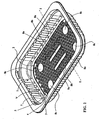
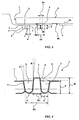
- the container represented on the figures 1 and 2 comprises a main compartment 1 limited by at least one main bottom wall 2 having a plurality of cavities 3 having a communication port 4 with the interior of the main compartment 1. These cavities 3 are limited by a peripheral wall cavity 5 and by a cavity bottom 6, as seen better on the figure 3 which is a partial sectional view of axis II of the container of figures 1 and 2 .
- Each of these cavities 3 comprises an outgrowth 7, with a cross-section smaller than the cross-section of the cavity 3, and developing from the cavity bottom 6 in the direction of the communication orifice 4.
- Each cavity 3 thus defines an annular volume V intended to contain liquid which will be retained by capillarity.
- the peripheral wall 5 of cavity is generally cylindrical with a draft A in the direction of the communication port 4, which allows the container to be made with inexpensive and robust molding tools, and to ensure proper demolding of the container .
- the cavity 3 has a peripheral contour 5 of circular shape, the protuberance 7 having a contour also circular.
- the protuberances 7 are disposed substantially in the center of the cavities 3.
- each point of the peripheral wall 5 of the cavities 3 is at the same distance d ( figure 5 ) of the contour of the protrusion 7. This ensures a liquid retention by completely uniform capillarity throughout the annular volume V cavities 3.
- the value of the volume V equal to or slightly less than a maximum value V max such that, when the mass M that fills the cavity is subjected to at an acceleration G tending to extract it from the cavity, the length of connecting line between the free liquid surface and the cavity walls is sufficient for the capillarity force F to be greater than the force MG exerted by the acceleration G on the mass M of liquid. In this way, the liquid remains in the cavity. Beyond this volume, a liquid retention by capillarity is no longer possible. This of course depends on the properties of the liquid to be retained.
- the cavity may have a shape such that the product of its depth P by its outside diameter D 2 is equal to or less than 20 about 2 mm.
- the effect obtained is a correct retention of the liquid when the container is held in the inverted position, with the communication port facing downwards.
- the protrusion 7 In order to optimize the volume V of liquids that can be retained by capillarity per unit area of the main bottom wall 2, it is desirable for the protrusion 7 to have a reduced dimension, that is to say a small diameter D1 in the embodiment of Figures 1 to 5 . This diameter must, however, be large enough to allow proper release of the protrusion during manufacture.
- the contour of the protrusion 7 is circular, which is advantageous in more ways than one. Indeed, the mold used for thermoforming or molding the container is easier to manufacture. This is all the more important that the protrusion 7 must have a diameter D1 as small as possible.
- the contour of the protrusion 7 will participate in a balanced manner, along its circumference, to the retention of the liquid by capillarity.
- the cavities 3 are arranged closest to each other and staggered. This optimizes the number of cavities 3 per unit area, which optimizes the volume of liquids that can be retained per unit area of the bottom of the container.
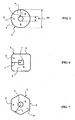
- the figure 6 illustrates a cavity 3 according to a second embodiment of the invention.
- This cavity 3 has a peripheral wall 5 with a square contour, and the protrusion 7 disposed in the center of the cavity 3 also has a contour having a square shape.
- This embodiment makes it possible to increase the number of cavities 3 per unit area for a container of rectangular shape.
- the figure 7 illustrates a cavity 3 according to a third embodiment of the invention.
- the cavity 3 has a peripheral wall 5 with hexagonal shaped contour.
- the contours of the protuberances 7 have a shape of the same type as that of the peripheral contour of the cavities 3. This makes it possible to ensure the most uniform capillary retention possible throughout the annular volume V of the cavities 3.
- the height H of the protuberances 7 is substantially equal to the depth P of the cavities 3.
- the liquid contained in the volume V of the cavities 3 may have a curved surface S that may protrude beyond the communication orifice 4 towards the inside of the main compartment 1, a product resting on the main bottom wall 2 Such a container may then be in contact with the liquid contained in the cavities 3. At the same time, the vertex of the protrusion 7 is below the surface S of liquid, and no longer participates in the retaining effect. liquid by capillarity.
- spacers 8a and 8b developing from the main bottom wall 2 towards the interior of the main compartment 1 may be provided to support the lower face 9a of the product 9 to the distance from the communication orifices 4 and the convex surface S of the liquid contained in the cavities 3.
- the product 9 is thus effectively kept away from the liquids retained by capillarity in the cavities 3.
- the product 9 will thus have less of a tendency to "dribble" when the user takes it out of the container where it was packed.
- spacers 8a, 8b and 8c there are several types of spacer, namely the spacers 8a, 8b and 8c.
- the spacers 8a are made on a portion of the main bottom wall 2 disposed between the cavities 3. This avoids, by the presence of the spacers 8a, to reduce the number of cavities 3 per unit area, unlike the spacers 8b and 8c .
- the spacers 8b and 8c occupy indeed a large portion of the main bottom wall 2 on which it is not possible to provide cavities 3.
- the protrusion 7 develops beyond the communication port 4 towards the inside of the main compartment 1, the protrusion 7 having a height H greater than the depth P of the cavity 3, with an overrun at least equal to to the maximum exceeding of the surface S of liquid above the contour of the communication port 4.
- the protrusion 7 still retains its action effective retention of the liquid by capillarity, even when the liquid fills the cavity in occupying the maximum volume delimited by the convex surface S.
- the use of such excrescences 7 also allows to exert an anti-slip action on the product placed on the main bottom wall 2. It is possible to tilt and orient the container so as to make its content more visible to consumers.
- the container may thus be arranged with its main bottom wall 2 at an angle with a horizontal plane of installation, without the product slipping (which would substantially degrade its visual appearance) and without the liquid leaving volumes V of cavities 3.
- a container with cavities 3 having a depth P of approximately 2 mm, with concentric protrusions 7 centered with a circular contour having a diameter at the apex D1 of approximately 2.5, has been easily formed by thermoforming.
Landscapes
- Engineering & Computer Science (AREA)
- Food Science & Technology (AREA)
- Mechanical Engineering (AREA)
- Packages (AREA)
- Containers Having Bodies Formed In One Piece (AREA)
- Packaging Of Annular Or Rod-Shaped Articles, Wearing Apparel, Cassettes, Or The Like (AREA)
- Details Of Rigid Or Semi-Rigid Containers (AREA)
Claims (17)
- Behälter mit Mitteln zum Zurückhalten von Flüssigkeiten, mit mindestens einem Hauptfach (1), das durch mindestens eine Haupt-Bodenwand (2) begrenzt ist, wobei die Haupt-Bodenwand (2) mindestens einen ringförmigen begrenzten Hohlraum (3) hat, der mit dem Inneren des Hauptfaches (1) über eine Verbindungsöffnung (4) in Verbindung steht und durch eine Umfangswand (5) des Hohlraumes, durch eine Bodenwand (6) des Hohlraumes und durch einen inneren Ansatz (7), der einen kleineren Querschnitt hat als der Querschnitt der Verbindungsöffnung (4) und sich von dem Boden (6) des Hohlraumes in Richtung zur Verbindungsöffnung (4) erstreckt, begrenzt ist, dadurch gekennzeichnet, daß:- der Ansatz (7) eine Seitenfläche hat, die eine Formschräge in Richtung zur Verbindungsöffnung (4) aufweist,- die Umfangswand (5) des Hohlraumes eine Formschräge in Richtung zur Verbindungsöffnung aufweist.
- Behälter nach Anspruch 1, dadurch gekennzeichnet, daß der Hohlraum (3) eine solche Form hat, daß das Produkt aus seiner Tiefe (P) mal seinem Außendurchmesser (D2) gleich oder geringfügig kleiner als ca. 20 mm2 ist, vorzugsweise gleich oder geringfügig kleiner als ca. 15 mm2, wobei der Außendurchmesser (D2) des Hohlraumes größer als ca. 6 mm und kleiner als ca. 9 mm ist.
- Behälter nach einem der Ansprüche 1 oder 2, dadurch gekennzeichnet, daß der Hohlraum (3) eine kreisförmige Umfangskontur hat.
- Behälter nach einem der Ansprüche 1 oder 2, dadurch gekennzeichnet, daß der Hohlraum (3) eine polygonalförmige Umfangskontur hat.
- Behälter nach Anspruch 4, dadurch gekennzeichnet, daß der Hohlraum (3) eine hexagonalförmige Umfangskontur hat.
- Behälter nach irgendeinem der Ansprüche 1 bis 5, dadurch gekennzeichnet, daß der Ansatz (7) im wesentlichen in der Mitte des Hohlraumes (3) angeordnet ist.
- Behälter nach irgendeinem der Ansprüche 1 bis 6, dadurch gekennzeichnet, daß die Kontur des Ansatzes (7) eine Form desselben Typs hat, wie die Umfangskontur des Hohlraumes (3).
- Behälter nach irgendeinem der Ansprüche 1 bis 6, dadurch gekennzeichnet, daß die Kontur des Ansatzes (7) kreisförmig ist.
- Behälter nach irgendeinem der Ansprüche 1 bis 8, dadurch gekennzeichnet, daß die Umfangswand (5) des Hohlraumes einen Formschrägungswinkel (A) von größer als ca. 1° hat.
- Behälter nach Anspruch 9, dadurch gekennzeichnet, daß die Seitenfläche des Ansatzes (7) einen Formschrägungswinkel (B) von größer als ca. 4° hat.
- Behälter nach irgendeinem der Ansprüche 1 bis 10, dadurch gekennzeichnet, daß die Haupt-Bodenwand (2) eine Vielzahl von Hohlräumen (3) hat, die nahe nebeneinander und versetzt angeordnet sind.
- Behälter nach irgendeinem der Ansprüche 1 bis 11, dadurch gekennzeichnet, daß:- die Hohlräume (3) vom Boden (6) bis zur Verbindungsöffnung (4) eine Tiefe (P) aufweisen, die zwischen ca. 2 mm und ca. 4 mm liegt,- die Ansätze (7) eine kreisförmige Kontur mit einem Gipfeldurchmesser (D1) aufweisen, der zwischen ca. 1,5 mm und ca. 3 mm liegt,- die Hohlräume (3) eine kreisförmige Umfangskontur mit einem Durchmesser (D2) an der Öffnung aufweisen, der zwischen ca. 5 mm und ca. 8 mm liegt.
- Behälter nach Anspruch 12, dadurch gekennzeichnet, daß:- die Hohlräume (3) ausgehend vom Boden (6) bis zur Verbindungsöffnung (4) eine Tiefe (P) von ca. 2 mm haben,- die Ansätze (7) eine kreisförmige Kontur mit einem Gipfeldurchmesser (D1) von ca. 2,5 mm und einen Basisdurchmesser von ca. 3 mm haben,- die Hohlräume (3) einen Durchmesser (D2) der Öffnung von ca. 7 mm haben.
- Behälter nach irgendeinem der Ansprüche 1 bis 13, dadurch gekennzeichnet, daß der Ansatz (7) sich von der Verbindungsöffnung (4) zum Inneren des Hauptfaches (1) mit einem Überstand erstreckt, der mindestens gleich einem maximalen Überstand der freien Oberfläche eines Volumens von Wasser ist, das den Hohlraum (3) füllt.
- Behälter nach irgendeinem der Ansprüche 1 bis 14, dadurch gekennzeichnet, daß er Stege (8a, 8b, 8c) aufweist, die sich von der Haupt-Bodenwand (2) zum Inneren des Hauptfaches (1) erstrecken, um ein Produkt (9) fern von den Verbindungsöffnungen (4) zu halten.
- Behälter nach irgendeinem der Ansprüche 1 bis 15, dadurch gekennzeichnet, daß er durch Formguß, Thermoformung oder Spritzguß hergestellt ist.
- Behälter nach irgendeinem der Ansprüche 1 bis 16, dadurch gekennzeichnet, daß er aus Kunststoffmaterial ist, vorzugsweise Polyethylen, Polypropylen, Polystyrol oder Polylactid.
Applications Claiming Priority (1)
| Application Number | Priority Date | Filing Date | Title |
|---|---|---|---|
| FR0650780A FR2898107B1 (fr) | 2006-03-06 | 2006-03-06 | Conteneur absorbant |
Publications (2)
| Publication Number | Publication Date |
|---|---|
| EP1832525A1 EP1832525A1 (de) | 2007-09-12 |
| EP1832525B1 true EP1832525B1 (de) | 2009-10-07 |
Family
ID=37075532
Family Applications (1)
| Application Number | Title | Priority Date | Filing Date |
|---|---|---|---|
| EP07356032A Not-in-force EP1832525B1 (de) | 2006-03-06 | 2007-03-06 | Absorbierender Behälter |
Country Status (4)
| Country | Link |
|---|---|
| EP (1) | EP1832525B1 (de) |
| AT (1) | ATE444919T1 (de) |
| DE (1) | DE602007002651D1 (de) |
| FR (1) | FR2898107B1 (de) |
Families Citing this family (6)
| Publication number | Priority date | Publication date | Assignee | Title |
|---|---|---|---|---|
| EP2794424A1 (de) * | 2011-12-20 | 2014-10-29 | Nestec S.A. | Lebensmittelverpackung |
| EP3696114B1 (de) * | 2014-09-30 | 2022-04-06 | Dampack International BV | Lebensmittelverpackungsschale |
| GR1009083B (el) * | 2016-05-12 | 2017-08-11 | Παλαμηδης Ανωνυμη Εταιρεια Ανοξειδωτα Προϊοντα Pal | Περιεκτης με πυθμενα τριγωνικων κυψελων |
| SI3643641T1 (sl) * | 2018-10-26 | 2021-05-31 | Esperia S.r.L. | Pladenj za živila |
| GB2590476B (en) * | 2019-12-19 | 2023-02-01 | Softform Ltd | A method and tool for manufacturing a container from a thermoplastic material |
| IT202000009187A1 (it) * | 2020-04-28 | 2021-10-28 | Coopbox Group S P A | Contenitore per alimenti essudanti |
Family Cites Families (3)
| Publication number | Priority date | Publication date | Assignee | Title |
|---|---|---|---|---|
| US4533585A (en) * | 1984-05-25 | 1985-08-06 | Mobil Oil Corporation | Liquid holding packaging tray |
| FR2717452B1 (fr) * | 1994-03-18 | 1996-05-24 | Saplest Productions Sa | Support absorbant pour le conditionnement de produits susceptibles de dégager un liquide et procédé de réalisation d'un tel support. |
| PL183159B1 (pl) * | 1995-07-07 | 2002-05-31 | Convenience Food Sys Bv | Sposób wytwarzania opakowań |
-
2006
- 2006-03-06 FR FR0650780A patent/FR2898107B1/fr not_active Expired - Fee Related
-
2007
- 2007-03-06 EP EP07356032A patent/EP1832525B1/de not_active Not-in-force
- 2007-03-06 AT AT07356032T patent/ATE444919T1/de not_active IP Right Cessation
- 2007-03-06 DE DE602007002651T patent/DE602007002651D1/de active Active
Also Published As
| Publication number | Publication date |
|---|---|
| EP1832525A1 (de) | 2007-09-12 |
| FR2898107B1 (fr) | 2010-03-12 |
| FR2898107A1 (fr) | 2007-09-07 |
| ATE444919T1 (de) | 2009-10-15 |
| DE602007002651D1 (de) | 2009-11-19 |
Similar Documents
| Publication | Publication Date | Title |
|---|---|---|
| EP1832525B1 (de) | Absorbierender Behälter | |
| EP1193186B1 (de) | Vorrichtung für die reversible Befestigung eines Behälters auf einer Halterung und mit einer derartigen Vorrichtung ausgestatteter Behälter | |
| FR2532282A1 (fr) | Emballage a oeufs perfectionne et outil pour sa realisation | |
| FR2925263A1 (fr) | Article de cosmetique comprenant un bloc de produit et une grille | |
| BE1000161A6 (fr) | Tasse a cafe ou pour boissons similaires, en matiere synthetique thermoplastique. | |
| US7845512B2 (en) | Thin-walled cup | |
| EP3105134A1 (de) | Behälter für kohlensäurehaltige flüssigkeit und verpackung mit einer vielzahl von behältern | |
| EP0028953B1 (de) | Wassertrog oder Sandkiste | |
| EP2138408A1 (de) | Topfset für Lebensmittel | |
| EP2905240B1 (de) | Lebensmittelverpackung mit wiederverschließbarem Deckel | |
| EP1107922A1 (de) | Unter druck stehender und mit einem dichten kolben versehener spender für cremeprodukte | |
| EP1316366A2 (de) | Vorrichtung zur Aufbewahrung und dosierten Ausgabe einer Flüssigkeit | |
| EP1015327A2 (de) | Verpackung für nahrungsprodukte, insbesondere für backwaren und milchprodukte | |
| EP3845473B1 (de) | Abfallsammelbehälter mit seitlichen abstufungen | |
| EP1890581B1 (de) | Arbeitsbehälter für ein haushaltsgerät zur nahrungszubereitung | |
| EP1838586A2 (de) | Lebensmittelpackung und mindestens zwei solche lebensmittelpackungen umfassendes lebensmittelverpackungssystem | |
| FR2962982A1 (fr) | Dispositif verseur destine a etre insere dans un embout de sortie d'un recipient, en particulier d'une bouteille | |
| EP0785149A1 (de) | Boden einer Schale,eines Kastens oder einer anderen Verpackung für Fleisch oder andere Nahrungsmittel | |
| EP0801004A1 (de) | Vorrichtung mit Sicherheitsverschluss gegen Stosseinflüsse zum Aufbewahren eines Schwermünzenstapels | |
| FR3111123A1 (fr) | Récipient en matière plastique | |
| BE1018200A3 (fr) | Recipient. | |
| FR2915465A1 (fr) | Conteneur avec dose pour liquide integree | |
| EP4163223A1 (de) | Verpackung für frische lebensmittel, die flüssigkeiten ausdehnt | |
| EP4660092A1 (de) | Behälter mit wellboden und formboden zur herstellung eines solchen behälters | |
| FR3163808A1 (fr) | Flacon à mémoire de forme |
Legal Events
| Date | Code | Title | Description |
|---|---|---|---|
| PUAI | Public reference made under article 153(3) epc to a published international application that has entered the european phase |
Free format text: ORIGINAL CODE: 0009012 |
|
| AK | Designated contracting states |
Kind code of ref document: A1 Designated state(s): AT BE BG CH CY CZ DE DK EE ES FI FR GB GR HU IE IS IT LI LT LU LV MC MT NL PL PT RO SE SI SK TR |
|
| AX | Request for extension of the european patent |
Extension state: AL BA HR MK YU |
|
| 17P | Request for examination filed |
Effective date: 20080307 |
|
| AKX | Designation fees paid |
Designated state(s): AT BE BG CH CY CZ DE DK EE ES FI FR GB GR HU IE IS IT LI LT LU LV MC MT NL PL PT RO SE SI SK TR |
|
| GRAP | Despatch of communication of intention to grant a patent |
Free format text: ORIGINAL CODE: EPIDOSNIGR1 |
|
| GRAS | Grant fee paid |
Free format text: ORIGINAL CODE: EPIDOSNIGR3 |
|
| GRAA | (expected) grant |
Free format text: ORIGINAL CODE: 0009210 |
|
| AK | Designated contracting states |
Kind code of ref document: B1 Designated state(s): AT BE BG CH CY CZ DE DK EE ES FI FR GB GR HU IE IS IT LI LT LU LV MC MT NL PL PT RO SE SI SK TR |
|
| REG | Reference to a national code |
Ref country code: GB Ref legal event code: FG4D Free format text: NOT ENGLISH |
|
| REG | Reference to a national code |
Ref country code: CH Ref legal event code: EP |
|
| REG | Reference to a national code |
Ref country code: IE Ref legal event code: FG4D |
|
| REF | Corresponds to: |
Ref document number: 602007002651 Country of ref document: DE Date of ref document: 20091119 Kind code of ref document: P |
|
| REG | Reference to a national code |
Ref country code: CH Ref legal event code: NV Representative=s name: ZIMMERLI, WAGNER & PARTNER AG |
|
| PG25 | Lapsed in a contracting state [announced via postgrant information from national office to epo] |
Ref country code: SI Free format text: LAPSE BECAUSE OF FAILURE TO SUBMIT A TRANSLATION OF THE DESCRIPTION OR TO PAY THE FEE WITHIN THE PRESCRIBED TIME-LIMIT Effective date: 20091007 |
|
| NLV1 | Nl: lapsed or annulled due to failure to fulfill the requirements of art. 29p and 29m of the patents act | ||
| LTIE | Lt: invalidation of european patent or patent extension |
Effective date: 20091007 |
|
| PG25 | Lapsed in a contracting state [announced via postgrant information from national office to epo] |
Ref country code: FI Free format text: LAPSE BECAUSE OF FAILURE TO SUBMIT A TRANSLATION OF THE DESCRIPTION OR TO PAY THE FEE WITHIN THE PRESCRIBED TIME-LIMIT Effective date: 20091007 Ref country code: PT Free format text: LAPSE BECAUSE OF FAILURE TO SUBMIT A TRANSLATION OF THE DESCRIPTION OR TO PAY THE FEE WITHIN THE PRESCRIBED TIME-LIMIT Effective date: 20100208 Ref country code: IS Free format text: LAPSE BECAUSE OF FAILURE TO SUBMIT A TRANSLATION OF THE DESCRIPTION OR TO PAY THE FEE WITHIN THE PRESCRIBED TIME-LIMIT Effective date: 20100207 Ref country code: LT Free format text: LAPSE BECAUSE OF FAILURE TO SUBMIT A TRANSLATION OF THE DESCRIPTION OR TO PAY THE FEE WITHIN THE PRESCRIBED TIME-LIMIT Effective date: 20091007 Ref country code: ES Free format text: LAPSE BECAUSE OF FAILURE TO SUBMIT A TRANSLATION OF THE DESCRIPTION OR TO PAY THE FEE WITHIN THE PRESCRIBED TIME-LIMIT Effective date: 20100118 Ref country code: SE Free format text: LAPSE BECAUSE OF FAILURE TO SUBMIT A TRANSLATION OF THE DESCRIPTION OR TO PAY THE FEE WITHIN THE PRESCRIBED TIME-LIMIT Effective date: 20091007 |
|
| REG | Reference to a national code |
Ref country code: IE Ref legal event code: FD4D |
|
| PG25 | Lapsed in a contracting state [announced via postgrant information from national office to epo] |
Ref country code: PL Free format text: LAPSE BECAUSE OF FAILURE TO SUBMIT A TRANSLATION OF THE DESCRIPTION OR TO PAY THE FEE WITHIN THE PRESCRIBED TIME-LIMIT Effective date: 20091007 Ref country code: LV Free format text: LAPSE BECAUSE OF FAILURE TO SUBMIT A TRANSLATION OF THE DESCRIPTION OR TO PAY THE FEE WITHIN THE PRESCRIBED TIME-LIMIT Effective date: 20091007 |
|
| PG25 | Lapsed in a contracting state [announced via postgrant information from national office to epo] |
Ref country code: AT Free format text: LAPSE BECAUSE OF FAILURE TO SUBMIT A TRANSLATION OF THE DESCRIPTION OR TO PAY THE FEE WITHIN THE PRESCRIBED TIME-LIMIT Effective date: 20091007 |
|
| PG25 | Lapsed in a contracting state [announced via postgrant information from national office to epo] |
Ref country code: RO Free format text: LAPSE BECAUSE OF FAILURE TO SUBMIT A TRANSLATION OF THE DESCRIPTION OR TO PAY THE FEE WITHIN THE PRESCRIBED TIME-LIMIT Effective date: 20091007 Ref country code: NL Free format text: LAPSE BECAUSE OF FAILURE TO SUBMIT A TRANSLATION OF THE DESCRIPTION OR TO PAY THE FEE WITHIN THE PRESCRIBED TIME-LIMIT Effective date: 20091007 Ref country code: BG Free format text: LAPSE BECAUSE OF FAILURE TO SUBMIT A TRANSLATION OF THE DESCRIPTION OR TO PAY THE FEE WITHIN THE PRESCRIBED TIME-LIMIT Effective date: 20100107 Ref country code: DK Free format text: LAPSE BECAUSE OF FAILURE TO SUBMIT A TRANSLATION OF THE DESCRIPTION OR TO PAY THE FEE WITHIN THE PRESCRIBED TIME-LIMIT Effective date: 20091007 Ref country code: IE Free format text: LAPSE BECAUSE OF FAILURE TO SUBMIT A TRANSLATION OF THE DESCRIPTION OR TO PAY THE FEE WITHIN THE PRESCRIBED TIME-LIMIT Effective date: 20091007 Ref country code: EE Free format text: LAPSE BECAUSE OF FAILURE TO SUBMIT A TRANSLATION OF THE DESCRIPTION OR TO PAY THE FEE WITHIN THE PRESCRIBED TIME-LIMIT Effective date: 20091007 |
|
| PLBE | No opposition filed within time limit |
Free format text: ORIGINAL CODE: 0009261 |
|
| STAA | Information on the status of an ep patent application or granted ep patent |
Free format text: STATUS: NO OPPOSITION FILED WITHIN TIME LIMIT |
|
| PG25 | Lapsed in a contracting state [announced via postgrant information from national office to epo] |
Ref country code: CZ Free format text: LAPSE BECAUSE OF FAILURE TO SUBMIT A TRANSLATION OF THE DESCRIPTION OR TO PAY THE FEE WITHIN THE PRESCRIBED TIME-LIMIT Effective date: 20091007 Ref country code: SK Free format text: LAPSE BECAUSE OF FAILURE TO SUBMIT A TRANSLATION OF THE DESCRIPTION OR TO PAY THE FEE WITHIN THE PRESCRIBED TIME-LIMIT Effective date: 20091007 |
|
| 26N | No opposition filed |
Effective date: 20100708 |
|
| PG25 | Lapsed in a contracting state [announced via postgrant information from national office to epo] |
Ref country code: MC Free format text: LAPSE BECAUSE OF NON-PAYMENT OF DUE FEES Effective date: 20100331 Ref country code: GR Free format text: LAPSE BECAUSE OF FAILURE TO SUBMIT A TRANSLATION OF THE DESCRIPTION OR TO PAY THE FEE WITHIN THE PRESCRIBED TIME-LIMIT Effective date: 20100108 |
|
| PG25 | Lapsed in a contracting state [announced via postgrant information from national office to epo] |
Ref country code: IT Free format text: LAPSE BECAUSE OF FAILURE TO SUBMIT A TRANSLATION OF THE DESCRIPTION OR TO PAY THE FEE WITHIN THE PRESCRIBED TIME-LIMIT Effective date: 20091007 |
|
| PG25 | Lapsed in a contracting state [announced via postgrant information from national office to epo] |
Ref country code: MT Free format text: LAPSE BECAUSE OF FAILURE TO SUBMIT A TRANSLATION OF THE DESCRIPTION OR TO PAY THE FEE WITHIN THE PRESCRIBED TIME-LIMIT Effective date: 20091007 |
|
| PGFP | Annual fee paid to national office [announced via postgrant information from national office to epo] |
Ref country code: CH Payment date: 20120328 Year of fee payment: 6 |
|
| PGFP | Annual fee paid to national office [announced via postgrant information from national office to epo] |
Ref country code: BE Payment date: 20120327 Year of fee payment: 6 Ref country code: GB Payment date: 20120327 Year of fee payment: 6 |
|
| PG25 | Lapsed in a contracting state [announced via postgrant information from national office to epo] |
Ref country code: CY Free format text: LAPSE BECAUSE OF FAILURE TO SUBMIT A TRANSLATION OF THE DESCRIPTION OR TO PAY THE FEE WITHIN THE PRESCRIBED TIME-LIMIT Effective date: 20091007 |
|
| PG25 | Lapsed in a contracting state [announced via postgrant information from national office to epo] |
Ref country code: LU Free format text: LAPSE BECAUSE OF NON-PAYMENT OF DUE FEES Effective date: 20100306 Ref country code: HU Free format text: LAPSE BECAUSE OF FAILURE TO SUBMIT A TRANSLATION OF THE DESCRIPTION OR TO PAY THE FEE WITHIN THE PRESCRIBED TIME-LIMIT Effective date: 20100408 |
|
| PG25 | Lapsed in a contracting state [announced via postgrant information from national office to epo] |
Ref country code: TR Free format text: LAPSE BECAUSE OF FAILURE TO SUBMIT A TRANSLATION OF THE DESCRIPTION OR TO PAY THE FEE WITHIN THE PRESCRIBED TIME-LIMIT Effective date: 20091007 |
|
| PGFP | Annual fee paid to national office [announced via postgrant information from national office to epo] |
Ref country code: DE Payment date: 20130326 Year of fee payment: 7 |
|
| BERE | Be: lapsed |
Owner name: C.G.L. PACK SERVICE Effective date: 20130331 |
|
| REG | Reference to a national code |
Ref country code: CH Ref legal event code: PL |
|
| GBPC | Gb: european patent ceased through non-payment of renewal fee |
Effective date: 20130306 |
|
| PG25 | Lapsed in a contracting state [announced via postgrant information from national office to epo] |
Ref country code: CH Free format text: LAPSE BECAUSE OF NON-PAYMENT OF DUE FEES Effective date: 20130331 Ref country code: GB Free format text: LAPSE BECAUSE OF NON-PAYMENT OF DUE FEES Effective date: 20130306 Ref country code: BE Free format text: LAPSE BECAUSE OF NON-PAYMENT OF DUE FEES Effective date: 20130331 Ref country code: LI Free format text: LAPSE BECAUSE OF NON-PAYMENT OF DUE FEES Effective date: 20130331 |
|
| REG | Reference to a national code |
Ref country code: DE Ref legal event code: R119 Ref document number: 602007002651 Country of ref document: DE |
|
| REG | Reference to a national code |
Ref country code: DE Ref legal event code: R119 Ref document number: 602007002651 Country of ref document: DE Effective date: 20141001 |
|
| PG25 | Lapsed in a contracting state [announced via postgrant information from national office to epo] |
Ref country code: DE Free format text: LAPSE BECAUSE OF NON-PAYMENT OF DUE FEES Effective date: 20141001 |
|
| REG | Reference to a national code |
Ref country code: FR Ref legal event code: PLFP Year of fee payment: 10 |
|
| REG | Reference to a national code |
Ref country code: FR Ref legal event code: PLFP Year of fee payment: 11 |
|
| REG | Reference to a national code |
Ref country code: FR Ref legal event code: PLFP Year of fee payment: 12 |
|
| PGFP | Annual fee paid to national office [announced via postgrant information from national office to epo] |
Ref country code: FR Payment date: 20180308 Year of fee payment: 12 |
|
| PG25 | Lapsed in a contracting state [announced via postgrant information from national office to epo] |
Ref country code: FR Free format text: LAPSE BECAUSE OF NON-PAYMENT OF DUE FEES Effective date: 20190331 |