EP1832976A1 - Programme de mise a jour de logiciel, dispositif de mise a jour de logiciel et procede de mise a jour de logiciel - Google Patents
Programme de mise a jour de logiciel, dispositif de mise a jour de logiciel et procede de mise a jour de logiciel Download PDFInfo
- Publication number
- EP1832976A1 EP1832976A1 EP04792279A EP04792279A EP1832976A1 EP 1832976 A1 EP1832976 A1 EP 1832976A1 EP 04792279 A EP04792279 A EP 04792279A EP 04792279 A EP04792279 A EP 04792279A EP 1832976 A1 EP1832976 A1 EP 1832976A1
- Authority
- EP
- European Patent Office
- Prior art keywords
- software
- information
- processing apparatus
- configuration
- information processing
- Prior art date
- Legal status (The legal status is an assumption and is not a legal conclusion. Google has not performed a legal analysis and makes no representation as to the accuracy of the status listed.)
- Withdrawn
Links
Images





Classifications
-
- G—PHYSICS
- G06—COMPUTING OR CALCULATING; COUNTING
- G06F—ELECTRIC DIGITAL DATA PROCESSING
- G06F8/00—Arrangements for software engineering
- G06F8/60—Software deployment
- G06F8/65—Updates
-
- H—ELECTRICITY
- H04—ELECTRIC COMMUNICATION TECHNIQUE
- H04L—TRANSMISSION OF DIGITAL INFORMATION, e.g. TELEGRAPHIC COMMUNICATION
- H04L67/00—Network arrangements or protocols for supporting network services or applications
- H04L67/01—Protocols
- H04L67/10—Protocols in which an application is distributed across nodes in the network
- H04L67/1001—Protocols in which an application is distributed across nodes in the network for accessing one among a plurality of replicated servers
-
- H—ELECTRICITY
- H04—ELECTRIC COMMUNICATION TECHNIQUE
- H04L—TRANSMISSION OF DIGITAL INFORMATION, e.g. TELEGRAPHIC COMMUNICATION
- H04L67/00—Network arrangements or protocols for supporting network services or applications
- H04L67/01—Protocols
- H04L67/10—Protocols in which an application is distributed across nodes in the network
- H04L67/1001—Protocols in which an application is distributed across nodes in the network for accessing one among a plurality of replicated servers
- H04L67/1004—Server selection for load balancing
- H04L67/1008—Server selection for load balancing based on parameters of servers, e.g. available memory or workload
-
- H—ELECTRICITY
- H04—ELECTRIC COMMUNICATION TECHNIQUE
- H04L—TRANSMISSION OF DIGITAL INFORMATION, e.g. TELEGRAPHIC COMMUNICATION
- H04L67/00—Network arrangements or protocols for supporting network services or applications
- H04L67/34—Network arrangements or protocols for supporting network services or applications involving the movement of software or configuration parameters
Definitions
- the present invention relates to a software updating program, a software updating apparatus, and a software updating method for collecting various pieces of information and instructing operations by communicating with an agent installed in an information processing apparatus via a network and for updating software in the information processing apparatus, and more particularly, to a software updating program, a software updating apparatus, and a software updating method capable of automatically updating software in an information processing apparatus employed in a complicated operation mode.
- the patch is a program or data that improves a problem in an information processing system, or a combination thereof.
- a patch When a patch is applied to an information processing system, it is required to follow a premised procedure, and another problem can be caused by following a wrong procedure. For example, when the patch is applied, it is sometimes required to stop a certain service in the information processing system or to apply another patch in advance.
- servers are often operated in parallel using a load balancer.
- This operates a system in a mode where a plurality of servers installed with an identical application is arranged, the load balancer receives all requests from clients, and it assigns the process into any one of the servers.
- a plurality of servers can be operated as a single information processing apparatus by appearance, and increased number of the servers can improve the processing performance. Moreover, the number of the servers can be dynamically changed for the operation depending on the load status and occurrence of failures, whereby achieving high availability.
- the mode using the load balancer is also advantageous in the patch-applying work.
- a patch is applied, in many cases, it is necessary to stop the service of the server.
- the mode using the load balancer by performing a procedure with respect to each server, the procedure including disconnecting the server fro the load balancer to stop the service and connecting the server to the load balancer again after the patch is applied, the patch can be applied to all the servers without stopping providing the service.
- the method of applying the patch to each server after being disconnected from the load balancer is referred to as a rolling application.
- the rolling application includes a great advantage of being able to apply the patch while the information system is in operation as described above; however, it also includes a disadvantage that erroneous operation can occur because configuration of the load balancer and the like needs to be changed and the procedure is very complicated.
- the inventions disclosed in Patent Document 1 and Patent Document 2 improve only the application of the patch, and they do not improve most part of the rolling application procedure.
- the target system of the rolling application is, as described above, a system that operates servers in parallel, which is often a large-scale system. Therefore, if an erroneous operation occurs in the rolling application of the patch, an effect thereof is very likely to be very profound, and it is very important to prevent occurrence of the erroneous operation.
- the present invention was made in consideration of the above, and it is an object of the present invention to provide the software updating program, the software updating apparatus, and the software updating method capable of ensuring update of software including application of the patch.
- a software updating program is for performing an information collection and an operation instruction by performing a communication with a program deployed in an information processing apparatus via a network, to perform an update of a software of the information processing apparatus.
- the software updating program causes a computer to execute a configuration-information acquiring procedure of acquiring configuration information from a database that stores therein current configuration information of the information processing apparatus, post configuration information of the information processing apparatus after updating the software, and configuration information of a network device connected to the information processing apparatus via the network; a network-configuration setting procedure of changing a setting of the network device as appropriate; and a software applying procedure including determining a software to be installed in the information processing apparatus or to be removed from the information processing apparatus by comparing the current configuration information with the post configuration information acquired at the configuration-information acquiring procedure, instructing the program deployed in the information processing apparatus to install or remove the software, and instructing, when it is determined that a change of the setting of the network device is needed when installing or removing the software from the configuration information of the network device acquired at the configuration-information acquiring procedure, the changing to change the setting of the network device.
- a software updating apparatus is for performing an information collection and an operation instruction by performing a communication with a program deployed in an information processing apparatus via a network, to perform an update of a software of the information processing apparatus.
- the software updating apparatus includes a configuration-information acquiring unit that acquires configuration information from a database that stores therein current configuration information of the information processing apparatus, post configuration information of the information processing apparatus after updating the software, and configuration information of a network device connected to the information processing apparatus via the network; a network-configuration setting unit that changes a setting of the network device as appropriate; and a software applying unit that determines a software to be installed in the information processing apparatus or to be removed from the information processing apparatus by comparing the current configuration information with the post configuration information acquired by the configuration-information acquiring unit, instructs the program deployed in the information processing apparatus to install or remove the software, and instructs, when it is determined that a change of the setting of the network device is needed when installing or removing the software from the configuration information of the network device acquired by the configuration-information
- a software updating method is for performing an information collection and an operation instruction by performing a communication with a program deployed in an information processing apparatus via a network, to perform an update of a software of the information processing apparatus.
- the software updating method includes a configuration-information acquiring step of acquiring configuration information from a database that stores therein current configuration information of the information processing apparatus, post configuration information of the information processing apparatus after updating the software, and configuration information of a network device connected to the information processing apparatus via the network; a network-configuration setting step of changing a setting of the network device as appropriate; and a software applying step including determining a software to be installed in the information processing apparatus or to be removed from the information processing apparatus by comparing the current configuration information with the post configuration information acquired at the configuration-information acquiring step, instructing the program deployed in the information processing apparatus to install or remove the software, and instructing, when it is determined that a change of the setting of the network device is needed when installing or removing the software from the configuration information of the network device acquired at the configuration
- the operation of updating the software can be automated including changing the network configuration.
- the software applying procedure includes instructing, when it is determined that the information processing apparatus in which the software is to be installed or from which the software is to be removed is connected to a load distributing apparatus from the configuration information acquired at the configuration-information acquiring procedure, the network-configuration setting procedure to change the setting of the network device in such a manner that the load distributing apparatus suspends a distribution of a processing to the information processing apparatus before installing or removing the software, and resumes the distribution of the processing to the information processing apparatus after installing or removing the software.
- the software applying unit instructs, when it is determined that the information processing apparatus in which the software is to be installed or from which the software is to be removed is connected to a load distributing apparatus from the configuration information acquired by the configuration-information acquiring unit, the network-configuration setting unit to change the setting of the network device in such a manner that the load distributing apparatus suspends a distribution of a processing to the information processing apparatus before installing or removing the software, and resumes the distribution of the processing to the information processing apparatus after installing or removing the software.
- the software applying step includes instructing, when it is determined that the information processing apparatus in which the software is to be installed or from which the software is to be removed is connected to a load distributing apparatus from the configuration information acquired at the configuration-information acquiring step, the network-configuration setting step to change the setting of the network device in such a manner that the load distributing apparatus suspends a distribution of a processing to the information processing apparatus before installing or removing the software, and resumes the distribution of the processing to the information processing apparatus after installing or removing the software.
- the rolling application of a patch to information processing apparatuses operated in parallel using the load balancer can be automated.
- the software applying procedure includes instructing the program deployed in the information processing apparatus to execute an application-result confirming program for confirming a result of installing or removing the software, and collecting a result of executing the application-result confirming program.
- the software applying unit instructs the program deployed in the information processing apparatus to execute an application-result confirming program for confirming a result of installing or removing the software, and collects a result of executing the application-result confirming program.
- the software applying step includes instructing the program deployed in the information processing apparatus to execute an application-result confirming program for confirming a result of installing or removing the software, and collecting a result of executing the application-result confirming program.
- a software updating program, a software updating apparatus, and a software updating method according to the present invention are configured to manage the configuration information including the connected network device and change the network configuration as required for updating the software using the information. Therefore, the operation of updating the software can be advantageously automated including changing the network configuration.
- a software updating program, a software updating apparatus, and a software updating method according to the present invention are configured to change the configuration so that the load balancer does not assign any process to a information processing apparatus to be updated with the software during the software updating process if it is determined that the information processing apparatus is connected to the load balancer. Therefore, the rolling application of a patch to information processing apparatuses operated in parallel using the load balancer can be advantageously automated.
- a software updating program, a software updating apparatus, and a software updating method according to the present invention are configured to install a program for confirming result and collect the result after the software updating process is completed. Therefore, it can be advantageously confirmed that there was no problem with updating the software before starting the operation.
- Fig. 1 is a schematic for explaining a concept of a resource allocation management method according to the present invention.
- Information processing apparatuses such as web servers 41 to 49, AP (Application) servers 51 to 56, DB (Database) servers 61 to 63, and storages 71 to 79 are used in Fig. 1.
- the web servers 4 1 to 4 9 are servers that provide contents to be browsed by web browsers to client terminals via the Internet.
- the AP servers 5 1 to 5 6 are servers that take over execution of information processes requested by the web servers 4 1 to 4 9 that have received an information processing request from a user.
- the DB servers 6 1 to 6 3 are servers that manage accesses to database upon receiving requests for accessing the database from the AP servers 5 1 to 5 6 .
- the storages 7 1 to 7 9 are storage devices to be connected via a SAN to the web servers 4 1 to 4 9 , the AP servers 5 1 to 5 6 , and the DB servers 6 1 to 6 3 .
- a resource group that contains servers or storages having a uniform physical wire connection to other devices is managed as a domain in a LAN (local area network), a SAN, or the like.
- server groups used for tasks 1 and 2 are managed as a web domain 4, an AP domain 5, and a DB domain 6, while a storage group used for the tasks 1 and 2 is managed as a storage domain 7.
- the web servers 4 1 to 4 9 that belong to the web domain 4 have uniform connections to other devices
- the AP servers 5 1 to 5 6 that belong to the AP domain 5 have uniform connections to other devices
- the DB servers 6 1 to 6 3 that belong to the DB domain 6 have uniform connections to other devices
- the storages 7 1 to 7 9 that belong to the storage domain 7 have uniform connections to other devices.
- unused ones of the web servers 4 1 to 4 9 , the AP servers 5 1 to 5 6 , the DB servers 6 1 to 6 3 , and the storages 7 1 to 7 9 are registered to a pool 3 for each domain.
- the web servers 4 1 to 4 9 , the AP servers 5 1 to 5 6 , the DB servers 6 1 to 6 3 , and the storages 7 1 to 7 9 are assigned to each of the tasks 1 and 2 as appropriate.
- the web servers 4 2 and 4 3 , the AP server 5 1 , the DB server 6 1 , and the storage 7 7 are assigned to the task 1, while the web server 4 9 , the AP servers 5 2 and 5 3 , the DB server 6 2 , and the storages 7 8 and 7 9 are assigned to the task 2.
- the web servers 4 1 , 4 4 to 4 8 , the AP servers 5 4 to 5 6 , the DB server 6 3 , and the storages 7 1 to 7 6 registered to the pool 3 are added as servers available for the task.
- the web servers 4 1 , 4 4 to 4 8 , the AP servers 5 4 to 5 6 , and the DB server 6 3 registered to the pool 3 and automatically executing setting of the network and the like, the web servers 4 1 , 4 4 to 4 8 , the AP servers 5 4 to 5 6 , and the DB server 6 3 are added as the servers available for the task.
- the storages 7 1 to 7 6 are added as the storages 7 1 to 7 6 available for the task.
- the web server 4 4 that was registered to the pool 3 is added to the web domain 4 of the task 2.
- the web servers 4 2 , 4 3 , 4 9 , the AP servers 5 1 to 5 3 , the DB servers 6 1 , 6 2 , or the storages 7 7 to 7 9 used for the tasks 1 and 2 are not used for a long time, the web servers 4 2 , 4 3 , 4 9 , the AP servers 5 1 to 5 3 , the DB servers 6 1 , 6 2 , and the storages 7 7 to 7 9 are excluded from the servers available for the task and registered to the pool 3.
- the web servers 4 2 , 4 3 , 4 9 , the AP servers 5 1 to 5 3 , the DB servers 6 1 , 6 2 , and the storages 7 7 to 7 9 registered to the pool 3 are to be used if the load on the web servers 4 2 , 4 3 , 4 9 , the AP servers 5 1 to 5 3 , and the DB servers 6 1 , 6 2 , used for other tasks 1 and 2 increases or if the storage capacity of the storages 7 7 to 7 9 is not enough.
- the web servers 4 2 , 4 3 , 4 9 , the AP servers 5 1 to 5 3 , and the DB servers 6 1 , 6 2 are excluded from the servers available for the tasks 1 and 2 and registered to the pool 3.
- the storages 7 7 to 7 9 can be excluded from the storages available for the tasks 1 and 2 and registered to the pool 3.
- the AP server 5 2 that was registered to the pool 3 is excluded from the servers available for the task in the AP domain 5 of the task 2, and it is registered to the pool 3.
- the server 5 4 registered to the pool 3 is reused in such a case that the load on the server 5 1 used for the task 1 increases, and it is added to the task 1.
- Fig. 2 is a diagram of the functional configuration of the resource allocation management system that supports the embodiment.
- an operation management client 10 is connected to a site management server 20 via an FW (firewall) 30 over a network.
- the site management server 20 is connected over the network to domain management servers 50 and 60 via an FW 40.
- the site management server 20 is connected over the network to a router 80 that belongs to an edge domain 180 via the FW 40.
- the site management server 20 is also connected over the network to storages 160a to 160c that belong to a storage domain 220, and to a storage 160d that is pooled via the FW 40.
- the domain management server 50 is connected over the network to an SLB (server load balancer) 100 and to servers 110a to 110c that belong to a web domain 190.
- SLB server load balancer
- the domain management server 60 is connected over the network to an FW 120, an SLB 130, servers 140a to 140c that belong to an AP domain 200, servers 150a to 150c that belong to a DB domain 210.
- the storages 160a to 160c that belong to the storage domain 220, and the storage 160d that is pooled are also connected via a SAN 170 to the servers 110a to 110c that belong to the web domain 190, the servers 140a to 140c that belong to the AP domain 200, and the servers 150a to 150c that belong to the DB domain 210.
- the operation management client 10 is a client terminal that receives various settings related to resource management from a user and transmits information to the site management server 20, and that receives various output results from the site management server 20 and displays the output results on a monitor or the like.
- the site management server 20 is a server that performs the resource-assignment managing system described in Fig. 1 in cooperation with the domain management servers 50 and 60.
- the site management server 20 includes a system resource manager 21, a server RM (resource manager) 22, a software RM (resource manager) 23, a network RM (resource manager) 24, a storage RM (resource manager) 25, a system resource DB (database) 26, and an AP (application)-management control unit 27.
- the system resource manager 21 is a managing unit that receives various setting information related to the resource-assignment managing process from the operation management client 10, and operates resources in cooperation with the server RM 22, the software RM 23, the network RM 24, and the storage RM 25. In addition, the system resource manager 21 performs data reception and data transmission between the domain management servers 50 and 60.
- the server RM 22 is a managing unit that performs a boot and a shutdown of each of the servers 110a to 110c, 140a to 140c, and 150a to 150c, a collection of information about hardware, a setting, and the like.
- the server RM 22 performs the above processes in cooperation with a server sub RM (resource manager) 52 of the domain management server 50, and a server RM agent 112a of the server 110a.
- the software RM 23 is a managing unit that performs software installation, setting, collection of information about the software, and the like for each of the servers 110a to 110c, 140a to 140c, and 150a to 150c.
- the software RM 23 performs the above processes in cooperation with a software sub RM (resources manager) 53 of the domain management server 50, and a software RM agent 113a of the server 110a.
- the network RM 24 is a managing unit that performs information collection, setting, and the like related to the network.
- the network RM 24 performs the above processes in cooperation with a network sub RM (resource manager) 54 of the domain management server 50, and a network RM agent 114a of the server 110a.
- the storage RM 25 is a managing unit that performs information collection, setting, and the like related to the storages 160a to 160c that belong to the storage domain 220, and relate to the storage 160d that is pooled.
- the storage RM 25 manages the storages 160a to 160c and the storage 160d pooled without involving the domain management servers 50 and 60.
- the system resource DB 26 is a database that contains various resource information managed by the system resource manager 21, the server RM 22, the software RM 23, the network RM 24, and the storage RM 25. Details of stored data are explained later.
- the AP-management control unit 27 is a processing unit that controls and manages an AP (application) managing unit 116a. More specifically, the AP-management control unit 27 sends a request for executing process related to an application such as installation and setting to the AP managing unit 116a. Functions of the AP-management control unit 27 are realized by executing middleware installed on the site management server 20.
- the domain management servers 50 and 60 are servers that manage resources in a domain or a plurality of domains.
- the domain management server 50 includes a system resource domain manager 51, the server sub RM 52, the software sub RM 53, the network sub RM 54, and a domain resource DB (database) 55.
- the domain management server 60 includes the same function units as the function units of the domain management server 50, and therefore, the function units of the domain management server 60 are not shown in Fig. 2 and explanations thereof are omitted.
- the system resource domain manager 51 is a managing unit that performs information collection, setting process, and the like related to resources that belong to each of the domains in cooperation with the server sub RM 52, the software sub RM 53, and the network sub RM 54.
- system resource domain manager 51 performs data reception and data transmission to and from networking equipment such as the site management server 20, an FW 90, and the SLB 100, as well as to and from the servers 110a to 110c to be managed.
- the server sub RM 52 is a managing unit that performs boot, shutdown, collection of information about hardware, setting, and the like in cooperation with the server RM 22 and the server RM agent 112a.
- the software sub RM 53 is a managing unit that performs software installation, setting, collection of information about software, and the like for each of the servers 110a to 110c in cooperation with the software RM 23 and the software RM agent 113a.
- the network sub RM 54 is a managing unit that performs information collection, setting, and the like related to a network in cooperation with the network RM 24 and the network RM agent 114a.
- the domain resource DB 55 is a database that stores therein information acquired from the servers 110a to 110c and the system resource DB 26, when the server sub RM 52, the software sub RM 53, or the network sub RM 54 collects various information or specifies settings related to the servers 110a to 110c to be managed.
- the domain resource DB 55 stores therein a virtual OS (operating system) used for network boot of the servers 110a to 110c.
- the router 80 is networking equipment that performs routing of data packets in data communication via the Internet 70.
- the FWs 30, 40, 90, and 120 are networking equipments that prevent unauthorized access to each of the servers 110a to 110c, 140a to 140c, and 150a to 150c.
- the SLBs 100 and 130 are load balancers that distribute and transfer information-processing requests for the servers 110a to 110c or 140a to 140c to a plurality of the servers 110a to 110c or 140a to 140c. Although switches are also connected in upstream sides and downstream sides of the SLBs 100 and 130, the switches are not shown in Fig. 2.
- the servers 110a to 110c, 140a to 140c, and 150a to 150c are servers that perform various information processes.
- the server 110a includes a resource manager agent 111a, the server RM agent 112a, the software RM agent 113a, the network RM agent 114a, a storage RM agent 115a, and the AP managing unit 116a.
- the servers 110b, 140a, 140b, 150a, and 150b include the same function units as those of the server 110a. Therefore, the function units of the servers 110b, 140a, 140b, 150a, and 150b are not shown in Fig. 2, and explanations thereof are omitted.
- the servers 110c, 140c, and 150c are servers that are pooled, and do not include each of the resource manager agent 111a, the server RM agent 112a, the software RM agent 113a, the network RM agent 114a, the storage RM agent 115a, and the AP managing unit 116a.
- server 110c, 140c, or 150c When the server 110c, 140c, or 150c is set as a server available for tasks, a computer program that realizes each of the function units is installed on the server 110c, 140c, or 150c and is executed to realize each of the function units.
- the resource manager agent 111a is an agent that receives a request for executing process such as setting and information collection from the domain management server 50 of the system resource domain manager 51 for the server 110a, and performs processes in cooperation with the server RM agent 112a, the software RM agent 113a, the network RM agent 114a, and the storage RM agent 115a.
- the server RM agent 112a is an agent that performs a boot and a shutdown of the server 110a, a collection of information about hardware, a setting, and the like.
- the software RM agent 113a is an agent that performs software installation, setting, and collection of information about software for the server 110a.
- the network RM agent 114a is an agent that performs information collection, setting, and the like related to a network connected to the server 110a.
- the storage RM agent 115a is an agent that performs information collection, setting, and the like related to a storage connected to the server 110a.
- the storages 160a to 160c are storages used by the servers 110a to 110c that belong to the web domain 190, the servers 140a to 140c that belong to the AP domain 200, and the servers 150a to 150c that belong to the DB domain 210.
- the storage 160d is a storage that is pooled.
- the storages 160a to 160d are constituted of RAID devices.
- a VLAN virtual local area network
- a VLAN is set as a network that connects between the servers 110a to 110c that belong to the web domain 190, the servers 140a to 140c that belong to the AP domain 200, and the servers 150a to 150a that belong to the DB domain 210.
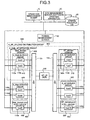
- FIG. 3 is a diagram of an example of the network to which the software updating apparatus according to the embodiment is connected.
- the site management server 20 is supposed to function as the software updating apparatus. It is also possible to configure the software updating apparatus as an independent information processing apparatus, and it is also possible to configure a domain management server such as the domain management server 50 to function as the software updating apparatus.
- a software updating apparatus 20 which is the site management server, includes the system resource DB 26 that stores therein management information of each device that configures the network, and it is connected to the operation management client 10, the domain management server 50, the servers 110a to 110e, and the servers 140a to 140e via the network.
- the servers 110a to 110e and the servers 140a to 140e connected to the software updating apparatus 20 are grouped based on a plurality of grouping systems according to the management purpose. One system is to group them based on a physical identity of the domain as explained above.
- the servers 110a to 110e are grouped into a Web_domain domain 400, and the servers 140a to 140e are grouped into an AP_domain domain 300.
- the servers that are not used for the task are grouped into a group referred to as a pool group.
- the server 140e is grouped into an AP_domain.pool pool group 330.
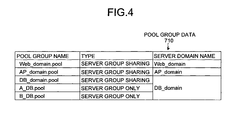
- FIG. 4 is a diagram of an example of the pool group data 710 stored as information on the pool groups.
- the pool group data 710 includes information on a pool group name, a type, and a server domain name.
- the pool group name is identification information of the pool of the servers described above.
- the type is information indicative of whether the pool group is to be shared by a plurality of server groups or to be allowed for a certain server group to use.
- the server domain name is identification information of the domain.
- the server used for the task is grouped into a group referred to as a server group.
- the server group is a group based on a software identity, and the servers that belong to the same server group include an identical software configuration.
- a plurality of the server groups can be generated in the domain, and there are two server groups in the AP_domain domain 300, which are an A_AP server group 310 and a B_AP server group 320.
- the servers 140a and 140b are grouped into the former server group, and the servers 140c and 140d are grouped into the latter server group.
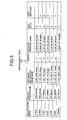
- Fig. 5 is a diagram of an example of the server group data 720 stored as information on the server groups.
- the server group data 720 includes information on a server group name, the server domain name, a software-distribution image name, a version, a storage template name, SAN boot, and automatic recovery.
- the server group name is identification information of the server group.
- the server domain name is information of the server domain to which the server group belongs.
- the software-distribution image name is information for identifying an image file of the software distributed to the server that belongs to the server group.
- the version is information on the version of the software distribution image that should currently be delivered to the server that configures the server group. Other items are unnecessary for explaining the embodiment, and the explanation thereof is omitted.
- FIG. 6 is a diagram of an example of the provisioning configuration data 730 in which storage sub-groups are specified.
- the provisioning configuration data 730 includes information on the server name, the pool group name, the storage sub-group name, and accessibility.
- the server name is identification information of the server, i.e., a host name.
- the group name is identification information of the pool to which the server belongs, and it is specified only when the server belongs to a pool.
- the server group name is identification information of the server group to which the server belongs, and it is set only when the server belongs to a server group. Other items are unnecessary for explaining the embodiment, and the explanation thereof is omitted.
- the server group belongs to a group referred to as a network group apart from the domain.
- the network group is a group of server groups that communicate with one another to provide the service, i.e., the server groups associated with one another in terms of the task.
- a A_Web server group 410 and the A_AP server group 310 belong to a network group referred to as an A_Web-AP network group 500.
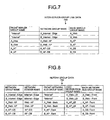
- FIG. 7 is a diagram of an example of the inter-server-group link data 740 stored as information on the server groups.
- the inter-server-group link data 740 includes information on a front server-group name, a network group name, and a back server-group name.
- the front server-group name is information indicative of the server group that requests a process among the server groups linked by the network group.
- the network group name is identification information for identifying the network group.
- the back server-group name is information indicative of the server group that executes the requested process and replies to a requestor among the server groups linked by the network group.
- the network group belongs to a still upper-level group referred to as a load distribution group.
- the load distribution group is a group for associating a load balancer with a network group on which the load balancer performs the load distribution.
- the load balancer is a device that receives requests for processing to all the servers that includes an identical configuration and assigns the requests for processing to a server with the lightest load based on a predetermined rule.
- the A_Web-AP network group 500 is linked to the SLB 130 (A_LB) and configures a load distribution group referred to as an A_AP_LB load distribution group 600.
- the former is the front-end and the latter is the back-end, and therefore the SLB 130 is to receive requests from the servers that belong to the A_Web server group 410 and to assign the process to the servers with the lighter load among those belonging to the A_AP server group 310.
- the servers that belong to the same server group have the same physical and software identity, the same processing result is acquired no matter which server the process is assigned to.
- FIG. 8 is a diagram of an example of the network group data 750 stored as information on the network groups.
- the network group data 750 includes information on the network group name, a network domain name, a front-network sub-group name, a load distribution group name, and a back-network sub-group name.
- the network group name is identification information of the network group.
- the load distribution group name is identification information of the load distribution group. Other items are unnecessary for explaining the embodiment, and the explanation thereof is omitted.
- configuration of various devices including the load balancer is managed by grouping them, and various configuration information is stored in the system resource DB 26.
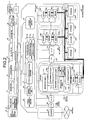
- Fig. 9 is a functional block diagram of a functional configuration of the software updating apparatus according to the embodiment.
- the software updating apparatus 20 is configured to be connected to the server 110a that is to be updated via the network.
- the server 110a that is to be updated via the network.
- other similar servers can be connected via the network.
- the software updating apparatus 20 includes a control unit 28 and a storing unit 29.
- the storing unit 29 stores therein various information, and includes a system-resource storing unit 29a.
- the system-resource storing unit 29a corresponds to the system resource DB 26.
- the system-resource storing unit 29a does not necessarily have to be built in the software updating apparatus 20.
- the system-resource storing unit 29a can be configured so that a part or all of it is present in another server and that the software updating apparatus 20 inputs and outputs information via the network.
- the control unit 28 controls the entire software updating apparatus 20, and includes a system-resource input/output unit 28a, a processing unit 28b, and an RM unit 28c.
- the system-resource input/output unit 28a controls input and output of data to and from the system-resource storing unit 29a.
- the RM unit 28c includes the system resource manager 21, the server RM 22, the software RM 23, the network RM 24, and the storage RM 25 that were already explained, and executes collection and setting of various information on the server 110a in association with the resource manager agent 111a, the server RM agent 112a, the software RM agent 113a, the network RM agent 114a, and the storage RM agent 115a in the server 110a.
- the processing unit 28b processes various operations related to software update, and includes a server-group information acquisition processing unit 28d, a load-distribution-group information acquisition processing unit 28e, a network-configuration setting processing unit 28f, a distribution-image comparison processing unit 28g, a software-image distribution processing unit 28h, a software-image application processing unit 28i, and a software-image application result confirming unit 28j.
- the server-group information acquisition processing unit 28d acquires information on the servers that configure the server group to be updated with the software from the system-resource storing unit 29a via the system-resource input/output unit 28a.
- the load-distribution-group information acquisition processing unit 28e acquires information on the load distribution group that includes the server group to be updated with the software from the system-resource storing unit 29a via the system-resource input/output unit 28a.
- the network-configuration setting processing unit 28f sets the load balancer and the VLAN by calling functions of various RMs to temporarily disconnect and reconnect the server to be updated with the software from and to a business server.
- the distribution-image comparison processing unit 28g acquires information on the latest software distribution image applied to the server to be updated with the software and information on the software distribution image associated with the server group to be updated with the software from the system-resource storing unit 29a via the system-resource input/output unit 28a, and compares the information.
- the software distribution image is a combination of software images that have been applied or that are to be applied.
- the software image is data that packs a patch or a disk image to which the patch has been applied, an installation program, an uninstall program, and an application-result confirming program.
- the software-image distribution processing unit 28h transfers the software image stored in a predetermined location in advance to the server to be updated with the software by calling the functions of various RMs.
- the software-image application processing unit 28i calls the functions of the various RMs and has them execute the installation program or the uninstall program included in the transferred software image.
- the software-image application result confirming unit 28j calls the functions of the various RMs and has them execute the application-result confirming program included in the transferred software image.
- the application-result confirming program is a test program generated based on a predetermined specification, and an exclusive one is prepared with respect to each software image in principle.
- the software updating apparatus 20 is configured so that the processing unit 28b calls the functions of the various RMs and has them execute various operations of the software updating process as needed while referring to the information in the system-resource storing unit 29a.
- version 1.2 of A_OS_AP_Image is applied to each server in the A_AP server group 310 as the latest software distribution image. It is also premised that version 1.3 of the software distribution image A_OS_AP_Image added with a patch to be applied to the version 1.2 of the software distribution image A_OS_AP_Image has been generated, and that it has been registered to the system resource DB 26 as the latest software distribution image for the A_AP server group 310.
- Fig. 10 is a flowchart of a processing procedure performed by the software updating apparatus 20 shown in Fig. 9.
- the software updating process starts when a user selects the server group to be updated and instructs the start of the software updating process by operating the operation management client 10. It is assumed herein that the user selects the A_AP server group 310 and starts the software updating process.
- the load-distribution-group information acquisition processing unit 28e Upon receiving the instruction to start the software updating process, the load-distribution-group information acquisition processing unit 28e acquires the information on the load distribution group to which the specified server group belongs.
- inter-server-group link data 740 it acquires the network group name in which the specified server group is a back server group (step S101), and, referring to the network group data 750, acquires the load distribution group name corresponding to the acquired network group name (step S102).
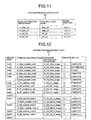
- Fig. 11 is a diagram of an example of the load distribution group data 760 stored as group information on the load balancer.
- the load distribution group data 760 includes information on the load distribution group name, the load balancer name, and representative IP.
- the load distribution group name is information for identifying the load distribution group.
- the load balancer name is a name for identifying the load balancer.
- the representative IP is information on an IP address assigned to each load distribution group.
- A_Web-AP is acquired as the network group name
- A_AP_LB is acquired as the load distribution group name
- AP_LB is acquired as the load balancer name.
- the distribution-image comparison processing unit 28g acquires information on the software distribution image associated with the server group to be processed. Specifically, referring to the server group data 720, it acquires the software-distribution image name and the version corresponding to the specified server group (step S104).
- A_OS_AP_image is acquired as the software-distribution image name, and 1.3 is acquired as the version.
- the server-group information acquisition processing unit 28d selects the server to be processed.
- the provisioning configuration data 730 acquires one of the servers that has not been updated with the software among the servers whose server group name matches the specified server group (step S105). If the server that has not been updated with the software is not present (YES at step S106), the process is terminated; otherwise (NO at step S106), the later process is continued.
- the server group specified as the target of the software updating process is the A_AP server group 310, a host 6 and a host 7 are to be serially selected, and it is assumed herein that the host 6 is selected at first.
- the distribution-image comparison processing unit 28g acquires information on the software distribution image that has been applied to the server to be processed, and compares it with the information on the software distribution image associated with the server group.
- distribution management data 770 it acquires the software-distribution image name and the version corresponding to the server selected at the step S105 (step S107), and compares it with the information acquired at the step S105 (step S108). If both of the software-distribution image name and the version match (NO at step S109), it is not necessary to update the software, and therefore the process returns to the step S105 and moves to another server. Otherwise (YES at step S109), the software updating process is executed.
- Fig. 12 is a diagram of an example of the distribution management data 770 stored as information on distribution status of the software distribution image.
- the distribution management data 770 includes information on the server name, the storage sub-group, the software-distribution image name, the version, and the status.
- the server name is information for identifying the server.
- the storage sub-group name is information for identifying a sub-group of a storage device in which the software distribution image is developed.
- the software-distribution image name is information for identifying the software distribution image that has been applied to the server.
- the version is information on the version of the software distribution image that has been applied to the server.
- the status is information indicative of the distribution status of the software distribution image.
- A_OS_AP_image is acquired as the software-distribution image name, and 1.2 is acquired as the version. In this case, because the version is different from the information associated with the server group, it is determined that the host 6 needs to be updated with the software.
- the network-configuration setting processing unit 28f disconnects the target server from the business network. Specifically, it instructs the load balancer acquired at the step S103 to suspend from assigning the process to the server (step S110). Moreover, it disconnects the server from the business LAN (step S111).
- the software-image distribution processing unit 28h and the software-image application processing unit 28i update the software. Specifically, they stop the service operating on the software (step S112), deliver necessary software image to the server (step S113), and apply it (step S114).
- Fig. 13 is a diagram of an example of the software distribution image management data 780 stored as information on the software distribution image.
- the software distribution image management data 780 includes information on the software-distribution image name, the version, a server architecture name, and a software image/snapshot name.
- the software-distribution image name is a name of the software distribution image.
- the version is the version of the software distribution image.
- the server architecture name is identification information for identifying a CPU architecture of the server to which the software distribution image is distributed.
- the software image/snapshot name is identification information for identifying a software image or a snapshot included in the software distribution image.
- the software-image application result confirming unit 28j executes the application-result confirming program corresponding to the software image, collects the result thereof (step S115), and, after confirming that the result is OK, updates the distribution management data 770 to the status in which the software has been updated (step S116). If the service of the server needs to have been resumed for executing the application-result confirming program, the steps S115 and S116 can be executed after a step S117.
- the software-image application processing unit 28i resumes the service of the server (step S117), the network-configuration setting processing unit 28f reconnects the server to the business LAN (step S118), and it instructs the load balancer to resume assigning the process to the server (step S119).
- the process resumes from the step S105 to update another server.
- the software updating apparatus executes the software updating process using the system resource information managed in a manner integrated with network devices, the total process can be automated even if the procedure is as complicated as the rolling application.
- the version associated with the server group differs from the version in the server, and therefore, it is determined that each server in the A_AP server group 310 needs to be updated with the software at the step S108.
- the steps S114 and S115 by comparing the information in the software distribution image management data 780, it is determined that the patch_a needs to be deleted, and the uninstall program for the software image is executed.
- This processing procedure can be used for software configuration when a server is added to the server group. As already explained, there are pools in a domain, and an unused server belongs to it. If load on any one of the server groups in the domain increases, the load can be reduced by adding the server in the pool to the server group with the heavy load.
- the software configuration in the server to be added needs to be identical to that in other servers in the server group. If a long time has passed since other servers were configured, it is a very difficult work to manually configure a server with the identical software configuration including application of patches, and an erroneous operation is likely to occur such as omission to apply a patch.
- a necessary software image is automatically introduced and an unnecessary software image is automatically deleted so that it is configured exactly as the software distribution image associated with the server group only by moving the server in the pool to the server group and having it execute the software updating process.
- the software updating method according to the embodiment is advantageous for addition of servers, which does not cause erroneous operations, and the work time is short.
- the server belonging to the pool can be configured to have the same software configuration as a certain server group in expectation of the application. By doing so, when the load on the server group increases, the server belonging to the pool can be added and operated in a short time.
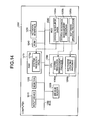
- Fig. 14 is a diagram of a hardware configuration of a computer 1200 that operates as the software updating apparatus 20 shown in Fig. 3.
- the computer 1200 is configured with an input device 1210 that receives data input from the user, a monitor 1220, a medium reader 1230 that reads a program from a recording medium that stores therein various programs, a ROM (Read Only Memory) 1240, a network interface 1250 that exchanges data with other computers via the network, an HDD (Hard Disk Drive) 1260, a RAM (Random Access Memory) 1270, and a CPU (Central Processing Unit) 1280, each connected with a bus 1290.
- an input device 1210 that receives data input from the user
- a monitor 1220 receives data input from the user
- a medium reader 1230 that reads a program from a recording medium that stores therein various programs
- ROM Read Only Memory
- network interface 1250 that exchanges data with other computers via the network
- an HDD (Hard Disk Drive) 1260
- the HDD 1260 stores therein programs that realize same functions as the software updating apparatus 20, i.e., a system-resource managing program 1260b and a software updating program 1260c shown in Fig. 14.
- the system-resource managing program 1260b and the software updating program 1260c can be integrated or disintegrated as needed to be stored.
- the system-resource managing process 1280a corresponds to the system resource manager 21, the server RM 22, the software RM 23, the network RM 24, and the storage RM 25 shown in Fig. 3.
- the software updating process 1280b corresponds to the processing unit 28b shown in Fig. 3.
- the HDD 1260 stores therein system resource data 1260a.
- the system resource data 1260a corresponds to various data stored in the system resource DB 26 shown in Fig. 3.
- the CPU 1280 stores therein various data related to management of the resources as the system resource data 1260a, reads the system resource data 1260a from the HDD 1260, stores it in the RAM 1270, and executes various data processes based on system resource data 1270a stored in the RAM 1270.
- the system resource DB 26 stores therein configuration information including the network devices such as the load balancer and the software updating process is performed based on the information stored in it. Therefore, a software updating process as complicated as the rolling application of a patch to servers that operate in parallel via the load balancer can be automated, whereby preventing occurrence of a trouble due to an erroneous operation.
- all or part of the processes explained to be automatically executed can be manually executed. Otherwise, all or part of the processes explained to be manually executed can be automatically executed using a known method.
- each processing function performed by each device can be realized by a CPU or a program analyzed and executed by the CPU, or it can be realized as wired logic hardware.
- the software updating program, the software updating apparatus, and the software updating method according to the present invention is advantageous for automation of software update in an information processing apparatus, and specifically suitable for automation of the software update in an information processing apparatus operated in a complicated operation mode.
Landscapes
- Engineering & Computer Science (AREA)
- Computer Networks & Wireless Communication (AREA)
- Signal Processing (AREA)
- General Engineering & Computer Science (AREA)
- Software Systems (AREA)
- Theoretical Computer Science (AREA)
- Computer Security & Cryptography (AREA)
- Physics & Mathematics (AREA)
- General Physics & Mathematics (AREA)
- Computer Hardware Design (AREA)
- Information Transfer Between Computers (AREA)
- Stored Programmes (AREA)
Applications Claiming Priority (1)
| Application Number | Priority Date | Filing Date | Title |
|---|---|---|---|
| PCT/JP2004/015035 WO2006040810A1 (fr) | 2004-10-12 | 2004-10-12 | Programme de mise a jour de logiciel, dispositif de mise a jour de logiciel et procede de mise a jour de logiciel |
Publications (2)
| Publication Number | Publication Date |
|---|---|
| EP1832976A1 true EP1832976A1 (fr) | 2007-09-12 |
| EP1832976A4 EP1832976A4 (fr) | 2009-04-29 |
Family
ID=36148112
Family Applications (1)
| Application Number | Title | Priority Date | Filing Date |
|---|---|---|---|
| EP04792279A Withdrawn EP1832976A4 (fr) | 2004-10-12 | 2004-10-12 | Programme de mise a jour de logiciel, dispositif de mise a jour de logiciel et procede de mise a jour de logiciel |
Country Status (4)
| Country | Link |
|---|---|
| US (1) | US7716373B2 (fr) |
| EP (1) | EP1832976A4 (fr) |
| JP (1) | JPWO2006040810A1 (fr) |
| WO (1) | WO2006040810A1 (fr) |
Cited By (8)
| Publication number | Priority date | Publication date | Assignee | Title |
|---|---|---|---|---|
| WO2011086180A1 (fr) * | 2010-01-18 | 2011-07-21 | Thomson Licensing | Procédé, système et dispositif destinés à l'exécution d'un logiciel |
| US20110191477A1 (en) * | 2010-02-03 | 2011-08-04 | Vmware, Inc. | System and Method for Automatically Optimizing Capacity Between Server Clusters |
| WO2012035576A1 (fr) * | 2010-09-14 | 2012-03-22 | Hitachi, Ltd. | Système de stockage stockant des modules électroniques appliqués à des objets électroniques communs à plusieurs ordinateurs, et son procédé de commande de stockage |
| EP2487591A4 (fr) * | 2009-10-07 | 2015-07-29 | Nec Corp | Système informatique et procédé de maintenance de système informatique |
| US9690567B2 (en) | 2013-09-10 | 2017-06-27 | International Business Machines Corporation | Runtime detection of software configurations and upgrades |
| EP3410293A1 (fr) * | 2017-05-16 | 2018-12-05 | Palantir Technologies Inc. | Systèmes et procédés de déploiement de configuration continu |
| US10353699B1 (en) | 2017-06-26 | 2019-07-16 | Palantir Technologies Inc. | Systems and methods for managing states of deployment |
| US11586428B1 (en) | 2018-06-04 | 2023-02-21 | Palantir Technologies Inc. | Constraint-based upgrade and deployment |
Families Citing this family (52)
| Publication number | Priority date | Publication date | Assignee | Title |
|---|---|---|---|---|
| US6751794B1 (en) * | 2000-05-25 | 2004-06-15 | Everdream Corporation | Intelligent patch checker |
| US7433546B2 (en) * | 2004-10-25 | 2008-10-07 | Apple Inc. | Image scaling arrangement |
| JP4734258B2 (ja) * | 2004-10-18 | 2011-07-27 | 富士通株式会社 | 運用管理プログラム、運用管理方法および運用管理装置 |
| JP4734259B2 (ja) * | 2004-10-18 | 2011-07-27 | 富士通株式会社 | 運用管理プログラム、運用管理方法および運用管理装置 |
| JP4874807B2 (ja) * | 2004-10-20 | 2012-02-15 | 富士通株式会社 | サーバ管理プログラム、サーバ管理方法、およびサーバ管理装置 |
| US7447166B1 (en) * | 2004-11-02 | 2008-11-04 | Cisco Technology, Inc. | Method to distribute IEEE 802.1X authenticated users among multiple broadcast domains |
| US8140644B2 (en) * | 2005-02-24 | 2012-03-20 | International Business Machines Corporation | Method and apparatus for updating application servers |
| CN1869932A (zh) * | 2005-05-24 | 2006-11-29 | 中国银联股份有限公司 | 实现数据升级的计算机处理系统以及数据升级方法 |
| US9418040B2 (en) * | 2005-07-07 | 2016-08-16 | Sciencelogic, Inc. | Dynamically deployable self configuring distributed network management system |
| US7930369B2 (en) | 2005-10-19 | 2011-04-19 | Apple Inc. | Remotely configured media device |
| JP5033455B2 (ja) * | 2007-03-29 | 2012-09-26 | 株式会社日本総合研究所 | 情報処理システム及び情報処理システムをバージョンアップするためのプログラム |
| JP5024610B2 (ja) * | 2007-05-31 | 2012-09-12 | ソニー株式会社 | 情報処理システム、情報処理装置、情報処理方法、及びプログラム |
| US20090063650A1 (en) * | 2007-09-05 | 2009-03-05 | International Business Machines Corporation | Managing Collections of Appliances |
| US8589909B2 (en) * | 2008-01-10 | 2013-11-19 | Oracle International Corporation | Techniques for reducing down time in updating applications with metadata |
| JP2009199361A (ja) * | 2008-02-21 | 2009-09-03 | Fujitsu Fip Corp | サーバ構築方法、同方法用コンピュータソフトウェアおよび記憶媒体 |
| US20090265699A1 (en) * | 2008-04-18 | 2009-10-22 | Telefonaktiebolaget Lm Ericsson (Publ) | Methods and systems for embedding upgrade steps for layered architectures |
| JP5326557B2 (ja) * | 2008-12-25 | 2013-10-30 | 富士通株式会社 | 資源配付システム |
| US8584113B2 (en) * | 2009-11-09 | 2013-11-12 | Bank Of America Corporation | Cross-updating of software between self-service financial transaction machines |
| US9128799B2 (en) | 2009-11-09 | 2015-09-08 | Bank Of America Corporation | Programmatic creation of task sequences from manifests |
| US8972974B2 (en) | 2009-11-09 | 2015-03-03 | Bank Of America Corporation | Multiple invocation points in software build task sequence |
| US20110113416A1 (en) * | 2009-11-09 | 2011-05-12 | Bank Of America Corporation | Network-Enhanced Control Of Software Updates Received Via Removable Computer-Readable Medium |
| US20110113226A1 (en) * | 2009-11-09 | 2011-05-12 | Bank Of America Corporation | Distribution Of Software Updates |
| US9176898B2 (en) | 2009-11-09 | 2015-11-03 | Bank Of America Corporation | Software stack building using logically protected region of computer-readable medium |
| US9122558B2 (en) | 2009-11-09 | 2015-09-01 | Bank Of America Corporation | Software updates using delta patching |
| US20110138374A1 (en) * | 2009-12-09 | 2011-06-09 | Suprio Pal | Downtime reduction for enterprise manager patching |
| WO2011136261A1 (fr) * | 2010-04-28 | 2011-11-03 | 日本電気株式会社 | Système de stockage, procédé de commande pour système de stockage, et programme d'ordinateur |
| JP5513997B2 (ja) * | 2010-06-07 | 2014-06-04 | 日本電信電話株式会社 | 通信システムおよび通信システム更新方法 |
| JP2012155689A (ja) * | 2011-01-28 | 2012-08-16 | Nippon Telegr & Teleph Corp <Ntt> | ソフトウェアイメージ配信方法およびシステム |
| JP5667506B2 (ja) * | 2011-04-27 | 2015-02-12 | 日本電信電話株式会社 | クラスタシステムおよびソフトウェアアップデート方法 |
| JP5681795B2 (ja) * | 2011-05-17 | 2015-03-11 | 株式会社日立製作所 | 計算機システムと計算機システムの情報処理方法及び情報処理プログラム |
| JP5928475B2 (ja) * | 2011-10-14 | 2016-06-01 | 富士通株式会社 | 管理装置、管理プログラムおよび管理方法 |
| JP5750072B2 (ja) * | 2012-03-01 | 2015-07-15 | 日本電信電話株式会社 | クラスタシステム |
| JP6102220B2 (ja) * | 2012-11-28 | 2017-03-29 | 株式会社リコー | 画像処理システム及びその情報処理方法 |
| US8891516B2 (en) * | 2013-01-15 | 2014-11-18 | International Business Machines Corporation | Extended link aggregation (LAG) for use in multiple switches |
| WO2014132954A1 (fr) * | 2013-02-26 | 2014-09-04 | 日本電気株式会社 | Système et procédé de communication, dispositif de commande et programme associé |
| US9430214B2 (en) * | 2013-03-07 | 2016-08-30 | Telefonaktiebolaget L M Ericsson (Publ) | System upgrade under high availability constraints |
| US20150149563A1 (en) * | 2013-11-26 | 2015-05-28 | At&T Intellectual Property I, L.P. | Intelligent machine-to-machine (im2m) reserve |
| KR102271265B1 (ko) | 2014-01-21 | 2021-07-01 | 오라클 인터내셔날 코포레이션 | 어플리케이션 서버, 클라우드 또는 다른 환경에서 멀티 테넌시를 지원하기 위한 시스템 및 방법 |
| US10318280B2 (en) | 2014-09-24 | 2019-06-11 | Oracle International Corporation | System and method for supporting patching in a multitenant application server environment |
| WO2016049376A1 (fr) | 2014-09-24 | 2016-03-31 | Oracle International Corporation | Système et procédé de prise en charge de corrections dans un environnement de serveur d'applications partagées |
| WO2017019108A1 (fr) | 2015-07-30 | 2017-02-02 | Hewlett Packard Enterprise Development Lp | Mise à jour de micrologiciel d'un dispositif d'interconnexion |
| US9740473B2 (en) | 2015-08-26 | 2017-08-22 | Bank Of America Corporation | Software and associated hardware regression and compatibility testing system |
| US10484512B2 (en) | 2015-08-31 | 2019-11-19 | Ayla Networks, Inc. | Management of multi-radio gateway device using virtual gateway device |
| US10404832B2 (en) * | 2015-08-31 | 2019-09-03 | Ayla Networks, Inc. | Management of gateway device using virtual gateway device |
| JP6323433B2 (ja) * | 2015-11-13 | 2018-05-16 | キヤノンマーケティングジャパン株式会社 | 情報処理システム、管理サーバ、制御方法、プログラム |
| US11243755B1 (en) * | 2016-06-22 | 2022-02-08 | Amazon Technologies, Inc. | Resource aware patching service |
| US11237814B2 (en) | 2017-08-17 | 2022-02-01 | Oracle International Corporation | System and method for supporting custom hooks during patching in an application server environment |
| US20190213268A1 (en) * | 2018-01-10 | 2019-07-11 | Red Hat, Inc. | Dynamic subtree pinning in storage systems |
| US10841157B2 (en) | 2018-03-23 | 2020-11-17 | Netapp, Inc. | Dynamic network discovery service for system deployment and validation |
| EP3984196A4 (fr) * | 2019-06-11 | 2023-06-07 | Net-Thunder, LLC | Système et procédé des technologies de l'information (it) déployés automatiquement à sécurité améliorée |
| US10992532B1 (en) * | 2020-01-15 | 2021-04-27 | EMC IP Holding Company LLC | Automated network configuration changes for I/O load redistribution |
| US12169709B2 (en) * | 2022-03-30 | 2024-12-17 | Kyndryl, Inc. | Contextually cognitive edge server manager |
Family Cites Families (12)
| Publication number | Priority date | Publication date | Assignee | Title |
|---|---|---|---|---|
| JP2550901B2 (ja) * | 1993-11-29 | 1996-11-06 | 日本電気株式会社 | 端末プログラムダウンロード方式 |
| JP3160149B2 (ja) * | 1994-05-13 | 2001-04-23 | 株式会社日立製作所 | ディスク制御装置の無停止プログラム変更方法およびディスク制御装置 |
| ATE392660T1 (de) * | 1998-03-03 | 2008-05-15 | Siebel Systems Inc | Verfahren, system, gerät und programm zur verteilung und einführung von software-upgrade |
| US6725261B1 (en) * | 2000-05-31 | 2004-04-20 | International Business Machines Corporation | Method, system and program products for automatically configuring clusters of a computing environment |
| US7149792B1 (en) * | 2000-11-20 | 2006-12-12 | Axeda Corporation | Device registration mechanism |
| JP2002163241A (ja) * | 2000-11-29 | 2002-06-07 | Ntt Data Corp | クライアントサーバシステム |
| JP2003015894A (ja) * | 2001-06-28 | 2003-01-17 | Nec Corp | パッチ適用方式、パッチ適用方法およびパッチ用プログラム |
| JP2003108255A (ja) | 2001-09-27 | 2003-04-11 | Cognitive Research Laboratories Inc | グループ管理ファイアウォールシステム |
| JP2003296132A (ja) | 2002-03-29 | 2003-10-17 | Mitsubishi Electric Corp | パッチ適用システム及びパッチ適用方法及びパッチ適用プログラム |
| JP2003316581A (ja) * | 2002-04-24 | 2003-11-07 | Hitachi Ltd | ソフトウェアインストール装置 |
| US7522906B2 (en) * | 2002-08-09 | 2009-04-21 | Wavelink Corporation | Mobile unit configuration management for WLANs |
| US8180860B2 (en) * | 2004-08-24 | 2012-05-15 | International Business Machines Corporation | Wireless device configuration management |
-
2004
- 2004-10-12 JP JP2006540794A patent/JPWO2006040810A1/ja active Pending
- 2004-10-12 EP EP04792279A patent/EP1832976A4/fr not_active Withdrawn
- 2004-10-12 WO PCT/JP2004/015035 patent/WO2006040810A1/fr not_active Ceased
-
2007
- 2007-04-11 US US11/786,438 patent/US7716373B2/en not_active Expired - Fee Related
Cited By (23)
| Publication number | Priority date | Publication date | Assignee | Title |
|---|---|---|---|---|
| EP2487591A4 (fr) * | 2009-10-07 | 2015-07-29 | Nec Corp | Système informatique et procédé de maintenance de système informatique |
| US9804884B2 (en) | 2009-10-07 | 2017-10-31 | Nec Corporation | Computer system and maintenance method of computer system |
| US10534632B2 (en) | 2009-10-07 | 2020-01-14 | Nec Corporation | Computer system and maintenance method of computer system |
| US9361149B2 (en) | 2009-10-07 | 2016-06-07 | Nec Corporation | Computer system and maintenance method of computer system |
| WO2011086180A1 (fr) * | 2010-01-18 | 2011-07-21 | Thomson Licensing | Procédé, système et dispositif destinés à l'exécution d'un logiciel |
| US9229699B2 (en) | 2010-01-18 | 2016-01-05 | Thomson Licensing | Method, system and device for execution of a software application |
| US11336576B2 (en) | 2010-02-03 | 2022-05-17 | Vmware, Inc. | System and method for automatically optimizing capacity between server clusters |
| US20150046586A1 (en) * | 2010-02-03 | 2015-02-12 | Vmware, Inc. | System and method for automatically optimizing capacity between server clusters |
| US8874744B2 (en) * | 2010-02-03 | 2014-10-28 | Vmware, Inc. | System and method for automatically optimizing capacity between server clusters |
| US20110191477A1 (en) * | 2010-02-03 | 2011-08-04 | Vmware, Inc. | System and Method for Automatically Optimizing Capacity Between Server Clusters |
| US10116568B2 (en) * | 2010-02-03 | 2018-10-30 | Vmware, Inc. | System and method for automatically optimizing capacity between server clusters |
| US8566541B2 (en) | 2010-09-14 | 2013-10-22 | Hitachi, Ltd. | Storage system storing electronic modules applied to electronic objects common to several computers, and storage control method for the same |
| WO2012035576A1 (fr) * | 2010-09-14 | 2012-03-22 | Hitachi, Ltd. | Système de stockage stockant des modules électroniques appliqués à des objets électroniques communs à plusieurs ordinateurs, et son procédé de commande de stockage |
| US9690564B2 (en) | 2013-09-10 | 2017-06-27 | International Business Machines Corporation | Runtime detection of software configurations and upgrades |
| US9690567B2 (en) | 2013-09-10 | 2017-06-27 | International Business Machines Corporation | Runtime detection of software configurations and upgrades |
| US10263845B2 (en) | 2017-05-16 | 2019-04-16 | Palantir Technologies Inc. | Systems and methods for continuous configuration deployment |
| EP3410293A1 (fr) * | 2017-05-16 | 2018-12-05 | Palantir Technologies Inc. | Systèmes et procédés de déploiement de configuration continu |
| US11924035B2 (en) | 2017-05-16 | 2024-03-05 | Palantir Technologies Inc. | Systems and methods for continuous configuration deployment |
| US10353699B1 (en) | 2017-06-26 | 2019-07-16 | Palantir Technologies Inc. | Systems and methods for managing states of deployment |
| US11003440B2 (en) | 2017-06-26 | 2021-05-11 | Palantir Technologies Inc. | Systems and methods for managing states of deployment |
| US11537393B2 (en) | 2017-06-26 | 2022-12-27 | Palantir Technologies Inc. | Systems and methods for managing states of deployment |
| US11586428B1 (en) | 2018-06-04 | 2023-02-21 | Palantir Technologies Inc. | Constraint-based upgrade and deployment |
| US12487812B2 (en) | 2018-06-04 | 2025-12-02 | Palantir Technologies Inc. | Constraint-based upgrade and deployment |
Also Published As
| Publication number | Publication date |
|---|---|
| US20070244999A1 (en) | 2007-10-18 |
| EP1832976A4 (fr) | 2009-04-29 |
| US7716373B2 (en) | 2010-05-11 |
| WO2006040810A1 (fr) | 2006-04-20 |
| JPWO2006040810A1 (ja) | 2008-05-15 |
Similar Documents
| Publication | Publication Date | Title |
|---|---|---|
| EP1832976A1 (fr) | Programme de mise a jour de logiciel, dispositif de mise a jour de logiciel et procede de mise a jour de logiciel | |
| US8015275B2 (en) | Computer product, method, and apparatus for managing operations of servers | |
| DE102004052270B4 (de) | Verarbeitungsvorrichtungs-Managementsystem | |
| US7971089B2 (en) | Switching connection of a boot disk to a substitute server and moving the failed server to a server domain pool | |
| EP2043320B1 (fr) | Procédé et système pour la fourniture de serveur automatique et à distance à l'aide d'appareil de machines virtuelles | |
| US8224941B2 (en) | Method, apparatus, and computer product for managing operation | |
| JP2021506044A (ja) | 自動的に配備される情報技術(it)システム及び方法 | |
| JP2003022258A (ja) | サーバーのバックアップシステム | |
| US20070027973A1 (en) | Virtual data center for network resource management | |
| US20070234351A1 (en) | Method, apparatus, and computer product for managing operation | |
| US20160054993A1 (en) | Modular architecture for distributed system management | |
| JP2013218687A (ja) | サーバー監視システム及びその方法 | |
| US20070237162A1 (en) | Method, apparatus, and computer product for processing resource change | |
| US11860776B2 (en) | Concurrent memory recycling for collection of servers | |
| CN107453888B (zh) | 高可用性的虚拟机集群的管理方法及装置 | |
| EP1811397A1 (fr) | Programme de gestion d'operations, procede de gestion d'operations et dispositif de gestion d'operations | |
| JP7485055B2 (ja) | 管理システム、管理方法及び管理プログラム | |
| JPH1027146A (ja) | 通信処理装置及び通信処理方法 | |
| JP7643561B2 (ja) | 管理装置、管理方法及び管理プログラム | |
| CN121125662B (zh) | 虚拟机网络的检测方法、装置、设备、存储介质及程序 | |
| JP3981342B2 (ja) | 計算機の運用管理方法及び装置 | |
| CN118550712A (zh) | 云平台容灾的方法、装置、设备、介质及产品 | |
| CN119806729A (zh) | 跨存储池的云主机迁移方法 | |
| HK40045134A (en) | Automatically deployed information technology (it) system and method |
Legal Events
| Date | Code | Title | Description |
|---|---|---|---|
| PUAI | Public reference made under article 153(3) epc to a published international application that has entered the european phase |
Free format text: ORIGINAL CODE: 0009012 |
|
| 17P | Request for examination filed |
Effective date: 20070510 |
|
| AK | Designated contracting states |
Kind code of ref document: A1 Designated state(s): DE FR GB |
|
| DAX | Request for extension of the european patent (deleted) | ||
| RBV | Designated contracting states (corrected) |
Designated state(s): DE FR GB |
|
| A4 | Supplementary search report drawn up and despatched |
Effective date: 20090330 |
|
| 17Q | First examination report despatched |
Effective date: 20110324 |
|
| STAA | Information on the status of an ep patent application or granted ep patent |
Free format text: STATUS: THE APPLICATION IS DEEMED TO BE WITHDRAWN |
|
| 18D | Application deemed to be withdrawn |
Effective date: 20110503 |