EP1832987B1 - Inhaltsdaten-suchvorrichtung - Google Patents
Inhaltsdaten-suchvorrichtung Download PDFInfo
- Publication number
- EP1832987B1 EP1832987B1 EP05790249.6A EP05790249A EP1832987B1 EP 1832987 B1 EP1832987 B1 EP 1832987B1 EP 05790249 A EP05790249 A EP 05790249A EP 1832987 B1 EP1832987 B1 EP 1832987B1
- Authority
- EP
- European Patent Office
- Prior art keywords
- search word
- range
- impression
- music
- search
- Prior art date
- Legal status (The legal status is an assumption and is not a legal conclusion. Google has not performed a legal analysis and makes no representation as to the accuracy of the status listed.)
- Expired - Lifetime
Links
Images






Classifications
-
- G—PHYSICS
- G06—COMPUTING OR CALCULATING; COUNTING
- G06F—ELECTRIC DIGITAL DATA PROCESSING
- G06F16/00—Information retrieval; Database structures therefor; File system structures therefor
- G06F16/20—Information retrieval; Database structures therefor; File system structures therefor of structured data, e.g. relational data
- G06F16/24—Querying
- G06F16/245—Query processing
- G06F16/2452—Query translation
- G06F16/24522—Translation of natural language queries to structured queries
-
- G—PHYSICS
- G06—COMPUTING OR CALCULATING; COUNTING
- G06F—ELECTRIC DIGITAL DATA PROCESSING
- G06F16/00—Information retrieval; Database structures therefor; File system structures therefor
- G06F16/40—Information retrieval; Database structures therefor; File system structures therefor of multimedia data, e.g. slideshows comprising image and additional audio data
- G06F16/48—Retrieval characterised by using metadata, e.g. metadata not derived from the content or metadata generated manually
Definitions
- the present invention relates to a content data retrieval apparatus which retrieves content data.
- an attribute value indicating a content attribute is assigned to each content data, for example.
- the search word is converted into information indicating the range of the attribute value associated with the search word. Then, the pieces of content data specified by the attribute values included in the range of the attribute value are outputted as search results.
- Such content data retrieving system includes a music retrieval system for retrieving music data using impression words (e.g. Patent Reference 1).
- An impression word is a qualitative word representing an impression on music content, e.g., "relaxing”.
- an impression value being an index value representing an impression on the music is set in advance for each music data.
- an impression word inputted as a search word is converted to indicate the range of the corresponding impression value.
- the respective music data specified by the impression values included in the range of the impression value are retrieved as search results.
- the music retrieval system is applied, for example, to car navigation apparatuses and PC music playback software.
- Patent Reference 1 Japanese Laid-Open Patent Application No. 2004-86189 .
- the range of the impression value associated with an impression word is determined in a fixed manner. Therefore, in the case where the distribution of the impression values of respective pieces of music regarded as search targets is uneven, music is searched out only in the case of conducting a search using a specific impression word.
- a search target is a group of music obtained as a result of conducting a search using a specific artist's name
- the impressions of many pieces of music are similar. That is to say that the absolute positions, within a space where impression values are presented, of the impression values of the respective pieces of music are close to each other. Therefore, in the case of conducting a search using an impression word, numerous pieces of music are selected for a specific impression word whereas no music is retrieved for an impression word other than that specific impression word.
- the range of the impression word intended by the user differs, e.g., the impression word "relaxing" used for the music performed by a rock artist who sings intensive music differs from the impression word "relaxing” used for the music performed by a female artist who sings calm music.
- the user subconsciously knows that the possible range of impression values of music differs depending on an artist or a genre of the music, and thus represents, with an impression word, an impression relatively perceived in a group of music performed by the artist.
- the conventional music retrieval system using impression words does not take this point into consideration.
- the present invention is conceived in view of the above problem, and an object of the present invention is to provide a content data retrieval apparatus which retrieves, using a search word, the content data associated with an attribute value indicating a content attribute, and which appropriately narrows down the range of search targets even in the case where the distribution of attribute values for a group of contents regarded as search targets is uneven.
- the content data retrieval apparatus of the present invention is a content data retrieval apparatus as defined in claim 1.
- the content data retrieval apparatus of the present invention can modify the relative relationship between a distribution range of attribute values and a range of search word according to the distribution of the attribute values of respective content data to be a search target. Moreover, it is possible to retrieve content data using an inputted search word in the modified relative relationship between the distribution range of attribute value and the range of search word. Therefore, it is thus possible to appropriately narrow down the range of the search target even in the case where the distribution of the attribute values of the respective content data regarded as search targets is uneven.
- the modification unit modifies the search word range read from the conversion table by reducing the size of the search word range and by moving the reduced-size search word range, so that the range is included in the distribution range, and the retrieval unit retrieves the content data corresponding to the search word, by searching the attribute values included in the search word range that is associated with the search word received by the receiving unit and that is modified by the modification unit.
- the present invention can be realized as a method which includes, as steps, the characteristic components of the content data retrieval apparatus of the present invention, or as a program that includes such steps, or as a storage medium such as a CD-ROM in which the program is stored, and even as an integrated circuit.
- a program can be distributed via a transmitting media such as a communication network.
- the content data retrieval apparatus of the present invention it is possible to modify the relative relationship between the distribution range of attribute value and the range of search word according to the distribution of the attribute values of the respective content data regarded as search targets.
- the range of the search target can be appropriately narrowed down.
- FIG. 1 is a block diagram showing the functional configuration of a music retrieval apparatus 100 according to the example of the present invention.
- the music retrieval apparatus 100 shown in FIG. 1 is an example of the content data retrieval apparatus of the present invention, and is an apparatus which retrieves music data using an impression word specified as a search word by the user.
- the music retrieval apparatus 100 can be realized as an apparatus equipped with a music retrieval function, such as an audio device, a home server, an in-vehicle AV server, a music player for cell phones and a mobile terminal which can store a large amount of music data and playback the stored data.
- a music retrieval function such as an audio device, a home server, an in-vehicle AV server, a music player for cell phones and a mobile terminal which can store a large amount of music data and playback the stored data.
- a music retrieval function such as an audio device, a home server, an in-vehicle AV server, a music player for cell phones and a mobile terminal which can store a large amount of music data and playback the stored data.
- the music retrieval apparatus 100 includes a search results storage unit 101, a music data storage unit 105, a receiving unit 107, a conversion table storage unit 108, a range modification unit 109, a conversion unit 110, a retrieval unit 111, an impression value calculation unit 106, and an output unit 120.
- the music data storage unit 105 includes a music database 102, a music information database 103 and an impression value database 104.
- the search results storage unit 101 is a storage apparatus which stores information related to the results of the search conducted by the music retrieval apparatus 100.
- the information related to search results is information such as a music ID of the retrieved music data and an impression word being a search word used for the retrieval.
- a music ID is an identifier for identifying respective pieces of music.
- the music data storage unit 105 is a constituent unit that stores numerous pieces of music data, music information and impression values in association with one another. To be more specific, such music data, music information, and impression values are stored in the music database 102, the music information database 103 and the impression value database 104, respectively. The information and the data stored in the respective databases are associated by music IDs.
- the music data stored in the music database 102 is a music signal of a piece of music. Numerous music signals are stored in the music database 102. These music signals are each associated with a music ID, and a desired music signal is called out by specifying a music ID. In addition, such music signals are wave form data compliant with linear PCM or compressed data compliant with MP3, AAC or the like.
- the music information stored in the music information database 103 is information related to music, such as artist's name, title of album, genre, year of release and name of composer.
- the music information of respective pieces of music is stored in association with a music ID.
- An impression value stored in the impression value database 104 is calculated by the impression value calculation unit 106. Such impression value is stored in association with a music ID.
- the impression values stored in the impression value database 104 will be mentioned later with reference to FIG. 2 .
- an impression value is an example of an attribute value used in the content data retrieval apparatus of the present invention
- the impression value database 104 is an example of the attribute value storage unit in the content data retrieval apparatus of the present invention.
- the receiving unit 107 is a processing unit which receives an impression word specified by the user.
- the impression words according to the example are phrases representing impressions of music and words to intuitively express music, e.g., "uptempo” "pop” and "healing”.
- the conversion table storage unit 108 is a storage apparatus which stores an impression word conversion table in which an impression word is associated with information indicating a range of impression values (hereinafter to be referred to as "impression word range") associated with the impression word.
- impression word range a range of impression values
- the range modification unit 109 is a processing unit for solving the problems of the conventional music retrieval system using impression words, and is also a processing unit which obtains an impression word conversion table from the conversion table storage unit 108 and modifies the detail of the obtained impression word conversion table according to the distribution of the impression values of the respective pieces of music regarded as search targets.
- a concrete method for the range modification unit 109 to modify the detail of the impression word conversion table read out from the conversion table storage unit 108 will be mentioned later with reference to FIGS. 4 and 5 .
- the conversion unit 110 is a processing unit which converts information indicating a range of the impression values (hereinafter to be referred to as "impression word range") associated with the impression word specified by the user, using the impression word conversion table modified by the range modification unit 109.
- impression word range is an example of the search word range applied in the content data retrieval apparatus of the present invention.
- the retrieval unit 111 is a processing unit which retrieves multiple music data corresponding to an impression word specified by the user, by searching the impression values included in an impression word range.
- the output unit 120 is a processing unit for outputting, to the user, the results of the search conducted by the retrieval unit 111. Note that the search results outputted by the output unit 120 are presented to the user by a display apparatus not illustrated in the diagram.
- the impression value calculation unit 106 is a processing unit which calculates an impression value of a piece of music based on the music data stored in the music database 102. Specifically, the impression value calculation unit 106 analyzes a physical feature quantity of the music signal inputted from the music database 102, and calculates an impression value to which the feature quantity is weighted.
- a spectrum change degree (a degree at which a spectrum changes between frames of predetermined time length); an average pronunciation frequency (a pronunciation frequency of a sound pronounced in music); an aperiodic degree of pronunciation (an aperiodic degree of a sound pronounced in music); a beat cycle (a time length equivalent to quarter note in music); a beat cycle ratio (a strength of a sound pronounced in a cycle equivalent to quarter note in music); and a beat strength ratio (a ratio of first beat strength and second beat strength).
- the impression value calculation unit 106 performs predetermined weighting addition to the feature quantity obtained through the analysis so as to calculate an impression value.
- One or more types of impression values are calculated for one piece of music. Also, predetermined maximum value and minimum value which are possibly indicated by an impression value are set.
- music can be represented as a dot in a two-dimensional space.
- music is represented as a dot in a five-dimensional space.
- each piece of the music stored in the music database 102 has coordinate values which reflect the respective impression values in such a space. It is therefore possible to discriminate one piece of the music stored in the music database 102 from another piece based on a pair of these impression values.
- an impression value is an index value presenting an impression such as sensation and emotion that arises when one listens to the music, e.g. intensiveness, dynamism, exhilaration, simplicity and softness. Impression values can be thus expressed as linear or non-linear function presenting feature quantities of plural types as described above. For example, with the use of five types of impression values such as intensiveness, dynamism, exhilaration, simplicity and softness, music is represented by a dot in a five-dimensional space.
- impression space Such a spatial coordinate system in which impression values of music are distributed is hereinafter referred to as "impression space".
- An impression value is a quantity which indicates an impression that one receives in listening to the music. Therefore, when the impression values of respective pieces of music are placed in an impression space, the impression values are placed in accordance with similarity between the impressions on the respective music. That is to say that the plural pieces of music giving similar impressions are placed in the positions close to each other even in the impression space.
- impression value X being an impression value based on the emotional factor
- impression value Y being an impression value based on the active factor
- FIG. 2 is a diagram showing an example of the impression value data stored in the impression value database 104.
- two impression values are associated with each other for each music ID, and a pair of the two impression values can be handled as a coordinate value indicating one dot in a two-dimensional space.
- a coordinate value of a given music can be treated as an index indicating an impression of the music, for instance, "dynamic and exhilarating". Therefore, a coordinate value made up of one or more impression values is also regarded as an "impression value" of the music.
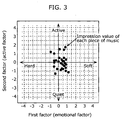
- FIG. 3 is a conceptual diagram showing an example of the impression space according to the example.
- the impression space of the example is, as described above, two-dimensional and the more right a coordinate value is located, more "Soft” an impression of a piece of music is and the more left a coordinate value is located, more "Hard” an impression of a piece of music is.
- the upper a coordinate value is located, more "Active” an impression of a piece of music is and the lower a coordinate value is located, more "Quiet” an impression of a piece of music is.
- the two-dimensional impression space has a predetermined size.
- both of a horizontal direction (X-axis direction) and a vertical direction (Y-axis direction) are ranged from -4 to +4, as shown in FIG. 3 . That is to say, the smallest values of the impression values X and Y are -4 while the largest values thereof are +4.
- the respective dots in the impression space shown in FIG. 3 correspond to one piece of music except for the case where there exist plural pieces of music having the same impression values.
- the dots in the impression space shown in FIG. 3 are lopsidedly inclined toward the center. In other words, it can be said that the impressions of many pieces of the music indicated by the dots within the impression space are similar.
- the range modification unit 109 modifies, as described above, the detail of the impression word conversion table obtained from the conversion table storage unit 108, according to the distribution of the impression values within an impression space.
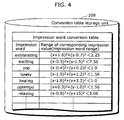
- FIG. 4 is a diagram showing an example of the data structure of the impression word conversion table stored in the conversion table storage unit 108.
- An impression word conversion table is a table for converting an impression word specified as a search word by the user into information indicating an impression word range.
- the impression words such as "exhilarating" and "pop" are set in the impression word conversion table.
- the user can specify an impression word to be used as a search word from among the impression words already set in the impression word conversion table, using an input apparatus (not illustrated in FIG. 1 ) such as a mouse.
- an equation which expresses a circle within the impression space is defined as information indicating the range of the impression value associated with each impression word.
- the impression word range is a range that is within the impression space and that satisfies the corresponding equation that is set in the impression word conversion table.
- the range modification unit 109 obtains the impression word conversion table shown in FIG. 4 from the conversion table storage unit 108, and modifies the detail of the table based on the method indicated below.
- the range of the impression values of the respective pieces of music regarded as search targets is (-0.9 ⁇ X ⁇ 1.3), (-1.6 ⁇ Y ⁇ 1.7) and the receiving unit 107 receives an impression word "pop".
- the range of the impression space is set as (-4 ⁇ X ⁇ 4), (-4 ⁇ Y ⁇ 4).
- the inner range (Equation 1) of the circle whose radius is 1 with (0.4, -0.2) in the center which is the impression word range corresponding to the impression word "pop" is converted to the inner range of an ellipse as represented by the equation (Equation 4), using the mapping function.
- the range modification unit 109 makes modification to each impression word range read out from the conversion table storage unit 108 in accordance with the distribution of impression values.
- the range modification unit 109 passes, to the conversion unit 110, the impression conversion table to which modification has been made.
- the conversion unit 110 converts the impression word specified by the user and received by the receiving unit 107 into information indicating an impression word range.
- the impression word conversion table modified by the range modification unit 109 using the above-mentioned method is referred to for the conversion.
- the impression word range information obtained through the conversion is sent to the retrieval unit 111. That is to say that, in the example, the modified equation as exemplified by the equation (Equation 4) is sent to the retrieval unit 111.
- the retrieval unit 111 retrieves the music data that fall within the impression word range modified by the range modification unit 109, but not the impression word range that is previously set in the impression word conversion table.
- FIG. 5 is a conceptual diagram showing an example of the modification made by the range modification unit 109 to a range of impression values.
- the graph in the left of FIG. 5 indicates an impression word range within the impression space for the impression word "pop" before modification, whereas the graph in the right indicates an impression word range within the impression space for the impression word "pop” after modification.
- music data retrieval is performed using an impression word specified by the user, and the user is provided, via the output unit 120, with music IDs, music information and music data of the respective pieces of music searched out using the impression word, as search results.
- the information regarding the search results such as music IDs and impression words used as search words is stored into the search results storage unit 101 as described above.
- the next search is performed using the information thus stored in the search results storage unit 101.
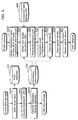
- FIG. 6 is a flowchart showing an example of the flow of the processes performed by the music retrieval apparatus 100 according to the example of the present invention.
- the processes performed by the music retrieval apparatus 100 can be divided into two kinds of processes: the processes (S201-S203) related to the creation of the impression value database 104 necessary for music data retrieval; and the processes (S204-S210) related to the execution of the music data retrieval.
- music data is stored in the music database 102 by a predetermined unit (S201). Each of the stored music data is attached with a single music ID.
- the impression value calculation unit 106 calculates an impression value for each of the stored music data (S202). Specifically, the impression value calculation unit 106 analyzes a music signal of the music data stored, calculates a feature quantity of the music, as described above. The impression value calculation unit 106 then calculates an impression value by performing weighting addition to the calculated feature quantity. Lastly, the impression calculation unit 106 stores, in the impression value database 104, the calculated impression value in association with the music ID of the music data based on which the calculation is performed (S203).
- the music database 102 and the impression value database 104 which are necessary for performing music data retrieval using impression values are generated.
- the music information database 103 is also created as needed when storing music data.
- the conversion unit 110 obtains an impression value of each of the pieces of music regarded as search targets (S204). To be more concrete, in the case of conducting a search for narrowing down the number of search results obtained through the previous search, the conversion unit 110 obtains the music IDs of the music data that are searched out through the previous search. Furthermore, the conversion unit 110 reads out, from the impression value database 104, the impression values associated with the respective music IDs obtained.
- the conversion unit 110 obtains all the impression values and the music IDs stored in the impression value database 104.
- the search targets are a group of music data obtained as a result of conducting a previous search or whether the search targets are all pieces of music is judged based on a user's predetermined operation. This judgment is made upon the reception of the user's predetermined operation by the receiving unit 107, and then the result of the judgment may be notified to the range modification unit 109 via the conversion unit 110.
- the range modification unit 109 reads out an impression word conversion table from the conversion table storage unit 108, and modifies the read-out impression word conversion table in accordance with the distribution of the impression values of the respective pieces of music regarded as search targets (S205).
- the method of modification is as described above, and an equation that is set in the impression word conversion table is modified according to the distribution of the impression values.
- the receiving unit 107 receives the impression word specified by the user (S206).
- the conversion unit 110 converts the impression word obtained by the receiving unit 107 into an equation that indicates an impression word range, using the impression word conversion table modified by the range modification unit 109 (S207).
- the retrieval unit 111 conducts a search based on the music IDs of the respective pieces of music regarded as search targets and the equation indicating an impression word range (S208). Specifically, the retrieval unit 111 receives, via the conversion unit 110, the music IDs of the multiple number of music regarded as search targets. Note that in the case where the search target is a group of music searched out through the previous search, the retrieval unit 111 may obtain a device ID from the search results storage unit 101.
- the retrieval unit 111 receives an equation indicating an impression word range from the conversion unit 110.
- the retrieval unit 111 reads out, from the impression value 104, the impression values associated with the received music IDs, and retrieves the impression values which fall within the impression word range indicated by the equation, from among the read-out impression values.
- the retrieval unit 111 stores, into the search results storage unit 101, information such as the pieces of music retrieved in the search, that is, the respective music IDs associated with the impression values located within the impression word range (S209).
- the retrieval unit 111 notifies the output unit 120 of the music IDs of the respective pieces of the retrieved music.
- the output unit 120 reads out, when necessary, the music information and music data associated with the notified music IDs respectively from the music information database 103 and the music database 102, and outputs them to the user (S210).
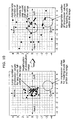
- FIG. 7 is a conceptual diagram showing impression spaces showing the difference between the search results obtained by the conventional music retrieval system and the search results obtained by the music retrieval apparatus 100 of the example.
- the graph in the left of FIG. 7 shows the search results obtained by the conventional music retrieval system and the graph in the right shows the search results obtained by the music retrieval apparatus 100 of the example.
- the pieces of music regarded as search targets are the pieces of music performed by a specific singer, and the distribution of impression values is lopsidedly inclined to the center of the impression space. Therefore, in the case of conducting a search using the conventional music retrieval system, the search results in that a large number of music fall within the impression word range for the impression word "pop" while no music fall within the impression word range for the impression word "healing".
- an impression word range is modified according to the distribution of impression words, as described above.
- an impression word range is modified by performing linear mapping to the impression word range, from an impression value space to the distribution range of impression values. Therefore, an adequate number of music fall within the impression word ranges for the impression words "pop" and "healing" equally, as shown in the right of FIG. 7 .
- a search can be conducted using impression words in the relative relationship, which is obtained by modifying the distribution of such impression values, between the distribution range of impression values and the search word range.
- impression words in the relative relationship, which is obtained by modifying the distribution of such impression values, between the distribution range of impression values and the search word range.
- the range modification unit 109 modifies, through mapping, an impression word range within an impression space so that the impression word range is fitted to the distribution range of the impression values of a group of music regarded as search targets.
- impression values may be modified using inverse mapping so that the distribution range of impression values disperses on the entire impression space.
- the distribution range of impression values may be modified.
- FIG. 8 is a block diagram showing the functional configuration of the music retrieval apparatus 100 equipped with an impression value modification unit 112.
- the music retrieval apparatus 100 shown in FIG. 8 produces the same effect as achieved by the music retrieval apparatus 100 of the example described above. In other words, even in the case where the distribution of the impression values of the respective pieces of music regarded as search targets is not even, it is possible to appropriately narrow down the search target.
- the music retrieval apparatus 100 in FIG. 8 is equipped with the impression value modification unit 112 which modifies the distribution range of impression values within an impression space, which is different from the music retrieval apparatus 100 of the example described above.
- the impression value modification unit 112 is another example of the modification unit in the content data retrieval apparatus of the present invention.
- the impression values of the respective pieces of music regarded as search targets are modified by inverse mapping conversion which is inverse conversion of the mapping conversion as expressed by the above-mentioned equations (Equation 2) and (Equation 3).
- the equations (Equation 5) and (Equation 6) are inverse mapping conversion function of the equations (Equation 2) and (Equation 3). Namely, the equations (Equation 5) and (Equation 6) are functions representing linear mapping from a distribution range of impression values to an impression value space.
- X 2.2 8 x ⁇ 0.2
- Y 3.3 8 y ⁇ 0.05
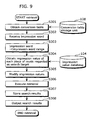
- FIG. 9 is a diagram showing an example of the flow of the processes performed by the music retrieval apparatus 100 equipped with the impression value modification unit 112.
- the processes related to the execution of music data retrieval performed by the music retrieval apparatus 100 shown in FIG. 8 is described with reference to FIG. 9 . These processes are started by a user's predetermined operation as a trigger.
- the conversion unit 110 reads out an impression word conversion table from the conversion table storage unit 108 (S301).
- the receiving unit 107 receives an impression word specified by the user (S302).
- the conversion unit 110 converts the impression word obtained by the receiving unit 107 into an equation expressing an impression word range, using the impression word conversion table read out from the conversion table storage unit 108 (S303).
- the impression value modification unit 112 obtains an impression value of each of the pieces of music regarded as search targets. (S304). Specifically, in the case of conducting a search for narrowing down the number of search results obtained through the previous search, the impression value modification unit 112 obtains the music IDs of the respective pieces of music searched out in the previous search, and then reads out the impression values associated with the obtained music IDs from the impression value database 104.
- the impression value modification unit 112 obtains the music IDs of all the impression values stored in the impression value database 104.
- the search targets are a group of music data obtained as a result of conducting a previous search or whether the search targets are all pieces of music is judged based on a user's predetermined operation. This judgment is made upon the reception of the user's predetermined operation by the receiving unit 107, and then the result of the judgment may be notified to the impression value modification unit 112 via the conversion unit 110 and the retrieval unit 111.
- the impression value modification unit 112 modifies the impression values of the respective pieces of music regarded as search targets, using the above equations (Equation 5) and (Equation 6).
- the retrieval unit 111 conducts a search based on the music IDs of the respective pieces of music regarded as search targets and the equation representing an impression word range (S306). Specifically, the retrieval unit 111 receives the music IDs of the respective pieces of music regarded as search targets and the modified impression values from the impression value modification unit 112, as well as the equation representing an impression word range from the conversion unit 110. The retrieval unit 111 retrieves the impression values that are within the impression value range represented by the equation, from among the received impression values.
- the retrieval unit 111 causes the search results storage unit 101 to store information such as pieces of the music retrieved in the search, that is, the music IDs associated with the impression values located within the impression word range (S307).
- the retrieval unit 111 notifies the output unit 120 of the music IDs of the respective pieces of the music retrieved.
- the output unit 120 reads out the music information and music data associated with each of the notified music IDs into the music information database 103 and the music database 102 respectively, and outputs them to the user (S308).
- the music retrieval apparatus 100 equipped with the impression value modification unit 112 can appropriately narrow down the range of search target.
- FIG. 10 is a conceptual diagram of impression spaces showing a difference between the search results obtained in the case of not modifying the distribution range of impression values and the search results obtained in the case of modifying the distribution range of impression values according to the flow of the processes shown in FIG. 9 .
- the pieces of music regarded as search targets are a group of music obtained as a result of conducting a search using a specific singer's name, as is the case described with reference to FIG. 7 .
- the distribution of impression values is lopsidedly inclined to the center of the impression space. Therefore, in the case of searching a conduct using the conventional music retrieval system, the search results in that a large number of music fall within the impression word range for the impression word "pop" while no music fall within the impression word range for the impression word "healing". This is the processing performed in the conventional music retrieval system.
- the music retrieval apparatus 100 equipped with the impression value modification unit 112 modifies the distribution range of impression values. More specifically, the impression values are modified through a conversion by linear mapping from a distribution range of impression vales to an impression value space. As a result, an adequate number of music fall within the range of impression words "pop" and "healing" equally.
- the music retrieval apparatus 100 may include the impression value modification unit 112 which modifies a distribution range of impression values, as shown in FIG. 8 , instead of the range modification unit 109 which modifies an impression word range.
- the music retrieval apparatus 100 may include both of the range modification unit 109 and the impression value modification unit 112 rather than including the impression value modification unit 112 instead of the range modification unit 109.
- the range modification unit 109 may modify an impression word range.
- the impression value modification unit 112 may modify the impression words.
- impression values and impression word range may be modified.
- a reference two-dimensional space which serves as a reference and has a predetermined size, for example, is determined.
- the impression value is modified through linear mapping so that its distribution range has the same size as the size of the reference two-dimensional space.
- a search word range is modified through linear mapping from an impression word space to a reference two-dimensional space.
- one of impression values and search word range may be modified, or the both may be modified.
- impression word conversion tables may be prepared in advance, and the range modification unit 109 may select an impression word conversion table for use in retrieval may be selected according to the characteristics of a group of the music regarded as search targets.
- the conversion table storage unit 108 stores artist-classified impression word conversion tables that are in accordance with a distribution of the impression values of a group of music classified on an artist basis.
- the range modification unit 109 selects the impression word conversion table associated with the artist. After that, retrieval is performed using the selected impression word conversion table.
- plural impression word ranges are set in advance for the selected impression word conversion table, in accordance with the distribution of the impression values of respective search target music. Therefore, previously preparing the artist-classified impression word conversion tables has the same effect as can be achieved by modifying an impression word range according to the distribution of impression values of respective search target music. In short, it is possible to appropriately narrow down the range of search target even in the case where the distribution of impression values of the respective pieces of music regarded as search targets is uneven.
- the range modification unit 109 may obtain an artist's name stored as music information in the music information database 103, as well as an impression value of the artist's music, which is stored in the impression value database 104, and create such an artist-classified impression word conversion table in advance.
- music-genre-classified impression word conversion tables may be prepared beforehand instead of artist-classified impression word conversion tables. It is conceived that the impression values of music depend on music genre, in many cases. Therefore, both of the artist-classified impression word conversion tables and the genre-classified impression word conversion tables shall be prepared.
- search targets are a group of music obtained as a result of conducting a search using a specific genre
- the range modification unit 109 selects the impression word conversion table associated with the genre. After that, retrieval using the selected impression word conversion table is performed.
- the range modification unit 109 may obtain a genre stored in the music information database 103 and an impression value of the music which belongs to the genre and is stored in the impression value database 104, and create such a genre-classified impression value conversion table.
- the range modification unit 109 does not need to perform calculation for modifying an impression word range in the case where the search targets are a group of music obtained as a result of conducting a search based on a specific artist's name or genre. In other words, it is possible to reduce the load related to the processes performed during the search.
- the artist's name and genre described above are the examples of the attribute values for grouping multiple pieces of music, and the name of a label to which music belongs or a year in which music is released may be used as such attributes.
- a label-classified impression word conversion table may be prepared beforehand.
- a search target is a group of music obtained as a result of conducting a search using a specific label name, a search may be conducted using such a label-classified impression word conversion table.
- the range modification unit 109 modifies the size and the position of the impression word range using the equations (Equation 2) and (Equation 3) described above. However, only the size may be modified.
- the impression word range that is set in the impression word conversion table of the present example is represented in the form of a circle. In such a case, instead of modifying the position of the center of the circle, only the length of the radius may be modified.
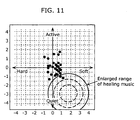
- FIG. 11 is a conceptual diagram showing an example in the case where only a radius of the impression word range within an impression space is modified.
- the size of the impression word range is enlarged until a predetermined or larger number of impression values are included in the impression word range. For instance, the size of the impression word range is enlarged until three impression values are included. In this case, at least three impression values which are the closest to the center of the impression word range are to be selected. Thus, it is possible to appropriately narrow down the range of the search target even in the case of enlarging the size of the impression word range, as needed, without modifying the position of the center of the impression word range.
- the range modification unit 109 may reduce the size of the impression word range until the number of impression values included in the impression word range is a predetermined number or below. For instance, in the case where six or more impression values are included in the impression word range, the size of the impression word range may be reduced until the number becomes 5 or below.
- the enlargement/reduction may be performed after modifying the form of the impression word range into the form of an ellipse in accordance with the distribution of impression values.
- the size of the impression word range may be enlarged/reduced after having modified the shape of the impression word range from a circle to an ellipse that is created by extending only the radius in the Y-axis direction.
- the size modification can be performed after changing a ratio between the length of the radius in the Y-axis direction and the length of the radius in the X-axis direction of the impression word range to become equal to a ratio between the length of the radius in the Y-axis direction and the length of the radius in the X-axis direction of the distribution range of impression values.
- the functions for enlarging or reducing the size of an impression word range may be added to the mode of modifying the size of an impression word range using the equations (Equation 2) and (Equation 3) described above.
- the same functions may be added to the mode of modifying impression values using the equations (Equation 5) and (Equation 6) described above.
- an impression space is two-dimensional.
- the impression space may be one-, three- or more than three- dimensional.
- an equation representing an impression word range stored in an impression word conversion table may be changed into an equation representing a closed range within the impression space.
- the range modification unit 109 or the impression value modification unit 112 may modify an impression word range or an impression value in accordance with the distribution of impression values in a three-dimensional impression space, using mapping function or inverse mapping function.
- search words are defined to be impression words such as “uptempo”, “pop”, “healing” and the like which express music at intuitive level.
- ambiguous words other types of ambiguous words (hereinafter referred to as “ambiguous words”) may be used as the search words.
- the ambiguous words such as "recent” and "old time” that represent an attribute of music, e.g., decade, era, period or the like, in which music is released may be used.
- the music retrieval apparatus 100 can be applied to the mode of retrieving music data using such an ambiguous word as a search word, and also, it is possible to appropriately narrow down the range of search targets.
- an attribute value to be associated with respective pieces of music is one type, that is, a chronological value indicating a decade in which music is released, and the space in which the chronological values are distributed is one-dimensional.
- a one-dimensional space is referred to as "chronological space”. That is to say that the range of chronological values associated with an ambiguous word within such a chronological space becomes a search word range.
- FIG. 12 is a conceptual diagram of a chronological space indicating a difference between the search results obtained using a predetermined search word range in the case of searching music data with an ambiguous word related to decades, and the search results obtained using the search word range modified according to the distribution of chronological values.
- the left of FIG. 12 shows the search results obtained using a predetermined search word range while the right of FIG. 7 shows the search results using the search word range modified according to the distribution of chronological values.
- the left of FIG. 12 shows the search results obtained in the case of applying the conventional music retrieval system to the retrieval using ambiguous words. It is also assumed that the search target is the respective groups of music performed by a singer A and a singer B.
- the chronological space has a predetermined size, e.g., a period between 1990 and 2005.
- the search word range of the ambiguous word "recent" is the same.
- a search range is fixed by a predetermined period based, for example, on the present time or a predetermined period of years or months.
- the conversion table storage unit 108 is made to store in advance the search word conversion table associated with an ambiguous word indicating a decade or the like and a range of chronological values. For example, information indicating a period from six months ago to the present is previously associated with the ambiguous word "recent".
- a chronological value database may be set in the music data storage unit 105, and the chronological values of respective pieces of music are previously stored in association with music IDs.
- the range modification unit 109 modifies a search word range according to the distribution of chronological values in a chronological space for the pieces of music regarded as search targets. For example, the search word range of the ambiguous word "recent" is modified through linear mapping from a chronological space to a distribution range of chronological values.
- the music retrieval apparatus 100 which searches music data is described as the example of the present invention, however, the data to be searched may be content data other than music data.
- video data or still image data may be searched instead.
- at least impression values of the video may be compiled as a database.
- the function of modifying an impression word range or a distribution range of attribute values such as impression values, which is the feature of the present invention, may never be lost whatever type of data a search target may be.
- the content data set as search targets can be associated with an attribute value indicating a content attribute, such as an impression value
- an attribute value indicating a content attribute such as an impression value
- an impression word to be used as a search word may be an impression word other than those shown in FIG. 4 , and may only need to be associated with an equation indicating an impression word range, or the like. Also, the user does not have to select an impression word from those shown in FIG. 4 . In this case, the impression word range associated with the impression word selected by the user need to be identified in an impression word conversion table.
- an impression word may be associated with an impression value represented by a dot.
- the impression word range may be information indicating such a dot.
- the music having an impression value, representing a dot, which falls within the impression word range can be outputted as search results.
- the impression word range which is a range of an impression value associated with an impression word, may not be such a mathematical expression as shown in FIG. 4 .
- the impression word range may be information indicating the center and radius of a circle for specifying the search word range.
- the information indicating the modified impression word range which is passed from the conversion unit 110 to the retrieval unit 111, may not be a mathematical expression per se, and may be information indicating a focal point and a ratio between vertical radius and horizontal radius of an ellipse.
- the information indicating a search word range does not need to be a mathematical expression, and only need to be information that can uniquely identify a range in an impression space.
- the range modification unit 109 and the impression value modification unit 112 perform linear mapping conversion in modifying an impression word range or an impression value.
- the conversion may not be linear, and may be non-linear instead.
- Plural linear and non-linear functions may be selectively used according to the distribution of impression values.
- the size of an impression word range may be reduced and moved so that at least the impression word range is included in a distribution range of impression values.
- the impression values may be modified so that at least the size of the distribution range of impression values is enlarged.
- the relative relationship between the distribution range of impression values and the impression word range can be modified in such a way that the effect of narrowing down the number of search targets through a search is produced.
- the order and the details of the processes related to the retrieval performed by the music retrieval apparatus 100 may not be the same as those shown in the flowchart in FIG. 9 .
- an impression word specified by the user may be first received (S207), and then, an impression word may be obtained (S204).
- the range modification unit 109 may read out only the mathematical expression indicating the search word range of the search word received by the receiving unit 107 and then modify the expression, for example.
- the order and the details of the processes related to the retrieval executed by the music retrieval apparatus 100 shall not be limited to those described in the example. At least, a relative relationship between a distribution range of impression values and an impression word range shall be modified according to the distribution of the impression values of a group of music regarded as search targets, and retrieval of music data using the search word specified by the user shall be enabled. Accordingly, the order of the processes related to the retrieval execution may be determined based on user's needs, an actual value of processing speed and the like.
- a music ID is used as an identifier for identifying music, however, information which can identify music and associate music data, music information and an impression value, such as a name of music and a music number may be used.
- the music data storage unit 105 equipped in the music retrieval apparatus 100 is configured of three databases of the music database 102, the music information database 103 and the impression value database 104.
- the music data storage unit 105 may only need to store respective music data, music information and an impression value in association with one another, and may also be configured of one database.
- the impression values of the respective pieces of music calculated by the impression value calculation unit 106 are stored in the impression value database 104, and then a search is conducted.
- the impression values stored in the impression value database 104 may be calculated in advance.
- the impression value database 104 may be generated by causing the music retrieval apparatus 100 to read necessary impression values from a storage medium in which the impression values of the respective pieces of music are stored.
- the music data and music information may be stored in an external database. At least with the database in which an impression value and a music ID are stored in association with each other, it is possible to identify the music searched out.
- the search results storage unit 101 is defined to store information related to the search results obtained in the music retrieval apparatus 100. However, information regarding the results searched out by another retrieval apparatus or the like, e.g., music IDs of respective pieces of music searched out, may be stored. In other words, the music retrieval apparatus 100 is capable of further narrowing down the range of the search targets, the number of which has already been narrowed down by another retrieval apparatus.
- the output unit 120 outputs the searched-out music IDs, music data and the like to the user.
- a different apparatus may be caused to display and reproduce such music IDs, music data and the like to the user.
- the music retrieval apparatus 100 may be incorporated into a network distribution system for distributing music data via a network such as the Internet, and may be used in music data retrieval.
- the music retrieval apparatus 100 is capable of appropriately narrowing down the range of search targets, as described above. For this reason, the music retrieval apparatus 100 is suitable for the network distribution system in which the music data desired by the user needs to be effectively searched out from a large amount of music data.
- methods of presenting the search results to the user may include generating a play list in which the music IDs of the searched-out music data and the titles of the music included in the music information are listed.
- the methods of outputting search results to the user may be designed according to user's requests, manufacturing cost, and the like.
- the content data retrieval apparatus of the present invention is capable of modifying a relative relationship between a distribution range of attribute values of contents and a search word range according to the distribution of the attribute values of the contents. Therefore, it is possible to appropriately narrow down the range of search targets even in the case where the distribution of the attribute values of the contents regarded as the search target is uneven.
- the content data retrieval apparatus of the present invention is useful as an apparatus which narrows down the number of music through a search by an audio device, audio function equipped car navigation, a mobile music player, a PC music playback application, or the like.
Landscapes
- Engineering & Computer Science (AREA)
- Theoretical Computer Science (AREA)
- Data Mining & Analysis (AREA)
- Databases & Information Systems (AREA)
- Physics & Mathematics (AREA)
- General Engineering & Computer Science (AREA)
- General Physics & Mathematics (AREA)
- Artificial Intelligence (AREA)
- Computational Linguistics (AREA)
- Library & Information Science (AREA)
- Multimedia (AREA)
- Information Retrieval, Db Structures And Fs Structures Therefor (AREA)
Claims (13)
- Inhaltsdatenbeschaffungsvorrichtung (100), die unter Verwendung eines Suchworts Inhaltsdaten beschafft, die mit einem Attributwert assoziiert sind, der ein Inhaltsattribut angibt, wobei die Vorrichtung umfasst:eine Attributwertspeichereinheit (105), die ausgestaltet ist, den Attributwert zu speichern,eine Umsetzungstabelle, in der ein Suchwort mit einem Suchwortbereich assoziiert ist, der ein Bereich von Attributwerten ist, die mit dem Suchwort assoziiert sind,eine Modifikationseinheit (109, 112), die ausgestaltet ist, eine relative Beziehung zwischen dem Suchwortbereich und einem Verteilungsbereich von Attributwerten durch Modifizieren von Attributwerten, die aus der Attributwertspeichereinheit (105) gelesen werden, oder des Suchwortbereichs entsprechend der Verteilung der Attributwerte zu modifizieren, die mit jeweiligen Inhaltsdaten assoziiert sind, die als Suchziele angesehen werden,eine Empfangseinheit (107), die ausgestaltet ist, eine Eingabe eines Suchworts zu empfangen, undeine Beschaffungseinheit (111), die ausgestaltet ist, die Inhaltsdaten entsprechend dem Suchwort durch Suchen der Attributwerte zu beschaffen, die in dem Suchwortbereich in der relativen Beziehung enthalten sind, die durch die Modifikationseinheit (109, 112) modifiziert ist, wobei der Suchwortbereich mit dem Suchwort assoziiert ist, das von der Empfangseinheit empfangen wurde, und durch die Modifikationseinheit modifiziert wurde,wobei die Modifikationseinheit (109, 112) ausgestaltet ist, (i) mehrere modifizierte Umsetzungstabellen zu erzeugen, wobei jede modifizierte Umsetzungstabelle durch Reduzieren und Bewegen des Suchwortbereichs erzeugt wird, der aus der Umsetzungstabelle gelesen wird, so dass der Suchwortbereich in dem Verteilungsbereich der Attributwerte enthalten ist, die mit den jeweiligen Inhaltsdaten assoziiert sind, die zu einer Gruppe gehören, die hinsichtlich Charakteristiken spezifisch für die modifizierte Umsetzungstabelle ist, und (ii) eine modifizierte Umsetzungstabelle aus den mehreren modifizierten Umsetzungstabellen entsprechend den Charakteristiken einer Gruppe von Inhaltsdaten auszuwählen, die als die Suchziele betrachtet werden, und wobei die Beschaffungseinheit (111) ausgestaltet ist, den Suchwortbereich aus der modifizierten Umsetzungstabelle auszulesen, die durch die Modifikationseinheit (109, 112) ausgewählt ist, und die Attributwerte zu suchen, die in dem Suchwortbereich enthalten sind.
- Inhaltsdatenbeschaffungsvorrichtung (100) nach Anspruch 1,
wobei ein Raum, in dem die Attributwerte verteilt sind, ein Attributwertraum mit einer vorbestimmten Größe ist,
der Suchwortbereich innerhalb des Attributwertraums angeordnet ist, und
die Modifikationseinheit (109, 112) ausgestaltet ist, den Suchwortbereich durch Umsetzen des Suchwortbereichs, der aus der Umsetzungstabelle gelesen wird, mittels linearen Mappings von dem Attributwertraum auf den Verteilungsbereich zu modifizieren. - Inhaltsdatenbeschaffungsvorrichtung (100) nach Anspruch 1,
wobei die Modifikationseinheit (109, 112) ferner ausgestaltet ist, die Attributwerte, die aus der Attributwertspeichereinheit (105) gelesen werden, so zu modifizieren, dass der Verteilungsbereich vergrößert ist, und
die Beschaffungseinheit (111) ausgestaltet ist, die Inhaltsdaten entsprechend dem Suchwort durch Suchen der Attributwerte zu beschaffen, die in dem Suchwortbereich enthalten sind und die durch die Modifikationseinheit (109, 112) modifiziert sind, wobei der Suchwortbereich mit dem Suchwort assoziiert ist, das durch die Empfangseinheit empfangen wurde, und durch die Modifikationseinheit (109, 112) modifiziert wurde. - Inhaltsdatenbeschaffungsvorrichtung (100) nach Anspruch 3,
wobei ein Raum, in dem die Attributwerte verteilt sind, ein Attributwertraum mit einer vorbestimmten Größe ist,
der Suchwortbereich innerhalb des Attributwertraums angeordnet ist, und
die Modifikationseinheit (109, 112) ausgestaltet ist, die Attributwerte, die aus der Attributwertspeichereinheit (105) ausgelesen werden, durch Umsetzen der Attributwerte mittels linearen Mappings von dem Verteilungsbereich auf den Attributwertraum zu modifizieren. - Inhaltsdatenbeschaffungsvorrichtung (100) nach Anspruch 1,
wobei in dem Fall, dass die Zahl der Attributwerte, die in dem Suchwortbereich enthalten sind, geringer als eine vorbestimmte Zahl ist, die Modifikationseinheit (109, 112) ferner ausgestaltet ist, den Suchwortbereich, der aus der Umsetzungstabelle gelesen wird, zu modifizieren, indem der Suchwortbereich so vergrößert wird, dass die Zahl von Attributwerten, die in dem Suchwortbereich enthalten sind, gleich oder größer als die vorbestimmte Zahl ist. - Inhaltsdatenbeschaffungsvorrichtung (100) nach Anspruch 5,
wobei ein Raum, in dem die Attributwerte verteilt sind, ein Attributwertraum mit einer vorbestimmten Größe ist,
der Suchwortbereich innerhalb des Attributwertraums angeordnet ist, und
die Modifikationseinheit (109, 112) ausgestaltet ist:ein Verhältnis zwischen den Längen in Richtungen jeweiliger Dimensionen innerhalb des Attributwertraums des Suchwortbereichs, der aus der Umsetzungstabelle gelesen wird, entsprechend einem Verhältnis zwischen den Längen in Richtungen jeweiliger Dimensionen innerhalb des Attributwertraums des Verteilungsbereichs zu bestimmen, undden Suchwortbereich durch Vergrößern der Größe des Suchwortbereichs so zu verändern, dass die Zahl von Attributwerten, die in dem Suchwortbereich enthalten sind, gleich oder größer als eine vorbestimmte Zahl ist, während das bestimmte Längenverhältnis beibehalten wird. - Inhaltsdatenbeschaffungsvorrichtung (100) nach Anspruch 1,
wobei in dem Fall, dass die Zahl von Attributwerten, die in dem Suchwortbereich enthalten sind, eine vorbestimmte Zahl überschreitet, die Modifikationseinheit (109, 112) ferner ausgestaltet ist, den Suchwortbereich, der aus der Umsetzungstabelle gelesen wird, durch Reduzieren der Größe des Suchwortbereichs so zu modifizieren, dass die Zahl von Attributwerten, die in dem Suchwortbereich enthalten sind, gleich oder geringer als die vorbestimmte Zahl ist. - Inhaltsdatenbeschaffungsvorrichtung (100) nach Anspruch 7,
wobei ein Raum, in dem die Attributwerte verteilt sind, ein Attributwertraum mit einer vorbestimmten Größe ist,
der Suchwortbereich innerhalb des Attributwertraums angeordnet ist, und
die Modifikationseinheit (109, 112) ausgestaltet ist:ein Verhältnis zwischen den Längen in Richtungen jeweiliger Dimensionen innerhalb des Attributwertraums des Suchwortbereichs, der aus der Umsetzungstabelle gelesen wird, entsprechend einem Verhältnis zwischen den Längen in Richtungen jeweiliger Dimensionen innerhalb des Attributwertraums des Verteilungsbereichs zu bestimmen, undden Suchwortbereich durch Verringern der Größe des Suchwortbereichs so zu verändern, dass die Zahl von Attributwerten, die in dem Suchwortbereich enthalten sind, gleich oder kleiner als eine vorbestimmte Zahl ist, während das bestimmte Längenverhältnis beibehalten wird. - Inhaltsdatenbeschaffungsvorrichtung (100) nach Anspruch 1,
wobei der Attributwert ein Impressionswert ist, der ein Indexwert ist, der eine Impression hinsichtlich des Inhalts darstellt. - Inhaltsdatenbeschaffungsvorrichtung nach Anspruch 1,
wobei die erste Gruppe und die zweite Gruppe durch einen Künstlernamen, ein Genre, ein Veröffentlichungsjahr oder einen Label-Namen bestimmt sind, die mit dem jeweiligen Inhaltsdaten assoziiert sind. - Beschaffungsverfahren, das in einer Inhaltsdatenbeschaffungsvorrichtung (100) verwendet wird, die unter Verwendung eines Suchworts Inhaltsdaten beschafft, die mit einem Attributwert assoziiert sind, der ein Inhaltsattribut angibt,
wobei die Inhaltsdatenbeschaffungsvorrichtung eine Attributwertspeichereinheit (105), die ausgestaltet ist, den Attributwert zu speichern, und eine Umsetzungstabelle umfasst, in der ein Suchwort mit einem Suchwortbereich assoziiert ist, der ein Bereich von Attributwerten ist, die mit dem Suchwort assoziiert sind,
wobei das Verfahren umfasst:Modifizieren (S205, S305) einer relativen Beziehung zwischen dem Suchwortbereich und einem Verteilungsbereich von Attributwerten durch Modifizieren von Attributwerten, die aus der Attributwertspeichereinheit (105) gelesen werden, oder des Suchwortbereichs entsprechend der Verteilung der Attributwerte, die mit jeweiligen Inhaltsdaten assoziiert sind, die als Suchziele angesehen werden,Empfangen (S206, S302) einer Eingabe eines Suchworts, undBeschaffen (S208, S306) der Inhaltsdaten entsprechend dem Suchwort durch Suchen der Attributwerte, die in dem Suchwortbereich in der relativen Beziehung enthalten sind, die in dem Modifizieren (S205, S305) modifiziert wurde, wobei der Suchwortbereich mit dem Suchwort assoziiert ist, das in dem Empfangen empfangen wurde, und in dem Modifizieren (S205, S305) modifiziert wurde, undwobei der Modifizierungsschritt (S205, S305) umfasst, (i) mehrere modifizierte Umsetzungstabellen zu erzeugen, wobei jede modifizierte Umsetzungstabelle durch Reduzieren und Bewegen des Suchwortbereichs erzeugt wird, der aus der Umsetzungstabelle gelesen wird, so dass der Suchwortbereich in dem Verteilungsbereich der Attributwerte enthalten ist, die mit den jeweiligen Inhaltsdaten assoziiert sind, die zu einer Gruppe gehören, die hinsichtlich Charakteristiken spezifisch für die modifizierte Umsetzungstabelle ist, und (ii) eine modifizierte Umsetzungstabelle aus den mehreren modifizierten Umsetzungstabellen entsprechend den Charakteristiken einer Gruppe von Inhaltsdaten auszuwählen, die als die Suchziele betrachtet werden, undwobei der Beschaffungsschritt (S208, S306) vorgesehen ist, um den Suchwortbereich aus der modifizierten Umsetzungstabelle auszulesen, die durch den Modifizierungsschritt (S205, S305) ausgewählt ist, und die Attributwerte zu suchen, die in dem Suchwortbereich enthalten sind. - Programm, das in einer Inhaltsdatenbeschaffungsvorrichtung (100) verwendet wird, die unter Verwendung eines Suchworts Inhaltsdaten beschafft, die mit einem Attributwert assoziiert sind, der ein Inhaltsattribut angibt,
wobei die Inhaltsdatenbeschaffungsvorrichtung eine Attributwertspeichereinheit (105), die ausgestaltet ist, den Attributwert zu speichern, und eine Umsetzungstabelle umfasst, in der ein Suchwort mit einem Suchwortbereich assoziiert ist, der ein Bereich von Attributwerten ist, die mit dem Suchwort assoziiert sind,
wobei das Programm einen Computer veranlasst, auszuführen:Modifizieren (S205, S305) einer relativen Beziehung zwischen dem Suchwortbereich und einem Verteilungsbereich von Attributwerten durch Modifizieren von Attributwerten, die aus der Attributwertspeichereinheit (105) gelesen werden, oder des Suchwortbereichs entsprechend der Verteilung der Attributwerte, die mit jeweiligen Inhaltsdaten assoziiert sind, die als Suchziele angesehen werden,Empfangen (S206, S302) einer Eingabe eines Suchworts, undBeschaffen (S208, S306) der Inhaltsdaten entsprechend dem Suchwort durch Suchen der Attributwerte, die in dem Suchwortbereich in der relativen Beziehung enthalten sind, die in dem Modifizieren (S205, S305) modifiziert wurde, wobei der Suchwortbereich mit dem Suchwort assoziiert ist, das in dem Empfangen empfangen wurde, und in dem Modifizieren (S205, S305) modifiziert wurde, undwobei der Modifizierungsschritt (S205, S305) umfasst, (i) mehrere modifizierte Umsetzungstabellen zu erzeugen, wobei jede modifizierte Umsetzungstabelle durch Reduzieren und Bewegen des Suchwortbereichs erzeugt wird, der aus der Umsetzungstabelle gelesen wird, so dass der Suchwortbereich in dem Verteilungsbereich der Attributwerte enthalten ist, die mit den jeweiligen Inhaltsdaten assoziiert sind, die zu einer Gruppe gehören, die hinsichtlich Charakteristiken spezifisch für die modifizierte Umsetzungstabelle ist, und (ii) eine modifizierte Umsetzungstabelle aus den mehreren modifizierten Umsetzungstabellen entsprechend den Charakteristiken einer Gruppe von Inhaltsdaten auszuwählen, die als die Suchziele betrachtet werden, undwobei der Beschaffungsschritt (S208, S306) vorgesehen ist, um den Suchwortbereich aus der modifizierten Umsetzungstabelle auszulesen, die durch den Modifizierungsschritt (S205, S305) ausgewählt ist, und die Attributwerte zu suchen, die in dem Suchwortbereich enthalten sind. - Integrierte Schaltung, die in einer Inhaltsdatenbeschaffungsvorrichtung (100) verwendet wird, die unter Verwendung eines Suchworts Inhaltsdaten beschafft, die mit einem Attributwert assoziiert sind, der ein Inhaltsattribut angibt,
wobei die Inhaltsdatenbeschaffungsvorrichtung (100) eine Attributwertspeichereinheit (105), die ausgestaltet ist, den Attributwert zu speichern, und eine Umsetzungstabelle umfasst, in der ein Suchwort mit einem Suchwortbereich assoziiert ist, der ein Bereich von Attributwerten ist, die mit dem Suchwort assoziiert sind,
wobei die integrierte Schaltung umfasst:eine Modifikationseinheit (109, 112), die ausgestaltet ist, eine relative Beziehung zwischen dem Suchwortbereich und einem Verteilungsbereich von Attributwerten durch Modifizieren von Attributwerten, die aus der Attributwertspeichereinheit (105) gelesen werden, oder des Suchwortbereichs entsprechend der Verteilung der Attributwerte zu modifizieren, die mit jeweiligen Inhaltsdaten assoziiert sind, die als Suchziele angesehen werden,eine Empfangseinheit (107), die ausgestaltet ist, eine Eingabe eines Suchworts zu empfangen, undeine Beschaffungseinheit (111), die ausgestaltet ist, die Inhaltsdaten entsprechend dem Suchwort durch Suchen der Attributwerte zu beschaffen, die in dem Suchwortbereich in der relativen Beziehung enthalten sind, die durch die Modifikationseinheit (109, 112) modifiziert ist, wobei der Suchwortbereich mit dem Suchwort assoziiert ist, das von der Empfangseinheit empfangen wurde, und durch die Modifikationseinheit modifiziert wurde,wobei die Modifikationseinheit (109, 112) ausgestaltet ist, (i) mehrere modifizierte Umsetzungstabellen zu erzeugen, wobei jede modifizierte Umsetzungstabelle durch Reduzieren und Bewegen des Suchwortbereichs erzeugt wird, der aus der Umsetzungstabelle gelesen wird, so dass der Suchwortbereich in dem Verteilungsbereich der Attributwerte enthalten ist, die mit den jeweiligen Inhaltsdaten assoziiert sind, die zu einer Gruppe gehören, die hinsichtlich Charakteristiken spezifisch für die modifizierte Umsetzungstabelle ist, und (ii) eine modifizierte Umsetzungstabelle aus den mehreren modifizierten Umsetzungstabellen entsprechend den Charakteristiken einer Gruppe von Inhaltsdaten auszuwählen, die als die Suchziele betrachtet werden, undwobei die Beschaffungseinheit (111) ausgestaltet ist, den Suchwortbereich aus der modifizierten Umsetzungstabelle auszulesen, die durch die Modifikationseinheit (109, 112) ausgewählt ist, und die Attributwerte zu suchen, die in dem Suchwortbereich enthalten sind.
Applications Claiming Priority (2)
| Application Number | Priority Date | Filing Date | Title |
|---|---|---|---|
| JP2004320198 | 2004-11-04 | ||
| PCT/JP2005/018353 WO2006048988A1 (ja) | 2004-11-04 | 2005-10-04 | コンテンツデータ検索装置 |
Publications (4)
| Publication Number | Publication Date |
|---|---|
| EP1832987A1 EP1832987A1 (de) | 2007-09-12 |
| EP1832987A4 EP1832987A4 (de) | 2009-12-09 |
| EP1832987B1 true EP1832987B1 (de) | 2016-04-13 |
| EP1832987B8 EP1832987B8 (de) | 2016-10-12 |
Family
ID=36319003
Family Applications (1)
| Application Number | Title | Priority Date | Filing Date |
|---|---|---|---|
| EP05790249.6A Expired - Lifetime EP1832987B8 (de) | 2004-11-04 | 2005-10-04 | Inhaltsdaten-suchvorrichtung |
Country Status (5)
| Country | Link |
|---|---|
| US (1) | US7743049B2 (de) |
| EP (1) | EP1832987B8 (de) |
| JP (1) | JP4659755B2 (de) |
| CN (1) | CN101048776B (de) |
| WO (1) | WO2006048988A1 (de) |
Families Citing this family (11)
| Publication number | Priority date | Publication date | Assignee | Title |
|---|---|---|---|---|
| JP2007172702A (ja) * | 2005-12-20 | 2007-07-05 | Sony Corp | コンテンツ選択方法及びコンテンツ選択装置 |
| JP4683290B2 (ja) * | 2006-01-23 | 2011-05-18 | ソニー株式会社 | 表示装置、表示方法、表示プログラム |
| JP5135931B2 (ja) * | 2007-07-17 | 2013-02-06 | ヤマハ株式会社 | 楽曲加工装置およびプログラム |
| KR101283429B1 (ko) | 2008-03-07 | 2013-07-08 | 닛뽕빅터 가부시키가이샤 | 서버 장치, 단말 장치, 재생 장치 |
| JP4577627B2 (ja) * | 2008-03-07 | 2010-11-10 | 日本ビクター株式会社 | 端末装置、再生装置、サーバ装置 |
| JP4577628B2 (ja) * | 2008-03-17 | 2010-11-10 | 日本ビクター株式会社 | 端末装置、再生装置、サーバ装置 |
| US8825646B1 (en) * | 2008-08-08 | 2014-09-02 | Google Inc. | Scalable system for determining short paths within web link network |
| JP5458880B2 (ja) * | 2009-03-02 | 2014-04-02 | 富士通株式会社 | 文書検査装置、コンピュータ読み取り可能な記録媒体および文書検査方法 |
| GB201708771D0 (en) * | 2017-06-01 | 2017-07-19 | Upshoot Ltd | Improved search engine |
| US20240169165A1 (en) * | 2022-11-17 | 2024-05-23 | Samsung Electronics Co., Ltd. | Automatically Generating Annotated Ground-Truth Corpus for Training NLU Model |
| CN117056460B (zh) * | 2023-08-11 | 2026-03-10 | 百度时代网络技术(北京)有限公司 | 文档的检索方法、装置、电子设备和介质 |
Family Cites Families (6)
| Publication number | Priority date | Publication date | Assignee | Title |
|---|---|---|---|---|
| JPH11161659A (ja) * | 1997-11-27 | 1999-06-18 | Nippon Telegr & Teleph Corp <Ntt> | 検索式の動的変更方法及び装置及び検索式の動的変更プログラムを格納した記憶媒体 |
| JP2001022778A (ja) * | 1999-07-09 | 2001-01-26 | Fuji Xerox Co Ltd | 検索装置及び検索方法 |
| JP3639480B2 (ja) * | 1999-11-05 | 2005-04-20 | 日本電信電話株式会社 | 類似データ検索方法,類似データ検索装置,および類似データ検索用プログラム記録媒体 |
| JP2003016078A (ja) * | 2001-06-29 | 2003-01-17 | Hitachi Ltd | データの分類、検索および表示方法 |
| JP2004086189A (ja) | 2002-07-02 | 2004-03-18 | Matsushita Electric Ind Co Ltd | 楽曲検索システム |
| EP1378912A3 (de) * | 2002-07-02 | 2005-10-05 | Matsushita Electric Industrial Co., Ltd. | Musiksuchsystem |
-
2005
- 2005-10-04 WO PCT/JP2005/018353 patent/WO2006048988A1/ja not_active Ceased
- 2005-10-04 CN CN2005800368296A patent/CN101048776B/zh not_active Expired - Lifetime
- 2005-10-04 EP EP05790249.6A patent/EP1832987B8/de not_active Expired - Lifetime
- 2005-10-04 JP JP2006542314A patent/JP4659755B2/ja not_active Expired - Lifetime
- 2005-10-04 US US11/665,663 patent/US7743049B2/en not_active Expired - Lifetime
Also Published As
| Publication number | Publication date |
|---|---|
| CN101048776A (zh) | 2007-10-03 |
| JP4659755B2 (ja) | 2011-03-30 |
| WO2006048988A1 (ja) | 2006-05-11 |
| US7743049B2 (en) | 2010-06-22 |
| EP1832987A4 (de) | 2009-12-09 |
| EP1832987A1 (de) | 2007-09-12 |
| US20080222128A1 (en) | 2008-09-11 |
| CN101048776B (zh) | 2010-08-18 |
| JPWO2006048988A1 (ja) | 2008-05-22 |
| EP1832987B8 (de) | 2016-10-12 |
Similar Documents
| Publication | Publication Date | Title |
|---|---|---|
| Chang et al. | Evolution of research subjects in library and information science based on keyword, bibliographical coupling, and co-citation analyses | |
| US8321456B2 (en) | Generating metadata for association with a collection of content items | |
| KR101029403B1 (ko) | 자동 질의 클러스터링 | |
| US8356038B2 (en) | User to user recommender | |
| JP6014725B2 (ja) | 単文/複文構造の自然言語クエリに対する検索および情報提供方法並びにシステム | |
| US20060155684A1 (en) | Systems and methods to present web image search results for effective image browsing | |
| WO2009044341A2 (en) | Classifying a set of content items | |
| WO2002054287A2 (en) | Multi-query data visualization | |
| JP2010541092A5 (de) | ||
| KR20040091095A (ko) | 정보 검색 요청에 응답하여 검색 결과를 제공하는 방법 및장치 | |
| JP2005182280A (ja) | 情報検索システム、検索結果加工システム及び情報検索方法並びにプログラム | |
| KR100403947B1 (ko) | 개인용 전자문서를 생성하는 방법, 시스템 및 컴퓨터프로그램 제조물 | |
| Font et al. | Sound sharing and retrieval | |
| US7743049B2 (en) | Content data retrieval apparatus | |
| JP2006073012A (ja) | 予め定められた個数の予め定義された質問に応答することによって情報を管理するシステムおよび方法 | |
| WO2018103642A1 (en) | Systems, apparatuses, and methods for searching and displaying information available in large databases according to the similarity of chemical structures discussed in them | |
| Schedl et al. | A music information system automatically generated via web content mining techniques | |
| CN109815320B (zh) | 问答系统的答案生成方法、装置、设备及存储介质 | |
| KR20190043965A (ko) | 검색 필드 설정을 위한 시각적 ui 제공 시스템 및 방법과 이를 저장한 기록매체 | |
| Kontopoulos et al. | A Domain-Agnostic Tool for Scalable Ontology Population and Enrichment from Diverse Linked Data Sources. | |
| JP6902131B2 (ja) | クエリ処理方法、クエリ処理装置及びコンピュータ読み取り可能な媒体 | |
| Blandford et al. | Usability of Musical Digital Libraries: a Multimodal Analysis. | |
| US20030009490A1 (en) | Information processing apparatus, information processing method, recording medium, program, and electronic-publishing-data providing system | |
| Tombros et al. | Clustering top-ranking sentences for information access | |
| Kaur et al. | Automated scientific document retrieval |
Legal Events
| Date | Code | Title | Description |
|---|---|---|---|
| PUAI | Public reference made under article 153(3) epc to a published international application that has entered the european phase |
Free format text: ORIGINAL CODE: 0009012 |
|
| 17P | Request for examination filed |
Effective date: 20070604 |
|
| AK | Designated contracting states |
Kind code of ref document: A1 Designated state(s): DE FR GB |
|
| DAX | Request for extension of the european patent (deleted) | ||
| RBV | Designated contracting states (corrected) |
Designated state(s): DE FR GB |
|
| RAP1 | Party data changed (applicant data changed or rights of an application transferred) |
Owner name: PANASONIC CORPORATION |
|
| A4 | Supplementary search report drawn up and despatched |
Effective date: 20091111 |
|
| 17Q | First examination report despatched |
Effective date: 20120314 |
|
| RAP1 | Party data changed (applicant data changed or rights of an application transferred) |
Owner name: PANASONIC INTELLECTUAL PROPERTY CORPORATION OF AME |
|
| GRAP | Despatch of communication of intention to grant a patent |
Free format text: ORIGINAL CODE: EPIDOSNIGR1 |
|
| INTG | Intention to grant announced |
Effective date: 20151023 |
|
| GRAS | Grant fee paid |
Free format text: ORIGINAL CODE: EPIDOSNIGR3 |
|
| GRAA | (expected) grant |
Free format text: ORIGINAL CODE: 0009210 |
|
| AK | Designated contracting states |
Kind code of ref document: B1 Designated state(s): DE FR GB |
|
| REG | Reference to a national code |
Ref country code: GB Ref legal event code: FG4D |
|
| REG | Reference to a national code |
Ref country code: DE Ref legal event code: R096 Ref document number: 602005049002 Country of ref document: DE |
|
| GRAT | Correction requested after decision to grant or after decision to maintain patent in amended form |
Free format text: ORIGINAL CODE: EPIDOSNCDEC |
|
| REG | Reference to a national code |
Ref country code: DE Ref legal event code: R097 Ref document number: 602005049002 Country of ref document: DE |
|
| PLBE | No opposition filed within time limit |
Free format text: ORIGINAL CODE: 0009261 |
|
| STAA | Information on the status of an ep patent application or granted ep patent |
Free format text: STATUS: NO OPPOSITION FILED WITHIN TIME LIMIT |
|
| 26N | No opposition filed |
Effective date: 20170116 |
|
| GBPC | Gb: european patent ceased through non-payment of renewal fee |
Effective date: 20161004 |
|
| REG | Reference to a national code |
Ref country code: FR Ref legal event code: ST Effective date: 20170630 |
|
| PG25 | Lapsed in a contracting state [announced via postgrant information from national office to epo] |
Ref country code: GB Free format text: LAPSE BECAUSE OF NON-PAYMENT OF DUE FEES Effective date: 20161004 Ref country code: FR Free format text: LAPSE BECAUSE OF NON-PAYMENT OF DUE FEES Effective date: 20161102 |
|
| REG | Reference to a national code |
Ref country code: DE Ref legal event code: R079 Ref document number: 602005049002 Country of ref document: DE Free format text: PREVIOUS MAIN CLASS: G06F0017300000 Ipc: G06F0016000000 |
|
| PGFP | Annual fee paid to national office [announced via postgrant information from national office to epo] |
Ref country code: DE Payment date: 20241021 Year of fee payment: 20 |
|
| REG | Reference to a national code |
Ref country code: DE Ref legal event code: R071 Ref document number: 602005049002 Country of ref document: DE |