EP1833019A2 - Appareil et procédé pour la détection d'une zone variée - Google Patents
Appareil et procédé pour la détection d'une zone variée Download PDFInfo
- Publication number
- EP1833019A2 EP1833019A2 EP07250836A EP07250836A EP1833019A2 EP 1833019 A2 EP1833019 A2 EP 1833019A2 EP 07250836 A EP07250836 A EP 07250836A EP 07250836 A EP07250836 A EP 07250836A EP 1833019 A2 EP1833019 A2 EP 1833019A2
- Authority
- EP
- European Patent Office
- Prior art keywords
- variation
- brightness difference
- threshold value
- pixels
- target pixel
- Prior art date
- Legal status (The legal status is an assumption and is not a legal conclusion. Google has not performed a legal analysis and makes no representation as to the accuracy of the status listed.)
- Withdrawn
Links
Images


Classifications
-
- G—PHYSICS
- G06—COMPUTING OR CALCULATING; COUNTING
- G06T—IMAGE DATA PROCESSING OR GENERATION, IN GENERAL
- G06T7/00—Image analysis
- G06T7/20—Analysis of motion
- G06T7/254—Analysis of motion involving subtraction of images
Definitions
- the present invention relates to an apparatus and a method for detecting a varied area that compares a learned image in the normal state with a current input image and extracts an area where a change has occurred.
- Peripheral Increment Sign Correlation that detects a varied area on the basis of the difference between a learned background texture and an input image texture (See Yutaka Sato, Shunichi Kaneko, Satoru Igarashi. Detection and Separation of a robust object on the basis of Peripheral Increment Sign Correlation, Transactions of The Institute of Electronics, Information and Communication Engineers, Vol.J84-D-II, No.12, pp.2585-2594, December 2001 , hereinafter referred to as "Sato-1").
- BPRRC Bi-polar radial reach correlation
- peripheral increment sign correlation has a problem such that the brightness difference between the target pixel and the peripheral reference pixels is small, and hence erroneous detection may occur often when the brightness difference is liable to be inverted due to the variation of illumination or noises.
- the BPRRC method has a problem that omission of detection can occur easily because it can only detect a remarkable difference which could invert the brightness difference between the target pixel and the reference pixels.
- an apparatus for detecting a varied area and a method thereof which is robust against variation in illumination or noises, and can extract the varied area and in which excessive detection and omission of detection are reduced.
- this embodiment is an apparatus for detecting a varied area in an input image, comprising:
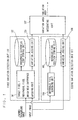
- Fig. 1 is a block diagram showing a general configuration of the apparatus for detecting a varied area in this embodiment.
- the apparatus for detecting a varied area includes a first variation detecting unit 110, a second variation detecting unit 111 and a varied area integrating unit 107 that integrates results of variation detection of these two units.
- the first variation detecting unit 110 includes a target pixel/peripheral pixel brightness difference encoding unit 101 that judges the brightness difference between the target pixel and the peripheral pixels and encoding the same, a brightness difference code storing unit 102 that stores brightness difference codes in a learned image, and a variation judging unit 103 that judges the variation in the input image on the basis of the brightness difference codes between the learned image and the input image.
- the second variation detecting unit 111 includes a reference pixel searching unit 104 that searches pixels having the brightness difference located in a plurality of directions from the target pixel in the learned image, a reference pixel position storing unit 105 that stores the positions of the reference pixels, and a variation judging unit 106 that detects the variation of the brightness difference between the target pixel and the reference pixels in the input image on the basis of the stored positions of the reference pixels.
- the apparatus for detecting a varied area can also be realized by using, for example, a general computer apparatus as basic hardware.
- the first variation detecting unit 110, the second variation detecting unit 111 and the varied area integrating unit 107 can be realized by causing a processor installed in the above-described computer apparatus to execute programs.
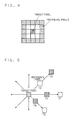
- Fig. 2 is a general drawing showing a flow of a learning process. Referring now to Fig. 2, the leaning process will be described.
- the learning process is executed, the learned image to be compared with the input image as an object to be detected is supplied from an image input device such as a video camera to the first variation detecting unit 110 and the second variation detecting unit 111 respectively.
- the leaned image is, for example, a background image of a room in a state in which there is no incomer.
- Step S101 the target pixel/peripheral pixel brightness difference encoding unit 101 executes encoding on the basis of the brightness difference between and the target pixel and the peripheral pixels in the learned image.
- the peripheral pixels may be pixels, for example, at the coordinates (x+2, y-2), (x+2, y-1), ... (x+1, y2) which is located at two pixels apart from the target pixel as shown in Fig. 4, where (x, y) represents the coordinate of the target pixel, and the I(x, y) represents the brightness value thereof.
- Step S102 the brightness difference code storing unit 102 stores the brightness difference codes bi(x, y).
- an average values of the brightness difference codes bi(x, y) obtained from the respective images may be stored.
- the processes in Step S101 and Step S102 for the target pixel I(x, y) are performed for all the pixels in the learned image.
- the reference pixel searching unit 104 searches the reference pixels in the learned image in the same manner as the method in Sato's Document 2.
- Step S104 the reference pixel position storing unit 105 stores the positions of the reference pixels, ci - (x, y) and ci + (x, y).
- the processes in Steps S103 and S104 for the target pixel I(x, y) are executed for all the pixels in the learned image.
- Fig. 3 is a diagram showing a general flow of the detecting process. The detecting process will be described on the basis of Fig. 3 below.
- the input image as the object to be detected is supplied from the image input device such as a video camera to the first variation detecting unit 110 and the second variation detecting unit 111 respectively.
- the input image may be, for example, an image of the room in the current state, and the object to be detected is an incomer to this room.
- Step S201 the target pixel/peripheral pixel brightness difference encoding unit 101 executes encoding on the basis of the brightness difference between the target pixel and the peripheral pixels in the input image.
- the encoding process is achieved by the same process as the learning process.
- Step S203 the variation judging unit 106 extracts the brightness difference between the target pixel and the reference pixels in the input image on the basis of the reference pixel positions stored in the reference pixel position storing unit 105.
- Step S205 the variation area integrating unit 107 integrates a result Result b (x, y) obtained in Step S202 and a result Result c (x, y) obtained in Step S204.
- Result x ⁇ y ⁇ varied when Result b x ⁇ y ⁇ is varied or Result c x ⁇ y is varied not varied other cases
- the first variation detecting unit 110 detects the variation on the basis of the brightness difference between the target pixel and the peripheral pixels, that is, the texture (pattern which includes a change in brightness), the detection performance is high when there is a texture in at least one of the learned image and the input image. However, when there is a little texture in both the learned image and the input image, omission of detection may often occur.
- the second variation detecting unit 111 searches the reference pixels having the brightness difference in eight directions, even though there is a little texture in both the learned image and the input image, the detecting performance can be maintained by comparing with the reference pixels located relatively apart therefrom. However, since it can only detect relatively large variations which could invert the brightness difference, the omission of detection may easily occur. In other words, when these units are employed independently, there arises a problem such that the possibility of occurrence of the omission of detection increases.
- both units gives high complementary effects.
- the area which cannot be detected by one of these units can be detected by the other unit.
- the excessive detection can hardly be increased even though these units are combined.
- the combination of these two units has an advantage such that the omission of detection can be reduced while restraining the excessive detection.
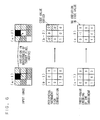
- the brightness differences are encoded as shown under (c-1) by the three-value encoding.
- the brightness of the target pixel is varied because a slight variation such as a noise is applied to the image and hence the input as shown in (a-2) is resulted, the largeness is inverted between the target pixel and the peripheral pixels, and hence the state as shown in (b-2) is resulted in the peripheral increment sign correlation.
- the code can be inverted easily between the pixels having the brightness difference close to the criterion of 0/1 (having the brightness difference close to zero) by the slight variation such as a noise in the peripheral increment sign correlation (in the hatched area in (b-2), while the code 0 is assigned stably according to the method in this embodiment, and hence the configuration which is robust against the variation is achieved.
- Result b (x, y) and Result c (x, y) may be added after having applied a predetermined weight. Then, it may be judged that the variation has occurred when the sum exceeds a reference value.
- This embodiment may be used for detecting an area of an incomer by image monitoring, or for detecting an area where persons may exist for capturing motions or recognizing gestures of the persons in the image.
Landscapes
- Engineering & Computer Science (AREA)
- Multimedia (AREA)
- Computer Vision & Pattern Recognition (AREA)
- Physics & Mathematics (AREA)
- General Physics & Mathematics (AREA)
- Theoretical Computer Science (AREA)
- Image Analysis (AREA)
- Compression Or Coding Systems Of Tv Signals (AREA)
Applications Claiming Priority (1)
| Application Number | Priority Date | Filing Date | Title |
|---|---|---|---|
| JP2006060266A JP2007241479A (ja) | 2006-03-06 | 2006-03-06 | 変動領域検出装置及びその方法 |
Publications (2)
| Publication Number | Publication Date |
|---|---|
| EP1833019A2 true EP1833019A2 (fr) | 2007-09-12 |
| EP1833019A3 EP1833019A3 (fr) | 2009-02-25 |
Family
ID=38024127
Family Applications (1)
| Application Number | Title | Priority Date | Filing Date |
|---|---|---|---|
| EP07250836A Withdrawn EP1833019A3 (fr) | 2006-03-06 | 2007-02-28 | Appareil et procédé pour la détection d'une zone variée |
Country Status (4)
| Country | Link |
|---|---|
| US (1) | US20070206869A1 (fr) |
| EP (1) | EP1833019A3 (fr) |
| JP (1) | JP2007241479A (fr) |
| CN (1) | CN100493140C (fr) |
Families Citing this family (5)
| Publication number | Priority date | Publication date | Assignee | Title |
|---|---|---|---|---|
| JP5041229B2 (ja) * | 2007-12-07 | 2012-10-03 | ソニー株式会社 | 学習装置および方法、認識装置および方法、並びにプログラム |
| US8085989B2 (en) * | 2008-10-23 | 2011-12-27 | Glory Ltd. | Method and apparatus for determining authenticity |
| JP5310372B2 (ja) * | 2009-08-12 | 2013-10-09 | ソニー株式会社 | 表示装置、輝度劣化補正方法および電子機器 |
| JP6408414B2 (ja) * | 2015-03-31 | 2018-10-17 | Kddi株式会社 | 動物体検出装置及びその背景モデル構築方法 |
| JP6516609B2 (ja) * | 2015-07-22 | 2019-05-22 | Kddi株式会社 | 動物体検出装置及びその背景モデル構築方法 |
Citations (2)
| Publication number | Priority date | Publication date | Assignee | Title |
|---|---|---|---|---|
| US5748794A (en) | 1992-11-24 | 1998-05-05 | Sharp Kabushiki Kaisha | Image processing device |
| EP1115254A2 (fr) | 2000-01-06 | 2001-07-11 | Sharp Kabushiki Kaisha | Méthode et appareil de segmentation d'images numériques |
Family Cites Families (8)
| Publication number | Priority date | Publication date | Assignee | Title |
|---|---|---|---|---|
| JP2921936B2 (ja) * | 1990-07-13 | 1999-07-19 | 株式会社東芝 | 画像監視装置 |
| US5751378A (en) * | 1996-09-27 | 1998-05-12 | General Instrument Corporation | Scene change detector for digital video |
| JP4419210B2 (ja) * | 1999-06-01 | 2010-02-24 | ソニー株式会社 | 画像処理装置および方法、並びに記録媒体 |
| JP3340976B2 (ja) * | 1999-06-21 | 2002-11-05 | 松下電器産業株式会社 | 動き検出回路とノイズ低減装置 |
| JP2001128012A (ja) * | 1999-08-17 | 2001-05-11 | Fuji Xerox Co Ltd | 画像処理装置及び方法 |
| WO2001061648A2 (fr) * | 2000-02-17 | 2001-08-23 | British Telecommunications Public Limited Company | Systeme d'attention visuelle |
| JP2002216115A (ja) * | 2001-01-19 | 2002-08-02 | Fujitsu General Ltd | 侵入者検出装置 |
| US7693325B2 (en) * | 2004-01-14 | 2010-04-06 | Hexagon Metrology, Inc. | Transprojection of geometry data |
-
2006
- 2006-03-06 JP JP2006060266A patent/JP2007241479A/ja active Pending
-
2007
- 2007-02-28 EP EP07250836A patent/EP1833019A3/fr not_active Withdrawn
- 2007-03-02 US US11/712,961 patent/US20070206869A1/en not_active Abandoned
- 2007-03-06 CN CNB2007100856854A patent/CN100493140C/zh not_active Expired - Fee Related
Patent Citations (2)
| Publication number | Priority date | Publication date | Assignee | Title |
|---|---|---|---|---|
| US5748794A (en) | 1992-11-24 | 1998-05-05 | Sharp Kabushiki Kaisha | Image processing device |
| EP1115254A2 (fr) | 2000-01-06 | 2001-07-11 | Sharp Kabushiki Kaisha | Méthode et appareil de segmentation d'images numériques |
Non-Patent Citations (1)
| Title |
|---|
| KATSUHIKO SAKAUE, PROCEEDINGS OF THE IEEE INTERNATIONAL CONFERENCE ON COMPUTERS, COMMUNICATIONS, CONTROL AND POWER ENGINEERING (TENCON05), November 2005 (2005-11-01), pages 998 - 1003 |
Also Published As
| Publication number | Publication date |
|---|---|
| CN100493140C (zh) | 2009-05-27 |
| EP1833019A3 (fr) | 2009-02-25 |
| JP2007241479A (ja) | 2007-09-20 |
| CN101035196A (zh) | 2007-09-12 |
| US20070206869A1 (en) | 2007-09-06 |
Similar Documents
| Publication | Publication Date | Title |
|---|---|---|
| CN109035304B (zh) | 目标跟踪方法、介质、计算设备和装置 | |
| US20040047494A1 (en) | Method of detecting a specific object in an image signal | |
| KR101385599B1 (ko) | 몽타주 추론 방법 및 장치 | |
| US7426287B2 (en) | Face detecting system and method using symmetric axis | |
| USRE42367E1 (en) | Method for illumination independent change detection in a pair of registered gray images | |
| US8923552B2 (en) | Object detection apparatus and object detection method | |
| US20070206865A1 (en) | Block-based Gaussian Mixture Model video motion detection | |
| US20110311100A1 (en) | Method, Apparatus and Computer Program Product for Providing Object Tracking Using Template Switching and Feature Adaptation | |
| US20160004935A1 (en) | Image processing apparatus and image processing method which learn dictionary | |
| US20030043172A1 (en) | Extraction of textual and graphic overlays from video | |
| US20130070105A1 (en) | Tracking device, tracking method, and computer program product | |
| JP7272024B2 (ja) | 物体追跡装置、監視システムおよび物体追跡方法 | |
| EP1833019A2 (fr) | Appareil et procédé pour la détection d'une zone variée | |
| US7835543B2 (en) | Object detection method | |
| US10424068B2 (en) | Image processing apparatus and image processing method for person identification | |
| US20180047271A1 (en) | Fire detection method, fire detection apparatus and electronic equipment | |
| US7813533B2 (en) | Operation-discerning apparatus and apparatus for discerning posture of subject | |
| JP4533836B2 (ja) | 変動領域検出装置及びその方法 | |
| US20060104598A1 (en) | Robust detection of a reference image during major photometric transformations | |
| US20040131236A1 (en) | Method and apparatus for processing an image | |
| KR20230020708A (ko) | 객체 검출 장치 및 객체 검출 방법 | |
| Foresti et al. | Detecting moving people in video streams | |
| KR100513739B1 (ko) | 얼굴특징을 이용한 움직임 검출장치 및 이를 적용한감시시스템 | |
| US20140376822A1 (en) | Method for Computing the Similarity of Image Sequences | |
| US20070274402A1 (en) | Application of short term and long term background scene dynamics in motion detection |
Legal Events
| Date | Code | Title | Description |
|---|---|---|---|
| PUAI | Public reference made under article 153(3) epc to a published international application that has entered the european phase |
Free format text: ORIGINAL CODE: 0009012 |
|
| 17P | Request for examination filed |
Effective date: 20070307 |
|
| AK | Designated contracting states |
Kind code of ref document: A2 Designated state(s): AT BE BG CH CY CZ DE DK EE ES FI FR GB GR HU IE IS IT LI LT LU LV MC NL PL PT RO SE SI SK TR |
|
| AX | Request for extension of the european patent |
Extension state: AL BA HR MK YU |
|
| PUAL | Search report despatched |
Free format text: ORIGINAL CODE: 0009013 |
|
| AK | Designated contracting states |
Kind code of ref document: A3 Designated state(s): AT BE BG CH CY CZ DE DK EE ES FI FR GB GR HU IE IS IT LI LT LU LV MC NL PL PT RO SE SI SK TR |
|
| AX | Request for extension of the european patent |
Extension state: AL BA HR MK RS |
|
| 17Q | First examination report despatched |
Effective date: 20090911 |
|
| AKX | Designation fees paid |
Designated state(s): DE FR GB |
|
| GRAP | Despatch of communication of intention to grant a patent |
Free format text: ORIGINAL CODE: EPIDOSNIGR1 |
|
| RIN1 | Information on inventor provided before grant (corrected) |
Inventor name: YOKOI, KENTARO |
|
| STAA | Information on the status of an ep patent application or granted ep patent |
Free format text: STATUS: THE APPLICATION IS DEEMED TO BE WITHDRAWN |
|
| 18D | Application deemed to be withdrawn |
Effective date: 20101103 |