EP1833190A1 - Division de table pour procédés cryptographiques - Google Patents
Division de table pour procédés cryptographiques Download PDFInfo
- Publication number
- EP1833190A1 EP1833190A1 EP06110747A EP06110747A EP1833190A1 EP 1833190 A1 EP1833190 A1 EP 1833190A1 EP 06110747 A EP06110747 A EP 06110747A EP 06110747 A EP06110747 A EP 06110747A EP 1833190 A1 EP1833190 A1 EP 1833190A1
- Authority
- EP
- European Patent Office
- Prior art keywords
- masked
- data word
- split
- bits
- tables
- Prior art date
- Legal status (The legal status is an assumption and is not a legal conclusion. Google has not performed a legal analysis and makes no representation as to the accuracy of the status listed.)
- Granted
Links
Images


Classifications
-
- H—ELECTRICITY
- H04—ELECTRIC COMMUNICATION TECHNIQUE
- H04L—TRANSMISSION OF DIGITAL INFORMATION, e.g. TELEGRAPHIC COMMUNICATION
- H04L9/00—Cryptographic mechanisms or cryptographic arrangements for secret or secure communications; Network security protocols
- H04L9/002—Countermeasures against attacks on cryptographic mechanisms
- H04L9/003—Countermeasures against attacks on cryptographic mechanisms for power analysis, e.g. differential power analysis [DPA] or simple power analysis [SPA]
-
- G—PHYSICS
- G09—EDUCATION; CRYPTOGRAPHY; DISPLAY; ADVERTISING; SEALS
- G09C—CIPHERING OR DECIPHERING APPARATUS FOR CRYPTOGRAPHIC OR OTHER PURPOSES INVOLVING THE NEED FOR SECRECY
- G09C1/00—Apparatus or methods whereby a given sequence of signs, e.g. an intelligible text, is transformed into an unintelligible sequence of signs by transposing the signs or groups of signs or by replacing them by others according to a predetermined system
-
- H—ELECTRICITY
- H04—ELECTRIC COMMUNICATION TECHNIQUE
- H04L—TRANSMISSION OF DIGITAL INFORMATION, e.g. TELEGRAPHIC COMMUNICATION
- H04L9/00—Cryptographic mechanisms or cryptographic arrangements for secret or secure communications; Network security protocols
- H04L9/06—Cryptographic mechanisms or cryptographic arrangements for secret or secure communications; Network security protocols the encryption apparatus using shift registers or memories for block-wise or stream coding, e.g. DES systems or RC4; Hash functions; Pseudorandom sequence generators
- H04L9/0618—Block ciphers, i.e. encrypting groups of characters of a plain text message using fixed encryption transformation
- H04L9/0631—Substitution permutation network [SPN], i.e. cipher composed of a number of stages or rounds each involving linear and nonlinear transformations, e.g. AES algorithms
-
- H—ELECTRICITY
- H04—ELECTRIC COMMUNICATION TECHNIQUE
- H04L—TRANSMISSION OF DIGITAL INFORMATION, e.g. TELEGRAPHIC COMMUNICATION
- H04L2209/00—Additional information or applications relating to cryptographic mechanisms or cryptographic arrangements for secret or secure communication H04L9/00
- H04L2209/04—Masking or blinding
- H04L2209/043—Masking or blinding of tables, e.g. lookup, substitution or mapping
-
- H—ELECTRICITY
- H04—ELECTRIC COMMUNICATION TECHNIQUE
- H04L—TRANSMISSION OF DIGITAL INFORMATION, e.g. TELEGRAPHIC COMMUNICATION
- H04L2209/00—Additional information or applications relating to cryptographic mechanisms or cryptographic arrangements for secret or secure communication H04L9/00
- H04L2209/04—Masking or blinding
- H04L2209/046—Masking or blinding of operations, operands or results of the operations
-
- H—ELECTRICITY
- H04—ELECTRIC COMMUNICATION TECHNIQUE
- H04L—TRANSMISSION OF DIGITAL INFORMATION, e.g. TELEGRAPHIC COMMUNICATION
- H04L2209/00—Additional information or applications relating to cryptographic mechanisms or cryptographic arrangements for secret or secure communication H04L9/00
- H04L2209/08—Randomization, e.g. dummy operations or using noise
Definitions
- This invention relates generally to computing systems and, more particularly, to computing systems implementing encryption operations and countermeasures to resist attacks such as power analysis attacks on such operations.
- Computing systems often require operations to be carried out in a secure manner. For embedded computing devices and for pervasive systems, security of operation is often crucial. To ensure operations and communications are secure, such systems employ cryptographic methods. The implementation of such a cryptographic method must itself be secure. However, cryptographic methods are subject to attacks.
- One type of non-invasive attack on computing devices implementing cryptographic methods is known as a power analysis attack.
- Another type of attack is based on electromagnetic analysis of the device carrying out a cryptographic process.
- a power analysis attack involves the monitoring of the power consumption of one or more components of a device while the device executes a cryptographic method. Statistical methods are subsequently used to derive information intended to be kept secret by the cryptographic method.
- Differential power analysis (DPA) is an example of a power analysis attack that may be used against cryptographic operations that include the indexing of one or more tables (substitution tables or "S-boxes) by a combination of secret key and plaintext values (" Differential Power Analysis", P. Kocher, CRYPTO'99, Lecture Notes in Computer Science, 1666, pp. 388-397, 1999, Springer-Verlag ).
- an improved countermeasure for a cryptographic process or system is preferably provided.
- a computing device implemented method for generating split masked tables for use in a cryptographic process the cryptographic process being defined with respect to an original substitution table S(x) having data word entries S[x], each entry S[x] having a defined word length in bits, the method including the steps of:
- the above method in which the selection of bits from the masked data word, the randomized mask data word and, where the size n of the set of random values is 2 or more, the random value data words in the set other than the selected value r1[x] is carried out by selecting contiguous bits from the data words and the step of generating each of the entries in a split masked table includes the step of concatenating the selected contiguous bits to form the entry.
- the size n of the set of random values is 1 and the length of the masked data word and of the randomized mask data word is 32 bits
- the selection of bits including the step of selecting the first 16 bits from the masked data word and from the randomized mask data word to form an entry in a first split masked table by concatenation and a further selection of bits including the step of selecting the second 16 bits from the masked data word and from the randomized mask data word to form an entry in a second split masked table by concatenation.
- a computing device implemented method for executing an enhanced cryptographic process resistant to cryptographic attack on the computing device including cryptographic steps based on a defined cryptographic process, the defined cryptographic process being characterized by accepting an input and generating an output, and utilizing one or more originally-defined substitution tables, the method including the following steps:
- the above method further including the refresh step of refreshing each entry in each of the split masked tables upon the entry being accessed during execution of the cryptographic steps, the refresh step being accomplished by defining a random refresh data word and masking each bit in the split masked table entry by the appropriate bit in the random refresh data word.
- the step of combining the set of split masked table outputs includes a merge step followed by a reassembly step.
- the step of generating each of the sets of split masked tables for one of the originally defined substitution tables S(x) includes, for data word entries S[x], each entry S[x] having a defined word length in bits, the following steps:
- the above method in which the selection of bits from the masked data word, the randomized mask data word and, where the size n of the set of random values is 2 or more, the random value data words in the set other than the selected value r1[x] is carried out by selecting contiguous bits from the data words and the step of generating each of the entries in a split masked table includes the step of concatenating the selected contiguous bits to form the entry.
- the size n of the set of random values is 1 and the length of the masked data word and of the randomized mask data word is 32 bits
- the selection of bits including the step of selecting the first 16 bits from the masked data word and from the randomized mask data word to form an entry in a first split masked table by concatenation and a further selection of bits including the step of selecting the second 16 bits from the masked data word and from the randomized mask data word to form an entry in a second split masked table by concatenation.
- the above method further including the step of refreshing each entry in each of the split masked tables upon the entry being accessed during execution of the cryptographic process, the refresh step being accomplished by defining a random refresh data word and masking each bit in the split masked table entry by the appropriate bit in the random refresh data word whereby each bit in the entry corresponding to a bit selected from the masked data word, the randomized mask data word and, where the size n of the set of random values is 2 or more, the random value data words in the set other than the selected value r1[x], is masked with the same bit from the random refresh data word.
- the defined cryptographic process is an AES encryption or decryption process.
- a computing device program product for carrying out a cryptographic process so as to resist cryptographic attacks
- the computing device program product including a computing device usable medium having computing device readable program product code embodied in the medium, the program code being executable by a processor of a computing device, apparatus and/or system for implementing the above methods.
- a computing device, apparatus and/or system for executing an enhanced cryptographic process resistant to cryptographic attack including cryptographic steps based on a defined cryptographic process, the defined cryptographic process being characterized by accepting an input and generating an output, and utilizing one or more originally-defined substitution tables, the computing device, apparatus and/or system including:
- a data processing system or network including at least one computing device, apparatus and/or system according to the above description.
- Advantages of a preferred embodiment include increasing the resistance to a DPA attack or other similar cryptographic attack on a device implementing the preferred embodiment due to the parallelism of the encryption carried out in accordance with the preferred embodiment.
- table splitting as described in the preferred embodiment makes a higher order cryptographic attack such as a DPA attack more difficult due to a reduction in the number of available samples. For example, a single power sample reflecting data including both a random mask bit and a masked table output bit is potentially obtainable, but such a single available sample may not be sufficient for a viable higher order DPA attack.
- Advantages include the implementation of varying masks for substitution tables that incur reduced overhead costs in energy, performance and program code. Such limited overhead permits the use of this countermeasure approach with devices such as wireless mobile devices where security is required for the operations carried out by the devices but in which constraints on power and processor performance are potential concerns. Table values are re-masked as the values are accessed (in contrast to an approach that requires a full table regeneration step) and many random masks are potentially used.
- Cryptographic operations implemented in computing devices may use substitution tables (S-tables or S-boxes). For example, in AES and in Triple DES (Triple Data Encryption Standard, or "3DES"), multiple S-boxes are utilized in the process of encryption of plaintext and in the decryption of cipher text. To provide countermeasures for security attacks on such cryptographic operations the input and the output of such substitution tables may be masked. The security provided by such a masking of the table output may, however, itself be subject to attack.
- the preferred embodiment may be implemented as a computer program product that includes program code that operates to carry out the steps in the process described.
- the preferred embodiment may be implemented as a computer system (which includes a subsystem or system defined to work in conjunction with other systems) for encryption that includes elements that execute the functions as described.
- the computer system of the preferred embodiment may be defined by, and the computer program product may be embodied in, signals carried by networks, including the Internet or may be embodied in media such as magnetic, electronic or optical storage media.
- the process described may be implemented in a computing device as a method to be carried out by a combination of computing code and hardware embodied in the computing device (the process being in this case a computing device-implemented method).
- Computing devices on which the preferred embodiment is able to be implemented include full-featured computers or network equipment, for example.
- the preferred embodiment will be implemented on mobile devices such as wireless handheld mobile computing devices in which resources such as power, memory and processing capacity are constrained by desired limits on the size and weight of the devices.
- a data processing device such as a wireless handheld mobile device it is advantageous to have data stored in an encrypted manner to prevent unauthorized access to information of the proper user.
- the preferred embodiment is intended to be implemented, for example, to prevent such encrypted data being made available to unauthorized individuals.
- the preferred embodiment is described with reference to an example showing encryption steps for the AES encryption process. However, it will be appreciated that the preferred embodiment may be implemented with respect to decryption processes and to other cryptographic processes that include keys and substitution tables and for which countermeasures for attacks such as DPA are desirable.
- the substitution tables and the tables generated according to the preferred embodiment may be implemented using one of the different available data structures definable in a data store on a computing device such as a mobile communications device.
- the tables comprise a set of values, stored in a data store on a computing device, in accordance with a selected data structure. As is described below, the values making up the tables are represented as data words comprising bits, as is understood by those skilled in the art.
- the masking referred to in the description of the preferred embodiment is carried out by the use of a bit-wise exclusive-or operation (XOR) typically carried out with respect to two defined data words.
- XOR bit-wise exclusive-or operation
- other masking operations may be used.
- arithmetic masking involving the use of addition and/or subtraction in place of the exclusive-or operation may alternatively be used.
- a set of split masked tables is generated based on an original substitution table (defined for use in a cryptographic process) and a mask value.
- the values in the split masked tables are generated such that the split masked tables may be used in place of the combination of the original substitution table and mask value in the cryptographic process.
- the output of the cryptographic process using the split masked tables will be the same as that achievable with the original substitution table and mask value.
- the preferred embodiment contemplates the generation (and refreshing) of defined split masked tables which are generated as an initial step in a modified cryptographic process
- the split masked tables may be partially generated at one time or may be implemented such that the table entries are generated as required without the entire table being generated at one particular time.
- the split masked substitution table entries will be available for use in the cryptographic process as is described in the case where the tables are initially defined and are persistently stored (with the refresh steps described below).
- random value data words and mask values referred to below may be defined by the preferred embodiment including a random-value generator or a pseudorandom value generator, or may be defined by the preferred embodiment system or method invoking an independent process or system for providing such random values.
- FIG 1 shows a simple example in which S(x), an original substitution table 8 (S-box), is used to generate a pair of split, masked substitution tables 24, 26 (sm(x) and sm'(x)) in accordance with the preferred embodiment.
- each entry S[x] in original substitution table 8 comprises a data word of length 32 bits.
- a set of random value data words r(x) is generated such that there is a random value data word r[x] for each entry S[x] in original substitution table 8.
- each random value data word r[x] is exclusive or'ed (at exclusive or 12) with the corresponding data word S[x] (in general in the Figures, the exclusive or operation is denoted by a small oval having two input values).
- Each of the set of random values r(x) is also combined with a single randomly-generated mask value m (the generation step is shown in block 14 in Figure 1).
- the exclusive or of the data word r[x] with the data word value m (exclusive or 15), and the exclusive or of the data word r[x] with the original S-box value S[x] (12) form split table entry pairs 16, 18 (denoted S(x) ⁇ r(x), r(x) ⁇ m, respectively).
- the maskings described above are carried out for all values x in original substitution table S(x). As will be appreciated by those skilled in the art, it is possible to mask only some values in the original substitution table. However, with such an approach the strength of the countermeasure may be reduced or compromised.
- the pair of split, masked tables 24, 26 is defined using the set of split table entry pairs 16, 18 as shown with respect to sm(x) and sm'(x).
- the Figure 1 example distribution arrangement for the split table entry pairs is shown by the combination of (concatenation of) r[x] ⁇ S[x]_0..15 with r(x) ⁇ m_0..15 (shown as data word 20) and of r[x] ⁇ S[x]_16..31 with r[x] ⁇ m_16..31 (data word 22) as shown in Figure 1.
- the notation "_x..y” denotes bits at positions x through y inclusive in a data word.
- each r[x] ⁇ S[x] value (16) has a data word representation as does each r[x] ⁇ m value (18).
- Each of the bits in each of the data words in the split table entry pair has a bit location within its data word. According to the preferred embodiment, bit pairs made up of one bit from each of the table entry pair, each having correspondingly selected and equivalent source bit locations, are placed in the same word in one of the split masked substitution tables.
- the word forming a table entry for a split masked table is generated by a concatenation of one half of the split table entry data word pair with the corresponding half of the other data word in the split table entry pair.
- the preferred embodiment is not limited to this particular distribution arrangement of the bits from the split table entry pairs to form data words for the entries in the split mask substitution tables.
- the bits in the entries in split masked substitution tables may be arranged to take on any desired pattern.
- the simple concatenation of bits from the split table entry pair as shown in Figure 1 need not be used to define the location of bits in the words of each split mask table, although such an arrangement or pre-selected pattern has the advantage of simplicity.
- the split masked substitution tables defined or generated in accordance with the preferred embodiment are able to be used in cryptographic processes in which the original substitution table was usable with a mask value.
- the split masked tables are provided with input as is otherwise defined in the cryptographic process.
- the output of the split masked tables will, taken together, be data values whose data word length is larger than the data word length of the output of a single (not split) substitution table. Consequently, where split masked tables are used, there are data reassembly steps taken, in addition to the originally defined cryptographic process steps, to obtain the output expected from the cryptographic process. These steps involve the bits in the output data being appropriately exclusive or'ed with each other.
- this exclusive or operation provides a value that is based on the masking of the original substitution table.
- a further step is carried out for reassembling the set of such bits to place them in order corresponding to the original bit order of the data words input to the substitution table. This reordering is based upon the pre-selected pattern that was used to generate the various data words defining the split masked substitution tables.
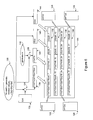
- Figure 2 is a block diagram that shows a high-level representation of an example of the preferred embodiment as applied to certain AES encryption steps (using table implementation of AES for high performance as described in Dr. Brian Gladman, "A Specification for Rijndael, the AES Algorithm", at fp.gladman.plus.com/cryptography technology/rijndael/aes.spec.311.pdf, 15 April 2003 (pages 18-19 ).).
- Figure 2 shows input j (29) for a set of four substitution tables (the value sj/tj in the table implementation of AES referenced above).
- the substitution tables for the AES encryption process are represented in the Figure 2 example by the split masked tables sm1(x), sm2(x), sm3(x), sm4(x) and corresponding split masked tables sm1'(x), sm2'(x), sm3'(x), sm4'(x).
- the AES cryptographic process as described in Gladman, above, calls for four different substitution tables (S1, S2, S3, S4, not shown). These four tables are subject to a split masking operation (as suggested in Figure 1). The result is the two sets of split masked substitution tables shown in Figure 2.
- the words in the split masked tables are 32-bits in length and each of the pairs of split masked tables (sm1(x) and sm1'(x) and so forth) are defined as described above with respect to the split masked table generation shown in Figure 1.
- the AES input values are applied to each of the two sets of split masked tables and the encryption is carried out in accordance with the AES process for each of the two sets of tables.
- the output from each of the two sets of split masked substitution tables is a 32-bit word value.
- the 32-bit output data words are each applied as input to a merge table denoted m5(x) (table 32 shown in Figure 2).
- This merge table is constructed to merge the bits in the 32-bit output data words by exclusive or'ing the bits that have been processed by (exclusive or'ed by) the r[x] ⁇ S[x] values with the corresponding bits processed by the r[x] ⁇ m values.
- the resulting bit value will be effectively processed by the value m ⁇ S[x]. Consequently, the effect is the same as if the masked substitution value (m ⁇ S[x]) had been applied to the input, without that masked value having been directly applied to the input.
- the output of each of the two copies of the m5(x) table 32 as shown in Figure 2 will be a word having half the bit-length of the 32-bit data words generated by each set of the split masked substitution tables.
- the output of each copy of m5(x) table 32 is a data word with a bit-length of 16.
- the merge box 33 in Figure 2 illustrates a further reassembly step by which the bits for each data word are placed into their correct bit-order for the output (34) of the masked substitution table process.
- the correct bit-order is defined by concatenating the two resulting data values together as the data words in the split masked tables are defined by the concatenation operation.
- other more complex patterns of bits may be used in defining the split masked tables and in such cases, the appropriate mapping of bits required will be carried out in merge step 33 shown in Figure 2.
- m5(x) table 32 takes an 8-bit data word as input and produces a 4-bit data word as output ( Figure 2 shows m5(x) table 32 used to accept 32-bit input and to produce 16-bit output - achievable by repeated operation of m5(x) table 32 as described below).
- FIG 3 the symbol ⁇ represents the concatenation operation.
- the example of Figure 3 shows input for m5(x) table 32 being defined by a set of 16 bits representing the value r[x] ⁇ S[x] and a further 16 bits representing the values r[x] ⁇ m. The bits are arranged as shown in Figure 3.
- the m5(x) table 32 for this example is defined to operate by accepting an 8-bit input and outputting a 4-bit value.
- the 4-bit value is generated by exclusive or'ing the corresponding bits of the r[x] ⁇ S[x] and the r[x] ⁇ m values.
- 8-bit byte 50 is input to m5(x) table 32 to produce 4- bit byte 52.
- Figure 3 shows the values that are exclusive or'ed with inputs to split masked substitution table sm(x), defined as shown in Figure 1.
- Table sm(x) is defined by r(x) ⁇ S(x) ⁇ r(x) ⁇ m as is described above for Figure 1.
- the first 8-bit byte 50 is a value that represents the table input exclusive or'ed with value r(x) ⁇ S(x)_0..3 and with r(x) ⁇ m_0..3, concatenated.
- the result of repeated operation of m5(x) table 32 on bytes 50, 54, 56, 58 is a 16-bit word made up of 4-bit bytes 52, 60, 62, 64.
- the entire resultant data word is therefore equivalent to the input exclusive or'ed with m ⁇ S[x], the original substitution table entry, masked with value m.
- Figure 4 shows the manner in which a split masked substitution table 70 of the preferred embodiment may be refreshed without requiring a full table regeneration step.
- the preferred embodiment provides that on each access of a table entry in split masked substitution table 70 that table entry will be refreshed using a random masking step (the exclusive or shown as oval 72).
- split masked substitution table 70 is shown with an entry sm[x] being defined as r[x] ⁇ S[x] ⁇ r[x] ⁇ m having word length w-bits.
- the entry value is masked by a randomly generated value r (as shown in elements 74, 76, 78 in Figure 4) to provide a new, refreshed value for the table entry defined as r ⁇ r[x] ⁇ S[x] ⁇ r ⁇ r[x] ⁇ m.
- r a randomly generated value for the table entry defined as r ⁇ r[x] ⁇ S[x] ⁇ r ⁇ r[x] ⁇ m.
- the above approach permits the values in the split masked substitution tables to be refreshed without the necessity to replace or regenerate the full table at any one time.
- the number of randomly defined masks will be potentially large as new masks are defined for each refresh step after split masked substitution table access.
- Figure 5 shows a further example in accordance with the preferred embodiment in which a single original substitution table 80 is used to generate four split masked substitution tables 82, 84, 86, 88 (sm(x), sm'(x), sm"(x) and sm'''(x), respectively).
- the four split masked substitution tables 82, 84, 86, 88 are defined, in the example of Figure 5, using a combination of masked bits and unmasked random bits as is shown in the figure.
- Each entry S[x] in original substitution table 80 is masked with both the values r1[x] and r2[x], as generated for that entry S[x]. This is shown by the exclusive or operation at 96 resulting in value r1[x] ⁇ r2[x] ⁇ S[x] shown at masked data word 98 in Figure 5.
- each r1[x] is masked with value m, as shown at exclusive or 100 resulting in randomized mask data word 102 with value r1[x] ⁇ m.
- the second set of random values r2(x) is used without masking (see data word 104) in the generation of values in the split masked substitution tables 82, 84, 86, 88.
- the first eight bits of each of data words 98, 102, 104 are combined to provide the appropriate 24-bit word entry in table sm(x) (split masked substitution table 82).
- the entry generated for sm(x) is defined as shown in data word 108: the concatenation of the first eight bits of r1[x] ⁇ r2[x] ⁇ S[x], of r1[x] ⁇ m, and of r2[x].
- entries for split masked substitution tables 84, 86, 88 are defined by data words 110, 112, 114 which reflect the concatenations of the second, third and fourth 8-bit portions of r1[x] ⁇ r2[x] ⁇ S[x], of r1[x] ⁇ m, and of r2[x], respectively, as shown in Figure 5.
- this approach to the generation of the split masked substitution tables of the preferred embodiment will potentially produce split masked tables having word lengths different from the original substitution table.
- such a change in data word length for the entries in the substitution tables may not be significant.
- the selection of a particular number of random value sets (i.e. r1(x), r2(x),...) will affect the way in which the masking operations are carried out according to the preferred embodiment. If there are n such sets (corresponding to r1(x), ... rn(x) random value sets) then there is a first masking operation defined by r1(x) ⁇ ...rn(x) ⁇ s(x). The resulting data word is then divided across the data words used in generating the split masked substitution tables. To allow for the combination of data words to provide the effect of masking the original substitution table (S(x) ⁇ m), the preferred embodiment utilizes an even number of split masked substitution tables.
- n+1 substitution tables are required.
- the case with 3 sets of random values, r1(x),r2(x),r3(x), is illustrated in Figure 6, as is described in more detail below.
- (n+2) substitution tables are required.
- Figure 6 shows S(x), single original substitution table 120, used to generate split masked substitution tables 122, 124, 126, 128 (sm(x), sm'(x), sm''(x), s'''(x), respectively).
- the approach to generation of these split masked tables is similar to that shown in Figure 5.
- the entries in the generated split masked substitution tables are 32-bit words. In the example of Figure 6, this is shown by the generation of three sets of random values r1(x), r2(x) and r3(x) (at generator 130) and the generation of a random value m (at generator 132).
- each entry S[x] in original substitution table 120 is masked with each of the generated random values.
- the resulting data word 136 therefore has the value r1[x] ⁇ r2[x] ⁇ r3[x] ⁇ S[x].
- the mask value m is masked with each r1[x] value (exclusive or 138) to give data word 140 with value r1[x] ⁇ m. Random values r2(x) and r3(x) are used without masking as shown by data words 142, 144, respectively.
- the first eight bits of each of data words 136, 140, 142, 144 are combined to provide the appropriate entry in split masked substitution table 122.
- the entry generated in sm(x) is defined as shown in data word 152: the entry is the concatenation of the first eight bits of r1[x] ⁇ r2[x] ⁇ r3 [x] ⁇ S[x], of r1[x] ⁇ m, of r2[x], and of r3[x].
- entries for split masked substitution tables 124, 126, 128 are defined by data words 154, 156, 158 which reflect the concatenations of the second, third and fourth 8-bit portions of r1[x] ⁇ r2[x] ⁇ r3 [x] ⁇ S[x], of r1 x] ⁇ m, of r2[x], and of r3[x], respectively, as shown in Figure 6 (portions from data words 136, 140, 142 and 144).
- the result of splitting and subsequent concatenating of the data words 152, 154, 156, 158 is the set of split masked substitution tables 122, 124, 126, 128. As will be seen, these resultant tables each have a data word that is 32-bits in length.
- the examples in Figures 1 through 6 show a splitting and concatenation of the split values to generate split masked table entries.
- the preferred embodiment may also be implemented without using concatenation, so long as the split masked table entry contains split table entry bit pairs and those pairs are placed in defined locations in the entry so that a combination of the two split table entry pair values can be made to generate the correct masked substitution table entry bit.
- the merging of the split values, illustrated in Figure 2 and Figure 3 may also be implemented using an alternative process to the use of the m5(x) table where the alternative process acts to create the resulting value m ⁇ S[x]. For example, the shifting of the values by 16 bits and exclusive or operations could be used to produce the resulting value m ⁇ S[x] for the Figure 1 arrangement, instead of using the m5(x) table.
- the words of the resulting split masked table entries are generated using a portion of the original S-box table entry, masked by the different set of generated random r(x) values, a portion of one of those values masked by the a first random m value, and a portion of the other generated r(x) random values in the set.
- These split masked substitution tables may be used in a modified cryptographic process, in which copies of the input value for the cryptographic process is input into each of the generated set of split masked substitution tables.
Landscapes
- Engineering & Computer Science (AREA)
- Computer Security & Cryptography (AREA)
- Computer Networks & Wireless Communication (AREA)
- Signal Processing (AREA)
- Physics & Mathematics (AREA)
- General Physics & Mathematics (AREA)
- Theoretical Computer Science (AREA)
- Storage Device Security (AREA)
- Table Devices Or Equipment (AREA)
Priority Applications (7)
| Application Number | Priority Date | Filing Date | Title |
|---|---|---|---|
| EP06110747A EP1833190B1 (fr) | 2006-03-07 | 2006-03-07 | Division de table pour procédés cryptographiques |
| DE602006015902T DE602006015902D1 (de) | 2006-03-07 | 2006-03-07 | Tabellenteilung für kryptografische Verfahren |
| AT06110747T ATE476803T1 (de) | 2006-03-07 | 2006-03-07 | Tabellenteilung für kryptografische verfahren |
| SG200700911-1A SG136033A1 (en) | 2006-03-07 | 2007-02-06 | Table splitting for cryptographic processes |
| SG200907423-8A SG157375A1 (en) | 2006-03-07 | 2007-02-06 | Table splitting for cryptographic processes |
| CA2578316A CA2578316C (fr) | 2006-03-07 | 2007-02-12 | Fractionnement de tables pour procedes de chiffrement |
| CN2007100052881A CN101034978B (zh) | 2006-03-07 | 2007-02-14 | 用于执行抵抗密码攻击的密码过程的方法和计算设备、以及数据处理系统 |
Applications Claiming Priority (1)
| Application Number | Priority Date | Filing Date | Title |
|---|---|---|---|
| EP06110747A EP1833190B1 (fr) | 2006-03-07 | 2006-03-07 | Division de table pour procédés cryptographiques |
Publications (2)
| Publication Number | Publication Date |
|---|---|
| EP1833190A1 true EP1833190A1 (fr) | 2007-09-12 |
| EP1833190B1 EP1833190B1 (fr) | 2010-08-04 |
Family
ID=36676717
Family Applications (1)
| Application Number | Title | Priority Date | Filing Date |
|---|---|---|---|
| EP06110747A Expired - Lifetime EP1833190B1 (fr) | 2006-03-07 | 2006-03-07 | Division de table pour procédés cryptographiques |
Country Status (6)
| Country | Link |
|---|---|
| EP (1) | EP1833190B1 (fr) |
| CN (1) | CN101034978B (fr) |
| AT (1) | ATE476803T1 (fr) |
| CA (1) | CA2578316C (fr) |
| DE (1) | DE602006015902D1 (fr) |
| SG (2) | SG136033A1 (fr) |
Cited By (10)
| Publication number | Priority date | Publication date | Assignee | Title |
|---|---|---|---|---|
| WO2009074726A1 (fr) * | 2007-12-13 | 2009-06-18 | Oberthur Technologies | Procede de traitement cryptographique de donnees, notamment a l'aide d'une boite s, dispositif et programme associes |
| WO2009074727A1 (fr) * | 2007-12-13 | 2009-06-18 | Oberthur Technologies | Procede d'acces a un sous-mot dans un mot binaire, dispositif et programme associes |
| WO2011080487A1 (fr) * | 2009-12-30 | 2011-07-07 | France Telecom | Procede de generation de table de correspondance pour une boite blanche cryptographique |
| EP2363974A1 (fr) * | 2010-02-26 | 2011-09-07 | Research In Motion Limited | Masquage de tables variable pour procédés cryptographiques |
| US8184806B2 (en) | 2004-05-24 | 2012-05-22 | Research In Motion Limited | Table masking for resistance to power analysis attacks |
| US8325928B2 (en) | 2004-04-16 | 2012-12-04 | Research In Motion Limited | Security countermeasure for power analysis attacks |
| CN103413084A (zh) * | 2013-07-22 | 2013-11-27 | 中国联合网络通信集团有限公司 | 密码框显示内容的控制方法及装置 |
| CN107547190A (zh) * | 2016-06-28 | 2018-01-05 | 埃沙尔公司 | 用于保护使用替换表的替换运算免受侧信道分析的方法 |
| US20230214216A1 (en) * | 2021-12-30 | 2023-07-06 | Nuvoton Technology Corporation | Addition mask value generator, encryptor and method for generating stream key |
| EP4351080A1 (fr) * | 2022-10-03 | 2024-04-10 | Canon Kabushiki Kaisha | Appareil de traitement de chiffrement, procédé de traitement de chiffrement pour appareil de traitement de chiffrement et support de stockage |
Families Citing this family (5)
| Publication number | Priority date | Publication date | Assignee | Title |
|---|---|---|---|---|
| CN101729241B (zh) * | 2008-10-23 | 2012-01-25 | 国民技术股份有限公司 | 抵御差分能量攻击的aes加密方法 |
| DE102012018924A1 (de) | 2012-09-25 | 2014-03-27 | Giesecke & Devrient Gmbh | Seitenkanalgeschützte Maskierung |
| CN103647637B (zh) * | 2013-11-19 | 2017-01-04 | 国家密码管理局商用密码检测中心 | 一种对简单掩码的sm4算法进行二阶侧信道能量分析方法 |
| DE102014016548A1 (de) * | 2014-11-10 | 2016-05-12 | Giesecke & Devrient Gmbh | Verfahren zum Testen und zum Härten von Softwareapplikationen |
| CN115348066B (zh) * | 2022-08-05 | 2023-03-28 | 昆仑数智科技有限责任公司 | 数据加密传输方法、装置及电子设备、存储介质 |
Citations (3)
| Publication number | Priority date | Publication date | Assignee | Title |
|---|---|---|---|---|
| EP1267514A2 (fr) * | 2001-06-13 | 2002-12-18 | Fujitsu Limited | Cryptage sécurisé contre les attaques DPA par analyse différentielle de consommation de courant |
| US20050232430A1 (en) * | 2004-04-16 | 2005-10-20 | Gebotys Catherine H | Security countermeasures for power analysis attacks |
| EP1601132A1 (fr) * | 2004-05-24 | 2005-11-30 | Research In Motion Limited | Masquage de table pour résister aux attaques par analyse de puissance |
-
2006
- 2006-03-07 EP EP06110747A patent/EP1833190B1/fr not_active Expired - Lifetime
- 2006-03-07 DE DE602006015902T patent/DE602006015902D1/de not_active Expired - Lifetime
- 2006-03-07 AT AT06110747T patent/ATE476803T1/de not_active IP Right Cessation
-
2007
- 2007-02-06 SG SG200700911-1A patent/SG136033A1/en unknown
- 2007-02-06 SG SG200907423-8A patent/SG157375A1/en unknown
- 2007-02-12 CA CA2578316A patent/CA2578316C/fr active Active
- 2007-02-14 CN CN2007100052881A patent/CN101034978B/zh active Active
Patent Citations (3)
| Publication number | Priority date | Publication date | Assignee | Title |
|---|---|---|---|---|
| EP1267514A2 (fr) * | 2001-06-13 | 2002-12-18 | Fujitsu Limited | Cryptage sécurisé contre les attaques DPA par analyse différentielle de consommation de courant |
| US20050232430A1 (en) * | 2004-04-16 | 2005-10-20 | Gebotys Catherine H | Security countermeasures for power analysis attacks |
| EP1601132A1 (fr) * | 2004-05-24 | 2005-11-30 | Research In Motion Limited | Masquage de table pour résister aux attaques par analyse de puissance |
Non-Patent Citations (1)
| Title |
|---|
| KOUICHI ITOH ET AL: "DPA Countermeasure Based on the Masking Method", PROCEEDINGS OF ICICS. INTERNATIONAL CONFERENCE ON INFORMATION COMMUNICATIONS AND SIGNAL PROCESSING, 6 December 2001 (2001-12-06), pages 440 - 456, XP002297044 * |
Cited By (16)
| Publication number | Priority date | Publication date | Assignee | Title |
|---|---|---|---|---|
| US8325928B2 (en) | 2004-04-16 | 2012-12-04 | Research In Motion Limited | Security countermeasure for power analysis attacks |
| US8638944B2 (en) | 2004-04-16 | 2014-01-28 | Blackberry Limited | Security countermeasures for power analysis attacks |
| US8184806B2 (en) | 2004-05-24 | 2012-05-22 | Research In Motion Limited | Table masking for resistance to power analysis attacks |
| US8473751B2 (en) | 2007-12-13 | 2013-06-25 | Oberthur Technologies | Method for cryptographic data processing, particularly using an S box, and related device and software |
| WO2009074726A1 (fr) * | 2007-12-13 | 2009-06-18 | Oberthur Technologies | Procede de traitement cryptographique de donnees, notamment a l'aide d'une boite s, dispositif et programme associes |
| WO2009074727A1 (fr) * | 2007-12-13 | 2009-06-18 | Oberthur Technologies | Procede d'acces a un sous-mot dans un mot binaire, dispositif et programme associes |
| US9154295B2 (en) | 2009-12-30 | 2015-10-06 | Koninklijke Philps N.V. | Method of generating a correspondence table for a cryptographic white box |
| WO2011080487A1 (fr) * | 2009-12-30 | 2011-07-07 | France Telecom | Procede de generation de table de correspondance pour une boite blanche cryptographique |
| EP2363974A1 (fr) * | 2010-02-26 | 2011-09-07 | Research In Motion Limited | Masquage de tables variable pour procédés cryptographiques |
| CN103413084A (zh) * | 2013-07-22 | 2013-11-27 | 中国联合网络通信集团有限公司 | 密码框显示内容的控制方法及装置 |
| CN103413084B (zh) * | 2013-07-22 | 2016-07-06 | 中国联合网络通信集团有限公司 | 密码框显示内容的控制方法及装置 |
| CN107547190A (zh) * | 2016-06-28 | 2018-01-05 | 埃沙尔公司 | 用于保护使用替换表的替换运算免受侧信道分析的方法 |
| US20230214216A1 (en) * | 2021-12-30 | 2023-07-06 | Nuvoton Technology Corporation | Addition mask value generator, encryptor and method for generating stream key |
| US12282771B2 (en) * | 2021-12-30 | 2025-04-22 | Nuvoton Technology Corporation | Addition mask value generator, encryptor and method for generating stream key |
| EP4351080A1 (fr) * | 2022-10-03 | 2024-04-10 | Canon Kabushiki Kaisha | Appareil de traitement de chiffrement, procédé de traitement de chiffrement pour appareil de traitement de chiffrement et support de stockage |
| US12438712B2 (en) | 2022-10-03 | 2025-10-07 | Canon Kabushiki Kaisha | Encryption processing apparatus, encryption processing method for encryption processing apparatus, and storage medium |
Also Published As
| Publication number | Publication date |
|---|---|
| EP1833190B1 (fr) | 2010-08-04 |
| SG136033A1 (en) | 2007-10-29 |
| DE602006015902D1 (de) | 2010-09-16 |
| CN101034978A (zh) | 2007-09-12 |
| CA2578316C (fr) | 2011-11-08 |
| CA2578316A1 (fr) | 2007-09-07 |
| CN101034978B (zh) | 2013-09-04 |
| SG157375A1 (en) | 2009-12-29 |
| ATE476803T1 (de) | 2010-08-15 |
Similar Documents
| Publication | Publication Date | Title |
|---|---|---|
| CA2578316C (fr) | Fractionnement de tables pour procedes de chiffrement | |
| US7899190B2 (en) | Security countermeasures for power analysis attacks | |
| US8619985B2 (en) | Table splitting for cryptographic processes | |
| EP1722502B1 (fr) | Masquage de clé pour procédés cryptographiques | |
| US8184806B2 (en) | Table masking for resistance to power analysis attacks | |
| US8503670B2 (en) | Parallelizable integrity-aware encryption technique | |
| US8094816B2 (en) | System and method for stream/block cipher with internal random states | |
| US8644500B2 (en) | Apparatus and method for block cipher process for insecure environments | |
| US8199909B2 (en) | Method and device for carrying out a cryptographic calculation | |
| US8605894B2 (en) | Cryptographic process execution protecting an input value against attacks | |
| US7720225B2 (en) | Table splitting for cryptographic processes | |
| KR101095386B1 (ko) | 이산화된 카오스 함수를 이용한 암호 시스템 | |
| EP1601132B1 (fr) | Masquage de table pour résister aux attaques par analyse de puissance | |
| CA2504338C (fr) | Contremesures de securite en cas d'attaques aux analyses de puissance | |
| EP2363974A1 (fr) | Masquage de tables variable pour procédés cryptographiques | |
| KR20240046850A (ko) | 암호화 처리 장치, 암호화 처리 장치의 암호화 처리 방법, 및 저장 매체 | |
| HK1082346B (en) | Security countermeasures for power analysis attacks | |
| HK1083956B (en) | Table masking for resistance to power analysis attacks |
Legal Events
| Date | Code | Title | Description |
|---|---|---|---|
| PUAI | Public reference made under article 153(3) epc to a published international application that has entered the european phase |
Free format text: ORIGINAL CODE: 0009012 |
|
| 17P | Request for examination filed |
Effective date: 20060307 |
|
| AK | Designated contracting states |
Kind code of ref document: A1 Designated state(s): AT BE BG CH CY CZ DE DK EE ES FI FR GB GR HU IE IS IT LI LT LU LV MC NL PL PT RO SE SI SK TR |
|
| AX | Request for extension of the european patent |
Extension state: AL BA HR MK YU |
|
| 17Q | First examination report despatched |
Effective date: 20071102 |
|
| AKX | Designation fees paid |
Designated state(s): AT BE BG CH CY CZ DE DK EE ES FI FR GB GR HU IE IS IT LI LT LU LV MC NL PL PT RO SE SI SK TR |
|
| AXX | Extension fees paid |
Extension state: MK Payment date: 20060307 Extension state: BA Payment date: 20060307 Extension state: AL Payment date: 20060307 Extension state: HR Payment date: 20060307 Extension state: YU Payment date: 20060307 |
|
| GRAP | Despatch of communication of intention to grant a patent |
Free format text: ORIGINAL CODE: EPIDOSNIGR1 |
|
| GRAS | Grant fee paid |
Free format text: ORIGINAL CODE: EPIDOSNIGR3 |
|
| GRAA | (expected) grant |
Free format text: ORIGINAL CODE: 0009210 |
|
| AK | Designated contracting states |
Kind code of ref document: B1 Designated state(s): AT BE BG CH CY CZ DE DK EE ES FI FR GB GR HU IE IS IT LI LT LU LV MC NL PL PT RO SE SI SK TR |
|
| AX | Request for extension of the european patent |
Extension state: AL BA HR MK YU |
|
| REG | Reference to a national code |
Ref country code: GB Ref legal event code: FG4D |
|
| REG | Reference to a national code |
Ref country code: CH Ref legal event code: EP |
|
| REG | Reference to a national code |
Ref country code: IE Ref legal event code: FG4D |
|
| REF | Corresponds to: |
Ref document number: 602006015902 Country of ref document: DE Date of ref document: 20100916 Kind code of ref document: P |
|
| REG | Reference to a national code |
Ref country code: NL Ref legal event code: VDEP Effective date: 20100804 |
|
| LTIE | Lt: invalidation of european patent or patent extension |
Effective date: 20100804 |
|
| PG25 | Lapsed in a contracting state [announced via postgrant information from national office to epo] |
Ref country code: LT Free format text: LAPSE BECAUSE OF FAILURE TO SUBMIT A TRANSLATION OF THE DESCRIPTION OR TO PAY THE FEE WITHIN THE PRESCRIBED TIME-LIMIT Effective date: 20100804 Ref country code: AT Free format text: LAPSE BECAUSE OF FAILURE TO SUBMIT A TRANSLATION OF THE DESCRIPTION OR TO PAY THE FEE WITHIN THE PRESCRIBED TIME-LIMIT Effective date: 20100804 Ref country code: FI Free format text: LAPSE BECAUSE OF FAILURE TO SUBMIT A TRANSLATION OF THE DESCRIPTION OR TO PAY THE FEE WITHIN THE PRESCRIBED TIME-LIMIT Effective date: 20100804 Ref country code: NL Free format text: LAPSE BECAUSE OF FAILURE TO SUBMIT A TRANSLATION OF THE DESCRIPTION OR TO PAY THE FEE WITHIN THE PRESCRIBED TIME-LIMIT Effective date: 20100804 |
|
| PG25 | Lapsed in a contracting state [announced via postgrant information from national office to epo] |
Ref country code: PT Free format text: LAPSE BECAUSE OF FAILURE TO SUBMIT A TRANSLATION OF THE DESCRIPTION OR TO PAY THE FEE WITHIN THE PRESCRIBED TIME-LIMIT Effective date: 20101206 Ref country code: SI Free format text: LAPSE BECAUSE OF FAILURE TO SUBMIT A TRANSLATION OF THE DESCRIPTION OR TO PAY THE FEE WITHIN THE PRESCRIBED TIME-LIMIT Effective date: 20100804 Ref country code: CY Free format text: LAPSE BECAUSE OF FAILURE TO SUBMIT A TRANSLATION OF THE DESCRIPTION OR TO PAY THE FEE WITHIN THE PRESCRIBED TIME-LIMIT Effective date: 20100804 Ref country code: IS Free format text: LAPSE BECAUSE OF FAILURE TO SUBMIT A TRANSLATION OF THE DESCRIPTION OR TO PAY THE FEE WITHIN THE PRESCRIBED TIME-LIMIT Effective date: 20101204 Ref country code: PL Free format text: LAPSE BECAUSE OF FAILURE TO SUBMIT A TRANSLATION OF THE DESCRIPTION OR TO PAY THE FEE WITHIN THE PRESCRIBED TIME-LIMIT Effective date: 20100804 Ref country code: BG Free format text: LAPSE BECAUSE OF FAILURE TO SUBMIT A TRANSLATION OF THE DESCRIPTION OR TO PAY THE FEE WITHIN THE PRESCRIBED TIME-LIMIT Effective date: 20101104 |
|
| PG25 | Lapsed in a contracting state [announced via postgrant information from national office to epo] |
Ref country code: GR Free format text: LAPSE BECAUSE OF FAILURE TO SUBMIT A TRANSLATION OF THE DESCRIPTION OR TO PAY THE FEE WITHIN THE PRESCRIBED TIME-LIMIT Effective date: 20101105 Ref country code: SE Free format text: LAPSE BECAUSE OF FAILURE TO SUBMIT A TRANSLATION OF THE DESCRIPTION OR TO PAY THE FEE WITHIN THE PRESCRIBED TIME-LIMIT Effective date: 20100804 Ref country code: LV Free format text: LAPSE BECAUSE OF FAILURE TO SUBMIT A TRANSLATION OF THE DESCRIPTION OR TO PAY THE FEE WITHIN THE PRESCRIBED TIME-LIMIT Effective date: 20100804 Ref country code: BE Free format text: LAPSE BECAUSE OF FAILURE TO SUBMIT A TRANSLATION OF THE DESCRIPTION OR TO PAY THE FEE WITHIN THE PRESCRIBED TIME-LIMIT Effective date: 20100804 |
|
| PG25 | Lapsed in a contracting state [announced via postgrant information from national office to epo] |
Ref country code: DK Free format text: LAPSE BECAUSE OF FAILURE TO SUBMIT A TRANSLATION OF THE DESCRIPTION OR TO PAY THE FEE WITHIN THE PRESCRIBED TIME-LIMIT Effective date: 20100804 |
|
| PG25 | Lapsed in a contracting state [announced via postgrant information from national office to epo] |
Ref country code: EE Free format text: LAPSE BECAUSE OF FAILURE TO SUBMIT A TRANSLATION OF THE DESCRIPTION OR TO PAY THE FEE WITHIN THE PRESCRIBED TIME-LIMIT Effective date: 20100804 Ref country code: IT Free format text: LAPSE BECAUSE OF FAILURE TO SUBMIT A TRANSLATION OF THE DESCRIPTION OR TO PAY THE FEE WITHIN THE PRESCRIBED TIME-LIMIT Effective date: 20100804 Ref country code: CZ Free format text: LAPSE BECAUSE OF FAILURE TO SUBMIT A TRANSLATION OF THE DESCRIPTION OR TO PAY THE FEE WITHIN THE PRESCRIBED TIME-LIMIT Effective date: 20100804 Ref country code: SK Free format text: LAPSE BECAUSE OF FAILURE TO SUBMIT A TRANSLATION OF THE DESCRIPTION OR TO PAY THE FEE WITHIN THE PRESCRIBED TIME-LIMIT Effective date: 20100804 Ref country code: RO Free format text: LAPSE BECAUSE OF FAILURE TO SUBMIT A TRANSLATION OF THE DESCRIPTION OR TO PAY THE FEE WITHIN THE PRESCRIBED TIME-LIMIT Effective date: 20100804 |
|
| PLBE | No opposition filed within time limit |
Free format text: ORIGINAL CODE: 0009261 |
|
| STAA | Information on the status of an ep patent application or granted ep patent |
Free format text: STATUS: NO OPPOSITION FILED WITHIN TIME LIMIT |
|
| PG25 | Lapsed in a contracting state [announced via postgrant information from national office to epo] |
Ref country code: ES Free format text: LAPSE BECAUSE OF FAILURE TO SUBMIT A TRANSLATION OF THE DESCRIPTION OR TO PAY THE FEE WITHIN THE PRESCRIBED TIME-LIMIT Effective date: 20101115 |
|
| 26N | No opposition filed |
Effective date: 20110506 |
|
| REG | Reference to a national code |
Ref country code: DE Ref legal event code: R097 Ref document number: 602006015902 Country of ref document: DE Effective date: 20110506 |
|
| PG25 | Lapsed in a contracting state [announced via postgrant information from national office to epo] |
Ref country code: MC Free format text: LAPSE BECAUSE OF NON-PAYMENT OF DUE FEES Effective date: 20110331 |
|
| REG | Reference to a national code |
Ref country code: CH Ref legal event code: PL |
|
| REG | Reference to a national code |
Ref country code: IE Ref legal event code: MM4A |
|
| PG25 | Lapsed in a contracting state [announced via postgrant information from national office to epo] |
Ref country code: LI Free format text: LAPSE BECAUSE OF NON-PAYMENT OF DUE FEES Effective date: 20110331 Ref country code: CH Free format text: LAPSE BECAUSE OF NON-PAYMENT OF DUE FEES Effective date: 20110331 Ref country code: IE Free format text: LAPSE BECAUSE OF NON-PAYMENT OF DUE FEES Effective date: 20110307 |
|
| PG25 | Lapsed in a contracting state [announced via postgrant information from national office to epo] |
Ref country code: LU Free format text: LAPSE BECAUSE OF NON-PAYMENT OF DUE FEES Effective date: 20110307 |
|
| PG25 | Lapsed in a contracting state [announced via postgrant information from national office to epo] |
Ref country code: TR Free format text: LAPSE BECAUSE OF FAILURE TO SUBMIT A TRANSLATION OF THE DESCRIPTION OR TO PAY THE FEE WITHIN THE PRESCRIBED TIME-LIMIT Effective date: 20100804 |
|
| PG25 | Lapsed in a contracting state [announced via postgrant information from national office to epo] |
Ref country code: HU Free format text: LAPSE BECAUSE OF FAILURE TO SUBMIT A TRANSLATION OF THE DESCRIPTION OR TO PAY THE FEE WITHIN THE PRESCRIBED TIME-LIMIT Effective date: 20100804 |
|
| REG | Reference to a national code |
Ref country code: DE Ref legal event code: R082 Ref document number: 602006015902 Country of ref document: DE Representative=s name: MERH-IP MATIAS ERNY REICHL HOFFMANN, DE |
|
| REG | Reference to a national code |
Ref country code: DE Ref legal event code: R082 Ref document number: 602006015902 Country of ref document: DE Representative=s name: MERH-IP MATIAS ERNY REICHL HOFFMANN, DE Effective date: 20140925 Ref country code: DE Ref legal event code: R081 Ref document number: 602006015902 Country of ref document: DE Owner name: BLACKBERRY LIMITED, WATERLOO, CA Free format text: FORMER OWNER: RESEARCH IN MOTION LTD., WATERLOO, ONTARIO, CA Effective date: 20140925 Ref country code: DE Ref legal event code: R082 Ref document number: 602006015902 Country of ref document: DE Representative=s name: MERH-IP MATIAS ERNY REICHL HOFFMANN PATENTANWA, DE Effective date: 20140925 |
|
| REG | Reference to a national code |
Ref country code: FR Ref legal event code: PLFP Year of fee payment: 11 |
|
| REG | Reference to a national code |
Ref country code: FR Ref legal event code: PLFP Year of fee payment: 12 |
|
| REG | Reference to a national code |
Ref country code: FR Ref legal event code: PLFP Year of fee payment: 13 |
|
| REG | Reference to a national code |
Ref country code: DE Ref legal event code: R082 Ref document number: 602006015902 Country of ref document: DE Ref country code: DE Ref legal event code: R081 Ref document number: 602006015902 Country of ref document: DE Owner name: MALIKIE INNOVATIONS LTD., IE Free format text: FORMER OWNER: BLACKBERRY LIMITED, WATERLOO, ONTARIO, CA |
|
| PGFP | Annual fee paid to national office [announced via postgrant information from national office to epo] |
Ref country code: DE Payment date: 20250327 Year of fee payment: 20 |
|
| PGFP | Annual fee paid to national office [announced via postgrant information from national office to epo] |
Ref country code: FR Payment date: 20250324 Year of fee payment: 20 |
|
| PGFP | Annual fee paid to national office [announced via postgrant information from national office to epo] |
Ref country code: GB Payment date: 20250325 Year of fee payment: 20 |
|
| REG | Reference to a national code |
Ref country code: DE Ref legal event code: R071 Ref document number: 602006015902 Country of ref document: DE |
|
| REG | Reference to a national code |
Ref country code: GB Ref legal event code: PE20 Expiry date: 20260306 |