EP1833238A2 - Verfahren zum Erzeugen von Halbtonschwellwertdaten, Vorrichtung zum Erzeugen eines Halbtonbildes und Aufzeichnungsmedium - Google Patents
Verfahren zum Erzeugen von Halbtonschwellwertdaten, Vorrichtung zum Erzeugen eines Halbtonbildes und Aufzeichnungsmedium Download PDFInfo
- Publication number
- EP1833238A2 EP1833238A2 EP07008904A EP07008904A EP1833238A2 EP 1833238 A2 EP1833238 A2 EP 1833238A2 EP 07008904 A EP07008904 A EP 07008904A EP 07008904 A EP07008904 A EP 07008904A EP 1833238 A2 EP1833238 A2 EP 1833238A2
- Authority
- EP
- European Patent Office
- Prior art keywords
- halftone threshold
- halftone
- data
- patterns
- threshold data
- Prior art date
- Legal status (The legal status is an assumption and is not a legal conclusion. Google has not performed a legal analysis and makes no representation as to the accuracy of the status listed.)
- Withdrawn
Links
- 238000000034 method Methods 0.000 claims description 32
- 239000011159 matrix material Substances 0.000 claims description 8
- 238000010586 diagram Methods 0.000 description 12
- 230000000737 periodic effect Effects 0.000 description 11
- 230000000694 effects Effects 0.000 description 3
- 238000012986 modification Methods 0.000 description 1
- 230000004048 modification Effects 0.000 description 1
Images








Classifications
-
- H—ELECTRICITY
- H04—ELECTRIC COMMUNICATION TECHNIQUE
- H04N—PICTORIAL COMMUNICATION, e.g. TELEVISION
- H04N1/00—Scanning, transmission or reproduction of documents or the like, e.g. facsimile transmission; Details thereof
- H04N1/40—Picture signal circuits
- H04N1/405—Halftoning, i.e. converting the picture signal of a continuous-tone original into a corresponding signal showing only two levels
- H04N1/4055—Halftoning, i.e. converting the picture signal of a continuous-tone original into a corresponding signal showing only two levels producing a clustered dots or a size modulated halftone pattern
Definitions
- the present invention relates to a method of generating halftone threshold data for converting continuous gradation image data into halftone image data, an apparatus for generating a halftone image, and a recording medium for recording halftone threshold data thereon.
- Halftone image generating apparatus compare continuous gradation image data obtained from an original image with halftone threshold data to produce binary or multivalued halftone image data, and control a laser beam or the like according to the halftone image data to output a halftone image on a recording medium such as a print sheet, a film, or the like.
- FIG. 13 of the accompanying drawings illustrates a process of generating a halftone image using a clustered-dot ordered halftone threshold pattern 2 in a halftone image generating apparatus.
- the clustered-dot ordered halftone threshold pattern 2 have halftone threshold data arranged such that they are progressively greater from the center toward the periphery thereof. As the density of the dot cells 8 increases, more adjacent pixels 6 are successively produced. Therefore, the dot gain does not sharply increases on a recording medium, and a halftone image close to a desired blackened area can be produced in a high density range.
- the size of one dot cell 8 produced according to the halftone threshold pattern 2 i.e., the lower limit of a screen ruling is limited, the number of gradations determined by the halftone threshold data of the halftone threshold pattern 2 cannot sufficiently be increased.
- the halftone image 12 may contain periodic density irregularities as indicated by the dot-and-dash lines in particular density areas depending on the output resolution of the halftone image generating apparatus.
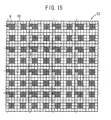
- One process of minimizing such periodic density irregularities uses a dispersed-dot ordered halftone threshold pattern 14 shown in FIG. 16 of the accompanying drawings.
- a typical example of the dispersed-dot ordered halftone threshold pattern is the Bayer array of halftone threshold data which takes into account the spatial frequency characteristics of vision.
- the dispersed-dot ordered halftone threshold pattern 14 contains halftone threshold data arranged such that the spatial frequency characteristics of pixels 6 of dot cells 16 are in a high frequency range.
- the dispersed-dot ordered halftone threshold pattern 14 is advantageous in that periodic density irregularities are less visible because the pixels 6 have lower periodicity.
- the dot gain of the pixels 6 on the recording medium has a greater effect than with the clustered-dot ordered halftone threshold pattern 2, and cannot easily be controlled.
- the dispersed arrangement of the pixels 6 tends to produce a halftone image having a graininess in a low density region.
- a major object of the present invention is to provide a method of generating halftone threshold data, an apparatus for generating a halftone image, and a recording medium which are capable of suppressing a density increase due to the effect of a dot gain and turning a high-density region of a halftone image into a desired gradation.
- Another object of the present invention is to provide a method of generating halftone threshold data, an apparatus for generating a halftone image, and a recording medium which make it possible to produce a high-quality halftone image free of graininess.
- a method of generating halftone threshold data for converting continuous gradation image into halftone image data comprising the steps of generating a clustered-dot ordered array of halftone threshold data making up halftone threshold patterns, and generating a dispersed-dot ordered array, between the halftone threshold patterns, of halftone threshold data making up a multiple halftone threshold pattern which is a collection of the halftone threshold patterns.
- the array of halftone threshold data between the clustered-dot ordered patterns of halftone threshold data is a dispersed-dot ordered multiple halftone threshold pattern, it is possible to generate high-gradation, high-quality halftone images, and periodic density irregularities are made less visible in generated halftone images due to the dispersed-dot ordered array of halftone threshold data.
- an array of halftone threshold data of a minimum unit is a clustered-dot ordered pattern of halftone threshold data
- the halftone image suffers a small density increase due to the effect of a dot gain and has desired gradations, and is of a high quality free of graininess which is inherent with a dispersed-dot ordered pattern of halftone threshold data.
- any periodic density irregularities in a halftone image generated according to a multiple halftone threshold pattern are made sufficiently less visible.
- the dispersed-dot ordered array of halftone threshold data should preferably be an array depending on the spatial frequency characteristics of vision, called an FM screen (see Japanese laid-open patent publications Nos. 8-265566 and 8-274991 ).
- the Bayer array is one of FM screens.
- the multiple halftone threshold pattern can be produced by collecting auxiliary multiple halftone threshold patterns each produced by collecting a plurality of halftone threshold patterns, for thereby increasing the number of gradations that can be expressed.
- an apparatus for generating a halftone image by converting continuous gradation image into halftone image data using halftone threshold data comprising a halftone threshold data memory for storing halftone threshold data of a dispersed-dot ordered multiple halftone threshold pattern, between halftone threshold patterns, of halftone threshold data composed of a collection of halftone threshold patterns each comprising a clustered-dot ordered array of halftone threshold data, and an image data converter for converting the continuous gradation image into the halftone image data with the halftone threshold data.
- the apparatus has an output resolution ranging from 1000 to 1300 dots per inch and a screen ruling ranging from 150 to 200 lines per inch, then the number of halftone threshold data making up one halftone threshold pattern is in the range from 4 to 100 and the size of dot cells produced according the one halftone threshold pattern is smaller than 0.5 mm.
- a recording medium for recording halftone threshold data for converting continuous gradation image into halftone image data, the halftone image data comprising a dispersed-dot ordered multiple halftone threshold pattern, between halftone threshold patterns, of halftone threshold data composed of a collection of halftone threshold patterns each comprising a clustered-dot ordered array of halftone threshold data.
- FIGS. 1 through 12 A method of generating halftone threshold data, an apparatus for generating a halftone image, and a recording medium according to the present invention will be described below with reference to FIGS. 1 through 12.
- Those parts shown in FIGS. 1 through 12 which are identical to those shown in FIGS. 13 through 16 are denoted by identical reference characters, and will not be described in detail below.
- FIGS. 13 through 16 will also be referred to in the description of the present invention.
- FIG. 1 illustrates a method of generating halftone threshold data according to the present invention. The method of generating halftone threshold data according to the present invention will be described below with reference to FIG. 1.
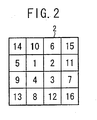
- a halftone threshold pattern 2 which is a basic unit of halftone threshold data making up one dot cell shown in FIG. 2 is generated in step S1.
- the halftone threshold pattern 2 is clustered-dot ordered with the halftone threshold data that are progressively greater from the center toward the periphery thereof, as shown in FIG. 13.
- an array of halftone threshold data that make up an auxiliary multiple halftone threshold pattern 18 composed of four halftone threshold patterns 2a through 2d is determined according to the array of halftone threshold data of the halftone threshold pattern 2 in step S2.
- Each of the halftone threshold patterns 2a through 2d comprises 4 ⁇ 4 halftone threshold data.
- the array of halftone threshold data that make up the auxiliary multiple halftone threshold pattern 18 is determined by, for example, repeating a process of setting halftone threshold data 1 through 4 in a given sequence at corresponding positions in the halftone threshold patterns 2a through 2d where halftone threshold data 1 in the halftone threshold pattern 2 are set, and setting halftone threshold data 5 through 8 in a given sequence at corresponding positions in the halftone threshold patterns 2a through 2d where halftone threshold data 2 in the halftone threshold pattern 2 are set.
- halftone threshold data of the auxiliary multiple halftone threshold pattern 18 are generated according to the determined array of halftone threshold data, as shown in FIG. 3, in step S3.
- the auxiliary multiple halftone threshold pattern 18 thus generated can express a halftone image of 65 gradations.
- an array of halftone threshold data of a multiple halftone threshold pattern 20 comprising 16 auxiliary multiple halftone threshold patterns 18a through 18r shown in FIG. 4 is determined in step S4.
- the array of halftone threshold data between the auxiliary multiple halftone threshold patterns 18a through 18r is established as a dispersed-dot ordered array which serves as an FM screen such as a Bayer array or the like. If the Bayer array is employed, then the auxiliary multiple halftone threshold pattern 18a corresponding to the position where the halftone threshold data 1 is set in the halftone threshold pattern 14 shown in FIG. 16 is selected. Then, the position where the halftone threshold data 1 is set in the auxiliary multiple halftone threshold pattern 18 shown in FIG. 3 is selected, and the halftone threshold data 1 is set in the corresponding position in the auxiliary multiple halftone threshold pattern 18a.
- the auxiliary multiple halftone threshold pattern 18k corresponding to the position where the halftone threshold data 2 is set in the halftone threshold pattern 14 shown in FIG. 16 is selected.
- the position where the halftone threshold data 1 is set in the auxiliary multiple halftone threshold pattern 18 shown in FIG. 3 is selected, and the halftone threshold data 2 is set in the corresponding position in the auxiliary multiple halftone threshold pattern 18a.
- a process similar to the above process is repeated to determine the array of halftone threshold data as shown in FIG. 4.
- halftone threshold data of the multiple halftone threshold pattern 20 are generated according to the determined array of halftone threshold data in step S5.
- the multiple halftone threshold pattern 20 thus generated can express a halftone image of 1025 gradations.
- a dispersed-dot ordered array of halftone threshold data depending on the spatial frequency characteristics of vision can be determined by successively selecting the auxiliary multiple halftone threshold patterns 18a through 18r spaced at largest distances, for example. A process of determining such a dispersed-dot ordered array of halftone threshold data will be described later on.
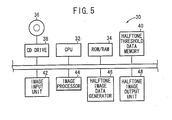
- FIG. 5 shows in block form a halftone image generating apparatus 30 for generating a halftone image using the multiple halftone threshold pattern 20 thus generated.
- the halftone image generating apparatus 30 has a CPU (Central Processing Unit) 32 for controlling the halftone image generating apparatus 30 in its entirety, a ROM/RAM (Read Only Memory/Random Access Memory) 34 for storing programs and various processing data, and a CD drive 38 for driving a CD-ROM (Compact Disk - Read Only Memory) 36 which is a recording medium for recording the multiple halftone threshold pattern 20.
- a CPU Central Processing Unit
- ROM/RAM Read Only Memory/Random Access Memory
- CD-ROM Compact Disk - Read Only Memory
- the CD drive 38 reads the multiple halftone threshold pattern 20 from the CD-ROM 36, and stores the multiple halftone threshold pattern 20 in a halftone threshold data memory 40.
- An image input unit 42 reads the image information of an original image and supplies the read image information as continuous gradation image data to an image processor 44.
- the image processor 44 processes the supplied continuous gradation image data as desired.
- a halftone image data generator 46 reads halftone threshold data according to a desired screen angle and screen ruling from the halftone threshold data memory 40, and compares the processed continuous gradation image data with the halftone threshold data to produce halftone image data.
- a halftone image output unit 48 generates a laser beam or the like based on the halftone image data to output a halftone image on a recording medium such as a film or the like.
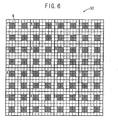
- FIG. 6 shows a halftone image 50 comprising a region which corresponds to the multiple halftone threshold pattern 20 of the 256th gradation which is outputted from halftone image generating apparatus 30 using the multiple halftone threshold pattern 20 which is capable of representing 1025 gradations.
- a multiple halftone threshold pattern 20 of the 257th gradation is produced and outputted by blackening the pixel 6 denoted by the numeral "1" in FIG. 6.
- the pixels 6 indicated by numerals applied according to the rule of the dispersed-dot ordered array are blackened and outputted.
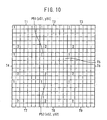
- a 7 ⁇ 7 threshold matrix T5 and surrounding matrixes T1 through T4, T6 through T9, each identical to the 7 ⁇ 7 threshold matrix T5, are defined.
- the threshold matrix T5 may be determined as a 4 ⁇ 4 threshold matrix as shown in FIG. 2.
- Each of the pixel points Pkn has an x coordinate xkn and a y coordinate ykn.
- step S11 all the halftone threshold data t(Pkn) of each of the threshold matrixes Tk are set to 0.
- pixel points Pkn for setting halftone threshold data t(Pkn) 3 through 49 are determined.
- the variable i is updated in step S18, the minimum value Rmin(i) is determined in step S21, and the determined minimum value Rmin(i) is compared with the maximum value Rmax updated in step S23 in steps S22, S25.
- a multiple halftone threshold pattern 20a comprising 49 auxiliary multiple halftone threshold patterns 18(1) through 18(49) each made up of four clustered-dot ordered halftone threshold patterns 2a through 2d is generated.
- the auxiliary multiple halftone threshold patterns 18(1) through 18(49) are successively selected in the order of halftone threshold data of the dispersed-dot ordered halftone threshold data pattern 22 shown in FIG. 11, and then halftone threshold data therefor are set therein, so that final halftone threshold data are determined.
- the auxiliary multiple halftone threshold pattern 18(1) is first selected.
- Halftone threshold data "1" are placed in the halftone threshold pattern 2a according to the rule shown in FIG. 3.
- the auxiliary multiple halftone threshold pattern 18(2) is selected, and halftone threshold data "2" are placed in the halftone threshold pattern 2a.
- halftone threshold data 1 through 3136 are placed according to the rules shown in FIGS. 3 and 11.
- a halftone image generated using the multiple halftone threshold pattern 20a thus set is a smooth image free of periodic irregularities.
- a clustered-dot ordered halftone threshold pattern is generated, an auxiliary multiple halftone threshold pattern is generated according to the array of halftone threshold data thereof, and a dispersed-dot ordered multiple halftone threshold pattern is generated according to the array of halftone threshold data thereof.
- a dispersed-dot ordered multiple halftone threshold pattern may be generated directly from the array of halftone threshold data of a clustered-dot ordered halftone threshold pattern.
- the halftone image generating apparatus has an output resolution ranging from 1000 to 1300 dpi (dots per inch) and a screen ruling ranging from 150 to 200 lpi (lines per inch), then the number of halftone threshold data making up one halftone threshold pattern should preferably be in the range from 4 to 100. If the size of dot cells produced according one halftone threshold pattern is smaller than 0.5 mm, then it is possible to make sufficiently less visible periodic density irregularities in a halftone image that is generated according to a multiple halftone threshold pattern.
Landscapes
- Engineering & Computer Science (AREA)
- Multimedia (AREA)
- Signal Processing (AREA)
- Image Processing (AREA)
- Facsimile Image Signal Circuits (AREA)
- Color, Gradation (AREA)
Applications Claiming Priority (3)
| Application Number | Priority Date | Filing Date | Title |
|---|---|---|---|
| JP2001330852 | 2001-10-29 | ||
| JP2002124628A JP4150206B2 (ja) | 2001-10-29 | 2002-04-25 | 網点閾値データ作成方法 |
| EP02022346A EP1307041A3 (de) | 2001-10-29 | 2002-10-08 | Bildhalbtonrasterung mittels Schwellendaten |
Related Parent Applications (1)
| Application Number | Title | Priority Date | Filing Date |
|---|---|---|---|
| EP02022346A Division EP1307041A3 (de) | 2001-10-29 | 2002-10-08 | Bildhalbtonrasterung mittels Schwellendaten |
Publications (1)
| Publication Number | Publication Date |
|---|---|
| EP1833238A2 true EP1833238A2 (de) | 2007-09-12 |
Family
ID=26624164
Family Applications (2)
| Application Number | Title | Priority Date | Filing Date |
|---|---|---|---|
| EP02022346A Withdrawn EP1307041A3 (de) | 2001-10-29 | 2002-10-08 | Bildhalbtonrasterung mittels Schwellendaten |
| EP07008904A Withdrawn EP1833238A2 (de) | 2001-10-29 | 2002-10-08 | Verfahren zum Erzeugen von Halbtonschwellwertdaten, Vorrichtung zum Erzeugen eines Halbtonbildes und Aufzeichnungsmedium |
Family Applications Before (1)
| Application Number | Title | Priority Date | Filing Date |
|---|---|---|---|
| EP02022346A Withdrawn EP1307041A3 (de) | 2001-10-29 | 2002-10-08 | Bildhalbtonrasterung mittels Schwellendaten |
Country Status (3)
| Country | Link |
|---|---|
| US (1) | US20030081258A1 (de) |
| EP (2) | EP1307041A3 (de) |
| JP (1) | JP4150206B2 (de) |
Cited By (1)
| Publication number | Priority date | Publication date | Assignee | Title |
|---|---|---|---|---|
| WO2017019105A1 (en) * | 2015-07-30 | 2017-02-02 | Hewlett-Packard Development Company, L.P. | Embedding a pattern in output content |
Families Citing this family (15)
| Publication number | Priority date | Publication date | Assignee | Title |
|---|---|---|---|---|
| US7359091B2 (en) * | 2003-01-15 | 2008-04-15 | Xerox Corporation | Multi-bit output sampled threshold array halftoner |
| JP2005286999A (ja) | 2004-03-05 | 2005-10-13 | Fuji Photo Film Co Ltd | 閾値マトリクスの割当方法 |
| JP2005252893A (ja) | 2004-03-05 | 2005-09-15 | Fuji Photo Film Co Ltd | 閾値マトリクス |
| JP2005252888A (ja) | 2004-03-05 | 2005-09-15 | Fuji Photo Film Co Ltd | 閾値マトリクスの作成方法及びその閾値マトリクス並びにカラー画像の再現方法 |
| JP2006159698A (ja) | 2004-12-08 | 2006-06-22 | Canon Inc | 記録方法、及び記録装置 |
| JP2006159697A (ja) * | 2004-12-08 | 2006-06-22 | Canon Inc | 記録方法、及び記録装置 |
| JP4241632B2 (ja) | 2005-01-25 | 2009-03-18 | 富士フイルム株式会社 | 色版作成用閾値マトリクスの作成方法、カラー画像の再現方法、カラー画像分版作成装置及び閾値マトリクス |
| US20060197989A1 (en) * | 2005-03-07 | 2006-09-07 | Toshiba Corporation | Multi-configured halftone system |
| JP4548251B2 (ja) * | 2005-07-11 | 2010-09-22 | セイコーエプソン株式会社 | テクスチャを抑制した画像形成装置 |
| JP4979509B2 (ja) * | 2007-08-10 | 2012-07-18 | キヤノン株式会社 | データ変換装置、該装置を備えた記録装置及びデータ変換方法 |
| FR2948216B1 (fr) | 2009-07-17 | 2011-11-25 | Arjowiggins Security | Element de securite a effet de parallaxe |
| FR2948217B1 (fr) * | 2009-07-17 | 2011-11-11 | Arjowiggins Security | Element de securite a effet de parallaxe |
| US8289574B2 (en) * | 2009-09-02 | 2012-10-16 | Xerox Corporation | Method and system for controlling darkening of image data |
| JP2012029060A (ja) * | 2010-07-23 | 2012-02-09 | Brother Ind Ltd | 画像処理装置 |
| EP3250366A4 (de) * | 2015-01-30 | 2018-09-05 | Hewlett-Packard Development Company, L.P. | Strukturen dreidimensionaler objekte |
Family Cites Families (20)
| Publication number | Priority date | Publication date | Assignee | Title |
|---|---|---|---|---|
| US4736254A (en) * | 1984-11-22 | 1988-04-05 | Matsushita Electric Industrial Co., Ltd. | Method and apparatus for generating pseudo-halftone dots by comparing gray scale values of an original with dither threshold values stored in cells of a matrix array divided into imaginary matrices of elemental areas each containing one cell |
| US5555103A (en) * | 1992-03-16 | 1996-09-10 | Eastman Kodak Company | Half-tone conversion mask for digital images |
| US5438431A (en) * | 1992-05-21 | 1995-08-01 | Ostromoukhov; Victor B. | Method and apparatus for generating digital halftone images using a rotated dispersed dither matrix |
| US5291296A (en) * | 1992-09-29 | 1994-03-01 | Xerox Corporation | Specific set of rotated screens for digital halftoning |
| JP2647618B2 (ja) * | 1993-04-08 | 1997-08-27 | ライノタイプ−ヘル アクチエンゲゼルシャフト | 網目スクリーンの最適化方法 |
| US5987219A (en) * | 1993-09-01 | 1999-11-16 | Canon Information Systems Research Australia Pty. Ltd. | Method of producing a dither matrix by dividing an array into a plurality of regions and altering the borders of each region to have continuous irregular boundaries |
| US5422742A (en) * | 1993-09-08 | 1995-06-06 | Ostromoukhov; Victor B. | Method and apparatus for generating halftone images by discrete one-to-one dither tile rotation |
| US5832122A (en) * | 1995-03-24 | 1998-11-03 | Fuji Photo Film Co., Ltd. | Method of processing image data |
| US5587811A (en) * | 1995-04-28 | 1996-12-24 | Dataproducts Corporation | Halftone screen using spot function to rank pixels following one or more design rules |
| US5768425A (en) * | 1995-07-14 | 1998-06-16 | Texas Instruments Incorporated | Method and system for improved threshold based screening |
| US5953459A (en) * | 1996-02-23 | 1999-09-14 | Brother Kogyo Kabushiki Kaisha | Dither matrix producing method |
| DE69735250T8 (de) * | 1996-05-17 | 2007-03-08 | Dainippon Screen Mfg. Co., Ltd. | Verfahren und Gerät zur Erzeugung von Halbtonrasterpunkten |
| JPH10166664A (ja) * | 1996-12-12 | 1998-06-23 | Casio Electron Mfg Co Ltd | カラー印刷装置 |
| US6356363B1 (en) * | 1997-09-30 | 2002-03-12 | Lexmark International, Inc. | Method for halftoning using interlocked threshold arrays or interlocked dot profiles |
| US6624911B1 (en) * | 1999-11-17 | 2003-09-23 | Lexmark International, Inc. | Method and apparatus for correcting unadjusted threshold arrays for halftoning by use of transfer function tables |
| JP2001169108A (ja) * | 1999-12-06 | 2001-06-22 | Brother Ind Ltd | 画像形成装置 |
| JP2001298616A (ja) * | 2000-04-13 | 2001-10-26 | Canon Inc | 閾値マトリクス、及びそれを利用した階調再現方法とその装置 |
| US6778299B2 (en) * | 2001-03-09 | 2004-08-17 | Hewlett-Packard Development Company, L.P. | Error diffusion with partial dots method and system |
| US6839450B2 (en) * | 2001-04-26 | 2005-01-04 | Hewlett-Packard Development Company, L.P. | Detecting halftone modulations embedded in an image |
| JP4124580B2 (ja) * | 2001-06-12 | 2008-07-23 | 富士フイルム株式会社 | 階調画像作成用閾値配列決定方法 |
-
2002
- 2002-04-25 JP JP2002124628A patent/JP4150206B2/ja not_active Expired - Fee Related
- 2002-10-07 US US10/265,360 patent/US20030081258A1/en not_active Abandoned
- 2002-10-08 EP EP02022346A patent/EP1307041A3/de not_active Withdrawn
- 2002-10-08 EP EP07008904A patent/EP1833238A2/de not_active Withdrawn
Cited By (2)
| Publication number | Priority date | Publication date | Assignee | Title |
|---|---|---|---|---|
| WO2017019105A1 (en) * | 2015-07-30 | 2017-02-02 | Hewlett-Packard Development Company, L.P. | Embedding a pattern in output content |
| US10574853B2 (en) | 2015-07-30 | 2020-02-25 | Hewlett-Packard Development Company, L.P. | Embedding a pattern in output content |
Also Published As
| Publication number | Publication date |
|---|---|
| JP2003204433A (ja) | 2003-07-18 |
| JP4150206B2 (ja) | 2008-09-17 |
| EP1307041A2 (de) | 2003-05-02 |
| US20030081258A1 (en) | 2003-05-01 |
| EP1307041A3 (de) | 2005-08-24 |
Similar Documents
| Publication | Publication Date | Title |
|---|---|---|
| EP1833238A2 (de) | Verfahren zum Erzeugen von Halbtonschwellwertdaten, Vorrichtung zum Erzeugen eines Halbtonbildes und Aufzeichnungsmedium | |
| EP1505821B1 (de) | Bildverarbeitungsvorrichtung, Bilderzeugungsvorrichtung und Bildverarbeitungsverfahren | |
| EP0650288B1 (de) | Genaue Bildtypunterscheidung | |
| EP1267564B1 (de) | Verfahren zur Bestimmung einer Schwellenmatrix zur Erzeugung eines Gradationsbildes | |
| US7224488B2 (en) | Method of correcting threshold array, dot pattern data structure, method of correcting pixel layout of image, and method of determining threshold array for generating image | |
| US8405877B2 (en) | Laser print apparatus with dual half tones | |
| EP1679880B1 (de) | Verfahren zur Erzeugung einer Schwellenmatrix, Vorrichtung zur Erzeugung einer Schwellenmatrix, und Aufzeichnungsmedium | |
| EP1366618B1 (de) | Verfahren und system zur fehlerdiffusion bei teilhalbtonpunkten | |
| US7315398B2 (en) | Multi-level error diffusion with color image data | |
| EP0461250B1 (de) | Fehlerhafte dichtekonturunterdrückung, die zufallsmodifizierte eingangssignale für den vergleich mit schwellenwerten benutzt | |
| JP3762800B2 (ja) | 網目スクリーンの作成方法 | |
| US6978045B1 (en) | Image-processing apparatus | |
| US7599097B2 (en) | Method and system for designing multilevel halftone screens using spot functions | |
| US7295347B2 (en) | Image processing method for generating multi-level data | |
| US20030020935A1 (en) | Image processing method and apparatus | |
| JP2016127479A (ja) | 画像処理装置、画像形成装置、画像処理方法及びプログラム | |
| EP1401190B1 (de) | Unterpunktphasenmodulation für Tintenstrahlsysteme vom Rechner zur Platte | |
| US6356360B1 (en) | Apparatus and method for rendering halftone dot structures using grey level dots | |
| US4945422A (en) | False density contour suppression using stored random probabilities to form print/no-print decisions | |
| JP3917634B2 (ja) | 網目スクリーンの作成方法 | |
| US5446561A (en) | Method and apparatus for digital scale halftoning with variable screen structure for electrophotographic printing devices | |
| US7933466B2 (en) | Grey value correction method for binary image data | |
| JP3402118B2 (ja) | 画像信号処理方法及び画像信号処理装置 | |
| JPH09247438A (ja) | 多階調印刷装置 | |
| JP3589415B2 (ja) | 画像処理装置 |
Legal Events
| Date | Code | Title | Description |
|---|---|---|---|
| PUAI | Public reference made under article 153(3) epc to a published international application that has entered the european phase |
Free format text: ORIGINAL CODE: 0009012 |
|
| 17P | Request for examination filed |
Effective date: 20070502 |
|
| AC | Divisional application: reference to earlier application |
Ref document number: 1307041 Country of ref document: EP Kind code of ref document: P |
|
| AK | Designated contracting states |
Kind code of ref document: A2 Designated state(s): DE GB |
|
| STAA | Information on the status of an ep patent application or granted ep patent |
Free format text: STATUS: THE APPLICATION HAS BEEN WITHDRAWN |
|
| 18W | Application withdrawn |
Effective date: 20090213 |