EP1834440B1 - Système et procédé pour la localisation de données et dispositifs - Google Patents
Système et procédé pour la localisation de données et dispositifs Download PDFInfo
- Publication number
- EP1834440B1 EP1834440B1 EP06717588.5A EP06717588A EP1834440B1 EP 1834440 B1 EP1834440 B1 EP 1834440B1 EP 06717588 A EP06717588 A EP 06717588A EP 1834440 B1 EP1834440 B1 EP 1834440B1
- Authority
- EP
- European Patent Office
- Prior art keywords
- content
- lan
- network
- item
- sink device
- Prior art date
- Legal status (The legal status is an assumption and is not a legal conclusion. Google has not performed a legal analysis and makes no representation as to the accuracy of the status listed.)
- Expired - Lifetime
Links
Images





Classifications
-
- H—ELECTRICITY
- H04—ELECTRIC COMMUNICATION TECHNIQUE
- H04L—TRANSMISSION OF DIGITAL INFORMATION, e.g. TELEGRAPHIC COMMUNICATION
- H04L63/00—Network architectures or network communication protocols for network security
- H04L63/08—Network architectures or network communication protocols for network security for authentication of entities
-
- G—PHYSICS
- G06—COMPUTING OR CALCULATING; COUNTING
- G06F—ELECTRIC DIGITAL DATA PROCESSING
- G06F21/00—Security arrangements for protecting computers, components thereof, programs or data against unauthorised activity
- G06F21/10—Protecting distributed programs or content, e.g. vending or licensing of copyrighted material ; Digital rights management [DRM]
- G06F21/101—Protecting distributed programs or content, e.g. vending or licensing of copyrighted material ; Digital rights management [DRM] by binding digital rights to specific entities
- G06F21/1012—Protecting distributed programs or content, e.g. vending or licensing of copyrighted material ; Digital rights management [DRM] by binding digital rights to specific entities to domains
-
- G—PHYSICS
- G06—COMPUTING OR CALCULATING; COUNTING
- G06F—ELECTRIC DIGITAL DATA PROCESSING
- G06F21/00—Security arrangements for protecting computers, components thereof, programs or data against unauthorised activity
- G06F21/10—Protecting distributed programs or content, e.g. vending or licensing of copyrighted material ; Digital rights management [DRM]
- G06F21/106—Enforcing content protection by specific content processing
- G06F21/1063—Personalisation
-
- H—ELECTRICITY
- H04—ELECTRIC COMMUNICATION TECHNIQUE
- H04L—TRANSMISSION OF DIGITAL INFORMATION, e.g. TELEGRAPHIC COMMUNICATION
- H04L63/00—Network architectures or network communication protocols for network security
- H04L63/10—Network architectures or network communication protocols for network security for controlling access to devices or network resources
-
- H—ELECTRICITY
- H04—ELECTRIC COMMUNICATION TECHNIQUE
- H04N—PICTORIAL COMMUNICATION, e.g. TELEVISION
- H04N21/00—Selective content distribution, e.g. interactive television or video on demand [VOD]
-
- G—PHYSICS
- G06—COMPUTING OR CALCULATING; COUNTING
- G06F—ELECTRIC DIGITAL DATA PROCESSING
- G06F2221/00—Indexing scheme relating to security arrangements for protecting computers, components thereof, programs or data against unauthorised activity
- G06F2221/21—Indexing scheme relating to G06F21/00 and subgroups addressing additional information or applications relating to security arrangements for protecting computers, components thereof, programs or data against unauthorised activity
- G06F2221/2129—Authenticate client device independently of the user
-
- H—ELECTRICITY
- H04—ELECTRIC COMMUNICATION TECHNIQUE
- H04L—TRANSMISSION OF DIGITAL INFORMATION, e.g. TELEGRAPHIC COMMUNICATION
- H04L2463/00—Additional details relating to network architectures or network communication protocols for network security covered by H04L63/00
- H04L2463/101—Additional details relating to network architectures or network communication protocols for network security covered by H04L63/00 applying security measures for digital rights management
Definitions
- Embodiments of the present invention pertain to controlling access to content residing on a network.
- DTCP Digital Transmission Content Protection
- DTLA Digital Transmission Licensing Authority
- the rights holder of a copyrighted work may choose to license the work to certain types of devices but not to others.
- a copyrighted movie for example, may be licensed to play only on digital video disk (DVD) player devices that are licensed by the DVD Copy Control Association (DVD CCA).
- DVD CCA DVD Copy Control Association
- a licensed device may be required to have digital video outputs that are protected by the High Definition Content Protection (HDCP) standard.
- Digital Video Interface (DVI) and High Definition Multi-Media Interface (HDMI) devices use HDCP.
- DVI Digital Video Interface
- HDMI High Definition Multi-Media Interface
- the manufacturer of compliant devices will use the DVD CCA's Content Scramble System (CSS) and will receive a CSS key from the licensing authority.
- DTLA administers licenses to compliant IEEE 1394 and USB 2.0 devices that process content according to the DTCP standard.
- the DTLA also licenses DTCP/IP (Internet Protocol) technology for devices that operate over IP networks.
- LMI License Management International
- CPRM Content Protection for Recordable Media
- OMA DRM 2 Digital Rights Management version 2
- IP networking Unlike DTCP/IP and OMA DRM 2, many licensed devices operate over a particular type of transmission medium such as a computer bus or removable disc. With IP networking, however, such devices can be network-accessible throughout the home as well as practically anywhere else on earth. This reality of IP networking poses a problem for business models and security policies that attempt to place localization constraints on devices and data. A device and/or method that can address this type of problem, considering the many protocols and algorithms used by the various licensing authorities, would be advantageous.
- WO 03/098931 discloses a method of controlling access to a content item in a domain comprising a set of mutually authenticated devices, the method comprising deriving one or more domain-specific rights from a right associated with the content item, the one or more domain-specific rights being bound to the domain and allowing the devices in the domain access to the content item.
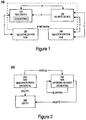
- Figure 1 is a block diagram of a network 100 according to an embodiment of the present invention.
- network 100 is a representation of a household or home network with devices on the network.
- network 100 is a representation of an enterprise network with devices on the network.
- the network 100 includes a sink device 110 upon which embodiments of the present invention can be implemented, a source device 120, a first localization hub 130, and a second localization hub 140.
- Hub 130 can service both source and sink in a localized network such as a network of DTCP/IP devices.
- An advantage of the present invention is in allowing the source to be remote to the sink beyond the seven (7) milli-second and three (3) hop localization constraints of DTCP/IP. In the remote case, there may be two hubs that localize devices by household or affinity group.
- all devices are at least connected to a private network (e.g., a household or enterprise network), and may be connected to a public network as well (e.g., an Internet point of presence operated by an Internet service provider).
- the private network can include more elements than the example illustrated in the figures.
- a home network may consist of multiple networks (e.g., multiple local area networks).
- the sink device 110 attempts to receive data from a source device 120 along arc A.
- the data is encrypted and the sink device 110 requests a decryption key from the source device 120 or some third device along arc B.
- Such key establishment algorithms in which a requester presents a credential to a responder who uses it to authorize access, are well known.
- the requester is the sink device 110 and its authorizing credential is the network-service credential, which was obtained earlier in the enrollment process by an arc C exchange.
- the sink device 110 secures the arc C exchange with IP Security (IPsec) protocols; it is well known in the art of network security to use the Internet Key Exchange (IKE) to establish a secure connection when each party proves its authorization using digital certificates singed by an authority.
- IPsec IP Security
- IKE Internet Key Exchange
- An embodiment of the present invention uses Digital Transmission License Authority (DTLA) credentials for this purpose.
- the credentials are initialized in sink device 110 memory (e.g., the credential for the device identity is in memory along with the root public key for the DTLA authority).
- the source device 120 and sink device 110 mutually authenticate using their respective keys and DTLA credentials.
- sink device 110 additionally passes its network-service credential to prove that it has enrolled with a localization hub on the particular network service, and source device 120 uses this credential for authorization purposes (e.g., to conditionally allow access to content works that are restricted to devices that are enrolled on a particular network).
- a network device or hub obtains the network-service credential from an Internet service provider; this localizes the hub or device to a network-service interface, and the localization uses a physical interface when the hub is co-resident with a modem such as a cable DOCSIS (Data Over Cable Service Interface Specification) modem.
- DOCSIS Data Over Cable Service Interface Specification
- the hub device 130 and sink device 110 mutually authenticate using the DTLA credential when the sink device has no network-service credential.
- Each device uses a pair of DTLA and network service credentials subsequent to the first network-service enrollment.
- CMLA Content Management License Administration
- OMA Open Mobile Alliance
- Microsoft DRM 10 proprietary systems
- the arc C exchange occurs entirely within a household network between the sink device and the hub device, which also runs a Dynamic Host Configuration Protocol (DHCP) server of administratively scoped IP addresses.
- the hub uses Universal Plug and Play (UPnP) protocols to speak to home network devices for discovery or other purposes.
- the arc C exchange occurs between the home network device and a service provider's equipment to obtain the service provider's network-service credential from its hub. This localizes the credential to a network service interface such as a broadband network interface in cable or digital subscriber line (DSL) modems.
- the arc C' exchange occurs in which a device can obtain or query additional credentials when the service is multi-homed. (A multi-homed device has more than one network-service interface each with its own network-service credential.)
- source, sink, and hub devices each have a public/private keypair. It is known for a licensing authority to sign a credential that contains the device's public key and thereby attest to compliance with a device license or security policy. An embodiment uses the DTLA as the licensing authority.
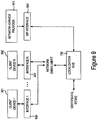
- Figure 2 is an apparatus state transition diagram 200 showing different enrollment states according to an embodiment of the present invention. This diagram defines how a network-service credential is initialized in non-volatile apparatus memory, maintained, deleted, and replaced with another credential. Figure 2 depicts an embodiment in which a device is permitted to enroll in exactly one network service. Different embodiments may allow multiple enrollments or only count enrollments or merely track state.
- the non-volatile apparatus memory is initialized with a copy of the device manufacturer's DTLA certificate.
- This state is referred to in the state transition diagram 200 as "HAS MANUFACTURER'S CREDENTIAL” 210.
- a DELETE operation erases credential memory to disable the apparatus.
- This state is referred to in the state transition diagram 200 as "EMPTY” 230.
- An ENROLL transaction (as within arc C of Figure 1 ) replaces the device-manufacturer's credential in the apparatus with a network-service credential.
- This state is referred to in the state transition diagram 200 as "HAS NETWORK-SERVICE CREDENTIAL" 220.
- Subsequent RE-ENROLL transactions (as within arc C of Figure 1 ) authenticate using the current network-service credential.
- Network-service equipment and operators do not necessarily allow every device to automatically ENROLL or RE-ENROLL, which in an embodiment is an infrequent procedure performed by the user when the device is first installed in the residence or office, or at the time of moving to a new or different household or enterprise network.
- the mobile case is special because source devices may accept local credentials with non-local IP addresses such as those found outside of a home gateway.
- the network enrollment is entirely under user control and the device may be enrolled and re-enrolled entirely under user control.
- the ENROLL transaction is further described.
- the present invention uses a logical association between a data-processing (network) device and a network-service (localization hub) device, which issues a signed credential when the particular network (source or sink) device enrolls on its network.
- a credential typically identifies a particular authority whose signature conveys implicit authorization for some access.
- the network-service credential identifies the network-service, which includes the name or address of the service provider and optional subscriber information.
- the name is a large (e.g., 16 byte) and random number in an embodiment, and the address is an IPv4 or IPv6 address.
- Network service providers have various means to associate a subscriber with an interface to their network, including the medium access control address of a broadband modem.
- an explicit identifier for a network subscriber is defined, which may be referred to as a "subscriber identifier (ID)."
- ID conveys information that the network-service uses to identify a subscriber's home network.
- the subscriber ID option is stripped off along with physical network information before the network address is passed to a subscriber's device.
- the network-service identifier upon enrollment, the network-service identifier is returned to the device in the form of a digitally-signed network-service credential.
- an authority issues the network-service credential or delegates this role to the network operator or equipment vendor.
- This authority issues a certificate attesting to one or more things about a device.
- a licensing authority issues a digitally signed credential attesting that the device is authorized to process some class of data.
- Such licensing authorities exist for DVD, IEEE 1394, OMA, and digital video devices.
- the apparatus uses the DTLA or some other device licensing authority as a signing authority for network-service credentials.
- the apparatus uses the certificate authority of the network service.
- the apparatus accepts equipment vendors' credentials.
- the credential contains the cryptographic identity (e.g., the public key in an X.509 certificate) of the device and of the network service provider.
- the network (sink) and hub devices use these credentials in authenticated key establishment, such as in a DTCP or IKE procedure.
- the authority that issues the credential to the device mandates the methods for association with a network service (enrollment), disassociation with the network (revocation), and association with a new network (re-enrollment).
- mobile operation is defined in which a device with a non-local address authenticates with a local credential.
- the present embodiment therefore, uses a logical rather than a physical notion of localization for home and enterprise networks that extends to remote devices on the Internet.
- the present invention applies to networks that have no connection to the Internet and to those that have multiple Internet Service Provider (ISP) connections (e.g., are "multi-homed").
- ISP Internet Service Provider
- the truth table 300 can be used to determine what type of device (designated herein as household, mobile, visitor, or foreign devices) is attempting to gain access to a particular network service (e.g., a server of movies or other media).
- a particular network service e.g., a server of movies or other media.
- the truth table 300 resides in the authorization logic of a server or source device on the same network as the sink device.
- the type of a device attempting to gain access to data on a source device can be determined based on its IP address and network-service credential. If it were a household device attempting to gain access, it would have the same IP address range (e.g., subnet) and same network-service credential as the network-service device's apparatus.
- An item of content for example, can be labeled as being available only to certain types of devices.
- an item of content identified as being available only to household devices would only be provided to a sink device that is identified as a household device according to truth table 300.
- FIG. 4 is a block diagram showing an embodiment of the household network model 400.
- each source and sink device (430, 440 and 450) enrolls with the local hub 420, which may be co-resident with a modem and/or DHCP server in an embodiment, which in turn enrolls with the ISP localization hub 410 for the ISP's network.
- the local hub 420 uses a manufacturer's credential in an embodiment as its authority for issuing a network credential to a network device.
- local hub 420 enrolls with ISP localization hub 410, which then signs a network-service credential to the home-network hub.
- hub 420 is absent and devices enroll directly with hub 410.
- the network device may receive a pair of credentials, one for the local network service and one for the ISP's network service.
- a data-processing device on a home network becomes associated with a network service in the form of a credential (e.g., a signed digital certificate) for the network service. This is true in embodiments that are independent of DHCP as well as those that co-locate the network service with a DHCP server or relay.
- FIG. 5 is a flowchart of a method 500 for credentialing a device according to an embodiment of the present invention. Although specific steps are disclosed in flowchart 500, such steps are exemplary. That is, embodiments of the present invention are well suited to performing various other (additional) steps or variations of the steps recited in flowchart 500. It is appreciated that the steps in flowchart 500 may be performed in an order different than presented, and that not all of the steps in flowchart 500 may be performed.
- a credential is received at a network device in the home.
- the credential indicates that the device is enrolled in the network or service.
- the credential is stored in non-volatile memory on the device.
- the credential binds the device to the network and thus controls device access to other networks, according to the particular policies of those networks.
- the network device presents the credential as part of a request for content or service.
- the request may be made to the hub itself, or to a firewall that accepts the hub credentials, or to a provider of licensed data such as movies.
- the hub, gateway, or server, etc. uses the credential to authenticate the device, wherein upon authentication the authorized device is provided access to the service. Whether the device is authorized is determined by truth table 300 and/or other licensing constraints on the content in an embodiment. If the device has a household IP address and is enrolled on the household network, for example, it may be authorized to access household content whereas a mobile or foreign device may not be so authorized.
- the presentation of the credential and the authentication process are transparent to a user of the device.
- a signed credential (a network-service credential) is used to enable and control data access on a network when the data is private or licensed to be localized to a particular household or home network.
- a logical association can be used between a network device and a hub device to provide localization to a network such as a particular subscriber to a particular broadband service in a particular locale.
- the credential can associate a device on a home network in one city with a cable company or telephone company subscriber in another city. This localization function is useful for a hub that offers a proxy function and transcription of DRM localization schemes.
- a network-service credential can be stored on a device and used to identify the network or service to which the device belongs.
- the device remains bound (via logical association using a network-service credential) to a particular network-service until another network-service permits re-enrollment, which is done according to the terms of a particular licensing authority or security policy.
- a network-service credential the device is permitted only one network-service association at a time, although multiple network-service associations may be allowed. If the network device is illegitimately bound to one network-service, however, it can be prevented from legitimately binding to any other network-service when the policy is to restrict enrollment to one network service.
- Those wanting, for example, data-dissemination controls on home or enterprise networks can control data transfer on, to, and from these networks.
- FIG. 6 is a block diagram of a system 600 upon which embodiments of the present invention may be implemented.
- system 600 includes processor 601 for processing information and instructions, random access (volatile) memory 602 for storing information and instructions for processor 601, read-only (non-volatile) memory 603 for storing static information and instructions for processor 601, and data storage device 604 such as a magnetic or optical disk and disk drive for storing content.
- System 600 may include an optional user output device and an optional user input device for communicating information and command selections.
- system 600 is utilized as a "localization hub" that aggregates one or more licensed interfaces and provides network localization services to network devices, particularly devices that are licensed by an authority charged with controlling the distribution of copyrighted works, such as DVD CCA, DTLA, CMLA, LMI and HDCP.
- the hub is an aggregation of licensed interfaces and conventional network interfaces, and adds a layer of localization while remaining compliant with the localization policies of the aforementioned licensing authorities; additional information is provided in conjunction with Figure 7 , below.
- the hub associates a network device (also referred to herein as an entertainment device, a client device or a sink or source device) with a network locale; in particular, a home network that is owned by a subscriber can be associated with a cable, telecommunications company (telco) or other broadband service.
- the hub may reside within the home network or at a network-service provider, as will be described in more detail below.
- the hub can be used to "localize" devices and data that are owned by a household or licensed to the household by association with that home network and by associating the home network with a subscription to a network service.
- FIG. 7 illustrates an "external" view of a localization hub 702 according to one embodiment of the present invention, showing examples of logical interfaces from various licensing authorities.
- hub 702 also includes at least one interface 704 that runs the IP suite of services over some type of network, such as an Ethernet or WiFi (wireless fidelity) network.
- DTCP/IP and OMA DRM 2 interfaces 706 and 708 also run over IP networks, and the interfaces 706 and 708 may be multiplexed on a shared IP interface.
- client devices (not shown in Figure 7 ) enroll with hub 702 over a network as described above in conjunction with Figures 1-5 .
- the hub 702 may be embedded within a client device itself (e.g., within a DVD player, a DVD writer, or some other type of media device), in which case an explicit enrollment exchange such as that described above by Figure 2 (as well as by Figure 9 , below) may not be necessary.
- Client devices may use standard protocols to obtain a certificate from hub 702, such as the Simple Certificate Enrollment Protocol.
- hub 702 can associate different devices to, for example, a subscriber's home network so that those devices can prove their network association to each other as well as to devices outside the home network.
- hub refers generally to a localization point of activity.
- the spokes of the hub can be the interfaces mentioned above, although a spoke may also connect another hub.
- hub should not be construed as being limited to, for example, a repeater or other such device.
- a hub 702 defines a home network (a "household"). There may be multiple hubs per household. For example, there may be multiple hubs per household when there are multiple address spaces in the household, such as when a router or firewall segments a home network using separate address assignments for the devices in the home network. In one embodiment, hubs that are on separate address segments can enroll with a "root hub" for the home network (the root hub may be one of the multiple hubs). Another embodiment uses an apparatus such as a dongle, token device, or smart card to associate hubs or to associate devices with hubs. In yet another embodiment, a human user places an authenticated phone call to an interactive voice response system in a hub. Those practiced and skilled in the art of computer security will see the benefit of using a human's physical action to make the association and thereby prevent devices operated by impersonators on the Internet from making a rogue association with a hub.
- FIG 8 is a block diagram of a network 800 incorporating localization hub 702 (on household network 816) and localization hub 810 (on ISP network 812) according to an embodiment of the present invention.
- Network 816 may be referred to as a local area network (LAN), and network 812 may be referred to as a wide area network (WAN).
- LAN local area network
- WAN wide area network
- gateway 814 provides the communication interface between the household network 816 and one or more ISP networks.
- Client devices 804, 805 and 806 can be some type of network device (e.g., a network DVD player).
- household network 816 is an IEEE 802-compatible local area network.
- hub 702 is embedded in gateway 814. In yet another embodiment, hub 702 is embedded within one of the client devices 804, 805 and 806. In yet another embodiment, hub 702 is a separate device.
- the household hub 702 associates (enrolls) with the ISP hub 810.
- hub 702 enrolls with hub 810 as described above in conjunction with Figures 1-5 .
- a secure virtual private network connects the hubs 702 and 810, using an IPsec connection, for example.
- location is the network location defined according to the address space of the network (e.g., the range of IP addresses allocated to the network), assigned for example by a DHCP server, and not the physical location of the network.
- location identifies a service interface to a broadband network service, e.g., a specific address. In these embodiments, location is limited to the location of the hub when the hub was enrolled. However, the use of the term "location" can be extended to also allow mobile or multi-homed devices, for example, to access content from within a household.
- a device can be associated with a hub using a "courier introducer” method that carries a pre-shared or public key to establish a secure association (a "trust") between devices.
- Easy Secure Device Positioning (EZSDP) (also called Easy Secure Device Deployment) allows a secure association to be made between devices.
- EZSDP uses a trusted introducer model, which can be implemented as a Web browser interface that allows a human user to establish a secure association between two devices.
- a telephone call can be used in place of a Web browser to accommodate circumstances in which a Web browser or personal computer is not available to make the introduction or association.
- Other methods such as smart cards or security dongles can also be used to establish a secure association between a hub and a device.
- the association of the hub 702 with the hub 810 also means that hub 702 can be delegated the authority to enroll other devices (e.g., client devices 804-806) that are in the household network 816.
- client devices 804-806 e.g., client devices 804-806
- the association of those other devices with hub 702 attests to the fact that those other devices are associated with the subscriber's household network.
- the number and type of client devices on household network 816 may not be visible to the network-service provider.
- the functionality of hub 702 is instead provided by hub 810, in which case the client devices on the household network would be visible to the network-service provider.
- client device 806 is directly connected to hub 702, while client devices 804 and 805 communicate to hub 702 through the fabric of the household network 816.
- hub 702 is not illustrated as lying on the path between the client devices 804-806 because, although hub 702 is accessible to and provides service to the client devices 804-806, content (e.g., a copyrighted work) does not necessarily pass through hub 702 on its way to a client device.
- the client devices 804-806 may be licensed according to a licensing authority, as previously described herein. Also, hub 702 may have multiple IP or licensed-device interfaces.
- FIG. 9 diagrams a network enrollment process according to an embodiment of the present invention.
- hub 702 associates with network-service provider's hub 910 via ISP interface 920.
- hub 702 may fetch an appropriate credential ("certificate store"), in order to demonstrate that it is authorized by a licensing authority or manufacturer to enroll the requesting client device.
- certificate store an appropriate credential
- the interfaces 920, 930 and 931 are not necessarily separate devices. As used here, the interfaces 920, 930 and 931 correspond to the various types of interfaces that are in use in a home network, as described above in conjunction with the examples of Figure 7 . Thus, the interfaces 920, 930 and 931 can be, in general, wired or wireless interfaces and more specifically, Ethernet, WiFi, etc., interfaces.
- FIG 10 is a flowchart 1000 showing a process for enrolling a device (e.g., a client device) with a localization hub according to one embodiment of the present invention.
- the localization hub 702 receives an enrollment request from a client device (e.g., client device 901).
- step 1002 hub 702 confirms that the requesting client device 901 is a member of the household network governed by hub 702 using the various methods described above such as pre-association by a "courier introducer.” In one embodiment, if the client device 901 has the same pre-shared secret and also shares the same address space as hub 702, then it is demonstrated that client device 901 is a member of the household network, and flowchart 1000 proceeds to step 1003. Otherwise, flowchart 1000 proceeds to step 1004.
- hub 702 confirms that it has the authority to enroll the requesting client device 901. In one embodiment, hub 702 confirms that the device 901 has the appropriate credential issued by a licensing authority or manufacturer and so can enroll the requesting client device 901. In one such embodiment, hub 702 confirms that it has a credential issued by the same licensing authority as the requesting client device 901. In another embodiment, hub 702 can enroll devices that have a credential such as a self-signed certificate that is authorized by a courier introducer or similar technique.
- Hub 702 issues credentials (such as but not limited to X.509 certificates and symmetric secret credentials) to enrolled devices so that the credentials can be used for authorizing and controlling access in home network devices such as servers, firewalls, video recorders, cameras, jukeboxes and the like.
- devices that have enrolled with hub 702 can access resources controlled by other devices that have similarly enrolled with hub 702. This effectively restricts access by outsiders (including the network-service provider) to the home network unless they are expressly permitted (either by the network owner or a licensing authority) to establish an affinity relationship with the home network. Such an affinity relationship would allow outsiders to share controlled content (if so permitted by the license terms of a content work).
- step 1004 if it is not demonstrated that client device 901 is a member of the household network governed by hub 702 (see step 1002, above), or if the hub 702 is not authorized to enroll the requesting client device (see step 1003, above), then the enrollment request is denied.
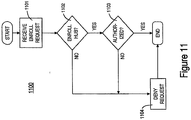
- FIG 11 is a flowchart 1100 showing a process for enrolling a hub (a "child hub") with another hub (a "parent hub") according to one embodiment of the present invention.
- the process of flowchart 1100 is performed to associate multiple hubs with a particular household network.
- the child hub may be one of multiple hubs in a household network
- the parent hub may be a hub in the household network designated as the root hub.
- the parent hub may be the ISP localization hub 810 of Figure 8 .
- the parent hub receives a request for enrollment from the child hub.
- the parent hub confirms that the requesting child hub is a member of the household network governed by the parent hub.
- the parent and child hubs are connected on the same DOCSIS cable interface or DSL interface then the child hub is authorized to enroll with the parent.
- the child hub can be enrolled if it establishes an authorized and secure connection with the parent hub, such as an IPsec connection using the appropriate authorization (e.g., a pre-shared secret from courier introducer, a pass-phrase, etc.). If the child hub can be enrolled, then flowchart 1100 proceeds to step 1103. Otherwise, flowchart 1100 proceeds to step 1104.
- the parent hub confirms that it has the authority to enroll the requesting child hub. For example, the parent hub determines whether it has the appropriate credential issued by a licensing authority or manufacturer and so can enroll the requesting child hub.
- step 1104 if it is not demonstrated that the requesting child hub is a member of the household network governed by the parent hub (see step 1102, above), or if the parent hub is not authorized to enroll the requesting child hub (see step 1103, above), then the enrollment request is denied.
- home network (e.g., client) devices are not dependent on the hub at the service provider (e.g., hub 810 of Figure 8 ) because hub 810 delegates authority to the household hub (e.g., hub 702 of Figure 8 ).
- a device can provide a certificate to show that is enrolled with a service provider even when that service provider's interface is down and the device is accessing the Internet through some other link not associated with the service provider; this is one benefit to having a hub on the home network.
- a hub associates a device (or another hub) with a network (specifically, a household or home network).
- the hub may be attached to the home network, or it may be embodied in a network-service provider device. That is, client devices (e.g., media players) may enroll with a hub on the household network, or the device may enroll directly with a hub operated by the service provider.
- Association with a network enables a hub or network device (e.g., a network entertainment device) to be identified as belonging to the network of a subscriber that is authorized to receive licensed content (e.g., a copyrighted movie).
- a hub or network device e.g., a network entertainment device
- licensed content e.g., a copyrighted movie.
- embodiments in accordance with the present invention utilize network location or network association as a condition for receiving access to licensed data. Significantly, this is achieved within the context of the many protocols and algorithms used by the various licensing authorities.
- the subject invention can act as a proxy to "transcribe" the DRM localization of one Figure 7 interface to another.
- exchanges across the DTCP/IP interface 606 can be transcribed to and from the WAN IP interface 704.
- Such transcription can only be performed legally if the licensing authority that governs DTCP (the DTLA), for example, authorizes the hub to output DTCP/IP content over the IP interface, which is localized differently from the DTCP/IP method of constraining round-trip time and hop count.
- DTCP/IP has a localization scheme for its sources and sinks and so an output protocol must have a suitable localization method.
- the subject invention uses a network service credential to localize a home network to a network service.
- the protocol in one embodiment is IPsec Authentication Header (AH) protocol using the network service credential.
- AH IPsec Authentication Header
- the hub participates in the key management that controls access to the decryption keys for the licensed data.
- Licensed systems such as DTCP/IP and OMA DRM 2 encrypt licensed data as a means to limit access to those data. These licensed systems have key management protocols to manage and establish decryption keys for the data.
- An endpoint device will authenticate to some identity and prove that it is authorized to receive the key, which is most commonly called “authenticated key establishment” (AKE).
- AKE authentication key establishment
- DTCP/IP and other licensed systems perform AKE using credentials that a licensing authority issues to authorized devices.
- CA Certificate Authority
- PKI Public Key Infrastructure
- the licensing authority signs the credential, which identifies the device by the device's public key or name.
- the device presents the credential to a source of licensed data. This source requires a valid credential as a condition for granting access to the plaintext key.
- the device presents the credential to prove its authorization to receive licensed data (e.g., entertainment content works) and to gain access to the decryption key.
- the authorization decision consists of a single check of a digital signature to ensure that the relevant authority had issued the credential and has not subsequently revoked that credential.
- licensed systems use complex authorization based on compliance with a rights specification as in Microsoft DRM 10 and OMA DRM 2. The present invention is useful for complex authorization DRM systems like Microsoft and OMA DRM that wish to localize content and devices as explained herein.
- DTCP/IP systems can also benefit from use of the present invention because network localization is an effective means to extend DTCP/IP operation over a wide area.
- An embodiment of the present invention uses the hub to extend DTCP/IP operation across a wide area while ensuring that the mobile device is local to the other DTCP/IP devices on a home network. That assurance comes from the fact that the mobile device has previously enrolled (or registered) with the home network, such as an X.509 registrar in a DTCP/IP proxy (as in Figure 2 , for example).
- Figures 12 and 13 show a delivery path of a licensed work from a source 1210 to a sink 1240 according to embodiments of the present invention. Key management messages flow across all or part of the path.
- One or more hub devices may separate the source 1210 and sink 1240.
- a hub that acts as a localization gateway proxies a connection between two different localization schemes.
- the proxy 1230 is behind the sink's gateway and thus is on the sink's network, which in one embodiment is a private, home network.
- the gateway 1220 and the proxy 1230 are logical functions that may be co-located in the same physical device (e.g., the proxy 1230 might be integrated into the sink's gateway 1220).
- the proxy 1235 is behind the source's gateway and thus is on the source's network.
- the gateway 1225 and the proxy 1235 are logical functions that may be co-located in the same physical device (e.g., the proxy 1235 might be integrated into the sink's gateway 1225).
- the sink 1240 initiates an exchange with the source 1210, which has licensed content (data) that the sink 1240 is seeking to access.
- the proxy 1235 runs an exchange with the source 1210.
- the proxy 1235 identifies itself using a network service credential. If the source 1210 is able to authenticate the proxy 1235, it checks the access privileges of the proxy 1235. In one embodiment, an access control list is used to validate the signature (e.g., the source 1210 performs one or a small number of signature verifications before downloading a key to the proxy 1235).
- the exchanges could include many more checks of much more information, as described for OMA DRM 2.0.
- proxy 1235 runs DTCP/IP to the sink 1240 and other protocols such as IKE with IPsec AH to the source 1210.
- source 1210 and proxy 1235 use a file encryption and authentication protocol, such as RFC 3394 key wrap (as used with OMA DRM 2.0), but the proxy 1235 runs DTCP/IP to the sink 1240.
- the proxy 1235 merely relays the AKE messages to and from the device being proxied by proxy 1235.
- the proxy serves to localize the device and the content based on its network service credential.
- the proxy in such an embodiment is also useful in keeping remote access off of the sink's network (when it proxies the sink 1240) or the source's network (when it proxies the source 1210).
- the proxy 1235 is beneficial even when it does not have access to the key; that is, it can still protect privacy and limit network access.
- proxy 1235 passively acquires a key when the proxy 1235 is authorized to do so by the particular licensing authority.
- the proxy 1235 changes the messages between the source 1210 and the sink 1240 as a method to obtain the plaintext key.
- the man-in-the-middle is legitimate (when the proxy 1235 is authorized to function as a man-in-the-middle by the relevant authority).
- a proxy can complete an authenticated key exchange on behalf of some other device (e.g., a proxied device).
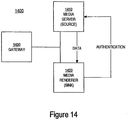
- FIG 14 is a block diagram of a local area network (LAN) or network composed of multiple LANs 1400 (e.g., a private, home network) according to one embodiment of the present invention.
- LAN 1400 includes a media server (source) 1410, a media renderer (sink) 1420, and a gateway 1430 (which may be a residential gateway).
- Sink 1420 may be, for example, a set-top box or a digital media adapter (DMA).
- DMA digital media adapter
- the source 1410, sink 1420 and gateway 1430 are enrolled in the home network and are issued credentials, as described previously herein (refer to the discussion in conjunction with Figures 1-5 above). Any device in the home network can manage enrollment; in one embodiment, enrollment is performed by gateway 1430, which acts as a registrar of network service credentials and localizes enrolling devices through some physical-world action such as using a pre-shared secret on a dongle, a passphrase, or other means.
- gateway 1430 is a residential gateway that, in addition to acting as both an interface and boundary between a wide area network (WAN) and a LAN or home network composed of multiple LANs as described above, also serves as an interface for quality-of-service (QoS) schemes and for the transport of content.
- gateway 1430 may incorporate a router and a broadband modem, and can support the use of more than one type of home network media (e.g., IEEE 1402.11, 10/100 Ethernet, etc.).
- a network service provider remotely manages gateway 1430; that is, the localization and proxy functionality of the gateway 1430 is visible to the service provider, and the service provider can install a configuration file or otherwise alter parameters of the gateway 1430.
- gateway 1430 has just been described as having certain characteristics and features, the present invention is not limited to a device having such characteristics and features.
- gateway 1430 couples LAN 1400 with a wide area network (e.g., the Internet).
- Gateway 1430 provides broadband connectivity to a WAN on one side, and provides access to home-network devices on the LAN side.
- the presence of network address translation (NAT) in gateway 1430 provides a boundary between public IP addresses (on the WAN side) and private IP address spaces (on the LAN side).
- NAT network address translation
- sink 1420 authenticates itself to source 1410 in order to establish that sink 1420 is authorized to receive an item of content (data) from source 1410.
- Different mechanisms can be used for authentication and authorization.
- sink 1420 is enrolled and issued a credential, which is used to authenticate and authorize sink 1420.
- the content is transmitted within LAN 1400 using DTCP/IP.
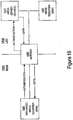
- Figures 15 and 16 are block diagrams of a LAN 1400 (e.g., a home network) and a WAN 1500 (e.g., a broadband network such as the Internet) according to embodiments of the present invention.
- the networks of Figures 15 and 16 are analogous to the systems of Figures 12 and 13 , discussed above.
- gateway 1430 contains a hub 702 that acts as a proxy sink for content that is sourced from WAN-based media server (source) 1540, which is outside of LAN 1400. Also, gateway 1430 acts as a proxy source for sink 1420 located within the LAN 1400.
- the content from WAN-based source 1540 may be transported in accordance with a DRM scheme (e.g., Microsoft DRM 10). Accordingly, gateway 1430 performs DRM "transcription" of the localization method to convert from the WAN-based localization scheme to the localization scheme used by LAN 1400 (e.g., DTCP/IP).
- the WAN-based localization uses a network service credential, and the gateway/hub maintains this credential on the WAN IP interface and ensures that the LAN interface to DTCP/IP devices conforms to DTCP/IP localization (e.g., a maximum of seven milliseconds and a packet "Time To Live" of three hops or less).
- Sink 1420 then decrypts the content from DTCP/IP and renders (visually or audibly) the content.
- gateway 1430 does not decrypt the content.
- sink 1420 authenticates itself to gateway 1430
- gateway 1430 authenticates itself to WAN-based source 1540.
- Different mechanisms can be used for authentication and authorization.
- the sink 1420 and gateway 1430 are credentialed, as previously described herein.
- WAN-based source 1540 may also be enrolled with LAN 1400 and appropriately credentialed.
- source 1540 may be a mobile device that is a member of a home network, but has been temporarily transported outside of the home.
- gateway 1430 acts as a proxy sink for content that is sourced from within the LAN 1400 (e.g., from source 1410). Gateway 1430 also acts as a proxy source for a media renderer (sink) 1640, which is outside of LAN 1400.
- media renderer sink
- gateway 1430 authenticates itself to source 1410
- sink 1640 authenticates itself to gateway 1430.
- the source 1410 and gateway 1430 are credentialed, as previously described herein.
- Sink 1640 may also be enrolled with LAN 1400 and appropriately credentialed.
- sink 1640 may be a mobile device that is a member of a home network, but has been temporarily transported outside of the home.
- gateway 1430 performs localization transcription to convert from DTCP/IP localization to a localization scheme that is used by sink 1640 and which can be used to authorize access over WAN 1500.
- an item of content that is copy-protected according to DTCP/IP only travels as far as gateway 1430.
- Gateway 1430 then transcripts the content into a format that is suitable for transporting the item of content across WAN 1500 to sink 1640.
- that format is a simple encapsulation of DTCP/IP messages in IPsec Authentication Header (AH) protocol.
- AH IPsec Authentication Header
- an item of content on LAN 1400 is "wrapped” using the DTCP/IP scheme.
- gateway 1430 "unwraps” the item of content, then “rewraps” it in a format that can be used outside of LAN 1400 (a scheme other than DTCP/IP).
- gateway 1430 "encapsulates” messages received on LAN 1400 in another protocol such as IPsec AH and forwarded onto WAN 900. Messages from WAN 1500 are “decapsulated” and forwarded onto LAN 1400.
- IPsec AH IPsec AH
- Messages from WAN 1500 are "decapsulated” and forwarded onto LAN 1400.
- gateway 1430 is described as an element separate from the other devices (e.g., sinks and sources) in LAN 1400, the functionalities provided by gateway 1430 can alternatively be implemented on any of the devices in LAN 1400. That is, for example, a source or sink device on LAN 1400 can provide dual functionality, operating as a source or sink and also operating as a gateway device.
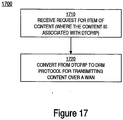
- FIG 17 is a flowchart 1700 of a method for managing the distribution of content according to one embodiment of the present invention.
- flowchart 1700 is implemented on a gateway (e.g., gateway 1430 of Figures 15 and 16 ).
- a request for an item of content is received from a sink device.
- the request is sent over a WAN (e.g., the Internet).
- the item of content resides on a LAN.
- Distribution of the item of content within the LAN uses a first localization method and protocol that prevents the item of content from being distributed outside the LAN (e.g., DTCP/IP).
- the gateway converts the first localization method and protocol to a second localization method and protocol.
- the localization method is the network service credential and the procedures for enrollment that associates devices with a network service.
- the localization protocol encapsulates, wraps, or unwraps content to optimize transport over a WAN or LAN.
- the item of content can then be forwarded to the sink device according to the second localization method and protocol.
- the sink device authenticates itself using a credential that binds the sink device to the LAN, thus demonstrating that it is authorized to receive the content that is localized to a network.
- embodiments of the present invention can help resolve consumer and industry concerns with the issue referred to as "mobility” (that is, the ability for individuals to access home-based content they own from outside their home) and “affinity” (allowing friends, family or other persons access to household-licensed content works).
- mobility that is, the ability for individuals to access home-based content they own from outside their home
- affinity allowing friends, family or other persons access to household-licensed content works.
- local content from inside a home network can be authorized and transported to an authorized device outside the home network without violating household-based localization constraints (e.g., when data is licensed strictly to household devices).
- remote content from outside the home network can be authorized and transported to devices that are enrolled with the home network.
- the present invention provides localization guarantees that the device is associated with the household and no other (or few others, etc.).
- a device such as a residential gateway provides this localization guarantee.
- this writing has also disclosed methods and devices controlling access to content. For example, a request to enroll a device is received at a localization hub.
- the localization hub is associated with a subscriber that is authorized to access the content.
- a credential is issued to the device. The credential demonstrates that the device is enrolled in the local area network and is authorized to receive the content.
- this writing has also disclosed methods and devices allowing distribution of content that resides in a source device on a local area network (LAN).
- a gateway between the LAN and a wide area network (WAN) receives from a sink device a request for an instance of content. The request is sent over the WAN.
- Distribution of the item of content within the LAN uses a first digital rights management (DRM) protocol that prevents the item of content from being distributed outside the LAN.
- DRM digital rights management
- the gateway converts from the first DRM protocol to a second DRM protocol that can be used for transmitting content over the WAN.
- the item of content can then be forwarded to the sink device according to the second DRM protocol.
- DRM digital rights management
- a credential is provided to a device.
- the credential indicates the device is enrolled in the network.
- the credential is stored in non-volatile memory on the device.
- the credential binds the device to the network and prevents the device from accessing another network.
- the device presents the credential to a provider, and the provider uses the credential to authenticate and authorize the device. Upon authorization, the device is provided access to the service.
Landscapes
- Engineering & Computer Science (AREA)
- Signal Processing (AREA)
- Computer Hardware Design (AREA)
- Computer Security & Cryptography (AREA)
- General Engineering & Computer Science (AREA)
- Software Systems (AREA)
- Computer Networks & Wireless Communication (AREA)
- Multimedia (AREA)
- Computing Systems (AREA)
- Theoretical Computer Science (AREA)
- Technology Law (AREA)
- Physics & Mathematics (AREA)
- General Physics & Mathematics (AREA)
- Data Exchanges In Wide-Area Networks (AREA)
- Storage Device Security (AREA)
- Mobile Radio Communication Systems (AREA)
- Small-Scale Networks (AREA)
Claims (10)
- Procédé de gestion de la distribution d'un contenu qui réside dans un dispositif source (1410) sur un réseau local, LAN (1400), en utilisant un dispositif intermédiaire (1430) situé entre le LAN et un réseau étendu, WAN (1500), dans lequel le dispositif intermédiaire fait office de destinataire proxy pour un élément de contenu provenant du dispositif source dans le LAN et de source proxy pour un dispositif destinataire situé en dehors du LAN, ledit procédé comprenant, au niveau du dispositif intermédiaire :la réception depuis le dispositif destinataire (1640) situé dans ledit WAN d'une demande portant sur l'élément de contenu, dans lequel ladite demande est envoyée sur ledit WAN, dans lequel audit élément de contenu est associé un premier protocole de gestion de droits numériques, DRM, qui empêche la distribution dudit élément de contenu en dehors dudit LAN ;l'authentification et l'autorisation dudit dispositif destinataire en utilisant une référence qui indique que ledit dispositif destinataire est enregistré auprès dudit LAN, dans lequel ladite référence lie ledit dispositif destinataire audit LAN et empêche ledit dispositif destinataire d'accéder à un autre LAN ;l'acquisition passive d'une clé pour ledit élément de contenu, en échangeant des messages entre le dispositif source et le dispositif destinataire pour réaliser un échange de clé authentifié ;l'utilisation de la clé pour réaliser une conversion dudit premier protocole DRM en un second protocole DRM qui est utilisé pour transmettre un contenu sur ledit WAN ; etl'acheminement dudit élément de contenu au dispositif destinataire conformément au second protocole DRM.
- Procédé selon la revendication 1 dans lequel ledit premier protocole DRM est le protocole DTCP/IP, (Digital Transmission Content Protection over Internet Protocol).
- Procédé selon la revendication 1 comprenant en outre l'identification d'un protocole DRM convenant à la transmission dudit élément de contenu audit dispositif destinataire.
- Procédé selon la revendication 1 comprenant l'obtention de la clé en vue de son utilisation durant la conversion en échangeant des messages d'établissement de clé authentifiés entre le dispositif source situé dans le LAN et le dispositif destinataire situé dans le WAN.
- Support utilisable par ordinateur dans lequel est intégré un code de programme lisible par ordinateur pour amener un dispositif intermédiaire (1430) qui est couplé à un réseau étendu, WAN (1500), et à un réseau local, LAN (1400), à exécuter un procédé de gestion de la distribution d'un contenu résidant sur ledit LAN, dans lequel le dispositif intermédiaire fait office de destinataire proxy pour un élément de contenu provenant d'un dispositif source dans le LAN et de source mandataire pour un dispositif destinataire situé en dehors du LAN, ledit procédé comprenant :la réception depuis le dispositif destinataire (1640) situé dans ledit WAN d'une demande portant sur l'élément de contenu, dans lequel ladite demande est envoyée sur ledit WAN, dans lequel audit élément de contenu est associé un premier protocole de gestion de droits numériques, DRM, qui empêche la distribution dudit élément de contenu en dehors dudit LAN ;l'authentification et l'autorisation dudit dispositif destinataire en utilisant une référence qui indique que ledit dispositif destinataire est enregistré auprès dudit LAN, dans lequel ladite référence lie ledit dispositif destinataire audit LAN et empêche ledit dispositif destinataire d'accéder à un autre LAN ;l'acquisition passive d'une clé pour ledit élément de contenu, en échangeant des messages entre le dispositif source et le dispositif destinataire pour réaliser un échange de clé authentifié ;l'utilisation de la clé pour réaliser une conversion dudit premier protocole DRM en un second protocole DRM qui est utilisé pour transmettre un contenu sur ledit WAN ; etl'acheminement dudit élément de contenu au dispositif destinataire conformément au second protocole DRM.
- Support utilisable par un ordinateur selon la revendication 5 dans lequel ledit premier protocole DRM est le protocole DTCP/IP (Digital Transmission Content Protection over Internet Protocol).
- Support utilisable par un ordinateur selon la revendication 5 dans lequel ledit procédé comprend en outre l'identification d'un protocole DRM convenant à la transmission dudit élément de contenu audit dispositif destinataire.
- Système (1430) qui couple un réseau local, LAN (1400), et un réseau étendu, WAN (1500), ledit système gérant la distribution d'un contenu qui réside dans un dispositif source (1410) sur ledit LAN, ledit système étant configuré pour faire office de destinataire mandataire pour un élément de contenu provenant d'un dispositif source dans le LAN et de source mandataire pour un dispositif destinataire situé en dehors du LAN, le système comprenant :un moyen de réception depuis le dispositif destinataire situé dans ledit WAN d'une demande portant sur l'élément de contenu, dans lequel ladite demande est envoyée sur ledit WAN, dans lequel audit élément de contenu est associé un premier protocole de gestion de droits numériques, DRM, qui empêche la distribution dudit élément de contenu en dehors dudit LAN ;un moyen d'authentification et d'autorisation dudit dispositif destinataire en utilisant une référence qui indique que ledit dispositif destinataire est enregistré auprès dudit LAN, dans lequel ladite référence lie ledit dispositif destinataire audit LAN et empêche ledit dispositif destinataire d'accéder à un autre LAN ;un moyen d'acquisition passive d'une clé pour ledit élément de contenu en échangeant des messages entre le dispositif source et le dispositif destinataire pour réaliser un échange de clé authentifié ;un moyen d'utilisation de la clé pour réaliser une conversion dudit premier protocole DRM en un second protocole DRM qui est utilisé pour transmettre un contenu sur ledit WAN ; etun moyen d'acheminement dudit élément de contenu au dispositif destinataire conformément au second protocole DRM.
- Système selon la revendication 8 dans lequel ledit premier protocole DRM est le protocole DTCP/IP (Digital Transmission Content Protection over Internet Protocol).
- Système selon la revendication 8, ledit système étant une passerelle résidentielle qui couple lesdits LAN et WAN.
Applications Claiming Priority (4)
| Application Number | Priority Date | Filing Date | Title |
|---|---|---|---|
| US11/032,764 US7533258B2 (en) | 2005-01-07 | 2005-01-07 | Using a network-service credential for access control |
| US11/075,197 US7500269B2 (en) | 2005-01-07 | 2005-03-07 | Remote access to local content using transcryption of digital rights management schemes |
| US11/260,531 US7340769B2 (en) | 2005-01-07 | 2005-10-26 | System and method for localizing data and devices |
| PCT/US2006/000411 WO2006074338A2 (fr) | 2005-01-07 | 2006-01-06 | Systeme et procede pour la localisation de donnees et dispositifs |
Publications (3)
| Publication Number | Publication Date |
|---|---|
| EP1834440A2 EP1834440A2 (fr) | 2007-09-19 |
| EP1834440A4 EP1834440A4 (fr) | 2012-06-27 |
| EP1834440B1 true EP1834440B1 (fr) | 2019-07-24 |
Family
ID=36648191
Family Applications (1)
| Application Number | Title | Priority Date | Filing Date |
|---|---|---|---|
| EP06717588.5A Expired - Lifetime EP1834440B1 (fr) | 2005-01-07 | 2006-01-06 | Système et procédé pour la localisation de données et dispositifs |
Country Status (4)
| Country | Link |
|---|---|
| US (1) | US7340769B2 (fr) |
| EP (1) | EP1834440B1 (fr) |
| JP (1) | JP4866862B2 (fr) |
| WO (1) | WO2006074338A2 (fr) |
Families Citing this family (86)
| Publication number | Priority date | Publication date | Assignee | Title |
|---|---|---|---|---|
| US7752269B2 (en) * | 2004-01-19 | 2010-07-06 | Avaya Inc. | Adhoc secure document exchange |
| US8001609B1 (en) * | 2004-09-17 | 2011-08-16 | Avaya Inc. | Method and apparatus for preventing the inadvertent or unauthorized release of information |
| KR100677152B1 (ko) * | 2004-11-17 | 2007-02-02 | 삼성전자주식회사 | 사용자 바인딩을 이용한 홈 네트워크에서의 콘텐츠 전송방법 |
| KR100656079B1 (ko) | 2005-03-23 | 2006-12-11 | 에스케이 텔레콤주식회사 | 홈 네트워크 기반의 디지털 액자 서비스 제공 방법 |
| US20070168293A1 (en) * | 2005-06-02 | 2007-07-19 | Alexander Medvinsky | Method and apparatus for authorizing rights issuers in a content distribution system |
| WO2007136423A2 (fr) * | 2005-12-30 | 2007-11-29 | Bmo Llc | Distribution de contenu numérique via un réseau virtuel privé (vpn) incorporant des décodeurs sécurisés |
| US8347341B2 (en) * | 2006-03-16 | 2013-01-01 | Time Warner Cable Inc. | Methods and apparatus for centralized content and data delivery |
| US8099343B1 (en) * | 2006-04-20 | 2012-01-17 | At&T Intellectual Property I, L.P. | Distribution schemes and related payment models for subscriber-created content |
| US7730181B2 (en) | 2006-04-25 | 2010-06-01 | Cisco Technology, Inc. | System and method for providing security backup services to a home network |
| US20070254634A1 (en) * | 2006-04-27 | 2007-11-01 | Jose Costa-Requena | Configuring a local network device using a wireless provider network |
| CN100438517C (zh) * | 2006-04-30 | 2008-11-26 | 中国移动通信集团公司 | 家庭网关设备 |
| US8745227B2 (en) * | 2006-06-07 | 2014-06-03 | Apple Inc. | Distributed secure content delivery |
| US8520850B2 (en) | 2006-10-20 | 2013-08-27 | Time Warner Cable Enterprises Llc | Downloadable security and protection methods and apparatus |
| US20080281718A1 (en) * | 2007-01-08 | 2008-11-13 | Barrett Morgan | Household network incorporating secure set-top devices |
| US8621540B2 (en) | 2007-01-24 | 2013-12-31 | Time Warner Cable Enterprises Llc | Apparatus and methods for provisioning in a download-enabled system |
| US7954131B2 (en) | 2007-06-13 | 2011-05-31 | Time Warner Cable Inc. | Premises gateway apparatus and methods for use in a content-based network |
| KR20090007954A (ko) * | 2007-07-16 | 2009-01-21 | 삼성전자주식회사 | Drm 컨텐츠 다운로드 방법 및 시스템 |
| US8353052B2 (en) * | 2007-09-03 | 2013-01-08 | Sony Mobile Communications Ab | Providing services to a guest device in a personal network |
| US20090129301A1 (en) * | 2007-11-15 | 2009-05-21 | Nokia Corporation And Recordation | Configuring a user device to remotely access a private network |
| US9743142B2 (en) | 2008-02-19 | 2017-08-22 | Time Warner Cable Enterprises Llc | Multi-stream premises apparatus and methods for use in a content delivery network |
| US8156542B2 (en) * | 2008-04-04 | 2012-04-10 | Cisco Technology, Inc. | Conditional data delivery to remote devices |
| US9100548B2 (en) * | 2008-07-17 | 2015-08-04 | Cisco Technology, Inc. | Feature enablement at a communications terminal |
| US9357247B2 (en) | 2008-11-24 | 2016-05-31 | Time Warner Cable Enterprises Llc | Apparatus and methods for content delivery and message exchange across multiple content delivery networks |
| US20100146534A1 (en) * | 2008-12-09 | 2010-06-10 | At&T Intellectual Property I, L.P. | System and Method to Authenticate a Set-Top Box Device |
| US8156540B2 (en) * | 2009-01-28 | 2012-04-10 | Dell Products, Lp | System and method for managing feature enablement in an information handling system |
| US11076189B2 (en) | 2009-03-30 | 2021-07-27 | Time Warner Cable Enterprises Llc | Personal media channel apparatus and methods |
| US9215423B2 (en) | 2009-03-30 | 2015-12-15 | Time Warner Cable Enterprises Llc | Recommendation engine apparatus and methods |
| US8130643B2 (en) * | 2009-04-07 | 2012-03-06 | Cisco Technology, Inc. | System and method for controlling a data transfer over a network |
| US9602864B2 (en) | 2009-06-08 | 2017-03-21 | Time Warner Cable Enterprises Llc | Media bridge apparatus and methods |
| US8707456B2 (en) * | 2009-07-24 | 2014-04-22 | Broadcom Corporation | Method and system for integrating remote devices into a domestic VLAN |
| JP5754491B2 (ja) * | 2009-09-09 | 2015-07-29 | ソニー株式会社 | 通信システム、通信装置及び通信方法、並びにコンピューター・プログラム |
| US8396055B2 (en) | 2009-10-20 | 2013-03-12 | Time Warner Cable Inc. | Methods and apparatus for enabling media functionality in a content-based network |
| US10264029B2 (en) | 2009-10-30 | 2019-04-16 | Time Warner Cable Enterprises Llc | Methods and apparatus for packetized content delivery over a content delivery network |
| US9519728B2 (en) | 2009-12-04 | 2016-12-13 | Time Warner Cable Enterprises Llc | Apparatus and methods for monitoring and optimizing delivery of content in a network |
| US9602425B2 (en) | 2009-12-31 | 2017-03-21 | Cable Television Laboratories, Inc. | Zero sign-on authentication |
| US8793769B2 (en) * | 2009-12-31 | 2014-07-29 | Cable Television Laboratories, Inc. | Zero sign-on authentication |
| US9342661B2 (en) | 2010-03-02 | 2016-05-17 | Time Warner Cable Enterprises Llc | Apparatus and methods for rights-managed content and data delivery |
| US8402555B2 (en) | 2010-03-21 | 2013-03-19 | William Grecia | Personalized digital media access system (PDMAS) |
| US20100185868A1 (en) * | 2010-03-21 | 2010-07-22 | William Grecia | Personilized digital media access system |
| US9906838B2 (en) | 2010-07-12 | 2018-02-27 | Time Warner Cable Enterprises Llc | Apparatus and methods for content delivery and message exchange across multiple content delivery networks |
| US8997136B2 (en) | 2010-07-22 | 2015-03-31 | Time Warner Cable Enterprises Llc | Apparatus and methods for packetized content delivery over a bandwidth-efficient network |
| US9449324B2 (en) | 2010-11-11 | 2016-09-20 | Sony Corporation | Reducing TV licensing costs |
| US9602414B2 (en) | 2011-02-09 | 2017-03-21 | Time Warner Cable Enterprises Llc | Apparatus and methods for controlled bandwidth reclamation |
| US8955078B2 (en) * | 2011-06-30 | 2015-02-10 | Cable Television Laboratories, Inc. | Zero sign-on authentication |
| US8863201B2 (en) | 2012-01-30 | 2014-10-14 | Time Warner Cable Enterprises Llc | Gateway apparatus and methods for providing content and data delivery in a fiber-based content delivery network |
| US8923326B2 (en) | 2012-02-23 | 2014-12-30 | Cisco Technology, Inc. | High-definition multimedia interface copper adapter |
| US9488994B2 (en) * | 2012-03-29 | 2016-11-08 | Honeywell International Inc. | Method and system for configuring wireless sensors in an HVAC system |
| US9467723B2 (en) | 2012-04-04 | 2016-10-11 | Time Warner Cable Enterprises Llc | Apparatus and methods for automated highlight reel creation in a content delivery network |
| US10193887B2 (en) * | 2012-07-10 | 2019-01-29 | Oath Inc. | Network appliance |
| US9985942B2 (en) * | 2012-07-30 | 2018-05-29 | Weckey | Portable sign-in service |
| US20140082645A1 (en) | 2012-09-14 | 2014-03-20 | Peter Stern | Apparatus and methods for providing enhanced or interactive features |
| GB2507105A (en) * | 2012-10-19 | 2014-04-23 | Ibm | Consumer location-based host service placement |
| US9621446B2 (en) | 2012-10-26 | 2017-04-11 | Comscore, Inc. | Combining measurements based on beacon data |
| US9565472B2 (en) | 2012-12-10 | 2017-02-07 | Time Warner Cable Enterprises Llc | Apparatus and methods for content transfer protection |
| US9059977B2 (en) * | 2013-03-13 | 2015-06-16 | Route1 Inc. | Distribution of secure or cryptographic material |
| GB2514550A (en) * | 2013-05-28 | 2014-12-03 | Ibm | System and method for providing access to a resource for a computer from within a restricted network and storage medium storing same |
| US9729546B2 (en) * | 2013-07-23 | 2017-08-08 | Arris Global Ltd. | Auto-correcting credentials for network subscriber equipment |
| US8743758B1 (en) | 2013-11-27 | 2014-06-03 | M87, Inc. | Concurrent uses of non-cellular interfaces for participating in hybrid cellular and non-cellular networks |
| US10136311B2 (en) | 2013-12-13 | 2018-11-20 | M87, Inc. | Methods and systems of secure connections for joining hybrid cellular and non-cellular networks |
| US9716861B1 (en) | 2014-03-07 | 2017-07-25 | Steelcase Inc. | Method and system for facilitating collaboration sessions |
| US10664772B1 (en) | 2014-03-07 | 2020-05-26 | Steelcase Inc. | Method and system for facilitating collaboration sessions |
| US9621940B2 (en) | 2014-05-29 | 2017-04-11 | Time Warner Cable Enterprises Llc | Apparatus and methods for recording, accessing, and delivering packetized content |
| US9766079B1 (en) | 2014-10-03 | 2017-09-19 | Steelcase Inc. | Method and system for locating resources and communicating within an enterprise |
| US9955318B1 (en) | 2014-06-05 | 2018-04-24 | Steelcase Inc. | Space guidance and management system and method |
| US9380682B2 (en) | 2014-06-05 | 2016-06-28 | Steelcase Inc. | Environment optimization for space based on presence and activities |
| US11744376B2 (en) | 2014-06-06 | 2023-09-05 | Steelcase Inc. | Microclimate control systems and methods |
| US10433646B1 (en) | 2014-06-06 | 2019-10-08 | Steelcaase Inc. | Microclimate control systems and methods |
| US9445248B2 (en) | 2014-07-25 | 2016-09-13 | Qualcomm Incorporated | Radio-agnostic message translation service |
| US10114939B1 (en) * | 2014-09-22 | 2018-10-30 | Symantec Corporation | Systems and methods for secure communications between devices |
| US9852388B1 (en) | 2014-10-03 | 2017-12-26 | Steelcase, Inc. | Method and system for locating resources and communicating within an enterprise |
| CN105871792A (zh) * | 2015-01-23 | 2016-08-17 | 中兴通讯股份有限公司 | 多媒体内容的发送、接收方法及装置以及家庭网关 |
| US10116676B2 (en) | 2015-02-13 | 2018-10-30 | Time Warner Cable Enterprises Llc | Apparatus and methods for data collection, analysis and service modification based on online activity |
| US10237616B2 (en) | 2015-05-15 | 2019-03-19 | Comscore, Inc. | Audio correlation for viewership determination |
| US10733371B1 (en) | 2015-06-02 | 2020-08-04 | Steelcase Inc. | Template based content preparation system for use with a plurality of space types |
| US10404758B2 (en) | 2016-02-26 | 2019-09-03 | Time Warner Cable Enterprises Llc | Apparatus and methods for centralized message exchange in a user premises device |
| US20170262523A1 (en) * | 2016-03-14 | 2017-09-14 | Cisco Technology, Inc. | Device discovery system |
| US9921726B1 (en) | 2016-06-03 | 2018-03-20 | Steelcase Inc. | Smart workstation method and system |
| US10264213B1 (en) | 2016-12-15 | 2019-04-16 | Steelcase Inc. | Content amplification system and method |
| US20180288035A1 (en) * | 2017-03-30 | 2018-10-04 | Avaya Inc. | Device enrollment service system and method |
| US11416868B1 (en) | 2019-12-27 | 2022-08-16 | United Services Automobile Association (Usaa) | Methods and systems for third-party approval of secure account fund transfer |
| US11489842B1 (en) * | 2019-12-27 | 2022-11-01 | United Services Automobile Association (Usaa) | Methods and systems for managing delegates for secure account fund transfers |
| US12099997B1 (en) | 2020-01-31 | 2024-09-24 | Steven Mark Hoffberg | Tokenized fungible liabilities |
| US12118178B1 (en) | 2020-04-08 | 2024-10-15 | Steelcase Inc. | Wayfinding services method and apparatus |
| US11763015B2 (en) * | 2020-07-14 | 2023-09-19 | Sympatic, Inc. | Securely processing shareable data utilizing a vault proxy |
| US11984739B1 (en) | 2020-07-31 | 2024-05-14 | Steelcase Inc. | Remote power systems, apparatus and methods |
| US12052653B1 (en) * | 2020-10-02 | 2024-07-30 | Cable Television Laboratories, Inc. | Converged access communication systems and associated methods |
Family Cites Families (33)
| Publication number | Priority date | Publication date | Assignee | Title |
|---|---|---|---|---|
| US5790548A (en) * | 1996-04-18 | 1998-08-04 | Bell Atlantic Network Services, Inc. | Universal access multimedia data network |
| JP3472098B2 (ja) * | 1997-09-08 | 2003-12-02 | 株式会社東芝 | 移動計算機装置、中継装置及びデータ転送方法 |
| US6675208B1 (en) * | 1997-10-14 | 2004-01-06 | Lucent Technologies Inc. | Registration scheme for network |
| US6065120A (en) * | 1997-12-09 | 2000-05-16 | Phone.Com, Inc. | Method and system for self-provisioning a rendezvous to ensure secure access to information in a database from multiple devices |
| US6438550B1 (en) * | 1998-12-10 | 2002-08-20 | International Business Machines Corporation | Method and apparatus for client authentication and application configuration via smart cards |
| US6993580B2 (en) * | 1999-01-25 | 2006-01-31 | Airclic Inc. | Method and system for sharing end user information on network |
| FR2802666B1 (fr) * | 1999-12-17 | 2002-04-05 | Activcard | Systeme informatique pour application a acces par accreditation |
| WO2001046788A1 (fr) * | 1999-12-21 | 2001-06-28 | Netscape Communications Corporation | Procede d'auto-inscription de jetons de materiel |
| US7103769B1 (en) * | 2000-03-03 | 2006-09-05 | Koninklijke Philips Electronics N.V. | IEEE 1394 link layer chip with “5C” authentication and key exchange accelerator |
| US6952428B1 (en) * | 2001-01-26 | 2005-10-04 | 3Com Corporation | System and method for a specialized dynamic host configuration protocol proxy in a data-over-cable network |
| US20020112186A1 (en) * | 2001-02-15 | 2002-08-15 | Tobias Ford | Authentication and authorization for access to remote production devices |
| JP4759823B2 (ja) * | 2001-03-19 | 2011-08-31 | ソニー株式会社 | ネットワークシステム、端末装置、サーバ、通信方法、プログラムおよび記録媒体 |
| US7487363B2 (en) * | 2001-10-18 | 2009-02-03 | Nokia Corporation | System and method for controlled copying and moving of content between devices and domains based on conditional encryption of content key depending on usage |
| EP1304844B1 (fr) * | 2001-10-19 | 2007-04-04 | Sony Deutschland GmbH | Système de protection de contenu et de gestion de duplication pour un réseau |
| JP4477822B2 (ja) * | 2001-11-30 | 2010-06-09 | パナソニック株式会社 | 情報変換装置 |
| US20030126086A1 (en) * | 2001-12-31 | 2003-07-03 | General Instrument Corporation | Methods and apparatus for digital rights management |
| US8972589B2 (en) * | 2002-03-01 | 2015-03-03 | Enterasys Networks, Inc. | Location-based access control in a data network |
| JP2003271487A (ja) * | 2002-03-12 | 2003-09-26 | Nec Corp | 通信システム、ゲートウエイ装置、ゲートウエイプログラム |
| GB2386713B (en) * | 2002-03-22 | 2005-08-31 | Hewlett Packard Co | Apparatus for distributed access control |
| AU2003219431A1 (en) * | 2002-04-26 | 2003-11-10 | Koninklijke Philips Electronics N.V. | Security modules for conditional access with restrictions |
| EP1510071B1 (fr) * | 2002-05-22 | 2019-05-15 | Koninklijke Philips N.V. | Procede et dispositif de gestion des droits numeriques |
| JP2004015495A (ja) * | 2002-06-07 | 2004-01-15 | Sony Corp | 権限管理システム、情報処理装置、および方法、並びにコンピュータ・プログラム |
| US7322043B2 (en) * | 2002-06-20 | 2008-01-22 | Hewlett-Packard Development Company, L.P. | Allowing an electronic device accessing a service to be authenticated |
| JP4112962B2 (ja) * | 2002-10-28 | 2008-07-02 | 株式会社東芝 | コンテンツ送受信システム、コンテンツ送信装置、コンテンツ受信装置及びコンテンツ送受信方法 |
| JP3826100B2 (ja) * | 2002-11-27 | 2006-09-27 | 株式会社東芝 | 通信中継装置、通信システム及び通信制御プログラム |
| US7188245B2 (en) * | 2002-12-09 | 2007-03-06 | Kabushiki Kaisha Toshiba | Contents transmission/reception scheme with function for limiting recipients |
| US20040123152A1 (en) * | 2002-12-18 | 2004-06-24 | Eric Le Saint | Uniform framework for security tokens |
| US20050063333A1 (en) * | 2003-09-23 | 2005-03-24 | Sbc Knowledge Ventures, L.P. | System and method for accessing network and data services |
| US20050229004A1 (en) * | 2004-03-31 | 2005-10-13 | Callaghan David M | Digital rights management system and method |
| US7539862B2 (en) * | 2004-04-08 | 2009-05-26 | Ipass Inc. | Method and system for verifying and updating the configuration of an access device during authentication |
| US20050246529A1 (en) * | 2004-04-30 | 2005-11-03 | Microsoft Corporation | Isolated persistent identity storage for authentication of computing devies |
| US7600230B2 (en) * | 2004-07-06 | 2009-10-06 | Oracle International Corporation | System and method for managing security meta-data in a reverse proxy |
| US7533258B2 (en) * | 2005-01-07 | 2009-05-12 | Cisco Technology, Inc. | Using a network-service credential for access control |
-
2005
- 2005-10-26 US US11/260,531 patent/US7340769B2/en not_active Expired - Fee Related
-
2006
- 2006-01-06 JP JP2007550484A patent/JP4866862B2/ja not_active Expired - Fee Related
- 2006-01-06 EP EP06717588.5A patent/EP1834440B1/fr not_active Expired - Lifetime
- 2006-01-06 WO PCT/US2006/000411 patent/WO2006074338A2/fr not_active Ceased
Non-Patent Citations (1)
| Title |
|---|
| None * |
Also Published As
| Publication number | Publication date |
|---|---|
| WO2006074338B1 (fr) | 2007-05-10 |
| EP1834440A4 (fr) | 2012-06-27 |
| JP4866862B2 (ja) | 2012-02-01 |
| US7340769B2 (en) | 2008-03-04 |
| WO2006074338A2 (fr) | 2006-07-13 |
| WO2006074338A3 (fr) | 2007-03-15 |
| US20060156392A1 (en) | 2006-07-13 |
| JP2008527543A (ja) | 2008-07-24 |
| EP1834440A2 (fr) | 2007-09-19 |
Similar Documents
| Publication | Publication Date | Title |
|---|---|---|
| EP1834440B1 (fr) | Système et procédé pour la localisation de données et dispositifs | |
| US7500269B2 (en) | Remote access to local content using transcryption of digital rights management schemes | |
| KR101038612B1 (ko) | 정보 처리 장치, 및 정보 처리 방법 | |
| US8037538B2 (en) | Access control processing method | |
| US9032215B2 (en) | Management of access control in wireless networks | |
| US7533258B2 (en) | Using a network-service credential for access control | |
| CN101414907B (zh) | 一种基于用户身份授权访问网络的方法和系统 | |
| US20070254630A1 (en) | Methods, devices and modules for secure remote access to home networks | |
| JP3749817B2 (ja) | 送信装置およびその送信方法 | |
| US20060020784A1 (en) | Certificate based authorized domains | |
| JP2007528658A (ja) | 改良されたドメインマネージャ及びドメイン装置 | |
| WO2012051006A1 (fr) | Procédés et systèmes pour assurer et contrôler de manière chiffrée des communications sécurisées sur des réseaux non sécurisés entre un terminal virtuel sécurisé et un système distant | |
| US20190190910A1 (en) | End-to-end security communication method based on mac protocol using software defined-networking, and communication controller and computer program for the same | |
| JP2015536061A (ja) | クライアントをサーバに登録するための方法および装置 | |
| CN101006679A (zh) | 管理到网络中的设备的接入许可和网络中的设备间的认证 | |
| EP1941654B1 (fr) | Systeme et procede de localisation de donnees et dispositifs | |
| WO2009070453A1 (fr) | Procédé et appareil pour exécuter une gestion de clés et une distribution de clés dans des réseaux sans fil | |
| CN118741524A (zh) | 一种通信方法、系统及装置 | |
| Müller et al. | A secure service infrastructure for interconnecting future home networks based on DPWS and XACML | |
| Lucenius et al. | Security technologies in home and wireless networking environments | |
| Backman et al. | WLAN Information Security | |
| KR20070022019A (ko) | 개선된 도메인 매니저 및 도메인 디바이스 | |
| KR20070115574A (ko) | 데이터 통신 방법 |
Legal Events
| Date | Code | Title | Description |
|---|---|---|---|
| PUAI | Public reference made under article 153(3) epc to a published international application that has entered the european phase |
Free format text: ORIGINAL CODE: 0009012 |
|
| 17P | Request for examination filed |
Effective date: 20070515 |
|
| AK | Designated contracting states |
Kind code of ref document: A2 Designated state(s): AT BE BG CH CY CZ DE DK EE ES FI FR GB GR HU IE IS IT LI LT LU LV MC NL PL PT RO SE SI SK TR |
|
| AX | Request for extension of the european patent |
Extension state: AL BA HR MK YU |
|
| DAX | Request for extension of the european patent (deleted) | ||
| A4 | Supplementary search report drawn up and despatched |
Effective date: 20120524 |
|
| RIC1 | Information provided on ipc code assigned before grant |
Ipc: G06F 21/00 20060101ALI20120518BHEP Ipc: G06F 7/04 20060101ALI20120518BHEP Ipc: H03M 1/68 20060101ALI20120518BHEP Ipc: H04L 9/32 20060101ALI20120518BHEP Ipc: H04L 29/06 20060101ALI20120518BHEP Ipc: G06F 17/13 20060101ALI20120518BHEP Ipc: H04L 9/00 20060101AFI20120518BHEP |
|
| 17Q | First examination report despatched |
Effective date: 20160331 |
|
| STAA | Information on the status of an ep patent application or granted ep patent |
Free format text: STATUS: EXAMINATION IS IN PROGRESS |
|
| REG | Reference to a national code |
Ref country code: DE Ref legal event code: R079 Ref document number: 602006058344 Country of ref document: DE Free format text: PREVIOUS MAIN CLASS: H04L0009000000 Ipc: G06F0021100000 |
|
| GRAP | Despatch of communication of intention to grant a patent |
Free format text: ORIGINAL CODE: EPIDOSNIGR1 |
|
| STAA | Information on the status of an ep patent application or granted ep patent |
Free format text: STATUS: GRANT OF PATENT IS INTENDED |
|
| RIC1 | Information provided on ipc code assigned before grant |
Ipc: H04L 29/06 20060101ALI20190129BHEP Ipc: G06F 21/10 20130101AFI20190129BHEP Ipc: H04N 21/00 20110101ALI20190129BHEP |
|
| INTG | Intention to grant announced |
Effective date: 20190218 |
|
| GRAS | Grant fee paid |
Free format text: ORIGINAL CODE: EPIDOSNIGR3 |
|
| GRAA | (expected) grant |
Free format text: ORIGINAL CODE: 0009210 |
|
| STAA | Information on the status of an ep patent application or granted ep patent |
Free format text: STATUS: THE PATENT HAS BEEN GRANTED |
|
| AK | Designated contracting states |
Kind code of ref document: B1 Designated state(s): AT BE BG CH CY CZ DE DK EE ES FI FR GB GR HU IE IS IT LI LT LU LV MC NL PL PT RO SE SI SK TR |
|
| REG | Reference to a national code |
Ref country code: GB Ref legal event code: FG4D |
|
| REG | Reference to a national code |
Ref country code: CH Ref legal event code: EP |
|
| REG | Reference to a national code |
Ref country code: DE Ref legal event code: R096 Ref document number: 602006058344 Country of ref document: DE |
|
| REG | Reference to a national code |
Ref country code: AT Ref legal event code: REF Ref document number: 1159053 Country of ref document: AT Kind code of ref document: T Effective date: 20190815 |
|
| REG | Reference to a national code |
Ref country code: IE Ref legal event code: FG4D |
|
| REG | Reference to a national code |
Ref country code: NL Ref legal event code: MP Effective date: 20190724 |
|
| REG | Reference to a national code |
Ref country code: LT Ref legal event code: MG4D |
|
| REG | Reference to a national code |
Ref country code: AT Ref legal event code: MK05 Ref document number: 1159053 Country of ref document: AT Kind code of ref document: T Effective date: 20190724 |
|
| PG25 | Lapsed in a contracting state [announced via postgrant information from national office to epo] |
Ref country code: LT Free format text: LAPSE BECAUSE OF FAILURE TO SUBMIT A TRANSLATION OF THE DESCRIPTION OR TO PAY THE FEE WITHIN THE PRESCRIBED TIME-LIMIT Effective date: 20190724 Ref country code: FI Free format text: LAPSE BECAUSE OF FAILURE TO SUBMIT A TRANSLATION OF THE DESCRIPTION OR TO PAY THE FEE WITHIN THE PRESCRIBED TIME-LIMIT Effective date: 20190724 Ref country code: PT Free format text: LAPSE BECAUSE OF FAILURE TO SUBMIT A TRANSLATION OF THE DESCRIPTION OR TO PAY THE FEE WITHIN THE PRESCRIBED TIME-LIMIT Effective date: 20191125 Ref country code: AT Free format text: LAPSE BECAUSE OF FAILURE TO SUBMIT A TRANSLATION OF THE DESCRIPTION OR TO PAY THE FEE WITHIN THE PRESCRIBED TIME-LIMIT Effective date: 20190724 Ref country code: BG Free format text: LAPSE BECAUSE OF FAILURE TO SUBMIT A TRANSLATION OF THE DESCRIPTION OR TO PAY THE FEE WITHIN THE PRESCRIBED TIME-LIMIT Effective date: 20191024 Ref country code: NL Free format text: LAPSE BECAUSE OF FAILURE TO SUBMIT A TRANSLATION OF THE DESCRIPTION OR TO PAY THE FEE WITHIN THE PRESCRIBED TIME-LIMIT Effective date: 20190724 Ref country code: SE Free format text: LAPSE BECAUSE OF FAILURE TO SUBMIT A TRANSLATION OF THE DESCRIPTION OR TO PAY THE FEE WITHIN THE PRESCRIBED TIME-LIMIT Effective date: 20190724 |
|
| PG25 | Lapsed in a contracting state [announced via postgrant information from national office to epo] |
Ref country code: IS Free format text: LAPSE BECAUSE OF FAILURE TO SUBMIT A TRANSLATION OF THE DESCRIPTION OR TO PAY THE FEE WITHIN THE PRESCRIBED TIME-LIMIT Effective date: 20191124 Ref country code: GR Free format text: LAPSE BECAUSE OF FAILURE TO SUBMIT A TRANSLATION OF THE DESCRIPTION OR TO PAY THE FEE WITHIN THE PRESCRIBED TIME-LIMIT Effective date: 20191025 Ref country code: LV Free format text: LAPSE BECAUSE OF FAILURE TO SUBMIT A TRANSLATION OF THE DESCRIPTION OR TO PAY THE FEE WITHIN THE PRESCRIBED TIME-LIMIT Effective date: 20190724 Ref country code: ES Free format text: LAPSE BECAUSE OF FAILURE TO SUBMIT A TRANSLATION OF THE DESCRIPTION OR TO PAY THE FEE WITHIN THE PRESCRIBED TIME-LIMIT Effective date: 20190724 |
|
| PG25 | Lapsed in a contracting state [announced via postgrant information from national office to epo] |
Ref country code: TR Free format text: LAPSE BECAUSE OF FAILURE TO SUBMIT A TRANSLATION OF THE DESCRIPTION OR TO PAY THE FEE WITHIN THE PRESCRIBED TIME-LIMIT Effective date: 20190724 |
|
| PG25 | Lapsed in a contracting state [announced via postgrant information from national office to epo] |
Ref country code: EE Free format text: LAPSE BECAUSE OF FAILURE TO SUBMIT A TRANSLATION OF THE DESCRIPTION OR TO PAY THE FEE WITHIN THE PRESCRIBED TIME-LIMIT Effective date: 20190724 Ref country code: DK Free format text: LAPSE BECAUSE OF FAILURE TO SUBMIT A TRANSLATION OF THE DESCRIPTION OR TO PAY THE FEE WITHIN THE PRESCRIBED TIME-LIMIT Effective date: 20190724 Ref country code: PL Free format text: LAPSE BECAUSE OF FAILURE TO SUBMIT A TRANSLATION OF THE DESCRIPTION OR TO PAY THE FEE WITHIN THE PRESCRIBED TIME-LIMIT Effective date: 20190724 Ref country code: IT Free format text: LAPSE BECAUSE OF FAILURE TO SUBMIT A TRANSLATION OF THE DESCRIPTION OR TO PAY THE FEE WITHIN THE PRESCRIBED TIME-LIMIT Effective date: 20190724 Ref country code: RO Free format text: LAPSE BECAUSE OF FAILURE TO SUBMIT A TRANSLATION OF THE DESCRIPTION OR TO PAY THE FEE WITHIN THE PRESCRIBED TIME-LIMIT Effective date: 20190724 |
|
| PG25 | Lapsed in a contracting state [announced via postgrant information from national office to epo] |
Ref country code: SK Free format text: LAPSE BECAUSE OF FAILURE TO SUBMIT A TRANSLATION OF THE DESCRIPTION OR TO PAY THE FEE WITHIN THE PRESCRIBED TIME-LIMIT Effective date: 20190724 Ref country code: CZ Free format text: LAPSE BECAUSE OF FAILURE TO SUBMIT A TRANSLATION OF THE DESCRIPTION OR TO PAY THE FEE WITHIN THE PRESCRIBED TIME-LIMIT Effective date: 20190724 Ref country code: IS Free format text: LAPSE BECAUSE OF FAILURE TO SUBMIT A TRANSLATION OF THE DESCRIPTION OR TO PAY THE FEE WITHIN THE PRESCRIBED TIME-LIMIT Effective date: 20200224 |
|
| REG | Reference to a national code |
Ref country code: DE Ref legal event code: R097 Ref document number: 602006058344 Country of ref document: DE |
|
| PLBE | No opposition filed within time limit |
Free format text: ORIGINAL CODE: 0009261 |
|
| STAA | Information on the status of an ep patent application or granted ep patent |
Free format text: STATUS: NO OPPOSITION FILED WITHIN TIME LIMIT |
|
| PG2D | Information on lapse in contracting state deleted |
Ref country code: IS |
|
| 26N | No opposition filed |
Effective date: 20200603 |
|
| PG25 | Lapsed in a contracting state [announced via postgrant information from national office to epo] |
Ref country code: SI Free format text: LAPSE BECAUSE OF FAILURE TO SUBMIT A TRANSLATION OF THE DESCRIPTION OR TO PAY THE FEE WITHIN THE PRESCRIBED TIME-LIMIT Effective date: 20190724 Ref country code: MC Free format text: LAPSE BECAUSE OF FAILURE TO SUBMIT A TRANSLATION OF THE DESCRIPTION OR TO PAY THE FEE WITHIN THE PRESCRIBED TIME-LIMIT Effective date: 20190724 |
|
| REG | Reference to a national code |
Ref country code: CH Ref legal event code: PL |
|
| REG | Reference to a national code |
Ref country code: BE Ref legal event code: MM Effective date: 20200131 |
|
| PG25 | Lapsed in a contracting state [announced via postgrant information from national office to epo] |
Ref country code: LU Free format text: LAPSE BECAUSE OF NON-PAYMENT OF DUE FEES Effective date: 20200106 |
|
| PG25 | Lapsed in a contracting state [announced via postgrant information from national office to epo] |
Ref country code: CH Free format text: LAPSE BECAUSE OF NON-PAYMENT OF DUE FEES Effective date: 20200131 Ref country code: LI Free format text: LAPSE BECAUSE OF NON-PAYMENT OF DUE FEES Effective date: 20200131 Ref country code: BE Free format text: LAPSE BECAUSE OF NON-PAYMENT OF DUE FEES Effective date: 20200131 |
|
| PG25 | Lapsed in a contracting state [announced via postgrant information from national office to epo] |
Ref country code: IE Free format text: LAPSE BECAUSE OF NON-PAYMENT OF DUE FEES Effective date: 20200106 |
|
| PGFP | Annual fee paid to national office [announced via postgrant information from national office to epo] |
Ref country code: FR Payment date: 20210125 Year of fee payment: 16 |
|
| PGFP | Annual fee paid to national office [announced via postgrant information from national office to epo] |
Ref country code: DE Payment date: 20210127 Year of fee payment: 16 Ref country code: GB Payment date: 20210128 Year of fee payment: 16 |
|
| PG25 | Lapsed in a contracting state [announced via postgrant information from national office to epo] |
Ref country code: CY Free format text: LAPSE BECAUSE OF FAILURE TO SUBMIT A TRANSLATION OF THE DESCRIPTION OR TO PAY THE FEE WITHIN THE PRESCRIBED TIME-LIMIT Effective date: 20190724 |
|
| REG | Reference to a national code |
Ref country code: DE Ref legal event code: R119 Ref document number: 602006058344 Country of ref document: DE |
|
| GBPC | Gb: european patent ceased through non-payment of renewal fee |
Effective date: 20220106 |
|
| PG25 | Lapsed in a contracting state [announced via postgrant information from national office to epo] |
Ref country code: GB Free format text: LAPSE BECAUSE OF NON-PAYMENT OF DUE FEES Effective date: 20220106 Ref country code: DE Free format text: LAPSE BECAUSE OF NON-PAYMENT OF DUE FEES Effective date: 20220802 |
|
| PG25 | Lapsed in a contracting state [announced via postgrant information from national office to epo] |
Ref country code: FR Free format text: LAPSE BECAUSE OF NON-PAYMENT OF DUE FEES Effective date: 20220131 |
|
| P01 | Opt-out of the competence of the unified patent court (upc) registered |
Effective date: 20230525 |