EP1834523A1 - Procédé et dispositif d'aquaculture d'une langoustine - Google Patents
Procédé et dispositif d'aquaculture d'une langoustine Download PDFInfo
- Publication number
- EP1834523A1 EP1834523A1 EP07101413A EP07101413A EP1834523A1 EP 1834523 A1 EP1834523 A1 EP 1834523A1 EP 07101413 A EP07101413 A EP 07101413A EP 07101413 A EP07101413 A EP 07101413A EP 1834523 A1 EP1834523 A1 EP 1834523A1
- Authority
- EP
- European Patent Office
- Prior art keywords
- scampi
- lobster
- aquaculturing
- container
- water
- Prior art date
- Legal status (The legal status is an assumption and is not a legal conclusion. Google has not performed a legal analysis and makes no representation as to the accuracy of the status listed.)
- Withdrawn
Links
- 241000238565 lobster Species 0.000 title claims abstract 51
- 238000000034 method Methods 0.000 title claims abstract 27
- 241000238557 Decapoda Species 0.000 claims abstract 7
- 239000013535 sea water Substances 0.000 claims abstract 6
- XLYOFNOQVPJJNP-UHFFFAOYSA-N water Substances O XLYOFNOQVPJJNP-UHFFFAOYSA-N 0.000 claims 9
- 241000238582 Artemia Species 0.000 claims 5
- 230000001418 larval effect Effects 0.000 claims 5
- 235000013601 eggs Nutrition 0.000 claims 3
- 239000008188 pellet Substances 0.000 claims 2
- 241000536568 Metanephrops japonicus Species 0.000 claims 1
- 230000000366 juvenile effect Effects 0.000 claims 1
- 235000015170 shellfish Nutrition 0.000 claims 1
Images


Classifications
-
- A—HUMAN NECESSITIES
- A01—AGRICULTURE; FORESTRY; ANIMAL HUSBANDRY; HUNTING; TRAPPING; FISHING
- A01K—ANIMAL HUSBANDRY; AVICULTURE; APICULTURE; PISCICULTURE; FISHING; REARING OR BREEDING ANIMALS, NOT OTHERWISE PROVIDED FOR; NEW BREEDS OF ANIMALS
- A01K61/00—Culture of aquatic animals
- A01K61/50—Culture of aquatic animals of shellfish
- A01K61/59—Culture of aquatic animals of shellfish of crustaceans, e.g. lobsters or shrimps
-
- Y—GENERAL TAGGING OF NEW TECHNOLOGICAL DEVELOPMENTS; GENERAL TAGGING OF CROSS-SECTIONAL TECHNOLOGIES SPANNING OVER SEVERAL SECTIONS OF THE IPC; TECHNICAL SUBJECTS COVERED BY FORMER USPC CROSS-REFERENCE ART COLLECTIONS [XRACs] AND DIGESTS
- Y02—TECHNOLOGIES OR APPLICATIONS FOR MITIGATION OR ADAPTATION AGAINST CLIMATE CHANGE
- Y02A—TECHNOLOGIES FOR ADAPTATION TO CLIMATE CHANGE
- Y02A40/00—Adaptation technologies in agriculture, forestry, livestock or agroalimentary production
- Y02A40/80—Adaptation technologies in agriculture, forestry, livestock or agroalimentary production in fisheries management
- Y02A40/81—Aquaculture, e.g. of fish
Definitions
- the present invention relates to a method of aquaculturing a scampi lobster, a device for aquaculturing a scampi lobster, and a scampi lobster aquacultured by said method or said device.
- a scampi lobster means a lobster of Metanephrops or Nephrops which falls under Nephropidae.
- Scampi lobsters include Metanephrops andamanicus, Metanephrops arafurensis, Metanephrops armatus, Metanephrops australensis, Metanephrops binghami, Metanephrops boschmai, Metanephrops challengeri, Metanephrops formosanus, Metanephrops japonicus, Metanephrops mozambicus, Metanephrops neptunus, Metanephrops rubellas, Metanephrops sagamiensis, Metanephrops sibogae, Metanephrops sinensis, Metanephrops Thomsoni, Metanephrops velutinus, and Nephrops norvegicus.
- Aquaculture or aquaculturing in the present invention includes rearing, cultivating, seed production, nursing, stocking and preserving.
- the present invention is a method of aquaculturing a scampi lobster, comprising containing a scampi lobster within a container, said container containing a seawater, said container being disposed in aquaculturing facilities on land, said scampi lobster being reared, cultivated, nursed, stocked or preserved, or seeds thereof being produced respectively under artificial control.
- Said seawater may be a deep seawater.
- Said scampi lobster may lack a zoeal stage.
- Said scampi lobster may be a Metanephrops japonicus.
- the development of said scampi lobster may be one of an egg, a larva including a megalopa and a post larva, an immature including a juvenile, and an adult, said scampi lobster being obtained in nature or obtained under artificial control.
- Said scampi lobster may be fed under artificial control with fishes, shellfishes, dry pellets or Artemia spp.
- said development of said scampi lobster may be a larva or an immature, said scampi lobster being fed with dry pellets and/or Artemia spp.
- the aquaculturing water under artificial control may be a seawater or a deep seawater run through, circulated or disposed.
- the aquaculturing water under artificial control may have a temperature of 8 to 20 °C.
- the development of said scampi lobster may be an adult, said aquaculturing water having a temperature of below 16 °C.
- the development of said scampi lobster may be a larva or an immature, said aquaculturing water having a temperature of 14 to 18 °C.
- Said container under artificial control may allow water to pass therethrough, said scampi lobster being contained within said container.
- the interference between scampi lobsters may be reduced by lowering the density of said scampi lobsters contained within said container or by disposing a shelter within said container.
- Said scampi lobster may be individually contained within said container.
- a larval or immature scampi lobster may be individually contained within said container, said container allowing water to pass therethrough, said container being contained within another container in which Artemia spp. exist.
- Larvae may be hatched from an ovigerous female scampi lobster within said container.
- Eggs separated from a parent scampi lobster may be aquacultured and hatched within said container.
- Said separated eggs may be kept in a floating state or a dynamic state by a stream of water moving within said container in an upward direction.
- the present invention is a method of aquaculturing a scampi lobster, comprising a larval or immature scampi lobster being individually contained within a container, said container allowing water and feed to pass therethrough, said container not allowing said larval or immature scampi lobster to pass therethrough, said container being contained within another container in which feed exists.
- Said feed may be Artemia spp.
- the present invention is a device for aquaculturing a scampi lobster, comprising a container, a larval or immature scampi lobster being individually contained within said container, said container allowing water and feed to pass therethrough, said container not allowing said larval or immature scampi lobster to pass therethrough, said container being contained within another container in which feed exists.
- Said feed may be Artemia spp.
- Said method or said device may be further used in addition.
- the present invention is a scampi lobster aquacultured by said method or said device.
- scampi lobsters can be effectively reared, cultivated, nursed, stocked or preserved, and seeds thereof can be effectively produced. It is possible to effectively produce scampi lobsters for release with a view to recovering and increasing the resources, and to effectively produce scampi lobsters with a view to supplying foodstuffs. It is, of course, possible to utilize the reared, cultivated, nursed, stocked or preserved scampi lobsters as foodstuffs. Also, it is possible to exhibit the reared, cultivated, nursed, stocked or preserved scampi lobsters.
- a scampi lobster means a lobster of Metanephrops or Nephrops which falls under Nephropidae.
- lobsters lacking the zoeal stage are preferably aquacultured.
- the lobsters lacking the zoeal stage have a high survival rate because they can be aquacultured from a developed stage.
- Metanephrops japonicus is more preferably aquacultured.
- Said Metanephrops japonicus hatches as a prezoea, and mostly develops into a megalopa (post larva) within 3 hours in the absence of feed.
- the megalopa develops into a 1st juvenile. Therefore, said Metanephrops japonicus has a higher survival rate than scampi lobsters having a zoeal stage because said Metanephrops japonicus lacks the zoeal stage and can be aquacultured from a developed stage.
- the development of the scampi lobster as an object of aquaculture under artificial control is one of an egg, a larva including a megalopa and a post larva, an immature including a juvenile, and an adult.
- the scampi lobster may be obtained in nature or obtained under artificial control.
- Said scampi lobster obtained under artificial control may be artificially hatched from a parent, artificially hatched from an aquacultured egg, or artificially aquacultured.
- Preferable feeds under artificial control include mysids, krills, shrimps, squids, clams and other shellfishes, dry pellets and Artemia spp. These feeds improve the survival and growth of the scampi lobster.
- the scampi lobster is preferably fed with dry pellets and/or Artemia spp. These feeds improve the survival of the scampi lobster.
- the dry pellets and Artemia spp. may be used individually.
- the dry pellets and Artemia spp. are preferably used together to improve the survival of the scampi lobster.
- the Artemia spp. should be used wherever practicable because the Artemia spp. stabilizes the survival rate of the scampi lobster.
- a preferable aquaculturing water under artificial control is a seawater, a deep seawater or a mixture of them.
- the aquaculturing water may be run through, circulated or disposed.
- the temperature and quality of the aquaculturing water in the container are stabilized by keeping constant the temperature of the aquaculturing water run, circulated or disposed, or by disposing said container within a larger container filled with a water having a temperature similar to the temperature of the aquaculturing water.
- the temperature and quality of the aquaculturing water in the container are stabilized also by running the aquaculturing water through the container, circulating the aquaculturing water within the container and discharging the aquaculturing water from the container, or by replacing the aquaculturing water within the container with an aquaculturing water prepared in advance. Excretions are removed with the discharge or replacement of the aquaculturing water, or artificially removed from the container.
- the aquaculturing water for the scampi lobster preferably has a temperature of 8 to 20 °C, which gives a better survival rate of the scampi lobster. Within the temperature range of 8 to 20 °C, a higher temperature gives the scampi lobster a faster growth.
- the aquaculturing water having a temperature of 14 to 18 °C improves the survival rate.
- the container under artificial control preferably allows water to pass therethrough, the scampi lobster being contained within said container.
- the aquaculturing water keeps running and a fresh environment is maintained.
- the group or individual control of the scampi lobster becomes easier.
- the interference between scampi lobsters is reduced preferably by lowering the density of said scampi lobsters contained within the container or by disposing a shelter within the container.
- the survival rate is improved by eliminating grapples, cannibalism and other relations between individuals.
- a larval or immature scampi lobster is preferably individually contained within the container, said container allowing water to pass therethrough, said container being contained within another container in which Artemia spp. exists.
- the survival rate of the scampi lobster is improved by, in an early history in which the survival rate is low, using the Artemia spp. as a feed, containing the scampi lobster individually within the container which allows water to pass therethrough, and eliminating the relations between individuals.
- larvae are hatched from an ovigerous female scampi lobster within the container. It is possible to stably secure scampi lobsters to be aquacultured by hatching larvae from an ovigerous female scampi lobster. In this case, if the interference between scampi lobsters is reduced, then less stress will be laid on the scampi lobsters, egg loss will be decreased, and more larvae will be hatched.
- Eggs separated from a parent scampi lobster are aquacultured and hatched within said container. It is possible to stably secure scampi lobsters to be aquacultured by artificially aquaculturing and hatching eggs held by a dead parent or dropped from a parent.
- an upwelling egg aquaculturing method in which separated eggs are kept in a floating state or a dynamic state by a stream of water moving within said container in an upward direction.
- said upwelling egg aquaculturing method the aquaculturing water is kept in a running state, the eggs in a dynamic state being maintained in a fresh environment, larvae being effectively hatched.
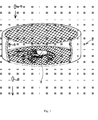
- the present invention provides a device for aquaculturing a scampi lobster, comprising a container 1, a larval or immature scampi lobster 3 being individually contained within said container 1, said container 1 allowing water and feed 5 to pass therethrough, said container 1 not allowing said larval or immature scampi lobster 3 to pass therethrough, said container 1 being contained within another container 7 in which feed exists. See Fig. 1 and Fig. 2.
- said aquaculturing device In said aquaculturing device, the relations between individuals are eliminated, said scampi lobster 3 eating said feed 5 which enters the container 1 from outside. A stream of water is formed by aeration, etc. to supply said feed 5 to the scampi lobster 3. If the container 1 containing each scampi lobster 3 is made as small as possible, then individual aquaculture at a high density is possible, the amount of necessary feed being minimized, the control work of feeding being very efficient.
- Said feed is preferably Artemia spp.
- the Artemia spp. is smaller than scampi lobsters and is available almost in a uniform size. Therefore, the Artemia spp. is preferably used in the aquaculturing device of the present invention.
- the aquaculturing device of the present invention makes it easy to aquaculture larval or immature scampi lobsters.
- the present invention provides a method of aquaculturing a scampi lobster, wherein the above-mentioned method or device is further used in addition thereto. Using various methods and devices in combination makes it possible to aquaculture scampi lobsters efficiently.
- the present invention enables the aquaculture of scampi lobsters.
- 4th juvenile scampi lobsters can be produced in 2 to 3 months after hatching, the survival rate being 40 to 80 %.
- Scampi lobsters having a commercial size can be produced in 2 years after hatching, the survival rate being 10 to 20 %.
- the present invention provides scampi lobsters aquacultued by the above-mentioned method.
- Scampi lobsters thus obtained have a wide range of application. For example, they are used as release seeds for the recovery and increase of resources, as seeds for nursery or stocking, as foodstuff, or for display.
- the scampi lobster aquacultured in the present invention is preferably a Metanephrops japonicus.
- the Metanephrops japonicus lives in a sandy bottom at depths of 200 to 400 meters off the coast of Japan from Kanto area to Kyushu area.
- the Metanephrops japonicus is an expensive edible scampi lobster having a body length of about 20 cm.
- the Metanephrops japonicus has sizes as follows according to the development thereof.
- the egg diameter is about 2 to 4 mm.
- the carapace length is about 3 mm for prezoea, about 3 to 4 mm for megalopa, about 4 to 5 mm for 1st juvenile, about 6 to 8 mm for 4th juvenile, about 15 to 19 mm for 10th juvenile, and about 45 to 80 mm for adult.
- Seawater is composed of a surface seawater at depths of below 100 meters and a deep seawater at depths of above 100 meters.
- the seawater in the present invention is drawn up from the sea and used on the ground.
- the surface seawater used in the present invention is, for example, drawn from Suruga Bay at depths of 10 to 30 meters.
- the deep seawater used in the present invention is, for example, drawn from Suruga Bay at depths of 300 to 700 meters.
- Aquaculturing containers each having a capacity of 20 liters, were disposed respectively within three 1.5-ton tanks, each of said aquaculturing containers allowing water to pass therethrough.
- 1 Metanephrops japonicus was put into each of said aquaculturing containers each having a capacity of 20 liters.
- 9 Metanephrops japonicus were aquacultured in the 10 °C experimental section.
- 11 Metanephrops japonicus were aquacultured in the 14 °C experimental section.
- 6 Metanephrops japonicus were aquacultured in the 18 °C experimental section.
- Aquaculturing water used in each of the three experimental sections was a deep seawater.
- the water temperature in each tank was adjusted to its temperature range mentioned above, and water was continuously flowing through each aquaculturing container.
- the scampi lobsters were aquacultured for 200 days. They were sufficiently fed every other day with frozen sergestid shrimps. Residual feed, etc. were removed every day. The survival, etc. of the scampi lobsters were watched.
- the survival rates of the scampi lobsters in 100 days after the experiment was started were as follows: 100 % in the 10 °C experimental section, 100 % in the 14 °C experimental section, and 83.3 % in the 18 °C experimental section.
- the survival rates of the scampi lobsters in 200 days after the experiment was started were as follows: 77.8 % in the 10 °C experimental section, 81.8 % in the 14 °C experimental section, and 0 % in the 18 °C experimental section. This means that when the scampi lobsters were aquacultured for a period of more than 6 months, they had good survival rates at water temperatures below 16 °C.
- each 1.5-ton tank By supplying water to each 1.5-ton tank so that water therein is exchanged at a rate of about 10 times per day, the water temperature in each tank was adjusted to 15 (12.1 to 17) °C, and water was continuously flowing through each aquaculturing container.
- the scampi lobsters were aquacultured for 200 days. They were sufficiently fed every other day with frozen sergestid shrimps. Residual feed, etc. were removed every day. The survival, etc. of the scampi lobsters were watched.
- the survival rates of the scampi lobsters in 100 days after the experiment was started were as follows: 92.9 % in the deep seawater experimental section, and 81.5 % in the surface seawater experimental section.
- the survival rates of the scampi lobsters in 200 days after the experiment was started were as follows: 85.7 % in the deep seawater experimental section, and 40.7 % in the surface seawater experimental section. This means that, both in the deep seawater experimental section and in the surface seawater experimental section, it was possible to aquaculture the scampi lobsters for a period of more than 6 months.
- Larvae hatched in April to July The number of larvae hatching females and the rate of hatching, which is obtained by dividing the number of larvae hatching females by the number of females at the start of the experiment, were as follows: 10 (71.4 %) in the deep seawater experimental section, and 9 (33.3 %) in the surface seawater experimental section. Larvae hatched both in the deep seawater experimental section and in the surface seawater experimental section.
- the average numbers of larvae hatched per female were as follows: 143.2 in the deep seawater experimental section, and 149.8 in the surface seawater experimental section.
- eggs were aquacultured in an upwelling environment within a plastic aquaculturing container having a capacity of 6 liters, a diameter of 15 cm and a height of 45 cm. Said upwelling environment was obtained by supplying water to a lower portion of the container and removing the water from an upper portion of the container. 40 eggs were contained within the aquaculturing container. In the container, the eggs were kept moving up and down in balance by their gravity and the upwelling, without being moved out of the container.
- Feeds were Artemia spp. nauplii and finely chopped muscles of sergestid shrimps.
- Aquaculturing water was a surface seawater. The temperature of the water was adjusted by means of a water bath. The water was slightly ventilated. The water was exchanged every other day by moving the living things in the beaker to another beaker prepared in advance. Survival and ecdysis were watched almost every day.
- Feeds were Artemia spp. nauplii and finely chopped muscles of sergestid shrimps. Aquaculturing water in all of the four experimental sections was a deep seawater. The water was slightly ventilated. The water was exchanged every other day by moving the living things in the beaker to another beaker prepared in advance. Survival and ecdysis were watched almost every day. After the megalopas changed into juveniles, aquaculturing was continued in the same way as the melalopas until they changed into 3rd juveniles.
- the megalopas changed into 1st juveniles in the average days as follows after the experiment was started: 40.8 (37 to 47) days in the 8 °C experimental section, 30.8 (30 to 32) days in the 10 °C experimental section, 15.2 (14 to 17) days in the 14 °C experimental section, and 12.4 (12 to 13) days in the 18 °C experimental section.
- the megalopas changed into 3rd juveniles in the average days as follows after the experiment was started: 142.8 (133 to 150) days in the 8 °C experimental section, 121.8 (115 to 131) days in the 10 °C experimental section, 57.3 (55 to 60) days in the 14 °C experimental section, and 48.2 (45 to 52) days in the 18 °C experimental section.
- the megalopas and juveniles grew in a shorter period of time as the water temperature was higher. In view of the survival and growth, preferable water temperatures were 14 to 18 °C.
- a surface seawater was used as aquaculturing water.
- the surface seawater was adjusted to have an average temperature of 15.2 °C by means of a water bath.
- the water was slightly ventilated.
- the water was exchanged every other day by moving the living things in the beaker to another beaker prepared in advance. Survival and ecdysis were watched almost every day.
- aquaculturing was continued in the same way as the magalopas until they changed into 4th juveniles.
- the megalopas changed into 4th juveniles in the average days as follows after the experiment was started: 95.4 (89 to 106) days in the Artemia spp. nauplii experimental section, 86.3 (85 to 89) days in the sergestid shrimp muscle experimental section, 91.0 (85 to 97) days in the mysid experimental section, and 105.1 (93 to 114) days in the assorted feed experimental section.
- a deep seawater was used as aquaculturing water.
- the deep seawater was adjusted to have an average temperature of 15.1 °C by means of a water bath.
- the water was slightly ventilated.
- the water was exchanged every other day by moving the living things in the beaker to another beaker prepared in advance. Survival and ecdysis were watched almost every day.
- aquaculturing was continued in the same way as the magalopas until they changed into 4th juveniles.
- the megalopas changed into 4th juveniles in the average days as follows after the experiment was started: 85.3 (78 to 97) days in the Artemia spp. nauplii experimental section, 94.5 (88 to 104) days in the assorted feed experimental section, and 78.4 (76 to 86) days in the Artemia spp. nauplii and assorted feed experimental section.
- Artemia spp. nauplii and assorted feed were favorable feeds. When both the Artemia spp. nauplii and assorted feed were used, they had a favorable effect on the growth of juveniles.
- Metanephrops japonicus megalopas hatched from an ovigerous female scampi lobster were used in the experiment.
- Five experimental sections as follows were prepared according to the density per liter of the Metanephrops japonicus megalopas: a 0.5 individual experimental section, a 1 individual experimental section, a 1.5 individual experimental section, a 4 individual experimental section, and a 7.5 individual experimental section.
- a surface seawater was used as aquaculturing water.
- the surface seawater was adjusted to have an average temperature of 15.2 °C by means of a water bath.
- the water was slightly ventilated.
- the water was exchanged every other day by moving the megalopas in the bowl to another bowl prepared in advance. Survival and ecdysis were watched almost every day.
- the survival rate was high in densities of 1.5 and below. The survival rate decreased as the density increased.
- a deep seawater was used as aquaculturing water.
- the deep seawater was adjusted to have an average temperature of 15.1 °C by means of a water bath.
- the water was slightly ventilated.
- the water was exchanged every other day by moving the living things in the beaker to another beaker prepared in advance. Survival and ecdysis were watched almost every day.
- the immature scampi lobsters were aquacultured in the same way as the megalopas for 60 days after hatching.
- a deep seawater was used as aquaculturing water.
- the deep seawater was adjusted to have an average temperature of 15.1 °C by means of a water bath.
- the water was slightly ventilated.
- the water was exchanged every other day by moving the living things in each tank to another tank prepared in advance. Survival and ecdysis were watched almost every day.
- the immature scampi lobsters were aquacultured in the same way as the megalopas for 60 days after hatching.
- the magalopas changed into 1st juveniles in 15 to 18 days after the experiment was started.
- the tank had the shelter 5 (19 %) megalopas changed into 1st juveniles.
- the tank did not have the shelter 2 (7.4 %) megalopas changed into 1st juveniles.
- the tank had the shelter 13 (19.0 %) megalopas changed into 1st juveniles.
- each capsule chamber (container for tissue sections having a capacity of 0.008 liter, a diameter of 35 mm, a height of 8 mm, and a mesh size of 2 mm, allowing water to pass therethrough), a total of 175 megalopas being aquacultured (125 individuals per liter).
- the capsule chambers were contained within a cylindrical tank having a capacity of 5 liters.
- Artemia spp. nauplii were used as a feed. In the capsule chamber experimental section, Artemia spp. nauplii were put into the tank within which the capsule chambers were contained.
- a deep seawater was used as aquaculturing water.
- the deep seawater was adjusted to have an average temperature of 15.1 °C by means of a water bath.
- the water was slightly ventilated.
- the water was exchanged every other day by moving the living things in containing means or the capsule chambers within which the living things were contained to another containing means or another tank for containing the capsule chambers prepared in advance. Survival and ecdysis were watched almost every day.
- the immature scampi lobsters were aquacultured in the same way as the megalopas for 40 days after hatching.
- a surface seawater was used as aquaculturing water.
- the temperature of the surface seawater was adjusted by means of a water bath.
- the water was slightly ventilated.
- the water was exchanged every other day by moving the living things in each beaker to another beaker prepared in advance. Survival and ecdysis were watched almost every day.
- the immature scampi lobsters were aquacultured in the same way as the megalopas after hatching.
- Immature scampi lobsters after being grown to 4th or 5th juveniles, were contained in a plastic cage (a mesh size of 5 mm, a top opening about 15 cm square, a depth of 10 cm) which was disposed within a tank, said lobsters being aquacultured in running water.
- a surface seawater was used as aquaculturing water. The surface seawater was poured into the tank about 2 times per hour.
- the lobsters were sufficiently fed every day with frozen sergestid shrimp muscles. Residual feed, dead lobsters, exuvia, etc. were removed every day. Aquaculturing continued for a period of 600 days after hatching. The temperature of the water was adjusted to 15.5 (14.2 to 17.2) °C.
- Fig. 3 shows the relationship between the number of days after hatching and the carapace length.
Landscapes
- Life Sciences & Earth Sciences (AREA)
- Environmental Sciences (AREA)
- Marine Sciences & Fisheries (AREA)
- Zoology (AREA)
- Animal Husbandry (AREA)
- Biodiversity & Conservation Biology (AREA)
- Farming Of Fish And Shellfish (AREA)
Applications Claiming Priority (1)
| Application Number | Priority Date | Filing Date | Title |
|---|---|---|---|
| JP2006070133A JP4734509B2 (ja) | 2006-03-15 | 2006-03-15 | スキャンピの養殖方法 |
Publications (1)
| Publication Number | Publication Date |
|---|---|
| EP1834523A1 true EP1834523A1 (fr) | 2007-09-19 |
Family
ID=38162277
Family Applications (1)
| Application Number | Title | Priority Date | Filing Date |
|---|---|---|---|
| EP07101413A Withdrawn EP1834523A1 (fr) | 2006-03-15 | 2007-01-30 | Procédé et dispositif d'aquaculture d'une langoustine |
Country Status (2)
| Country | Link |
|---|---|
| EP (1) | EP1834523A1 (fr) |
| JP (1) | JP4734509B2 (fr) |
Cited By (5)
| Publication number | Priority date | Publication date | Assignee | Title |
|---|---|---|---|---|
| CN104026045A (zh) * | 2014-03-21 | 2014-09-10 | 魏学恒 | 高原高寒冷水小龙虾大规模养殖方法 |
| CN104430069A (zh) * | 2014-09-24 | 2015-03-25 | 全椒县花溪湖特种水产合作社 | 一种小龙虾室内人工繁殖的方法 |
| CN108739572A (zh) * | 2018-07-06 | 2018-11-06 | 新疆旭日昕昤环保科技有限公司 | 含鱼植共生培养液的生态水中澳洲淡水龙虾育苗方法 |
| CN112136754A (zh) * | 2020-11-09 | 2020-12-29 | 中国水产科学研究院淡水渔业研究中心 | 一种水产品选择养殖系统、青虾选择养殖方法、应用 |
| CN112471043A (zh) * | 2020-11-24 | 2021-03-12 | 浙江省淡水水产研究所 | 一种澳洲淡水龙虾仿生孵化系统 |
Families Citing this family (2)
| Publication number | Priority date | Publication date | Assignee | Title |
|---|---|---|---|---|
| JP5150972B2 (ja) * | 2008-02-01 | 2013-02-27 | 静岡県 | 甲殻類の飼育方法及びその方法により飼育された甲殻類 |
| CN106359216A (zh) * | 2016-08-26 | 2017-02-01 | 岑健 | 一种龙虾的养殖方法 |
Citations (3)
| Publication number | Priority date | Publication date | Assignee | Title |
|---|---|---|---|---|
| US4007709A (en) * | 1975-03-24 | 1977-02-15 | Wishner Frederick B | Apparatus and process for raising lobsters |
| WO2003026406A1 (fr) * | 2001-09-26 | 2003-04-03 | Viktor Jablonsky | Procede et appareil d'aquaculture |
| WO2004036987A1 (fr) * | 2002-10-25 | 2004-05-06 | Tormod Drengstig | Dispositif de conchyliculture |
Family Cites Families (8)
| Publication number | Priority date | Publication date | Assignee | Title |
|---|---|---|---|---|
| JPS4896199U (fr) * | 1972-02-23 | 1973-11-15 | ||
| JPS6137042A (ja) * | 1984-07-30 | 1986-02-21 | 出水 昇 | オニテナガ海老の卵孵化方法 |
| JP2525609B2 (ja) * | 1987-06-26 | 1996-08-21 | 二郎 橘高 | イセエビ類幼生の飼育方法 |
| JPS6447327A (en) * | 1987-08-14 | 1989-02-21 | Hiroshi Kato | Tank for artificial incubation of fish roe |
| HU202050B (en) * | 1988-10-06 | 1991-02-28 | Vizepitoeipari Troeszt | Apparatus for propagating crayfish and breeding the hatched larva |
| JPH09298973A (ja) * | 1996-05-17 | 1997-11-25 | Masahiro Kobayashi | 海老の種苗生産方法及び装置 |
| JP2003284449A (ja) * | 2002-03-29 | 2003-10-07 | Toshiba Corp | 養殖システム |
| JP3584030B2 (ja) * | 2002-09-12 | 2004-11-04 | 明人 山本 | 魚類の養殖装置およびその方法 |
-
2006
- 2006-03-15 JP JP2006070133A patent/JP4734509B2/ja not_active Expired - Fee Related
-
2007
- 2007-01-30 EP EP07101413A patent/EP1834523A1/fr not_active Withdrawn
Patent Citations (3)
| Publication number | Priority date | Publication date | Assignee | Title |
|---|---|---|---|---|
| US4007709A (en) * | 1975-03-24 | 1977-02-15 | Wishner Frederick B | Apparatus and process for raising lobsters |
| WO2003026406A1 (fr) * | 2001-09-26 | 2003-04-03 | Viktor Jablonsky | Procede et appareil d'aquaculture |
| WO2004036987A1 (fr) * | 2002-10-25 | 2004-05-06 | Tormod Drengstig | Dispositif de conchyliculture |
Non-Patent Citations (2)
| Title |
|---|
| DATABASE BIOSIS [online] BIOSCIENCES INFORMATION SERVICE, PHILADELPHIA, PA, US; June 2001 (2001-06-01), ROTLLANT GUIOMAR ET AL: "Effects of diet on Nephrops norvegicus (L.) larval and postlarval development, growth, and elemental composition", XP002439145, Database accession no. PREV200200359847 * |
| JOURNAL OF SHELLFISH RESEARCH, vol. 20, no. 1, June 2001 (2001-06-01), pages 347 - 352, ISSN: 0730-8000 * |
Cited By (7)
| Publication number | Priority date | Publication date | Assignee | Title |
|---|---|---|---|---|
| CN104026045A (zh) * | 2014-03-21 | 2014-09-10 | 魏学恒 | 高原高寒冷水小龙虾大规模养殖方法 |
| CN104026045B (zh) * | 2014-03-21 | 2015-12-30 | 魏学恒 | 高原高寒冷水小龙虾大规模养殖方法 |
| CN104430069A (zh) * | 2014-09-24 | 2015-03-25 | 全椒县花溪湖特种水产合作社 | 一种小龙虾室内人工繁殖的方法 |
| CN108739572A (zh) * | 2018-07-06 | 2018-11-06 | 新疆旭日昕昤环保科技有限公司 | 含鱼植共生培养液的生态水中澳洲淡水龙虾育苗方法 |
| CN108739572B (zh) * | 2018-07-06 | 2021-08-31 | 新疆旭日昕昤环保科技有限公司 | 含鱼植共生培养液的生态水中澳洲淡水龙虾育苗方法 |
| CN112136754A (zh) * | 2020-11-09 | 2020-12-29 | 中国水产科学研究院淡水渔业研究中心 | 一种水产品选择养殖系统、青虾选择养殖方法、应用 |
| CN112471043A (zh) * | 2020-11-24 | 2021-03-12 | 浙江省淡水水产研究所 | 一种澳洲淡水龙虾仿生孵化系统 |
Also Published As
| Publication number | Publication date |
|---|---|
| JP2007244255A (ja) | 2007-09-27 |
| JP4734509B2 (ja) | 2011-07-27 |
Similar Documents
| Publication | Publication Date | Title |
|---|---|---|
| Nash et al. | Review of breeding and propagation techniques for grey mullet, Mugil cephalus L | |
| US3473509A (en) | Method for the artificial culture of shrimp | |
| JP6902030B2 (ja) | 浮遊および水中式の密閉収容型水産養殖ファーミング、および魚を育成する方法 | |
| KR100689083B1 (ko) | 갑각류의 유충 사육방법과 장치 | |
| van der Meeren et al. | Development of rearing techniques using large enclosed ecosystems in the mass production of marine fish fry | |
| Nicosia et al. | Homarid lobster hatcheries: their history and role in research, management, and aquaculture | |
| EP1834523A1 (fr) | Procédé et dispositif d'aquaculture d'une langoustine | |
| KR20130128073A (ko) | 가두리방식의 해삼양식장치 | |
| CA1319574C (fr) | Aquaculture des petoncles | |
| US3196833A (en) | Method of raising shellfish seed in a simulated habitat | |
| Fielder et al. | Hatchery manual for the production of Australian bass, mulloway and yellowtail kingfish | |
| Boyce et al. | Cunner and lumpfish as cleaner fish species in Canada | |
| CN101692795B (zh) | 利用养殖笼在海水中养殖螃蟹的方法 | |
| KR102037627B1 (ko) | 성게 육상 축양을 위한 양식수조, 이를 이용한 성게 육상 양식 방법 | |
| Lipps | Biology/paleobiology of foraminifera | |
| Perez Benavente et al. | Culture of juvenile European lobster (Homarus gammarus L.) in submerged cages | |
| Starushenko | Introduction of mullet haarder (Mugil so-iuy Basilewsky) into the Black Sea and the Sea of Azov | |
| Newell et al. | Mussel aquaculture | |
| KR20220138817A (ko) | 수산생물의 종자 방류장치 및 방류 방법 | |
| KR101355164B1 (ko) | 침하식 문어과 생물 양식 장치 | |
| JP3669968B2 (ja) | 蟹類の養殖装置及びその使用方法 | |
| KR102542583B1 (ko) | 성게 양성용 원통형 회전식 사육장치 | |
| Kerby | The striped bass and its hybrids | |
| Nehr et al. | Development of an intensive culture system for sea bass (Dicentrarchus labrax) larvae in sea enclosures | |
| KR102200440B1 (ko) | 해상용 해삼 양식장치 |
Legal Events
| Date | Code | Title | Description |
|---|---|---|---|
| PUAI | Public reference made under article 153(3) epc to a published international application that has entered the european phase |
Free format text: ORIGINAL CODE: 0009012 |
|
| AK | Designated contracting states |
Kind code of ref document: A1 Designated state(s): AT BE BG CH CY CZ DE DK EE ES FI FR GB GR HU IE IS IT LI LT LU LV MC NL PL PT RO SE SI SK TR |
|
| AX | Request for extension of the european patent |
Extension state: AL BA HR MK YU |
|
| 17P | Request for examination filed |
Effective date: 20071026 |
|
| 17Q | First examination report despatched |
Effective date: 20071213 |
|
| AKX | Designation fees paid |
Designated state(s): FR GB |
|
| REG | Reference to a national code |
Ref country code: DE Ref legal event code: 8566 |
|
| GRAP | Despatch of communication of intention to grant a patent |
Free format text: ORIGINAL CODE: EPIDOSNIGR1 |
|
| STAA | Information on the status of an ep patent application or granted ep patent |
Free format text: STATUS: THE APPLICATION IS DEEMED TO BE WITHDRAWN |
|
| 18D | Application deemed to be withdrawn |
Effective date: 20120801 |