EP1834570B1 - Pièce d'introduction pour endoscopes - Google Patents
Pièce d'introduction pour endoscopes Download PDFInfo
- Publication number
- EP1834570B1 EP1834570B1 EP05844211.2A EP05844211A EP1834570B1 EP 1834570 B1 EP1834570 B1 EP 1834570B1 EP 05844211 A EP05844211 A EP 05844211A EP 1834570 B1 EP1834570 B1 EP 1834570B1
- Authority
- EP
- European Patent Office
- Prior art keywords
- distal end
- observation
- optical system
- image pickup
- observation optical
- Prior art date
- Legal status (The legal status is an assumption and is not a legal conclusion. Google has not performed a legal analysis and makes no representation as to the accuracy of the status listed.)
- Expired - Lifetime
Links
Images






Classifications
-
- G—PHYSICS
- G02—OPTICS
- G02B—OPTICAL ELEMENTS, SYSTEMS OR APPARATUS
- G02B27/00—Optical systems or apparatus not provided for by any of the groups G02B1/00 - G02B26/00, G02B30/00
- G02B27/0006—Optical systems or apparatus not provided for by any of the groups G02B1/00 - G02B26/00, G02B30/00 with means to keep optical surfaces clean, e.g. by preventing or removing dirt, stains, contamination, condensation
-
- A—HUMAN NECESSITIES
- A61—MEDICAL OR VETERINARY SCIENCE; HYGIENE
- A61B—DIAGNOSIS; SURGERY; IDENTIFICATION
- A61B1/00—Instruments for performing medical examinations of the interior of cavities or tubes of the body by visual or photographical inspection, e.g. endoscopes; Illuminating arrangements therefor
- A61B1/00064—Constructional details of the endoscope body
- A61B1/00071—Insertion part of the endoscope body
- A61B1/0008—Insertion part of the endoscope body characterised by distal tip features
- A61B1/00091—Nozzles
-
- A—HUMAN NECESSITIES
- A61—MEDICAL OR VETERINARY SCIENCE; HYGIENE
- A61B—DIAGNOSIS; SURGERY; IDENTIFICATION
- A61B1/00—Instruments for performing medical examinations of the interior of cavities or tubes of the body by visual or photographical inspection, e.g. endoscopes; Illuminating arrangements therefor
- A61B1/04—Instruments for performing medical examinations of the interior of cavities or tubes of the body by visual or photographical inspection, e.g. endoscopes; Illuminating arrangements therefor combined with photographic or television appliances
- A61B1/043—Instruments for performing medical examinations of the interior of cavities or tubes of the body by visual or photographical inspection, e.g. endoscopes; Illuminating arrangements therefor combined with photographic or television appliances for fluorescence imaging
-
- A—HUMAN NECESSITIES
- A61—MEDICAL OR VETERINARY SCIENCE; HYGIENE
- A61B—DIAGNOSIS; SURGERY; IDENTIFICATION
- A61B1/00—Instruments for performing medical examinations of the interior of cavities or tubes of the body by visual or photographical inspection, e.g. endoscopes; Illuminating arrangements therefor
- A61B1/12—Instruments for performing medical examinations of the interior of cavities or tubes of the body by visual or photographical inspection, e.g. endoscopes; Illuminating arrangements therefor with cooling or rinsing arrangements
- A61B1/127—Instruments for performing medical examinations of the interior of cavities or tubes of the body by visual or photographical inspection, e.g. endoscopes; Illuminating arrangements therefor with cooling or rinsing arrangements with means for preventing fogging
-
- A—HUMAN NECESSITIES
- A61—MEDICAL OR VETERINARY SCIENCE; HYGIENE
- A61B—DIAGNOSIS; SURGERY; IDENTIFICATION
- A61B5/00—Measuring for diagnostic purposes; Identification of persons
- A61B5/0059—Measuring for diagnostic purposes; Identification of persons using light, e.g. diagnosis by transillumination, diascopy, fluorescence
- A61B5/0071—Measuring for diagnostic purposes; Identification of persons using light, e.g. diagnosis by transillumination, diascopy, fluorescence by measuring fluorescence emission
-
- A—HUMAN NECESSITIES
- A61—MEDICAL OR VETERINARY SCIENCE; HYGIENE
- A61B—DIAGNOSIS; SURGERY; IDENTIFICATION
- A61B5/00—Measuring for diagnostic purposes; Identification of persons
- A61B5/0059—Measuring for diagnostic purposes; Identification of persons using light, e.g. diagnosis by transillumination, diascopy, fluorescence
- A61B5/0082—Measuring for diagnostic purposes; Identification of persons using light, e.g. diagnosis by transillumination, diascopy, fluorescence adapted for particular medical purposes
- A61B5/0084—Measuring for diagnostic purposes; Identification of persons using light, e.g. diagnosis by transillumination, diascopy, fluorescence adapted for particular medical purposes for introduction into the body, e.g. by catheters
-
- G—PHYSICS
- G01—MEASURING; TESTING
- G01N—INVESTIGATING OR ANALYSING MATERIALS BY DETERMINING THEIR CHEMICAL OR PHYSICAL PROPERTIES
- G01N21/00—Investigating or analysing materials by the use of optical means, i.e. using sub-millimetre waves, infrared, visible or ultraviolet light
- G01N21/62—Systems in which the material investigated is excited whereby it emits light or causes a change in wavelength of the incident light
- G01N21/63—Systems in which the material investigated is excited whereby it emits light or causes a change in wavelength of the incident light optically excited
- G01N21/64—Fluorescence; Phosphorescence
- G01N21/645—Specially adapted constructive features of fluorimeters
- G01N21/6456—Spatial resolved fluorescence measurements; Imaging
-
- G—PHYSICS
- G02—OPTICS
- G02B—OPTICAL ELEMENTS, SYSTEMS OR APPARATUS
- G02B23/00—Telescopes, e.g. binoculars; Periscopes; Instruments for viewing the inside of hollow bodies; Viewfinders; Optical aiming or sighting devices
- G02B23/24—Instruments or systems for viewing the inside of hollow bodies, e.g. fibrescopes
- G02B23/2407—Optical details
- G02B23/2423—Optical details of the distal end
-
- G—PHYSICS
- G02—OPTICS
- G02B—OPTICAL ELEMENTS, SYSTEMS OR APPARATUS
- G02B23/00—Telescopes, e.g. binoculars; Periscopes; Instruments for viewing the inside of hollow bodies; Viewfinders; Optical aiming or sighting devices
- G02B23/24—Instruments or systems for viewing the inside of hollow bodies, e.g. fibrescopes
- G02B23/2476—Non-optical details, e.g. housings, mountings, supports
Definitions
- the present invention relates to an endoscope insertion portion to be inserted into a body cavity.
- the endoscope has been widely used in a medical field, and the like.
- the endoscope for example, can provide observation of an organ and the like within a body cavity by inserting an elongated insertion portion into the body cavity, and various treatments using a treatment instrument inserted into a treat instrument insertion channel as needed.
- a bending portion is provided at a distal end of the insertion portion, so that an observation direction of an observation window at a distal end portion can be changed by operating an operation portion of the endoscope.
- an air/water feeding nozzle for cleaning is provided. Then, cleaning liquid is spouted or air is sprayed from the air/water feeding nozzle, for example, thereby ensuring a clean observation field of view.
- an endoscope including a plurality of objective optical systems as observation optical systems.
- the endoscope includes a plurality of image pickup units, and a plurality of objective optical systems and an aperture portion of the air/water feeding nozzle are disposed at a distal end of the insertion portion so as to align almost linearly.
- a recently used endoscope includes a duct (hereinafter referred to as a treatment instrument channel) through which various forceps are inserted or from which body fluid, filth, and the like in the body cavity are sucked, and a duct (hereinafter referred to as a forward water-feeding channel) from which cleaning fluid is sprayed in a direction of a diseased part in order to clean mucous, blood, or filth and the like adhering to the diseased part which is a region to be inspected.
- the respective aperture portions of the treatment instrument channel and the forward water-feeding channel are provided on a distal end surface of the distal end portion.
- JP 11-10470 discloses an endoscope insertion portion having first and second observation optical systems, first and second illumination systems, a forceps channel, and a nozzle having two openings configured to spray wash water to the first and second objective optical systems, respectively.
- JP 11-125773 discloses an endoscope insertion portion having first through third optical systems, first to third illumination systems, a treatment instrument channel, and a nozzle for spraying wash water on the first optical system.
- the present invention which is defined in independent claim 1 and in dependent claims is conceived in view of the above circumstances, and an object of the present invention is to provide an endoscope insertion portion in which a favorable observation field of view can be ensured by surely cleaning the filth attached to the outer surface of the respective observation optical systems.
- the endoscope insertion portion may comprise an insertion portion including a distal end portion, and provided inside with a duct including an inner circumferential length allowing a medical instrument to be inserted; a first image pickup portion for obtaining a first observation image; a second image pickup portion for obtaining a second observation image; a first observation optical system for condensing light incident on the first image pickup portion, the first observation optical system being disposed at the distal end portion; a second observation optical system for condensing light incident on the second image pickup portion, the second observation optical system being disposed at the distal end portion; and aperture portion communicating with the duct, the aperture portion being disposed at a distal end surface of the distal end portion; wherein, on the distal end surface, a distance between a center of the aperture portion and a center of the first observation optical system is shorter than a distance between the center of the aperture portion and a center of the second observation optical system.
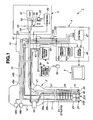
- FIG. 1 is an explanatory view schematically showing the endoscope system according to the embodiment of the present invention.
- an endoscope system 1 includes in the present embodiment: an endoscope 2 capable of performing a normal light observation and a fluorescent light observation; a light source device 3 for supplying illumination light to the endoscope 2; a processor 4 serving as a signal processing device for performing signal processing with respect to the endoscope 2 having an endoscope insertion portion; a monitor 5 serving as a display portion for displaying endoscope images for the normal light observation and the fluorescent light observation in response to a video signal outputted from the processor 4 and inputted to the monitor; an air/water feeding device 6 for feeding air or water; and a forward water-feeding device 6a for feeding water forward.
- the endoscope 2 includes an elongated insertion portion 11 for easier insertion into a body cavity as a subject, an operation portion 12 linked to a proximal end of the insertion portion 11, and a universal cable 13 extended from a side portion of the operation portion 12.
- a connector 14 provided at an end portion of the universal cable 13 is detachably connected to the light source device 3.
- the insertion portion 11 of the endoscope 2 has a configuration as an endoscope insertion portion, and includes a rigid distal end portion 15 formed at a distal end thereof, a bending portion 16 formed at a proximal end of the distal end portion 15, and a flexible tube portion 17 having a flexibility formed from a proximal end of the bending portion 16 to the operation portion 12.
- a light guide 21 for transmitting illumination light is inserted.
- the light guide 21 is inserted in the universal cable 13 via the operation portion 12 to be connected to a light guide connector, not shown, of which proximal end portion 22 is projected out from the connector 14.
- a distal end part of the light guide 21 is fixed in the distal end portion 15.
- an illumination lens 25 of an illumination unit to be described later serving as an illumination optical system is provided and illumination light is emitted from the light guide 21 via the illumination lens 25.
- a distal end cover 24 is provided on a distal end surface of the distal end portion 15.
- the light guide 21 diverges in the operation portion 12, for example, and inserted in the insertion portion 11, divided into two parts. Then, distal end surfaces of the respective divided two parts of the light guide 21 are arranged in the vicinity of rear surfaces of the two illumination lenses 25 provided on the distal end cover 24, respectively.
- the insertion portion 11 has inside thereof a treatment instrument channel (also referred to as a forceps channel) as a first duct having an inner circumferential length long enough for a treatment instrument such as a forceps which is a medical instrument to be inserted, for example.
- the distal end of the treatment instrument channel is open on a distal end surface of the distal end cover 24.
- the treatment instrument channel diverges on a proximal end side of the insertion portion 11.
- One diverging part of the treatment instrument channel is inserted to reach a treatment instrument insertion port, not shown, provided on the operation portion 12.
- the other diverging part of the treatment instrument channel passes through the insertion portion 11 and the universal cable 13 to communicate with a suction channel, and proximal end of the diverging part is connected to a suction means, not shown, via the connector 14.
- a normal-light-observing image pickup unit (hereinafter referred to as a normal light image pickup unit) 31A which is a first image pickup portion for normal light observation
- a fluorescent-light-observing image pickup unit (hereinafter referred to as a fluorescent light image pickup unit) 31B which is a second image pickup portion for special light observation are incorporated.
- the second image pickup portion is the fluorescent-light-observing image pickup unit capable of performing fluorescent light observation which is special light observation.
- the second image pickup portion is not limited especially to the unit for fluorescent light observation, and may be, for example, a night vision-observing image pickup unit, an infrared-light-observing image pickup unit, or the like.
- one ends of signal cables 38a, 38b are connected, respectively.
- the other ends of the signal cables 38a, 38b are inserted in the operation portion 12 and the universal cable 13, and swichably connected to a common signal cable 43 on a relay substrate 42 provided in the connector 14.
- the common signal cable 43 is connected to the processor 4 by passing through in a scope cable 44 which is connected to the connector 14.
- the processor 4 has inside thereof, driving circuits 45a, 45b which drive the normal light image pickup unit 31A and the fluorescent light image pickup unit 3 1 B, respectively, a signal processing circuit 46 for performing signal processing on the image pickup signals outputted respectively from the two image pickup devices via the relay substrate 42, and a control circuit 47 for controlling operation states of the signal processing circuit 46 and the like.
- the operation portion 12 of the endoscope 2 includes control switches 48a, 48b, an air/water feeding button 63, a bending operation knob, not shown, a switch (also referred to as a tele-zoom button), not shown, for performing tele-zoom operation of the normal light image pickup unit 31A, a forward water-feeding button, not shown, and the above-described treatment instrument insertion port, not shown.
- control switches 48a, 48b are connected to the control circuit 47 of the processor 4 via signal lines 49a, 49b, respectively.
- the control switch 48a generates a switching instruction signal, for example
- the control switch 48b generates a freeze instruction signal, for example.
- the relay substrate 42 performs a switching operation so as to switch from a state where one of the signal cables 38a, 38b which are connected to the image pickup devices respectively is connected to the common signal cable 43 to a state the other cable is connected to the signal cable 43, in response to an operation of the control switch 48a, for example.
- the control switch 48a when the control switch 48a is operated, for example, a switching signal is outputted to the relay substrate 42 via a switching signal line 49c inserted in the scope cable 44 and electrically connected to the control circuit 47.
- the relay substrate 42 to which a switching signal line 49c is connected, is in a state where an input terminal to which a signal is inputted from the control circuit is normally in an L (LOW) level and a switching control terminal is pulled down.
- the signal cable 38a of the normal light image pickup unit 31A is connected to the common signal cable 43.
- the switching control terminal is set to be in the low level. That is, the switching control terminal of the relay substrate 42 is set to be for the normal light observation, unless switching instruction operation is performed.
- control circuit 47 in response to the operation of the control switch 48a, the control circuit 47 outputs a control signal also to a control circuit 58 in the light source device 3 via a control signal line 49d in the scope cable 44. Then, the control circuit 58 controls the respective portions of the light source device 3 such that normal observation light or excitation light for fluorescent light observation can be generated in response to the control signal outputted from the control circuit 47. Furthermore, the control circuit 47 causes the respective image pickup devices of the normal light image pickup unit 31 A and the fluorescent light image pickup unit 31B to perform corresponding operations by controlling an operation state of the signal processing circuit 46.
- the light source device 3 includes a lamp 51 for generating white light including a wavelength of excitation light, a collimator lens 52 for rendering the light of the lamp 51 a parallel light flux, a rotation filter 53 which is disposed in an optical path of the collimator lens 52 and includes in a circuit direction thereof an RGB filter for transmitting respective wavelength components of R (RED), G (GREEN) and B (BLUE) in a visible light wavelength band (from 380 nm to 780 nm), for example, and a condenser lens 54 for condensing light transmitted through the rotation filter 53 to emit the light to a proximal end portion 22 of the light guide 21.
- RED red
- G GREEN
- B BLUE
- the rotation filter 53 provided with the RGB filter has outside of the circuit direction an excitation light filter for transmitting the excitation light of a wavelength band shorter than that of visible light.
- the rotation filter 53 is rotated and driven by a motor 55.
- the motor 55 is mounted to a rack 56 and configured to move in a direction orthogonal to an illumination optical axis by a gear-equipped motor 57 engaged with the rack 56, as shown by an arrow.
- the gear-equipped motor 57 is controlled by a control circuit 58.
- the control circuit 58 is connected with the control circuit 47 of the processor 4 via the control signal line 49d and performs control action in response to an operation of the control switch 48a.
- an air/water feeding nozzle 60 serving as an air/water feeding portion is disposed such that a spouting port thereof faces outer surfaces of the respective objective lenses (later, also referred to as observation lenses) of the normal light image pickup unit 31A and the fluorescent light image pickup unit 31B which are disposed on the distal end cover 24.
- the air/water feeding nozzle 60 is, as described later, connected to an air/water feeding duct 61 configured to be diverged at a proximal end thereof into two ducts of an air feeding duct 61a and a water feeding duct 61b, and integrated at a distal end thereof into one duct with the two ducts merged.
- the air feeding duct 61a and the water feeding duct 61b which are communicating with the air/water feeding nozzle 60 are inserted to reach the connector 14 of the universal cable 13, and connected to the air/water feeding device 6 incorporating a pump, not shown, for feeding air and water.
- the air feeding duct 61a and the water feeding duct 61 b are interposed with the air/water feeding button 63 in the operation portion 12 located at halfway of the ducts. Then, air and water are fed by operating the above-described air/water feeding button 63.
- gas such as air or liquid such as distilled water
- the insertion portion 11 has inside thereof a forward water-feeding channel as a second duct for feeding liquid such as distilled water to a region to be inspected in a body cavity. And the distal end of the forward water-feeding channel opens on a distal end surface of the distal end cover 24.
- the forward water-feeding channel is connected to the forward water-feeding device 6a, and has a forward water-feeding button not shown provided in the operation portion 12.
- a forward water-feeding button When the forward water-feeding button is operated, liquid such as distilled water is sprayed from the distal end surface of the insertion portion 11 in an insertion direction into the body cavity. This allows the body fluid and the like attached to the region to be inspected in the body cavity to be cleaned.
- a foot switch 6b is connected to a cable extending from the forward water-feeding device 6a, therefore a user can spray liquid such as distilled water from the distal end surface of the insertion portion 11 in the insertion direction into the body cavity by operating the foot switch 6b.
- the above-described treatment instrument channel and the forward water-feeding channel configure endoscope ducts in the present embodiment.
- an observation lens 31a as a first optical member and a first observation window which configures a first observation optical system of the normal light image pickup unit 31A
- a second observation lens 31b as a second optical member and a second observation window which configures a second observation optical system of the fluorescent light image pickup unit 31B
- two illumination lenses 25a, 25b an aperture portion 26 of the treatment instrument channel
- an aperture portion 27 of the forward water-feeding channel the air/water feeding nozzle 60 is disposed such that a spouting port 60a faces the observation lenses 31 a, 31 b, as described above.
- the observation lens 31a disposed on the distal end cover 24 of the distal end portion 15 condenses the light incident on the normal light image pickup unit 31 A.
- the observation lens 31b disposed on the distal end cover 24 of the distal end portion 15 condenses the light incident on the fluorescent light image pickup unit 31 B.
- FIGS. 2 and 3 are perspective views showing the distal end cover part of the endoscope of FIG 1 .
- FIG 4 is a plan view of the distal end cover of the endoscope of FIG 1 viewed from the front.
- the two observation lenses 31a, 31b are the optical members.
- the observation lens 31a is disposed at the approximately center of the distal end surface of the generally circular-shaped distal end cover 24 when viewed the distal end portion 15 from the distal end thereof, and the illumination lenses 25a, 25b are provided on the right and left when viewed facing the paper surface of FIG 4 , respectively, so as to sandwich the observation lens 31a. Furthermore, on the distal end surface of the distal end cover 24, provided are the aperture portion 27 of the forward water-feeding channel on the upper right side of the observation lens 31a facing the paper surface of FIG 4 , the air/water feeding nozzle 60 on the upper left side, the observation lens 31b as the second observation optical system on the lower right side and the aperture portion 26 of the treatment instrument channel on the lower left side.
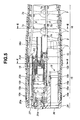
- FIG 5 is a cross-sectional view of the distal end portion and the bending portion cut along A-A line of FIG 4 .
- FIG 6 is a cross-sectional view of the distal end portion cut along B-B line of FIG 4 .
- FIG 7 is a cross-sectional view showing a diverging part of the air/water feeding duct of the endoscope of FIG 1 .
- FIG 8 is a cross-sectional view showing the distal end portion cut along C-C line of FIG 4 .
- FIG 9 is a cross-sectional view showing the distal end portion cut along D-D line of FIG 4 .
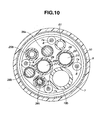
- FIG 10 is a cross-sectional view showing the distal end portion cut along E-E line of FIG 5 .
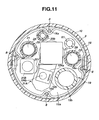
- FIG. 11 is a cross-sectional view showing the bending portion cut along F-F line of FIG 5 .
- the bending portion 16 of the endoscope 2 has a plurality of circular ring-shaped bending pieces 7 rotatably provided thereto in a linked manner.
- the respective bending pieces 7 have four wire guards 7a fixed on inner circumferential surfaces thereof by means of adhesion.
- the four wire guards 7a are, as shown in FIG 10 , fixed on the inner circumferential surface of each of the bending pieces 7 at positions deviated from one another about the insertion axis by approximately 90 degrees.
- the plurality of bending pieces 7 are covered with a bending braid 9 formed by knitting thin wires in a pipe shape so as to cover the outer circumferences thereof, and moreover, on the bending braid 9, an outer covering 10 is covered so as to keep watertightness.
- the bending portion 16 is formed by the bending pieces 7 having the above-described configuration, the bending braids 9, and the outer covering 10.
- the outer covering 10 is covered over the full length of the insertion portion 11 configured by the distal end portion 15, bending portion 16, and the flexible tube portion 17 so as to integrate each components, and the distal end outer circumferential part of the outer cover 10 is fastened in the distal end portion 15 by a spool-shaped adhering portion 10a.
- the four bending operation wires 8 serving as bending operation means extending from the bending portion 16 toward the proximal end are inserted in the insertion portion 11.
- the four bending operation wires 8 have distal end parts which are held and fixed so as to be deviated from one another about the insertion axis by approximately 90 degrees by four fixing portions 18a (See FIG 1 . Note that only one of them is shown in FIG 5 ) of a fixing ring 18 provided in the distal end portion 15, and configured such that the proximal ends thereof are each inserted into the wire guards 7a provided in each of the bending pieces 7.
- the distal end portion 15 and the respective bending pieces 7 are joined such that the respective bending operation wires 8, which are held and fixed by the respective fixing portions 18a of the fixing ring 18 provided in the distal end portion 15 and inserted into the respective wire guards 7a of each of the bending pieces 7, are almost linearly disposed in a state where the insertion axis of the bending portion 16 is almost linear.
- the proximal end portions of the bending operation wires 8 are provided in the operation portion 12, and the bending operation wires 8 are connected to a bending operation mechanism not shown connected to a bending operation knob to be alternately pulled and relaxed.
- the two bending operation wires 8 serving as first bending operation means for operating the bending portion 16 in the up and down directions and the two bending operation wires 8 serving as second bending operation means for operating the bending portion 16 in the left and right directions make a pair, respectively. That is, the two bending operation wires 8 respectively inserted and held by the two wire guards 7a positioned in directions corresponding to the up and down directions in the bending pieces 7 in the bending portion 16 are the first bending operation means, and the two bending operation wires 8 respectively inserted and held by the two wire guards 7a positioned in directions corresponding to the left and right directions in the bending pieces 7 in the bending portion 16 are the second bending operation means.
- a columnar member 15a made of a rigid metal and including a plurality of, or seven hole portions in the present embodiment, and a circular ring-shaped reinforcing ring 15b externally fitted with the proximal end side outer circumferential part of the columnar member 15a.
- the fixing ring 18 having the four fixing portions 18a is fitted by insertion on an inner circumferential side of the reinforcing ring 15b of the distal end portion 15.
- the proximal end part of the reinforcing ring 15b is connected to the bending piece 7 located at the distal-most end.
- the two hole portions among the seven hole portions formed of the columnar member 15a in the distal end portion 15 form distal end parts of the treatment instrument channel 19 and the forward water-feeding channel 20, and in the remaining five hole portions, disposed respectively are the normal light image pickup unit 31 A, the fluorescent light image pickup unit 31B, and the air/water feeding nozzle 60 which are described above, and two illumination lens units to be described later.
- one hole portion of the seven hole portions of the columnar member 15a configures, for example, first observation-optical-system-disposing means in which the normal light image pickup unit 31 A including the observation lens 31a configuring the first observation optical system fixed by first observation-optical-system-fixing means such as a screw and adhesive is disposed.
- another one hole portion configures, for example, second observation-optical-system-disposing means in which the fluorescent light image pickup unit 31B including the observation lens 31b configuring the second observation optical system fixed by second observation-optical-system fixing means such as screw and adhesive is disposed.
- two illumination lens units which include illumination lenses 25 serving as the first and the second illumination optical systems, respectively, are each fixedly disposed by first and second illumination-optical-system-fixing means such as a screw and adhesive, for example.
- first and second illumination-optical-system-fixing means such as a screw and adhesive, for example.
- One of the two holes configures first illumination optical system-disposing means and the other configures second illumination-optical-system-disposing means.
- treatment instrument channel 19 is fixedly disposed in one hole portion among the seven hole portions by first endoscope-duct-fixing means such as a screw and adhesive, for example, and the forward water-feeding channel 20 is fixedly disposed in another one hole portion by second endoscope-duct-fixing means such as a screw and adhesive, for example.
- the treatment instrument channel 19 includes: the aperture portion 26 which opens on the distal end cover 24 provided on the distal end surface of the distal end portion 15, a generally cylindrical tube member 19a fitted by insertion in the hole portion of the columnar member 15a of the distal end portion 15, and a treatment instrument duct 19b formed of a flexible tube of which distal end part covers a proximal end part of the tube member 19a and connected and fixed thereto by a spool.
- the treatment instrument duct 19b is inserted in the insertion portion 11, and of which proximal end is open at the operation portion 12, that is, open in the treatment instrument insertion port not shown in FIG 1 , as described above.
- the forward water-feeding channel 20 similarly having the aperture portion 27 on the distal end cover 24 includes a generally cylindrical tube member 20a fitted by insertion in the hole portion of the columnar member 15a of the distal end portion 15, and a forward water-feeding duct 20b which covers a proximal end part of the tube member 20a and of which distal end part is connected and fixed by a spool.
- the forward water-feeding duct 20b is inserted through the insertion portion 11, the operation portion 12 and the universal cable 13, to reach the connector 14, and is connected to the forward water-feeding device 6a. Note that, as described above, the forward water-feeding duct 20b as the forward water-feeding channel 20 includes the forward water-feeding button not shown placed in the operation portion 12.
- the air/water feeding nozzle 60 is a tubular member bent in an approximate L shape, and of which proximal end part is fitted by insertion in the hole portion of the columnar member 15a of the distal end portion 15 such that the distal end side aperture portion 60a faces outer surface sides of the respective observation lenses 31a, 31b.
- a distal end part of the tube member 62 is fitted by insertion, and a proximal end part of the tube member 62 is connected to the air/water feeding duct 61.
- the tube member 62 and the air/water feeding duct 61 are connected and fixed by a spool.
- the air/water feeding duct 61 has, as shown in FIG 7 , a proximal end part connected to a diverging tube 50, and diverging end portions of the diverging tube 50 are connected to distal end parts of the air feeding duct 61 a and the water feeding duct 61b, respectively.
- This allows the air/water feeding duct 61 to communicate with the air feeding duct 61a and the water feeding duct 61b.
- the respective ducts 61, 61 a, 61 b are connected and fixed to the diverging tube 50 by the spool, and the respective connecting parts and around the entirety of the diverging tube 50 are applied with adhesive, for example, thereby allowing the respective connecting parts to be kept airtight (watertight).
- each of the illumination lens units 23 includes a plurality of illumination lenses 25, and a holding barrel 23a for holding the illumination lenses 25.
- the two illumination lens units 23 in the present embodiment include the illumination lenses 25a, 25b which are the distal-most end lenses among the illumination lenses, respectively.
- the light guide 21 of which distal end part is covered with a cylindrical member 21 a is coated by an outer covering 29 binding up a plurality of fibers.
- a proximal end part of the cylindrical member 21 a is connected and fixed to a tube 28 of which distal end part is spool-fixed, and into the tube 28, the light guide 21 coated by the outer covering 29 is inserted.
- the normal light image pickup unit 31A includes a lens unit 32, and image pickup device 33 which is a CCD or a CMOS and the like, and a circuit substrate 34.
- the lens unit 32 includes first to fourth lens groups 32A to 32D, and first to fourth lens barrels 32a to 32d.
- the first lens group 32A formed by four objective lenses including the observation lens 31a, the second lens 32B formed by one objective lens, the third lens group 32C formed by two objective lenses, and the fourth lens group 32D formed by three objective lenses are held by the first lens barrel 32a, the second lens barrel 32b, the third lens barrel 32c, and fourth lens barrel 32d, respectively.
- the second lens barrel 32b holding the second lens 32B is a moving barrel advanceable and retractable for zooming with respect to a photographing optical axis direction.
- the second lens barrel 32b moves with respect to the photographing optical axis direction by an operation to be described later performed by the normal light image pickup unit 31A based on a drive-stop signal outputted when a zooming operation button, not shown, which is provided to the operation portion 12 is operated.
- the drive-stop signal for causing the second lens barrel 32b with respect to the photographing optical axis direction is outputted from the zooming operation button, not shown, which is provided to the operation portion 12, to the normal light image pickup unit 31A via a signal line 38c shown in FIG 10 .
- the signal line 38c is inserted from the normal light image pickup unit 31A, through inside of the insertion portion 11, to the operation portion 12 to which the zooming operation button not shown is provided.
- the normal light image pickup unit 31A includes, as shown in FIG 11 , an extending portion 201 extending from a part in which the lens unit 32 and the like are provided in a direction approximately orthogonal with respect to the photographing optical axis.
- a supporting barrel 103 outside of the extending portion 201 is almost covered by a supporting barrel 103.
- a moving lens barrel 101 inside of the extending portion 201, provided are a moving lens barrel 101, a driving shaft member 102, a rotation driving portion 104, a flexible substrate 105, a connector portion 106, and a cable 107.
- the second lens barrel 32b of the normal light image pickup unit 31A has, as shown in FIG. 12 , a part extending in a direction approximately orthogonal to the photographing optical axis, at which part the lens barrel is formed integrally with the moving lens barrel 101.
- the moving lens barrel 101 is formed in a generally channel shape in which a distal end side surface in the photographing optical axis direction is open, and provided so as to contact the supporting barrel 103 and is slidable on an inner circumferential surface of the supporting barrel 103.
- the moving lens barrel 101 has on a proximal end side surface in the photographing optical axis direction a screw hole in which a screw portion 102a of the driving shaft member 102 is screwed.
- the rotation driving portion 104 includes an outer barrel 104a of which outer circumferential surface is provided so as to contact the supporting barrel 103, and a motor 104b as driving means provided inside of the outer barrel 104a.
- the motor 104b is connected to the driving shaft member 102 on the distal end side in the photographing optical axis direction.
- the motor 104b includes inside thereof the flexible substrate 105 extending outwardly on the proximal end side in the photographing optical axis direction.
- the flexible substrate 105 is connected, via the connector portion 106, to the cable 107 having the signal line 38c provided inside thereof.
- the drive-stop signal for issuing operational instruction based on the operation is outputted to the normal light image pickup unit 31A having the configuration described above, and thereafter the drive-stop signal is inputted to the motor 104b via the signal line 38c, the connector portion 106, and the flexible substrate 105.
- the motor 104b causes the driving shaft member 102 provided on the distal end side in the photographing optical axis direction to rotate based on the inputted drive-stop signal.
- the driving shaft member 102 converts the rotational driving by the motor 104b into a linear motion in the optical axis direction by a screwing of the screw portion 102a and the screw hole of the moving lens barrel 101.
- the driving shaft member 102 enables the moving lens barrel 101 to move, for example, in the direction shown by an arrow Z1 in FIG 12 , that is, the photographing optical axis direction.
- the second lens 32B provided in the second lens barrel 32b moves, for example, in a direction shown by an arrow Z2 in FIG 12 , that is, the photographing optical axis direction, in accordance with the advance and retreat of the moving lens barrel 101.
- the above-described motion is performed in the respective portions provided in the extending portion 201, and thereby the normal light image pickup unit 31 A, for example, is capable of displaying on the monitor 5 in an enlarged manner a part of an endoscope image obtained within the field of view of the observation lens 31 a to be described later.
- disposing positions of the ducts such as treatment instrument channel provided so as to be inserted in the insertion portion depends on a disposing position of the motor and the like as a mechanism for moving the observation optical system or a part of the observation optical system in the photographing optical axis direction and for displaying the image in an enlarged manner.
- a certain positional relation of the disposing positions of the above-described components requires an endoscope insertion portion of larger outer diameter, thereby increasing pain imposed on a patient when a user inserts the insertion portion into a patient's body cavity.
- the treatment instrument channel 19 and the fluorescent light image pickup unit 31B of the endoscope 2 according to the present embodiment are so disposed as to sandwich the extending portion 201 of the normal light image pickup unit 31A, as shown in FIG. 11 . Therefore, in the endoscope 2 according to the present embodiment, the insertion portion 11 has a smaller diameter, thereby reducing a pain imposed on a patient when a user inserts the insertion portion into the patient's body cavity and also expanding regions of body cavities where the endoscope is insertable.
- means for moving the second lens barrel 32b and the moving lens barrel 101 in the photographing optical axis direction is not limited to the above means having the mechanism configured by the motor 104b and the like, and may be means having a mechanism configured by an actuator and the like, or a mechanism configured by a wire and the like, for example.
- the image pickup device 33 includes on a light receiving surface side a cover lens 33a which is juxtaposed on a proximal end side of the objective lens positioned at the proximal-most end of the fourth lens barrel 32d, and outputs to a circuit substrate 34 an electrical signal corresponding to an optical image.
- the circuit substrate 34 has electrical parts and a wiring pattern, and photoelectrically converts the optical image from the image pickup device 33 into an electrical image signal to output the image signal to the signal cable 38a. Note that, to the circuit substrate 34, a plurality of signal lines of the signal cable 38a are connected by means of soldering and the like.
- the cover lens 33a, the image pickup device 33, the circuit substrate 34 and the distal end part of the signal cable 38a respectively have outer circumferential portions which are integrally covered with, for example, an insulation sealing resin and coated with a reinforcing circular ring portion 35a and an insulating tube 35b.
- the signal cable 38a transmits the image signal obtained from the image pickup device 33 of the normal light image pickup unit 31A and the circuit substrate 34 to the signal processing circuit 46 of the processor 4, via the relay substrate 42 of the connector 14 and the signal cable 43 which are shown in FIG. 1 .
- the fluorescent light image pickup unit 31B includes, similarly as the normal light image pickup unit 31A, the lens unit 36, an image pickup device 38 such as a CCD or a CMOS and the like, and a circuit substrate 39.
- the lens unit 36 includes first and second lens groups 36A, 36B, and first and second lens barrels 32a, 32b.
- the first lens group 36A formed of seven objective lenses including the observation lens 31b and the second lens 36B are held by the first lens barrel 36a and the second lens barrel 36b, respectively.
- the image pickup device 38 includes on a light receiving surface side a cover lens 40 which is juxtaposed on a proximal end side of the objective lens positioned at the proximal-most end of the second lens barrel 36b and outputs to the circuit substrate 39 an electrical signal corresponding to an optical image.
- the circuit substrate 39 has electrical parts and a wiring pattern similarly as the circuit substrate 34 of the normal light image pickup unit 31A, and to the circuit substrate 39, a plurality of signal lines included in the signal cable 38a are connected by means of soldering and the like.
- the circuit substrate 39 photoelectrically converts the optical image from the image pickup device 38 into an electrical image signal to output the image signal to the signal cable 38b.
- the cover lens 40, the image pickup device 33, the circuit substrate 34 and the distal end part of the signal cable 38a respectively have outer circumferential portions which are integrally covered with, for example, an insulation sealing resin and coated with a reinforcing circular ring portion 35a and an insulating tube 35b.
- the signal cable 38b transmits the image signal obtained from the image pickup device 38 and the circuit substrate 39 of the fluorescent light image pickup unit 3 1 B to the signal processing circuit 46 of the processor 4, via the relay substrate 42 and the signal cable 43 of the connector 14 which are shown in FIG. 1 .
- the normal light image pickup unit 31 A and the fluorescent light image pickup unit 31 B described above are fitted by insertion into predetermined hole portions provided in the columnar member 15a of the distal end portion 15, respectively, and firmly fixed with fixing members such as screws along with adhesive and the like.
- the observation lens 31a disposed at the distal end of the normal light image pickup unit 31 A has a larger lens diameter (diameter as outer diameter) compared with the observation lens 31 b disposed at the distal end of the fluorescent light image pickup unit 31 B.
- the disposition directions of the respective image pickup units 31 A, 31 B in the distal end portion 15 are determined such that the respective light receiving surfaces of the two image pickup devices 33, 38 are orthogonal with respect to the insertion axis of the insertion portion 11, and a horizontal transfer direction and a vertical transfer direction of the image pickup device 33 coincide with a horizontal transfer direction and a vertical transfer direction of the image pickup device 38, respectively.
- Subject images photographed by the respective image pickup units 31 A, 31 B are displayed on the monitor 5, and the up/down direction and left/right direction of the monitor 5 coincide with the vertical transfer directions and the horizontal transfer directions of the CCD elements and the CMOS elements of the respective image pickup devices 33, 38, respectively. That is, the up, down, left, and right directions of the endoscope images photographed by the respective image pickup units 31 A, 31 B coincide with the up, down, left, and right directions of the monitor 5.
- the up, down, left, and right directions of the bending portion 16 of the insertion portion 11 are determined so as to correspond to the up, down, left, and right directions of the endoscope image displayed on the monitor 5. Accordingly, the four bending operation wires 8 inserted in the bending portion 16 are pulled and relaxed by predetermined operations of the bending operation knob provided in the operation portion 12, as described above, thereby allowing the bending portion 16 to be bendable in four directions, that is, the up, down, left, and right directions corresponding to the up, down, left, and right directions of the endoscope image displayed on the monitor 5.
- the up, down, left, and right directions of the endoscope image displayed on the monitor 5 always coincide with those of the bending operation directions of the bending portion 16, and the disposition directions of the image pickup units 31 A, 31 B in the distal end portion 15 are determined such that the horizontal transfer direction and the vertical transfer direction of the image pickup device 33 coincide with the horizontal transfer direction and the vertical direction of the image pickup device 38, respectively.
- the user can perform a bending operation of the bending portion 16 in up, down, left, and right directions without feeling a sense of discomfort with respect to the up, down, left, and right directions of the endoscope image displayed on the monitor 5 when the endoscope image is switched between the normal light observation image and the fluorescent light observation image.
- the up/down direction as a first direction will be described as the direction approximately coincident with the up/down direction of the endoscope image displayed on the monitor 5 and the up/down direction in which the bending portion 16 is operated and bent.
- the monitor 5 is generally disposed such that the up/down direction thereof approximately coincides with the plumb up/down direction.
- the left/right direction as a second direction approximately orthogonal to the above-described up/down direction will be described as a direction approximately coincident with the left/right direction of the endoscope image displayed on the monitor 5 and the left/right direction in which the bending portion 16 is operated and bent.
- the user connects the connector 14 of the endoscope 2 to the light source device 3, then connects one end and the other end of the scope cable 44 with the connector 14 and the processor 4, respectively.
- the user connects the air feeding duct 61 a and the water feeding duct 61b to the air/water feeding device 6.
- the user turns on power switches of the light source device 3 and the like to set the device and the like in an operation state, respectively.
- the control circuits 47, 58 of the processor 4 and the light source device 3 become a state in which they can transmit and receive a control signal and the like.
- the relay substrate 42 is set such that the normal light image pickup unit 31 A is selected.
- the control circuit 47 performs a control operation to set the normal light observation state. That is, the control circuit 47 transmits a control signal to the control circuit 58 of the light source device 3 to set the light source device 3 in a state where illumination light for normal light observation is supplied.
- control circuit 47 controls to drive the CCD driving circuit 45a, and sets the operation state of the signal processing circuit 46 in the normal light observation mode.
- the user inserts the insertion portion 11 of the endoscope 2 into a body cavity to set such that a diseased part and the like as a subject to be diagnosed can be observed.
- the light source device 3 becomes the state where the illumination light for normal light observation is supplied, as described above.
- the rotation filter 53 is rotated and driven by the motor 55 in a state where the RGB filter is disposed in the illumination optical path.
- red, green, and blue illumination lights are supplied to the light guide 21 as frame sequential lights.
- the CCD driving circuit 45a outputs a CCD driving signal, and the illumination lights illuminate the diseased part in a patient's body cavity via the illumination lenses 25a, 25b.
- the images of the illuminated subject such as the diseased part pass through the lens unit 32 of the normal light image pickup unit 31A to be formed on the light receiving surface of the image pickup device 33, and then photoelectrically converted. Then, the image pickup device 33 outputs the signals obtained by the photoelectric conversion, in response to application of a driving signal.
- the outputted signals are inputted to the signal processing circuit 46 through the signal cable 38a and the common signal cable 43 selected by the relay substrate 42.
- the signals inputted to the signal processing circuit 46 are A/D converted in the circuit to be temporarily stored in an RGB memory.
- the signals stored in the RGB memory are simultaneously read out to be synchronized R, G, B signals, and then D/A converted to be analog R, G, B signals, thereafter being color-displayed on the monitor 5.
- the control circuit 47 performs switching control of the relay substrate 42 in response to the switch instruction signal outputted from the control switch 48a, and sets the light source device 3 in a state where excitation light for fluorescent light observation is supplied via the control circuit 58.
- control circuit 47 controls the driving circuit 45b in an operation state and sets the signal processing circuit 46 in a processing mode by the fluorescent light observation.
- control circuit 58 in the light source device 3 moves the rotation filter 53 as well as the motor 55 in a direction orthogonal to the illumination optical path by means of the gear-equipped motor 57 such that an excitation light filter is disposed on the illumination optical path.
- light from the lamp 51 is supplied to the light guide 21 as the excitation light having a wavelength band around 400 to 450 nm, for example, by passing through the excitation light filter. Then, the excitation light is illuminated onto the diseased part or the like in the body cavity via the illumination lenses 25a, 25b.
- the diseased part or the like on which the excitation light is illuminated is a cancer tissue, they absorb the excitation light to emit stronger fluorescent light, compared with the case where the disease part or the like is a normal tissue.
- the light from the part emitting the fluorescent light passes through the lens unit 36 of the fluorescent light image pickup unit 31 B and image-formed on the light receiving surface of the image pickup device 38 to be photoelectrically converted.
- the image pickup device 38 outputs the signals obtained by the photoelectric conversion and amplification in response to application of a driving signal from the driving circuit 45b.
- the signals obtained by the photoelectric conversion and the amplification are inputted to the signal processing circuit 46 via the signal cable 38b and the common signal cable 43 selected by the relay substrate 42.
- the signals inputted in the signal processing circuit 46 are A/D converted in the circuit and simultaneously stored in the RGB memory, for example.
- the signals stored in the RGB memory is simultaneously read out to be synchronized R, G, B signals, and then D/A converted into analog R, G, B signals, thereafter being monochrome-displayed on the monitor 5.
- signals inputted in the signal processing circuit 46 may be turned into pseudo-colors to be displayed by comparing the levels of the signals with a plurality of threshold values and changing colors to be allocated to the signals depending on the comparison result.
- the fluorescent light observation can be performed, thereby realizing the endoscope facilitating a diagnosis compared with the endoscope capable of performing only the normal light observation.
- the image pickup units 31A, 31B are provided, so that it is possible to obtain the normal light observation image as a first observation image and the special light observation image as a second observation image, that is, the fluorescent light observation image. That is, the image pickup unit 31 A as the first image pickup portion can obtain the normal light observation image as the first observation image based on the light condensed by the observation lens 31a disposed on the distal end cover 24 of the distal end portion 15.
- the image pickup unit 31 B as the second image pickup portion can obtain the special light observation image as the second observation image based on the light condensed by the observation lens 31 b disposed on the distal end cover 24 of the distal end portion 15.
- the images based on weaker light are often picked up compared with the case of normal observation. Therefore, it is desirable to employ an image pickup device having a high S/N (signal to noise) ratio in the fluorescent light observation.
- the image pickup for normal observation is used also as the one for fluorescent light observation, the picked up image tends to have a low S/N ratio.
- the image pickup device 38 dedicated and suitable for the fluorescent light observation is employed, thereby allowing the fluorescent light image with high S/N ratio to be obtained.
- the switching relay substrate 42 is provided, thereby allowing a configuration in which only one of the two image pickup units 31A, 31B is connected to the processor 4, so that the endoscope system 1 can be formed to have a compact configuration compared with the one in which it is necessary to constantly drive the two image pickup units 31 A, 31 B, and perform signal processing with respect to the units.
- one air/water feeding nozzle 60 is employed to keep the both observation lenses 31a, 31 b clean by spraying gas or water on the outer surfaces of the lenses, thereby ensuring the excellent observation field of view.
- the insertion portion 11 have a smaller diameter, thereby reducing pain imposed on a patient when a user inserts the insertion portion into the patient's body cavity and also expanding regions in body cavities where the endoscope is insertable.
- the endoscope 2 according to the present invention has the same external configuration as an existing endoscope including only the image pickup unit for normal light observation, and can be used also as the endoscope for normal light observation similarly as the existing endoscope, by connecting, via the scope cable 44, to a processor, not shown, for driving and performing signal processing with respect to the existing endoscope including only the image pickup unit for normal light observation. That is, the endoscope 2 can be also used by connecting with the existing processor, while keeping a similar compatibility with the existing endoscope including only the image pickup unit for normal light observation.
- the endoscope 2 according to the present invention has various characteristics (effects) with structure described below.
- FIG 13 is a front view showing the distal end surface of the distal end cover.
- the centers of the distal end cover 24, the observation lens 31a of the normal light image pickup unit 31A, and the observation lens 31 b of the fluorescent light image pickup unit 31 B are referred to as O 0 , O 1 , and O 2 , respectively.
- the centers of the two illumination lenses 25a, 25b to be described later are referred to as O 3 , O 4 , respectively
- the centers of the aperture portion 26 of the treatment instrument channel 19 and the aperture portion 27 of the forward water-feeding channel 20 are referred to as O 5 , O 6 , respectively.
- a line passing through the center O 0 of the distal end surface of the distal end cover 24 in the up/down bending direction of the bending portion 16 and a line in the left/right bending direction of the bending portion 16 are defined as a vertical line X and a horizontal line Y, respectively.
- the vertical line X in the present embodiment is equal to the plumb line in the following description.
- the air/water feeding nozzle 60 is provided on the upper left side of the distal end surface of the distal end cover 24 when viewed facing the paper surface of FIG 13 such that the spouting port 60a faces toward the observation lens 31a.
- the air/water feeding nozzle 60 may be provided on the upper right side of the distal end surface of the distal end cover 24 when viewed facing the paper surface of FIG 13 such that the spouting port 60a faces toward the observation lens 31a.
- the air/water feeding nozzle 60 and the respective observation lenses 31a, 31b are so disposed as to be almost linearly juxtaposed on the distal end surface of the distal end cover 24.
- the air/water feeding nozzle 60 is provided on the distal end surface of the distal end cover 24 such that the gas or liquid such as air or distilled water spouted from the spouting port 60a of the air/water feeding nozzle 60 is spouted in the arrow line AR direction in the drawing as a predetermined direction.
- the air/water feeding nozzle 60 spouts to diffuse the gas or liquid such as air or distilled water from the spouting port 60a into a gas/liquid spouting range A.
- arrow line AR is a line in a direction approximately orthogonal to the distal end surface of the air/water feeding nozzle 60 having the spouting port 60a and passing through the center of the hole surface of the spouting port 60a.
- the disposition direction of the air/water feeding nozzle 60 about an axis is determined such that the observation optical axis passing the center O 1 of the observation lens 31a intersects the arrow line AR described above.
- the direction in which the spouting port 60a of the air/water feeding nozzle 60 faces is determined such that the arrow line AR which is the spouting direction of the gas or liquid such as air or distilled water from the air/water feeding nozzle 60 has a predetermined angle ⁇ 1 as a first angle with respect to the vertical line X.
- the observation lens 31b of the fluorescent light image pickup unit 31B is provided on the lower right side of the distal end surface of the distal end cover 24 facing the paper surface of FIG 3 such that the outer surface of the observation lens 31b has at least a part intersecting the arrow line AR when viewing the distal end cover 24 from the distal end side thereof.
- the observation lens 31b is provided on the distal end surface of the distal end cover 24 such that the center O 2 thereof is positioned on the lower side than a segment of the arrow line AR. Note that the observation lens 31b is disposed at a position on a side of the arrow line AR direction relative to the observation lens 31a and further from the air/water feeding nozzle 60 than the observation lens 31 a.
- the air/water feeding nozzle 60 and two observation lenses 31a, 31b are almost linearly juxtaposed on the distal end surface of the distal end cover 24.
- a line a connecting the center O 1 of the observation lens 31a of the normal light image pickup unit 31A and the center O 2 of the observation lens 31b of the fluorescent light image pickup unit 31B is slightly deviated to the lower side by a predetermined angle O 2 with respect to the arrow line AR, when viewed from the distal end cover 24 from the distal end surface side thereof.
- a line b connecting the hole surface center of the spouting port 60a of the air/water feeding nozzle 60 and the center O 2 of the observation lens 31b is slightly deviated to the lower side by a predetermined angle ⁇ 3 with respect to the arrow line AR, when viewed from the distal end cover 24 from the distal end surface side thereof.
- the respective disposing positions of the observation lenses 31a, 31b on the distal end cover 24 to be determined, and in accordance with the positions, the direction of the spouting port 60a (the arrow line AR direction) of the air/water feeding nozzle 60 is determined.
- the angles ⁇ 2, ⁇ 3 are set within a range such that the whole outer surface of the observation lens 31b is located within the gas/liquid spouting range A of the air/water feeding nozzle 60.
- the gas/liquid spouting range A of the air/water feeding nozzle 60 is set so as to contain the whole outer surface of the observation lens 31a of the normal light image pickup unit 31A, when viewed from the distal end side of the distal end cover 24.
- observation lens 31a having a larger lens diameter (diameter as the outer diameter) than the outer diameter of the observation lens 31 b is provided on the distal end surface of the distal end cover 24 so as to be close to the air/water feeding nozzle 60.
- the distal end cover 24 has the air/water feeding nozzle 60 at a position on an upper side than the horizontal line Y approximately bisecting the bending up/down direction of the bending portion 16 with respect to a direction viewed from the distal end surface side, that is, up/down direction of the vertical transfer direction in which the image pickup devices 33, 38 included in the respective image pickup units 31 A, 31B perform processings.
- the air/water feeding nozzle 60 is provided to the distal end cover 24 away from the horizontal line Y in a direction opposite to the spouting direction (arrow line AR direction).
- the distal end cover 24 has the air/water feeding nozzle 60 provided such that a cross section of the air/water feeding nozzle 60 in a direction orthogonal to the longitudinal axis (axis parallel with the insertion direction) thereof is not positioned on the vertical line X which bisects a left/right direction (which is reverse to the bending left/right direction of the bending portion 16) with respect to the direction viewed from the distal end surface side of the distal end cover, that is, the left/right direction of the vertical transfer direction in which the image pickup devices 33, 38 included in the respective image pickup units 31A, 31B perform processings.
- the air/water feeding nozzle 60 and the spouting port 60a are provided at a position on the distal end surface of the distal end cover 24 so as to be separated by a predetermined distance in the left direction from the vertical line X, when viewed from the distal end surface side of the distal end cover 24. That is, the air/water feeding nozzle 60 is disposed such that a longitudinal axis thereof is located at a position deviated to the upper side than the horizontal line Y bisecting the distal end cover 24 into upper and lower parts, and deviated to the left side from the vertical line X bisecting the distal end cover 24 into left and right parts, when viewed from the distal end surface side of the distal end cover 24.
- the endoscope 2 of the present embodiment includes, on the distal end surface of the distal end cover 24, the air/water feeding nozzle 60, the observation lens 31a of the normal light image pickup unit 31 A, and the observation lens 31 b of the fluorescent light image pickup unit 3 1 B which are almost linearly provided.
- the endoscope 2 of the present embodiment is configured such that gas or water is sprayed from one air/water feeding nozzle 60 onto the outer surfaces of the respective observation lenses 31 a, 31 b to keep the lenses in a clean state, thereby ensuring an excellent observation field of view.
- the air/water feeding nozzle 60 is disposed such that the longitudinal axis thereof is located on the upper side than the horizontal line Y bisecting the distal end cover 24 into upper and lower parts, and at a position deviated by a predetermined distance from the vertical line X bisecting the distal end cover 24 into left and right parts. Therefore, when the insertion portion 11 is in an almost straight state, the air/water feeding duct 61 communicating with the air/water feeding nozzle 60 is inserted almost straight into the distal end portion 15 and the bending portion 16, without contacting the four fixing portions 18a of the fixing ring 18 provided in the distal end portion 15 and the four wire guards 7a provided respectively to each of the bending pieces 7 provided in the bending portion 16.
- disposition of the above-described air/water feeding nozzle 60 prevents the air/water feeding duct 61 from contacting the four bending operation wires 8 respectively held by insertion into the four wire guards of each of the bending pieces 7 in the bending portion 16. Therefore, in the endoscope 2 according to the present embodiment, movement of the bending operation wires 8 due to pulling and relaxing is not obstructed and the degradation of the bending operation wires 8 due to scratch can be prevented.
- the insertion portion 11, particularly, the distal end portion 15 and the bending portion 16 have smaller diameter, thereby reducing the pain imposed on the patient at the time of insertion and expanding regions of body cavities where the endoscope is insertable.
- the endoscope 2 is generally used by a user such that the up/down bending direction of the bending portion 16 coincides with the up and down in the plumb direction. Accordingly, the liquid such as distilled water spouted from the spouting port 60a of the air/water feeding nozzle 60 flows down to the lower side due to influence of gravitational force, on a far side from the spouting port 60a.
- the gas or liquid such as air or distilled water
- the gas or the water is subject to a pulling force in the direction of the aperture portion 26 due to a suction force from the aperture portion 26 of the treatment instrument channel 19 provided on the lower side of the distal end cover 24, resulting in a change of the flow direction of the gas or the air to the down bending direction side.
- the observation lens 31a of the normal light image pickup unit 3A, the observation lens 31 b of the fluorescent light image pickup unit 31 B, and the spouting port 60a of the air/water feeding nozzle 60 are disposed in a state where the line a connecting the center O 2 of the observation lens 31 b and the center O 1 of the observation lens 31a is deviated by the predetermined angle of ⁇ 2 in the down bending direction of the bending portion 16 with respect to the arrow line AR which is the spouting direction of the liquid such as distilled water spouted from the spouting port 60a.
- the observation lens 31 b which is located further from the air/water feeding nozzle 60 than the observation lens 31a on the distal end surface of the distal end cover 24 is efficiently sprayed with the liquid such as distilled water flown down lower to the down bending direction side than the spouting direction due to the influence of gravitational force, and thereby cleaned to be a clean state.
- the observation lens 31b is also efficiently sprayed with the gas or air such as air or distilled water of which flow direction is changed to the down bending direction side due to the suction, and thereby cleaned to be a clean state and the excellent observation field of view is ensured.
- the normal light image pickup unit 31 A of the present embodiment is provided near the center of the distal end surface of the distal end portion 15, and is provided with the observation lens 31a having a larger lens diameter (diameter as the outer diameter) than that (diameter as the outer diameter) of the observation lens 31b for guiding light incident on the fluorescent light image pickup unit 31B for image pickup, thereby ensuring the excellent observation field of view and the sufficient amount of received light.
- the endoscope of the present embodiment in particular, has an enlargement function, so that a plurality of lens groups 32A to 32D are required so as to suppress aberration at the time of telephotographing/zooming. As a result, the light beam height becomes higher, which leads to the larger lens diameter (diameter as the outer diameter).
- the observation lens 31a has the larger lens diameter (diameter as the outer diameter) than that of the observation lens 31b, that is, has a larger outer surface area, and condenses the incident light on the image pickup device 33 of the normal light image pickup unit 31A provided on an image forming side of the incident light.
- spouting force thereof is larger on the side closer to the spouting port 60a, and as going further side of the spouting direction, the spouting force becomes smaller and the density becomes lower by diffusion.
- the observation lens 31a of the normal light image pickup unit 31 A having a larger lens diameter (diameter as the outer diameter) than that (diameter as the outer diameter) of the observation lens 31 b of the fluorescent light image pickup unit 31B is disposed at a position closer to the air/water feeding nozzle 60 on the distal end surface of the distal end cover 24.
- the whole outer surface of the observation lens 31a is contained in the gas/liquid spouting range A to which air or distilled water is spouted from the spouting port 60a of the air/water feeding nozzle 60.
- the endoscope 2 has at the position closer to the air/water feeding nozzle 60 the observation lens 31a having the large lens diameter (diameter as the outer diameter) to which body fluid, filth, and the like are easily attached, thereby improving the cleaning efficiency without being subject to the influence due to a decrease in the spouting force and the density of the gas or fluid such as air or distilled water spouted from the spouting port 60a.
- the air/water feeding nozzle 60, the observation lens 31a of the normal light image pickup unit 31A, and the observation lens 31b of the fluorescent light image pickup unit 31B are almost linearly juxtaposed on the distal end surface of the distal end cover 24 shown in FIG. 13 .
- the arrow line AR which is the spouting direction of the gas or liquid such as air or distilled water spouted from the spouting port 60a of the air/water feeding nozzle 60.
- the gas or liquid which has been used for cleaning the filth and the like attached to the respective observation lenses 31a, 31b flows to an outer edge portion of the distal end cover 24 in the arrow line AR direction as the spouting direction, without flowing toward the other components.
- the distal end surface of the distal end cover 24 of the endoscope 2 is surely cleaned, when the gas or liquid such as air or distilled water is spouted from the air/water feeding nozzle 60.
- two illumination lenses 25a, 25b are disposed at the positions in the left/right bending direction so as to sandwich the observation lens 31a of the normal light image pickup unit 31 A which is provided at near the center of the distal end surface. Furthermore, on the distal end surface of the distal end cover 24, the aperture portion 26 of the treatment instrument channel 19 and the aperture portion 27 of the forward water-feeding channel 20 are disposed at a position on the lower left side of the observation lens 31a and at a position on the upper right side of the observation lens 3 1a, respectively.
- the aperture portion 26 of the treatment instrument channel 19 and the aperture portion 27 of the forward water-feeding channel 20 are provided on the distal end surface of the distal end cover 24 such that the entireties of the hole surfaces thereof are positioned outside of the gas/liquid spouting range A into which gas or liquid such as air or distilled water is spouted to diffuse from the spouting port 60a of the air/water feeding nozzle 60.
- the aperture portion 26 of the treatment instrument channel 19 is disposed in an area B on the distal end surface of the distal end cover 24 which is an area at the lower part of the distal end surface of the distal end cover 24 when dividing the distal end surface into two parts along the arrow line AR which shows the spouting direction of the gas or liquid such as air or distilled water spouted from the spouting port 60a of the air/water feeding nozzle 60, and which is exclusive of the gas/liquid spouting range A.
- the aperture portion 27 of the forward water-feeding channel 20 is disposed in an area C on the distal end surface of the distal end cover 24 which is an area at the upper part of the distal end surface of the distal end cover 24 when dividing the distal end surface into two parts along the arrow line AR, and which is exclusive of the gas/liquid spouting range A.
- the respective aperture portions 26, 27 are disposed on the distal end surface of the distal end cover 24 at approximately symmetrical positions with respect to the arrow line AR showing the spouting direction of gas or liquid such as air or distilled water, respectively. That is, the respective aperture portions 26 and 27 are disposed at positions on the distal end surface of the distal end cover 24 such that the centers O 5 and O 6 are separated from each other by a predetermined distance.
- the aperture portion 26 when comparing a first distance between the center O 1 of the observation lens 31a and the center O 5 of the aperture portion 26 in a case of connecting the two by a straight line M with a second distance between the center O 2 of the observation lens 31 b and the center O 5 of the aperture portion 26 in a case of connecting the two by a straight line N, the aperture portion 26 is disposed at a position on the distal end surface of the distal end cover 24 such that the first distance is shorter than the second distance.
- the aperture portion 26 is disposed such that the center O 5 thereof is located lower than the center O 4 of the observation lens 31 b of the fluorescent light image pickup unit 31B which is lower positioned one of the two observation lenses 31a and 31b disposed on the distal end surface of the distal end cover 24.
- the aperture portion 26 is disposed on the distal end surface of the distal end cover 24 at a position closer to the observation lens 31a of the normal light image pickup unit 31 A than the observation lens 31b of the fluorescent light image pickup unit 31B.
- the aperture portion 26 of the treatment instrument channel 19 and the aperture portion 27 of the forward water-feeding channel 20 are disposed outside of the gas/liquid spouting range A of the air/water feeding nozzle 60 on the distal end surface of the distal end cover 24.
- the aperture portion 26 of the endoscope 2 according to the present embodiment is disposed at the position where the first distance is shorter than the second distance, as described above, with respect to the observation lenses 31a, 31 b. This prevents the gas or liquid such as air or distilled water spouted from the air/water feeding nozzle 60 from flowing into the respective aperture portions 26, 27.
- the endoscope 2 has the aperture portion 26 disposed at the position where the above-described first distance is shorter than the second distance with respect to the observation lenses 31 a, 31 b. Therefore, the gas or liquid such as air or distilled water spouted from the air/water feeding nozzle 60 is surely sprayed not only onto the observation lens 31 a of the normal light image pickup unit 31 A but also onto the further side observation lens 3 1 b of the fluorescent light image pickup unit 31 B. As a result, the observation lens 31 b of the fluorescent light image pickup unit 31 B is surely and efficiently sprayed with gas or liquid, and cleaned to be in a clean state, thereby ensuring an excellent observation field of view.
- the gas or liquid such as air or distilled water spouted from the air/water feeding nozzle 60 is surely sprayed not only onto the observation lens 31 a of the normal light image pickup unit 31 A but also onto the further side observation lens 3 1 b of the fluorescent light image pickup unit 31 B.
- the aperture portion 26 is disposed on the distal end surface of the distal end cover 24 at the position closer to the observation lens 31a of the normal light image pickup unit 3 1 A than the observation lens 31b of the fluorescent light image pickup unit 31B.
- the frequency in which a treatment instrument, not shown, is used after being inserted in the treatment instrument channel 19 and protruded from the aperture portion 26 is higher in the normal light observation than in the fluorescent light observation. Accordingly, the aperture portion 26 is disposed at the above-described position with respect to the observation lens 31 a, so that the user is capable of surely perform a treatment when performing the treatment to a diseased part using a treatment instrument at the time of normal light observation.
- the respective aperture portions 26, 27 are disposed in the areas B, C exclusive of the gas/liquid spouting range A, respectively, so as to be separated from each other as far as possible to the outer circumferential side of the distal end cover 24. That is, the respective aperture portions 26, 27 are disposed on the distal end surface of the distal end cover 24 at the positions such that the center O 5 of the aperture portion 26 and the center O 6 of the aperture portion 27 are separated from each other by a predetermined distance.
- the respective aperture portions 26, 27 are disposed on the distal end surface of the distal end cover 24 at the approximately line-symmetrical positions, respectively, with respect to the arrow line AR showing the spouting direction of the gas or liquid such as air or distilled water.
- the respective aperture portions 26, 27 are disposed on the distal end surface of the distal end cover 24 at the approximately line-symmetrical positions with respect to the line a connecting the respective centers O 1 and O 2 of the observation lenses 31 a, 31 b.
- the area B' is the part exclusive of the gas/liquid spouting area A, and lower left part on the distal end surface of the distal end cover 24 when viewed facing the paper surface of FIG 16 .
- the area C' is the part exclusive of the gas/liquid spouting area A, and upper right part on the distal end surface of the distal end cover 24 when viewed facing the paper surface of FIG 16 . That is, the respective areas B', C' are parts point-symmetric with respect to the center O 0 of the distal end surface of the distal end cover 24 at which the vertical line X and the horizontal line Y intersect, and exclusive of the gas/liquid spouting area A.
- the aperture portion 26 of the treatment instrument channel 19 is provided within the area B' on the distal end surface of the distal end cover 24.
- the aperture portion 27 of the forward water-feeding channel 20 is provided within the area C' on the distal end surface of the distal end cover 24.
- the respective aperture portions 26, 27 are disposed respectively within the areas B', C' exclusive of the gas/liquid spouting range A on the distal end surface of the distal end cover 24, and the one aperture portion is disposed in the area B' and the other aperture portion is disposed in the area C' such that the respective centers O 5 , O 6 are separated from each other as far as possible by a predetermined distance.
- the aperture portion 26 of the treatment instrument channel 19 and the aperture portion 27 of the forward water-feeding channel 20 are disposed outside of the gas/liquid spouting range A of the air/water feeding nozzle 60 on the distal end surface of the distal end cover 24. Therefore, the endoscope 2 according to the present embodiment is capable of preventing the gas or liquid such as air or distilled water spouted from the air/water feeding nozzle 60 from flowing into the respective aperture portions 26, 27.
- the gas or liquid such as air or distilled water spouted from the air/water feeding nozzle 60 to be surely sprayed onto the further side observation lens 31b of the fluorescent light image pickup unit 31B.
- the observation lens 31b of the fluorescent light image pickup unit 31B is surely and efficiently sprayed with the gas or liquid and cleaned to be a clean state, thereby ensuring the excellent observation field of view.
- the aperture portion 27 is separately disposed at a position on the distal end surface of the distal end cover 24 such that the third distance is shorter than the fourth distance, as shown in FIG 17 .
- the aperture portion 26 of the treatment instrument channel 19 and the aperture portion 27 of the forward water-feeding channel 20 are disposed outside of the gas/liquid spouting range A of the air/water feeding nozzle 60 on the distal end surface of the distal end cover 24.
- the aperture portion 27 of the endoscope 2 according to the present embodiment is, in particular, disposed at the position where the above-described third distance is shorter than the fourth distance with respect to the observation lenses 31a, 31b. Therefore, the gas or liquid such as air or distilled water spouted from the air/water feeding nozzle 60 is prevented from flowing into the respective aperture portions 26, 27.
- the endoscope 2 has the aperture portion 27 disposed at the position where the above-described third distance is shorter than the fourth distance with respect to the observation lenses 31a, 3 1b. Therefore, the gas or liquid such as air or distilled water spouted from the air/water feeding nozzle 60 is surely sprayed not only onto the observation lens 31a of the normal light image pickup unit 31 A but also onto the further side observation lens 31b of the fluorescent light image pickup unit 31 B. As a result, the observation lens 31 b of the fluorescent light image pickup unit 31B is surely and efficiently sprayed with the gas or liquid and cleaned to be a clean state, thereby ensuring the excellent observation field of view.
- the gas or liquid such as air or distilled water spouted from the air/water feeding nozzle 60 is surely sprayed not only onto the observation lens 31a of the normal light image pickup unit 31 A but also onto the further side observation lens 31b of the fluorescent light image pickup unit 31 B.
- the observation lens 31 b of the fluorescent light image pickup unit 31B is surely and efficiently sprayed
- the aperture portion 27 is disposed so as to be positioned in the vicinity of the observation lens 31a, which is the observation lens disposed closer to the center O 0 of the distal end surface of the distal end cover 24, out of the observation lenses 31a, 31b disposed on the distal end surface of the distal end cover 24.
- liquid such as distilled water is spouted from the aperture portion 27 of the forward water-feeding channel 20, thereby allowing the liquid such as distilled water to be sprayed to a diseased part existing in the insertion direction of the insertion portion 11.
- the forward water feeding is performed more frequently at the time of the normal light observation than at the time of the fluorescent light observation.
- the aperture portion 27 is disposed at the above-described position with respect to the observation lens 31a, so that a user can more surely perform forward water-feeding to a desired position of the diseased part when performing the forward water-feeding to the diseased part at the time of the normal light observation.
- the respective aperture portions 26, 27 are disposed on the distal end surface of the distal end cover 24 such that the respective centers O 5 ,O 6 are separated from each other by a predetermined distance.
- the endoscope 2 of the present invention having the above-described various features (effects) includes on the distal end surface of the distal end cover 24 the air/water feeding nozzle 60, the observation lens 31a of the normal light image pickup unit 31A, and the observation lens 31b of the fluorescent light image pickup unit 31 B which are approximately linearly disposed. Accordingly, in the endoscope 2 of the present embodiment, gas or liquid is sprayed from one air/water feeding nozzle 60 onto the outer surface of the respective observation lenses 31 a, 31b and keep the lenses in a clean state, thereby ensuring the excellent observation field of view.
- the special light observation is not limited to the fluorescent light observation, but may be an enlarged observation for obtaining an enlarged observation image as a special light observation image, in which the image can be enlarged to a high enlargement magnification compared with the normal light observation image by means of an enlarging optical system having an enlargement magnification of a histological level for observing a cell or gland structure (desirably equal to or more than 100 times level enlargement magnification).
Landscapes
- Health & Medical Sciences (AREA)
- Life Sciences & Earth Sciences (AREA)
- Physics & Mathematics (AREA)
- Surgery (AREA)
- Optics & Photonics (AREA)
- Pathology (AREA)
- General Health & Medical Sciences (AREA)
- Biomedical Technology (AREA)
- Biophysics (AREA)
- Molecular Biology (AREA)
- Heart & Thoracic Surgery (AREA)
- Animal Behavior & Ethology (AREA)
- Engineering & Computer Science (AREA)
- Public Health (AREA)
- Veterinary Medicine (AREA)
- Medical Informatics (AREA)
- Nuclear Medicine, Radiotherapy & Molecular Imaging (AREA)
- General Physics & Mathematics (AREA)
- Radiology & Medical Imaging (AREA)
- Astronomy & Astrophysics (AREA)
- Chemical & Material Sciences (AREA)
- Analytical Chemistry (AREA)
- Biochemistry (AREA)
- Immunology (AREA)
- Instruments For Viewing The Inside Of Hollow Bodies (AREA)
- Endoscopes (AREA)
Claims (13)
- Partie d'insertion d'endoscope (11) comprenant :une partie d'extrémité distale (15), dans laquelle la partie d'insertion (11) est munie à l'intérieur d'un premier conduit (19, 19a, 19b) présentant un diamètre interne permettant à un instrument médical d'être inséré ;une première partie de capture d'images (31A) destinée à obtenir une première image d'observation configurée pour être affichée sur la partie d'affichage (5) de manière partiellement agrandie ;une deuxième partie de capture d'images (31B) destinée à obtenir une deuxième image d'observation ;un premier système optique d'observation (31a) destiné à condenser une lumière incidente sur la première partie de capture d'images (31A), le premier système optique d'observation (31a) étant disposé au niveau de la partie d'extrémité distale (15) ;un deuxième système optique d'observation (31b) destiné à condenser une lumière incidente sur la deuxième partie de capture d'images (31B), le deuxième système optique d'observation (31b) étant disposé au niveau de la partie d'extrémité distale (15) ; etune première partie d'ouverture (26) communiquant avec le premier conduit (19, 19a, 19b), la partie d'ouverture (26) étant disposée au niveau d'une surface d'extrémité distale (24) de la partie d'extrémité distale (15),dans laquelle, sur la surface d'extrémité distale (24), une distance entre un centre de la première partie d'ouverture (26) et un centre du premier système optique d'observation (31a) est plus courte qu'une distance entre le centre de la première partie d'ouverture (27) et un centre du deuxième système optique d'observation (31b) ;caractérisé en ce qu'elle comprend en outre :une deuxième partie d'ouverture (27) prévue en communication avec un deuxième conduit (20, 20a, 20b) différent du premier conduit (19, 19a, 19b) et disposée sur la surface extrémité distale (24) de la partie d'extrémité distale (15) et adaptée pour vaporiser un liquide depuis la surface d'extrémité distale (24) de la partie d'extrémité distale (15) et vers l'extérieur d'une extrémité distale du deuxième conduit (20, 20a, 20b) dans la cavité de corps dans une direction d'insertion de la partie d'insertion (11) ; etune partie d'extension (201) prévue à l'intérieur de la partie d'insertion (11) en tant que partie de la première partie de capture d'images (31A), la partie d'extension (201) s'étendant approximativement de façon orthogonale par rapport à une direction d'axe optique de photographie du premier système optique d'observation (31a) et comprenant une partie d'entraînement en rotation (104) et un substrat flexible (105),dans laquelle le premier conduit (19, 19a, 19b) et la deuxième partie de capture d'images (31B) sont disposés de façon à prendre en sandwich la partie d'extension (201) ;dans laquelle la première partie de capture d'images (31A) comprend un barillet d'objectif mobile (101) et un élément d'arbre d'entraînement (102) fixé sur un côté d'extrémité proximale du barillet d'objectif mobile (101),dans laquelle l'élément d'arbre d'entraînement (102) est entraîné pour avancer et reculer le barillet d'objectif mobile (101) le long de la direction de l'axe optique de photographie conformément à une instruction d'affichage de la première image d'observation de manière agrandie, etdans laquelle, à mesure que le barillet d'objectif mobile (101) se déplace, un barillet d'objectif prédéterminé (32b) et un objectif prédéterminé (32B) contenus dans le premier système optique d'observation (31a) sont déplacés dans la direction de l'axe optique de photographie.
- Partie d'insertion d'endoscope selon la revendication 1, dans laquelle la partie d'insertion (11) comprend en outre une partie de cintrage (16) pouvant être cintrée dans une première direction approximativement coïncidente avec une direction vers le haut/vers le bas d'une image d'endoscope affichée sur la partie d'affichage (5) ; et
une partie d'alimentation en air/eau (60) approximativement juxtaposée sur une ligne raccordant les centres des premier système optique d'observation (31a) et deuxième système optique d'observation (31b) respectifs sur la surface d'extrémité distale (24) de la partie d'extrémité distale (15), la partie d'alimentation en air/eau (60) comprenant une direction de jaillissement ayant un premier angle par rapport à la première direction de façon à être séparée d'une distance prédéterminée d'un axe de la première direction traversant près d'un centre de la surface d'extrémité distale (24), la direction de jaillissement étant une direction dans laquelle du gaz ou du liquide jaillit sur les surfaces externes du premier système optique d'observation (31a) et du deuxième système optique (31b) depuis un orifice de jaillissement (60a) disposé sur la surface d'extrémité distale (24),
dans laquelle, sur la surface d'extrémité distale (24), le deuxième système optique d'observation (31b) est disposé au niveau d'une position sur un côté de la direction de jaillissement dans laquelle la partie d'alimentation en air/eau (60) fait jaillir du gaz ou du liquide depuis l'orifice de jaillissement (60a), par rapport au premier système optique d'observation (31a), la position étant plus éloignée de la partie d'alimentation en air/eau (60) que le premier système optique d'observation (31a). - Partie d'insertion d'endoscope selon la revendication 1 ou 2, dans laquelle la première partie de capture d'images (31A) obtient une image d'observation à la lumière normale en tant que première image d'observation, et la deuxième partie de capture d'images (31B) obtient une image d'observation à la lumière spéciale en tant que deuxième image d'observation.
- Partie d'insertion d'endoscope selon la revendication 1, dans laquelle l'image d'observation à la lumière spéciale est une image d'observation à la lumière fluorescente.
- Partie d'insertion d'endoscope selon la revendication 1 ou 2, dans laquelle la première partie d'ouverture (26) est disposée au niveau d'une position plus proche du premier système optique d'observation (31a) que du deuxième système optique d'observation (31b).
- Partie d'insertion d'endoscope selon la revendication 1 ou 2, dans laquelle le premier système optique d'observation (31a) est un système optique d'agrandissement avec un rapport d'agrandissement plus élevé par rapport au deuxième système optique d'observation (31b).
- Partie d'insertion d'endoscope selon la revendication 1 ou 2,
dans laquelle le premier système optique d'observation (31a) est muni d'une première fenêtre d'observation (31a) destinée à condenser une lumière incidente sur la première partie de capture d'images (31A) ; et
le deuxième système optique d'observation (31b) est muni d'une deuxième fenêtre d'observation (31b) destinée à condenser une lumière incidente sur la deuxième partie de capture d'images (31B), la deuxième fenêtre d'observation (31b) présentant un diamètre externe plus petit qu'un diamètre externe de la première fenêtre d'observation (31a). - Partie d'insertion d'endoscope selon la revendication 1 ou 2, dans laquelle le premier conduit (19, 19a, 19b) est un conduit d'insertion d'instrument de traitement (19, 19a, 19b) à travers lequel un instrument de traitement en tant qu'instrument médical est inséré, le premier conduit (19, 19a, 19b) étant prévu d'un côté d'extrémité proximale à un côté d'extrémité distale de la partie d'insertion (11).
- Partie d'insertion d'endoscope selon la revendication 1 ou 2, dans laquelle la première partie d'ouverture (26) et la deuxième partie l'ouverture (27) sont approximativement disposées de manière symétrique sur la surface d'extrémité distale (24) par rapport à une ligne raccordant le centre de la surface externe du premier système optique d'observation (31a) et le centre de la surface externe du deuxième système optique d'observation (31b).
- Partie d'insertion d'endoscope selon la revendication 2, dans laquelle
la première partie d'ouverture (26) est disposée à l'intérieur d'une première zone sur la surface d'extrémité distale de façon à être placée à l'extérieur d'une zone de jaillissement du gaz ou du liquide ayant jailli de la partie d'alimentation en air/eau (60), la première zone étant l'une parmi quatre zones divisées par une ligne verticale et une ligne horizontale traversant un centre de la surface d'extrémité distale (24), et
la deuxième partie d'ouverture (27) est disposée à l'intérieur d'une deuxième zone sur la surface d'extrémité distale (24) de façon à être placée à l'extérieur de la zone de jaillissement du gaz ou du liquide ayant jailli de la partie d'alimentation en air/eau (60), la deuxième zone étant l'une parmi les quatre zones et différente de la première zone. - Partie d'insertion d'endoscope selon la revendication 1 ou 2, dans laquelle, sur la surface d'extrémité distale, une distance entre un centre de la deuxième partie d'ouverture (27) et le centre du premier système optique d'observation (31a) est plus courte qu'une distance entre le centre de la deuxième partie d'ouverture (27) et le centre du deuxième système optique d'observation (31b).
- Partie d'insertion d'endoscope selon la revendication 1 ou 2, dans laquelle le premier système optique d'observation (31a) est disposé au niveau d'une position plus près d'un centre de la surface d'extrémité distale (24) comparé au deuxième système optique d'observation (31b).
- Partie d'insertion d'endoscope selon la revendication 1 ou 2, dans laquelle la deuxième partie d'ouverture (27) est disposée près du premier système optique d'observation (31a).
Applications Claiming Priority (5)
| Application Number | Priority Date | Filing Date | Title |
|---|---|---|---|
| JP2005003196A JP4350652B2 (ja) | 2005-01-07 | 2005-01-07 | 内視鏡用挿入部及び内視鏡 |
| JP2005003203A JP2006187554A (ja) | 2005-01-07 | 2005-01-07 | 内視鏡用挿入部および内視鏡 |
| JP2005003199A JP4358753B2 (ja) | 2005-01-07 | 2005-01-07 | 内視鏡用挿入部および内視鏡 |
| JP2005004574A JP2006191986A (ja) | 2005-01-11 | 2005-01-11 | 内視鏡用挿入部および内視鏡 |
| PCT/JP2005/024122 WO2006073121A1 (fr) | 2005-01-07 | 2005-12-28 | Pièce d’introduction pour endoscopes |
Publications (3)
| Publication Number | Publication Date |
|---|---|
| EP1834570A1 EP1834570A1 (fr) | 2007-09-19 |
| EP1834570A4 EP1834570A4 (fr) | 2010-01-27 |
| EP1834570B1 true EP1834570B1 (fr) | 2013-07-31 |
Family
ID=36647602
Family Applications (1)
| Application Number | Title | Priority Date | Filing Date |
|---|---|---|---|
| EP05844211.2A Expired - Lifetime EP1834570B1 (fr) | 2005-01-07 | 2005-12-28 | Pièce d'introduction pour endoscopes |
Country Status (3)
| Country | Link |
|---|---|
| US (1) | US20070260113A1 (fr) |
| EP (1) | EP1834570B1 (fr) |
| WO (1) | WO2006073121A1 (fr) |
Families Citing this family (40)
| Publication number | Priority date | Publication date | Assignee | Title |
|---|---|---|---|---|
| DE10154163A1 (de) | 2001-11-03 | 2003-05-22 | Advanced Med Tech | Vorrichtung zum Aufrichten und Stabilisieren der Wirbelsäule |
| JP4575174B2 (ja) | 2005-01-07 | 2010-11-04 | オリンパスメディカルシステムズ株式会社 | 内視鏡用挿入部及び内視鏡 |
| JP4451316B2 (ja) | 2005-01-07 | 2010-04-14 | オリンパスメディカルシステムズ株式会社 | 内視鏡用挿入部及び内視鏡 |
| US7584534B2 (en) | 2005-01-10 | 2009-09-08 | Perceptron, Inc. | Remote inspection device |
| JP4354425B2 (ja) * | 2005-04-11 | 2009-10-28 | オリンパスメディカルシステムズ株式会社 | 内視鏡用挿入部及び内視鏡 |
| JP4875319B2 (ja) * | 2005-06-20 | 2012-02-15 | オリンパスメディカルシステムズ株式会社 | 内視鏡 |
| US8979931B2 (en) | 2006-12-08 | 2015-03-17 | DePuy Synthes Products, LLC | Nucleus replacement device and method |
| US20090088789A1 (en) | 2007-09-28 | 2009-04-02 | O'neil Michael J | Balloon With Shape Control For Spinal Procedures |
| US9387009B2 (en) | 2007-10-05 | 2016-07-12 | DePuy Synthes Products, Inc. | Dilation system and method of using the same |
| JP5289870B2 (ja) * | 2008-09-08 | 2013-09-11 | オリンパスメディカルシステムズ株式会社 | 内視鏡用撮像ユニット |
| US8361041B2 (en) | 2009-04-09 | 2013-01-29 | University Of Utah Research Foundation | Optically guided feeding tube, catheters and associated methods |
| US9254245B2 (en) | 2009-04-09 | 2016-02-09 | University Of Utah | Optically guided medical tube and control unit assembly and methods of use |
| JP6170432B2 (ja) * | 2010-10-08 | 2017-07-26 | コーニンクレッカ フィリップス エヌ ヴェKoninklijke Philips N.V. | 血管穿孔機の内視鏡支援による配置 |
| US9622779B2 (en) | 2011-10-27 | 2017-04-18 | DePuy Synthes Products, Inc. | Method and devices for a sub-splenius / supra-levator scapulae surgical access technique |
| WO2013067179A2 (fr) | 2011-11-01 | 2013-05-10 | Synthes Usa, Llc | Système de dilatation |
| US9265490B2 (en) | 2012-04-16 | 2016-02-23 | DePuy Synthes Products, Inc. | Detachable dilator blade |
| US9480855B2 (en) | 2012-09-26 | 2016-11-01 | DePuy Synthes Products, Inc. | NIR/red light for lateral neuroprotection |
| CN104219989B (zh) * | 2013-02-06 | 2016-10-05 | 奥林巴斯株式会社 | 立体内窥镜 |
| JP6203010B2 (ja) * | 2013-11-18 | 2017-09-27 | オリンパス株式会社 | 内視鏡 |
| JP6017729B2 (ja) * | 2014-06-27 | 2016-11-02 | オリンパス株式会社 | 内視鏡システム |
| US9980737B2 (en) | 2014-08-04 | 2018-05-29 | Medos International Sarl | Flexible transport auger |
| US9924979B2 (en) | 2014-09-09 | 2018-03-27 | Medos International Sarl | Proximal-end securement of a minimally invasive working channel |
| US10264959B2 (en) | 2014-09-09 | 2019-04-23 | Medos International Sarl | Proximal-end securement of a minimally invasive working channel |
| US10111712B2 (en) | 2014-09-09 | 2018-10-30 | Medos International Sarl | Proximal-end securement of a minimally invasive working channel |
| US10786264B2 (en) | 2015-03-31 | 2020-09-29 | Medos International Sarl | Percutaneous disc clearing device |
| US11744447B2 (en) | 2015-09-04 | 2023-09-05 | Medos International | Surgical visualization systems and related methods |
| US11672562B2 (en) | 2015-09-04 | 2023-06-13 | Medos International Sarl | Multi-shield spinal access system |
| US10987129B2 (en) | 2015-09-04 | 2021-04-27 | Medos International Sarl | Multi-shield spinal access system |
| CN113143355A (zh) | 2015-09-04 | 2021-07-23 | 美多斯国际有限公司 | 多护罩脊柱进入系统 |
| US12150636B2 (en) | 2015-09-04 | 2024-11-26 | Medos International Sárl | Surgical instrument connectors and related methods |
| US11439380B2 (en) | 2015-09-04 | 2022-09-13 | Medos International Sarl | Surgical instrument connectors and related methods |
| WO2017081956A1 (fr) * | 2015-11-09 | 2017-05-18 | オリンパス株式会社 | Endoscope |
| US10299838B2 (en) | 2016-02-05 | 2019-05-28 | Medos International Sarl | Method and instruments for interbody fusion and posterior fixation through a single incision |
| US11013530B2 (en) | 2019-03-08 | 2021-05-25 | Medos International Sarl | Surface features for device retention |
| US11241252B2 (en) | 2019-03-22 | 2022-02-08 | Medos International Sarl | Skin foundation access portal |
| US11129727B2 (en) | 2019-03-29 | 2021-09-28 | Medos International Sari | Inflatable non-distracting intervertebral implants and related methods |
| US11813026B2 (en) | 2019-04-05 | 2023-11-14 | Medos International Sarl | Systems, devices, and methods for providing surgical trajectory guidance |
| US20220257104A1 (en) * | 2021-02-17 | 2022-08-18 | Olympus Corporation | Endoscope with a lens cleaning nozzle |
| US11771517B2 (en) | 2021-03-12 | 2023-10-03 | Medos International Sarl | Camera position indication systems and methods |
| TWI803065B (zh) * | 2021-11-23 | 2023-05-21 | 醫電鼎眾股份有限公司 | 方便組裝的內視鏡鏡頭組合 |
Family Cites Families (11)
| Publication number | Priority date | Publication date | Assignee | Title |
|---|---|---|---|---|
| NO140715C (no) * | 1977-11-15 | 1979-10-24 | Norsk Hydro As | Fremgangsmaate ved fremstilling av smeltet jernoksyd |
| JP3034019B2 (ja) * | 1990-11-26 | 2000-04-17 | 旭光学工業株式会社 | 内視鏡の先端部 |
| JPH0614865A (ja) * | 1992-07-02 | 1994-01-25 | Asahi Optical Co Ltd | 内視鏡の先端部 |
| JP3242467B2 (ja) * | 1992-11-18 | 2001-12-25 | オリンパス光学工業株式会社 | 内視鏡 |
| JP3755060B2 (ja) | 1997-06-20 | 2006-03-15 | 株式会社大同機械製作所 | クランプ装置 |
| JP3853931B2 (ja) * | 1997-10-02 | 2006-12-06 | オリンパス株式会社 | 内視鏡 |
| US6217510B1 (en) * | 1997-10-02 | 2001-04-17 | Olympus Optical Co., Ltd. | Endoscopes and endoscope devices which image regular observation images and fluorescent images as well as which provide easier operation of treatment tools |
| JPH11125773A (ja) | 1997-10-21 | 1999-05-11 | Olympus Optical Co Ltd | 内視鏡 |
| JP5063834B2 (ja) * | 2000-10-12 | 2012-10-31 | オリンパス株式会社 | 電子内視鏡システム |
| US6932762B2 (en) * | 2001-09-21 | 2005-08-23 | Fujinon Corporation | Endoscope having red component cut filter |
| JP4054222B2 (ja) * | 2002-06-05 | 2008-02-27 | オリンパス株式会社 | 内視鏡装置用光源装置 |
-
2005
- 2005-12-28 EP EP05844211.2A patent/EP1834570B1/fr not_active Expired - Lifetime
- 2005-12-28 WO PCT/JP2005/024122 patent/WO2006073121A1/fr not_active Ceased
-
2007
- 2007-07-03 US US11/825,115 patent/US20070260113A1/en not_active Abandoned
Also Published As
| Publication number | Publication date |
|---|---|
| EP1834570A4 (fr) | 2010-01-27 |
| EP1834570A1 (fr) | 2007-09-19 |
| US20070260113A1 (en) | 2007-11-08 |
| WO2006073121A1 (fr) | 2006-07-13 |
Similar Documents
| Publication | Publication Date | Title |
|---|---|---|
| EP1834570B1 (fr) | Pièce d'introduction pour endoscopes | |
| US8114013B2 (en) | Endoscope insertion portion | |
| EP1834572B1 (fr) | Module d'insertion pour endoscope | |
| US7896802B2 (en) | Endoscope insertion portion | |
| EP1870014B1 (fr) | Section d'insertion pour endoscope | |
| US8038606B2 (en) | Endoscope insertion portion | |
| EP1859723B1 (fr) | Section d insertion pour endoscope | |
| US8033990B2 (en) | Endoscope insertion portion | |
| JP4350652B2 (ja) | 内視鏡用挿入部及び内視鏡 | |
| JP4451333B2 (ja) | 内視鏡用挿入部及び内視鏡 | |
| JP4358753B2 (ja) | 内視鏡用挿入部および内視鏡 | |
| JP2006187555A (ja) | 内視鏡用挿入部および内視鏡 | |
| JP4414897B2 (ja) | 内視鏡用挿入部および内視鏡 | |
| JP2006191986A (ja) | 内視鏡用挿入部および内視鏡 | |
| JP2006187554A (ja) | 内視鏡用挿入部および内視鏡 |
Legal Events
| Date | Code | Title | Description |
|---|---|---|---|
| PUAI | Public reference made under article 153(3) epc to a published international application that has entered the european phase |
Free format text: ORIGINAL CODE: 0009012 |
|
| 17P | Request for examination filed |
Effective date: 20070704 |
|
| AK | Designated contracting states |
Kind code of ref document: A1 Designated state(s): DE FR GB |
|
| RBV | Designated contracting states (corrected) |
Designated state(s): DE FR GB |
|
| DAX | Request for extension of the european patent (deleted) | ||
| A4 | Supplementary search report drawn up and despatched |
Effective date: 20091228 |
|
| 17Q | First examination report despatched |
Effective date: 20100416 |
|
| GRAP | Despatch of communication of intention to grant a patent |
Free format text: ORIGINAL CODE: EPIDOSNIGR1 |
|
| GRAS | Grant fee paid |
Free format text: ORIGINAL CODE: EPIDOSNIGR3 |
|
| GRAA | (expected) grant |
Free format text: ORIGINAL CODE: 0009210 |
|
| AK | Designated contracting states |
Kind code of ref document: B1 Designated state(s): DE FR GB |
|
| REG | Reference to a national code |
Ref country code: GB Ref legal event code: FG4D |
|
| REG | Reference to a national code |
Ref country code: DE Ref legal event code: R081 Ref document number: 602005040688 Country of ref document: DE Owner name: OLYMPUS CORPORATION, JP Free format text: FORMER OWNER: OLYMPUS MEDICAL SYSTEMS CORP., TOKIO/TOKYO, JP |
|
| REG | Reference to a national code |
Ref country code: DE Ref legal event code: R096 Ref document number: 602005040688 Country of ref document: DE Effective date: 20130926 |
|
| PLBE | No opposition filed within time limit |
Free format text: ORIGINAL CODE: 0009261 |
|
| STAA | Information on the status of an ep patent application or granted ep patent |
Free format text: STATUS: NO OPPOSITION FILED WITHIN TIME LIMIT |
|
| 26N | No opposition filed |
Effective date: 20140502 |
|
| REG | Reference to a national code |
Ref country code: DE Ref legal event code: R097 Ref document number: 602005040688 Country of ref document: DE Effective date: 20140502 |
|
| GBPC | Gb: european patent ceased through non-payment of renewal fee |
Effective date: 20131228 |
|
| REG | Reference to a national code |
Ref country code: FR Ref legal event code: ST Effective date: 20140829 |
|
| PG25 | Lapsed in a contracting state [announced via postgrant information from national office to epo] |
Ref country code: FR Free format text: LAPSE BECAUSE OF NON-PAYMENT OF DUE FEES Effective date: 20131231 Ref country code: GB Free format text: LAPSE BECAUSE OF NON-PAYMENT OF DUE FEES Effective date: 20131228 |
|
| REG | Reference to a national code |
Ref country code: DE Ref legal event code: R082 Ref document number: 602005040688 Country of ref document: DE Representative=s name: WUESTHOFF & WUESTHOFF, PATENTANWAELTE PARTG MB, DE Ref country code: DE Ref legal event code: R081 Ref document number: 602005040688 Country of ref document: DE Owner name: OLYMPUS CORPORATION, JP Free format text: FORMER OWNER: OLYMPUS MEDICAL SYSTEMS CORP., TOKIO/TOKYO, JP |
|
| PGFP | Annual fee paid to national office [announced via postgrant information from national office to epo] |
Ref country code: DE Payment date: 20181210 Year of fee payment: 14 |
|
| REG | Reference to a national code |
Ref country code: DE Ref legal event code: R119 Ref document number: 602005040688 Country of ref document: DE |
|
| PG25 | Lapsed in a contracting state [announced via postgrant information from national office to epo] |
Ref country code: DE Free format text: LAPSE BECAUSE OF NON-PAYMENT OF DUE FEES Effective date: 20200701 |