EP1835018A1 - Verfahren zur herstellung eines vergorenen getränks mit ausgezeichnetes brauaroma zeigendem biergeschmack - Google Patents
Verfahren zur herstellung eines vergorenen getränks mit ausgezeichnetes brauaroma zeigendem biergeschmack Download PDFInfo
- Publication number
- EP1835018A1 EP1835018A1 EP05805244A EP05805244A EP1835018A1 EP 1835018 A1 EP1835018 A1 EP 1835018A1 EP 05805244 A EP05805244 A EP 05805244A EP 05805244 A EP05805244 A EP 05805244A EP 1835018 A1 EP1835018 A1 EP 1835018A1
- Authority
- EP
- European Patent Office
- Prior art keywords
- fermentation
- fermented beverage
- process according
- beer
- feed
- Prior art date
- Legal status (The legal status is an assumption and is not a legal conclusion. Google has not performed a legal analysis and makes no representation as to the accuracy of the status listed.)
- Withdrawn
Links
- 235000019985 fermented beverage Nutrition 0.000 title claims abstract description 76
- 238000000034 method Methods 0.000 title claims abstract description 48
- 239000000796 flavoring agent Substances 0.000 title claims description 24
- 235000019634 flavors Nutrition 0.000 title claims description 24
- 235000013405 beer Nutrition 0.000 title description 26
- 235000019640 taste Nutrition 0.000 title description 2
- 230000001747 exhibiting effect Effects 0.000 title 1
- 238000000855 fermentation Methods 0.000 claims abstract description 112
- 230000004151 fermentation Effects 0.000 claims abstract description 112
- MLFHJEHSLIIPHL-UHFFFAOYSA-N isoamyl acetate Chemical compound CC(C)CCOC(C)=O MLFHJEHSLIIPHL-UHFFFAOYSA-N 0.000 claims abstract description 90
- 102000004169 proteins and genes Human genes 0.000 claims abstract description 80
- 108090000623 proteins and genes Proteins 0.000 claims abstract description 80
- 240000008042 Zea mays Species 0.000 claims abstract description 75
- 235000002017 Zea mays subsp mays Nutrition 0.000 claims abstract description 75
- 235000016383 Zea mays subsp huehuetenangensis Nutrition 0.000 claims abstract description 71
- 235000009973 maize Nutrition 0.000 claims abstract description 71
- 229940117955 isoamyl acetate Drugs 0.000 claims abstract description 45
- IJGRMHOSHXDMSA-UHFFFAOYSA-N Atomic nitrogen Chemical compound N#N IJGRMHOSHXDMSA-UHFFFAOYSA-N 0.000 claims abstract description 42
- 229910052799 carbon Inorganic materials 0.000 claims abstract description 34
- OKTJSMMVPCPJKN-UHFFFAOYSA-N Carbon Chemical compound [C] OKTJSMMVPCPJKN-UHFFFAOYSA-N 0.000 claims abstract description 32
- 229910052757 nitrogen Inorganic materials 0.000 claims abstract description 21
- XLYOFNOQVPJJNP-UHFFFAOYSA-N water Substances O XLYOFNOQVPJJNP-UHFFFAOYSA-N 0.000 claims abstract description 11
- 230000001476 alcoholic effect Effects 0.000 claims abstract description 8
- 235000013361 beverage Nutrition 0.000 claims description 34
- 239000012138 yeast extract Substances 0.000 claims description 32
- 229940041514 candida albicans extract Drugs 0.000 claims description 31
- GXCLVBGFBYZDAG-UHFFFAOYSA-N N-[2-(1H-indol-3-yl)ethyl]-N-methylprop-2-en-1-amine Chemical compound CN(CCC1=CNC2=C1C=CC=C2)CC=C GXCLVBGFBYZDAG-UHFFFAOYSA-N 0.000 claims description 18
- 235000013339 cereals Nutrition 0.000 claims description 18
- 150000001413 amino acids Chemical class 0.000 claims description 17
- 235000000346 sugar Nutrition 0.000 claims description 16
- 235000007340 Hordeum vulgare Nutrition 0.000 claims description 13
- 239000004615 ingredient Substances 0.000 claims description 8
- 240000005979 Hordeum vulgare Species 0.000 claims 2
- 239000000203 mixture Substances 0.000 abstract description 11
- 239000007788 liquid Substances 0.000 abstract description 7
- 235000018102 proteins Nutrition 0.000 description 72
- 240000004808 Saccharomyces cerevisiae Species 0.000 description 39
- 235000014680 Saccharomyces cerevisiae Nutrition 0.000 description 39
- 235000010633 broth Nutrition 0.000 description 30
- 229940024606 amino acid Drugs 0.000 description 15
- 235000001014 amino acid Nutrition 0.000 description 15
- 239000000243 solution Substances 0.000 description 14
- ROHFNLRQFUQHCH-YFKPBYRVSA-N L-leucine Chemical compound CC(C)C[C@H](N)C(O)=O ROHFNLRQFUQHCH-YFKPBYRVSA-N 0.000 description 13
- ROHFNLRQFUQHCH-UHFFFAOYSA-N Leucine Natural products CC(C)CC(N)C(O)=O ROHFNLRQFUQHCH-UHFFFAOYSA-N 0.000 description 13
- 241000209219 Hordeum Species 0.000 description 11
- 239000000049 pigment Substances 0.000 description 10
- 238000004519 manufacturing process Methods 0.000 description 9
- 239000000047 product Substances 0.000 description 9
- 235000020374 simple syrup Nutrition 0.000 description 9
- MIDXCONKKJTLDX-UHFFFAOYSA-N 3,5-dimethylcyclopentane-1,2-dione Chemical compound CC1CC(C)C(=O)C1=O MIDXCONKKJTLDX-UHFFFAOYSA-N 0.000 description 8
- 235000013736 caramel Nutrition 0.000 description 8
- 239000008188 pellet Substances 0.000 description 8
- 239000007858 starting material Substances 0.000 description 8
- 150000005693 branched-chain amino acids Chemical class 0.000 description 7
- LFQSCWFLJHTTHZ-UHFFFAOYSA-N Ethanol Chemical compound CCO LFQSCWFLJHTTHZ-UHFFFAOYSA-N 0.000 description 6
- AGPKZVBTJJNPAG-WHFBIAKZSA-N L-isoleucine Chemical compound CC[C@H](C)[C@H](N)C(O)=O AGPKZVBTJJNPAG-WHFBIAKZSA-N 0.000 description 6
- 230000000694 effects Effects 0.000 description 6
- 229960000310 isoleucine Drugs 0.000 description 6
- AGPKZVBTJJNPAG-UHFFFAOYSA-N isoleucine Natural products CCC(C)C(N)C(O)=O AGPKZVBTJJNPAG-UHFFFAOYSA-N 0.000 description 6
- KZSNJWFQEVHDMF-BYPYZUCNSA-N L-valine Chemical compound CC(C)[C@H](N)C(O)=O KZSNJWFQEVHDMF-BYPYZUCNSA-N 0.000 description 5
- KZSNJWFQEVHDMF-UHFFFAOYSA-N Valine Natural products CC(C)C(N)C(O)=O KZSNJWFQEVHDMF-UHFFFAOYSA-N 0.000 description 5
- 235000013334 alcoholic beverage Nutrition 0.000 description 5
- 238000010790 dilution Methods 0.000 description 5
- 239000012895 dilution Substances 0.000 description 5
- 238000004817 gas chromatography Methods 0.000 description 5
- 239000000463 material Substances 0.000 description 5
- 239000004474 valine Substances 0.000 description 5
- 235000005824 Zea mays ssp. parviglumis Nutrition 0.000 description 4
- 150000001720 carbohydrates Chemical class 0.000 description 4
- 235000014633 carbohydrates Nutrition 0.000 description 4
- 235000005822 corn Nutrition 0.000 description 4
- 239000000835 fiber Substances 0.000 description 4
- BTCSSZJGUNDROE-UHFFFAOYSA-N gamma-aminobutyric acid Chemical compound NCCCC(O)=O BTCSSZJGUNDROE-UHFFFAOYSA-N 0.000 description 4
- 239000000126 substance Substances 0.000 description 4
- 239000006228 supernatant Substances 0.000 description 4
- 240000007594 Oryza sativa Species 0.000 description 3
- 235000007164 Oryza sativa Nutrition 0.000 description 3
- 229920002472 Starch Polymers 0.000 description 3
- 238000005516 engineering process Methods 0.000 description 3
- 239000000284 extract Substances 0.000 description 3
- 239000007789 gas Substances 0.000 description 3
- 235000009566 rice Nutrition 0.000 description 3
- 239000007787 solid Substances 0.000 description 3
- 239000008107 starch Substances 0.000 description 3
- 235000019698 starch Nutrition 0.000 description 3
- 150000008163 sugars Chemical class 0.000 description 3
- OGNSCSPNOLGXSM-UHFFFAOYSA-N (+/-)-DABA Natural products NCCC(N)C(O)=O OGNSCSPNOLGXSM-UHFFFAOYSA-N 0.000 description 2
- QGZKDVFQNNGYKY-UHFFFAOYSA-N Ammonia Chemical compound N QGZKDVFQNNGYKY-UHFFFAOYSA-N 0.000 description 2
- 241000196324 Embryophyta Species 0.000 description 2
- 244000068988 Glycine max Species 0.000 description 2
- 235000010469 Glycine max Nutrition 0.000 description 2
- DLRVVLDZNNYCBX-UHFFFAOYSA-N Polydextrose Polymers OC1C(O)C(O)C(CO)OC1OCC1C(O)C(O)C(O)C(O)O1 DLRVVLDZNNYCBX-UHFFFAOYSA-N 0.000 description 2
- 235000021307 Triticum Nutrition 0.000 description 2
- 241000209140 Triticum Species 0.000 description 2
- 239000002253 acid Substances 0.000 description 2
- 230000002411 adverse Effects 0.000 description 2
- 238000004458 analytical method Methods 0.000 description 2
- 239000002585 base Substances 0.000 description 2
- 230000002950 deficient Effects 0.000 description 2
- 235000013325 dietary fiber Nutrition 0.000 description 2
- 150000002148 esters Chemical class 0.000 description 2
- 238000001914 filtration Methods 0.000 description 2
- 229960003692 gamma aminobutyric acid Drugs 0.000 description 2
- 239000010903 husk Substances 0.000 description 2
- 230000000977 initiatory effect Effects 0.000 description 2
- 229910052500 inorganic mineral Chemical class 0.000 description 2
- 235000020094 liqueur Nutrition 0.000 description 2
- 239000011707 mineral Chemical class 0.000 description 2
- 239000000843 powder Substances 0.000 description 2
- 238000000926 separation method Methods 0.000 description 2
- 235000015096 spirit Nutrition 0.000 description 2
- 235000013343 vitamin Nutrition 0.000 description 2
- 239000011782 vitamin Substances 0.000 description 2
- 229940088594 vitamin Drugs 0.000 description 2
- 229930003231 vitamin Natural products 0.000 description 2
- 235000014101 wine Nutrition 0.000 description 2
- PIGTXFOGKFOFTO-FVFWYJKVSA-N (2S,3S,4S,5R,6R)-6-[[(3S,4S,4aR,6aR,6bS,8R,8aR,12aS,14aR,14bR)-8a-carboxy-4-formyl-8-hydroxy-4,6a,6b,11,11,14b-hexamethyl-1,2,3,4a,5,6,7,8,9,10,12,12a,14,14a-tetradecahydropicen-3-yl]oxy]-3,4,5-trihydroxyoxane-2-carboxylic acid Chemical compound O([C@H]1CC[C@]2(C)[C@H]3CC=C4[C@@]([C@@]3(CC[C@H]2[C@@]1(C=O)C)C)(C)C[C@@H](O)[C@]1(CCC(C[C@H]14)(C)C)C(O)=O)[C@@H]1O[C@H](C(O)=O)[C@@H](O)[C@H](O)[C@H]1O PIGTXFOGKFOFTO-FVFWYJKVSA-N 0.000 description 1
- 108091003079 Bovine Serum Albumin Proteins 0.000 description 1
- 239000004375 Dextrin Substances 0.000 description 1
- 229920001353 Dextrin Polymers 0.000 description 1
- 102000004190 Enzymes Human genes 0.000 description 1
- 108090000790 Enzymes Proteins 0.000 description 1
- WHUUTDBJXJRKMK-UHFFFAOYSA-N Glutamic acid Natural products OC(=O)C(N)CCC(O)=O WHUUTDBJXJRKMK-UHFFFAOYSA-N 0.000 description 1
- 235000008694 Humulus lupulus Nutrition 0.000 description 1
- 241001465754 Metazoa Species 0.000 description 1
- 108010084695 Pea Proteins Proteins 0.000 description 1
- 108091005804 Peptidases Proteins 0.000 description 1
- 240000004713 Pisum sativum Species 0.000 description 1
- 235000010582 Pisum sativum Nutrition 0.000 description 1
- 108010064851 Plant Proteins Proteins 0.000 description 1
- 229920001100 Polydextrose Polymers 0.000 description 1
- 239000004365 Protease Substances 0.000 description 1
- 102100037486 Reverse transcriptase/ribonuclease H Human genes 0.000 description 1
- 150000001242 acetic acid derivatives Chemical class 0.000 description 1
- 239000002535 acidifier Substances 0.000 description 1
- 150000001298 alcohols Chemical class 0.000 description 1
- 239000003513 alkali Substances 0.000 description 1
- 150000001371 alpha-amino acids Chemical class 0.000 description 1
- 235000008206 alpha-amino acids Nutrition 0.000 description 1
- 229910021529 ammonia Inorganic materials 0.000 description 1
- 235000019658 bitter taste Nutrition 0.000 description 1
- 229940098773 bovine serum albumin Drugs 0.000 description 1
- 239000003153 chemical reaction reagent Substances 0.000 description 1
- 239000003795 chemical substances by application Substances 0.000 description 1
- 239000013065 commercial product Substances 0.000 description 1
- 239000000470 constituent Substances 0.000 description 1
- 239000013256 coordination polymer Substances 0.000 description 1
- 230000001877 deodorizing effect Effects 0.000 description 1
- 235000019425 dextrin Nutrition 0.000 description 1
- 238000007865 diluting Methods 0.000 description 1
- 150000002016 disaccharides Chemical class 0.000 description 1
- 239000003925 fat Substances 0.000 description 1
- 239000006260 foam Substances 0.000 description 1
- 239000004088 foaming agent Substances 0.000 description 1
- 235000003599 food sweetener Nutrition 0.000 description 1
- 235000013922 glutamic acid Nutrition 0.000 description 1
- 239000004220 glutamic acid Substances 0.000 description 1
- 238000004128 high performance liquid chromatography Methods 0.000 description 1
- 125000001909 leucine group Chemical group [H]N(*)C(C(*)=O)C([H])([H])C(C([H])([H])[H])C([H])([H])[H] 0.000 description 1
- 238000005259 measurement Methods 0.000 description 1
- 244000005700 microbiome Species 0.000 description 1
- 238000002156 mixing Methods 0.000 description 1
- 150000002772 monosaccharides Chemical class 0.000 description 1
- 239000012452 mother liquor Substances 0.000 description 1
- 238000006386 neutralization reaction Methods 0.000 description 1
- 229920001542 oligosaccharide Polymers 0.000 description 1
- 150000002482 oligosaccharides Chemical class 0.000 description 1
- 235000021118 plant-derived protein Nutrition 0.000 description 1
- 239000001259 polydextrose Substances 0.000 description 1
- 235000013856 polydextrose Nutrition 0.000 description 1
- 229940035035 polydextrose Drugs 0.000 description 1
- 239000002243 precursor Substances 0.000 description 1
- 125000002924 primary amino group Chemical group [H]N([H])* 0.000 description 1
- 230000001737 promoting effect Effects 0.000 description 1
- 239000003531 protein hydrolysate Substances 0.000 description 1
- 230000017854 proteolysis Effects 0.000 description 1
- 239000001397 quillaja saponaria molina bark Substances 0.000 description 1
- 238000007670 refining Methods 0.000 description 1
- 229930182490 saponin Natural products 0.000 description 1
- 150000007949 saponins Chemical class 0.000 description 1
- 238000010561 standard procedure Methods 0.000 description 1
- 239000003765 sweetening agent Substances 0.000 description 1
- 150000004043 trisaccharides Chemical class 0.000 description 1
- 150000003722 vitamin derivatives Chemical class 0.000 description 1
Images
Classifications
-
- C—CHEMISTRY; METALLURGY
- C12—BIOCHEMISTRY; BEER; SPIRITS; WINE; VINEGAR; MICROBIOLOGY; ENZYMOLOGY; MUTATION OR GENETIC ENGINEERING
- C12C—BEER; PREPARATION OF BEER BY FERMENTATION; PREPARATION OF MALT FOR MAKING BEER; PREPARATION OF HOPS FOR MAKING BEER
- C12C5/00—Other raw materials for the preparation of beer
-
- C—CHEMISTRY; METALLURGY
- C12—BIOCHEMISTRY; BEER; SPIRITS; WINE; VINEGAR; MICROBIOLOGY; ENZYMOLOGY; MUTATION OR GENETIC ENGINEERING
- C12C—BEER; PREPARATION OF BEER BY FERMENTATION; PREPARATION OF MALT FOR MAKING BEER; PREPARATION OF HOPS FOR MAKING BEER
- C12C11/00—Fermentation processes for beer
- C12C11/003—Fermentation of beerwort
-
- C—CHEMISTRY; METALLURGY
- C12—BIOCHEMISTRY; BEER; SPIRITS; WINE; VINEGAR; MICROBIOLOGY; ENZYMOLOGY; MUTATION OR GENETIC ENGINEERING
- C12C—BEER; PREPARATION OF BEER BY FERMENTATION; PREPARATION OF MALT FOR MAKING BEER; PREPARATION OF HOPS FOR MAKING BEER
- C12C12/00—Processes specially adapted for making special kinds of beer
- C12C12/02—Beer with low calorie content
-
- C—CHEMISTRY; METALLURGY
- C12—BIOCHEMISTRY; BEER; SPIRITS; WINE; VINEGAR; MICROBIOLOGY; ENZYMOLOGY; MUTATION OR GENETIC ENGINEERING
- C12G—WINE; PREPARATION THEREOF; ALCOHOLIC BEVERAGES; PREPARATION OF ALCOHOLIC BEVERAGES NOT PROVIDED FOR IN SUBCLASSES C12C OR C12H
- C12G3/00—Preparation of other alcoholic beverages
- C12G3/02—Preparation of other alcoholic beverages by fermentation
- C12G3/021—Preparation of other alcoholic beverages by fermentation of botanical family Poaceae, e.g. wheat, millet, sorghum, barley, rye, or corn
Definitions
- the present invention relates to beer-taste fermented beverages having a good flavor and a process for producing them.
- the organoleptic appeal in particular, the aroma of brewed alcoholic beverages such as regular beer and low-malt beer is greatly influenced by the brewing aroma of higher alcohols, esters and the like that are generated by a yeast during fermentation.
- isoamyl acetate provides a brewing aroma that affords fruitiness by the banana-like flavor it has, and increasing attention is drawn to techniques that can intensify this component as a substance that enhances the organoleptic appeal of refined sake and wine as well as regular beer and low-malt beer.
- JP 11-235176 A discloses a process for producing alcoholic beverages with the amount of production of acetate esters being modified by using a yeast capable of efficient production of isoamyl acetate.
- JP 6-30756 A discloses a process for producing regular beer with an enhanced ester aroma by performing fermentation under a special condition such as a lowered fermentation temperature.
- Isoamyl acetate can also be controlled in terms of the composition of amino acids in the fermenting broth.
- a precursor of isoamyl acetate is amply produced in the middle of the process of its takeup and assimilation by the yeast, whereupon a greater amount of isoamyl acetate is produced (Non-patent document 1).
- JP 2003-250512 A discloses a process for producing an alcoholic beverage with a high content of GABA (gamma-amino butyric acid) using a maize protein digest as a source of glutamic acid supply.
- GABA gamma-amino butyric acid
- An object of the present invention is to provide fermented beverages, in particular, beer-taste ones that contain isoamyl acetate abundantly to assure high organoleptic appeal.
- the present inventors thought that even a material using only a small quantity of barley-derived ingredient such as malt would be applicable in a feed for beer-like alcoholic beverages in a process capable of producing brewed beverages that contain isoamyl acetate abundantly to assure high organoleptic appeal; based on this assumption, the inventors paid particular attention to branched-chain amino acids in the feed and selected a maize protein digest as a starting material.
- the present inventors investigated the protein digests of various cereals and checked closely how they would affect the composition of amino acids and the flavor. As a result, they have found the following: leucine which is one of branched-chain amino acids is more abundant in a maize protein digest than in malt or other cereal-derived products; if the maize protein digest is added as a source of amino acids in a fermenting broth and the latter is fermented with yeast, the resulting beverage has an extremely high content of isoamyl acetate; further in addition, even if little or no malt is used in the feed, a beer-like flavor can be imparted to the fermented beverage.
- the present invention provides a process for producing a fermented beverage using a maize protein digest as part of the feed. More particularly, the present invention relates to a process for producing a fermented beverage by performing alcoholic fermentation of a fermentation broth comprising a feed containing a carbon source, a nitrogen source, water and optionally hop, wherein a maize protein digest is incorporated in the feed to afford a good flavor to the fermented beverage.
- the present invention provides a beer-taste fermented beverage with a good flavor and a process for producing it.
- the present invention provides a beer-taste fermented beverage that uses a sugar as a main carbon source, which is characterized by having a good flavor with high isoamyl acetate content that results from using a leucine-rich maize protein digest as a main nitrogen source, as well as using a propagation/fermentation aid such as a yeast extract.
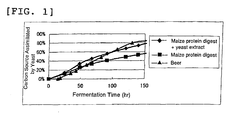
- FIG. 1 is a graph showing the effect of a yeast extract, as used in the fermentation step, on beer-taste fermented beverages incorporating a maize protein digest.
- the fermented beverages according to the present invention encompass all beverages that are produced via the step of fermentation with yeast.
- the fermented beverages, in particular, beer-taste fermented beverages that are provided by the present invention mean those beverages with a beer-like flavor which are produced by fermenting with yeast a feed comprising a carbon source, a nitrogen source, a hop, etc.
- the process comprises the steps of adding yeast to a carbohydrate solution prepared either by saccharifying malt and a cereal such as barley, rice or maize or from a sugar itself and then fermenting the mixture; in some cases, a protein derived from a plant other than malt or a hydrolyzate thereof may be used as a nitrogen source.
- Beer-taste fermented beverages include, for example, regular beer, low-malt beer, zasshu, liqueurs, spirits, and low-alcohol fermented beverages (e.g. malt-fermented beverages with an alcohol content of less than 1%).
- a carbon source and a nitrogen source are mixed, optionally in the presence of an added hop; the liquid mixture is then boiled and subjected to solid-liquid separation, and yeast is added to the resulting clear fermentation broth for subsequent yeast fermentation. If desired, solid-liquid separation may be performed after fermentation.
- carbon source means a starting material that serves as a carbon source during fermentation. Examples include malt, cereal materials such as barley other than malt, rice and maize, all converting to carbon sources via the saccharifying step.
- saccharified starch, sugar syrup and others that are assimilable by yeast without being subjected to the saccharifying step can be herein referred to as sugars.
- the process of the present invention can advantageously be applied to the case where sugars such as saccharified starch and sugar syrup that are assimilable by yeast without being subjected to the saccharifying step are used as carbon sources.
- At least 50% of the carbon source in the feed may initially be present as a sugar whereas the remaining part of the carbon source is subjected to fermentation after the cereal material is saccharified. Saccharification may be performed not on malt but rather by a saccharifying enzyme derived from other plants or an animal or a microorganism.
- the amino acid source that is to be assimilated by yeast fermentation should contain a sufficient amount of leucine or leucine residues to generate abundant isoamyl acetate upon fermentation.
- a preferred amino acid source is a cereal protein digest.
- a maize protein digest is particularly preferred.
- the maize protein digest is a kind of plant protein hydrolyzate; it is a starting material in powder or paste form that is produced by fractionally purifying maize to yield a protein fraction, which is hydrolyzed with an acid, an alkali or a protease, and then subjecting the hydrolyzate to a series of steps including neutralization, decoloring/deodorizing, refining, and concentrating.
- the maize protein digest may be a commercial product, say, ENZAP CP of Dai-Nippon Meiji Sugar Co., Ltd.
- the maize protein digest is known to contain leucine abundantly in the constituent amino acids.
- the good flavor of the fermented beverages of the present invention originates from the aroma of the isoamyl acetate that is produced from the leucine in the maize protein digest during fermentation. Therefore, the fermented beverages of the present invention are characterized by containing more isoamyl acetate than those which are produced by the same method except that no maize protein digest is used as a starting material. The advantage that results from this characteristic is particularly noticeable when the fermented beverage is a beer-taste one.
- malt may be incorporated in the feed as in the case of producing regular beer; no malt or barley need be used or, alternatively, they may be used in an amount of no more than 50 wt%, preferably no more than 25 wt%, as solids and yet beer-taste beverages having a good flavor comparable to that of regular beer can be produced.
- the amount in which the maize protein digest is added is not limited to any particular value as long as it is within the range that can impart a satisfactory flavor without adversely affecting the fermentation step; a preferred amount is from about 0.1 to 0.5 wt%, as solids, of the mother liquor (fermentation broth) in the step of yeast fermentation.
- the timing of adding the maize protein digest may be at any stage as long as it is added in such a way that it is present in the feed yet to be fermented.
- Hop is used in the case where the fermented beverage that is to be produced in the present invention is a beer-taste one.
- Applicable hops may be selected as appropriate for the flavor from among ordinary products that are commonly used in the production of regular beer and the like, i.e., pellet hop, powder hop and hop extracts.
- processed hop products such as isomerized hop, hexa-hop and tetra-hop may also be employed.
- the yeast to be used in the present invention can be freely chosen considering the type of the fermented beverage to be produced, the desired flavor, fermentation conditions, and the like.
- commercial beer yeasts such as strain Weihenstephan-34 may be employed.
- yeast propagation/fermentation aid may be employed.
- the yeast propagation/fermentation aid may be of any commonly known types such as an yeast extract, a bran ingredient in rice, barley or the like, vitamin and mineral complexes, which may be used, either independently or in combination, in appropriate amounts.
- yeast extracts are used with advantage.
- the yeast extract acts as a nitrogen source.
- the amount in which the yeast extract is used is not limited to any particular value as long as it is within the range that allows vigorous fermentation of the yeast; however, for good flavor, the weight ratio of the maize protein digest to the yeast extract is desirably in the range from 4:6 to 8:2.
- the beer-taste fermented beverage produced by the process of the present invention contains isoamyl acetate abundantly, so even if the yeast propagation/fermentation promoting aid such as a yeast extract is added, the smell peculiar to the feed can be reduced. If the yeast propagation/fermentation promoter is to be used, it may be added to the feed which is yet to undergo alcoholic fermentation or, alternatively, it may be added during alcoholic fermentation.
- the free amino acid nitrogen level (FAN value) as used herein means a quantity that corresponds to the total amount of free ⁇ -amino acids.
- the FAN value of the fermentation both can be adjusted by controlling the amount in which the starting materials such as the maize protein digest and the yeast extract that serve as nitrogen sources are added; for the purpose of yeast fermentation, the amount is generally from 5 to 22 mg/100 ml, preferably from about 10 to 20 mg/100 ml, and more preferably from 15 to 20 mg/100 ml.
- a pigment, a foaming agent, a scent, a water-soluble dietary fiber, etc. may optionally be added.
- the pigment is used in order to impart a beer-like color and a caramel pigment or the like is added in an amount that presents a beer-like color hue.
- a plant-extracted saponin-base material such as soyabean saponin or Quillaja saponin or a protein-base material such as bovine serum albumin is used as appropriate.
- a scent having a beer flavor can be used in an appropriate amount.
- a water-soluble dietary fiber such as difficult-to-digest dextrin, polydextrose or a water-soluble corn fiber can be added as required.
- the fermented beverage of the present invention is of a low-sugar or low-calorie type.
- the fermented beverage that is obtained by using the process of the present invention can be drunk as such; however, in order to produce fermented beverages that can be tasted with a minimum intake of sugars or calorific value, the fermented beverage may be diluted to produce a low-sugar, beer-taste fermented beverage. This is because the maize protein digest to be used in the fermentation feed in the present invention contains isoleucine abundantly so that isoamyl acetate is generated abundantly during brewing.
- the resulting fermented beverage can be diluted 5 to 8 folds, yet yielding a fermented beverage having a good flavor ( Japanese Patent Application 2005-157921 ).
- Dilution may be performed with water but in order to compensate for the taste-affording substance in which the low-sugar fermented beverage is deficient, an acidifier, a sweetener, a bitterness imparting agent or an alcohol may also be added; alternatively, the addition of the taste-affording substance may be effected as a separate step after the diluting operation ( Japanese Patent Application 2005-157921 ).
- dilution may be replaced by or combined with the use of a fermentation feed that uses carbon sources at increased proportions of a trisaccharide, a disaccharide and a monosaccharide that are easily assimilable by yeast (say, 80% or more of all carbon sources used).
- low-sugar means that the sugar concentration in a fermented beverage is less than 0.8 wt%, especially less than 0.5 wt% as solids.
- Fermented beverages that are preferably low-sugar include refined sake, wine, regular beer, low-malt beer, liqueurs, spirits, zasshu, and beer-taste fermented beverages. Among these, low-malt beer and beer-taste fermented beverages are preferred, with beer-taste fermented beverages being more preferred.
- low-calorie beverages in particular, low-calorie fermented beverages having a beer taste.
- Low-calorie beverages are beverages having a calorific value of less than 12 kcal/100 ml and they can be realized by satisfying the requirement of low-sugar and/or low-alcohol.
- Low-sugar or low-calorie beer-taste beverages often involve a problem with imparting an aroma.
- the maize protein digest is used as a nitrogen source in the fermentation feed, so a satisfactory fermentation aroma is afforded if fermentation is fully performed; hence, the technology of the present invention can be applied with advantage in the manufacture of low-sugar or low-calorie beer-taste beverages.
- compositions of amino acids in proteins of various cereals in particular, the compositional amounts of branched-chain amino acids were investigated.
- the cereals tested were maize, wheat, soybean, and pea. Each of them was physically stripped of the peel fraction, fat, starch, fiber, etc. to obtain a protein fraction.
- composition of the amino acids in 100 g of the thus obtained protein fraction was measured by high-performance liquid chromatography.
- the protein fraction of each cereal was deproteinated by treatment with ethanol, passed through a filter, and diluted 2000-folds for measuring the contents of amino acids in the solution. The conditions of analysis are shown below.
- the maize protein Since the maize protein abundantly contained the leucine which would contribute to the generation of isoamyl acetate during fermentation, it was evaluated as an ingredient capable of imparting a flavor to fermented beverages. With large contents of valine and isoleucine, the generation of isoamyl acetate is suppressed rather than promoted (Non-patent document 1); however, the contents of valine and isoleucine in the maize protein were comparable to those in other protein ingredients and were evaluated not to cause adverse effects on the generation of isoamyl acetate.
- the maize protein digest was studied for the effects it would have on the isoamyl acetate content of beer-taste fermented beverages.
- a commercial sugar syrup (Kato Chemical Co., Ltd.) was used to prepare a 10 wt% carbohydrate solution.
- 0.03% caramel pigment and 0.03% pellet hop were added; furthermore, 0.2% maize protein digest (sample A), or 0.2% maize protein digest + 0.2% yeast extract (sample B), or 0.4% yeast extract only (sample C) was added.
- the resulting samples were boiled for 60-80 minutes and allowed to settle down; then, the residual hop was removed to prepare the corresponding fermentation broths.
- beer wort (sample D) of 100% malt was prepared by the usual method.
- the four kinds of fermentation broth were measured for the composition of amino acids by the same technique as in Example 1 and the proportions of branched-chain amino acids relative to the total amino acid composition were calculated.
- the fermentation broths were fermented with yeast to produce beer-taste fermented beverages.
- a beer yeast strain Weihenstephan-314 was added in 0.4-0.6% and fermentation was done at 12-15°C for 6-8 days; after the end of fermentation, the yeast was removed from moromi (fermenting broth) and the density of the resulting supernatant was measured with a densitometer; the amounts of the carbon sources assimilated with the yeast were calculated and the progress of fermentation was observed.
- sample A even after it was subjected to the same fermentation step as were the other beverages, an assimilable sugar still remained, indicating the possibility of insufficient fermentation.
- the maize protein digest contained sufficient amounts of amino acids but was deficient in the trace ingredients (e.g. vitamins and minerals) necessary for the propagation and fermentation of the yeast.
- beer-taste fermented beverages using the maize protein digest were studied for the effect of yeast extract in the fermentation step.
- a commercial sugar syrup (Kato Chemical Co., Ltd.) was used to prepare a 10 wt% carbohydrate solution.
- 0.2% maize protein digest, 0.03% caramel pigment and 0.03% pellet hop were added; to one of these levels, 0.2% yeast extract was further added.
- the resulting solutions were boiled for 60-80 minutes and allowed to settle down; then, the residual hop was removed to prepare pre-fermentation broths.
- 0.4-0.6% of a beer yeast strain Weihenstephan-34) was added and fermentation was done at 12-15°C for 150 hours. In the process, the behavior of the carbon sources assimilated during fermentation was measured with a densitometer and the progress of fermentation was observed.
- a commercial sugar syrup (Kato Chemical Co., Ltd.) was used to prepare a 10 wt% carbohydrate solution.
- a maize protein digest and a yeast extract were added as nitrogen sources at varying weight ratios.
- 0.03% caramel pigment and 0.03% pellet hop were added and the resulting solutions were boiled for 60-80 minutes and allowed to settle down; then, the residual hop was removed to prepare pre-fermentation broths.
- the FAN value was adjusted to 20 mg/100 ml.
- each beverage had an isoamyl acetate content greater than the desired 1.5 ppm and it was found that fermentation had proceeded adequately.
- the proportion of the maize protein digest to the yeast extract was in the range from 4:6 to 8:2, the isoamyl acetate content was 3 ppm and more, giving particularly good results.
- Two kinds of beer-taste beverage were produced using a maize protein digest and a yeast extract in varying amounts.
- the resulting solutions were boiled for 60 minutes and allowed to settle down; then, the residual hop was removed to prepare fermentation broths.
- the FAN value was 20 mg/100 ml.
- a yeast strain Weihenstephan-314 was added to give a viable cell count of 20 x 10 6 cells/ml and fermentation was done at a temperature of 13°C for 8 days. After the end of assimilation of the carbon sources, the yeast was removed by filtration and the resulting fermented beverages were filled into bottles.
- the isoamyl acetate content in the two kinds of fermented beverage was measured by gas chromatography in accordance with the Analytica-EBC method.
- the results are shown in Table 5.
- the two types of fermented beverage had isoamyl acetate contents of 3.0 and 3.5 ppm, which were more than twice the value of an ordinary commercial regular beer, demonstrating the applicability of the technology of the present invention to the manufacture of actual fermented beverages.
- Invention product 1 Invention product 2 Amount in which the maize protein digest was used (w/w%) 0.3 0.2 Amount in which the yeast extract was used (w/w%) 0.2 0.3 Content of isoamyl acetate (ppm) 3.5 3.0
- the maize protein digest was added during the step of preparing a low-malt beverage (low-malt beer) for fermentation and a check was made to see what effect it would have on the generation of isoamyl acetate.
- Ground malt (2.4 kg) was mixed with 9.6 kg of mother water and the mixture was saccharified and filtered; thereafter, a commercial sugar syrup (Kato Chemical Co., Ltd.) was added in 7.6 kg and mother water was added to adjust the total volume to 100 kg (sample 1).
- a commercial sugar syrup Kato Chemical Co., Ltd.
- mother water was added to adjust the total volume to 100 kg (sample 1).
- the maize protein digest was further added in 100 g (sample 2).
- 8 g of pellet hop was added and the resulting solutions were boiled for 60-80 minutes and allowed to settle down; then, the residual hop was removed to prepare pre-fermentation broths.
- a yeast strain Weihenstephan-314
- fermentation was done at a temperature of 13°C for 8 days.
- the yeast was removed by filtration, the fermenting broth was diluted with four volumes of deaerated water, and the resulting fermented beverage was filled into bottles.
- the sugar concentration of the product was measured by the BCOJ method.
- the calorific value and the alcohol level were measured by standard methods.
- the present invention provides a process by which, even if barley-derived ingredients such as malt are used in low proportions, beer-taste brewed alcoholic beverages that contain isoamyl acetate abundantly to assure high organoleptic appeal can be produced by using a maize protein digest as part of the feed.
- a beer-like fermented beverage having a good flavor can be produced at lower cost and with greater ease by incorporating a maize protein digest in a feed containing a carbon source, a nitrogen source, water and optionally hop when a fermentation broth comprising the feed is subjected to alcoholic fermentation to produce the fermented beverage.
Landscapes
- Organic Chemistry (AREA)
- Chemical & Material Sciences (AREA)
- Engineering & Computer Science (AREA)
- Life Sciences & Earth Sciences (AREA)
- Genetics & Genomics (AREA)
- Zoology (AREA)
- General Engineering & Computer Science (AREA)
- General Health & Medical Sciences (AREA)
- Health & Medical Sciences (AREA)
- Biochemistry (AREA)
- Wood Science & Technology (AREA)
- Bioinformatics & Cheminformatics (AREA)
- Food Science & Technology (AREA)
- Microbiology (AREA)
- Alcoholic Beverages (AREA)
- Distillation Of Fermentation Liquor, Processing Of Alcohols, Vinegar And Beer (AREA)
- Micro-Organisms Or Cultivation Processes Thereof (AREA)
- Non-Alcoholic Beverages (AREA)
Applications Claiming Priority (3)
| Application Number | Priority Date | Filing Date | Title |
|---|---|---|---|
| JP2004312514 | 2004-10-27 | ||
| JP2005175769A JP5129441B2 (ja) | 2004-10-27 | 2005-06-15 | 良好な醸造香を有するビールテイスト発酵飲料の製造方法 |
| PCT/JP2005/019609 WO2006046567A1 (ja) | 2004-10-27 | 2005-10-25 | 良好な醸造香を有するビールテイスト発酵飲料の製造方法 |
Publications (2)
| Publication Number | Publication Date |
|---|---|
| EP1835018A1 true EP1835018A1 (de) | 2007-09-19 |
| EP1835018A4 EP1835018A4 (de) | 2011-06-15 |
Family
ID=36227808
Family Applications (1)
| Application Number | Title | Priority Date | Filing Date |
|---|---|---|---|
| EP05805244A Withdrawn EP1835018A4 (de) | 2004-10-27 | 2005-10-25 | Verfahren zur herstellung eines vergorenen getränks mit ausgezeichnetes brauaroma zeigendem biergeschmack |
Country Status (9)
| Country | Link |
|---|---|
| US (1) | US20080131555A1 (de) |
| EP (1) | EP1835018A4 (de) |
| JP (1) | JP5129441B2 (de) |
| KR (1) | KR101199809B1 (de) |
| CN (1) | CN1769417B (de) |
| AU (1) | AU2005297958B2 (de) |
| CA (1) | CA2585245A1 (de) |
| TW (1) | TWI440715B (de) |
| WO (1) | WO2006046567A1 (de) |
Cited By (4)
| Publication number | Priority date | Publication date | Assignee | Title |
|---|---|---|---|---|
| WO2010003997A1 (en) * | 2008-07-11 | 2010-01-14 | Nestec S.A. | Isoamyl acetate for weight management |
| EP1867710A4 (de) * | 2005-03-18 | 2011-08-10 | Suntory Holdings Ltd | Vergorenes getränk unter verwendung von fraktioniertem mais |
| WO2018127341A1 (en) * | 2017-01-06 | 2018-07-12 | Anheuser-Busch Inbev S.A. | Process for preparing an alcoholic fermented beverage with the aid of nutrients and use of such nutrients |
| WO2019240603A1 (en) * | 2018-06-12 | 2019-12-19 | Sulimar Sp. Z.O.O. | A non-alcoholic functional beverage with a malt base or based on non-alcoholic beer or a water-aroma base enriched with amino acids and dietary fibre as well as a method of manufacturing a non-alcoholic functional beverage with a malt base or based on non-alcoholic beer or a water-aroma base, enriched with amino acids and dietary fibre |
Families Citing this family (30)
| Publication number | Priority date | Publication date | Assignee | Title |
|---|---|---|---|---|
| CN101821376B (zh) * | 2007-10-16 | 2012-12-26 | 三得利控股株式会社 | 低糖质发酵饮料及其制造方法 |
| CL2008002189A1 (es) * | 2008-07-25 | 2008-10-24 | Univ Mayor | Metodo para producir extracto de saponinas de quillaja saponaria molina que comprende tratar producto comercial de saponinas de quillaja saponaria molina con pool enzimatico de pectinasa, proteasa, glicosidasa y enzimas hemiceluliticas, filtrar y mez |
| JP5695322B2 (ja) * | 2009-02-12 | 2015-04-01 | サントリーホールディングス株式会社 | 酵母エキスを用いたビールテイスト飲料の香味改善方法および香味改善したビールテイスト飲料 |
| RU2376360C1 (ru) * | 2009-03-19 | 2009-12-20 | Олег Иванович Квасенков | Способ приготовления ароматизированного темного пива |
| RU2377293C1 (ru) * | 2009-03-20 | 2009-12-27 | Олег Иванович Квасенков | Способ получения ароматизированного темного пива |
| JP4615058B1 (ja) * | 2009-07-17 | 2011-01-19 | 麒麟麦酒株式会社 | アルコールゼロビール様麦芽飲料及びその製造方法 |
| WO2011145671A1 (ja) * | 2010-05-19 | 2011-11-24 | サントリーホールディングス株式会社 | 泡の安定化されたビールテイスト飲料 |
| WO2012077212A1 (ja) * | 2010-12-09 | 2012-06-14 | アサヒビール株式会社 | ピルビン酸含有量の高いビール様発泡性発酵飲料の製造方法 |
| JP5566962B2 (ja) * | 2011-07-19 | 2014-08-06 | アサヒビール株式会社 | 未発酵のビールテイスト飲料 |
| US10492514B2 (en) * | 2011-09-02 | 2019-12-03 | Suntory Holdings Limited | Saponin-containing, beer-taste beverages |
| KR20160039311A (ko) * | 2011-11-22 | 2016-04-08 | 산토리 홀딩스 가부시키가이샤 | 후미가 개선된 논알코올의 맥주 테이스트 음료 |
| JP6009159B2 (ja) * | 2011-12-28 | 2016-10-19 | 麒麟麦酒株式会社 | 自然なフルーツ様ホップ香を持つ香気付与剤、それを含んでなる飲料およびその製造方法 |
| JP6009160B2 (ja) * | 2011-12-28 | 2016-10-19 | 麒麟麦酒株式会社 | 自然なハーバル様ホップ香を持つ香気付与剤、それを含んでなる飲料およびその製造方法 |
| CA2890379A1 (en) | 2012-12-28 | 2014-07-03 | Suntory Holdings Limited | Non-alcohol, beer-taste beverage having shimari in taste |
| EP2816102A1 (de) * | 2013-06-18 | 2014-12-24 | Anheuser-Busch InBev S.A. | Verfahren zur Herstellung eines vergorenen Getränks und so hergestelltes Getränk |
| JP6403380B2 (ja) * | 2013-12-16 | 2018-10-10 | アサヒビール株式会社 | ビールテイスト発酵飲料の製造方法 |
| JP6403381B2 (ja) * | 2013-12-16 | 2018-10-10 | アサヒビール株式会社 | 麦芽発酵飲料の香気を低減する方法 |
| JP6438654B2 (ja) * | 2014-01-30 | 2018-12-19 | サッポロビール株式会社 | ビールテイスト飲料及びその製造方法 |
| CN103992904B (zh) * | 2014-05-13 | 2016-06-08 | 甘肃省农业科学院农产品贮藏加工研究所 | 一种提高苹果白兰地中酯类含量的方法 |
| JP6730778B2 (ja) * | 2014-10-03 | 2020-07-29 | アサヒビール株式会社 | ビール様飲料用風味改善剤 |
| MX2017007689A (es) * | 2014-12-15 | 2017-10-27 | Corn Products Dev Inc | Uso de proteina vegetal enzimaticamente hidrolizada en la produccion de bebidas fermentadas. |
| JP6689569B2 (ja) * | 2015-01-08 | 2020-04-28 | キリンホールディングス株式会社 | ビールテイストアルコール飲料およびその製造方法 |
| JP6746275B2 (ja) * | 2015-02-17 | 2020-08-26 | キリンホールディングス株式会社 | 低糖質ビールテイストアルコール飲料およびその製造方法 |
| JP6663194B2 (ja) * | 2015-09-16 | 2020-03-11 | サッポロビール株式会社 | ビールテイスト飲料、ビールテイスト飲料の製造方法、及びビールテイスト飲料の香気改善方法 |
| JP6663195B2 (ja) * | 2015-09-16 | 2020-03-11 | サッポロビール株式会社 | ビールテイスト飲料、ビールテイスト飲料の製造方法、及びビールテイスト飲料の香気改善方法 |
| JP7152843B2 (ja) * | 2016-09-30 | 2022-10-13 | サッポロビール株式会社 | ビールテイスト飲料、ビールテイスト飲料の製造方法、及びビールテイスト飲料に良好な濃醇さと後味の質を付与する方法 |
| JP7048218B2 (ja) * | 2017-05-12 | 2022-04-05 | サッポロビール株式会社 | ビールテイスト飲料、ビールテイスト飲料の製造方法、及びビールテイスト飲料の雑味の残存感を低減する方法 |
| JP6567134B1 (ja) * | 2018-05-25 | 2019-08-28 | サッポロビール株式会社 | ビールテイスト飲料、ビールテイスト飲料の製造方法、及び、ビールテイスト飲料の香味向上方法 |
| JP7153617B2 (ja) * | 2019-07-29 | 2022-10-14 | サッポロビール株式会社 | ビールテイスト飲料、ビールテイスト飲料の製造方法、及び、ビールテイスト飲料の香味向上方法 |
| JP7668628B2 (ja) * | 2020-10-06 | 2025-04-25 | サッポロビール株式会社 | ビールテイスト飲料及びその製造方法、並びにビールテイスト飲料に苦味のボリュームを付与する方法 |
Family Cites Families (13)
| Publication number | Priority date | Publication date | Assignee | Title |
|---|---|---|---|---|
| GB1014114A (en) * | 1963-08-29 | 1965-12-22 | Pfizer & Co C | Improvements in or relating to the production of brewers' wort |
| IE48036B1 (en) * | 1977-10-18 | 1984-09-05 | Nordstjernan Ab | Process for the preparation of a hydrolysed product from whole corn,and such a product |
| JPH0714335B2 (ja) * | 1985-07-03 | 1995-02-22 | 月桂冠株式会社 | 変異酵母の培養法 |
| JP2727048B2 (ja) * | 1993-06-15 | 1998-03-11 | 北海道ワイン株式会社 | ビール類似の新規な発泡酒の製造法 |
| JP3547532B2 (ja) * | 1995-08-09 | 2004-07-28 | 麒麟麦酒株式会社 | 新規ビールの製造方法 |
| US20010043965A1 (en) * | 1996-08-22 | 2001-11-22 | Hokkaido Wine Co., Ltd. | Process for the production of beer-like carbonated alcoholic beverage |
| JPH11178564A (ja) * | 1997-12-19 | 1999-07-06 | Sapporo Breweries Ltd | 発泡酒の製法 |
| DK1063285T3 (da) * | 1999-06-16 | 2004-06-07 | Cerestar Holding Bv | Fremgangsmåde til fremsitlling af en öl-lignende drik |
| CN1088749C (zh) * | 1999-08-11 | 2002-08-07 | 肖荫贤 | 含α-氨基氮麦芽糖浆及其制备方法 |
| WO2002032231A1 (en) * | 2000-10-19 | 2002-04-25 | Edens, Luppo | Protein hydrolysates |
| JP2003164265A (ja) | 2001-12-03 | 2003-06-10 | Gun Ei Chem Ind Co Ltd | 発酵食品の製造方法 |
| DE60332675D1 (de) * | 2002-06-25 | 2010-07-01 | Sapporo Breweries | Alkoholisches Getränk mit Biergeschmack und Verfahren zu seiner Herstellung |
| CN1526808A (zh) * | 2003-09-22 | 2004-09-08 | 山东省鲁洲食品集团有限公司 | 啤酒专用糖浆及其制备方法 |
-
2005
- 2005-06-15 JP JP2005175769A patent/JP5129441B2/ja not_active Expired - Fee Related
- 2005-10-25 KR KR1020077011876A patent/KR101199809B1/ko not_active Expired - Fee Related
- 2005-10-25 CA CA002585245A patent/CA2585245A1/en not_active Abandoned
- 2005-10-25 EP EP05805244A patent/EP1835018A4/de not_active Withdrawn
- 2005-10-25 AU AU2005297958A patent/AU2005297958B2/en not_active Ceased
- 2005-10-25 WO PCT/JP2005/019609 patent/WO2006046567A1/ja not_active Ceased
- 2005-10-25 US US11/666,348 patent/US20080131555A1/en not_active Abandoned
- 2005-10-26 TW TW094137492A patent/TWI440715B/zh not_active IP Right Cessation
- 2005-10-27 CN CN2005101160422A patent/CN1769417B/zh not_active Expired - Fee Related
Cited By (6)
| Publication number | Priority date | Publication date | Assignee | Title |
|---|---|---|---|---|
| EP1867710A4 (de) * | 2005-03-18 | 2011-08-10 | Suntory Holdings Ltd | Vergorenes getränk unter verwendung von fraktioniertem mais |
| WO2010003997A1 (en) * | 2008-07-11 | 2010-01-14 | Nestec S.A. | Isoamyl acetate for weight management |
| US8647687B2 (en) | 2008-07-11 | 2014-02-11 | Nestec S.A. | Isoamyl acetate for weight management |
| WO2018127341A1 (en) * | 2017-01-06 | 2018-07-12 | Anheuser-Busch Inbev S.A. | Process for preparing an alcoholic fermented beverage with the aid of nutrients and use of such nutrients |
| BE1025452B1 (nl) * | 2017-01-06 | 2019-03-05 | Anheuser-Busch Inbev S.A. | Proces voor het bereiden van een alcoholische gefermenteerde drank met behulp van voedingsstoffen en gebruik van dergelijke voedingsstoffen |
| WO2019240603A1 (en) * | 2018-06-12 | 2019-12-19 | Sulimar Sp. Z.O.O. | A non-alcoholic functional beverage with a malt base or based on non-alcoholic beer or a water-aroma base enriched with amino acids and dietary fibre as well as a method of manufacturing a non-alcoholic functional beverage with a malt base or based on non-alcoholic beer or a water-aroma base, enriched with amino acids and dietary fibre |
Also Published As
| Publication number | Publication date |
|---|---|
| JP5129441B2 (ja) | 2013-01-30 |
| AU2005297958B2 (en) | 2010-12-09 |
| TWI440715B (zh) | 2014-06-11 |
| JP2006149367A (ja) | 2006-06-15 |
| KR20070084563A (ko) | 2007-08-24 |
| KR101199809B1 (ko) | 2012-11-09 |
| CN1769417A (zh) | 2006-05-10 |
| TW200626713A (en) | 2006-08-01 |
| CN1769417B (zh) | 2011-04-06 |
| CA2585245A1 (en) | 2006-05-04 |
| WO2006046567A1 (ja) | 2006-05-04 |
| US20080131555A1 (en) | 2008-06-05 |
| EP1835018A4 (de) | 2011-06-15 |
| AU2005297958A1 (en) | 2006-05-04 |
Similar Documents
| Publication | Publication Date | Title |
|---|---|---|
| AU2005297958B2 (en) | Process for producing beer-taste beverages having a satisfactory brewing aroma | |
| EP2752122B1 (de) | Saponinhaltiges getränk mit biergeschmack | |
| JP5303046B2 (ja) | 良好な醸造香を有する低糖質発酵飲料の製造方法 | |
| JP6397452B2 (ja) | 低糖質発酵飲料及びその製造方法 | |
| JP5032751B2 (ja) | 良好な醸造香を有する低糖質発酵飲料の製造方法 | |
| JP4435721B2 (ja) | 食物繊維を含有する発酵飲料の製造方法。 | |
| WO2017038437A1 (ja) | ビール様発泡性飲料の製造方法 | |
| WO2017026226A1 (ja) | ビール様発泡性飲料 | |
| CN114845562A (zh) | 无酒精啤酒风味饮料、无酒精啤酒风味饮料的醇厚味增强剂及酸味减轻剂以及无酒精啤酒风味饮料的醇厚味增强方法及酸味减轻方法 | |
| TW202212558A (zh) | 啤酒風味飲料 | |
| JP2017216892A (ja) | ビールらしい香りを有する未発酵のビールテイスト飲料 | |
| AU2023242373A1 (en) | Beer-flavored beverage | |
| JP5859103B1 (ja) | ビールテイストの発酵アルコール飲料およびその製造方法 | |
| JP2021141836A (ja) | ビールテイスト飲料およびその製造方法 | |
| JP2021141837A (ja) | ビールテイスト飲料およびその製造方法 | |
| JP2023180120A (ja) | ビールテイスト発酵アルコール飲料及びその製造方法 | |
| JP6403381B2 (ja) | 麦芽発酵飲料の香気を低減する方法 | |
| JP2018108050A (ja) | ビール様発泡性飲料及びその製造方法 | |
| JP2021141835A (ja) | ビールテイスト飲料およびその製造方法 | |
| JP2021141838A (ja) | ビールテイスト飲料 | |
| HK1181617B (en) | Beer-taste beverage containing saponin | |
| NZ619625B2 (en) | Saponin-containing, beer-taste beverages |
Legal Events
| Date | Code | Title | Description |
|---|---|---|---|
| PUAI | Public reference made under article 153(3) epc to a published international application that has entered the european phase |
Free format text: ORIGINAL CODE: 0009012 |
|
| 17P | Request for examination filed |
Effective date: 20070529 |
|
| AK | Designated contracting states |
Kind code of ref document: A1 Designated state(s): AT BE BG CH CY CZ DE DK EE ES FI FR GB GR HU IE IS IT LI LT LU LV MC NL PL PT RO SE SI SK TR |
|
| DAX | Request for extension of the european patent (deleted) | ||
| RAP1 | Party data changed (applicant data changed or rights of an application transferred) |
Owner name: SUNTORY HOLDINGS LIMITED |
|
| A4 | Supplementary search report drawn up and despatched |
Effective date: 20110513 |
|
| 17Q | First examination report despatched |
Effective date: 20120316 |
|
| STAA | Information on the status of an ep patent application or granted ep patent |
Free format text: STATUS: THE APPLICATION IS DEEMED TO BE WITHDRAWN |
|
| 18D | Application deemed to be withdrawn |
Effective date: 20120727 |