EP1835683A1 - Procédé pour modulation d'un mot de code - Google Patents
Procédé pour modulation d'un mot de code Download PDFInfo
- Publication number
- EP1835683A1 EP1835683A1 EP06005411A EP06005411A EP1835683A1 EP 1835683 A1 EP1835683 A1 EP 1835683A1 EP 06005411 A EP06005411 A EP 06005411A EP 06005411 A EP06005411 A EP 06005411A EP 1835683 A1 EP1835683 A1 EP 1835683A1
- Authority
- EP
- European Patent Office
- Prior art keywords
- chunk
- sub
- stream
- bits
- modulation format
- Prior art date
- Legal status (The legal status is an assumption and is not a legal conclusion. Google has not performed a legal analysis and makes no representation as to the accuracy of the status listed.)
- Withdrawn
Links
Images


Classifications
-
- H—ELECTRICITY
- H04—ELECTRIC COMMUNICATION TECHNIQUE
- H04L—TRANSMISSION OF DIGITAL INFORMATION, e.g. TELEGRAPHIC COMMUNICATION
- H04L1/00—Arrangements for detecting or preventing errors in the information received
- H04L1/0001—Systems modifying transmission characteristics according to link quality, e.g. power backoff
- H04L1/0006—Systems modifying transmission characteristics according to link quality, e.g. power backoff by adapting the transmission format
- H04L1/0007—Systems modifying transmission characteristics according to link quality, e.g. power backoff by adapting the transmission format by modifying the frame length
-
- H—ELECTRICITY
- H04—ELECTRIC COMMUNICATION TECHNIQUE
- H04L—TRANSMISSION OF DIGITAL INFORMATION, e.g. TELEGRAPHIC COMMUNICATION
- H04L1/00—Arrangements for detecting or preventing errors in the information received
- H04L1/0001—Systems modifying transmission characteristics according to link quality, e.g. power backoff
- H04L1/0002—Systems modifying transmission characteristics according to link quality, e.g. power backoff by adapting the transmission rate
- H04L1/0003—Systems modifying transmission characteristics according to link quality, e.g. power backoff by adapting the transmission rate by switching between different modulation schemes
-
- H—ELECTRICITY
- H04—ELECTRIC COMMUNICATION TECHNIQUE
- H04L—TRANSMISSION OF DIGITAL INFORMATION, e.g. TELEGRAPHIC COMMUNICATION
- H04L1/00—Arrangements for detecting or preventing errors in the information received
- H04L1/0001—Systems modifying transmission characteristics according to link quality, e.g. power backoff
- H04L1/0009—Systems modifying transmission characteristics according to link quality, e.g. power backoff by adapting the channel coding
-
- H—ELECTRICITY
- H04—ELECTRIC COMMUNICATION TECHNIQUE
- H04L—TRANSMISSION OF DIGITAL INFORMATION, e.g. TELEGRAPHIC COMMUNICATION
- H04L27/00—Modulated-carrier systems
- H04L27/32—Carrier systems characterised by combinations of two or more of the types covered by groups H04L27/02, H04L27/10, H04L27/18 or H04L27/26
- H04L27/34—Amplitude- and phase-modulated carrier systems, e.g. quadrature-amplitude modulated carrier systems
- H04L27/3405—Modifications of the signal space to increase the efficiency of transmission, e.g. reduction of the bit error rate, bandwidth, or average power
- H04L27/3416—Modifications of the signal space to increase the efficiency of transmission, e.g. reduction of the bit error rate, bandwidth, or average power in which the information is carried by both the individual signal points and the subset to which the individual points belong, e.g. using coset coding, lattice coding, or related schemes
- H04L27/3427—Modifications of the signal space to increase the efficiency of transmission, e.g. reduction of the bit error rate, bandwidth, or average power in which the information is carried by both the individual signal points and the subset to which the individual points belong, e.g. using coset coding, lattice coding, or related schemes in which the constellation is the n - fold Cartesian product of a single underlying two-dimensional constellation
-
- H—ELECTRICITY
- H04—ELECTRIC COMMUNICATION TECHNIQUE
- H04L—TRANSMISSION OF DIGITAL INFORMATION, e.g. TELEGRAPHIC COMMUNICATION
- H04L1/00—Arrangements for detecting or preventing errors in the information received
- H04L2001/0098—Unequal error protection
-
- H—ELECTRICITY
- H04—ELECTRIC COMMUNICATION TECHNIQUE
- H04L—TRANSMISSION OF DIGITAL INFORMATION, e.g. TELEGRAPHIC COMMUNICATION
- H04L27/00—Modulated-carrier systems
- H04L27/26—Systems using multi-frequency codes
- H04L27/2601—Multicarrier modulation systems
- H04L27/2602—Signal structure
Definitions
- the invention relates to a method for coding and modulation of data packets, where the coded data packet can span over different resource units.
- Each resource unit comprises a number of time and frequency bins, referred to as chunk.
- chunk There is also the possibility to reuse the chunks in a spatial and/or code domain, i.e. chunk layer.
- Orthogonal frequency division multiplexing abbreviated "OFDM” is considered as leading technology for the air interface of UTRA LTE systems and so called “beyond” 3G wireless mobile systems.
- OFDM orthogonal frequency division multiple access
- a minimum resource unit is represented by a "chunk".
- a chunk is a rectangular area spanning a few adjacent sub-carriers on the one hand and a few successive OFDM symbols periods on the other hand.
- a specific number of sub-carriers and of symbol periods in one chunk is selected according to the propagation scenario, i.e. in accordance to the channel coherence time and coherence bandwidth properties.
- the selection is done in such a kind, that within one chunk approximately flat fading and an approximate time invariant channel can be observed.
- QoS Quality of Service
- the data packets In a packet-based transmission of data, the data packets belong to different traffic classes, which are characterized by different latency requirements and error probability requirements.
- traffic classes which are characterized by different latency requirements and error probability requirements.
- adaptive transmission systems there is the possibility to choose an error-correction-code among a number of error-correction-codes or within a set of error correcting codes.
- This kind of error correcting codes show different lengths each. Therefore it is possible to select a tradeoff between error protection on the one hand and of message latency on the other hand.
- code-words built by coding of packet data with the selected error-correcting-code, are mapped onto the signal constellations, selected according to the current channel state. The mapping is done straight forward.
- a chunk can only carry a limited number of bits (e.g., lower than 96 bits for lowest modulation order, e.g. BSPSK, dependent on the channel properties).
- the invention proposes a general approach for the mapping of data bits on different chunks, whereas the data bits can be mapped coded or not coded in direct manner.
- Different modulation formats can be used on the different chunks (or chunk layers) spanned by one codeword and these can be chosen adaptively, e.g. according to the signal to noise plus interference ratio experienced on the single chunk (or chunk layer).
- the codeword can span more than one chunk where different signal constellations are used, from which the approach is referred to as non uniform modulation per codeword.
- the inventive method find convenient application in a chunk-based OFDM system in which adaptive transmission in the form of link adaptation and/or adaptive chunk allocation, e.g. on TDMA (time division multiple access) and FDMA basis, is employed.
- TDMA time division multiple access
- FDMA frequency division multiple access
- the inventive method allows high granularity in the link adaptation per chunk.
- the high granularity is allowed in the link adaptation per chunk by simply adjusting the number of not coded or "uncoded" bits mapped per chunk, without requiring any puncturing of the employed code nor codeword segmentation.
- the number of coded bits mapped on the allocated chunks is independent of the signal constellation (modulation format) used on each chunk.
- the link adaptation is performed independently on a per chunk basis and independently of the chosen code parameters, i.e. rate and length, and from the chunk size.
- the inventive method can be used in conjunction with any coded modulation scheme, as described later.
- the inventive method is very simple and can allow a significant reduction in implementation complexity, since only one error correction coding scheme is required.
- the inventive method allows the "fine tuning" of the code parameters independently of the chosen modulation format and, hence, in case of link adaptation per chunk, of the experienced propagation conditions.
- the inventive method can be used advantageously in a chunk based OFDMA/TDMA system, also together with spatial division multiple access (SDMA) component, in which the data bits of different user flows are mapped on different chunk layers separated in the spatial domain.
- SDMA spatial division multiple access
- This also includes the case of spatial multiplexing, (which is a sub-case of MIMO), i.e. the case that multiple spatially separated streams on a single chunk are assigned to a user.
- the method can be used also together with code division multiplexing (CDM) or multiple access (CDMA) component, i.e. the case in which different data flows, belonging to one user or to different users, respectively, are mapped on different chunk layers separated in code domain.
- CDMA code division multiplexing
- CDMA multiple access
- a joint optimization of code length and modulation format is possible, leading to an optimization of the number of allocated chunks (or chunk layers) towards and efficiently exploitation of resources, e.g. in an OFDMA/TDMA system with chunk based adaptive resource allocation.
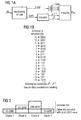
- FIG 1A shows the inventive method step by step with partitioning, encoding and mapping.
- a given data flow or data stream DS is partitioned into at least two sub-streams, a first sub-stream SUB1 and a second sub-stream SUB2.
- the first sub-stream SUB1 may be further partitioned into a number of sub-streams, but all of them are encoded with codes whose parameters, e.g. rate and length, are independent of the signal constellation being used. These can be chosen dependent in general on the user flow Quality of Service requirements (QoS), that is, e.g., on the required level of error protection and on the user flow delay-sensitivity.
- QoS Quality of Service requirements
- the code length can be further chosen based on a tradeoff between the required level of error protection and a number "m" of chunks that the coded packet can be allocated for transmission.
- Bits from the second sub-stream SUB2 are mapped on the modulated symbol of each chunk in a number depending on the chosen modulation format.
- bits from the second sub-stream SUB2 can be kept uncoded.
- the second sub-stream is not strictly "uncoded", but is coded significantly less than another sub-stream.
- the number of redundancy bit employed for this sub-stream is significantly lower than for another sub-stream (e.g. there could be used less than half as many redundancy bits).
- the term "uncoded" also covers the case of a coding with a significantly lower level of protection than on the other sub-streams.
- this coding operation can be performed not only on the second sub-stream SUB2, but also on the bits used as input bits for the first sub-stream SUB1, i.e. usage of two nested codes for the first sub-stream.
- the modulation format is chosen for each chunk independently, according to the signal-to-noise-plus-interference ratio (SNIR) the chunk experiences.
- SNIR signal-to-noise-plus-interference ratio
- the modulation format could be described as: 2 2 ⁇ 1 + t i in case of QAM-modulation.
- the inventive method is also suitable for mapping of code-words on different chunk layers, in case that each time-frequency chunk is reused in the spatial domain through multiple antennas (MIMO or SDMA) or in code domain (CDM or CDMA).
- MIMO multiple antennas
- CDMA code domain
- the method is suitable for application with variants of OFDM transmission technique, e.g. DFT (Discrete Fourier Transform)-precoded OFDM, Filtered Multi Tone and Single-Carrier FDMA schemes.
- OFDM transmission technique e.g. DFT (Discrete Fourier Transform)-precoded OFDM, Filtered Multi Tone and Single-Carrier FDMA schemes.
Landscapes
- Engineering & Computer Science (AREA)
- Computer Networks & Wireless Communication (AREA)
- Signal Processing (AREA)
- Quality & Reliability (AREA)
- Detection And Prevention Of Errors In Transmission (AREA)
Priority Applications (1)
| Application Number | Priority Date | Filing Date | Title |
|---|---|---|---|
| EP06005411A EP1835683A1 (fr) | 2006-03-16 | 2006-03-16 | Procédé pour modulation d'un mot de code |
Applications Claiming Priority (1)
| Application Number | Priority Date | Filing Date | Title |
|---|---|---|---|
| EP06005411A EP1835683A1 (fr) | 2006-03-16 | 2006-03-16 | Procédé pour modulation d'un mot de code |
Publications (1)
| Publication Number | Publication Date |
|---|---|
| EP1835683A1 true EP1835683A1 (fr) | 2007-09-19 |
Family
ID=36778112
Family Applications (1)
| Application Number | Title | Priority Date | Filing Date |
|---|---|---|---|
| EP06005411A Withdrawn EP1835683A1 (fr) | 2006-03-16 | 2006-03-16 | Procédé pour modulation d'un mot de code |
Country Status (1)
| Country | Link |
|---|---|
| EP (1) | EP1835683A1 (fr) |
Cited By (3)
| Publication number | Priority date | Publication date | Assignee | Title |
|---|---|---|---|---|
| WO2009067181A2 (fr) | 2007-11-16 | 2009-05-28 | Broadcom Corporation | Modulation d'ordre supérieur codée par un contrôle de parité à faible densité (ldpc) |
| WO2011004948A1 (fr) * | 2009-07-10 | 2011-01-13 | 엘지전자주식회사 | Procédé et dispositif de transmission de données utilisant des ressources multiples dans un système de communication sans fil |
| WO2011029369A1 (fr) * | 2009-09-08 | 2011-03-17 | 中兴通讯股份有限公司 | Procédé et système de codage et de décodage vidéo et système de vidéosurveillance |
Citations (1)
| Publication number | Priority date | Publication date | Assignee | Title |
|---|---|---|---|---|
| US20020136317A1 (en) * | 2001-01-12 | 2002-09-26 | International Business Machines Corporation | Block coding for multilevel data communication |
-
2006
- 2006-03-16 EP EP06005411A patent/EP1835683A1/fr not_active Withdrawn
Patent Citations (1)
| Publication number | Priority date | Publication date | Assignee | Title |
|---|---|---|---|---|
| US20020136317A1 (en) * | 2001-01-12 | 2002-09-26 | International Business Machines Corporation | Block coding for multilevel data communication |
Non-Patent Citations (2)
| Title |
|---|
| LI B ET AL: "A NEW TURBO CODED QAM SCHEME WITH VERY LOW DECODING COMPLEXITY FOR ADSL SYSTEM", GLOBECOM'01. 2001 IEEE GLOBAL TELECOMMUNICATIONS CONFERENCE. SAN ANTONIO, TX, NOV. 25 - 29, 2001, IEEE GLOBAL TELECOMMUNICATIONS CONFERENCE, NEW YORK, NY : IEEE, US, vol. VOL. 1 OF 6, 25 November 2001 (2001-11-25), pages 349 - 353, XP001090275, ISBN: 0-7803-7206-9 * |
| LIANG ZHANG ET AL: "Turbo coding for transmission over ADSL", COMMUNICATION TECHNOLOGY PROCEEDINGS, 2000. WCC - ICCT 2000. INTERNATIONAL CONFERENCE ON BEIJING, CHINA 21-25 AUG. 2000, PISCATAWAY, NJ, USA,IEEE, US, 21 August 2000 (2000-08-21), pages 124 - 131, XP010526727, ISBN: 0-7803-6394-9 * |
Cited By (6)
| Publication number | Priority date | Publication date | Assignee | Title |
|---|---|---|---|---|
| WO2009067181A2 (fr) | 2007-11-16 | 2009-05-28 | Broadcom Corporation | Modulation d'ordre supérieur codée par un contrôle de parité à faible densité (ldpc) |
| WO2009067181A3 (fr) * | 2007-11-16 | 2009-08-27 | Broadcom Corporation | Modulation d'ordre supérieur codée par un contrôle de parité à faible densité (ldpc) |
| US8275050B2 (en) | 2007-11-16 | 2012-09-25 | Broadcom Corporation | Low density parity check (LDPC) encoded higher order modulation |
| US8503540B2 (en) | 2007-11-16 | 2013-08-06 | Broadcom Corporation | Low density parity check (LDPC) encoded higher order modulation |
| WO2011004948A1 (fr) * | 2009-07-10 | 2011-01-13 | 엘지전자주식회사 | Procédé et dispositif de transmission de données utilisant des ressources multiples dans un système de communication sans fil |
| WO2011029369A1 (fr) * | 2009-09-08 | 2011-03-17 | 中兴通讯股份有限公司 | Procédé et système de codage et de décodage vidéo et système de vidéosurveillance |
Similar Documents
| Publication | Publication Date | Title |
|---|---|---|
| US8243841B2 (en) | Symbol interleaving and channel mapping device and method and mobile communication system | |
| KR101522059B1 (ko) | Ofdma 시스템에서 harq를 사용하는 스펙트럼 효율 링크 적응 방법 및 장치 | |
| CN101048963B (zh) | 用于在多载波通信系统中确定信道质量和执行自适应调制/编码的方法和装置 | |
| KR101479792B1 (ko) | 멀티-캐리어 통신 시스템 내에서의 송신을 위한 방법 및 장치 | |
| CN106464645B (zh) | 发送设备和接收设备及其方法 | |
| CN101511121B (zh) | 通信系统中控制和数据的复用 | |
| EP1575233A2 (fr) | Systèm et procédé pour transmettre une sous-voie dans des systèmes de communications à accès multiple par répartition orthogonale de fréquence (OFDMA) | |
| WO2007080727A1 (fr) | Procede et appareil de communication | |
| EP1533926B1 (fr) | Dispositif de transmission radio, dispositif de reception radio, et procede pour une selection de sous-porteuses d'annulation de transmission | |
| EP1968271B1 (fr) | Procédé de mappage de symboles à base de modulation QAM croisée et dispositif dans un système de communication mobile | |
| KR20090047339A (ko) | 복호화 실패 또는 신뢰도에 따라 패킷을 재전송하는 방법 | |
| CN101167291B (zh) | 使用高阶调制方案进行数字数据传输的方法和发射机 | |
| US20110051599A1 (en) | Radio Communication System, Base Station Device, Radio Communication Terminal, and Radio Communication Method | |
| CN101064708B (zh) | 多载波系统频率资源映射方法及装置 | |
| US9673915B2 (en) | Systems and methods for enhancing spectral efficiency in a communication network | |
| KR101467764B1 (ko) | 피드백 정보에 따른 패킷 재전송 방법 | |
| US7281189B2 (en) | Apparatus and method for separately modulating systematic bits and parity bits in accordance with communication quality | |
| EP1835683A1 (fr) | Procédé pour modulation d'un mot de code | |
| CN101944973A (zh) | 通过相位调制复用来利用多用户分集 | |
| EP2192713B1 (fr) | Procédé de transmission et dispositif de transmission | |
| KR20080113653A (ko) | 부호어 생성 방법 및 이를 이용한 제어정보 전송 방법 | |
| Stiglmayr et al. | Adaptive coding and modulation in mimo ofdma systems | |
| Stiglmayr et al. | Mutual‐information‐based adaptive coding and modulation in bit‐interleaved OFDM systems using punctured LDPC codes | |
| KR101465794B1 (ko) | 반복 코딩을 이용한 데이터 전송 방법 | |
| Dobre et al. | An adaptive data transmission scheme for OFDM systems |
Legal Events
| Date | Code | Title | Description |
|---|---|---|---|
| PUAI | Public reference made under article 153(3) epc to a published international application that has entered the european phase |
Free format text: ORIGINAL CODE: 0009012 |
|
| AK | Designated contracting states |
Kind code of ref document: A1 Designated state(s): AT BE BG CH CY CZ DE DK EE ES FI FR GB GR HU IE IS IT LI LT LU LV MC NL PL PT RO SE SI SK TR |
|
| AX | Request for extension of the european patent |
Extension state: AL BA HR MK YU |
|
| RAP3 | Party data changed (applicant data changed or rights of an application transferred) |
Owner name: NOKIA SIEMENS NETWORKS S.P.A. |
|
| RAP3 | Party data changed (applicant data changed or rights of an application transferred) |
Owner name: NOKIA SIEMENS NETWORKS GMBH & CO. KG |
|
| 17P | Request for examination filed |
Effective date: 20080319 |
|
| 17Q | First examination report despatched |
Effective date: 20080423 |
|
| AKX | Designation fees paid |
Designated state(s): AT BE BG CH CY CZ DE DK EE ES FI FR GB GR HU IE IS IT LI LT LU LV MC NL PL PT RO SE SI SK TR |
|
| STAA | Information on the status of an ep patent application or granted ep patent |
Free format text: STATUS: THE APPLICATION IS DEEMED TO BE WITHDRAWN |
|
| 18D | Application deemed to be withdrawn |
Effective date: 20080904 |