EP1836465B1 - Vorrichtung und verfahren zur kontrolle des be- und/oder entladeprozesses eines flugzeugs - Google Patents
Vorrichtung und verfahren zur kontrolle des be- und/oder entladeprozesses eines flugzeugs Download PDFInfo
- Publication number
- EP1836465B1 EP1836465B1 EP06700778A EP06700778A EP1836465B1 EP 1836465 B1 EP1836465 B1 EP 1836465B1 EP 06700778 A EP06700778 A EP 06700778A EP 06700778 A EP06700778 A EP 06700778A EP 1836465 B1 EP1836465 B1 EP 1836465B1
- Authority
- EP
- European Patent Office
- Prior art keywords
- aircraft
- freight
- cargo
- weight
- piece
- Prior art date
- Legal status (The legal status is an assumption and is not a legal conclusion. Google has not performed a legal analysis and makes no representation as to the accuracy of the status listed.)
- Expired - Lifetime
Links
Images
Classifications
-
- B—PERFORMING OPERATIONS; TRANSPORTING
- B64—AIRCRAFT; AVIATION; COSMONAUTICS
- B64D—EQUIPMENT FOR FITTING IN OR TO AIRCRAFT; FLIGHT SUITS; PARACHUTES; ARRANGEMENT OR MOUNTING OF POWER PLANTS OR PROPULSION TRANSMISSIONS IN AIRCRAFT
- B64D9/00—Equipment for handling freight; Equipment for facilitating passenger embarkation or the like
-
- G—PHYSICS
- G01—MEASURING; TESTING
- G01G—WEIGHING
- G01G19/00—Weighing apparatus or methods adapted for special purposes not provided for in the preceding groups
- G01G19/02—Weighing apparatus or methods adapted for special purposes not provided for in the preceding groups for weighing wheeled or rolling bodies, e.g. vehicles
- G01G19/07—Weighing apparatus or methods adapted for special purposes not provided for in the preceding groups for weighing wheeled or rolling bodies, e.g. vehicles for weighing aircraft
-
- G—PHYSICS
- G01—MEASURING; TESTING
- G01G—WEIGHING
- G01G23/00—Auxiliary devices for weighing apparatus
- G01G23/18—Indicating devices, e.g. for remote indication; Recording devices; Scales, e.g. graduated
- G01G23/36—Indicating the weight by electrical means, e.g. using photoelectric cells
- G01G23/37—Indicating the weight by electrical means, e.g. using photoelectric cells involving digital counting
- G01G23/3728—Indicating the weight by electrical means, e.g. using photoelectric cells involving digital counting with wireless means
-
- G—PHYSICS
- G01—MEASURING; TESTING
- G01M—TESTING STATIC OR DYNAMIC BALANCE OF MACHINES OR STRUCTURES; TESTING OF STRUCTURES OR APPARATUS, NOT OTHERWISE PROVIDED FOR
- G01M1/00—Testing static or dynamic balance of machines or structures
- G01M1/12—Static balancing; Determining position of centre of gravity
- G01M1/122—Determining position of centre of gravity
- G01M1/125—Determining position of centre of gravity of aircraft
Definitions
- the present invention relates to a method and a device for controlling the loading and / or unloading process of an aircraft.
- the weight and / or the center of gravity of an aircraft change.
- the total weight is one of the crucial parameters for calculating the required fuel quantity, while the center of gravity has a special influence on the flight characteristics and the maneuverability and must therefore be located in a defined region of the aircraft. It should also be noted that the center of gravity must also be within a prescribed range during loading and unloading, for example, to prevent a tail touch of the aircraft with the ground.
- the weight and center of gravity of the aircraft in loaded condition is determined in advance by means of a loading schedule in which cargo items are assigned positions in the cargo space.
- cargo item is understood to mean the smallest distinguishable units, which are also referred to as ULD (Unit Load Device). These may be, for example, pallets, containers, individual pieces of luggage or other items.
- the object of the present invention to provide an improved system for controlling the loading and / or unloading process of an aircraft while avoiding the above-mentioned disadvantages.
- a cargo loaded or to be loaded into the aircraft is identified, a weight is assigned to the cargo, the position of the cargo within the aircraft is tracked, and the total weight and / or center of gravity of the aircraft information provided and the aircraft Weights and positions of freight calculated.
- the aircraft information is, for example, information about the weight and the center of gravity of the empty aircraft, data on the weight and location of the fuel and other objects and liquids such as drinking water or catering cars.
- a device has means for identifying a freight item introduced or to be brought into the aircraft, at least one interface for connecting the device to at least one system for determining the freight item position and at least one arithmetic unit for calculating the total weight and / or the center of gravity of the aircraft from provided aircraft information as well as the weights and positions of the freight items.
- the arithmetic unit is also referred to as WCU (Weight Calculation Unit).
- WCU Weight Calculation Unit
- the determination or tracking of the position of the freight item within the aircraft preferably takes place by means of a freight loading system.
- a cargo loading system is a known system on board an aircraft by means of which the freight items can be transported and fixed.
- such a system has actuators such as roller conveyors (PDUs) for moving the freight items and, on the other hand, sensors such as cover sensors of the PDUs or proximity switches for determining the position of the freight items.
- the sensor data possibly in processed form, are transmitted via the interface to the WCU.
- This allows the W & B system to track the freight item location.
- the position determination can additionally be effected by further sensors or other devices, such as, for example, image acquisition and processing.
- the W & B system is preferably connected to the cargo loading system via the CAN bus (Controller Area Network).
- Alternative systems for determining or tracking the position of the freight item within the aircraft are, for example, laser-based or infrared-based systems, ultrasound systems or optical systems based on image recognition.
- the future center of gravity of the aircraft is predicted from the aircraft information, the weights and positions of the cargo, and the status of the cargo loading system. From the current position of the freight item and the conveying direction of the PDUs, the future position of the freight item can be extrapolated, whereby critical loading conditions can be recognized even before they occur.
- the aircraft information and / or the weights of the freight items are for example recorded manually, recorded via a cable or a data carrier or received by infrared or radio.
- the device preferably has an interface to an aircraft data bus, for example an AFDX bus (Avionics Full Duplex Network), via which the WCU the information is provided. This is done, for example, by the EICAS (Engine Indicating and Crew Alerting System).
- the identification of the freight items for example, by means of a keyboard, a touch screen, a bar code reader and / or a receiver for infrared or radio signals such as a RFID receiver (Radio Frequency IDentification).
- the identification of a freight item already takes place immediately before entering the cargo compartment, for example on a lifting platform or a conveyor such as a conveyor belt directly in front of the cargo compartment door.
- a lifting platform or a conveyor such as a conveyor belt directly in front of the cargo compartment door.
- the identification is also optionally used to check the loading order provided in the loading plan. This ensures that the packages are loaded in the correct order and do not block the final destination or transport path of a later-to-arrive package, which could result in partial unloading of the cargo compartment.
- the information that a cargo has been identified and retracted into the aircraft is reported to the logistics system to enable tracking of freight in the logistics chain.
- the weights of the packages are determined, for example, by means of scales in the airport loading system or along the logistics chain and entered into the W & B system by means of a keyboard, a touchscreen, a barcode reader and / or a receiver for infrared or radio signals such as an RFID receiver , Alternatively, the respective weight is noted on the corresponding piece of freight and is read in the identification.
- the weight is determined and / or verified by a scale arranged in the aircraft.
- the balance is arranged, for example, in the area of the ball mats on the cargo compartment door.
- the W & B system has at least one display device for displaying the weight and / or center of gravity of the aircraft.
- This display device may stand alone, combined with an input means such as a keyboard, a bar code reader or a receiver or in an operating and control console be integrated.
- existing devices such as the EICAS or other control and control consoles are used for display.
- the weight of a freight item, all freight items in a freight deck and / or the freight items in all cargo spaces can be displayed.
- a visual and / or audible alarm or issue a warning in critical situations can occur, for example, at the risk of a situation referred to as tail tip, in which threatens the rear of the aircraft during loading or unloading in contact with the ground.
- the alarm could be triggered if the center of gravity of the aircraft threatens to move away from the permissible range or threatens to leave, which leads to a deteriorated attitude and the need for strong countersteering in flight.
- the W & B system is connected to an internal maintenance system (OMS: Onboard Maintenance System).
- OMS Onboard Maintenance System
- the positions of the freight items are optionally compared with the loading schedule. As a result, compliance with the loading plan can be verified or the absence of a freight item recognized. A freight item not listed in the loading plan can already be identified when it is identified when it is brought into the cargo hold. Optionally, it is possible to store past, present and predicted load states for informational purposes.
- a means for identifying an inserted freight item is preferably arranged in the region of each cargo compartment door.
- the calculation of the weight and / or the center of gravity takes place, for example, by means of a single arithmetic unit.
- Each WCU preferably determines the weight and the weight distribution of the freight items contained in the associated cargo space or the associated cargo spaces and transmits this data to the master WCU, which calculates therefrom the total weight and / or the center of gravity of the aircraft.
- each of the WCUs receives data from all cargo holds and calculates the overall weight and / or center of gravity of the aircraft. This results in a redundancy of the calculation.
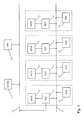
- FIG. 1 a distributed W & B system with multiple WCUs
- This embodiment shows the use of a W & B system according to the invention in an Airbus A380-800.
- Aircraft of this type are equipped with an AFDX data bus 10 and have a total of four cargo decks (main deck, upper deck, lower deck front and lower deck rear).
- AFDX data bus 10 main deck, upper deck, lower deck front and lower deck rear.
- a distributed system is used, in which each cargo deck is equipped with a WCU 1-4.
- the WCUs are interconnected via a CAN bus 15 in a master-slave arrangement, the master WCU 1 additionally having an interface for connection to the AFDX bus 10.
- the EICAS 9 also connected to this bus, provides the WCUs 1 - 4 with basic information such as the weight and center of gravity of the unloaded aircraft, the weight and location of the fuel and other items.
- OCS onboard maintenance system
- the WCUs 1 - 4 are furthermore connected to the door area control boxes (DCB) 11 - 14 and thus to the freight loading systems in the individual cargo decks.
- the DCBs are used to control the roller conveyors in the cargo hold, for example by means of a joystick.
- the WCUs 1-4 are also connected to RFID readers 5-8. By means of the RFID reader 5 - 8, the freight items introduced into the cargo holds are identified. For each piece of freight in the WCUs 1 - 4 the respective weight is stored.
- the components associated with a cargo deck are each framed with a dashed quadrangle.
- the WCU 1 receives from EICAS 9 the basic data about the unloaded aircraft. If a new freight item is loaded into the aircraft, the identification of the freight item is read out via RFID and a weight is assigned to the freight item in the WCU assigned to the freight deck. Using this weight and the information on previously loaded cargo, WCUs 1 - 4 calculate the weight and weight distribution of the cargo in the respective cargo deck and communicate that data to WCU 1, which calculates the total weight and / or center of gravity of the aircraft and cargo. These values can be transmitted via the AFDX bus 10 to the EICAS 9 and displayed in the cockpit, as well as via the CAN bus 15 to the DCBs 11-14 to be displayed in the individual cargo decks.
- the cargo With the help of the cargo loading system, the cargo is transported within the cargo deck to its final position. Sensors of the freight loading system constantly record the current position and report this via the CAN bus 15 to the responsible WCU. The latter continuously calculates the current center of gravity of the freight items in the cargo deck from this data and transmits them to the master WCU 1. This continuously calculates the weight and / or the center of gravity of the aircraft and compares these values with specified limit values. Should these be exceeded, the roller conveyors of the cargo loading systems are stopped and / or a corresponding alarm is triggered. By recording the final positions of the freight items, compliance with the loading plan can be checked and, if necessary, rectified.
- the W & B system receives, in addition to the weight of the freight items, their respective center of gravity, whereby an even more accurate calculation of the center of gravity of the aircraft is possible.
Landscapes
- Engineering & Computer Science (AREA)
- Aviation & Aerospace Engineering (AREA)
- Physics & Mathematics (AREA)
- General Physics & Mathematics (AREA)
- Computer Networks & Wireless Communication (AREA)
- Management, Administration, Business Operations System, And Electronic Commerce (AREA)
- Warehouses Or Storage Devices (AREA)
- Ship Loading And Unloading (AREA)
- Control Of Position, Course, Altitude, Or Attitude Of Moving Bodies (AREA)
Description
- Die vorliegende Erfindung betrifft ein Verfahren sowie eine Vorrichtung zur Kontrolle des Be- und/oder Entladeprozesses eines Flugzeugs.
- In Abhängigkeit von der Beladungssituation ändern sich das Gewicht und/oder der Schwerpunkt eines Flugzeugs. Das Gesamtgewicht ist einer der entscheidenden Parameter für die Berechnung der benötigten Treibstoffmenge, während der Schwerpunkt besonderen Einfluss auf die Flugeigenschaften sowie die Manövrierbarkeit hat und sich daher in einer definierten Region des Flugzeugs befinden muss. Weiterhin ist zu beachten, dass der Schwerpunkt auch während des Be- und Entladens in einem vorgeschriebenen Bereich liegen muss, um beispielsweise eine Heckberührung des Flugzeugs mit dem Boden (Tail Tip) zu verhindern.
- Das Gewicht und der Schwerpunkt des Flugzeugs in beladenem Zustand wird im Vorfeld mittels eines Beladeplans ermittelt, bei dem den Frachtstücken Positionen im Laderaum zugewiesen werden. Dabei werden unter dem Begriff Frachtstück die kleinsten unterscheidbaren Einheiten verstanden, die auch als ULD (Unit Load Device) bezeichnet werden. Dabei kann es sich beispielsweise um Paletten, Container, einzelne Gepäckstücke oder sonstige Gegenstände handeln.
- Aufgrund des kritischen Einflusses von Gewicht und Schwerpunktlage auf die Flugleistungen ist eine Kontrolle der Beladung notwendig. Dazu sind bislang ausschließlich fahrwerksbezogene Systeme bekannt, die mit Drucksensoren oder Dehnungsmessstreifen im Bereich der Fahrwerke arbeiten. Aus den Messergebnissen kann auf das Gesamtgewicht des Flugzeugs sowie die Schwerpunktlage geschlossen werden.
- Derartige Systeme weisen eine Reihe von Nachteilen auf. So ist ein mechanischer und elektrischer Eingriff in das Fahrwerk, eines der wesentlichsten Teilsysteme eines Flugzeugs, notwendig. Außerdem ergibt sich durch das relativ hohe Flugzeugleergewicht im Verhältnis zu den einzelnen Frachtstücken eine begrenzte Genauigkeit, die durch die Anfälligkeit gegenüber Wind-, Regen- und Schneelasten noch weiter verringert wird. Des Weiteren kann der Einfluss eines Frachtstücks erst dann ermittelt werden, wenn es sich bereits an Bord befindet. Erst zu diesem Zeitpunkt zeigt sich, ob Frachtstücke verschoben oder gar ausgeladen werden müssen.
- Dokument
US-A-2004/226996 offenbart ein Verfahren und eine Vorrichtung zur Kontrolle des Beladungsprozesses eines Flugzeugs. Die DokumenteWO-A-01/90707 US-A-4446524 befassen sich mit der Erstellung eines Beladeplans für ein Flugzeug. - Daher ergibt sich die Aufgabe der vorliegenden Erfindung, ein verbessertes System zur Kontrolle des Be- und/oder Entladeprozesses eines Flugzeugs unter Vermeidung der oben genannten Nachteile bereitzustellen.
- Gelöst wird die Aufgabe erfindungsgemäß durch ein Verfahren gemäß dem Patentanspruch 1 und eine Vorrichtung gemäß dem Patentanspruch 10. Weitere vorteilhafte Ausgestaltungsformen sind den abhängigen Patentansprüchen zu entnehmen. Im Folgenden wird eine gattungsgemäße Vorrichtung auch als W&B-System (Weight & Balance) bezeichnet.
- Bei der Kontrolle des Be- und/oder Entladeprozesses wird ein in das Flugzeug eingebrachtes oder einzubringendes Frachtstück identifiziert, dem Frachtstück ein Gewicht zugeordnet, die Position des Frachtstücks innerhalb des Flugzeugs verfolgt und das Gesamtgewicht und/oder der Schwerpunkt des Flugzeugs aus bereitgestellten Flugzeuginformationen sowie den Gewichten und Positionen der Frachtstücke berechnet. Bei den Flugzeuginformationen handelt es sich beispielsweise um Informationen über das Gewicht und den Schwerpunkt des leeren Flugzeugs, Daten über Gewicht und Lagerort des Treibstoffs sowie sonstiger Gegenstände und Flüssigkeiten wie beispielsweise Trinkwasser oder Catering-Wagen.
- Eine erfindungsgemäße Vorrichtung weist auf Mittel zur Identifizierung eines in das Flugzeug eingebrachten oder einzubringenden Frachtstücks, mindestens eine Schnittstel-le zum Anschluss der Vorrichtung an mindestens ein System zur Ermittlung der Frachtstückposition und mindestens eine Recheneinheit zur Berechnung des Gesamtgewichts und/oder des Schwerpunkts des Flugzeugs aus bereitgestellten Flugzeuginformationen sowie den Gewichten und Positionen der Frachtstücke. Die Recheneinheit wird auch als WCU (Weight Calculation Unit) bezeichnet.
Die Ermittlung beziehungsweise Verfolgung der Position des Frachtstücks innerhalb des Flugzeugs erfolgt bevorzugt mittels eines Frachtladesystems. Bei einem Frachtladesystem handelt es sich um ein bekanntes System an Bord eines Flugzeugs, mittels dessen die Frachtstücke befördert und fixiert werden können. Ein solches System verfügt einerseits über Aktoren wie Rollenförderer (PDU, Power Drive Unit) zur Bewegung der Frachtstücke und andererseits über Sensoren wie beispielsweise Überdeckungssensoren der PDUs oder Näherungsschalter zur Bestimmung der Position der Frachtstücke. Die Sensordaten werden, eventuell in aufbereiteter Form, über die Schnittstelle an die WCU übertragen. Dadurch kann das W&B-System die Frachtstückposition verfolgen. Die Positionsbestimmung kann zusätzlich durch weitere Sensoren oder sonstige Vorrichtungen, wie beispielsweise eine Bilderfassung und -verarbeitung erfolgen. Das W&B-System ist bevorzugt über den CAN-Bus (Controller Area Network) mit dem Frachtladesystem verbunden. - Alternative Systeme zur Ermittlung beziehungsweise Verfolgung der Position des Frachtstücks innerhalb des Flugzeugs sind zum Beispiel laser- oder infrarotbasierte Systeme, Ultraschallsysteme oder optische Systeme auf Basis von Bilderkennung.
- Optional wird aus den Flugzeuginformationen, den Gewichten und Positionen der Frachtstücke und dem Status des Frachtladesystems der zukünftige Schwerpunkt des Flugzeugs prognostiziert. Aus der aktuellen Position des Frachtstücks und der Förderrichtung der PDUs ist die zukünftige Position des Frachtstücks extrapolierbar, wodurch kritische Beladezustände bereits vor deren Eintreten erkennbar sind.
- Die Flugzeuginformationen und/oder die Gewichte der Frachtstücke werden beispielsweise manuell erfasst, über ein Kabel oder einen Datenträger eingespielt oder per infrarot beziehungsweise Funk empfangen. Bevorzugt weist die Vorrichtung jedoch eine Schnittstelle zu einem Flugzeug-Datenbus, beispielsweise einem AFDX-Bus (Avionics Full Duplex Network) auf, über den der WCU die Informationen bereitgestellt werden. Dies erfolgt zum Beispiel durch das EICAS (Engine Indicating and Crew Alerting System).
- Es ist auch eine ständige Aktualisierung möglich, wie sie unter anderem während des Betankungsvorgangs sinnvoll ist.
- Die Identifizierung der Frachtstücke erfolgt beispielsweise mittels einer Tastatur, eines Touchscreens, eines Strichcodelesers und/oder eines Empfängers für Infrarot- oder Funksignale wie zum Beispiel einem RFID-Empfänger (Radio Frequency IDentification). In einer Ausführungsform der Erfindung erfolgt die Identifizierung eines Frachtstücks bereits unmittelbar vor dem Einfahren in den Frachtraum, beispielsweise auf einer Hebebühne oder einer Fördereinrichtung wie einem Förderband direkt vor der Frachtraumtür. Somit ist die Prognose des Gewichts und/oder des Schwerpunkts des Flugzeugs schon vor dem Einfahren des Frachtstücks möglich. Eine Warnung des Beladepersonals oder ein Abschalten des Frachtladesystems kann somit erfolgen, bevor das Frachtstück in das Flugzeug eingefahren wird und einen unerwünschten Beladungszustand verursacht.
- Die Identifizierung wird weiterhin optional dazu genutzt, die im Beladeplan vorgesehene Beladereihenfolge zu überprüfen. Somit wird sichergestellt, dass die Frachtstücke in der richtigen Reihenfolge eingeladen werden und die Endpostion oder den Transportweg eines später einzufahrenden Frachtstücks nicht blockieren, was zu einem teilweisen Ausladen des Frachtraums führen könnte. Optional wird die Information, dass ein Frachtstück identifiziert und in das Flugzeug eingefahren wurde, an das Logistiksystem gemeldet, um ein Verfolgen von Frachtstücken in der Logistikkette zu ermöglichen.
- Die Gewichte der Frachtstücke werden beispielsweise mittels Waagen im Verladesystem des Flughafens oder im Verlauf der Logistikkette bestimmt und dem W&B-System mittels einer Tastatur, eines Touchscreens, eines Strichcodelesers und/oder eines Empfängers für Infrarot- oder Funksignale wie zum Beispiel einem RFID-Empfänger eingegeben. Alternativ ist das jeweilige Gewicht auf dem entsprechenden Frachtstück vermerkt und wird bei der Identifizierung eingelesen. Optional wird das Gewicht durch eine im Flugzeug angeordnete Waage ermittelt und/oder verifiziert. Die Waage ist beispielsweise im Bereich der Kugelmatten an der Frachtraumtür angeordnet.
- In vorteilhafter Weise verfügt das W&B-System über mindestens eine Anzeigevorrichtung zum Anzeigen des Gewichts und/oder Schwerpunkts des Flugzeugs. Diese Anzeigevorrichtung kann für sich alleine stehen, mit einem Eingabemittel wie einer Tastatur, einem Strichcodeleser oder einem Empfänger kombiniert oder in eine Bedien- und Kontrollkonsole integriert sein. Weiterhin ist es möglich, dass zur Anzeige bereits existierende Vorrichtungen, wie das EICAS oder sonstige Bedien- und Kontrollkonsolen verwendet werden. Angezeigt werden können alternativ oder zusätzlich das Gewicht eines Frachtstücks, aller Frachtstücke in einem Frachtdeck und/oder der Frachtstücke in allen Frachträumen.
- Außerdem bietet sich an, in kritischen Situationen einen visuellen und / oder akustischen Alarm auszulösen oder eine Warnung auszugeben. Dies kann beispielsweise bei der Gefahr einer als Tail Tip bezeichneten Situation erfolgen, bei der das Heck des Flugzeugs bei Be- oder Entladen in Kontakt mit dem Boden zu kommen droht. Weiterhin könnte der Alarm ausgelöst werden, falls sich der Schwerpunkt des Flugzeugs aus dem zulässigen Bereich entfernt oder zu entfernen droht, was zu einer verschlechterten Fluglage und der Notwendigkeit starken Gegensteuerns im Flug führt.
- In einer weiteren vorteilhaften Ausgestaltungsform ist das W&B-System mit einem internen Wartungssystem (OMS: Onboard Maintenance System) verbunden. Auf diese Weise lässt sich im Fehlerfall eine einfache Diagnose unter Zuhilfenahme eines bekannten und vertrauten Wartungssystems vornehmen.
- Neben der Bestimmung des Gewichts und/oder Schwerpunkts des Flugzeugs werden optional die Positionen der Frachtstücke mit dem Beladungsplan verglichen. Dadurch lässt sich die Einhaltung des Beladeplans verifizieren oder das Fehlen eines Frachtstücks erkennen. Ein nicht im Beladeplan aufgeführtes Frachtstück ist bereits bei seiner Identifizierung beim Einbringen in den Frachtraum erkennbar. Optional ist es möglich, zu Informationszwecken vergangene, momentane und prognostizierte Beladungszustände zu speichern.
- Mit dem vorstehend beschriebenen W&B-System lässt sich die Beladung sowohl von einem als auch von mehreren Frachträumen eines Flugzeugs kontrollieren. Bei der Kontrolle mehrer Frachträume ist bevorzugt im Bereich jeder Frachtraumtür ein Mittel zur Identifizierung eines eingebrachten Frachtstücks angeordnet. Die Berechnung des Gewichts und/oder des Schwerpunkts erfolgt beispielsweise mittels einer einzigen Recheneinheit.
- Neben dieser zentral organisierten Struktur des W&B-Systems, bei der eine WCU sämtliche Frachträume überwacht, besteht weiterhin die Möglichkeit einer Untergliederung der Vorrichtung in Subsysteme, die in den einzelnen Frachträumen angeordnet und untereinander mittels eines Bus-Systems verbunden sind. Auch hierfür bietet sich der CAN-Bus an. Dabei sind die WCUs in vorteilhafter Weise in Master-Slave-Anordnung vernetzt, wobei nur der Master über eine Schnittstelle zur Verbindung mit dem AFDX-Bus des Flugzeugs verfügt. Dadurch muss nur ein Gerät in den Datenbus des Flugzeugs eingebunden werden.
- Bevorzugt ermittelt jede WCU das Gewicht und die Gewichtsverteilung der in dem zugehörigen Frachtraum oder den zugehörigen Frachträumen befindlichen Frachtstücke und übermittelt diese Daten an die Master-WCU, die daraus das Gesamtgewicht und/oder den Schwerpunkt des Flugzeugs berechnet. Alternativ erhält jede der WCUs die Daten aus allen Frachträumen und berechnet das Gesamtgewicht und/oder den Schwerpunkt des Flugzeugs. Dadurch wird eine Redundanz der Berechnung erzielt.
- Die Erfindung soll anhand eines Ausführungsbeispiels näher erläutert werden. Dabei zeigt
Figur 1 ein verteiltes W&B-System mit mehreren WCUs - Dieses Ausführungsbeispiel zeigt die Verwendung eines erfindungsgemäßen W&B-Systems in einem Airbus A380-800. Flugzeuge dieses Typs sind mit einem AFDX-Datenbus 10 ausgerüstet und verfügen über insgesamt vier Frachtdecks (Hauptdeck, oberes Deck, unteres Deck vorne und unteres Deck hinten). Im Rahmen dieses Ausführungsbeispiels wird ein verteiltes System eingesetzt, bei dem jedes Frachtdeck mit einer WCU 1 - 4 ausgerüstet ist. Die WCUs sind untereinander über einen CAN-Bus 15 in einer Master-Slave-Anordnung verbunden, wobei die Master-WCU 1 zusätzlich über eine Schnittstelle zum Anschluss an den AFDX-Bus 10 verfügt. Das ebenfalls an diesen Bus angeschlossene EICAS 9 stellt den WCUs 1 - 4 grundlegende Informationen wie das Gewicht und den Schwerpunkt des unbeladenen Flugzeugs, Gewicht und Lagerort des Treibstoffs sowie weiterer Gegenstände zur Verfügung. Über den AFDX-Bus 10 besteht darüber hinaus eine Verbindung zwischen dem W&B-System und dem im Flugzeug vorhandenen Onboard Maintenance System (OMS) 16. Somit ist eine einfache Wartung des Systems möglich.
- Ober den CAN-Bus 15 sind die WCUs 1 - 4 weiterhin mit den Door area Control Boxes (DCB) 11 - 14 und somit den Frachtladesystemen in den einzelnen Frachtdecks verbunden. Die DCBs dienen der Steuerung der Rollenförderer im Frachtraum, zum Beispiel mittels eines Joysticks. Die WCUs 1 - 4 sind außerdem mit RFID-Lesem 5 - 8 verbunden. Mittels der RFID-Leser 5 - 8 werden die in die Frachträume eingebrachten Frachtstücke identifiziert. Zu jedem Frachtstück ist in den WCUs 1 - 4 das jeweilige Gewicht hinterlegt. Die einem Frachtdeck zugeordneten Komponenten sind jeweils mit einem gestrichelten Viereck umrahmt.
- Über den AFDX-Bus 10 empfängt die WCU 1 vom EICAS 9 die grundlegenden Daten über das unbeladene Flugzeug. Wird ein neues Frachtstück in das Flugzeug verladen, so wird die Identifizierung des Frachtstücks über RFID ausgelesen und in der dem Frachtdeck zugeordneten WCU dem Frachtstück ein Gewicht zugeordnet. Mit diesem Gewicht und den Informationen über bereits eingeladene Frachtstücke berechnen die WCUs 1 - 4 das Gewicht und die Gewichtsverteilung der Frachtstücke in den jeweiligen Frachtdecks und übermitteln diese Daten an die WCU 1, die das Gesamtgewicht und/oder den Schwerpunkt des Flugzeugs mitsamt Ladung berechnet. Diese Werte können sowohl über den AFDX-Bus 10 an das EICAS 9 übertragen und im Cockpit angezeigt werden, als auch über den CAN-Bus 15 an die DCBs 11 - 14, um in den einzelnen Frachtdecks dargestellt zu werden.
- Mit Hilfe des Frachtladesystems wird das Frachtstück innerhalb des Frachtdecks an seine endgültige Position transportiert. Dabei erfassen Sensoren des Frachtladesystems ständig die aktuelle Position und melden diese über den CAN-Bus 15 an die zuständige WCU. Diese berechnet aus diesen Daten laufend die momentane Schwerpunktlage der Frachtstücke im Frachtdeck und übermittelt diese an die Master-WCU 1. Diese berechnet laufend das Gewicht und/oder den Schwerpunkt des Flugzeugs und vergleicht diese Werte mit festgelegten Grenzwerten. Sollten diese überschritten werden, so werden die Rollenförderer der Frachtladesysteme gestoppt und/oder ein entsprechender Alarm ausgelöst. Durch die Erfassung der Endpositionen der Frachtstücke kann die Einhaltung des Beladeplans kontrolliert und eventuell eine Nachbesserung veranlasst werden.
- Das oben angeführte Ausführungsbeispiel ist rein exemplarisch und daher nicht als beschränkend zu verstehen. Insbesondere können die Art und Anzahl der Komponenten sowie deren Anordnung variiert werden, ohne den Erfindungsgedanken zu verlassen. Gleichfalls ist die Anwendung nicht auf Flugzeuge beschränkt, sondern kann auch auf andere Transportmittel wie Hubschrauber und Schiffe übertragen werden. Auch ist eine abweichende Verteilung der Berechnungen auf die WCUs möglich.
- In einer Weiterbildung der Erfindung erhält das W&B-System neben dem Gewicht der Frachtstücke auch deren jeweilige Schwerpunkte, wodurch eine noch genauere Berechnung des Schwerpunkts des Flugzeugs möglich ist.
-
- 1
- WCU
- 2
- WCU
- 3
- WCU
- 4
- WCU
- 5
- RFID-Empfänger
- 6
- RFID-Empfänger
- 7
- RFID-Empfänger
- 8
- RFID-Empfänger
- 9
- EICAS
- 10
- AFDX-Bus
- 11
- DCB
- 12
- DCB
- 13
- DCB
- 14
- DCB
- 15
- CAN-Bus
- 16
- OMS
Claims (17)
- Verfahren zur Kontrolle des Be- und/oder Entladeprozesses eines Flugzeugs, wobei ein in das Flugzeug eingebrachtes oder einzubringendes Frachtstück identifiziert wird und dem Frachtstück ein Gewicht zugeordnet wird, dadurch gekennzeichnet, dass die Position des Frachtstücks innerhalb eines Frachtdecks des Flugzeugs ständig verfolgt wird und das Gesamtgewicht und/oder der Schwerpunkt des Flugzeugs aus bereitgestellten Flugzeuginformationen sowie den Gewichten und Positionen der Frachtstücke laufend berechnet wird.
- Verfahren nach Anspruch 1, dadurch gekennzeichnet, dass die Identifizierung des Frachtstücks mittels einer Tastatur, eines Touchscreens, eines Strichcodelesers und/oder eines Empfängers für Infrarot- oder Funksignale (5 - 8) erfolgt.
- Verfahren nach Anspruch 1 oder 2, dadurch gekennzeichnet, dass das Frachtstück bereits unmittelbar vor dem Einfahren in den Frachtraum identifiziert wird.
- Verfahren nach einem der Ansprüche 1 bis 3, dadurch gekennzeichnet, dass die Position des Frachtstücks innerhalb des Flugzeugs mittels eines Frachtladesystems verfolgt wird.
- Verfahren nach einem der Ansprüche 1 bis 4, dadurch gekennzeichnet, dass aus den Flugzeuginformationen, den Gewichten und Positionen der Frachtstücke und dem Status des Frachtladesystems der zukünftige Schwerpunkt des Flugzeugs prognostiziert wird.
- Verfahren nach einem der Ansprüche 1 bis 5, dadurch gekennzeichnet, dass beim Überschreiten eines Grenzwertes für das Gewicht und/oder den Schwerpunkt des Flugzeugs eine Warnung ausgegeben wird.
- Verfahren nach einem der Ansprüche 1 bis 6, dadurch gekennzeichnet, dass das Gewicht des Frachtstücks innerhalb des Flugzeugs verifiziert wird.
- Verfahren nach einem der Ansprüche 1 bis 7, dadurch gekennzeichnet, dass die Positionen der Frachtstücke mit einem Beladeplan verglichen werden.
- Verfahren nach einem der Ansprüche 1 bis 8, dadurch gekennzeichnet, dass das Gewicht und/oder der Schwerpunkt des Flugzeugs angezeigt wird.
- Vorrichtung zur Kontrolle des Be- und/oder Entladeprozesses eines Flugzeugs, aufweisend Mittel (5 - 8) zur Identifizierung eines in das Flugzeug eingebrachten oder einzubringenden Frachtstücks, gekennzeichnet durch mindestens eine Schnittstelle (15) zum Anschluss der Vorrichtung an mindestens ein System zur ständigen Ermittlung der Frachtstückposition und mindestens eine Recheneinheit (1 - 4) zur laufenden Berechnung des Gesamtgewichts und/oder des Schwerpunkts des Flugzeugs aus bereitgestellten Flugzeuginformationen sowie den Gewichten und Positionen der Frachtstücke.
- Vorrichtung nach Anspruch 10, dadurch gekennzeichnet, dass es sich bei dem System zur Ermittlung der Frachtstückposition um ein Frachtladesystem handelt.
- Vorrichtung nach Anspruch 10 oder 11, gekennzeichnet durch eine Schnittstelle (10) zum Anschluss der Vorrichtung an einen Datenbus des Flugzeugs.
- Vorrichtung nach einem der Ansprüche 10 bis 12, dadurch gekennzeichnet, dass es sich bei dem Mittel (5 - 8) zur Identifizierung des Frachtstücks um eine Tastatur, einen Touchscreen, einen Strichcodeleser und/oder einen Empfänger für Infrarot- oder Funksignale handelt.
- Vorrichtung nach einem der Ansprüche 10 bis 13, gekennzeichnet durch eine Schnittstelle (10) zur Verbindung mit einem Onboard-Maintenance-System (16).
- Vorrichtung nach einem der Ansprüche 10 bis 14, gekennzeichnet durch eine Untergliederung der Vorrichtung in Subsysteme, die in den einzelnen Frachträumen angeordnet und untereinander mittels eines Bus-Systems (15) verbunden sind.
- Vorrichtung nach einem der Ansprüche 10 bis 15, gekennzeichnet durch mindestens eine Anzeigevorrichtung zum Anzeigen des Gewichts und/oder Schwerpunkts des Flugzeugs.
- Vorrichtung nach einem der Ansprüche 10 bis 16, gekennzeichnet durch eine im Flugzeug angeordnete Waage zur Kontrolle des Gewichts des Frachtstücks.
Applications Claiming Priority (2)
| Application Number | Priority Date | Filing Date | Title |
|---|---|---|---|
| DE102005001517 | 2005-01-13 | ||
| PCT/EP2006/000174 WO2006074908A1 (de) | 2005-01-13 | 2006-01-11 | Vorrichtung und verfahren zur kontrolle des be- und/oder entladeprozesses eines flugzeugs |
Publications (2)
| Publication Number | Publication Date |
|---|---|
| EP1836465A1 EP1836465A1 (de) | 2007-09-26 |
| EP1836465B1 true EP1836465B1 (de) | 2010-03-31 |
Family
ID=36000874
Family Applications (1)
| Application Number | Title | Priority Date | Filing Date |
|---|---|---|---|
| EP06700778A Expired - Lifetime EP1836465B1 (de) | 2005-01-13 | 2006-01-11 | Vorrichtung und verfahren zur kontrolle des be- und/oder entladeprozesses eines flugzeugs |
Country Status (5)
| Country | Link |
|---|---|
| US (1) | US8185234B2 (de) |
| EP (1) | EP1836465B1 (de) |
| AT (1) | ATE462962T1 (de) |
| DE (1) | DE502006006574D1 (de) |
| WO (1) | WO2006074908A1 (de) |
Cited By (1)
| Publication number | Priority date | Publication date | Assignee | Title |
|---|---|---|---|---|
| DE102010049846A1 (de) * | 2010-10-27 | 2012-05-03 | Anmelderangaben unklar / unvollständig | Schulranzen mit Gewichts- und Inhaltserfassung sowie Datenaustausch "Chillbag" |
Families Citing this family (36)
| Publication number | Priority date | Publication date | Assignee | Title |
|---|---|---|---|---|
| WO2007106191A2 (en) * | 2006-02-27 | 2007-09-20 | Sikorsky Aircraft Corporation | Aircraft load management system for interior loads |
| US8515656B2 (en) * | 2007-11-02 | 2013-08-20 | Goodrich Corporation | Integrated aircraft cargo loading and monitoring system |
| US7944372B2 (en) * | 2008-04-18 | 2011-05-17 | The Boeing Company | Aircraft tip alarm system |
| US20100063718A1 (en) * | 2008-09-10 | 2010-03-11 | Schmidt Willard H | Aircraft center of gravity automatic calculating system |
| DE102009020039A1 (de) | 2009-05-05 | 2010-11-25 | Rheinmetall Defence Electronics Gmbh | Verfahren zur Bestimmung der Position eines Frachtstücks |
| US10181060B2 (en) * | 2009-12-07 | 2019-01-15 | The Boeing Company | Methods and systems for real time RFID locating onboard an aircraft |
| DE102010033084A1 (de) * | 2010-08-02 | 2012-02-02 | Airbus Operations Gmbh | Frachtevaluierung für ein Luftfahrzeug |
| DE102010033568A1 (de) * | 2010-08-06 | 2012-02-09 | Airbus Operations Gmbh | Integrierte Cargo Loading System Architektur |
| CN102050363B (zh) * | 2010-12-22 | 2013-08-28 | 重庆伊士顿电梯有限责任公司 | 高楼层电梯控制主令板及控制方法 |
| US20150005927A1 (en) * | 2012-02-10 | 2015-01-01 | Cassidian Airborne Solutions Gmbh | Flexible, scalable freight loading system |
| US9221556B2 (en) | 2013-10-29 | 2015-12-29 | The Boeing Company | Airplane off ground advisory system |
| US10210473B2 (en) * | 2014-03-06 | 2019-02-19 | United Parcel Service Of America, Inc. | Systems, methods, and computer program products for providing real-time validation of container loading and positioning data |
| DE102014105657A1 (de) | 2014-04-22 | 2015-10-22 | Telair International Gmbh | Frachtladesystem für das Be- und Entladen eines Frachtstücks, Verfahren zur Erstellung und/oder Aktualisierung eines Ladeplans |
| US9522741B2 (en) * | 2015-02-18 | 2016-12-20 | The Boeing Company | Aircraft tipping alarm system and method using fluid pressure measurement on nose landing gear shock strut |
| US9446846B1 (en) * | 2015-03-31 | 2016-09-20 | Goodrich Corporation | Multi directional input cargo moving system |
| EP3130538B1 (de) * | 2015-08-14 | 2018-12-05 | Airbus Operations GmbH | System und verfahren zur bestimmung des gewichts von frachteinheiten und gepäck |
| CN105523184B (zh) * | 2015-12-15 | 2018-10-09 | 广东南航天合信息科技有限公司 | 一种民航飞机自动配载的方法 |
| US9988161B2 (en) | 2016-06-07 | 2018-06-05 | Mohit Gupta | Method for optimizing the placement of check-in bags in aircraft |
| US12358644B2 (en) * | 2016-06-10 | 2025-07-15 | Metal Raptor Inc. | Drone package loading based on package characterization |
| US11142342B2 (en) * | 2016-10-26 | 2021-10-12 | The Boeing Company | Intelligent baggage handling |
| ES2678748B2 (es) * | 2017-02-15 | 2019-02-18 | Univ De Las Palmas De Gran Canaria | Sistema electrónico para estimación de carga y centrado de aeronaves |
| US10005564B1 (en) | 2017-05-05 | 2018-06-26 | Goodrich Corporation | Autonomous cargo handling system and method |
| US10913528B1 (en) * | 2017-11-03 | 2021-02-09 | Uber Technologies, Inc. | Safe vertical take-off and landing aircraft payload distribution and adjustment |
| US10759537B2 (en) | 2017-11-03 | 2020-09-01 | Uber Technologies, Inc. | Safe vertical take-off and landing aircraft payload assignment |
| US10936390B2 (en) | 2018-02-22 | 2021-03-02 | Goodrich Corporation | Aircraft cargo monitoring and maintenance |
| US10768661B2 (en) * | 2018-06-13 | 2020-09-08 | Goodrich Corporation | Automatic orientation of a display of a portable aircraft cargo control and monitor panel |
| US11066168B2 (en) * | 2018-08-10 | 2021-07-20 | The Boeing Company | Aircraft cargo roller panel |
| US11014672B2 (en) * | 2018-11-15 | 2021-05-25 | Goodrich Corporation | Aircraft cargo handling system architecture |
| KR20210136022A (ko) | 2019-03-07 | 2021-11-16 | 볼보 트럭 코퍼레이션 | 차량의 질량 상태량을 알아내기 위한 방법 |
| US11572238B2 (en) * | 2019-10-01 | 2023-02-07 | Oceaneering International, Inc. | Autonomous loading/unloading of cargo |
| EP3808655B1 (de) * | 2019-10-16 | 2022-08-31 | Aircraft Cabin Modification GmbH | System zur nutzlastüberwachung, flugzeug und verfahren |
| US20210309354A1 (en) * | 2020-04-07 | 2021-10-07 | MightyFly Inc. | System and method for package transportation |
| DE102021125502A1 (de) * | 2021-10-01 | 2023-04-06 | Schenck Process Europe Gmbh | Differenzialdosierwaage für Flüssigkeiten |
| US20230202676A1 (en) | 2021-12-28 | 2023-06-29 | Beta Air, Llc | Systems and methods for monitoring impact on electric aircraft |
| CN114819674B (zh) * | 2022-05-07 | 2023-05-02 | 安道亿联(重庆)供应链管理有限公司 | 货箱装载的重心修正方法、装置、电子设备及存储介质 |
| KR20240163419A (ko) * | 2023-05-10 | 2024-11-19 | 현대자동차주식회사 | 화물 적재시스템 및 화물 적재방법 |
Family Cites Families (6)
| Publication number | Priority date | Publication date | Assignee | Title |
|---|---|---|---|---|
| US3584503A (en) * | 1969-12-04 | 1971-06-15 | Blh Electronics | Aircraft weight and center of gravity determination system which includes alarm,self-checking,and fault override circuitry |
| US4446524A (en) | 1978-01-18 | 1984-05-01 | Messerschmitt-Boelkow-Blohm Gesellschaft Mit Beschraenkter Haftung | Apparatus for loading and unloading an aircraft |
| US6308131B1 (en) * | 2000-05-25 | 2001-10-23 | Capital Cargo International Airlines, Inc. | Method of pre-planning the loading of aircraft |
| US6293375B1 (en) * | 2000-05-26 | 2001-09-25 | Chun-Feng Chen | Permanent magnet brake mechanism |
| US6923375B2 (en) * | 2003-05-15 | 2005-08-02 | Arinc, Inc. | Aircraft weight and balance system |
| DE10338704A1 (de) | 2003-08-22 | 2005-03-24 | Telair International Gmbh | Frachtladesystem |
-
2006
- 2006-01-11 EP EP06700778A patent/EP1836465B1/de not_active Expired - Lifetime
- 2006-01-11 US US11/795,233 patent/US8185234B2/en active Active
- 2006-01-11 DE DE502006006574T patent/DE502006006574D1/de not_active Expired - Lifetime
- 2006-01-11 WO PCT/EP2006/000174 patent/WO2006074908A1/de not_active Ceased
- 2006-01-11 AT AT06700778T patent/ATE462962T1/de not_active IP Right Cessation
Cited By (1)
| Publication number | Priority date | Publication date | Assignee | Title |
|---|---|---|---|---|
| DE102010049846A1 (de) * | 2010-10-27 | 2012-05-03 | Anmelderangaben unklar / unvollständig | Schulranzen mit Gewichts- und Inhaltserfassung sowie Datenaustausch "Chillbag" |
Also Published As
| Publication number | Publication date |
|---|---|
| US8185234B2 (en) | 2012-05-22 |
| US20090105874A1 (en) | 2009-04-23 |
| DE502006006574D1 (de) | 2010-05-12 |
| WO2006074908A1 (de) | 2006-07-20 |
| ATE462962T1 (de) | 2010-04-15 |
| EP1836465A1 (de) | 2007-09-26 |
Similar Documents
| Publication | Publication Date | Title |
|---|---|---|
| EP1836465B1 (de) | Vorrichtung und verfahren zur kontrolle des be- und/oder entladeprozesses eines flugzeugs | |
| EP3808655B1 (de) | System zur nutzlastüberwachung, flugzeug und verfahren | |
| DE102005019280B4 (de) | Maschinenlesbare Kennungen nutzendes Flugzeug-Frachtladelogistiksystem | |
| EP2384974B2 (de) | Beladungssystem und Verfahren zum Beladen eines Laderaums eines Flugzeugs | |
| EP2675709B1 (de) | Frachtladesystem und verfahren zur steuerung einer vielzahl von frachtfördereinrichtungen | |
| EP2937279B1 (de) | Frachtladesystem für das be- und entladen eines frachtstücks, verfahren zur erstellung und/oder aktualisierung eines ladeplans | |
| EP0153111B1 (de) | Methode und Apparat zur Bestimmung des Gewichts eines Fahrzeuges | |
| US8768608B2 (en) | Method, device and computer program product for monitoring loading and unloading procedures in the cargo holds of an aircraft | |
| EP3552962B1 (de) | System zur bestandsführung einer bordverpflegung eines fahrzeugs | |
| DE102005019194A1 (de) | Flugzeug-Frachtladelogistiksystem | |
| DE102005026898A1 (de) | Flugzeug-Frachtortungssystem | |
| WO2018024847A1 (de) | System und mobile frachtstation bzw. verfahren zum verteilen, ausliefern und abholen von fracht | |
| DE10338704A1 (de) | Frachtladesystem | |
| DE102009037982B4 (de) | Integriertes Frachtlade- und Überwachungssystem für Flugzeuge | |
| DE102018104986A1 (de) | Verfahren zum Betreiben eines Flurförderzeugs | |
| DE202013012530U1 (de) | Produktionssystem | |
| EP3543928B1 (de) | Verfahren zum öffnen einer tür eines lieferwagens | |
| DE102014224884B4 (de) | Logistikeinrichtung | |
| DE69521052T2 (de) | Verfahren und system zur überwachung der wartung eines flugzeuges | |
| DE102005049688A1 (de) | Funkbasierende Zustandskontrolle in Transportbehältern | |
| DE102016221422A1 (de) | Vorrichtung und Verfahren zur Überwachung eines Lagerraumes | |
| DE102007027993A1 (de) | Verfahren zum Beladen von Frachträumen mit Ladegut | |
| DE102021118250A1 (de) | Frachtladesystem und Frachtladeverfahren zum Laden von ULDs in ein Luftfahrzeug | |
| SE522067C2 (sv) | Förfarande för i- och urlastning av gods i flygplan | |
| DE102007023658A1 (de) | Verfahren zum optimierten Ein- und Auslagern von Handgepäck |
Legal Events
| Date | Code | Title | Description |
|---|---|---|---|
| PUAI | Public reference made under article 153(3) epc to a published international application that has entered the european phase |
Free format text: ORIGINAL CODE: 0009012 |
|
| 17P | Request for examination filed |
Effective date: 20070618 |
|
| AK | Designated contracting states |
Kind code of ref document: A1 Designated state(s): AT BE BG CH CY CZ DE DK EE ES FI FR GB GR HU IE IS IT LI LT LU LV MC NL PL PT RO SE SI SK TR |
|
| DAX | Request for extension of the european patent (deleted) | ||
| GRAP | Despatch of communication of intention to grant a patent |
Free format text: ORIGINAL CODE: EPIDOSNIGR1 |
|
| GRAS | Grant fee paid |
Free format text: ORIGINAL CODE: EPIDOSNIGR3 |
|
| GRAA | (expected) grant |
Free format text: ORIGINAL CODE: 0009210 |
|
| AK | Designated contracting states |
Kind code of ref document: B1 Designated state(s): AT BE BG CH CY CZ DE DK EE ES FI FR GB GR HU IE IS IT LI LT LU LV MC NL PL PT RO SE SI SK TR |
|
| REG | Reference to a national code |
Ref country code: CH Ref legal event code: EP Ref country code: GB Ref legal event code: FG4D Free format text: NOT ENGLISH |
|
| REG | Reference to a national code |
Ref country code: IE Ref legal event code: FG4D |
|
| REF | Corresponds to: |
Ref document number: 502006006574 Country of ref document: DE Date of ref document: 20100512 Kind code of ref document: P |
|
| REG | Reference to a national code |
Ref country code: NL Ref legal event code: VDEP Effective date: 20100331 |
|
| PG25 | Lapsed in a contracting state [announced via postgrant information from national office to epo] |
Ref country code: LT Free format text: LAPSE BECAUSE OF FAILURE TO SUBMIT A TRANSLATION OF THE DESCRIPTION OR TO PAY THE FEE WITHIN THE PRESCRIBED TIME-LIMIT Effective date: 20100331 |
|
| LTIE | Lt: invalidation of european patent or patent extension |
Effective date: 20100331 |
|
| PG25 | Lapsed in a contracting state [announced via postgrant information from national office to epo] |
Ref country code: PL Free format text: LAPSE BECAUSE OF FAILURE TO SUBMIT A TRANSLATION OF THE DESCRIPTION OR TO PAY THE FEE WITHIN THE PRESCRIBED TIME-LIMIT Effective date: 20100331 Ref country code: SI Free format text: LAPSE BECAUSE OF FAILURE TO SUBMIT A TRANSLATION OF THE DESCRIPTION OR TO PAY THE FEE WITHIN THE PRESCRIBED TIME-LIMIT Effective date: 20100331 Ref country code: LV Free format text: LAPSE BECAUSE OF FAILURE TO SUBMIT A TRANSLATION OF THE DESCRIPTION OR TO PAY THE FEE WITHIN THE PRESCRIBED TIME-LIMIT Effective date: 20100331 Ref country code: FI Free format text: LAPSE BECAUSE OF FAILURE TO SUBMIT A TRANSLATION OF THE DESCRIPTION OR TO PAY THE FEE WITHIN THE PRESCRIBED TIME-LIMIT Effective date: 20100331 |
|
| REG | Reference to a national code |
Ref country code: IE Ref legal event code: FD4D |
|
| PG25 | Lapsed in a contracting state [announced via postgrant information from national office to epo] |
Ref country code: EE Free format text: LAPSE BECAUSE OF FAILURE TO SUBMIT A TRANSLATION OF THE DESCRIPTION OR TO PAY THE FEE WITHIN THE PRESCRIBED TIME-LIMIT Effective date: 20100331 Ref country code: ES Free format text: LAPSE BECAUSE OF FAILURE TO SUBMIT A TRANSLATION OF THE DESCRIPTION OR TO PAY THE FEE WITHIN THE PRESCRIBED TIME-LIMIT Effective date: 20100712 Ref country code: RO Free format text: LAPSE BECAUSE OF FAILURE TO SUBMIT A TRANSLATION OF THE DESCRIPTION OR TO PAY THE FEE WITHIN THE PRESCRIBED TIME-LIMIT Effective date: 20100331 Ref country code: NL Free format text: LAPSE BECAUSE OF FAILURE TO SUBMIT A TRANSLATION OF THE DESCRIPTION OR TO PAY THE FEE WITHIN THE PRESCRIBED TIME-LIMIT Effective date: 20100331 Ref country code: CY Free format text: LAPSE BECAUSE OF FAILURE TO SUBMIT A TRANSLATION OF THE DESCRIPTION OR TO PAY THE FEE WITHIN THE PRESCRIBED TIME-LIMIT Effective date: 20100331 Ref country code: SE Free format text: LAPSE BECAUSE OF FAILURE TO SUBMIT A TRANSLATION OF THE DESCRIPTION OR TO PAY THE FEE WITHIN THE PRESCRIBED TIME-LIMIT Effective date: 20100331 |
|
| PG25 | Lapsed in a contracting state [announced via postgrant information from national office to epo] |
Ref country code: SK Free format text: LAPSE BECAUSE OF FAILURE TO SUBMIT A TRANSLATION OF THE DESCRIPTION OR TO PAY THE FEE WITHIN THE PRESCRIBED TIME-LIMIT Effective date: 20100331 Ref country code: IS Free format text: LAPSE BECAUSE OF FAILURE TO SUBMIT A TRANSLATION OF THE DESCRIPTION OR TO PAY THE FEE WITHIN THE PRESCRIBED TIME-LIMIT Effective date: 20100731 Ref country code: CZ Free format text: LAPSE BECAUSE OF FAILURE TO SUBMIT A TRANSLATION OF THE DESCRIPTION OR TO PAY THE FEE WITHIN THE PRESCRIBED TIME-LIMIT Effective date: 20100331 |
|
| PG25 | Lapsed in a contracting state [announced via postgrant information from national office to epo] |
Ref country code: IE Free format text: LAPSE BECAUSE OF FAILURE TO SUBMIT A TRANSLATION OF THE DESCRIPTION OR TO PAY THE FEE WITHIN THE PRESCRIBED TIME-LIMIT Effective date: 20100331 Ref country code: DK Free format text: LAPSE BECAUSE OF FAILURE TO SUBMIT A TRANSLATION OF THE DESCRIPTION OR TO PAY THE FEE WITHIN THE PRESCRIBED TIME-LIMIT Effective date: 20100331 Ref country code: PT Free format text: LAPSE BECAUSE OF FAILURE TO SUBMIT A TRANSLATION OF THE DESCRIPTION OR TO PAY THE FEE WITHIN THE PRESCRIBED TIME-LIMIT Effective date: 20100802 |
|
| PLBE | No opposition filed within time limit |
Free format text: ORIGINAL CODE: 0009261 |
|
| STAA | Information on the status of an ep patent application or granted ep patent |
Free format text: STATUS: NO OPPOSITION FILED WITHIN TIME LIMIT |
|
| 26N | No opposition filed |
Effective date: 20110104 |
|
| PG25 | Lapsed in a contracting state [announced via postgrant information from national office to epo] |
Ref country code: IT Free format text: LAPSE BECAUSE OF FAILURE TO SUBMIT A TRANSLATION OF THE DESCRIPTION OR TO PAY THE FEE WITHIN THE PRESCRIBED TIME-LIMIT Effective date: 20100331 |
|
| BERE | Be: lapsed |
Owner name: RHEINMETALL DEFENCE ELECTRONICS G.M.B.H. Effective date: 20110131 |
|
| PG25 | Lapsed in a contracting state [announced via postgrant information from national office to epo] |
Ref country code: MC Free format text: LAPSE BECAUSE OF NON-PAYMENT OF DUE FEES Effective date: 20110131 |
|
| REG | Reference to a national code |
Ref country code: CH Ref legal event code: PL |
|
| GBPC | Gb: european patent ceased through non-payment of renewal fee |
Effective date: 20110111 |
|
| PG25 | Lapsed in a contracting state [announced via postgrant information from national office to epo] |
Ref country code: LI Free format text: LAPSE BECAUSE OF NON-PAYMENT OF DUE FEES Effective date: 20110131 Ref country code: CH Free format text: LAPSE BECAUSE OF NON-PAYMENT OF DUE FEES Effective date: 20110131 |
|
| PG25 | Lapsed in a contracting state [announced via postgrant information from national office to epo] |
Ref country code: BE Free format text: LAPSE BECAUSE OF NON-PAYMENT OF DUE FEES Effective date: 20110131 Ref country code: GB Free format text: LAPSE BECAUSE OF NON-PAYMENT OF DUE FEES Effective date: 20110111 |
|
| REG | Reference to a national code |
Ref country code: AT Ref legal event code: MM01 Ref document number: 462962 Country of ref document: AT Kind code of ref document: T Effective date: 20110111 |
|
| PG25 | Lapsed in a contracting state [announced via postgrant information from national office to epo] |
Ref country code: AT Free format text: LAPSE BECAUSE OF NON-PAYMENT OF DUE FEES Effective date: 20110111 |
|
| REG | Reference to a national code |
Ref country code: DE Ref legal event code: R084 Ref document number: 502006006574 Country of ref document: DE Effective date: 20130103 |
|
| PG25 | Lapsed in a contracting state [announced via postgrant information from national office to epo] |
Ref country code: LU Free format text: LAPSE BECAUSE OF NON-PAYMENT OF DUE FEES Effective date: 20110111 |
|
| REG | Reference to a national code |
Ref country code: DE Ref legal event code: R082 Ref document number: 502006006574 Country of ref document: DE Representative=s name: THUL PATENTANWALTSGESELLSCHAFT MBH, DE |
|
| REG | Reference to a national code |
Ref country code: DE Ref legal event code: R082 Ref document number: 502006006574 Country of ref document: DE Representative=s name: THUL PATENTANWALTSGESELLSCHAFT MBH, DE Effective date: 20130724 Ref country code: DE Ref legal event code: R081 Ref document number: 502006006574 Country of ref document: DE Owner name: CASSIDIAN AIRBORNE SOLUTIONS GMBH, DE Free format text: FORMER OWNER: RHEINMETALL DEFENCE ELECTRONICS GMBH, 28309 BREMEN, DE Effective date: 20130724 |
|
| PG25 | Lapsed in a contracting state [announced via postgrant information from national office to epo] |
Ref country code: BG Free format text: LAPSE BECAUSE OF FAILURE TO SUBMIT A TRANSLATION OF THE DESCRIPTION OR TO PAY THE FEE WITHIN THE PRESCRIBED TIME-LIMIT Effective date: 20100630 Ref country code: TR Free format text: LAPSE BECAUSE OF FAILURE TO SUBMIT A TRANSLATION OF THE DESCRIPTION OR TO PAY THE FEE WITHIN THE PRESCRIBED TIME-LIMIT Effective date: 20100331 |
|
| PG25 | Lapsed in a contracting state [announced via postgrant information from national office to epo] |
Ref country code: HU Free format text: LAPSE BECAUSE OF FAILURE TO SUBMIT A TRANSLATION OF THE DESCRIPTION OR TO PAY THE FEE WITHIN THE PRESCRIBED TIME-LIMIT Effective date: 20100331 |
|
| REG | Reference to a national code |
Ref country code: FR Ref legal event code: TP Owner name: CASSIDIAN AIRBORNE SOLUTIONS GMBH, DE Effective date: 20131217 |
|
| PG25 | Lapsed in a contracting state [announced via postgrant information from national office to epo] |
Ref country code: GR Free format text: LAPSE BECAUSE OF FAILURE TO SUBMIT A TRANSLATION OF THE DESCRIPTION OR TO PAY THE FEE WITHIN THE PRESCRIBED TIME-LIMIT Effective date: 20100331 |
|
| REG | Reference to a national code |
Ref country code: FR Ref legal event code: PLFP Year of fee payment: 11 |
|
| REG | Reference to a national code |
Ref country code: FR Ref legal event code: PLFP Year of fee payment: 12 |
|
| REG | Reference to a national code |
Ref country code: FR Ref legal event code: PLFP Year of fee payment: 13 |
|
| PGFP | Annual fee paid to national office [announced via postgrant information from national office to epo] |
Ref country code: DE Payment date: 20250121 Year of fee payment: 20 |
|
| PGFP | Annual fee paid to national office [announced via postgrant information from national office to epo] |
Ref country code: FR Payment date: 20250127 Year of fee payment: 20 |
|
| REG | Reference to a national code |
Ref country code: DE Ref legal event code: R071 Ref document number: 502006006574 Country of ref document: DE |