EP1837310A2 - Einschluss von Immobilisierungstabletten und zugehöriges Herstellungsverfahren, Abwasserbehandlungsverfahren und zugehörige Ausrüstung - Google Patents
Einschluss von Immobilisierungstabletten und zugehöriges Herstellungsverfahren, Abwasserbehandlungsverfahren und zugehörige Ausrüstung Download PDFInfo
- Publication number
- EP1837310A2 EP1837310A2 EP20070005936 EP07005936A EP1837310A2 EP 1837310 A2 EP1837310 A2 EP 1837310A2 EP 20070005936 EP20070005936 EP 20070005936 EP 07005936 A EP07005936 A EP 07005936A EP 1837310 A2 EP1837310 A2 EP 1837310A2
- Authority
- EP
- European Patent Office
- Prior art keywords
- sludge
- entrapping immobilization
- immobilization pellets
- pellets
- purified water
- Prior art date
- Legal status (The legal status is an assumption and is not a legal conclusion. Google has not performed a legal analysis and makes no representation as to the accuracy of the status listed.)
- Withdrawn
Links
- 239000008188 pellet Substances 0.000 title claims abstract description 240
- 238000000034 method Methods 0.000 title claims description 38
- 238000004065 wastewater treatment Methods 0.000 title claims description 24
- 239000010802 sludge Substances 0.000 claims abstract description 226
- XLYOFNOQVPJJNP-UHFFFAOYSA-N water Chemical compound O XLYOFNOQVPJJNP-UHFFFAOYSA-N 0.000 claims abstract description 140
- 239000008213 purified water Substances 0.000 claims abstract description 110
- 241000894006 Bacteria Species 0.000 claims abstract description 82
- 230000001546 nitrifying effect Effects 0.000 claims abstract description 61
- 244000005700 microbiome Species 0.000 claims abstract description 31
- 239000002245 particle Substances 0.000 claims description 29
- 239000000463 material Substances 0.000 claims description 18
- 239000002351 wastewater Substances 0.000 claims description 18
- 230000003100 immobilizing effect Effects 0.000 claims description 14
- 239000000203 mixture Substances 0.000 claims description 10
- 238000002156 mixing Methods 0.000 claims description 5
- 230000000694 effects Effects 0.000 abstract description 23
- 239000000126 substance Substances 0.000 description 25
- 238000012360 testing method Methods 0.000 description 23
- QGZKDVFQNNGYKY-UHFFFAOYSA-N Ammonia Chemical compound N QGZKDVFQNNGYKY-UHFFFAOYSA-N 0.000 description 16
- 239000000701 coagulant Substances 0.000 description 11
- XKMRRTOUMJRJIA-UHFFFAOYSA-N ammonia nh3 Chemical compound N.N XKMRRTOUMJRJIA-UHFFFAOYSA-N 0.000 description 9
- 238000006243 chemical reaction Methods 0.000 description 9
- 238000006116 polymerization reaction Methods 0.000 description 9
- 238000000746 purification Methods 0.000 description 9
- LYCAIKOWRPUZTN-UHFFFAOYSA-N Ethylene glycol Chemical compound OCCO LYCAIKOWRPUZTN-UHFFFAOYSA-N 0.000 description 8
- 239000002202 Polyethylene glycol Substances 0.000 description 8
- 229910021529 ammonia Inorganic materials 0.000 description 8
- 229920001223 polyethylene glycol Polymers 0.000 description 8
- NIXOWILDQLNWCW-UHFFFAOYSA-M Acrylate Chemical compound [O-]C(=O)C=C NIXOWILDQLNWCW-UHFFFAOYSA-M 0.000 description 7
- QVGXLLKOCUKJST-UHFFFAOYSA-N atomic oxygen Chemical compound [O] QVGXLLKOCUKJST-UHFFFAOYSA-N 0.000 description 7
- 239000001301 oxygen Substances 0.000 description 7
- 229910052760 oxygen Inorganic materials 0.000 description 7
- IJGRMHOSHXDMSA-UHFFFAOYSA-N Atomic nitrogen Chemical compound N#N IJGRMHOSHXDMSA-UHFFFAOYSA-N 0.000 description 6
- VNWKTOKETHGBQD-UHFFFAOYSA-N methane Chemical compound C VNWKTOKETHGBQD-UHFFFAOYSA-N 0.000 description 6
- 238000012856 packing Methods 0.000 description 6
- WOBHKFSMXKNTIM-UHFFFAOYSA-N Hydroxyethyl methacrylate Chemical compound CC(=C)C(=O)OCCO WOBHKFSMXKNTIM-UHFFFAOYSA-N 0.000 description 5
- 125000004386 diacrylate group Chemical group 0.000 description 5
- USHAGKDGDHPEEY-UHFFFAOYSA-L potassium persulfate Chemical compound [K+].[K+].[O-]S(=O)(=O)OOS([O-])(=O)=O USHAGKDGDHPEEY-UHFFFAOYSA-L 0.000 description 5
- OKTJSMMVPCPJKN-UHFFFAOYSA-N Carbon Chemical compound [C] OKTJSMMVPCPJKN-UHFFFAOYSA-N 0.000 description 4
- VYPSYNLAJGMNEJ-UHFFFAOYSA-N Silicium dioxide Chemical compound O=[Si]=O VYPSYNLAJGMNEJ-UHFFFAOYSA-N 0.000 description 4
- QAOWNCQODCNURD-UHFFFAOYSA-N Sulfuric acid Chemical compound OS(O)(=O)=O QAOWNCQODCNURD-UHFFFAOYSA-N 0.000 description 4
- 244000144992 flock Species 0.000 description 4
- WGCNASOHLSPBMP-UHFFFAOYSA-N hydroxyacetaldehyde Natural products OCC=O WGCNASOHLSPBMP-UHFFFAOYSA-N 0.000 description 4
- 230000000813 microbial effect Effects 0.000 description 4
- 239000003505 polymerization initiator Substances 0.000 description 4
- PEDCQBHIVMGVHV-UHFFFAOYSA-N Glycerine Chemical compound OCC(O)CO PEDCQBHIVMGVHV-UHFFFAOYSA-N 0.000 description 3
- XAGFODPZIPBFFR-UHFFFAOYSA-N aluminium Chemical compound [Al] XAGFODPZIPBFFR-UHFFFAOYSA-N 0.000 description 3
- 229910052782 aluminium Inorganic materials 0.000 description 3
- 238000007865 diluting Methods 0.000 description 3
- STVZJERGLQHEKB-UHFFFAOYSA-N ethylene glycol dimethacrylate Substances CC(=C)C(=O)OCCOC(=O)C(C)=C STVZJERGLQHEKB-UHFFFAOYSA-N 0.000 description 3
- 238000000855 fermentation Methods 0.000 description 3
- 230000004151 fermentation Effects 0.000 description 3
- 239000003673 groundwater Substances 0.000 description 3
- 229910052757 nitrogen Inorganic materials 0.000 description 3
- 238000010526 radical polymerization reaction Methods 0.000 description 3
- 229920002818 (Hydroxyethyl)methacrylate Polymers 0.000 description 2
- MYWOJODOMFBVCB-UHFFFAOYSA-N 1,2,6-trimethylphenanthrene Chemical compound CC1=CC=C2C3=CC(C)=CC=C3C=CC2=C1C MYWOJODOMFBVCB-UHFFFAOYSA-N 0.000 description 2
- XFCMNSHQOZQILR-UHFFFAOYSA-N 2-[2-(2-methylprop-2-enoyloxy)ethoxy]ethyl 2-methylprop-2-enoate Chemical compound CC(=C)C(=O)OCCOCCOC(=O)C(C)=C XFCMNSHQOZQILR-UHFFFAOYSA-N 0.000 description 2
- RZVINYQDSSQUKO-UHFFFAOYSA-N 2-phenoxyethyl prop-2-enoate Chemical compound C=CC(=O)OCCOC1=CC=CC=C1 RZVINYQDSSQUKO-UHFFFAOYSA-N 0.000 description 2
- XOJWAAUYNWGQAU-UHFFFAOYSA-N 4-(2-methylprop-2-enoyloxy)butyl 2-methylprop-2-enoate Chemical compound CC(=C)C(=O)OCCCCOC(=O)C(C)=C XOJWAAUYNWGQAU-UHFFFAOYSA-N 0.000 description 2
- VEXZGXHMUGYJMC-UHFFFAOYSA-M Chloride anion Chemical compound [Cl-] VEXZGXHMUGYJMC-UHFFFAOYSA-M 0.000 description 2
- JOYRKODLDBILNP-UHFFFAOYSA-N Ethyl urethane Chemical compound CCOC(N)=O JOYRKODLDBILNP-UHFFFAOYSA-N 0.000 description 2
- 229910021578 Iron(III) chloride Inorganic materials 0.000 description 2
- KWYHDKDOAIKMQN-UHFFFAOYSA-N N,N,N',N'-tetramethylethylenediamine Chemical compound CN(C)CCN(C)C KWYHDKDOAIKMQN-UHFFFAOYSA-N 0.000 description 2
- IOVCWXUNBOPUCH-UHFFFAOYSA-M Nitrite anion Chemical compound [O-]N=O IOVCWXUNBOPUCH-UHFFFAOYSA-M 0.000 description 2
- QAOWNCQODCNURD-UHFFFAOYSA-L Sulfate Chemical compound [O-]S([O-])(=O)=O QAOWNCQODCNURD-UHFFFAOYSA-L 0.000 description 2
- 230000003213 activating effect Effects 0.000 description 2
- 230000004913 activation Effects 0.000 description 2
- 230000005587 bubbling Effects 0.000 description 2
- 230000003247 decreasing effect Effects 0.000 description 2
- UHESRSKEBRADOO-UHFFFAOYSA-N ethyl carbamate;prop-2-enoic acid Chemical class OC(=O)C=C.CCOC(N)=O UHESRSKEBRADOO-UHFFFAOYSA-N 0.000 description 2
- RBTARNINKXHZNM-UHFFFAOYSA-K iron trichloride Chemical compound Cl[Fe](Cl)Cl RBTARNINKXHZNM-UHFFFAOYSA-K 0.000 description 2
- PBOSTUDLECTMNL-UHFFFAOYSA-N lauryl acrylate Chemical compound CCCCCCCCCCCCOC(=O)C=C PBOSTUDLECTMNL-UHFFFAOYSA-N 0.000 description 2
- 239000007788 liquid Substances 0.000 description 2
- 230000014759 maintenance of location Effects 0.000 description 2
- 229920000642 polymer Polymers 0.000 description 2
- 229920001451 polypropylene glycol Polymers 0.000 description 2
- 239000002994 raw material Substances 0.000 description 2
- GEHJYWRUCIMESM-UHFFFAOYSA-L sodium sulfite Chemical compound [Na+].[Na+].[O-]S([O-])=O GEHJYWRUCIMESM-UHFFFAOYSA-L 0.000 description 2
- 239000007787 solid Substances 0.000 description 2
- 238000003860 storage Methods 0.000 description 2
- 239000000758 substrate Substances 0.000 description 2
- MXFQRSUWYYSPOC-UHFFFAOYSA-N (2,2-dimethyl-3-prop-2-enoyloxypropyl) prop-2-enoate Chemical class C=CC(=O)OCC(C)(C)COC(=O)C=C MXFQRSUWYYSPOC-UHFFFAOYSA-N 0.000 description 1
- ZODNDDPVCIAZIQ-UHFFFAOYSA-N (2-hydroxy-3-prop-2-enoyloxypropyl) 2-methylprop-2-enoate Chemical compound CC(=C)C(=O)OCC(O)COC(=O)C=C ZODNDDPVCIAZIQ-UHFFFAOYSA-N 0.000 description 1
- DDKMFQGAZVMXQV-UHFFFAOYSA-N (3-chloro-2-hydroxypropyl) 2-methylprop-2-enoate Chemical compound CC(=C)C(=O)OCC(O)CCl DDKMFQGAZVMXQV-UHFFFAOYSA-N 0.000 description 1
- PSGCQDPCAWOCSH-UHFFFAOYSA-N (4,7,7-trimethyl-3-bicyclo[2.2.1]heptanyl) prop-2-enoate Chemical compound C1CC2(C)C(OC(=O)C=C)CC1C2(C)C PSGCQDPCAWOCSH-UHFFFAOYSA-N 0.000 description 1
- VDYWHVQKENANGY-UHFFFAOYSA-N 1,3-Butyleneglycol dimethacrylate Chemical compound CC(=C)C(=O)OC(C)CCOC(=O)C(C)=C VDYWHVQKENANGY-UHFFFAOYSA-N 0.000 description 1
- OGBWMWKMTUSNKE-UHFFFAOYSA-N 1-(2-methylprop-2-enoyloxy)hexyl 2-methylprop-2-enoate Chemical compound CCCCCC(OC(=O)C(C)=C)OC(=O)C(C)=C OGBWMWKMTUSNKE-UHFFFAOYSA-N 0.000 description 1
- ZDQNWDNMNKSMHI-UHFFFAOYSA-N 1-[2-(2-prop-2-enoyloxypropoxy)propoxy]propan-2-yl prop-2-enoate Chemical compound C=CC(=O)OC(C)COC(C)COCC(C)OC(=O)C=C ZDQNWDNMNKSMHI-UHFFFAOYSA-N 0.000 description 1
- ZDTLUUIYCAMIMQ-UHFFFAOYSA-N 2-(2-hydroxyethoxy)-1-methoxyethanol;2-methylprop-2-enoic acid Chemical compound CC(=C)C(O)=O.COC(O)COCCO ZDTLUUIYCAMIMQ-UHFFFAOYSA-N 0.000 description 1
- IAMASUILMZETHW-UHFFFAOYSA-N 2-(2-hydroxyethoxy)-1-phenoxyethanol;prop-2-enoic acid Chemical compound OC(=O)C=C.OCCOCC(O)OC1=CC=CC=C1 IAMASUILMZETHW-UHFFFAOYSA-N 0.000 description 1
- SMZOUWXMTYCWNB-UHFFFAOYSA-N 2-(2-methoxy-5-methylphenyl)ethanamine Chemical compound COC1=CC=C(C)C=C1CCN SMZOUWXMTYCWNB-UHFFFAOYSA-N 0.000 description 1
- NIXOWILDQLNWCW-UHFFFAOYSA-N 2-Propenoic acid Natural products OC(=O)C=C NIXOWILDQLNWCW-UHFFFAOYSA-N 0.000 description 1
- COORVRSSRBIIFJ-UHFFFAOYSA-N 2-[2-(2-hydroxyethoxy)ethoxy]-1-methoxyethanol;prop-2-enoic acid Chemical compound OC(=O)C=C.COC(O)COCCOCCO COORVRSSRBIIFJ-UHFFFAOYSA-N 0.000 description 1
- FIQBJLHOPOSODG-UHFFFAOYSA-N 2-[2-(2-methylprop-2-enoyloxy)ethoxycarbonyl]benzoic acid Chemical compound CC(=C)C(=O)OCCOC(=O)C1=CC=CC=C1C(O)=O FIQBJLHOPOSODG-UHFFFAOYSA-N 0.000 description 1
- HWSSEYVMGDIFMH-UHFFFAOYSA-N 2-[2-[2-(2-methylprop-2-enoyloxy)ethoxy]ethoxy]ethyl 2-methylprop-2-enoate Chemical compound CC(=C)C(=O)OCCOCCOCCOC(=O)C(C)=C HWSSEYVMGDIFMH-UHFFFAOYSA-N 0.000 description 1
- FWWXYLGCHHIKNY-UHFFFAOYSA-N 2-ethoxyethyl prop-2-enoate Chemical compound CCOCCOC(=O)C=C FWWXYLGCHHIKNY-UHFFFAOYSA-N 0.000 description 1
- GTELLNMUWNJXMQ-UHFFFAOYSA-N 2-ethyl-2-(hydroxymethyl)propane-1,3-diol;prop-2-enoic acid Chemical class OC(=O)C=C.OC(=O)C=C.OC(=O)C=C.CCC(CO)(CO)CO GTELLNMUWNJXMQ-UHFFFAOYSA-N 0.000 description 1
- OMIGHNLMNHATMP-UHFFFAOYSA-N 2-hydroxyethyl prop-2-enoate Chemical compound OCCOC(=O)C=C OMIGHNLMNHATMP-UHFFFAOYSA-N 0.000 description 1
- GWZMWHWAWHPNHN-UHFFFAOYSA-N 2-hydroxypropyl prop-2-enoate Chemical compound CC(O)COC(=O)C=C GWZMWHWAWHPNHN-UHFFFAOYSA-N 0.000 description 1
- CFVWNXQPGQOHRJ-UHFFFAOYSA-N 2-methylpropyl prop-2-enoate Chemical compound CC(C)COC(=O)C=C CFVWNXQPGQOHRJ-UHFFFAOYSA-N 0.000 description 1
- MTPJEFOSTIKRSS-UHFFFAOYSA-N 3-(dimethylamino)propanenitrile Chemical compound CN(C)CCC#N MTPJEFOSTIKRSS-UHFFFAOYSA-N 0.000 description 1
- WHNPOQXWAMXPTA-UHFFFAOYSA-N 3-methylbut-2-enamide Chemical compound CC(C)=CC(N)=O WHNPOQXWAMXPTA-UHFFFAOYSA-N 0.000 description 1
- ZEWLHMQYEZXSBH-UHFFFAOYSA-N 4-[2-(2-methylprop-2-enoyloxy)ethoxy]-4-oxobutanoic acid Chemical compound CC(=C)C(=O)OCCOC(=O)CCC(O)=O ZEWLHMQYEZXSBH-UHFFFAOYSA-N 0.000 description 1
- DBCAQXHNJOFNGC-UHFFFAOYSA-N 4-bromo-1,1,1-trifluorobutane Chemical compound FC(F)(F)CCCBr DBCAQXHNJOFNGC-UHFFFAOYSA-N 0.000 description 1
- UZDMJPAQQFSMMV-UHFFFAOYSA-N 4-oxo-4-(2-prop-2-enoyloxyethoxy)butanoic acid Chemical compound OC(=O)CCC(=O)OCCOC(=O)C=C UZDMJPAQQFSMMV-UHFFFAOYSA-N 0.000 description 1
- JTHZUSWLNCPZLX-UHFFFAOYSA-N 6-fluoro-3-methyl-2h-indazole Chemical compound FC1=CC=C2C(C)=NNC2=C1 JTHZUSWLNCPZLX-UHFFFAOYSA-N 0.000 description 1
- DXPPIEDUBFUSEZ-UHFFFAOYSA-N 6-methylheptyl prop-2-enoate Chemical compound CC(C)CCCCCOC(=O)C=C DXPPIEDUBFUSEZ-UHFFFAOYSA-N 0.000 description 1
- FIHBHSQYSYVZQE-UHFFFAOYSA-N 6-prop-2-enoyloxyhexyl prop-2-enoate Chemical compound C=CC(=O)OCCCCCCOC(=O)C=C FIHBHSQYSYVZQE-UHFFFAOYSA-N 0.000 description 1
- HRPVXLWXLXDGHG-UHFFFAOYSA-N Acrylamide Chemical compound NC(=O)C=C HRPVXLWXLXDGHG-UHFFFAOYSA-N 0.000 description 1
- QGZKDVFQNNGYKY-UHFFFAOYSA-O Ammonium Chemical compound [NH4+] QGZKDVFQNNGYKY-UHFFFAOYSA-O 0.000 description 1
- IAYPIBMASNFSPL-UHFFFAOYSA-N Ethylene oxide Chemical compound C1CO1 IAYPIBMASNFSPL-UHFFFAOYSA-N 0.000 description 1
- 241000233866 Fungi Species 0.000 description 1
- 229910002651 NO3 Inorganic materials 0.000 description 1
- NHNBFGGVMKEFGY-UHFFFAOYSA-N Nitrate Chemical compound [O-][N+]([O-])=O NHNBFGGVMKEFGY-UHFFFAOYSA-N 0.000 description 1
- GOOHAUXETOMSMM-UHFFFAOYSA-N Propylene oxide Chemical compound CC1CO1 GOOHAUXETOMSMM-UHFFFAOYSA-N 0.000 description 1
- 239000006004 Quartz sand Substances 0.000 description 1
- ZJCCRDAZUWHFQH-UHFFFAOYSA-N Trimethylolpropane Chemical compound CCC(CO)(CO)CO ZJCCRDAZUWHFQH-UHFFFAOYSA-N 0.000 description 1
- DAKWPKUUDNSNPN-UHFFFAOYSA-N Trimethylolpropane triacrylate Chemical compound C=CC(=O)OCC(CC)(COC(=O)C=C)COC(=O)C=C DAKWPKUUDNSNPN-UHFFFAOYSA-N 0.000 description 1
- OKKRPWIIYQTPQF-UHFFFAOYSA-N Trimethylolpropane trimethacrylate Chemical compound CC(=C)C(=O)OCC(CC)(COC(=O)C(C)=C)COC(=O)C(C)=C OKKRPWIIYQTPQF-UHFFFAOYSA-N 0.000 description 1
- 241000589651 Zoogloea Species 0.000 description 1
- ULQMPOIOSDXIGC-UHFFFAOYSA-N [2,2-dimethyl-3-(2-methylprop-2-enoyloxy)propyl] 2-methylprop-2-enoate Chemical compound CC(=C)C(=O)OCC(C)(C)COC(=O)C(C)=C ULQMPOIOSDXIGC-UHFFFAOYSA-N 0.000 description 1
- HVVWZTWDBSEWIH-UHFFFAOYSA-N [2-(hydroxymethyl)-3-prop-2-enoyloxy-2-(prop-2-enoyloxymethyl)propyl] prop-2-enoate Chemical compound C=CC(=O)OCC(CO)(COC(=O)C=C)COC(=O)C=C HVVWZTWDBSEWIH-UHFFFAOYSA-N 0.000 description 1
- XRMBQHTWUBGQDN-UHFFFAOYSA-N [2-[2,2-bis(prop-2-enoyloxymethyl)butoxymethyl]-2-(prop-2-enoyloxymethyl)butyl] prop-2-enoate Chemical compound C=CC(=O)OCC(COC(=O)C=C)(CC)COCC(CC)(COC(=O)C=C)COC(=O)C=C XRMBQHTWUBGQDN-UHFFFAOYSA-N 0.000 description 1
- OQHMGFSAURFQAF-UHFFFAOYSA-N [2-hydroxy-3-(2-methylprop-2-enoyloxy)propyl] 2-methylprop-2-enoate Chemical compound CC(=C)C(=O)OCC(O)COC(=O)C(C)=C OQHMGFSAURFQAF-UHFFFAOYSA-N 0.000 description 1
- KNSXNCFKSZZHEA-UHFFFAOYSA-N [3-prop-2-enoyloxy-2,2-bis(prop-2-enoyloxymethyl)propyl] prop-2-enoate Chemical class C=CC(=O)OCC(COC(=O)C=C)(COC(=O)C=C)COC(=O)C=C KNSXNCFKSZZHEA-UHFFFAOYSA-N 0.000 description 1
- 150000001252 acrylic acid derivatives Chemical class 0.000 description 1
- 150000001412 amines Chemical class 0.000 description 1
- 230000001580 bacterial effect Effects 0.000 description 1
- 230000015271 coagulation Effects 0.000 description 1
- 238000005345 coagulation Methods 0.000 description 1
- -1 contact filters Substances 0.000 description 1
- 238000012258 culturing Methods 0.000 description 1
- KBLWLMPSVYBVDK-UHFFFAOYSA-N cyclohexyl prop-2-enoate Chemical compound C=CC(=O)OC1CCCCC1 KBLWLMPSVYBVDK-UHFFFAOYSA-N 0.000 description 1
- 125000000118 dimethyl group Chemical group [H]C([H])([H])* 0.000 description 1
- 238000007599 discharging Methods 0.000 description 1
- 238000001035 drying Methods 0.000 description 1
- 238000010894 electron beam technology Methods 0.000 description 1
- 238000005516 engineering process Methods 0.000 description 1
- 230000007613 environmental effect Effects 0.000 description 1
- SUPCQIBBMFXVTL-UHFFFAOYSA-N ethyl 2-methylprop-2-enoate Chemical compound CCOC(=O)C(C)=C SUPCQIBBMFXVTL-UHFFFAOYSA-N 0.000 description 1
- 239000000945 filler Substances 0.000 description 1
- 239000007789 gas Substances 0.000 description 1
- 239000008187 granular material Substances 0.000 description 1
- 238000005469 granulation Methods 0.000 description 1
- 230000003179 granulation Effects 0.000 description 1
- YDKNBNOOCSNPNS-UHFFFAOYSA-N methyl 1,3-benzoxazole-2-carboxylate Chemical compound C1=CC=C2OC(C(=O)OC)=NC2=C1 YDKNBNOOCSNPNS-UHFFFAOYSA-N 0.000 description 1
- 239000000178 monomer Substances 0.000 description 1
- HMZGPNHSPWNGEP-UHFFFAOYSA-N octadecyl 2-methylprop-2-enoate Chemical compound CCCCCCCCCCCCCCCCCCOC(=O)C(C)=C HMZGPNHSPWNGEP-UHFFFAOYSA-N 0.000 description 1
- 230000001590 oxidative effect Effects 0.000 description 1
- 229920003023 plastic Polymers 0.000 description 1
- 239000004033 plastic Substances 0.000 description 1
- 229920005650 polypropylene glycol diacrylate Polymers 0.000 description 1
- 229920002451 polyvinyl alcohol Polymers 0.000 description 1
- 238000001556 precipitation Methods 0.000 description 1
- 238000007717 redox polymerization reaction Methods 0.000 description 1
- 238000011160 research Methods 0.000 description 1
- 239000004576 sand Substances 0.000 description 1
- 239000010865 sewage Substances 0.000 description 1
- 239000000377 silicon dioxide Substances 0.000 description 1
- 235000010265 sodium sulphite Nutrition 0.000 description 1
- 239000002904 solvent Substances 0.000 description 1
- 238000010561 standard procedure Methods 0.000 description 1
- MUTNCGKQJGXKEM-UHFFFAOYSA-N tamibarotene Chemical compound C=1C=C2C(C)(C)CCC(C)(C)C2=CC=1NC(=O)C1=CC=C(C(O)=O)C=C1 MUTNCGKQJGXKEM-UHFFFAOYSA-N 0.000 description 1
- ISXSCDLOGDJUNJ-UHFFFAOYSA-N tert-butyl prop-2-enoate Chemical compound CC(C)(C)OC(=O)C=C ISXSCDLOGDJUNJ-UHFFFAOYSA-N 0.000 description 1
- 239000002562 thickening agent Substances 0.000 description 1
- 239000003053 toxin Substances 0.000 description 1
- 231100000765 toxin Toxicity 0.000 description 1
Images



Classifications
-
- C—CHEMISTRY; METALLURGY
- C02—TREATMENT OF WATER, WASTE WATER, SEWAGE, OR SLUDGE
- C02F—TREATMENT OF WATER, WASTE WATER, SEWAGE, OR SLUDGE
- C02F3/00—Biological treatment of water, waste water, or sewage
- C02F3/02—Aerobic processes
- C02F3/10—Packings; Fillings; Grids
- C02F3/105—Characterized by the chemical composition
- C02F3/108—Immobilising gels, polymers or the like
-
- C—CHEMISTRY; METALLURGY
- C02—TREATMENT OF WATER, WASTE WATER, SEWAGE, OR SLUDGE
- C02F—TREATMENT OF WATER, WASTE WATER, SEWAGE, OR SLUDGE
- C02F3/00—Biological treatment of water, waste water, or sewage
- C02F3/02—Aerobic processes
- C02F3/10—Packings; Fillings; Grids
- C02F3/104—Granular carriers
-
- C—CHEMISTRY; METALLURGY
- C02—TREATMENT OF WATER, WASTE WATER, SEWAGE, OR SLUDGE
- C02F—TREATMENT OF WATER, WASTE WATER, SEWAGE, OR SLUDGE
- C02F3/00—Biological treatment of water, waste water, or sewage
- C02F3/34—Biological treatment of water, waste water, or sewage characterised by the microorganisms used
- C02F3/348—Biological treatment of water, waste water, or sewage characterised by the microorganisms used characterised by the way or the form in which the microorganisms are added or dosed
-
- C—CHEMISTRY; METALLURGY
- C12—BIOCHEMISTRY; BEER; SPIRITS; WINE; VINEGAR; MICROBIOLOGY; ENZYMOLOGY; MUTATION OR GENETIC ENGINEERING
- C12N—MICROORGANISMS OR ENZYMES; COMPOSITIONS THEREOF; PROPAGATING, PRESERVING, OR MAINTAINING MICROORGANISMS; MUTATION OR GENETIC ENGINEERING; CULTURE MEDIA
- C12N11/00—Carrier-bound or immobilised enzymes; Carrier-bound or immobilised microbial cells; Preparation thereof
- C12N11/02—Enzymes or microbial cells immobilised on or in an organic carrier
- C12N11/08—Enzymes or microbial cells immobilised on or in an organic carrier the carrier being a synthetic polymer
- C12N11/082—Enzymes or microbial cells immobilised on or in an organic carrier the carrier being a synthetic polymer obtained by reactions only involving carbon-to-carbon unsaturated bonds
- C12N11/087—Acrylic polymers
-
- C—CHEMISTRY; METALLURGY
- C12—BIOCHEMISTRY; BEER; SPIRITS; WINE; VINEGAR; MICROBIOLOGY; ENZYMOLOGY; MUTATION OR GENETIC ENGINEERING
- C12N—MICROORGANISMS OR ENZYMES; COMPOSITIONS THEREOF; PROPAGATING, PRESERVING, OR MAINTAINING MICROORGANISMS; MUTATION OR GENETIC ENGINEERING; CULTURE MEDIA
- C12N11/00—Carrier-bound or immobilised enzymes; Carrier-bound or immobilised microbial cells; Preparation thereof
- C12N11/02—Enzymes or microbial cells immobilised on or in an organic carrier
- C12N11/08—Enzymes or microbial cells immobilised on or in an organic carrier the carrier being a synthetic polymer
- C12N11/089—Enzymes or microbial cells immobilised on or in an organic carrier the carrier being a synthetic polymer obtained otherwise than by reactions only involving carbon-to-carbon unsaturated bonds
-
- C—CHEMISTRY; METALLURGY
- C02—TREATMENT OF WATER, WASTE WATER, SEWAGE, OR SLUDGE
- C02F—TREATMENT OF WATER, WASTE WATER, SEWAGE, OR SLUDGE
- C02F3/00—Biological treatment of water, waste water, or sewage
- C02F2003/001—Biological treatment of water, waste water, or sewage using granular carriers or supports for the microorganisms
-
- C—CHEMISTRY; METALLURGY
- C02—TREATMENT OF WATER, WASTE WATER, SEWAGE, OR SLUDGE
- C02F—TREATMENT OF WATER, WASTE WATER, SEWAGE, OR SLUDGE
- C02F3/00—Biological treatment of water, waste water, or sewage
- C02F3/30—Aerobic and anaerobic processes
- C02F3/302—Nitrification and denitrification treatment
-
- Y—GENERAL TAGGING OF NEW TECHNOLOGICAL DEVELOPMENTS; GENERAL TAGGING OF CROSS-SECTIONAL TECHNOLOGIES SPANNING OVER SEVERAL SECTIONS OF THE IPC; TECHNICAL SUBJECTS COVERED BY FORMER USPC CROSS-REFERENCE ART COLLECTIONS [XRACs] AND DIGESTS
- Y02—TECHNOLOGIES OR APPLICATIONS FOR MITIGATION OR ADAPTATION AGAINST CLIMATE CHANGE
- Y02W—CLIMATE CHANGE MITIGATION TECHNOLOGIES RELATED TO WASTEWATER TREATMENT OR WASTE MANAGEMENT
- Y02W10/00—Technologies for wastewater treatment
- Y02W10/10—Biological treatment of water, waste water, or sewage
Definitions
- the present invention relates to entrapping immobilization pellets and a process for producing the same, and wastewater treatment process and equipment using the same. More particularly, the present invention relates to entrapping immobilization pellets that biologically denitrify ammonia from wastewater containing ammonia and a process for producing the same, and wastewater treatment process and equipment using the same.
- Nitrifying bacteria contained in activated sludge used for wastewater treatment grow slower than common bacteria. In particular, in winter during which water temperatures are low, such nitrifying bacteria have only a small number of bacterial cells and thus exhibit significantly reduced nitrification activity. This also applies to microorganisms having the same properties as in nitrifying bacteria.
- wastewater nitrification performance of nitrifying bacteria has been improved by immobilizing activated sludge containing nitrifying bacteria to the surface of an attachment material such as quartz sand, activated carbon, or plastic to increase the concentration of nitrifying bacteria (reference: Water Treatment by Microorganism Immobilization Process: Pellet Immobilization Process, Entrapping Immobilization Process, Biologically Activated Carbon Process, published by NTS Inc. in 2000 ).
- the concentration of nitrifying bacteria cannot be sufficiently increased in attachment immobilization pellets in which microorganisms are attached to an attachment material, because the attached microorganisms are released from the material, or microorganisms differing from nitrifying bacteria as target microorganisms are attached to the material. Accordingly, wastewater has been treated at high speed with increased nitrification activity by producing entrapping immobilization pellets in which useful microorganisms such as nitrifying bacteria are entrapped and immobilized in an immobilizing material, and packing a reaction tank with the entrapping immobilization pellets to increase the concentration of nitrifying bacteria.
- Activated sludge refers to flocked microorganisms grown by bubbling air to organic wastewater such as sewage, and the microorganisms include bacteria, fungi, protozoa, and micrometazoa.
- pellets having a large surface area on which useful microorganisms are supported for example, Japanese Patent No. 3131678 .
- the pellets are obtained by granulating purified water sludge mainly composed of inorganic components and then drying and burning the granules, and are supposed to result in porous microbial pellets having an extremely large specific area.
- An object of the present invention is to provide entrapping immobilization pellets that have rapidly activated nitrification activity and stable pellet strength and a process for producing the same, and wastewater treatment process and equipment using the same.
- entrapping immobilization pellets in which microorganisms are entrapped and immobilized, the entrapping immobilization pellets comprising entrapped and immobilized purified water sludge containing nitrifying bacteria.
- purified water sludge Sludge generated in a water purification plant (purified water sludge) has been assumed to be free from nitrifying bacteria. Therefore, purified water sludge has not been used as seed sludge for entrapping and immobilizing nitrifying bacteria, and only activated sludge generated from a wastewater treatment plant has been used as seed sludge.
- purified water sludge contains a large amount of inorganic substances and also contains microorganisms for natural purification such as nitrifying bacteria.
- the inventors have also found that entrapping immobilization pellets having nitrification activity more rapidly activated and pellet strength more stable than in conventional entrapping immobilization pellets can be obtained by applying such purified water sludge to entrapping immobilization pellets.
- the entrapping immobilization pellets comprise entrapped and immobilized purified water sludge containing nitrifying bacteria.
- pellets can be obtained with rapidly activated nitrification activity and stable pellet strength.
- the purified water sludge herein mainly refers to sludge obtained by purification treatment of river water, ground water, or dam lake water.
- Examples of the sludge include sludge collected when performing coagulation precipitation treatment in a water purification plant.
- the entrapping immobilization pellets according to the first aspect wherein the purified water sludge has a VSS/SS of 0.1 to 0.3.
- the purified water sludge contained in the entrapping immobilization pellets has a VSS/SS of 0.1 to 0.3.
- pellets can be obtained with rapidly activated nitrification activity and stable pellet strength.
- VSS/SS herein refers to a ratio of VSS (Volatile Suspended Solid, JIS K 0102 method) to SS (Suspended Solid, JIS K 0102 method), and is an index to show the content of organic substances in sludge.
- the entrapping immobilization pellets according to the first or second aspect, wherein the purified water sludge contained in the entrapping immobilization pellets has an average particle size of 10 ⁇ m to 30 ⁇ m.
- the purified water sludge immobilized in the entrapping immobilization pellets has an average particle size of 10 ⁇ m to 30 ⁇ m, so that the pellet strength can be increased.
- pellets can be obtained with rapidly activated nitrification activity and stable strength.
- purified water sludge having an average particle size within the above range may be used as is.
- Purified water sludge having an average particle size outside the above range may also be used if the average particle size is controlled to be within such a range using a coagulant, a crushing device, or the like.
- the average particle size of purified water sludge specifically refers to an average particle size of particles containing silica or the like as a main component or particles in which microorganisms are coagulated.
- the average particle size of the purified water sludge can be readily measured by a laser diffraction/scattering particle size distribution analyzer.
- the entrapping immobilization pellets according to any one of the first to third aspects, wherein the entrapping immobilization pellets contains the purified water sludge for an SS concentration of 2 mass% or more.
- the entrapping immobilization pellets contains the purified water sludge for an SS concentration of 2 mass% or more.
- pellets can be obtained with rapidly activated nitrification activity and stable strength.
- the entrapping immobilization pellets contains the purified water sludge for an SS concentration of 2 mass% to 10 mass%.
- the entrapping immobilization pellets according to any one of the first to fourth aspects, wherein the entrapping immobilization pellets contains the purified water sludge for a VSS concentration of 0.2 mass% to 2 mass%.
- the present inventors have found that the activation speed of nitrification activity differs depending on the concentration of organic substances contained in entrapping immobilization pellets. As a result of further extensive studies, the inventors have found an appropriate range of such a concentration.
- the entrapping immobilization pellets contains the purified water sludge for a VSS concentration of 0.2 mass% to 2 mass%.
- nitrifying bacteria can be difficult to be affected by heterotrophic bacteria, and entrapping immobilization pellets can be obtained with rapidly activated nitrification activity and stable strength.
- the entrapping immobilization pellets contains the purified water sludge for a VSS concentration of 0.5 mass% to 1 mass%.
- entrapping immobilization pellets in which microorganisms are entrapped and immobilized, the entrapping immobilization pellets comprising entrapped and immobilized sludge containing nitrifying bacteria, the sludge having a VSS/SS of 0.1 to 0.3.
- the entrapping immobilization pellets comprise entrapped and immobilized sludge containing nitrifying bacteria, and the sludge has a VSS/SS of 0.1 to 0.3.
- pellets can be obtained with rapidly activated nitrification activity and stable pellet strength.
- the sludge may be any sludge having the above composition other than purified water sludge, and may be culture sludge or lake sludge.
- the sludge used may be controlled to have a VSS/SS within the above range by introduction of purified water sludge, an inorganic coagulant, an inorganic substance, or the like into activated sludge.
- the entrapping immobilization pellets according to the sixth aspect wherein the sludge contained in the entrapping immobilization pellets has an average particle size of 10 ⁇ m to 30 ⁇ m.
- the sludge immobilized in the entrapping immobilization pellets has an average particle size of 10 ⁇ m to 30 ⁇ m, so that the pellet strength can be increased.
- pellets can be obtained with rapidly activated nitrification activity and stable strength.
- the sludge of the present invention When the sludge of the present invention has an average particle size within the above range, the sludge may be used for the entrapping immobilization pellets as is. Even when the sludge does not have an average particle size within the above range, the sludge may be used for the entrapping immobilization pellets after controlling the average particle size to be within the above range by use of a coagulant, a crushing device, or the like.
- the entrapping immobilization pellets according to the sixth or seventh aspect, wherein the entrapping immobilization pellets contains the sludge for an SS concentration of 2 mass % or more.
- pellets can be obtained with more rapidly activated nitrification activity and more stable pellet strength.
- the entrapping immobilization pellets contains the sludge for an SS concentration of 2 mass% to 10 mass%.
- the entrapping immobilization pellets according to any one of the sixth to eighth aspects, wherein the entrapping immobilization pellets contains the sludge for a VSS concentration of 0.2 mass% to 2 mass%.
- the entrapping immobilization pellets contains the sludge for a VSS concentration of 0.2 mass% to 2 mass%.
- entrapping immobilization pellets can be obtained with rapidly activated nitrification activity and stable strength. More preferably, the entrapping immobilization pellets contains the sludge for a VSS concentration of 0.5 mass% to 1 mass%.
- a process for producing entrapping immobilization pellets comprising mixing purified water sludge containing nitrifying bacteria with an immobilizing material and gelling the mixture to entrap and immobilize the purified water sludge as seed sludge for the nitrifying bacteria.
- a process for producing entrapping immobilization pellets comprising mixing sludge containing nitrifying bacteria and having a VSS/SS of 0.1 to 0.3 with an immobilizing material, so that the entrapping immobilization pellets contains the sludge for an SS concentration of 2 mass% or more, and gelling the mixture to entrap and immobilize the sludge.
- the tenth and eleventh aspects show the process for producing entrapping immobilization pellets according to the present invention.
- a wastewater treatment process comprising introducing the entrapping immobilization pellets according to any one of the first to ninth aspects into a treatment tank to treat wastewater.
- wastewater treatment equipment comprising the entrapping immobilization pellets according to any one of the first to ninth aspects in a treatment tank.
- wastewater is treated in wastewater treatment equipment comprising the entrapping immobilization pellets of the present invention in a treatment tank (such as an aerobic tank).
- a treatment tank such as an aerobic tank.
- entrapping immobilization pellets can be obtained with rapidly activated nitrification activity and stable pellet strength.
- Fig. 1 is a view showing an example of the process for producing entrapping immobilization pellets according to the present invention.
- purified water sludge containing microorganisms is first mixed with an immobilizing material to prepare a raw material liquid.
- a polymerization initiator such as potassium persulfate is added to the raw material liquid, and the mixture is polymerized (gelled) at a polymerization temperature of 15 to 40°C, and preferably 20 to 30°C, for a polymerization time of 1 to 60 minutes, and preferably 1.5 to 60 minutes.
- the gelled pellet sheet is cut into about 3 mm-square angular pellets.
- the entrapping immobilization pellets of the present invention are thus produced.
- the purified water sludge mainly refers to sludge obtained by purification treatment of river water, ground water, or dam lake water.
- Examples of the sludge include sludge collected from a water purification plant.
- the water source for a water purification plant is not specifically limited to the above-mentioned rivers, ground water, or dam lakes.
- the purified water sludge is composed of natural sand grains containing aluminum or the like by addition of a coagulant.
- the sludge mainly contains a large amount of inorganic components and further contains bacteria for natural purification (such as nitrifying bacteria).
- the coagulant used may be a coagulant generally used such as aluminum-based sulfuric acid band, polyaluminum chloride (PAC), ferric chloride, or polyferric sulfate, and is not specifically limited.
- the purified water sludge has a VSS/SS of preferably 0.1 to 0.3, and more preferably 0.15 to 0.25.
- the VSS/SS can be controlled by adding an inorganic substance, activated sludge, or an organic substance to the purified water sludge, by burning a part of the purified water sludge, or by diluting the sludge, for example.
- the sludge used in the present embodiment is not limited to the above-described purified water sludge. It is also possible to use other sludges (such as culture sludge and lake sludge) having a VSS/SS of 0.1 to 0.3. Activated sludge typically has a VSS/SS of 0.7 to 0.9. It is also possible to use such activated sludge controlled to have a VSS/SS within the above range by addition of purified water sludge, an inorganic coagulant, an inorganic substance, or the like to the activated sludge.
- the purified water sludge, or sludge having a VSS/SS of 0.1 to 0.3 preferably contains microorganisms for natural purification, in particular, complex microorganisms such as nitrifying bacteria, denitrifying bacteria, or anaerobic ammonium oxidizing bacteria.
- the purified water sludge or the like has an average particle size of preferably 10 ⁇ m to 30 ⁇ m, and more preferably 10 ⁇ m to 20 ⁇ m. Because this allows the sludge itself to be uniformly dispersed in the entrapping immobilization pellets, the pellet strength can be increased.
- the purified water sludge or the like can be uniformly mixed with the immobilizing material due to its high affinity to the immobilizing material.
- the sludge When the purified water sludge or the like has an average particle size within the above range, the sludge may be used for the entrapping immobilization pellets as is. Even when the purified water sludge or the like does not have an average particle size within the above range, the sludge may be used for the entrapping immobilization pellets after controlling the average particle size to be within the above range by use of a coagulant or a crushing device (such as a homogenizer).
- the coagulant used may be a coagulant generally used such as aluminum-based sulfuric acid band, polyaluminum chloride (PAC), ferric chloride, or polyferric sulfate, as in the case described above.
- the purified water sludge or the like has a viscosity lower than that of activated sludge.
- the purified water sludge having an SS concentration of 10,000 mg/L has a viscosity of preferably 5 mPa-s to 30 mPa.s (20°C), and more preferably 5 mPa.s to 15 mPa ⁇ s (20°C).
- the viscosity of the purified water sludge or the like can be controlled by mixing the sludge with a solvent such as water or low-viscosity sludge to dilute the sludge, by adding a thickener to the sludge, or by concentrating the sludge.
- the entrapping immobilization pellets contains the purified water sludge or the like for an SS concentration of preferably 2 mass% or more, and more preferably 2 mass% to 10 mass%.
- the SS concentration of the purified water sludge or the like to the entrapping immobilization pellets in the entrapping immobilization pellets can be controlled by adding an inorganic substance to the purified water sludge or diluting or concentrating the sludge as described above.
- the entrapping immobilization pellets contains the purified water sludge or the like for a VSS concentration of preferably 0.2 mass% to 2 mass%, and more preferably 0.5 mass% to 1 mass%.
- the VSS concentration of the purified water sludge or the like to the entrapping immobilization pellets, in the entrapping immobilization pellets can be controlled by adding an organic substance to the purified water sludge or diluting or concentrating the sludge as described above.
- the purified water sludge or the like may be used alone or in any combination with other sludges, microorganisms, or the like.
- the immobilizing material may be a high-molecular-weight monomer, prepolymer, oligomer, or the like, but is not specifically limited.
- a polyethylene glycol polymer, a polyvinyl alcohol polymer, or the like is preferably used.
- a prepolymer having a molecular weight of 4,000 which contains ethylene oxide and propylene oxide at 7:3 and has a diacrylate as a terminal group may be preferably used.
- polyethylene glycol acrylate polyethylene glycol diacrylate, polyethylene glycol methacrylate, or the like may be used as the immobilizing material.
- prepolymers may also be used:
- the immobilization materials may be used singly or in a combination of two or more.
- polymerization of the entrapping immobilization pellets is most appropriately radical polymerization using potassium persulfate, but may be polymerization using ultraviolet rays or electron beams or redox polymerization.
- radical polymerization using potassium persulfate potassium persulfate is preferably added in an amount of 0.001 mass% to 0.25 mass%
- an amine polymerization promoter is preferably added in an amount of 0.001 mass% to 0.5 mass% as ⁇ -dimethylaminopropionitrile, N,N,N',N'-tetramethylethylenediamine, or the like.
- Sodium sulfite can also be preferably used.
- sheet forming is used as a process for forming entrapping immobilization pellets, but the process is not limited thereto.
- Tube forming, drop granulation, block forming, or the like may also be used.
- the entrapping immobilization pellets produced in the above manner are preferably subjected to activation (acclimatization) before full-scale operation of wastewater treatment.
- the entrapping immobilization pellets are preferably activated by a process of bringing real wastewater or synthetic wastewater containing ammonia and nitrite into contact with the entrapping immobilization pellets.
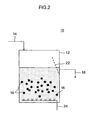
- FIG. 2 is a view describing an example of wastewater treatment equipment 10 using the entrapping immobilization pellets of the present invention.
- the wastewater treatment equipment 10 has, as main components, a treatment tank 12 for treating raw water; an inflow pipe 14 of allowing raw water containing ammonia to flow into the treatment tank 12; entrapping immobilization pellets 16 of the present invention introduced into the treatment tank 12; and a discharge pipe 18 of discharging the treated water from the treatment tank 12.
- the treatment tank 12 is an apparatus that includes the entrapping immobilization pellets 16 and treats raw water containing ammonia flown from the inflow pipe 14 to remove ammonia.
- a screen 22 for suppressing discharge of the entrapping immobilization pellets 16 is provided near the discharge port of the treatment tank 12.
- a diffuser pipe 24 for bubbling air necessary for nitrification reaction is provided in the treatment tank 12.
- the packing ratio of the entrapping immobilization pellets 16 in the treatment tank 12 is preferably 5 vol% to 40 vol%, and more preferably 8 vol% to 20 vol%.
- the packing ratio of attachment pellets is preferably 40 vol% to 90 vol%, and more preferably 50 vol% to 80 vol%.
- raw water containing ammonia is flown into the treatment tank 12 from the inflow pipe 14, and nitrification reaction is carried out by microorganisms (such as nitrifying bacteria) in the entrapping immobilization pellets 16 of the present invention, so that ammonia in the raw water is oxidized into nitrite or nitrate.
- Air necessary for the nitrification reaction is supplied from the diffuser pipe 24.
- the treated water is discharged from the discharge pipe 18 through the screen 22.
- Wastewater can be stably treated by packing the treatment tank 12 with the entrapping immobilization pellets 16 of the present invention in this manner.
- the pellets have activity rapidly activated, and the treatment time can be significantly reduced.
- entrapping immobilization pellets can be obtained with rapidly activated nitrification activity and stable pellet strength.
- Embodiments of the entrapping immobilization pellets and the process for producing the same, and the wastewater treatment process and equipment using the same according to the present invention are as described above.
- the present invention is not limited to the above embodiments, and various embodiments are possible.
- the entrapping immobilization pellets contain nitrifying bacteria.
- the present embodiment can be applied to entrapping immobilization pellets containing microorganisms difficult to be grown other than nitrifying bacteria.
- the sludge of the present invention (such as purified water sludge) can be used not only for entrapping immobilization pellets but also as microorganisms or sludge for other microbial pellets (such as attachment immobilization pellets, contact filters, or pellets having a biofilm formed).
- Entrapping immobilization pellets having different types of sludge were prepared to compare the nitrification performance.
- Each of the four types of sludge was mixed with the immobilizing material, polymerization initiator, and polymerization promoter to carry out radical polymerization at a polymerization temperature of 20°C for 30 minutes, and then the polymer was formed into four types of about 3 mm-square entrapping immobilization pellets.
- Sludge in a methane fermentation tank was used as the anaerobic sludge.
- the four types of entrapping immobilization pellets were respectively subjected to wastewater treatment (acclimatization) under the above treatment conditions.
- the nitrification speed of the pellets was calculated by measuring the amounts of ammonium nitrogen in the inflow wastewater and in the treated water and determining the amount of reduced ammonium nitrogen. The results at that time are shown in Fig. 3.
- the number of days necessary for achieving a nitrification speed of the pellets of 100 mg-N/L-pellet-h was smallest and 13 days for the pellets using purified water sludge (Test 1).
- the number of nitrifying bacteria contained in each type of the entrapping immobilization pellets was measured by the MPN (Most Probable Number) method in order to examine that the above results were based on the number of nitrifying bacteria.
- the pellet strength was also measured for each type of the entrapping immobilization pellets.
- the pellet strength of the entrapping immobilization pellets (MPa/cM 2 ) was calculated by measuring using a rheometer the pressure (kg) gradually applied to the pellet surface enough to break the pellets, and dividing the pressure by the cross-sectional area of the pellets (cm 2 ). The results are shown in Table 1.
- the number of nitrifying bacteria contained in the entrapping immobilization pellets is larger in the order of activated sludge, purified water sludge, anaerobic sludge, and lake sludge.
- the time necessary for activating nitrification activity described above is not necessarily proportional to the number of nitrifying bacteria.
- Nitrifying bacteria of purified water sludge were rapidly grown in this manner, presumably because a flock was not formed as in activated sludge, making the amount of organic substances adsorbed small, and the concentration of organic substances in the pellets was low, so that there was an environment in which heterotrophic bacteria were difficult to be grown and nitrifying bacteria were easily grown.
- the entrapping immobilization pellets using purified water sludge had a highest pellet strength which was about 1.4 times the pellet strength of conventional activated sludge.
- the purified water sludges P or Q had a content of organic substances VSS/SS extremely lower than that of the activated sludge. On the contrary, the purified water sludges,P or Q had a content of inorganic substances (A1 and Fe) higher than that of the activated sludge.
- Entrapping immobilization pellets shown in Table 3 were produced in the same manner as in 1) using the sludges shown in Table 2.
- the purified water sludge in the above 1) was used as the purified water sludge.
- the average particle size of the purified water sludge was controlled by addition of a coagulant or use of a homogenizer. Except for such conditions, the same conditions as in the above 1) were used for preparing the entrapping immobilization pellets.
- the pellet strength of the entrapping immobilization pellets was calculated by measuring using a rheometer the pressure (kg) gradually applied to the pellet surface enough to break the pellets, and dividing the pressure by the cross-sectional area of the pellets (cm 2 ) in the same manner as described above. The results are shown in Fig. 5.
- the purified water sludge preferably has an average particle size of 10 ⁇ m to 30 ⁇ m.
- entrapping immobilization pellets were prepared under the same conditions as in the above 1) so that the pellets contained the purified water sludge for an SS concentration of 1 mass% to 6 mass%.
- the entrapping immobilization pellets were respectively subjected to wastewater treatment (acclimatization) under the above treatment conditions.
- the nitrification speed of the pellets was measured after two weeks had passed at 20°C.
- the nitrification speed of the pellets was measured by a batch test using inorganic synthetic wastewater. The results at that time are shown in Fig. 6.
- the nitrification speed was increased as the SS concentration of the purified water sludge to the entrapping immobilization pellets, in the pellets was increased, and the nitrification speed was stable to be an almost constant value when the pellets contained the purified water sludge for an SS concentration of 2 mass% or more. From this it was found that the concentration of nitrifying bacteria is high and nitrification reaction is rapidly activated when the pellets contained the purified water sludge for an SS concentration of 2 mass% or more..
- the purified water sludge in the above 1) was used as the purified water sludge.
- the VSS concentration of the purified water sludge to the entrapping immobilization pellets, in the pellets was controlled by adding sterile activated sludge to sterile purified water sludge.
- the entrapping immobilization pellets were prepared using cultured nitrifying bacteria as the nitrifying bacteria so that the number of nitrifying bacteria was 40,000 cells/mL-pellet. Except for such conditions, the same conditions as above were used for preparing the entrapping immobilization pellets.
- the increasing rate of nitrifying bacteria in the pellets was measured after two weeks had passed at 20°C.
- the increasing rate of nitrifying bacteria referred to a ratio of the number of nitrifying bacteria two weeks after acclimatization to the number of nitrifying bacteria before acclimatization.
- the number of nitrifying bacteria was measured by the MPN method. The results are shown in Fig. 7.
- the number of nitrifying bacteria was increased by about 500 fold, meaning that the increasing rate of nitrifying bacteria was high. Further, when the pellets contained the purified water sludge for a VSS concentration of 0.5 mass % to 1 mass%, the number of nitrifying bacteria was increased by about 1,000 fold, meaning that the increasing rate of nitrifying bacteria was higher.
- a reason for this is that, when the pellets contained the purified water sludge for a VSS concentration of less than 0.2 mass%, it is difficult to grow microorganisms coexisting with nitrifying bacteria in the pellets, and toxin caused by growth of nitrifying bacteria cannot be sufficiently reduced. It is also assumed that, when the pellets contained the purified water sludge for a VSS concentration of more than 2 mass%, heterotrophic bacteria easily oxidize organic substances and the amount of dissolved oxygen used for nitrification reaction is insufficient, making it difficult to grow nitrifying bacteria.
Landscapes
- Life Sciences & Earth Sciences (AREA)
- Chemical & Material Sciences (AREA)
- Engineering & Computer Science (AREA)
- Organic Chemistry (AREA)
- Microbiology (AREA)
- Bioinformatics & Cheminformatics (AREA)
- Health & Medical Sciences (AREA)
- Genetics & Genomics (AREA)
- Wood Science & Technology (AREA)
- Zoology (AREA)
- General Engineering & Computer Science (AREA)
- Biodiversity & Conservation Biology (AREA)
- Biotechnology (AREA)
- General Health & Medical Sciences (AREA)
- Biomedical Technology (AREA)
- Water Supply & Treatment (AREA)
- Environmental & Geological Engineering (AREA)
- Biochemistry (AREA)
- Hydrology & Water Resources (AREA)
- General Chemical & Material Sciences (AREA)
- Chemical Kinetics & Catalysis (AREA)
- Biological Treatment Of Waste Water (AREA)
- Purification Treatments By Anaerobic Or Anaerobic And Aerobic Bacteria Or Animals (AREA)
- Immobilizing And Processing Of Enzymes And Microorganisms (AREA)
Applications Claiming Priority (1)
| Application Number | Priority Date | Filing Date | Title |
|---|---|---|---|
| JP2006081369A JP4235836B2 (ja) | 2006-03-23 | 2006-03-23 | 包括固定化担体及びその製造方法、並びにそれを用いた廃水処理方法及び装置 |
Publications (2)
| Publication Number | Publication Date |
|---|---|
| EP1837310A2 true EP1837310A2 (de) | 2007-09-26 |
| EP1837310A3 EP1837310A3 (de) | 2010-11-24 |
Family
ID=38255521
Family Applications (1)
| Application Number | Title | Priority Date | Filing Date |
|---|---|---|---|
| EP20070005936 Withdrawn EP1837310A3 (de) | 2006-03-23 | 2007-03-22 | Einschluss von Immobilisierungstabletten und zugehöriges Herstellungsverfahren, Abwasserbehandlungsverfahren und zugehörige Ausrüstung |
Country Status (5)
| Country | Link |
|---|---|
| US (1) | US7842185B2 (de) |
| EP (1) | EP1837310A3 (de) |
| JP (1) | JP4235836B2 (de) |
| KR (2) | KR101343964B1 (de) |
| CN (1) | CN101041511B (de) |
Cited By (1)
| Publication number | Priority date | Publication date | Assignee | Title |
|---|---|---|---|---|
| CN110104936A (zh) * | 2018-01-30 | 2019-08-09 | 辽宁德智环保技术有限公司 | 纳米聚合氯化铝处理发酵污泥的方法 |
Families Citing this family (8)
| Publication number | Priority date | Publication date | Assignee | Title |
|---|---|---|---|---|
| JP4432050B2 (ja) * | 2005-06-06 | 2010-03-17 | 株式会社日立プラントテクノロジー | 包括固定化担体の製造方法及び装置 |
| JP2011147868A (ja) * | 2010-01-20 | 2011-08-04 | Hitachi Plant Technologies Ltd | 廃水処理システム、及び廃水処理方法 |
| US9334507B2 (en) | 2012-06-15 | 2016-05-10 | Microvi Biotech, Inc. | Bioprocesses for making butanol |
| US9752164B2 (en) | 2012-06-15 | 2017-09-05 | Microvi Biotech, Inc. | Enhanced efficiency ethanol and sugar conversion processes |
| WO2013188858A2 (en) | 2012-06-15 | 2013-12-19 | Microvi Biotech Inc. | Novel biocatalyst compositions and processes for use |
| US9255281B2 (en) | 2012-06-15 | 2016-02-09 | Microvi Biotech Inc. | Bioconversion processes using water-insoluble liquids |
| KR20190075188A (ko) | 2017-12-20 | 2019-07-01 | 서울시립대학교 산학협력단 | 미생물 고정화 고분자 담체를 이용한 고농도 질소함유 하·폐수처리장치 |
| CN108753762A (zh) * | 2018-06-07 | 2018-11-06 | 陈帅 | 一种处理废水的方法 |
Citations (2)
| Publication number | Priority date | Publication date | Assignee | Title |
|---|---|---|---|---|
| JP3131678B2 (ja) | 1995-06-15 | 2001-02-05 | 日立造船株式会社 | 微生物担体の製造方法 |
| EP1331204A1 (de) | 2002-01-25 | 2003-07-30 | Hitachi Plant Engineering & Construction Co., Ltd. | Träger für Nitrit-type Nitrifikation sowie Verfahren zu seiner Herstellung und Verfahren und Vorrichtung zur Stickstoffelimination unter Verwendung desselben |
Family Cites Families (8)
| Publication number | Priority date | Publication date | Assignee | Title |
|---|---|---|---|---|
| DE3617875C2 (de) * | 1985-06-28 | 1993-10-14 | Hitachi Plant Eng & Constr Co | Verfahren zum Immobilisieren von Mikroorganismen |
| JPH0279910A (ja) * | 1988-09-19 | 1990-03-20 | Ninaki Akira | 粒状天然ゼオライトを主成分とする混合園芸培土 |
| JPH02207895A (ja) | 1989-02-08 | 1990-08-17 | Chubu Electric Power Co Inc | 包括固定化微生物を用いる硝化法 |
| JPH02207894A (ja) | 1989-02-08 | 1990-08-17 | Chubu Electric Power Co Inc | 包括固定化微生物を用いる硝化方法 |
| US7384555B1 (en) * | 1993-09-22 | 2008-06-10 | Kurita Water Industries Ltd. | Process for biological treatment of aqueous organic wastes |
| JP3687292B2 (ja) | 1997-07-24 | 2005-08-24 | 日立プラント建設株式会社 | 硝化細菌の包括固定化方法及び包括固定化担体の製造方法 |
| JP3422234B2 (ja) | 1997-09-25 | 2003-06-30 | 日立プラント建設株式会社 | 包括固定化担体の製造方法 |
| JP4006750B2 (ja) | 2002-03-15 | 2007-11-14 | 株式会社日立プラントテクノロジー | 固定化微生物担体及びそれを用いた環境浄化方法 |
-
2006
- 2006-03-23 JP JP2006081369A patent/JP4235836B2/ja not_active Expired - Lifetime
-
2007
- 2007-03-20 US US11/725,486 patent/US7842185B2/en not_active Expired - Fee Related
- 2007-03-22 CN CN2007100887814A patent/CN101041511B/zh not_active Expired - Fee Related
- 2007-03-22 EP EP20070005936 patent/EP1837310A3/de not_active Withdrawn
- 2007-03-22 KR KR1020070028100A patent/KR101343964B1/ko not_active Expired - Fee Related
-
2013
- 2013-09-30 KR KR1020130116561A patent/KR101344801B1/ko not_active Expired - Fee Related
Patent Citations (2)
| Publication number | Priority date | Publication date | Assignee | Title |
|---|---|---|---|---|
| JP3131678B2 (ja) | 1995-06-15 | 2001-02-05 | 日立造船株式会社 | 微生物担体の製造方法 |
| EP1331204A1 (de) | 2002-01-25 | 2003-07-30 | Hitachi Plant Engineering & Construction Co., Ltd. | Träger für Nitrit-type Nitrifikation sowie Verfahren zu seiner Herstellung und Verfahren und Vorrichtung zur Stickstoffelimination unter Verwendung desselben |
Non-Patent Citations (7)
Cited By (1)
| Publication number | Priority date | Publication date | Assignee | Title |
|---|---|---|---|---|
| CN110104936A (zh) * | 2018-01-30 | 2019-08-09 | 辽宁德智环保技术有限公司 | 纳米聚合氯化铝处理发酵污泥的方法 |
Also Published As
| Publication number | Publication date |
|---|---|
| CN101041511B (zh) | 2011-06-22 |
| KR20070096861A (ko) | 2007-10-02 |
| EP1837310A3 (de) | 2010-11-24 |
| US7842185B2 (en) | 2010-11-30 |
| US20070221571A1 (en) | 2007-09-27 |
| KR101343964B1 (ko) | 2013-12-24 |
| KR20130116232A (ko) | 2013-10-23 |
| JP2007253078A (ja) | 2007-10-04 |
| CN101041511A (zh) | 2007-09-26 |
| JP4235836B2 (ja) | 2009-03-11 |
| KR101344801B1 (ko) | 2013-12-26 |
Similar Documents
| Publication | Publication Date | Title |
|---|---|---|
| US7842185B2 (en) | Pellets comprising sludge containing nitrifying bacteria for treating wastewater | |
| EP1780271A1 (de) | Immobilisierungs-Pellets für den Einschluss Ammonium-oxidierender anaerober Bakterien und Verfahren zu deren Herstellung | |
| EP3411339B1 (de) | Verfahren zur aeroben nitrierung von ammoniak | |
| CN117466437B (zh) | 一种强化硫自养反硝化复合载体填料的制备及应用 | |
| JP4915036B2 (ja) | 脱窒方法及び脱窒装置 | |
| CN1740100B (zh) | 固定化微生物及其制造方法、采用其的反应装置 | |
| EP1741678A1 (de) | Verfahren und Vorrichtung zur Herstellung von Immobilisierungspellets | |
| CN100475713C (zh) | 硝化方法、装置以及废水处理装置 | |
| JP4632025B2 (ja) | 包括固定化微生物担体の製造方法及び包括固定化微生物担体並びに廃水処理装置 | |
| US20100038311A1 (en) | Entrapping immobilization pellets, wastewater treatment system using the entrapping immobilization pellets and wastewater treatment method | |
| JP2006289347A (ja) | 廃水処理方法及び装置 | |
| JP4131315B2 (ja) | 包括固定化微生物担体及びその製造方法 | |
| CN111573831A (zh) | 一种用于污水处理的反硝化包埋菌颗粒制备方法 | |
| US7816110B2 (en) | Process for producing pellets containing entrapped microorganisms | |
| CN115465955B (zh) | 具有微胶囊可生物降解的复合材料及其制备方法和应用 | |
| JP5105251B2 (ja) | 包括固定化担体及びその製造方法 | |
| JP2007268368A (ja) | 包括固定化担体及びそれを用いた廃水処理装置 | |
| JP3265981B2 (ja) | 窒素除去用包括固定化担体及びその形成方法 | |
| WO2016067970A1 (ja) | 包括固定化担体及びそれを用いた廃水処理装置 | |
| US20070170114A1 (en) | Method and biological product for the residential and commercial aquatic environment | |
| JP4211004B2 (ja) | 包括固定化担体及び廃水処理装置 | |
| CN120005868A (zh) | 一种酶源颗粒载体及其制备方法、应用 | |
| Dong et al. | Synthesis and application of polyurethane Hydrogel carrier on nitrobacteria immobilization | |
| JP2008012383A (ja) | 包括固定化担体、包括固定化担体を用いた廃水処理装置及び廃水処理方法 | |
| JP2008283872A (ja) | 固定化微生物担体の製造方法及び排水処理装置 |
Legal Events
| Date | Code | Title | Description |
|---|---|---|---|
| PUAI | Public reference made under article 153(3) epc to a published international application that has entered the european phase |
Free format text: ORIGINAL CODE: 0009012 |
|
| AK | Designated contracting states |
Kind code of ref document: A2 Designated state(s): AT BE BG CH CY CZ DE DK EE ES FI FR GB GR HU IE IS IT LI LT LU LV MC MT NL PL PT RO SE SI SK TR |
|
| AX | Request for extension of the european patent |
Extension state: AL BA HR MK YU |
|
| RAP1 | Party data changed (applicant data changed or rights of an application transferred) |
Owner name: HITACHI PLANT TECHNOLOGIES, LTD. |
|
| PUAL | Search report despatched |
Free format text: ORIGINAL CODE: 0009013 |
|
| AK | Designated contracting states |
Kind code of ref document: A3 Designated state(s): AT BE BG CH CY CZ DE DK EE ES FI FR GB GR HU IE IS IT LI LT LU LV MC MT NL PL PT RO SE SI SK TR |
|
| AX | Request for extension of the european patent |
Extension state: AL BA HR MK RS |
|
| 17P | Request for examination filed |
Effective date: 20110420 |
|
| AKX | Designation fees paid |
Designated state(s): DE FR GB |
|
| 17Q | First examination report despatched |
Effective date: 20130524 |
|
| RAP1 | Party data changed (applicant data changed or rights of an application transferred) |
Owner name: HITACHI, LTD. |
|
| STAA | Information on the status of an ep patent application or granted ep patent |
Free format text: STATUS: THE APPLICATION IS DEEMED TO BE WITHDRAWN |
|
| 18D | Application deemed to be withdrawn |
Effective date: 20150120 |