EP1837312A1 - Verre de lithium-aluminium-silicate avec cycle court de céramisation - Google Patents
Verre de lithium-aluminium-silicate avec cycle court de céramisation Download PDFInfo
- Publication number
- EP1837312A1 EP1837312A1 EP20060005593 EP06005593A EP1837312A1 EP 1837312 A1 EP1837312 A1 EP 1837312A1 EP 20060005593 EP20060005593 EP 20060005593 EP 06005593 A EP06005593 A EP 06005593A EP 1837312 A1 EP1837312 A1 EP 1837312A1
- Authority
- EP
- European Patent Office
- Prior art keywords
- glass
- tio
- sno
- lithium
- ceramic
- Prior art date
- Legal status (The legal status is an assumption and is not a legal conclusion. Google has not performed a legal analysis and makes no representation as to the accuracy of the status listed.)
- Granted
Links
Images

Classifications
-
- C—CHEMISTRY; METALLURGY
- C03—GLASS; MINERAL OR SLAG WOOL
- C03C—CHEMICAL COMPOSITION OF GLASSES, GLAZES OR VITREOUS ENAMELS; SURFACE TREATMENT OF GLASS; SURFACE TREATMENT OF FIBRES OR FILAMENTS MADE FROM GLASS, MINERALS OR SLAGS; JOINING GLASS TO GLASS OR OTHER MATERIALS
- C03C10/00—Devitrified glass ceramics, i.e. glass ceramics having a crystalline phase dispersed in a glassy phase and constituting at least 50% by weight of the total composition
- C03C10/0018—Devitrified glass ceramics, i.e. glass ceramics having a crystalline phase dispersed in a glassy phase and constituting at least 50% by weight of the total composition containing SiO2, Al2O3 and monovalent metal oxide as main constituents
- C03C10/0027—Devitrified glass ceramics, i.e. glass ceramics having a crystalline phase dispersed in a glassy phase and constituting at least 50% by weight of the total composition containing SiO2, Al2O3 and monovalent metal oxide as main constituents containing SiO2, Al2O3, Li2O as main constituents
-
- C—CHEMISTRY; METALLURGY
- C03—GLASS; MINERAL OR SLAG WOOL
- C03C—CHEMICAL COMPOSITION OF GLASSES, GLAZES OR VITREOUS ENAMELS; SURFACE TREATMENT OF GLASS; SURFACE TREATMENT OF FIBRES OR FILAMENTS MADE FROM GLASS, MINERALS OR SLAGS; JOINING GLASS TO GLASS OR OTHER MATERIALS
- C03C10/00—Devitrified glass ceramics, i.e. glass ceramics having a crystalline phase dispersed in a glassy phase and constituting at least 50% by weight of the total composition
- C03C10/0036—Devitrified glass ceramics, i.e. glass ceramics having a crystalline phase dispersed in a glassy phase and constituting at least 50% by weight of the total composition containing SiO2, Al2O3 and a divalent metal oxide as main constituents
- C03C10/0045—Devitrified glass ceramics, i.e. glass ceramics having a crystalline phase dispersed in a glassy phase and constituting at least 50% by weight of the total composition containing SiO2, Al2O3 and a divalent metal oxide as main constituents containing SiO2, Al2O3 and MgO as main constituents
-
- C—CHEMISTRY; METALLURGY
- C03—GLASS; MINERAL OR SLAG WOOL
- C03C—CHEMICAL COMPOSITION OF GLASSES, GLAZES OR VITREOUS ENAMELS; SURFACE TREATMENT OF GLASS; SURFACE TREATMENT OF FIBRES OR FILAMENTS MADE FROM GLASS, MINERALS OR SLAGS; JOINING GLASS TO GLASS OR OTHER MATERIALS
- C03C10/00—Devitrified glass ceramics, i.e. glass ceramics having a crystalline phase dispersed in a glassy phase and constituting at least 50% by weight of the total composition
- C03C10/0054—Devitrified glass ceramics, i.e. glass ceramics having a crystalline phase dispersed in a glassy phase and constituting at least 50% by weight of the total composition containing PbO, SnO2, B2O3
-
- C—CHEMISTRY; METALLURGY
- C03—GLASS; MINERAL OR SLAG WOOL
- C03C—CHEMICAL COMPOSITION OF GLASSES, GLAZES OR VITREOUS ENAMELS; SURFACE TREATMENT OF GLASS; SURFACE TREATMENT OF FIBRES OR FILAMENTS MADE FROM GLASS, MINERALS OR SLAGS; JOINING GLASS TO GLASS OR OTHER MATERIALS
- C03C3/00—Glass compositions
- C03C3/04—Glass compositions containing silica
- C03C3/076—Glass compositions containing silica with 40% to 90% silica, by weight
- C03C3/095—Glass compositions containing silica with 40% to 90% silica, by weight containing rare earths
Definitions
- glasses can be converted as main crystal phases from the system L 2 O-Al 2 O 3 SiO 2 in glass ceramics with high quartz mixed crystals or keatite mixed crystals.
- the invention relates to a lithium aluminosilicate glass which can be converted with short ceramization times of less than 2.5 hours, preferably less than 100 minutes, into a transparent glass ceramic with high quartz mixed crystals as the predominant crystal phase and without visually disturbing light scattering (turbidity) or intrinsic color.
- glass ceramics have an extremely low coefficient of thermal expansion ⁇ 20 / 700 ⁇ 1.5 ⁇ 10 -6 / K in a temperature range from room temperature to about 700 ° C.
- These glass-ceramics are therefore used in transparent form, for example as fire-resistant glass, chimney panes, cookware, cooking surfaces, and as substrate material for wafer stages or for mirror carriers for telescopes and for reflectors in beamers.
- the starting glass is first produced by conventional glass production processes.
- Arsenic and / or antimony oxide is typically used as the refining agent in the melt. These refining agents are compatible with the required glass-ceramic properties and lead to good bubble qualities in the melt.
- SnO 2 is used in particular in conjunction with high-temperature refining above 1700 ° C as refining agent.
- the glass After melting and refining, the glass usually undergoes hot forming by rolling, casting, pressing or, more recently, floating. Subsequently, the starting glass is transferred by controlled crystallization in the glass-ceramic article.
- This ceramization takes place in a two-stage temperature process in which nuclei, usually from ZrO 2 / TiO 2 mixed crystals, are initially produced by nucleation at a temperature between 600 and 800 ° C. SnO 2 may also be involved in nucleation.
- the high-quartz mixed crystals grow on these nuclei at the crystallization temperature of 800 ° to 900 ° C. If desired, the high quartz mixed crystals can subsequently be converted into keatite mixed crystals.
- the conversion into keatite mixed crystals takes place at a temperature increase in a temperature range of about 900 to 1200 ° C.
- glass ceramics with keatite mixed crystals as the main phase are translucent or opaque and have a white color, which can be changed by adding color oxides.
- the thermal expansion coefficient of the glass-ceramic increases and the transparency is reduced by the light scattering associated with the enlargement of the crystals.
- Transparency means that the glass ceramics should have high light transmission in the visible range and low light scattering (turbidity).
- the low light scattering is achieved by a high nucleus density, which causes the growing high quartz mixed crystals with their size below the range of the wavelength of visible light.
- the average crystallite size of the high-quartz mixed crystals is in the range from 20 to 80 nm. High nucleation requires sufficient nucleator contents and sufficient nucleation times during ceramization.
- the inherent color of transparent glass ceramic plates can have different causes.
- the coloring element Fe is contained as an impurity.
- refining agents Sb 2 O 3 and CeO 2 also leads to a low intrinsic color.
- the described brownish yellow intrinsic coloration of the transparent glass-ceramics is based to a great extent on electronic transitions to color complexes which absorb in the region of visible light and on which the nuclei necessary for nucleation Component, the Ti-ion involved.
- the most common absorbing color complex is the formation of adjacent Fe and Ti ions between which electronic charge transfer transitions occur. Sn / Ti complexes also cause an intrinsic color.
- the Fe / Ti color complexes lead to a red-brown, the Sn / Ti color complexes to a yellow-brown discoloration.
- the formation of these adjacent color complexes already takes place during cooling of the starting glass and in particular during later ceraming of the glass ceramics.
- the ions are evenly distributed, during cooling, at high temperatures and during ceramization they prefer to store each other.
- ceramizing the transparent glass ceramics reinforced by the intrinsic color compared to the starting glass quite considerably. By absorption in the short-wave part of the visible spectrum, the transparent flat glasses and especially the glass ceramics produced therefrom obtain a distinct inherent color, which increases greatly with the thickness.
- nucleating agent TiO 2 In order to ensure sufficient nucleation, however, minimum contents of the nucleating agent TiO 2 are required since this nucleating agent can only be replaced with disadvantages in terms of melt and devitrification by the alternative nucleating agent ZrO 2 . This means that the desired fast ceramization times and short nucleation times over the required levels of TiO 2 lead to an increased intrinsic color.
- the reduction of the Fe content is only to a certain extent an economically feasible measure. Due to the large-scale available Gemengerohstoffe for the production of glass and abrasion from plant parts for the production and homogenization of the mixture always creates a certain entry of Fe 2 O 3 in the mixture. Due to the cost of high-purity raw materials and constructive plant special measures, it is no longer economically justifiable to reduce the Fe 2 O 3 content below about 50 ppm in transparent glass ceramics. Usually, the Fe 2 O 3 content is in the order of about 100 to 500 ppm.
- the JP 03-23237 A describes the production of transparent glass ceramics without intrinsic color. These glass ceramics avoid the Addition of TiO 2 as a nucleating agent and based on a mixed nucleation by ZrO 2 / SnO 2 .
- the necessary SnO 2 contents amount to more than 1 wt .-%. At these high SnO 2 contents, however, the devitrification resistance of the glass deteriorates. In the area of shaping, since at viscosities around the processing temperature V A of 10 4 dPas, a disruptive Sn-containing crystal phase crystallizes out. This leads to an impermissible reduction in the strength of the glasses and the glass ceramics produced therefrom. It has also been found that high SnO 2 contents lead to a strong attack of the glass melt on noble metal internals, such as stirrers, electrodes. This shortens the life of the precious metal fixtures.
- a likewise TiO 2 -free glass ceramic is described as being preferred for applications in fire-resistant glazings which has the addition of Nd 2 O 3 in contents of 0.2-1% by weight in order to over-color the intrinsic color produced by Fe ions.
- the glass ceramics are germinated by 3-7 wt.% ZrO 2 .
- the devitrification strength of the glass in the area of shaping deteriorates at viscosities about the processing temperature V A. It crystallizes ZrO 2 (baddeleyite) as a disturbing crystal phase.
- the US 4093468 describes the use of Nd 2 O 3 for overstaining the color cast caused by the Fe / Ti color complex.
- Transparent glass ceramics with virtually no inherent color are known from this document, which contain 0.5 to 6% by weight of TiO 2 as nucleating agent, an Fe 2 O 3 content above impurity of up to 500 ppm, and those by the addition of 0.03 -0.75 wt .-% Nd 2 O 3 are over- dyed.
- the Nd 2 O 3 in contrast to the usual colorants such as Co, Se, Cu, Cr, Mn, Ni V is particularly well suited to to neutralize the color cast produced by the Fe / Ti color complex.
- the document gives no indication of how to achieve a high transparency, ie, low turbidity and high light transmission in short Keramleiters founded by optimizing the nucleating agent.
- the examples of this patent contain unfavorable nucleant combinations, such high TiO 2 contents or too low nucleator concentrations. Due to the lack of use of the alkalis Na 2 O and K 2 O, the glasses also have insufficient resistance to devitrification. No statement is made about the influence of the refining agent on the formation of the Fe / Ti color complex.
- the contents of the nucleating components TiO 2 , ZrO 2 , SnO 2 must be kept within relatively narrow limits. In this case, however, certain minimum contents of these compounds are required in order to produce in the desired short ceramization of less than 2.5 hours, preferably less than 100 minutes during nucleation nuclei in high density, so that after the growth of high quartz mixed crystals transparent glass ceramics without turbidity are feasible. Due to the high germ density, the average crystallite size of the high quartz mixed crystals remains limited to values ⁇ 80 nm, which avoids disturbing light scattering. Minimum levels of TiO 2 and ZrO 2 are required for effective nucleation.
- the haze should be less than 1%, preferably less than 0.5% (measured for a 3.6 mm thick plate with both sides polished surfaces). Haze is according to ASTM D 1003 the percentage Share of transmitted light, which differs from the incident light beam on average by more than 2.5 °.
- nucleating agents ZrO 2 , TiO 2 and SnO 2 can be achieved if certain conditions are met.
- the nucleation effect of SnO 2 and TiO 2 (in wt%) is about the same, so these two components can be considered together.
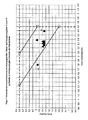
- the nucleating effect of ZrO 2 (in% by weight) is significantly stronger. Therefore, combinations of the nucleating agents ZrO 2 and (TiO 2 + SnO 2 ) with the same nucleating effect can be represented, which lie on a straight line in a corresponding diagram (FIG. 1).
- the upper limit is also shown in FIG.
- the sum of the TiO 2 and SnO 2 contents should not exceed 2.7% by weight, because these components are involved in the formation of the color pigments Fe / Ti and Sn / Ti.
- the content of SnO 2 should not exceed 0.4 wt .-%, because otherwise it comes to an unwanted devitrification in the form of an Sn-containing crystal phase when shaped in the vicinity of the processing point V A.
- the permissible range of nucleator contents can be defined in a diagram (FIG. 1).
- For ZrO 2 minimum levels of 1.3 wt% and for ⁇ SnO 2 + TiO 2 of 1.3 wt% are required to ensure a low haze of less than 1%.
- the intrinsic color based on Fe / Ti and / or Sn / Ti color complexes is reduced by additions of Nd 2 O 3 in contents of 50-4000 ppm. Below 50 ppm Nd 2 O 3 the effect is no longer reliable and above 4000 ppm either the transmission of the glasses is poor (at too high Fe 2 O 3 contents) or the intrinsic color of the Nd-ion becomes disturbing. Contents of 100 to 4000 ppm and in particular 200 to 3000 ppm of Nd 2 O 3 are preferred. An upper limit for the N 2 O 3 content of less than 2000 ppm is very particularly preferred. The contents Nd 2 O 3 are necessary in order to achieve the object according to the invention of reducing the intrinsic color of the floated flat glasses and of the transparent glass ceramics produced therefrom by overstaining.
- Additives of Nd have the advantage that this element counteracts the red-brown coloration by Fe / Ti or the yellow-brown coloration by Sn / Ti complexes particularly well.
- the color point measured in the different color systems e.g. in the CIE or the CIELAB (short Lab) color system is well moved by Nd in the direction of the Unpuntmays.
- the Nd as a coloring ion from the 4f group of the periodic table has very many characteristic absorption bands that allow a unique labeling. When converted into the transparent glass ceramic, these absorption lines are only slightly changed.
- the marking of the glass or of the transparent glass ceramic produced therefrom can therefore be detected very easily with commercially available spectrometers. This allows the manufacturer of the original product to recognize its product and, even in the case of possible damage, ensures easier allocation in terms of product liability.
- a distinction of transparent glass-ceramics of different The manufacturer is otherwise only possible by means of complex analytical measuring methods, such as are available only in a few specialized laboratories.
- the characteristic absorption lines of the Nd also allow detection and separation in treatment processes in the recycling of old shards of soda-lime glass.
- Particularly advantageous is the addition of Nd to the label because of the characteristic absorption lines and its property to fluoresce in the infrared.
- transparent glass-ceramic cullets which due to their low intrinsic color are easily removed, e.g. can be confused with normal windows made of low-melting soda-lime glasses, get into their treatment process and re-melting.
- the danger is that, due to the high melting temperatures of the lithium aluminosilicate glasses (and glass ceramics), unmelted relics are formed in comparison with those of soda lime glasses. This leads in the best case to visually recognizable relics in the soda lime glass products, in the worst case, it can lead to clogging of channels or nozzles in the molding process and thus to total failure in the production of soda-lime glasses.
- the lithium aluminosilicate glasses according to the invention should contain less than 400 ppm, preferably less than 200 ppm Fe 2 O 3 . Higher contents lead to higher contents of the over-colorant Nd being needed to neutralize the color cast Fe / Ti. This leads to low light transmission and a visually perceptible gray cast.
- the contents of Fe 2 O 3 should be minimized to economically justifiable extent, lower contents than about 50 ppm are no longer economical because of the high cost of low-Fe mixed raw materials.
- Additions of CoO in a total amount of up to 50 ppm to the addition of Nd are advantageous in order to adjust the color point of the transparent glass ceramic more precisely in the direction of the chromatic point.
- the Nd addition alone does not shift the color point exactly toward the achromatic point, so that this slight correction may be advantageous.
- Preferred is an amount of CoO of 1 to 50 ppm. However, it is preferred not to exceed an upper limit for the CoO of 40 ppm, in particular of 30 ppm.
- other colorants such as e.g. Cr Ni, V, Cu, Mn, Ce can be added. The total amount should not exceed 100 ppm.
- the oxides Li 2 O, Al 2 O 3 and SiO 2 are necessary in the preferred limits specified in the claims components of the high quartz and / or keatite mixed crystal phases.
- a minimum content of Li 2 O of 3 wt .-% is generally required, but Li 2 O contents of more than 4.5 wt .-% in the manufacturing process often lead to unwanted devitrification.
- a content of 3.2 to 4.3 wt .-% Li 2 O leads to particularly good results.
- the SiO 2 content should preferably be at most 69% by weight, in particular 68% by weight, because this component greatly increases the viscosity of the glass. Thus, for the melting of the glasses and with regard to the temperature stress during the molding, higher contents of SiO 2 are unfavorable.
- the minimum content of SiO 2 should preferably be 55% by weight, in particular 60% by weight.
- MgO, ZnO and P 2 O 5 can be incorporated into the crystal phases.
- the ZnO content is limited to values of at most 2.5 wt .-%, preferably at most 2.0 wt .-%, because of the problem of the formation of unwanted crystal phases such as Zn spinel in the ceramization.
- the MgO content is limited to a maximum of 2.0% by weight, preferably up to 1.5% by weight, because otherwise it would unduly increase the expansion coefficient of the glass ceramic.
- MgO contents of less than 0.8% by weight and especially less than 0.6% by weight are advantageous.
- An MgO minimum content of 0.1 wt .-% is usually required so that the thermal expansion of the glass ceramic does not fall to negative values below -0.3 x 10 -6 / K.
- the addition of the alkalis Na 2 O, K 2 O, the alkaline earths CaO, SrO, BaO, as well as of B 2 O 3 improve the meltability and the devitrification behavior of the glass during shaping.
- the contents must be limited because these components remain substantially in the residual glass phase of the glass-ceramic and increase the thermal expansion in an unreliable manner. Higher contents may also impair the crystallization behavior during the conversion of the glass into the glass ceramic and have an unfavorable effect on the temperature resistance of the glass ceramic.
- the sum of the alkalis Na 2 O + K 2 O should be at least 0.2% by weight, preferably at least 0.3% by weight.
- the addition of P 2 O 5 may be up to 3% by weight and is preferably limited to 1.5% by weight. The addition of P 2 O 5 is favorable for the devitrification resistance, higher contents, however, have an unfavorable effect on the acid resistance.
- the glasses according to the invention are refined using the refining agents arsenic and / or antimony oxide which are customary for glasses made from the Li 2 O-Al 2 O 3 -SiO 2 system.
- SnO 2 can be used in particular Compound having a high temperature refining> 1700 ° C may be added alternatively or in combination in amounts of up to 0.3% by weight.
- Other refining additives such as CeO 2 , sulfate compounds, chloride compounds, fluoride compounds can be added to the glass melt. The total content of refining agents and additives should not exceed 2% by weight.
- the water content of the glasses according to the invention is usually between 0.015 and 0.06 mol / l, depending on the choice of the batch raw materials and the process conditions in the melt. This corresponds to OH values of 0.16 to 0.64 mm -1 .
- the glass according to the invention preferably has a composition (in% by weight based on oxide) of: Li 2 O 3.0-4.5 Na 2 O 0-1.5 K 2 O 0-1.5 ⁇ Na 2 O + K 2 O 0.2-2.0 MgO 0-2.0 CaO 0-1.5 SrO 0-1.5 BaO 0-2.5 ZnO 0-2.5 B 2 O 3 0-1.0 Al 2 O 3 19-25 SiO 2 55-69 TiO 2 1.4 to 2.7 ZrO 2 1.3-2.5 SnO 2 0-0.4 ⁇ SnO 2 + TiO 2 ⁇ 2.7 P 2 O 5 0-3.0 Nd 2 O 3 100-4000 ppm CoO 0-40 ppm optionally with additions of chemical refining agents such as As 2 O 3 , Sb 2 O 3 , CeO 2 and optionally further refining additives, such as, for example, sulfate compounds, chloride compounds, fluoride compounds in total amounts of up to 2% by weight.
- the Nd content is converted to these figures Oxide base (Nd
- the glass has an oxide-based weight percent composition of: Li 2 O 3.2-4.3 Na 2 O 0.2-1.0 K 2 O 0-0.8 ⁇ Na 2 O + K 2 O 0.3-1.5 MgO 0.1-1.5 CaO 0-1.0 SrO 0-1.0 BaO 0-2.5 ZnO 0-2.0 Al 2 O 3 19-24 SiO 2 60-68 TiO 2 1.4 to 2.7 ZrO 2 1.3-2.2 SnO 2 0-0.3 ⁇ SnO 2 + TiO 2 ⁇ 2.7 P 2 O 5 0-1.5 Nd 2 O 3 200-3000 ppm CoO 0-30 ppm optionally with additions of chemical refining agents such as As 2 O 3 , Sb 2 O 3 , CeO 2 and refining additives such as sulfate, chloride, fluoride compounds in total contents up to 1.5 wt .-%.
- chemical refining agents such as As 2 O 3 , Sb 2 O 3 , CeO 2 and refining additives such as sulfate, chloride
- the glass ceramic plate as refining agent As 2 O 3 possibly with other Cleansing additives such as sulfate, chloride, fluoride compounds in total contents up to 1 wt .-% and without the refining Sb 2 O 3 and SnO 2 is purified.
- the lithium-aluminosilicate glass according to the invention is typically characterized by a processing temperature V A below 1350 ° C., in order to favor the fusibility of the glass and to limit the thermal stress on the system components during shaping.
- the upper devitrification temperature OEG is below the processing temperature V A.
- the thermal expansion coefficient ⁇ 20/700 should not deviate from the zero expansion by more than 0.5 ⁇ 10 -6 / K.
- the deviation should be less than 0.3 ⁇ 10 -6 / K.
- a preferred embodiment of the invention is to provide a low intrinsic color and a high light transmission in addition to the low turbidity.
- the transparent glass ceramic then has a haze with Haze value ⁇ 1%, preferably ⁇ 0.5% (at 3.6 mm thickness), in transmission at 4 mm thickness via a chroma in the CIELAB color system of C * ⁇ 3, 5 and a light transmission (brightness) Y of> 80%, preferably> 85%.
- This combination of properties is possible with the concerted low Fe 2 O 3 contents of the invention, the limitation of the levels of overstaining agent Nd 2 O 3 to less than 2000 ppm and CoO to less than 20 ppm in combination with the well-defined contents of the Nucleating agents TiO 2 , SnO 2 and ZrO 2 .
- the lithium-aluminosilicate glasses according to the invention can be converted by an additional heat treatment at temperatures between about 900 and 1200 ° C in a glass ceramic containing keatite mixed crystal.
- Glass ceramics of this type have a higher temperature resistance, but at the expense of an increase in the coefficient of thermal expansion, which should be less than 1.5 ⁇ 10 -6 / K between room temperature and 700 ° C. Due to the crystal growth associated with the transformation, they have a translucent to opaque white appearance. The haze is usually at Haze values of> 50%.
- the transparent, colorless glass ceramic with high-quartz mixed crystals prepared from the lithium-aluminosilicate glass according to the invention is preferably used as a fire-resistant glass, fireplace visor, oven visor, in particular for pyrolysis stoves, covers of luminaires of high energy.
- a light-absorbing underside coating can be made of the transparent glass ceramic, a colored cooking surface with the required light transmission.
- this is preferably used in translucent or opaque form as a cooking surface or as a cover plate in microwave ovens.
- Table 1 shows compositions and properties of the lithium aluminosilicate glasses.
- Glasses 1 to 8 are glasses according to the invention and glasses 9 and 10 are comparative glasses outside the scope of the present invention.
- the comparative glass No. 10 became the US 4093468 (Example B) taken.
- Table 1 shows the compositions of the starting glasses Nos. 1 to 8 according to the invention and the starting glasses 9 and 10 for the comparative examples.
- Table 1 also shows the properties in the glassy state, such as: transformation temperature Tg, processing temperature V A , upper devitrification limit OEG, thermal expansion between room temperature and 300 ° C, and the density. Due to the composition, in particular the nucleating agent contents, the upper devitrification limit is below the processing temperature V A. Table 1 also shows the Fe 2 O 3 contents due to raw material contamination in the compositions.
- the water content of the glasses is 0.03-0.05 mol / l, corresponding to ⁇ OH values of 0.32 to 0.53 mm -1 .
- the starting glasses of Table 1 were melted and refined from temperatures common in the glass industry at temperatures of about 1620 ° C. After melting in crucibles made of sintered silica glass, the melts were recast in Pt / Rh crucible with inner crucible made of silica glass and homogenized by stirring at temperatures of 1550 ° C, 30 minutes. After standing for 2 hours at 1640 ° C castings of about 140x100x30 mm size were poured and in a cooling furnace, starting from about 660 ° C cooled to room temperature. The castings were subdivided into the sizes required for testing and ceramization.
- Tables 2 and 3 show the properties of the transparent glass ceramics with high quartz mixed crystals as the predominant crystal phase, which were prepared with the ceramizing programs 1 and 2, respectively.
- Examples 9 and 10 or 19 and 20 are comparative ceramics outside of the invention.
- the transmission measurements were carried out on polished plates of 4 mm thickness with standard light C, 2 °.
- the CIELAB system also lists the color coordinates x, y in the CIE system.
- the glass-ceramics according to the invention demonstrate the advantageous effect of the use of Nd and optionally additionally of Co for reducing the intrinsic color.
- the yellowness index according to standard ASTM 1925/70 (77, 85) is, like the chroma C *, a measure of the intrinsic color.
- Table 2 also shows characteristic values of the glass ceramic, such as infrared transmission at 1600 nm, thermal expansion between 20 and 700 ° C., density and the phase content of the main crystal phase, which consists of high quartz mixed crystals, and the mean crystallite size, as measured by X-ray diffraction.
- ceramization program 3 was converted into translucent glass-ceramics with keatite mixed crystals as the predominant crystal phase and their properties as well as phase contents and crystal sizes were determined (Table 4).
- the maximum temperatures T max during production are given in the table.
- the light transmission Y and the IR transmission at 1600 nm were measured on 3.6 mm thick plates.
- the color values L *, a *, b * were in remission (incident light) on 3.6 mm thick polished plates with the Mercury 2000 measuring instrument (Datacolor, Lawrenceville, USA), Standard light C, 2 ° determined.
- the haze values of the examples are more than 90%.
- FIG. 1 shows a plot of the nucleator concentration of the glass ceramics according to the invention and of the comparison ceramics (starting glasses 9, 10) within the specified limits.
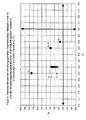
- FIG. 2 shows the transmission spectra of the glass-ceramic example 8 according to the invention and the comparison glass-ceramic example 9.
- the comparative example shows the disturbing coloring combined with a high yellowness index and chroma C *.
- the glass ceramic according to the invention exhibits the characteristic absorption bands of the Nd ion, which are also outstandingly suitable for marking the glass ceramic plates according to the invention.
- the Nd 2 O 3 addition also simplifies the recyclability of the glass-ceramic by optical shear separation methods due to the absorption bands and the infrared fluorescence of the Nd-ion.
- FIG. 3 shows the color coordinates of the glass-ceramics 11 to 18 according to the invention and the comparative glass-ceramic example 19 in the CIELAB system.
- the comparative glass-ceramic example 20 can not be sensibly classified due to the high turbidity (milky appearance).
- Table 1 Compositions and properties of starting glasses according to the invention and comparative glasses 9 and 10 Glass no.
Landscapes
- Chemical & Material Sciences (AREA)
- Engineering & Computer Science (AREA)
- Materials Engineering (AREA)
- Chemical Kinetics & Catalysis (AREA)
- General Chemical & Material Sciences (AREA)
- Geochemistry & Mineralogy (AREA)
- Life Sciences & Earth Sciences (AREA)
- Organic Chemistry (AREA)
- Ceramic Engineering (AREA)
- Crystallography & Structural Chemistry (AREA)
- Dispersion Chemistry (AREA)
- Glass Compositions (AREA)
- Re-Forming, After-Treatment, Cutting And Transporting Of Glass Products (AREA)
Priority Applications (8)
| Application Number | Priority Date | Filing Date | Title |
|---|---|---|---|
| AT06005593T ATE469106T1 (de) | 2006-03-20 | 2006-03-20 | Lithium-aluminium-silikatglas mit kurzen keramisierungszeiten |
| DE502006007025T DE502006007025D1 (de) | 2006-03-20 | 2006-03-20 | Lithium-Aluminium-Silikatglas mit kurzen Keramisierungszeiten |
| EP06005593.6A EP1837312B2 (fr) | 2006-03-20 | 2006-03-20 | Verre de lithium-aluminium-silicate avec cycle court de céramisation |
| ES06005593.6T ES2344267T5 (es) | 2006-03-20 | 2006-03-20 | Vidrio de litio, alúmina y silicato con unos cortos períodos de tiempo de ceramización |
| US11/688,104 US20090018007A1 (en) | 2006-03-20 | 2007-03-19 | Lithium-aluminosilicate glass with short glazing times |
| JP2007072541A JP5367952B2 (ja) | 2006-03-20 | 2007-03-20 | 短時間のグレージングを伴うアルミノケイ酸リチウムガラス |
| CN2007101035741A CN101269910B (zh) | 2006-03-20 | 2007-03-20 | 具有短陶瓷化时间的锂-铝硅酸盐玻璃 |
| US13/567,744 US8685873B2 (en) | 2006-03-20 | 2012-08-06 | Lithium-aluminosilicate glass with short glazing times |
Applications Claiming Priority (1)
| Application Number | Priority Date | Filing Date | Title |
|---|---|---|---|
| EP06005593.6A EP1837312B2 (fr) | 2006-03-20 | 2006-03-20 | Verre de lithium-aluminium-silicate avec cycle court de céramisation |
Publications (3)
| Publication Number | Publication Date |
|---|---|
| EP1837312A1 true EP1837312A1 (fr) | 2007-09-26 |
| EP1837312B1 EP1837312B1 (fr) | 2010-05-26 |
| EP1837312B2 EP1837312B2 (fr) | 2015-07-22 |
Family
ID=37022863
Family Applications (1)
| Application Number | Title | Priority Date | Filing Date |
|---|---|---|---|
| EP06005593.6A Expired - Lifetime EP1837312B2 (fr) | 2006-03-20 | 2006-03-20 | Verre de lithium-aluminium-silicate avec cycle court de céramisation |
Country Status (7)
| Country | Link |
|---|---|
| US (2) | US20090018007A1 (fr) |
| EP (1) | EP1837312B2 (fr) |
| JP (1) | JP5367952B2 (fr) |
| CN (1) | CN101269910B (fr) |
| AT (1) | ATE469106T1 (fr) |
| DE (1) | DE502006007025D1 (fr) |
| ES (1) | ES2344267T5 (fr) |
Cited By (22)
| Publication number | Priority date | Publication date | Assignee | Title |
|---|---|---|---|---|
| DE102008043718A1 (de) | 2008-11-13 | 2010-05-20 | Schott Ag | Hochtransparente wuchteinwirkungsfeste Glaskeramik |
| DE102010032113A1 (de) | 2010-07-23 | 2012-01-26 | Schott Ag | Transparente oder transparente eingefärbte Lithiumaluminiumsilikat Glaskeramik mit angepasster thermischer Ausdehnung und deren Verwendung |
| WO2013124240A1 (fr) * | 2012-02-22 | 2013-08-29 | Schott Ag | Procédé de fabrication de verres et de vitrocéramiques et leur utilisation |
| WO2013171288A1 (fr) * | 2012-05-15 | 2013-11-21 | Eurokera | Vitrocéramiques de β-quartz transparentes, sensiblement incolores et non dépolies ; articles composés desdites vitrocéramiques ; verres précurseurs |
| WO2015024857A1 (fr) * | 2013-08-22 | 2015-02-26 | Schott Ag | Procédé de détermination d'une fenêtre de processus et procédé de fabrication d'une vitrocéramique |
| US9199873B2 (en) | 2008-11-13 | 2015-12-01 | Schott Ag | Process for producing a highly transparent impact-resistant glass ceramic |
| EP2990390A1 (fr) * | 2014-08-27 | 2016-03-02 | D. Swarovski KG | Composition de verre luminescent |
| US9296645B2 (en) | 2012-02-22 | 2016-03-29 | Schott Ag | Transparent low-color lithium aluminum silicate glass ceramic and the use thereof |
| EP3067333A1 (fr) | 2015-03-10 | 2016-09-14 | Schott AG | Procede de fabrication d'un article en vitroceramique ou en verre avec un revetement de couleur a base de verre, article en vitroceramique ou en verre revetu et son utilisation |
| US9676643B2 (en) | 2012-02-22 | 2017-06-13 | Schott Ag | Method for producing glasses, glass ceramics and the use of same |
| DE202018102534U1 (de) | 2017-12-22 | 2018-05-15 | Schott Ag | Transparente, eingefärbte Lithiumaluminiumsilikat-Glaskeramik |
| DE102018132945A1 (de) | 2018-12-19 | 2020-06-25 | Schott Ag | Plattenförmiger Gegenstand, Verfahren zu dessen Herstellung sowie dessen Verwendung |
| US10995961B2 (en) | 2017-12-22 | 2021-05-04 | Schott Ag | Fitout articles and articles of equipment for kitchens or laboratories with a lighting element |
| US11072557B2 (en) | 2017-12-22 | 2021-07-27 | Schott Ag | Glass ceramic with reduced lithium content |
| US11097979B2 (en) | 2017-12-22 | 2021-08-24 | Schott Ag | Cover panel with colour-neutral coating |
| EP3872043A1 (fr) | 2020-02-28 | 2021-09-01 | Schott AG | Verre de silicate de lithium-aluminium cristallisable et vitrocéramique fabriquée à partir de celui-ci, ainsi que procédé de fabrication du verre et du verre céramique et utilisation du verre céramique |
| DE102020202602A1 (de) | 2020-02-28 | 2021-09-02 | Schott Ag | Kristallisierbares Lithiumaluminiumsilikat-Glas und daraus hergestellte Glaskeramik sowie Verfahren zur Herstellung des Glases und der Glaskeramik und Verwendung der Glaskeramik |
| US11136262B2 (en) | 2017-12-22 | 2021-10-05 | Schott Ag | Fitout articles and articles of equipment for kitchens or laboratories with a display device |
| EP3932884A1 (fr) | 2020-07-02 | 2022-01-05 | Schott Ag | Article vitrocéramique en silicate de lithium-aluminium transparent et non coloré à cristaux mélangés de quartz béta en tant que phase cristalline principale, ainsi que procédé de fabrication dudit article et son utilisation |
| EP4140964A1 (fr) * | 2021-08-25 | 2023-03-01 | Schott Ag | Verre à base de silicate de lithium-aluminium cristallisable et vitrocéramique fabriqué à partir de celui-ci, ainsi que procédé de fabrication de la vitrocéramique et utilisation de la vitrocéramique |
| EP4375247A1 (fr) * | 2022-11-25 | 2024-05-29 | Schott Ag | Vitrocéramique à base d'aluminosilicate de lithium |
| WO2024110094A1 (fr) * | 2022-11-25 | 2024-05-30 | Schott Ag | Vitrocéramique à base de silicate d'aluminium et de lithium |
Families Citing this family (32)
| Publication number | Priority date | Publication date | Assignee | Title |
|---|---|---|---|---|
| DE502006004506D1 (de) * | 2006-03-20 | 2009-09-24 | Schott Ag | Transparente, farblose Lithium-Aluminosilikat-Glaskeramikplatte mit blickdichter, farbiger Unterseitenbeschichtung |
| CN101454254B (zh) * | 2006-05-29 | 2012-04-18 | 日本电气硝子株式会社 | Li2O-A12O3-SiO2系结晶化玻璃 |
| JP5656040B2 (ja) * | 2006-05-29 | 2015-01-21 | 日本電気硝子株式会社 | Li2O−Al2O3−SiO2系結晶化ガラス |
| WO2010007902A1 (fr) * | 2008-07-14 | 2010-01-21 | コニカミノルタオプト株式会社 | Substrat en verre pour support d’enregistrement d’informations et support d’enregistrement d’informations |
| JPWO2010007901A1 (ja) * | 2008-07-14 | 2012-01-05 | コニカミノルタオプト株式会社 | 情報記録媒体用ガラス基板及び情報記録媒体 |
| DE102008050263C5 (de) * | 2008-10-07 | 2020-01-02 | Schott Ag | Transparente, eingefärbte Kochfläche mit verbesserter farbiger Anzeigefähigkeit und Verfahren zur Herstellung einer solchen Kochfläche |
| US20150132560A9 (en) * | 2008-11-13 | 2015-05-14 | Thilo Zachau | Highly transparent impact-resistant plate laminate and armored or bulletproof glass and articles made with same |
| US9302937B2 (en) | 2010-05-14 | 2016-04-05 | Corning Incorporated | Damage-resistant glass articles and method |
| ES2443592T3 (es) * | 2010-11-04 | 2014-02-19 | Corning Incorporated | Vitrocerámica transparente de espinela exenta de As2O3 y Sb2O3 |
| TWI572480B (zh) | 2011-07-25 | 2017-03-01 | 康寧公司 | 經層壓及離子交換之強化玻璃疊層 |
| US9868664B2 (en) | 2012-02-29 | 2018-01-16 | Corning Incorporated | Low CTE, ion-exchangeable glass compositions and glass articles comprising the same |
| US9604871B2 (en) * | 2012-11-08 | 2017-03-28 | Corning Incorporated | Durable glass ceramic cover glass for electronic devices |
| CN115504681A (zh) | 2014-10-07 | 2022-12-23 | 康宁股份有限公司 | 具有确定的应力分布的玻璃制品及其生产方法 |
| DE102014116378B4 (de) * | 2014-11-10 | 2016-07-28 | Schott Ag | Verfahren zum Herstellen eines glaskeramischen Ionenleiters |
| JP6675577B2 (ja) * | 2015-02-04 | 2020-04-01 | 日本電気硝子株式会社 | 半導体ウエハ支持基板 |
| FR3036700B1 (fr) | 2015-05-29 | 2021-04-16 | Eurokera | Vitroceramiques du type aluminosilicate de lithium, transparentes, essentiellement incolores, affinees a l'etain, avec une microstructure amelioree et des proprietes de dilatation thermique ameliorees |
| KR20180067577A (ko) * | 2015-10-14 | 2018-06-20 | 코닝 인코포레이티드 | 결정된 응력 프로파일을 갖는 적층 유리 제품 및 그 제조방법 |
| KR102216663B1 (ko) * | 2017-02-02 | 2021-02-17 | 엘지전자 주식회사 | 유리 조성물, 이의 제조방법 및 조리기기 |
| KR102679797B1 (ko) | 2017-02-02 | 2024-07-02 | 엘지전자 주식회사 | 유리 조성물 및 조리기기 |
| FR3069240B1 (fr) | 2017-07-21 | 2021-04-23 | Eurokera | Vitroceramiques de spodumene-beta, blanches, opalescentes ou opaques, a faible teneur en titane, affinees a l'etain |
| NL2020896B1 (en) | 2018-05-08 | 2019-11-14 | Corning Inc | Water-containing glass-based articles with high indentation cracking threshold |
| FR3088321B1 (fr) * | 2018-11-09 | 2021-09-10 | Eurokera | Vitroceramiques transparentes de quartz-beta a basse teneur en lithium |
| TWI891613B (zh) | 2018-11-16 | 2025-08-01 | 美商康寧公司 | 用於透過蒸氣處理而強化之玻璃成分及方法 |
| WO2020231959A1 (fr) | 2019-05-16 | 2020-11-19 | Corning Incorporated | Lunettes à profil de module de young modifié |
| WO2020231961A1 (fr) * | 2019-05-16 | 2020-11-19 | Corning Incorporated | Compositions de verre et procédés ayant une résistance au trouble de traitement à la vapeur |
| US12122711B2 (en) | 2019-05-16 | 2024-10-22 | Corning Incorporated | Steam strengthenable glass compositions with low phosphorous content |
| DE102020117213A1 (de) | 2020-06-30 | 2021-12-30 | Schott Ag | Glaskeramikartikel, Verfahren zu dessen Herstellung und dessen Verwendung |
| CN112047634A (zh) * | 2020-09-15 | 2020-12-08 | 秦皇岛耀华玻璃技术开发有限公司 | 一种透明锂铝硅酸盐玻璃陶瓷极其制备方法 |
| JP7183230B2 (ja) * | 2020-09-18 | 2022-12-05 | 株式会社オハラ | 結晶化ガラスおよび強化結晶化ガラス |
| CN112110645B (zh) * | 2020-09-23 | 2022-04-15 | 成都光明光电股份有限公司 | 一种玻璃、玻璃制品及其制造方法 |
| CN121127444A (zh) * | 2023-06-16 | 2025-12-12 | 日本电气硝子株式会社 | 玻璃及其制造方法 |
| EP4495077A1 (fr) * | 2023-07-19 | 2025-01-22 | Schott Ag | Vitrocéramique transparente à base d'aluminosilicate de lithium |
Citations (6)
| Publication number | Priority date | Publication date | Assignee | Title |
|---|---|---|---|---|
| GB1070124A (en) | 1964-08-20 | 1967-05-24 | Fuji Photo Film Co Ltd | Improvements in or relating to glasses |
| US4018612A (en) * | 1976-03-25 | 1977-04-19 | Corning Glass Works | Transparent beta-quartz glass-ceramics |
| US4093468A (en) | 1977-03-23 | 1978-06-06 | Corning Glass Works | Process to obtain transparent colorless and glass-ceramics so obtained |
| FR2405906A1 (fr) | 1977-10-11 | 1979-05-11 | Corning Glass Works | Procede d'obtention de vitroceramiques transparentes teintees et vitroceramiques ainsi obtenues |
| JPH05193985A (ja) | 1991-07-26 | 1993-08-03 | Asahi Glass Co Ltd | 耐火・防火透明結晶化ガラス |
| DE10017701A1 (de) | 2000-04-08 | 2001-10-25 | Schott Glas | Glas sowie Verfahren zu seiner Herstellung und Verwendung desselben |
Family Cites Families (6)
| Publication number | Priority date | Publication date | Assignee | Title |
|---|---|---|---|---|
| FR2341525A1 (fr) † | 1976-02-19 | 1977-09-16 | Corning Glass Works | Procedure d'obtention de vitroceramiques transparentes incolores et vitroceramiques ainsi obtenues |
| EP0220333B1 (fr) * | 1985-10-26 | 1990-03-21 | Schott Glaswerke | Vitrocéramique transparente colorée à bonne tenue à la température et à transmission variable et réglable dans le domaine de l'infrarouge |
| DK0564802T3 (da) * | 1992-04-10 | 1997-03-10 | Schott Glaswerke | Bly- og bariumfrit krystalglas med høj lystransmission |
| DE10238608A1 (de) * | 2002-08-16 | 2004-03-04 | Schott Glas | Bauteil aus einer Lithiumaluminosilikat-Glaskeramik |
| DE102004040759B4 (de) † | 2004-08-21 | 2010-09-16 | Schott Ag | Hausgerät mit einer Glas- oder Glaskeramikplatte |
| FR2886288B1 (fr) * | 2005-05-27 | 2007-07-06 | Saint Gobain | Substrats de verre pour ecrans plats |
-
2006
- 2006-03-20 ES ES06005593.6T patent/ES2344267T5/es not_active Expired - Lifetime
- 2006-03-20 EP EP06005593.6A patent/EP1837312B2/fr not_active Expired - Lifetime
- 2006-03-20 DE DE502006007025T patent/DE502006007025D1/de not_active Expired - Lifetime
- 2006-03-20 AT AT06005593T patent/ATE469106T1/de active
-
2007
- 2007-03-19 US US11/688,104 patent/US20090018007A1/en not_active Abandoned
- 2007-03-20 CN CN2007101035741A patent/CN101269910B/zh active Active
- 2007-03-20 JP JP2007072541A patent/JP5367952B2/ja active Active
-
2012
- 2012-08-06 US US13/567,744 patent/US8685873B2/en active Active
Patent Citations (6)
| Publication number | Priority date | Publication date | Assignee | Title |
|---|---|---|---|---|
| GB1070124A (en) | 1964-08-20 | 1967-05-24 | Fuji Photo Film Co Ltd | Improvements in or relating to glasses |
| US4018612A (en) * | 1976-03-25 | 1977-04-19 | Corning Glass Works | Transparent beta-quartz glass-ceramics |
| US4093468A (en) | 1977-03-23 | 1978-06-06 | Corning Glass Works | Process to obtain transparent colorless and glass-ceramics so obtained |
| FR2405906A1 (fr) | 1977-10-11 | 1979-05-11 | Corning Glass Works | Procede d'obtention de vitroceramiques transparentes teintees et vitroceramiques ainsi obtenues |
| JPH05193985A (ja) | 1991-07-26 | 1993-08-03 | Asahi Glass Co Ltd | 耐火・防火透明結晶化ガラス |
| DE10017701A1 (de) | 2000-04-08 | 2001-10-25 | Schott Glas | Glas sowie Verfahren zu seiner Herstellung und Verwendung desselben |
Cited By (49)
| Publication number | Priority date | Publication date | Assignee | Title |
|---|---|---|---|---|
| US9199873B2 (en) | 2008-11-13 | 2015-12-01 | Schott Ag | Process for producing a highly transparent impact-resistant glass ceramic |
| EP2191962A1 (fr) | 2008-11-13 | 2010-06-02 | Schott AG | Vitrocéramique hautement transparente résistant à l'effet de vibration |
| DE102008043718B4 (de) * | 2008-11-13 | 2011-11-10 | Schott Ag | Hochtransparentes wuchteinwirkungsfestes Scheibenlaminat umfassend wenigstens eine Scheibe einer Lithium-Alumino-Silicat-Glaskeramik und dessen Verwendung |
| DE102008043718B9 (de) * | 2008-11-13 | 2012-05-31 | Schott Ag | Hochtransparentes wuchteinwirkungsfestes Scheibenlaminat umfassend wenigstens eine Scheibe einer Lithium-Alumino-Silicat-Glaskeramik und dessen Verwendung |
| US8404350B2 (en) | 2008-11-13 | 2013-03-26 | Schott Ag | Highly transparent impact-resistant glass ceramic |
| DE102008043718A1 (de) | 2008-11-13 | 2010-05-20 | Schott Ag | Hochtransparente wuchteinwirkungsfeste Glaskeramik |
| DE102010032113A1 (de) | 2010-07-23 | 2012-01-26 | Schott Ag | Transparente oder transparente eingefärbte Lithiumaluminiumsilikat Glaskeramik mit angepasster thermischer Ausdehnung und deren Verwendung |
| WO2012010341A1 (fr) | 2010-07-23 | 2012-01-26 | Schott Ag | Vitrocéramique à base de silicate de lithium-aluminium transparente ou teintée et transparente à dilatation thermique adaptée, et utilisation correspondante |
| EP3878825A1 (fr) | 2010-07-23 | 2021-09-15 | Schott AG | Vitrocéramique teintée et transparente en silicate de lithium aluminium à expansion thermique adaptée et son utilisation |
| DE102010032113B9 (de) * | 2010-07-23 | 2017-06-22 | Schott Ag | Transparente oder transparente eingefärbte Lithiumaluminiumsilikat-Glaskeramik mit einstellbarer thermischer Ausdehnung und deren Verwendung |
| DE102010032113B4 (de) * | 2010-07-23 | 2017-04-20 | Schott Ag | Transparente oder transparente eingefärbte Lithiumaluminiumsilikat-Glaskeramik mit einstellbarer thermischer Ausdehnung und deren Verwendung |
| US9446982B2 (en) | 2010-07-23 | 2016-09-20 | Schott Ag | Transparent or transparent colored lithium aluminum silicate glass ceramic articles having adapted thermal expansion and use thereof |
| WO2013124240A1 (fr) * | 2012-02-22 | 2013-08-29 | Schott Ag | Procédé de fabrication de verres et de vitrocéramiques et leur utilisation |
| US9676643B2 (en) | 2012-02-22 | 2017-06-13 | Schott Ag | Method for producing glasses, glass ceramics and the use of same |
| US9296645B2 (en) | 2012-02-22 | 2016-03-29 | Schott Ag | Transparent low-color lithium aluminum silicate glass ceramic and the use thereof |
| WO2013171288A1 (fr) * | 2012-05-15 | 2013-11-21 | Eurokera | Vitrocéramiques de β-quartz transparentes, sensiblement incolores et non dépolies ; articles composés desdites vitrocéramiques ; verres précurseurs |
| FR2990690A1 (fr) * | 2012-05-15 | 2013-11-22 | Eurokera | Vitroceramiques de quartz-beta, transparentes, essentiellement incolores et non diffusantes; articles en lesdites vitroceramiques; verres precurseurs |
| DE102013216736B4 (de) * | 2013-08-22 | 2016-07-28 | Schott Ag | Verfahren zur Ermittlung eines Prozessfensters sowie Verfahren zur Herstellung einer Glaskeramik |
| WO2015024858A1 (fr) * | 2013-08-22 | 2015-02-26 | Schott Ag | Verre et vitrocéramique |
| DE102013216736B9 (de) * | 2013-08-22 | 2016-12-15 | Schott Ag | Verfahren zur Ermittlung eines Prozessfensters sowie Verfahren zur Herstellung einer Glaskeramik |
| WO2015024857A1 (fr) * | 2013-08-22 | 2015-02-26 | Schott Ag | Procédé de détermination d'une fenêtre de processus et procédé de fabrication d'une vitrocéramique |
| DE102013216736A1 (de) | 2013-08-22 | 2015-02-26 | Schott Ag | Glas, Glaskeramik und Verfahren zur Ermittlung eines Prozessfensters sowie Verfahren zur Herstellung einer Glaskeramik |
| US10106456B2 (en) | 2013-08-22 | 2018-10-23 | Schott Ag | Glass and glass ceramic |
| EP2990390A1 (fr) * | 2014-08-27 | 2016-03-02 | D. Swarovski KG | Composition de verre luminescent |
| US10414686B2 (en) | 2014-08-27 | 2019-09-17 | D. Swarovski Kg | Luminescent glass composition |
| DE102015103461A1 (de) | 2015-03-10 | 2016-09-15 | Schott Ag | Verfahren zur Herstellung eines Glas- oder Glaskeramikartikels mit einer farbigen glasbasierten Beschichtung, beschichteter Glas- oder Glaskeramikartikel und dessen Verwendung |
| EP3067333A1 (fr) | 2015-03-10 | 2016-09-14 | Schott AG | Procede de fabrication d'un article en vitroceramique ou en verre avec un revetement de couleur a base de verre, article en vitroceramique ou en verre revetu et son utilisation |
| DE102015103461B4 (de) | 2015-03-10 | 2018-08-02 | Schott Ag | Verfahren zur Herstellung eines Glas- oder Glaskeramikartikels mit einer farbigen glasbasierten Beschichtung, beschichteter Glas- oder Glaskeramikartikel und dessen Verwendung |
| DE202018102534U1 (de) | 2017-12-22 | 2018-05-15 | Schott Ag | Transparente, eingefärbte Lithiumaluminiumsilikat-Glaskeramik |
| DE102018110908A1 (de) | 2017-12-22 | 2018-06-21 | Schott Ag | Transparente, eingefärbte Lithiumaluminiumsilikat-Glaskeramik sowie Verfahren zur Herstellung und Verwendung der Glaskeramik |
| US11724960B2 (en) | 2017-12-22 | 2023-08-15 | Schott Ag | Glass ceramic with reduced lithium content |
| US10995961B2 (en) | 2017-12-22 | 2021-05-04 | Schott Ag | Fitout articles and articles of equipment for kitchens or laboratories with a lighting element |
| US11059739B2 (en) | 2017-12-22 | 2021-07-13 | Schott Ag | Coloured stove sightglass with colour-neutral transmission characteristics |
| US11072557B2 (en) | 2017-12-22 | 2021-07-27 | Schott Ag | Glass ceramic with reduced lithium content |
| US11097979B2 (en) | 2017-12-22 | 2021-08-24 | Schott Ag | Cover panel with colour-neutral coating |
| US11365889B2 (en) | 2017-12-22 | 2022-06-21 | Schott Ag | Fitout articles and articles of equipment for kitchens or laboratories with a lighting element |
| US11267748B2 (en) | 2017-12-22 | 2022-03-08 | Schott Ag | Transparent coloured lithium aluminium silicate glass ceramic and process for production and use of the glass ceramic |
| US11136262B2 (en) | 2017-12-22 | 2021-10-05 | Schott Ag | Fitout articles and articles of equipment for kitchens or laboratories with a display device |
| WO2019121742A1 (fr) | 2017-12-22 | 2019-06-27 | Schott Ag | Vitrocéramique colorée, transparente, à base de silicate de lithium et d'aluminium ainsi que procédé pour la fabrication et utilisation de la vitrocéramique |
| DE102018132945A1 (de) | 2018-12-19 | 2020-06-25 | Schott Ag | Plattenförmiger Gegenstand, Verfahren zu dessen Herstellung sowie dessen Verwendung |
| KR20210110519A (ko) * | 2020-02-28 | 2021-09-08 | 쇼오트 아게 | 결정화 가능한 리튬 알루미늄 규산염 유리 및 그로부터 제조된 유리 세라믹, 유리 및 유리 세라믹의 제조 방법 및 유리 세라믹의 용도 |
| DE102020202600A1 (de) | 2020-02-28 | 2021-09-02 | Schott Ag | Kristallisierbares Lithiumaluminiumsilikat-Glas und daraus hergestellte Glaskeramik sowie Verfahren zur Herstellung des Glases und der Glaskeramik und Verwendung der Glaskeramik |
| DE102020202602A1 (de) | 2020-02-28 | 2021-09-02 | Schott Ag | Kristallisierbares Lithiumaluminiumsilikat-Glas und daraus hergestellte Glaskeramik sowie Verfahren zur Herstellung des Glases und der Glaskeramik und Verwendung der Glaskeramik |
| EP3872043A1 (fr) | 2020-02-28 | 2021-09-01 | Schott AG | Verre de silicate de lithium-aluminium cristallisable et vitrocéramique fabriquée à partir de celui-ci, ainsi que procédé de fabrication du verre et du verre céramique et utilisation du verre céramique |
| EP3932884A1 (fr) | 2020-07-02 | 2022-01-05 | Schott Ag | Article vitrocéramique en silicate de lithium-aluminium transparent et non coloré à cristaux mélangés de quartz béta en tant que phase cristalline principale, ainsi que procédé de fabrication dudit article et son utilisation |
| DE102020117468A1 (de) | 2020-07-02 | 2022-01-05 | Schott Ag | Transparenter, nicht eingefärbter Lithiumaluminiumsilikat-Glaskeramikartikel mit Hochquarz-Mischkristall als Hauptkristallphase sowie Verfahren zur Herstellung des Artikels und dessen Verwendung |
| EP4140964A1 (fr) * | 2021-08-25 | 2023-03-01 | Schott Ag | Verre à base de silicate de lithium-aluminium cristallisable et vitrocéramique fabriqué à partir de celui-ci, ainsi que procédé de fabrication de la vitrocéramique et utilisation de la vitrocéramique |
| EP4375247A1 (fr) * | 2022-11-25 | 2024-05-29 | Schott Ag | Vitrocéramique à base d'aluminosilicate de lithium |
| WO2024110094A1 (fr) * | 2022-11-25 | 2024-05-30 | Schott Ag | Vitrocéramique à base de silicate d'aluminium et de lithium |
Also Published As
| Publication number | Publication date |
|---|---|
| ES2344267T5 (es) | 2015-11-02 |
| JP2007254279A (ja) | 2007-10-04 |
| ATE469106T1 (de) | 2010-06-15 |
| US20120302422A1 (en) | 2012-11-29 |
| ES2344267T3 (es) | 2010-08-23 |
| EP1837312B1 (fr) | 2010-05-26 |
| CN101269910A (zh) | 2008-09-24 |
| CN101269910B (zh) | 2011-09-28 |
| DE502006007025D1 (de) | 2010-07-08 |
| JP5367952B2 (ja) | 2013-12-11 |
| EP1837312B2 (fr) | 2015-07-22 |
| US20090018007A1 (en) | 2009-01-15 |
| US8685873B2 (en) | 2014-04-01 |
Similar Documents
| Publication | Publication Date | Title |
|---|---|---|
| EP1837312B1 (fr) | Verre de lithium-aluminium-silicate avec cycle court de céramisation | |
| EP1837314B1 (fr) | Plaque de vitrocéramique de lithium aluminium silicate transparente et incolore avec sous-revêtement opaque et coloré | |
| EP1837313B1 (fr) | Verre de lithium-aluminium-silicate, optiquement détectable, floatable et céramisable sans arsen et antimoine | |
| EP2817269B9 (fr) | Vitrocéramique transparente peu colorée à base de silicate de lithium et d'aluminium et utilisation de ladite vitrocéramique | |
| US10106456B2 (en) | Glass and glass ceramic | |
| DE102016208300B3 (de) | Kristallisierbares Lithiumaluminiumsilikat-Glas und daraus hergestellte transparente Glaskeramik sowie Verfahren zur Herstellung des Glases und der Glaskeramik und Verwendung der Glaskeramik | |
| DE202018100558U1 (de) | Eingefärbte transparente Lithiumaluminiumsilikat-Glaskeramik | |
| EP3872044B1 (fr) | Verre de silicate de lithium-aluminium cristallisable et vitrocéramique fabriquée à partir de celui-ci, ainsi que procédé de fabrication du verre et du verre céramique et utilisation du verre céramique | |
| EP4026813A1 (fr) | Surface de cuisson en une plaque vitrocéramique la | |
| EP4375250A1 (fr) | Vitrocéramique à base d'aluminosilicate de lithium | |
| EP4375246A1 (fr) | Vitrocéramique à base d'aluminosilicate de lithium | |
| EP4385958A1 (fr) | Vitrocéramique transparente, en particulier comme plaque de recouvrement | |
| EP3932884A1 (fr) | Article vitrocéramique en silicate de lithium-aluminium transparent et non coloré à cristaux mélangés de quartz béta en tant que phase cristalline principale, ainsi que procédé de fabrication dudit article et son utilisation | |
| EP4375248B1 (fr) | Vitrocéramique à base d'aluminosilicate de lithium | |
| EP3872043B1 (fr) | Verre de silicate de lithium-aluminium cristallisable et vitrocéramique fabriquée à partir de celui-ci, ainsi que procédé de fabrication du verre et du verre céramique et utilisation du verre céramique | |
| WO2024110097A1 (fr) | Vitrocéramique à base de silicate d'aluminium et de lithium | |
| EP4375251A1 (fr) | Vitrocéramique à base d'aluminosilicate de lithium | |
| EP4375244A1 (fr) | Vitrocéramique à base d'aluminosilicate de lithium | |
| EP4375247B1 (fr) | Vitrocéramique à base d'aluminosilicate de lithium | |
| EP4495076A1 (fr) | Vitrocéramique transparente à base d'aluminosilicate de lithium | |
| EP4375245A1 (fr) | Vitrocéramique à base d'aluminosilicate de lithium | |
| EP4375252A1 (fr) | Vitrocéramique à base d'aluminosilicate de lithium | |
| EP4375243A1 (fr) | Vitrocéramique à base d'aluminosilicate de lithium | |
| EP4495077A1 (fr) | Vitrocéramique transparente à base d'aluminosilicate de lithium | |
| DE202023104159U1 (de) | Transparente Lithiumaluminiumsilikat-Glaskeramik |
Legal Events
| Date | Code | Title | Description |
|---|---|---|---|
| PUAI | Public reference made under article 153(3) epc to a published international application that has entered the european phase |
Free format text: ORIGINAL CODE: 0009012 |
|
| 17P | Request for examination filed |
Effective date: 20060320 |
|
| AK | Designated contracting states |
Kind code of ref document: A1 Designated state(s): AT BE BG CH CY CZ DE DK EE ES FI FR GB GR HU IE IS IT LI LT LU LV MC NL PL PT RO SE SI SK TR |
|
| AX | Request for extension of the european patent |
Extension state: AL BA HR MK YU |
|
| 17Q | First examination report despatched |
Effective date: 20071220 |
|
| AKX | Designation fees paid |
Designated state(s): AT BE BG CH CY CZ DE DK EE ES FI FR GB GR HU IE IS IT LI LT LU LV MC NL PL PT RO SE SI SK TR |
|
| GRAP | Despatch of communication of intention to grant a patent |
Free format text: ORIGINAL CODE: EPIDOSNIGR1 |
|
| GRAS | Grant fee paid |
Free format text: ORIGINAL CODE: EPIDOSNIGR3 |
|
| GRAA | (expected) grant |
Free format text: ORIGINAL CODE: 0009210 |
|
| AK | Designated contracting states |
Kind code of ref document: B1 Designated state(s): AT BE BG CH CY CZ DE DK EE ES FI FR GB GR HU IE IS IT LI LT LU LV MC NL PL PT RO SE SI SK TR |
|
| REG | Reference to a national code |
Ref country code: GB Ref legal event code: FG4D Free format text: NOT ENGLISH |
|
| REG | Reference to a national code |
Ref country code: CH Ref legal event code: EP |
|
| REG | Reference to a national code |
Ref country code: IE Ref legal event code: FG4D Free format text: LANGUAGE OF EP DOCUMENT: GERMAN |
|
| REF | Corresponds to: |
Ref document number: 502006007025 Country of ref document: DE Date of ref document: 20100708 Kind code of ref document: P |
|
| REG | Reference to a national code |
Ref country code: ES Ref legal event code: FG2A Ref document number: 2344267 Country of ref document: ES Kind code of ref document: T3 |
|
| REG | Reference to a national code |
Ref country code: SE Ref legal event code: TRGR |
|
| REG | Reference to a national code |
Ref country code: NL Ref legal event code: VDEP Effective date: 20100526 |
|
| LTIE | Lt: invalidation of european patent or patent extension |
Effective date: 20100526 |
|
| PG25 | Lapsed in a contracting state [announced via postgrant information from national office to epo] |
Ref country code: LT Free format text: LAPSE BECAUSE OF FAILURE TO SUBMIT A TRANSLATION OF THE DESCRIPTION OR TO PAY THE FEE WITHIN THE PRESCRIBED TIME-LIMIT Effective date: 20100526 |
|
| PG25 | Lapsed in a contracting state [announced via postgrant information from national office to epo] |
Ref country code: FI Free format text: LAPSE BECAUSE OF FAILURE TO SUBMIT A TRANSLATION OF THE DESCRIPTION OR TO PAY THE FEE WITHIN THE PRESCRIBED TIME-LIMIT Effective date: 20100526 Ref country code: SI Free format text: LAPSE BECAUSE OF FAILURE TO SUBMIT A TRANSLATION OF THE DESCRIPTION OR TO PAY THE FEE WITHIN THE PRESCRIBED TIME-LIMIT Effective date: 20100526 Ref country code: LV Free format text: LAPSE BECAUSE OF FAILURE TO SUBMIT A TRANSLATION OF THE DESCRIPTION OR TO PAY THE FEE WITHIN THE PRESCRIBED TIME-LIMIT Effective date: 20100526 Ref country code: IS Free format text: LAPSE BECAUSE OF FAILURE TO SUBMIT A TRANSLATION OF THE DESCRIPTION OR TO PAY THE FEE WITHIN THE PRESCRIBED TIME-LIMIT Effective date: 20100926 |
|
| PG25 | Lapsed in a contracting state [announced via postgrant information from national office to epo] |
Ref country code: CY Free format text: LAPSE BECAUSE OF FAILURE TO SUBMIT A TRANSLATION OF THE DESCRIPTION OR TO PAY THE FEE WITHIN THE PRESCRIBED TIME-LIMIT Effective date: 20100526 Ref country code: GR Free format text: LAPSE BECAUSE OF FAILURE TO SUBMIT A TRANSLATION OF THE DESCRIPTION OR TO PAY THE FEE WITHIN THE PRESCRIBED TIME-LIMIT Effective date: 20100827 Ref country code: PL Free format text: LAPSE BECAUSE OF FAILURE TO SUBMIT A TRANSLATION OF THE DESCRIPTION OR TO PAY THE FEE WITHIN THE PRESCRIBED TIME-LIMIT Effective date: 20100526 |
|
| REG | Reference to a national code |
Ref country code: IE Ref legal event code: FD4D |
|
| PG25 | Lapsed in a contracting state [announced via postgrant information from national office to epo] |
Ref country code: EE Free format text: LAPSE BECAUSE OF FAILURE TO SUBMIT A TRANSLATION OF THE DESCRIPTION OR TO PAY THE FEE WITHIN THE PRESCRIBED TIME-LIMIT Effective date: 20100526 Ref country code: PT Free format text: LAPSE BECAUSE OF FAILURE TO SUBMIT A TRANSLATION OF THE DESCRIPTION OR TO PAY THE FEE WITHIN THE PRESCRIBED TIME-LIMIT Effective date: 20100927 Ref country code: NL Free format text: LAPSE BECAUSE OF FAILURE TO SUBMIT A TRANSLATION OF THE DESCRIPTION OR TO PAY THE FEE WITHIN THE PRESCRIBED TIME-LIMIT Effective date: 20100526 Ref country code: IE Free format text: LAPSE BECAUSE OF FAILURE TO SUBMIT A TRANSLATION OF THE DESCRIPTION OR TO PAY THE FEE WITHIN THE PRESCRIBED TIME-LIMIT Effective date: 20100526 Ref country code: DK Free format text: LAPSE BECAUSE OF FAILURE TO SUBMIT A TRANSLATION OF THE DESCRIPTION OR TO PAY THE FEE WITHIN THE PRESCRIBED TIME-LIMIT Effective date: 20100526 |
|
| PLBI | Opposition filed |
Free format text: ORIGINAL CODE: 0009260 |
|
| PG25 | Lapsed in a contracting state [announced via postgrant information from national office to epo] |
Ref country code: SK Free format text: LAPSE BECAUSE OF FAILURE TO SUBMIT A TRANSLATION OF THE DESCRIPTION OR TO PAY THE FEE WITHIN THE PRESCRIBED TIME-LIMIT Effective date: 20100526 Ref country code: CZ Free format text: LAPSE BECAUSE OF FAILURE TO SUBMIT A TRANSLATION OF THE DESCRIPTION OR TO PAY THE FEE WITHIN THE PRESCRIBED TIME-LIMIT Effective date: 20100526 Ref country code: RO Free format text: LAPSE BECAUSE OF FAILURE TO SUBMIT A TRANSLATION OF THE DESCRIPTION OR TO PAY THE FEE WITHIN THE PRESCRIBED TIME-LIMIT Effective date: 20100526 |
|
| PLAX | Notice of opposition and request to file observation + time limit sent |
Free format text: ORIGINAL CODE: EPIDOSNOBS2 |
|
| 26 | Opposition filed |
Opponent name: NIPPON ELECTRIC GLASS CO., LTD. Effective date: 20110223 |
|
| REG | Reference to a national code |
Ref country code: DE Ref legal event code: R026 Ref document number: 502006007025 Country of ref document: DE Effective date: 20110223 |
|
| PLAF | Information modified related to communication of a notice of opposition and request to file observations + time limit |
Free format text: ORIGINAL CODE: EPIDOSCOBS2 |
|
| BERE | Be: lapsed |
Owner name: SCHOTT A.G. Effective date: 20110331 |
|
| PLBB | Reply of patent proprietor to notice(s) of opposition received |
Free format text: ORIGINAL CODE: EPIDOSNOBS3 |
|
| PG25 | Lapsed in a contracting state [announced via postgrant information from national office to epo] |
Ref country code: MC Free format text: LAPSE BECAUSE OF NON-PAYMENT OF DUE FEES Effective date: 20110331 |
|
| REG | Reference to a national code |
Ref country code: CH Ref legal event code: PL |
|
| PG25 | Lapsed in a contracting state [announced via postgrant information from national office to epo] |
Ref country code: BE Free format text: LAPSE BECAUSE OF NON-PAYMENT OF DUE FEES Effective date: 20110331 |
|
| PG25 | Lapsed in a contracting state [announced via postgrant information from national office to epo] |
Ref country code: LI Free format text: LAPSE BECAUSE OF NON-PAYMENT OF DUE FEES Effective date: 20110331 Ref country code: CH Free format text: LAPSE BECAUSE OF NON-PAYMENT OF DUE FEES Effective date: 20110331 |
|
| REG | Reference to a national code |
Ref country code: AT Ref legal event code: MM01 Ref document number: 469106 Country of ref document: AT Kind code of ref document: T Effective date: 20110320 |
|
| PG25 | Lapsed in a contracting state [announced via postgrant information from national office to epo] |
Ref country code: AT Free format text: LAPSE BECAUSE OF NON-PAYMENT OF DUE FEES Effective date: 20110320 |
|
| PG25 | Lapsed in a contracting state [announced via postgrant information from national office to epo] |
Ref country code: LU Free format text: LAPSE BECAUSE OF NON-PAYMENT OF DUE FEES Effective date: 20110320 |
|
| PG25 | Lapsed in a contracting state [announced via postgrant information from national office to epo] |
Ref country code: BG Free format text: LAPSE BECAUSE OF FAILURE TO SUBMIT A TRANSLATION OF THE DESCRIPTION OR TO PAY THE FEE WITHIN THE PRESCRIBED TIME-LIMIT Effective date: 20100826 |
|
| PG25 | Lapsed in a contracting state [announced via postgrant information from national office to epo] |
Ref country code: HU Free format text: LAPSE BECAUSE OF FAILURE TO SUBMIT A TRANSLATION OF THE DESCRIPTION OR TO PAY THE FEE WITHIN THE PRESCRIBED TIME-LIMIT Effective date: 20100526 |
|
| REG | Reference to a national code |
Ref country code: DE Ref legal event code: R082 Ref document number: 502006007025 Country of ref document: DE Representative=s name: MEHLER ACHLER PATENTANWAELTE, DE Ref country code: DE Ref legal event code: R082 Ref document number: 502006007025 Country of ref document: DE Representative=s name: MEHLER ACHLER PATENTANWAELTE PARTNERSCHAFT MBB, DE |
|
| APBM | Appeal reference recorded |
Free format text: ORIGINAL CODE: EPIDOSNREFNO |
|
| APBP | Date of receipt of notice of appeal recorded |
Free format text: ORIGINAL CODE: EPIDOSNNOA2O |
|
| APAH | Appeal reference modified |
Free format text: ORIGINAL CODE: EPIDOSCREFNO |
|
| APBU | Appeal procedure closed |
Free format text: ORIGINAL CODE: EPIDOSNNOA9O |
|
| PUAH | Patent maintained in amended form |
Free format text: ORIGINAL CODE: 0009272 |
|
| STAA | Information on the status of an ep patent application or granted ep patent |
Free format text: STATUS: PATENT MAINTAINED AS AMENDED |
|
| 27A | Patent maintained in amended form |
Effective date: 20150722 |
|
| AK | Designated contracting states |
Kind code of ref document: B2 Designated state(s): AT BE BG CH CY CZ DE DK EE ES FI FR GB GR HU IE IS IT LI LT LU LV MC NL PL PT RO SE SI SK TR |
|
| REG | Reference to a national code |
Ref country code: DE Ref legal event code: R102 Ref document number: 502006007025 Country of ref document: DE |
|
| REG | Reference to a national code |
Ref country code: SE Ref legal event code: RPEO |
|
| REG | Reference to a national code |
Ref country code: FR Ref legal event code: PLFP Year of fee payment: 11 |
|
| REG | Reference to a national code |
Ref country code: FR Ref legal event code: PLFP Year of fee payment: 12 |
|
| REG | Reference to a national code |
Ref country code: FR Ref legal event code: PLFP Year of fee payment: 13 |
|
| PGFP | Annual fee paid to national office [announced via postgrant information from national office to epo] |
Ref country code: GB Payment date: 20210325 Year of fee payment: 16 |
|
| REG | Reference to a national code |
Ref country code: DE Ref legal event code: R082 Ref document number: 502006007025 Country of ref document: DE Representative=s name: WSL PATENTANWAELTE PARTNERSCHAFT MBB, DE |
|
| GBPC | Gb: european patent ceased through non-payment of renewal fee |
Effective date: 20220320 |
|
| PG25 | Lapsed in a contracting state [announced via postgrant information from national office to epo] |
Ref country code: GB Free format text: LAPSE BECAUSE OF NON-PAYMENT OF DUE FEES Effective date: 20220320 |
|
| P01 | Opt-out of the competence of the unified patent court (upc) registered |
Effective date: 20230516 |
|
| PGFP | Annual fee paid to national office [announced via postgrant information from national office to epo] |
Ref country code: SE Payment date: 20250321 Year of fee payment: 20 |
|
| PGFP | Annual fee paid to national office [announced via postgrant information from national office to epo] |
Ref country code: DE Payment date: 20250319 Year of fee payment: 20 |
|
| PGFP | Annual fee paid to national office [announced via postgrant information from national office to epo] |
Ref country code: FR Payment date: 20250325 Year of fee payment: 20 |
|
| PGFP | Annual fee paid to national office [announced via postgrant information from national office to epo] |
Ref country code: IT Payment date: 20250325 Year of fee payment: 20 |
|
| PGFP | Annual fee paid to national office [announced via postgrant information from national office to epo] |
Ref country code: TR Payment date: 20250311 Year of fee payment: 20 |
|
| PGFP | Annual fee paid to national office [announced via postgrant information from national office to epo] |
Ref country code: ES Payment date: 20250425 Year of fee payment: 20 |
|
| REG | Reference to a national code |
Ref country code: DE Ref legal event code: R071 Ref document number: 502006007025 Country of ref document: DE |
|
| REG | Reference to a national code |
Ref country code: ES Ref legal event code: FD2A Effective date: 20260327 |
|
| PG25 | Lapsed in a contracting state [announced via postgrant information from national office to epo] |
Ref country code: ES Free format text: LAPSE BECAUSE OF EXPIRATION OF PROTECTION Effective date: 20260321 |