EP1837849A2 - Appareil d'affichage à plasma - Google Patents
Appareil d'affichage à plasma Download PDFInfo
- Publication number
- EP1837849A2 EP1837849A2 EP06291270A EP06291270A EP1837849A2 EP 1837849 A2 EP1837849 A2 EP 1837849A2 EP 06291270 A EP06291270 A EP 06291270A EP 06291270 A EP06291270 A EP 06291270A EP 1837849 A2 EP1837849 A2 EP 1837849A2
- Authority
- EP
- European Patent Office
- Prior art keywords
- period
- duration
- scan
- time point
- signal
- Prior art date
- Legal status (The legal status is an assumption and is not a legal conclusion. Google has not performed a legal analysis and makes no representation as to the accuracy of the status listed.)
- Withdrawn
Links
- 238000012423 maintenance Methods 0.000 claims description 36
- 230000000630 rising effect Effects 0.000 claims description 8
- 239000010410 layer Substances 0.000 description 22
- 230000007423 decrease Effects 0.000 description 12
- 239000000758 substrate Substances 0.000 description 10
- 238000000034 method Methods 0.000 description 8
- 230000006641 stabilisation Effects 0.000 description 8
- 238000011105 stabilization Methods 0.000 description 8
- OAICVXFJPJFONN-UHFFFAOYSA-N Phosphorus Chemical compound [P] OAICVXFJPJFONN-UHFFFAOYSA-N 0.000 description 6
- 239000000463 material Substances 0.000 description 3
- 230000001174 ascending effect Effects 0.000 description 2
- 230000004888 barrier function Effects 0.000 description 2
- 230000003247 decreasing effect Effects 0.000 description 2
- 238000010586 diagram Methods 0.000 description 2
- 238000009413 insulation Methods 0.000 description 2
- 238000006386 neutralization reaction Methods 0.000 description 2
- 239000011241 protective layer Substances 0.000 description 2
- 230000005540 biological transmission Effects 0.000 description 1
- 238000000151 deposition Methods 0.000 description 1
- AMGQUBHHOARCQH-UHFFFAOYSA-N indium;oxotin Chemical compound [In].[Sn]=O AMGQUBHHOARCQH-UHFFFAOYSA-N 0.000 description 1
- 238000012986 modification Methods 0.000 description 1
- 230000004048 modification Effects 0.000 description 1
- 230000001360 synchronised effect Effects 0.000 description 1
Images








Classifications
-
- G—PHYSICS
- G09—EDUCATION; CRYPTOGRAPHY; DISPLAY; ADVERTISING; SEALS
- G09G—ARRANGEMENTS OR CIRCUITS FOR CONTROL OF INDICATING DEVICES USING STATIC MEANS TO PRESENT VARIABLE INFORMATION
- G09G3/00—Control arrangements or circuits, of interest only in connection with visual indicators other than cathode-ray tubes
- G09G3/20—Control arrangements or circuits, of interest only in connection with visual indicators other than cathode-ray tubes for presentation of an assembly of a number of characters, e.g. a page, by composing the assembly by combination of individual elements arranged in a matrix no fixed position being assigned to or needed to be assigned to the individual characters or partial characters
- G09G3/22—Control arrangements or circuits, of interest only in connection with visual indicators other than cathode-ray tubes for presentation of an assembly of a number of characters, e.g. a page, by composing the assembly by combination of individual elements arranged in a matrix no fixed position being assigned to or needed to be assigned to the individual characters or partial characters using controlled light sources
- G09G3/28—Control arrangements or circuits, of interest only in connection with visual indicators other than cathode-ray tubes for presentation of an assembly of a number of characters, e.g. a page, by composing the assembly by combination of individual elements arranged in a matrix no fixed position being assigned to or needed to be assigned to the individual characters or partial characters using controlled light sources using luminous gas-discharge panels, e.g. plasma panels
- G09G3/288—Control arrangements or circuits, of interest only in connection with visual indicators other than cathode-ray tubes for presentation of an assembly of a number of characters, e.g. a page, by composing the assembly by combination of individual elements arranged in a matrix no fixed position being assigned to or needed to be assigned to the individual characters or partial characters using controlled light sources using luminous gas-discharge panels, e.g. plasma panels using AC panels
- G09G3/291—Control arrangements or circuits, of interest only in connection with visual indicators other than cathode-ray tubes for presentation of an assembly of a number of characters, e.g. a page, by composing the assembly by combination of individual elements arranged in a matrix no fixed position being assigned to or needed to be assigned to the individual characters or partial characters using controlled light sources using luminous gas-discharge panels, e.g. plasma panels using AC panels controlling the gas discharge to control a cell condition, e.g. by means of specific pulse shapes
- G09G3/292—Control arrangements or circuits, of interest only in connection with visual indicators other than cathode-ray tubes for presentation of an assembly of a number of characters, e.g. a page, by composing the assembly by combination of individual elements arranged in a matrix no fixed position being assigned to or needed to be assigned to the individual characters or partial characters using controlled light sources using luminous gas-discharge panels, e.g. plasma panels using AC panels controlling the gas discharge to control a cell condition, e.g. by means of specific pulse shapes for reset discharge, priming discharge or erase discharge occurring in a phase other than addressing
- G09G3/2927—Details of initialising
-
- G—PHYSICS
- G09—EDUCATION; CRYPTOGRAPHY; DISPLAY; ADVERTISING; SEALS
- G09G—ARRANGEMENTS OR CIRCUITS FOR CONTROL OF INDICATING DEVICES USING STATIC MEANS TO PRESENT VARIABLE INFORMATION
- G09G3/00—Control arrangements or circuits, of interest only in connection with visual indicators other than cathode-ray tubes
- G09G3/20—Control arrangements or circuits, of interest only in connection with visual indicators other than cathode-ray tubes for presentation of an assembly of a number of characters, e.g. a page, by composing the assembly by combination of individual elements arranged in a matrix no fixed position being assigned to or needed to be assigned to the individual characters or partial characters
- G09G3/22—Control arrangements or circuits, of interest only in connection with visual indicators other than cathode-ray tubes for presentation of an assembly of a number of characters, e.g. a page, by composing the assembly by combination of individual elements arranged in a matrix no fixed position being assigned to or needed to be assigned to the individual characters or partial characters using controlled light sources
- G09G3/28—Control arrangements or circuits, of interest only in connection with visual indicators other than cathode-ray tubes for presentation of an assembly of a number of characters, e.g. a page, by composing the assembly by combination of individual elements arranged in a matrix no fixed position being assigned to or needed to be assigned to the individual characters or partial characters using controlled light sources using luminous gas-discharge panels, e.g. plasma panels
- G09G3/288—Control arrangements or circuits, of interest only in connection with visual indicators other than cathode-ray tubes for presentation of an assembly of a number of characters, e.g. a page, by composing the assembly by combination of individual elements arranged in a matrix no fixed position being assigned to or needed to be assigned to the individual characters or partial characters using controlled light sources using luminous gas-discharge panels, e.g. plasma panels using AC panels
- G09G3/296—Driving circuits for producing the waveforms applied to the driving electrodes
-
- G—PHYSICS
- G09—EDUCATION; CRYPTOGRAPHY; DISPLAY; ADVERTISING; SEALS
- G09G—ARRANGEMENTS OR CIRCUITS FOR CONTROL OF INDICATING DEVICES USING STATIC MEANS TO PRESENT VARIABLE INFORMATION
- G09G3/00—Control arrangements or circuits, of interest only in connection with visual indicators other than cathode-ray tubes
- G09G3/20—Control arrangements or circuits, of interest only in connection with visual indicators other than cathode-ray tubes for presentation of an assembly of a number of characters, e.g. a page, by composing the assembly by combination of individual elements arranged in a matrix no fixed position being assigned to or needed to be assigned to the individual characters or partial characters
- G09G3/22—Control arrangements or circuits, of interest only in connection with visual indicators other than cathode-ray tubes for presentation of an assembly of a number of characters, e.g. a page, by composing the assembly by combination of individual elements arranged in a matrix no fixed position being assigned to or needed to be assigned to the individual characters or partial characters using controlled light sources
- G09G3/28—Control arrangements or circuits, of interest only in connection with visual indicators other than cathode-ray tubes for presentation of an assembly of a number of characters, e.g. a page, by composing the assembly by combination of individual elements arranged in a matrix no fixed position being assigned to or needed to be assigned to the individual characters or partial characters using controlled light sources using luminous gas-discharge panels, e.g. plasma panels
- G09G3/288—Control arrangements or circuits, of interest only in connection with visual indicators other than cathode-ray tubes for presentation of an assembly of a number of characters, e.g. a page, by composing the assembly by combination of individual elements arranged in a matrix no fixed position being assigned to or needed to be assigned to the individual characters or partial characters using controlled light sources using luminous gas-discharge panels, e.g. plasma panels using AC panels
- G09G3/291—Control arrangements or circuits, of interest only in connection with visual indicators other than cathode-ray tubes for presentation of an assembly of a number of characters, e.g. a page, by composing the assembly by combination of individual elements arranged in a matrix no fixed position being assigned to or needed to be assigned to the individual characters or partial characters using controlled light sources using luminous gas-discharge panels, e.g. plasma panels using AC panels controlling the gas discharge to control a cell condition, e.g. by means of specific pulse shapes
- G09G3/293—Control arrangements or circuits, of interest only in connection with visual indicators other than cathode-ray tubes for presentation of an assembly of a number of characters, e.g. a page, by composing the assembly by combination of individual elements arranged in a matrix no fixed position being assigned to or needed to be assigned to the individual characters or partial characters using controlled light sources using luminous gas-discharge panels, e.g. plasma panels using AC panels controlling the gas discharge to control a cell condition, e.g. by means of specific pulse shapes for address discharge
-
- G—PHYSICS
- G09—EDUCATION; CRYPTOGRAPHY; DISPLAY; ADVERTISING; SEALS
- G09G—ARRANGEMENTS OR CIRCUITS FOR CONTROL OF INDICATING DEVICES USING STATIC MEANS TO PRESENT VARIABLE INFORMATION
- G09G2310/00—Command of the display device
- G09G2310/06—Details of flat display driving waveforms
- G09G2310/066—Waveforms comprising a gently increasing or decreasing portion, e.g. ramp
-
- G—PHYSICS
- G09—EDUCATION; CRYPTOGRAPHY; DISPLAY; ADVERTISING; SEALS
- G09G—ARRANGEMENTS OR CIRCUITS FOR CONTROL OF INDICATING DEVICES USING STATIC MEANS TO PRESENT VARIABLE INFORMATION
- G09G2320/00—Control of display operating conditions
- G09G2320/02—Improving the quality of display appearance
- G09G2320/0228—Increasing the driving margin in plasma displays
-
- G—PHYSICS
- G09—EDUCATION; CRYPTOGRAPHY; DISPLAY; ADVERTISING; SEALS
- G09G—ARRANGEMENTS OR CIRCUITS FOR CONTROL OF INDICATING DEVICES USING STATIC MEANS TO PRESENT VARIABLE INFORMATION
- G09G2320/00—Control of display operating conditions
- G09G2320/04—Maintaining the quality of display appearance
- G09G2320/041—Temperature compensation
-
- G—PHYSICS
- G09—EDUCATION; CRYPTOGRAPHY; DISPLAY; ADVERTISING; SEALS
- G09G—ARRANGEMENTS OR CIRCUITS FOR CONTROL OF INDICATING DEVICES USING STATIC MEANS TO PRESENT VARIABLE INFORMATION
- G09G3/00—Control arrangements or circuits, of interest only in connection with visual indicators other than cathode-ray tubes
- G09G3/20—Control arrangements or circuits, of interest only in connection with visual indicators other than cathode-ray tubes for presentation of an assembly of a number of characters, e.g. a page, by composing the assembly by combination of individual elements arranged in a matrix no fixed position being assigned to or needed to be assigned to the individual characters or partial characters
- G09G3/2007—Display of intermediate tones
- G09G3/2018—Display of intermediate tones by time modulation using two or more time intervals
- G09G3/2022—Display of intermediate tones by time modulation using two or more time intervals using sub-frames
Definitions
- This document relates to a plasma display apparatus.
- a related art plasma display apparatus comprises a plasma display panel comprising a plurality of electrodes and a driver for driving electrodes of the plasma display panel.
- the driver supplies a driving voltage to the electrodes of the plasma display panel such that a discharge is generated.
- the driving voltage generates a reset discharge, an address discharge and a sustain discharge within discharge cells of the plasma display panel.
- a discharge gas filled in the discharge cells When the driving voltage generates the discharge within the discharge cells, a discharge gas filled in the discharge cells generates high frequency light such as vacuum ultraviolet rays.
- the high frequency light emits a phosphor layer formed in the discharge cells and the phosphor layer generates visible light such that an image is displayed.
- the plasma display apparatus can be manufactured to be thin and light, the plasma display apparatus has been considered as a display apparatus.
- a temperature of the plasma display panel is a high temperature relatively more than a normal temperature
- wall charges are not enough to generate the discharge within the discharge cells. Therefore, the intensity of the reset discharge, the address discharge or the sustain discharge becomes excessively weak, or even the discharge is not generated.
- Embodiments of the present invention provide a plasma display apparatus capable of reducing the generation of an erroneous discharge by improving a driving signal supplied to a scan electrode.
- a plasma display apparatus comprising a plasma display panel comprising a scan electrode, and a scan driver for supplying a driving signal to the scan electrode in a first subfield and a second subfield, wherein the duration of a first period ranging from a supply start time point of a scan reference voltage to a supply start time point of a scan signal in the first subfield is different from the duration of a second period ranging from a supply start time point of a scan reference voltage to a supply start time point of a scan signal in the second subfield.
- a plasma display apparatus comprising a plasma display panel comprising a scan electrode, and a scan driver for supplying a driving signal to the scan electrode in a first subfield and a second subfield, wherein the duration of a first period ranging from a supply start time point of a scan reference voltage to a supply start time point of a scan signal in the first subfield at a first temperature is different from the duration of a second period ranging from a supply start time point of a scan reference voltage to a supply start time point of a scan signal in the second subfield at a second temperature.
- a plasma display apparatus comprising a plasma display panel comprising a scan electrode, and a scan driver for supplying a driving signal to the scan electrode in a first subfield and a second subfield, wherein the duration of a first period ranging from a supply start time point of a scan reference voltage to a supply start time point of a scan signal in the first subfield is different from the duration of a second period ranging from a supply start time point of a scan reference voltage to a supply start time point of a scan signal in the second subfield, and wherein the duration of the first period and the duration of the second period depend on a highest level voltage of a setup signal.
- a plasma display apparatus comprising a plasma display panel comprising a scan electrode, and a scan driver for supplying a driving signal to the scan electrode in a first subfield and a second subfield, wherein the duration of a first period ranging from a supply end time point of a set-down signal to a supply start time point of a scan signal in the first subfield is different from the duration of a second period ranging from a supply end time point of a set-down signal to a supply start time point of a scan signal in the second subfield.
- a method of driving a plasma display apparatus comprising a plasma display panel comprising a scan electrode, the method comprising supplying a driving signal to the scan electrode during a first period ranging from a supply end time point of a set-down signal to a supply start time point of a scan signal in a first subfield, and supplying a driving signal to the scan electrode during a second period ranging from a supply end time point of a set-down signal to a supply start time point of a scan signal in a second subfield.
- FIG. 1 illustrates a plasma display apparatus according to a first embodiment of the present invention
- FIG. 2a illustrates a plasma display panel of the plasma display apparatus according to the embodiment of the first present invention
- FIG. 2b is a diagram for enlarging a portion indicated by a reference symbol A of FIG. 2a;
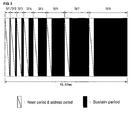
- FIG. 3 illustrates a frame used to represent gray scale of an image in the plasma display apparatus according to the first embodiment of the present invention
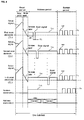
- FIG. 4 illustrates an operation of a driver of the plasma display apparatus according to the first embodiment of the present invention in one subfield
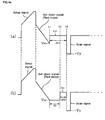
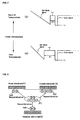
- FIG. 5 illustrates an example of a change in the duration of a period, which ranges from a supply start time point of a scan reference voltage to a supply start time point of a scan signal, in the plasma display apparatus according to the first embodiment of the present invention
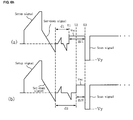
- FIGS. 6a to 6h illustrate an another example of a change in the duration of a period, which ranges from a supply start time point of a scan reference voltage to a supply start time point of a scan signal, in the plasma display apparatus according to the first embodiment of the present invention
- FIG. 7 illustrates a change in the duration of a period ranging from a supply start time point of a scan reference voltage to a supply start time point of a scan signal, depending on a temperature of a plasma display panel in a plasma display apparatus according to a second embodiment of the present invention
- FIG. 8 illustrates a reason to reduce the duration of a period ranging from a supply start time point of a scan reference voltage to a supply start time point of a scan signal when the temperature of the plasma display panel is relatively high;
- FIG. 9 illustrates a change in the duration of a period ranging from a supply start time point of a scan reference voltage to a supply start time point of a scan signal depending on the temperature of the plasma display panel.
- FIG. 10 illustrates the duration of a period ranging from a supply start time point of a scan reference voltage to a supply start time point of a scan signal depending on a highest level voltage of a setup signal in a plasma display apparatus according to a third embodiment of the present invention.
- a plasma display apparatus comprises a plasma display panel comprising a scan electrode, and a scan driver for supplying a driving signal to the scan electrode in a first subfield and a second subfield, wherein the duration of a first period ranging from a supply start time point of a scan reference voltage to a supply start time point of a scan signal in the first subfield is different from the duration of a second period ranging from a supply start time point of a scan reference voltage to a supply start time point of a scan signal in the second subfield.
- the first subfield may be one of a plurality of subfields, and the second subfield may be at least one of the remaining subfields.
- the changes in the duration of the first period and the second period may range from about 1 ⁇ s to about 50 ⁇ s during the period when the scan signal is first supplied to a scan electrode.
- the scan electrode is one of a plurality of scan electrodes.
- the changes in the duration of the first period and the second period may range from about 5 ⁇ s to about 15 ⁇ s during the period when the scan signal is first supplied to a scan electrode.
- the scan electrode is one of a plurality of scan electrodes.
- a difference between the duration of the first period and the duration of the second period may range from about 1 ⁇ s to about 50 ⁇ s.
- a difference between the duration of the first period and the duration of the second period may range from about 10 us to about 30 us.
- a difference between the duration of the first period and the duration of the second period may range from about 15 us to about 25 ⁇ s.
- the duration of the first period and the duration of the second period may be inversely proportional to the duration of a falling period of a set-down signal.
- the duration of the first period and the duration of the second period may be inversely proportional to a lowest level voltage of a set-down signal.
- the duration of the first period and the duration of the second period may be inversely proportional to the duration of a maintenance period of a voltage at a supply end time point of a set-down signal.
- the duration of the first period and the duration of the second period may be inversely proportional to the duration of a maintenance period of a voltage at a supply start time point of a set-down signal.
- the duration of the first period and the duration of the second period may be inversely proportional to the duration of a rising period of a setup signal.
- the duration of the first period and the duration of the second period may be inversely proportional to the duration of a maintenance period of a voltage at a supply end time point of a setup signal.
- the duration of the first period and the duration of the second period may be inversely proportional to the duration of a maintenance period of a voltage at a supply start time point of a setup signal.
- the shift of a supply start time point of a reset signal changes the duration of the first period and the duration of the second period.
- a plasma display apparatus comprises a plasma display panel comprising a scan electrode, and a scan driver for supplying a driving signal to the scan electrode in a first subfield and a second subfield, wherein the duration of a first period ranging from a supply start time point of a scan reference voltage to a supply start time point of a scan signal in the first subfield at a first temperature is different from the duration of a second period ranging from a supply start time point of a scan reference voltage to a supply start time point of a scan signal in the second subfield at a second temperature.
- the duration of the second period may be less than the duration of the first period.
- the first temperature and the second temperature may comprise either an internal temperature of the plasma display panel or an ambient temperature of the plasma display panel.
- a plasma display apparatus comprises a plasma display panel comprising a scan electrode, and a scan driver for supplying a driving signal to the scan electrode in a first subfield and a second subfield, wherein the duration of a first period ranging from a supply start time point of a scan reference voltage to a supply start time point of a scan signal in the first subfield is different from the duration of a second period ranging from a supply start time point of a scan reference voltage to a supply start time point of a scan signal in the second subfield, and wherein the duration of the first period and the duration of the second period depend on a highest level voltage of a setup signal.
- the duration of the second period may be less than the duration of the first period.
- a plasma display apparatus comprises a plasma display panel comprising a scan electrode, and a scan driver for supplying a driving signal to the scan electrode in a first subfield and a second subfield, wherein the duration of a first period ranging from a supply end time point of a set-down signal to a supply start time point of a scan signal in the first subfield is different from the duration of a second period ranging from a supply end time point of a set-down signal to a supply start time point of a scan signal in the second subfield.
- the duration of the second period may be less than the duration of the first period.
- a method of driving a plasma display apparatus comprising a plasma display panel comprising a scan electrode comprises supplying a driving signal to the scan electrode during a first period ranging from a supply end time point of a set-down signal to a supply start time point of a scan signal in a first subfield, and supplying a driving signal to the scan electrode during a second period ranging from a supply end time point of a set-down signal to a supply start time point of a scan signal in a second subfield.
- the duration of the second period may be less than the duration of the first period.
- FIG. 1 illustrates a plasma display apparatus according to a first embodiment of the present invention.
- a plasma display apparatus comprises a plasma display panel 100 and a scan driver 102. Further, the plasma display apparatus may comprise a data driver 101 and a sustain driver 103.
- the data driver 101 supplies a data signal to address electrodes X1 to Xm of the plasma display panel 100 to drive the address electrodes X1 to Xm.
- the scan driver 102 supplies a reset signal, a scan signal, and a sustain signal with a sustain voltage to scan electrodes Y1 to Yn of the plasma display panel 100 to drive the scan electrodes Y1 to Yn.
- the sustain driver 103 supplies a sustain bias voltage and a sustain signal with a sustain voltage to sustain electrodes Z of the plasma display panel 100 to drive the sustain electrodes Z.
- the scan driver 102 and the sustain driver 103 may be integrated with each other and may be formed on a single board. Therefore, an integrated driver for integrating the scan driver 102 and the sustain driver 103 may supply a reset signal, a scan signal and a sustain signal.
- FIG. 2a illustrates a plasma display panel of the plasma display apparatus according to the first embodiment of the present invention.
- FIG. 2b is a diagram for enlarging a portion indicated by a reference symbol A of FIG. 2a.
- the plasma display panel comprises a front panel 200 and a rear panel 210 which are coalesced in parallel to oppose to each other at a given distance therebetween.
- the front panel 200 comprises a front substrate 201 on which a scan electrode 202 and a sustain electrode 203 are formed.
- the rear panel 210 comprises a rear substrate 211 on which an address electrode 213 is formed to intersect the scan electrode 202 and the sustain electrode 203.
- the scan electrode 202 and the sustain electrode 203 formed on the front substrate 201 generate a mutual discharge therebetween within discharge cells for forming discharge spaces and provide a path for discharge maintenance.
- An upper dielectric layer 204 is formed on an upper portion of the front substrate 201 on which the scan electrode 202 and the sustain electrode 203 are formed, thereby covering the scan electrode 202 and the sustain electrode 203.
- the upper dielectric layer 204 limits a discharge current of the scan electrode 202 and the sustain electrode 203, and providing insulation between the scan electrode 202 and the sustain electrode 203.
- a protective layer 205 is formed on an upper surface of the upper dielectric layer 204 to facilitate discharge conditions.
- the protective layer 205 is formed by depositing a material such as MgO on an upper portion of the upper dielectric layer 204.
- the address electrode 213 formed on the rear substrate 211 provides a data supply path for the discharge cells.
- a lower dielectric layer 215 is formed on an upper portion of the rear substrate 211 on which the address electrode 213 is formed, thereby covering the address electrode 213.
- the lower dielectric layer 215 provides insulation between the address electrodes 213.
- a plurality of stripe-type or well-type barrier ribs 212 for forming the discharge cells are formed on an upper portion of the lower dielectric layer 215. Therefore, Red (R), green (G) and blue (B) discharge cells are formed between the front substrate 201 and the rear substrate 211.
- the discharge cells formed by the barrier rib 212 are filled with a predetermined discharge gas.
- a phosphor layer 214 is formed within the discharge cells to emit visible light for displaying an image during the generation of an address discharge. For example, red (R), green (G) and blue (B) phosphor layers 214 may be formed.
- the plasma display apparatus generates the discharge within the discharge cells by supplying a driving voltage to at least one of the scan electrode 202, the sustain electrode 203 or the address electrode 213.
- the discharge gas filled in the discharge cell generates vacuum ultraviolet rays, and the vacuum ultraviolet rays are applied to the phosphor layer 214 formed within the discharge cells.
- the scan electrode 202 and the sustain electrode 203 which comprise only one layer, in FIG. 2a.
- at least one of the scan electrode 202 and the sustain electrode 203 may comprise a plurality of layers. This will be described with reference to FIG. 2b.
- the scan electrode 202 and the sustain electrode 203 each may comprise two layers.
- the scan electrode 202 and the sustain electrode 203 each may comprise transparent electrodes 202a and 203a made of a transparent indium-tin-oxide (ITO) material and bus electrodes 202b and 203b made of an opaque material such as Ag, in consideration of a light transmission rate and electric conductivity.
- ITO transparent indium-tin-oxide
- the reason why the scan electrode 202 and the sustain electrode 203 comprise the transparent electrodes 202a and 203a is to efficiently emit the visible light generated within the discharge cell to the outside of the plasma display panel.
- the reason why the scan electrode 202 and the sustain electrode 203 comprise the bus electrodes 202b and 203b is to prevent a reduction in the driving efficiency.
- the scan electrode 202 and the sustain electrode 203 comprise only the transparent electrodes 202a and 203a
- the transparent electrodes 202a and 203a with relatively low electric conductivity causes a reduction in the driving efficiency of the plasma display apparatus. Therefore, the bus electrodes 202b and 203b compensate the low electric conductivity of the transparent electrodes 202a and 203a.
- FIGS. 2a and 2b The explanation was given of an example of the plasma display panel according to the first embodiment of the present invention in FIGS. 2a and 2b.
- the plasma display panel according to the first embodiment of the present invention is not limited to the plasma display panel with the structure illustrated in FIGS. 2a and 2b.
- at least one of the upper dielectric layer 204 and the lower dielectric layer 215 may comprise a plurality of layers.
- FIG. 3 illustrates a frame used to represent gray scale of an image in the plasma display apparatus according to the first embodiment of the present invention.
- FIG. 4 illustrates an operation of a driver of the plasma display apparatus according to the first embodiment of the present invention in one subfield.
- one frame in the plasma display panel is divided into several subfields whose number of emissions are different from one another.
- each of the subfields comprises a reset period for initializing all of the discharge cells, an address period for selecting cells to be discharged and a sustain period for representing gray scale depending on number of discharges.
- a frame period (16.67 ms) corresponding to 1/60 sec is divided into eight subfields SF1 to SF8.
- the eight subfields SF1 to SF8 each comprise a reset period, an address period and a sustain period.
- the duration of the reset period in a subfield is equal to the duration of the reset periods in the remaining subfields.
- the duration of the address period in a subfield is equal to the duration of the address periods in the remaining subfields.
- Gray level weight of the corresponding subfield is controlled by controlling the number of sustain signals supplied in the sustain period. In other words, gray level weight is given in each of the subfields using the sustain period.
- gray level weight of a first subfield is set to 2°
- gray level weight of a second subfield is set to 2 1 .
- various images are displayed by controlling the number of sustain signals supplied in the sustain period of each of the subfields depending on gray level weight in each of the subfields.
- the plasma display apparatus uses a plurality of frames to display an image during 1 second. For example, 60 frames are used to display an image during 1 second.
- one frame may comprise 12 subfields. Further, one frame may comprise 10 subfields.
- Image quality of the plasma display apparatus for representing gray scale of the image using the frame is controlled by the number of subfields included in the frame.
- gray scale of 2 11 images can be represented.
- gray scale of 2 7 images can be represented.
- the several subfields of one frame were arranged in ascending order of gray level weight in FIG. 3.
- the several subfields may be arranged in descending order of gray level weight.
- the several subfields may be arranged irrespective of gray level weight.
- FIG. 4 An example of operations of the plasma display apparatus in one subfield of the plurality of subfields included in the frame of FIG. 3 is illustrated in FIG. 4.
- one subfields may comprise a reset period comprising a setup period and a set-down period, an address period, and a sustain period.
- a signal supply period for erasing wall charges within the discharge cells is included between the reset period and the address period.
- the scan driver 102 supplies a setup signal with a gradually rising signal to all of the scan electrodes Y1 to Yn in the setup period of the reset period.
- the setup signal generates a weak dark discharge, that is, a setup discharge within the discharge cells.
- the setup discharge accumulates a proper quantity of wall charges within the discharge cells.
- the scan driver 102 supplies a set-down signal, which gradually falls from a voltage less than a peak voltage of the setup signal, to all of the scan electrodes Y1 to Yn in the set-down period of the reset period.
- the set-down signal generates a weak erasure discharge, that is, a set-down discharge within the discharge cells.
- the set-down discharge sufficiently erases the wall charges excessively accumulated within the discharge cells by the setup discharge. As a result, the wall charges uniformly remain within the discharge cells to the degree that there is the generation of a stable address discharge.
- the scan driver 102 sequentially supplies a scan reference voltage Vsc and a scan signal, which falls from the scan reference voltage Vsc to a negative scan voltage -Vy, to all of the scan electrodes Y1 to Yn in the address period which follows the reset period.
- the scan driver 102 supplies a first scan signal to the first scan electrode Y1 and supplies a n-th scan signal to the n-th scan electrode Yn
- the scan driver 102 may randomly supply the scan signal to all of the scan electrodes Y1 to Yn.
- the scan signal may be sequentially supplied to all of the even-numbered scan electrodes
- the scan signal may be sequentially supplied to all of the odd-numbered scan electrodes. Further, the scan signal may be supplied irrespective of the order of the scan signal.
- the scan driver 102 may supply a scan bias voltage being a sum of the scan reference voltage Vsc and the negative scan voltage -Vy.
- the scan driver 102 may supply the scan signal which falls from the scan bias voltage to the negative scan voltage -Vy.
- the scan driver 102 supplies a driving signal to the scan electrode Y in the first subfield and the second subfield.
- a first period ranges from a supply start time point of the scan reference voltage Vsc to a supply start time point of the scan signal in the first subfield.
- a second period ranges from a supply start time point of the scan reference voltage Vsc to a supply start time point of the scan signal in the second subfield. The duration of the first period and the duration of the second period are different from each other.
- the scan driver 102 supplies the driving signal to the first scan electrode Y1 in the first period and the second period whose the durations are different from each other.
- the first subfield is one of the plurality of subfields.
- the second subfield is at least one of the remaining subfields.
- first subfield is included in one of the plurality of frames.
- second subfield is included in at least one of the remaining frames.
- gray level weights of the first subfield and the second subfield may be equal to each other or may be different from each other.
- the duration of a period ⁇ t which ranges from a supply start time point of the scan reference voltage Vsc to a supply start time point of the first scan signal, changes.
- the remaining scan signals are sequentially supplied to the remaining scan electrodes Y2 to Yn, the durations of periods ranging from a supply start time point of the scan reference voltage Vsc to a supply start time point of each of the remaining scan signals may change.
- the scan driver 102 supplies the scan signal with the negative scan voltage -Vy to the scan electrode Y1 to Yn
- the data driver 101 supplies a data signal corresponding to the scan signal to the address electrode X.
- the sustain driver 103 supplies a sustain bias voltage Vzb to the sustain electrode Z in the address period to prevent an erroneous discharge caused by the interference of the sustain electrode Z.
- the wall charges necessary for a sustain discharge when supplying the sustain voltage Vs of the sustain signal are formed within the discharge cells selected by performing the address discharge.
- the scan driver 102 and the sustain driver 103 supply a sustain signal sus to at least one of the scan electrode Y and the sustain electrode Z in the sustain period which follows the address period.
- the scan driver 102 and the sustain driver 103 alternately supply the sustain signal sus to the scan electrode Y and the sustain electrode Z.
- the scan driver 102 and the sustain driver 103 may alternately supply the sustain signal sus, which swings from a voltage of Vs/2 to a voltage of -Vs/2, to the scan electrode Y and the sustain electrode Z.
- an integrated driver may supply the sustain signal sus to the scan electrode Y or the sustain electrode Z.
- the swing width of the sustain signal sus may range from a voltage of Vs to a voltage of -Vs.
- a sustain discharge that is, a display discharge
- the scan electrode Y and the sustain electrode Z whenever the sustain signal sus is supplied.
- a predetermined image is displayed on the plasma display panel.
- a change in the duration of the period ⁇ t, which ranges from the supply start time point of the scan reference voltage Vsc to the supply start time point of the scan signal, will be described with reference to FIG. 5 and FIGS. 6a to 6h.
- FIG. 5 illustrates an example of a change in the duration of a period, which ranges from a supply start time point of a scan reference voltage to a supply start time point of a scan signal, in the plasma display apparatus according to the first embodiment of the present invention.
- FIGS. 6a to 6h illustrate an another example of a change in the duration of a period, which ranges from a supply start time point of a scan reference voltage to a supply start time point of a scan signal, in the plasma display apparatus according to the first embodiment of the present invention.
- the duration of the first period and the duration of the second period are inversely proportional to the duration of a falling period of the set-down signal.
- the duration of the falling period of the set-down signal in the second subfield is more than the duration of the falling period of the set-down signal in the first subfield.
- the duration of a period which ranges from a supply start time point of the scan reference voltage Vsc to a supply start time point t1 of the scan signal, decreases.
- the supply time point t1 of the scan signal in the first subfield as illustrated in (a) of FIG. 5 approximately equals to the supply time point t1 of the scan signal in the second subfield as illustrated in (b) of FIG. 5.
- a lowest voltage V1 of the set-down signal at a supply end time point of the set-down signal in the first subfield approximately equals to a lowest voltage V1 of the set-down signal at a supply end time point of the set-down signal in the second subfield.
- the driving signal is supplied to the same scan electrode in the first subfield and the second subfield.
- the first period ranging from the supply start time point of the scan reference voltage Vsc to a supply start time point t1 of the scan signal is set to ⁇ t1.
- the second period ranging from a supply start time point t2 of the scan reference voltage Vsc to the supply start time point t1 of the scan signal is set to ⁇ t2 shorter than ⁇ t1.
- the scan driver 102 supplies the driving signal, in which the duration of the supply period of the set-down signal equals to d1 and the duration of the first period equals to ⁇ t1, to the scan electrode Y in the first subfield. Further, the scan driver 102 supplies the driving signal, in which the duration of the supply period of the set-down signal equals to d2 longer than d1 and the duration of the first period equals to ⁇ t2 shorter than ⁇ t1, to the scan electrode Y, which equals to the scan electrode Y supplied in the first subfield, in the second subfield.
- the scan signal is supplied to the first scan electrode Y1 after the lapse of time of ⁇ t from the supply start time point of the scan reference voltage Vsc.
- the scan signal is supplied to the first scan electrode Y1 after the lapse of time of ⁇ t from a supply end time point of the discharge generated by the set-down signal in the reset period.
- the wall charges produced by the discharge generated by the set-down signal in the reset period are combined with space charges having a space within the discharge cells, such that the wall charges are neutralized.
- the quantity of wall charges after the lapse of 5 us is more than the quantity of wall charges after the lapse of 15 ⁇ s.
- the distribution of the wall charges within the discharge cells can be controlled at the supply start time point t1 of the scan signal, that is, at a generation start time point of the address discharge.
- the intensity of the address discharge generated by the scan signal and the data signal excessively increases.
- the address discharge with the excessively great intensity is generated such that an erroneous address discharge is generated.
- the change in the duration of the falling period of the set-down signal changes the duration of the period At ranging from the supply start time point of the scan reference voltage Vsc to the supply start time point t1 of the scan signal.
- the duration of the first period and the duration of the second period are inversely proportional to the lowest level voltage of the set-down signal in the reset period.
- the duration of the falling period of the set-down signal increases by increasing a magnitude of the lowest voltage of the set-down signal from V1 to V2.
- the supply start time point of the scan reference voltage Vsc is changed from t1 in the first subfield to t2 in the second subfield.
- the duration of the period ⁇ t2 ranging from the supply start time point t2 of the scan reference voltage Vsc to the supply start time point t3 of the scan signal in the second subfield is less than the duration of the period ⁇ t1 in the first subfield.
- the scan driver 102 supplies the driving signal in which the lowest voltage of the set-down signal equals to V1 and the first period equals to ⁇ t1 in the first subfield, and the driving signal in which the lowest voltage of the set-down signal equals to V2 and the second period equals to ⁇ t2 with the duration less than the duration of the first period ⁇ t1 less than the first period in the second subfield, to the scan electrode Y.
- the duration of the first period and the duration of the second period are inversely proportional to the duration of a maintenance period of a voltage at a supply start time point of the set-down signal.
- the scan driver 102 supplies the driving signal in which the maintenance period of the voltage V10 at the supply start time point of the set-down signal does not exist and the first period equals to ⁇ t1 in the first subfield, and the driving signal in which the maintenance period of the voltage V10 at the supply start time point of the set-down signal equals to d2 and the second period equals to ⁇ t2 with the duration less than the duration of the first period ⁇ t1 in the second subfield, to the scan electrode Y.
- the duration of the first period and the duration of the second period are inversely proportional to the duration of a maintenance period of a voltage at a supply end time point of the set-down signal.
- the duration of the maintenance period of the voltage at the supply end time point of the set-down signal changes and the duration of the period ranging from the supply start time point of the scan reference voltage Vsc to the supply start time point t3 of the scan signal changes.
- the scan driver 102 supplies the driving signal in which the maintenance period of the voltage at the supply end time point of the set-down signal does not exist and the first period equals to ⁇ t1 in the first subfield, and the driving signal in which the maintenance period of the lowest voltage V20 of the set-down signal equals to d2 and the second period equals to ⁇ t2 with the duration less than the duration of the first period ⁇ t1 in the second subfield, to the scan electrode Y.
- the duration of the first period and the duration of the second period are inversely proportional to the duration of a rising period of the setup signal in the reset period.
- the rising period of the setup signal is set to d1 and the first period ranging from the supply start time point t1 of the scan reference voltage Vsc to the supply start time point t3 of the scan signal equals to ⁇ t1.
- the rising period of the setup signal is set to d2 with the duration longer than the duration of the rising period d1 and the second period ranging from the supply start time point t2 of the scan reference voltage Vsc to the supply start time point t3 of the scan signal equals to ⁇ t2 with the duration less than the duration of the first period ⁇ t1.
- the duration of the period ranging from the supply start time point of the scan reference voltage Vsc to the supply start time point t3 of the scan signal decreases by relatively decreasing the slope of the setup signal.
- the duration of the first period and the duration of the second period are inversely proportional to the duration of a maintenance period of a voltage at a supply end time point of the setup signal in the reset period.
- the maintenance period of the voltage V30 at the supply end time point of the setup signal is changed from d1 to d2 and the duration of the period ranging from the supply start time point of the scan reference voltage Vsc to the supply start time point t3 of the scan signal changes.
- the first period ranging from the supply start time point t1 of the scan reference voltage Vsc to the supply start time point t3 of the scan signal equals to ⁇ t1.
- the duration of the period ranging from the supply start time point of the scan reference voltage Vsc to the supply start time point t3 of the scan signal decreases by relatively increasing the duration of the maintenance period of the voltage at the supply end time point of the setup signal.
- the duration of the first period and the duration of the second period are inversely proportional to the duration of a maintenance period of a voltage at a supply start time point of the setup signal in the reset period.
- the maintenance period of the voltage V40 at the supply start time point of the setup signal changes and the duration of the period ranging from the supply start time point of the scan reference voltage Vsc to the supply start time point t3 of the scan signal changes.
- the first period ranging from the supply start time point t1 of the scan reference voltage Vsc to the supply start time point t3 of the scan signal equals to ⁇ t1.
- the duration of the period ranging from the supply start time point of the scan reference voltage Vsc to the supply start time point t3 of the scan signal decreases by relatively increasing the duration of the maintenance period of the voltage at the supply start time point of the setup signal.
- the shift of a supply start time point of the reset signal in the reset period changes the duration of the first period and the duration of the second period.
- the supply start time point of the reset signal is shifted by the duration of a period d2 and the duration of the period ranging from the supply start time point of the scan reference voltage Vsc to the supply start time point t3 of the scan signal changes.
- the first period ranging from the supply start time point t1 of the scan reference voltage Vsc to the supply start time point t3 of the scan signal equals to ⁇ t1.
- the second period ranging from the supply start time point t2 of the scan reference voltage Vsc to the supply start time point t3 of the scan signal equals to ⁇ t2 with the duration less than the duration of the first period ⁇ t1.
- the supply start time point of the reset signal is changeable, the supply start time point of the reset signal is shifted such that the duration of the period ranging from the supply start time point of the scan reference voltage Vsc to the supply start time point t3 of the scan signal relatively decreases.
- the duration of the period ranging from the supply start time point of the scan reference voltage Vsc to the supply start time point t3 of the scan signal changes by changing the duration of the stabilization period.
- a stabilization periods d1 and d2 where a signal for properly reducing the wall charges is supplied to the scan electrode Y, may be added between the reset period and the address period.
- the period ranging from the supply start time point of the scan reference voltage Vsc to the supply start time point t3 of the scan signal is changed from ⁇ t1 to ⁇ t1 by changing the duration of the stabilization period from d1 to d2.
- the duration of the period ranging from the supply start time point of the scan reference voltage Vsc to the supply start time point t3 of the scan signal decreases by relatively increasing the duration of the stabilization period.
- the signal in the stabilization period may be alternately supplied to the scan electrode and the sustain electrode. Further, the signal in the stabilization period may be supplied in the form of a square wave other than a ramp form.
- the duration of the period ranging from the supply start time point of the scan reference voltage Vsc to the supply start time point t3 of the scan signal changes by various methods.
- the duration of the period ranging from the supply start time point of the scan reference voltage Vsc to the supply start time point t3 of the scan signal is changeable by combining the above-described examples.
- the sustain bias voltage Vzb synchronized with the scan reference voltage Vsc supplied to the scan electrode may be supplied to the sustain electrode.
- the changes in the duration of the first period and the second period range from about 1 ⁇ s to about 50 ⁇ s during the period when the scan signal is first supplied to a scan electrode.
- the scan electrode is one of a plurality of scan electrodes.
- the changes in the duration of the first period and the second period of the driving signal supplied to the first scan electrode Y1 ranges from 1 ⁇ s to about 50 ⁇ s.
- the changes in the duration of the first period and the second period range from about 1 ⁇ s to about 50 ⁇ s during the period when the scan signal is first supplied to a scan electrode.
- the scan electrode is one of a plurality of scan electrodes.
- the duration of the first period and the second period changes in the range of about 1 ⁇ s or more, a period for efficiently controlling the quantity of wall charges within the discharge cells is secured and a period for performing the stable address discharge is also secured.
- the duration of the first period and the duration of the second period change in the range of about 50 ⁇ s or less, a period for efficiently controlling the quantity of wall charges within the discharge cells is secured and a minimum margin for a driving period of the driving signal is also secured.
- the changes in the duration of the first period and the second period range from about 5 ⁇ s to about 15 ⁇ s during the period when the scan signal is first supplied to a scan electrode.
- the scan electrode is one of a plurality of scan electrodes.
- a period for more efficiently controlling the quantity of wall charges within the discharge cells is secured under the various conditions such as a pressure, a temperature, a mixed state of a gas within the plasma display panel and a period for performing the more stable address discharge is also secured.
- a period for more efficiently controlling the quantity of wall charges within the discharge cells is secured under the various conditions such as a pressure, a temperature, a mixed state of a gas within the plasma display panel and a proper margin for a driving period of the driving signal is also secured.
- a difference between the duration of the first period and the duration of the second period ranges from about 1 ⁇ s to about 50 ⁇ s.
- the difference between the duration of the first period and the duration of the second period is about 1 ⁇ s or more, the minimum duration of a period for controlling the quantity of wall charges within the discharge cells is secured.
- the difference between the duration of the first period and the duration of the second period is about 50 ⁇ s or less, a period for controlling the quantity of wall charges within the discharge cells is secured and a minimum driving margin for a driving period of the driving signal is also secured.
- a difference between the duration of the first period and the duration of the second period ranges from about 5 ⁇ s to about 30 ⁇ s.
- the difference between the duration of the first period and the duration of the second period is about 5 ⁇ s or more, a period for efficiently controlling the quantity of wall charges within the discharge cells is secured. Since the difference between the duration of the first period and the duration of the second period is about 30 ⁇ s or less, a proper driving margin for all of the driving periods is secured and the quantity of wall charges is properly controlled.
- a difference between the duration of the first period and the duration of the second period ranges from about 10 ⁇ s to about 25 ⁇ s.
- the difference between the duration of the first period and the duration of the second period is about 10 ⁇ s or more, a period for more efficiently controlling the quantity of wall charges within the discharge cells is secured. Since the difference between the duration of the first period and the duration of the second period is about 25 ⁇ s or less, a more proper driving margin is secured and the quantity of wall charges is more properly controlled.
- the duration of the period ranging from the supply start time point of the scan reference voltage Vsc to the supply start time point t3 of the scan signal changes depending on a temperature of the plasma display panel.
- FIG. 7 illustrates a change in the duration of a period ranging from a supply start time point of a scan reference voltage to a supply start time point of a scan signal, depending on a temperature of a plasma display panel in a plasma display apparatus according to a second embodiment of the present invention.
- a plasma display apparatus comprises a plasma display panel comprising a scan electrode, and a scan driver for supplying a driving signal to the scan electrode in a first subfield and a second subfield.
- the duration of a first period ranging from a supply start time point of a scan reference voltage to a supply start time point of a scan signal in the first subfield at a first temperature is different from the duration of a second period ranging from a supply start time point of a scan reference voltage to a supply start time point of a scan signal in the second subfield at a second temperature.
- the first temperature and the second temperature comprise either an internal temperature of the plasma display panel or an ambient temperature of the plasma display panel.
- the duration of the second period is less than the duration of the first period.
- the duration of the period ranging from the supply start time point of the scan reference voltage Vsc to the supply start time point of the scan signal changes.
- the first period ranging from the supply start time point of the scan reference voltage Vsc to the supply start time point of the scan signal is set to ⁇ t1.
- the second period ranging from the supply start time point of the scan reference voltage Vsc to the supply start time point of the scan signal is set to ⁇ t2 with the duration less than the duration of the first period ⁇ t1.
- the scan signal is scanned more accurately.
- FIG. 8 illustrates a reason to reduce the duration of a period ranging from a supply start time point of a scan reference voltage to a supply start time point of a scan signal when the temperature of the plasma display panel is relatively high.
- wall charges 800 and space charges 801 exist within discharge cells surrounded by a scan electrode Y, a sustain electrode Z and an address electrode X of the plasma display panel.
- the wall charges 800 may be produced by leading and then disposing the space charges 801 on the scan electrode Y, the sustain electrode Z or the address electrode X.
- thermal energy is supplied to the wall charges 800 and the space charges 801 within the discharge cells such that the wall charges 800 and the space charges 801 actively move.
- the wall charges 800 and the space charges 801 are recombined such that a neutralization rate of the wall charges 800 and the space charges 801 increases and the quantity of wall charges within the discharge cells decreases.
- the duration of the period ranging from the supply start time point of the scan reference voltage Vsc to the supply start time point of the scan signal relatively decreases.
- the sufficient quantity of wall charges remains within the discharge cell at the supply start time point of the scan signal, that is, at a generation time point of the address discharge such that an erroneous address discharge is prevented.
- the duration of the period ranging from the supply start time point of the scan reference voltage Vsc to the supply start time point of the scan signal relatively increases.
- the quantity of wall charges sufficiently decreases at the supply start time point of the scan signal, that is, at a generation time point of the address discharge such that an erroneous address discharge is prevented.
- FIG. 9 illustrates a change in the duration of a period ranging from a supply start time point of a scan reference voltage to a supply start time point of a scan signal depending on the temperature of the plasma display panel.
- a plurality of critical temperatures for example, a first temperature, a second temperature, a third temperature, a fourth temperature, and a fifth temperature are set and the temperature of the plasma display panel comprises the critical temperatures
- the duration of the period ranging from the supply start time point of the scan reference voltage to the supply start time point of the scan signal changes.
- the period ranging from the supply start time point of the scan reference voltage Vsc to the supply start time point of the scan signal is set to ⁇ t1.
- the period ranging from the supply start time point of the scan reference voltage Vsc to the supply start time point of the scan signal is set to ⁇ t2 with the duration less than the duration of the period ⁇ t1.
- the period ranging from the supply start time point of the scan reference voltage Vsc to the supply start time point of the scan signal is set to ⁇ t3 with the duration less than the duration of the period ⁇ t2.
- the period ranging from the supply start time point of the scan reference voltage Vsc to the supply start time point of the scan signal is set to ⁇ t4, ⁇ t5 and ⁇ t6.
- the changes in the duration of the period ranging from the supply start time point of the scan reference voltage Vsc to the supply start time point of the scan signal range from about 1 ⁇ s to about 50 ⁇ s during the period when the scan signal is first supplied to a scan electrode.
- the scan electrode is one of a plurality of scan electrodes.
- the changes in the duration of the period ranging from the supply start time point of the scan reference voltage Vsc to the supply start time point of the scan signal range from about 5 ⁇ s to about 15 ⁇ s during the period when the scan signal is first supplied to a scan electrode.
- the scan electrode is one of a plurality of scan electrodes.
- FIG. 10 illustrates the duration of a period ranging from a supply start time point of a scan reference voltage to a supply start time point of a scan signal depending on a highest level voltage of a setup signal in a plasma display apparatus according to a third embodiment of the present invention.
- a plasma display apparatus a plasma display panel comprising a scan electrode, and a scan driver for supplying a driving signal to the scan electrode in a first subfield and a second subfield.
- the duration of a first period ranging from a supply start time point of a scan reference voltage to a supply start time point of a scan signal in the first subfield is different from the duration of a second period ranging from a supply start time point of a scan reference voltage to a supply start time point of a scan signal in the second subfield, depending on a highest level voltage of a setup signal.
- the duration of the second period is less than the duration of the first period.
- a highest level voltage of a setup signal in a reset period of a first subfield is more than a highest level voltage of a setup signal in reset periods of the remaining subfields.
- the duration of a period ranging from a supply start time point of a scan reference voltage Vsc to a supply start time point of a scan signal in at least one subfield of a plurality of subfields of one frame is different from the duration of a period ranging from a supply start time point of a scan reference voltage Vsc to a supply start time point of a scan signal in another subfield.
- one frame comprises seven subfields SF1 to SF7 and the seven subfields SF1 to SF7 are arranged in ascending order of gray level weight.
- a second period ranging from a supply start time point of a scan reference voltage Vsc to a supply start time point of a scan signal in the sixth subfield SF6 is set to ⁇ t2.
- a setup signal with a relatively high voltage is used in the reset period of the subfield with relatively low gray level weight for the purpose of the generation of the stable discharge.
- the initialization is completely performed by using the setup signal with the relatively high voltage in the subfield with relatively low gray level weight such that the whole discharge is stable.
- the setup signal may be omitted in the subfield with relatively high gray level weight.
- the setup signal with the relatively high voltage is omitted or is not illustrated in the attached drawings, the quantity of wall charges within the discharge cells is not sufficient in the reset period using the setup signal with the relatively low voltage.
- the duration of the period ranging from the supply start time point of the scan reference voltage Vsc to the supply start time point of the scan signal decreases in the subfield with relatively high gray level weight. Accordingly, the wall charge sufficiently remain within the discharge cells at the supply start time point of the scan signal, that is, the generation start time point of the address discharge such that the erroneous address discharge is prevented.
- the changes in the duration of the first period and the second period range from about 1 ⁇ s to about 50 ⁇ s during the period when the scan signal is first supplied to a scan electrode.
- the scan electrode is one of a plurality of scan electrodes.
- the changes in the duration of the first period and the second period range from about 5 us to about 15 us during the period when the scan signal is first supplied to a scan electrode.
- the scan electrode is one of a plurality of scan electrodes.
- the plasma display apparatus comprises a plasma display panel comprising a scan electrode, and a scan driver for supplying a driving signal to the scan electrode in a first subfield and a second subfield.
- the duration of a first period ranging from a supply end time point of a set-down signal to a supply start time point of a scan signal in the first subfield is different from the duration of a second period ranging from a supply end time point of a set-down signal to a supply start time point of a scan signal in the second subfield.
- the duration of the second period is less than the duration of the first period.
- the duration of the period ranging from the supply end time point of the set-down signal to the supply start time point of the scan signal can change using all of the example described in the first, second and third embodiments except the example illustrated in FIG. 6c. Further, the duration of the period ranging from the supply end time point of the set-down signal to the supply start time point of the scan signal can change the highest voltage of the setup signal.
Landscapes
- Engineering & Computer Science (AREA)
- Physics & Mathematics (AREA)
- Power Engineering (AREA)
- Plasma & Fusion (AREA)
- Computer Hardware Design (AREA)
- General Physics & Mathematics (AREA)
- Theoretical Computer Science (AREA)
- Control Of Indicators Other Than Cathode Ray Tubes (AREA)
- Control Of Gas Discharge Display Tubes (AREA)
Applications Claiming Priority (1)
| Application Number | Priority Date | Filing Date | Title |
|---|---|---|---|
| KR1020060025887A KR100784567B1 (ko) | 2006-03-21 | 2006-03-21 | 플라즈마 디스플레이 장치 |
Publications (2)
| Publication Number | Publication Date |
|---|---|
| EP1837849A2 true EP1837849A2 (fr) | 2007-09-26 |
| EP1837849A3 EP1837849A3 (fr) | 2008-01-23 |
Family
ID=38169315
Family Applications (1)
| Application Number | Title | Priority Date | Filing Date |
|---|---|---|---|
| EP06291270A Withdrawn EP1837849A3 (fr) | 2006-03-21 | 2006-08-04 | Appareil d'affichage à plasma |
Country Status (4)
| Country | Link |
|---|---|
| US (1) | US20070222708A1 (fr) |
| EP (1) | EP1837849A3 (fr) |
| KR (1) | KR100784567B1 (fr) |
| CN (1) | CN101042838B (fr) |
Families Citing this family (3)
| Publication number | Priority date | Publication date | Assignee | Title |
|---|---|---|---|---|
| KR100857677B1 (ko) * | 2007-04-23 | 2008-09-08 | 삼성에스디아이 주식회사 | Pdp 구동 회로, pdp 구동 방법 및 플라즈마디스플레이 장치 |
| KR101219479B1 (ko) * | 2008-10-01 | 2013-01-11 | 주식회사 오리온 | 플라즈마 디스플레이 패널의 구동방법 |
| CN107818760B (zh) * | 2016-09-14 | 2019-11-19 | 上海和辉光电有限公司 | 显示装置的显示方法、显示面板及显示装置 |
Citations (6)
| Publication number | Priority date | Publication date | Assignee | Title |
|---|---|---|---|---|
| US20030030599A1 (en) | 2001-08-13 | 2003-02-13 | Lg Electronics, Inc. | Driving method of plasma display panel |
| KR20030088536A (ko) | 2002-05-11 | 2003-11-20 | 엘지전자 주식회사 | 플라즈마 디스플레이 패널의 구동방법 및 장치 |
| KR20040078399A (ko) | 2003-03-04 | 2004-09-10 | 엘지전자 주식회사 | 플라즈마 디스플레이 패널의 구동 방법 및 장치 |
| WO2004114271A1 (fr) | 2003-06-24 | 2004-12-29 | Matsushita Electric Industrial Co., Ltd. | Appareil a ecran plasma et procede de commande de celui-ci |
| KR20050012467A (ko) | 2003-07-25 | 2005-02-02 | 엘지전자 주식회사 | 플라즈마 디스플레이 패널의 구동방법 및 장치 |
| US20050068262A1 (en) | 2003-08-29 | 2005-03-31 | Nec Plasma Display Corporation | Plasma display device and method for driving the same |
Family Cites Families (13)
| Publication number | Priority date | Publication date | Assignee | Title |
|---|---|---|---|---|
| KR100381270B1 (ko) * | 2001-05-10 | 2003-04-26 | 엘지전자 주식회사 | 플라즈마 디스플레이 패널의 구동방법 |
| CN1623177A (zh) * | 2001-05-30 | 2005-06-01 | 皇家菲利浦电子有限公司 | 用于驱动显示屏的方法和设备 |
| KR100477602B1 (ko) * | 2002-04-22 | 2005-03-18 | 엘지전자 주식회사 | 플라즈마 디스플레이 패널의 구동방법 |
| KR20040056047A (ko) * | 2002-12-23 | 2004-06-30 | 엘지전자 주식회사 | 선택적 쓰기 및 소거를 이용한 플라즈마 디스플레이패널의 구동방법 및 장치 |
| EP1505625A3 (fr) * | 2003-08-06 | 2007-08-08 | LG Electronics Inc. | Panneau d'affichage à plasma, méthode et appareil pour le commander |
| KR100551125B1 (ko) * | 2003-12-31 | 2006-02-13 | 엘지전자 주식회사 | 플라즈마 디스플레이 패널의 구동방법 및 장치 |
| JP4565877B2 (ja) * | 2004-04-16 | 2010-10-20 | 日立プラズマディスプレイ株式会社 | プラズマディスプレイ装置 |
| KR100521471B1 (ko) * | 2004-05-28 | 2005-10-13 | 삼성에스디아이 주식회사 | 서브필드 위치 변동 방지를 위한 플라즈마 디스플레이패널의 구동 방법 및 그 장치 |
| CN100395798C (zh) * | 2004-09-03 | 2008-06-18 | 南京Lg同创彩色显示系统有限责任公司 | 等离子显示器的驱动方法及装置 |
| US7639214B2 (en) * | 2004-11-19 | 2009-12-29 | Lg Electronics Inc. | Plasma display apparatus and driving method thereof |
| KR100646187B1 (ko) * | 2004-12-31 | 2006-11-14 | 엘지전자 주식회사 | 플라즈마 디스플레이 패널의 구동방법 |
| KR100644833B1 (ko) * | 2004-12-31 | 2006-11-14 | 엘지전자 주식회사 | 플라즈마 표시장치와 그 구동방법 |
| KR100647688B1 (ko) * | 2005-04-19 | 2006-11-23 | 삼성에스디아이 주식회사 | 플라즈마 디스플레이 패널 구동방법 |
-
2006
- 2006-03-21 KR KR1020060025887A patent/KR100784567B1/ko not_active Expired - Fee Related
- 2006-08-04 EP EP06291270A patent/EP1837849A3/fr not_active Withdrawn
- 2006-08-10 US US11/501,709 patent/US20070222708A1/en not_active Abandoned
- 2006-08-11 CN CN2006101110080A patent/CN101042838B/zh not_active Expired - Fee Related
Patent Citations (6)
| Publication number | Priority date | Publication date | Assignee | Title |
|---|---|---|---|---|
| US20030030599A1 (en) | 2001-08-13 | 2003-02-13 | Lg Electronics, Inc. | Driving method of plasma display panel |
| KR20030088536A (ko) | 2002-05-11 | 2003-11-20 | 엘지전자 주식회사 | 플라즈마 디스플레이 패널의 구동방법 및 장치 |
| KR20040078399A (ko) | 2003-03-04 | 2004-09-10 | 엘지전자 주식회사 | 플라즈마 디스플레이 패널의 구동 방법 및 장치 |
| WO2004114271A1 (fr) | 2003-06-24 | 2004-12-29 | Matsushita Electric Industrial Co., Ltd. | Appareil a ecran plasma et procede de commande de celui-ci |
| KR20050012467A (ko) | 2003-07-25 | 2005-02-02 | 엘지전자 주식회사 | 플라즈마 디스플레이 패널의 구동방법 및 장치 |
| US20050068262A1 (en) | 2003-08-29 | 2005-03-31 | Nec Plasma Display Corporation | Plasma display device and method for driving the same |
Also Published As
| Publication number | Publication date |
|---|---|
| KR100784567B1 (ko) | 2007-12-11 |
| CN101042838B (zh) | 2010-06-09 |
| EP1837849A3 (fr) | 2008-01-23 |
| CN101042838A (zh) | 2007-09-26 |
| US20070222708A1 (en) | 2007-09-27 |
| KR20070095582A (ko) | 2007-10-01 |
Similar Documents
| Publication | Publication Date | Title |
|---|---|---|
| US20060145955A1 (en) | Plasma display apparatus and driving method thereof | |
| EP1837849A2 (fr) | Appareil d'affichage à plasma | |
| CN101331577B (zh) | 等离子体显示设备及驱动pdp的方法 | |
| CN101632114B (zh) | 等离子体显示装置 | |
| US20060007064A1 (en) | Plasma display apparatus and driving method thereof | |
| US20070216605A1 (en) | Method of driving plasma display apparatus | |
| US20070216603A1 (en) | Method of driving plasma display apparatus | |
| JP2006011459A5 (fr) | ||
| KR100645783B1 (ko) | 플라즈마 표시장치 및 그 구동방법 | |
| KR100811549B1 (ko) | 플라즈마 디스플레이 장치 | |
| KR100531795B1 (ko) | 플라즈마 디스플레이 패널 구동 방법 | |
| US20080055204A1 (en) | Plasma display apparatus and method of driving the same | |
| KR100533725B1 (ko) | 플라즈마 디스플레이 패널의 구동방법 및 장치 | |
| US8098216B2 (en) | Plasma display apparatus and driving method thereof | |
| EP1947630A2 (fr) | Appareil d'affichage à plasma | |
| KR100667361B1 (ko) | 플라즈마 표시장치 | |
| KR100560513B1 (ko) | 플라즈마 디스플레이 패널의 구동 방법 및 플라즈마 표시장치 | |
| CN100466040C (zh) | 等离子显示装置及其驱动方法 | |
| KR20050051363A (ko) | 플라즈마 디스플레이 패널의 구동 방법 및 플라즈마 표시장치 | |
| KR20080055334A (ko) | 플라즈마 디스플레이 패널 | |
| KR20090074477A (ko) | 플라즈마 디스플레이 장치 | |
| KR20080101428A (ko) | 플라즈마 디스플레이 장치 및 그의 구동방법 | |
| KR20060091200A (ko) | 플라즈마 디스플레이 패널 구동장치 | |
| KR20060065383A (ko) | 플라즈마 디스플레이 패널 | |
| KR20060084758A (ko) | 플라즈마 디스플레이 패널 구동 장치 및 방법 |
Legal Events
| Date | Code | Title | Description |
|---|---|---|---|
| PUAI | Public reference made under article 153(3) epc to a published international application that has entered the european phase |
Free format text: ORIGINAL CODE: 0009012 |
|
| 17P | Request for examination filed |
Effective date: 20060822 |
|
| AK | Designated contracting states |
Kind code of ref document: A2 Designated state(s): AT BE BG CH CY CZ DE DK EE ES FI FR GB GR HU IE IS IT LI LT LU LV MC NL PL PT RO SE SI SK TR |
|
| AX | Request for extension of the european patent |
Extension state: AL BA HR MK YU |
|
| PUAL | Search report despatched |
Free format text: ORIGINAL CODE: 0009013 |
|
| AK | Designated contracting states |
Kind code of ref document: A3 Designated state(s): AT BE BG CH CY CZ DE DK EE ES FI FR GB GR HU IE IS IT LI LT LU LV MC NL PL PT RO SE SI SK TR |
|
| AX | Request for extension of the european patent |
Extension state: AL BA HR MK YU |
|
| AKX | Designation fees paid |
Designated state(s): DE FR GB NL |
|
| 17Q | First examination report despatched |
Effective date: 20081222 |
|
| STAA | Information on the status of an ep patent application or granted ep patent |
Free format text: STATUS: THE APPLICATION IS DEEMED TO BE WITHDRAWN |
|
| 18D | Application deemed to be withdrawn |
Effective date: 20130301 |