EP1837862A1 - Verfahren und Vorrichtung zur Lärmdämmung an Bord eines Luftschiffs - Google Patents
Verfahren und Vorrichtung zur Lärmdämmung an Bord eines Luftschiffs Download PDFInfo
- Publication number
- EP1837862A1 EP1837862A1 EP07005657A EP07005657A EP1837862A1 EP 1837862 A1 EP1837862 A1 EP 1837862A1 EP 07005657 A EP07005657 A EP 07005657A EP 07005657 A EP07005657 A EP 07005657A EP 1837862 A1 EP1837862 A1 EP 1837862A1
- Authority
- EP
- European Patent Office
- Prior art keywords
- noise
- cabin
- loudspeaker
- signals
- frequency
- Prior art date
- Legal status (The legal status is an assumption and is not a legal conclusion. Google has not performed a legal analysis and makes no representation as to the accuracy of the status listed.)
- Withdrawn
Links
- 238000000034 method Methods 0.000 title claims abstract description 19
- 238000005259 measurement Methods 0.000 claims abstract description 19
- 238000012545 processing Methods 0.000 claims abstract description 19
- 230000035807 sensation Effects 0.000 claims description 8
- 238000001914 filtration Methods 0.000 claims description 4
- 238000004422 calculation algorithm Methods 0.000 claims description 3
- 238000011161 development Methods 0.000 claims description 2
- 230000006870 function Effects 0.000 description 4
- 239000012528 membrane Substances 0.000 description 4
- 238000001228 spectrum Methods 0.000 description 4
- 230000006978 adaptation Effects 0.000 description 2
- 230000002238 attenuated effect Effects 0.000 description 2
- 230000000875 corresponding effect Effects 0.000 description 2
- 230000010354 integration Effects 0.000 description 2
- 101100536354 Drosophila melanogaster tant gene Proteins 0.000 description 1
- 230000003321 amplification Effects 0.000 description 1
- 230000003416 augmentation Effects 0.000 description 1
- 238000004364 calculation method Methods 0.000 description 1
- 210000004027 cell Anatomy 0.000 description 1
- 238000004891 communication Methods 0.000 description 1
- 230000001276 controlling effect Effects 0.000 description 1
- 230000002596 correlated effect Effects 0.000 description 1
- 238000013016 damping Methods 0.000 description 1
- 230000003247 decreasing effect Effects 0.000 description 1
- 238000004519 manufacturing process Methods 0.000 description 1
- 238000003199 nucleic acid amplification method Methods 0.000 description 1
- 238000005192 partition Methods 0.000 description 1
- 238000009738 saturating Methods 0.000 description 1
Images


Classifications
-
- G—PHYSICS
- G10—MUSICAL INSTRUMENTS; ACOUSTICS
- G10K—SOUND-PRODUCING DEVICES; METHODS OR DEVICES FOR PROTECTING AGAINST, OR FOR DAMPING, NOISE OR OTHER ACOUSTIC WAVES IN GENERAL; ACOUSTICS NOT OTHERWISE PROVIDED FOR
- G10K11/00—Methods or devices for transmitting, conducting or directing sound in general; Methods or devices for protecting against, or for damping, noise or other acoustic waves in general
- G10K11/16—Methods or devices for protecting against, or for damping, noise or other acoustic waves in general
- G10K11/175—Methods or devices for protecting against, or for damping, noise or other acoustic waves in general using interference effects; Masking sound
- G10K11/178—Methods or devices for protecting against, or for damping, noise or other acoustic waves in general using interference effects; Masking sound by electro-acoustically regenerating the original acoustic waves in anti-phase
- G10K11/1785—Methods, e.g. algorithms; Devices
- G10K11/17853—Methods, e.g. algorithms; Devices of the filter
- G10K11/17854—Methods, e.g. algorithms; Devices of the filter the filter being an adaptive filter
-
- G—PHYSICS
- G10—MUSICAL INSTRUMENTS; ACOUSTICS
- G10K—SOUND-PRODUCING DEVICES; METHODS OR DEVICES FOR PROTECTING AGAINST, OR FOR DAMPING, NOISE OR OTHER ACOUSTIC WAVES IN GENERAL; ACOUSTICS NOT OTHERWISE PROVIDED FOR
- G10K11/00—Methods or devices for transmitting, conducting or directing sound in general; Methods or devices for protecting against, or for damping, noise or other acoustic waves in general
- G10K11/16—Methods or devices for protecting against, or for damping, noise or other acoustic waves in general
- G10K11/175—Methods or devices for protecting against, or for damping, noise or other acoustic waves in general using interference effects; Masking sound
- G10K11/178—Methods or devices for protecting against, or for damping, noise or other acoustic waves in general using interference effects; Masking sound by electro-acoustically regenerating the original acoustic waves in anti-phase
- G10K11/1781—Methods or devices for protecting against, or for damping, noise or other acoustic waves in general using interference effects; Masking sound by electro-acoustically regenerating the original acoustic waves in anti-phase characterised by the analysis of input or output signals, e.g. frequency range, modes, transfer functions
- G10K11/17821—Methods or devices for protecting against, or for damping, noise or other acoustic waves in general using interference effects; Masking sound by electro-acoustically regenerating the original acoustic waves in anti-phase characterised by the analysis of input or output signals, e.g. frequency range, modes, transfer functions characterised by the analysis of the input signals only
- G10K11/17823—Reference signals, e.g. ambient acoustic environment
-
- G—PHYSICS
- G10—MUSICAL INSTRUMENTS; ACOUSTICS
- G10K—SOUND-PRODUCING DEVICES; METHODS OR DEVICES FOR PROTECTING AGAINST, OR FOR DAMPING, NOISE OR OTHER ACOUSTIC WAVES IN GENERAL; ACOUSTICS NOT OTHERWISE PROVIDED FOR
- G10K11/00—Methods or devices for transmitting, conducting or directing sound in general; Methods or devices for protecting against, or for damping, noise or other acoustic waves in general
- G10K11/16—Methods or devices for protecting against, or for damping, noise or other acoustic waves in general
- G10K11/175—Methods or devices for protecting against, or for damping, noise or other acoustic waves in general using interference effects; Masking sound
- G10K11/178—Methods or devices for protecting against, or for damping, noise or other acoustic waves in general using interference effects; Masking sound by electro-acoustically regenerating the original acoustic waves in anti-phase
- G10K11/1785—Methods, e.g. algorithms; Devices
- G10K11/17857—Geometric disposition, e.g. placement of microphones
-
- G—PHYSICS
- G10—MUSICAL INSTRUMENTS; ACOUSTICS
- G10K—SOUND-PRODUCING DEVICES; METHODS OR DEVICES FOR PROTECTING AGAINST, OR FOR DAMPING, NOISE OR OTHER ACOUSTIC WAVES IN GENERAL; ACOUSTICS NOT OTHERWISE PROVIDED FOR
- G10K11/00—Methods or devices for transmitting, conducting or directing sound in general; Methods or devices for protecting against, or for damping, noise or other acoustic waves in general
- G10K11/16—Methods or devices for protecting against, or for damping, noise or other acoustic waves in general
- G10K11/175—Methods or devices for protecting against, or for damping, noise or other acoustic waves in general using interference effects; Masking sound
- G10K11/178—Methods or devices for protecting against, or for damping, noise or other acoustic waves in general using interference effects; Masking sound by electro-acoustically regenerating the original acoustic waves in anti-phase
- G10K11/1787—General system configurations
- G10K11/17879—General system configurations using both a reference signal and an error signal
-
- G—PHYSICS
- G10—MUSICAL INSTRUMENTS; ACOUSTICS
- G10K—SOUND-PRODUCING DEVICES; METHODS OR DEVICES FOR PROTECTING AGAINST, OR FOR DAMPING, NOISE OR OTHER ACOUSTIC WAVES IN GENERAL; ACOUSTICS NOT OTHERWISE PROVIDED FOR
- G10K11/00—Methods or devices for transmitting, conducting or directing sound in general; Methods or devices for protecting against, or for damping, noise or other acoustic waves in general
- G10K11/16—Methods or devices for protecting against, or for damping, noise or other acoustic waves in general
- G10K11/175—Methods or devices for protecting against, or for damping, noise or other acoustic waves in general using interference effects; Masking sound
- G10K11/178—Methods or devices for protecting against, or for damping, noise or other acoustic waves in general using interference effects; Masking sound by electro-acoustically regenerating the original acoustic waves in anti-phase
- G10K11/1787—General system configurations
- G10K11/17879—General system configurations using both a reference signal and an error signal
- G10K11/17883—General system configurations using both a reference signal and an error signal the reference signal being derived from a machine operating condition, e.g. engine RPM or vehicle speed
Definitions
- the present invention relates to a method and a device for processing noise on board an aircraft.
- the technical field of the invention is that of the manufacture of rotorcraft.
- the present invention is more particularly relating to electronic noise treatment systems, also called noise or active noise canceling systems.
- Anti-noise techniques generally consist of measuring a noise and generating, as a function of the measurement, an acoustic wave intended to attenuate the noise; feedback techniques are generally distinguished where only a noise measurement sensor is used, "feel forward" techniques where a reference (correlation) signal is also used; according to the document ( Jari Kataja et al, Joint Baltie-Nordic Acoustics Meeting 2004, 8-10 June 2004 ), psychoacoustic phenomena should be taken into account when choosing the technique to use.
- the actuators used may be speakers or piezoelectric actuators, the sensors may be microphones or accelerometers.
- the algorithms used to minimize noise or vibration can be LMS or RLMS ("Recursive Least Mean Square").
- the patent US5845236 proposes to use an active attenuation device in addition to vibratory resonators.
- the patent US5754662 proposes to treat separately low frequencies and higher frequencies at low frequencies, and to separately control two actuators respectively adapted to these low and higher frequencies; it is proposed to use a subwoofer for low frequencies.
- the patent EP1031136 describes an active noise attenuation system inside the cabin of a helicopter with a gearbox and feet attaching the box to the cabin structure; the system controls several jacks attached to each foot to apply vibration to the foot, to reduce vibrations - due to gearboxes of the box - whose frequency is close to 700 Hz.
- the patent EP917706 describes a noise attenuation system adapted to a two-engine aircraft.
- An object of the invention is to propose a method and a device for processing noise on board an aircraft - in particular a rotorcraft - which are improved and / or which remedy, in part at least, the shortcomings and disadvantages. systems known in this field.
- the adapter comprising the duct (vent) connecting the cavity to the booth makes it possible to improve the efficiency of the loudspeaker in the vicinity of frequencies (low frequencies) which are preferably less than 1000 Hertz, in particular situated in a range from About 10 Hz to about 100 Hz, or in the range of about 30 Hz to about 300 Hz.
- frequencies low frequencies
- the device comprises several microphones and several speakers; each vent may have a substantially cylindrical or flared, convergent and / or divergent shape.
- two vents respectively associated with two cavities (and two loudspeakers) have two respective frequencies of maximum efficiency (sound level) whose values differ.
- the invention can be implemented via a program.
- a data processing program corresponding to noise measurements for providing loudspeaker control data which is attached to a medium - such as a memory, removable or not - readable by a calculator or processor of the on-board processing unit or intended to be on board the aircraft, and which is arranged to perform, when executed by this calculator or processor, operations of a method according to the invention.
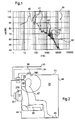
- the spectrum 39 of the noise prevailing in the cabin of a helicopter has a level increasing until it reaches a maximum 40 exceeding 100 decibels for frequencies close to 20 to 40 Hz; the level presents a decreasing general trend ("background noise") for the higher frequencies, including 41 "wide lines centered on frequencies of the order of 50 to 400 Hz, followed by" fine "lines 42 centered on frequencies of the order of 500 to 10000 Hz.
- the cabin 20 is delimited by ceiling panels 43, partition panels 44, and floor panels 45; a seat 35 provided with a headrest 46 equips the cabin and receives a passenger 47.
- a loudspeaker 26 is attached to the panel 43 so that the front face of its membrane 260 can radiate directly into the cabin.
- a second speaker 27 is attached to the panel 44 via a conduit 31; the front face of the membrane 270 of the speaker 27 extends to the left end of the duct 31 which opens into the cabin at its right end.
- a microphone 22 is attached to the headrest 46 and is connected, like the loudspeakers 26 and 27, to a signal and data processing unit 28.
- a sensor 25 - such as a tachometric sensor sensitive to the rotation frequency of the main rotor of the helicopter - and / or a microphone or accelerometer 24 are also connected to the unit 28 to deliver a reference signal.
- the device comprises two microphones 22 and 23 for measuring noise in two areas of the cabin where the noise sensation must be minimized.
- Each microphone is connected to the unit 28 by a low-pass filter 36 and a high-pass filter 37, so that the unit 28 receives on its inputs 281 filtered, low frequency noise measurement signals, and receives on its inputs 282 filtered noise signals of medium and high frequency.
- the cutoff frequency of the filters 36 and 37 may be of the order of 300 Hz to about 600 Hz.
- the filters 36, 37 may be digital and / or integrated in the unit 28.
- the unit 28 From the signals delivered by the sensors 22 to 25, the unit 28 generates control signals that it delivers on its outputs to which the loudspeakers 26, 27 are connected.
- a cavity 32 extends forward of the membrane of each loudspeaker 26, 27; in addition, each cavity 32 is respectively connected by a tubular vent 29 to the cabin 20.
- the cavity 32 extends behind the membrane 270 of the loudspeaker 27; a vent 30 extends through the wall 44 separating the cavity 32 of the cabin, and connects the cavity to the volume of the cabin.
- the sound level of the loudspeaker at low frequencies, especially in the vicinity of frequencies 33 or 34, is not high enough to effectively attenuate the wide noise lines 40, 41 (see FIG. .
- the cavity and the vent form an acoustic resonator (Helmholtz type) connecting the loudspeaker to the cabin; the assembly formed by the speaker and the resonator is a bass-reflex system which has, as shown in Figure 4, a variable efficiency (50) depending on the frequency.
- the two speakers equipped with their resonator have a maximum sound level for the low frequency 33 or 34 respectively; these frequencies 33 or 34 correspond to the acoustic characteristics of the two zones and are generally less than 100 Hz.
- the amplification obtained effectively attenuates the lines 40 or 41.
- a first speaker connected to the cab by a first adapter has the sound level 50
- a second speaker connected to the cab by a second adapter has the sound level 500; note that these two curves (50 or 500) of sound level have maximums for two frequencies of different values.
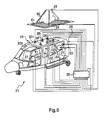
- the device comprises a microphone 22 disposed in the cockpit 200 of the helicopter 21 and four other microphones 22 attached to the seats (not shown) equipping the main cabin 201; a loudspeaker 27 integral with the wall separating the cockpit from the cabin makes it possible to attenuate the noise in the cockpit.
- Six speakers 26 equip a ceiling panel of cabin 201 and a speaker 27 equips a rear panel of the cabin. At least one of these speakers is used for communication (intercom) between the crew and the passengers.
- the device further comprises two sensors (accelerometers) 24, 25 of reference respectively integral with a structure 51 ("mechanical floor”) receiving the main gearbox 52 of the helicopter, and this gearbox.
- the device also comprises an electromechanical resonator or vibrator 53 integral with the structure of the helicopter and controlled by the unit 26 to attenuate the noise in the cabin 200, 201; a sensor 25 additional reference is set near this resonator and connected to an input of the unit 28.
- the unit 28 for processing the signals delivered by the sensors comprises a psychoacoustic weighting module 38; this module performs a weighting of the signals or noise data entering the unit 28, and / or a weighting of the signals or control data of the loudspeakers; this weighting makes it possible to optimize one or more parameters of acoustic comfort, in particular the loudness or the level in dBA, dBG, or dBSIL4.
- the effectiveness of a device according to the invention results in particular from the use of loudspeakers and acoustic adapters adapted to the frequency bands in which the noise level corresponds to a significant energy; this efficiency can be enhanced by the separate control of speakers adapted to the low frequencies on the one hand, and speakers adapted to medium and high frequencies on the other hand.
- a psychoacoustic weighting avoids unnecessary attenuation of noise components producing a lesser sensation of discomfort.
Landscapes
- Physics & Mathematics (AREA)
- Engineering & Computer Science (AREA)
- Acoustics & Sound (AREA)
- Multimedia (AREA)
- Soundproofing, Sound Blocking, And Sound Damping (AREA)
Applications Claiming Priority (1)
| Application Number | Priority Date | Filing Date | Title |
|---|---|---|---|
| FR0602555A FR2899011B1 (fr) | 2006-03-24 | 2006-03-24 | Procede et dispositif de traitement du bruit a bord d'un aeronef |
Publications (1)
| Publication Number | Publication Date |
|---|---|
| EP1837862A1 true EP1837862A1 (de) | 2007-09-26 |
Family
ID=37763928
Family Applications (1)
| Application Number | Title | Priority Date | Filing Date |
|---|---|---|---|
| EP07005657A Withdrawn EP1837862A1 (de) | 2006-03-24 | 2007-03-20 | Verfahren und Vorrichtung zur Lärmdämmung an Bord eines Luftschiffs |
Country Status (3)
| Country | Link |
|---|---|
| US (1) | US20080019536A1 (de) |
| EP (1) | EP1837862A1 (de) |
| FR (1) | FR2899011B1 (de) |
Cited By (2)
| Publication number | Priority date | Publication date | Assignee | Title |
|---|---|---|---|---|
| EP2119628A4 (de) * | 2007-12-14 | 2015-01-07 | Panasonic Corp | Rauschverringerungsvorrichtung und rauschverringerungssystem |
| CN110775269A (zh) * | 2018-07-26 | 2020-02-11 | 松下知识产权经营株式会社 | 无人飞行体、信息处理方法以及程序记录介质 |
Families Citing this family (10)
| Publication number | Priority date | Publication date | Assignee | Title |
|---|---|---|---|---|
| FR2918636B1 (fr) * | 2007-07-10 | 2009-10-23 | Eads Europ Aeronautic Defence | Avion a confort acoustique ameliore |
| JP5327049B2 (ja) * | 2007-12-14 | 2013-10-30 | パナソニック株式会社 | 騒音低減装置 |
| US20100054490A1 (en) * | 2008-08-29 | 2010-03-04 | Lucent Technologies Inc. | Audio Noise Cancellation System |
| JP2013178471A (ja) * | 2012-02-09 | 2013-09-09 | Panasonic Corp | 騒音低減装置 |
| FR2997219B1 (fr) | 2012-10-23 | 2014-12-05 | Eurocopter France | Procede et dispositif actif de traitement de bruit a bord d'un vehicule, et vehicule muni d'un tel dispositif |
| US10440480B2 (en) * | 2016-04-06 | 2019-10-08 | Harman International Industries, Incorporated | Hybrid active noise control |
| EP3379529A1 (de) * | 2017-03-21 | 2018-09-26 | RUAG Schweiz AG | Aktives geräuschdämpfungssystem in einem flugzeug und verfahren zur geräuschminderung im flugzeug |
| JP6961528B2 (ja) * | 2017-07-04 | 2021-11-05 | 鹿島建設株式会社 | 能動騒音制御装置及び能動騒音制御方法 |
| CN114201819B (zh) * | 2021-12-06 | 2024-01-12 | 南京航空航天大学 | 一种融合声阵列和在桨控制的直升机主动噪声抑制装置 |
| GB2623542B (en) * | 2022-10-19 | 2025-05-14 | Sony Interactive Entertainment Inc | Audio cancellation system and method |
Citations (5)
| Publication number | Priority date | Publication date | Assignee | Title |
|---|---|---|---|---|
| DE4226885A1 (de) * | 1992-08-13 | 1994-02-17 | Bayerische Motoren Werke Ag | Schallabsorptionsverfahren für Kraftfahrzeuge |
| WO1996003945A1 (en) * | 1994-07-29 | 1996-02-15 | Noise Cancellation Technologies, Inc. | Active vibration control system for aircraft |
| WO1996017340A1 (en) * | 1994-11-30 | 1996-06-06 | Lord Corporation | Frequency-focused actuators for active vibrational energy control systems |
| US5778081A (en) * | 1996-03-04 | 1998-07-07 | United Technologies Corp | Active noise control using phased-array active resonators |
| WO2003073415A1 (en) * | 2002-02-27 | 2003-09-04 | Sikorsky Aircraft Corporation | Computationally efficient means for optimal control with control constraints |
Family Cites Families (2)
| Publication number | Priority date | Publication date | Assignee | Title |
|---|---|---|---|---|
| US5526292A (en) * | 1994-11-30 | 1996-06-11 | Lord Corporation | Broadband noise and vibration reduction |
| US6343127B1 (en) * | 1995-09-25 | 2002-01-29 | Lord Corporation | Active noise control system for closed spaces such as aircraft cabin |
-
2006
- 2006-03-24 FR FR0602555A patent/FR2899011B1/fr not_active Expired - Fee Related
-
2007
- 2007-03-20 EP EP07005657A patent/EP1837862A1/de not_active Withdrawn
- 2007-03-23 US US11/727,028 patent/US20080019536A1/en not_active Abandoned
Patent Citations (5)
| Publication number | Priority date | Publication date | Assignee | Title |
|---|---|---|---|---|
| DE4226885A1 (de) * | 1992-08-13 | 1994-02-17 | Bayerische Motoren Werke Ag | Schallabsorptionsverfahren für Kraftfahrzeuge |
| WO1996003945A1 (en) * | 1994-07-29 | 1996-02-15 | Noise Cancellation Technologies, Inc. | Active vibration control system for aircraft |
| WO1996017340A1 (en) * | 1994-11-30 | 1996-06-06 | Lord Corporation | Frequency-focused actuators for active vibrational energy control systems |
| US5778081A (en) * | 1996-03-04 | 1998-07-07 | United Technologies Corp | Active noise control using phased-array active resonators |
| WO2003073415A1 (en) * | 2002-02-27 | 2003-09-04 | Sikorsky Aircraft Corporation | Computationally efficient means for optimal control with control constraints |
Cited By (2)
| Publication number | Priority date | Publication date | Assignee | Title |
|---|---|---|---|---|
| EP2119628A4 (de) * | 2007-12-14 | 2015-01-07 | Panasonic Corp | Rauschverringerungsvorrichtung und rauschverringerungssystem |
| CN110775269A (zh) * | 2018-07-26 | 2020-02-11 | 松下知识产权经营株式会社 | 无人飞行体、信息处理方法以及程序记录介质 |
Also Published As
| Publication number | Publication date |
|---|---|
| FR2899011A1 (fr) | 2007-09-28 |
| US20080019536A1 (en) | 2008-01-24 |
| FR2899011B1 (fr) | 2008-07-18 |
Similar Documents
| Publication | Publication Date | Title |
|---|---|---|
| EP1837862A1 (de) | Verfahren und Vorrichtung zur Lärmdämmung an Bord eines Luftschiffs | |
| CA1265063A (fr) | Procedes et dispositifs pour attenuer les bruits d'origine externe parvenant au tympan et ameliorer l'intelligibilite des communications electro- acoustiques | |
| EP2725575B1 (de) | Verfahren und aktive Vorrichtung zur Lärmbehandlung an Bord eines Fahrzeugs, und mit einer solchen Vorrichtung ausgestattetes Fahrzeug | |
| EP2518724B1 (de) | Kombinierte Audioeinheit bestehend aus Mikrofon und Kopfhörer, die Mittel zur Geräuschdämpfung eines nahen Wortsignals umfasst, insbesondere für eine telefonische Freisprechanlage | |
| EP0852793B1 (de) | Verfahren und vorrichtung für aktive hybride schwingungsdämpfung, insbesondere von mechanischen, schall- und dergleichen schwingungen | |
| US11862139B2 (en) | Method and system for creating a plurality of sound zones within an acoustic cavity | |
| US9099075B2 (en) | Standing wave attenuation device | |
| US8335318B2 (en) | Active noise reduction adaptive filtering | |
| EP0829079B1 (de) | Personales verfahren und anordnung für aktive schalldämpfung mit invarianter impulsantwort | |
| JP4140607B2 (ja) | エンジン音加工装置 | |
| CN109243422B (zh) | 用于免提麦克风的安静区 | |
| FR2636189A1 (fr) | Systeme d'attenuation electronique de bruit | |
| EP3828880A1 (de) | Geräuschdämpfende kopfstütze für einen fahrzeugsitz | |
| CN108140377A (zh) | 道路和发动机噪声控制 | |
| CN101877808A (zh) | 无噪声区控制系统 | |
| FR2656719A1 (fr) | Systeme de controle actif du bruit pour un vehicule automobile. | |
| JPH0519160B2 (de) | ||
| CN101473371A (zh) | 主动降噪引擎速度的确定 | |
| CN104737475A (zh) | 针对具有多个声学区域的车载通信系统的风噪声检测 | |
| JPH0728474A (ja) | 騒音キャンセル方式 | |
| CN118522268A (zh) | 降噪控制系统、方法、车辆以及设备 | |
| FR3078931A1 (fr) | Dispositif et procede pour l'amenagement d'au moins une zone acoustique privee dans l'habitacle d'un vehicule | |
| JP2008205804A (ja) | 音響システム | |
| JPH06266374A (ja) | 騒音キャンセル方式 | |
| JPH04308899A (ja) | 車室内音の適応型能動消音方式 |
Legal Events
| Date | Code | Title | Description |
|---|---|---|---|
| PUAI | Public reference made under article 153(3) epc to a published international application that has entered the european phase |
Free format text: ORIGINAL CODE: 0009012 |
|
| AK | Designated contracting states |
Kind code of ref document: A1 Designated state(s): AT BE BG CH CY CZ DE DK EE ES FI FR GB GR HU IE IS IT LI LT LU LV MC MT NL PL PT RO SE SI SK TR |
|
| AX | Request for extension of the european patent |
Extension state: AL BA HR MK YU |
|
| 17P | Request for examination filed |
Effective date: 20080207 |
|
| AKX | Designation fees paid |
Designated state(s): GB IT |
|
| REG | Reference to a national code |
Ref country code: DE Ref legal event code: 8566 |
|
| RAP1 | Party data changed (applicant data changed or rights of an application transferred) |
Owner name: AIRBUS HELICOPTERS |
|
| STAA | Information on the status of an ep patent application or granted ep patent |
Free format text: STATUS: THE APPLICATION IS DEEMED TO BE WITHDRAWN |
|
| 18D | Application deemed to be withdrawn |
Effective date: 20151001 |