EP1838245B1 - Lentille intraoculaire aspherique ameliorant le contraste - Google Patents
Lentille intraoculaire aspherique ameliorant le contraste Download PDFInfo
- Publication number
- EP1838245B1 EP1838245B1 EP05852535A EP05852535A EP1838245B1 EP 1838245 B1 EP1838245 B1 EP 1838245B1 EP 05852535 A EP05852535 A EP 05852535A EP 05852535 A EP05852535 A EP 05852535A EP 1838245 B1 EP1838245 B1 EP 1838245B1
- Authority
- EP
- European Patent Office
- Prior art keywords
- iol
- lens
- profile
- aspherical
- range
- Prior art date
- Legal status (The legal status is an assumption and is not a legal conclusion. Google has not performed a legal analysis and makes no representation as to the accuracy of the status listed.)
- Revoked
Links
Images




Classifications
-
- A—HUMAN NECESSITIES
- A61—MEDICAL OR VETERINARY SCIENCE; HYGIENE
- A61F—FILTERS IMPLANTABLE INTO BLOOD VESSELS; PROSTHESES; DEVICES PROVIDING PATENCY TO, OR PREVENTING COLLAPSING OF, TUBULAR STRUCTURES OF THE BODY, e.g. STENTS; ORTHOPAEDIC, NURSING OR CONTRACEPTIVE DEVICES; FOMENTATION; TREATMENT OR PROTECTION OF EYES OR EARS; BANDAGES, DRESSINGS OR ABSORBENT PADS; FIRST-AID KITS
- A61F2/00—Filters implantable into blood vessels; Prostheses, i.e. artificial substitutes or replacements for parts of the body; Appliances for connecting them with the body; Devices providing patency to, or preventing collapsing of, tubular structures of the body, e.g. stents
- A61F2/02—Prostheses implantable into the body
- A61F2/14—Eye parts, e.g. lenses or corneal implants; Artificial eyes
-
- A—HUMAN NECESSITIES
- A61—MEDICAL OR VETERINARY SCIENCE; HYGIENE
- A61F—FILTERS IMPLANTABLE INTO BLOOD VESSELS; PROSTHESES; DEVICES PROVIDING PATENCY TO, OR PREVENTING COLLAPSING OF, TUBULAR STRUCTURES OF THE BODY, e.g. STENTS; ORTHOPAEDIC, NURSING OR CONTRACEPTIVE DEVICES; FOMENTATION; TREATMENT OR PROTECTION OF EYES OR EARS; BANDAGES, DRESSINGS OR ABSORBENT PADS; FIRST-AID KITS
- A61F2/00—Filters implantable into blood vessels; Prostheses, i.e. artificial substitutes or replacements for parts of the body; Appliances for connecting them with the body; Devices providing patency to, or preventing collapsing of, tubular structures of the body, e.g. stents
- A61F2/02—Prostheses implantable into the body
- A61F2/14—Eye parts, e.g. lenses or corneal implants; Artificial eyes
- A61F2/16—Intraocular lenses
- A61F2/1613—Intraocular lenses having special lens configurations, e.g. multipart lenses; having particular optical properties, e.g. pseudo-accommodative lenses, lenses having aberration corrections, diffractive lenses, lenses for variably absorbing electromagnetic radiation, lenses having variable focus
-
- A—HUMAN NECESSITIES
- A61—MEDICAL OR VETERINARY SCIENCE; HYGIENE
- A61F—FILTERS IMPLANTABLE INTO BLOOD VESSELS; PROSTHESES; DEVICES PROVIDING PATENCY TO, OR PREVENTING COLLAPSING OF, TUBULAR STRUCTURES OF THE BODY, e.g. STENTS; ORTHOPAEDIC, NURSING OR CONTRACEPTIVE DEVICES; FOMENTATION; TREATMENT OR PROTECTION OF EYES OR EARS; BANDAGES, DRESSINGS OR ABSORBENT PADS; FIRST-AID KITS
- A61F2/00—Filters implantable into blood vessels; Prostheses, i.e. artificial substitutes or replacements for parts of the body; Appliances for connecting them with the body; Devices providing patency to, or preventing collapsing of, tubular structures of the body, e.g. stents
- A61F2/02—Prostheses implantable into the body
- A61F2/14—Eye parts, e.g. lenses or corneal implants; Artificial eyes
- A61F2/16—Intraocular lenses
-
- A—HUMAN NECESSITIES
- A61—MEDICAL OR VETERINARY SCIENCE; HYGIENE
- A61F—FILTERS IMPLANTABLE INTO BLOOD VESSELS; PROSTHESES; DEVICES PROVIDING PATENCY TO, OR PREVENTING COLLAPSING OF, TUBULAR STRUCTURES OF THE BODY, e.g. STENTS; ORTHOPAEDIC, NURSING OR CONTRACEPTIVE DEVICES; FOMENTATION; TREATMENT OR PROTECTION OF EYES OR EARS; BANDAGES, DRESSINGS OR ABSORBENT PADS; FIRST-AID KITS
- A61F2/00—Filters implantable into blood vessels; Prostheses, i.e. artificial substitutes or replacements for parts of the body; Appliances for connecting them with the body; Devices providing patency to, or preventing collapsing of, tubular structures of the body, e.g. stents
- A61F2/02—Prostheses implantable into the body
- A61F2/14—Eye parts, e.g. lenses or corneal implants; Artificial eyes
- A61F2/16—Intraocular lenses
- A61F2/1613—Intraocular lenses having special lens configurations, e.g. multipart lenses; having particular optical properties, e.g. pseudo-accommodative lenses, lenses having aberration corrections, diffractive lenses, lenses for variably absorbing electromagnetic radiation, lenses having variable focus
- A61F2/1637—Correcting aberrations caused by inhomogeneities; correcting intrinsic aberrations, e.g. of the cornea, of the surface of the natural lens, aspheric, cylindrical, toric lenses
- A61F2/164—Aspheric lenses
Definitions
- the present invention generally relates to intraocular lenses (IOL) and, more particularly, to such lenses that provide enhanced vision for large pupil sizes.
- IOL intraocular lenses
- An intraocular lens is routinely implanted in a patient's eye during cataract surgery to compensate for the lost optical power when the natural lens is removed.
- an intraocular lens can be implanted in a patient's eye, which retains its natural lens, so as to provide an optical power for correcting a refractive error of the natural eye.
- the aberrations of the eye, and in particular those of the cornea, are typically ignored in designing conventional intraocular lenses. Hence, patients having such lenses can suffer from a degraded image quality, especially at low light levels and large pupil sizes.
- Intraocular lenses that compensate for corneal aberrations are also known.
- such aspheric intraocular lenses are designed to counteract the asphericity of the patient's cornea by greatly reducing, or eliminating all together, the overall aberrations of the eye.
- intraocular lenses fabricated based on these techniques may provide a better image contrast, they generally result in a decrease in a patient's depth of field.
- the state of the art is represented by US-A-4,504,982 (Burk et at) and WO 01/89424 A (Pharmacia Groningen B.V. et al ).
- the present invention is generally directed to intraocular lenses that can provide a balance between image contrast and depth of field, upon implantation in a patient's eye, so as to afford the patient improved vision, especially under conditions where the pupil of the eye is large. More particularly, an intraocular lens of the invention can exhibit a selected degree of asphericity at one or more refractive surfaces such that the aberrations of the lens combine with those of the eye in a manner that would provide the patient not only with a useful image contrast, but also with a depth of field within an acceptable range, especially for large pupil sizes.
- the present invention provides an intraocular lens (IOL) that includes an optic having an anterior refractive surface and a posterior refractive surface, which cooperatively provide a selected optical power, e.g., an optical power in a range of about zero to about 40 Diopters (D) or more, typically in a range of about 18 to about 26 Diopters.
- IOL intraocular lens
- D Diopters
- an aspheric profile for controlling the aberrations of an eye in which the IOL is implanted so as to provide the patient with an image contrast, as characterized by a peak modulation transfer function (MTF), of at least about 0.25 at a spatial frequency of about 50 line pairs per millimeter (lp/mm) and a depth of field of at least about 0.75 Diopters (D).
- MTF peak modulation transfer function
- the implanted lens can provide the patient with an MTF in a range of about 0.25 to about 0.4 and a depth of field in a range of about 0.75 to about 1.5 Diopters.
- the aspherical lenses of the present invention can control the aberrations of the eye of a pseudophakic patient, i.e., a patient having the IOL as a replacement for a natural lens.
- a pseudophakic patient i.e., a patient having the IOL as a replacement for a natural lens.
- such lenses can control the aberrations of the eye of a phakic patient, i.e., a patient having the IOL in addition to the natural lens.
- a modulation transfer function provides a quantitative measure of image contrast exhibited by an optical system, e.g., a system formed of an IOL and the cornea or an optical system formed of an IOL, the cornea and the natural lens, as discussed in more detail below.
- an optical system e.g., a system formed of an IOL and the cornea or an optical system formed of an IOL, the cornea and the natural lens, as discussed in more detail below.
- depth of field and depth of focus which are herein used interchangeably, are well known in the context of a lens and readily understood by those skilled in the art.
- the term "depth of field” or “depth of focus” as used herein can be calculated and/or measured by an amount of defocus associated with the optical system at which a through-focus modulation transfer function (MTF) of the system calculated and/or measured with an aperture, e.g., a pupil size, of about 4.5 mm and monochromatic green light, e.g., light having a wavelength of about 550 nm, exhibits a contrast of at least about 0.05 at a spatial frequency of about 50 line pairs per millimeter (lp/mm).
- MTF through-focus modulation transfer function
- the aspheric profile of the anterior surface or the posterior surface, or both can control the aberrations of an eye in which the IOL is implanted such that the combined lens and cornea would exhibit a peak modulation transfer function contrast of at least about 0.25 at a spatial frequency of about 50 lp/mm and a depth of field of at least about 0.75 Diopters for pupil diameters in a range of about 4.5 mm to about 5 mm and for monochromatic light at a wavelength of about 550 nm.
- the peak modulation transfer function can be calculated in a model eye, as discussed in more detail below.
- An IOL according to this invention can be fabricated preferably by employing a deformable biocompatible material, such as acrylic, silicone, or hydrogel polymeric materials and the like that allow the lens body to be folded for insertion into the eye.
- the optic can be formed of a copolymer of acrylate and methacrylate.
- a copolymer of acrylate and methacrylate For illustrative examples of such copolymer compositions, see for example, U.S. Patent No. 5,922,821 entitled “Ophthalmic Lens Polymers” issued to Lebouef et al. on July 13, 1999 and U.S. Patent No. 6,353,069 entitled "High Refractive Index Ophthalmic Device Materials” issued to Freeman et al. on March 5, 2002.
- rigid biocompatible materials such as polymethyl methacrylate (PMMA) can be employed.
- the aspherical profile of one of the surfaces can exhibit a selected deviation from a putative spherical profile having a radius of curvature of R 1 that substantially coincides with the aspherical profile at small radial distance from an optical axis of the lens, while the other surface can have a spherical profile having a radius of curvature R 2 .
- the other surface can also have an aspherical profile exhibiting deviations from a respective putative spherical profile having a radius of curvature of R 2 .
- the radii R 1 and R 2 are selected such that the lens would exhibit a desired optical power.
- At least one refractive surface of the IOL has an aspheric portion for controlling average aberrations exhibited by the eyes of a selected patient group such that upon implantation of the lens in a patient's eye the combined lens and cornea would exhibit a peak modulation transfer function (MTF) contrast of at least about 0.25 for monochromatic light having a wavelength of 550 nm and depth of field of at least about 0.75 Diopters.
- MTF peak modulation transfer function
- the MTF and the depth of field can be calculated or measured, for example, for a spatial frequency of about 50 line pairs per millimeter and for a pupil size of about 4.5 mm.
- Distance units are given herein in millimeters. For example, the curvature constant is given in units of inverse millimeter, while A is given in units of 1 mm 3 and B is given in units of 1 mm 5 .
- the curvature constant C can be chosen based on a desired optical power of the lens, and the aspherical coefficients Q, A, and B, as well as the higher order terms where applicable, can be chosen so as to impart a selected degree of asphericity to the surface.
- the choice of the aspherical coefficients can generally depend on the material from which the lens is fabricated, the shape factor of the lens, and the aberrations of the eye for which the lens is intended.
- the conic constant for a biconvex lens of average power (e.g., 21 Diopters) formed of an acrylic polymer can be in a range of about 0 (zero) to about -100 (minus 100), or in a range of - 10 to about -50, or in a range of about -15 to about -25 and the higher order deformation coefficients A and B can be, respectively, in a range of about - 1 x 10 -3 (minus 0.001) to about 1x 10 -3 (plus 0.001) and in a range of about - 1x10 -4 (minus 0.0001) to about 1x10 -4 (plus 0.0001).
- the curvature coefficient (C) can be in a range of about 0.0125 to about 0.12, or in a range of about 0.025 to about 0.1 (the curvature can be positive or negative corresponding to convex or concave surfaces, respectively).
- the invention provides a method of designing an intraocular lens having an anterior and a posterior refractive surface that includes deriving a model average of aberrations of the eye based on wavefront measurements of aberrations exhibited by the eyes of a selected patient population (alternatively the aberrations of an individual patient for whom the lens is intended can be employed), and adjusting asphericity of at least one of the refractive surfaces for controlling the average aberrations such that a patient in which the lens is implanted would exhibit an image contrast characterized by a peak modulation transfer function (MTF) contrast of at least about 0.25 and a depth of field of at least about 0.75 D.
- MTF peak modulation transfer function
- FIGURE 1A schematically depicts a monofocal intraocular lens 10 according to one embodiment of the invention having an optic 12 preferably formed of a soft biocompatible material, such as soft acrylic polymer, silicone, or hydrogel.
- the exemplary lens 10 further includes radially extending fixation members or haptics 14 for its placement in a patient's eye.
- the fixation members 14 can be made of suitable polymeric materials, such as polypropylene, polymethyl methacrylate and the like as known to those having ordinary skill in the art.
- the optic and the fixation members are formed from the same material as a single -piece lens.
- the optic 12 includes an anterior refractive surface 16 and a posterior refractive surface 18 that are shaped so as to cooperatively provide the lens with a nominal optical power in a range of zero to about 40 Diopters and, more preferably, in a range of about 18 to about 26 Diopters.
- the refractive surfaces 16 and 18 are generally symmetric about an optical axis 20 of the lens, although in other embodiments either surface can be asymmetric about this axis.
- the refractive surfaces 16 and 18 are depicted as being generally convex, either surface can have a generally concave shape.
- the surfaces 16 and 18 can be selected to generate a plano-convex or a plano-concave lens.
- a lens according to the teachings of the invention can have a positive or a negative nominal power.
- the lens can have a negative power, e.g., in a range of about -20 D to about -10 D, or -15 D to about -10 D.
- Such lenses can be employed in phakic patients. More generally, a lens of the invention can have a power in a range of about -20 D to about +10 D.
- FIGURE 1B schematically illustrates a base profile 22a of the anterior refractive surface 16 as a function of radial distance (r) relative to an intersection of optical axis 20 with the anterior surface 16 (for purposes of illustration the curvature is greatly exaggerated).
- the base profile 22a is aspherical with a selected degree of deviation from a putative spherical profile 24 having a radius of curvature R 1 that substantially coincides with the aspherical profile at small radial distances.
- the aspherical anterior surface 16 is flatter than the putative spherical profile, in other embodiments it can be steeper.
- the posterior surface 18 exhibits a spherical profile 22b with a radius of curvature R 2 , as shown schematically in FIGURE 1C .
- the radii R 1 and R 2 are generally chosen to provide the lens with a desired optical power and a desired shape factor.
- the posterior surface can also exhibit an aspheric profile, while in others the anterior surface can be spherical and the posterior surface aspherical.
- a desired degree of asphericity can be achieved by imparting an aspherical profile to only one of the refractive surfaces, or by dividing the total aspheric deviation between the two surfaces.
- the aspheric profile of the anterior surface 16 is selected to control the aberrations of a patient's eye in which the IOL 10 is implanted so as to enhance the patient's image contrast relative to that provided by a substantially identical lens in which the anterior surface has the putative spherical profile 24, rather than the aspherical profile 22a, while providing the patient with a depth of field greater than about 0.75 D.
- the aspheric profile controls the aberrations of an eye in which the IOL 10 is implanted such that the combined lens and cornea, or the combined lens, the cornea and the natural lens, would exhibit a peak modulation transfer function (MTF) contrast of at least about 0.25 and a depth of field of at least about 0.75 Diopters for pupil diameters in a range of about 4.5 millimeters to about 5 millimeters when measured or calculated with monochromatic light at a wavelength of about 550 nanometers and at a spatial frequency of about 50 line pairs per millimeter.
- MTF peak modulation transfer function
- the patient having the IOL can experience a peak MTF contrast at the retina in a range of about 0.25 to about 0.4 while having a depth of focus in a range of about 0.75 to about 1.5 D.
- the image contrast is enhanced while maintaining a useful depth of field.
- a quantitative measure of image contrast provided by a lens can be obtained by calculating and/or measuring a modulation transfer function (MTF) associated with that lens.
- MTF modulation transfer function
- a contrast or modulation associated with an optical signal e.g., a two-dimensional pattern of light intensity distribution emanated from or reflected by an object to be imaged or associated with the image of such an object, can be defined in accordance with the following relation: I max - I min I max + I min wherein I max and I min indicate, respectively, a maximum or a minimum intensity associated with the signal.
- I max and I min indicate, respectively, a maximum or a minimum intensity associated with the signal.
- Such a contrast can be calculated or measured for each spatial frequency present in the optical signal.
- An MTF of an imaging optical system such as the combined IOL and the cornea, can then be defined as a ratio of a contrast associated with an image of an object formed by the optical system relative to a contrast associated with the object.
- the MTF associated with an optical system can then be defined as a ratio of a contrast associated with an image of an object formed by the optical system relative to a contrast associated with the object.
- the system is not only dependent on the spatial frequencies of the intensity distribution of the light illuminating the system, but it can also be affected by other factors, such as the size of an illumination aperture as well as the wavelength of the illuminating light.
- an IOL according to the invention is utilized to enhance a patient's image contrast
- it can be employed to primarily enhance a patient's depth of field with a potential moderate decrease in the image contrast.
- a patient whose cornea exhibits a highly aspherical flattening can benefit from an aspherical IOL according to one embodiment of the invention that can partially compensate for the severe flattening to enhance the patient's depth of filed albeit with a potential small decrease in the image contrast.
- the conic constant Q alone can be adjusted to obtain a desired deviation from sphericity with the higher order aspherical constants A and B, and others set to zero.
- one or both of the higher order constants A and B in addition to, or instead of, the conic constant Q, can be adjusted to provide a selected aspherical profile for one or both refractive surfaces of an IOL.
- the higher order aspherical constants can be particularly useful for tailoring the profile of the peripheral portions of the lens surface, i.e., portions far from the optical axis.
- the choice of the aspherical constants can depend, for example, on the aberrations of the eye in which the IOL is implanted, the material from which the IOL is fabricated, and the optical power provided by the IOL. In general, these constants are selected such that the IOL can provide a balance between a patient's image contrast and depth of field, e.g., enhancing the image contrast while substantially preserving the depth of field.
- the conic constant Q of the lens in the above relation can be in a range of about 0 to about - 50
- the deformation coefficients A and B can be, respectively, in a range of about - 1 x 10 -3 to about 1x 10 -3 and in a range of about -1 x 10 -4 to about 1 x 10 -4 .
- the choice of the degree of sphericity of one or both surfaces of the IOL can depend, at least in part, on the lens's shape factor (X).
- X lens's shape factor
- the conic constant can be in range of about -50 to about 0.
- an IOL according to the teachings of the invention can find a variety of different applications.
- the IOL 10 can be implanted in a patient's eye while retaining the eye's natural lens by inserting the optic 12 in the eye's anterior chamber 26 with the distal ends of the fixation members 14 in contact with an angle 28 of the iris 30, as shown in FIGURE 2 .
- the IOL can provide an optical power for correcting a refractive defect of the eye.
- the aspherical profile of the anterior surface 16 of the IOL can control the overall aberrations of the natural eye, for example, the combined aberrations of the cornea 32 and the natural lens 34, so as to enhance the image contrast on the retina, especially for large pupil sizes, while maintaining a desired depth of field, as discussed above.
- the IOL 10 can be implanted in a patient's eye after removal of the patient's natural lens during cataract surgery.
- the aspherical profile of the IOL 10 can control the aberrations exhibited by the cornea so as to enhance the image contrast while substantially preserving the depth of field.
- the cornea is substantially spherical, characterized, for example, by a vanishing conic constant, while in other cases the cornea itself can show a certain degree of asphericity.
- the aspherical profile of the IOL 10 can be adjusted accordingly to provide the desired degree of image contrast, or depth of field, enhancement.
- the aspherical profile of IOL can be characterized by curve that is flatter than that of a putative spherical profile, while in other cases it is steeper.
- a variety of techniques can be employed to determine the requisite degree of asphericity for the IOL 10. For example, in one approach, aberrations exhibited by a patient's eye, or by a group of patients, are measured preoperatively by employing known topographical methods and systems. For phakic eyes, the measured aberrations can correspond primarily to the combined aberrations of the natural lens and the cornea while for the pseudophakic patients, they can correspond to those of the cornea. In one such method, wavefront aberrations of the eye can be measured at a selected measurement plane, e.g., the entrance pupil of the patient's eye, and at a selected wavelength, e.g., at a wavelength of about 830 nm. Further details regarding measurements of aberrations of the eye can be found in U.S. Patent No. 6,786,603 and U.S. Patent Application No. 2002/0105617 .
- Wavefront measurements can be employed to determine a requisite level of asphericity of the IOL needed for controlling the aberrations of the eye.
- an aspherical profile of the IOL can be designed to reduce spherical aberrations of the cornea inferred from the wavefront measurements.
- One or more aspherical parameters of the IOL can be obtained theoretically or experimentally, or both.
- a ray tracing program such as OSLO, marketed by Lambda Research Corporation of Littleton, Massachusetts, U.S.A, can be employed to model the eye and its aberrations inferred from the wavefront measurements as well as an IOL having one or more aspherical surfaces.
- the asphericity of the IOL can then be adjusted, e.g., via adjusting the conic constant and possibly the higher order deformation constants, to obtain a desired MTF and depth of field.
- average aberrations exhibited by the eyes of a selected group of patients are considered for designing an IOL suitable for controlling on average such aberrations.
- the aspherical parameters of an IOL can also be determined experimentally.
- an IOL can be inserted in a model eye exhibiting aberrations corresponding to those inferred from the wavefront measurements, e.g., a corneal aberration characterized by a conic constant.
- modulation transfer functions obtained by a combined system of the model eye and intraocular lenses having different aspherical profiles are measured to select a suitable aspherical profile.
- the aberrations of a population of patients are measured to design a lens suitable for controlling average aberrations exhibited by patients.
- two or more types of intraocular lenses, each type designed to control average aberrations exhibited by the eyes of select group of patients, can be provided.
- FIGURE 3A presents a through-focus MTF plot 40 for a cornea having a conic constant of - 0.5 - a cornea exhibiting a high level of aspheric flattening - with an IOL having a vanishing conic constant (herein referred to as condition A), while FIGURE 3B presents a respective MTF plot 42 for the same cornea but with an IOL according to the teachings of the invention having an aspherical anterior surface with a conic constant of 2.8 (herein referred to as condition B).
- a comparison of the plots 40 and 42 shows that although the cornea with the aspherical lens exhibits a lower peak MTF contrast (an MTF of 0.41 for the aspherical case relative to 0.86 for the spherical case), it exhibits, however, a much improved depth of field (a depth of field of 0.8 for the aspherical case compared with 0.50 for the spherical case).
- the asphericity of the IOL is selected to reduce an asphericity exhibited by a cornea so as to enhance the depth of field at the expense of a slight decrease in the image contrast.
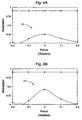
- FIGURE 4A presents a calculated control through-focus modulation transfer function plot 36 for a spherical cornea - a cornea exhibiting severe spherical aberration - combined with an IOL having a spherical profile (i.e., a conic constant of zero), herein referred to as condition E, while FIGURE 4B presents a respective through-focus MTF plot 38 for the same cornea combined with an IOL according to the teachings of the invention having an anterior aspherical surface with a conic constant of - 6, herein referred to as condition D.
- a comparison of plots 36 and 38 shows that the use of the aspherical lens results in an increase of the peak MTF contrast from about 0.24 to about 0.4 (a 67 % increase), while substantially preserving the depth of focus (a depth of focus of 1.14 Diopters at 0.05 MTF for the spherical lens compared to a corresponding depth of focus of 1.02 Diopters for the aspherical lens).
- FIGURE 5 shows a through-focus MTF plot 44 of such a cornea with a spherical IOL (herein referred to as condition C), indicating a peak MTF comparable with those obtained for the above conditions B and D, namely, for a spherical cornea with an aspherical lens having a negative conic constant of -6 and a cornea exhibiting severe aspherical flattening with an aspherical lens having a positive conic constant of 2.8.
- FIGURE 6 presents three graphs 46, 48 and 50 illustrating, respectively, peak MTF, and defocus in Diopter (D) at which the MTF has a value of 0.05 and 0.1 (herein also referred to as depth of focus at 0.05 or 0.1 MTF).
- these graphs show that the peak MTF increases by employing an IOL according to the teachings of the invention having an aspheric profile for an eye with a spherical cornea while substantially preserving the depth of field.
- an intraocular lens (IOL) of the invention can have one or two toric refractive surfaces that exhibit two different optical powers along two orthogonal surface directions.
- Such toric IOLs can be employed, for example, to correct astigmatism.
- one surface is toric and the other non-toric.
- a selected degree of asphericity can be imparted to the toric surface, to the non-toric surface or to both.
- both lens surfaces can be toric with at least one exhibiting asphericity.
- At least one of the toric surfaces can exhibit an asphericity along one or both of the two surface orthogonal directions, each associated with an optical power different than the power along the other direction, such that a combination of the lens and the eye in which the lens is implanted provides not only a useful image contrast, but also a depth of field within an acceptable range, such as those discussed above in connection with the other embodiments.
- the toric surface exhibiting a selected asphericity in one of the two directions can be characterized by an aspherical profile 52A having a central curvature R 1 at its vertex (i.e., intersection of an optical axis of the lens with the surface) and a selected deviation from a putative spherical profile 52B that substantially coincides with the aspherical profile at small radial distances.
- a profile 54A of the toric surface can be characterized by a central curvature R 2 , that is different than R 1 , and a selected deviation from a putative spherical profile 54B that substantially coincides with the aspherical profile at small radial distances.
Landscapes
- Health & Medical Sciences (AREA)
- Ophthalmology & Optometry (AREA)
- Cardiology (AREA)
- Oral & Maxillofacial Surgery (AREA)
- Transplantation (AREA)
- Engineering & Computer Science (AREA)
- Biomedical Technology (AREA)
- Heart & Thoracic Surgery (AREA)
- Vascular Medicine (AREA)
- Life Sciences & Earth Sciences (AREA)
- Animal Behavior & Ethology (AREA)
- General Health & Medical Sciences (AREA)
- Public Health (AREA)
- Veterinary Medicine (AREA)
- Prostheses (AREA)
- Materials For Medical Uses (AREA)
- Pharmaceuticals Containing Other Organic And Inorganic Compounds (AREA)
- Polysaccharides And Polysaccharide Derivatives (AREA)
Claims (21)
- Lentille intraoculaire (LIO) (10) comprenant :une lentille optique réfractive (12) ayant une surface antérieure (16) et une surface postérieure (18),au moins une des faces antérieure ou postérieure ayant un profil asphérique adapté pour contrôler les aberrations d'un oeil modèle dans lequel la LIO est implantée, et pour apporter du contraste d'image à l'oeil modèle,caractérisée en ce qu'une lentille et une cornée modèle combinées présentent un contraste de fonction de transfert de modulation (FTM) calculé maximum d'au moins environ 0,25 et une profondeur de champ d'au moins environ 0,75 dioptrie, pour des diamètres de pupille s'étendant de 4,5 mm à 5 mm, pour une lumière monochromatique d'une longueur d'onde d'environ 550 nm,dans laquelle ladite surface antérieure (16) est caractérisée par ledit profil asphérique présentant une déviation sélectionnée par rapport à un profil sphérique putatif ayant un rayon de courbure R1,et ladite surface de base postérieure (18) ayant un profil de base avec un rayon de courbure R2, où R2 est plus grand que R1.
- Lentille LIO selon la revendication 1, dans laquelle lesdites lentille et cornée modèle combinées présentent une fonction de transfert de modulation (FTM) au niveau de la rétine supérieure à environ 0,3 pour 50 paires de lignes par mm et à une longueur d'onde d'environ 550 nm.
- Lentille LIO selon la revendication 1, dans laquelle lesdites lentille et cornée modèle combinées présentent une fonction de transfert de modulation (FTM) supérieure à environ 0,35 pour 50 paires de lignes par mm et à une longueur d'onde d'environ 550 nm.
- Lentille LIO selon la revendication 1, dans laquelle lesdites lentille et cornée modèle combinées présentent une fonction de transfert de modulation (FTM) s'étendant d'environ 0,25 à environ 0,4 à une fréquence spatiale d'environ 50 lp/mm, à une longueur d'onde d'environ 550 nm et un diamètre de pupille d'environ 4,5 mm.
- Lentille LIO selon la revendication 1, dans laquelle ladite surface postérieure (18) est caractérisée par un profil sphérique ayant un rayon de courbure R2, où R2 est plus grand que R1.
- Lentille LIO selon la revendication 5, dans laquelle ladite lentille présente un facteur de forme K défini comme suit :

où K est compris entre environ 0 et environ +1. - Lentille LIO selon la revendication 1, dans laquelle ladite surface postérieure (18) est caractérisée par un profil de base asphérique présentant une déviation sélectionnée par rapport à un profil sphérique putatif ayant un rayon de courbure R2, où R2 est plus grand que R1.
- Lentille LIO selon l'une quelconque des revendications 1 à 7, dans laquelle ledit profil asphérique est adapté pour contrôler une aberration sphérique de la cornée modèle.
- Lentille LIO selon l'une quelconque des revendications 1 à 8, dans laquelle ladite surface asphérique comprend une surface réfractive antérieure (16) de ladite lentille.
- Lentille LIO selon l'une quelconque des revendications 1 à 8, dans laquelle ladite surface asphérique comprend une surface réfractive postérieure (18) de ladite lentille.
- Lentille LIO selon l'une quelconque des revendications 1 à 10, ayant une puissance optique dioptrique s'étendant d'environ 0 à environ 40.
- Lentille LIO selon l'une quelconque des revendications 1 à 11, dans laquelle ladite lentille est adaptée pour procurer au patient une FTM s'étendant de 0,25 à 0,4.
- Lentille LIO selon l'une quelconque des revendications 1 à 12, dans laquelle ladite lentille est adaptée pour apporter à l'oeil modèle une profondeur de champ s'étendant de 0,75 à 1,5 dioptrie.
- Lentille LIO selon l'une quelconque des revendications 1 à 13, dans laquelle ledit profil asphérique est adapté pour contrôler les aberrations présentées par la cornée modèle.
- Lentille LIO selon l'une quelconque des revendications 1 à 13, dans laquelle ledit profil asphérique est adapté pour contrôler les aberrations présentées par la cornée modèle et un cristallin naturel combinés.
- Lentille LIO selon l'une quelconque des revendications 1 à 13, dans laquelle ledit profil asphérique est adapté pour contrôler les aberrations présentées par les yeux d'un groupe de patients sélectionné.
- Lentille LIO selon la revendication 1, comprenant une lentille optique comprenant au moins une surface réfractive ayant une base caractérisée par un profil décrit par l'équation suivante :

où z désigne un gauchissement de la surface parallèle à un axe (z) perpendiculaire à la surface,
C désigne une courbure au niveau du vertex de la surface,
Q désigne un coefficient conique,
R désigne une position radiale sur la surface,
A désigne un coefficient de déformation de quatrième ordre, et
B désigne un coefficient de déformation de sixième ordre,
où Q se situe dans un intervalle s'étendant d'environ 0 à environ 100, A dans un intervalle s'étendant d'environ -1x10⁻³ à environ 1x10⁻³, et B dans un intervalle s'étendant d'environ -1x10⁻⁴ à environ 1x10⁻⁴. - Lentille LIO selon l'une quelconque des revendications 1 à 17, dans laquelle ladite lentille optique est formée d'un matériau souple biocompatible, dont un matériau acrylique souple, un hydrogel ou de la silicone.
- Lentille LIO selon la revendication 18, dans laquelle ladite lentille optique présente une constante conique asphérique dans un intervalle s'étendant d'environ 0 à environ -50.
- Lentille LIO selon la revendication 1, comprenant une lentille optique (12) ayant une surface antérieure réfractive (16) et une surface postérieure réfractive (18), au moins une desdites surfaces ayant une forme généralement torique présentant différentes valeurs de puissance optique le long de deux directions de surfaces orthogonales et présentant une asphéricité le long d'au moins une direction desdites directions orthogonales pour contrôler les aberrations d'un oeil modèle dans lequel la lentille LIO est implantée, de telle manière que la combinaison de la lentille et de l'oeil modèle présente une fonction de transfert de modulation d'au moins environ 0,25 et une profondeur de champ d'au moins environ 0,75 D pour un diamètre de pupille d'environ 4,5 mm et une longueur d'onde monochromatique d'environ 550 nm, telle que calculée dans l'oeil modèle.
- Procédé de conception de lentille intraoculaire (10) ayant des surfaces réfractives antérieure et postérieure (16, 18), comprenant les étapes consistant à :dériver une moyenne type des aberrations d'un oeil modèle en se basant sur des mesures de front d'onde d'aberrations présentées par les yeux d'une population de patients sélectionnée, etajuster l'asphéricité d'au moins une desdites surfaces réfractives pour contrôler lesdites aberrations moyennes de telle manière qu'un oeil modèle dans lequel la lentille est implantée présente un contraste d'image caractérisé par un contraste de fonction de transfert de modulation (FTM) maximum d'au moins environ 0,25 et une profondeur de champ d'au moins environ 0,75 D pour des diamètres de pupilles s'étendant de 4,5 mm à 5 mm, pour une lumière monochromatique d'une longueur d'onde d'environ 550 nm.
Priority Applications (3)
| Application Number | Priority Date | Filing Date | Title |
|---|---|---|---|
| SI200531285T SI1838245T1 (sl) | 2004-12-01 | 2005-12-01 | Asferična intraokularna leča, ki izboljša kontrast |
| PL05852535T PL1838245T3 (pl) | 2004-12-01 | 2005-12-01 | Wzmacniająca kontrast asferyczna soczewka wewnątrzgałkowa |
| CY20111100476T CY1111459T1 (el) | 2004-12-01 | 2011-05-17 | Ασφαιρικος ενδοοφθαλμικος φακος με συμπεριφορα ενισχυσης αντιθεσης |
Applications Claiming Priority (2)
| Application Number | Priority Date | Filing Date | Title |
|---|---|---|---|
| US11/000,728 US20060116763A1 (en) | 2004-12-01 | 2004-12-01 | Contrast-enhancing aspheric intraocular lens |
| PCT/US2005/043318 WO2006060477A2 (fr) | 2004-12-01 | 2005-12-01 | Lentille intraoculaire aspherique ameliorant le contraste |
Publications (2)
| Publication Number | Publication Date |
|---|---|
| EP1838245A2 EP1838245A2 (fr) | 2007-10-03 |
| EP1838245B1 true EP1838245B1 (fr) | 2011-03-02 |
Family
ID=36565681
Family Applications (1)
| Application Number | Title | Priority Date | Filing Date |
|---|---|---|---|
| EP05852535A Revoked EP1838245B1 (fr) | 2004-12-01 | 2005-12-01 | Lentille intraoculaire aspherique ameliorant le contraste |
Country Status (16)
| Country | Link |
|---|---|
| US (3) | US20060116763A1 (fr) |
| EP (1) | EP1838245B1 (fr) |
| KR (1) | KR101154066B1 (fr) |
| AT (1) | ATE499906T1 (fr) |
| AU (1) | AU2005311946B2 (fr) |
| CA (1) | CA2590166C (fr) |
| CY (1) | CY1111459T1 (fr) |
| DE (1) | DE602005026717D1 (fr) |
| DK (1) | DK1838245T3 (fr) |
| ES (1) | ES2359574T3 (fr) |
| MX (1) | MX2007007063A (fr) |
| PL (1) | PL1838245T3 (fr) |
| PT (1) | PT1838245E (fr) |
| RU (1) | RU2377963C2 (fr) |
| SI (1) | SI1838245T1 (fr) |
| WO (1) | WO2006060477A2 (fr) |
Families Citing this family (98)
| Publication number | Priority date | Publication date | Assignee | Title |
|---|---|---|---|---|
| US7217288B2 (en) | 2002-12-12 | 2007-05-15 | Powervision, Inc. | Accommodating intraocular lens having peripherally actuated deflectable surface and method |
| US10835373B2 (en) | 2002-12-12 | 2020-11-17 | Alcon Inc. | Accommodating intraocular lenses and methods of use |
| US8361145B2 (en) | 2002-12-12 | 2013-01-29 | Powervision, Inc. | Accommodating intraocular lens system having circumferential haptic support and method |
| US8328869B2 (en) | 2002-12-12 | 2012-12-11 | Powervision, Inc. | Accommodating intraocular lenses and methods of use |
| EP1639398B9 (fr) * | 2003-06-30 | 2012-02-22 | Werner Fiala | Lentille intra-oculaire ou lentille de contact a foyer de grande profondeur |
| US9872763B2 (en) | 2004-10-22 | 2018-01-23 | Powervision, Inc. | Accommodating intraocular lenses |
| DE102005028933A1 (de) * | 2005-06-22 | 2006-12-28 | Acri.Tec Gesellschaft für ophthalmologische Produkte mbH | Astigmatische Intraokularlinse |
| US20080004698A1 (en) * | 2006-06-30 | 2008-01-03 | Alcon, Inc. | Correction of surgically-induced astigmatism during intraocular lens implants |
| US20080079928A1 (en) * | 2006-09-29 | 2008-04-03 | Nikon Corporation | System and method for designing an optical element |
| RU2482817C2 (ru) * | 2007-01-12 | 2013-05-27 | Алькон, Инк | Улучшение зрения на промежуточное расстояние с помощью факичной мультифокальной оптики, использующей остаточную аккомодацию |
| US20080269885A1 (en) * | 2007-04-30 | 2008-10-30 | Simpson Michael J | IOL Peripheral Surface Designs to Reduce Negative Dysphotopsia |
| US20080269890A1 (en) * | 2007-04-30 | 2008-10-30 | Alcon Universal Ltd. | Intraocular lens with peripheral region designed to reduce negative dysphotopsia |
| US20080269886A1 (en) | 2007-04-30 | 2008-10-30 | Simpson Michael J | IOL Peripheral Surface Designs to Reduce Negative Dysphotopsia |
| US20080269882A1 (en) * | 2007-04-30 | 2008-10-30 | Alcon Universal Ltd. | Intraocular lens with asymmetric optics |
| US20080269881A1 (en) * | 2007-04-30 | 2008-10-30 | Simpson Michael J | Intraocular Lens with Asymmetric Haptics |
| CN101754728B (zh) | 2007-07-23 | 2013-09-18 | 力景公司 | 晶状体递送系统 |
| EP2178462B1 (fr) | 2007-07-23 | 2014-04-02 | PowerVision, Inc. | Modification de puissance de lentille post-implant |
| JP5346022B2 (ja) | 2007-07-23 | 2013-11-20 | パワーヴィジョン・インコーポレーテッド | 調節眼内レンズおよび使用方法 |
| US8314927B2 (en) * | 2007-07-23 | 2012-11-20 | Powervision, Inc. | Systems and methods for testing intraocular lenses |
| US8968396B2 (en) | 2007-07-23 | 2015-03-03 | Powervision, Inc. | Intraocular lens delivery systems and methods of use |
| US9216080B2 (en) | 2007-08-27 | 2015-12-22 | Amo Groningen B.V. | Toric lens with decreased sensitivity to cylinder power and rotation and method of using the same |
| US8747466B2 (en) | 2007-08-27 | 2014-06-10 | Amo Groningen, B.V. | Intraocular lens having extended depth of focus |
| US20090062911A1 (en) * | 2007-08-27 | 2009-03-05 | Amo Groningen Bv | Multizonal lens with extended depth of focus |
| US8740978B2 (en) * | 2007-08-27 | 2014-06-03 | Amo Regional Holdings | Intraocular lens having extended depth of focus |
| US8974526B2 (en) | 2007-08-27 | 2015-03-10 | Amo Groningen B.V. | Multizonal lens with extended depth of focus |
| WO2009076500A1 (fr) * | 2007-12-11 | 2009-06-18 | Bausch & Lomb Incorporated | Procédé et appareil pour fournir des systèmes optiques oculaires présentant des profondeurs de champ étendues |
| CA2715537C (fr) | 2008-02-15 | 2016-09-06 | Amo Regional Holdings | Systeme, verre ophtalmique et procede pour etendre la profondeur de foyer |
| US8439498B2 (en) | 2008-02-21 | 2013-05-14 | Abbott Medical Optics Inc. | Toric intraocular lens with modified power characteristics |
| ES2609289T3 (es) | 2008-04-02 | 2017-04-19 | Junzhong Liang | Métodos y dispositivos para correcciones refractivas de presbicia |
| US8231219B2 (en) * | 2008-04-24 | 2012-07-31 | Amo Groningen B.V. | Diffractive lens exhibiting enhanced optical performance |
| US7871162B2 (en) * | 2008-04-24 | 2011-01-18 | Amo Groningen B.V. | Diffractive multifocal lens having radially varying light distribution |
| US8167940B2 (en) * | 2008-05-06 | 2012-05-01 | Novartis Ag | Aspheric toric intraocular lens |
| US8862447B2 (en) | 2010-04-30 | 2014-10-14 | Amo Groningen B.V. | Apparatus, system and method for predictive modeling to design, evaluate and optimize ophthalmic lenses |
| US20100016965A1 (en) * | 2008-07-15 | 2010-01-21 | Xin Hong | Accommodative IOL with Toric Optic and Extended Depth of Focus |
| EP2307923A1 (fr) | 2008-07-15 | 2011-04-13 | Alcon, Inc. | Lentille à profondeur de foyer étendue (edof) pour augmenter une pseudo-accommodation par utilisation d'une dynamique de pupille |
| US10299913B2 (en) | 2009-01-09 | 2019-05-28 | Powervision, Inc. | Accommodating intraocular lenses and methods of use |
| WO2010100523A1 (fr) * | 2009-03-05 | 2010-09-10 | Amo Regional Holdings | Lentille multizone avec profondeur de foyer étendue |
| EP2473138A4 (fr) * | 2009-08-31 | 2017-08-16 | PowerVision, Inc. | Estimation de la taille de la capsule du cristallin |
| CA2784782C (fr) | 2009-12-18 | 2018-02-27 | Hendrik A. Weeber | Lentille a echelette limitee, systemes et procedes |
| US8331048B1 (en) | 2009-12-18 | 2012-12-11 | Bausch & Lomb Incorporated | Methods of designing lenses having selected depths of field |
| WO2011106435A2 (fr) | 2010-02-23 | 2011-09-01 | Powervision, Inc. | Fluide pour recevoir des lentilles intraoculaires |
| US9220590B2 (en) | 2010-06-10 | 2015-12-29 | Z Lens, Llc | Accommodative intraocular lens and method of improving accommodation |
| WO2012006616A2 (fr) | 2010-07-09 | 2012-01-12 | Powervision, Inc. | Dispositif de pose de lentilles intraoculaires et leurs procédés d'utilisation |
| US9817246B2 (en) | 2010-12-01 | 2017-11-14 | Amo Groningen B.V. | Multifocal lens having an optical add power progression, and a system and method of providing same |
| US9931200B2 (en) | 2010-12-17 | 2018-04-03 | Amo Groningen B.V. | Ophthalmic devices, systems, and methods for optimizing peripheral vision |
| US8894204B2 (en) | 2010-12-17 | 2014-11-25 | Abbott Medical Optics Inc. | Ophthalmic lens, systems and methods having at least one rotationally asymmetric diffractive structure |
| RU2457811C1 (ru) * | 2011-03-23 | 2012-08-10 | Федеральное государственное учреждение "Межотраслевой научно-технический комплекс "Микрохирургия глаза" имени академика С.Н. Федорова Федерального агентства по высокотехнологичной медицинской помощи" | Искусственный хрусталик глаза |
| RU2457812C1 (ru) * | 2011-03-23 | 2012-08-10 | Федеральное государственное учреждение "Межотраслевой научно-технический комплекс "Микрохирургия глаза" имени академика С.Н. Федорова Федерального агентства по высокотехнологичной медицинской помощи" | Искусственный хрусталик глаза |
| JP6071995B2 (ja) | 2011-03-24 | 2017-02-01 | パワーヴィジョン・インコーポレーテッド | 眼内レンズ装填システムおよび使用方法 |
| EP2739248B1 (fr) | 2011-08-04 | 2016-09-14 | BARRETT, Graham David | Lentilles intraoculaires à profondeur de foyer étendue |
| US10433949B2 (en) | 2011-11-08 | 2019-10-08 | Powervision, Inc. | Accommodating intraocular lenses |
| US9364318B2 (en) | 2012-05-10 | 2016-06-14 | Z Lens, Llc | Accommodative-disaccommodative intraocular lens |
| US9065993B1 (en) | 2012-07-31 | 2015-06-23 | Google Inc. | Fixed focus camera with lateral sharpness transfer |
| BR112015004617A2 (pt) | 2012-08-31 | 2017-07-04 | Amo Groningen Bv | sistemas e métodos para profundidade de foco estendida de lente de múltiplos áneis |
| CA2877203A1 (fr) | 2012-12-04 | 2014-06-12 | Amo Groningen B.V. | Lentilles, systemes et procedes pour fournir des traitements personnalises binoculaires pour corriger une presbytie |
| AU2014228357B2 (en) | 2013-03-11 | 2018-08-23 | Johnson & Johnson Surgical Vision, Inc. | Intraocular lens that matches an image surface to a retinal shape, and method of designing same |
| EP3785668A1 (fr) | 2013-03-15 | 2021-03-03 | Alcon Inc. | Dispositifs de stockage et de chargement de lentille intra-oculaire et procédés d'utilisation |
| PL3052983T3 (pl) * | 2013-10-04 | 2024-07-22 | Ophtec B.V. | Soczewka okulistyczna do korekcji astygmatyzmu |
| WO2016038470A2 (fr) | 2014-03-10 | 2016-03-17 | Amo Groningen B.V. | Lentille intra-oculaire formant doublet qui améliore la vision globale en cas de perte localisée de la fonction rétinienne |
| WO2015177651A1 (fr) | 2014-04-21 | 2015-11-26 | Amo Groningen B.V. | Dispositifs ophtalmiques, système et procédés qui améliorent la vision périphérique |
| EP3148484B1 (fr) * | 2014-06-02 | 2023-04-19 | MIRO GmbH | Procédé de fabrication d'un implant oculaire |
| CN107072779B (zh) | 2014-09-09 | 2020-01-14 | 斯塔尔外科有限公司 | 具有扩展的景深和增强的远距视力的眼科植入物 |
| US12127934B2 (en) | 2014-09-09 | 2024-10-29 | Staar Surgical Company | Method of Providing Modified Monovision to a Subject with a First Lens and a Second Lens |
| ES2962463T3 (es) | 2015-06-10 | 2024-03-19 | Alcon Inc | Materiales y componentes de lentes intraoculares |
| CN111407464B (zh) | 2015-11-06 | 2022-12-13 | 爱尔康公司 | 可调节人工晶状体和制造方法 |
| CA3013857A1 (fr) | 2016-02-09 | 2017-08-17 | Amo Groningen B.V. | Lentille intraoculaire progressive et ses procedes d'utilisation et de fabrication |
| CN109070506B (zh) | 2016-03-09 | 2021-06-29 | 斯塔尔外科有限公司 | 具有扩展的景深和增强的远距视力的眼科植入物 |
| EP3426191B1 (fr) | 2016-03-11 | 2024-09-11 | Amo Groningen B.V. | Lentilles intraoculaires améliorant la vision périphérique |
| WO2017165623A1 (fr) | 2016-03-23 | 2017-09-28 | Abbott Medical Optics Inc. | Calculateur de puissance pour un appareil ophtalmique avec méridiens correctifs ayant une tolérance ou bande opérationnelle étendue |
| AU2017237090B2 (en) | 2016-03-23 | 2021-10-21 | Johnson & Johnson Surgical Vision, Inc. | Ophthalmic apparatus with corrective meridians having extended tolerance band by modifying refractive powers in uniform meridian distribution |
| US11096778B2 (en) | 2016-04-19 | 2021-08-24 | Amo Groningen B.V. | Ophthalmic devices, system and methods that improve peripheral vision |
| CN109890325B (zh) | 2016-08-24 | 2021-10-26 | Z晶状体有限责任公司 | 双模式调节-去调节型人工晶状体 |
| FR3056766B1 (fr) * | 2016-09-23 | 2018-10-26 | Joel Pynson | Lentille intraoculaire a profondeur de champ etendue |
| US11013594B2 (en) | 2016-10-25 | 2021-05-25 | Amo Groningen B.V. | Realistic eye models to design and evaluate intraocular lenses for a large field of view |
| US20180153683A1 (en) * | 2016-11-30 | 2018-06-07 | Amo Groningen B.V. | Iol with reduced pupillary reflections |
| US11497599B2 (en) | 2017-03-17 | 2022-11-15 | Amo Groningen B.V. | Diffractive intraocular lenses for extended range of vision |
| US10739227B2 (en) | 2017-03-23 | 2020-08-11 | Johnson & Johnson Surgical Vision, Inc. | Methods and systems for measuring image quality |
| US11523897B2 (en) | 2017-06-23 | 2022-12-13 | Amo Groningen B.V. | Intraocular lenses for presbyopia treatment |
| US11262598B2 (en) | 2017-06-28 | 2022-03-01 | Amo Groningen, B.V. | Diffractive lenses and related intraocular lenses for presbyopia treatment |
| AU2018292030B2 (en) | 2017-06-28 | 2024-02-08 | Amo Groningen B.V. | Extended range and related intraocular lenses for presbyopia treatment |
| US11327210B2 (en) | 2017-06-30 | 2022-05-10 | Amo Groningen B.V. | Non-repeating echelettes and related intraocular lenses for presbyopia treatment |
| CA3082053A1 (fr) | 2017-11-30 | 2019-06-06 | Amo Groningen B.V. | Lentilles intraoculaires permettant d'ameliorer l'independance vis a vis des lunettes apres une intervention chirurgicale et leurs procedes de fabrication |
| EP3821851A4 (fr) * | 2018-07-13 | 2022-01-26 | Eyebright Medical Technology (Beijing) Co., Ltd. | Lentille intraoculaire et son procédé de fabrication |
| ES2956033T3 (es) | 2018-08-17 | 2023-12-12 | Staar Surgical Co | Composición polimérica que exhibe nanogradiente de índice de refracción |
| CN112955095B (zh) * | 2018-10-08 | 2025-01-24 | 爱克透镜国际公司 | 具有可变像差的组合以进行景深扩展的可调节眼内晶状体 |
| US12204178B2 (en) | 2018-12-06 | 2025-01-21 | Amo Groningen B.V. | Diffractive lenses for presbyopia treatment |
| WO2021007377A1 (fr) * | 2019-07-09 | 2021-01-14 | Aaren Scientific Inc. | Conceptions de lentille intraoculaire pour résultat clinique optimal |
| ES2811423B2 (es) * | 2019-09-11 | 2022-04-28 | Physiol S A | Lente intraocular con profundidad de foco extendida |
| BE1027570B1 (fr) | 2019-09-11 | 2021-04-06 | Physiol Sa | Lentille intraoculaire avec profondeur de champ étendue |
| AU2020416055B2 (en) | 2019-12-30 | 2026-04-30 | Amo Groningen B.V. | Lenses having diffractive profiles with irregular width for vision treatment |
| US11886046B2 (en) | 2019-12-30 | 2024-01-30 | Amo Groningen B.V. | Multi-region refractive lenses for vision treatment |
| AU2022208681A1 (en) * | 2021-01-13 | 2023-08-17 | Forsight Vision6, Inc. | Variable thickness dynamic membrane for accommodating intraocular lenses |
| KR102579838B1 (ko) * | 2021-03-11 | 2023-09-26 | 김주영 | 난시를 교정하기 위한 인공수정체 |
| EP4333685B1 (fr) | 2021-05-05 | 2026-01-14 | AMO Groningen B.V. | Système d'halomètre annulaire et procédé de quantification de dysphotopsies |
| CN113599021B (zh) * | 2021-06-04 | 2024-04-16 | 天津世纪康泰生物医学工程有限公司 | 一种对抗术后残余屈光不正的非球面人工晶状体 |
| JP2024537856A (ja) | 2021-10-04 | 2024-10-16 | スター サージカル カンパニー | 調整可能な光学部で視力を矯正する眼科インプラント、及び、その製造方法と使用方法 |
| WO2023099745A1 (fr) | 2021-12-03 | 2023-06-08 | Amo Groningen B.V. | Lentilles ayant une conception multi-anneaux pour le traitement de la vision |
| CN119908876B (zh) * | 2025-04-02 | 2025-07-15 | 晶天医疗科技有限公司 | 一种波前调控的连续视程人工晶状体 |
Family Cites Families (15)
| Publication number | Priority date | Publication date | Assignee | Title |
|---|---|---|---|---|
| US4504962A (en) * | 1978-12-22 | 1985-03-12 | Emi Limited | Computerized tomography |
| US4504982A (en) * | 1982-08-05 | 1985-03-19 | Optical Radiation Corporation | Aspheric intraocular lens |
| US4769033A (en) * | 1987-07-02 | 1988-09-06 | Nordan Lee T | Intraocular multifocal lens |
| US5171319A (en) * | 1992-02-10 | 1992-12-15 | Keates Richard H | Foldable intraocular lens system |
| US5684560A (en) * | 1995-05-04 | 1997-11-04 | Johnson & Johnson Vision Products, Inc. | Concentric ring single vision lens designs |
| SE9501714D0 (sv) * | 1995-05-09 | 1995-05-09 | Pharmacia Ab | A method of selecting an intraocular lens to be implanted into an eye |
| US5922821A (en) * | 1996-08-09 | 1999-07-13 | Alcon Laboratories, Inc. | Ophthalmic lens polymers |
| US6096077A (en) * | 1997-08-20 | 2000-08-01 | Thinoptx, Inc. | Deformable intraocular corrective lens |
| US6353069B1 (en) * | 1998-04-15 | 2002-03-05 | Alcon Manufacturing, Ltd. | High refractive index ophthalmic device materials |
| US6609793B2 (en) * | 2000-05-23 | 2003-08-26 | Pharmacia Groningen Bv | Methods of obtaining ophthalmic lenses providing the eye with reduced aberrations |
| IL152772A0 (en) | 2000-05-23 | 2003-06-24 | Pharmacia Groningen Bv | Methods of obtaining ophthalmic lenses providing the eye with reduced aberrations |
| US6536898B1 (en) * | 2000-09-15 | 2003-03-25 | The Regents Of The University Of Colorado | Extended depth of field optics for human vision |
| SE0004829D0 (sv) * | 2000-12-22 | 2000-12-22 | Pharmacia Groningen Bv | Methods of obtaining ophthalmic lenses providing the eye with reduced aberrations |
| US6786603B2 (en) * | 2002-09-25 | 2004-09-07 | Bausch & Lomb Incorporated | Wavefront-generated custom ophthalmic surfaces |
| US7556381B2 (en) | 2002-10-04 | 2009-07-07 | Gerhard Kelch | Method for producing a lens and a lens produced thereby |
-
2004
- 2004-12-01 US US11/000,728 patent/US20060116763A1/en not_active Abandoned
-
2005
- 2005-12-01 PL PL05852535T patent/PL1838245T3/pl unknown
- 2005-12-01 DK DK05852535.3T patent/DK1838245T3/da active
- 2005-12-01 DE DE602005026717T patent/DE602005026717D1/de not_active Expired - Lifetime
- 2005-12-01 RU RU2007124576/14A patent/RU2377963C2/ru not_active IP Right Cessation
- 2005-12-01 AT AT05852535T patent/ATE499906T1/de active
- 2005-12-01 MX MX2007007063A patent/MX2007007063A/es active IP Right Grant
- 2005-12-01 SI SI200531285T patent/SI1838245T1/sl unknown
- 2005-12-01 KR KR1020077015197A patent/KR101154066B1/ko not_active Expired - Fee Related
- 2005-12-01 AU AU2005311946A patent/AU2005311946B2/en not_active Ceased
- 2005-12-01 WO PCT/US2005/043318 patent/WO2006060477A2/fr not_active Ceased
- 2005-12-01 PT PT05852535T patent/PT1838245E/pt unknown
- 2005-12-01 EP EP05852535A patent/EP1838245B1/fr not_active Revoked
- 2005-12-01 ES ES05852535T patent/ES2359574T3/es not_active Expired - Lifetime
- 2005-12-01 CA CA2590166A patent/CA2590166C/fr not_active Expired - Fee Related
-
2009
- 2009-04-16 US US12/425,002 patent/US20090204208A1/en not_active Abandoned
-
2011
- 2011-05-17 CY CY20111100476T patent/CY1111459T1/el unknown
-
2012
- 2012-10-31 US US13/665,386 patent/US20130060332A1/en not_active Abandoned
Also Published As
| Publication number | Publication date |
|---|---|
| KR20070089839A (ko) | 2007-09-03 |
| ATE499906T1 (de) | 2011-03-15 |
| EP1838245A2 (fr) | 2007-10-03 |
| AU2005311946B2 (en) | 2011-04-21 |
| WO2006060477A2 (fr) | 2006-06-08 |
| DK1838245T3 (da) | 2011-06-14 |
| MX2007007063A (es) | 2007-09-14 |
| CY1111459T1 (el) | 2015-08-05 |
| AU2005311946A1 (en) | 2006-06-08 |
| US20090204208A1 (en) | 2009-08-13 |
| RU2377963C2 (ru) | 2010-01-10 |
| RU2007124576A (ru) | 2009-01-10 |
| CA2590166A1 (fr) | 2006-06-08 |
| CA2590166C (fr) | 2013-09-10 |
| SI1838245T1 (sl) | 2011-06-30 |
| PL1838245T3 (pl) | 2011-09-30 |
| DE602005026717D1 (de) | 2011-04-14 |
| US20130060332A1 (en) | 2013-03-07 |
| US20060116763A1 (en) | 2006-06-01 |
| WO2006060477A9 (fr) | 2006-07-27 |
| PT1838245E (pt) | 2011-05-09 |
| WO2006060477A3 (fr) | 2006-09-14 |
| KR101154066B1 (ko) | 2012-06-11 |
| ES2359574T3 (es) | 2011-05-24 |
Similar Documents
| Publication | Publication Date | Title |
|---|---|---|
| AU2005311946B2 (en) | Contrast-enhancing aspheric intraocular lens | |
| RU2383312C2 (ru) | Аподизированные асферические дифракционные линзы | |
| US9987127B2 (en) | Toric lens with decreased sensitivity to cylinder power and rotation and method of using the same | |
| US8167940B2 (en) | Aspheric toric intraocular lens | |
| EP1753373B1 (fr) | Lentille intra-oculaire | |
| US11963868B2 (en) | Double-sided aspheric diffractive multifocal lens, manufacture, and uses thereof | |
| EP2255752B1 (fr) | Lentille intraoculaire monofocale à zones multiples pour la correction d'aberrations optiques | |
| EP3191022B1 (fr) | Implants ophtalmiques avec profondeur de champ étendue et acuité visuelle à distance renforcée | |
| EP3426476B1 (fr) | Implants ophtalmiques offrant une profondeur de champ étendue et une meilleure acuité visuelle de loin | |
| KR20160097192A (ko) | 난시를 교정하기 위한 안경 렌즈 | |
| HK1262100B (en) | Ophthalmic implants with extended depth of field and enhanced distance visual acuity |
Legal Events
| Date | Code | Title | Description |
|---|---|---|---|
| PUAI | Public reference made under article 153(3) epc to a published international application that has entered the european phase |
Free format text: ORIGINAL CODE: 0009012 |
|
| 17P | Request for examination filed |
Effective date: 20070618 |
|
| AK | Designated contracting states |
Kind code of ref document: A2 Designated state(s): AT BE BG CH CY CZ DE DK EE ES FI FR GB GR HU IE IS IT LI LT LU LV MC NL PL PT RO SE SI SK TR |
|
| DAX | Request for extension of the european patent (deleted) | ||
| 17Q | First examination report despatched |
Effective date: 20081219 |
|
| RAP1 | Party data changed (applicant data changed or rights of an application transferred) |
Owner name: ALCON, INC. |
|
| GRAP | Despatch of communication of intention to grant a patent |
Free format text: ORIGINAL CODE: EPIDOSNIGR1 |
|
| GRAS | Grant fee paid |
Free format text: ORIGINAL CODE: EPIDOSNIGR3 |
|
| GRAA | (expected) grant |
Free format text: ORIGINAL CODE: 0009210 |
|
| AK | Designated contracting states |
Kind code of ref document: B1 Designated state(s): AT BE BG CH CY CZ DE DK EE ES FI FR GB GR HU IE IS IT LI LT LU LV MC NL PL PT RO SE SI SK TR |
|
| REG | Reference to a national code |
Ref country code: GB Ref legal event code: FG4D |
|
| REG | Reference to a national code |
Ref country code: CH Ref legal event code: NV Representative=s name: LEMAN CONSULTING S.A. Ref country code: CH Ref legal event code: EP |
|
| REG | Reference to a national code |
Ref country code: IE Ref legal event code: FG4D |
|
| REF | Corresponds to: |
Ref document number: 602005026717 Country of ref document: DE Date of ref document: 20110414 Kind code of ref document: P |
|
| REG | Reference to a national code |
Ref country code: DE Ref legal event code: R096 Ref document number: 602005026717 Country of ref document: DE Effective date: 20110414 |
|
| REG | Reference to a national code |
Ref country code: PT Ref legal event code: SC4A Free format text: AVAILABILITY OF NATIONAL TRANSLATION Effective date: 20110502 |
|
| REG | Reference to a national code |
Ref country code: ES Ref legal event code: FG2A Ref document number: 2359574 Country of ref document: ES Kind code of ref document: T3 Effective date: 20110524 Ref country code: SE Ref legal event code: TRGR |
|
| REG | Reference to a national code |
Ref country code: RO Ref legal event code: EPE |
|
| REG | Reference to a national code |
Ref country code: NL Ref legal event code: T3 |
|
| REG | Reference to a national code |
Ref country code: DK Ref legal event code: T3 |
|
| REG | Reference to a national code |
Ref country code: EE Ref legal event code: FG4A Ref document number: E005200 Country of ref document: EE Effective date: 20110407 |
|
| REG | Reference to a national code |
Ref country code: GR Ref legal event code: EP Ref document number: 20110401150 Country of ref document: GR Effective date: 20110614 |
|
| REG | Reference to a national code |
Ref country code: SK Ref legal event code: T3 Ref document number: E 9348 Country of ref document: SK |
|
| REG | Reference to a national code |
Ref country code: PL Ref legal event code: T3 |
|
| REG | Reference to a national code |
Ref country code: HU Ref legal event code: AG4A Ref document number: E011281 Country of ref document: HU |
|
| PLBI | Opposition filed |
Free format text: ORIGINAL CODE: 0009260 |
|
| 26 | Opposition filed |
Opponent name: ABBOTT MEDICAL OPTICS INC. Effective date: 20111202 Opponent name: KOWA COMPANY, LTD Effective date: 20111201 |
|
| PLAX | Notice of opposition and request to file observation + time limit sent |
Free format text: ORIGINAL CODE: EPIDOSNOBS2 |
|
| REG | Reference to a national code |
Ref country code: DE Ref legal event code: R026 Ref document number: 602005026717 Country of ref document: DE Effective date: 20111201 |
|
| PLAF | Information modified related to communication of a notice of opposition and request to file observations + time limit |
Free format text: ORIGINAL CODE: EPIDOSCOBS2 |
|
| BERE | Be: lapsed |
Owner name: ALCON, INC. Effective date: 20111231 |
|
| PLBB | Reply of patent proprietor to notice(s) of opposition received |
Free format text: ORIGINAL CODE: EPIDOSNOBS3 |
|
| REG | Reference to a national code |
Ref country code: DK Ref legal event code: EBP |
|
| LTIE | Lt: invalidation of european patent or patent extension | ||
| PG25 | Lapsed in a contracting state [announced via postgrant information from national office to epo] |
Ref country code: MC Free format text: LAPSE BECAUSE OF NON-PAYMENT OF DUE FEES Effective date: 20111231 Ref country code: LT Free format text: LAPSE BECAUSE OF NON-PAYMENT OF DUE FEES Effective date: 20111201 Ref country code: CZ Free format text: LAPSE BECAUSE OF NON-PAYMENT OF DUE FEES Effective date: 20111201 |
|
| REG | Reference to a national code |
Ref country code: SE Ref legal event code: EUG |
|
| REG | Reference to a national code |
Ref country code: EE Ref legal event code: MM4A Ref document number: E005200 Country of ref document: EE Effective date: 20111231 |
|
| PG25 | Lapsed in a contracting state [announced via postgrant information from national office to epo] |
Ref country code: FI Free format text: LAPSE BECAUSE OF NON-PAYMENT OF DUE FEES Effective date: 20111201 Ref country code: LV Free format text: LAPSE BECAUSE OF NON-PAYMENT OF DUE FEES Effective date: 20111201 |
|
| REG | Reference to a national code |
Ref country code: SI Ref legal event code: KO00 Effective date: 20120705 |
|
| REG | Reference to a national code |
Ref country code: GR Ref legal event code: ML Ref document number: 20110401150 Country of ref document: GR Effective date: 20120704 Ref country code: SK Ref legal event code: MM4A Ref document number: E 9348 Country of ref document: SK Effective date: 20111201 |
|
| REG | Reference to a national code |
Ref country code: PT Ref legal event code: MM4A Free format text: LAPSE DUE TO NON-PAYMENT OF FEES Effective date: 20120903 |
|
| PG25 | Lapsed in a contracting state [announced via postgrant information from national office to epo] |
Ref country code: CY Free format text: LAPSE BECAUSE OF NON-PAYMENT OF DUE FEES Effective date: 20111201 |
|
| PG25 | Lapsed in a contracting state [announced via postgrant information from national office to epo] |
Ref country code: SE Free format text: LAPSE BECAUSE OF NON-PAYMENT OF DUE FEES Effective date: 20111202 Ref country code: SI Free format text: LAPSE BECAUSE OF NON-PAYMENT OF DUE FEES Effective date: 20111202 Ref country code: BE Free format text: LAPSE BECAUSE OF NON-PAYMENT OF DUE FEES Effective date: 20111231 Ref country code: EE Free format text: LAPSE BECAUSE OF NON-PAYMENT OF DUE FEES Effective date: 20111231 Ref country code: IS Free format text: LAPSE BECAUSE OF FAILURE TO SUBMIT A TRANSLATION OF THE DESCRIPTION OR TO PAY THE FEE WITHIN THE PRESCRIBED TIME-LIMIT Effective date: 20120701 |
|
| PG25 | Lapsed in a contracting state [announced via postgrant information from national office to epo] |
Ref country code: SK Free format text: LAPSE BECAUSE OF NON-PAYMENT OF DUE FEES Effective date: 20111201 Ref country code: GR Free format text: LAPSE BECAUSE OF NON-PAYMENT OF DUE FEES Effective date: 20120704 Ref country code: PT Free format text: LAPSE BECAUSE OF NON-PAYMENT OF DUE FEES Effective date: 20120903 Ref country code: HU Free format text: LAPSE BECAUSE OF NON-PAYMENT OF DUE FEES Effective date: 20111202 |
|
| PG25 | Lapsed in a contracting state [announced via postgrant information from national office to epo] |
Ref country code: RO Free format text: LAPSE BECAUSE OF NON-PAYMENT OF DUE FEES Effective date: 20110302 Ref country code: DK Free format text: LAPSE BECAUSE OF NON-PAYMENT OF DUE FEES Effective date: 20120102 |
|
| REG | Reference to a national code |
Ref country code: AT Ref legal event code: MM01 Ref document number: 499906 Country of ref document: AT Kind code of ref document: T Effective date: 20111201 |
|
| PG25 | Lapsed in a contracting state [announced via postgrant information from national office to epo] |
Ref country code: LU Free format text: LAPSE BECAUSE OF NON-PAYMENT OF DUE FEES Effective date: 20111201 |
|
| PG25 | Lapsed in a contracting state [announced via postgrant information from national office to epo] |
Ref country code: AT Free format text: LAPSE BECAUSE OF NON-PAYMENT OF DUE FEES Effective date: 20111201 |
|
| PG25 | Lapsed in a contracting state [announced via postgrant information from national office to epo] |
Ref country code: BG Free format text: LAPSE BECAUSE OF NON-PAYMENT OF DUE FEES Effective date: 20110302 |
|
| PLAB | Opposition data, opponent's data or that of the opponent's representative modified |
Free format text: ORIGINAL CODE: 0009299OPPO |
|
| REG | Reference to a national code |
Ref country code: DE Ref legal event code: R064 Ref document number: 602005026717 Country of ref document: DE Ref country code: DE Ref legal event code: R103 Ref document number: 602005026717 Country of ref document: DE |
|
| R26 | Opposition filed (corrected) |
Opponent name: KOWA COMPANY, LTD Effective date: 20111201 |
|
| PGFP | Annual fee paid to national office [announced via postgrant information from national office to epo] |
Ref country code: ES Payment date: 20141111 Year of fee payment: 10 Ref country code: GB Payment date: 20141126 Year of fee payment: 10 Ref country code: DE Payment date: 20141125 Year of fee payment: 10 Ref country code: CH Payment date: 20141212 Year of fee payment: 10 Ref country code: IE Payment date: 20141209 Year of fee payment: 10 |
|
| PGFP | Annual fee paid to national office [announced via postgrant information from national office to epo] |
Ref country code: FR Payment date: 20141208 Year of fee payment: 10 Ref country code: NL Payment date: 20141210 Year of fee payment: 10 Ref country code: PL Payment date: 20141014 Year of fee payment: 10 |
|
| RDAF | Communication despatched that patent is revoked |
Free format text: ORIGINAL CODE: EPIDOSNREV1 |
|
| PGFP | Annual fee paid to national office [announced via postgrant information from national office to epo] |
Ref country code: IT Payment date: 20141126 Year of fee payment: 10 |
|
| RDAG | Patent revoked |
Free format text: ORIGINAL CODE: 0009271 |
|
| STAA | Information on the status of an ep patent application or granted ep patent |
Free format text: STATUS: PATENT REVOKED |
|
| REG | Reference to a national code |
Ref country code: CH Ref legal event code: PLX |
|
| 27W | Patent revoked |
Effective date: 20141215 |
|
| GBPR | Gb: patent revoked under art. 102 of the ep convention designating the uk as contracting state |
Effective date: 20141215 |
|
| PG25 | Lapsed in a contracting state [announced via postgrant information from national office to epo] |
Ref country code: LI Free format text: LAPSE BECAUSE OF THE APPLICANT RENOUNCES Effective date: 20110302 Ref country code: CH Free format text: LAPSE BECAUSE OF THE APPLICANT RENOUNCES Effective date: 20110302 |
|
| REG | Reference to a national code |
Ref country code: DE Ref legal event code: R107 Ref document number: 602005026717 Country of ref document: DE |
|
| REG | Reference to a national code |
Ref country code: SK Ref legal event code: MC4A Ref document number: E 9348 Country of ref document: SK Effective date: 20141215 |
|
| REG | Reference to a national code |
Ref country code: EE Ref legal event code: MF4A Ref document number: E005200 Country of ref document: EE Effective date: 20150721 |
|
| REG | Reference to a national code |
Ref country code: AT Ref legal event code: MA03 Ref document number: 499906 Country of ref document: AT Kind code of ref document: T Effective date: 20141215 |
|
| PGFP | Annual fee paid to national office [announced via postgrant information from national office to epo] |
Ref country code: TR Payment date: 20151022 Year of fee payment: 11 |
|
| REG | Reference to a national code |
Ref country code: SE Ref legal event code: ECNC |