EP1839852A2 - Brennstoffschlauch - Google Patents
Brennstoffschlauch Download PDFInfo
- Publication number
- EP1839852A2 EP1839852A2 EP07006315A EP07006315A EP1839852A2 EP 1839852 A2 EP1839852 A2 EP 1839852A2 EP 07006315 A EP07006315 A EP 07006315A EP 07006315 A EP07006315 A EP 07006315A EP 1839852 A2 EP1839852 A2 EP 1839852A2
- Authority
- EP
- European Patent Office
- Prior art keywords
- layer
- fuel
- pbt
- permeation
- hose
- Prior art date
- Legal status (The legal status is an assumption and is not a legal conclusion. Google has not performed a legal analysis and makes no representation as to the accuracy of the status listed.)
- Withdrawn
Links
Images
Classifications
-
- B—PERFORMING OPERATIONS; TRANSPORTING
- B32—LAYERED PRODUCTS
- B32B—LAYERED PRODUCTS, i.e. PRODUCTS BUILT-UP OF STRATA OF FLAT OR NON-FLAT, e.g. CELLULAR OR HONEYCOMB, FORM
- B32B27/00—Layered products comprising a layer of synthetic resin
- B32B27/36—Layered products comprising a layer of synthetic resin comprising polyesters
-
- B—PERFORMING OPERATIONS; TRANSPORTING
- B32—LAYERED PRODUCTS
- B32B—LAYERED PRODUCTS, i.e. PRODUCTS BUILT-UP OF STRATA OF FLAT OR NON-FLAT, e.g. CELLULAR OR HONEYCOMB, FORM
- B32B1/00—Layered products having a non-planar shape
- B32B1/08—Tubular products
-
- B—PERFORMING OPERATIONS; TRANSPORTING
- B32—LAYERED PRODUCTS
- B32B—LAYERED PRODUCTS, i.e. PRODUCTS BUILT-UP OF STRATA OF FLAT OR NON-FLAT, e.g. CELLULAR OR HONEYCOMB, FORM
- B32B27/00—Layered products comprising a layer of synthetic resin
- B32B27/06—Layered products comprising a layer of synthetic resin as the main or only constituent of a layer, which is next to another layer of the same or of a different material
- B32B27/08—Layered products comprising a layer of synthetic resin as the main or only constituent of a layer, which is next to another layer of the same or of a different material of synthetic resin
-
- B—PERFORMING OPERATIONS; TRANSPORTING
- B32—LAYERED PRODUCTS
- B32B—LAYERED PRODUCTS, i.e. PRODUCTS BUILT-UP OF STRATA OF FLAT OR NON-FLAT, e.g. CELLULAR OR HONEYCOMB, FORM
- B32B27/00—Layered products comprising a layer of synthetic resin
- B32B27/30—Layered products comprising a layer of synthetic resin comprising vinyl (co)polymers; comprising acrylic (co)polymers
- B32B27/308—Layered products comprising a layer of synthetic resin comprising vinyl (co)polymers; comprising acrylic (co)polymers comprising acrylic (co)polymers
-
- F—MECHANICAL ENGINEERING; LIGHTING; HEATING; WEAPONS; BLASTING
- F16—ENGINEERING ELEMENTS AND UNITS; GENERAL MEASURES FOR PRODUCING AND MAINTAINING EFFECTIVE FUNCTIONING OF MACHINES OR INSTALLATIONS; THERMAL INSULATION IN GENERAL
- F16L—PIPES; JOINTS OR FITTINGS FOR PIPES; SUPPORTS FOR PIPES, CABLES OR PROTECTIVE TUBING; MEANS FOR THERMAL INSULATION IN GENERAL
- F16L11/00—Hoses, i.e. flexible pipes
- F16L11/04—Hoses, i.e. flexible pipes made of rubber or flexible plastics
-
- B—PERFORMING OPERATIONS; TRANSPORTING
- B32—LAYERED PRODUCTS
- B32B—LAYERED PRODUCTS, i.e. PRODUCTS BUILT-UP OF STRATA OF FLAT OR NON-FLAT, e.g. CELLULAR OR HONEYCOMB, FORM
- B32B2250/00—Layers arrangement
- B32B2250/02—2 layers
-
- B—PERFORMING OPERATIONS; TRANSPORTING
- B32—LAYERED PRODUCTS
- B32B—LAYERED PRODUCTS, i.e. PRODUCTS BUILT-UP OF STRATA OF FLAT OR NON-FLAT, e.g. CELLULAR OR HONEYCOMB, FORM
- B32B2250/00—Layers arrangement
- B32B2250/03—3 layers
-
- B—PERFORMING OPERATIONS; TRANSPORTING
- B32—LAYERED PRODUCTS
- B32B—LAYERED PRODUCTS, i.e. PRODUCTS BUILT-UP OF STRATA OF FLAT OR NON-FLAT, e.g. CELLULAR OR HONEYCOMB, FORM
- B32B2250/00—Layers arrangement
- B32B2250/24—All layers being polymeric
- B32B2250/244—All polymers belonging to those covered by group B32B27/36
-
- B—PERFORMING OPERATIONS; TRANSPORTING
- B32—LAYERED PRODUCTS
- B32B—LAYERED PRODUCTS, i.e. PRODUCTS BUILT-UP OF STRATA OF FLAT OR NON-FLAT, e.g. CELLULAR OR HONEYCOMB, FORM
- B32B2264/00—Composition or properties of particles which form a particulate layer or are present as additives
- B32B2264/02—Synthetic macromolecular particles
- B32B2264/0207—Particles made of materials belonging to B32B25/00
-
- B—PERFORMING OPERATIONS; TRANSPORTING
- B32—LAYERED PRODUCTS
- B32B—LAYERED PRODUCTS, i.e. PRODUCTS BUILT-UP OF STRATA OF FLAT OR NON-FLAT, e.g. CELLULAR OR HONEYCOMB, FORM
- B32B2264/00—Composition or properties of particles which form a particulate layer or are present as additives
- B32B2264/02—Synthetic macromolecular particles
- B32B2264/0214—Particles made of materials belonging to B32B27/00
- B32B2264/0221—Thermoplastic elastomer particles
-
- B—PERFORMING OPERATIONS; TRANSPORTING
- B32—LAYERED PRODUCTS
- B32B—LAYERED PRODUCTS, i.e. PRODUCTS BUILT-UP OF STRATA OF FLAT OR NON-FLAT, e.g. CELLULAR OR HONEYCOMB, FORM
- B32B2264/00—Composition or properties of particles which form a particulate layer or are present as additives
- B32B2264/10—Inorganic particles
- B32B2264/105—Metal
-
- B—PERFORMING OPERATIONS; TRANSPORTING
- B32—LAYERED PRODUCTS
- B32B—LAYERED PRODUCTS, i.e. PRODUCTS BUILT-UP OF STRATA OF FLAT OR NON-FLAT, e.g. CELLULAR OR HONEYCOMB, FORM
- B32B2264/00—Composition or properties of particles which form a particulate layer or are present as additives
- B32B2264/10—Inorganic particles
- B32B2264/107—Ceramic
- B32B2264/108—Carbon, e.g. graphite particles
-
- B—PERFORMING OPERATIONS; TRANSPORTING
- B32—LAYERED PRODUCTS
- B32B—LAYERED PRODUCTS, i.e. PRODUCTS BUILT-UP OF STRATA OF FLAT OR NON-FLAT, e.g. CELLULAR OR HONEYCOMB, FORM
- B32B2264/00—Composition or properties of particles which form a particulate layer or are present as additives
- B32B2264/12—Mixture of at least two particles made of different materials
-
- B—PERFORMING OPERATIONS; TRANSPORTING
- B32—LAYERED PRODUCTS
- B32B—LAYERED PRODUCTS, i.e. PRODUCTS BUILT-UP OF STRATA OF FLAT OR NON-FLAT, e.g. CELLULAR OR HONEYCOMB, FORM
- B32B2270/00—Resin or rubber layer containing a blend of at least two different polymers
-
- B—PERFORMING OPERATIONS; TRANSPORTING
- B32—LAYERED PRODUCTS
- B32B—LAYERED PRODUCTS, i.e. PRODUCTS BUILT-UP OF STRATA OF FLAT OR NON-FLAT, e.g. CELLULAR OR HONEYCOMB, FORM
- B32B2274/00—Thermoplastic elastomer material
-
- B—PERFORMING OPERATIONS; TRANSPORTING
- B32—LAYERED PRODUCTS
- B32B—LAYERED PRODUCTS, i.e. PRODUCTS BUILT-UP OF STRATA OF FLAT OR NON-FLAT, e.g. CELLULAR OR HONEYCOMB, FORM
- B32B2307/00—Properties of the layers or laminate
- B32B2307/20—Properties of the layers or laminate having particular electrical or magnetic properties, e.g. piezoelectric
- B32B2307/202—Conductive
-
- B—PERFORMING OPERATIONS; TRANSPORTING
- B32—LAYERED PRODUCTS
- B32B—LAYERED PRODUCTS, i.e. PRODUCTS BUILT-UP OF STRATA OF FLAT OR NON-FLAT, e.g. CELLULAR OR HONEYCOMB, FORM
- B32B2307/00—Properties of the layers or laminate
- B32B2307/20—Properties of the layers or laminate having particular electrical or magnetic properties, e.g. piezoelectric
- B32B2307/21—Anti-static
-
- B—PERFORMING OPERATIONS; TRANSPORTING
- B32—LAYERED PRODUCTS
- B32B—LAYERED PRODUCTS, i.e. PRODUCTS BUILT-UP OF STRATA OF FLAT OR NON-FLAT, e.g. CELLULAR OR HONEYCOMB, FORM
- B32B2307/00—Properties of the layers or laminate
- B32B2307/70—Other properties
- B32B2307/712—Weather resistant
-
- B—PERFORMING OPERATIONS; TRANSPORTING
- B32—LAYERED PRODUCTS
- B32B—LAYERED PRODUCTS, i.e. PRODUCTS BUILT-UP OF STRATA OF FLAT OR NON-FLAT, e.g. CELLULAR OR HONEYCOMB, FORM
- B32B2597/00—Tubular articles, e.g. hoses, pipes
-
- F—MECHANICAL ENGINEERING; LIGHTING; HEATING; WEAPONS; BLASTING
- F16—ENGINEERING ELEMENTS AND UNITS; GENERAL MEASURES FOR PRODUCING AND MAINTAINING EFFECTIVE FUNCTIONING OF MACHINES OR INSTALLATIONS; THERMAL INSULATION IN GENERAL
- F16L—PIPES; JOINTS OR FITTINGS FOR PIPES; SUPPORTS FOR PIPES, CABLES OR PROTECTIVE TUBING; MEANS FOR THERMAL INSULATION IN GENERAL
- F16L11/00—Hoses, i.e. flexible pipes
- F16L11/04—Hoses, i.e. flexible pipes made of rubber or flexible plastics
- F16L2011/047—Hoses, i.e. flexible pipes made of rubber or flexible plastics with a diffusion barrier layer
-
- Y—GENERAL TAGGING OF NEW TECHNOLOGICAL DEVELOPMENTS; GENERAL TAGGING OF CROSS-SECTIONAL TECHNOLOGIES SPANNING OVER SEVERAL SECTIONS OF THE IPC; TECHNICAL SUBJECTS COVERED BY FORMER USPC CROSS-REFERENCE ART COLLECTIONS [XRACs] AND DIGESTS
- Y10—TECHNICAL SUBJECTS COVERED BY FORMER USPC
- Y10T—TECHNICAL SUBJECTS COVERED BY FORMER US CLASSIFICATION
- Y10T428/00—Stock material or miscellaneous articles
- Y10T428/13—Hollow or container type article [e.g., tube, vase, etc.]
- Y10T428/1352—Polymer or resin containing [i.e., natural or synthetic]
- Y10T428/139—Open-ended, self-supporting conduit, cylinder, or tube-type article
- Y10T428/1393—Multilayer [continuous layer]
Definitions
- the present invention relates to a fuel hose for transportation or the like of a fuel such as gasoline, alcohol-containing gasoline (gasohol), diesel fuel, hydrogen, dimethyl ether, liquefied petroleum gas (LPG) and compressed natural gas (CNG).
- a fuel such as gasoline, alcohol-containing gasoline (gasohol), diesel fuel, hydrogen, dimethyl ether, liquefied petroleum gas (LPG) and compressed natural gas (CNG).
- the polyester resins such as PBN and PBT are less adhesive to other types of materials. Therefore, the polyester resin layer and the thermoplastic resin layer are typically laminated by providing an adhesive layer therebetween. This correspondingly complicates the production process.
- a hose having a laminated structure of a layer of the polyester resin such as PBN or PBT and a layer of a thermoplastic polyester elastomer (TPEE). Since both layers are based on the same polyester series, they can be formed by co-extrusion, and laminated and bonded without the use of an adhesive.
- a hose having a three-layer structure of a TPEE layer, a polyester resin layer and a TPEE layer, laminated in this order from inside, wherein the TPEE layer for the outer layer is formed by TPEE (for example, HYTREL 5577 available from Toray Du Pont Co., Ltd.) obtained by copolymerization of polytetramethylene glycol (PTMG) mainly to provide flexibility to the entire hose and improve hydrolysis resistance (see, for example, Japanese Unexamined Patent Publication No, 2003-287165 ).
- TPEE for example, HYTREL 5577 available from Toray Du Pont Co., Ltd.
- PTMG polytetramethylene glycol
- the outer layer is formed by the TPEE copolymerized with PTMG, and thus is superior to the outer layer formed by the conventional TPEE in flexibility, a low temperature property (flexibility at a low temperature) and hydrolysis resistance.
- the outer layer has high permeability. For this reason, when water permeating the outer layer is absorbed by its lower polyester resin layer (PBN or PBT layer), the polyester resin layer goes brittle by hydrolysis. Then, the hose may be broken from the thus brittle point of the polyester resin layer by folding.
- the hose proposed by the above-mentioned publication tends to be easily affected by ultraviolet radiation or ozone because bonding energy of ether groups contained in PTMG of the outer layer is low. As a result, there are concerns about physical properties, such as weather resistance and ozone resistance.
- a fuel hose comprises an inner layer which contacts a fuel being transported,afuel-permeation-resistantlayer provided on an outer peripheral surface of the inner layer and an outer layer provided on an outer peripheral surface of the fuel-permeation-resistant layer, the inner layer being formed by the following (A), the fuel-permeation-resistant layer being formed by the following (B), and the outer layer being formed by the following (C):
- the inventors of the present invention have conducted intensive studies on materials for forming an outer layer covered on an outer peripheral surface of a less permeable layer to automotive fuels or a fuel-permeation-resistant layer, such as a PBN layer or a PBT layer.
- a fuel-permeation-resistant layer such as a PBN layer or a PBT layer.
- the inventors have found that when an outer layer is formed by a polymer obtained by blending soft ingredients such as polymer particles each having a core-shell structure, AEM and a styrene-isobutylene block copolymer into PBT, concerns about weather resistance and ozone resistance are solved because PTMG or the like is not contained. Since the soft ingredients impart desired flexibility to the outer layer material, a desired flexibility can be obtained.
- a layer (an inner layer) in contact with an inner peripheral surface of a fuel-permeation-resistant layer is formed by a polyester resin softened by an alloy of elastomer components or copolymerization (a blend (alloy) of an elastomer and a polyester resin or thermoplastic polyester elastomer (TPEE). Since each layer in contact with an inner peripheral surface and an outer peripheral surface of the fuel-permeation-resistant layer is made of polyester material, respectively, as same as that of the fuel-permeation-resistant layer, each interlaminar can be bonded without use of adhesive.
- a fuel hose having such a structure can enjoy less permeability of a benefit of polyester and solve poor hydrolysis resistance of a demerit of polyester.
- a fuel hose according to a second aspect of the present invention comprises an inner layer which contacts a fuel being transported and an outer layer provided on an outer peripheral surface of the inner layer, the inner layer being formed by the following (A) and the outer layer being formed by the following (C):
- the resulting hose is inferior in less permeability as compared with the three-layered hose, but is more flexible than the three-layered hose. Therefore, they found that in the case where performance like built-in flexibility is more important, the hose having the two-layer structure is more advantageous. As same as in the three-layered hose, interlaminar of this hose can be bonded without use of adhesive, and the resulting polyester hose is excellent in hydrolysis resistance and is suitable for practical use.
- the .fuel hose of the present invention includes an inner layer formed by a polyester resin softened by an alloy of elastomer components or copolymerization, a fuel-permeation-resistant layer (a PBN layer or a PBT layer) provided on an outer peripheral surface of the inner layer and an outer layer provided on an outer peripheral surface of the fuel-permeation-resistant layer, in which the outer layer is formed by a polymer having flexural modulus within a specified range obtained by blending soft ingredients, such as polymer particles each having a core-shell structure, AEM and a styrene-isobutylene block copolymer into PBT.
- a PBN layer or a PBT layer fuel-permeation-resistant layer
- the outer layer is formed by a polymer having flexural modulus within a specified range obtained by blending soft ingredients, such as polymer particles each having a core-shell structure, AEM and a styrene-isobutylene block copolymer into PBT.
- the fuel hose of the present invention is less permeable to automotive fuels and excellent in a low temperature property, flexibility, hydrolysis resistance, weather resistance and ozone resistance. Further, since the interlaminar adhesion of the fuel hose according to the present invention can be obtained without use of adhesive, and material cost thereof is inexpensive, the hose of the present invention is available at low cost in spite of its high performance, as mentioned above.
- the fuel hose of the present invention includes an inner layer formed by a polyester resin softened by an alloy of elastomer components or copolymerization and an outer layer provided on an outer peripheral surface of the inner layer, in which the outer layer is formed by a polymer having flexural modulus within a specified range obtained by blending soft ingredients, such as polymer particles each having a core-shell structure, AEM and a styrene-isobutylene block copolymer into PBT.
- soft ingredients such as polymer particles each having a core-shell structure, AEM and a styrene-isobutylene block copolymer into PBT.
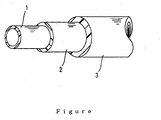
- the sole figure of the drawing is a diagram illustrating an exemplary fuel hose according to the present invention.
- a fuel hose according to the present invention includes an inner layer 1 which contacts a fuel being transported, a fuel-permeation-resistant layer 2 provided on an outer peripheral surface of the inner layer 1, and an outer layer 3 provided on an outer peripheral surface of the fuel-permeation-resistant layer 2 as shown in Figure.
- the inner layer 1 is composed of a polyester resin softened by an alloy of elastomer components or copolymerization (an alloy of an elastomer and a polyester resin or thermoplastic polyester elastomer (TPEE))
- the fuel-permeation resistant layer 2 is composed of at least one polyester resin of polybutylene naphthalate (PBN) and polybutylene terephthalate (PBT).
- the outer layer 3 is composed of a specific blend polymer having flexural modulus within a specified range obtained by blending soft ingredients, such as polymer particles each having a core-shell structure, ethylene acrylic elastomer (AEM) and a styrene-isobutylene block copolymer into PBT.
- soft ingredients such as polymer particles each having a core-shell structure, ethylene acrylic elastomer (AEM) and a styrene-isobutylene block copolymer into PBT.
- the alloy of an elastomer and a polyester resin, as the material for forming the inner layer 1, is not particularly limited, but examples thereof include softened polyesters obtained by alloying modified polyolefin or a soft ingredient having a core-shell structure (as same as those used for the outer layer 3) with PBT or PBN. These are used either alone or in combination.
- thermoplastic polyester elastomer as the material for forming the inner layer 1, is not particularly limited, but examples thereof include thermoplastic polybutylene-naphthalate elastomer (PBN-based TPE), thermoplastic polybutylene-terephthalate elastomer (PBT-based TPE), PBT-based TPE containing a dimer acid or PTMG as a copolymerizing component, which are used either alone or in combination.
- PBN-based TPE thermoplastic polybutylene-naphthalate elastomer
- PBT-based TPE thermoplastic polybutylene-terephthalate elastomer
- PBT-based TPE PBT-based TPE containing a dimer acid or PTMG as a copolymerizing component
- the inner layer 1 may be imparted with electrical conductivity by blending an electrically conductive material such as carbon black, carbon nanotube and metal powder in the material for forming the inner layer so as to release static electricity, generated by a fuel pump, from the hose to outside the hose to prevent ignition of a fuel (such as gasoline) and a like accident which may otherwise occur due to the static electricity.
- an electrically conductive material such as carbon black, carbon nanotube and metal powder in the material for forming the inner layer so as to release static electricity, generated by a fuel pump, from the hose to outside the hose to prevent ignition of a fuel (such as gasoline) and a like accident which may otherwise occur due to the static electricity.
- the fuel-permeation-resistant layer 2 is, as mentioned above, composed of at least one polyester resin of polybutylene naphthalate (PBN) and polybutylene terephthalate (PBT).
- PBN polybutylene naphthalate
- PBT polybutylene terephthalate
- PBT or PBN is used alone or in combination of PBT and PBN.
- the PBT may be prepared, for example, by a DMT method employing dimethyl terephthalate (DMT) and 1,4-butanediol as raw materials or a direct copolymerization method employing terephthalic acid (TPA) and 1,4-butanediol as raw materials.
- DMT dimethyl terephthalate
- TPA terephthalic acid
- the PBN may be prepared, for example, by an ester exchange method employing 2,6-dimethyl naphthalate (DMN) and 1,4-butanediol as raw materials, or by a direct polymerization method employing 2, 6-naphthalenedicarboxylic acid and 1,4-butanediol as raw materials.
- DBN 2,6-dimethyl naphthalate
- 1,4-butanediol 1,4-butanediol
- the fuel-permeation-resistant layer 2 may also be imparted with electrical conductivity by blending an electrically conductive material such as carbon black, carbon nanotube and metal powder in the material for forming the fuel-permeation-resistant layer.
- the outer layer 3 formed on an outer peripheral surface of the fuel-permeation-resistant layer 2, as mentioned above, is formed by a blend polymer having flexural modulus within a specified range (350 to 650MPa) obtained by blending soft ingredients such as, polymer particles each having a core-shell structure, AEM and a styrene-isobutylene block copolymer into PBT.
- the soft ingredients may be used either alone or in combination.
- the flexural modulus of the blend polymer is measured in accordance with ISO 178.
- the blend polymer is an alloy generally having a sea-island structure in which an island phase (domain) composed of the soft ingredient(s) disperses in a sea phase (matrix) composed of PBT, as a base for the blend polymer.
- the same materials as those for the fuel-permeation-resistant layer 2 are used.
- the polymer particles of the core-shell structure as a soft ingredient of the blend polymer are not particularly limited.
- the core-shell structure may have a structure including an elastic core of an acrylic elastomer (ACM), a diene elastomer or a silicon elastomer and a shell layer of an acrylic resin or vinyl polymer.
- ACM acrylic elastomer
- particle polymers having a structure including a core of acrylic elastomer (ACM) and a shell layer of an acrylic resin having a polar functional group are preferred because of excellent compatibility with PBT as a base.
- the polar functional group for forming the shell layer is not particularly limited, however, acrylic resins having an epoxy group or a carboxylic group are preferred in terms of the above-mentioned compatibility.
- ethylene acrylic elastomer may be used as a soft ingredient for the blend polymer.
- examples of the ethylene acrylic elastomer (AEM) include one prepared by polymerization of ethylene, acrylic ester and a small amount of closslinking monomer.
- Acrylic elastomer (ACM) may be blended into the AEM, as required.
- examples of the acrylic elastomer (ACM) include that prepared by polymerization of ethylene, vinyl acetate, acrylic ester and a small amount of crosslinking monomer.
- acrylic ester examples include butyl acrylate, methyl acrylate, ethyl acrylate, propyl acrylate, hexyl acrylate and 2-ethylhexyl acrylate, which may be used either alone or in combination.
- cross-linking monomer examples include esters (such as butylene diacrylate, butylene dimethacrylate and trimethylolpropane) of acrylic acid and polyols, vinyl compounds such as divinylbenzene, vinyl acrylate and vinyl methacrylate, and allyl compounds such as allyl acrylate, allyl methacrylate, diallyl maleate, diallyl fumarate, diallyl itaconate, monoallyl maleate, monoallyl fumarate, triallyl cyanurate, which may be used either alone or in combination.
- the AEM and the ACM may be crosslinked by reaction employing a small amount of a vulcanizing agent in melt blending, so that heat resistance and oil resistance can be improved with flexibility maintained.
- the styrene-isobutylene block copolymer as a soft ingredient for the blend polymer is not particularly limited as long as polystyrene (PS) is employed as a hard segment and polyisobutylene (PIB) is employed as a soft segment.
- PS polystyrene
- PIB polyisobutylene
- examples thereof include styrene-isobutylene diblock copolymer (SIB) and styrene-isobutylene-styrene triblock copolymer (SIBS), among which SIBS is preferably used in terms of excellent strength.
- SIBS styrene-isobutylene diblock copolymer
- SIBS styrene-isobutylene-styrene triblock copolymer
- SIBS styrene-isobutylene-styrene triblock copolymer
- SIBS styrene-isobut
- a compatibilizer is preferably mixed in addition thereto, because advantageous effects that the dispersibility of the styrene-isobutylene block copolymer to the PBT as a base is improved and also the elongation of the resulting hose is improved can be obtained.
- the compatibilizer examples include an ethylene-glycidyl methacrylate (EGMA), a modified EGMA, an ethylene-glycidylmethacrylate-vinyl acetate ternary copolymer, an ethylene-glycidyl methacrylate-methyl acrylate ternary copolymer, an ethylene-methyl acrylate copolymer, an ethylene-methyl acrylate-acrylic acid ternary copolymer, an ethylene-ethyl acrylate copolymer (EEA), a modified EEA, a modified ethylene-ethyl acrylate-maleic anhydride copolymer, an ethylene-methacrylate copolymer, an acrylic elastomer (ACM), an ethylene-vinyl acetate copolymer (EVAc), a modified EVAc, a modified polypropylene (PP), a modified polyethylene (PE), an ethylene-acrylate-maleic anhydride ternary copolymer,
- modified EGMA examples include one obtained by grafting polystyrene (PS), polymethyl methacrylate (PMMA) an acrylonitrile-styrene copolymer (AS), a copolymer of PMMA and butyl acrylate or the like to EGMA and the like.
- modified EEA examples include one obtained by grafting PS, PMMA, AS, a copolymer of PMMA and butyl acrylate or the like to EEA, a maleic anhydride-modified EEA, a silane-modified EEA and the like.
- modified ethylene-ethyl acrylate-maleic anhydride copolymer examples include one obtained by grafting PS, PMMA, AS, a copolymer of PMMA and butyl acrylate or the like to an ethylene-ethyl acrylate-maleic anhydride copolymer and the like.
- modified EVAc examples include one obtained by grafting PS, PMMA, AS, a copolymer of PMMA and butyl acrylate or the like to EVAc and the like.
- modified PP examples include one obtained by grafting PS or AS to PP, a maleic anhydride-modified PP, a hydroxyl group-modified PP and the like.
- modified PE examples include one obtained by grafting PS, PMMA, AS, a copolymer of PMMA and butyl acrylate or the like to a low-density polyethylene (LDPE), amaleicanhydride-modifiedPE, ahydroxylgroup-modified PP and the like.
- LDPE low-density polyethylene
- amaleicanhydride-modifiedPE ahydroxylgroup-modified PP and the like.
- the blend polymer for forming the outer layer 3 has flexural modulus of 350 to 650 MPa, preferably 400 to 500 MPa.
- flexural modulus is within this range, a balance among a low temperature property, hydrolysis resistance and the like becomes excellent, so that performances required for the hose of the present invention can be exerted.
- the mixing ratio of each soft ingredient as mentioned above for enabling the flexural modulus to fall within this range is as follows.
- the soft ingredient is preferably 70 to 120 parts by weight (hereinafter, just abbreviated to "parts") based on 100 parts of PBT.
- the soft ingredient is preferably 30 to 100 parts based on 100 parts of PBT.
- the soft ingredient is preferably 50 to 400 parts and the compatibilizer is 5 to 20 parts based on 100 parts of PBT.
- the outer layer 3 may also be imparted with electrical conductivity by blending an electrically conductive material such as carbon black, carbon nanotube and metal powder in the material for forming the outer layer.
- the fuel hose of the present invention is produced, for example, in the following manner.
- the materials for forming the inner layer 1, the fuel-permeation resistant layer 2 and the outer layer 3 are each kneaded for preparation of each composition.
- these compositions are each co-extruded by means of an extruder, and the resulting inner, fuel-permeation-resistant and outer layers are sized by way of vacuum sizing and cooled to solidification in a cooling water bath.
- the intended fuel hose (see the Figure) is produced.
- the fuel hose of the present invention may have a four-layer structure by extruding the same material as for forming the inner layer 1 (an alloy of an elastomer and a polyester resin or thermoplastic polyester elastomer, which may be the same or different with the material for forming the inner layer 1) between the material for forming the fuel-permeation-resistant layer 2 and the material for forming the outer layer 3 by means of an extruder (four-layer simultaneous extrusion), as required, so as to have a four-layer hose.
- the thus obtained (three-layer or four-layer) fuel hose of the present invention may at least partly have a bellows structure, which is created, for example, by a corrugator.
- each layer is formed by the co-extrusion method.
- the method for the formation of each layer is not limited to the co-extrusion method.
- the inner layer 1 may first be formed on a mandrel by extrusion, and then the fuel-permeation-resistant and outer layers 2, 3 may sequentially be formed on the outer peripheral surface of the inner layer 1 by extrusion.
- the inner layer 1 of the thus obtained fuel hose typically has a thickness of 0.01 to 0.5 mm, preferably 0.1 to 0.4 mm.
- the fuel-permeation-resistant layer 2 typically has a thickness of 0.01 to 0.5 mm, preferably 0. 05 to 0. 4 mm.
- the outer layer 3 typically has a thickness of 0.1 to 3 mm, preferably 0.3 to 1 mm.
- the additional layer provided, as required, between the fuel-permeation-resistant layer 2 and the outer layer 3 typically has a thickness of 0.01 to 0.5 mm, preferably 0.1 to 0.4 mm.
- the fuel hose of the present invention typically has an inner diameter of 3 to 60 mm, preferably 4 to 40 mm.
- the flexural modulus of the inner layer 1 is preferably in the range of 400 to 2000 MPa, particularly preferably in the range of 450 to 1500 MPa.
- the flexural modulus of the fuel-permeation-resistant layer 2 is preferably in the range of 1400 to 2400 MPa, particularly preferably in the range of 1400 to 2100 MPa.
- the flexural modulus of the outer layer 3 is preferably in the range of 350 to 650 MPa, particularly preferably in the range of 400 to 500 MPa.
- the flexural modulus is expressed as a value measured in accordance with ISO 178.
- the fuel hose of the present invention is not limited to the three-layer structure, as shown in the Figure.
- the fuel hose of the present invention may have a four-layer structure provided with the additional layer formed by the same material as the inner layer 1 (an alloy of an elastomer and a polyester resin or thermoplastic polyester elastomer, which may be the same or different with the material for forming the inner layer 1) between the fuel-permeation-resistant layer 2 and the outer layer 3.
- the strength of the laminated product is increased.
- pressure resistance is further improved and is more excellent.
- a wire-mesh layer or a reinforcing fiber layer may be provided, as required, on an outer peripheral surface of the fuel hose of the present invention.
- the resulting hose is slightly inferior in less permeability as compared with the three-layered hose, but is more flexible than the three-layered hose.
- the hose having the two-layer structure is more advantageous.
- the two-layer hose can be produced and interface of this hose can be bonded without use of adhesive, and the resulting polyester hose is excellent in hydrolysis resistance and is suitable for practical use.
- a wire-mesh layer or a reinforcing layer may be provided, as required, on an outer peripheral surface of the two-layer fuel hose of the present invention.
- GRILPET B24HNZ available from EMS-CHEMIE AG (Flexural modulus: 1490 MPa)
- PELPRENE EN5030 available from Toyobo Co., Ltd. (Flexural modulus: 480 MPa)
- TQB-OT available from Teijin Chemicals, Ltd. (Flexural modulus: 1900 MPa)
- VAMAC G available from E.I.DuPont de Nemours & Company
- DIAC #1 available from E.I.DuPont de Nemours & Company
- SIBS Styrene-isobutylene-styrene triblock copolymer
- Epoxidized SBS (EPOFREIEND AT501 available from Daicel Chemical Co., Ltd.)
- each material as shown in Table 1 was prepared.
- Each outer layer material a, b, d, e and g was blended as shown in Table 1, and the resulting mixture was mixed and stirred, and then kneaded by means of a twin screw extruder so as to be pelletized.
- Each outer layer material c and f was mixed with AEM polymer, a vulcanizing agent and carbon black by means of a kneader, and then formed into a ribbon-like shape by a roll. Further, the thus obtained ribbon-shaped mixture was melt-blended with the PBT resin by a side feeder as incidental facilities of the twin screw extruder so as to be pelletized.
- the cup test jig was filled with pure water (100 cm 3 ), and was covered with the sample sheet via butyl rubber packing, and then was turned upside down, so that the sample sheet was in contact with pure water. Then, it was allowed to stand at 80°C. Decreasing amount of pure water and time for letting to stand were plotted in a graph.
- the permeability constant [(mg ⁇ mm) / (cm 2 ⁇ day)] was calculated by inclination of the curve.
- outer layer material a b c d e f g PBT resin 100 100 100 100 100 100 100 Carbon black 1 1 1 1 1 1 1 1 1 Soft ingredients
- Core-shell particles i) 70 - - - 50 - - Core-shell particles (ii) - 120 - - - - - AEM polymer - - 60 - - 110 - Vulcanizing agent - - 0.3 - - 0.5 - SIBS - - - 400 - - 500
- each material for forming an inner layer or a fuel-permeation-resistant layer as shown in Tables 2 and 3 was prepared in addition to the above-mentioned outer layer materials a to g. Then, an inner layer material, a fuel-permeation-resistant layer material and an outer layer material were each simultaneously extruded by means of an extruder, and then cooled to solidification in a cooling water bath, so that fuel hoses (inner diameter: 6 mm) of Examples and Comparative Examples each having an inner layer (thickness: 0.3 mm), a fuel-permeation-resistant layer (thickness: 0.2 mm) formed on an outer peripheral surface of the inner layer and an outer layer (thickness: 0.5 mm) on outer peripheral surface of the fuel-permeation-resistant layer.
- Example 6 a fuel-permeation-resistant layer was not formed.
- Example 8 a hose was produced in the same manner as in Example 1, except that a dry blend of 50 wt% of PBT pellets and 50 wt% of PBN pellets was used for forming a fuel-permeation-resistant layer.
- Example 9 a hose having a four-layer structure was produced by forming a modified polyolefin alloy PBT layer between a fuel-permeation-resistant layer and an outer layer.
- each material was simultaneously extruded by means of a four-layer extruder, and then cooled to solidification in a cooling water bath, so that fuel hoses (inner diameter: 6 mm) having an inner layer (thickness: 0.3 mm), a fuel-permeation-resistant layer (thickness: 0. 1 mm) formed on an outer peripheral surface of the inner layer, modified polyolefin alloy PBT (GRILPET B24HNZ available from EMS-CHEMIE AG) layer (thickness: 0.2 mm) on an outer peripheral surface of the fuel-permeation-resistant layer and an outer layer (thickness: 0.4mm) on outer peripheral surface thereof was produced in Exmple 9.
- fuel hoses inner diameter: 6 mm
- a fuel-permeation-resistant layer thinness: 0. 1 mm
- modified polyolefin alloy PBT GRILPET B24HNZ available from EMS-CHEMIE AG
- the fuel hose was bent by 180 degrees for the evaluation of the low-temperature flexibility.
- the symbol X indicates that the fuel hose suffered from abnormalities such as cracks on the interior surface or exterior surface of the hose, and the symbol ⁇ indicates that the hose did not suffer from any abnormalities.
- the fuel hoses of the Examples each employed the blend polymer having flexural modulus within a specified range (350 to 650MPa) obtained by blending soft ingredients such as polymer particles each having a core-shell structure, ethylene acrylic elastomer (AEM) and a styrene-isobutylene block copolymer into polybutylene terephthalate (PBT) for the outer layer, the fuel hoses of the Examples were less permeable to gasoline, and were excellent in low-temperature flexibility and hydrolysis resistance.
- AEM ethylene acrylic elastomer
- PBT polybutylene terephthalate
- each fuel hose of Comparative Examples 1 to 3 was formed by the same material as the above-mentioned blend polymer, which, however, did not satisfy requirements of the flexural modulus according to the present invention, it was found the fuel hose was inferior in the balance among fuel-permeation-resistance, low-temperature flexibility and hydrolysis resistance, and thus desired hose performances could not be exerted. It is thought that the outer layer had poor adhesion with the PBT resin and thus reinforcing effect could not be obtained, so that low temperature flexibility was inferior in the hose of the Comparative Example 3.
- the fuel hose of the present invention is preferably used as an automotive fuel hose, however, it may be also used a as fuel hose for a tractor, a cultivator and the like.
Landscapes
- Engineering & Computer Science (AREA)
- Mechanical Engineering (AREA)
- General Engineering & Computer Science (AREA)
- Laminated Bodies (AREA)
- Rigid Pipes And Flexible Pipes (AREA)
Applications Claiming Priority (1)
| Application Number | Priority Date | Filing Date | Title |
|---|---|---|---|
| JP2006089072A JP2007261078A (ja) | 2006-03-28 | 2006-03-28 | 燃料用ホース |
Publications (2)
| Publication Number | Publication Date |
|---|---|
| EP1839852A2 true EP1839852A2 (de) | 2007-10-03 |
| EP1839852A3 EP1839852A3 (de) | 2007-12-19 |
Family
ID=38198084
Family Applications (1)
| Application Number | Title | Priority Date | Filing Date |
|---|---|---|---|
| EP07006315A Withdrawn EP1839852A3 (de) | 2006-03-28 | 2007-03-27 | Brennstoffschlauch |
Country Status (3)
| Country | Link |
|---|---|
| US (1) | US20070231521A1 (de) |
| EP (1) | EP1839852A3 (de) |
| JP (1) | JP2007261078A (de) |
Cited By (1)
| Publication number | Priority date | Publication date | Assignee | Title |
|---|---|---|---|---|
| CN105626982A (zh) * | 2014-10-29 | 2016-06-01 | 安徽中鼎胶管制品有限公司 | 一种自动变速箱油冷管及制备方法 |
Families Citing this family (3)
| Publication number | Priority date | Publication date | Assignee | Title |
|---|---|---|---|---|
| JP5172761B2 (ja) * | 2008-03-31 | 2013-03-27 | ウィンテックポリマー株式会社 | ポリブチレンテレフタレート樹脂組成物及び燃料チューブ |
| JP5405862B2 (ja) | 2008-03-31 | 2014-02-05 | ウィンテックポリマー株式会社 | 多層チューブ |
| US10457410B2 (en) * | 2016-04-27 | 2019-10-29 | The Boeing Company | Magnetic carbon nanotube cluster systems and methods |
Family Cites Families (7)
| Publication number | Priority date | Publication date | Assignee | Title |
|---|---|---|---|---|
| EP0185103A1 (de) * | 1984-12-13 | 1986-06-25 | General Electric Company | Biegsame thermoplastische Polyester-Zusammensetzungen |
| DE4214383C2 (de) * | 1992-04-30 | 1996-08-14 | Inventa Ag | Koextrudiertes Mehrschicht-Polymer-Rohr |
| EP0637509B1 (de) * | 1993-08-03 | 2002-10-23 | Nitta Moore Company | Kraftstofftransportschlauch |
| DE19838709A1 (de) * | 1998-08-26 | 2000-03-02 | Degussa | Mehrschichtverbund mit Barrierewirkung |
| JP2003287165A (ja) * | 2002-01-24 | 2003-10-10 | Tokai Rubber Ind Ltd | 燃料用ホース |
| JP2004176906A (ja) * | 2002-09-30 | 2004-06-24 | Tokai Rubber Ind Ltd | 燃料系ホース |
| JP2006272630A (ja) * | 2005-03-28 | 2006-10-12 | Tokai Rubber Ind Ltd | 燃料用ホース |
-
2006
- 2006-03-28 JP JP2006089072A patent/JP2007261078A/ja not_active Withdrawn
-
2007
- 2007-03-22 US US11/689,807 patent/US20070231521A1/en not_active Abandoned
- 2007-03-27 EP EP07006315A patent/EP1839852A3/de not_active Withdrawn
Cited By (1)
| Publication number | Priority date | Publication date | Assignee | Title |
|---|---|---|---|---|
| CN105626982A (zh) * | 2014-10-29 | 2016-06-01 | 安徽中鼎胶管制品有限公司 | 一种自动变速箱油冷管及制备方法 |
Also Published As
| Publication number | Publication date |
|---|---|
| JP2007261078A (ja) | 2007-10-11 |
| EP1839852A3 (de) | 2007-12-19 |
| US20070231521A1 (en) | 2007-10-04 |
Similar Documents
| Publication | Publication Date | Title |
|---|---|---|
| EP1426178B1 (de) | Mehrschichtstruktur aus Kunststoff für medizinische Produkte | |
| EP2106904B1 (de) | Mehrlagiges Rohr | |
| KR101491440B1 (ko) | 폴리알킬렌 카보네이트 및 폴리올레핀 기반의 혼합 조성물 | |
| EP1704996B1 (de) | Brennstoffzellenschlauch | |
| EP1466724B1 (de) | Thermoplastische Harz-Zusammensetzung und Mehrschichtlaminat | |
| EP2554887B2 (de) | Kraftstoffschlauch und dessen herstellungsverfahren | |
| EP1588836B1 (de) | Brennstoffzellenschlauch | |
| US20070231521A1 (en) | Fuel hose | |
| EP1837373B1 (de) | Harzzusammensetzung und daraus hergestellter film | |
| EP2690150A1 (de) | Haftfähige harzzusammensetzung und mehrschichtige struktur damit | |
| EP1333212B1 (de) | Kraftstoffschlauch | |
| US20040146679A1 (en) | Automotive fuel hose | |
| CN1179381A (zh) | 多层塑料容器 | |
| US20040040608A1 (en) | Automotive fuel hose | |
| JPS6215349B2 (de) | ||
| KR102251199B1 (ko) | 가스 배리어성 수지 조성물 및 이로부터 제조되는 제품 | |
| JP2004176906A (ja) | 燃料系ホース | |
| JP2006272630A (ja) | 燃料用ホース | |
| JP4304597B2 (ja) | 多層ポリエステル系フィルム | |
| JPH09187892A (ja) | 多層積層体 | |
| JP4670234B2 (ja) | ポリエステル系フィルム | |
| JP3489902B2 (ja) | 樹脂組成物およびそれを用いた多層構造体 | |
| WO2001094829A1 (en) | Multilayer resin tube | |
| JPH09302159A (ja) | 樹脂組成物及び該組成物からなるフィルム、シート | |
| JP3169282B2 (ja) | バッグインボックス用内容器 |
Legal Events
| Date | Code | Title | Description |
|---|---|---|---|
| PUAI | Public reference made under article 153(3) epc to a published international application that has entered the european phase |
Free format text: ORIGINAL CODE: 0009012 |
|
| AK | Designated contracting states |
Kind code of ref document: A2 Designated state(s): AT BE BG CH CY CZ DE DK EE ES FI FR GB GR HU IE IS IT LI LT LU LV MC MT NL PL PT RO SE SI SK TR |
|
| AX | Request for extension of the european patent |
Extension state: AL BA HR MK YU |
|
| PUAL | Search report despatched |
Free format text: ORIGINAL CODE: 0009013 |
|
| AK | Designated contracting states |
Kind code of ref document: A3 Designated state(s): AT BE BG CH CY CZ DE DK EE ES FI FR GB GR HU IE IS IT LI LT LU LV MC MT NL PL PT RO SE SI SK TR |
|
| AX | Request for extension of the european patent |
Extension state: AL BA HR MK YU |
|
| 17P | Request for examination filed |
Effective date: 20080616 |
|
| AKX | Designation fees paid |
Designated state(s): FR |
|
| REG | Reference to a national code |
Ref country code: DE Ref legal event code: 8566 |
|
| 17Q | First examination report despatched |
Effective date: 20081211 |
|
| STAA | Information on the status of an ep patent application or granted ep patent |
Free format text: STATUS: THE APPLICATION IS DEEMED TO BE WITHDRAWN |
|
| 18D | Application deemed to be withdrawn |
Effective date: 20090422 |