EP1840409A2 - Chaîne et système de transmission de puissance - Google Patents
Chaîne et système de transmission de puissance Download PDFInfo
- Publication number
- EP1840409A2 EP1840409A2 EP07006607A EP07006607A EP1840409A2 EP 1840409 A2 EP1840409 A2 EP 1840409A2 EP 07006607 A EP07006607 A EP 07006607A EP 07006607 A EP07006607 A EP 07006607A EP 1840409 A2 EP1840409 A2 EP 1840409A2
- Authority
- EP
- European Patent Office
- Prior art keywords
- chain
- power transmission
- pin
- link plates
- transmission chain
- Prior art date
- Legal status (The legal status is an assumption and is not a legal conclusion. Google has not performed a legal analysis and makes no representation as to the accuracy of the status listed.)
- Withdrawn
Links
Images




Classifications
-
- F—MECHANICAL ENGINEERING; LIGHTING; HEATING; WEAPONS; BLASTING
- F16—ENGINEERING ELEMENTS AND UNITS; GENERAL MEASURES FOR PRODUCING AND MAINTAINING EFFECTIVE FUNCTIONING OF MACHINES OR INSTALLATIONS; THERMAL INSULATION IN GENERAL
- F16G—BELTS, CABLES, OR ROPES, PREDOMINANTLY USED FOR DRIVING PURPOSES; CHAINS; FITTINGS PREDOMINANTLY USED THEREFOR
- F16G5/00—V-belts, i.e. belts of tapered cross-section
- F16G5/16—V-belts, i.e. belts of tapered cross-section consisting of several parts
- F16G5/18—V-belts, i.e. belts of tapered cross-section consisting of several parts in the form of links
-
- B—PERFORMING OPERATIONS; TRANSPORTING
- B21—MECHANICAL METAL-WORKING WITHOUT ESSENTIALLY REMOVING MATERIAL; PUNCHING METAL
- B21L—MAKING METAL CHAINS
- B21L15/00—Finishing or dressing chains or chain links, e.g. removing burr material, calibrating
- B21L15/005—Pre-stretching chains
-
- F—MECHANICAL ENGINEERING; LIGHTING; HEATING; WEAPONS; BLASTING
- F16—ENGINEERING ELEMENTS AND UNITS; GENERAL MEASURES FOR PRODUCING AND MAINTAINING EFFECTIVE FUNCTIONING OF MACHINES OR INSTALLATIONS; THERMAL INSULATION IN GENERAL
- F16H—GEARING
- F16H9/00—Gearings for conveying rotary motion with variable gear ratio, or for reversing rotary motion, by endless flexible members
- F16H9/02—Gearings for conveying rotary motion with variable gear ratio, or for reversing rotary motion, by endless flexible members without members having orbital motion
- F16H9/04—Gearings for conveying rotary motion with variable gear ratio, or for reversing rotary motion, by endless flexible members without members having orbital motion using belts, V-belts, or ropes
- F16H9/12—Gearings for conveying rotary motion with variable gear ratio, or for reversing rotary motion, by endless flexible members without members having orbital motion using belts, V-belts, or ropes engaging a pulley built-up out of relatively axially-adjustable parts in which the belt engages the opposite flanges of the pulley directly without interposed belt-supporting members
- F16H9/16—Gearings for conveying rotary motion with variable gear ratio, or for reversing rotary motion, by endless flexible members without members having orbital motion using belts, V-belts, or ropes engaging a pulley built-up out of relatively axially-adjustable parts in which the belt engages the opposite flanges of the pulley directly without interposed belt-supporting members using two pulleys, both built-up out of adjustable conical parts
- F16H9/18—Gearings for conveying rotary motion with variable gear ratio, or for reversing rotary motion, by endless flexible members without members having orbital motion using belts, V-belts, or ropes engaging a pulley built-up out of relatively axially-adjustable parts in which the belt engages the opposite flanges of the pulley directly without interposed belt-supporting members using two pulleys, both built-up out of adjustable conical parts only one flange of each pulley being adjustable
Definitions
- the present invention relates to a power transmission system such as a chain type continuously variable transmission system to be adopted in a vehicle or the like, and to a power transmission chain to be used in the power transmission system.
- a continuously variable transmission (CVT) of an automobile is exemplified to include an input pulley disposed on the engine side, an output pulley disposed on the drive wheel side, and an endless power transmission chain looped between the two pulleys.
- a known power transmission chain (as referred to JP-A-8-312725 ) includes a link plate having a pair of pin through holes, or through holes into which pins are inserted, and a plurality of first and second pin members, one of which is fixed in the through hole whereas the other is inserted in a rolling manner into the through hole, so that they can be bent by the first and second pin members are brought into rolling contact to each other relatively.
- the power transmission chain of JP-A-8-312725 is to be manufactured, it is generally performed that the plural link plates are connected in a bendable manner by pin members, and that a pretension is applied to the endless loop chain thereby to apply a compressive residual stress to the link plates thereby to strengthen the link plates. If the excessive tensile load acts, when the pretension is applied, on the link plates so that the plastic deformation extends as wide as the portions needing no plastic deformation, there arises a problem that the durability of the chain cannot be sufficiently improved.
- the present invention has been conceived in view of such background, and has an object to provide a power transmission chain having a high durability and a power transmission system using the chain.
- the invention takes the following technical means.
- a power transmission chain comprising:
- the compressive residual stress is applied selectively to the vicinities of those outer corners of the two upper and lower sides of the one pin member, which confront each other in the chain radial direction, so that the plastic deformation does not extend to the unnecessary portion so that the durability of the chain can be improved.
- a power transmission system comprising a first pulley having a conical sheave face, a second pulley having a conical sheave face, and a power transmission chain looped between said first and second pulleys and contacting with the sheave faces of said first and second pulleys thereby to transmit a power between the two pulleys by a frictional force, characterized in that said power transmission chain is the aforementioned power transmission chain.
- the aforementioned power transmission chain having the high durability is used so that the power transmission can be stably performed for a long time.
- the compressive residual stress is applied selectively to the vicinities of those outer corners of the two upper and lower sides of the one pin member, which confront each other in the chain radial direction, so that the plastic deformation does not extend to the unnecessary portion so that the durability of the chain can be improved.
- the power transmission system of the invention uses the aforementioned power transmission chain so that the power transmission can be stably performed for a long time.
- Fig. 1 and Fig. 2 show a chain type continuously variable transmission system C (as will also be shortly referred to as the "continuously variable transmission system") according to one mode of embodiment of a power transmission system of the invention
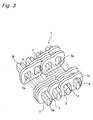
- Fig. 3 shows a power transmission chain 1 (as will also be shortly referred to as the "chain") to be used in that continuously variable transmission system C.
- This continuously variable transmission system C is mounted on an automobile, for example, and is equipped with an input pulley 10 made of a metal (e.g., structural steel) as a first pulley, an output pulley 20 made of a metal (e.g., structural steel) as a second pulley, and the aforementioned power transmission chain 1 looped between the input pulley 10 and the output pulley 20.
- an input pulley 10 made of a metal (e.g., structural steel) as a first pulley
- an output pulley 20 made of a metal (e.g., structural steel) as a second pulley
- the aforementioned power transmission chain 1 looped between the input pulley 10 and the output pulley 20.
- the input pulley 10 is so mounted on an input shaft 11 connected to the engine side as to rotate integrally therewith, and is equipped with a stationary sheave 12 having a conical sheave face 12a and a moving sheave 13 having a conical sheave face 13a arranged to confront the sheave face 12a.
- These sheave faces 12a and 13a form a V-shaped groove, by which the chain 1 is clamped and held by a strong pressure.
- the hydraulic actuator (although not shown) for changing the groove width.
- the moving sheave 13 is moved to vary the groove width so that the chain 1 can be moved to vary the winding radius of the chain 1 relative to the input shaft 11.
- the output pulley 20 is so mounted on an output shaft 21 connected to the drive wheel side as to rotate integrally therewith, and is equipped, like the input pulley 10, with a stationary sheave 23 and a moving sheave 22 having sheave faces for forming a groove to clamp the chain 1 by a strong pressure.
- the hydraulic actuator (although not shown).
- the moving sheave 13 is moved in its axial direction to vary the groove width so that the chain 1 can be moved to vary the winding radius of the chain 1 relative to the output shaft 21.
- the continuously variable transmission system C thus constructed according to this mode of embodiment can change the speed continuously in the following manner. Specifically, in case the rotating speed of the output shaft 21 is to be decelerated, the groove width on the side of the input pulley 10 is enlarged by the movement of the moving sheave 13 to reduce the winding diameter of the chain 1 on the input shaft 11 while the pin end faces 3a and 3b of the chain 1 being held in sliding contact under a boundary lubricating condition toward the inner sides of the conical sheave faces 12a and 13a.
- the groove width is reduced by the movement of the moving sheave 22 to enlarge the winding diameter of the chain 1 on the output shaft 21 while the pin end faces 3a and 3b of the chain 1 being held in sliding contact under a boundary lubricating condition toward the outer sides of conical sheave faces 22a and 23a.
- the rotation of the output shaft 21 can be decelerated.
- the groove width on the side of the input pulley 10 is reduced by the movement of the moving sheave 13 to enlarge the winding diameter of the chain 1 on the input shaft 11 while the pin end faces 3a and 3b of the chain 1 being held in sliding contact under a boundary lubricating condition toward the outer sides of the conical sheave faces 12a and 13a.
- the groove width is enlarged by the movement of the moving sheave 22 to reduce the winding diameter of the chain 1 on the output shaft 21 while the pin end faces 3a and 3b of the chain 1 being held in sliding contact under a boundary lubricating condition toward the inner sides of conical sheave faces 22a and 23a.
- the rotation of the output shaft 21 can be accelerated.
- This chain 1 is constructed to include: a plurality of link plates 2 made of a metal (e.g., carbon steel) and acting as chain constructing members; a plurality of pins 3 made of a metal (e.g., bearing steel) and acting as first or second pin members for connecting those link plates 2 to each other; and strips 4 acting as first or second pin members slightly shorter than those pins 3.
- a plurality of link plates 2 made of a metal (e.g., carbon steel) and acting as chain constructing members
- a plurality of pins 3 made of a metal (e.g., bearing steel) and acting as first or second pin members for connecting those link plates 2 to each other
- the illustration of the widthwise center portion of the chain 1 is partially omitted from Fig. 1.
- the link plates 2 are shaped to have a substantially identical gentle contour, and are individually provided with two through holes 2a.
- Each through hole 2a is shaped to combine two elliptical shapes, which are elongated in a direction perpendicular to the chain advancing direction.
- the pins 3 connecting those link plates 2 are rod members having side faces along the inner peripheries of the through holes 2a, and are all formed to have a substantially identical shape.
- the pin end faces 3a and 3b are formed into protruding curved faces set to have a predetermined curvature so that they contact with the two pulleys to transmit the power.
- the strips 4 are made slightly shorter than the pins, and are rod members which have side faces along the inner peripheries of the through holes 2a and which are all formed to have a substantially identical shape. Moreover, the plural link plates 2 are arranged in an overlapped manner, and are connected to each other in a bendable manner by inserting the pins 3 and the strips 4 into the through holes 2a of the link plates 2 arranged to overlap each other.
- the pin 3 and the strip 4 are so inserted into one through hole 2a that one of them is press-fitted in the through hole 2a whereas the other is rotatably inserted while making rolling contact with the side face of one. Moreover, the other is press-fitted in the through hole 2a of one link plate 2 overlapping and adjoining to another link plate 2. Moreover, said one is rotatably inserted into the through hole 2a of said another link plate 2. Of the pin 3 and the strip 4, one is press-fitted in the through hole 2a whereas the other is rotatably inserted into the through hole 2a, so that the link plates 2 are connected in the bendable manner to each other.
- the bendable chain 1 is constructed by connecting the overlapped link plates 2 in the bendable manner and by arranging the overlapped link plates 2 in a chain width direction perpendicular to the chain advancing direction.
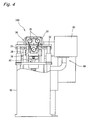
- Fig. 4 shows a preloading apparatus 100 acting as the pretension applying apparatus for applying the pretension to the chain 1p.
- This apparatus 100 is equipped with an apparatus body 30, an hydraulic device 40 positioned on the lower side of the apparatus body 30, a platform 50; and a control device 60 arranged on the side of the apparatus body 30.
- the apparatus body 30 is equipped with: guide posts 31 erected from the two right and left sides of the platform 50; a stationary support plate 32 mounted on the upper ends of the guide posts 31; a stationary portion 33 fixed on the stationary support plate 32; a lifting unit 34 positioned below the stationary portion 33; two upper rollers 35 mounted on the stationary portion 33; and a lower roller 36 mounted on the lifting unit 34.
- the two upper rollers 35 are supported at the same level positions, and the lower roller 36 is so supported at such a lower position as corresponds to the central portion between the two upper rollers 35.
- These upper rollers 35 and lower roller 36 are so arranged that the chain 1p looped between the rollers 35 and 36 forms a triangular shape in a front view.
- the lifting unit 34 In the two right and left sides of the lifting unit 34, moreover, there are individually formed through holes 34a, into which the aforementioned guide posts 31 are inserted, so that the lifting unit 34 can vertically move close to and apart from the stationary portion 33. As a result, the lifting unit 34 is moved upward and downward (i.e., into and out of the aforementioned triangle) by the hydraulic device 40 disposed below the lifting unit 34, so that the distances between the individual upper rollers 35 disposed on the stationary unit 33 and the lower roller 36 carried on the lifting unit 34 vary.
- the central portion of the stationary support plate 32 there is formed an inlet port 32a, into which the upper portion of the lifting unit 34 proceeds as lifting unit 34 rises.
- the upper rollers 35 and the lower roller 36 are individually formed integrally with the leading end of a support shaft 37, as shown in Fig. 6. These support shafts 37 are rotatably supported individually by bearings 38 in the stationary portion 33 and in the lifting unit 34. As a result, the upper rollers 35 and the lower roller 36 are so supported in a cantilever state as can rotate on their individual axes s1 and s2. Moreover, the stationary portion 33 is equipped with the not-shown roller drive units, by which the upper rollers 35 are rotated. At the leading ends of the upper rollers 35 and the lower roller 36, moreover, there are mounted guide caps 39 for mounting the chain 1p easily.
- the control device 60 controls the hydraulic device 40 and the roller drive unit to move the lower roller 36 upward and downward and to rotate the upper rollers 35.
- Each of the upper rollers 35 and the lower roller 36 is equipped with a U-shaped groove u for running the chain 1p. This chain 1p is looped in the individual grooves u of the upper rollers 35 and the lower roller 36.
- a tensile load is applied to the chain 1p.
- the lower roller 36 is lifted together with the lifting unit 34, and the chain 1p is fitted in and looped between the grooves u of the two upper rollers 35 and the lower roller 36. Then, the lower roller 36 is lowered to tense the chain 1p. Next, the upper rollers 35 are rotated, and the lower roller 36 is further lowered by a predetermined distance from the upper rollers 35.
- the chain 1p is loaded with a tensile load while being endlessly turned.
- the chain 1p is endlessly turned by several turns at a peripheral speed for an ordinary use, in which the speed or the rollers take 1,000 rpm.
- the number of turns of the chain 1p is 7 or less, preferably 1.
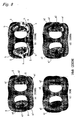
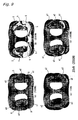
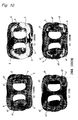
- Fig. 7 to Fig. 10 present the results of the finite element method (FEM) analyses of the stress distributions of the link plates 2 at the time when the pretension was applied to the chain 1p.
- FEM finite element method
- the plastic deformation portions s extend. Especially in Fig. 9 and Fig. 10, the plastic deformation portions s widely extend.
- the compressive stress portion a2 is small in Fig. 7 and Fig. 8, and the compressive stress portion a2 extends wider in Fig. 9 and Fig. 10 in the procedure where the tensile load was applied again.
- the vicinities of the through hole outer corners R are compared at (a) and (d) in the individual Figures.
- (a) shows the time of the pretension
- (d) shows the time of 1,000 (r) when the tension was applied again.
- the variation of the plastic deformation portions s is hardly recognized between (a) and (d) of Fig. 7.
- the plastic deformation portion s exists in Fig. 8(a) between Fig. 8(a) and Fig. 8(d), but the plastic deformation portion is small or hardly exists in Fig. 8(b). Comparing (a) and (d) of Fig. 9 and Fig. 10, it is recognized in (d) of the individual Figures that the plastic deformation portion s become smaller, but that the tensile stress portion h and the compressive stress portions a1 and a2 become larger.
- the plastic deformation portions s are concentrated near the through hole outer corners R, to which the compressive residual stress is applied.
- the plastic deformation portions s are shrunken till the pretension becomes 16 kN.
- the pretension exceeds 20 kN, the tensile stress portions h and the compressive stress portion a2 extend, and it is understood that the pretension is preferably to be set to 12 kN to 16 kN. Therefore, the lower roller 36 is so moved downward from the upper rollers 35 that the pretension may be 12 kN to 16 kN, and the tensile load is applied to the chain 1p while the chain 1p being endlessly turned.
- both the peripheral speed and the peripheral turns of the chain are suppressed so that the plastic deformation does not extend to the portions other than the vicinities of the through hole outer corners R.
- the vicinities of the through hole outer corners R, against which the pins 3 and the strips 4 on the press-fitted and fixed sides abut, are plastically deformed to establish the compressive residual stresses. More specifically, the vicinities, at which the strongest force is applied, of the link plates 2 are especially strengthened to establish the so-called "shake-down state", in which the metallic fatigue is prevented as a result of a rise in the deformation resistance. Moreover, the plastic deformation in the link plates 2 does not extend to the unnecessary portions so that the durability of the chain 1 can be improved.
- the power transmission system C of the mode of embodiment thus far described employs the aforementioned power transmission chain 1 having an improved durability and a stabilized quality so that it can perform the power transmission stably for a long time.
- the power transmission system of the invention should not be limited to the mode, in which the groove widths of both the input pulley and the output pulley fluctuate, but may be exemplified by the mode, in which only one groove width is fluctuated whereas the other is fixed unfluctuant.
- the groove width is continuously fluctuated, but the invention can also be applied to another power transmission system, in which the groove width is stepwise fluctuated or fixed.
- the pin members constituting the chain may also be composed of pin bodies and contact members disposed on the two end portions of the pin bodies.
- the chain may also be of the block type having block members for clamping the overlapped link plates.
Landscapes
- Engineering & Computer Science (AREA)
- General Engineering & Computer Science (AREA)
- Mechanical Engineering (AREA)
- Transmissions By Endless Flexible Members (AREA)
- Devices For Conveying Motion By Means Of Endless Flexible Members (AREA)
- Load-Engaging Elements For Cranes (AREA)
Applications Claiming Priority (1)
| Application Number | Priority Date | Filing Date | Title |
|---|---|---|---|
| JP2006096597A JP2007270942A (ja) | 2006-03-31 | 2006-03-31 | 動力伝達チェーン及び動力伝達装置 |
Publications (2)
| Publication Number | Publication Date |
|---|---|
| EP1840409A2 true EP1840409A2 (fr) | 2007-10-03 |
| EP1840409A3 EP1840409A3 (fr) | 2009-12-09 |
Family
ID=38222515
Family Applications (1)
| Application Number | Title | Priority Date | Filing Date |
|---|---|---|---|
| EP07006607A Withdrawn EP1840409A3 (fr) | 2006-03-31 | 2007-03-29 | Chaîne et système de transmission de puissance |
Country Status (3)
| Country | Link |
|---|---|
| US (1) | US20070232431A1 (fr) |
| EP (1) | EP1840409A3 (fr) |
| JP (1) | JP2007270942A (fr) |
Cited By (2)
| Publication number | Priority date | Publication date | Assignee | Title |
|---|---|---|---|---|
| EP1938916A1 (fr) * | 2006-12-01 | 2008-07-02 | JTEKT Corporation | Procédé d'application de contrainte pour chaîne de transmission de puissance et appareil d'application de contrainte utilisé dans ledit procédé |
| NL1034882C2 (nl) * | 2008-01-02 | 2009-07-06 | Gear Chain Ind Bv | Inrichting voor het rekken van een transmissieketting. |
Families Citing this family (5)
| Publication number | Priority date | Publication date | Assignee | Title |
|---|---|---|---|---|
| JP4803423B2 (ja) * | 2005-10-14 | 2011-10-26 | 株式会社ジェイテクト | 動力伝達チェーンおよびこれを備える動力伝達装置 |
| EP2085643B1 (fr) * | 2006-10-31 | 2018-06-27 | JTEKT Corporation | Procédé et dispositif d'étirage d'une chaîne de transmission de puissance |
| JP6256756B2 (ja) * | 2014-02-12 | 2018-01-10 | 株式会社ジェイテクト | 動力伝達チェーンの製造方法 |
| JP6298736B2 (ja) * | 2014-08-08 | 2018-03-20 | 株式会社豊田中央研究所 | 無段変速機及び無段変速機を設計する方法 |
| CN115003929A (zh) * | 2020-02-19 | 2022-09-02 | 舍弗勒技术股份两合公司 | 供板式连杆链的摇杆销对所用的摇杆销 |
Citations (1)
| Publication number | Priority date | Publication date | Assignee | Title |
|---|---|---|---|---|
| JPH08312725A (ja) | 1995-05-03 | 1996-11-26 | Gear Chain Ind Bv | コーンプーリトランスミッションのための伝動用チェーン |
Family Cites Families (8)
| Publication number | Priority date | Publication date | Assignee | Title |
|---|---|---|---|---|
| US4430067A (en) * | 1981-04-20 | 1984-02-07 | Whitaker Ranald O | Variable speed drive with no slippage between belt and sheaves |
| US4507106A (en) * | 1982-11-17 | 1985-03-26 | Borg-Warner Corporation | Power transmission chain |
| DE3664669D1 (en) * | 1985-02-12 | 1989-08-31 | Tsubakimoto Chain Co | Frictional transmission chain |
| JP3076023B1 (ja) * | 1999-03-03 | 2000-08-14 | 株式会社椿本チエイン | 低摩耗伸びサイレントチェーン |
| DE10047979B4 (de) * | 1999-10-13 | 2013-05-16 | Schaeffler Technologies AG & Co. KG | Kette |
| JPWO2005050055A1 (ja) * | 2003-11-10 | 2007-06-07 | 株式会社ジェイテクト | 動力伝達チェーンおよび動力伝達装置ならびにその製造方法 |
| JP2005291322A (ja) * | 2004-03-31 | 2005-10-20 | Koyo Seiko Co Ltd | 動力伝達チェーンおよびこれを備える動力伝達装置 |
| JP2007051711A (ja) * | 2005-08-18 | 2007-03-01 | Jtekt Corp | 動力伝達チェーンおよびこれを備える動力伝達装置 |
-
2006
- 2006-03-31 JP JP2006096597A patent/JP2007270942A/ja not_active Withdrawn
-
2007
- 2007-03-28 US US11/727,847 patent/US20070232431A1/en not_active Abandoned
- 2007-03-29 EP EP07006607A patent/EP1840409A3/fr not_active Withdrawn
Patent Citations (1)
| Publication number | Priority date | Publication date | Assignee | Title |
|---|---|---|---|---|
| JPH08312725A (ja) | 1995-05-03 | 1996-11-26 | Gear Chain Ind Bv | コーンプーリトランスミッションのための伝動用チェーン |
Cited By (3)
| Publication number | Priority date | Publication date | Assignee | Title |
|---|---|---|---|---|
| EP1938916A1 (fr) * | 2006-12-01 | 2008-07-02 | JTEKT Corporation | Procédé d'application de contrainte pour chaîne de transmission de puissance et appareil d'application de contrainte utilisé dans ledit procédé |
| NL1034882C2 (nl) * | 2008-01-02 | 2009-07-06 | Gear Chain Ind Bv | Inrichting voor het rekken van een transmissieketting. |
| EP2077169A1 (fr) * | 2008-01-02 | 2009-07-08 | Gear Chain Industrial B.V. | Dispositif pour étirer une chaîne de transmission |
Also Published As
| Publication number | Publication date |
|---|---|
| JP2007270942A (ja) | 2007-10-18 |
| EP1840409A3 (fr) | 2009-12-09 |
| US20070232431A1 (en) | 2007-10-04 |
Similar Documents
| Publication | Publication Date | Title |
|---|---|---|
| EP1840409A2 (fr) | Chaîne et système de transmission de puissance | |
| EP1949986B1 (fr) | Procédé de fabrication d'une chaîne de transmission de puissance et dispositif de prétension utilisé dans celui-ci | |
| EP1837552A2 (fr) | Chaîne et système de transmission de puissance | |
| EP1818568A2 (fr) | Procédé de prétension d'une chaîne de transmission, dispositif pour la mise en oeuvre dudit procédé et dispositif de transmission | |
| JP5347290B2 (ja) | 動力伝達チェーンの予張方法 | |
| EP2249060B1 (fr) | Chaîne de transmission et dispositif de transmission de puissance équipé de celle-ci | |
| EP1998077A2 (fr) | Chaîne de transmission de puissance et appareil de transmission de puissance doté de celle-ci | |
| US8141402B2 (en) | Pretension loading method for power transmission chain and pretension loading apparatus | |
| JP4910982B2 (ja) | 動力伝達チェーンの製造方法 | |
| EP1953413B1 (fr) | Chaîne de transmission de puissance et appareil de transmission de puissance | |
| EP1867893A2 (fr) | Chaîne de transmission de puissance et dispositif de transmission de puissance l'utilisant | |
| EP1938916B1 (fr) | Procédé d'application de contrainte pour chaîne de transmission de puissance et appareil d'application de contrainte utilisé dans ledit procédé | |
| JP4770454B2 (ja) | 無段変速機用動力伝達チェーンの製造方法 | |
| EP1985890A2 (fr) | Chaîne et appareil de transmission de puissance | |
| JP4853017B2 (ja) | 動力伝達チェーンおよびその製造方法ならびに動力伝達装置 | |
| JP5151140B2 (ja) | 動力伝達チェーンおよび動力伝達装置 | |
| JP4830707B2 (ja) | 動力伝達チェーンおよび動力伝達装置 | |
| JP2011200874A (ja) | 動力伝達チェーンの製造方法 | |
| JP2009028737A (ja) | 動力伝達チェーンの予張方法および予張装置 | |
| JP2008168301A (ja) | 動力伝達チェーンの製造方法および製造装置 | |
| JP2008208920A (ja) | 動力伝達チェーンおよび動力伝達装置 | |
| JP2008215522A (ja) | 動力伝達チェーンおよび動力伝達装置 | |
| JP2009255121A (ja) | 動力伝達チェーンの予張方法および予張装置 | |
| JP2008208980A (ja) | 動力伝達チェーンおよび動力伝達装置 | |
| JP2009115193A (ja) | 動力伝達チェーンおよび動力伝達装置 |
Legal Events
| Date | Code | Title | Description |
|---|---|---|---|
| PUAI | Public reference made under article 153(3) epc to a published international application that has entered the european phase |
Free format text: ORIGINAL CODE: 0009012 |
|
| AK | Designated contracting states |
Kind code of ref document: A2 Designated state(s): AT BE BG CH CY CZ DE DK EE ES FI FR GB GR HU IE IS IT LI LT LU LV MC MT NL PL PT RO SE SI SK TR |
|
| AX | Request for extension of the european patent |
Extension state: AL BA HR MK YU |
|
| PUAL | Search report despatched |
Free format text: ORIGINAL CODE: 0009013 |
|
| AK | Designated contracting states |
Kind code of ref document: A3 Designated state(s): AT BE BG CH CY CZ DE DK EE ES FI FR GB GR HU IE IS IT LI LT LU LV MC MT NL PL PT RO SE SI SK TR |
|
| AX | Request for extension of the european patent |
Extension state: AL BA HR MK RS |
|
| AKY | No designation fees paid | ||
| STAA | Information on the status of an ep patent application or granted ep patent |
Free format text: STATUS: THE APPLICATION IS DEEMED TO BE WITHDRAWN |
|
| 18D | Application deemed to be withdrawn |
Effective date: 20100511 |
|
| REG | Reference to a national code |
Ref country code: DE Ref legal event code: 8566 |