EP1840794B1 - Procédé, système et programme pour l'authentification d'un utilisateur au moyen d'informations biométriques - Google Patents
Procédé, système et programme pour l'authentification d'un utilisateur au moyen d'informations biométriques Download PDFInfo
- Publication number
- EP1840794B1 EP1840794B1 EP07005963.9A EP07005963A EP1840794B1 EP 1840794 B1 EP1840794 B1 EP 1840794B1 EP 07005963 A EP07005963 A EP 07005963A EP 1840794 B1 EP1840794 B1 EP 1840794B1
- Authority
- EP
- European Patent Office
- Prior art keywords
- image
- filter
- verification
- registration
- biometric authentication
- Prior art date
- Legal status (The legal status is an assumption and is not a legal conclusion. Google has not performed a legal analysis and makes no representation as to the accuracy of the status listed.)
- Active
Links
Images







Classifications
-
- G—PHYSICS
- G06—COMPUTING OR CALCULATING; COUNTING
- G06F—ELECTRIC DIGITAL DATA PROCESSING
- G06F21/00—Security arrangements for protecting computers, components thereof, programs or data against unauthorised activity
- G06F21/30—Authentication, i.e. establishing the identity or authorisation of security principals
- G06F21/31—User authentication
- G06F21/32—User authentication using biometric data, e.g. fingerprints, iris scans or voiceprints
-
- G—PHYSICS
- G06—COMPUTING OR CALCULATING; COUNTING
- G06V—IMAGE OR VIDEO RECOGNITION OR UNDERSTANDING
- G06V40/00—Recognition of biometric, human-related or animal-related patterns in image or video data
- G06V40/10—Human or animal bodies, e.g. vehicle occupants or pedestrians; Body parts, e.g. hands
-
- G—PHYSICS
- G07—CHECKING-DEVICES
- G07C—TIME OR ATTENDANCE REGISTERS; REGISTERING OR INDICATING THE WORKING OF MACHINES; GENERATING RANDOM NUMBERS; VOTING OR LOTTERY APPARATUS; ARRANGEMENTS, SYSTEMS OR APPARATUS FOR CHECKING NOT PROVIDED FOR ELSEWHERE
- G07C9/00—Individual registration on entry or exit
- G07C9/30—Individual registration on entry or exit not involving the use of a pass
- G07C9/32—Individual registration on entry or exit not involving the use of a pass in combination with an identity check
- G07C9/37—Individual registration on entry or exit not involving the use of a pass in combination with an identity check using biometric data, e.g. fingerprints, iris scans or voice recognition
-
- H—ELECTRICITY
- H04—ELECTRIC COMMUNICATION TECHNIQUE
- H04K—SECRET COMMUNICATION; JAMMING OF COMMUNICATION
- H04K1/00—Secret communication
-
- H—ELECTRICITY
- H04—ELECTRIC COMMUNICATION TECHNIQUE
- H04L—TRANSMISSION OF DIGITAL INFORMATION, e.g. TELEGRAPHIC COMMUNICATION
- H04L9/00—Cryptographic mechanisms or cryptographic arrangements for secret or secure communications; Network security protocols
- H04L9/32—Cryptographic mechanisms or cryptographic arrangements for secret or secure communications; Network security protocols including means for verifying the identity or authority of a user of the system or for message authentication, e.g. authorization, entity authentication, data integrity or data verification, non-repudiation, key authentication or verification of credentials
- H04L9/3226—Cryptographic mechanisms or cryptographic arrangements for secret or secure communications; Network security protocols including means for verifying the identity or authority of a user of the system or for message authentication, e.g. authorization, entity authentication, data integrity or data verification, non-repudiation, key authentication or verification of credentials using a predetermined code, e.g. password, passphrase or PIN
- H04L9/3231—Biological data, e.g. fingerprint, voice or retina
-
- G—PHYSICS
- G06—COMPUTING OR CALCULATING; COUNTING
- G06F—ELECTRIC DIGITAL DATA PROCESSING
- G06F2221/00—Indexing scheme relating to security arrangements for protecting computers, components thereof, programs or data against unauthorised activity
- G06F2221/21—Indexing scheme relating to G06F21/00 and subgroups addressing additional information or applications relating to security arrangements for protecting computers, components thereof, programs or data against unauthorised activity
- G06F2221/2107—File encryption
-
- G—PHYSICS
- G06—COMPUTING OR CALCULATING; COUNTING
- G06V—IMAGE OR VIDEO RECOGNITION OR UNDERSTANDING
- G06V40/00—Recognition of biometric, human-related or animal-related patterns in image or video data
- G06V40/50—Maintenance of biometric data or enrolment thereof
- G06V40/53—Measures to keep reference information secret, e.g. cancellable biometrics
-
- G—PHYSICS
- G07—CHECKING-DEVICES
- G07C—TIME OR ATTENDANCE REGISTERS; REGISTERING OR INDICATING THE WORKING OF MACHINES; GENERATING RANDOM NUMBERS; VOTING OR LOTTERY APPARATUS; ARRANGEMENTS, SYSTEMS OR APPARATUS FOR CHECKING NOT PROVIDED FOR ELSEWHERE
- G07C2209/00—Indexing scheme relating to groups G07C9/00 - G07C9/38
- G07C2209/12—Comprising means for protecting or securing the privacy of biometric data, e.g. cancellable biometrics
-
- H—ELECTRICITY
- H04—ELECTRIC COMMUNICATION TECHNIQUE
- H04L—TRANSMISSION OF DIGITAL INFORMATION, e.g. TELEGRAPHIC COMMUNICATION
- H04L2209/00—Additional information or applications relating to cryptographic mechanisms or cryptographic arrangements for secret or secure communication H04L9/00
- H04L2209/80—Wireless
- H04L2209/805—Lightweight hardware, e.g. radio-frequency identification [RFID] or sensor
Definitions
- the present invention relates to a biometric authentication method and system for authenticating a user by biometric information of the user.
- a personal authentication system using biometric information obtains biometric information of a user in the initial registration, extracts information called a feature quantity, and registers the extracted information. This registered information is called a template. Upon authentication, the system obtains again the biometric information from the user to extract the feature quantity, and verifies the identity of the user by verifying the feature quantity against the template having been registered.
- the server In a system in which a client and a server are connected via a network, typically the server maintains a template when biometrically authenticating a user on the client side.
- the client obtains the biometric information of the user upon authentication, extracts a feature quantity, and transmits to the server.
- the server matches the feature quantity against the template to determine whether the two feature quantities are from the same person.
- the template is information by which an individual can be identified.
- the template needs to be strictly managed as personal information and thereby needs a high management cost.
- the number of physical characteristics per person for one pieces of biometric information e.g., only ten fingers for fingerprints
- the number of physical characteristics per person for one pieces of biometric information is limited, so that the template is not easily changed, unlike the password and encryption key.
- the biometric authentication could not be used if the template were leaked and exposed to forgery.
- the same biometric information is registered to a different system, the different system also faces a threat.
- JP-A No. 7802/2001 discloses a method that biometric information is encrypted and transmitted to an authentication server.
- biometric information is needed to be encrypted upon authentication, it is difficult to prevent leakage caused by sophisticated attacks as well as leakage intentionally caused by a server administrator.
- the method is insufficient for the protection of privacy issues.
- cancelable biometric authentication a method in which, upon registration of biometric information, a feature quantity is transformed by a certain function and secret parameter held by the client and is stored as a template to the server to which the original information is kept confidential, and upon authentication, a feature quantity of biometric information is newly extracted by the client, transformed by the same function and parameter, and is transmitted to the server which then matches the received feature quantity against the template in the transformed state respectively.
- a specific method for realizing cancelable biometric authentication is dependant on the type and verification algorithm of the biometric information.
- a method for realizing cancelable biometric authentication by face images is proposed in M. Savvides, B.V.K. Vijayakumar, and P.K. Khosla, "Authentication-Invariant Cancelable Biometric Filters for Illumination-Tolerant Face Verification", Biometric Technology for Human Identification, Proceedings of SPIE Vol. 5404, p156-163 .
- a face image is transformed into frequency space.
- a filter is generated as a template for absorbing illumination changes and the like.
- a filter process is applied using the template to the input face image. Then the authentication is performed by making a threshold determination for the output pattern.
- the input biometric information is encrypted on the client side and is transmitted to the authentication server in which the encrypted information is decoded.
- the user's biometric information may not be confidential to a server administrator as the biometric information is decoded within the authentication server. For this reason, there is a possibility of leakage of unencrypted biometric information due to an accident or dishonesty of the server administrator. Still there remains a problem that the hesitation about privacy for the user may not be reduced.
- the cancelable transformation may not be realized by the method proposed in M. Savvides, B.V.K. Vijayakumar, and P.K. Khosla, "Authentication-Invariant Cancelable Biometric Filters for Illumination-Tolerant Face Verification", Biometric Technology for Human Identification, Proceedings of SPIE Vol. 5404, p156-163 .
- US 2005/018925 A1 discloses an image pattern recognition method using correlation filters operating both in the image and frequency domains.
- US 6 836 554 B1 discloses the use of non-invertible scrambling and morphing techniques for biometric signals and images.
- the present invention is a method for authenticating a user based on cross-correlation between an enrolled image and a verification image of biometric information of a user.
- cancelable biometric authentication that can authenticate a user with an enrolled image and a verification image kept confidential to a server administrator by randomizing the images in a verification algorithm based on the cross-correlation between the images. It is also possible to realize cancelable biometric authentication in the case in which the images are three-value images and the verification algorithm uses distance values as verification values. Further, a random filter can be generated to make it more difficult to reproduce the original image from a randomized image.
- Fig. 1 shows a configuration of a cancelable finger vein authentication system.
- This cancelable finger vein authentication system includes: a client terminal (hereinafter simply referred to as a client) 100 for obtaining a finger vein image upon registration and authentication, generating a three value image, and performing random transformation; and a server 130 for storing and verifying a template.
- the client 100 and the server 130 are connected via a network such as the internet or intranet.
- the client 100 is managed by its user or a reliable third party, having a finger vein sensor 110 for imaging finger vein, and handling a portable recording medium 120.
- the portable recording medium 120 is a recording medium that the user carries and manages, such as IC card or USB memory. It is needless to say that other media, such as a portable terminal and a flexible disk, can also be used.
- the client 100 may be a home personal computer managed by the user and the server 130 may be a server machine managed by a bank.
- the client 100 includes: a three-value image generation unit 101 for extracting a finger vein pattern from a finger vein image and converting into three values; a random filter generation unit 103 for generating a random filter pair whose pixels have random values, respectively, upon registration; a random transformation unit 102 for transforming the three-value image by the random filter to generate a random image; a recording medium I/F unit 104 for communicating with the portable recording medium 120; and a communication unit 105 for communicating via a network.
- the processes of the three-value image generation unit 101, random filter generation unit 103, and random transformation unit 102 are realized by a processor of the client 100 executing a program.
- the three-value image generation can be realized, for example, by a method disclosed in JP-A No. 178606/2004 .
- the server 130 includes: a communication unit 131 for communicating via the network; a registration unit 132 for registering the random image as a template; a memory 133 for storing the template; and a verification unit 134 for calculating the mismatch rate by verifying a random image newly received upon authentication against the template.
- the processes in the registration unit 132 and the verification unit 134 are realized by the server 130 executing a program.
- the mismatch rate is an index of how the target random image and the template are not similar. The images are similar to each other as the mismatch rate is smaller.
- the mismatch rate calculation can be realized, for example, by applying a method disclosed in Naoto Miura, Akio Nagasaka, Takafumi Miyatake, "Feature extraction of finger-vein patterns based on repeated line tracking and its application to personal identification", Machine Vision and Applications (2004) Vol. 15, p.194-203 .
- Fig. 2A shows an operation flow of a finger vein registration process
- Fig. 2B shows an operation flow of a finger vein authentication process.
- a registration process operation will be described.
- the finger vein sensor 110 obtains a finger vein image of a user (S201).
- the client 100 extracts a finger vein pattern from the finger vein image, converts into three values, and generates a three-value image (S202).
- the three-value image generation can be realized, for example, by the method described in JP-A No. 178606/2004 .
- these widths are defined as He ⁇ Hv, We ⁇ Wv.
- the size of the three-value image g upon registration is enlarged to the size of the three-value image f upon authentication by the following method.
- the center of g is adjusted to the center of f, and then the luminance values of the pixels in an area outside g and inside f (namely, an area beyond g) are set to 1. In this way, the size of g can be enlarged to the vertical width Hv and the horizontal width Wv.
- K represents a random filter
- L represents an inverse random filter.
- the client 100 writes the inverse random filter L into the portable recording medium 120, deleting the inverse random filter L from the memory in the client (S204) .
- the inverse random filter L is stored in the portable recording medium 120 and is kept confidential to the server 130.
- the client 100 inputs the random filter K and the three-value image g into the random transformation unit 102, and transmits an output random image KG to the server 130 (S205) .
- the details of the random transformation will be described later.
- the server 130 receives the random image KG and registers the random image as a template to the memory 133 (S206).
- the client 100 obtains a finger vein image of a user via the finger vein sensor 110 (S211).
- the client 100 generates a three-value image f from the finger vein image (S212).
- the three-value image generation is performed, for example, by the method described in JP-A No. 178606/2004 .
- the three-value image f has a size of the vertical width Hv and the horizontal width Wv.
- the client 100 reads the inverse random filter L from the portable recording medium 120 (S213). Then the client 100 inputs the inverse random filter L and the three-value image f into the random transformation unit 102, and transmits an output random image LF to the server 130 (S214). The details of the random transformation will be described later.
- the server 130 receives the random image LF and matches the random image LF against the template KG to determine whether the two finger veins are from the same person (S215).
- the client 100 deletes the inverse random filter L from the memory therein after completion of the authentication process.
- the server 130 stores the transformed random image KG as the template, and receives the transformed random image LF upon authentication.
- the random filter K and the inverse random filter L are kept confidential to the server 130, so that the original finger vein three-value images g and f can be unknown to the server 130. This ensures the confidentiality of the user to the server 130 and thus the privacy is protected. Even if the template KG is leaked from the server 130, the finger vein will not be forged as the original three-value image g is unknown. Further, it is possible to disable the old template by changing the random filter K and the inverse random filter L and updating the template, while using the same finger. This makes it possible to realize high safety and low template management cost in the server.
- the inverse random filter L is stored in the recording medium carried by the user, but may be stored in the client 100 or may be dynamically generated from a password input by the user.
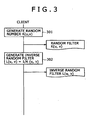
- the random filter K (u, v) is first set. With (u, v) for coordinates in a space after the basis transformation, a random value is generated for each (u, v) and is set to the value of K (u, v) (S301). Next, an inverse random filter L (u, v) is set.
- a reciprocal (or inverse for multiplication) of K (u, v) corresponding to each (u, v) is set to the value of L (u, v) (S302).
- binary images are generated in the random transformation as described below, a pair of random filters K' (u, v) and L'(u, v) for scrambling the binary images is separately generated using the same flow as above.
- images to be transmitted to the server upon authentication can also be scrambled by use of the inverse filters L (u, v) and L' (u, v) to generate L (u, v) ⁇ F (u, v), L' (u, v) ⁇ F' (u, v). In this way it is possible to make the finger vein verification cancelable.
- the generation of the random filter pair (K, L) in the random filter generation unit 103 may be realized by the following method.
- K (u, v) and L (u, v) are set so that the random images K (u, v) ⁇ G (u, v) and L (u, v) ⁇ F (u, v), the outputs of the random transformation unit 102, have uniform random numbers.
- the client 100 generates a uniform random number at each (u, v) (S401).
- the client receives an image G (u, v), divides a random number R (u, v) by G (u, v), and sets this to the random filter K (u, v) (S402).
- the client calculates the inverse of K (u, v), and sets this to the inverse random filter L (u, v) (S403).
- the random image K (u, v) ⁇ G (u, v) to be registered as a template to the server is equal to R (u, v) and has a uniform random value. Even if K (u, v) ⁇ G (u, v) with the uniform random value is leaked from the server, it is difficult to determine the finger vein image and to reproduce G (u, v), unless the random filter K (u, v) is known. With the random filter pair generated by such a method, it is possible to make it more difficult to reproduce the random image K (u, v) ⁇ G (u, v) to be stored in the server. Similarly, the filters K' (u, v), L' (u, v) to be applied to the binary images G' (u, v), F' (u, v) can be set using the same flow as described above.
- the client 100 inputs the three-value image (g or f) to the random transformation unit 102.
- the random transformation unit 102 first calculates the number of vein pixels of the three-value image (S501). Upon registration, the random transformation unit 102 determines the sum of pixels with a luminance value of 2 on the three-value image g (x, y). This is denoted by Sg.
- the random transformation unit 102 determines the sum of pixels with a luminance value of 2 on the three-value image f (x, y) . This is denoted by Sf.
- the random transformation unit 102 generates a binary image from the three-value image (S502).
- the binary image generation when the pixels of the three-value image (g (x, y) or f (x, y)) have luminance values of 0 and 1, the values remain unchanged, and when the pixels have a luminance value of 2, the value is replaced by 0.
- the generated binary images are denoted by g' (x, y) and f' (x, y).
- the random transformation unit 102 performs a basis transformation to the three-value image (g (x, y) or f (x, y)) and the binary image (g' (x, y) or f' (x, y)) (S503).
- Fourier transform is taken as an example of the basis transformation.
- the image g (x, y) is transformed into a Fourier image G (u, v) by Fourier transform.
- the value of G (u, v) represents a space frequency element of g (x, y), where the frequency in the x direction is u and the frequency in the y direction is v.
- Fourier image of g (x, y) is denoted by G (u, v), Fourier image of f (x, y) by F (u, v), Fourier image of g' (x, y) by G' (u, v), and Fourier image of f' (x, y) by F' (u, v), respectively.
- G u, v
- F u, v
- g' x, y
- F' Fourier image of f' (x, y) by F' (u, v)
- a number theoretic transform may be used as the basis transformation, instead of the Fourier transform.
- the random transformation unit 102 performs a random filter calculation to the Fourier images by the random filters (S504).
- the random transformation unit 102 performs the operation to G and G' by the random filter K upon registration, and performs the calculation to F and F' by the inverse random filter L upon authentication.
- K and L are similar to the Fourier images, having values for every combination of frequency u in the x direction and frequency v in the y direction, which can be represented by K (u, v), L (u, v), respectively.
- the random transformation unit 102 calculates K (u, v) ⁇ G (u, v) and K (u, v) ⁇ G' (u, v) upon registration, and calculates L (u, v) ⁇ F (u, v) and L (u, v) ⁇ F' (u, v) upon authentication.
- the calculation results are referred to as random images.
- K (u, v), L (u, v) are unknown, it is difficult to reproduce the original images G (u, v), F (u, v) from the random images, so that the finger vein three-value images can be kept confidential to the server 130.
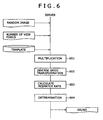
- the server 130 inputs the random images L (u, v) ⁇ F (u, v), L (u, v) ⁇ F' (u, v) and the templates K (u, v) ⁇ G (u, v), K (u, v) ⁇ G' (u, v) into the verification unit 134.
- the verification unit 134 first calculates the product of L (u, v) ⁇ F (u, v) and K (u, v) ⁇ G (u, v) as well as the product of L (u, v) ⁇ F' (u, v) and K (u, v) ⁇ G' (u, v) (S601). The calculation results are denoted by W (u, v), W' (u, v) respectively.
- the verification unit 134 performs an inverse basis transformation to W (u, v), W' (u, v) (602).
- inverse Fourier transform corresponding to the Fourier transform is taken as an example of the inverse basis transformation.
- the result of the inverse Fourier transform of W (u, v), w (p, q), represents the cross-correlation value obtained when g (x, y) is moved parallel to f (x, y) by (p, q).
- the result of the inverse Fourier transform of W' (u, v), w' (p, q) represents the cross-correlation value obtained when g' (x, y) is moved parallel to f' (x, y) by (p, q).
- the corresponding inverse transformation is preferably used.
- the verification unit 134 calculates a mismatch rate Rm (p, q) from w (p, q), w' (p, q), Sg, and Sf (S603).
- the mismatch rate Rm (p, q) is determined by dividing Sf+Sg- ⁇ w(p, q)-w'(p, q) ⁇ /2 by Sf+Sg.
- the verification unit 134 calculates the minimum value of the mismatch rate Rm (p, q), compares this to a predetermined threshold, and identifies the user when the value is smaller than the threshold, while identifying another person when the value is larger than the threshold (S604).
- the verification is performed without reproducing the original three-value images or binary images from the random images K (u, v) ⁇ G (u, v), K (u, v) ⁇ G' (u, v), L (u, v) ⁇ F (u, v), and L (u, v) ⁇ F' (u, v).
- the authentication process can be performed with the finger vein three-value image or binary image kept confidential to the server 130. This makes it possible to realize the finger vein authentication of protection type of templates (here the three-value images or binary images of the finger vein).
- Sf and Sg are open to the server 130, it is difficult to reproduce the original three-value images from these parameters and thus there is no problem of confidentiality.
- the reproduction difficulty of the original three-value image may be enhanced according to the following method.
- This can be realized using the number theoretic transform as the basis transformation in the random unit 102 (S303).
- S303 the number theoretic transform as the basis transformation in the random unit 102.
- the two-dimensional number theoretic transform is applied to the three-value image (g (x, y) or f (x, y)) and the binary image (g' (x, y) or f' (x, y)). Then images Gn (u, v), G'n (u, v), Fn (u, v), and F'n (u, v) are generated after the transformation.
- the random filter K (u, v) used in the above random transformation is applied to Gn (u, v) and G'n (u, v), which involves performs modulo multiplication of the integer M.
- Ln (n, v) is applied to Fn (u, v), F'n (u, v).
- K (n, v) ⁇ Gn (u, v) is taken up as an example.
- K (u, v) ⁇ Gn (u, v) already known an attacker intends to find K (u, v) and Gn (u, v).
- the attacker calculates K (u, v) ⁇ Gn (u, v) modulo the integer M.
- K (u, v) ⁇ Gn (u, v) obtained by the calculation as a simple integer is larger than M, as indicated on the number line in Fig. 7 , this is seen to be identical to the remainder of the division by M.
- K (u, v) ⁇ Gn (u, v) is smaller than the respective values of K (u, v) and Gn (u, v) .
- K (u, v) and Gn (u, v) smaller than K (u, v) ⁇ Gn (u, v) are candidates for K (u, v), Gn (u, v) that the attacker should know.
- the template In order to prevent replay attacks or other risks due to leakage of the template from the server 130, it is preferable to update the template that has been made cancelable and is registered in the server 130, periodically or upon detection of leakage of the template. At this time, it is also desirable to reduce the burden to the user in such a way that the finger vein itself is not reregistered.
- An example of a template update method will be described below. In this example, the description will be made assuming that the Fourier transform is used as the basis transformation in the random transformation. However, it is applicable to another basis transformation such as the number theoretic transform.
- Fig. 8 shows a process operation of a template update method.
- the client 100 newly generates a random filter pair (S801).
- the existing random filter pair is represented by (K 1 , L 1 ) and the new random filter pair is represented by (K 2 , L 2 ).
- the generation method of the random filter pair preferably follows the above described example.
- the client 100 writes the new inverse random filter L 2 into the portable recording medium in which the existing inverse random filter L 1 is overwritten (S802). Then the client 100 calculates K 2 /K 1 and sets it to the random filter difference ⁇ K (S803) .
- the template can be updated without leakage of the new and old random filters K 1 , K 2 to the server 130 as well as without the need to reregister the finger vein itself.
- the template can be updated without leakage of the new and old random filters K 1 , K 2 to the server 130 as well as without the need to reregister the finger vein itself.
- the biometric authentication system registers and matches the biometric information in the server.
- the system is not limited to the above described example and can be applied to other situations. For example, it is applicable to information access control in corporate networks, identity verification in Internet banking systems or ATMs (Automated Teller Machines), login to members Web sites, and user authentication necessary for entering protected areas.
- the same user would use plural systems and would register the biometric information to the respective systems.
- the filter and the inverse filter are applied by changing coefficients according to the target system. The coefficients are changed in this way, so that it is possible to protect the use of the same biometric information in other systems against leakage of the biometric information from a certain system.
- the embodiment is a cancelable fingerprint authentication system for performing fingerprint verification within a server while keeping the fingerprint image confidential to the server.
- Fig. 9 shows a system configuration of cancelable fingerprint authentication.
- the cancelable fingerprint authentication system includes: a client terminal (hereinafter simply referred to as a client) 900 for obtaining a fingerprint image upon registration and authentication, generating a binary image, extracting a core and minutia, cutting out an image, and performing the random transformation; and a server 930 for storing and verifying a template.
- the client 900 and the server 930 are connected via a network such as the internet or intranet.
- the client 900 is managed by its user or a reliable third party, having a fingerprint sensor 910 for imaging a fingerprint, and handling a portable recording medium 920 carried by the user.
- the portable recording medium 920 is a recording medium that the user carries and manages, such as IC card or USB memory.
- the client 900 may be a home personal computer managed by the user and the server 930 may be a server machine managed by a bank.
- the client 900 includes: a binary image generation unit 901 for binarizing a fingerprint image; a core-minutia extracting unit 902 for detecting positions of a core (the center of the fingerprint whorl) and minutiae (a ridge ending and a ridge bifurcation) from the binary image; a dummy minutia generation unit 903 for randomly generating coordinates of dummy minutiae, in addition to the original minutiae coordinates; a random filter generation unit 904 for generating pairs of random filters for each of the minutiae (the original minutia and the dummy minutia); an image cutting unit 906 for cutting out chip images or peripheral images around each of the minutiae; a random transformation unit 907 for transforming the binary images to random images by the random filters applied to each of the chip images or peripheral images; a recording medium I/F unit 905 for performing communication with the portable recording medium 920; and a communication unit 908, for performing communication via a network.
- the processes of the binary image generation unit 901, core-minutia extracting unit 902, dummy minutia generation unit 903, random filter generation unit 904, image cutting unit 906, and random transformation unit 907 are realized by a processor of the client 900 executing a program.
- the binary image generation, core-minutia extraction, and image output can be realized, for example, by a method disclosed in JP-A No. 344213/2001 ( US 20020150283 , EP 1313026 ).
- the server 930 includes: a communication unit 931 for performing communication via the network; a registration unit 932 for registering the random images as templates; a memory 933 for storing the templates; and a verification unit 934 for calculating degree of similarity by verifying random images newly received upon authentication against the templates.
- the processes in the registration unit 932 and the verification unit 934 are realized by the server 930 executing a program.
- the degree of similarity is the number of matched images determined when plural chip images cut out upon registration are compared to plural peripheral images cut out upon verification, respectively. It is shown that the registered fingerprint and the verified fingerprint are similar as the degree of similarity is large.
- the match or mismatch between the chip image and the peripheral image is determined based on the number of pixels matched when the two images are overlapped. However, the positions of the minutiae may be displaced due to influences such as deformation and rotation upon registration and verification. Thus the size of the peripheral image is made larger than the size of the chip image.
- the chip image is moved parallel on the peripheral image to find a location where the number of matched pixels is the maximum value.
- the match/mismatch is determined based on the maximum value. This feature will be understood in more detail by the description of JP-A No. 344213/2001 ( US 20020150283 , EP 1313026 ).
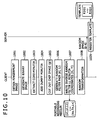
- the client 900 obtains a fingerprint image of a user (S1001).
- the client 900 binarizes the obtained fingerprint image and generates a binary image for registration 1200 (S1002).
- the value of each pixel is -1 (white) or 1 (black).
- the client 900 extracts the positions of the core and minutiae, and calculates the coordinates of each minutia with the core position as the original point (0, 0) (S1003).
- the client 900 generates plural sets of random coordinates as dummy minutiae (S1004).
- the client 900 generates a random filter pair (Ki, Li) for the each minutia (S1006).
- Ki is referred to as a random filter, Li as an inverse random filter.
- the client 900 transforms the each chip image 1201 (gi) by the random filter Ki to generate a random image. More specifically, the client 900 pads the periphery of the chip image 1201 (gi) with 0 (grey) to expand to W ⁇ W pixels, to which the basis transformation (number theoretic transform or Fourier transform) is applied. An image 1202 (W ⁇ W pixels) after the basis transformation is denoted by Gi.
- the server 930 receives the random image Gi ⁇ Ki and registers as a template (S1009).
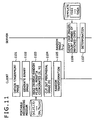
- the client 900 obtains a fingerprint image of a user (S1101).
- the client 900 binarizes the obtained fingerprint image and generates a binary image for verification 1210 (S1102).
- the value of each pixel is -1 (white) or 1 (black).
- the client 900 cuts out a peripheral image 1211 (fi) around the each minutia coordinates (Xi, Yi) from the binary image for verification (S1104).
- the size of the peripheral image is set to W ⁇ W pixels.
- inverse basis transformation inverse number theoretic transform or inverse Fourier transform
- the pixel value at coordinates ( ⁇ X, ⁇ Y) on the correlation image indicates the correlation value obtained when the chip image gi is overlapped and moved parallel by ( ⁇ X, ⁇ Y) on the peripheral image fi.
- the pixel values of the binary image are -1 (white) and 1 (black)
- the server 930 determines the match/mismatch for each pair of chip image and peripheral image, and counts the number of matched images to represent the degree of similarity (S1106). Finally the server 930 compares the degree of similarity to a predetermined authentication threshold. When it is larger than the authentication threshold, the server 930 determines that the fingerprint is matched. When it is smaller than the authentication threshold, the server 930 determines that the fingerprint is not matched (S1107).
- the chip image and peripheral image of the fingerprint are scrambled by the random filter and the inverse random filter, and then are transmitted to the server.
- the correlation value can be calculated while the original image is unknown to the server.
- deformation can easily occur in the fingerprint image, and sufficient authentication accuracy may not be obtained by verification based on the correlation between the entire images.
- by determining the match/mismatch between the images seen locally it is possible to reduce the influence of deformation. Particularly this is suitable for the fingerprint identification as the periphery of the fingerprint minutia (ridge ending or ridge bifurcation) has a special structure.
- the embodiment it is necessary to record the coordinates of minutiae.
- the coordinates of minutiae are in themselves the important information to identify the fingerprint, or kind of fingerprint information. If the coordinates of minutiae are leaked from the client, there is a possibility that the leaked coordinates may be a clue to forge the fingerprint.
- the chip image of a dummy minutia is very likely to be identical not only to the user's fingerprint but also to another person's fingerprint. This means the number of matched chips (degree of similarity) increases both for the user and another person when compared to the case of using only the original chip images.
- the authentication threshold is appropriately increased as much as the increased number of matched chips, the accuracy will not be degraded.
- the present invention is not limited to the above described embodiments, and various modifications can be made.
- the user's biometric information is obtained from the finger vein sensor 110, and the processes including the generation of images for registration and verification are performed in the client 100.
- the biometric device may be configured such that the functions 101 to 105 within the client 100 shown in Fig. 1 are integrally formed with the finger vein sensor 110.
- the user can carry the biometric device and collect the user's biometric information at an arbitrary time and place to use for personal authentication.
- the present invention is not limited to the authentication using finger vein and fingerprint described in the embodiments. It goes without saying that the present invention can be applied to the authentication using palm print and other biometric information.
Landscapes
- Engineering & Computer Science (AREA)
- Computer Security & Cryptography (AREA)
- Physics & Mathematics (AREA)
- General Physics & Mathematics (AREA)
- Theoretical Computer Science (AREA)
- Human Computer Interaction (AREA)
- Signal Processing (AREA)
- Computer Networks & Wireless Communication (AREA)
- General Health & Medical Sciences (AREA)
- Biomedical Technology (AREA)
- Biodiversity & Conservation Biology (AREA)
- Life Sciences & Earth Sciences (AREA)
- Computer Hardware Design (AREA)
- Software Systems (AREA)
- General Engineering & Computer Science (AREA)
- Health & Medical Sciences (AREA)
- Multimedia (AREA)
- Collating Specific Patterns (AREA)
Claims (20)
- Procédé d'authentification biométrique pour identifier un utilisateur sur la base d'une corrélation croisée entre une image et une image de vérification d'informations biométriques d'un utilisateur, le procédé comportant les étapes consistant à :pendant l'enregistrement d'informations biométriques,appliquer une transformation de Fourier à l'image enregistrée,générer (203) un filtre pour brouiller l'image enregistrée et un filtre inversé correspondant,générer (205) un modèle d'enregistrement embrouillant l'image enregistrée générée à partir des informations biométriques en utilisant le filtre généré, dans un espace fréquentiel, etmémoriser (206) le modèle d'enregistrement dans une mémoire, etpendant l'authentification,appliquer la transformation de Fourier à l'image de vérification,appliquer (214) le filtre inversé à l'image de vérification générée à partir des informations biométriques obtenues de l'utilisateur, dans l'espace fréquentiel, etvérifier (101) l'identité de l'utilisateur sur la base de la multiplication du modèle d'enregistrement et de l'image de vérification après l'application du filtre inversé.
- Procédé d'authentification biométrique selon la revendication 1,
dans lequel le filtre pour brouiller l'image et le filtre inversé correspondant sont définis de sorte que le modèle d'enregistrement, lequel est généré en appliquant le filtre, et l'image de vérification, laquelle est générée en appliquant le filtre inversé, ont des valeurs aléatoires. - Procédé d'authentification biométrique selon la revendication 1,
dans lequel l'image enregistrée et l'image de vérification sont des images à trois valeurs ayant trois types de valeurs de luminance 0, 1 et 2,
le procédé comportant l'étape consistant à :pendant l'enregistrement,
changer la valeur de luminance de pixels de 2 à 0 dans l'image enregistrée,
générer une image binaire ayant deux types de valeurs de luminance 0, 1, en tant qu'image binaire d'enregistrement, et
appliquer le filtre pour brouiller l'image enregistrée et l'image binaire d'enregistrement, respectivement, en tant que modèles d'enregistrement,pendant l'authentification,
changer la valeur de luminance de pixels de 2 à 0 dans l'image de vérification,
générer une image binaire ayant deux types de valeurs de luminance 0, 1, en tant qu'image binaire de vérification, et
appliquer le filtre inversé à l'image de vérification et à l'image binaire de vérification, respectivement, et
vérifier l'identité de l'utilisateur en calculant une valeur de distance, en utilisant la multiplication de l'image enregistrée des modèles d'enregistrement et l'image de vérification ainsi que la multiplication de l'image binaire d'enregistrement et de l'image binaire de vérification. - Procédé d'authentification biométrique selon la revendication 1,
dans lequel le filtre inversé généré est mémorisé (204) dans un support d'enregistrement porté par l'utilisateur ou dans une mémoire de l'équipement terminal. - Procédé d'authentification biométrique selon la revendication 1,
dans lequel le filtre et le filtre inversé sont utilisés en changeant des coefficients conformément à une cible à laquelle le procédé d'authentification biométrique est appliqué. - Procédé d'authentification biométrique selon la revendication 1, comportant en outre les étapes consistant à :sélectionner des coordonnées à un ou plusieurs emplacements de l'image enregistrée,découper une image locale d'une taille prédéterminée autour des coordonnées respectives,déterminer une concordance ou une disconcordance relative à l'image locale par relation croisée ou une distance entre une image périphérique des coordonnées et l'image locale, sur l'image de vérification, etvérifier l'identité de l'utilisateur sur la base du nombre d'images locales concordantes.
- Procédé d'authentification biométrique selon la revendication 6,
dans lequel les coordonnées sélectionnées sur l'image enregistrée sont les coordonnées d'un point ayant une structure caractéristique dans l'image enregistrée. - Procédé d'authentification biométrique selon la revendication 6,
dans lequel les coordonnées sélectionnées sur l'image enregistrée sont les coordonnées d'un point ayant une structure caractéristique et les coordonnées d'un point sélectionné de manière aléatoire dans l'image enregistrée. - Procédé d'authentification biométrique selon la revendication 7,
dans lequel les informations biométriques de l'utilisateur sont une empreinte digitale,
le point ayant la structure caractéristique est une fin ou une bifurcation de nervure d'empreinte digitales, et
les coordonnées sont calculées avec le noyau de l'empreinte digitale en tant que point original. - Procédé d'authentification biométrique selon la revendication 1,
dans lequel les informations biométriques de l'utilisateur sont une veine d'un doigt. - Système d'authentification biométrique pour authentifier de manière biométrique un utilisateur par l'intermédiaire d'un équipement terminal (100) et d'un serveur (130), lesquels sont reliés via un réseau, l'équipement terminal comprenant :une unité de génération d'images (101) adaptée pour générer une image en vue de l'enregistrement ou de la vérification à partir d'informations biométriques collectées de l'utilisateur,une unité de génération de filtre (103) adaptée pour générer un filtre pour brouiller l'image enregistrée et un filtre inversé correspondant,une unité de transformation (102) adaptée pour appliquer une transformation de Fourier à l'image générée dans l'unité de génération d'images et pour générer un modèle d'enregistrement en brouillant celle-ci à l'aide du filtre généré dans l'unité de génération de filtre dans un espace fréquentiel, ou pour générer une image de vérification en appliquant la transformation de Fourier et le filtre inversé dans l'espace fréquentiel à l'image, etune première unité de communication (105) adaptée pour transmettre des informations incluant au moins le modèle d'enregistrement ou l'image de vérification, au serveur,dans lequel le serveur comprend :une seconde unité de communication (131) adaptée pour recevoir des informations transmises depuis l'équipement terminal,une unité d'enregistrement (132) adaptée pour mémoriser le modèle d'enregistrement reçu via la seconde unité de communication dans une mémoire (133), etunité de vérification (134) adaptée pour faire concorder l'image de vérification obtenue via la seconde unité de communication lors de l'authentification au modèle d'enregistrement mémorisé dans la mémoire, et pour déterminer une corrélation croisée entre eux sur la base de la multiplication de l'image de vérification et du modèle d'enregistrement dans l'espace fréquentiel, de manière à vérifier l'identité de l'utilisateur conformément à un résultat de détermination de l'unité de vérification.
- Système d'authentification biométrique selon la revendication 11,
dans lequel, lorsque le modèle d'enregistrement est mis à jour, l'équipement terminal est adapté pour générer à nouveau et mémoriser un filtre et un filtre inversé, afin d'obtenir une différence entre le filtre existant et le nouveau filtre, et pour transmettre la différence des filtres au serveur, et
le serveur est adapté pour générer un nouveau modèle en appliquant la différence reçue entre les filtres au modèle d'enregistrement ayant été enregistré, et pour enregistrer le nouveau modèle dans la mémoire. - Système d'authentification biométrique selon la revendication 11,
dans lequel le filtre pour brouiller l'image et le filtre inversé correspondant sont définis de sorte que le modèle d'enregistrement, lequel est généré en appliquant le filtre, et l'image de vérification, laquelle est générée en appliquant le filtre inversé, ont des valeurs aléatoires. - Système d'authentification biométrique selon la revendication 11,
dans lequel le filtre et le filtre inversé sont utilisés en changeant des coefficients selon un système auquel le système d'authentification biométrique est appliqué. - Système d'authentification biométrique selon la revendication 11,
dans lequel équipement terminal comprend en outre une unité de découpe d'images locales adaptée pour sélectionner des coordonnées à un ou plusieurs emplacements sur l'image, et pour découper une image locale d'une taille prédéterminée autour des coordonnées respectives,
dans lequel l'unité de génération de filtre est adaptée pour générer un filtre pour brouiller les images locales respectives et un filtre inversé correspondant,
dans lequel l'unité de transformation est adaptée pour générer le modèle d'enregistrement en appliquant les filtres respectifs générés dans l'unité de génération de filtre aux images locales respectives générées dans l'unité de découpe d'images locales, ou pour générer une image locale pour vérification en appliquant les filtres inversés respectifs aux images respectives,
dans lequel l'unité de vérification (934) dans le serveur est adaptée pour faire concorder l'image locale de vérification obtenue via la seconde unité de communication au modèle d'enregistrement mémorisé dans la mémoire, afin de déterminer une concordance ou une disconcordance par relation croisée entre eux, et
dans lequel le serveur comprend en outre une unité de détermination adaptée pour déterminer la concordance ou la disconcordance des informations biométriques sur la base du nombre des images locales concordantes, de manière à authentifier l'utilisateur conformément à un résultat de détermination de l'unité de détermination. - Système d'authentification biométrique selon la revendication 15,
dans lequel, lorsque le modèle d'enregistrement est mis à jour, l'équipement terminal est adapté pour générer à nouveau et mémoriser un filtre et un filtre inversé pour les coordonnées respectives, afin d'obtenir une différence entre les filtres existants respectifs et les nouveaux filtres respectifs, et afin de transmettre la différence des filtres au serveur, et
le serveur est adapté pour générer un nouveau modèle en appliquant les différences reçues respectives entre les filtres aux modèles d'enregistrement respectifs ayant été enregistrés, et pour mémoriser le nouveau modèle dans la mémoire. - Système d'authentification biométrique selon la revendication 15,
dans lequel, pendant l'enregistrement des informations biométriques, l'équipement terminal est adapté pour appliquer la transformation de Fourier aux images locales respectives découpées à partir de l'image enregistrée, et pour appliquer le filtre pour brouiller l'image, sur un espace fréquentiel, et
pendant l'authentification, l'équipement terminal est adapté pour appliquer la transformation de Fourier aux images locales respectives découpées à partir de l'image de vérification, et pour appliquer le filtre inversé sur l'espace fréquentiel. - Système d'authentification biométrique selon la revendication 15,
dans lequel, pendant l'enregistrement des informations biométriques, l'équipement terminal est adapté pour appliquer une transformée théorique numérale aux images locales respectives découpées à partir de l'image enregistrée, et pour appliquer le filtre pour brouiller l'image après la transformée théorique numérale, et
pendant l'authentification, l'équipement terminal est adapté pour appliquer la transformée théorique numérale aux images locales respectives découpées à partir de l'image de vérification, et pour appliquer le filtre inversé à l'image après la transformée théorique numérale. - Système d'authentification biométrique selon la revendication 15,
dans lequel le filtre pour brouiller l'image et le filtre inversé correspondant sont définis de sorte que le modèle d'enregistrement, lequel est généré en appliquant le filtre, et l'image d'irrigation, laquelle est générée en appliquant le filtre inversé, ont des valeurs aléatoires. - Programme comprenant des instructions exécutables par ordinateur, lesquelles, lorsqu'elles sont exécutées par un système d'authentification biométrique selon l'une quelconque des revendications 11 à 19 incluant l'équipement terminal (100) et un serveur (130) qui sont reliés via un réseau, amènent le système d'authentification biométrique à mettre en oeuvre le procédé des revendications 1 ou 6.
Applications Claiming Priority (2)
| Application Number | Priority Date | Filing Date | Title |
|---|---|---|---|
| JP2006091807 | 2006-03-29 | ||
| JP2007000671A JP4961214B2 (ja) | 2006-03-29 | 2007-01-05 | 生体認証方法およびシステム |
Publications (3)
| Publication Number | Publication Date |
|---|---|
| EP1840794A2 EP1840794A2 (fr) | 2007-10-03 |
| EP1840794A3 EP1840794A3 (fr) | 2011-11-09 |
| EP1840794B1 true EP1840794B1 (fr) | 2013-10-16 |
Family
ID=38219459
Family Applications (1)
| Application Number | Title | Priority Date | Filing Date |
|---|---|---|---|
| EP07005963.9A Active EP1840794B1 (fr) | 2006-03-29 | 2007-03-22 | Procédé, système et programme pour l'authentification d'un utilisateur au moyen d'informations biométriques |
Country Status (4)
| Country | Link |
|---|---|
| US (2) | US7936905B2 (fr) |
| EP (1) | EP1840794B1 (fr) |
| JP (1) | JP4961214B2 (fr) |
| CN (1) | CN101047498B (fr) |
Families Citing this family (57)
| Publication number | Priority date | Publication date | Assignee | Title |
|---|---|---|---|---|
| JP4966765B2 (ja) * | 2007-06-27 | 2012-07-04 | 株式会社日立情報制御ソリューションズ | 生体認証システム |
| JP4929136B2 (ja) * | 2007-11-27 | 2012-05-09 | 株式会社日立製作所 | 生体認証方法、装置およびシステム |
| US8249314B2 (en) * | 2008-06-16 | 2012-08-21 | International Business Machines Corporation | Anonymous and revocable fingerprint recognition |
| GB2474999B (en) * | 2008-07-22 | 2013-02-20 | Validity Sensors Inc | System and method for securing a device component |
| JP2010039890A (ja) | 2008-08-07 | 2010-02-18 | Hitachi Ltd | 認証端末、認証サーバ、認証システム、認証方法および認証プログラム |
| US9633261B2 (en) * | 2008-08-22 | 2017-04-25 | International Business Machines Corporation | Salting system and method for cancelable iris biometric |
| JP5271669B2 (ja) * | 2008-10-31 | 2013-08-21 | 株式会社日立製作所 | 生体認証方法およびシステム |
| JP5147673B2 (ja) * | 2008-12-18 | 2013-02-20 | 株式会社日立製作所 | 生体認証システムおよびその方法 |
| US8242892B2 (en) * | 2009-02-12 | 2012-08-14 | International Business Machines Corporation | System, method and program product for communicating a privacy policy associated with a radio frequency identification tag and associated object |
| US8289135B2 (en) | 2009-02-12 | 2012-10-16 | International Business Machines Corporation | System, method and program product for associating a biometric reference template with a radio frequency identification tag |
| US9298902B2 (en) * | 2009-02-12 | 2016-03-29 | International Business Machines Corporation | System, method and program product for recording creation of a cancelable biometric reference template in a biometric event journal record |
| US8301902B2 (en) * | 2009-02-12 | 2012-10-30 | International Business Machines Corporation | System, method and program product for communicating a privacy policy associated with a biometric reference template |
| US8327134B2 (en) * | 2009-02-12 | 2012-12-04 | International Business Machines Corporation | System, method and program product for checking revocation status of a biometric reference template |
| US8359475B2 (en) * | 2009-02-12 | 2013-01-22 | International Business Machines Corporation | System, method and program product for generating a cancelable biometric reference template on demand |
| EP2426640A4 (fr) | 2009-04-28 | 2018-01-03 | Fujitsu Limited | Dispositif, procédé et programme d'authentification biométrique |
| JP2010286937A (ja) * | 2009-06-10 | 2010-12-24 | Hitachi Ltd | 生体認証方法、及び、生体認証に用いるクライアント端末、認証サーバ |
| JP5287550B2 (ja) * | 2009-07-01 | 2013-09-11 | 富士通株式会社 | 生体認証システム,生体認証方法,生体認証装置,生体情報処理装置,生体認証プログラムおよび生体情報処理プログラム |
| JP5270514B2 (ja) | 2009-10-23 | 2013-08-21 | 株式会社日立製作所 | 生体認証方法及び計算機システム |
| JP2011243042A (ja) * | 2010-05-19 | 2011-12-01 | Nec Corp | 生体撮像装置、及び生体撮像方法 |
| JP5309088B2 (ja) | 2010-06-21 | 2013-10-09 | 株式会社日立製作所 | 生体認証システムにおける、生体情報の登録方法、テンプレートの利用申請の方法、および、認証方法 |
| JP5416846B2 (ja) | 2010-10-29 | 2014-02-12 | 株式会社日立製作所 | 情報認証方法および情報認証システム |
| WO2012124115A1 (fr) | 2011-03-17 | 2012-09-20 | 富士通株式会社 | Dispositif d'acquisition de données biologiques, dispositif de comparaison de données biologiques et programme |
| CN102184387A (zh) * | 2011-05-10 | 2011-09-14 | 陈庆武 | 手指静脉认证系统 |
| US9020208B2 (en) * | 2011-07-13 | 2015-04-28 | Honeywell International Inc. | System and method for anonymous biometrics analysis |
| WO2013080320A1 (fr) | 2011-11-30 | 2013-06-06 | 三菱電機株式会社 | Dispositif de traitement de données, procédé de traitement de données et programme |
| US9836103B2 (en) | 2012-10-26 | 2017-12-05 | Mark Kramer | Wireless personal tracking device |
| US9251396B2 (en) | 2013-01-29 | 2016-02-02 | Diamond Fortress Technologies, Inc. | Touchless fingerprinting acquisition and processing application for mobile devices |
| JP5963936B2 (ja) | 2013-02-25 | 2016-08-03 | 三菱電機株式会社 | サーバ装置、秘匿検索プログラム,記録媒体及び秘匿検索システム |
| US9152869B2 (en) * | 2013-02-26 | 2015-10-06 | Qtech Systems Inc. | Biometric authentication systems and methods |
| CN104298908B (zh) * | 2013-07-15 | 2018-04-27 | 联想(北京)有限公司 | 一种信息处理方法及电子设备 |
| JP6167733B2 (ja) * | 2013-07-30 | 2017-07-26 | 富士通株式会社 | 生体特徴ベクトル抽出装置、生体特徴ベクトル抽出方法、および生体特徴ベクトル抽出プログラム |
| US9390327B2 (en) | 2013-09-16 | 2016-07-12 | Eyeverify, Llc | Feature extraction and matching for biometric authentication |
| US8965066B1 (en) | 2013-09-16 | 2015-02-24 | Eye Verify LLC | Biometric template security and key generation |
| WO2015102564A1 (fr) | 2013-12-30 | 2015-07-09 | Empire Technology Developement LLC | Schéma de restitution d'informations |
| CN103995997B (zh) * | 2014-05-15 | 2017-09-12 | 华为技术有限公司 | 一种用户权限的分配方法和设备 |
| CN105227307A (zh) * | 2014-06-03 | 2016-01-06 | 阿里巴巴集团控股有限公司 | 身份验证方法与系统以及服务器数据处理方法和服务器 |
| US9507994B1 (en) * | 2014-09-18 | 2016-11-29 | Egis Technology Inc. | Fingerprint recognition methods and electronic device |
| US9374370B1 (en) | 2015-01-23 | 2016-06-21 | Island Intellectual Property, Llc | Invariant biohash security system and method |
| CN107580767B (zh) | 2015-03-12 | 2020-12-29 | 眼锁有限责任公司 | 使用生物特征来管理网络活动的方法和系统 |
| JP2016218783A (ja) * | 2015-05-21 | 2016-12-22 | 日本電気通信システム株式会社 | 生体情報変更フィルタ、プログラムおよび生体認証方法 |
| KR102558736B1 (ko) * | 2015-06-30 | 2023-07-25 | 삼성전자주식회사 | 지문 인식 방법 및 장치 |
| PH12018500541B1 (en) | 2015-09-11 | 2024-04-12 | Jumio Corp | Method and system for determining a quality metric in biometric authentication |
| KR102447501B1 (ko) * | 2015-12-24 | 2022-09-27 | 삼성전자주식회사 | 생체 정보를 처리하는 전자 장치 및 그 제어 방법 |
| CN105654071A (zh) * | 2016-02-19 | 2016-06-08 | 努比亚技术有限公司 | 指纹识别装置和方法 |
| JP7057283B2 (ja) | 2016-02-25 | 2022-04-19 | トゥルソナ,インコーポレイテッド | アンチリプレイのシステム及び方法 |
| US10040574B1 (en) * | 2016-04-26 | 2018-08-07 | James William Laske, Jr. | Airplane anti-hijacking system |
| WO2018022993A1 (fr) * | 2016-07-29 | 2018-02-01 | Trusona, Inc. | Systèmes d'authentification anti-remplissage et procédés |
| WO2018049234A1 (fr) | 2016-09-09 | 2018-03-15 | Trusona, Inc. | Systèmes et procédés de distribution d'informations d'authentification sélectionnées pour un réseau de dispositifs |
| JP7051859B2 (ja) | 2016-12-12 | 2022-04-11 | トゥルソナ,インコーポレイテッド | 光検出を用いたネットワーク対応アカウント作成のための方法及びシステム |
| CN108055339B (zh) * | 2017-12-22 | 2021-02-23 | 海尔优家智能科技(北京)有限公司 | 家电设备互联的方法、装置、存储介质及云平台服务器 |
| KR102415224B1 (ko) * | 2018-07-12 | 2022-07-01 | 한국전자통신연구원 | 생체 신호의 주파수 응답 특성을 이용하는 생체 인증 시스템 및 생체 인증 방법 |
| EP3841508A4 (fr) * | 2018-08-24 | 2022-04-20 | Trusona, Inc. | Systèmes et procédés d'authentification anti-réinsertion |
| JP2020038492A (ja) * | 2018-09-04 | 2020-03-12 | 株式会社東海理化電機製作所 | 生体情報認証装置 |
| CN111968289B (zh) * | 2020-08-23 | 2021-08-27 | 湖南银宝科技发展有限公司 | 阻车破胎器与多个电动库门的联动控制系统 |
| KR102627219B1 (ko) * | 2020-11-18 | 2024-01-23 | 주식회사 바이오로그디바이스 | 노이즈 감소를 위한 지문 센싱 시스템 |
| JP7439785B2 (ja) * | 2021-03-19 | 2024-02-28 | 株式会社デンソー | 認証システム及び追跡システム |
| JP7729407B2 (ja) | 2021-12-27 | 2025-08-26 | 日本電気株式会社 | 照合システム、鍵生成装置、照合装置、第1変換装置、第2変換装置、およびそれらの方法 |
Family Cites Families (17)
| Publication number | Priority date | Publication date | Assignee | Title |
|---|---|---|---|---|
| US5680460A (en) * | 1994-09-07 | 1997-10-21 | Mytec Technologies, Inc. | Biometric controlled key generation |
| CA2203212A1 (fr) * | 1997-04-21 | 1998-10-21 | Vijayakumar Bhagavatula | Methode de codage utilisant la biometrie |
| US6134340A (en) * | 1997-12-22 | 2000-10-17 | Trw Inc. | Fingerprint feature correlator |
| JP4519963B2 (ja) | 1999-06-21 | 2010-08-04 | 富士通株式会社 | 生体情報の暗号化・復号化方法および装置並びに、生体情報を利用した本人認証システム |
| US6744909B1 (en) * | 1999-08-19 | 2004-06-01 | Physical Optics Corporation | Authentication system and method |
| JP2001344213A (ja) | 2000-05-31 | 2001-12-14 | Hitachi Ltd | 生体認証システム |
| US6836554B1 (en) * | 2000-06-16 | 2004-12-28 | International Business Machines Corporation | System and method for distorting a biometric for transactions with enhanced security and privacy |
| WO2004061668A1 (fr) * | 2002-12-31 | 2004-07-22 | International Business Machines Corporation | Authentification anonyme autorisee |
| JP2004266646A (ja) * | 2003-03-03 | 2004-09-24 | Sony Corp | データ処理方法およびその装置 |
| GB0306356D0 (en) * | 2003-03-20 | 2003-04-23 | Qinetiq Ltd | Biometric verification apparatus and method |
| US7483569B2 (en) * | 2003-05-29 | 2009-01-27 | Carnegie Mellon University | Reduced complexity correlation filters |
| JP4251067B2 (ja) | 2003-12-01 | 2009-04-08 | 株式会社日立製作所 | 個人認証装置及び個人認証用の血管パターン抽出装置 |
| EP1759259A2 (fr) * | 2004-06-09 | 2007-03-07 | Koninklijke Philips Electronics N.V. | Architectures pour la protection de la confidentialite de modeles biometriques |
| US7689006B2 (en) * | 2004-08-20 | 2010-03-30 | The Research Foundation Of State University Of Ny | Biometric convolution using multiple biometrics |
| US8634606B2 (en) * | 2004-12-07 | 2014-01-21 | Mitsubishi Electric Research Laboratories, Inc. | Method and system for binarization of biometric data |
| DE102005008257A1 (de) * | 2005-02-23 | 2006-08-24 | Giesecke & Devrient Gmbh | Authentisieren mit Chipkarte |
| US20070237366A1 (en) * | 2006-03-24 | 2007-10-11 | Atmel Corporation | Secure biometric processing system and method of use |
-
2007
- 2007-01-05 JP JP2007000671A patent/JP4961214B2/ja active Active
- 2007-03-22 EP EP07005963.9A patent/EP1840794B1/fr active Active
- 2007-03-27 US US11/691,575 patent/US7936905B2/en active Active
- 2007-03-28 CN CN2007100915886A patent/CN101047498B/zh not_active Expired - Fee Related
-
2011
- 2011-04-20 US US13/090,577 patent/US8204279B2/en active Active
Also Published As
| Publication number | Publication date |
|---|---|
| US8204279B2 (en) | 2012-06-19 |
| US7936905B2 (en) | 2011-05-03 |
| US20110200234A1 (en) | 2011-08-18 |
| CN101047498B (zh) | 2012-10-31 |
| US20080037833A1 (en) | 2008-02-14 |
| EP1840794A2 (fr) | 2007-10-03 |
| JP4961214B2 (ja) | 2012-06-27 |
| EP1840794A3 (fr) | 2011-11-09 |
| JP2007293807A (ja) | 2007-11-08 |
| CN101047498A (zh) | 2007-10-03 |
Similar Documents
| Publication | Publication Date | Title |
|---|---|---|
| EP1840794B1 (fr) | Procédé, système et programme pour l'authentification d'un utilisateur au moyen d'informations biométriques | |
| EP1865442B1 (fr) | Procédé, système et programme pour l'authentification d'un utilisateur au moyen d'informations biométriques | |
| Jain et al. | Hiding biometric data | |
| Patel et al. | Cancelable biometrics: A review | |
| KR101226651B1 (ko) | 생체 인식 기술의 사용에 기초한 사용자 인증 방법 및 관련구조 | |
| Joshi et al. | Security vulnerabilities against fingerprint biometric system | |
| EP2151968A2 (fr) | Terminal d'authentification, serveur d'authentification et système d'authentification | |
| Ratha et al. | Biometrics break-ins and band-aids | |
| Khan et al. | Chaos and NDFT-based spread spectrum concealing of fingerprint-biometric data into audio signals | |
| Mehta et al. | An efficient and lossless fingerprint encryption algorithm using Henon map & Arnold transformation | |
| Loukhaoukha et al. | Efficient and secure cryptosystem for fingerprint images in wavelet domain | |
| Kant et al. | Biometrics security using steganography | |
| Khan et al. | Robust hiding of fingerprint-biometric data into audio signals | |
| CN112163542A (zh) | 一种基于ElGamal加密的掌纹保密认证方法 | |
| Moon et al. | Performance evaluation of watermarking techniques for secure multimodal biometric systems | |
| Ratha | Privacy protection in high security biometrics applications | |
| Kim et al. | Secure remote fingerprint verification using dual watermarks | |
| Bayly et al. | Fractional biometrics: safeguarding privacy in biometric applications | |
| Chizari et al. | Security issues in ATM smart card technology | |
| Ibjaoun et al. | Biometric template privacy using visual cryptography | |
| CN112187477A (zh) | 一种虹膜保密认证方法 | |
| Priyadarshini et al. | Privacy preserved two factor authentication system using spread spectrum watermarking of fingerprint and crypto code | |
| Khan et al. | Securing biometric templates for reliable identity authentication | |
| Abdullahi et al. | Concealing fingerprint-biometric data into audio signals for identify authentication | |
| KR20100068044A (ko) | 지문 인식 장치와 이를 이용한 지문 등록 방법 및 사용자 인증 방법 |
Legal Events
| Date | Code | Title | Description |
|---|---|---|---|
| PUAI | Public reference made under article 153(3) epc to a published international application that has entered the european phase |
Free format text: ORIGINAL CODE: 0009012 |
|
| AK | Designated contracting states |
Kind code of ref document: A2 Designated state(s): AT BE BG CH CY CZ DE DK EE ES FI FR GB GR HU IE IS IT LI LT LU LV MC MT NL PL PT RO SE SI SK TR |
|
| AX | Request for extension of the european patent |
Extension state: AL BA HR MK YU |
|
| 17P | Request for examination filed |
Effective date: 20080331 |
|
| PUAL | Search report despatched |
Free format text: ORIGINAL CODE: 0009013 |
|
| AK | Designated contracting states |
Kind code of ref document: A3 Designated state(s): AT BE BG CH CY CZ DE DK EE ES FI FR GB GR HU IE IS IT LI LT LU LV MC MT NL PL PT RO SE SI SK TR |
|
| AX | Request for extension of the european patent |
Extension state: AL BA HR MK RS |
|
| RIC1 | Information provided on ipc code assigned before grant |
Ipc: G06F 21/00 20060101ALI20111006BHEP Ipc: G07C 9/00 20060101ALI20111006BHEP Ipc: G06K 9/00 20060101AFI20111006BHEP Ipc: H04K 1/00 20060101ALI20111006BHEP Ipc: H04L 9/32 20060101ALI20111006BHEP |
|
| 17Q | First examination report despatched |
Effective date: 20120511 |
|
| AKX | Designation fees paid |
Designated state(s): DE FR GB NL |
|
| RIC1 | Information provided on ipc code assigned before grant |
Ipc: H04L 9/32 20060101ALI20130301BHEP Ipc: G07C 9/00 20060101ALI20130301BHEP Ipc: H04K 1/00 20060101ALI20130301BHEP Ipc: G06F 21/32 20130101ALI20130301BHEP Ipc: G06K 9/00 20060101AFI20130301BHEP |
|
| GRAP | Despatch of communication of intention to grant a patent |
Free format text: ORIGINAL CODE: EPIDOSNIGR1 |
|
| INTG | Intention to grant announced |
Effective date: 20130417 |
|
| GRAS | Grant fee paid |
Free format text: ORIGINAL CODE: EPIDOSNIGR3 |
|
| GRAP | Despatch of communication of intention to grant a patent |
Free format text: ORIGINAL CODE: EPIDOSNIGR1 |
|
| GRAA | (expected) grant |
Free format text: ORIGINAL CODE: 0009210 |
|
| INTG | Intention to grant announced |
Effective date: 20130828 |
|
| AK | Designated contracting states |
Kind code of ref document: B1 Designated state(s): DE FR GB NL |
|
| REG | Reference to a national code |
Ref country code: GB Ref legal event code: FG4D |
|
| REG | Reference to a national code |
Ref country code: NL Ref legal event code: T3 |
|
| REG | Reference to a national code |
Ref country code: DE Ref legal event code: R096 Ref document number: 602007033302 Country of ref document: DE Effective date: 20131212 |
|
| REG | Reference to a national code |
Ref country code: DE Ref legal event code: R097 Ref document number: 602007033302 Country of ref document: DE |
|
| PLBE | No opposition filed within time limit |
Free format text: ORIGINAL CODE: 0009261 |
|
| STAA | Information on the status of an ep patent application or granted ep patent |
Free format text: STATUS: NO OPPOSITION FILED WITHIN TIME LIMIT |
|
| 26N | No opposition filed |
Effective date: 20140717 |
|
| REG | Reference to a national code |
Ref country code: DE Ref legal event code: R097 Ref document number: 602007033302 Country of ref document: DE Effective date: 20140717 |
|
| REG | Reference to a national code |
Ref country code: FR Ref legal event code: PLFP Year of fee payment: 10 |
|
| REG | Reference to a national code |
Ref country code: FR Ref legal event code: PLFP Year of fee payment: 11 |
|
| REG | Reference to a national code |
Ref country code: FR Ref legal event code: PLFP Year of fee payment: 12 |
|
| REG | Reference to a national code |
Ref country code: DE Ref legal event code: R079 Ref document number: 602007033302 Country of ref document: DE Free format text: PREVIOUS MAIN CLASS: G06K0009000000 Ipc: G06V0010000000 |
|
| PGFP | Annual fee paid to national office [announced via postgrant information from national office to epo] |
Ref country code: NL Payment date: 20260219 Year of fee payment: 20 |
|
| PGFP | Annual fee paid to national office [announced via postgrant information from national office to epo] |
Ref country code: GB Payment date: 20260220 Year of fee payment: 20 |
|
| PGFP | Annual fee paid to national office [announced via postgrant information from national office to epo] |
Ref country code: DE Payment date: 20260219 Year of fee payment: 20 |
|
| PGFP | Annual fee paid to national office [announced via postgrant information from national office to epo] |
Ref country code: FR Payment date: 20260219 Year of fee payment: 20 |