EP1840833A2 - Procédé et appareil correspondant pour rechercher automatiquement des zones dýintérêt dans des images numériques - Google Patents
Procédé et appareil correspondant pour rechercher automatiquement des zones dýintérêt dans des images numériques Download PDFInfo
- Publication number
- EP1840833A2 EP1840833A2 EP07005457A EP07005457A EP1840833A2 EP 1840833 A2 EP1840833 A2 EP 1840833A2 EP 07005457 A EP07005457 A EP 07005457A EP 07005457 A EP07005457 A EP 07005457A EP 1840833 A2 EP1840833 A2 EP 1840833A2
- Authority
- EP
- European Patent Office
- Prior art keywords
- digital image
- interest
- zones
- ranklet
- probability
- Prior art date
- Legal status (The legal status is an assumption and is not a legal conclusion. Google has not performed a legal analysis and makes no representation as to the accuracy of the status listed.)
- Withdrawn
Links
Images

Classifications
-
- G—PHYSICS
- G06—COMPUTING OR CALCULATING; COUNTING
- G06T—IMAGE DATA PROCESSING OR GENERATION, IN GENERAL
- G06T7/00—Image analysis
- G06T7/0002—Inspection of images, e.g. flaw detection
- G06T7/0012—Biomedical image inspection
-
- G—PHYSICS
- G06—COMPUTING OR CALCULATING; COUNTING
- G06T—IMAGE DATA PROCESSING OR GENERATION, IN GENERAL
- G06T7/00—Image analysis
- G06T7/20—Analysis of motion
-
- G—PHYSICS
- G06—COMPUTING OR CALCULATING; COUNTING
- G06T—IMAGE DATA PROCESSING OR GENERATION, IN GENERAL
- G06T7/00—Image analysis
- G06T7/20—Analysis of motion
- G06T7/246—Analysis of motion using feature-based methods, e.g. the tracking of corners or segments
-
- G—PHYSICS
- G06—COMPUTING OR CALCULATING; COUNTING
- G06T—IMAGE DATA PROCESSING OR GENERATION, IN GENERAL
- G06T2207/00—Indexing scheme for image analysis or image enhancement
- G06T2207/30—Subject of image; Context of image processing
- G06T2207/30004—Biomedical image processing
- G06T2207/30068—Mammography; Breast
Definitions
- the present invention relates to a method and an apparatus for automatically searching for zones of interest in digital images.
- the representation of the zones to be classified is achieved through a transform known as the "ranklet transform” (see article by F. Smeraldi. Ranklets: Orientation selective non-parametric features applied to face detection. In Proceedings of the 16th International Conference on Pattern Recognition Quebec QC, volume 3, pages 379-382, August 2002 ).
- the ranklet transform is an orientatable, non-parametric and multi-resolution transform. It is orientatable because it is calculated in a similar manner to the Haar wavelet transform. Similarly to the Haar wavelet transform, in fact, the ranklet coefficients can be calculated for various orientations by applying the vertical, horizontal and diagonal Haar wavelet supports to the analysed image.
- rank is defined as the corresponding order of each pixel with respect to the others on the basis of the intensity value.
- multi-resolution due to the possibility of calculating the ranklet coefficients with different resolutions by means of redimensioning and translating along the analysed image the aforesaid Haar wavelet supports.
- Toughness is defined as the non sensibility of the ranklet transform to variations in the intensity values of the pixels that do not change the rank of the pixels.
- Invariance is defined as stability compared with changes in the instruments for acquiring images or in the values of the parameters that regulate such acquisition methods.
- the ranklet representation of the objects to be detected is provided at the input to a classifier called the Relevance Vector Machine (RVM) (see article by Tipping, M. E. (2001). Sparse Bayesian learning and the relevance vector machine. Journal of Machine Learning Research 1, 211-244 ).
- RVM Relevance Vector Machine
- the RVM classifier keeps the excellent properties of SVM classifiers in terms of classification results, at the same time overcoming the previously highlighted limits thereof.
- the RVM classifiers are able to provide as a result a number linked to the probability that the investigated object belongs to the class of the objects to be investigated.
- RVM further identifies the classes of objects to be detected on the basis of a very small number of examples of these objects. These examples will represent a sort of "prototype" for each of the classes, i.e. RVM uses the most characteristic examples of each class to define the classes.
- the very low number of "prototypes" is a further and significant RVM advantage: the small number of "prototypes” in fact improves the generalisation properties of the classifier. In other words, a system based on RVM is able to distinguish objects belonging to different classes using a small number of training examples, simultaneously obtaining more reliable results.
- the main object of the present invention is thus to provide a method for automatically searching for zones of interest in a digital image; a method comprising the step of representing zones of said digital image by means of ranklet transform and of highlighting or not said zones on the basis of a probability value obtained using at least a classifier known as the Relevance Vector Machine (RVM).
- RVM Relevance Vector Machine
- a further object of the present invention is an apparatus suitable for implementing the main method that is the object of the present invention.
- a window with fixed dimensions scans the image by moving from right to left from top to bottom with a pitch of approximately 1/10 of the linear dimensions thereof. For each window identified in this manner the portion of image contained in the window is extracted.
- the portion of image is transformed by means of a ranklet transformation of preset parameters.
- the passages required to calculate the ranklet transform are disclosed below. It is supposed that the portion of image consists of pl, ... pN pixels.
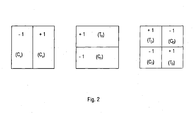
- the ranklet transform is calculated by dividing the N pixels of the same portion of image into two subset T and C each with the dimensions N/2, then assigning half of the pixels to the subset T and the remaining half to the subset C.
- the two subsets T and C are defined in the same way as the Haar wavelet supports shown in Fig 2.
- the vertical, horizontal and diagonal Haar wavelet supports the subsets TV and CV, TH and CH, TD and CD are defined.
- ranklet coefficients are calculated at different resolutions by redimensioning and translating the Haar wavelet supports along the analysed portion of image.
- the result is a set of groups of three vertical, horizontal and diagonal ranklet coefficients, each of which corresponding to a specific redimensioning and to a specific translation of the Haar wavelet supports.
- the numeric coefficients produced by the ranklet transform for each level of resolution and for each scale are concatenated in a single vector.
- the number of elements of all the vectors produced by all the windows is identical.
- This vector constitutes the input for the RVM classifier.
- the RVM classifier was previously trained with a set of examples chosen in such a way that it returns a high probability value if an input vector is presented to it that is representative of the "mass class".
- this RVM classifier returns for the input vector a probability value belonging to the mass class.
- the responses of several RVM classifiers can be used to assign this probability value to the input vector.
- the windows are then selected that have a greater probability of containing the object of interest, in this case the tumour mass.
- the tumour mass For this purpose for each window there is defined a group of neighbours, choosing the windows that are spatially near in a preset Euclidean radius r. Inside this group a candidate is elected, i.e. the window with the highest probability.
- All the elected windows are stored in a list whilst all the non-elected windows are rejected.
- the entire procedure is repeated for different dimensions of the scanning window to search for masses of various dimensions. In this way many lists are produced containing as many elected windows as there are searched dimensions.
- the windows contained in these lists are inserted into a single list, ordered in descending order on the basis of the probability value associated with them. Windows with a probability below a preset threshold t are rejected. At this point the first n windows are selected, n being a preset value. These remaining windows are the windows that obtained the greatest probability of containing a mass at all search dimensions.
- a subsequent step of filtering these remaining windows is then started: in the geometric neighborhood of each window a search is made to see if there are others. If the window in question is isolated it is rejected. If on the other hand there are others, all of them plus the window under examination are grouped into a single new window with which there is associated as a centre the centroid of the component windows, as a dimension the average dimension of the component windows and as a probability value a combination of the probabilities of the probability values of the components.
Landscapes
- Engineering & Computer Science (AREA)
- Computer Vision & Pattern Recognition (AREA)
- Physics & Mathematics (AREA)
- General Physics & Mathematics (AREA)
- Theoretical Computer Science (AREA)
- Multimedia (AREA)
- Health & Medical Sciences (AREA)
- General Health & Medical Sciences (AREA)
- Medical Informatics (AREA)
- Nuclear Medicine, Radiotherapy & Molecular Imaging (AREA)
- Radiology & Medical Imaging (AREA)
- Quality & Reliability (AREA)
- Apparatus For Radiation Diagnosis (AREA)
- Image Analysis (AREA)
- Analysing Materials By The Use Of Radiation (AREA)
Applications Claiming Priority (1)
| Application Number | Priority Date | Filing Date | Title |
|---|---|---|---|
| IT000200A ITBO20060200A1 (it) | 2006-03-20 | 2006-03-20 | Metodo, e relativa apparecchiatura per la ricerca automatica di zone di interesse in immagini digitali. |
Publications (2)
| Publication Number | Publication Date |
|---|---|
| EP1840833A2 true EP1840833A2 (fr) | 2007-10-03 |
| EP1840833A3 EP1840833A3 (fr) | 2010-12-15 |
Family
ID=38293143
Family Applications (1)
| Application Number | Title | Priority Date | Filing Date |
|---|---|---|---|
| EP07005457A Withdrawn EP1840833A3 (fr) | 2006-03-20 | 2007-03-16 | Méthode et appareil correspondant pour chercher automatiquement des zones d'intérêt dans des images numériques |
Country Status (2)
| Country | Link |
|---|---|
| EP (1) | EP1840833A3 (fr) |
| IT (1) | ITBO20060200A1 (fr) |
Cited By (4)
| Publication number | Priority date | Publication date | Assignee | Title |
|---|---|---|---|---|
| US9486146B2 (en) | 2015-03-25 | 2016-11-08 | Xerox Corporation | Detecting tumorous breast tissue in a thermal image |
| US9622698B2 (en) | 2014-11-19 | 2017-04-18 | Xerox Corporation | System and method for detecting cancerous tissue from a thermal image |
| ITUA20164752A1 (it) * | 2016-06-29 | 2017-12-29 | Bioretics S R L | Metodo per la ricerca automatica di zone di interesse in immagini digitali di prodotti, in particolare alimentati in una rispettiva linea di avanzamento industriale di detti prodotti. |
| US10055542B2 (en) | 2015-03-25 | 2018-08-21 | Niramai Health Analytix Pvt Ltd | Software interface tool for breast cancer screening |
Family Cites Families (1)
| Publication number | Priority date | Publication date | Assignee | Title |
|---|---|---|---|---|
| ITBO20010763A1 (it) * | 2001-12-14 | 2003-06-16 | Renato Campanini | Metodo , e relativa apparecchiatura , per la ricerca automatica di zone di interesse in immagini digitali di tessuto biologico |
-
2006
- 2006-03-20 IT IT000200A patent/ITBO20060200A1/it unknown
-
2007
- 2007-03-16 EP EP07005457A patent/EP1840833A3/fr not_active Withdrawn
Cited By (4)
| Publication number | Priority date | Publication date | Assignee | Title |
|---|---|---|---|---|
| US9622698B2 (en) | 2014-11-19 | 2017-04-18 | Xerox Corporation | System and method for detecting cancerous tissue from a thermal image |
| US9486146B2 (en) | 2015-03-25 | 2016-11-08 | Xerox Corporation | Detecting tumorous breast tissue in a thermal image |
| US10055542B2 (en) | 2015-03-25 | 2018-08-21 | Niramai Health Analytix Pvt Ltd | Software interface tool for breast cancer screening |
| ITUA20164752A1 (it) * | 2016-06-29 | 2017-12-29 | Bioretics S R L | Metodo per la ricerca automatica di zone di interesse in immagini digitali di prodotti, in particolare alimentati in una rispettiva linea di avanzamento industriale di detti prodotti. |
Also Published As
| Publication number | Publication date |
|---|---|
| EP1840833A3 (fr) | 2010-12-15 |
| ITBO20060200A1 (it) | 2007-09-21 |
Similar Documents
| Publication | Publication Date | Title |
|---|---|---|
| US9489562B2 (en) | Image processing method and apparatus | |
| Sirmacek et al. | Urban area detection using local feature points and spatial voting | |
| Zhao et al. | AE-FLOW: Autoencoders with normalizing flows for medical images anomaly detection | |
| JP6945253B2 (ja) | 分類装置、分類方法、プログラム、ならびに、情報記録媒体 | |
| CN114187277A (zh) | 基于深度学习的甲状腺细胞学多种类型细胞的检测方法 | |
| Natalia et al. | Lumbar spine MRI annotation with intervertebral disc height and Pfirrmann grade predictions | |
| Taschwer et al. | Automatic separation of compound figures in scientific articles | |
| KR100836740B1 (ko) | 영상 데이터 처리 방법 및 그에 따른 시스템 | |
| EP1840833A2 (fr) | Procédé et appareil correspondant pour rechercher automatiquement des zones dýintérêt dans des images numériques | |
| KR101093107B1 (ko) | 영상정보 분류방법 및 장치 | |
| Masood et al. | SA-SVM based automated diagnostic system for skin cancer | |
| Suwalka et al. | An improved unsupervised mapping technique using AMSOM for neurodegenerative disease detection | |
| Santosh et al. | Scalable arrow detection in biomedical images | |
| Lai et al. | A protozoan parasite extraction scheme for digital microscopic images | |
| Owjimehr et al. | Fully automatic segmentation and classification of liver ultrasound images using completed LBP texture features | |
| Zhang et al. | Extraction of karyocytes and their components from microscopic bone marrow images based on regional color features | |
| Moetesum et al. | Segmentation and classification of offline hand drawn images for the bgt neuropsychological screening test | |
| Pandian et al. | Development of algorithm for identification of maligant growth in cancer using artificial neural network | |
| Gopinathan et al. | Enhancement of image segmentation using automatic histogram thresholding | |
| Lee et al. | Automated identification of lung nodules | |
| Gunti et al. | A Convolutional Neural Networks based Coral Reef Annotation and Localization. | |
| Beulah et al. | Diagnosis of central canal spinal stenosis from lumbar mid-sagittal mr images | |
| Prathibha et al. | Multi-resolution texture analysis of mammograms using nearest neighbor classification techniques | |
| Karnan et al. | Diagnose breast cancer through mammograms, using image processing techniques and optimization techniques | |
| Rosyadi et al. | A Flexible Sub-Block In Region Based Image Retrieval Based On Transition Region |
Legal Events
| Date | Code | Title | Description |
|---|---|---|---|
| PUAI | Public reference made under article 153(3) epc to a published international application that has entered the european phase |
Free format text: ORIGINAL CODE: 0009012 |
|
| AK | Designated contracting states |
Kind code of ref document: A2 Designated state(s): AT BE BG CH CY CZ DE DK EE ES FI FR GB GR HU IE IS IT LI LT LU LV MC MT NL PL PT RO SE SI SK TR |
|
| AX | Request for extension of the european patent |
Extension state: AL BA HR MK YU |
|
| PUAL | Search report despatched |
Free format text: ORIGINAL CODE: 0009013 |
|
| AK | Designated contracting states |
Kind code of ref document: A3 Designated state(s): AT BE BG CH CY CZ DE DK EE ES FI FR GB GR HU IE IS IT LI LT LU LV MC MT NL PL PT RO SE SI SK TR |
|
| AX | Request for extension of the european patent |
Extension state: AL BA HR MK RS |
|
| RIC1 | Information provided on ipc code assigned before grant |
Ipc: G06T 7/20 20060101ALI20101110BHEP Ipc: G06T 7/60 20060101ALI20101110BHEP Ipc: G06T 7/00 20060101AFI20070809BHEP |
|
| AKY | No designation fees paid | ||
| REG | Reference to a national code |
Ref country code: DE Ref legal event code: R108 |
|
| REG | Reference to a national code |
Ref country code: DE Ref legal event code: R108 Effective date: 20110824 |
|
| STAA | Information on the status of an ep patent application or granted ep patent |
Free format text: STATUS: THE APPLICATION IS DEEMED TO BE WITHDRAWN |
|
| 18D | Application deemed to be withdrawn |
Effective date: 20110616 |