EP1845657B1 - Procede de realisation de securisation du reseau par partitionnement du ttl - Google Patents
Procede de realisation de securisation du reseau par partitionnement du ttl Download PDFInfo
- Publication number
- EP1845657B1 EP1845657B1 EP06741926A EP06741926A EP1845657B1 EP 1845657 B1 EP1845657 B1 EP 1845657B1 EP 06741926 A EP06741926 A EP 06741926A EP 06741926 A EP06741926 A EP 06741926A EP 1845657 B1 EP1845657 B1 EP 1845657B1
- Authority
- EP
- European Patent Office
- Prior art keywords
- ttl
- message
- network
- carrier network
- wholesale
- Prior art date
- Legal status (The legal status is an assumption and is not a legal conclusion. Google has not performed a legal analysis and makes no representation as to the accuracy of the status listed.)
- Not-in-force
Links
- 238000000034 method Methods 0.000 title claims abstract description 39
- 238000000638 solvent extraction Methods 0.000 title 1
- 238000005192 partition Methods 0.000 claims abstract description 97
- 230000006855 networking Effects 0.000 claims description 20
- 230000003247 decreasing effect Effects 0.000 claims description 18
- 238000010586 diagram Methods 0.000 description 7
- 239000000969 carrier Substances 0.000 description 3
- 239000000243 solution Substances 0.000 description 3
- 239000003637 basic solution Substances 0.000 description 2
- 230000000694 effects Effects 0.000 description 2
- 235000008694 Humulus lupulus Nutrition 0.000 description 1
- 230000002411 adverse Effects 0.000 description 1
- 230000005540 biological transmission Effects 0.000 description 1
- 230000007423 decrease Effects 0.000 description 1
- 230000001419 dependent effect Effects 0.000 description 1
- 238000005516 engineering process Methods 0.000 description 1
- 238000012986 modification Methods 0.000 description 1
- 230000004048 modification Effects 0.000 description 1
Images


Classifications
-
- H—ELECTRICITY
- H04—ELECTRIC COMMUNICATION TECHNIQUE
- H04L—TRANSMISSION OF DIGITAL INFORMATION, e.g. TELEGRAPHIC COMMUNICATION
- H04L45/00—Routing or path finding of packets in data switching networks
-
- H—ELECTRICITY
- H04—ELECTRIC COMMUNICATION TECHNIQUE
- H04L—TRANSMISSION OF DIGITAL INFORMATION, e.g. TELEGRAPHIC COMMUNICATION
- H04L45/00—Routing or path finding of packets in data switching networks
- H04L45/20—Hop count for routing purposes, e.g. TTL
-
- H—ELECTRICITY
- H04—ELECTRIC COMMUNICATION TECHNIQUE
- H04L—TRANSMISSION OF DIGITAL INFORMATION, e.g. TELEGRAPHIC COMMUNICATION
- H04L63/00—Network architectures or network communication protocols for network security
- H04L63/14—Network architectures or network communication protocols for network security for detecting or protecting against malicious traffic
- H04L63/1408—Network architectures or network communication protocols for network security for detecting or protecting against malicious traffic by monitoring network traffic
- H04L63/1416—Event detection, e.g. attack signature detection
Definitions
- the present invention relates to the field of network communications, and in particular, to a method and a system for realizing network security protection by TTL (Time to Live) partition.
- TTL Time to Live
- a forwarding loop in an IP network Due to the existence of a forwarding loop in an IP network, a message may be forwarded endlessly in the loop, and a lot of resources may be consumed.
- a TTL field is set in an IPv4 (Internet Protocol Version 4) header, and a Hop Limit field is set in an IPv6 header. Lengths, functions and processing of the two fields are totally identical. A processing procedure will be described taking the TTL field as an example.
- an initial value which is a numerical value between 0 and 255, is allocated to the TTL field of the message.
- the initial value is 64 by default, and in the Windows (an operating system from the Microsoft Corporation), the initial value is 128 by default.
- a router receives such an IPv4 message described above, it checks the value of the TTL field prior to forwarding the message. If the value of the TTL field is zero, the message is discarded. If the value of the TTL field is not zero, the value of the TTL field of the message is decreased by one, and then the message is forwarded. Thus, if the forwarding loop exists in a network, the message will discarded in the loop when the TTL is decreased to zero, so that the message would not be forwarded endlessly in the loop.
- the security of a network or a network node can be protected effectively using the above characteristics of the TTL.
- TTL Partition Security Mechanism a method for realizing backbone network security protection using TTL partition, i.e., a TPSM (TTL Partition Security Mechanism) method.
- TTL Partition Security Mechanism draft-miao-ttl-partition-00.txt
- MIAO FUYOU HUAWEI TECHNOLOGIES describes in detail the procedure of the TPSM method.
- a basic assumption of the TPSM is that a backbone network device needs not to interact directly with a user, but only forwards a message from the user without processing through any protocol above the IP layer. If the message comes from the user, and the message is destined for the backbone network device, the backbone network device can directly discard the message.
- the TPSM divides a network into a carrier network and a customer network, where the carrier network is consisted of a P (P Router, a core router of a carrier) device and a PE (Provider Edge, an edge router of the carrier network) device.
- the PE is connected either directly to the customer network (such as an enterprise network) or via a Layer-2 network to the customer network or a customer host, such as an ADSL (Asymmetric Digital Subscriber Loop), and the P device is a backbone of the carrier network, and responsible for connecting PE routers.
- a TrustRadius can be defined for a device, which refers to a maximum number of hops from another device trusted by that device.
- the TPSM divides the TTL into a high partition and a low partition, where the high partition ranging from 255 to 255-TrustRadius is allocated to the backbone network of the carrier, and a TTL of a message communicated between the PE device and the P device of the backbone network can only be within this range, and an initial value for the TTL of a message communicated in the backbone network is set as 255.
- a P or PE router finds that the TTL of a message destined for the P or PE router is less than 255-TrustRadius, this message is regarded as being from a customer network, and is discarded directly; if the TTL of the message is greater than 255-TrustRadius, a corresponding processing can be performed.
- the P router of the backbone network may wrongly receive this message.
- the TTL of a message of the backbone network can be decreased to a value less than 255-trustRadius, i.e. a maximum TTL_USER_MAX for the TTL of a message of the customer network. This value is typically greater than 128, so that the effect on the network due to the above situation can be decreased to a relatively low level.
- the TPSM divides a network into a customer network and a carrier network, treating the carrier network as a whole.
- networks for serving a customer may involve numerous carrier networks between which there are various relationships.
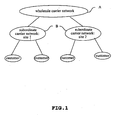
- a carrier network may provide another carrier network with a backbone network connection, in which case the latter carrier network is a carrier for its customers, while it is a customer of the carrier network which provides it with a backbone network connection.
- This is generally referred to as a CsC (Carrier's Carrier)
- a carrier providing a VPN (Virtual Private Network) service is referred to as a wholesale carrier
- a carrier that uses a wholesale service is referred to as a subordinate carrier.
- the networking of the CsC is illustrated as in FIG. 1 .
- the above TPSM can be implemented individually in a wholesale carrier network A without any adverse effect on the network.
- the network B shall determine whether to take the wholesale carrier network A as a customer network or merely as a P device. If the A is taken as a customer network, the TPSM can only be implemented individually in each site within the network B. As a result, devices at different sites within network B cannot communicate directly, which would be not acceptable.
- the same message TTL processing rule(s) shall be enforced as for a P device within the network B, which in fact would be impossible, since a wholesale carrier network may provide several subordinate carriers with wholesale services at the same time, and some of the subordinate carriers may have already realized the TPSM while others have not. Parameters may not be totally the same even if the TPSM has been realized in all of the subordinate carriers.
- An object of the invention is to provide a method for realizing network security protection by TTL partition, so that a TPSM can be implemented simultaneously in a wholesale carrier network and a subordinate carrier network in the case of CsC networking.
- Another object of the invention is to provide a system for realizing network security protection by TTL partition, so that a TPSM may be implemented simultaneously in a wholesale carrier network and a subordinate carrier network in the case of CsC networking.
- TTL Time to Live
- the step A may include:
- the step B may include:
- the step B may include:
- the step A may include:
- the step B may include:
- the step B may include:
- the step B may include:
- the step B may include:
- the method may be applicable to an IPv4 or IPv6 network.
- TTL Time to Live
- system may further include a network strategy setting device, connected with the TTL partition allocating device, for setting a message receiving strategy of the at least one subordinate carrier network.
- a network strategy setting device connected with the TTL partition allocating device, for setting a message receiving strategy of the at least one subordinate carrier network.
- the TTL partition allocating device allocates the TTL partitions as following:
- the security mechanism control device may include:
- An essence of the invention lies in that in the case of CsC networking, different TTL partitions are allocated to a wholesale carrier network, a subordinate carrier network and a customer network in a CsS according to different requirements of the actual networking, so that a TPSM can be implemented simultaneously in the wholesale carrier network and the subordinate carrier network.
- FIG.2 it illustrates a flow chart of a method according to the invention, which includes the steps of:
- the subordinate carrier may receive a message sent from a device in the wholesale carrier network, for example, a routing update message, or does not receive such a message, for example, the message itself may be regarded as a potential security attack.
- different TTL partitions can be allocated, according to different situations of the actual CsC networking, to a wholesale carrier network, a subordinate carrier network and a customer network therein.
- the subordinate carrier network uses a TTL partition lower than that of the wholesale carrier network, which can include the TTL partition used by the wholesale carrier network, but cannot be partially intersected with the TTL partition used by the wholesale carrier network, which will be described in detail hereinafter.
- Step 202 the TPSM is realized simultaneously in the wholesale carrier network and the subordinate carrier network using the allocated TTL partitions.
- the message is allocated with an appropriate initial value of the TTL (for example, 255).
- the message is allocated with an appropriate initial value of the TTL (for example, 255).
- a specific value can be set according to different node locations and networking requirements.
- a PE of the wholesale carrier network checks each message entering that network. Upon receipt of a message not destined for the PE, the PE checks the TTL of the message. If the TTL is greater than an allowable minimum for a TTL of the wholesale carrier network, the TTL of the message is decreased to an allowable maximum for a TTL of the subordinate carrier network, and the message is forwarded. If the TTL is less than or equal to the allowable minimum of a TTL of the wholesale carrier network, the message is forwarded normally.
- a device of the wholesale carrier network When a device of the wholesale carrier network receives a message not destined for the device, if the TTL of the message is less than or equal to the allowable minimum for a TTL of the wholesale carrier network, the message is discarded; if the TTL of the message is greater than the allowable minimum for a TTL of the wholesale carrier network, the message is delivered to an upper-layer protocol for processing.
- a PE of the subordinate carrier network checks each message entering that network. Upon receipt of a message not destined for the PE connected to the user, the PE network checks the TTL of the message. If the TTL is greater than an allowable minimum for a TTL of the subordinate carrier network, the TTL of the message is decreased to an allowable maximum for a TTL of the customer network, and the message is forwarded. If the TTL is less than or equal to the allowable minimum of a TTL of the subordinate carrier network, the message is forwarded normally.
- the subordinate carrier receives a message sent from a device in the wholesale carrier network, for example, a routing update message.
- FIG.3 a schematic diagram of setting TPSM parameters in a wholesale carrier network, a subordinate carrier network and a customer network is illustrated in FIG.3 .
- the invention divides a TTL ranging from 255 to A1_min into a plurality of partitions, where A1_min is an allowable minimum for a TTL of the carrier A.
- a larger TTL partition used by the wholesale carrier ranges from 255 to B1_min, where B1_min is an allowable minimum for a TTL of the carrier B, and less than A1_min, and thus this TTL partition contains the TTL partition used by the wholesale carrier.
- the TTL partition used by the customer network ranges from U1_max to 0, where U1_max is an allowable maximum for a TTL of the customer network, and is less than B1_min.
- a TPSM processing procedure in the wholesale carrier network A and the subordinate carrier network B is as following.
- the TPSM can be realized as specified in an existing TPSM, particularly as following.
- a PE (Provider Edge) of the network A checks each message entering the network A. If the PE checks that the message is not destined for the PE, and the TTL of the message is greater than A1_min, i.e., 255-TrustRadius as specified in the TPSM, the TTL of the message is decreased to B1_max (for the network A, B1_max is TTL_USER_MAX in a basic solution of the TPSM), and the message is forwarded normally. If the TTL of the message is less than or equal to A1_min, the message is forwarded normally.
- A1_min i.e., 255-TrustRadius as specified in the TPSM
- An initial value for the TTL of the message sent by a device in the network A is set as 255.
- a device in the network A (including a PE in the network A) receives a message not destined for the device, and the TTL is less than or equal to A1_min, the message is discarded directly. If the TTL is greater than A1_min, according to a security strategy, the TTL of a message and TPSM parameters for the network A determined in advance, the message is delivered to an upper-layer protocol for processing.
- a TPSM processing procedure is as following.
- a PE of the network B checks each message entering the network B.
- a PE connected to a customer network checks that the message is not destined for the PE, and the TTL of the message is greater than B1_min, the TTL of the message is decreased to U1_max, and the message is forwarded normally. If the TTL of the message is less than or equal to B1_min, the message is forwarded normally.
- a PE connected to the network A checks that a message from the network A is not destined for the PE, the message is forwarded directly in a normal way.
- An initial value for the TTL of a message sent by a device in the network B is also set as 255.
- the message cannot be determined whether to be from the network A or B.
- the message can be forward normally or be delivered to an upper-layer protocol for processing.
- a device in the network B (including a PE in the network B) receives a message not destined for the device, and the TTL is less than or equal to B1_min, the message is regarded as being from the customer network, and the message is discarded directly. If the TTL is greater than B1_min, according to a security strategy, the TTL of a message and TPSM parameters for the network B determined in advance, the message is delivered to an upper-layer protocol for processing.
- the processing procedure of the inventive method in the first situation is simple to implement, and is applicable to most applications, and it is of little difference from a basic TPSM, where for the network B, B1_min is 255-TrustRadius in the TPSM.
- the subordinate carrier does not receive the message sent from a device in the wholesale carrier network.
- a message is regarded as a potential security attack.
- FIG.4 a schematic diagram of setting TPSM parameters in a wholesale carrier network, a subordinate carrier network and a customer network is illustrated in FIG.4 .
- the invention also divides a TTL into a plurality of partitions.
- a larger TTL partition used by the wholesale carrier ranges from 255 to A2_min, where A2_min is an allowable minimum for a TTL of the carrier A, and a shorter TTL partition used by the subordinate carrier ranges from B2_max to A2_min, where B2_max is an allowable maximum for a TTL of the carrier B, B2_min is an allowable minimum for a TTL of the carrier B, and B2_max is less than A2_min.
- a lowest TTL partition used by the customer network ranges from U2_max to 0, where U2_max is an allowable maximum for a TTL of the customer network, and is less than B2_min.
- a TPSM processing procedure in the wholesale carrier network A and the subordinate carrier network B is as following.
- the TPSM processing procedure is as following.
- a PE of the network A checks each message entering the network A. If the PE checks a message not destined for the PE, and the TTL of the message is greater than A2_min, i.e., 255-TrustRadius as specified in the TPSM, the TTL of the message is decreased to B2_max (for the network A, B2_max is TTL_USER_MAX in a basic solution for the TPSM), and the message is forwarded normally. If the TTL of the message is less than or equal to A2_min, the message is forwarded normally.
- A2_min i.e., 255-TrustRadius as specified in the TPSM
- An initial value for the TTL of a message sent by a device in the network A is set as 255.
- a device in network A (including a PE in the network A) receives a message not destined for the device, and the TTL is not greater than A2_min, the message is discarded directly. If the TTL is greater than or equal to A2_min, according to a security strategy, the TTL of a message and TPSM parameters for the network A determined in advance, the message is delivered to an upper-layer protocol for processing.
- a TPSM processing procedure is as follows:
- An edge router PE of the network B checks each message entering the network B.
- a PE connected to a customer network checks that a message from the customer network is not destined for the PE, and the TTL of the message is greater than B2_min, the TTL of the message is decreased to U2_max, and the message is forwarded normally. If the TTL of the message is less than or equal to B2_min, then the message is forwarded normally.
- a PE connected to the network A checks that a message from the network A is not destined for the PE, and the TTL of the message is greater than B2_max, the message is discarded directly. If the TTL of the message is less than or equal to B2_max, then the message is forwarded normally.
- An initial value for the TTL of a message sent by a device in the network B is set as B_max. If a device in the network B (including a PE in the network B) receives a message not destined for the device, and the TTL is less than or equal to B2_min, the message is regarded as being from the customer network and is discarded directly. If the TTL is greater than B2_min, then according to a predetermined security strategy, the TTL of a message and TPSM parameters for the network B determined in advance, the message is delivered to an upper-layer protocol for processing.
- the method according to the invention is applicable to an IPv4 or IPv6 network.
- the invention provides a system for realizing network security protection by TTL partition, a principle block diagram of which is illustrated in FIG.5 .
- the system includes a TTL partition allocating device S1 and a security mechanism control device S2.
- the TTL partition allocating device S1 is used to allocate in CsC networking different TTL partitions to a wholesale carrier network, a subordinate carrier network and a customer network
- the security mechanism control device S2 connected with the TTL partition allocating device and further with the wholesale carrier network and the subordinate carrier network, is used to realize the TPSM simultaneously in the wholesale carrier network and the subordinate carrier network using the allocated TTL partitions.
- the system can further include a network strategy setting device S3, connected with the TTL partition allocating device S1, for setting a message receiving strategy of the subordinate carrier network.
- the TTL partition allocating device S1 can flexibly allocate TTL partitions used by various levels of networks according to different application requirements of the CsC networking.
- TTL partitions can be set as following.
- the TTL partition allocating device allocates TTL partitions in the following ways.
- a range of a TTL allocated to the wholesale carrier network is A1_min ⁇ TTL ⁇ 255, where A1_min is an allowable minimum for a TTL of the wholesale carrier network.
- a range of a TTL allocated to the subordinate carrier network is B 1 _ min ⁇ TTL ⁇ 255 , where B1_min is an allowable minimum for a TTL of the subordinate carrier network, and is less than A1_min.
- a range of a TTL allocated to the customer network is 0 ⁇ TTL ⁇ U 1_max , where U1_max is an allowable maximum for a TTL of the customer network, and is less than B1_min.
- the TTL partition allocating device allocates TTL partitions in the following ways.
- a range of a TTL allocated to the wholesale carrier network is A2_min ⁇ TTL ⁇ 255, where A2_min is an allowable minimum for a TTL of the wholesale carrier network.
- a range of a TTL allocated to the subordinate carrier network is B 2_min ⁇ TTL ⁇ B 2_max , where B2_max is an allowable maximum for a TTL of the subordinate carrier network, B2_min is an allowable minimum for a TTL of the subordinate carrier network, and is less than A2_min.
- a range of a TTL allocated to the customer network is 0 ⁇ TTL ⁇ U 2_max , where U2 max is an allowable maximum for a TTL of the customer network, and is less than B2_min.
- a control module of a wholesale carrier network message S21 and a control module of a subordinate carrier network message S22 can be provided in the security mechanism control device.
- the control module of a wholesale carrier network message S21 can be provided in an edge router of the wholesale carrier network, so that according to a TTL partition allocated to the wholesale carrier network by the TTL partition allocating device, the edge router can be controlled to forward a received message.
- the control module of a subordinate carrier network message S22 can be provided in an edge router of the subordinate carrier network, so that according to a TTL partition allocated to the subordinate carrier network by the TTL partition allocating device, the edge router can be controlled to forward a received message.
Landscapes
- Engineering & Computer Science (AREA)
- Computer Networks & Wireless Communication (AREA)
- Signal Processing (AREA)
- Computer Security & Cryptography (AREA)
- Computer Hardware Design (AREA)
- Computing Systems (AREA)
- General Engineering & Computer Science (AREA)
- Data Exchanges In Wide-Area Networks (AREA)
Claims (16)
- Procédé de réalisation d'une sécurisation de réseau par partitionnement du TTL, caractérisé en ce qu'il comprend :A) l'attribution (201) de différentes partitions de TTL à un réseau d'opérateur grossiste, à au moins un réseau d'opérateur subordonné et à au moins un réseau client dans une réseautique d'Opérateur d'Opérateurs ;B) la réalisation (202) d'un Mécanisme de Sécurisation par Partitionnement de TTL, TPSM, simultanément sur le réseau d'opérateur grossiste et l'au moins un réseau d'opérateur subordonné au moyen des partitions de TTL attribuées.
- Procédé de réalisation d'une sécurisation de réseau par partitionnement du TTL selon la revendication 1, dans lequel l'étape A comprend :si l'au moins un réseau d'opérateur subordonné reçoit un message envoyé par un dispositif dans le réseau d'opérateur grossiste, une plage d'un TTL attribuée au réseau d'opérateur grossiste est A1_min≤TTL≤255, où A1_min est un minimum admissible pour un TTL du réseau d'opérateur grossiste ;une plage d'un TTL attribuée à l'au moins un réseau d'opérateur subordonné est B1_min≤TTL≤255, où B1_min est un minimum admissible pour un TTL de l'au moins un réseau d'opérateur subordonné, et est inférieur à A1_min ; etune plage d'un TTL attribuée à l'au moins un réseau client est 0<TTL≤U1_max, où U1_max est un maximum admissible pour un TTL de l'au moins un réseau client, et est inférieur à B1_min.
- Procédé de réalisation d'une sécurisation de réseau par partitionnement du TTL selon la revendication 2, dans lequel l'étape B comprend :la vérification, par un routeur limitrophe PE du réseau d'opérateur grossiste, de chaque message entrant dans le réseau d'opérateur grossiste, et quand le PE reçoit un message non destiné au PE, si un TTL du message est supérieur à A1_min, la diminution du TTL du message à un maximum admissible pour un TTL de l'au moins un réseau d'opérateur subordonné et l'acheminement du message ;quand un dispositif dans le réseau d'opérateur grossiste reçoit un message destiné au dispositif, si un TTL du message est inférieur ou égal à A1_min, le rejet du message ;si un TTL du message est supérieur à A1_min, la délivrance du message à un protocole de couche supérieure en vue de son traitement.
- Procédé de réalisation d'une sécurisation de réseau par partitionnement du TTL selon la revendication 2 ou 3, dans lequel l'étape B comprend en outre :le réglage d'une valeur initiale d'un TTL d'un message envoyé par le dispositif dans le réseau d'opérateur grossiste à 255.
- Procédé de réalisation d'une sécurisation de réseau par partitionnement du TTL selon la revendication 2 ou 3, dans lequel l'étape B comprend en outre :la vérification, par un routeur limitrophe PE de l'au moins un réseau d'opérateur subordonné, de chaque message entrant dans l'au moins un réseau d'opérateur subordonné ; et quand un PE connecté à l'au moins un réseau client reçoit un message non destiné au PE, si un TTL du message est supérieur à B1_min, la diminution du TTL du message à U1_max et l'acheminement du message, et quand un PE connecté au réseau d'opérateur grossiste reçoit un message non destiné au PE, l'acheminement normal du message ;quand un dispositif dans l'au moins un réseau d'opérateur subordonné reçoit un message destiné au dispositif, si un TTL du message est inférieur ou égal à B1_min,le rejet du message ; si un TTL du message est supérieur à B1_min, la délivrance du message à un protocole de couche supérieure en vue de son traitement.
- Procédé de réalisation d'une sécurisation de réseau par partitionnement du TTL selon la revendication 5, dans lequel l'étape B comprend en outre :le réglage d'une valeur initiale d'un TTL d'un message envoyé par le dispositif dans l'au moins un réseau d'opérateur subordonné à 255.
- Procédé de réalisation d'une sécurisation de réseau par partitionnement du TTL selon la revendication 1, dans lequel l'étape A comprend :si l'au moins un réseau d'opérateur subordonné ne reçoit pas un message envoyé par un dispositif dans le réseau d'opérateur grossiste, une plage d'un TTL attribuée au réseau d'opérateur grossiste est A2_min≤TTL≤255, où A2_min est un minimum admissible pour un TTL du réseau d'opérateur grossiste ;une plage d'un TTL attribuée à l'au moins un réseau d'opérateur subordonné est B2_min≤TTL≤B2_max, où B2_max est un maximum admissible pour un TTL de l'au moins un réseau d'opérateur subordonné, B2_min est un minimum admissible pour un TTL de l'au moins un réseau d'opérateur subordonné, et B2_max est inférieur à A2_min;une plage d'un TTL attribuée à l'au moins un réseau client est 0<TTL≤U2_max, où U2_max est un maximum admissible pour un TTL de l'au moins un réseau client, et est inférieur à B2_min.
- Procédé de réalisation d'une sécurisation de réseau par partitionnement du TTL selon la revendication 7, dans lequel l'étape B comprend :la vérification, par un routeur limitrophe PE du réseau d'opérateur grossiste, de chaque message entrant dans le réseau d'opérateur grossiste, et quand le PE reçoit un message non destiné au PE, si un TTL du message est supérieur à A2_min, la diminution du TTL du message à B2_max et l'acheminement du message ;quand un dispositif dans le réseau d'opérateur grossiste reçoit un message destiné au dispositif, si un TTL du message n'est pas supérieur à A2_min, le rejet du message ;si un TTL du message est supérieur à A2_min, la délivrance du message à un protocole de couche supérieure en vue de son traitement.
- Procédé de réalisation d'une sécurisation de réseau par partitionnement du TTL selon la revendication 7 ou 8, dans lequel l'étape B comprend en outre :le réglage d'une valeur initiale d'un TTL d'un message envoyé par le dispositif du réseau d'opérateur grossiste à 255.
- Procédé de réalisation d'une sécurisation de réseau par partitionnement du TTL selon la revendication 7 ou 8, dans lequel l'étape B comprend en outre :la vérification, par un PE de l'au moins un réseau d'opérateur subordonné, de chaque message entrant dans l'au moins un réseau d'opérateur subordonné ; et quand le PE connecté à l'au moins un réseau client reçoit un message non destiné au PE, si un TTL du message est supérieur à B2_min, la diminution du TTL du message à U2_max et l'acheminement du message, et quand le PE connecté au réseau d'opérateur grossiste reçoit un message non destiné au PE, si un TTL du message est supérieur à B2_max, le rejet du message ;quand un dispositif dans l'au moins un réseau d'opérateur subordonné reçoit un message destiné au dispositif, si un TTL du message est inférieur ou égal à B2_min,le rejet du message ; si un TTL du message est supérieur à B2_min, la délivrance du message à un protocole de couche supérieure en vue de son traitement.
- Procédé de réalisation d'une sécurisation de réseau par partitionnement du TTL selon la revendication 10, dans lequel l'étape B comprend en outre :le réglage d'une valeur initiale d'un TTL d'un message envoyé par le dispositif dans l'au moins un réseau d'opérateur subordonné à B2_max.
- Procédé de réalisation d'une sécurisation de réseau par partitionnement du TTL selon la revendication 1, le procédé étant applicable à un réseau IPv4 ou IPv6.
- Système de réalisation d'une sécurisation de réseau par partitionnement du TTL, caractérisé en ce qu'il comprend :un dispositif d'attribution de partitions de TTL (S1), adapté pour attribuer différentes partitions de TTL à un réseau d'opérateur grossiste, à au moins un réseau d'opérateur subordonné et à au moins un réseau client dans une réseautique d'Opérateur d'Opérateurs ;un dispositif de commande de mécanisme de sécurité (S2), connecté au dispositif d'attribution de partitions de TTL, adapté pour réaliser un Mécanisme de Sécurisation par Partitionnement du TTL, TPSM, simultanément dans le réseau d'opérateur grossiste et l'au moins un réseau d'opérateur subordonné au moyen des partitions de TTL attribuées.
- Système de réalisation d'une sécurisation de réseau par partitionnement du TTL selon la revendication 13, le système comprenant en outre :un dispositif d'établissement de stratégie de réseau, connecté au dispositif d'attribution de partitions de TTL, adapté pour établir une stratégie de réception de message de l'au moins un réseau d'opérateur subordonné.
- Système de réalisation d'une sécurisation de réseau par partitionnement du TTL selon la revendication 14, dans lequel :si la stratégie de réception de message de l'au moins un réseau d'opérateur subordonné établie par le dispositif d'établissement de stratégie de réseau est qu'un message envoyé par un dispositif dans le réseau d'opérateur grossiste est reçu, le dispositif d'attribution de partitions de TTL est adapté pour attribuer les partitions de TTL comme suit :une plage d'un TTL attribuée au réseau d'opérateur grossiste est A1_min≤TTL≤255, où A1_min est un minimum admissible pour un TTL du réseau d'opérateur grossiste ;une plage d'un TTL attribuée à l'au moins un réseau d'opérateur subordonné est B1_min≤TTL≤255, où B1_min est un minimum admissible pour un TTL de l'au moins un réseau d'opérateur subordonné, et est inférieur à A1_min ;une plage d'un TTL attribuée à l'au moins un réseau client est 0<TTL≤U1_max, où U1_max est un maximum admissible pour un TTL de l'au moins un réseau client, et est inférieur à B1_min ;si la stratégie de réception de message de l'au moins un réseau d'opérateur subordonné établie par le dispositif d'établissement de stratégie de réseau est qu'un message envoyé par un dispositif dans le réseau d'opérateur grossiste n'est pas reçu,le dispositif d'attribution de partitions de TTL est adapté pour attribuer les partitions de TTL comme suit :une plage d'un TTL attribuée au réseau d'opérateur grossiste est A2_min≤TTL≤255, où A2_min est un minimum admissible pour un TTL du réseau d'opérateur grossiste ;une plage d'un TTL attribuée à l'au moins un réseau d'opérateur subordonné est B2_min≤TTL≤B2_max, où B2_max est un maximum admissible pour un TTL de l'au moins un réseau d'opérateur subordonné, B2_min est un minimum admissible pour un TTL de l'au moins un réseau d'opérateur subordonné, et B2_max est inférieur à A2_min ;une plage d'un TTL attribuée à l'au moins un réseau client est 0<TTL≤U2_max, où U2_max est un maximum admissible pour un TTL de l'au moins un réseau client, et est inférieur à B2_min.
- Système de réalisation d'une sécurisation de réseau par partitionnement du TTL selon la revendication 13, dans lequel le dispositif de commande de mécanisme de sécurité comprend :un module de commande d'un message de réseau d'opérateur grossiste, situé dans un routeur limitrophe du réseau d'opérateur grossiste, adapté pour commander, en fonction de la partition de TTL attribuée par le dispositif d'attribution de partitions de TTL au réseau d'opérateur grossiste, le routeur limitrophe afin qu'il achemine un message reçu,un module de commande d'un message de réseau d'opérateur subordonné, situé dans un routeur limitrophe de l'au moins un réseau d'opérateur subordonné, adapté pour commander, en fonction de la partition de TTL attribuée par le dispositif d'attribution de partitions de TTL à l'au moins un réseau d'opérateur subordonné, le routeur limitrophe afin qu'il achemine un message reçu.
Applications Claiming Priority (2)
| Application Number | Priority Date | Filing Date | Title |
|---|---|---|---|
| CNA2005101055074A CN1937619A (zh) | 2005-09-23 | 2005-09-23 | 运营商的运营商情况下生存时间分区安全机制的实现方法 |
| PCT/CN2006/001038 WO2007033541A1 (fr) | 2005-09-23 | 2006-05-19 | Procede de realisation de securisation du reseau par segmentation le ttl |
Publications (3)
| Publication Number | Publication Date |
|---|---|
| EP1845657A1 EP1845657A1 (fr) | 2007-10-17 |
| EP1845657A4 EP1845657A4 (fr) | 2008-05-07 |
| EP1845657B1 true EP1845657B1 (fr) | 2012-03-14 |
Family
ID=37888531
Family Applications (1)
| Application Number | Title | Priority Date | Filing Date |
|---|---|---|---|
| EP06741926A Not-in-force EP1845657B1 (fr) | 2005-09-23 | 2006-05-19 | Procede de realisation de securisation du reseau par partitionnement du ttl |
Country Status (5)
| Country | Link |
|---|---|
| US (1) | US7966651B2 (fr) |
| EP (1) | EP1845657B1 (fr) |
| CN (2) | CN1937619A (fr) |
| AT (1) | ATE549816T1 (fr) |
| WO (1) | WO2007033541A1 (fr) |
Families Citing this family (6)
| Publication number | Priority date | Publication date | Assignee | Title |
|---|---|---|---|---|
| CN1937619A (zh) | 2005-09-23 | 2007-03-28 | 华为技术有限公司 | 运营商的运营商情况下生存时间分区安全机制的实现方法 |
| CN101453527B (zh) * | 2007-11-30 | 2011-11-30 | 华为技术有限公司 | 一种动态策略转换的方法、网络系统及网络设备 |
| WO2010087308A1 (fr) * | 2009-02-02 | 2010-08-05 | 日本電気株式会社 | Système de gestion de réseau de communication, procédé, programme et ordinateur de gestion |
| CA3081255C (fr) | 2009-04-01 | 2023-08-22 | Nicira, Inc. | Procede et appareil destines a mettre en application et a gerer des commutateurs virtuels |
| US8606825B1 (en) * | 2011-07-20 | 2013-12-10 | Google Inc. | Query response streams based on dynamic query library |
| US8984240B2 (en) | 2012-08-30 | 2015-03-17 | International Business Machines Corporation | Reducing page faults in host OS following a live partition mobility event |
Family Cites Families (8)
| Publication number | Priority date | Publication date | Assignee | Title |
|---|---|---|---|---|
| US6104695A (en) * | 1998-03-31 | 2000-08-15 | Sun Microsystems, Inc. | Repair TTL computation and correction mechanism to perform localized repairs in a multicast data distribution setup/framework |
| US6760309B1 (en) * | 2000-03-28 | 2004-07-06 | 3Com Corporation | Method of dynamic prioritization of time sensitive packets over a packet based network |
| US6985476B1 (en) * | 2001-08-20 | 2006-01-10 | Bbnt Solutions Llc | Automatic setting of time-to-live fields for packets in an ad hoc network |
| WO2003019404A1 (fr) * | 2001-08-30 | 2003-03-06 | Riverhead Networks Inc. | Protection contre des attaques par saturation |
| US7953088B2 (en) * | 2003-06-10 | 2011-05-31 | Cisco Technology, Inc. | Method and apparatus for packet classification and rewriting |
| CN1234226C (zh) * | 2003-06-27 | 2005-12-28 | 中国科学院计算技术研究所 | 一种利用分组头中的剩余生命期进行分组传输服务质量调度的方法 |
| US7415018B2 (en) * | 2003-09-17 | 2008-08-19 | Alcatel Lucent | IP Time to Live (TTL) field used as a covert channel |
| CN1937619A (zh) | 2005-09-23 | 2007-03-28 | 华为技术有限公司 | 运营商的运营商情况下生存时间分区安全机制的实现方法 |
-
2005
- 2005-09-23 CN CNA2005101055074A patent/CN1937619A/zh active Pending
-
2006
- 2006-05-19 AT AT06741926T patent/ATE549816T1/de active
- 2006-05-19 EP EP06741926A patent/EP1845657B1/fr not_active Not-in-force
- 2006-05-19 CN CNB2006800122996A patent/CN100563172C/zh not_active Expired - Fee Related
- 2006-05-19 WO PCT/CN2006/001038 patent/WO2007033541A1/fr not_active Ceased
-
2008
- 2008-03-19 US US12/051,206 patent/US7966651B2/en not_active Expired - Fee Related
Also Published As
| Publication number | Publication date |
|---|---|
| CN100563172C (zh) | 2009-11-25 |
| US7966651B2 (en) | 2011-06-21 |
| WO2007033541A1 (fr) | 2007-03-29 |
| CN1937619A (zh) | 2007-03-28 |
| EP1845657A4 (fr) | 2008-05-07 |
| ATE549816T1 (de) | 2012-03-15 |
| EP1845657A1 (fr) | 2007-10-17 |
| CN101160807A (zh) | 2008-04-09 |
| US20080189765A1 (en) | 2008-08-07 |
Similar Documents
| Publication | Publication Date | Title |
|---|---|---|
| US10972437B2 (en) | Applications and integrated firewall design in an adaptive private network (APN) | |
| US8457132B2 (en) | Method of relaying traffic from a source to a targeted destination in a communications network and corresponding equipment | |
| US7738457B2 (en) | Method and system for virtual routing using containers | |
| US7379465B2 (en) | Tunneling scheme optimized for use in virtual private networks | |
| EP1712056B1 (fr) | Groupes de securite tunnelise | |
| US20190306598A1 (en) | Method and apparatus for controlling data forwarding in pon | |
| US20070140235A1 (en) | Network visible inter-logical router links | |
| EP3201777B1 (fr) | Fourniture d'exigences fonctionnelles pour une connexion de réseau depuis une bibliothèque locale | |
| CN114363182A (zh) | 确定性网络系统及确定性业务的传输方法 | |
| US7154899B2 (en) | Protecting the filtering database in virtual bridges | |
| EP4005180B1 (fr) | Gestion de ressources de système dans des réseaux auto-régénérants | |
| US7966651B2 (en) | Method for realizing the network security by segmenting the TTL | |
| US7577737B2 (en) | Method and apparatus for controlling data to be routed in a data communications network | |
| US8630296B2 (en) | Shared and separate network stack instances | |
| US10050937B1 (en) | Reducing impact of network attacks in access networks | |
| US20090122784A1 (en) | Method and device for implementing the security of the backbone network | |
| JP2004528756A (ja) | サービス拒否攻撃に耐えるために、仮想私設網(vpn)およびベストエフォートトラフィックを隔離するシステム、方法および装置 | |
| JP3841417B2 (ja) | 通信接続方法、サーバ計算機、および、プログラム | |
| US7042885B2 (en) | System and method for implementing a distributed service platform using a system-wide switchtag definition | |
| JP2004533149A (ja) | IPQoSのサービス拒否攻撃に耐えるための仮想私設網を採用するシステム、方法および装置 | |
| US20230388270A1 (en) | Method and device for prioritising packet flows | |
| US7602716B1 (en) | Load sharing on DOCSIS | |
| Tsaur et al. | Establishing secure Ethernet LANs using intelligent switching hubs in Internet environments | |
| HK1241484B (en) | Providing functional requirements for a network connection from a local library |
Legal Events
| Date | Code | Title | Description |
|---|---|---|---|
| PUAI | Public reference made under article 153(3) epc to a published international application that has entered the european phase |
Free format text: ORIGINAL CODE: 0009012 |
|
| 17P | Request for examination filed |
Effective date: 20070823 |
|
| AK | Designated contracting states |
Kind code of ref document: A1 Designated state(s): AT BE BG CH CY CZ DE DK EE ES FI FR GB GR HU IE IS IT LI LT LU LV MC NL PL PT RO SE SI SK TR |
|
| AX | Request for extension of the european patent |
Extension state: AL BA HR MK YU |
|
| RAP1 | Party data changed (applicant data changed or rights of an application transferred) |
Owner name: HUAWEI TECHNOLOGIES CO., LTD. |
|
| RIN1 | Information on inventor provided before grant (corrected) |
Inventor name: MIAO, FUYOU |
|
| A4 | Supplementary search report drawn up and despatched |
Effective date: 20080403 |
|
| RIC1 | Information provided on ipc code assigned before grant |
Ipc: H04L 29/06 20060101ALI20080328BHEP Ipc: H04L 12/24 20060101ALI20080328BHEP Ipc: H04L 12/22 20060101AFI20080328BHEP |
|
| 17Q | First examination report despatched |
Effective date: 20080722 |
|
| RTI1 | Title (correction) |
Free format text: A METHOD FOR REALIZING THE NETWORK SECURITY BY PARTITIONING THE TTL |
|
| GRAP | Despatch of communication of intention to grant a patent |
Free format text: ORIGINAL CODE: EPIDOSNIGR1 |
|
| DAX | Request for extension of the european patent (deleted) | ||
| GRAS | Grant fee paid |
Free format text: ORIGINAL CODE: EPIDOSNIGR3 |
|
| GRAA | (expected) grant |
Free format text: ORIGINAL CODE: 0009210 |
|
| AK | Designated contracting states |
Kind code of ref document: B1 Designated state(s): AT BE BG CH CY CZ DE DK EE ES FI FR GB GR HU IE IS IT LI LT LU LV MC NL PL PT RO SE SI SK TR |
|
| REG | Reference to a national code |
Ref country code: GB Ref legal event code: FG4D |
|
| REG | Reference to a national code |
Ref country code: CH Ref legal event code: EP Ref country code: AT Ref legal event code: REF Ref document number: 549816 Country of ref document: AT Kind code of ref document: T Effective date: 20120315 |
|
| REG | Reference to a national code |
Ref country code: IE Ref legal event code: FG4D |
|
| REG | Reference to a national code |
Ref country code: DE Ref legal event code: R096 Ref document number: 602006028185 Country of ref document: DE Effective date: 20120510 |
|
| REG | Reference to a national code |
Ref country code: NL Ref legal event code: VDEP Effective date: 20120314 |
|
| PG25 | Lapsed in a contracting state [announced via postgrant information from national office to epo] |
Ref country code: LT Free format text: LAPSE BECAUSE OF FAILURE TO SUBMIT A TRANSLATION OF THE DESCRIPTION OR TO PAY THE FEE WITHIN THE PRESCRIBED TIME-LIMIT Effective date: 20120314 |
|
| LTIE | Lt: invalidation of european patent or patent extension |
Effective date: 20120314 |
|
| PG25 | Lapsed in a contracting state [announced via postgrant information from national office to epo] |
Ref country code: GR Free format text: LAPSE BECAUSE OF FAILURE TO SUBMIT A TRANSLATION OF THE DESCRIPTION OR TO PAY THE FEE WITHIN THE PRESCRIBED TIME-LIMIT Effective date: 20120615 Ref country code: FI Free format text: LAPSE BECAUSE OF FAILURE TO SUBMIT A TRANSLATION OF THE DESCRIPTION OR TO PAY THE FEE WITHIN THE PRESCRIBED TIME-LIMIT Effective date: 20120314 Ref country code: LV Free format text: LAPSE BECAUSE OF FAILURE TO SUBMIT A TRANSLATION OF THE DESCRIPTION OR TO PAY THE FEE WITHIN THE PRESCRIBED TIME-LIMIT Effective date: 20120314 |
|
| REG | Reference to a national code |
Ref country code: AT Ref legal event code: MK05 Ref document number: 549816 Country of ref document: AT Kind code of ref document: T Effective date: 20120314 |
|
| PG25 | Lapsed in a contracting state [announced via postgrant information from national office to epo] |
Ref country code: CY Free format text: LAPSE BECAUSE OF FAILURE TO SUBMIT A TRANSLATION OF THE DESCRIPTION OR TO PAY THE FEE WITHIN THE PRESCRIBED TIME-LIMIT Effective date: 20120314 |
|
| PG25 | Lapsed in a contracting state [announced via postgrant information from national office to epo] |
Ref country code: SI Free format text: LAPSE BECAUSE OF FAILURE TO SUBMIT A TRANSLATION OF THE DESCRIPTION OR TO PAY THE FEE WITHIN THE PRESCRIBED TIME-LIMIT Effective date: 20120314 Ref country code: PL Free format text: LAPSE BECAUSE OF FAILURE TO SUBMIT A TRANSLATION OF THE DESCRIPTION OR TO PAY THE FEE WITHIN THE PRESCRIBED TIME-LIMIT Effective date: 20120314 Ref country code: RO Free format text: LAPSE BECAUSE OF FAILURE TO SUBMIT A TRANSLATION OF THE DESCRIPTION OR TO PAY THE FEE WITHIN THE PRESCRIBED TIME-LIMIT Effective date: 20120314 Ref country code: SE Free format text: LAPSE BECAUSE OF FAILURE TO SUBMIT A TRANSLATION OF THE DESCRIPTION OR TO PAY THE FEE WITHIN THE PRESCRIBED TIME-LIMIT Effective date: 20120314 Ref country code: CZ Free format text: LAPSE BECAUSE OF FAILURE TO SUBMIT A TRANSLATION OF THE DESCRIPTION OR TO PAY THE FEE WITHIN THE PRESCRIBED TIME-LIMIT Effective date: 20120314 Ref country code: EE Free format text: LAPSE BECAUSE OF FAILURE TO SUBMIT A TRANSLATION OF THE DESCRIPTION OR TO PAY THE FEE WITHIN THE PRESCRIBED TIME-LIMIT Effective date: 20120314 Ref country code: IS Free format text: LAPSE BECAUSE OF FAILURE TO SUBMIT A TRANSLATION OF THE DESCRIPTION OR TO PAY THE FEE WITHIN THE PRESCRIBED TIME-LIMIT Effective date: 20120714 Ref country code: BE Free format text: LAPSE BECAUSE OF FAILURE TO SUBMIT A TRANSLATION OF THE DESCRIPTION OR TO PAY THE FEE WITHIN THE PRESCRIBED TIME-LIMIT Effective date: 20120314 |
|
| PG25 | Lapsed in a contracting state [announced via postgrant information from national office to epo] |
Ref country code: SK Free format text: LAPSE BECAUSE OF FAILURE TO SUBMIT A TRANSLATION OF THE DESCRIPTION OR TO PAY THE FEE WITHIN THE PRESCRIBED TIME-LIMIT Effective date: 20120314 Ref country code: PT Free format text: LAPSE BECAUSE OF FAILURE TO SUBMIT A TRANSLATION OF THE DESCRIPTION OR TO PAY THE FEE WITHIN THE PRESCRIBED TIME-LIMIT Effective date: 20120716 |
|
| PG25 | Lapsed in a contracting state [announced via postgrant information from national office to epo] |
Ref country code: MC Free format text: LAPSE BECAUSE OF NON-PAYMENT OF DUE FEES Effective date: 20120531 |
|
| REG | Reference to a national code |
Ref country code: CH Ref legal event code: PL |
|
| PLBE | No opposition filed within time limit |
Free format text: ORIGINAL CODE: 0009261 |
|
| STAA | Information on the status of an ep patent application or granted ep patent |
Free format text: STATUS: NO OPPOSITION FILED WITHIN TIME LIMIT |
|
| PG25 | Lapsed in a contracting state [announced via postgrant information from national office to epo] |
Ref country code: DK Free format text: LAPSE BECAUSE OF FAILURE TO SUBMIT A TRANSLATION OF THE DESCRIPTION OR TO PAY THE FEE WITHIN THE PRESCRIBED TIME-LIMIT Effective date: 20120314 Ref country code: AT Free format text: LAPSE BECAUSE OF FAILURE TO SUBMIT A TRANSLATION OF THE DESCRIPTION OR TO PAY THE FEE WITHIN THE PRESCRIBED TIME-LIMIT Effective date: 20120314 Ref country code: NL Free format text: LAPSE BECAUSE OF FAILURE TO SUBMIT A TRANSLATION OF THE DESCRIPTION OR TO PAY THE FEE WITHIN THE PRESCRIBED TIME-LIMIT Effective date: 20120314 Ref country code: LI Free format text: LAPSE BECAUSE OF NON-PAYMENT OF DUE FEES Effective date: 20120531 Ref country code: CH Free format text: LAPSE BECAUSE OF NON-PAYMENT OF DUE FEES Effective date: 20120531 |
|
| 26N | No opposition filed |
Effective date: 20121217 |
|
| GBPC | Gb: european patent ceased through non-payment of renewal fee |
Effective date: 20120614 |
|
| REG | Reference to a national code |
Ref country code: IE Ref legal event code: MM4A |
|
| PG25 | Lapsed in a contracting state [announced via postgrant information from national office to epo] |
Ref country code: IT Free format text: LAPSE BECAUSE OF FAILURE TO SUBMIT A TRANSLATION OF THE DESCRIPTION OR TO PAY THE FEE WITHIN THE PRESCRIBED TIME-LIMIT Effective date: 20120314 |
|
| REG | Reference to a national code |
Ref country code: DE Ref legal event code: R097 Ref document number: 602006028185 Country of ref document: DE Effective date: 20121217 |
|
| PG25 | Lapsed in a contracting state [announced via postgrant information from national office to epo] |
Ref country code: ES Free format text: LAPSE BECAUSE OF FAILURE TO SUBMIT A TRANSLATION OF THE DESCRIPTION OR TO PAY THE FEE WITHIN THE PRESCRIBED TIME-LIMIT Effective date: 20120625 Ref country code: GB Free format text: LAPSE BECAUSE OF NON-PAYMENT OF DUE FEES Effective date: 20120614 Ref country code: IE Free format text: LAPSE BECAUSE OF NON-PAYMENT OF DUE FEES Effective date: 20120519 |
|
| PG25 | Lapsed in a contracting state [announced via postgrant information from national office to epo] |
Ref country code: BG Free format text: LAPSE BECAUSE OF FAILURE TO SUBMIT A TRANSLATION OF THE DESCRIPTION OR TO PAY THE FEE WITHIN THE PRESCRIBED TIME-LIMIT Effective date: 20120614 |
|
| PG25 | Lapsed in a contracting state [announced via postgrant information from national office to epo] |
Ref country code: TR Free format text: LAPSE BECAUSE OF FAILURE TO SUBMIT A TRANSLATION OF THE DESCRIPTION OR TO PAY THE FEE WITHIN THE PRESCRIBED TIME-LIMIT Effective date: 20120314 |
|
| PG25 | Lapsed in a contracting state [announced via postgrant information from national office to epo] |
Ref country code: LU Free format text: LAPSE BECAUSE OF NON-PAYMENT OF DUE FEES Effective date: 20120519 |
|
| PG25 | Lapsed in a contracting state [announced via postgrant information from national office to epo] |
Ref country code: HU Free format text: LAPSE BECAUSE OF FAILURE TO SUBMIT A TRANSLATION OF THE DESCRIPTION OR TO PAY THE FEE WITHIN THE PRESCRIBED TIME-LIMIT Effective date: 20060519 |
|
| REG | Reference to a national code |
Ref country code: FR Ref legal event code: PLFP Year of fee payment: 11 |
|
| REG | Reference to a national code |
Ref country code: FR Ref legal event code: PLFP Year of fee payment: 12 |
|
| REG | Reference to a national code |
Ref country code: FR Ref legal event code: PLFP Year of fee payment: 13 |
|
| REG | Reference to a national code |
Ref country code: FR Ref legal event code: PLFP Year of fee payment: 17 |
|
| PGFP | Annual fee paid to national office [announced via postgrant information from national office to epo] |
Ref country code: FR Payment date: 20220408 Year of fee payment: 17 Ref country code: DE Payment date: 20220329 Year of fee payment: 17 |
|
| REG | Reference to a national code |
Ref country code: DE Ref legal event code: R119 Ref document number: 602006028185 Country of ref document: DE |
|
| PG25 | Lapsed in a contracting state [announced via postgrant information from national office to epo] |
Ref country code: DE Free format text: LAPSE BECAUSE OF NON-PAYMENT OF DUE FEES Effective date: 20231201 |
|
| PG25 | Lapsed in a contracting state [announced via postgrant information from national office to epo] |
Ref country code: FR Free format text: LAPSE BECAUSE OF NON-PAYMENT OF DUE FEES Effective date: 20230531 |