EP1845664A2 - Dispositifs et systèmes pour améliorer la communication d'un adaptateur sans fils - Google Patents
Dispositifs et systèmes pour améliorer la communication d'un adaptateur sans fils Download PDFInfo
- Publication number
- EP1845664A2 EP1845664A2 EP07251552A EP07251552A EP1845664A2 EP 1845664 A2 EP1845664 A2 EP 1845664A2 EP 07251552 A EP07251552 A EP 07251552A EP 07251552 A EP07251552 A EP 07251552A EP 1845664 A2 EP1845664 A2 EP 1845664A2
- Authority
- EP
- European Patent Office
- Prior art keywords
- host
- usb
- communication
- adapter
- bluetooth
- Prior art date
- Legal status (The legal status is an assumption and is not a legal conclusion. Google has not performed a legal analysis and makes no representation as to the accuracy of the status listed.)
- Withdrawn
Links
Images

Classifications
-
- H—ELECTRICITY
- H01—ELECTRIC ELEMENTS
- H01Q—ANTENNAS, i.e. RADIO AERIALS
- H01Q1/00—Details of, or arrangements associated with, antennas
- H01Q1/12—Supports; Mounting means
- H01Q1/22—Supports; Mounting means by structural association with other equipment or articles
- H01Q1/2258—Supports; Mounting means by structural association with other equipment or articles used with computer equipment
-
- G—PHYSICS
- G06—COMPUTING OR CALCULATING; COUNTING
- G06F—ELECTRIC DIGITAL DATA PROCESSING
- G06F13/00—Interconnection of, or transfer of information or other signals between, memories, input/output devices or central processing units
- G06F13/38—Information transfer, e.g. on bus
- G06F13/382—Information transfer, e.g. on bus using universal interface adapter
- G06F13/387—Information transfer, e.g. on bus using universal interface adapter for adaptation of different data processing systems to different peripheral devices, e.g. protocol converters for incompatible systems, open system
-
- H—ELECTRICITY
- H01—ELECTRIC ELEMENTS
- H01Q—ANTENNAS, i.e. RADIO AERIALS
- H01Q1/00—Details of, or arrangements associated with, antennas
- H01Q1/12—Supports; Mounting means
- H01Q1/22—Supports; Mounting means by structural association with other equipment or articles
- H01Q1/2258—Supports; Mounting means by structural association with other equipment or articles used with computer equipment
- H01Q1/2266—Supports; Mounting means by structural association with other equipment or articles used with computer equipment disposed inside the computer
-
- G—PHYSICS
- G06—COMPUTING OR CALCULATING; COUNTING
- G06F—ELECTRIC DIGITAL DATA PROCESSING
- G06F2213/00—Indexing scheme relating to interconnection of, or transfer of information or other signals between, memories, input/output devices or central processing units
- G06F2213/38—Universal adapter
- G06F2213/3814—Wireless link with a computer system port
-
- H—ELECTRICITY
- H04—ELECTRIC COMMUNICATION TECHNIQUE
- H04L—TRANSMISSION OF DIGITAL INFORMATION, e.g. TELEGRAPHIC COMMUNICATION
- H04L63/00—Network architectures or network communication protocols for network security
- H04L63/08—Network architectures or network communication protocols for network security for authentication of entities
- H04L63/083—Network architectures or network communication protocols for network security for authentication of entities using passwords
Definitions
- the present invention relates generally to wireless communication and more particularly, but not exclusively, to wireless devices and systems operating on the Bluetooth® standard.
- Bluetooth® is one of the most widely-produced technology standards in history, with approximately 300 million devices shipped in 2005, 500 million predicted for 2006, and one billion product shipments forecast by the year 2008.
- Bluetooth's® promise has always been connectivity, particularly Personal Area Networking (PAN), where users make ad hoc connections to Bluetooth® -enabled computers, kiosks, handheld products and various other devices within a short (10 meter or 100 meter) range around their Bluetooth® device.
- PAN Personal Area Networking
- Bluetooth® promise for easy PAN connectivity it remains largely unfulfilled more than 7 years after it's initial rollout in 1999.
- Design application-level software has been developed to maximize Bluetooth® user experience, and proprietary Input/Output (I/O) middleware to access Bluetooth's® Serial Communication Port (SPP) standard, occupying an actual or virtual COM Port on computers, Personal Data Assistants (PDAs), smart phones and the like.
- I/O Input/Output
- SPP Serial Communication Port
- Every remote Bluetooth® device must occupy one COM Port as Master ("Outgoing” mode in Windows® speak) and another distinct COM Port in Slave ("Incoming") mode.
- these 2 COM Ports for each and every Bluetooth® device discovered and added under SP2 are distinct from every other Bluetooth® node, even for 2 USB dongles, say, of the same brand and model.
- my personal area network comprises 20 devices - cell phones, PDAs, kiosks and other computers - I am forced to keep track of 40 different incoming and outgoing COM Port combinations.
- ABSK Advanced BlueKey®
- menu-driven BlueKey® application software on each end allows the user(s) to print, view, edit, run, play or share files, folders, music, photos, albums, emails or presentations by selecting the data to transfer and clicking "Apply," a process many times simpler than any known Bluetooth® operation of today.
- Bluetooth® Although it is one of the most successful and widely-produced technology standards in history, Bluetooth® has yet to fulfill its promise to connect millions of computers, cell phones, PDAs and other devices. Although 300 million Bluetooth® devices shipped in 2005 and a billion shipments are forecast by the year 2008, the driving force behind the tremendous growth of Bluetooth® has almost exclusively come from cable replacement: for peripherals like wireless mice, keyboards, and especially cordless headsets for mobile telephony.
- Bluetooth® promise to empower users to make simple ad hoc connections to computers, kiosks, handheld products and other devices within their 10 or 100 meter Personal Area Network space has remained unfulfilled.
- Bluetooth® connectivity remains difficult beyond the ability and patience of the average user, with unstable and complex software, bloated installers and little to offer in the way of utility.
- the exemplary embodiments disclosed herein illustrate how most of the barriers to widespread Bluetooth® use and acceptance are overcome, allowing it to assume its place as the important connectivity tool it was always supposed to be.
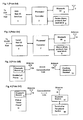
- Fig. 1 is an exemplary top-level block diagram illustrating an embodiment of a prior art Bluetooth® configuration, wherein a USB Host I/O Interface section translates data from and to a USB host.
- Fig. 2 is an alternative embodiment of the Bluetooth® configuration of Fig. 1, wherein the USB Host I/O Interface section communicates via an RS-232 serial communication port.
- Fig. 3 is an exemplary top-level diagram illustrating an embodiment of a prior art mobile/cell phone comprising a Bluetooth® module and Bluetooth® Antenna.
- Fig. 4 is an alternative embodiment of the mobile/cell phone of Fig. 3, wherein the mobile/cell phone comprises a Bluetooth®-enabled PDA or "Smart Phone.”
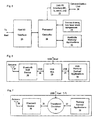
- Fig. 5 is an exemplary top-level diagram illustrating an embodiment of a Bluetooth® device, wherein the Bluetooth® device includes an on-device memory system.
- Fig. 6 is an exemplary top-level diagram illustrating an alternative embodiment of the Bluetooth® device of Fig. 5.
- Fig. 7 is an exemplary top-level diagram illustrating another alternative embodiment of the Bluetooth® device of Fig. 5, wherein the Bluetooth® device is configured to communicate with a USB host system.
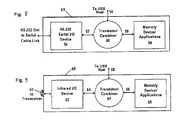
- Fig. 8 is an exemplary top-level diagram illustrating an alternative embodiment of the Bluetooth® device of Fig. 7, wherein the Bluetooth® device is configured to communicate with a serial I/O device via an RS-232 communication link.
- Fig. 9 is an exemplary top-level diagram illustrating another alternative embodiment of the Bluetooth® device of Fig. 7, wherein the Bluetooth® device is configured to communicate with an infrared I/O device via an infrared communication link.
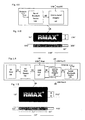
- Fig. 10A is an exemplary top-level diagram illustrating an embodiment of an "Advanced BlueKey®” device, wherein the "Advanced BlueKey®” device enables a USB Host to connect with a USB-to-Serial Adapter.
- Fig. 10B is an exemplary detail drawing illustrating a preferred form factor of the Advanced BlueKey® device of Fig. 10A.
- Fig. 11 A is an exemplary top-level diagram illustrating an alternative embodiment of the Advanced BlueKey® device of Figs. 10A-B, wherein the "Advanced BlueKey®” device communicates with the USB Host via a USB communication hub.
- Fig. 11B is an exemplary detail drawing illustrating a preferred form factor of the Advanced BlueKey® device of Fig. 11A.
- Fig. 12 is an exemplary detail drawing illustrating a preferred embodiment of the Advanced BlueKey® device of Figs. 10A-B.
- Fig. 13 is an exemplary detail drawing illustrating a preferred embodiment of the Advanced BlueKey® device of Figs. 11A-B.
- Fig. 14 is an exemplary top-level diagram illustrating an alternative embodiment of the Advanced BlueKey® device of Figs. 11A-B.
- Fig. 15 is an exemplary top-level diagram illustrating another alternative embodiment of the Advanced BlueKey® device of Figs. 11A-B, wherein the Advanced BlueKey® device further includes a USB Host-to-Host Bridge Controller 175 for forming a high speed USB bridge between two computers.
- Fig. 16 is an exemplary top-level diagram illustrating a universal connectivity of the Advanced BlueKey® device of Figs. 10-17.
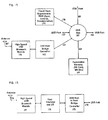
- Fig. 1 depicts a typical Bluetooth® configuration, wherein a Universal Serial Bus (USB) Host I/O Interface section 1 translates data from and to a USB host such as a computer on one hand, and to and from a Processor/Controller 2 on the other, said Processor/Controller operating as a Bluetooth® baseband module to interface with a Bluetooth® RF module 4 and antenna 5 as well as internal memory storing device driver, protocol and low level stack functions 3. This memory is not available to the user.
- USB Universal Serial Bus
- USB Bluetooth® devices or dongles such as this are currently in widespread use.
- An example of one such USB Bluetooth® dongle can be found in United States Patent application US2002/0159419 A1 .
- Fig. 2 has elements corresponding to those in Fig. 1, except the host interface in Fig. 2 is via an RS-232 serial communication port.
- the Host I/O Interface 6 communicates over RS-232 protocol at the host side, translating input and output data as before for Processor/Controller 17 which connects to Bluetooth® RF module 9, Antenna 10 and the device driver, protocol and low level stack 8.
- USB Bluetooth® dongle While not in such widespread use as the USB Bluetooth® dongle of Fig. 1, a number of companies manufacture and market Serial Bluetooth® devices like this.
- An example is the "Cordless Serial Adapter with Bluetooth® Wireless Technology" from Socket Communications: www.socketcom.com.
- Fig. 3 shows a Mobile/Cell Phone 11 containing Bluetooth® module 12 and Bluetooth® Antenna 12A.
- Bluetooth® technology involves mobile phones such as this, with a Communication Link to a Cordless Bluetooth® headset 13 and Antenna 13A.
- Fig. 4 features a Bluetooth®-enabled PDA or "Smart Phone” 14 rather than the more generic cell phone of Fig. 3.
- This device also contains a Bluetooth® Module 15 and Bluetooth® Antenna 16, with a Communication Link to a remote Bluetooth® Module 17 and its Antenna 18.
- Bluetooth® in the PDA or Smart Phone in Fig. 4 can similarly be used for cordless headset operation as in Fig. 3, it is just as likely to connect to a Terminal or Peripheral Device 19.
- a computer is an example of a terminal device, while peripheral devices might include keyboards, mice and printers.
- PDAs and Smart Phones are very likely to have an actively-functioning Serial Port Profile as well as discovery and other profiles from the Bluetooth® specification. As a consequence, such devices are excellent candidates for the features disclosed herein.
- the Palm® family of Bluetooth®-enabled devices already function with the disclosed embodiments, including Palm's Zire 72 PDA and Treo 650 smart phone.
- Fig. 5 is a general block of one preferred embodiment, combining a communication device and accessible memory in a single form factor.
- a processor/controller 20 communicates with low level memory area 21, wherein memory is allocated for device drivers, low level stack and protocol functions; and with high level memory area 22, with memory available for applications and user storage. While memory portions allocated to low level functions and applications may be accessible for upgrade and modification by authorized personnel, user ability to erase or modify these areas can be hidden or obstructed by various known means.
- designated memory in flash or other read-write form may be completely user-accessible to provide reusable storage.
- read-only memory, firmware, or non-volatile memory could be utilized for such functions as drivers and low level protocol software, installation software and user applications. Portions of the memory may also provide such benefits to the user as password or other entry security.
- Processor/controller 20 likewise communicates with link I/O interface 23, incorporating components necessary to exchange digital information over a communication link 24. According to my previous Provisional Patent Application, communication from interface 23 and over link 24 may be via radio frequency (RF), infrared (IR), cable or other known communication means.
- RF radio frequency
- IR infrared
- Host I/O interface 25 translates memory and link data from processor/controller 20 for interface with a host device, which may be a computer or other digital device.
- Fig. 6 depicts three separate USB devices interconnected and unified in a single USB dongle form factor 46.
- Bluetooth® USB device 26 (c.f. Fig. 1) sends and receives RF signals via antenna 27, and also has a USB connection 28 to a USB hub 29.
- USB Memory device 30 contains memory space for both low and high level applications, and may contain additional memory accessible for user storage.
- USB hub 29 is connected to memory device 30 via USB connection 31.
- USB Hub 29 interfaces with a host computer or other device.
- Fig. 6 Although the operation of the interconnected devices in Fig. 6 is indistinguishable from connecting a USB Bluetooth dongle, a USB storage dongle and a USB hub with USB connectors and cables, it is understood that the devices in Fig. 6 are mounted in close proximity within a single USB dongle 46 similar to the form depicted in Fig. 9B below. The only USB connector utilized is found at the output of hub 29.
- Fig. 7 is an exemplary top-level diagram illustrating another alternative embodiment of the Bluetooth® device of Fig. 5.
- a translator/combiner 33 communicates 1) over connection 34 with a Bluetooth device 35 connected to antenna 36; 2) over connection 37 with a memory device 38, including low and high level applications; and 3) to a host device via USB connector 54.
- translator/combiner 33 may variously serve as a translator or processor of signals from both Bluetooth and memory modules, translating them from whatever form into a combined USB stream in the manner of a virtual hub.
- Fig. 8 is a specific embodiment of Fig. 7, wherein a translator/combiner 60 communicates 1) via connection 57 with a serial I/O device 56, said serial device having RS-232 output connector to a cable link; 2) through connection 59 with a memory device 58 incorporating both low and high level applications; and 3) to a host device via USB connector 55. All devices and circuit modules are housed together in a USB form factor 61.
- Fig. 9 shows another specific embodiment of Fig. 7, wherein a translator/combiner 67 communicates 1) over connection 64 with an Infrared I/O device 62 which in turns sends and receives signals from IR transceiver 63; 2) through connection 66 with a memory device 65 incorporating both low and high level applications; and 3) to a host device via USB connector 68. All devices and circuit modules are housed together in a USB form factor 69.
- Fig. 10A depicts one embodiment of an "Advanced BlueKey®" device, wherein USB Host 140 connects to a USB-to-Serial Adapter 141. Installation of the OS driver for the USB-to-Serial Adapter creates a Virtual COM Port on the host device, which may be a Personal Computer operating on any Windows® 98, 98SE, ME, 2000, XP Home or Professional, or the various editions (versions, iterations) of Vista.
- USB-to-Serial Adapter 141 connects to a Serial Bluetooth® Device or module 143 via connection 142, which passes logic-level serial data between the sections as opposed to RS-232 physical layer data. Put another way, no RS-232 driver circuits, interfaces or converters are necessary for the operation of the device shown in Fig. 10A.
- the data-modulated RF output from Serial Bluetooth® Device 143 is connected to Bluetooth® Antenna 144 from which it radiates outward approximately 10 or 100 meters, depending on the class of the Bluetooth® transmitter selected.
- the circuitry in Fig. 10A is shown in more detail in Fig. 12 below.
- USB-Serial device like the PL-2303X integrated circuit from Prolific Technologies presently preferred.
- the USB-Serial device effectively acts as a hardware firewall, removing the Serial Bluetooth® device from the "prying eyes" of the Windows® or other operating system.
- USB-Serial device as a shield for the Bluetooth® portion of the dongle yields several important advantages and improvements over the current Bluetooth® connectivity art:
- USB-hosted Bluetooth® dongle disclosed above installs in seconds from a small, 1.6 MB installer.
- Typical Widcomm® USB- Bluetooth® installers are 10-20 times larger and take 10-20 times as long to install.
- the installer of this embodiment does not require re-starting the computer, while a Widcomm® installer typically does.
- the installer of this embodiment creates a single Virtual COM Port on the host computer, present only when the Advanced BlueKey® (ABK) device is connected.
- the Widcomm® installer typically creates 11 COM Ports and many other artifacts that permanently remain on the host computer whether or not a USB Bluetooth® dongle is connected.
- Vista is the OS version currently being shipped with new Windows® computers.
- Vista and newer XP machines have a pre-installed driver set that recognizes USB Bluetooth® devices, then imposes an incredibly complex hierarchy of COM Ports: one "Outgoing” (Master) and one "Incoming” (Slave) for each and every remote Bluetooth® device encountered.
- Master the Master
- Incoming the "Incoming”
- the exemplary ABK device creates a single COM Port, regardless of whether operation is in Master or Slave mode, and regardless of what remote Bluetooth® device it connects to. If COM 5 is ABK's initial COM Port, COM 5 will remain its port whether sending or receiving initiating a connection or being discovered.
- Windows® Vista and later XP versions do something even more disruptive when detecting a conventional USB Bluetooth® dongle. If two of these computers are attempting to connect and communicate, the OS effectively "hijacks" Bluetooth® operation, disallowing COM Port connectivity and subsequent data exchange by any means other than a poor and weak file transfer utility native to Windows®.
- the illustrative embodiments of the ABK devices disclosed herein run on the Serial Port Profile (SPP), the most generic and prevalent of all Bluetooth® profiles. As a consequence, connectivity with most Bluetooth®-enabled cell phones, PDAs, computers and other devices is assured.
- SPP Serial Port Profile
- Fig. 10B illustrates the form factor of an Advanced BlueKey® device being made by the inventor's company. This enclosure conforms to USB dongle dimensions: 2.75" length, 0.75" width, and 0.3125" depth. Overall length, including USB connector, 3.25".
- Fig. 11A shows another Advanced BlueKey® device with several features additional to those in Fig. 10A.
- a USB Host device 146 connects to USB Hub 147, a 4-port-out hub in the example.
- Two of the outputs 157, 158 may go to USB female connectors to give the user at least two extra USB ports for whatever use, including replacement of the one taken up by the ABK device. Since the ABK device requires only two hub outputs, a 4-port hub yields two user ports, a 6-port hub, four ports, and so on.
- USB Hub 147 Another output from USB Hub 147 connects on line 148 to a USB-Serial adapter 149 like the one delineated in Fig. 10A.
- the USB-Serial adapter in turn connects to Serial Bluetooth® device 151 and from there to Antenna 152 in the manner set forth above.
- the block diagram between 148 and 151 is exactly the same as the one divulged in Fig. 10A.
- USB Hub 147 goes to SD (Secure Digital) Card Reader 154, and the Reader further connects via 155 to a removable SD card 156.
- SD Secure Digital
- this section is somewhat akin to the USB Memory 30 specified in Prior Disclosure Fig. 6, it has the distinct advantage of being removable and of user-selectable memory size. Needless to say, a card standard other than SD might be chosen and the appropriate Reader circuit substituted. Likewise the device could accommodate multiple removable memory card standards.
- This Advanced BlueKey® version includes a USB Hub, not only to replace the USB port it occupies, but also to provide the user with one or more additional USB ports for whatever use.
- This ABK version comes with a built-in SD Card Reader to accommodate removable memory cards of any desired size between 16 MB and 8 GB, with even higher memory sizes being developed by the SD card industry.
- the SD Card standard is the most commonly used of all removable memory standards. This tends to offer users insurance against obsolescence. Moreover, the same reader will directly accommodate MMC (Multi Media Card), and smaller Mini and Micro SD cards with a readily-available adapter frame.
- MMC Multi Media Card
- this data may comprise 4 MB, leaving 999,996 MB of memory available to the user.
- this Advanced BlueKey device can also serve as a simple SD card reader to receive data from and make data available to whatever host computer or device it is connected to.
- Fig. 11B depicts the form factor for the Advanced BlueKey® device disclosed in Fig. 11A.
- Length is 2.4" (2.9" including USB plug), width is 1.6" and depth is 0.4". Because of it's width and need to keep the SD Card accessible, this ABK version is typically used with a 2 or 3 foot USB extension cable.
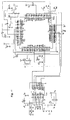
- Fig. 12 illustrates one presently preferred embodiment of the Advanced BlueKey® device of Fig. 10A.
- the USB-to-Serial Adapter 141 of Fig. 10A is shown in schematic form on the left side of Fig. 12, where: J1 is the USB connector to the host computer or device; U1 is the USB-Serial IC, a Prolific Technologies PL-2303X; and U3 is a 5V-to-3.3V power regulator chip.
- U2 the larger IC on the right, is a National Semiconductor LMX9820A serial Bluetooth® module. Lines from U1 pins 1, 3, 5 and 11 connect to U3 pins C9, D11, D10 and C10 directly at logic level, with no need for RS-232 driver, interface or other input-output circuitry.
- U3 pin H7 goes to an on-board, printed antenna with appropriate means to tune for maximum RF efficiency via variable capacitors C11 and C12. ICs and circuit parts other than those depicted can also be utilized to achieve the desired results.
- Fig. 13 shows a presently-preferred embodiment of the more complex Advanced BlueKey® device discussed in Fig. 11A.
- U6 is a USB 2.0 hub IC, model UPD720114 from NEC, Inc.
- JP4 at far left connects to the computer or other USB host device while JP5 and JP6 are female connectors for USB ports.
- Pins 25 and 26 of U6 connect to pins 34 and 33 of U7, a PL-2533 SD Card Reader controller chip from Prolific Technologies. Pins 2, 3, 4, 6, 7 and 8 of U7 lead to SD Card socket J2.
- Pins 28 and 29 of USB Hub U6 route to pins 5 and 6 on U1 in Fig. 12 (see J1, pins 3 and 2).
- This is a PL-2303X IC, the USB-Serial adapter portion of that circuit. From this point on the schematic is the same as that of Fig. 12.
- a new LMX9830 Bluetooth Module from National Semiconductor can be accommodated in place of the LMX9820 in either Fig. 12 or Fig 13.
- the newer chip has several advantages, including reduced size, faster througput speed and lower cost.
- Fig. 14 is a more open and future-looking form of the block diagram described under Fig. 11A wherein a USB Host 160 connects to USB Hub 161, shown with six USB Port outputs. Two of these ports 162 and 163 go to female USB connectors for general availability to the user; if Hub 161 accommodates more ports than 6, more ports can likewise be devoted to general user needs.
- a Removable Memory module 169 which comprises a Card Reader for SD cards or their derivatives; Memory Stick; Compact Flash or a number of other card formats.
- Card Reader ICs accommodate multiple card standards and can be employed here as well.
- USB Host Bridge Controller 165 is a high-speed controller or processor programmed to look like a USB terminal device such as a computer to Windows® and other computer operating systems to achieve the advantage of isolating and masking its companion Bluetooth® device.
- USB-Serial Adapter described under Fig. 10A, paragraphs 4 and 5. This configuration works well at current Bluetooth® throughputs, but will be severely limited as Bluetooth® speeds increase in the future, due to restraints placed by Windows® on what it perceives to be a serial communication technology.
- USB Host Bridge Controller 165 also acts as an I/O (input-output) controller for High Speed USB Bluetooth® Module 166, designed to transmit, receive and transmit data several orders of magnitude above today's rates. High Speed USB Bluetooth® Module 166 connects to Antenna 167 and works to 10 or 100 meters depending on its transmitter class.
- Block 166 anticipates the arrival of USB Bluetooth® modules capable of many times the data throughput of units currently on the market, particularly as ultra-wideband (UWB) capability is added to the Bluetooth® standard.
- the unique architecture of section 165 assures high speed capability from the computer to the High Speed USB Bluetooth® module.
- a Fixed Flash Upgradeable ROM (Read Only Memory) module 169 that also attaches to USB Hub 161.
- the fixed flash memory of module 171 can contain essential ABK install software, BlueKey® and other applications, documentation and, quite possibly, security measures for future firmware access and upgrades.
- Fig. 14 many, if not all, of the component sections comprising Fig. 14 can be manufactured in proprietary form on a single integrated circuit chip to decrease unit cost in high-volume production while maintaining the highest possible throughput, robust physical construction and minimal size.
- Fig. 15 depicts a different hardware configuration to mask a High Speed USB Bluetooth® module like the one discussed under Fig. 14.
- line 174 is the same as connection 164 from the USB Hub in Fig. 14.
- Line 174 connects a USB Hub like 161 in Fig. 14 to a USB Host-to-Host Bridge Controller 175.
- Controller 175 is an IC designed to form a high speed USB bridge between 2 computers, for file and data transfer speed up to USB 2.0's 480 Mbps, approximately 1000 times the throughput of current Bluetooth® devices.
- An example of such a chip is the PL-2501 made by Prolific Technologies.
- Controller 175 is connected to a novel Host Emulator and I/O circuit 176.
- the purpose of this section is twofold.
- the Host Emulator portion looks and acts like a host computer connected to the other side of Controller 175 so that high speed data can flow between the Emulator and the actual computer USB Host (on line 160 and through a USB Hub 161 in Fig. 14).
- circuit 176 serves an I/O (input-output) function, channeling high speed data in and out of High Speed USB Bluetooth® Module 177.
- I/O input-output
- circuit 176 serves as an interface between Bridge Contoller 175 and Bluetooth® Module 177.
- the High Speed USB Bluetooth® Module 177 and it's Antenna 178 are the same as those previously described under Fig. 14 (166, 167).
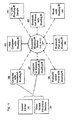
- Fig. 16 illustrates the universal connectivity of the Advanced BlueKey® devices disclosed in the specification in conjunction with the embodiments illustrated in Figs. 10-13.
- Circle 180 represents any one such ABK device, connected to a Host Computer 181 with BlueKey® application capability.
- Device 182 is a computer with a BlueKey® dongle of the type disclosed above.
- Device 183 is a Bluetooth®-equipped cell phone including BlueKey® software on its OS.
- Device 184 is a kiosk with BlueKey®. Such a kiosk may be to process and edit photos; sell music or video or vend any number of other products; provide the user with a platform for email, Internet use, printing, editing or whatever: the possibilities are endless.
- Device 185 is a Bluetooth®-equipped PDA with BlueKey®, which typically can send emails, address info, memos, documents, expense reports and so on to the ABK Host.
- Device 186 is a Bluetooth®-equipped Smart Phone with BlueKey®, which can transfer files and data per the examples under 185 above, and serve phone-specific functions as well.
- Device 187 is a computer with generic Bluetooth® capability, whether via an internal Bluetooth® module or outboard USB, PC Card or Serial Bluetooth® dongle. Such "legacy” systems can also connect to ABK and communicate via BlueKey®.
- Device 188 is a second computer with Advanced BlueKey®. Obviously this device can likewise connect and share with the ABK device 180 and its computer host 181.
- Device 189 is a hosted printer of any make or model that can be connected to a computer like one of those shown in 187 and 188, or to a kiosk or other computer-centered system.
- a computer like one of those shown in 187 and 188, or to a kiosk or other computer-centered system.
- BlueKey's® host architecture permits distributed processing, meaning that the file transfer and setup operation takes place in the computer rather than the printer. This is in accord with the natural flow of today's personal computer and printer architecture, where printers cost little and computers do most of the work. Put another way, standalone Bluetooth® printers have not been successful in the marketplace because they require onboard processing power and cost far more than their more passive counterparts.
- Block 190 represents any number of other peripheral devices: media drives, display monitors, projectors, game consoles, manufacturing tools, drawing tables, etc. Like printer 189, such devices can be made to perform their specialized functions through a Bluetooth® equipped, BlueKey® enabled computer host.
Landscapes
- Engineering & Computer Science (AREA)
- Computer Hardware Design (AREA)
- General Engineering & Computer Science (AREA)
- Theoretical Computer Science (AREA)
- Physics & Mathematics (AREA)
- General Physics & Mathematics (AREA)
- Information Transfer Systems (AREA)
- Mobile Radio Communication Systems (AREA)
- Computer And Data Communications (AREA)
Applications Claiming Priority (2)
| Application Number | Priority Date | Filing Date | Title |
|---|---|---|---|
| US79137006P | 2006-04-11 | 2006-04-11 | |
| US11/685,690 US7974577B2 (en) | 2006-04-11 | 2007-03-13 | Devices and systems for improved wireless communication |
Publications (2)
| Publication Number | Publication Date |
|---|---|
| EP1845664A2 true EP1845664A2 (fr) | 2007-10-17 |
| EP1845664A3 EP1845664A3 (fr) | 2012-04-18 |
Family
ID=38213687
Family Applications (1)
| Application Number | Title | Priority Date | Filing Date |
|---|---|---|---|
| EP07251552A Withdrawn EP1845664A3 (fr) | 2006-04-11 | 2007-04-11 | Dispositifs et systèmes pour améliorer la communication d'un adaptateur sans fils |
Country Status (6)
| Country | Link |
|---|---|
| US (1) | US7974577B2 (fr) |
| EP (1) | EP1845664A3 (fr) |
| JP (1) | JP2007280403A (fr) |
| AU (1) | AU2007201223B2 (fr) |
| CA (1) | CA2582733A1 (fr) |
| TW (1) | TW200745868A (fr) |
Cited By (2)
| Publication number | Priority date | Publication date | Assignee | Title |
|---|---|---|---|---|
| WO2011076474A1 (fr) * | 2009-12-21 | 2011-06-30 | Gemalto Sa | Clé électronique destinée à améliorer les capacités de périphériques |
| EP3349162A1 (fr) * | 2017-01-13 | 2018-07-18 | Flytech Technology Co., Ltd. | Architecture de paiement mobile hybride et son module de point de vente mobile |
Families Citing this family (18)
| Publication number | Priority date | Publication date | Assignee | Title |
|---|---|---|---|---|
| AU2007323859A1 (en) * | 2006-11-19 | 2008-05-29 | Rmax, Llc | Internet-based computer for mobile and thin client users |
| US7734247B2 (en) * | 2007-01-25 | 2010-06-08 | Sony Ericsson Mobile Communications Ab | Configurable serial memory interface |
| KR20080075297A (ko) * | 2007-02-12 | 2008-08-18 | 삼성전자주식회사 | 휴대용 단말기의 블루투스 연결 장치 및 방법 |
| US8208854B2 (en) * | 2008-06-18 | 2012-06-26 | Plantronics, Inc. | Bluetooth control for VoIP telephony using headset profile |
| EP2192651A1 (fr) * | 2008-11-27 | 2010-06-02 | Gemalto SA | Dispositif de communication radiofréquence à antenne déportée |
| CN101566940B (zh) * | 2009-05-25 | 2012-02-29 | 中兴通讯股份有限公司 | 实现无线数据终端通用串行总线音频传输的方法及装置 |
| US8209739B2 (en) * | 2009-08-03 | 2012-06-26 | Kingston Technology Corporation | Universal serial bus—hardware firewall (USB-HF) adaptor |
| US20110117869A1 (en) | 2009-11-18 | 2011-05-19 | Ryan Woodings | Multiple band portable spectrum analyzer |
| JP5852013B2 (ja) * | 2010-02-06 | 2016-02-03 | エスティー‐エリクソン、ソシエテ、アノニム | 複数の無線デバイスにおいて無線スタックを実装するシステム及び方法 |
| CN101917780B (zh) * | 2010-08-11 | 2015-05-20 | 中兴通讯股份有限公司 | 无线通信终端网络设备功能的实现方法及装置 |
| US20120137228A1 (en) * | 2010-11-30 | 2012-05-31 | Action Star Enterprise Co. Ltd. | Point-to-point file transmitting device and file transmitting method thereof |
| KR101080674B1 (ko) * | 2011-03-09 | 2011-11-08 | (주)자람테크놀로지 | 입력 인터페이스를 제공하는 usb 장치 및 그 인터페이스 제공 방법 |
| WO2013046198A1 (fr) * | 2011-09-27 | 2013-04-04 | R.F Keeper Ltd | Dispositif de transfert de données sans pilote |
| US8989328B2 (en) * | 2013-03-14 | 2015-03-24 | Qualcomm Incorporated | Systems and methods for serial communication |
| US10216673B2 (en) * | 2017-01-16 | 2019-02-26 | International Business Machines Corporation | USB device firmware sanitization |
| US11520939B2 (en) | 2017-03-17 | 2022-12-06 | International Business Machines Corporation | Protecting computer systems from malicious USB devices via a USB firewall |
| KR101985011B1 (ko) * | 2018-11-26 | 2019-05-31 | 김진만 | 가상 시리얼 포트를 이용한 전자처방전 전송방법 |
| EP3925229A4 (fr) * | 2019-06-26 | 2022-03-30 | Samsung Electronics Co., Ltd. | Appareil d'affichage et son procédé de commande |
Citations (2)
| Publication number | Priority date | Publication date | Assignee | Title |
|---|---|---|---|---|
| US20040122649A1 (en) | 2002-12-23 | 2004-06-24 | Bartek David J. | Wireless cable replacement for computer peripherals using a master adapter |
| US20050015534A1 (en) | 2001-12-14 | 2005-01-20 | Wu Zong Liang | Wireless peripheral interface with universal serial bus port |
Family Cites Families (21)
| Publication number | Priority date | Publication date | Assignee | Title |
|---|---|---|---|---|
| JPH0392152U (fr) * | 1990-01-09 | 1991-09-19 | ||
| JP3045985B2 (ja) * | 1997-08-07 | 2000-05-29 | インターナショナル・ビジネス・マシーンズ・コーポレイション | 接続確立方法、通信方法、状態変化伝達方法、状態変化実行方法、無線装置、無線デバイス、及びコンピュータ |
| US6785807B1 (en) * | 2000-03-06 | 2004-08-31 | International Business Machines Corporation | Method and system for providing bootcode support in a data processing system that uses a communications port that utilizes a first communications protocol, an external device that utilizes a second communications protocol, and a device driver that is loaded in response to booting to communicate with the external device through the communications port |
| US6892248B2 (en) * | 2001-02-21 | 2005-05-10 | International Business Machines Corporation | Method and apparatus for configuring a port on a legacy-free device for general I/O purposes or debugging purposes |
| TWI270786B (en) * | 2002-04-10 | 2007-01-11 | Avision Inc | Scanner capable of being a universal serial bus host |
| US7309260B2 (en) * | 2002-04-15 | 2007-12-18 | Lantronix, Inc. | Wireless communication module |
| US7305511B2 (en) * | 2002-12-23 | 2007-12-04 | Microtune (Texas), L.P. | Providing both wireline and wireless connections to a wireline interface |
| US7127541B2 (en) * | 2002-12-23 | 2006-10-24 | Microtune (Texas), L.P. | Automatically establishing a wireless connection between adapters |
| US6950859B1 (en) * | 2002-12-23 | 2005-09-27 | Microtune (San Diego), Inc. | Wireless cable replacement for computer peripherals |
| TWI225200B (en) * | 2003-06-24 | 2004-12-11 | Lite On Technology Corp | Fast wake-up wireless signal receiving device |
| JP4432385B2 (ja) * | 2003-07-28 | 2010-03-17 | セイコーエプソン株式会社 | データ中継システム |
| JP4196871B2 (ja) * | 2003-10-10 | 2008-12-17 | ソニー株式会社 | 無線通信装置 |
| US7597250B2 (en) * | 2003-11-17 | 2009-10-06 | Dpd Patent Trust Ltd. | RFID reader with multiple interfaces |
| US20080250485A1 (en) * | 2004-01-29 | 2008-10-09 | Koninklijke Philips Electronic, N.V. | Guest Dongle and Method of Connecting Guest Apparatuses to Wireless Home Networks |
| TWM260958U (en) * | 2004-07-23 | 2005-04-01 | Blueexpert Technology Corp | USB wireless transmitter with USB expansion slot |
| US20060166173A1 (en) * | 2005-01-27 | 2006-07-27 | Ellis Michael B | Educational method and device |
| US20060190238A1 (en) * | 2005-02-24 | 2006-08-24 | Autor Jeffrey S | Methods and systems for managing a device |
| WO2007047827A1 (fr) * | 2005-10-18 | 2007-04-26 | Aquatron Inc. | Procédé et appareil de nettoyage de piscine programmable sur mesure |
| TW200908705A (en) * | 2007-08-15 | 2009-02-16 | Asustek Comp Inc | Image capturing device with detachable extension unit |
| US8209678B2 (en) * | 2007-09-17 | 2012-06-26 | Sony Corporation | System, apparatus, and method for an upgrader module |
| US8208854B2 (en) * | 2008-06-18 | 2012-06-26 | Plantronics, Inc. | Bluetooth control for VoIP telephony using headset profile |
-
2007
- 2007-03-13 US US11/685,690 patent/US7974577B2/en not_active Expired - Fee Related
- 2007-03-20 TW TW096109461A patent/TW200745868A/zh unknown
- 2007-03-21 AU AU2007201223A patent/AU2007201223B2/en not_active Ceased
- 2007-03-21 CA CA002582733A patent/CA2582733A1/fr not_active Abandoned
- 2007-04-10 JP JP2007102782A patent/JP2007280403A/ja active Pending
- 2007-04-11 EP EP07251552A patent/EP1845664A3/fr not_active Withdrawn
Patent Citations (2)
| Publication number | Priority date | Publication date | Assignee | Title |
|---|---|---|---|---|
| US20050015534A1 (en) | 2001-12-14 | 2005-01-20 | Wu Zong Liang | Wireless peripheral interface with universal serial bus port |
| US20040122649A1 (en) | 2002-12-23 | 2004-06-24 | Bartek David J. | Wireless cable replacement for computer peripherals using a master adapter |
Cited By (3)
| Publication number | Priority date | Publication date | Assignee | Title |
|---|---|---|---|---|
| WO2011076474A1 (fr) * | 2009-12-21 | 2011-06-30 | Gemalto Sa | Clé électronique destinée à améliorer les capacités de périphériques |
| EP2348696A1 (fr) * | 2009-12-21 | 2011-07-27 | Gemalto SA | Clé électronique pour améliorer les capacités des dispositifs périphériques |
| EP3349162A1 (fr) * | 2017-01-13 | 2018-07-18 | Flytech Technology Co., Ltd. | Architecture de paiement mobile hybride et son module de point de vente mobile |
Also Published As
| Publication number | Publication date |
|---|---|
| AU2007201223B2 (en) | 2011-05-19 |
| TW200745868A (en) | 2007-12-16 |
| JP2007280403A (ja) | 2007-10-25 |
| CA2582733A1 (fr) | 2007-10-11 |
| AU2007201223A1 (en) | 2007-10-25 |
| US20070287493A1 (en) | 2007-12-13 |
| US7974577B2 (en) | 2011-07-05 |
| EP1845664A3 (fr) | 2012-04-18 |
Similar Documents
| Publication | Publication Date | Title |
|---|---|---|
| US7974577B2 (en) | Devices and systems for improved wireless communication | |
| KR100904005B1 (ko) | 전기 인터페이스를 통한 접속의 사용을 지원하는 방법 및장치 | |
| CN101883446B (zh) | 一种sd控制芯片及数据通信方法 | |
| US7801561B2 (en) | Methods of configuring a generic bluetooth controller of a flash drive to be compatible with multiple bluetooth peripheral devices | |
| US7269183B2 (en) | System and method for connecting bluetooth-enabled devices to a personal computer | |
| EP2466480B1 (fr) | Clé électronique et procédé de fonctionnement d'un dispositif d'entrée externe, et system d'entrée externe avec la clé électronique | |
| US6745255B2 (en) | Small memory device with drivers on device | |
| US20060020723A1 (en) | USB hub with wireless communication function | |
| CN102421207A (zh) | 移动终端的多种移动通信制式兼容设计方法及移动终端 | |
| US20080081559A1 (en) | Flash drive that configures generic bluetooth controller of the drive to be compatible with multiple bluetooth peripheral devices | |
| CN102033828A (zh) | 外接卡的访问方法和系统 | |
| WO2008042597A2 (fr) | Disque dur à mémoire flash qui configure un contrôleur bluetooth générique du disque dur pour qu'il soit compatible avec de multiples périphériques bluetooth | |
| CN106339348B (zh) | 基于移动终端接口扩展的数据传输方法和装置 | |
| US20070266178A1 (en) | Secondary channel in multiplexed communication between host computer and smartphone | |
| HK1107621A (en) | Devices and systems for improved communication of a wireless adapter | |
| JP4745069B2 (ja) | 高速無線内部バス | |
| CN100483378C (zh) | PCI-Express多模扩充卡及具有所述扩充卡的通讯装置 | |
| CN100456790C (zh) | 一种多功能无线通信装置 | |
| CN1790941B (zh) | 具有天线分集的便携式设备 | |
| CN1307821C (zh) | 具有phs及wlan功能的双模式无线数据卡 | |
| CN105988555A (zh) | 可切换无线/有线传输模式的移动电脑用扩充装置 | |
| EP2801035B1 (fr) | Procédé de programmation d'un appareil usb | |
| WO2012079429A1 (fr) | Dispositif de mémorisation et procédé de configuration de ce dispositif | |
| CN2810042Y (zh) | 一种蓝牙模块与外接式储存媒体存取模块集成装置 | |
| US20140325532A1 (en) | Microminiature personal computer and method of using thereof |
Legal Events
| Date | Code | Title | Description |
|---|---|---|---|
| PUAI | Public reference made under article 153(3) epc to a published international application that has entered the european phase |
Free format text: ORIGINAL CODE: 0009012 |
|
| AK | Designated contracting states |
Kind code of ref document: A2 Designated state(s): AT BE BG CH CY CZ DE DK EE ES FI FR GB GR HU IE IS IT LI LT LU LV MC MT NL PL PT RO SE SI SK TR |
|
| AX | Request for extension of the european patent |
Extension state: AL BA HR MK YU |
|
| REG | Reference to a national code |
Ref country code: HK Ref legal event code: DE Ref document number: 1107621 Country of ref document: HK |
|
| PUAL | Search report despatched |
Free format text: ORIGINAL CODE: 0009013 |
|
| AK | Designated contracting states |
Kind code of ref document: A3 Designated state(s): AT BE BG CH CY CZ DE DK EE ES FI FR GB GR HU IE IS IT LI LT LU LV MC MT NL PL PT RO SE SI SK TR |
|
| AX | Request for extension of the european patent |
Extension state: AL BA HR MK RS |
|
| RIC1 | Information provided on ipc code assigned before grant |
Ipc: H01Q 1/22 20060101ALI20120312BHEP Ipc: G06F 13/38 20060101AFI20120312BHEP |
|
| 17P | Request for examination filed |
Effective date: 20121016 |
|
| AKX | Designation fees paid |
Designated state(s): AT BE BG CH CY CZ DE DK EE ES FI FR GB GR HU IE IS IT LI LT LU LV MC MT NL PL PT RO SE SI SK TR |
|
| STAA | Information on the status of an ep patent application or granted ep patent |
Free format text: STATUS: THE APPLICATION IS DEEMED TO BE WITHDRAWN |
|
| 18D | Application deemed to be withdrawn |
Effective date: 20131101 |
|
| REG | Reference to a national code |
Ref country code: HK Ref legal event code: WD Ref document number: 1107621 Country of ref document: HK |