EP1847556B1 - Polymere, polymere reticule, composition pour electrolyte polymere solide, electrolyte polymere solide et composition d'adhesif - Google Patents
Polymere, polymere reticule, composition pour electrolyte polymere solide, electrolyte polymere solide et composition d'adhesif Download PDFInfo
- Publication number
- EP1847556B1 EP1847556B1 EP06711868A EP06711868A EP1847556B1 EP 1847556 B1 EP1847556 B1 EP 1847556B1 EP 06711868 A EP06711868 A EP 06711868A EP 06711868 A EP06711868 A EP 06711868A EP 1847556 B1 EP1847556 B1 EP 1847556B1
- Authority
- EP
- European Patent Office
- Prior art keywords
- polymer
- repeating unit
- hydrocarbon
- represents hydrogen
- polymer according
- Prior art date
- Legal status (The legal status is an assumption and is not a legal conclusion. Google has not performed a legal analysis and makes no representation as to the accuracy of the status listed.)
- Expired - Lifetime
Links
- VAYCBEIMJNGBGH-UHFFFAOYSA-N C=CC(OC1CC2OC2CC1)=O Chemical compound C=CC(OC1CC2OC2CC1)=O VAYCBEIMJNGBGH-UHFFFAOYSA-N 0.000 description 1
- CYFZNUYHYPTKTH-QPJJXVBHSA-N CC(C(OCCO/C=C/C(OCCCN=O)=O)=O)=C Chemical compound CC(C(OCCO/C=C/C(OCCCN=O)=O)=O)=C CYFZNUYHYPTKTH-QPJJXVBHSA-N 0.000 description 1
- JUVGLPRIQOJMIR-VOTSOKGWSA-N O=C(/C=C/c1ccccc1)OCC1OC1 Chemical compound O=C(/C=C/c1ccccc1)OCC1OC1 JUVGLPRIQOJMIR-VOTSOKGWSA-N 0.000 description 1
- LYANLQCAACLKIK-UHFFFAOYSA-N O=C(C1=CCCC1)OCC1OC1 Chemical compound O=C(C1=CCCC1)OCC1OC1 LYANLQCAACLKIK-UHFFFAOYSA-N 0.000 description 1
- YJAXLFLBQGZKAS-UHFFFAOYSA-N O=C(C1=CCCCC1)OCC1=CO1 Chemical compound O=C(C1=CCCCC1)OCC1=CO1 YJAXLFLBQGZKAS-UHFFFAOYSA-N 0.000 description 1
Classifications
-
- C—CHEMISTRY; METALLURGY
- C08—ORGANIC MACROMOLECULAR COMPOUNDS; THEIR PREPARATION OR CHEMICAL WORKING-UP; COMPOSITIONS BASED THEREON
- C08F—MACROMOLECULAR COMPOUNDS OBTAINED BY REACTIONS ONLY INVOLVING CARBON-TO-CARBON UNSATURATED BONDS
- C08F290/00—Macromolecular compounds obtained by polymerising monomers on to polymers modified by introduction of aliphatic unsaturated end or side groups
- C08F290/02—Macromolecular compounds obtained by polymerising monomers on to polymers modified by introduction of aliphatic unsaturated end or side groups on to polymers modified by introduction of unsaturated end groups
- C08F290/06—Polymers provided for in subclass C08G
-
- C—CHEMISTRY; METALLURGY
- C08—ORGANIC MACROMOLECULAR COMPOUNDS; THEIR PREPARATION OR CHEMICAL WORKING-UP; COMPOSITIONS BASED THEREON
- C08F—MACROMOLECULAR COMPOUNDS OBTAINED BY REACTIONS ONLY INVOLVING CARBON-TO-CARBON UNSATURATED BONDS
- C08F297/00—Macromolecular compounds obtained by successively polymerising different monomer systems using a catalyst of the ionic or coordination type without deactivating the intermediate polymer
- C08F297/02—Macromolecular compounds obtained by successively polymerising different monomer systems using a catalyst of the ionic or coordination type without deactivating the intermediate polymer using a catalyst of the anionic type
-
- C—CHEMISTRY; METALLURGY
- C08—ORGANIC MACROMOLECULAR COMPOUNDS; THEIR PREPARATION OR CHEMICAL WORKING-UP; COMPOSITIONS BASED THEREON
- C08F—MACROMOLECULAR COMPOUNDS OBTAINED BY REACTIONS ONLY INVOLVING CARBON-TO-CARBON UNSATURATED BONDS
- C08F293/00—Macromolecular compounds obtained by polymerisation on to a macromolecule having groups capable of inducing the formation of new polymer chains bound exclusively at one or both ends of the starting macromolecule
-
- C—CHEMISTRY; METALLURGY
- C08—ORGANIC MACROMOLECULAR COMPOUNDS; THEIR PREPARATION OR CHEMICAL WORKING-UP; COMPOSITIONS BASED THEREON
- C08F—MACROMOLECULAR COMPOUNDS OBTAINED BY REACTIONS ONLY INVOLVING CARBON-TO-CARBON UNSATURATED BONDS
- C08F293/00—Macromolecular compounds obtained by polymerisation on to a macromolecule having groups capable of inducing the formation of new polymer chains bound exclusively at one or both ends of the starting macromolecule
- C08F293/005—Macromolecular compounds obtained by polymerisation on to a macromolecule having groups capable of inducing the formation of new polymer chains bound exclusively at one or both ends of the starting macromolecule using free radical "living" or "controlled" polymerisation, e.g. using a complexing agent
-
- C—CHEMISTRY; METALLURGY
- C08—ORGANIC MACROMOLECULAR COMPOUNDS; THEIR PREPARATION OR CHEMICAL WORKING-UP; COMPOSITIONS BASED THEREON
- C08F—MACROMOLECULAR COMPOUNDS OBTAINED BY REACTIONS ONLY INVOLVING CARBON-TO-CARBON UNSATURATED BONDS
- C08F297/00—Macromolecular compounds obtained by successively polymerising different monomer systems using a catalyst of the ionic or coordination type without deactivating the intermediate polymer
-
- C—CHEMISTRY; METALLURGY
- C08—ORGANIC MACROMOLECULAR COMPOUNDS; THEIR PREPARATION OR CHEMICAL WORKING-UP; COMPOSITIONS BASED THEREON
- C08J—WORKING-UP; GENERAL PROCESSES OF COMPOUNDING; AFTER-TREATMENT NOT COVERED BY SUBCLASSES C08B, C08C, C08F, C08G or C08H
- C08J5/00—Manufacture of articles or shaped materials containing macromolecular substances
- C08J5/20—Manufacture of shaped structures of ion-exchange resins
- C08J5/22—Films, membranes or diaphragms
- C08J5/2206—Films, membranes or diaphragms based on organic and/or inorganic macromolecular compounds
- C08J5/2218—Synthetic macromolecular compounds
- C08J5/2268—Synthetic macromolecular compounds based on macromolecular compounds obtained by reactions involving unsaturated carbon-to-carbon bonds, and by reactions not involving this type of bond
-
- C—CHEMISTRY; METALLURGY
- C08—ORGANIC MACROMOLECULAR COMPOUNDS; THEIR PREPARATION OR CHEMICAL WORKING-UP; COMPOSITIONS BASED THEREON
- C08L—COMPOSITIONS OF MACROMOLECULAR COMPOUNDS
- C08L53/00—Compositions of block copolymers containing at least one sequence of a polymer obtained by reactions only involving carbon-to-carbon unsaturated bonds; Compositions of derivatives of such polymers
-
- C—CHEMISTRY; METALLURGY
- C09—DYES; PAINTS; POLISHES; NATURAL RESINS; ADHESIVES; COMPOSITIONS NOT OTHERWISE PROVIDED FOR; APPLICATIONS OF MATERIALS NOT OTHERWISE PROVIDED FOR
- C09J—ADHESIVES; NON-MECHANICAL ASPECTS OF ADHESIVE PROCESSES IN GENERAL; ADHESIVE PROCESSES NOT PROVIDED FOR ELSEWHERE; USE OF MATERIALS AS ADHESIVES
- C09J153/00—Adhesives based on block copolymers containing at least one sequence of a polymer obtained by reactions only involving carbon-to-carbon unsaturated bonds; Adhesives based on derivatives of such polymers
-
- H—ELECTRICITY
- H01—ELECTRIC ELEMENTS
- H01M—PROCESSES OR MEANS, e.g. BATTERIES, FOR THE DIRECT CONVERSION OF CHEMICAL ENERGY INTO ELECTRICAL ENERGY
- H01M10/00—Secondary cells; Manufacture thereof
- H01M10/05—Accumulators with non-aqueous electrolyte
- H01M10/056—Accumulators with non-aqueous electrolyte characterised by the materials used as electrolytes, e.g. mixed inorganic/organic electrolytes
- H01M10/0564—Accumulators with non-aqueous electrolyte characterised by the materials used as electrolytes, e.g. mixed inorganic/organic electrolytes the electrolyte being constituted of organic materials only
- H01M10/0565—Polymeric materials, e.g. gel-type or solid-type
-
- C—CHEMISTRY; METALLURGY
- C08—ORGANIC MACROMOLECULAR COMPOUNDS; THEIR PREPARATION OR CHEMICAL WORKING-UP; COMPOSITIONS BASED THEREON
- C08F—MACROMOLECULAR COMPOUNDS OBTAINED BY REACTIONS ONLY INVOLVING CARBON-TO-CARBON UNSATURATED BONDS
- C08F2438/00—Living radical polymerisation
- C08F2438/01—Atom Transfer Radical Polymerization [ATRP] or reverse ATRP
-
- C—CHEMISTRY; METALLURGY
- C08—ORGANIC MACROMOLECULAR COMPOUNDS; THEIR PREPARATION OR CHEMICAL WORKING-UP; COMPOSITIONS BASED THEREON
- C08J—WORKING-UP; GENERAL PROCESSES OF COMPOUNDING; AFTER-TREATMENT NOT COVERED BY SUBCLASSES C08B, C08C, C08F, C08G or C08H
- C08J2353/00—Characterised by the use of block copolymers containing at least one sequence of a polymer obtained by reactions only involving carbon-to-carbon unsaturated bonds; Derivatives of such polymers
-
- C—CHEMISTRY; METALLURGY
- C08—ORGANIC MACROMOLECULAR COMPOUNDS; THEIR PREPARATION OR CHEMICAL WORKING-UP; COMPOSITIONS BASED THEREON
- C08L—COMPOSITIONS OF MACROMOLECULAR COMPOUNDS
- C08L2666/00—Composition of polymers characterized by a further compound in the blend, being organic macromolecular compounds, natural resins, waxes or and bituminous materials, non-macromolecular organic substances, inorganic substances or characterized by their function in the composition
- C08L2666/02—Organic macromolecular compounds, natural resins, waxes or and bituminous materials
-
- H—ELECTRICITY
- H01—ELECTRIC ELEMENTS
- H01M—PROCESSES OR MEANS, e.g. BATTERIES, FOR THE DIRECT CONVERSION OF CHEMICAL ENERGY INTO ELECTRICAL ENERGY
- H01M10/00—Secondary cells; Manufacture thereof
- H01M10/05—Accumulators with non-aqueous electrolyte
- H01M10/052—Li-accumulators
-
- H—ELECTRICITY
- H01—ELECTRIC ELEMENTS
- H01M—PROCESSES OR MEANS, e.g. BATTERIES, FOR THE DIRECT CONVERSION OF CHEMICAL ENERGY INTO ELECTRICAL ENERGY
- H01M2300/00—Electrolytes
- H01M2300/0017—Non-aqueous electrolytes
- H01M2300/0065—Solid electrolytes
- H01M2300/0082—Organic polymers
-
- Y—GENERAL TAGGING OF NEW TECHNOLOGICAL DEVELOPMENTS; GENERAL TAGGING OF CROSS-SECTIONAL TECHNOLOGIES SPANNING OVER SEVERAL SECTIONS OF THE IPC; TECHNICAL SUBJECTS COVERED BY FORMER USPC CROSS-REFERENCE ART COLLECTIONS [XRACs] AND DIGESTS
- Y02—TECHNOLOGIES OR APPLICATIONS FOR MITIGATION OR ADAPTATION AGAINST CLIMATE CHANGE
- Y02E—REDUCTION OF GREENHOUSE GAS [GHG] EMISSIONS, RELATED TO ENERGY GENERATION, TRANSMISSION OR DISTRIBUTION
- Y02E60/00—Enabling technologies; Technologies with a potential or indirect contribution to GHG emissions mitigation
- Y02E60/10—Energy storage using batteries
Definitions
- the present invention relates to polymers and crosslinked polymers which are useful as materials for electrochemical devices such as batteries, capacitors, sensors, condensers, electrochromic (EC) devices, and photoelectric conversion elements, and also as fixing agents or the like.
- the present invention also relates to compositions for solid polymer electrolytes, solid polymer electrolytes, and adhesive compositions which use the abovementioned polymers.
- a solid polymer electrolyte which uses a polymer having an acrylic ester derivative, which has a polyalkylene oxide chain at the ester moiety thereof, as the repeating unit
- a solid polymer electrolyte for example, which is formed from a matrix component of a crosslinked polymer (A) and electrolyte salt (B) and is produced by the polymerization reaction of the matrix component (A) and which is characterized by containing at least a urethane (meth)acrylate-based compound (A1) and polymerizable monomer (A2) represented by the following formula (1) is conventionally known (refer to Patent document 1).
- R 101 represents hydrogen or C 1-4 alkyl
- R 102 represents hydrogen, C 1-4 alkyl, or C 1-4 acyl
- k',l', and m' each independently represents an integer of 1 to 20.
- multi-branched polymers which are obtained by copolymerizing a monomer mixture containing at least a monomer (A3) represented by the formula (2) (in the formula, R 111 to R 113 each independently represents hydrogen or C 1-4 alkyl; R 114 represents hydrogen, C 1-4 alkyl, or C 1-4 acyl; and n' represents an integer of 1 to 20) and monomer (A4) represented by the formula (3) (in the formula, R 115 to R 117 each independently represents hydrogen or C 1-4 alkyl; and R 118 to R 122 each independently represents hydrogen, halogen, C 1-4 alkyl, or C 1-4 haloalkyl with a proviso that at least one of R 118 to R 122 is C 1-4 ⁇ -haloalkyl), and solid polymer electrolytes which use these multi-branched polymers are described.
- A3 monomer represented by the formula (2)
- R 111 to R 113 each independently represents hydrogen or C 1-4 alkyl
- R 114 represents hydrogen, C 1-4
- a block copolymer composition characterized by containing a block copolymer formed from a segment (A5) which contains 10 to 100 mol% of at least one polar monomer selected from the group consisting of the following polar monomers 1, 2, and 3 as a constituent, segment (A6) which contains less than 10 mol% of the same polar monomer as a constituent, and ester compound; and a solid polymer electrolyte which uses the composition are described.
- Polar monomer 1 a polar monomer having at least one polymerizable unsaturated bond and at least one functional group selected from the group consisting of hydroxyl, nitrile, carboxyl, amino, and amido.
- Patent document 4 a method to join by a porous adhesive-resin layer formed from polyfluorovinylidene is described in Patent document 4.
- the adhesive resin used turns into a porous film without being dissolved in an electrolyte and that the ionic conductivity can be adjusted by changing porosity and film thickness.
- a separator for adhesive composition-supporting cells is described as a cell/separator joined body where cells and separators are joined.
- a method to make a porous substrate support a heat-crosslinkable adhesive composition formed from polyfunctional isocyanate and reactive polymer is disclosed.
- the present invention is made in view of such circumstances of prior arts and its first object is to provide novel polymers and crosslinked polymers which are useful as production materials for solid polymer electrolytes, adhesive materials or the like.
- a second object of the present invention is to provide solid polymer electrolytes which use the polymers and crosslinked polymers of the present invention and which are excellent in thermal characteristics, physical characteristics, and ionic conductivity, and is almost at a practical level; and compositions for solid polymer electrolytes or the like for producing the above electrolytes.
- a third object of the present invention is to provide adhesive compositions which retain excellent adhesive capacity even in solutions formed from solvents, chemicals, acids/bases, and/or ionic solutions.
- the present invention provides the following polymers (1) to (8).
- the present invention provides the following crosslinked polymers (9) to (12).
- the present invention provides the following compositions (13) to (20) for a solid polymer electrolyte.
- the present invention provides the following solid polymer electrolytes (21) to (23).
- the present invention provides the following adhesive compositions (24) to (26).
- the polymers of the present invention and crosslinked polymers formed by crosslinking these polymers are novel compounds and useful as materials for producing compositions for solid polymer electrolytes and solid polymer electrolytes.
- the solid polymer electrolytes obtained from the compositions for solid polymer electrolytes of the present invention have excellent thermal characteristics, physical characteristics, and ionic conductivity.
- crosslinked polymers formed by crosslinking the polymers of the present invention have excellent adhesive performance and are useful as materials for fixing agents which bond/fix members such as electrode components.
- the present invention will be described below in detail by dividing into the following items; i.e. 1) polymer, 2) crosslinked polymer, 3) composition for solid polymer electrolyte, 4) solid polymer electrolyte, and 5) adhesive composition.
- the polymers of the present invention are characterized in that they have a block chain A composed from a random copolymer containing a repeating unit (I) represented by the aforementioned formula (I) and repeating unit (II) represented by the aforementioned formula (II); and block chain B which has a repeating unit (III) represented by the aforementioned formula (III) in an arrangement order of B, A, B.
- each block chain is arranged in the order of B, A, B means that each block chain may be bonded to each other directly or may be bonded having other constituting units such as connecting groups and polymerization chains in between.
- the state where each block chain is bonded and arranged in the order of B-A-B is preferable.
- the expression "bonded” refers to either the case where each block chain is bonded to each other directly or the case where each block chain is bonded via a low-molecule connecting group such as oxygen and alkylene.
- each block chain B may be the same or different.
- R 1 to R 3 each independently represents hydrogen or C 1-10 hydrocarbon such as methyl, ethyl, n-propyl, isopropyl, n-butyl, sec-butyl, isobutyl, t-butyl, phenyl, naphthyl, and benzyl.
- R 1 and R 3 may bond to form a ring.
- R 4a and R 4b each independently represents hydrogen or methyl.
- R5 represents hydrogen; hydrocarbon such as methyl, ethyl, n-propyl, isopropyl, n-butyl, sec-butyl, isobutyl, t-butyl, n-hexyl, phenyl, substituted phenyl, and naphthyl; acyl such as formyl, acetyl, propionyl, and butyryl; or silyl such as trimethylsilyl, t-butyldimethylsilyl, and dimethylphenylsilyl.
- hydrocarbon such as methyl, ethyl, n-propyl, isopropyl, n-butyl, sec-butyl, isobutyl, t-butyl, n-hexyl, phenyl, substituted phenyl, and naphthyl
- acyl such as formyl, acetyl, propionyl, and butyryl
- hydrocarbon of the aforementioned R 1 to R 5 may have a substituent on an appropriate carbon.
- substituents include halogen such as fluorine, chlorine, and bromine; hydrocarbon such as methyl, ethyl, n-propyl, phenyl, naphthyl, and benzyl; acyl such as acetyl and benzoyl; cyano; nitro; hydrocarbonoxy such as methoxy and phenoxy; alkylthio such as methylthio; alkylsulfinyl such as methylsulfinyl; alkylsulfonyl such as methylsulfonyl; optionally substituted amino such as amino and dimethylamino; and anilino,
- n represents any integer from 1 to 100 and is preferably any integer from 2 to 50.
- the value of m in each repeating unit may be the same or different from each other.
- each R 4a may be the same or different from one another and each R 4b may be the same or different from one another.
- the degree of polymerization of the aforementioned repeating unit (I) is preferably 5 or more, although this depends on the value of m, and is more preferably 10 or more.
- repeating unit (I) examples include the following. Note that the examples are given here as monomers which are considered to be formed into the repeating unit (I) represented by the formula (I).
- R 6 and R 8 each independently represents hydrogen; or C 1-10 hydrocarbon such as methyl, ethyl, n-propyl, isopropyl, n-butyl, sec-butyl, isobutyl, t-butyl, phenyl, naphthyl, and benzyl.
- R 6 and R 8 may bond to form a ring.
- R 7 represents hydrogen; C 1-10 hydrocarbon; hydroxyl; hydrocarbonoxy such as methoxy, ethoxy, and phenoxy; carboxyl; acid anhydride; amino; ester; or an organic group having at least one functional group selected from the group consisting of hydroxyl, carboxyl, epoxy, acid anhydride, and amino.
- R 9 represents an organic group having at least one functional group selected from the group consisting of hydroxyl, carboxyl, epoxy, acid anhydride, and amino.
- R 6 to R 9 may have a substituent on an appropriate carbon.
- substituents include halogen such as fluorine, chlorine, and bromine; hydrocarbon such as methyl, ethyl, n-propyl, phenyl, naphthyl, and benzyl; acyl such as acetyl and benzoyl; cyano; nitro; hydrocarbonoxy such as methoxy and phenoxy; alkylthio such as methylthio; alkylsulfinyl such as methylsulfinyl; alkylsulfonyl such as methylsulfonyl; optionally substituted amino such as amino and dimethylamino; and anilino.
- repeating unit (II) represented by the formula (II) the repeating unit which is represented by the following formula (IV), (V), (VI), or (VII) is preferable.
- R 14 to R 16 each independently represents hydrogen; or C 1-10 hydrocarbon such as methyl, ethyl, n-propyl, isopropyl, n-butyl, sec-butyl, isobutyl, t-butyl, phenyl, naphthyl, and benzyl.
- R 14 and R 16 may bond to form a ring.
- R 17 represents C 1-6 alkylene such as methylene, ethylene, 1-methylethylene, and propylene; C 6-10 divalent aromatic hydrocarbon such as phenylene and naphthylene; C 3-10 divalent alicyclic hydrocarbon such as cyclopropylene, cyclobutylene, cyclohexylene, and adamantanediyl; or a divalent organic group in which two or more of alkylene, divalent aromatic hydrocarbon, and divalent alicyclic hydrocarbon are combined.
- R 14 to R 17 may have a substituent on an appropriate carbon.
- substituents include halogen such as fluorine, chlorine, and bromine; hydrocarbon such as methyl, ethyl, n-propyl, phenyl, naphthyl, and benzyl; acyl such as acetyl and benzoyl; nitrile; nitro; hydrocarbonoxy such as methoxy and phenoxy; methylthio; methylsulfinyl; methylsulfonyl; optionally substituted amino such as amino and dimethylamino; and anilino.
- repeating unit (IV) represented by the formula (IV) are shown below. Note that the examples are given here as monomers which are considered to be formed into the repeating unit (IV). These compounds can be used alone or in combination of two or more kinds thereof.
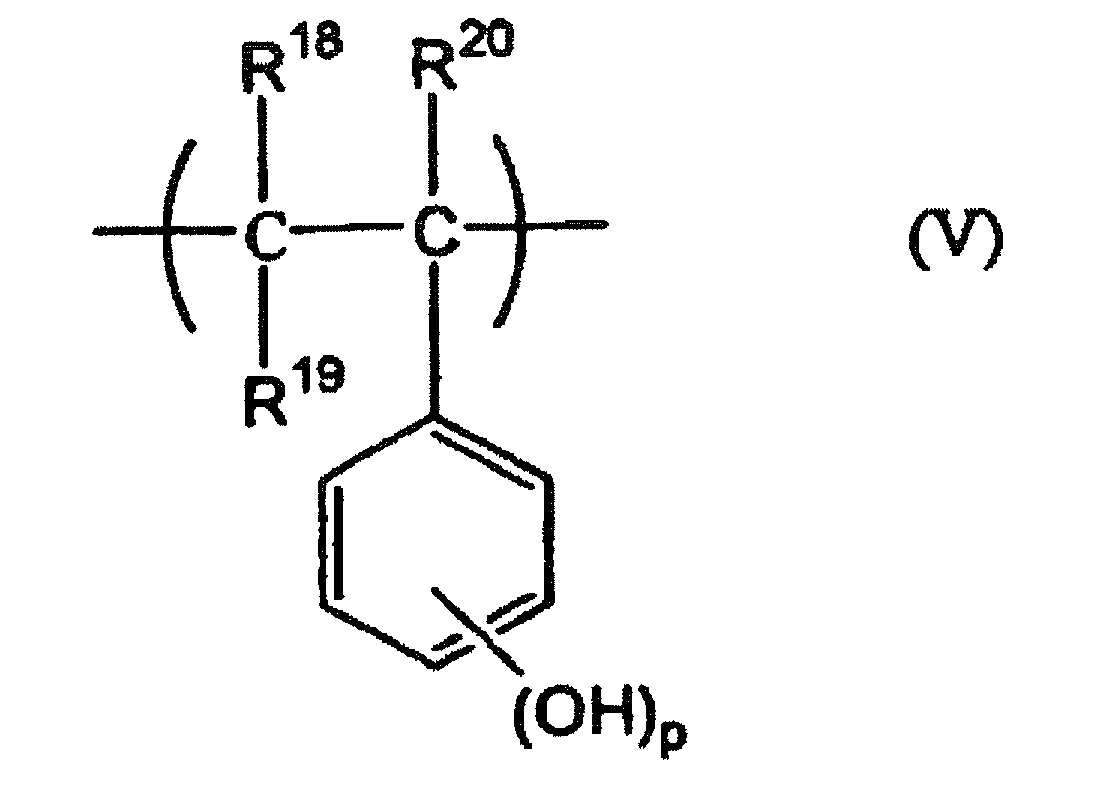
- R 18 to R 20 each independently represents hydrogen; or C 1-10 hydrocarbon such as methyl, ethyl, n-propyl, isopropyl, n-butyl, sec-butyl, isobutyl, t-butyl, phenyl, naphthyl, and benzyl; and p represents any integer from 1 to 3.
- the substituted position of hydroxyl is not particularly limited.
- R 18 to R 20 and phenyl may have a substituent on an appropriate carbon.
- substituents include the same substituents as those shown as the examples of substituents of R 14 to R 17 .
- repeating unit (V) represented by the formula (V) are shown below. Note that the examples are given here as monomers which are considered to be formed into the repeating unit (V). These compounds can be used alone or in combination of two or more kinds thereof.
- R 21 to R 23 each independently represents hydrogen; or C 1-10 hydrocarbon such as methyl, ethyl, n-propyl, isopropyl, n-butyl, sec-butyl, isobutyl, t-butyl, phenyl, naphthyl, and benzyl.
- R 21 and R 23 may bond to form a ring.
- R 24 represents C 1-6 alkylene such as methylene, ethylene, 1-methylethylene, and propylene; C 6-10 divalent aromatic hydrocarbon such as phenylene and naphthylene; C 3-10 divalent alicyclic hydrocarbon such as cyclopropylene, cyclobutylene, cyclohexylene and adamantanediyl; or a divalent organic group in which two or more of alkylene, divalent aromatic hydrocarbon, and divalent alicyclic hydrocarbon are combined.
- R 25 represents hydrogen; or C 1-4 alkyl such as methyl, ethyl, n-propyl, isopropyl, n-butyl, sec-butyl; isobutyl; and t-butyl.
- R 21 to R 25 may have a substituent on an appropriate carbon and examples of such substituents include the same substituents as those shown as the examples of substituents of R 14 to R 17 .
- repeating unit (VI) represented by the formula (VI) are shown below. Note that the examples are given here as monomers which are considered to be formed into the repeating unit (VI). These compounds can be used alone or in combination of two or more kinds thereof.
- R 26 to R 28 each independently represents hydrogen; or C 1-10 hydrocarbon such as methyl, ethyl, n-propyl, isopropyl, n-butyl, sec-butyl, isobutyl, t-butyl, phenyl, naphthyl, and benzyl.
- R 26 and R 28 may bond to form a ring.
- R 29 represents hydrogen or a functional group represented by the following formula (VIII). -R 30 -CO 2 H (VIII)
- R 30 represents C 1-6 alkylene such as methylene, ethylene, 1-methylethylene, and propylene; C 6-10 divalent aromatic hydrocarbon such as phenylene and naphthylene; C 3-10 divalent alicyclic hydrocarbon such as cyclopropylene, cyclobutylene, cyclohexylene and adamantanediyl; or a divalent organic group in which two or more of alkylene, divalent aromatic hydrocarbon, and divalent alicyclic hydrocarbon are combined.
- R 26 to R 30 may have a substituent on an appropriate carbon.
- substituents include the same substituents as those shown as the examples of substituents of R 14 to R 17 .
- repeating unit (VII) represented by the formula (VII) are shown below. Note that the examples are given here as monomers which are considered to be formed into the repeating unit (VII). These compounds can be used alone or in combination of two or more kinds thereof.
- the polymers of the present invention may have the following as the repeating unit (II) apart from the repeating units (IV) to (VII). Note that the examples are given here as monomers which are considered to be formed into the aforementioned repeating unit (II). These compounds can be used alone or in combination of two or more kinds thereof.
- the degree of polymerization of the aforementioned repeating unit (II) is not particularly limited, it is preferably 5 or more.
- the block chain A of the polymer of the present invention is preferably composed from a random copolymer where the ratio of the number of moles of the repeating unit (I) and repeating unit (II) is within the range from 50 to 95% and 50 to 5%, respectively with respect to the total number of moles of the repeating units in the block chain A.
- the polymers having such a block chain A are favorable as materials for producing solid polymer electrolytes which have excellent thermal characteristics, physical characteristics, and ionic conductivity.
- R 10 to R 12 each independently represents hydrogen; or C 1-10 hydrocarbon such as methyl, ethyl, n-propyl, isopropyl, n-butyl, sec-butyl, isobutyl, t-butyl, phenyl, naphthyl, and benzyl.
- R 13 represents aryl such as phenyl, naphthyl, and anthracenyl; or heteroaryl such as 2-pyridyl and 4-pyridyl.
- R 10 to R 13 may have a substituent on an appropriate carbon.
- substituents include the same substituents as those shown as the examples of substituents of R 14 to R 17 .
- repeating unit (III) represented by the formula (III) are shown below. Note that the examples are given here as monomers which are considered to be formed into the repeating unit (III). These compounds can be used alone or in combination of two or more kinds thereof.
- the examples include styrene, o-methylstyrene, p-methylstyrene, p-t-butylstyrene, ⁇ -methylstyrene, p-t-butoxystyrene, m-t-butoxystyrene, 2,4-dimethylstyrene, m-chlorostyrene, p-chlorostyrene, 1-vinylnaphthalene, 9-vinylanthracene, 2-vinylpyridine, and 4-vinylpyridine.
- the degree of polymerization of the aforementioned repeating unit (III) is not particularly limited, it is preferably 5 or more to form a microphase-separated structure.
- the ratio of the number of moles of the repeating units (I) and (II) summed up together is within the range of 10 to 80% and the ratio of the number of moles of the repeating units (III) is 90 to 20%, respectively with respect to the total number of moles of the repeating units in the polymer.
- Such polymers are favorable as materials for producing solid polymer electrolytes which have excellent thermal characteristics, physical characteristics, and ionic conductivity.
- the polymers of the present invention can contain different repeating units as constituting units in addition to the aforementioned repeating units (I), (II), and (III) within the molecule thereof.
- repeating units include the following compounds. Note that the examples are given here as monomers which are considered to be formed into repeating units. These compounds can be used alone or in combination of two or more kinds thereof.
- Examples include (meth)acrylic esters such as methyl(meth)acrylate, ethyl(meth)acrylate, n-butyl(meth)acrylate, t-butyl(meth)acrylate, cyclohexyl(meth)acrylate, benzyl(meth)acrylate, isobomyl(meth)acrylate, dicyclopentenyl(meth)acrylate, 1-adamantyl(meth)acrylate, 2-methyl-2-adamantyl(meth)acrylate, 1-methylene adamantyl(meth)acrylate, 1-ethylene adamantyl(meth)acrylate, 3,7-dimethyl-1-adamantyl(meth)acrylate, tricyclodecanyl(meth)acrylate, norbornane(meth)acrylate, mentyl(meth)acrylate, n-propyl(meth)acrylate, isopropyl(meth)acrylate, 2-eth
- the number average molecular weight of the polymers of the present invention is not particularly limited, the range between 5000 and 1000000 is preferable. When the number average molecular weight is higher than 5000, thermal and physical characteristics of the polymers improve and when the number average molecular weight is lower than 1000000, moldability or film-formability of the polymers improves.
- the ratio between the weight average molecular weight (Mw) and number average molecular weight (Mn) of the polymers of the present invention is not particularly limited, the range between 1.01 and 2.50 is preferable and the range between 1.01 and 1.50 is more preferable in order to form a microphase-separated structure which will be described later.
- the polymers of the present invention can be produced by known polymerization methods.
- Specific examples of polymerization methods include a living radical polymerization method in which at least one of the compounds represented by the following formulae (IX), (X), and (XI) is used as a monomer, a transition metal is used as a polymerization catalyst, and an organic halogen compound containing one or more halogen atoms is used as a polymerization initiator; a living radical polymerization method using a stable radical; and a living anionic polymerization method. Living radical polymerization methods are preferable since the targeted polymers can be obtained efficiently.
- R 1 to R 13 in the formulae (IX) to (XI) are the same as defined above.
- the central metals which constitute the aforemenetioned transition metal complexes include the elements which belong to 7 th to 11 th groups of the periodic table such as manganese, rhenium, iron, ruthenium, rhodium, nickel, and copper (according to Chemical Handbook Fundamental Volume I (4th ed.,), edited by The Chemical Society of Japan ). Above all, ruthenium is preferable.
- the ligands which coordinate to these metals to form the complexes are not particularly limited, examples thereof include C 18-54 triarylphosphine such as triphenylphosphine and trinaphthylphosphine; C 3-18 trialkylphosphine such as triethylphosphine and tributylphosphine; triarylphosphite such as triphenylphosphite; diphenylphosphinoethane; halogen such as iodine, bromine, and chlorine; carbon monoxide; hydrogen; diene compounds such as cyclopentadiene, cyclohexadiene, cyclooctadiene, cyclooctatetraene, indene, and norbornadiene; aromatic hydrocarbon such as benzene, cymene, phenol, 4-isopropyltoluene, cyclopentadienyltoluene, and indenylto
- transition metal complexes include dicarbonylcyclopentadienyl iron (1) iodide, dicarbonylcyclopentadienyl ruthenium (II) iodide, and carbonylcyclopentadienyl nickel (II) iodide. These transition metal complexes can be used alone or in combination of two or more kinds thereof.
- Organic halogen compounds contain 1 to 4 or even more of halogen (such as fluorine, chlorine, bromine, and iodine) and are used as an initiator which initiates polymerization by interacting with a transition metal complex to generate radical species.
- halogen such as fluorine, chlorine, bromine, and iodine
- Such organic compounds can be used alone or in combination of two or more kinds thereof.
- organic halogen compounds include halogenated hydrocarbons, halogenated esters (halogen-containing esters), halogenated ketones (halogen-containing ketones), and sulfonyl halides (halogenated sulfonyl compounds).
- an activator which promotes radical polymerization by acting on a metal complex can be used concomitantly.
- activators include Lewis acids and/or amines.
- the aforementioned Lewis acids and amines can be used alone or in combination of two or more kinds thereof.
- Lewis acids used are not particularly limited and, for example, aluminum-based Lewis acids, scandium-based Lewis acids, titanium-based Lewis acids, zirconium-based Lewis acids, tin-based Lewis acids, or the like can be used.
- amines are not particularly limited as long as they are nitrogen-containing compounds such as secondary amines, tertiary amines, and nitrogen-containing aromatic heterocyclic compounds, secondary and tertiary amines are preferable.
- compounds which have at least two or more moieties selected from a primary amine moiety, secondary amine moiety, and tertiary amine moiety, within an identical molecule can also be used.
- the proportion of a transition metal complex and Lewis acids and/or amines used in terms of mole ratio is usually approximately 0.05 to 0.2/ 1 to 10/ 1 and preferably approximately 0.1/ 1 to 5/1.
- Living radical polymerization can also be carried out using stable radicals.
- stable radical-based initiators include mixtures of a stable free radical compound and radical polymerization initiator, or various alkoxyamines.
- Stable free radical compounds are present as free radicals which are stable by themselves at room temperature or under polymerization conditions and also compounds which can produce a redissociable bond by reacting with a growing-end radical during the polymerization reaction.
- examples thereof include the compounds which generate one or more of nitroxide radicals and hydrazinyl radicals such as 2,2,6,6-tetramethyl-1-piperidinyloxy (TEMPO), 4-amino-2,2,6,6-tetramethyl-1-piperidinyloxy, 4-hydroxy-2,2,6,6-tetramethyl-1-piperidinyloxy, 4-oxo-2,2,6,6-tetramethyl-1-piperidinyloxy, 4,4'-dimethyl-1,3-oxazoline-3-yloxy, 2,2,5,5-tetramethyl-1-pyrrodinyloxy, di-t-butylnitroxide, and 2,2-di(4-t-octylphenyl)-1-picrylhydrazil.
- Radical polymerization initiators are not particularly limited as long as they are compounds which decompose to generate free radicals and examples thereof include organic peroxides such as azo compounds, ketone peroxides, peroxyketals, hydroperoxides, dialkyl peroxides, and peroxyesters.
- organic peroxides such as azo compounds, ketone peroxides, peroxyketals, hydroperoxides, dialkyl peroxides, and peroxyesters.
- known polymerization accelerators such as dimethylaniline and cobalt naphthenate which are used by combining with organic peroxides may also be used concomitantly.
- radical polymerization initiators are normally used within the range of 0.05 to 0.5 moles and preferably 0.2 to 2 moles with respect to 1 mole of the aforementioned stable free radical compounds.
- alkoxyamines examples include the compounds described in documents such as " Handbook of Radical Polymerization” (in Japanese published by NTS Inc., 1999, p107 ) and J. Am Chem. Soc., 121, 3904 (1999 ) and the following compounds are particularly preferable.
- polymerization modes are not particularly limited and conventional polymerization modes such as bulk polymerization, solution polymerization, suspension polymerization, or emulsion polymerization can be adopted, solution polymerization is particularly preferable.
- solvents are not particularly limited and conventional solvents including aromatic hydrocarbons (such as benzene, toluene, and xylene), alicyclic hydrocarbons (such as cyclohexane), aliphatic hydrocarbons (such as hexane and octane), ketones (such as acetone, methyl ethyl ketone, and cyclohexanone), ethers (such as tetrahydrofuran and dioxane), esters (such as ethyl acetate and butyl acetate), amides (such as N,N-dimethylformamide and N,N-dimethylacetamide), sulfoxides (such as dimethyl sulfoxide), alcohols (such as methanol and ethanol), and polyhydric alcohol derivatives (such as ethylene glycol monomethyl ether and ethylene glycol monomethyl ether acetate) can be used.
- aromatic hydrocarbons such as benzene, toluen
- Polymerization reactions can usually be carried out under vacuum conditions or in an atmosphere of inert gases such as nitrogen and argon at a temperature of 0 to 200°C, and preferably at a reaction temperature of 40 to 150°C under normal or increased pressure.
- inert gases such as nitrogen and argon
- the polymerization method for the polymers of the present invention when a method which uses a living radical polymerization method and which uses a compound having an active hydrogen such as hydroxyl and carboxyl within the molecule is adopted as the polymerization method for the polymers of the present invention, it is possible to first protect the active hydrogen by known protection reactions such as silylation, acetalization, and butoxycarbonylation where necessary to provide for the polymerization reaction and then carry out a deprotection reaction using an acid, alkaline, or the like after the polymerization.
- protection reactions such as silylation, acetalization, and butoxycarbonylation
- Tracing of the polymerization reaction and confirmation of the completion of the polymerization reaction can be easily carried out by known analytical means, for example, gas chromatography, liquid chromatography, gel permeation chromatography, membrane osmometry, NMR, or the like.
- a targeted polymer can be isolated by applying a normal separation/purification method such as column purification, or filtering and drying polymer components which are precipitated when the reaction solution was poured into water or poor solvents.
- a normal separation/purification method such as column purification, or filtering and drying polymer components which are precipitated when the reaction solution was poured into water or poor solvents.
- the crosslinked polymer of the present invention is characterized by being obtained due to the reaction between the polymer of the present invention and crosslinking agent.
- the crosslinking agents used are not particularly limited as long as they react with a reaction point such as a hydroxyl group contained in the aforementioned repeating units (II) to crosslink.
- a reaction point such as a hydroxyl group contained in the aforementioned repeating units (II) to crosslink.
- the crosslinking agents the polyisocyanate compounds which contain 2 or more isocyanate groups within the molecule or the polyepoxy compounds which contain 2 or more epoxy groups within the molecule are preferable.
- polyisocyanate compounds include a polyisocyanate such as tolylene diisocyanate (TDI), diphenylmethane diisocyanate (MDI), hydrated diphenylmethane diisocyanate (H-MDI), triphenylmethane triisocyanate, polyphenylmethane polyisocyanate (crude MDI), modified diphenylmethane diisocyanate (modified MDI), hydrated xylylene diisocyanate (H-XDI), xylylene diisocyanate (XDI), hexamethylene diisocyanate (HMDI), trimethylhexamethylene diisocyante (TMHMDI), tetramethylxylylene diisocyante (m-TMXDI), isophorone diisocyanate (IPDI), norbornene diisocyanate (NBDI), 1,3-bis(isocyanatomethyl) cyclohexamethylene diiso
- blocked isocyanates in which a part of or all of the isocyante groups are blocked using known blocking agents such as phenolic compounds and oximes may be used.
- a chain extender such as ethylene glycol, propylene glycol, hexamethylene-1,6-diol, and polyethylene glycol may be used concomitantly where necessary.
- amines such as triethylamine, triethylenediamine, and hexamethylenetetramine
- heavy metal compounds such as cobalt naphthenate, tetra-n-butyltin, and dibutyltin dilaurate may be used concomitantly as curing-promoting agents where necessary.
- examples of the aforementioned polyepoxy compounds include the compounds which contain 2 or more epoxy groups such as bisphenol-A epoxy resin, bisphenol-F epoxy resin, hydrated bisphenol-A epoxy resin, phenol novolac epoxy resin, cresol novolac epoxy resin, glycidyl ester epoxy resin, polyglycol epoxy resin, alicyclic epoxy resin, glycidyl amine epoxy resin, isocyanurate epoxy resin, and halogenated bisphenol-A epoxy resin.
- epoxy groups such as bisphenol-A epoxy resin, bisphenol-F epoxy resin, hydrated bisphenol-A epoxy resin, phenol novolac epoxy resin, cresol novolac epoxy resin, glycidyl ester epoxy resin, polyglycol epoxy resin, alicyclic epoxy resin, glycidyl amine epoxy resin, isocyanurate epoxy resin, and halogenated bisphenol-A epoxy resin.
- tertiary amines such as benzyldimethyl amine and imidazoles such as 2-ethyl imidazole may be used concomitantly as curing-promoting agents where necessary.
- one which is normally used as a hardener for an epoxy resin can also be used as other crosslinking agents.
- examples thereof include aliphatic polyamines such as triethylene diamine and triethylene tetramine; aromatic polyamines such as diaminodiphenyl methane; alicyclic polyamines such as N-aminoethyl piperazine; acid anhydrides such as 4-methylhexahydrophthalic anhydride, trimellitic anhydride, and pyromellitic anhydride; polyphenols such as phenol novolac resin, cresol novolac resin, and poly-p-hydroxystyrene; dicyandiamide and polyamide resin; boron trifluoride-amine complexes; and various onium salts.
- the aforementioned acid anhydrides or polyphenols are used as a crosslinking agent
- known curing-promoting agents for example, the aforementioned tertiary amines and imidazoles may be used concomitantly where necessary.
- crosslinking agents curing agents, and curing-promoting agents can be used alone or in combination of two or more kinds thereof.
- an epoxy curing agent can apparently be made to function as a crosslinking agent.
- the combination of reactive groups contained in the aforementioned repeating units (II) with the crosslinking agent is not particularly limited as long as they react with each other.
- the reactive group in the aforementioned repeating unit (II) is hydroxyl
- polyisocyanate compounds can be used as a crosslinking agent
- the reactive group is carboxyl, amino, or phenolic hydroxyl
- polyepoxy compounds can be used as crosslinking agents.
- crosslinking agent used is not particularly limited, the range thereof is preferably 0.01 to 2 moles and more preferably 0.1 to 1 moles with respect to 1 mole of the repeating unit (II) having a crosslinking point.
- crosslinking agents within the range of 0.01 to 2 moles, crosslinked polymers having satisfactory thermal properties and physical properties, and also satisfactory ionic conductivity can be obtained.
- Crosslinking reactions can be carried out using a method in which a mixture of the polymer of the present invention and crosslinking agent is heated or a method in which the aforementioned mixture is irradiated with various energy rays such as ultraviolet rays, infrared rays, far infrared rays, and microwaves.
- various energy rays such as ultraviolet rays, infrared rays, far infrared rays, and microwaves.
- composition for a solid polymer electrolyte of the present invention is characterized by containing the polymer of the present invention and electrolyte salt.
- the composition for a solid polymer electrolyte of the present invention preferably contains a crosslinking agent.
- the polymer in the composition for a solid polymer electrolyte of the present invention, although the polymer may be used alone or in combination of two or more kinds thereof, it is preferably a copolymer which has at least a microphase-separated structure and more preferably a block copolymer in which the block chain A and block chain B are bound together and arranged in an order of B-A-B.
- composition for a solid polymer electrolyte of the present invention is not particularly limited as long as it contains a polymer, in which a polymer segment (P1) which has an ionic conductivity, polymer segment (P2) which does not have an ionic conductivity, and a polymer segment (P3) which has a crosslinking point are arranged in an order of P2, P1/P3, and P2 (i.e. the polymer of the present invention); a crosslinking agent; and an electrolyte salt.
- polymer segment (P1) having ionic conductivity and a polymer segment (P3) having a crosslinking point include the aforementioned block chain A
- polymer segment (P2) which does not have an ionic conductivity include the aforementioned block chain B.
- the aforementioned polymer which has an arrangement in the order of P2, P1/P3, and P2 those having a microphase-separated structure are preferable.
- polyisocyanate compounds containing 2 or more isocyanate groups within the molecule or the polyepoxy compounds having 2 or more epoxy groups within the molecule are preferable.
- crosslinking agents include the same crosslinking agents as those described above.
- the amount of crosslinking agent mixed therein is preferably within the range of 0.01 to 2 moles and more preferably 0.1 to 1 mole with respect to 1 mole of the aforementioned repeating unit (II) of the polymer.
- the electrolytic salts used in the composition for solid polymer electrolytes of the present invention are not particularly limited, and electrolytes which contain ions suitable as a carrier depending on the electric charge may be used. Among them, it is preferable to use those in which the dissociation constant in a solid polymer electrolyte obtained by hardening is large.
- the electrolyte salt may be used alone or in combination of two or more kinds thereof.
- Examples of the electrolyte salts used in the present invention include alkali metal salts, quaternary ammonium salts such as (CH 3 ) 4 NBF 6 , quaternary phosphonium salts such as (CH 3 ) 4 PBF 6 , transition metal salts such as AgClO 4 , and protonic acids such as hydrochloric acid, perchloric acid, and hydrofluoroboric acid.
- alkali metal salts, quaternary ammonium salts, and quaternary phosphonium salts are preferable and alkali metal salts are particularly preferable.
- alkali metal salts include LiCF 3 SO 3 , LiN(CF 3 SO 2 ) 2 , LiC(CF 3 SO 2 ) 3 , LiC(CH 3 )(CF 3 SO 2 ) 2 , LiCH(CF 3 SO 2 ) 2 , LiCH 2 (CF 3 SO 2 ), LiC 2 F 5 SO 3 , LiN(C 2 FsSO 2 ) n , LiB(CF 3 SO 2 ) 2 , LiPF 6 , LiClO 4 , LiI, LiBF 4 , LiSCN, LiAsF 6 , NaCF 3 SO 3 , NaPF 6 , NaClO 4 , NaI, NaBF 4 , NaAsF 6 , KCF 3 SO 3 , KPF 6 , KI, LiCF 3 CO 3 , NaClO 3 , NaSCN, KBF 4 , Mg (CIO 4 ) 2 , and Mg(BF 4 ) 2 , and lithium salts are particularly preferable.
- the amount of electrolyte salt added is within the range of 0.005 to 80 mole% and preferably 0.01 to 50 mole% with respect to the alkylene oxide unit of the aforementioned repeating unit (I).
- composition for a solid polymer electrolyte of the present invention can be produced by adding and mixing (combining) the polymer of the present invention, crosslinking agent, and electrolyte salt.
- the methods for adding and mixing (combining) the polymer of the present invention, crosslinking agent, and electrolyte salt are not particularly limited and examples thereof include a method to dissolve the polymer of the present invention, crosslinking agent, and electrolyte salt in an appropriate solvent such as tetrahydrofuran, methyl ethyl ketone, acetonitrile, ethanol, and dimethylformamide; and a method to mechanically mix the polymer of the present invention, crosslinking agent, and electrolyte salt at normal temperature or under heating.
- the solid polymer electrolyte of the present invention is characterized by containing the polymer of the present invention or the crosslinked polymer; and electrolyte salt.
- Examples of the methods for producing the solid polymer electrolyte of the present invention include the following: (i) a method in which the aforementioned composition for a solid polymer electrolyte of the present invention is, after being formed into various shapes such as sheet, membrane, and film, crosslinked using the aforementioned various energy forms to produce an ion conductive and sheet/membrane/film-shaped crosslinked polymer; (ii) a method in which the composition formed from the polymer of the present invention and crosslinking agent is crosslinked using various energy forms such as heat until almost complete crosslinking is achieved, and then completely crosslinking and hardening by further adding an electrolyte salt; (iii) a method in which a composition formed from two or more kinds of the polymers of the present invention which have different crosslinking conditions and one or more kinds of crosslinking agents is crosslinked under conditions where only one kind of polymer is crosslinked, and then the other kind(s) of polymer is further crosslinked and hardened by adding an electrolyte salt; and (i
- Examples of the means to produce the solid polymer electrolytes shaped as a sheet or the like include a method in which the aforementioned composition for a solid polymer electrolyte is film-formed on a support using various coating means such as a roll coating method, curtain coating method, spin coating method, dipping method, and casting method, and then a crosslinking reaction is carried out using the aforementioned energy followed by the separation/removal of the support.
- the solid polymer electrolytes shaped as a sheet or the like are not particularly limited as long as they are any of the following; i.e. a film which includes a polymer segment (P1) having an ionic conductivity, a polymer segment (P2) which does not have ionic conductivity, and a crosslinked polymer segment (P4), and which includes a network-type microphase-separated structure within the film; or a film which includes the polymer segment (P1) having ionic conductivity, a polymer segment (P2) which does not have ionic conductivity, and a crosslinked polymer obtained by the reaction between a polymer which contains a polymer segment (P3) having a crosslinking point and crosslinking agent, and which includes a network-type microphase-separated structure within the film.
- the polymer having the abovementioned P1, P2, and P3 and which forms a microphase-separated structure is preferable.
- polymer segment (P1) having ionic conductivity and a polymer segment (P3) having a crosslinking point include the aforementioned block chain A
- polymer segment (P2) which does not have ionic conductivity include the aforementioned block chain B.
- the solid polymer electrolyte of the present invention shaped as a sheet or the like has a structure containing a network-type microphase-separated structure in the film, the film maintains ionic conductivity (conductivity) and also has improved physical properties, thermal properties, and especially film strength.
- the solid polymer electrolyte of the present invention can favorably be used in solid polymer electrolyte batteries.
- the solid polymer electrolyte batteries can be produced, for example, by methods such as a method in which the solid polymer electrolyte of the present invention is used by forming into a compact such as films in advance and is incorporated between electrodes; or a method in which the composition containing a polymer such as the aforementioned copolymer and electrolyte salt is film-formed on electrodes and the aforementioned solid polymer electrolyte is film-formed on the cathode using various coating means such as a roll coating method, curtain coating method, spin coating method, dipping method, and casting method, and then the other electrode is further disposed.
- various coating means such as a roll coating method, curtain coating method, spin coating method, dipping method, and casting method, and then the other electrode is further disposed.
- the adhesive composition of the present invention is characterized by containing the polymer of the present invention and crosslinking agent.
- the adhesive composition of the present invention with respect to 1 mole of the repeating unit (II) in the polymer of the present invention, those containing 0.01 to 2 moles of a crosslinking agent are preferable and those containing 0.1 to 1 mole of the crosslinking agent are more preferable.
- crosslinking agent examples include the polyisocyanate compounds which contain 2 or more isocyanate groups within the molecule and the polyepoxy compounds which contain 2 or more epoxy groups within the molecule.
- the adhesive composition of the present invention has high adhesion to the coating substrates such as plastics including olefin resins, metals, inorganic compounds, and ceramics, and is excellent in the resistance to solvents, it can be used in solvents and is expected to be used as an adhesive between components which is free from deterioration in adhesive force.
- the polymers used in the adhesive composition of the present invention include the repeating unit (I) having a polyalkylene oxy group, they can be used as the adhesive composition having ionic conductivity.
- Examples of the methods for using the adhesive composition of the present invention include, (i) a method in which the polymer of the present invention and a crosslinking agent are dissolved in a solvent and the resulting solution is coated onto a substrate to crosslink/harden; (ii) a method in which two or more kinds of the polymers of the present invention which have different crosslinking conditions and one or more kinds of crosslinking agents are dissolved in a solvent and the resulting solution is coated onto a substrate, and after crosslinking under conditions where only one kind of polymer of the present invention is crosslinked, the rest is further crosslinked and hardened; and (iii) a method in which two or more kinds of the polymers of the present invention which have different crosslinking conditions and one or more kinds of crosslinking agents are crosslinked under conditions where only one kind of polymer of the present invention is crosslinked, and then the rest is further crosslinked and hardened.
- a viscous residue obtained by removing volatile components under reduced pressure was dried under reduced pressure at 60°C for 5 hours.
- the polymerization yield with respect to the total amount of monomers used was 68%.
- CPS chloropentamethylcyclopentadienyl bis(triphenylphosphine)ruthenium
- composition (1) was flow-casted onto a polytetrafluoroethylene sheet under an argon atmosphere and after being left for 24 hours at room temperature, was dried under reduced pressure at 60°C for 5 hours and at 100°C for further 10 hours to obtain a uniform solid electrolyte film (film thickness was 100 ⁇ m).
- This solid electrolyte film was sandwiched between platinum plates under an argon atmosphere and the ionic conductivity measurements were carried out over a frequency range of 5 to 10 MHz by the complex impedance analysis using a Solartron 1260 impedance analyzer.
- the ionic conductivity was 9.4 x 10 -6 S/cm at 20°C, 2.0 x 10 -5 S/cm at 30°C, 3.9 x 10 -5 S/cm at 40°C, 6.5 x 10 -5 S/cm at 50°C, and 9.7 x 10 -5 S/cm at 60°C.
- the abovementioned composition (2) was flow-casted onto a polytetrafluoroethylene sheet and after being left for 24 hours at room temperature, was dried under reduced pressure at 60°C for 5 hours and at 100°C for further 10 hours to obtain a uniform solid electrolyte film (film thickness was 100 ⁇ m).
- This solid electrolyte film was sandwiched between platinum plates under an argon atmosphere and the ionic conductivity measurements were carried out over a frequency range of 5 to 10 MHz by the complex impedance analysis using a Solartron 1260 impedance analyzer.
- LiClO 4 LiClO 4
- the abovementioned composition was flow-casted onto a polytetrafluoroethylene sheet and after being left for 24 hours at room temperature, was dried under reduced pressure at 60°C for 5 hours and at 100°C for further 10 hours to obtain a uniform solid electrolyte film (film thickness was 100 ⁇ m).
- This solid electrolyte film was sandwiched between platinum plates under an argon atmosphere and the ionic conductivity measurements were carried out over a frequency range of 5 to 10 MHz by the complex impedance analysis using a Solartron 1260 impedance analyzer.
- block-graft copolymer in which a block chain A3 composed from P-PME-1, a block chain B composed from polystyrene, and a block chain C composed from a repeating unit of HEA were bonded in the order of C-B-A3-B-C was obtained.
- the GPC analysis on the obtained copolymer showed that it was a monodisperse polymer in which Mn was 91000.
- Mn 91000.
- the ratio of the number of moles of the PME-1000 repeating unit was 52%
- the ratio of the number of moles of the St repeating unit was 35%
- the ratio of the number of moles of the HEA repeating unit was 13% with respect to the number of total moles of the repeating unit in the copolymer.
- the polymer obtained as described above will be abbreviated as "BL-2".
- the abovementioned composition was flow-casted onto a polytetrafluoroethylene sheet and after being left for 24 hours at room temperature, was dried under reduced pressure at 60°C for 5 hours and at 100°C for further 10 hours to obtain a uniform solid electrolyte film (film thickness was 100 ⁇ m).
- This solid electrolyte film was sandwiched between platinum plates under an argon atmosphere and the ionic conductivity measurements were carried out over a frequency range of 5 to 10 MHz by the complex impedance analysis using a Solartron 1260 impedance analyzer.
- the ionic conductivity was 7.0 ⁇ 10 -5 S/cm at 20°C, 1.2 ⁇ 10 -4 S/cm at 30°C, 3.0 ⁇ 10 -4 S/cm at 40°C, 4.2 ⁇ 10 -4 S/cm at 50°C, and 6.3 ⁇ 10 -4 S/cm at 60°C.
- a mixture solvent of ethylene carbonate/ diethylene carbonate (3/7, vol/vol) was prepared and 5 g of each of the copolymers for testing was left to stand in 100 ml of the mixed solvent to observe the solubility of copolymers. Testing conditions were: leaving to stand at room temperature; then heating to 80°C for 1 hour; followed by leaving to stand overnight at room temperature.
- the adhesive-composition solutions as obtained above were coated onto aluminum foil, and after pasting a microporous film made of polyethylene (PE) having a thickness of 20 ⁇ m thereon, the resultant was subjected to vacuum drying with heating (25°C ⁇ 0.5 h, 65°C ⁇ 4 h) to produce respective test specimens.
- PE polyethylene
- test specimens were subjected to the tensile strength measurements at 25°C and at a rate of 10 mm/min according to JIS K 6850; 1999.
- the crosslinking ratio shows the degree of crosslinking of the crosslinking point in the copolymers due to TDI.
- Table 2 Polymer Electrolyte Rupture Name Polymer composition
- Crosslinking ratio (%) salt stress (MPa) R-1 PSt-b-P(PME400/HEMA)-b-PSt 50 - 0.20 PME400mEMA/SP8019111 100 - 0.13 100 LiPF 6 0.15
- R-2 PSt-b-P(PME1000/HEMA)-b-PSt 50 - 0.19 PME1000/HEMA/St 77/8/15 100 - 0.18 100 LiPF 6 0.20
- the polymers of the present invention and crosslinked polymers which are formed by crosslinking these polymers are novel compounds and useful as materials for producing compositions for solid polymer electrolytes and solid polymer electrolytes.
- the solid polymer electrolytes which are obtained from the compositions for solid polymer electrolytes of the present invention have excellent thermal characteristics, physical characteristics, and ionic conductivity.
- crosslinked polymers which are formed by crosslinking the polymers of the present invention have excellent adhesive performance and are useful as materials for fixing agents which bond/fix members such as electrode components.
Landscapes
- Chemical & Material Sciences (AREA)
- Chemical Kinetics & Catalysis (AREA)
- Organic Chemistry (AREA)
- Health & Medical Sciences (AREA)
- Polymers & Plastics (AREA)
- Medicinal Chemistry (AREA)
- Inorganic Chemistry (AREA)
- Engineering & Computer Science (AREA)
- Manufacturing & Machinery (AREA)
- General Chemical & Material Sciences (AREA)
- Physics & Mathematics (AREA)
- Electrochemistry (AREA)
- General Physics & Mathematics (AREA)
- Dispersion Chemistry (AREA)
- Condensed Matter Physics & Semiconductors (AREA)
- Materials Engineering (AREA)
- Conductive Materials (AREA)
- Graft Or Block Polymers (AREA)
- Polyurethanes Or Polyureas (AREA)
- Epoxy Resins (AREA)
- Adhesives Or Adhesive Processes (AREA)
- Addition Polymer Or Copolymer, Post-Treatments, Or Chemical Modifications (AREA)
Abstract
Claims (15)
- Polymère comprenant :une chaîne de bloc A qui est formée à partir d'un copolymère statistique contenant un motif récurrent (I) représenté par la formule (I)
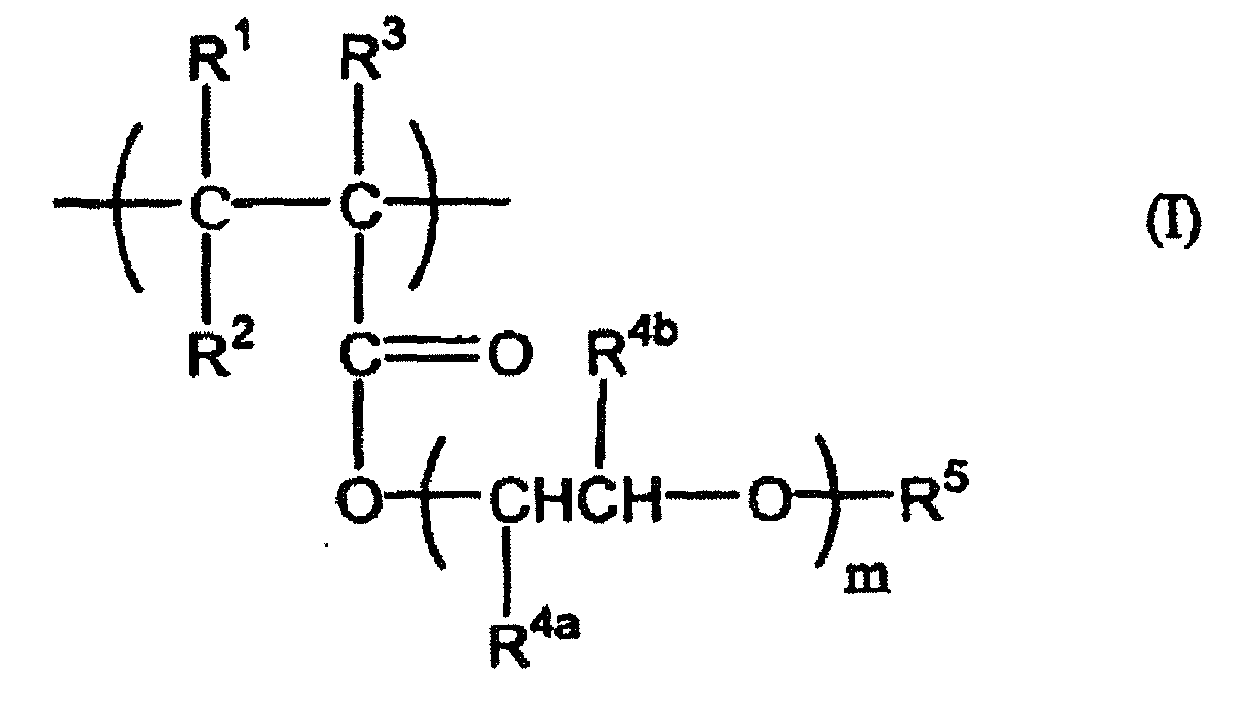 dans laquelle R1 à R3 représentent chacun indépendamment un atome d'hydrogène ou un groupe hydrocarboné en C1-10 et R1 et R3 peuvent être liés pour former un cycle ; R4a et R4b représentent chacun indépendamment un atome d'hydrogène ou un groupe méthyle ; R5 représente un atome d'hydrogène, un groupe hydrocarboné, acyle, ou silyle ; et m représente tout nombre entier de 1 à 100 et chacun des R4a peut être identique ou différent des autres et chacun des R4b peut être identique ou différent des autres lorsque m vaut 2 ou plus ; et un motif récurrent (II) représenté par la formule (II)
 dans laquelle R6 et R8 représentent chacun indépendamment un atome d'hydrogène ou un groupe hydrocarboné en C1-10 et R6 et R8 peuvent être liés pour former un cycle ; R7 représente un atome d'hydrogène, un groupe hydrocarboné en C1-10, hydroxyle, hydrocarbonoxy, carboxyle, anhydride d'acide, amino, ester, ou un groupe organique ayant au moins un groupe fonctionnel choisi dans le groupe constitué par les groupes hydroxyle, carboxyle, époxy, anhydride d'acide, et amino ; et R9 représente un groupe organique ayant au moins un groupe fonctionnel choisi dans le groupe constitué par les groupes hydroxyle, carboxyle, époxy, anhydride d'acide, et amino ; et,une chaîne de bloc B ayant un motif récurrent (III) représenté par la formule (III)
 dans laquelle R10 à R12 représentent chacun indépendamment un atome d'hydrogène ou un groupe hydrocarboné en C1-10 et R13 représente un groupe aryle ou hétéroaryle ; et,dans laquelle une séquence d'agencement de celles-ci est B, A, B.
 - Polymère selon la revendication 1, dans lequel la chaîne de bloc A et la chaîne de bloc B sont liées et agencées selon la séquence B-A-B.
- Polymère selon la revendication 1, dans lequel le degré de polymérisation du motif récurrent (I) est de 5 ou plus.
- Polymère selon la revendication 1, dans lequel le degré de polymérisation du motif récurrent (II) est de 5 ou plus.
- Polymère selon la revendication 1,
dans lequel la chaîne de bloc A est formée à partir d'un copolymère statistique dans lequel les rapports molaires du motif récurrent (I) et du motif récurrent (II) au nombre total de moles des motifs récurrents dans la chaîne de bloc A, se trouvent dans la plage de 50 à 95 % et de 50 à 5 %, respectivement. - Polymère selon la revendication 1, dans lequel le rapport molaire des motifs récurrents (I) et (II) additionnés se trouve dans la plage de 10 à 80 % et le rapport molaire des motifs récurrents (III) est de 90 à 20 %, respectivement, par rapport au nombre total de moles des motifs récurrents dans le polymère.
- Polymère selon la revendication 1, dans lequel la masse moléculaire moyenne en nombre du polymère se trouve dans la plage de 5 000 à 1 000 000.
- Polymère selon la revendication 1, dans lequel le motif récurrent (II) est au moins un motif récurrent choisi dans le groupe constitué par un motif récurrent (IV) représenté par la formule (IV)



-R30-CO2H (VIII)
dans laquelle R30 représente un groupe alkylène en C1-6, un groupe hydrocarboné aromatique bivalent en C6-10, un groupe hydrocarboné alicyclique bivalent en C3-10, ou un groupe organique bivalent dans lequel ces groupes sont combinés. - Polymère réticulé pouvant être obtenu par la réaction entre le polymère selon l'une quelconque des revendications 1 à 8 et un agent de réticulation.
- Polymère réticulé selon la revendication 9, dans lequel l'agent de réticulation est un composé polyisocyanate qui a 2 groupes isocyanate ou plus à l'intérieur d'une molecule ou un composé polyépoxy qui a 2 groupes époxy ou plus à l'intérieur de la molécule.
- Polymère réticulé selon la revendication 9, qui est obtenu par réaction du polymère selon l'une quelconque des revendications 1 à 8, avec 0,01 à 2 moles d'agent de réticulation relativement à 1 mole du motif récurrent (II) dans le polymère.
- Composition pour un électrolyte polymère solide qui comprend :le polymère selon l'une quelconque des revendications 1 à 8 etun sel électrolytique.
- Composition pour un électrolyte polymère solide selon la revendication 12, qui comprend en outre un agent de réticulation.
- Electrolyte polymère solide qui comprend :le polymère selon l'une quelconque des revendications 1 à 8 ou le polymère réticulé selon la revendication 9 ; et,un sel électrolytique.
- Composition adhésive qui comprend :le polymère selon l'une quelconque des revendications 1 à 8 ; et,un agent de réticulation.
Applications Claiming Priority (2)
| Application Number | Priority Date | Filing Date | Title |
|---|---|---|---|
| JP2005014195 | 2005-01-21 | ||
| PCT/JP2006/300599 WO2006077855A1 (fr) | 2005-01-21 | 2006-01-18 | Polymere, polymere reticule, composition pour electrolyte polymere solide, electrolyte polymere solide et composition d’adhesif |
Publications (3)
| Publication Number | Publication Date |
|---|---|
| EP1847556A1 EP1847556A1 (fr) | 2007-10-24 |
| EP1847556A4 EP1847556A4 (fr) | 2009-10-28 |
| EP1847556B1 true EP1847556B1 (fr) | 2010-12-08 |
Family
ID=36692244
Family Applications (1)
| Application Number | Title | Priority Date | Filing Date |
|---|---|---|---|
| EP06711868A Expired - Lifetime EP1847556B1 (fr) | 2005-01-21 | 2006-01-18 | Polymere, polymere reticule, composition pour electrolyte polymere solide, electrolyte polymere solide et composition d'adhesif |
Country Status (6)
| Country | Link |
|---|---|
| EP (1) | EP1847556B1 (fr) |
| JP (1) | JP4685037B2 (fr) |
| KR (1) | KR100891893B1 (fr) |
| CN (1) | CN101107282B (fr) |
| DE (1) | DE602006018708D1 (fr) |
| WO (1) | WO2006077855A1 (fr) |
Families Citing this family (11)
| Publication number | Priority date | Publication date | Assignee | Title |
|---|---|---|---|---|
| JP2009099530A (ja) * | 2007-09-27 | 2009-05-07 | Sanyo Electric Co Ltd | 非水電解質電池用正極及び非水電解質電池 |
| KR100947781B1 (ko) * | 2007-12-21 | 2010-03-15 | 연세대학교 산학협력단 | 수용성 고분자 및 가교성 멀티블록 공중합체를 이용한전해질 막 |
| CN102471464A (zh) * | 2009-07-31 | 2012-05-23 | 住友电木株式会社 | 液态树脂组合物及使用其的半导体装置 |
| JP5481229B2 (ja) * | 2010-02-26 | 2014-04-23 | 日本曹達株式会社 | 網目状ポリマー及びそれを使用したゲル電解質 |
| JP5934158B2 (ja) * | 2013-08-28 | 2016-06-15 | 藤森工業株式会社 | 電気絶縁用粘着剤層、電気絶縁用粘着フィルム、及びそれが貼合された光学部材 |
| KR20150026793A (ko) * | 2013-08-28 | 2015-03-11 | 후지모리 고교 가부시키가이샤 | 전기 절연용 점착제층, 전기 절연용 점착 필름 및 그것이 첩합된 광학 부재 |
| JP6685298B2 (ja) * | 2014-11-03 | 2020-04-22 | ハイドロ−ケベック | ランダムコポリマーおよび揮発性ポリアミン架橋剤に基づく架橋ポリマー、ならびにその製造プロセス |
| KR102097817B1 (ko) * | 2016-09-08 | 2020-04-07 | 주식회사 엘지화학 | 고분자 조성물 |
| US12191493B2 (en) * | 2017-08-31 | 2025-01-07 | Zeon Corporation | Composition for electrochemical device functional layer, functional layer for electrochemical device, and electrochemical device |
| KR102493809B1 (ko) * | 2022-09-26 | 2023-01-30 | 황성원 | 고체 전해질, 전고체 리튬이차전지 및 이의 제조방법 |
| CN119764543B (zh) * | 2024-12-23 | 2026-03-27 | 南开大学 | 一种主链氟代交联聚合物固态电解质及其制备方法和应用 |
Family Cites Families (4)
| Publication number | Priority date | Publication date | Assignee | Title |
|---|---|---|---|---|
| JPWO2002035636A1 (ja) * | 2000-10-20 | 2004-03-04 | 大日本インキ化学工業株式会社 | 高分子固体電解質及び該電解質を用いた電池 |
| EP1553117B1 (fr) * | 2002-07-23 | 2007-01-17 | Nippon Soda Co., Ltd. | Electrolyte polymere solide |
| JP4612272B2 (ja) | 2002-12-27 | 2011-01-12 | 日本曹達株式会社 | 高分子固体電解質用組成物 |
| JP4562364B2 (ja) * | 2003-09-12 | 2010-10-13 | 日本曹達株式会社 | ブロック・グラフト共重合体及びそれらを用いた高分子固体電解質 |
-
2006
- 2006-01-18 KR KR1020077016497A patent/KR100891893B1/ko not_active Expired - Fee Related
- 2006-01-18 EP EP06711868A patent/EP1847556B1/fr not_active Expired - Lifetime
- 2006-01-18 CN CN2006800025623A patent/CN101107282B/zh not_active Expired - Fee Related
- 2006-01-18 WO PCT/JP2006/300599 patent/WO2006077855A1/fr not_active Ceased
- 2006-01-18 DE DE602006018708T patent/DE602006018708D1/de not_active Expired - Lifetime
- 2006-01-18 JP JP2006553913A patent/JP4685037B2/ja not_active Expired - Fee Related
Also Published As
| Publication number | Publication date |
|---|---|
| CN101107282B (zh) | 2011-03-30 |
| WO2006077855A1 (fr) | 2006-07-27 |
| JPWO2006077855A1 (ja) | 2008-06-19 |
| KR20070093115A (ko) | 2007-09-17 |
| JP4685037B2 (ja) | 2011-05-18 |
| DE602006018708D1 (de) | 2011-01-20 |
| EP1847556A4 (fr) | 2009-10-28 |
| KR100891893B1 (ko) | 2009-04-03 |
| EP1847556A1 (fr) | 2007-10-24 |
| CN101107282A (zh) | 2008-01-16 |
Similar Documents
| Publication | Publication Date | Title |
|---|---|---|
| KR100779895B1 (ko) | 중합체 고체 전해질용 조성물, 중합체 고체 전해질,중합체, 중합체 고체 전해질 전지, 이온 전도성막,공중합체 및 공중합체의 제조방법 | |
| US7645830B2 (en) | Polymer, crosslinked polymer, composition for solid polymer electrolyte, solid polymer electrolyte, and adhesive composition | |
| EP1923418B1 (fr) | Polymere en etoile et procede pour la production de celui-ci | |
| EP1847556B1 (fr) | Polymere, polymere reticule, composition pour electrolyte polymere solide, electrolyte polymere solide et composition d'adhesif | |
| US20050256256A1 (en) | Solid polymer electrolyte | |
| US20090246630A1 (en) | Positive electrode for non-aqueous electrolyte battery and non-aqueous electrolyte battery | |
| EP3664210B1 (fr) | Composition d'électrolyte solide de batterie secondaire et électrolyte solide préparé à partir de celle-ci | |
| CN102300907A (zh) | 聚苯胺加成预聚物、聚苯胺加成预聚物的制备方法、聚苯胺接枝聚合物、聚苯胺接枝聚合物的制备方法、交联材料和油漆 | |
| CN101484488B (zh) | 星形聚合物及其制造方法 | |
| JP4612272B2 (ja) | 高分子固体電解質用組成物 | |
| JP4312550B2 (ja) | 高分子固体電解質、固体電解質シート及び固体電解質シートの製造方法 | |
| JP5000109B2 (ja) | 電極作製用結着剤、電極及びポリマー電池 | |
| JP4516528B2 (ja) | 高分子固体電解質 | |
| JP4937497B2 (ja) | 高分子固体電解質電池 | |
| JP4860986B2 (ja) | 接着剤、電極作製用結着剤、及び固体電解質用組成物 | |
| JP2005216794A (ja) | グラフト共重合体及びそれらを用いた高分子固体電解質 | |
| JP2007023112A (ja) | 高強度の接着剤および接着強度の向上方法 | |
| KR20190026444A (ko) | 실리콘 전극 바인더 | |
| JPWO2004081068A1 (ja) | 新規グラフト共重合体及びその製造方法 | |
| JP2011178856A (ja) | 網目状ポリマー及びそれを使用したゲル電解質 |
Legal Events
| Date | Code | Title | Description |
|---|---|---|---|
| PUAI | Public reference made under article 153(3) epc to a published international application that has entered the european phase |
Free format text: ORIGINAL CODE: 0009012 |
|
| 17P | Request for examination filed |
Effective date: 20070809 |
|
| AK | Designated contracting states |
Kind code of ref document: A1 Designated state(s): AT BE BG CH CY CZ DE DK EE ES FI FR GB GR HU IE IS IT LI LT LU LV MC NL PL PT RO SE SI SK TR |
|
| AX | Request for extension of the european patent |
Extension state: AL BA HR MK YU |
|
| A4 | Supplementary search report drawn up and despatched |
Effective date: 20090930 |
|
| GRAP | Despatch of communication of intention to grant a patent |
Free format text: ORIGINAL CODE: EPIDOSNIGR1 |
|
| RIC1 | Information provided on ipc code assigned before grant |
Ipc: C08F 293/00 20060101AFI20100511BHEP Ipc: H01B 1/06 20060101ALI20100511BHEP Ipc: C09J 153/00 20060101ALI20100511BHEP Ipc: C08F 290/06 20060101ALI20100511BHEP Ipc: C08L 53/00 20060101ALI20100511BHEP Ipc: H01M 10/052 20100101ALI20100511BHEP |
|
| GRAS | Grant fee paid |
Free format text: ORIGINAL CODE: EPIDOSNIGR3 |
|
| GRAA | (expected) grant |
Free format text: ORIGINAL CODE: 0009210 |
|
| RIN1 | Information on inventor provided before grant (corrected) |
Inventor name: AMAIKE, MASATO,C Inventor name: SHIMADA, MIKIYA,C Inventor name: KAWAMURA, KIYOSHI,C Inventor name: NIITANI, TAKESHI.,C |
|
| AK | Designated contracting states |
Kind code of ref document: B1 Designated state(s): AT BE BG CH CY CZ DE DK EE ES FI FR GB GR HU IE IS IT LI LT LU LV MC NL PL PT RO SE SI SK TR |
|
| AX | Request for extension of the european patent |
Extension state: AL BA HR MK YU |
|
| REG | Reference to a national code |
Ref country code: GB Ref legal event code: FG4D |
|
| REG | Reference to a national code |
Ref country code: CH Ref legal event code: EP |
|
| REG | Reference to a national code |
Ref country code: IE Ref legal event code: FG4D |
|
| REF | Corresponds to: |
Ref document number: 602006018708 Country of ref document: DE Date of ref document: 20110120 Kind code of ref document: P |
|
| REG | Reference to a national code |
Ref country code: NL Ref legal event code: T3 |
|
| PG25 | Lapsed in a contracting state [announced via postgrant information from national office to epo] |
Ref country code: LT Free format text: LAPSE BECAUSE OF FAILURE TO SUBMIT A TRANSLATION OF THE DESCRIPTION OR TO PAY THE FEE WITHIN THE PRESCRIBED TIME-LIMIT Effective date: 20101208 |
|
| LTIE | Lt: invalidation of european patent or patent extension |
Effective date: 20101208 |
|
| PG25 | Lapsed in a contracting state [announced via postgrant information from national office to epo] |
Ref country code: SI Free format text: LAPSE BECAUSE OF FAILURE TO SUBMIT A TRANSLATION OF THE DESCRIPTION OR TO PAY THE FEE WITHIN THE PRESCRIBED TIME-LIMIT Effective date: 20101208 Ref country code: BG Free format text: LAPSE BECAUSE OF FAILURE TO SUBMIT A TRANSLATION OF THE DESCRIPTION OR TO PAY THE FEE WITHIN THE PRESCRIBED TIME-LIMIT Effective date: 20110308 Ref country code: LV Free format text: LAPSE BECAUSE OF FAILURE TO SUBMIT A TRANSLATION OF THE DESCRIPTION OR TO PAY THE FEE WITHIN THE PRESCRIBED TIME-LIMIT Effective date: 20101208 Ref country code: SE Free format text: LAPSE BECAUSE OF FAILURE TO SUBMIT A TRANSLATION OF THE DESCRIPTION OR TO PAY THE FEE WITHIN THE PRESCRIBED TIME-LIMIT Effective date: 20101208 Ref country code: CY Free format text: LAPSE BECAUSE OF FAILURE TO SUBMIT A TRANSLATION OF THE DESCRIPTION OR TO PAY THE FEE WITHIN THE PRESCRIBED TIME-LIMIT Effective date: 20101208 Ref country code: AT Free format text: LAPSE BECAUSE OF FAILURE TO SUBMIT A TRANSLATION OF THE DESCRIPTION OR TO PAY THE FEE WITHIN THE PRESCRIBED TIME-LIMIT Effective date: 20101208 |
|
| PG25 | Lapsed in a contracting state [announced via postgrant information from national office to epo] |
Ref country code: BE Free format text: LAPSE BECAUSE OF FAILURE TO SUBMIT A TRANSLATION OF THE DESCRIPTION OR TO PAY THE FEE WITHIN THE PRESCRIBED TIME-LIMIT Effective date: 20101208 Ref country code: EE Free format text: LAPSE BECAUSE OF FAILURE TO SUBMIT A TRANSLATION OF THE DESCRIPTION OR TO PAY THE FEE WITHIN THE PRESCRIBED TIME-LIMIT Effective date: 20101208 Ref country code: GR Free format text: LAPSE BECAUSE OF FAILURE TO SUBMIT A TRANSLATION OF THE DESCRIPTION OR TO PAY THE FEE WITHIN THE PRESCRIBED TIME-LIMIT Effective date: 20110309 Ref country code: IS Free format text: LAPSE BECAUSE OF FAILURE TO SUBMIT A TRANSLATION OF THE DESCRIPTION OR TO PAY THE FEE WITHIN THE PRESCRIBED TIME-LIMIT Effective date: 20110408 Ref country code: PT Free format text: LAPSE BECAUSE OF FAILURE TO SUBMIT A TRANSLATION OF THE DESCRIPTION OR TO PAY THE FEE WITHIN THE PRESCRIBED TIME-LIMIT Effective date: 20110408 Ref country code: CZ Free format text: LAPSE BECAUSE OF FAILURE TO SUBMIT A TRANSLATION OF THE DESCRIPTION OR TO PAY THE FEE WITHIN THE PRESCRIBED TIME-LIMIT Effective date: 20101208 Ref country code: ES Free format text: LAPSE BECAUSE OF FAILURE TO SUBMIT A TRANSLATION OF THE DESCRIPTION OR TO PAY THE FEE WITHIN THE PRESCRIBED TIME-LIMIT Effective date: 20110319 |
|
| PG25 | Lapsed in a contracting state [announced via postgrant information from national office to epo] |
Ref country code: SK Free format text: LAPSE BECAUSE OF FAILURE TO SUBMIT A TRANSLATION OF THE DESCRIPTION OR TO PAY THE FEE WITHIN THE PRESCRIBED TIME-LIMIT Effective date: 20101208 Ref country code: MC Free format text: LAPSE BECAUSE OF NON-PAYMENT OF DUE FEES Effective date: 20110131 Ref country code: RO Free format text: LAPSE BECAUSE OF FAILURE TO SUBMIT A TRANSLATION OF THE DESCRIPTION OR TO PAY THE FEE WITHIN THE PRESCRIBED TIME-LIMIT Effective date: 20101208 Ref country code: PL Free format text: LAPSE BECAUSE OF FAILURE TO SUBMIT A TRANSLATION OF THE DESCRIPTION OR TO PAY THE FEE WITHIN THE PRESCRIBED TIME-LIMIT Effective date: 20101208 |
|
| REG | Reference to a national code |
Ref country code: CH Ref legal event code: PL |
|
| PLBE | No opposition filed within time limit |
Free format text: ORIGINAL CODE: 0009261 |
|
| STAA | Information on the status of an ep patent application or granted ep patent |
Free format text: STATUS: NO OPPOSITION FILED WITHIN TIME LIMIT |
|
| REG | Reference to a national code |
Ref country code: IE Ref legal event code: MM4A |
|
| PG25 | Lapsed in a contracting state [announced via postgrant information from national office to epo] |
Ref country code: DK Free format text: LAPSE BECAUSE OF FAILURE TO SUBMIT A TRANSLATION OF THE DESCRIPTION OR TO PAY THE FEE WITHIN THE PRESCRIBED TIME-LIMIT Effective date: 20101208 Ref country code: CH Free format text: LAPSE BECAUSE OF NON-PAYMENT OF DUE FEES Effective date: 20110131 Ref country code: LI Free format text: LAPSE BECAUSE OF NON-PAYMENT OF DUE FEES Effective date: 20110131 |
|
| 26N | No opposition filed |
Effective date: 20110909 |
|
| PG25 | Lapsed in a contracting state [announced via postgrant information from national office to epo] |
Ref country code: IT Free format text: LAPSE BECAUSE OF FAILURE TO SUBMIT A TRANSLATION OF THE DESCRIPTION OR TO PAY THE FEE WITHIN THE PRESCRIBED TIME-LIMIT Effective date: 20101208 |
|
| REG | Reference to a national code |
Ref country code: DE Ref legal event code: R097 Ref document number: 602006018708 Country of ref document: DE Effective date: 20110909 |
|
| PG25 | Lapsed in a contracting state [announced via postgrant information from national office to epo] |
Ref country code: IE Free format text: LAPSE BECAUSE OF NON-PAYMENT OF DUE FEES Effective date: 20110118 |
|
| PG25 | Lapsed in a contracting state [announced via postgrant information from national office to epo] |
Ref country code: LU Free format text: LAPSE BECAUSE OF NON-PAYMENT OF DUE FEES Effective date: 20110118 |
|
| PG25 | Lapsed in a contracting state [announced via postgrant information from national office to epo] |
Ref country code: TR Free format text: LAPSE BECAUSE OF FAILURE TO SUBMIT A TRANSLATION OF THE DESCRIPTION OR TO PAY THE FEE WITHIN THE PRESCRIBED TIME-LIMIT Effective date: 20101208 |
|
| PG25 | Lapsed in a contracting state [announced via postgrant information from national office to epo] |
Ref country code: HU Free format text: LAPSE BECAUSE OF FAILURE TO SUBMIT A TRANSLATION OF THE DESCRIPTION OR TO PAY THE FEE WITHIN THE PRESCRIBED TIME-LIMIT Effective date: 20101208 |
|
| REG | Reference to a national code |
Ref country code: FR Ref legal event code: PLFP Year of fee payment: 10 |
|
| PGFP | Annual fee paid to national office [announced via postgrant information from national office to epo] |
Ref country code: FI Payment date: 20150113 Year of fee payment: 10 |
|
| REG | Reference to a national code |
Ref country code: FR Ref legal event code: PLFP Year of fee payment: 11 |
|
| PG25 | Lapsed in a contracting state [announced via postgrant information from national office to epo] |
Ref country code: FI Free format text: LAPSE BECAUSE OF NON-PAYMENT OF DUE FEES Effective date: 20160118 |
|
| REG | Reference to a national code |
Ref country code: FR Ref legal event code: PLFP Year of fee payment: 12 |
|
| REG | Reference to a national code |
Ref country code: FR Ref legal event code: PLFP Year of fee payment: 13 |
|
| PGFP | Annual fee paid to national office [announced via postgrant information from national office to epo] |
Ref country code: FR Payment date: 20210121 Year of fee payment: 16 Ref country code: NL Payment date: 20210120 Year of fee payment: 16 |
|
| PGFP | Annual fee paid to national office [announced via postgrant information from national office to epo] |
Ref country code: DE Payment date: 20210120 Year of fee payment: 16 Ref country code: GB Payment date: 20210121 Year of fee payment: 16 |
|
| REG | Reference to a national code |
Ref country code: DE Ref legal event code: R119 Ref document number: 602006018708 Country of ref document: DE |
|
| REG | Reference to a national code |
Ref country code: NL Ref legal event code: MM Effective date: 20220201 |
|
| GBPC | Gb: european patent ceased through non-payment of renewal fee |
Effective date: 20220118 |
|
| PG25 | Lapsed in a contracting state [announced via postgrant information from national office to epo] |
Ref country code: NL Free format text: LAPSE BECAUSE OF NON-PAYMENT OF DUE FEES Effective date: 20220201 Ref country code: GB Free format text: LAPSE BECAUSE OF NON-PAYMENT OF DUE FEES Effective date: 20220118 Ref country code: DE Free format text: LAPSE BECAUSE OF NON-PAYMENT OF DUE FEES Effective date: 20220802 |
|
| PG25 | Lapsed in a contracting state [announced via postgrant information from national office to epo] |
Ref country code: FR Free format text: LAPSE BECAUSE OF NON-PAYMENT OF DUE FEES Effective date: 20220131 |