EP1847643B1 - Système de communication d'informations dans un appareil - Google Patents
Système de communication d'informations dans un appareil Download PDFInfo
- Publication number
- EP1847643B1 EP1847643B1 EP06254686.6A EP06254686A EP1847643B1 EP 1847643 B1 EP1847643 B1 EP 1847643B1 EP 06254686 A EP06254686 A EP 06254686A EP 1847643 B1 EP1847643 B1 EP 1847643B1
- Authority
- EP
- European Patent Office
- Prior art keywords
- options
- available
- option
- illumination
- indicating
- Prior art date
- Legal status (The legal status is an assumption and is not a legal conclusion. Google has not performed a legal analysis and makes no representation as to the accuracy of the status listed.)
- Active
Links
Images



Classifications
-
- D—TEXTILES; PAPER
- D06—TREATMENT OF TEXTILES OR THE LIKE; LAUNDERING; FLEXIBLE MATERIALS NOT OTHERWISE PROVIDED FOR
- D06F—LAUNDERING, DRYING, IRONING, PRESSING OR FOLDING TEXTILE ARTICLES
- D06F34/00—Details of control systems for washing machines, washer-dryers or laundry dryers
- D06F34/28—Arrangements for program selection, e.g. control panels therefor; Arrangements for indicating program parameters, e.g. the selected program or its progress
- D06F34/32—Arrangements for program selection, e.g. control panels therefor; Arrangements for indicating program parameters, e.g. the selected program or its progress characterised by graphical features, e.g. touchscreens
-
- D—TEXTILES; PAPER
- D06—TREATMENT OF TEXTILES OR THE LIKE; LAUNDERING; FLEXIBLE MATERIALS NOT OTHERWISE PROVIDED FOR
- D06F—LAUNDERING, DRYING, IRONING, PRESSING OR FOLDING TEXTILE ARTICLES
- D06F2101/00—User input for the control of domestic laundry washing machines, washer-dryers or laundry dryers
- D06F2101/20—Operation modes, e.g. delicate laundry washing programs, service modes or refreshment cycles
-
- D—TEXTILES; PAPER
- D06—TREATMENT OF TEXTILES OR THE LIKE; LAUNDERING; FLEXIBLE MATERIALS NOT OTHERWISE PROVIDED FOR
- D06F—LAUNDERING, DRYING, IRONING, PRESSING OR FOLDING TEXTILE ARTICLES
- D06F2105/00—Systems or parameters controlled or affected by the control systems of washing machines, washer-dryers or laundry dryers
- D06F2105/58—Indications or alarms to the control system or to the user
Definitions
- the invention relates to communicating information to the user of an appliance, and more specifically to a user interface for household appliance through which information may be communicated.
- Household appliances such as clothes washers and dryers, utilize user interfaces to enable a user of the appliance to control the operation of the appliance.
- the user interface typically includes a controller, which may comprise a microprocessor, memory, and associated circuitry, and a panel adapted to accommodate selection devices such as knobs, switches, push buttons, and the like.
- the selection devices are utilized to select operating modes, such as predefined wash and dry cycles, and options which can be selected for specific operating modes.
- Illustrative washing modes commonly include normal wash, heavy duty, delicate, for example.
- Illustrative drying modes commonly include normal dry, permanent press, air dry, for example.
- Illustrative options for clothes washers commonly include water temperature, spin speed, soil level, extra rinse, prewash, and the like.
- Illustrative options for dryers commonly include drying temperature, drying time, dryness level, and the like.
- the available options may vary depending on the selected mode. For example, if the operating mode selected for a clothes washer is a delicate washing cycle, the available water temperature options may be limited to "cold” and "warm,” with “hot” unavailable for selection. Some current clothes washers may indicate which of the options has been selected, e.g. "cold,” but not that "warm” is also available and that "hot” is unavailable. Thus, a user wishing to change the water temperature for the selected operating mode must select, in turn, each of the temperature options to determine which of the temperature options is available and can be selected. Other current washers may indicate all available options but stop indicating the available options upon the selection of one option by the user.
- DE-A1-195 05485 discloses a user interface for a washing machine in accordance with the pre-characterising portion of the independent claims.
- the invention relates to communicating operational information to a user of an appliance by indicating options available for selection by the user for a particular operating mode, indicating which of the available options is selected by the user, distinguishing between selected available option and non-selected available options, and continuing to indicate the non-selected available options subsequent to the selection of the selected available option.
- a first embodiment of the invention is illustrated as a clothes washer 10 having a cabinet 12, an access door 14 for enabling a user to access a perforated basket 16 rotatably mounted within an imperforate drum 18 housed in the cabinet 12, and adapted in a well known manner for the washing of clothes and other fabric items.
- the clothes washer 10 may be provided with a control panel 20 having a display 24 to enable a user of the appliance to control the operation of the appliance such as by selecting an operating mode from among a plurality of operating modes, and selecting options from among a plurality of options available for the selected operating mode
- the display 24 may provide information to the user to assist the user in the selection and operation of the clothes washer controls, including error messages.
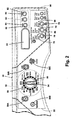
- the control panel 20 is illustrated in Figure 2 .
- a controller 22 may be associated with the control panel 20 and may extend behind the control panel 20 in operable registry with various controls and indicators.
- the controller 22 may be a generally well known microprocessor-based controller, which may be in the form of a circuit board, having memory, displays, circuitry, switches, and the like.
- the control panel 20 has a power switch 50 for turning the washer on and off.
- the panel 20 may be divided into a mode array 52 and an options array, which may have both a single-variable options array 64, and a multi-variable options array 66.
- the mode array 52 includes a variety of selectable washing modes or cycles, such as normal wash, bulky items, quick wash, delicates, rinse and spin, and the like.
- a mode may be selected by a mode selector 54, which is illustrated in Figure 2 as a rotatable dial. Alternatively, individual modes may be selected by depressing a button or switch associated with that mode.
- Each mode has an associated mode illumination source 56 which may be illuminated when the associated mode has been selected by the rotatable dial or switch 54, and may be otherwise darkened. Thus, if the normal wash mode is selected, the illumination source 56 associated with the normal wash mode may be illuminated. Otherwise, if another mode is selected, the illumination source 56 associated with the normal wash mode may be darkened.
- the mode array 52 may have related operational inputs such as the power switch 50A, start switch 50B, pause/cancel switch 50C, and a control lock 50D. These related operational inputs may be used to effect the progress of the selected mode.
- the single-variable options array 60 may encompass several options that may be selected for a given operational mode.
- the illustrated options are a pre-wash cycle, a presoak cycle, an extra rinse cycle, and the like, which may be selected by the user.
- the types of options are not limiting on the invention and are provided for illustration.
- Each option may be selectable through an options switch 62, such as a push-button switch, which has an associated visual indicator illustrated in the form of an illumination source 64.
- the illumination source 64 is illustrated in Figure 2 as encircling the switch 62.
- the type of indicator is not limiting on the invention even though a visual indicator in the form of an illumination source is illustrated. Thus, other configurations, for the illumination source may be used, such as a separate, adjacent illumination source.
- the multi-variable options array 66 encompasses several options which may be further organized into parameter sub-arrays 68.
- Each parameter sub-array 68 may be provided with an associated options switch 70, such as a push-button switch.
- Each parameter sub-array 68 may encompass several options, each of which may be associated with an options illumination source 72, which are logically or functionally related.
- the parameter sub-arrays 68 may include water temperature, spin speed, soil level, cycle signal, and sound.
- the options available for the water temperature parameter sub-array 68 may range from cold to super hot.
- the illumination sources 56, 64, 72 may comprise incandescent light bulbs, light emitting diodes (LEDs), fiber-optic devices, and the like, and may be operably connected to the controller 22 for control of the illumination state associated with a selected mode or option.
- Multi-color LEDs may be used to conveniently implement the invention. Multi-color LEDs can conveniently produce multiple illumination states based on the emitted color and/or the intensity of the light, which may include both on and off states of the LED, regardless of the emitted color.
- illumination source may be used, it is contemplated that at least either the color and/or intensity of the illumination source may be used to define different illumination states, which are used as different indications.
- intensity includes light output levels from full off to full on, and it also includes varying the light output, such blinking or strobing, at a constant or varying light output.
- the operation of the washer may be begun by the user pressing the power switch 50A to supply power to the appliance.
- the user then rotates the dial 54 to select the desired operating mode.
- the illumination source 56 for the selected mode changes illumination states from off to on.
- the controller 22 changes the illumination states of the illumination source for the options. For those options that are available to be selected for the selected operational mode, the controller illuminates the corresponding illumination source in a first illumination state to indicate to the user that the options are available for selection.
- the controller changes the illumination state of the corresponding illumination source for the selected available option(s) to a second illumination state to distinguish the selected available options from the non-selected available options.
- the controller 22 may select default options for one or more parameter sub-arrays. These default options may be illuminated in the second illumination state to indicate that the option is available and selected. For those options that are not available for the selected operational mode, the controller may set the illumination state of the corresponding illumination source to a third illumination state to distinguish the available options from the non-available options, regardless of whether the available options are selected.
- the third illumination state corresponds to the corresponding illumination source being turned off and the first and second illumination states correspond to illumination in different colors.
- the controller begins implementing the selected operational mode.
- the controller maintains the available options, both selected and non-selected, in their current illumination state until the operational mode passes the point where the available option may still be selected, at which time the available option becomes unavailable and the controller changes the illumination state to the third illumination state.
- the controller may change the corresponding illumination state from the first illumination state to the second illumination state. If the user unselects a previously selected option, the controller changes the illumination state from the second illumination state to the first illumination state.
- the user interface continuously communicates to the user the availability of the various options and the selected status of the available options.
- each of the available options may be indicated by the controller 22 illuminating the illumination source 64 in a first illumination state. If one of the options is selected, the illumination source 64 may then be illuminated in a second illumination state. If one of the options is not available, the illumination source may be illuminated in a third illumination state.
- the first and second illumination states may be different colors, such as amber and red, with the third illumination state being off or no illumination.
- each of the available parameter sub-arrays 68 may be indicated by the illumination of the options switch 70 in a first illumination state.
- Each option associated with a particular parameter sub-array 68 for example the temperature options in the water temperature parameter sub-array, may be indicated by illumination of the option illumination source 72 for each option in one of three illumination states.
- An option that is available and not selected may be illuminated in a first illumination state, which may be a first color such as amber.
- An option that is available and selected may be illuminated in a second illumination state, which may be a second color such as green.
- An option that is unavailable may be illuminated in a third illumination state, which may be darkened or a third color such as red.
- a parameter sub-array 68 that is not available may be indicated by the illumination of the options switch 70 in a second illumination state, such as a darkened or off state.
- the options illumination sources 72 for each of the options in the parameter sub-array 68 may also be indicated by the illumination of the options illumination sources 72 in the third illumination state, such as a darkened or off state.
- the multi-variable options illumination sources 72 may take one of several states depending upon the availability and selection of an option.
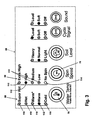
- the water temperature parameter sub-array 68 is illustrated as encompassing five different water temperatures: super hot, hot, warm with warm rinse, warm, and cold. These water temperatures may be available options for one or more modes.
- the selection of the normal wash mode may enable the selection of one of several water temperatures, for example, hot, warm with warm rinse, warm, and cold. Each of these wash temperatures may be available for selection until the wash cycle is started.
- wash temperatures may be indicated by a first illumination state, such as a blinking or strobing illumination, or a first color, such as amber.
- the wash temperature that may be selected may be indicated by a second illumination state, such as a continuous illumination, or a second color, such as green.
- a wash temperature that may be unavailable for the particular mode selected may be indicated by a third illumination state, such as a darkened indicator or a third color, such as red.
- the water temperature parameter sub-array 68 includes non-selected available indicators 110 illuminated in a first illumination state which indicate that the associated water temperatures super hot, hot, warm with warm rinse, and cold are available for the selected mode, but have not, in fact, been selected.
- the water temperature parameter sub-array 68 also includes the selected available indicator 112 which indicates that the warm water temperature may be available for the selected mode and has, in fact, been selected.
- the spin speed parameter sub-array 68 includes non-selected available indicators 110 which indicate that the associated spin speeds extra high, medium, and low are available for the selected mode, but have not, in fact, been selected.
- a non-selected unavailable indicator 114 associated with no spin may not be illuminated, indicating that, for the mode selected, a no spin option may be unavailable.
- the available selected indicator 112 indicates that the high speed has been selected.
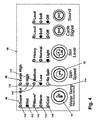
- the indicator associated with the hot temperature may be illuminated 112 to indicate that hot is available and selected.
- the remaining water temperatures super hot, warm with warm rinse, warm, and cold are illuminated 110 to indicate that these temperatures are available but non-selected.
- the indicator associated with the low spin speed may be illuminated 112 to indicate that low may be available and selected.
- the extra high, high, and medium spin speeds may be illuminated 110 to indicate that these spin speeds are available and non-selected.
- the indicator may be not illuminated 114 to indicate that this option may be unavailable.
- the options associated with a particular parameter sub-array 68 may remain available for selection until a predetermined point in the wash cycle, such as the initiation of the spin portion of the wash cycle.
- the multi-variable options illumination sources 72 may remain illuminated until the predetermined point in the wash cycle has been reached to indicate that the options remain selectable.
- the available non-selected spin speeds extra high, medium, and low may remain illuminated until the predetermined point in the wash cycle to indicate that these speeds remain available and non-selected.
- the available non-selected spin speed illumination sources 110 may be darkened or illuminated in some alternative state to indicate that these options are unavailable and non-selected. The illumination of the available selected spin speed 112 may remain unchanged.
- certain options may not be selectable while the appliance is operating, but may be selected when the appliance is in an abnormally stopped state, such as when the operational mode is paused or canceled.
- the available non-selected options may become unavailable when the operating mode is initiated by the user activating the start switch. The available and selected options would remain illuminated. If the user were to interrupt the current operating mode, e.g. by activating a pause switch on the washer or dryer or opening the dryer door, available and unselected options may become illuminated again to indicate that they are available and unselected.
- illumination sources capable of illumination in different states may provide additional information to a user to enable a user to more efficiently select available options and more effectively control the operation of the appliance.
- the use of illumination sources that indicate with a first illumination state that an option may be available but non-selected and with a second illumination state that an option may be unavailable may enable a user to quickly select an option desired without the necessity of selecting in a trial-and-error approach options that are unavailable.
- the continuation of the illumination of illumination sources in a particular illumination state until the point in the operating cycle of the appliance at which the option can no longer be selected may enable the user to more effectively determine the best options for the use of the appliance while such options may still be selected.
- the use of visual indicators capable of illumination in several different illumination states may provide a user with valuable information in a very short period of time.
- a second embodiment of the invention is illustrated as a clothes dryer 30 having a cabinet 32, and access door 34 for enabling a user to access a dryer drum 36 housed in the cabinet 32, and adapted in a well known manner for the drying of clothes and other fabric items.
- the clothes dryer 30 may be provided with a control panel 38 having a display 42.
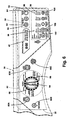
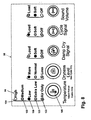
- the control panel 38 is illustrated in Figure 6 .
- a controller 40 may be associated with the control panel 38 and extends behind the control panel 38 in operable registry with various controls and indicators.
- the controller 40 may be a generally well known microprocessor-based controller, which may be in the form of a circuit board, having memory, displays, circuitry, switches, and the like.
- the control panel 38 has a power switch 80 for turning the dryer on and off.
- the panel 38 may be divided into a mode array 82 and an options array, which may have both a single-variable options array 90, and a multi-variable options array 96.
- the mode array 82 includes a variety of selectable drying modes or cycles, such as normal, heavy duty, damp dry, timed dry, and the like.
- a mode may be selected by a mode selector 84, which is illustrated in Figure 6 as a rotatable dial. Alternatively, individual modes may be selected by depressing a button or switch associated with that mode.
- Each mode has an associated mode illumination source 86 which may be illuminated when the associated mode has been selected by the rotatable dial or switch 84, and may be otherwise darkened. Thus, if the normal dry mode may be selected, the illumination source 86 associated with the normal dry mode may be illuminated. Otherwise, if another mode may be selected, the illumination source 86 associated with the normal dry mode may be darkened.
- the mode array 82 may have related operational inputs such as the power switch 80A, start switch 80B, pause/cancel switch 80C, and a control lock 80D. These related operational inputs may be used to affect the progress of the selected mode.
- the single-variable options array 90 may encompass several options that may be selected for a given operational mode.
- the illustrated options are a wrinkle shield, the option of increasing or decreasing the manual dry time, and the like, which may be selected by the user.
- the types of options are not limiting on the invention and are provided for illustration.
- Each option may be selectable through an options switch 92, such as a push-button switch, which has an associated visual indicator in the form of an illumination source 94.
- the illumination source 94 is illustrated in Figure 6 as encircling the switch 92.
- the type of indicator is not limiting on the invention even though a visual indicator in the form of an illumination source is illustrated. Thus, other configurations, for the illumination source may be used, such as a separate, adjacent illumination source.
- the multi-variable options array 96 encompasses several options which may be further organized into parameter sub-arrays 98.
- Each parameter sub-array 98 may be provided with an associated options switch 100, such as a push-button switch.
- Each parameter sub-array 98 encompasses several options, each of which may be associated with an options illumination source 102, which are logically or functionally related.
- the parameter sub-arrays 98 include dry temperature, dryness level, damp dry signal, cycle signal, and sound volume.
- the options available for the dry temperature parameter sub-array 98 may range from high to air only.
- the type of indicator for any of the modes or options is not limiting on the invention, the embodiment is illustrated with a visual indicator in the form of an illumination source.
- the second embodiment uses the same type of illumination sources as the first embodiment for the illumination sources 86, 94, 102.
- the operation of the dryer may be begun by the user pressing the power switch 80A to supply power to the appliance.
- the user then rotates the dial 84 to select the desired operating mode.
- the illumination source 86 for the selected mode changes illumination states from off to on.
- the controller 40 changes the illumination states of the illumination source for the options. For those options that are available to be selected for the selected operational mode, the controller illuminates the corresponding illumination source in a first illumination state to indicate to the user that the options are available for selection.
- the controller changes the illumination state of the corresponding illumination source for the selected available option(s) to a second illumination state to distinguish the selected available options from the non-selected available options.
- the controller 40 may select default options for one or more parameter sub-arrays. These default options may be illuminated in the second illumination state to indicate that the option is available and selected. For those options that are not available for the selected operational mode, the controller may be set the illumination state of the corresponding illumination source to a third illumination state to distinguish the available options from the non-available options, regardless of whether the available options are selected.
- the third illumination state corresponds to the corresponding illumination source being turned off and the first and second illumination states correspond to illumination in different colors.
- the controller begins implementing the selected operational mode.
- the controller maintains the available options, both selected and non-selected, in their current illumination state until the operational mode passes the point where the available option may still be selected at which time the available option becomes unavailable and the controller changes the illumination state to the third illumination state.
- the controller may be change the corresponding illumination state from the first illumination state to the second illumination state. If the user unselects a previously selected option, the controller changes the illumination state from the second illumination state to the first illumination state.
- the user interface continuously communicates to the user the availability of the various options and the selected status of the available options.
- each of the available options may be indicated by the controller 40 illuminating the illumination source 94 in a first illumination state. If one of the options is selected, the illumination source 94 may be then illuminated in a second illumination state. If one of the options is not available, the illumination source may be illuminated in a third illumination state.
- the first and second illumination states may be different colors, such as amber and red, with the third illumination state being off or no illumination.
- each of the available parameter sub-arrays 98 may be indicated by the illumination of the options switch 100 in a first illumination state.
- Each option associated with a particular parameter sub-array 98 for example the temperature options in the dryer temperature parameter sub-array, may be indicated by illumination of the option illumination source 102 for each option in one of three illumination states.
- An option that is available and not selected may be illuminated in a first illumination state, which may be a first color such as amber.
- An option that is available and selected may be illuminated in a second illumination state, which may be a second color such as green.
- An option that is unavailable may be illuminated in a third illumination state, which may be darkened or a third color such as red.
- a parameter sub-array 98 that is not available may be indicated by the illumination of the options switch 100 in a second illumination state, such as a darkened or off state.
- the options illumination sources 102 for each of the options in the parameter sub-array 98 may also be indicated by the illumination of the options illumination sources 102 in the third illumination state, such as a darkened or off state.
- the multi-variable options illumination sources 102 may take one of several states depending upon the availability and selection of an option.
- the dryness temperature parameter sub-array 98 is illustrated as encompassing five different dryness temperatures: high, medium, low, extra low, and air only. These dryness temperatures are available options for one or more modes.
- the selection of the normal dryer mode may enable the selection of one of several dryness temperatures, for example, medium, low, extra low, and air only. Each of these dryer temperatures may be available for selection until the dryer cycle is started.
- the availability of these dryer temperatures may be indicated by a first illumination state, such as a blanking or strobing illumination, or a first color, such as amber.
- the dryer temperature that may be selected may be indicated by a second illumination state, such as a continuous illumination, or a second color, such as green.
- a dryer temperature that may be unavailable for the particular mode selected may be indicated by a third illumination state, such as a darkened indicator or a third color, such as red.
- the dryer temperature parameter sub-array 98 includes non-selected available indicators 122 illuminated in a first illumination state which indicates that the associated dryer temperatures low, extra low, and air only are available for the selected mode, but have not, in fact, been selected.
- the dryer temperature parameter sub-array 98 also includes the selected available indicator 120 which indicates that the medium dryer temperature may be available for the selected mode and has, in fact, been selected.
- the dryer temperature parameter sub-array 98 also includes the unavailable indicator 124 which indicates that the high dryer temperature may be unavailable for the selected mode.
- the indicator associated with the low temperature may be illuminated 120 to indicate that low may be available and selected.
- the remaining dryer temperatures medium, extra low, and air only are illuminated 122 to indicate that these temperatures are available but non-selected.
- the high dryer temperature may be illuminated 124 to indicate that this temperature may be unavailable.
- the options associated with a particular parameter sub-array 98 may remain available for selection until a predetermined point in the dryer cycle, such as 80% dry, 50% dry, and the like, or after a predetermined elapsed time.
- a predetermined point in the dryer cycle such as 80% dry, 50% dry, and the like
- the dryness level may be changed for a period of time after initiation of the dryer cycle.
- the multi-variable options illumination sources 102 may remain illuminated until the predetermined point in the dryer cycle has been reached to indicate that the options remains selectable. After the predetermined point has been reached, however, the available non-selected illumination sources may be darkened or illuminated in some alternative state to indicate that these options are unavailable and non-selected. The illumination of the available selected dryness option may remain unchanged.
- the available non-selected options may be illuminated to indicate that they are not available while the machine is operating, but may be illuminated as available and non-selected when the operation of the appliance is abnormally stopped, such as paused or interrupted.
- clothes washer 58 12 cabinet 60 single-variable options array 14 door 62 options switch 16 basket 64 options illumination source 18 drum 66 multi-variable options array 20 control panel 68 parameter sub-array 22 controller 70 options switch 24 display 72 options illumination source 26 74 28 76 30 clothes dryer 78 32 cabinet 80 power switch 34 door 82 mode array 36 drum 84.
- mode selector 38 control panel 86 mode illumination source 40 controller 88 42 display 90 single-variable options array 44 92 options switch 46 94 options illumination source 48 96 multi-variable options array 50 power switch 98 parameter sub-array 52 mode array 100 options switch 54 mode selector 102 options illumination source 56 mode illumination source 104 106 108 110 selected available indicator 112 non-selected available indicator 114 unavailable indicator 116 118 120 selected available indicator 122 non-selected available indicator 124 unavailable indicator 126 128 130
Landscapes
- Engineering & Computer Science (AREA)
- Textile Engineering (AREA)
- Control Of Washing Machine And Dryer (AREA)
- Communication Control (AREA)
- User Interface Of Digital Computer (AREA)
Claims (28)
- Procédé de communication à un utilisateur d'un appareil (10) d'une information fonctionnelle liée à un mode de fonctionnement de l'appareil (10) par l'intermédiaire d'une interface utilisateur (20), comprenant :d'indiquer des options disponibles à la sélection par l'utilisateur pour un mode de fonctionnement de l'appareil (10) ;d'indiquer laquelle des options disponibles est sélectionnée par l'utilisateur ;de distinguer entre les options disponibles sélectionnées et les options disponibles non sélectionnées ; caractérisé par le fait de :continuer à indiquer les options disponibles non sélectionnées à la suite de la sélection de l'option disponible sélectionnée.
- Procédé selon la revendication 1 dans lequel l'indication continue des options disponibles non sélectionnées continue après l'initiation du mode de fonctionnement.
- Procédé selon la revendication 2 dans lequel l'indication continue des options disponibles non sélectionnées continue pour chaque option disponible non sélectionnée jusqu'à ce que le mode de fonctionnement progresse jusqu'à un point au-delà duquel l'option disponible non sélectionnée peut être mise en oeuvre.
- Procédé selon la revendication 1, 2 ou 3 dans lequel l'indication des options disponibles comprend d'indiquer visuellement les options disponibles.
- Procédé selon la revendication 1, 2, 3 ou 4 dans lequel la distinction entre les options disponibles sélectionnées et les options disponibles non sélectionnées comprend de distinguer visuellement entre les options disponibles sélectionnées et les options disponibles non sélectionnées.
- Procédé selon la revendication 5 dans lequel distinguer visuellement entre l'option disponible sélectionnée et les options disponibles non sélectionnées comprend d'éclairer les options disponibles sélectionnées dans un premier état d'éclairage et d'éclairer les options disponibles non sélectionnées dans un second état d'éclairage différent du premier état d'éclairage.
- Procédé selon la revendication 6 dans lequel les premier et second états d'éclairage diffèrent au moins en l'une de la couleur ou de l'intensité.
- Procédé selon la revendication 7 dans lequel les premier et second états d'éclairage sont la couleur.
- Procédé selon la revendication 8 dans lequel la couleur indiquant l'option disponible non sélectionnée est la couleur ambrée.
- Procédé selon l'une quelconque des revendications précédentes comprenant en outre d'indiquer les options non disponibles.
- Procédé selon la revendication 10 comprenant en outre de distinguer les options non disponibles des options disponibles.
- Procédé selon l'une quelconque des revendications précédentes dans lequel l'indication des options disponibles sélectionnées comprend d'indiquer de multiples options disponibles sélectionnées.
- Procédé selon l'une quelconque des revendications précédentes dans lequel l'indication des options disponibles sélectionnées comprend d'indiquer un paramètre sélectionné associé aux options disponibles sélectionnées.
- Procédé selon la revendication 13 dans lequel l'indication d'un paramètre sélectionné comprend d'indiquer un paramètre sélectionné parmi un groupe de paramètres.
- Procédé selon la revendication 14 dans lequel le groupe de paramètres comprend un groupe de paramètres disponibles.
- Procédé selon l'une quelconque des revendications précédentes comprenant en outre d'indiquer le mode de fonctionnement sélectionné par l'utilisateur parmi une pluralité de modes de fonctionnement.
- Procédé selon l'une quelconque des revendications précédentes comprenant en outre d'indiquer les options disponibles après l'arrêt anormal du mode de fonctionnement.
- Interface utilisateur (20) pour un appareil (10) comprenant :un sélecteur de mode (54) comprenant une pluralité de modes de fonctionnement avec un indicateur de mode (56) correspondant pour indiquer lequel des modes de fonctionnements est sélectionné ;un sélecteur d'option (60, 66) comprenant une pluralité d'options pour la pluralité de modes de fonctionnement avec un indicateur d'option (64, 72) correspondant pour indiquer un statut de l'option ; etune commande (22) couplée fonctionnellement au sélecteur de mode (54) et au sélecteur d'option (60, 66) dans lequel la commande (22) active l'indicateur de mode (56) correspondant à un mode de fonctionnement sélectionné, active dans un premier état d'activation l'indicateur d'option (64, 72) pour chaque option disponible et sélectionnée associée au mode de fonctionnement sélectionné, active dans un second état d'activation l'indicateur d'option (64, 72) pour chaque option disponible et non sélectionnée associée au mode de fonctionnement sélectionné ; caractérisée en ce que la commande (22) maintient l'activation des options disponibles et non sélectionnées après la sélection des options disponibles et sélectionnées.
- Interface utilisateur (20) selon la revendication 18 dans laquelle au moins l'un de l'indicateur d'option (64, 72) et de l'indicateur de mode (56) comprend un indicateur visuel.
- Interface utilisateur (20) selon la revendication 19 dans laquelle l'indicateur d'option (64, 72) comprend un indicateur visuel pour au moins certaines de la pluralité d'options.
- Interface utilisateur (20) selon la revendication 20 dans laquelle l'indicateur visuel comprend une source d'éclairage pouvant fonctionner dans de multiples états d'éclairage correspondant aux états d'activation.
- Interface utilisateur (20) selon la revendication 21 dans laquelle les multiples états d'éclairage comprennent un premier état d'éclairage correspondant aux options disponibles sélectionnées et les seconds états d'éclairage correspondant aux options disponibles non sélectionnées.
- Interface utilisateur (20) selon la revendication 21 dans laquelle les multiples états d'éclairage comprennent un troisième état d'éclairage correspondant à une option non disponible.
- Interface utilisateur (20) selon la revendication 23 dans laquelle les premier, second et troisième états d'éclairage diffèrent en au moins une de la couleur et de l'intensité produites par la source d'éclairage.
- Interface utilisateur (20) selon l'une quelconque des revendications 18 à 24 dans laquelle les premier et second états d'activation comprennent l'indicateur visuel différant en au moins l'une de la couleur et de l'intensité.
- Interface utilisateur (20) selon l'une quelconque des revendications 18 à 25 dans laquelle la commande (22) est configurée pour maintenir le second état d'activation pour l'indicateur d'option (64, 72) pour les options disponibles non sélectionnées jusqu'à ce que le mode de fonctionnement progresse jusqu'à un point au-delà duquel l'option disponible non sélectionnée peut être mise en oeuvre.
- Interface utilisateur (20) selon la revendication 26 dans laquelle la commande (22) est configurée pour maintenir le premier état d'activation pour l'indicateur d'option (64, 72) pour les options disponibles sélectionnées jusqu'à au moins l'achèvement du mode de fonctionnement.
- Interface utilisateur (20) selon l'une quelconque des revendications 18 à 27 dans laquelle la commande (22) est configurée pour activer l'indicateur d'option (64, 72) pour indiquer les options disponibles après l'arrêt anormal du mode de fonctionnement.
Applications Claiming Priority (1)
| Application Number | Priority Date | Filing Date | Title |
|---|---|---|---|
| US11/379,167 US7554463B2 (en) | 2006-04-18 | 2006-04-18 | Appliance information communication system |
Publications (4)
| Publication Number | Publication Date |
|---|---|
| EP1847643A2 EP1847643A2 (fr) | 2007-10-24 |
| EP1847643A3 EP1847643A3 (fr) | 2009-04-08 |
| EP1847643B1 true EP1847643B1 (fr) | 2013-05-08 |
| EP1847643B2 EP1847643B2 (fr) | 2016-10-12 |
Family
ID=38432858
Family Applications (1)
| Application Number | Title | Priority Date | Filing Date |
|---|---|---|---|
| EP06254686.6A Active EP1847643B2 (fr) | 2006-04-18 | 2006-09-08 | Système de communication d'informations dans un appareil |
Country Status (4)
| Country | Link |
|---|---|
| US (1) | US7554463B2 (fr) |
| EP (1) | EP1847643B2 (fr) |
| CA (1) | CA2562723A1 (fr) |
| MX (1) | MXPA06014038A (fr) |
Families Citing this family (22)
| Publication number | Priority date | Publication date | Assignee | Title |
|---|---|---|---|---|
| TR200903766T1 (tr) * | 2006-11-30 | 2009-10-21 | Ar�El�K Anon�M ��Rket� | Tamamlanan programın doğrulanmasına olanak veren bir program seçme anahtarına sahip olan bir ev cihazı |
| KR20080094504A (ko) * | 2007-04-20 | 2008-10-23 | 엘지전자 주식회사 | 의류 처리기의 발광 장치 |
| US9000886B2 (en) * | 2008-04-01 | 2015-04-07 | Micro Motion, Inc. | Method, computer program product, and system for preventing inadvertent configuration of electronic devices provided with infrared data association interfaces |
| KR20100062769A (ko) * | 2008-12-02 | 2010-06-10 | 엘지전자 주식회사 | 세탁장치 및 그 제어방법 |
| CN101880950B (zh) * | 2009-01-23 | 2012-04-25 | 南京乐金熊猫电器有限公司 | 洗涤装置及其控制方法 |
| WO2010120147A2 (fr) * | 2009-04-16 | 2010-10-21 | 엘지전자 주식회사 | Machine de traitement de linge avec fonction de vaporisation de liquide |
| KR101108760B1 (ko) | 2009-02-17 | 2012-02-16 | 엘지전자 주식회사 | 액체 분사 기능을 갖는 의류 처리장치 |
| EP2436827B1 (fr) * | 2010-09-30 | 2015-06-10 | Electrolux Home Products Corporation N.V. | Appareil domestique disposant d'un champ de contrôle et procédé de sélection et de réglage d'options de programme |
| EP2455527B1 (fr) * | 2010-11-23 | 2014-06-11 | Electrolux Home Products Corporation N.V. | Machine de traitement du linge avec interface utilisateur améliorée |
| ITPR20130025A1 (it) * | 2013-03-29 | 2014-09-30 | Indesit Co Spa | Elettrodomestico di lavaggio e asciugatura di capi. |
| KR20140121027A (ko) | 2013-04-04 | 2014-10-15 | 엘지전자 주식회사 | 컨트롤패널, 컨트롤패널의 제어방법 및 상기 컨트롤 패널이 구비된 의류처리장치 |
| BR102013021866B1 (pt) | 2013-08-27 | 2021-12-21 | Whirlpool S.A. | Sistema dispensador valvulado de insumos em forma líquida por ação inercial centrífuga para aparelhos eletrodomésticos |
| KR102214660B1 (ko) * | 2014-04-17 | 2021-02-09 | 엘지전자 주식회사 | 의류처리기기 및 그 제어방법 |
| WO2016087079A1 (fr) * | 2014-12-02 | 2016-06-09 | Arcelik Anonim Sirketi | Appareil électroménager fonctionnant en mode sécurisé |
| KR101691781B1 (ko) * | 2015-03-26 | 2017-01-02 | 한국과학기술연구원 | 인지적 만족도가 개선된 다이얼 인터페이스 |
| EP3187645B1 (fr) | 2015-12-29 | 2020-02-12 | Electrolux Appliances Aktiebolag | Machine à laver avec une unité de commande |
| EP3187646A1 (fr) * | 2015-12-29 | 2017-07-05 | Electrolux Appliances Aktiebolag | Machine à laver avec une unité de commande |
| US10648120B2 (en) | 2017-07-17 | 2020-05-12 | Whirlpool Corporation | Laundry treating appliance and method of control |
| US11473230B2 (en) * | 2017-07-17 | 2022-10-18 | Whirlpool Corporation | Selectable method of control for double basket laundry treating appliance |
| AU2020392145B2 (en) * | 2019-11-29 | 2026-02-26 | Samsung Electronics Co., Ltd. | Washing machine and control method thereof |
| CN111058223B (zh) * | 2019-12-31 | 2021-04-27 | 海信集团有限公司 | 洗衣机的洗涤模式调节方法、终端及洗衣机 |
| CN120649270A (zh) * | 2024-03-12 | 2025-09-16 | Lg电子株式会社 | 衣物处理装置 |
Family Cites Families (28)
| Publication number | Priority date | Publication date | Assignee | Title |
|---|---|---|---|---|
| US4009598A (en) * | 1975-11-26 | 1977-03-01 | General Motors Corporation | Automatic treating agent dispenser for washing appliance |
| US4454501A (en) | 1980-07-25 | 1984-06-12 | Roper Corporation | Prompting control |
| US4341197A (en) | 1980-07-25 | 1982-07-27 | Roper Corporation | Prompting control |
| DE3030607C2 (de) † | 1980-08-13 | 1985-01-03 | Bosch-Siemens Hausgeräte GmbH, 7000 Stuttgart | Elektronischer Programmwahlschalter |
| DE3149702C1 (de) | 1981-12-15 | 1989-09-21 | Bosch-Siemens Hausgeräte GmbH, 7000 Stuttgart | Programmwahl-Eingabetastatur fuer ein programmgesteuertes Haushaltsgeraet |
| DE3235752A1 (de) | 1982-09-27 | 1984-03-29 | Siemens Ag | Mehrfunktionstaste |
| US4772769A (en) | 1987-02-06 | 1988-09-20 | Burr-Brown Corporation | Apparatus for selective backlighting of keys of a keyboard |
| DE3722857A1 (de) | 1987-07-10 | 1989-01-19 | Thomson Brandt Gmbh | Tastatur zur eingabe von befehlen |
| US4903530A (en) | 1988-12-08 | 1990-02-27 | Hull Harold L | Liquid level sensing system |
| IT1228620B (it) | 1989-02-06 | 1991-06-25 | Philco Italiana | Sistema elettronico di selezione programmi in particolare per macchine lavatrici, lavasciugatrici e asciugatrici |
| US4992704A (en) | 1989-04-17 | 1991-02-12 | Basic Electronics, Inc. | Variable color light emitting diode |
| US5321602A (en) | 1990-06-04 | 1994-06-14 | Pitney Bowes Inc. | Tutorial control panel |
| DE4038531B4 (de) | 1990-12-03 | 2006-09-28 | BSH Bosch und Siemens Hausgeräte GmbH | Steuerung für eine Eingabeeinheit für Hausgeräte |
| FI88345C (fi) | 1991-01-29 | 1993-04-26 | Nokia Mobile Phones Ltd | Belyst tastatur |
| US5464955A (en) | 1993-04-15 | 1995-11-07 | Emerson Electric Co. | Backlit appliance control console |
| US5453731A (en) | 1993-11-22 | 1995-09-26 | Chrysler Corporation | Automotive switch lighted with integral diodes |
| CA2165370C (fr) | 1995-02-01 | 2001-12-11 | Mark A. Cracraft | Eclairage de fond selectif pour panneau de commande d'appareils |
| DE19505485A1 (de) * | 1995-02-17 | 1996-08-22 | Miele & Cie | Verfahren zur Überführung eines mikroprozessorgesteuerten Haushaltgerätes in einen Programmiermodus |
| JPH09135399A (ja) | 1995-11-09 | 1997-05-20 | Sony Corp | 画像表示装置及びパワーセーブモード表示方法 |
| US5619182A (en) | 1996-01-18 | 1997-04-08 | Robb; Charles L. R. | Configurable color selection circuit for choosing colors of multi-colored leds in toys and secondary automotive flasher/brake indicators |
| US5736942A (en) | 1996-07-25 | 1998-04-07 | Randolph; Glenn Edgar | Key pad for communicating with a microprocessor |
| DE19834229B4 (de) * | 1998-07-29 | 2007-02-01 | BSH Bosch und Siemens Hausgeräte GmbH | Verfahren zum Einstellen eines Betriebsprogramms und programmgesteuerten Haushaltgerät zur Durchführung des Verfahrens |
| EP1433260A4 (fr) * | 2001-09-20 | 2009-04-22 | Timothy B Higginson | Clavier universel |
| DE10307756A1 (de) † | 2003-02-19 | 2004-09-23 | Aucoteam Gmbh Berlin | Verfahren und Bedienvorrichtung zum Einstellen eines programmierbaren Haushaltgerätes |
| DE10308204B3 (de) * | 2003-02-25 | 2004-02-05 | Miele & Cie. Kg | Waschmaschine mit einem Bedienfeld |
| US7120471B2 (en) | 2003-02-28 | 2006-10-10 | Nokia Corporation | User interface and associated method for indicating status using keypad backlights |
| DE10326948A1 (de) † | 2003-06-10 | 2005-01-13 | E.G.O. Control Systems Gmbh & Co. Kg | Einrichtung zur Auswahl von Funktionsabläufen und Verfahren zur Steuerung eines Elektrogeräts |
| GB0323570D0 (en) | 2003-10-08 | 2003-11-12 | Harald Philipp | Touch-sensitivity control panel |
-
2006
- 2006-04-18 US US11/379,167 patent/US7554463B2/en active Active
- 2006-09-08 EP EP06254686.6A patent/EP1847643B2/fr active Active
- 2006-10-06 CA CA002562723A patent/CA2562723A1/fr not_active Abandoned
- 2006-11-30 MX MXPA06014038A patent/MXPA06014038A/es active IP Right Grant
Also Published As
| Publication number | Publication date |
|---|---|
| US7554463B2 (en) | 2009-06-30 |
| EP1847643A2 (fr) | 2007-10-24 |
| EP1847643B2 (fr) | 2016-10-12 |
| CA2562723A1 (fr) | 2007-10-18 |
| MXPA06014038A (es) | 2008-10-16 |
| EP1847643A3 (fr) | 2009-04-08 |
| US20070241938A1 (en) | 2007-10-18 |
Similar Documents
| Publication | Publication Date | Title |
|---|---|---|
| EP1847643B1 (fr) | Système de communication d'informations dans un appareil | |
| KR101710399B1 (ko) | 세탁장치의 제어방법 | |
| US8459066B2 (en) | Input device of washing machine and control method of the same | |
| US9611579B2 (en) | Home appliance having a control field and method for selecting and setting a program and program options | |
| US20090320530A1 (en) | Control panel of laundry machine | |
| US6425156B1 (en) | Method for varying programs stored in a program-controlled household appliance | |
| US7177712B2 (en) | Programmable laundry appliance | |
| EP0038687A2 (fr) | Appareil de commande | |
| CA2527758C (fr) | Appareil electromenager avec membrane de recouvrement sur le tableau de commande | |
| EP2455527B1 (fr) | Machine de traitement du linge avec interface utilisateur améliorée | |
| US7236099B2 (en) | Household appliance with user interface with bi-colored LEDs | |
| KR100531333B1 (ko) | 세탁기 | |
| JP4795789B2 (ja) | 洗濯機 | |
| JP2010142324A (ja) | 洗濯機およびそのプログラム | |
| EP2837724B1 (fr) | Machine de lavage du linge équipée d'une interface utilisateur avec une procédure de démarrage | |
| JPH0217582Y2 (fr) | ||
| KR100987444B1 (ko) | 세탁기 | |
| JPS63214284A (ja) | 洗濯機 | |
| US9068288B2 (en) | Household appliance wherein the amount of energy consumption in the stand-by mode is reduced | |
| KR20100046570A (ko) | 세탁물 처리기기 및 그의 제어방법 | |
| JP2010142323A (ja) | 洗濯乾燥機 | |
| JP2010142320A (ja) | 洗濯乾燥機 | |
| KR19980015855U (ko) | 식기 세척 건조기의 램프 장치 |
Legal Events
| Date | Code | Title | Description |
|---|---|---|---|
| PUAI | Public reference made under article 153(3) epc to a published international application that has entered the european phase |
Free format text: ORIGINAL CODE: 0009012 |
|
| AK | Designated contracting states |
Kind code of ref document: A2 Designated state(s): AT BE BG CH CY CZ DE DK EE ES FI FR GB GR HU IE IS IT LI LT LU LV MC NL PL PT RO SE SI SK TR |
|
| AX | Request for extension of the european patent |
Extension state: AL BA HR MK YU |
|
| PUAL | Search report despatched |
Free format text: ORIGINAL CODE: 0009013 |
|
| AK | Designated contracting states |
Kind code of ref document: A3 Designated state(s): AT BE BG CH CY CZ DE DK EE ES FI FR GB GR HU IE IS IT LI LT LU LV MC NL PL PT RO SE SI SK TR |
|
| AX | Request for extension of the european patent |
Extension state: AL BA HR MK RS |
|
| 17P | Request for examination filed |
Effective date: 20090623 |
|
| AKX | Designation fees paid |
Designated state(s): DE FR |
|
| GRAJ | Information related to disapproval of communication of intention to grant by the applicant or resumption of examination proceedings by the epo deleted |
Free format text: ORIGINAL CODE: EPIDOSDIGR1 |
|
| GRAP | Despatch of communication of intention to grant a patent |
Free format text: ORIGINAL CODE: EPIDOSNIGR1 |
|
| GRAP | Despatch of communication of intention to grant a patent |
Free format text: ORIGINAL CODE: EPIDOSNIGR1 |
|
| GRAP | Despatch of communication of intention to grant a patent |
Free format text: ORIGINAL CODE: EPIDOSNIGR1 |
|
| GRAS | Grant fee paid |
Free format text: ORIGINAL CODE: EPIDOSNIGR3 |
|
| GRAA | (expected) grant |
Free format text: ORIGINAL CODE: 0009210 |
|
| AK | Designated contracting states |
Kind code of ref document: B1 Designated state(s): DE FR |
|
| REG | Reference to a national code |
Ref country code: DE Ref legal event code: R096 Ref document number: 602006036145 Country of ref document: DE Effective date: 20130704 |
|
| PLBI | Opposition filed |
Free format text: ORIGINAL CODE: 0009260 |
|
| PLAX | Notice of opposition and request to file observation + time limit sent |
Free format text: ORIGINAL CODE: EPIDOSNOBS2 |
|
| 26 | Opposition filed |
Opponent name: BSH BOSCH UND SIEMENS HAUSGERAETE GMBH Effective date: 20140210 |
|
| REG | Reference to a national code |
Ref country code: DE Ref legal event code: R026 Ref document number: 602006036145 Country of ref document: DE Effective date: 20140210 |
|
| PLAF | Information modified related to communication of a notice of opposition and request to file observations + time limit |
Free format text: ORIGINAL CODE: EPIDOSCOBS2 |
|
| PLBB | Reply of patent proprietor to notice(s) of opposition received |
Free format text: ORIGINAL CODE: EPIDOSNOBS3 |
|
| PLBP | Opposition withdrawn |
Free format text: ORIGINAL CODE: 0009264 |
|
| PLAB | Opposition data, opponent's data or that of the opponent's representative modified |
Free format text: ORIGINAL CODE: 0009299OPPO |
|
| REG | Reference to a national code |
Ref country code: FR Ref legal event code: PLFP Year of fee payment: 11 |
|
| PUAH | Patent maintained in amended form |
Free format text: ORIGINAL CODE: 0009272 |
|
| STAA | Information on the status of an ep patent application or granted ep patent |
Free format text: STATUS: PATENT MAINTAINED AS AMENDED |
|
| 27A | Patent maintained in amended form |
Effective date: 20161012 |
|
| AK | Designated contracting states |
Kind code of ref document: B2 Designated state(s): DE FR |
|
| REG | Reference to a national code |
Ref country code: DE Ref legal event code: R102 Ref document number: 602006036145 Country of ref document: DE |
|
| REG | Reference to a national code |
Ref country code: FR Ref legal event code: PLFP Year of fee payment: 12 |
|
| REG | Reference to a national code |
Ref country code: FR Ref legal event code: PLFP Year of fee payment: 13 |
|
| P01 | Opt-out of the competence of the unified patent court (upc) registered |
Effective date: 20230522 |
|
| PGFP | Annual fee paid to national office [announced via postgrant information from national office to epo] |
Ref country code: DE Payment date: 20250926 Year of fee payment: 20 |
|
| PGFP | Annual fee paid to national office [announced via postgrant information from national office to epo] |
Ref country code: FR Payment date: 20250925 Year of fee payment: 20 |