EP1848036A2 - Module d'alimentation - Google Patents
Module d'alimentation Download PDFInfo
- Publication number
- EP1848036A2 EP1848036A2 EP07105036A EP07105036A EP1848036A2 EP 1848036 A2 EP1848036 A2 EP 1848036A2 EP 07105036 A EP07105036 A EP 07105036A EP 07105036 A EP07105036 A EP 07105036A EP 1848036 A2 EP1848036 A2 EP 1848036A2
- Authority
- EP
- European Patent Office
- Prior art keywords
- metal
- disposed
- wiring board
- power module
- power device
- Prior art date
- Legal status (The legal status is an assumption and is not a legal conclusion. Google has not performed a legal analysis and makes no representation as to the accuracy of the status listed.)
- Withdrawn
Links
Images


Classifications
-
- H—ELECTRICITY
- H10—SEMICONDUCTOR DEVICES; ELECTRIC SOLID-STATE DEVICES NOT OTHERWISE PROVIDED FOR
- H10W—GENERIC PACKAGES, INTERCONNECTIONS, CONNECTORS OR OTHER CONSTRUCTIONAL DETAILS OF DEVICES COVERED BY CLASS H10
- H10W40/00—Arrangements for thermal protection or thermal control
- H10W40/20—Arrangements for cooling
- H10W40/25—Arrangements for cooling characterised by their materials
- H10W40/251—Organics
-
- H—ELECTRICITY
- H10—SEMICONDUCTOR DEVICES; ELECTRIC SOLID-STATE DEVICES NOT OTHERWISE PROVIDED FOR
- H10W—GENERIC PACKAGES, INTERCONNECTIONS, CONNECTORS OR OTHER CONSTRUCTIONAL DETAILS OF DEVICES COVERED BY CLASS H10
- H10W90/00—Package configurations
- H10W90/701—Package configurations characterised by the relative positions of pads or connectors relative to package parts
- H10W90/731—Package configurations characterised by the relative positions of pads or connectors relative to package parts of die-attach connectors
- H10W90/734—Package configurations characterised by the relative positions of pads or connectors relative to package parts of die-attach connectors between a chip and a stacked insulating package substrate, interposer or RDL
Definitions
- the present invention relates to a power module capable of dissipating the heat from a power device to a heat sink efficiently.
- a power module in which a power device is mounted is used.
- a multilayer heat-dissipating structure is adopted that consists of a metal wiring board on which the power device is mounted, a ceramic insulating layer of aluminum nitride or the like, a metal heat dissipating plate, and a heat sink.
- a ceramic insulating layer of aluminum nitride or the like is used in at least one of the layers of which the module is made up.
- FIG. 5 shows an example of a conventional power module in which a heat-dissipating measure is taken.
- a power module 500 includes an IGBT chip 54, which is a power device, mounted via a first solder layer 55.
- an aluminum nitride insulating material 58 which is an insulating material, an aluminum wiring board 57 as a metal wiring board and an aluminum plate 59 are disposed.
- the first solder layer 55 is joined to an Ni plated layer 56, which is formed in such a manner as to cover the aluminum wiring board 57.
- the Ni plated layer is formed so as to obtain good wettability with respect to the solder layer.
- On the lower surface of the aluminum plate 59 a Ni plated layer 60 is formed.
- the Ni plated layer 60 is joined to a heat dissipating plate 63 via a second solder layer 61 and an Ni plated layer 62 formed on the lower surface of the second solder layer 61.
- an Ni plated layer 64 is formed on the lower surface of the heat dissipating plate 63.
- the Ni plated layer 64 is thermally joined to a heat sink 67 via a third solder layer or a silicone grease layer 65 and an Ni plated layer 66.
- the heat sink 67 dissipates heat into cooling water 68 or to the air.
- the large amount of heat generated by the IGBT chip 54, which is a power device, or the aluminum wiring board 57 is successively conducted by the first solder layer 55, the Ni plated layer 56, the aluminum wiring board 57, which is a metal wiring board, the aluminum nitride insulating material 58, which is an insulating material, the aluminum plate 59, the Ni plated layer 60, the second solder layer 61, the Ni plated layer 62, the heat dissipating plate 63, the Ni plated layer 64, the third solder layer or silicone grease layer 65, the Ni plated layer 66, and the heat sink 67, from which the heat is finally dissipated into the cooling water 68 or to the air.
- the conventional power device has a standard mounting structure consisting of 14 stages, resulting in a problem of complicated manufacturing process. This results in an increase in the cost of the final product. Also, the number of the layered members is large. While it could be possible to reduce the thickness of the solder layer to several hundred ⁇ m, for example, for miniaturization purposes, the three layers of solder layers themselves do not dissipate heat well, and there are many bonded interfaces of different materials, which interfere with the dissipation of heat. Thus, there is the inconvenience that the heat generated by the power device cannot be efficiently led to the heat sink material. In addition, the conventional mounting structure of the power device is complex and might lead to a reliability problem in the module itself.
- Patent Publication (Kokai) No. 2003-218298 A An example of a power device with such conventional heat-dissipating structure is disclosed in Patent Publication (Kokai) No. 2003-218298 A .
- the present invention is based on the realization made by the present inventors that these problems can be solved by using a resin-based insulating material instead of the conventional ceramic insulating material.
- the invention provides a power module comprising: a metal wiring board; a power device disposed on an upper surface of the metal wiring board via a solder layer; a metal heat dissipating plate disposed on a lower surface of the metal wiring board; and a heat sink disposed on a lower surface of the metal heat dissipating plate.
- the power module further comprises a resin-based insulating layer disposed between any two of the aforementioned layers.
- a basic form of the power module of the invention is the following:
- an Ni plated layer is provided in contact with the solder layer.
- the inventors have also found that levels of insulation and thermal conductivity comparable to those of the conventional structure can be obtained by selecting a film thickness within a specific range in consideration of the insulation value and heat conductivity required of the aforementioned resin-based insulating material.
- the resin-based insulating material used in the invention is preferably comprised of a resin material having a breakdown voltage of 60 to 300 kV/mm and a heat conductivity of 0.5 to 2.5 W/K ⁇ m.
- the film thickness of the resin-based insulating layer is 10 to 50 ⁇ m.
- the invention greatly differs from the conventional structure where the ceramic insulating layer has a thickness of 600 ⁇ m to 1 mm.
- a preferable example of the resin-based insulating material used in the invention is a thermoplastic polyimide resin.
- thermoplastic polyimide resin is a thermoplastic polyimide resin.
- thermoplastic polyimide material that satisfies the aforementioned properties in the insulating layer, the high insulation property and heat resistance of the polyimide material can be taken advantage of.
- polyimide materials which have heretofore been difficult to use as a power device mounting material due to their high heat resistance (i.e., low heat conductivity) as compared with ceramic materials, can be used in the heat-dissipating structure for a power module.
- a preferable example of a power device to which the power module of the invention can be applied is an IGBT (intelligent bipolar transistor) chip.
- An example of a power module is an inverter module.
- the invention provides a hybrid vehicle equipped with the above inverter module. Because the heat-dissipating structure can be greatly simplified, cost reduction can be achieved and the reliability of the module can be improved, thus promoting the mounting of such power module on hybrid vehicles.
- a resin-based insulating material is used in the heat-dissipating structure of a power module instead of the conventional ceramic insulating material.
- the use of a resin-based insulating material simplifies the mounting structure of the power device and leads to cost reduction, while achieving improvements in heat dissipation and the reliability of the module.
- resin-based insulating materials are inferior to ceramic insulating materials in terms of heat conductivity; however, when formed in a thin film so as to improve heat conductivity, the former can replace the latter.
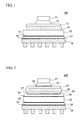
- FIG. 1 shows a schematic cross section of a basic form of the power module according to the invention.
- a power module 100 is a 9-stage power module comprised of, from top to bottom: a power device 11 such as an IGBT chip; a metal wiring board 13 disposed on the lower surface of the power device 11 via a first solder layer 12; a metal heat dissipating plate 15 disposed on the lower surface of the metal wiring board 13 via a resin-based insulating layer 14 of thermoplastic polyimide or the like; an Ni plated layer 16 formed on the lower surface of the metal heat dissipating plate 15; a solder layer or a silicone grease layer 17; an Ni plated layer 18; and a heat sink 19, on which the Ni plated layer 18 is formed.
- a power device 11 such as an IGBT chip
- a metal wiring board 13 disposed on the lower surface of the power device 11 via a first solder layer 12
- a metal heat dissipating plate 15 disposed on the lower surface of the metal wiring board
- the heat generated by the IGBT chip is conducted by the individual layers before it is dissipated via the heat sink into water or to the air.
- the present invention also advantageously allows the use of a metal heat dissipating plate made of Cu, which is inexpensive and of which there is not much price fluctuations.
- Fig. 2 shows a schematic cross section of a variation of the power module according to the invention.
- the ceramic insulating material of the conventional structure is replaced by a resin-based insulating material.
- a power module 200 is comprised of, from top to bottom: a power device 21 such as an IGBT chip; a first solder layer 22 disposed on the lower surface of the power device 21; an Ni plated layer 23; a metal wiring board 24; a metal plate 26 disposed on the lower surface of the metal wiring board via a resin-based insulating layer 25; an Ni plated layer 27; a second solder layer 28; an Ni plated layer 29; a metal heat dissipating plate 30; an Ni plated layer 31; a third solder layer or a silicone grease layer 32; and a heat sink 34 disposed via an Ni plated layer 33.
- the heat generated by the IGBT chip is conducted by the individual layers before it is dissipated via the heat sink into water or to the air.
- a power module 300 includes, from top to bottom: a power device 36 such as an IGBT chip; a metal wiring board/metal heat dissipating plate 40 disposed on the lower surface of the power device 36 via a first solder layer 38 and an Ni plated layer 39; a metal plate 42 disposed on the lower surface of the metal wiring board/metal heat dissipating plate 40 via a resin-based insulating layer 41; an Ni plated layer 43 disposed on the lower surface of the metal plate 42; a third solder layer or a silicone grease layer 44; and a heat sink 46 disposed via an Ni plated layer 45.
- a power device 36 such as an IGBT chip
- a metal wiring board/metal heat dissipating plate 40 disposed on the lower surface of the power device 36 via a first solder layer 38 and an Ni plated layer 39
- a metal plate 42 disposed on the lower surface of the metal wiring board/metal heat dissipating plate 40 via a resin-based insulating layer 41
- the heat generated by the IGBT chip is conducted by the individual layers and before it is dissipated via the heat sink into water or to the air.
- Fig. 4 shows a schematic cross section of another variation of the power module of the invention.
- the heat sink and the heat dissipating plate of the foregoing basic structure are combined.
- a power module 400 is comprised of, from top to bottom: a power device 47 such as an IGBT chip; a first solder layer 49 disposed on the lower surface of the power device 47; a metal wiring board 51 disposed via an Ni plated layer 50; and a heat sink/metal heat dissipating plate 53 disposed on the lower surface of the metal wiring board 51 via a resin-based insulating layer 52.
- the heat generated by the IGBT chip is conducted by the individual layers before it is dissipated via the heat sink into water or to the air.
- the problems of prior art include the following.
- the present invention does not require soldering for the bonding with the lower heat dissipating plate or the like. Therefore, no metal plate is required at the bottom of the insulating material.
- the type of metal that can be bonded to the resin insulating material such as polyimide, is not limited to aluminum but may be Cu or other general-purpose metal.
- the invention offers another advantage that metals having high wettability, such as Cu, do not require Ni plating.
- thermoplastic polyimide material has a very low Young's modulus such that it does not break when subjected to bending stress but instead absorbs the bending stress, thus preventing the device from being affected by such stress.
- the invention offers the advantage that the heat dissipating plate can be made of a general-purpose metal that has high thermal expansion and is inexpensive, such as copper or aluminum.
- thermoplastic polyimide suitable as a resin-based insulating material for the invention will be described.
- the thermoplastic polyimide is preferably an aromatic polyimide.
- Aromatic polyimides are a condensation product of an aromatic tetracarboxylic acid with an aliphatic or aromatic diamine. They are typically obtained by producing an amide acid by the condensation polymerization of tetracarboxylic acid dianhydride, such as pyromellitic acid dianhydride or biphenyltetracarboxylic acid dianhydride, and diamine, such as paraphenylene diamine or diaminodiphenyl ether, followed by ring-closing curing by heat or a catalyst.
- Such thermoplastic polyimide can be obtained by copolymerization of the following compounds, for example.
- dicarboxylic anhydride examples include: pyromellitic acid dianhydride; 4,4'-oxydiphthalic acid dianhydride; 3,3',4,4'-benzophenonetetracarboxylic acid dianhydride; 3,3',4,4'-biphenyltetracarboxylic acid dianhydride; 2,2',3,3'biphenyltetracarboxylic acid dianhydride; 2,2'-bis(3,4-dicarboxyphenyl)hexafuluoropropane dianhydride; bis(3,4-dicarboxyphenyl)sulfone dianhydride; bis(3,4-dicarboxyphenyl)sulfide dianhydride; bis(2,3-dicarboxyphenyl)methane dianhydride; bis(3,4-dicarboxyphenyl)methane dianhydride; 1,1-bis(2,3-dicarboxyphenyl)methane dianhydr
- diamine examples include: hexamethylenediamine; heptamethylenediamine; 3,3'-dimethylpentamethylene diamine; 3-methylhexamethylenediamine; 3-methylheptamethylenediamine; 2,5-dimethylhexamethylenediamine; octamethylenediamine; nonamethylenediamine; 1,1,6,6-tetramethylhexamethylenediamine; 2,2,5,5-tetramethylhexamethylenediamine; 4,4-dimethylheptamethylenediamine; decamethylenediamine; m-phenylenediamine; 4,4'-diaminobenzophenone; 4-aminophenyl-3-aminobenzoate; m-aminobenzoil-p-aminoanilide; 4,4'-diaminodiphenyl ether; 3,4'-diaminodiphenyl ether; bis(4-aminophenyl)methane; 1,1-bis(
- thermoplastic polyimide used in the present invention are a copolymer of 1,3-bis(4-aminophenoxy)benzene (abbreviated as RODA), pyromellitic acid dianhydride (abbreviated as PMDA), and 4,4'-oxydiphthalic acid dianhydride (ODPA), a copolymer of 4,4'-diaminodiphenyl ether (abbreviated as ODA) and 3,3'4,4'-biphenyltetracarboxylic acid dianhydride (abbreviated as BPDA), a copolymer of ODA, PMDA, and BPDA, and a copolymer of 3,3', 4,4'-benzophenonetetracarboxylic acid dianhydride (BTDA), PMDA, and 2,2'-bis[4-(4-aminophenoxy)phenyl)]propane (abbreviated as BAPP).
- RODA 1,3-bis(4-aminoph
- the glass transition temperature of the thermoplastic polyimide, which is softened when heated is from 200°C to 350°C and more preferably from 210°C to 300°C.
- the mounting structure of the power device can be simplified and a cost reduction can be achieved and, in addition, improvements in heat dissipation and the reliability of the module can be achieved.
- a resin-based insulating material in the heat-dissipating structure of a power module instead of the conventional ceramic insulating material
- the mounting structure of the power device can be simplified and a cost reduction can be achieved and, in addition, improvements in heat dissipation and the reliability of the module can be achieved.
- the mounting structure of a power device is simplified so as to reduce cost while achieving improvements in heat dissipation and reliability.
- a power module 100 is comprised of a metal wiring board 13, a power device 11 disposed on an upper surface of the metal wiring board 13 via a solder layer 12, a metal heat dissipating plate 15 disposed on a lower surface of the metal wiring board 13, and a heat sink 19 disposed on a lower surface of the metal heat dissipating plate 15.
- a resin-based insulating layer 14 is disposed between any desired two of the aforementioned layers.
Landscapes
- Cooling Or The Like Of Semiconductors Or Solid State Devices (AREA)
- Structure Of Printed Boards (AREA)
- Inverter Devices (AREA)
Applications Claiming Priority (1)
| Application Number | Priority Date | Filing Date | Title |
|---|---|---|---|
| JP2006115823A JP2007288054A (ja) | 2006-04-19 | 2006-04-19 | パワーモジュール |
Publications (2)
| Publication Number | Publication Date |
|---|---|
| EP1848036A2 true EP1848036A2 (fr) | 2007-10-24 |
| EP1848036A3 EP1848036A3 (fr) | 2010-04-14 |
Family
ID=38051809
Family Applications (1)
| Application Number | Title | Priority Date | Filing Date |
|---|---|---|---|
| EP07105036A Withdrawn EP1848036A3 (fr) | 2006-04-19 | 2007-03-27 | Module d'alimentation |
Country Status (4)
| Country | Link |
|---|---|
| US (1) | US20070284731A1 (fr) |
| EP (1) | EP1848036A3 (fr) |
| JP (1) | JP2007288054A (fr) |
| CN (1) | CN101068009B (fr) |
Families Citing this family (15)
| Publication number | Priority date | Publication date | Assignee | Title |
|---|---|---|---|---|
| JP4180980B2 (ja) * | 2003-06-10 | 2008-11-12 | 本田技研工業株式会社 | 半導体装置 |
| JP2009130060A (ja) * | 2007-11-21 | 2009-06-11 | Toyota Industries Corp | 放熱装置 |
| JP5070014B2 (ja) * | 2007-11-21 | 2012-11-07 | 株式会社豊田自動織機 | 放熱装置 |
| JP4881971B2 (ja) * | 2009-03-26 | 2012-02-22 | 株式会社豊田自動織機 | 半導体装置 |
| JP4977165B2 (ja) * | 2009-04-01 | 2012-07-18 | トヨタ自動車株式会社 | 3相ブラシレスモータのノイズ低減構造 |
| US20120126393A1 (en) * | 2009-07-03 | 2012-05-24 | Mitsui Chemicals, Inc. | Resin composition, multilayer body containing the same, semiconductor device, and film |
| JP5546889B2 (ja) * | 2010-02-09 | 2014-07-09 | 日本電産エレシス株式会社 | 電子部品ユニット及びその製造方法 |
| JP2012119597A (ja) * | 2010-12-03 | 2012-06-21 | Mitsubishi Electric Corp | 半導体装置及びその製造方法 |
| JP6154987B2 (ja) * | 2011-09-22 | 2017-06-28 | 新電元工業株式会社 | 半導体装置 |
| CN103295980B (zh) * | 2012-03-05 | 2016-01-13 | 上海沪通企业集团有限公司 | 单管igbt封装全桥模块及其封装方法 |
| JP6032254B2 (ja) * | 2013-10-11 | 2016-11-24 | 大日本印刷株式会社 | パワーモジュール用金属配線付基板、パワーモジュール及びパワーモジュール用基板、並びにパワーモジュール用金属配線付基板の製造方法 |
| KR20170039431A (ko) * | 2015-10-01 | 2017-04-11 | 현대자동차주식회사 | 솔더링 접합방식 인버터 및 이를 적용한 하이브리드 차량 |
| JP2019169619A (ja) * | 2018-03-23 | 2019-10-03 | 三菱マテリアル株式会社 | 金属ベース基板およびモジュール |
| TW202005020A (zh) * | 2018-05-28 | 2020-01-16 | 艾姆勒車電股份有限公司 | Igbt模組散熱結構 |
| JP7463909B2 (ja) * | 2020-08-25 | 2024-04-09 | 株式会社デンソー | 半導体装置及びその製造方法 |
Family Cites Families (19)
| Publication number | Priority date | Publication date | Assignee | Title |
|---|---|---|---|---|
| JPS5645060A (en) * | 1979-09-21 | 1981-04-24 | Hitachi Ltd | Semiconductor device |
| JP2925722B2 (ja) * | 1990-11-30 | 1999-07-28 | 三井化学株式会社 | ハーメチックシール型電気回路装置 |
| US5395679A (en) * | 1993-03-29 | 1995-03-07 | Delco Electronics Corp. | Ultra-thick thick films for thermal management and current carrying capabilities in hybrid circuits |
| JP3201277B2 (ja) * | 1996-09-11 | 2001-08-20 | 株式会社日立製作所 | 半導体装置 |
| JPH11204700A (ja) * | 1998-01-19 | 1999-07-30 | Hitachi Ltd | 放熱フィン一体型パワーモジュール |
| JPH11225459A (ja) * | 1998-02-05 | 1999-08-17 | Matsushita Electric Ind Co Ltd | モータ制御装置 |
| US6165612A (en) * | 1999-05-14 | 2000-12-26 | The Bergquist Company | Thermally conductive interface layers |
| JP2002110867A (ja) * | 2000-10-02 | 2002-04-12 | Toshiba Corp | 半導体装置及びその製造方法 |
| US6707671B2 (en) * | 2001-05-31 | 2004-03-16 | Matsushita Electric Industrial Co., Ltd. | Power module and method of manufacturing the same |
| JP3676268B2 (ja) * | 2001-08-01 | 2005-07-27 | 株式会社日立製作所 | 伝熱構造体及び半導体装置 |
| JP2003168769A (ja) * | 2001-11-30 | 2003-06-13 | Mitsubishi Electric Corp | 電力用半導体装置 |
| US6848172B2 (en) * | 2001-12-21 | 2005-02-01 | Intel Corporation | Device and method for package warp compensation in an integrated heat spreader |
| JP2003218298A (ja) * | 2002-01-18 | 2003-07-31 | Ikeda Electric Co Ltd | パワーモジュールの放熱構造 |
| WO2004015768A1 (fr) * | 2002-08-09 | 2004-02-19 | Sekisui Chemical Co., Ltd. | Dispositif de dissipation thermique et structure assemblee |
| JP3740116B2 (ja) * | 2002-11-11 | 2006-02-01 | 三菱電機株式会社 | モールド樹脂封止型パワー半導体装置及びその製造方法 |
| DE10327530A1 (de) * | 2003-06-17 | 2005-01-20 | Electrovac Gesmbh | Vorrichtung mit wenigstens einer von einem zu kühlenden Funktionselement gebildeten Wärmequelle, mit wenigstens einer Wärmesenke und mit wenigstens einer Zwischenlage aus einer thermischen leitenden Masse zwischen der Wärmequelle und der Wärmesenke sowie thermische leitende Masse, insbesondere zur Verwendung bei einer solchen Vorrichtung |
| JP2005064291A (ja) * | 2003-08-14 | 2005-03-10 | Nissan Motor Co Ltd | 絶縁シートおよびこの絶縁シートを用いた半導体装置組立体 |
| JP4046120B2 (ja) * | 2005-01-27 | 2008-02-13 | 三菱電機株式会社 | 絶縁シートの製造方法およびパワーモジュールの製造方法 |
| JP2006253183A (ja) * | 2005-03-08 | 2006-09-21 | Hitachi Ltd | 半導体パワーモジュール |
-
2006
- 2006-04-19 JP JP2006115823A patent/JP2007288054A/ja active Pending
-
2007
- 2007-03-15 US US11/724,188 patent/US20070284731A1/en not_active Abandoned
- 2007-03-27 EP EP07105036A patent/EP1848036A3/fr not_active Withdrawn
- 2007-04-13 CN CN200710096419.1A patent/CN101068009B/zh not_active Expired - Fee Related
Also Published As
| Publication number | Publication date |
|---|---|
| JP2007288054A (ja) | 2007-11-01 |
| CN101068009A (zh) | 2007-11-07 |
| US20070284731A1 (en) | 2007-12-13 |
| EP1848036A3 (fr) | 2010-04-14 |
| CN101068009B (zh) | 2010-11-03 |
Similar Documents
| Publication | Publication Date | Title |
|---|---|---|
| EP1848036A2 (fr) | Module d'alimentation | |
| EP2325000B1 (fr) | Film de polyimide hautement thermo-conducteur, stratifié blindé hautement thermo-conducteur et procédé de production associé | |
| CN101939396B (zh) | 电子部件用粘合剂组合物及使用其的电子部件用粘合剂片材 | |
| JP3312723B2 (ja) | 熱伝導シート状物とその製造方法及びそれを用いた熱伝導基板とその製造方法 | |
| JP4725581B2 (ja) | 放熱配線基板とそれを用いた電気機器 | |
| US6310391B1 (en) | Mounted structure of circuit board and multi-layer circuit board therefor | |
| US20070148467A1 (en) | Thermal management circuit materials, method of manufacture thereof, and articles formed therefrom | |
| JP5442491B2 (ja) | 熱伝導性金属−絶縁樹脂基板及びその製造方法 | |
| EP1249863A1 (fr) | Bande adhesive destinee a etre utilisee pour un substrat de connexion de semi-conducteurs et feuille stratifiee revetue de cuivre utilisant ladite bande | |
| JP2015043417A (ja) | パワーモジュール用金属配線基板、パワーモジュール及びパワーモジュール用基板、並びにパワーモジュール用金属配線基板の製造方法 | |
| JP2012213900A (ja) | 熱伝導性ポリイミド−金属基板 | |
| WO2012133098A1 (fr) | Dispositif à semi-conducteur et son procédé de fabrication | |
| JP5643536B2 (ja) | 熱伝導性接着樹脂組成物、それを含む積層体および半導体装置 | |
| JP2006319074A (ja) | Led実装用基板およびその製造方法 | |
| JP2008192787A (ja) | 熱伝導基板とこれを用いた回路モジュールとその製造方法 | |
| JP2011211190A (ja) | 積層構造体及びその製造方法 | |
| JPH046893A (ja) | パッケージ | |
| JP2000160007A (ja) | 熱融着性ポリイミド樹脂フィルム及びこれを用いた半導体装置並びに多層配線板。 | |
| JP4642479B2 (ja) | Cof用積層板及びcofフィルムキャリアテープ | |
| JP4178934B2 (ja) | 耐熱性積層フィルムおよび金属層付き積層フィルム、ならびにこれらを用いた半導体装置 | |
| JP3369016B2 (ja) | 放熱板付リードフレーム及びそれを用いた半導体装置 | |
| US12402246B2 (en) | Circuit board | |
| JP3752372B2 (ja) | ポリイミド接着フィルム | |
| CN102870512A (zh) | 安装基板用散热层压材料 | |
| JP2007116134A (ja) | 半導体用テープ、半導体用接着剤付きテープ、半導体集積回路接続用基板および半導体装置 |
Legal Events
| Date | Code | Title | Description |
|---|---|---|---|
| PUAI | Public reference made under article 153(3) epc to a published international application that has entered the european phase |
Free format text: ORIGINAL CODE: 0009012 |
|
| 17P | Request for examination filed |
Effective date: 20070327 |
|
| AK | Designated contracting states |
Kind code of ref document: A2 Designated state(s): AT BE BG CH CY CZ DE DK EE ES FI FR GB GR HU IE IS IT LI LT LU LV MC MT NL PL PT RO SE SI SK TR |
|
| AX | Request for extension of the european patent |
Extension state: AL BA HR MK YU |
|
| PUAL | Search report despatched |
Free format text: ORIGINAL CODE: 0009013 |
|
| AK | Designated contracting states |
Kind code of ref document: A3 Designated state(s): AT BE BG CH CY CZ DE DK EE ES FI FR GB GR HU IE IS IT LI LT LU LV MC MT NL PL PT RO SE SI SK TR |
|
| AX | Request for extension of the european patent |
Extension state: AL BA HR MK RS |
|
| AKX | Designation fees paid |
Designated state(s): DE FR GB |
|
| STAA | Information on the status of an ep patent application or granted ep patent |
Free format text: STATUS: THE APPLICATION IS DEEMED TO BE WITHDRAWN |
|
| 18D | Application deemed to be withdrawn |
Effective date: 20101015 |