EP1848037A2 - Lichtemittierende Vorrichtung - Google Patents
Lichtemittierende Vorrichtung Download PDFInfo
- Publication number
- EP1848037A2 EP1848037A2 EP07103120A EP07103120A EP1848037A2 EP 1848037 A2 EP1848037 A2 EP 1848037A2 EP 07103120 A EP07103120 A EP 07103120A EP 07103120 A EP07103120 A EP 07103120A EP 1848037 A2 EP1848037 A2 EP 1848037A2
- Authority
- EP
- European Patent Office
- Prior art keywords
- light emitting
- wall
- package
- emitting device
- lead frames
- Prior art date
- Legal status (The legal status is an assumption and is not a legal conclusion. Google has not performed a legal analysis and makes no representation as to the accuracy of the status listed.)
- Granted
Links
Images


Classifications
-
- H—ELECTRICITY
- H10—SEMICONDUCTOR DEVICES; ELECTRIC SOLID-STATE DEVICES NOT OTHERWISE PROVIDED FOR
- H10H—INORGANIC LIGHT-EMITTING SEMICONDUCTOR DEVICES HAVING POTENTIAL BARRIERS
- H10H20/00—Individual inorganic light-emitting semiconductor devices having potential barriers, e.g. light-emitting diodes [LED]
- H10H20/80—Constructional details
- H10H20/85—Packages
-
- H—ELECTRICITY
- H10—SEMICONDUCTOR DEVICES; ELECTRIC SOLID-STATE DEVICES NOT OTHERWISE PROVIDED FOR
- H10H—INORGANIC LIGHT-EMITTING SEMICONDUCTOR DEVICES HAVING POTENTIAL BARRIERS
- H10H20/00—Individual inorganic light-emitting semiconductor devices having potential barriers, e.g. light-emitting diodes [LED]
- H10H20/80—Constructional details
- H10H20/85—Packages
- H10H20/8506—Containers
-
- H—ELECTRICITY
- H10—SEMICONDUCTOR DEVICES; ELECTRIC SOLID-STATE DEVICES NOT OTHERWISE PROVIDED FOR
- H10H—INORGANIC LIGHT-EMITTING SEMICONDUCTOR DEVICES HAVING POTENTIAL BARRIERS
- H10H20/00—Individual inorganic light-emitting semiconductor devices having potential barriers, e.g. light-emitting diodes [LED]
- H10H20/80—Constructional details
- H10H20/85—Packages
- H10H20/852—Encapsulations
- H10H20/853—Encapsulations characterised by their shape
-
- H—ELECTRICITY
- H10—SEMICONDUCTOR DEVICES; ELECTRIC SOLID-STATE DEVICES NOT OTHERWISE PROVIDED FOR
- H10H—INORGANIC LIGHT-EMITTING SEMICONDUCTOR DEVICES HAVING POTENTIAL BARRIERS
- H10H20/00—Individual inorganic light-emitting semiconductor devices having potential barriers, e.g. light-emitting diodes [LED]
- H10H20/80—Constructional details
- H10H20/85—Packages
- H10H20/857—Interconnections, e.g. lead-frames, bond wires or solder balls
-
- H—ELECTRICITY
- H10—SEMICONDUCTOR DEVICES; ELECTRIC SOLID-STATE DEVICES NOT OTHERWISE PROVIDED FOR
- H10H—INORGANIC LIGHT-EMITTING SEMICONDUCTOR DEVICES HAVING POTENTIAL BARRIERS
- H10H20/00—Individual inorganic light-emitting semiconductor devices having potential barriers, e.g. light-emitting diodes [LED]
- H10H20/80—Constructional details
- H10H20/85—Packages
- H10H20/855—Optical field-shaping means, e.g. lenses
- H10H20/856—Reflecting means
-
- H—ELECTRICITY
- H10—SEMICONDUCTOR DEVICES; ELECTRIC SOLID-STATE DEVICES NOT OTHERWISE PROVIDED FOR
- H10W—GENERIC PACKAGES, INTERCONNECTIONS, CONNECTORS OR OTHER CONSTRUCTIONAL DETAILS OF DEVICES COVERED BY CLASS H10
- H10W72/00—Interconnections or connectors in packages
- H10W72/50—Bond wires
- H10W72/531—Shapes of wire connectors
- H10W72/536—Shapes of wire connectors the connected ends being ball-shaped
-
- H—ELECTRICITY
- H10—SEMICONDUCTOR DEVICES; ELECTRIC SOLID-STATE DEVICES NOT OTHERWISE PROVIDED FOR
- H10W—GENERIC PACKAGES, INTERCONNECTIONS, CONNECTORS OR OTHER CONSTRUCTIONAL DETAILS OF DEVICES COVERED BY CLASS H10
- H10W72/00—Interconnections or connectors in packages
- H10W72/50—Bond wires
- H10W72/531—Shapes of wire connectors
- H10W72/5363—Shapes of wire connectors the connected ends being wedge-shaped
-
- H—ELECTRICITY
- H10—SEMICONDUCTOR DEVICES; ELECTRIC SOLID-STATE DEVICES NOT OTHERWISE PROVIDED FOR
- H10W—GENERIC PACKAGES, INTERCONNECTIONS, CONNECTORS OR OTHER CONSTRUCTIONAL DETAILS OF DEVICES COVERED BY CLASS H10
- H10W90/00—Package configurations
-
- H—ELECTRICITY
- H10—SEMICONDUCTOR DEVICES; ELECTRIC SOLID-STATE DEVICES NOT OTHERWISE PROVIDED FOR
- H10W—GENERIC PACKAGES, INTERCONNECTIONS, CONNECTORS OR OTHER CONSTRUCTIONAL DETAILS OF DEVICES COVERED BY CLASS H10
- H10W90/00—Package configurations
- H10W90/701—Package configurations characterised by the relative positions of pads or connectors relative to package parts
- H10W90/751—Package configurations characterised by the relative positions of pads or connectors relative to package parts of bond wires
- H10W90/756—Package configurations characterised by the relative positions of pads or connectors relative to package parts of bond wires between a chip and a stacked lead frame, conducting package substrate or heat sink
-
- Y—GENERAL TAGGING OF NEW TECHNOLOGICAL DEVELOPMENTS; GENERAL TAGGING OF CROSS-SECTIONAL TECHNOLOGIES SPANNING OVER SEVERAL SECTIONS OF THE IPC; TECHNICAL SUBJECTS COVERED BY FORMER USPC CROSS-REFERENCE ART COLLECTIONS [XRACs] AND DIGESTS
- Y10—TECHNICAL SUBJECTS COVERED BY FORMER USPC
- Y10S—TECHNICAL SUBJECTS COVERED BY FORMER USPC CROSS-REFERENCE ART COLLECTIONS [XRACs] AND DIGESTS
- Y10S362/00—Illumination
- Y10S362/80—Light emitting diode
Definitions
- the present invention relates to a light emitting device, and more particularly relates to a surface mount type of light emitting device that is compact and lightweight.
- Light emitting devices that are compact, have good sensitivity, and have light emitting elements with high brightness and high output have been developed and put to use in various fields in recent years. Because of their compact size, low power consumption, light weight, and other advantages, such light emitting devices have been used, for example, for light sources in portable telephones and liquid crystal backlights, as light sources for various kinds of meter, and as various kinds of read-out sensor.
- a light source used for a backlight needs to have a thin construction so that the device in which it is used can be made more compact and lightweight. Therefore, the light emitting device used as the light source must itself be compact in size, and to this end a variety of light emitting devices have been developed in a configuration called a side view type (for example, JP-2006-24345-A ).
- a side view type is generally configured such that an opening for releasing light is formed in a side face of a package, a light emitting diode chip is mounted on the bottom face of the package, and part of a lead frame is taken as an external terminal from the inside of the package to the outside.
- the low strength of the package may cause it to bend or chip, and this lowers the yield.
- a package is formed by performing injection molding, compression molding, or the like, but a phenomenon called a short shot can occur in which the molding material does not reach all the way into the corners of the mold cavity and the cavity is not completely filled.
- a light emitting device comprising:
- the chipping and bending of a package due to low package strength are prevented, and deformation caused by thermal expansion is also prevented, which ensures good mechanical strength and improves handling and yield.
- the thinner and more compact size desired in the past can be achieved by utilizing the space inside the light emitting device more efficiently, and the mounting space accounted for by the device can be kept to a minimum.
- the occurrence of "short shot” can be prevented, and the package material can be prevented from leaking out from the lead frame portions, which makes manufacture easier and allows a light emitting device of higher quality to be obtained.
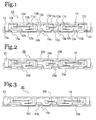
- the light emitting device embodying the present invention mainly comprises light emitting elements 11a, 11b, and 11c, lead frames 12a to 12f, one end of which functions as a lead terminal, and a package 13.
- the light emitting elements are generally semiconductor light emitting elements, especially, any semiconductor light emitting elements may be used so long as they are elements called light emitting diodes.
- it includes a laminated structure that contains an active layer above a substrate, which is made of nitride semiconductors such as InN, AlN, GaN, InGaN, AlGaN, and InGaAlN, and compound semiconductors of a group III-V elements, II-VI elements, and the like.
- the structures of semiconductor includes homostructures having MIS junctions, PIN junctions, or PN junctions or the like, heterostructures, and double heterostructures.
- a multilayer laminate structure or an ultra lattice structure are also acceptable, as are a single quantum well structure or a multiquantum well structure laminated as a thin film which generates quantum effects.
- the active layer may contain a donor impurity such as Si, Ge, or the like, and acceptor impurity such as An, Mg, or the like.
- a wave length of the obtained light emitting element may be changed from ultraviolet to red region depending on a material of the semiconductor, a mixed crystal rate, In content of the active layer, kind of the impurity doped in the active layer.
- the light emitting elements are mounted on the lead frames (discussed below), and a joining material is used for this purpose.
- a joining material is used for this purpose.
- an epoxy resin, silicone, or the like can be used.
- the back side of the light emitting elements may be plated with aluminum, or instead of using a resin, a solder such as eutectic Au-Sn, or a brazing material such as a low-melting point metal may be used.
- die bonding may be performed using a conductive paste made of silver, gold, palladium, or the like.
- the light emitting device embodying the present invention may comprise just one light emitting element, or a plurality of them may be mounted. In the latter case, a plurality of light emitting elements that emit light of the same color may be combined. Color reproduction can be enhanced by combining a plurality of light emitting elements that emit light of different colors, so as to handle RBG, for instance. Also, luminosity can be increased by combining a plurality of light emitting elements of the same emission color.
- the lead frames are electrodes used for electrically connecting to the light emitting elements, and may be substantially flat, or may be undulating, or may be in the form of a bumpy sheet.
- a material with a relatively high thermal conductivity is preferable. Forming from such a material allows the heat generated by the light emitting elements to escape more efficiently.
- examples include copper, aluminum, gold, silver, tungsten, iron, nickel, and other such metals, and alloys such as iron-nickel or phosphor bronze.
- the surface of the lead frames is preferably given a reflective plating so that the light from the mounted light emitting elements can be taken off more efficiently.
- the size, thickness, shape, and so forth of the lead frames can be suitably adjusted after taking into account the size, shape, and so forth of the light emitting device to be obtained.
- burrs and the like are moved from the portions of the lead frames that will come into contact with the side walls of the package, or from portions near the package, and if these edge portions are rounded. This allows the lead terminals to be worked as desired, without sacrificing the shape of the package.
- Each lead frame has a region in which a light emitting element is disposed inside the package (discussed below) and/or a region that is disposed inside the package and that is electrically connected to a light emitting element, and a region that protrudes from one face or side of the package and functions as a lead terminal.
- two or more lead frames are provided to a single light emitting device, and it is good for their to be one more lead frame than there are light emitting elements, or for there to be at least twice as many lead frames as light emitting elements. For instance, if just one light emitting element is used, the light emitting element is mounted on one of the lead frames, an electrical connection is made with one of the electrodes of the light emitting element, and the other lead frame is electrically connected with the other electrode of the light emitting element.
- each light emitting element may be mounted on and electrically connected to a separate lead frame, and other lead frames may be electrically connected to each of the light emitting elements.
- each light emitting element may be mounted on and electrically connected to a separate lead frame, and other lead frames may be electrically connected to each of the light emitting elements.
- three light emitting elements are used that correspond to RGB, and the RGB elements are independently driven, one common terminal and three independent terminals can be provided.
- the heat dissipation paths of the various light emitting elements can be formed without overlapping, so the heat generated from the light emitting elements can be dissipated more evenly, resulting in better heat radiation.
- the lead frames There are no particular restrictions on the material, shape, size, thickness, and so forth of the lead frames, but they must be made of a material that allows the proper amount of electrical power to be supplied to the light emitting elements.
- the other end of a lead frame may also be made to protrude from a package portion (such as the opposite side) that is different from the face or side where part of the lead frame protrudes.
- This lead frame may be one that is not electrically connected to a light emitting element and on which no light emitting element is mounted, or a light emitting element may just be mounted without being electrically connected.
- the other end of the lead frame preferably has a larger surface area than the portion that functions as a lead terminal. This allows this end to function as a heat dissipation path for guiding the heat produced by the light emitting element in the package to the outside, or as a means for dealing with over-voltage.
- the lead terminal and the other end of the lead frames there are no particular restrictions on the size and shape of the lead terminal and the other end of the lead frames, and as long as these extend outside the package (discussed below), for example, they can be suitably adjusted according to the heat dissipating capability of the light emitting elements mounted in the light emitting device and the mode in which the light emitting device will be used (installation space, installation location, etc.). Also, the other end and the lead terminal can be suitably bent or deformed according to the usage mode, such as the positional relationship with other electronic devices. However, it is good if the lead frame protruding beyond the package is accommodated in a concave portion formed in the surface of the package wall (discussed below). In this case, it is preferable if all or part of the lead frame is accommodated in the concave portion, as discussed below.
- the package may be formed of any material as long as the package protects the light emitting elements and is formed integrally with the lead frames, and insulation of the light emitting elements and the lead frames can be ensured.
- thermoplastic resins, thermosetting resins, and so forth can be used, specific examples of which include polyphthalamide (PPA), polycarbonate resin, polyphenylene sulfide (PPS), liquid crystal polymer (LCP), ABS resin, epoxy resin, phenol resin, acrylic resin, PBT resin, and other such resins, and ceramics.
- PPA polyphthalamide
- PPS polyphenylene sulfide
- LCP liquid crystal polymer
- ABS resin epoxy resin
- phenol resin phenol resin
- acrylic resin acrylic resin
- PBT resin polyBT resin
- ceramics Various kinds of dye, pigment, or the like may also be mixed into these materials as colorants or light diffusers.
- the package usually has an opening (discussed below) that is filled with a translucent covering material, so it is preferable to select materials with little different in their coefficients of thermal expansion, taking into account factors such as adhesion between the translucent covering material and the package that has been subjected to the effects of heat produced from the light emitting elements and so forth.
- the external shape in plan view may, for example, be circular, elliptical, triangular, quadrangular, polygonal, or some other shape that is close to these. Of these, a shape that is extended in the lengthwise direction is preferable.
- an opening for mounting the light emitting elements is formed in the surface of the package.
- the shape of this opening may be a circular, elliptical, triangular, quadrangular, or polygonal column, or may be dome-shaped, arm-shaped, etc., or a shape that is close to these. This allows light from the light emitting elements to be reflected by the walls inside the package, and to be taken off more efficiently in the front direction.
- the size, depth, and so forth of the opening can be suitably determined according to the number of light emitting elements to be mounted, the bonding method, and so on. Subjecting the bottom face and/or side faces of this opening to embossing, plasma treatment, or the like increases the adhesion surface area and improves adhesion with the translucent covering member (discussed below).
- a concave portion is formed in the outer surface of at least the part of the package wall in which the opening is located.
- the concave portion here preferably drops down to the inner surface of the package wall and is formed so that a convex portion is formed on the inner surface. This concave portion allows the space inside the light emitting device (such as dead space) to be utilized more effectively, and this affords a more compact light emitting device.
- the concave portion there are no particular restrictions on the size and shape of the concave portion, but it should ensure a space large enough for the part of the lead frame protruding outward from the package to be accommodated in this concave portion.
- it is large enough that to accommodate the part of the lead frame protruding outward from the package and for part of the surface to be in the same plane as the outer surface of the package wall.
- “In the same plane” here means that the lead terminal and a circuit board or other such mounting substrate are in electrical contact merely by placement on the circuit board, and the concave portion is flat enough to allow stable fixing.
- the height difference need not be strictly zero, however, and about ⁇ 2 mm is permissible.
- the package is preferably such that the package walls constituting the opening (the walls across from each other in the widthwise direction, pointed by arrows) are equipped with first walls A across from the light emitting element, second walls C that are raised up by a step from the first walls A, and third walls B that link the first walls A and the second walls C.
- the first wall A is the thinnest wall, formed around the periphery of the light emitting element, and the second wall C and third wall B are formed thicker than the first wall A.
- the “step” referred to here means that there is a stepped height differences on the inner wall face of the package.
- this height difference can be suitably adjusted according to the size of the light emitting device and the light emitting elements and other such factors, but an example is about 0.03 to 0.2 mm.
- This height difference is constituted by the first wall and second wall, and the first wall refers to the wall portion closest to the light emitting element.
- the third wall links the other two walls over this height difference step.
- the third wall is formed at a slope of at least 0.2, at least 0.25, at least 0.3, at least 0.35, at least 0.4, or at least 0.5, or for it to be linked to the first wall or second wall at an angle of 90° to 170°, 90° to 160°, 90° to 150°, or 90° to 148°.
- the thickness change at the angles in the above range is preferable for the second wall is preferably formed by a plane.
- the first wall which is the thinnest peripheral portion of the light emitting element, is favorably a plane, and in terms of ensuring a compact size for the light emitting device, it is favorable for this wall to be within a range up to about five times the width of the light emitting element, a range up to about four times, or a range up to about three times.
- the third wall is not necessarily constituted by a plane, but preferably includes a planar portion.
- the thicker portion (that is, the second wall and third wall of the package) is preferably the portion where the lead frame is disposed, or close thereto, but is not necessarily dependent on the location of the lead frame. For example, as shown by 53a in FIG. 5, it may be disposed in the vicinity of the peripheral part of the light emitting element. This allows the mechanical strength of the light emitting device itself to be increased even though the walls of the package are formed as thin films on the whole.
- the thicker portion is at least part of the wall constituting the concave portion.
- the molten package material is allowed to flow in by a known method, such as injection molding or compression molding, through a gate formed at a site corresponding to the lower face of the package, in a metal mold closed off by inserting a lead frame (preferably more than one), and this material is cured so that the parts are integrally molded.
- a lead frame preferably more than one
- a translucent covering material is usually injected around the light emitting element in the opening to seal the light emitting element, but because of the poor adhesion between the lead frame and package materials, the translucent covering material may leak out from the interface between the lead frame and package materials, and may leak through the package material and out to the adjacent terminal. If electroconductive dirt should adhere to the resin that leaks out, it can cause leakage and other such problems during the use of the device. If the lead frame is sandwiched at the portion corresponding to the wall constituting the concave portion, the uneven shape will lengthen the distance between electrodes on the package material, and this prevents the resin from leaking out to the adjacent electrode.
- the thicker wall is, but about 150 to 200% of the thickness of the other, thinner portion (for example, the thinnest portion of the package; the first wall) is favorable.
- the thicker portions may have a consistent thickness all the way in the depth direction of the opening (the direction leading from the top of the opening to the bottom), or the thickness may vary.
- a tapered shape (with the top of the opening being wider than the bottom) is particularly favorable.
- the taper angle but it may be about 0 to 45°, or about 10 to 30°, for example. This improves the light take-off efficiency.
- the taper angle of the thicker portion is smaller (if the slope is flatter) than that of the other portions of the package walls, then this portion can be made relatively thicker than the other portions of the package walls.
- the size of the light emitting device itself can be kept to a minimum, while it is possible to improve the strength of the package itself, the light take-off efficiency, and space utilization inside the light emitting device, all at the same time.
- the thicker portions of the walls are formed thicker by means of a taper angle that is different from that of other portions (including the first wall), the boundary between the thicker portions and the thin-film portions will have the same thickness at a point in the opening height direction, but there will be a step difference overall.
- the thicker portions do not necessarily have to have a tapered shape with the same taper angle, and there may be a plurality of portions of different thickness in the overall package.
- the first wall, second wall, and third wall are favorably set to a taper angle of 0 to 45°.
- the thicker portions may be formed thicker only in places by forming an uneven surface by embossing, texturing, or the like, or a plurality of thick film regions may be formed in the portion of the wall constituting the concave portion.
- a protective element other than a light emitting element may also be mounted in the light emitting device embodying the present invention. There may be just one protective element, or there may be two or more. There are no particular restrictions on the protective element, and any known type that is mounted in light emitting devices may be used. Specific examples include elements that protect against overheating, over-voltage, over-current, and static electricity, and circuit protection elements.
- the opening in which the light emitting element is located is preferably filled with a translucent covering material.
- This translucent covering material protects the light emitting element from external force, moisture, and so forth, and also protects wires.
- this translucent covering material include epoxy resin, silicone, acrylic resin, urea resin, and other transparent resins, glass, and so forth with excellent weather resistance.
- any moisture contained in the transparent resin can be released to the outside by baking for at least 14 hours at 100°C. Therefore, it is possible to prevent separation between the light emitting element and a molding member, and steam explosion.
- the translucent covering material may contain a diffuser or a fluorescent substance.
- a diffuser is an agent that diffuses light, and serves to lessen directionality from the light emitting element and to widen the viewing angle.
- a fluorescent substance is one that converts light from the light emitting element, and is able to convert the wavelength of light emitted from the light emitting element to the outside of the package.
- the light from the light emitting element is visible light with a short wavelength and high energy, then it is favorable to use an inorganic phosphorescent material such as ZnCdS:Cu, YAG:Ce, or nitrogen-containing CaO-Al 2 O 3 -SiO 2 that has been activated with europium and/or chromium, or a perylene derivative, which is an organic phosphorescent material.
- an inorganic phosphorescent material such as ZnCdS:Cu, YAG:Ce, or nitrogen-containing CaO-Al 2 O 3 -SiO 2 that has been activated with europium and/or chromium, or a perylene derivative, which is an organic phosphorescent material.
- the light emitting device 10 in this example comprises three light emitting elements 11a, 11b, and 11c corresponding to RGB, lead frames 12b, 12c, and 12e on which these light emitting elements are mounted and which are electrically connected by wires to one of the electrodes of the light emitting elements, three lead frames 12a, 12d, and 12f that are electrically connected by wires to the other electrode of these light emitting elements, and a package 13 that integrally fixes the lead frames 12a to 12f.
- the lead frames 12a to 12f are formed as flat pieces composed of an iron alloy of copper.
- the lead frames 12a to 12f each comprise a region in which a light emitting element is located, or which is electrically connected to a light emitting element, and a portion that protrudes from this region to the outside of the package and functions as a lead terminal.
- the lead frames 12a to 12f functioning as lead terminals are portions on the exterior of the package that have been worked into a suitable shape, and particularly worked by bending, and the portion that hits the wall of the package, or is disposed near the package, is deburred and its edges are rounded.
- the surface of the lead frames 12a to 12f is plated with silver so that the light from the light emitting elements can be taken off more efficiently.
- the package 13 has the lead frames 12a to 12f disposed on its bottom face, and is formed in an external shape that is close to being rectangular solid, with part of the lead frames 12a to 12f integrally fixed so as to protrude from the package.
- the package 13 has a substantially rectangular opening 14 formed near its center.
- the lead frames 12a to 12f are exposed in a row at the bottom inside the opening 14, the three light emitting elements 11a, 11b, and 11c corresponding to RGB are provided in a row, and the lead frames 12a, 12c, and 12e are connected by wires to one of the electrodes of the light emitting elements as a cathode.
- the lead frames 12b, 12d, and 12f are connected by wires to the other electrode of the light emitting elements as a anode.
- the side face of the wall of the package 13 varies in thickness from place to place.
- thin films 13a and 13c are formed on the wall of the package 13 in order to make the opening wider near the region where the light emitting elements 11a, 11b, and 11c are provided, and near the region electrically connected by wires, and thicker portions 13b and 13d are formed in the other regions.
- the thinner portion 13a, at the bottom faces, is formed in a thickness of about 0.1 mm, the thinner portion 13c about 0.12 mm, the thicker portion 13b about 0.2 mm, and the thicker portion 13d about 0.22 mm.
- the taper amount of the thinner portion 13a for example, is about 0.02 mm, the thinner portion 13c about 0.04 mm, the thicker portion 13b about 0.13 mm, and the thicker portion 13d about 0.1 mm. This ensures adequate strength in the package 13 while effectively utilizing the dead space in the interior, and thereby keeps the outer dimensions to a minimum.
- the portion near the lead frames 12a to 12f that protrude out from the package 13, that is the wall where the concave portions 15a and 15b are formed is formed as a thicker portion 13b, so leakage of package material from near the lead frames during the manufacture of the package can be effectively prevented.
- the thicker portion 13b and the thinner portion 13a differ by an angle of 135°.
- the side faces of the lead frames 12a to 12f are exposed on the outer surface of the package 13 in the portion where the thicker portion 13d is formed.
- the concave portions 15a and 15b are formed on the side face of the package 13. This concave portion 15a is cut out from the corner in the side face, and the concave portion 15b is in the form of an approximate groove in the side face. In particular, the concave portion 15b in the side face drops down to the inner surface so as to form a convex portion toward the inside the opening 14 in the package 13.
- the size of the concave portions is favorably such that the width is about 0.3 to 0.5 mm when the lengthwise direction of the package 13 is about 7.0 mm. This allows the lead frames 12a to 12f protruding from the package 13 to be accommodated in the concave portions 15a and 15b so that the outer surface of the lead frames 12a to 12f is in the same plane as part of the surface of the package 13.
- the light emitting device 10 has protective elements that are electrically connected to the lead frames 12a and 12b inside the package 13.
- This light emitting device can have enough mechanical strength while taking up the minimum amount of space, and can be easily mounted on a circuit board. Furthermore the space required for mounting on a circuit board can be kept to a minimum, which affords greater latitude in combining it with other electronic devices. In addition, other electronic devices can be disposed closer to the light emitting device, so the size and weight of a device can be reduced while the output is raised.
- the light emitting device 20 in this example is constituted substantially the same as the light emitting device in Example 1, except that near the concave portion 15b corresponding to the portion where the lead frames 12a to 12f protrude, the wall 23a of the package 23 is formed in a constant thickness and so that the taper angle is also substantially the same, and the thicker portion 23d and the thinner portion 23c are formed only on the side from which the lead frames 12a to 12f do not protrude.
- This light emitting device can have enough mechanical strength while taking up the minimum amount of space, and can be easily mounted on a circuit board. Furthermore the space required for mounting on a circuit board can be kept to a minimum, which affords greater latitude in combining it with other electronic devices. In addition, other electronic devices can be disposed closer to the light emitting device, so the size and weight of a device can be reduced while the output is raised.
- the light emitting device 30 in this example is constituted substantially the same as the light emitting device in Example 1, except that the wall 33c on the side of the package 33 from which the lead frames 12a to 12f do not protrude is formed in a constant thickness, and the thicker portion 33b is formed near the concave portion 15b corresponding to the portion where the lead frames 12a to 12f protrude, while the thinner portion 33a is formed in all other portions.
- the light emitting device 40 in this example is a light emitting device for mounting a single light emitting element, and two lead frames 42a and 42b are integrally fixed to a package 43.
- Two cut-away concave portions 45a are formed in the outer surface of the package 43, and the lead frames 42a and 42b are accommodated in the concave portions 45a.
- the wall of the package 43 is formed as a thinner portion 43a, but a thicker portion 43b is formed in all other portions.
- the thicker portion 43b and the thinner portion 43a vary at an angle of 146° (slope of 0.7).
- This light emitting device can have enough mechanical strength while taking up the minimum amount of space, and can be easily mounted on a circuit board. Furthermore the space required for mounting on a circuit board can be kept to a minimum, which affords greater latitude in combining it with other electronic devices. In addition, other electronic devices can be disposed closer to the light emitting device, so the size and weight of a device can be reduced while the output is raised.
- the light emitting device 50 in this example is a light emitting device for mounting a single light emitting element, and two lead frames 52a and 52b are integrally fixed to a package 53.
- Two cut-away concave portions 55a are formed in the outer surface of the package 53, and the lead frames 52a and 52b are accommodated in the concave portions 55a.
- a thicker portion 53a is formed in the wall of the package 53 in the portion of the outer peripheral region of the region where the light emitting element is mounted, and a thinner portion 53b is formed in all other portions.
- the thicker portion 53b and the thinner portion 53a vary at an angle of 135° (slope of 1).
- This light emitting device can have enough mechanical strength while taking up the minimum amount of space, and can be easily mounted on a circuit board. Furthermore the space required for mounting on a circuit board can be kept to a minimum, which affords greater latitude in combining it with other electronic devices. In addition, other electronic devices can be disposed closer to the light emitting device, so the size and weight of a device can be reduced while the output is raised.
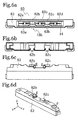
- the light emitting device 60 in this example is constituted substantially the same as the light emitting device in Example 1, except that the wall 63c on the side of the package 63 from which the lead frames 62a to 62d do not protrude is formed in a constant thickness, and the thicker portion 63b is formed near the concave portion 15b corresponding to the portion where the lead frames 62a to 62d protrude, while the thinner portion 63a is formed in all other portions.
- the light emitting device 60 in this example is a light emitting device that emits white light, in which three blue light emitting elements are mounted in the lead frames 62a, 62b, and 62d, and a resin containing a fluorescent material is sealed inside the opening 14.
- the lead frames 62b and 62c that are not sandwiched at the ends of the package 63 are such that the portion sandwiched and held by the package 63 is wider than the thicker portion 63b, so the lead frames 62b and 62c and the package 63 are securely fixed, and the lead frames 62b and 62c do not readily come out of the package 63.
- the portion sandwiched and held by the package 63 is thin (or, put another way, when the wall is thin)
- the lead frames 62b and 62c will not be held down by the package 63, so the lead frames 62b and 62c may come out. With this light emitting device, however, this can be avoided.
- the lead frames 62b and 62c which protrude outward from the package 63, are formed by bending on the exterior of the package 63, and serve as external terminals, are preferably such that their ends are larger than the bent portions protruding from the wall of the package 63 (such as, the ends having a home-plate shape or a trowel shape).
- This increases the surface area of the external terminals and improves heat dissipation. It is also advantageous because it makes bending easier because it is easier to apply force to the thick portion of the ends.
- positioning in three directions (XYZ) can be accomplished by using a concave portion (F in FIG. 6d) formed by cutting away part of the package 63 in the XYZ directions, or the convex portion next to it.
- a concave portion F in FIG. 6d
- precise positioning with a light guide or a mounting board or the like is easier, and more secure fixing to the light guide is possible.
- a light emitting device embodying the present invention can be utilized as a surface mount type of light emitting device, of the type in which light is emitted from a side face toward a side face of the package, by mounting a light emitting diode chip, for example, and can be used not only in illumination devices used in image readers such as facsimile machines, copiers, and hand scanners, but also in various other illumination devices such as illumination light sources, backlight light sources for LED displays, portable telephones, and so forth, signaling devices, lighting switches, automotive brake lamps, various kinds of sensor, various kinds of indicator, and so on.
Landscapes
- Led Device Packages (AREA)
Applications Claiming Priority (2)
| Application Number | Priority Date | Filing Date | Title |
|---|---|---|---|
| JP2006118360 | 2006-04-21 | ||
| JP2006205499A JP5119621B2 (ja) | 2006-04-21 | 2006-07-28 | 発光装置 |
Publications (3)
| Publication Number | Publication Date |
|---|---|
| EP1848037A2 true EP1848037A2 (de) | 2007-10-24 |
| EP1848037A3 EP1848037A3 (de) | 2009-04-15 |
| EP1848037B1 EP1848037B1 (de) | 2014-10-08 |
Family
ID=38290013
Family Applications (1)
| Application Number | Title | Priority Date | Filing Date |
|---|---|---|---|
| EP07103120.7A Ceased EP1848037B1 (de) | 2006-04-21 | 2007-02-27 | Leuchtdiodenvorrichtung |
Country Status (6)
| Country | Link |
|---|---|
| US (1) | US7422338B2 (de) |
| EP (1) | EP1848037B1 (de) |
| JP (1) | JP5119621B2 (de) |
| KR (2) | KR101316495B1 (de) |
| CN (1) | CN101071839B (de) |
| TW (1) | TWI408943B (de) |
Cited By (3)
| Publication number | Priority date | Publication date | Assignee | Title |
|---|---|---|---|---|
| KR20100115365A (ko) * | 2008-02-08 | 2010-10-27 | 니치아 카가쿠 고교 가부시키가이샤 | 발광 장치 |
| WO2014183801A1 (de) * | 2013-05-17 | 2014-11-20 | Osram Opto Semiconductors Gmbh | Optoelektronisches bauelement und verfahren zu seiner herstellung |
| EP2860775A4 (de) * | 2012-06-08 | 2016-01-20 | Lg Innotek Co Ltd | Gehäuse für leuchtdiode |
Families Citing this family (41)
| Publication number | Priority date | Publication date | Assignee | Title |
|---|---|---|---|---|
| TW200830576A (en) * | 2007-01-05 | 2008-07-16 | Uni Light Touchtek Corp | Method for forming light emitting diode array |
| JP4689637B2 (ja) * | 2007-03-23 | 2011-05-25 | シャープ株式会社 | 半導体発光装置 |
| US8704265B2 (en) * | 2007-08-27 | 2014-04-22 | Lg Electronics Inc. | Light emitting device package and lighting apparatus using the same |
| KR101488448B1 (ko) * | 2007-12-06 | 2015-02-02 | 서울반도체 주식회사 | Led 패키지 및 그 제조방법 |
| JP5230192B2 (ja) * | 2007-12-27 | 2013-07-10 | 豊田合成株式会社 | 発光装置 |
| KR100956888B1 (ko) * | 2008-01-24 | 2010-05-11 | 삼성전기주식회사 | 발광 다이오드 패키지 및 그 제조 방법 |
| JP5349811B2 (ja) * | 2008-02-06 | 2013-11-20 | シャープ株式会社 | 半導体発光装置 |
| USD601516S1 (en) * | 2008-02-25 | 2009-10-06 | Seoul Semiconductor Co., Ltd. | Light emitting diode (LED) |
| TWD133753S (zh) * | 2008-05-21 | 2010-03-11 | Alti電子股份有限公司 | 發光二極體 |
| KR20100003320A (ko) * | 2008-06-24 | 2010-01-08 | 엘지이노텍 주식회사 | 발광 다이오드 패키지 |
| KR100986202B1 (ko) * | 2008-07-01 | 2010-10-07 | 알티전자 주식회사 | 사이드 뷰 발광 다이오드 패키지 |
| CN101364585B (zh) * | 2008-09-25 | 2010-10-13 | 旭丽电子(广州)有限公司 | 一种芯片封装结构及其制造方法 |
| KR101491485B1 (ko) | 2008-11-18 | 2015-02-11 | 삼성전자주식회사 | 측면 방출형 발광장치 및 선광원형 발광장치 |
| JP5365252B2 (ja) * | 2009-02-25 | 2013-12-11 | 日亜化学工業株式会社 | 光半導体装置及びその製造方法 |
| GB2472998A (en) | 2009-08-26 | 2011-03-02 | Univ Southampton | Cleaning using acoustic energy and gas bubbles |
| JP5506313B2 (ja) * | 2009-09-30 | 2014-05-28 | スタンレー電気株式会社 | 車両ヘッドライト用発光ダイオード光源 |
| CN106449937B (zh) * | 2009-10-29 | 2020-11-03 | 日亚化学工业株式会社 | 发光装置及其制造方法 |
| US20110140591A1 (en) * | 2009-12-14 | 2011-06-16 | Han-Ming Lee | Single multi-facet light source LED bracket |
| KR101676670B1 (ko) * | 2010-07-01 | 2016-11-16 | 엘지이노텍 주식회사 | 발광 소자 |
| JP2012079723A (ja) | 2010-09-30 | 2012-04-19 | Toyoda Gosei Co Ltd | 発光装置 |
| KR101644110B1 (ko) * | 2010-12-17 | 2016-08-02 | 삼성전자주식회사 | 발광소자 패키지 |
| KR101852388B1 (ko) * | 2011-04-28 | 2018-04-26 | 엘지이노텍 주식회사 | 발광 소자 패키지 |
| JP5527286B2 (ja) * | 2011-06-29 | 2014-06-18 | 豊田合成株式会社 | 発光装置 |
| KR101823506B1 (ko) | 2011-06-29 | 2018-01-30 | 엘지이노텍 주식회사 | 발광 소자 패키지 및 이를 구비한 라이트 유닛 |
| JP5978572B2 (ja) * | 2011-09-02 | 2016-08-24 | 日亜化学工業株式会社 | 発光装置 |
| KR101946922B1 (ko) * | 2012-11-16 | 2019-02-12 | 엘지이노텍 주식회사 | 발광 소자 및 조명 장치 |
| KR102075561B1 (ko) * | 2013-05-08 | 2020-02-11 | 엘지이노텍 주식회사 | 발광 소자, 발광 모듈 및 조명 시스템 |
| CN104241262B (zh) * | 2013-06-14 | 2020-11-06 | 惠州科锐半导体照明有限公司 | 发光装置以及显示装置 |
| JP2015041685A (ja) * | 2013-08-21 | 2015-03-02 | 豊田合成株式会社 | 発光装置 |
| US9142745B2 (en) * | 2013-08-27 | 2015-09-22 | Glo Ab | Packaged LED device with castellations |
| US8999737B2 (en) | 2013-08-27 | 2015-04-07 | Glo Ab | Method of making molded LED package |
| TW201517323A (zh) | 2013-08-27 | 2015-05-01 | Glo公司 | 模製發光二極體封裝及其製造方法 |
| JP6575065B2 (ja) | 2014-12-26 | 2019-09-18 | 日亜化学工業株式会社 | 発光装置 |
| JP2016140722A (ja) * | 2015-02-05 | 2016-08-08 | 株式会社三共 | 遊技機および遊技用装置 |
| JP6374339B2 (ja) | 2015-03-26 | 2018-08-15 | 日亜化学工業株式会社 | 発光装置 |
| KR20170036635A (ko) * | 2015-09-24 | 2017-04-03 | 서울바이오시스 주식회사 | 발광 소자 및 이를 포함하는 발광 장치 |
| US10386058B1 (en) | 2016-03-17 | 2019-08-20 | Shat-R-Shield, Inc. | LED luminaire |
| US10767849B2 (en) | 2016-04-25 | 2020-09-08 | Shat-R-Shield, Inc. | LED luminaire |
| JP6521017B2 (ja) * | 2017-09-29 | 2019-05-29 | 日亜化学工業株式会社 | 発光装置 |
| US11417808B2 (en) | 2019-09-12 | 2022-08-16 | Nichia Corporation | Light emitting device |
| JP7436828B2 (ja) * | 2019-12-17 | 2024-02-22 | 日亜化学工業株式会社 | 発光装置 |
Family Cites Families (18)
| Publication number | Priority date | Publication date | Assignee | Title |
|---|---|---|---|---|
| JP2981370B2 (ja) * | 1993-07-16 | 1999-11-22 | シャープ株式会社 | Midチップ型発光素子 |
| JP3625498B2 (ja) * | 1994-09-21 | 2005-03-02 | 三洋電機株式会社 | 表示装置 |
| JP3466817B2 (ja) * | 1996-05-02 | 2003-11-17 | ローム株式会社 | Led発光装置およびその製造方法 |
| JP2003077317A (ja) * | 2001-09-03 | 2003-03-14 | Toyoda Gosei Co Ltd | Ledランプ |
| US6531328B1 (en) * | 2001-10-11 | 2003-03-11 | Solidlite Corporation | Packaging of light-emitting diode |
| JP4222017B2 (ja) * | 2001-12-18 | 2009-02-12 | 日亜化学工業株式会社 | 発光装置 |
| JP4239509B2 (ja) * | 2002-08-02 | 2009-03-18 | 日亜化学工業株式会社 | 発光ダイオード |
| JP3991961B2 (ja) * | 2002-09-05 | 2007-10-17 | 日亜化学工業株式会社 | 側面発光型発光装置 |
| JP3972889B2 (ja) * | 2002-12-09 | 2007-09-05 | 日亜化学工業株式会社 | 発光装置およびそれを用いた面状光源 |
| CN2612075Y (zh) * | 2003-02-08 | 2004-04-14 | 光鼎电子股份有限公司 | Led封装结构 |
| KR100609783B1 (ko) * | 2003-10-15 | 2006-08-10 | 럭스피아 주식회사 | 측면발광 다이오드 패키지 |
| JP4471356B2 (ja) * | 2004-04-23 | 2010-06-02 | スタンレー電気株式会社 | 半導体発光装置 |
| US7313649B2 (en) | 2004-04-28 | 2007-12-25 | Matsushita Electric Industrial Co., Ltd. | Flash memory and program verify method for flash memory |
| JP2006024345A (ja) | 2004-04-28 | 2006-01-26 | Matsushita Electric Ind Co Ltd | フラッシュメモリとフラッシュメモリのプログラムベリファイ方法 |
| US20070295975A1 (en) * | 2004-06-25 | 2007-12-27 | Sanyo Electric Co., Ltd. | Light-Emitting Device |
| KR100674827B1 (ko) * | 2004-07-28 | 2007-01-25 | 삼성전기주식회사 | 백라이트 유니트용 led 패키지 |
| CN101278416B (zh) * | 2005-09-30 | 2011-01-12 | 日亚化学工业株式会社 | 发光装置以及使用该发光装置的背光光源单元 |
| JP4952233B2 (ja) * | 2006-04-19 | 2012-06-13 | 日亜化学工業株式会社 | 半導体装置 |
-
2006
- 2006-07-28 JP JP2006205499A patent/JP5119621B2/ja active Active
-
2007
- 2007-02-23 US US11/709,756 patent/US7422338B2/en active Active
- 2007-02-27 EP EP07103120.7A patent/EP1848037B1/de not_active Ceased
- 2007-03-09 TW TW096108145A patent/TWI408943B/zh active
- 2007-04-20 CN CN2007101008797A patent/CN101071839B/zh not_active Expired - Fee Related
- 2007-04-20 KR KR1020070038778A patent/KR101316495B1/ko active Active
-
2013
- 2013-05-15 KR KR1020130055360A patent/KR101356262B1/ko active Active
Cited By (7)
| Publication number | Priority date | Publication date | Assignee | Title |
|---|---|---|---|---|
| KR20100115365A (ko) * | 2008-02-08 | 2010-10-27 | 니치아 카가쿠 고교 가부시키가이샤 | 발광 장치 |
| EP2244310A4 (de) * | 2008-02-08 | 2013-06-12 | Nichia Corp | Lichtemittierende vorrichtung |
| US8610164B2 (en) | 2008-02-08 | 2013-12-17 | Nichia Corporation | Light emitting device |
| US8847272B2 (en) | 2008-02-08 | 2014-09-30 | Nichia Corporation | Light emitting device |
| EP2860775A4 (de) * | 2012-06-08 | 2016-01-20 | Lg Innotek Co Ltd | Gehäuse für leuchtdiode |
| US9391117B2 (en) | 2012-06-08 | 2016-07-12 | Lg Innotek Co., Ltd. | Light emitting diode package |
| WO2014183801A1 (de) * | 2013-05-17 | 2014-11-20 | Osram Opto Semiconductors Gmbh | Optoelektronisches bauelement und verfahren zu seiner herstellung |
Also Published As
| Publication number | Publication date |
|---|---|
| EP1848037A3 (de) | 2009-04-15 |
| US7422338B2 (en) | 2008-09-09 |
| KR20070104283A (ko) | 2007-10-25 |
| KR101356262B1 (ko) | 2014-01-28 |
| US20070247841A1 (en) | 2007-10-25 |
| JP2007311736A (ja) | 2007-11-29 |
| CN101071839A (zh) | 2007-11-14 |
| JP5119621B2 (ja) | 2013-01-16 |
| TW200806008A (en) | 2008-01-16 |
| CN101071839B (zh) | 2010-08-11 |
| TWI408943B (zh) | 2013-09-11 |
| KR101316495B1 (ko) | 2013-10-10 |
| EP1848037B1 (de) | 2014-10-08 |
| KR20130071448A (ko) | 2013-06-28 |
Similar Documents
| Publication | Publication Date | Title |
|---|---|---|
| EP1848037B1 (de) | Leuchtdiodenvorrichtung | |
| KR101602977B1 (ko) | 발광 장치 | |
| US7527400B2 (en) | Light emitting device | |
| US7964892B2 (en) | Light emitting device | |
| EP1898474B1 (de) | Lichtemittierende Halbleitervorrichtung | |
| JP5444654B2 (ja) | 発光装置 | |
| CN102983255B (zh) | 发光装置 | |
| JP2009065002A (ja) | 発光装置 | |
| KR101669281B1 (ko) | 발광 장치 | |
| US20140008672A1 (en) | Light emitting device | |
| EP1843403B1 (de) | Lichtemittierender Baustein und Beleuchtungsvorrichtung | |
| JP5233478B2 (ja) | 発光装置 | |
| JP5071069B2 (ja) | 発光装置 | |
| JP5701843B2 (ja) | 発光装置 | |
| JP2007280983A (ja) | 発光装置 | |
| JP5722759B2 (ja) | 発光装置 |
Legal Events
| Date | Code | Title | Description |
|---|---|---|---|
| PUAI | Public reference made under article 153(3) epc to a published international application that has entered the european phase |
Free format text: ORIGINAL CODE: 0009012 |
|
| AK | Designated contracting states |
Kind code of ref document: A2 Designated state(s): AT BE BG CH CY CZ DE DK EE ES FI FR GB GR HU IE IS IT LI LT LU LV MC NL PL PT RO SE SI SK TR |
|
| AX | Request for extension of the european patent |
Extension state: AL BA HR MK YU |
|
| PUAL | Search report despatched |
Free format text: ORIGINAL CODE: 0009013 |
|
| AK | Designated contracting states |
Kind code of ref document: A3 Designated state(s): AT BE BG CH CY CZ DE DK EE ES FI FR GB GR HU IE IS IT LI LT LU LV MC NL PL PT RO SE SI SK TR |
|
| AX | Request for extension of the european patent |
Extension state: AL BA HR MK RS |
|
| RIC1 | Information provided on ipc code assigned before grant |
Ipc: H01L 33/00 20060101AFI20090306BHEP Ipc: H01L 25/075 20060101ALN20090306BHEP |
|
| 17P | Request for examination filed |
Effective date: 20091012 |
|
| AKX | Designation fees paid |
Designated state(s): DE FR GB |
|
| 17Q | First examination report despatched |
Effective date: 20091130 |
|
| GRAP | Despatch of communication of intention to grant a patent |
Free format text: ORIGINAL CODE: EPIDOSNIGR1 |
|
| RIC1 | Information provided on ipc code assigned before grant |
Ipc: H01L 33/48 20100101ALN20130522BHEP Ipc: H01L 25/075 20060101AFI20130522BHEP |
|
| INTG | Intention to grant announced |
Effective date: 20130617 |
|
| RAP1 | Party data changed (applicant data changed or rights of an application transferred) |
Owner name: NICHIA CORPORATION |
|
| 17Q | First examination report despatched |
Effective date: 20140113 |
|
| GRAP | Despatch of communication of intention to grant a patent |
Free format text: ORIGINAL CODE: EPIDOSNIGR1 |
|
| RIC1 | Information provided on ipc code assigned before grant |
Ipc: H01L 25/075 20060101AFI20140409BHEP Ipc: H01L 33/48 20100101ALN20140409BHEP |
|
| INTG | Intention to grant announced |
Effective date: 20140428 |
|
| GRAS | Grant fee paid |
Free format text: ORIGINAL CODE: EPIDOSNIGR3 |
|
| GRAA | (expected) grant |
Free format text: ORIGINAL CODE: 0009210 |
|
| AK | Designated contracting states |
Kind code of ref document: B1 Designated state(s): DE FR GB |
|
| REG | Reference to a national code |
Ref country code: GB Ref legal event code: FG4D |
|
| REG | Reference to a national code |
Ref country code: DE Ref legal event code: R096 Ref document number: 602007038800 Country of ref document: DE Effective date: 20141120 |
|
| REG | Reference to a national code |
Ref country code: DE Ref legal event code: R097 Ref document number: 602007038800 Country of ref document: DE |
|
| PLBE | No opposition filed within time limit |
Free format text: ORIGINAL CODE: 0009261 |
|
| STAA | Information on the status of an ep patent application or granted ep patent |
Free format text: STATUS: NO OPPOSITION FILED WITHIN TIME LIMIT |
|
| 26N | No opposition filed |
Effective date: 20150709 |
|
| REG | Reference to a national code |
Ref country code: FR Ref legal event code: PLFP Year of fee payment: 10 |
|
| REG | Reference to a national code |
Ref country code: FR Ref legal event code: PLFP Year of fee payment: 11 |
|
| REG | Reference to a national code |
Ref country code: FR Ref legal event code: PLFP Year of fee payment: 12 |
|
| REG | Reference to a national code |
Ref country code: DE Ref legal event code: R082 Ref document number: 602007038800 Country of ref document: DE Representative=s name: HL KEMPNER PATENTANWAELTE, SOLICITORS (ENGLAND, DE Ref country code: DE Ref legal event code: R082 Ref document number: 602007038800 Country of ref document: DE Representative=s name: HL KEMPNER PATENTANWALT, RECHTSANWALT, SOLICIT, DE Ref country code: DE Ref legal event code: R082 Ref document number: 602007038800 Country of ref document: DE Representative=s name: HL KEMPNER PARTG MBB, DE |
|
| P01 | Opt-out of the competence of the unified patent court (upc) registered |
Effective date: 20230522 |
|
| PGFP | Annual fee paid to national office [announced via postgrant information from national office to epo] |
Ref country code: DE Payment date: 20231229 Year of fee payment: 18 Ref country code: GB Payment date: 20240108 Year of fee payment: 18 |
|
| PGFP | Annual fee paid to national office [announced via postgrant information from national office to epo] |
Ref country code: FR Payment date: 20240103 Year of fee payment: 18 |
|
| REG | Reference to a national code |
Ref country code: DE Ref legal event code: R079 Ref document number: 602007038800 Country of ref document: DE Free format text: PREVIOUS MAIN CLASS: H01L0025075000 Ipc: H10H0029240000 |
|
| REG | Reference to a national code |
Ref country code: DE Ref legal event code: R119 Ref document number: 602007038800 Country of ref document: DE |
|
| GBPC | Gb: european patent ceased through non-payment of renewal fee |
Effective date: 20250227 |
|
| PG25 | Lapsed in a contracting state [announced via postgrant information from national office to epo] |
Ref country code: DE Free format text: LAPSE BECAUSE OF NON-PAYMENT OF DUE FEES Effective date: 20250902 |
|
| PG25 | Lapsed in a contracting state [announced via postgrant information from national office to epo] |
Ref country code: GB Free format text: LAPSE BECAUSE OF NON-PAYMENT OF DUE FEES Effective date: 20250227 |
|
| PG25 | Lapsed in a contracting state [announced via postgrant information from national office to epo] |
Ref country code: FR Free format text: LAPSE BECAUSE OF NON-PAYMENT OF DUE FEES Effective date: 20250228 |