EP1848196A1 - Farberkennung - Google Patents
Farberkennung Download PDFInfo
- Publication number
- EP1848196A1 EP1848196A1 EP07251695A EP07251695A EP1848196A1 EP 1848196 A1 EP1848196 A1 EP 1848196A1 EP 07251695 A EP07251695 A EP 07251695A EP 07251695 A EP07251695 A EP 07251695A EP 1848196 A1 EP1848196 A1 EP 1848196A1
- Authority
- EP
- European Patent Office
- Prior art keywords
- colour
- colour difference
- difference values
- analysed
- skew
- Prior art date
- Legal status (The legal status is an assumption and is not a legal conclusion. Google has not performed a legal analysis and makes no representation as to the accuracy of the status listed.)
- Granted
Links
Images

Classifications
-
- G—PHYSICS
- G06—COMPUTING OR CALCULATING; COUNTING
- G06T—IMAGE DATA PROCESSING OR GENERATION, IN GENERAL
- G06T7/00—Image analysis
- G06T7/80—Analysis of captured images to determine intrinsic or extrinsic camera parameters, i.e. camera calibration
-
- H—ELECTRICITY
- H04—ELECTRIC COMMUNICATION TECHNIQUE
- H04N—PICTORIAL COMMUNICATION, e.g. TELEVISION
- H04N1/00—Scanning, transmission or reproduction of documents or the like, e.g. facsimile transmission; Details thereof
- H04N1/46—Colour picture communication systems
- H04N1/56—Processing of colour picture signals
-
- G—PHYSICS
- G06—COMPUTING OR CALCULATING; COUNTING
- G06T—IMAGE DATA PROCESSING OR GENERATION, IN GENERAL
- G06T5/00—Image enhancement or restoration
- G06T5/40—Image enhancement or restoration using histogram techniques
-
- G—PHYSICS
- G06—COMPUTING OR CALCULATING; COUNTING
- G06V—IMAGE OR VIDEO RECOGNITION OR UNDERSTANDING
- G06V10/00—Arrangements for image or video recognition or understanding
- G06V10/20—Image preprocessing
- G06V10/28—Quantising the image, e.g. histogram thresholding for discrimination between background and foreground patterns
-
- G—PHYSICS
- G06—COMPUTING OR CALCULATING; COUNTING
- G06V—IMAGE OR VIDEO RECOGNITION OR UNDERSTANDING
- G06V10/00—Arrangements for image or video recognition or understanding
- G06V10/40—Extraction of image or video features
- G06V10/56—Extraction of image or video features relating to colour
Definitions
- This invention concerns the analysis of image data to detect monochrome images.
- a useful image characteristic is whether or not it contains a representation of the colours of objects.
- the invention consists of a method and apparatus for detecting representative colour content in an image by analysing the skew of the statistical distribution of colour difference values of pixels derived from the said image.
- the skew parameter is derived from an upper percentile, a lower percentile and a median value of the statistical distribution of colour difference values of the said pixels and representative colour is detected when the said skew parameter exceeds a threshold.
- results from the analysis of more than one colour difference value from each pixel are analysed.
- At least two related images are analysed and analysis results from separate images are used to derive a single detection result.
- a defined region within an image is analysed.
- the said analysis includes deriving a histogram of the statistical frequency distribution of colour difference values.
- the histogram is smoothed prior to analysis.
- the detection result depends upon an average luminance level.
- a detection result is discarded if an extreme average luminance value is detected.
- the detection result is modified if a high proportion of the colour difference values analysed correspond to high colour saturation.
- the detection result is modified if a high proportion of widely separated colour difference values occur in the analysed colour difference values.
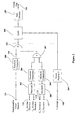
- Figure 1 shows an example of a system according to the invention for detecting representative colour information in image data.
- the image data needs to be in the form of luminance and colour difference values for pixels. If the image data is not in this form it can be converted to it by known methods including analogue to digital conversion, composite decoding, RGB to YUV or YC B C R conversion, compression decoding etc.
- the image data is input as Luminance (Y) values (101), Blue colour difference (C B ) values (102) and Red colour difference (C R ) values (103) for pixels of the image. If necessary the image can be subsampled to reduce the number of pixel values.
- the illustrated system operates on parallel streams of Y C B and C R pixel values where the pixels follow each other according to a conventional television scanning raster. It will be apparent to the skilled person that the principle of the invention may be applied to the processing of single images, sets or sequences of related images; the image data may or may not be streamed, and could be in a computer file for example; and, that the processing may be carried out faster or slower than the intended image display rate.
- the input C B pixel values (102) are input to a lowpass filter (104).
- a 16-sample moving-average filter is suitable.
- the filtered values are input to a statistical-frequency analyser (105) which counts the total number of pixels having each of the possible values; i.e. it computes a statistical histogram showing the statistical-frequency distribution of the sample values.
- the histogram will comprise a set of 256 sample value frequencies. If the input pixel values are represented with more bits per word it may be necessary to round or truncate the sample values to a lesser number of bits to simplify the implementation.
- the histogram For interlaced television it will usually be convenient to compute the histogram for the active picture area of each field. Alternatively a smaller analysis window within the active picture of each field may be analysed if other parts of the field are considered unimportant.
- the analysis window is defined by a measurement window control input (106) which identifies the pixels to be included in each statistical-frequency computation.
- the shape of the histogram is smoothed in a filtration process (107) in which each constituent frequency value of the filtered histogram is calculated by taking a weighted sum of a range of frequency values from the unfiltered histogram. For example:
- the smoothed histogram is analysed by a skew analyser (108), having a skew parameter output (111).
- the skew analyser (108) determines the degree of asymmetry of the smoothed histogram.
- a suitable method of analysis is to calculate the lower quartile value, median value and upper quartile value of the pixel frequency values. This is done by summing the frequencies of ranges consecutive pixel values and comparing the result with the sum of all the frequencies.
- a convenient skew parameter is given by doubling the median, subtracting the upper and lower quartiles from it, and taking the absolute magnitude of the result.
- this skew parameter is the output (111) of the skew analyser (108).
- the two quartiles and the median value are calculated with fractional precision. This can be done by assuming that the shape of the frequency distribution follows a straight line between the points defined by the histogram and calculating where the distribution would intersect the relevant total value.
- the skew parameter (111) derived from these non-integral values will therefore also not necessarily be an integer.
- the filtered pixels values at the output of the filter (104) are also passed to a deviation analyser (109), having a deviation parameter output (112); and, an average saturation analyser (110), having an average saturation output (113).
- a deviation analyser having a deviation parameter output (112)
- an average saturation analyser having an average saturation output (113).
- the input C R pixel values (103) are processed in a C R processing block (114), which has functions identical to those included in the illustrated block (115), and outputs: a skew parameter (116); a deviation parameter (117); and, an average saturation parameter (118).
- the greater of the skew values (111) and (116) is selected by a maximum selector (119) and input to an adder (120).
- This adder input gives a measure of the extent to which the pixel colour difference data is skewed, and it has been found that this measure can be used to distinguish images in which the colour information is representative of the object depicted in the image.
- the luminance pixel values (101) are averaged over the measurement window in an averager (121) and the average value is used to calculate a luminance range correction parameter (122) which forms the second input to the adder (120).
- a suitable value for the luminance range correction parameter (122) is obtained by evaluating the amount by which the average luminance value is less than a lower threshold value or the amount by which the average luminance value exceeds an upper threshold value. (No correction is applied if the average luminance lies between these threshold values.) For a system in which black is represented by the luminance value 16 and white is represented by 235, suitable lower and upper threshold values are 45 and 194 respectively.
- the output of the adder (120) thus comprises a measure of representative colour values in the image data. It may be made more reliable by combining the results from more than one related image in a recursive filter. This is shown in Figure 1 by the IIR filter (123) which gives an output representative colour measure (124).
- the output (124) may be compared with a threshold to determine whether the image contains representative colour information.
- a better result can be obtained in some circumstances by making use of information about the average colour saturation values and the spread of the colour difference values.
- Figure 2 shows how the output (124) from the system of Figure 1 can be improved if it is known that large plain areas of saturated colour are to be detected as representative colour.
- the output representative colour measure (124) from Figure 1 is input to a threshold comparator (200) which produces a colour flag (201) which is active when the representative colour measure (124) is greater than a threshold.
- a threshold value can be determined by experiment; the value 42 has been found appropriate for eight-bit television images.
- the flag is modified in an OR-gate (202) according to average saturation and colour difference spread information.
- the C B average saturation analyser (110) shown in Figure 1 computes the average C B value for all the pixels in the measurement window and outputs the magnitude of the difference between this average value and the value which represents zero colour difference (typically 128 in eight-bit systems) at the terminal (113).
- An identical process in the block (114) produces the equivalent for the C R values at the terminal (118).
- the greater of the values at terminals (113) and (118) is determined by a maximum function (203) in Figure 2 and input to a threshold comparator (204) which gives an output when a threshold is exceeded. The output from the comparator (204) therefore indicates whether there is significant saturated colour in the pixels within the measurement window.
- the deviation analyser (109) of Figure 1 compares the C B value of each pixel within the measurement window with the average C B value over the measurement window and accumulates the magnitudes of the differences. (In order to simplify the implementation it may be convenient to use an average C B value from a previous measurement.) The accumulated sum is divided by the number of pixels in the measurement window and output at terminal (112) as a C B colour deviation parameter. An identical process in the block (114) produces the equivalent for the C R values at the terminal (117). The greater of the values at terminals (112) and (117) is determined by a maximum function (205) in Figure 2 and input to a threshold comparator (206) which gives an output when a threshold is exceeded. The output of the comparator (206) therefore indicates when there is a significant range of different colours in the pixels within the measurement window.
- the modified colour flag is input to a latch (208) which is controlled according to the output (125) from the luminance average block (121) of Figure 1.
- An extreme luminance value detector (209) detects when the average luminance value is very close to black or white, for example less than 32 or greater than 210 in a system where black is represented by 16 and white is represented by 235. If such extreme values are detected the latch (208) is disenabled so that its output is held at the value for the previously analysed measurement window. However, if the average luminance is closer to grey the output of the latch (208) is equal to the output of the OR-gate (202).
- the colour flag at the output of the latch (208) can be made even more robust by a state-machine (210) which combines the results of several measurements and only allows its output colour flag (211) to change state if a defined number of changed input measurements from the latch (208) have been received. Depending on the application, it may be appropriate to have different criteria depending on the current state of the output (211).
- the invention has been described by example and many variants are possible within the concept which has been described.
- other methods of determining the skew of the distributions of colour difference values may be used, such as evaluating a statistical moment of the distribution; and, there are known methods of determining the skew of a data distribution without first computing a histogram of the data.
- the example described is particularly applicable to sequences of images such as video fields or film frames.
- the invention is equally applicable to individual images.
- the invention is not limited to images described by three parameters and colour difference signals other than the well-known C B and C R signals can be analysed for statistical asymmetry. For examples differences between one or more pairs of primary colour component signals can be analysed, or differences between individual primary colour components and combinations of primary components other than luminance can be analysed.
Landscapes
- Engineering & Computer Science (AREA)
- Physics & Mathematics (AREA)
- General Physics & Mathematics (AREA)
- Theoretical Computer Science (AREA)
- Multimedia (AREA)
- Signal Processing (AREA)
- Computer Vision & Pattern Recognition (AREA)
- Image Analysis (AREA)
- Facsimile Image Signal Circuits (AREA)
- Testing, Inspecting, Measuring Of Stereoscopic Televisions And Televisions (AREA)
Applications Claiming Priority (1)
| Application Number | Priority Date | Filing Date | Title |
|---|---|---|---|
| GB0607920A GB2437338A (en) | 2006-04-21 | 2006-04-21 | Detecting monochrome images from the skew of a statistical distribution of pixel values |
Publications (2)
| Publication Number | Publication Date |
|---|---|
| EP1848196A1 true EP1848196A1 (de) | 2007-10-24 |
| EP1848196B1 EP1848196B1 (de) | 2017-01-25 |
Family
ID=36581021
Family Applications (1)
| Application Number | Title | Priority Date | Filing Date |
|---|---|---|---|
| EP07251695.8A Not-in-force EP1848196B1 (de) | 2006-04-21 | 2007-04-23 | Farberkennung |
Country Status (3)
| Country | Link |
|---|---|
| US (1) | US7945090B2 (de) |
| EP (1) | EP1848196B1 (de) |
| GB (1) | GB2437338A (de) |
Families Citing this family (3)
| Publication number | Priority date | Publication date | Assignee | Title |
|---|---|---|---|---|
| GB2457694B (en) | 2008-02-21 | 2012-09-26 | Snell Ltd | Method of Deriving an Audio-Visual Signature |
| US11399187B2 (en) * | 2017-03-10 | 2022-07-26 | Intel Corporation | Screen content detection for adaptive encoding |
| CN111311697B (zh) * | 2020-03-19 | 2023-11-17 | 北京搜狐新媒体信息技术有限公司 | 图片色彩丰富度的检测方法及相关装置 |
Citations (8)
| Publication number | Priority date | Publication date | Assignee | Title |
|---|---|---|---|---|
| EP0187911A2 (de) * | 1985-01-15 | 1986-07-23 | International Business Machines Corporation | Verfahren und Vorrichtung zum Setzen eines Schwellwertes an Bilddaten |
| US4642683A (en) * | 1985-05-06 | 1987-02-10 | Eastman Kodak Company | Digital image processing method for images with bimodal tone value distribution |
| EP0441558A1 (de) * | 1990-02-05 | 1991-08-14 | Crosfield Electronics Limited | Verbesserungen in Steuerdatenfeldern von Bildelementen |
| US5295202A (en) * | 1991-08-19 | 1994-03-15 | Eastman Kodak Company | Method and apparatus for replicating a two-color original image with foreground and background colors exchanged |
| EP1326425A2 (de) * | 2001-12-24 | 2003-07-09 | Samsung Electronics Co., Ltd. | Vorrichtung und Verfahren zur Farbbildsättingungsregelung |
| US20040071362A1 (en) * | 2002-07-01 | 2004-04-15 | Xerox Corporation | Page background detection and neutrality on scanned documents |
| JP2005004470A (ja) * | 2003-06-11 | 2005-01-06 | Glory Ltd | 画像減色装置、画像減色方法および画像減色プログラム |
| US20050169524A1 (en) * | 2004-01-16 | 2005-08-04 | Seiko Epson Corporation. | Image processing device, image display device, image processing method, and image processing program |
Family Cites Families (10)
| Publication number | Priority date | Publication date | Assignee | Title |
|---|---|---|---|---|
| US4636845A (en) * | 1985-05-06 | 1987-01-13 | Eastman Kodak Company | Digital image processing method for over and under exposed photographic images |
| DE4003911A1 (de) | 1990-02-09 | 1991-08-14 | Linde Ag | Verkaufskuehlmoebel |
| US5608851A (en) * | 1992-06-17 | 1997-03-04 | Toppan Printing Co., Ltd. | Color variation specification method and a device therefor |
| EP1489833A1 (de) * | 1997-06-17 | 2004-12-22 | Seiko Epson Corporation | Verfahren und Vorrichtung zum Einstellen der Farbe |
| US6377702B1 (en) * | 1999-12-08 | 2002-04-23 | Sony Corporation | Color cast detection and removal in digital images |
| US7015978B2 (en) * | 1999-12-13 | 2006-03-21 | Princeton Video Image, Inc. | System and method for real time insertion into video with occlusion on areas containing multiple colors |
| JP4387584B2 (ja) * | 2000-12-27 | 2009-12-16 | キヤノン株式会社 | 画像処理装置及び画像処理方法 |
| JP3733873B2 (ja) * | 2001-06-07 | 2006-01-11 | ノーリツ鋼機株式会社 | 写真画像処理装置、方法及び写真処理装置 |
| JP2003250047A (ja) * | 2002-02-22 | 2003-09-05 | Konica Corp | 画像処理方法、記憶媒体、画像処理装置、及び画像記録装置 |
| JP2004180285A (ja) * | 2002-11-27 | 2004-06-24 | Oce Technol Bv | ピクセル画像の画像処理 |
-
2006
- 2006-04-21 GB GB0607920A patent/GB2437338A/en not_active Withdrawn
-
2007
- 2007-04-20 US US11/738,188 patent/US7945090B2/en not_active Expired - Fee Related
- 2007-04-23 EP EP07251695.8A patent/EP1848196B1/de not_active Not-in-force
Patent Citations (8)
| Publication number | Priority date | Publication date | Assignee | Title |
|---|---|---|---|---|
| EP0187911A2 (de) * | 1985-01-15 | 1986-07-23 | International Business Machines Corporation | Verfahren und Vorrichtung zum Setzen eines Schwellwertes an Bilddaten |
| US4642683A (en) * | 1985-05-06 | 1987-02-10 | Eastman Kodak Company | Digital image processing method for images with bimodal tone value distribution |
| EP0441558A1 (de) * | 1990-02-05 | 1991-08-14 | Crosfield Electronics Limited | Verbesserungen in Steuerdatenfeldern von Bildelementen |
| US5295202A (en) * | 1991-08-19 | 1994-03-15 | Eastman Kodak Company | Method and apparatus for replicating a two-color original image with foreground and background colors exchanged |
| EP1326425A2 (de) * | 2001-12-24 | 2003-07-09 | Samsung Electronics Co., Ltd. | Vorrichtung und Verfahren zur Farbbildsättingungsregelung |
| US20040071362A1 (en) * | 2002-07-01 | 2004-04-15 | Xerox Corporation | Page background detection and neutrality on scanned documents |
| JP2005004470A (ja) * | 2003-06-11 | 2005-01-06 | Glory Ltd | 画像減色装置、画像減色方法および画像減色プログラム |
| US20050169524A1 (en) * | 2004-01-16 | 2005-08-04 | Seiko Epson Corporation. | Image processing device, image display device, image processing method, and image processing program |
Also Published As
| Publication number | Publication date |
|---|---|
| GB0607920D0 (en) | 2006-05-31 |
| GB2437338A (en) | 2007-10-24 |
| US7945090B2 (en) | 2011-05-17 |
| EP1848196B1 (de) | 2017-01-25 |
| US20070280558A1 (en) | 2007-12-06 |
Similar Documents
| Publication | Publication Date | Title |
|---|---|---|
| JP4295845B2 (ja) | ディジタルビデオ画像のアスペクトフォーマットの自動検出方法及び装置 | |
| EP2107521B1 (de) | Erfassung eines Randbereichs in einem Bild | |
| JP3957148B2 (ja) | フリーズ・フィールド検出方法及び装置 | |
| US8023765B2 (en) | Block noise removal device | |
| KR20040006065A (ko) | 장면전환검출장치 및 그 방법 | |
| US6462790B1 (en) | Digital comb filter for decoding composite video signals | |
| US5469188A (en) | Pre-analysis of video signals obtained from digital images | |
| EP1435730A2 (de) | Vorrichtung zum Abschätzen des Video-Grundrauschens mit Erfassung des Rauschimpulses | |
| EP1848196B1 (de) | Farberkennung | |
| US7974491B2 (en) | Block noise removal device | |
| CN118301361A (zh) | 一种视频压缩方法、装置及电子设备 | |
| US7064793B2 (en) | Method and apparatus for measuring the noise contained in a picture | |
| KR20060058703A (ko) | 블럭 아티팩트 검출 | |
| US7330219B2 (en) | YC separator circuit | |
| JPH08237475A (ja) | 画像領域分離方法と画像領域分離装置、および画像処理方法と画像処理装置 | |
| EP0913994B1 (de) | Verfahren und Vorrichtung zur automatischen Detektion des Formats in digitalen Videobildern | |
| US20060268179A1 (en) | Motion detector for a video display system | |
| EP1744565B1 (de) | Verfahren und Vorrichtung zur Analyse von Bilddaten | |
| JP2003179779A (ja) | ノイズリダクション装置および方法 | |
| US20040179141A1 (en) | Method, apparatus, and system for reducing cross-color distortion in a composite video signal decoder | |
| US7599007B2 (en) | Noise detection method, noise reduction method, noise detection device, and noise reduction device | |
| JP2001326869A (ja) | 映像信号・映像信号解析結果同時表示装置 | |
| Nakagaki et al. | Wide aspect TV receiver with aspect detection and non-linear control for picture quality | |
| CN100356798C (zh) | 三维梳型滤波视讯解码器中移动侦测的方法 | |
| KR920003394B1 (ko) | Tv신호의 주사선 보간을 위한 움직임 검출회로 |
Legal Events
| Date | Code | Title | Description |
|---|---|---|---|
| PUAI | Public reference made under article 153(3) epc to a published international application that has entered the european phase |
Free format text: ORIGINAL CODE: 0009012 |
|
| AK | Designated contracting states |
Kind code of ref document: A1 Designated state(s): AT BE BG CH CY CZ DE DK EE ES FI FR GB GR HU IE IS IT LI LT LU LV MC MT NL PL PT RO SE SI SK TR |
|
| AX | Request for extension of the european patent |
Extension state: AL BA HR MK YU |
|
| 17P | Request for examination filed |
Effective date: 20080410 |
|
| 17Q | First examination report despatched |
Effective date: 20080514 |
|
| AKX | Designation fees paid |
Designated state(s): DE FR GB |
|
| RAP1 | Party data changed (applicant data changed or rights of an application transferred) |
Owner name: SNELL LIMITED |
|
| GRAP | Despatch of communication of intention to grant a patent |
Free format text: ORIGINAL CODE: EPIDOSNIGR1 |
|
| INTG | Intention to grant announced |
Effective date: 20160830 |
|
| GRAS | Grant fee paid |
Free format text: ORIGINAL CODE: EPIDOSNIGR3 |
|
| GRAA | (expected) grant |
Free format text: ORIGINAL CODE: 0009210 |
|
| RAP1 | Party data changed (applicant data changed or rights of an application transferred) |
Owner name: SNELL ADVANCED MEDIA LIMITED |
|
| AK | Designated contracting states |
Kind code of ref document: B1 Designated state(s): DE FR GB |
|
| REG | Reference to a national code |
Ref country code: GB Ref legal event code: FG4D |
|
| REG | Reference to a national code |
Ref country code: DE Ref legal event code: R096 Ref document number: 602007049628 Country of ref document: DE |
|
| REG | Reference to a national code |
Ref country code: DE Ref legal event code: R097 Ref document number: 602007049628 Country of ref document: DE |
|
| REG | Reference to a national code |
Ref country code: DE Ref legal event code: R119 Ref document number: 602007049628 Country of ref document: DE |
|
| PLBE | No opposition filed within time limit |
Free format text: ORIGINAL CODE: 0009261 |
|
| STAA | Information on the status of an ep patent application or granted ep patent |
Free format text: STATUS: NO OPPOSITION FILED WITHIN TIME LIMIT |
|
| 26N | No opposition filed |
Effective date: 20171026 |
|
| REG | Reference to a national code |
Ref country code: FR Ref legal event code: ST Effective date: 20171229 |
|
| PG25 | Lapsed in a contracting state [announced via postgrant information from national office to epo] |
Ref country code: DE Free format text: LAPSE BECAUSE OF NON-PAYMENT OF DUE FEES Effective date: 20171103 Ref country code: FR Free format text: LAPSE BECAUSE OF NON-PAYMENT OF DUE FEES Effective date: 20170502 |
|
| PGFP | Annual fee paid to national office [announced via postgrant information from national office to epo] |
Ref country code: GB Payment date: 20200427 Year of fee payment: 14 |
|
| GBPC | Gb: european patent ceased through non-payment of renewal fee |
Effective date: 20210423 |
|
| PG25 | Lapsed in a contracting state [announced via postgrant information from national office to epo] |
Ref country code: GB Free format text: LAPSE BECAUSE OF NON-PAYMENT OF DUE FEES Effective date: 20210423 |