EP1848203B2 - Méthode et système de conversion de format d'une image vidéo - Google Patents
Méthode et système de conversion de format d'une image vidéo Download PDFInfo
- Publication number
- EP1848203B2 EP1848203B2 EP06008001.7A EP06008001A EP1848203B2 EP 1848203 B2 EP1848203 B2 EP 1848203B2 EP 06008001 A EP06008001 A EP 06008001A EP 1848203 B2 EP1848203 B2 EP 1848203B2
- Authority
- EP
- European Patent Office
- Prior art keywords
- video images
- video
- section
- scaling
- aspect ratio
- Prior art date
- Legal status (The legal status is an assumption and is not a legal conclusion. Google has not performed a legal analysis and makes no representation as to the accuracy of the status listed.)
- Expired - Lifetime
Links
Images



Classifications
-
- H—ELECTRICITY
- H04—ELECTRIC COMMUNICATION TECHNIQUE
- H04N—PICTORIAL COMMUNICATION, e.g. TELEVISION
- H04N7/00—Television systems
- H04N7/01—Conversion of standards, e.g. involving analogue television standards or digital television standards processed at pixel level
- H04N7/0117—Conversion of standards, e.g. involving analogue television standards or digital television standards processed at pixel level involving conversion of the spatial resolution of the incoming video signal
- H04N7/0122—Conversion of standards, e.g. involving analogue television standards or digital television standards processed at pixel level involving conversion of the spatial resolution of the incoming video signal the input and the output signals having different aspect ratios
-
- G—PHYSICS
- G06—COMPUTING OR CALCULATING; COUNTING
- G06T—IMAGE DATA PROCESSING OR GENERATION, IN GENERAL
- G06T3/00—Geometric image transformations in the plane of the image
- G06T3/04—Context-preserving transformations, e.g. by using an importance map
Definitions
- the present invention relates to video image processing technology, and more particularly to a method and system for video image aspect ratio conversion.
- This invention concerns processing methods and electronic systems, which may or may not incorporate a display device, for enabling received video having one aspect ratio to be displayed in a display device having another, different, aspect ratio.
- the rectangular shape of the video image is described as the ratio of the visible picture width to the height.
- Standard television and computers have an aspect ratio of 4:3 (1.33), which means that the picture is 4 units wide for every 3 units of height.
- the new high definition television (HDTV) standard is 16:9; accordingly HDTV's 16:9 ratio is a rectangle that is, relatively speaking, horizontally wider than regular TV, which by comparison looks almost square.
- Film and video aspect ratios include 1.66:1 (used mostly for animated features), 1.85:1 or 1.78:1 (commonly known as 16:9 or Academic Flat Ratio) and 2.35:1 (called CinescopeTM, or "scope” for short, which is usually used in action movies).
- Scaling an image to an arbitrary size requires high quality scaling engines to prevent aliasing artefacts when down-scaling, and to retain sharpness when up-scaling.
- Converting a 4:3 aspect ratio standard definition video to a 16:9 wide aspect ratio high definition video involves scaling an image so as to contain as much as six times the number of pixels it had originally. How this is done determines the quality of the scaled image.
- One of the conventional methods is to linearly stretch the 4:3 images in the horizontal direction to a more rectangular 16:9 image, to fill the entire screen by keeping all the original image content.
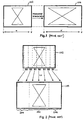
- This technique is illustrated in Fig. 1 : horizontal interpolation is used, for example so that the resolution (width w) increases from 640 pixels/line to 853 pixels/line (w'), when converting the original 4:3 image 102 (at 640x480 resolution) to the 16:9 converted image 104 (at 853x480 resolution).
- linear horizontal scaling distorts the overall image by 33 percent, in such a way that, for example, narrow images look wider than they originally are, or thin people look fatter.
- linear scaling requires some computational power in terms of system requirements and adds particular hardware and software features and involves relatively low cost increase, the visual result is not acceptable in most situations.
- Fig. 2 The current trend is towards to a more advanced technique, which is non-linear scaling: this is illustrated in Fig. 2 .
- This method aims to keep the picture quality pleasing and acceptable to the viewer by leaving the middle portion 202 of the 4:3 image unchanged, but horizontally stretching the left 204 and right 206 portions of the image, to thereby achieve an aspect ratio of 16:9.
- the middle 202 of the image does not appear distorted at all, but the left 204 and right 206 portions are increasingly deteriorated.
- the human visual system typically focuses on the middle 202 of the screen and not on the edges: therefore implementing the actual scaling on portions where human eyes are less sensitive to image distortions produces generally acceptable results.
- the picture 102 to be converted is divided into several scaling areas with several scaling factors (S0, S1, S2, S3).
- the scaling factor for the central area (SO) is 1 so that the image in the centre is not scaled.
- the rest of the scaling factors (S1, S2, S3%) are calculated according to the desired source and destination pixel ratios.
- Non-linear scaling also called 'Panorama' mode
- linear scaling requires more computational power than linear scaling, and can also be used to scale down a 16:9 image for display on a display screen having an aspect ratio of 4:3.
- Non-linear horizontal scaling has begun to be widely used because of its advantages in eliminating the unexpected distortion caused by linear scaling.
- Non-linear horizontal scaling makes it possible to fill the whole wide screen with the picture content, while disturbing the viewer as little as possible.
- non-linear scaling has one important disadvantage when the video images to be displayed include sliding text or sliding picture elements in the transmitted video content.
- Such content is common with news (e.g. scrolling headlines), informational (e.g. sports scores and tickers) and general TV programming, where additional text (for example) scrolls, normally from right to left, across the screen at or near the bottom.
- additional text for example
- Scrolls normally from right to left, across the screen at or near the bottom.
- Such material that scrolls horizontally across the screen
- HST horizontally scrolling text
- EP534220B1 discloses techniques for resizing video signals (enlarge/decrease), e.g. for displaying 4:3 picture on 16:9 displays, using (linear) interpolation, as well as electronics involved in implementing the resizing, using pixelwise conversion and spatial filtering.
- US5386236 discloses techniques for displaying 4:3 video on 16:9 displays, using interpolation. It comprises: removing a predetermined number (30) of upper and lower scanning lines having unimportant information in a vertical direction from a video signal having a screen aspect ratio of 4:3; performing vertical interpolation by the removed scanning lines to restore an original number of scanning lines; and performing time-compression of a predetermined rate in a horizontal direction and displaying a video signal on a screen having a screen aspect ratio of 16:9 by assigning a position of the compressed image.
- EP662272B1 discloses techniques, useful for displaying 4:3 pictures in 16:9 displays, for detecting the presence of subtitles within the undisplayed part of a picture and for shifting any such subtitles so detected to a displayed part of the received picture. This allows pictures transmitted in the 4:3 format to be expanded to fill a 16:9 format display without losing the subtitles when the lower portion of the picture, which may contain at least part of the subtitle information, is then outside the display area as a result of the picture expansion.
- US 2006/0061687A1 discloses a system for displaying 4:3 content on a 16:9 display, including a detector for detecting a dynamic region that may contain subtitles, text, symbols, written language, etc.
- a static region displays the main picture.
- the system operates (though vertical scaling) to fit the static region (at instants when there are no subtitles or other material in the dynamic region) or static region + dynamic region (at instants when there are subtitles or other material in the dynamic region) to the active region (display area) of the display device.
- US 2005/0008347 discloses a method of processing a subtitle stream, a reproducing apparatus, and an information storage medium (e.g. DVD) thereof.
- the information storage medium includes an AV stream, a subtitle stream which is displayed with the AV stream, and conversion information which indicates an instruction to change a format (4:3, 16:9, etc.) of the subtitle stream.
- US 2004/0212731 A1 discloses a video distribution system, using techniques for video aspect ratio conversion.
- the video distribution system distributes a video program in a first aspect ratio and simultaneously transmits video conversion information, used at the receiving end to convert the first aspect ratio to a second aspect ratio.
- Included in the video distribution system are a distribution point and a video converter that is located remotely from the distribution point.
- the video converter receives the information and the video program from the distribution point.
- the video converter uses the video conversion information to guide conversion between the first aspect ratio and the second aspect ratio.
- JP07-131734 discloses a television receiver with a title moving circuit which signal is inputted into a synthesizing processing circuit and compounder together with the videosignal. The compounded signal is then processed in the nonlinear processing circuit to display an aspect ratio of 16:9.
- the present invention provides a method of converting video images, according to claim 1.
- the one or more remaining sections of the first video images may include a relatively narrow section on the side of said first section opposite the main picture section.
- this may be a narrow band of the original picture below the HST area.
- the conversion operation performed on said relatively narrow section is identical to that performed on the first section.
- the conversion operation performed on said relatively narrow section is identical to that performed on the main picture section.
- the system may include a chroma detector, adapted to receive first video signals (CVBS) and output second video signals (RGB or YUV) to the signal processor.
- CVBS first video signals
- RGB or YUV second video signals
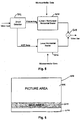
- FIG. 4 illustrates schematically a television system according to one embodiment of the invention.
- the TV system generally designated 400, comprises a tuner 402, a chroma decoder 404 a signal processor 406, memory 407, an external video switch or source 408, and a display device 410.
- the diagram illustrates the general circuit diagram of the TV receiver including components known to skilled persons.
- a desired channel is selected by the user and obtained by the tuner 402.
- CVBS colour TV/video
- RGB or YUV signals are created, by chroma decoder 404.
- external CVBS signals for example from a VCR, DVD or hard disk video source are switched to chroma decoder 404 by external video switch 404.
- YUV or RGB signals are switched to signal processor 406.
- Signal processor 406 contains the display driver and microcontroller (not shown), and processes in accordance with the invention are carried out by the signal processor 406 in conjunction with memory 407.
- Memory 407 may comprise ROM, RAM, or any suitable nonvolatile or volatile solid-state memory devices, or combination thereof, as is known to persons skilled in the art.
- the signal processor 406 achieves all the necessary processing on video signals and drives the display 410.
- Figure 5 shows schematically the different processing operations for different image sections, as used by the signal processor 406 in the system of Fig. 4 . This is suitably carried out in software, but for the purpose of illustration is shown by block diagram.
- Figure 6 illustrates the segmentation, in accordance with embodiments of the invention, of the video images into different sections.
- the input video signals (RGB/YUV) are first acted upon by the HST detector 502.
- the video data for the main picture area is routed to a linear/non-linear scaler module 504, which performs non-linear scaling on the main picture section 602 (see Fig. 6 ).
- the video data for the HST section is routed to a linear scaler module 506, which performs linear scaling on the HST section 604 (see Fig. 6 ).
- the image 102 includes a lower section 606 on the side of the HST section opposite the main picture section 602. This may be subject to linear or non-linear scaling, but preferably has the same scaling as HST area 604.
- the system itself determines the scaling technique to be applied to lower section 606, considering the height of lower section 606 or the factors such as HST section 604 being transparent or opaque. For example, it may apply linear scaling when the background is transparent and non-linear scaling when the background is opaque, or vice versa.
- the solution according to the invention is based on the automatic detection of HST section 604 which is superimposed on the broadcasted video information, then applying linear horizontal scaling to that portion of the video image and applying non-linear horizontal scaling to the rest of the video image (section 602) containing the main picture information.
- HST section 604 and the main picture section 602 are thereafter joined (at combining module 508) to make a single picture (video data) after the scaling process.
- Figure 7 shows by flow chart the HST area detection part of the process of Fig. 5 .
- Step 701 comprises finding movement vectors of small areas by comparing current video frame to the old (previous) frames.
- step 702 the last determined video frames are sent to memory 407 to be stored.
- step 703 comprises finding the area(s) with line groups having only one way (left or right) horizontal vectors.
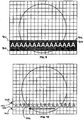
- Figure 8 illustrates the motion of video vectors in the video images. In the main picture section 602 there may be horizontal, vertical and/or diagonal vectors, in the HST area 604 there may be only horizontal vectors, and in the lower area 606 there may be horizontal, vertical and/or diagonal vectors.
- step 704 it is determined whether the background colour of the HST area 604 is opaque.
- Figure 9 shows a HST area 604 having an opaque background 906. If the condition is met, then in step 708, the line numbers of the most upper 902 and lower 904 lines of opaque background 906 are found. The upper and lower line numbers are received in step 709.
- step 705 determines if the background is transparent.
- Figure 10 illustrates a HST area without an opaque background, i.e. a transparent background. If the condition is met, the line numbers of the most upper 1002 and lower 1004 lines of HST 1006 is found in step 706.
- Step 707 is to add determined buffer lines on above 1008 and below 1010 the HST 1006.
- the foregoing process determines the area limits of sections 602, 604 and 606 (see Fig. 6 ).
- HST detection can be done manually by the viewer, i.e. by means of the arrow keys on the remote controller, the processor 406 being suitably programming to receive and/or detect this user selection.
- microcontroller data includes the information as to whether the scaling process should used on the video picture or not. This information is constructed from commands received via the remote controller (not shown) of the viewer of the TV system, the processor 406 being suitably programming to receive and/or detect this user selection. Consequently, user can determine if he/she wants the receiver to run the whole process (segmentation, separated scaling), or whether he/she wishes to watch the program/video in the distorted mode.
Landscapes
- Engineering & Computer Science (AREA)
- Computer Graphics (AREA)
- Multimedia (AREA)
- Signal Processing (AREA)
- Physics & Mathematics (AREA)
- General Physics & Mathematics (AREA)
- Theoretical Computer Science (AREA)
- Controls And Circuits For Display Device (AREA)
- Television Systems (AREA)
Claims (11)
- Procédé de conversion d'images vidéo, comprenant de :recevoir des premières images (102) ayant un premier rapport d'aspect ;convertir (502-506) les premières images vidéo en secondes images vidéo (104), les secondes images vidéo ayant un second rapport d'aspect, différent du premier rapport d'aspect, ladite conversion incluant une opération de mise à l'échelle horizontale ; etdélivrer les secondes images vidéo (104) ;caractérisé par ladite étape de conversion incluant la détection (701-709) de la présence dans les premières images vidéo de texte déroulable horizontalement et/ou d'éléments d'image déroulants horizontalement (302) ; et en ce quel'opération de mise à l'échelle horizontale (506) effectuée sur une première section (604) des premières images vidéo (102) qui contient le texte déroulable horizontalement et/ou les éléments d'image déroulants horizontalement (302) est différente de l'opération de mise à l'échelle horizontale (504) effectuée sur une ou plusieurs sections restantes (602,606) des premières images vidéo, dans lequel l'opération de conversion (506) effectuée sur la première section (604) des premières images vidéo (102) est une mise à l'échelle linéaire et dans lequel une desdites une ou plusieurs sections restantes (602,606) des premières images vidéo (102) comprend la section d'image principale (602) et l'opération de conversion (504) effectuée sur ladite section d'image principale (602) est une mise à l'échelle non linéaire, dans lequel la première section (604) après la mise à l'échelle linéaire est jointe à une ou plusieurs sections restantes (602,606) après la mise à l'échelle non linéaire pour produire une image unique.
- Procédé selon la revendication 1, dans lequel lesdites une ou plusieurs sections restantes (602, 606) des premières images vidéo (102) inclut une section relativement étroite (606) sur le côté de ladite première section (604) opposée à la section d'image principale (602).
- Procédé selon la revendication 2, dans lequel l'opération de conversion (504) effectuée sur ladite section relativement étroite (606) est identique à celle effectuée sur la première section (604).
- Procédé selon la revendication 2, dans lequel l'opération de conversion (504) effectuée sur ladite section relativement étroite (606) est identique à celle effectuée sur la section d'image principale (602) .
- Système de traitement vidéo, comprenant :un processeur de signaux (406), adapté pour recevoir des signaux vidéo (102) etun dispositif de mémoire (407), couplé au processeur de signaux (406),dans lequel le processeur de signaux (406) est opérationnel en liaison avec le dispositif de mémoire (407) pour mettre en oeuvre les étapes de réception des premières images vidéo (102) ayant un premier rapport d'aspect ;conversion (502-506) des premières images vidéo en secondes images vidéo (104), les secondes images vidéo ayant un second rapport d'aspect, différent dudit premier rapport d'aspect, ladite conversion incluant une opération de mise à l'échelle horizontale ; etdélivrance des secondes images vidéo (104) ;caractérisé par ladite étape de conversion incluant de détecter (701-709) la présence dans les premières images vidéo de texte déroulable horizontalement et/ou d'éléments d'image déroulants horizontalement (302) ; et en ce quel'opération de mise à l'échelle horizontale (506) effectuée sur une première section (604) des premières images vidéo (102) qui contient le texte déroulable horizontalement et/ou les éléments d'image déroulants horizontalement (302) est différente de l'opération de mise à l'échelle horizontale (504) effectuée sur une ou plusieurs sections restantes (602,606) des premières images vidéo, dans lequel l'opération de conversion (506) effectuée sur la première section (604) des premières images vidéo (102) est une mise à l'échelle linéaire et dans lequel une desdites une ouplusieurs sections restantes (602,606) des premières images vidéo (102) comprend la section d'image principale (602) et l'opération de conversion (504) effectuée sur ladite section d'image principale (602) est une mise à l'échelle non linéaire, dans lequel la première section (604) après la mise à l'échelle linéaire est jointe à une ou plusieurs sections restantes (602,606) après la mise à l'échelle non linéaire pour produire une image unique.
- Système selon la revendication 5, incluant en outre un détecteur de saturation (404), adapté pour recevoir des premiers signaux vidéo (CVBS) et délivrer des seconds signaux vidéo (RGB ou YUV) au processeur de signaux (406).
- Adaptateur vidéo comprenant le système selon une quelconque des revendications 5 ou 6, et comprenant en outre un syntoniseur (402) adapté pour recevoir des signaux provenant d'une antenne et délivrer des premiers signaux vidéo (CVBS).
- Système de génération vidéo comprenant le système selon une quelconque des revendications 5 ou 6, et comprenant un commutateur vidéo (408) et un appareil de playback vidéo pour lire une vidéo enregistrée.
- Système de télévision (400) comprenant le système selon une quelconque des revendications 5 ou 6 et un dispositif d'affichage (410).
- Support enregistrable, réinscriptible ou mémorisable sur lequel sont enregistrées ou mémorisées des données définissant ou transformables en instructions à des fins d'exécution par un circuit de traitement et correspondant au moins aux étapes d'une quelconque des revendications 1 à 4.
- Serveur informatique incorporant un dispositif de communication et un dispositif de mémoire et étant adapté pour une transmission à la demande ou sinon de données définissant ou transformables en instructions à des fins d'exécution par un circuit de traitement et correspondant au moins aux étapes d'une quelconque des revendications 1 à 4.
Priority Applications (3)
| Application Number | Priority Date | Filing Date | Title |
|---|---|---|---|
| AT06008001T ATE431675T1 (de) | 2006-04-18 | 2006-04-18 | Verfahren und system für die bildseitenverhältnisumwandlung eines videobildes |
| DE602006006805T DE602006006805D1 (de) | 2006-04-18 | 2006-04-18 | Verfahren und System für die Bildseitenverhältnisumwandlung eines Videobildes |
| EP06008001.7A EP1848203B2 (fr) | 2006-04-18 | 2006-04-18 | Méthode et système de conversion de format d'une image vidéo |
Applications Claiming Priority (1)
| Application Number | Priority Date | Filing Date | Title |
|---|---|---|---|
| EP06008001.7A EP1848203B2 (fr) | 2006-04-18 | 2006-04-18 | Méthode et système de conversion de format d'une image vidéo |
Publications (3)
| Publication Number | Publication Date |
|---|---|
| EP1848203A1 EP1848203A1 (fr) | 2007-10-24 |
| EP1848203B1 EP1848203B1 (fr) | 2009-05-13 |
| EP1848203B2 true EP1848203B2 (fr) | 2018-05-02 |
Family
ID=36570672
Family Applications (1)
| Application Number | Title | Priority Date | Filing Date |
|---|---|---|---|
| EP06008001.7A Expired - Lifetime EP1848203B2 (fr) | 2006-04-18 | 2006-04-18 | Méthode et système de conversion de format d'une image vidéo |
Country Status (3)
| Country | Link |
|---|---|
| EP (1) | EP1848203B2 (fr) |
| AT (1) | ATE431675T1 (fr) |
| DE (1) | DE602006006805D1 (fr) |
Families Citing this family (3)
| Publication number | Priority date | Publication date | Assignee | Title |
|---|---|---|---|---|
| TR200800856A2 (tr) * | 2008-02-11 | 2009-08-21 | Vestel Elektroni̇k Sanayi̇ Ve Ti̇caret A.Ş. | Bir eğlence sistemi için uyarlanabilir ölçekleme metodu. |
| CN101783900A (zh) * | 2010-03-10 | 2010-07-21 | 华为终端有限公司 | 一种图像分区缩放的方法和装置 |
| CN105556947A (zh) | 2013-09-16 | 2016-05-04 | 汤姆逊许可公司 | 用于色彩检测以生成文本色彩的方法和装置 |
Citations (5)
| Publication number | Priority date | Publication date | Assignee | Title |
|---|---|---|---|---|
| JPH07131734A (ja) † | 1993-10-28 | 1995-05-19 | Victor Co Of Japan Ltd | テレビジョン受像機及びオンスクリーン信号発生装置 |
| US5534934A (en) † | 1993-06-18 | 1996-07-09 | Hitachi, Ltd. | Television receiver capable of enlarging and compressing image |
| US20040212731A1 (en) † | 2003-03-14 | 2004-10-28 | Starz Encore Group, Llc | Video aspect ratio manipulation |
| EP1592246A1 (fr) † | 2004-04-30 | 2005-11-02 | Matsushita Electric Industrial Co., Ltd. | Détermination de mode film dans des zones d'image vidéo immobiles |
| US20050253964A1 (en) † | 2004-04-30 | 2005-11-17 | Frank Janssen | Ticker processing in video sequences |
Family Cites Families (2)
| Publication number | Priority date | Publication date | Assignee | Title |
|---|---|---|---|---|
| KR20040099058A (ko) * | 2003-05-17 | 2004-11-26 | 삼성전자주식회사 | 서브타이틀 처리 방법, 그 재생 장치 및 그 정보저장매체 |
| US7911536B2 (en) * | 2004-09-23 | 2011-03-22 | Intel Corporation | Screen filled display of digital video content |
-
2006
- 2006-04-18 DE DE602006006805T patent/DE602006006805D1/de not_active Expired - Lifetime
- 2006-04-18 AT AT06008001T patent/ATE431675T1/de not_active IP Right Cessation
- 2006-04-18 EP EP06008001.7A patent/EP1848203B2/fr not_active Expired - Lifetime
Patent Citations (5)
| Publication number | Priority date | Publication date | Assignee | Title |
|---|---|---|---|---|
| US5534934A (en) † | 1993-06-18 | 1996-07-09 | Hitachi, Ltd. | Television receiver capable of enlarging and compressing image |
| JPH07131734A (ja) † | 1993-10-28 | 1995-05-19 | Victor Co Of Japan Ltd | テレビジョン受像機及びオンスクリーン信号発生装置 |
| US20040212731A1 (en) † | 2003-03-14 | 2004-10-28 | Starz Encore Group, Llc | Video aspect ratio manipulation |
| EP1592246A1 (fr) † | 2004-04-30 | 2005-11-02 | Matsushita Electric Industrial Co., Ltd. | Détermination de mode film dans des zones d'image vidéo immobiles |
| US20050253964A1 (en) † | 2004-04-30 | 2005-11-17 | Frank Janssen | Ticker processing in video sequences |
Also Published As
| Publication number | Publication date |
|---|---|
| ATE431675T1 (de) | 2009-05-15 |
| EP1848203B1 (fr) | 2009-05-13 |
| DE602006006805D1 (de) | 2009-06-25 |
| EP1848203A1 (fr) | 2007-10-24 |
Similar Documents
| Publication | Publication Date | Title |
|---|---|---|
| US8284311B2 (en) | Screen filled display of digital video content | |
| KR100617178B1 (ko) | 텔레비전 시스템의 화면 크기 변환 장치 및 방법 | |
| US6504577B1 (en) | Method and apparatus for display of interlaced images on non-interlaced display | |
| JP4670494B2 (ja) | 表示装置及び表示画質設定方法 | |
| US8139081B1 (en) | Method for conversion between YUV 4:4:4 and YUV 4:2:0 | |
| JP3301055B2 (ja) | 表示システム及び方法 | |
| JP3472667B2 (ja) | ビデオデータ処理装置およびビデオデータ表示装置 | |
| KR20000053470A (ko) | 다중 스케일링된 비디오용 시스템 | |
| KR20050000956A (ko) | 비디오 포맷 변환 장치 | |
| CN101652994A (zh) | 视频发送装置、视频接收装置、视频记录装置、视频重放装置及视频显示装置 | |
| JP4568468B2 (ja) | 2つの異なるビデオプログラムを同時に記録及び表示するための方法及び装置 | |
| CN101998083B (zh) | 影像处理装置 | |
| US20050168483A1 (en) | Device and method for processing video signal | |
| US7616264B1 (en) | Cropped and scaled picture-in-picture system and method | |
| US9053752B1 (en) | Architecture for multiple graphics planes | |
| KR100487396B1 (ko) | 영화 모드를 지원하는 디지털 티브이 시스템 및 영화 모드지원 방법 | |
| CN100484210C (zh) | 视频图像处理方法 | |
| EP1848203B2 (fr) | Méthode et système de conversion de format d'une image vidéo | |
| KR100800021B1 (ko) | 고해상도 멀티채널 디스플레이 기능을 구비한 dvr | |
| JP5546508B2 (ja) | 画像表示装置及び画質設定方法 | |
| KR100499505B1 (ko) | 디지털 tv에서의 포맷 변환 장치 | |
| JP2008102233A (ja) | 映像信号処理装置 | |
| JP2009116421A (ja) | 映像再生装置 | |
| JP2004221751A (ja) | 画像信号処理装置 | |
| KR100759224B1 (ko) | 디스플레이 장치의 영상 표시방법 |
Legal Events
| Date | Code | Title | Description |
|---|---|---|---|
| PUAI | Public reference made under article 153(3) epc to a published international application that has entered the european phase |
Free format text: ORIGINAL CODE: 0009012 |
|
| 17P | Request for examination filed |
Effective date: 20060418 |
|
| AK | Designated contracting states |
Kind code of ref document: A1 Designated state(s): AT BE BG CH CY CZ DE DK EE ES FI FR GB GR HU IE IS IT LI LT LU LV MC NL PL PT RO SE SI SK TR |
|
| AX | Request for extension of the european patent |
Extension state: AL BA HR MK YU |
|
| 17Q | First examination report despatched |
Effective date: 20080411 |
|
| AKX | Designation fees paid |
Designated state(s): AT BE BG CH CY CZ DE DK EE ES FI FR GB GR HU IE IS IT LI LT LU LV MC NL PL PT RO SE SI SK TR |
|
| GRAP | Despatch of communication of intention to grant a patent |
Free format text: ORIGINAL CODE: EPIDOSNIGR1 |
|
| GRAS | Grant fee paid |
Free format text: ORIGINAL CODE: EPIDOSNIGR3 |
|
| GRAA | (expected) grant |
Free format text: ORIGINAL CODE: 0009210 |
|
| AK | Designated contracting states |
Kind code of ref document: B1 Designated state(s): AT BE BG CH CY CZ DE DK EE ES FI FR GB GR HU IE IS IT LI LT LU LV MC NL PL PT RO SE SI SK TR |
|
| REG | Reference to a national code |
Ref country code: GB Ref legal event code: FG4D |
|
| REG | Reference to a national code |
Ref country code: CH Ref legal event code: EP |
|
| REG | Reference to a national code |
Ref country code: IE Ref legal event code: FG4D |
|
| REF | Corresponds to: |
Ref document number: 602006006805 Country of ref document: DE Date of ref document: 20090625 Kind code of ref document: P |
|
| PG25 | Lapsed in a contracting state [announced via postgrant information from national office to epo] |
Ref country code: FI Free format text: LAPSE BECAUSE OF FAILURE TO SUBMIT A TRANSLATION OF THE DESCRIPTION OR TO PAY THE FEE WITHIN THE PRESCRIBED TIME-LIMIT Effective date: 20090513 Ref country code: ES Free format text: LAPSE BECAUSE OF FAILURE TO SUBMIT A TRANSLATION OF THE DESCRIPTION OR TO PAY THE FEE WITHIN THE PRESCRIBED TIME-LIMIT Effective date: 20090824 Ref country code: LT Free format text: LAPSE BECAUSE OF FAILURE TO SUBMIT A TRANSLATION OF THE DESCRIPTION OR TO PAY THE FEE WITHIN THE PRESCRIBED TIME-LIMIT Effective date: 20090513 Ref country code: AT Free format text: LAPSE BECAUSE OF FAILURE TO SUBMIT A TRANSLATION OF THE DESCRIPTION OR TO PAY THE FEE WITHIN THE PRESCRIBED TIME-LIMIT Effective date: 20090513 Ref country code: PT Free format text: LAPSE BECAUSE OF FAILURE TO SUBMIT A TRANSLATION OF THE DESCRIPTION OR TO PAY THE FEE WITHIN THE PRESCRIBED TIME-LIMIT Effective date: 20090913 |
|
| NLV1 | Nl: lapsed or annulled due to failure to fulfill the requirements of art. 29p and 29m of the patents act | ||
| PG25 | Lapsed in a contracting state [announced via postgrant information from national office to epo] |
Ref country code: LV Free format text: LAPSE BECAUSE OF FAILURE TO SUBMIT A TRANSLATION OF THE DESCRIPTION OR TO PAY THE FEE WITHIN THE PRESCRIBED TIME-LIMIT Effective date: 20090513 Ref country code: PL Free format text: LAPSE BECAUSE OF FAILURE TO SUBMIT A TRANSLATION OF THE DESCRIPTION OR TO PAY THE FEE WITHIN THE PRESCRIBED TIME-LIMIT Effective date: 20090513 Ref country code: NL Free format text: LAPSE BECAUSE OF FAILURE TO SUBMIT A TRANSLATION OF THE DESCRIPTION OR TO PAY THE FEE WITHIN THE PRESCRIBED TIME-LIMIT Effective date: 20090513 Ref country code: SI Free format text: LAPSE BECAUSE OF FAILURE TO SUBMIT A TRANSLATION OF THE DESCRIPTION OR TO PAY THE FEE WITHIN THE PRESCRIBED TIME-LIMIT Effective date: 20090513 Ref country code: SE Free format text: LAPSE BECAUSE OF FAILURE TO SUBMIT A TRANSLATION OF THE DESCRIPTION OR TO PAY THE FEE WITHIN THE PRESCRIBED TIME-LIMIT Effective date: 20090813 Ref country code: IS Free format text: LAPSE BECAUSE OF FAILURE TO SUBMIT A TRANSLATION OF THE DESCRIPTION OR TO PAY THE FEE WITHIN THE PRESCRIBED TIME-LIMIT Effective date: 20090913 |
|
| PG25 | Lapsed in a contracting state [announced via postgrant information from national office to epo] |
Ref country code: CZ Free format text: LAPSE BECAUSE OF FAILURE TO SUBMIT A TRANSLATION OF THE DESCRIPTION OR TO PAY THE FEE WITHIN THE PRESCRIBED TIME-LIMIT Effective date: 20090513 Ref country code: DK Free format text: LAPSE BECAUSE OF FAILURE TO SUBMIT A TRANSLATION OF THE DESCRIPTION OR TO PAY THE FEE WITHIN THE PRESCRIBED TIME-LIMIT Effective date: 20090513 Ref country code: EE Free format text: LAPSE BECAUSE OF FAILURE TO SUBMIT A TRANSLATION OF THE DESCRIPTION OR TO PAY THE FEE WITHIN THE PRESCRIBED TIME-LIMIT Effective date: 20090513 |
|
| PLBI | Opposition filed |
Free format text: ORIGINAL CODE: 0009260 |
|
| PG25 | Lapsed in a contracting state [announced via postgrant information from national office to epo] |
Ref country code: SK Free format text: LAPSE BECAUSE OF FAILURE TO SUBMIT A TRANSLATION OF THE DESCRIPTION OR TO PAY THE FEE WITHIN THE PRESCRIBED TIME-LIMIT Effective date: 20090513 Ref country code: BE Free format text: LAPSE BECAUSE OF FAILURE TO SUBMIT A TRANSLATION OF THE DESCRIPTION OR TO PAY THE FEE WITHIN THE PRESCRIBED TIME-LIMIT Effective date: 20090513 |
|
| 26 | Opposition filed |
Opponent name: INTERESSENGEMEINSCHAFT FUER RUNDFUNKSCHUTZ- RECHTE Effective date: 20100215 |
|
| PG25 | Lapsed in a contracting state [announced via postgrant information from national office to epo] |
Ref country code: BG Free format text: LAPSE BECAUSE OF FAILURE TO SUBMIT A TRANSLATION OF THE DESCRIPTION OR TO PAY THE FEE WITHIN THE PRESCRIBED TIME-LIMIT Effective date: 20090813 |
|
| PLAX | Notice of opposition and request to file observation + time limit sent |
Free format text: ORIGINAL CODE: EPIDOSNOBS2 |
|
| PLAF | Information modified related to communication of a notice of opposition and request to file observations + time limit |
Free format text: ORIGINAL CODE: EPIDOSCOBS2 |
|
| PLBB | Reply of patent proprietor to notice(s) of opposition received |
Free format text: ORIGINAL CODE: EPIDOSNOBS3 |
|
| PG25 | Lapsed in a contracting state [announced via postgrant information from national office to epo] |
Ref country code: GR Free format text: LAPSE BECAUSE OF FAILURE TO SUBMIT A TRANSLATION OF THE DESCRIPTION OR TO PAY THE FEE WITHIN THE PRESCRIBED TIME-LIMIT Effective date: 20090814 |
|
| PG25 | Lapsed in a contracting state [announced via postgrant information from national office to epo] |
Ref country code: MC Free format text: LAPSE BECAUSE OF NON-PAYMENT OF DUE FEES Effective date: 20100430 |
|
| REG | Reference to a national code |
Ref country code: CH Ref legal event code: PL |
|
| PG25 | Lapsed in a contracting state [announced via postgrant information from national office to epo] |
Ref country code: IE Free format text: LAPSE BECAUSE OF NON-PAYMENT OF DUE FEES Effective date: 20100418 |
|
| PG25 | Lapsed in a contracting state [announced via postgrant information from national office to epo] |
Ref country code: LI Free format text: LAPSE BECAUSE OF NON-PAYMENT OF DUE FEES Effective date: 20100430 Ref country code: CH Free format text: LAPSE BECAUSE OF NON-PAYMENT OF DUE FEES Effective date: 20100430 |
|
| APBM | Appeal reference recorded |
Free format text: ORIGINAL CODE: EPIDOSNREFNO |
|
| APBP | Date of receipt of notice of appeal recorded |
Free format text: ORIGINAL CODE: EPIDOSNNOA2O |
|
| APAH | Appeal reference modified |
Free format text: ORIGINAL CODE: EPIDOSCREFNO |
|
| REG | Reference to a national code |
Ref country code: DE Ref legal event code: R082 Ref document number: 602006006805 Country of ref document: DE Representative=s name: KEHL, ASCHERL, LIEBHOFF & ETTMAYR PATENTANWAEL, DE Ref country code: DE Ref legal event code: R082 Ref document number: 602006006805 Country of ref document: DE Representative=s name: KEHL, ASCHERL, LIEBHOFF & ETTMAYR - PATENTANWA, DE |
|
| APBQ | Date of receipt of statement of grounds of appeal recorded |
Free format text: ORIGINAL CODE: EPIDOSNNOA3O |
|
| PG25 | Lapsed in a contracting state [announced via postgrant information from national office to epo] |
Ref country code: CY Free format text: LAPSE BECAUSE OF FAILURE TO SUBMIT A TRANSLATION OF THE DESCRIPTION OR TO PAY THE FEE WITHIN THE PRESCRIBED TIME-LIMIT Effective date: 20090513 |
|
| PG25 | Lapsed in a contracting state [announced via postgrant information from national office to epo] |
Ref country code: HU Free format text: LAPSE BECAUSE OF FAILURE TO SUBMIT A TRANSLATION OF THE DESCRIPTION OR TO PAY THE FEE WITHIN THE PRESCRIBED TIME-LIMIT Effective date: 20091114 Ref country code: LU Free format text: LAPSE BECAUSE OF NON-PAYMENT OF DUE FEES Effective date: 20100418 |
|
| PG25 | Lapsed in a contracting state [announced via postgrant information from national office to epo] |
Ref country code: TR Free format text: LAPSE BECAUSE OF FAILURE TO SUBMIT A TRANSLATION OF THE DESCRIPTION OR TO PAY THE FEE WITHIN THE PRESCRIBED TIME-LIMIT Effective date: 20090513 |
|
| PG25 | Lapsed in a contracting state [announced via postgrant information from national office to epo] |
Ref country code: RO Free format text: LAPSE BECAUSE OF FAILURE TO SUBMIT A TRANSLATION OF THE DESCRIPTION OR TO PAY THE FEE WITHIN THE PRESCRIBED TIME-LIMIT Effective date: 20090513 |
|
| PLAB | Opposition data, opponent's data or that of the opponent's representative modified |
Free format text: ORIGINAL CODE: 0009299OPPO |
|
| R26 | Opposition filed (corrected) |
Opponent name: INTERESSENGEMEINSCHAFT FUER RUNDFUNKSCHUTZRECHTE E Effective date: 20100215 |
|
| PLAB | Opposition data, opponent's data or that of the opponent's representative modified |
Free format text: ORIGINAL CODE: 0009299OPPO |
|
| R26 | Opposition filed (corrected) |
Opponent name: INTERESSENGEMEINSCHAFT FUER RUNDFUNKSCHUTZRECHTE E Effective date: 20100215 |
|
| REG | Reference to a national code |
Ref country code: FR Ref legal event code: PLFP Year of fee payment: 11 |
|
| REG | Reference to a national code |
Ref country code: FR Ref legal event code: PLFP Year of fee payment: 12 |
|
| APBU | Appeal procedure closed |
Free format text: ORIGINAL CODE: EPIDOSNNOA9O |
|
| PUAH | Patent maintained in amended form |
Free format text: ORIGINAL CODE: 0009272 |
|
| STAA | Information on the status of an ep patent application or granted ep patent |
Free format text: STATUS: PATENT MAINTAINED AS AMENDED |
|
| REG | Reference to a national code |
Ref country code: FR Ref legal event code: PLFP Year of fee payment: 13 |
|
| 27A | Patent maintained in amended form |
Effective date: 20180502 |
|
| AK | Designated contracting states |
Kind code of ref document: B2 Designated state(s): AT BE BG CH CY CZ DE DK EE ES FI FR GB GR HU IE IS IT LI LT LU LV MC NL PL PT RO SE SI SK TR |
|
| REG | Reference to a national code |
Ref country code: DE Ref legal event code: R102 Ref document number: 602006006805 Country of ref document: DE |
|
| PGFP | Annual fee paid to national office [announced via postgrant information from national office to epo] |
Ref country code: DE Payment date: 20250422 Year of fee payment: 20 |
|
| PGFP | Annual fee paid to national office [announced via postgrant information from national office to epo] |
Ref country code: GB Payment date: 20250418 Year of fee payment: 20 |
|
| PGFP | Annual fee paid to national office [announced via postgrant information from national office to epo] |
Ref country code: IT Payment date: 20250424 Year of fee payment: 20 |
|
| PGFP | Annual fee paid to national office [announced via postgrant information from national office to epo] |
Ref country code: FR Payment date: 20250423 Year of fee payment: 20 |
|
| REG | Reference to a national code |
Ref country code: DE Ref legal event code: R071 Ref document number: 602006006805 Country of ref document: DE |