EP1850133A1 - Verfahren zur Bestimmung hoher Ristocetin-Kofaktor-Aktivitäten des von-Willebrand-Faktors - Google Patents
Verfahren zur Bestimmung hoher Ristocetin-Kofaktor-Aktivitäten des von-Willebrand-Faktors Download PDFInfo
- Publication number
- EP1850133A1 EP1850133A1 EP07007502A EP07007502A EP1850133A1 EP 1850133 A1 EP1850133 A1 EP 1850133A1 EP 07007502 A EP07007502 A EP 07007502A EP 07007502 A EP07007502 A EP 07007502A EP 1850133 A1 EP1850133 A1 EP 1850133A1
- Authority
- EP
- European Patent Office
- Prior art keywords
- vwf
- norm
- activity
- sample
- rco
- Prior art date
- Legal status (The legal status is an assumption and is not a legal conclusion. Google has not performed a legal analysis and makes no representation as to the accuracy of the status listed.)
- Withdrawn
Links
- 0 CC(*)C(*)([C@@]1C)C(*)(*2*34)[C@@]1(C)[C@]2(C)C3(C)[C@@]1(C)*4*(C)C(C)(C)C(C*)C1 Chemical compound CC(*)C(*)([C@@]1C)C(*)(*2*34)[C@@]1(C)[C@]2(C)C3(C)[C@@]1(C)*4*(C)C(C)(C)C(C*)C1 0.000 description 1
Images


Classifications
-
- G—PHYSICS
- G01—MEASURING; TESTING
- G01N—INVESTIGATING OR ANALYSING MATERIALS BY DETERMINING THEIR CHEMICAL OR PHYSICAL PROPERTIES
- G01N33/00—Investigating or analysing materials by specific methods not covered by groups G01N1/00 - G01N31/00
- G01N33/48—Biological material, e.g. blood, urine; Haemocytometers
- G01N33/50—Chemical analysis of biological material, e.g. blood, urine; Testing involving biospecific ligand binding methods; Immunological testing
- G01N33/86—Chemical analysis of biological material, e.g. blood, urine; Testing involving biospecific ligand binding methods; Immunological testing involving blood coagulating time or factors, or their receptors
-
- G—PHYSICS
- G01—MEASURING; TESTING
- G01N—INVESTIGATING OR ANALYSING MATERIALS BY DETERMINING THEIR CHEMICAL OR PHYSICAL PROPERTIES
- G01N2333/00—Assays involving biological materials from specific organisms or of a specific nature
- G01N2333/435—Assays involving biological materials from specific organisms or of a specific nature from animals; from humans
- G01N2333/745—Assays involving non-enzymic blood coagulation factors
- G01N2333/755—Factors VIII, e.g. factor VIII C [AHF], factor VIII Ag [VWF]
Definitions
- the invention is in the field of coagulation diagnostics and relates to a method for determining von Willebrand factor in samples containing high von Willebrand factor concentrations.
- the particular advantage of the method is that samples whose von Willebrand factor content is to be determined need not be diluted before mixing with the required test reagents.
- Von Willebrand Factor is a large-molecule, multimeric glycoprotein that is also referred to as an adhesive protein because of its important functions in primary hemostasis, that is, in platelet adhesion and aggregation.
- the VWF fulfills three essential tasks in the case of vascular injury: It mediates platelet adhesion to the subendothelium, mediates aggregation of the platelets among one another, thereby promoting thrombus formation, and forms a complex with the plasma coagulation factor VIII (F VIII) protects the F VIII from premature degradation.
- F VIII plasma coagulation factor VIII
- thrombin F VIII is cleaved from the F VIII -VWF complex and activated to F VIIIa and thus obtains its procoagulant activity, which is also often referred to as F VIII: C.
- VWF von Willebrand Factor Antigen
- the reference range for normal individuals ranges from 40% to 240% of the norm, including all age groups and the 95% confidence interval. It is Z. B. it is known that in persons with the blood group 0, the VWF: Ag concentration in blood is about 25% lower than in people with other blood types. As the age increases, the VWF: Ag level increases, so that the VWF: Ag level of persons older than 70 years old is about 15% higher than the VWF: Ag level of twenty years old. During pregnancy, the VWF: Ag level increases continuously, possibly up to 1064%. Increased concentrations of VWF: Ag are discussed as a risk factor or risk indicator for arterial vascular disease, and multiple venous thromboembolism has been reported to increase VWF: Ag levels.
- VEF Congenital or acquired debilitations or functional defects of the VWF are referred to as von Willebrand syndrome and are associated with a bleeding tendency (hemophilia), which can take life-threatening forms depending on the severity.
- Type I caused by a quantitative VWF: Ag reduction
- Type II with several subtypes, caused by a partial loss of activity, which often does not go hand in hand with a reduction in antigen concentration
- Type III caused by a complete lack of VWF: Ag.
- functional assays that allow the quantitative determination of the activity of VWF Ag.
- the so-called ristocetin cofactor assay serves to determine the ristocetin cofactor activity of the VWF.
- the ristocetin cofactor activity of VWF also referred to as VWF: RCo, is the activity of VWF which, in the presence of ristocetin, causes the aggregation of native or stabilized platelets (platelets). In vivo, platelets must be activated before they can aggregate. In vitro, VWF causes aggregation of non-activated platelets in the presence of ristocetin.
- Ristocetin is a therapeutically unusable antibiotic whose sole application is the ristocetin cofactor assay.
- the ristocetin cofactor assay for determining the ristocetin cofactor activity of the VWF is usually carried out in such a way that the sample to be examined, preferably a plasma sample is mixed with platelets and ristocetin and the aggregation reaction is measured.
- the aggregation can be visually evaluated, such as. In EP 186 476 A2 described.
- This semiquantitative method is increasingly being replaced by semi-automatic, quantitative aggregometric measurement, which usually measures light transmission. By aggregate formation, the light transmission of the platelet suspension is increased, so that by measuring the light transmission z. B. the speed of aggregate formation can be determined.
- the aggregation reaction is proportional to the VWF: RCo-activity of the sample: the higher z.
- the rate of aggregation reaction increases the greater the VWF: RCo activity in the sample.
- various variations of the ristocetin cofactor assay have been developed that allow fully automated accurate determination of VWF: RCo activity.
- Modern coagulation measuring devices such. B. the BCS ® coagulation analyzer (Dade Behring Marburg GmbH, Marburg, Germany) measure the change in the optical density of the test batch and automatically determine the VWF: RCo activity of the sample in% of the norm.
- the quantitative determination of the VWF: RCo activity of a sample is made by comparing the aggregation reaction of the sample with a reference curve.
- Reference curves are usually created by gradually diluting one or more reference samples with known VWF: RCo activity and measuring the activities. If the activity of a reference sample corresponds to the average activity of a normal population, it is defined as 100% of the norm or as 1 IU (International Unit). If z. B. a 1: 1 diluted reference sample measured at 100% of the standard, the measured VWF: RCo activity represents 50% of the norm.
- the sample to be tested is mixed with at least one reagent containing ristocetin and stabilized platelets into a test batch.
- test mixtures are generated such that the VWF: RCo activity in the test batch is usually about 10% of the norm.
- NCLS National Committee for Clinical Laboratory Standards
- the 500 ⁇ L assay consists of 400 ⁇ L of a platelet suspension, 50 ⁇ L of a ristocetin solution and 50 ⁇ L of an undiluted or diluted plasma sample together.
- the VWF final Ag concentration or VWF: RCo activity based on the total volume of the test mixture, as it comes about by the addition of undiluted normal plasma is thus 10% of the norm.
- the test mixtures are composed in such a way that the VWF: Ag concentration or the VWF: RCo activity in the test batch is always well below 30% of the norm.
- the plasma samples to be examined are previously diluted with a suitable buffer or with VWF: Ag depleted plasma.
- Table 1 shows the maximum VWF: Ag concentrations or VWF: RCo activities in test mixtures for determining the VWF: RCo activity, from various exemplary technical articles.
- the disadvantage of the hitherto known embodiments of the ristocetin cofactor assay is that the sample to be examined usually has to be prediluted if the VWF activity of the sample is significantly higher than the average activity of a normal plasma (100% of the norm). So z.
- the NCCLS will increase the dilution of the sample in its guidelines because the reference curve flattenes very sharply (see Figure 1 in NCCLS Document H51-P).
- Particularly disadvantageous is the need for dilution in the determination of highly concentrated VWF concentrates, the z. B. are provided for the replacement therapy of von Willebrand syndrome patients.
- a VWF concentrate is z. B. a known under the trade name Haemate ® P preparation (ZLB Behring GmbH, Germany).
- Haemate ® P preparation ZLB Behring GmbH, Germany.
- RCo activity concentrates must be greatly diluted so far. Dilution steps are not only time consuming, but always pose a risk of error. So z. B. only the nature of the dilution medium has a significant influence on the measured VWF: RCo activity have [ Fricke, WA et al. (1993) Standards for Assay of von Willebrand Factor Concentrates: A Collaborative Study. Thromb Haemost. 70, 351-356 ]. The possibility of the lowest possible dilution would be particularly desirable to minimize this source of error.
- VWF RCo assays are predominantly carried out on fully automatic analyzers
- Even modern analyzers have limited ability to pipette low volumes.
- the lowest volume for example, by coagulation analyzers BCS ® or BCT ® (Dade Behring Marburg GmbH, Marburg, Germany) can be pipetted, is making it is usually considered necessary in 3 ul, samples before determining the VWF: RCo activity to dilute.
- the object is to provide the method according to the invention described in the claims.
- the present invention is a method for determining the ristocetin cofactor activity of von Willebrand factor (VWF: RCo activity) in a sample, wherein an aliquot of the sample is mixed with platelets and with ristocetin to form a test batch and the aggregation reaction the platelets is measured.
- VWF von Willebrand factor
- RCo activities can be precisely measured when the VWF: RCo activity contained in the assay approach is greater than 25% of the norm and does not exceed 200% of the norm.
- the VWF: RCo activity contained in the assay is between 30% and 160% of the norm.
- the advantage of the method according to the invention is that patient samples and even VWF concentrates no longer need to be diluted unless a VWF: RCo activity of 200% of the standard is exceeded in the assay. Since in many embodiments of the ristocetin cofactor assay the proportion of sample in the assay batch volume is about 10%, samples having a VWF: RCo activity of up to 2,000% of the standard can be reliably measured without prior dilution. For samples known to have a higher VWF: RCo activity than 2,000% of the norm, such as. B. VWF or F VIII: VWF concentrates, can either modify the assay so that the proportion of sample in the assay batch volume is less than 10%, or the sample is previously diluted. Would z.
- Example 2 with a constant total volume of the test mixture (160 ⁇ L) instead of 5 ⁇ L sample only 1.6 ⁇ L sample are used, the proportion of the sample in the test batch volume would be 1%.
- samples with a VWF: RCo activity of up to 20,000% of the norm could still be measured undiluted.
- the method according to the invention is suitable for determining the VWF: RCo activity in a sample, which is to be assumed to have a VWF: RCo activity of between 600% and 20,000% of the standard.
- Samples that are expected to have a VWF: RCo activity between 600% and 20,000% of the standard are, for example, VWF concentrates for which VWF: RCo activity has been declared by the manufacturer in the aforementioned range.
- Other types of samples suspected of exhibiting VWF: RCo activity between 600% and 20,000% of the norm are samples of blood, blood plasma, or blood serum of human or animal origin derived from a donor has acute or chronic inflammation, polytrauma or sepsis or is in a postoperative condition or is pregnant.
- the assay per microliter contains about 900,000 to about 3,000,000 platelets, more preferably about 1,200,000 to 2,000,000 platelets.
- the platelet suspension mixed with the sample may be native or preferably stabilized platelets.
- the stabilized platelet preparations are pretreated platelets such. For example, formalin-fixed platelets or platelets treated with protease inhibitors.
- the assay contains ristocetin in a concentration of 0.7 to 2 milligrams, more preferably 0.9 to 1.5 milligrams per milliliter of assay.
- the assay for the determination of VWF RCo activity in a sample is continuously mixed during the phase in which the measurement of the aggregation reaction takes place.
- the mixing can z. B. by stirring or Shake the test batch or by sonication.
- the mixing by stirring can z.
- the test batch is stirred continuously at a stirring speed of 100 to 500 revolutions per minute (RPM).
- FIG. 1 A first figure.
- Example 1 Preparation of a Platelet Ristocetin Reagent and Preparation of Calibrators of Defined VWF: RCo Activity
- a reagent for use in the method of the invention for determining VWF-RCo activity formaldehyde-fixed human platelets were suspended in phosphate buffered saline and mixed with ristocetin to give the reagent 1.8 million platelets per ⁇ L and 1.25 mg ristocetin per mL.
- VWF RCo activity was determined by the platelet agglutination method using a commercial reagent (Von Willebrand reagent, Dade Behring Marburg GmbH, Marburg, Germany) containing stabilized platelets, ristocetin and EDTA.
- the factor VIII-VWF concentrate was serially diluted with isotonic saline, and 50 ⁇ L of concentrate dilution and 50 ⁇ L of saline (blank) were pipetted onto a glass plate.
- RCo activity Haemate® ® P was diluted with VWF-deficient plasma.
- Calibrators containing the following VWF: RCo activities were prepared in this way: Calibrator 1 5000% of the norm Calibrator 2 4000% of the norm Calibrator 3 3030% of the norm Calibrator 4 2000% of the norm Calibrator 5 1000% of the norm Calibrator 6 0% of the norm.
- Calibrator 6 contained no Haemate® ® P and consisted exclusively of VWF-deficient plasma.
- Example 1 5 ⁇ L of the plasma sample or calibrator to be examined (see Example 1) were placed in a reaction vessel, mixed with 5 ⁇ L of VWF-deficient plasma and incubated for 15 seconds at 37 ° C. Subsequently, 150 ⁇ L of the platelet ristocetin reagent (see Example 1) was added. The test batches contained a ristocetin concentration of 1.17 mg / mL and a platelet concentration of approximately 1.68 million per ⁇ L.
- VWF RCo activities were generated in the test batch in this way: ⁇ b> Table 2 ⁇ / b> VWF: RCo activity of the calibrator VWF: RCo activity in the assay
- the absorbance of the assay was measured at 405 nm for a period of 90 seconds.
- the Extinction change (mE / minute) was determined and the maximum absorbance change (Vmax of the absorbance decrease) was determined.
- the Vmax values of the various calibrators were plotted against the VWF: RCo activities of the calibrators (in% of the standard). By means of a linear connection of these calibration curve points, the calibration curve was calculated (see also FIG. 1).
- the VWF: RCo activity of a plasma sample was determined by determining the VWF: RCo activity of the sample (in% of the standard) by comparing the Vmax value of the sample with the calibration curve.
Landscapes
- Health & Medical Sciences (AREA)
- Life Sciences & Earth Sciences (AREA)
- Hematology (AREA)
- Engineering & Computer Science (AREA)
- Molecular Biology (AREA)
- Biomedical Technology (AREA)
- Chemical & Material Sciences (AREA)
- Immunology (AREA)
- Urology & Nephrology (AREA)
- Biotechnology (AREA)
- Microbiology (AREA)
- Cell Biology (AREA)
- Food Science & Technology (AREA)
- Medicinal Chemistry (AREA)
- Physics & Mathematics (AREA)
- Analytical Chemistry (AREA)
- Biochemistry (AREA)
- General Health & Medical Sciences (AREA)
- General Physics & Mathematics (AREA)
- Pathology (AREA)
- Investigating Or Analysing Biological Materials (AREA)
Abstract
Description
- Die Erfindung liegt auf dem Gebiet der Gerinnungsdiagnostik und betrifft ein Verfahren zur Bestimmung des von-Willebrand-Faktors in Proben, die hohe von-Willebrand-Faktor-Konzentrationen enthalten. Der besondere Vorteil des Verfahrens besteht darin, dass Proben, deren von-Willebrand-Faktor-Gehalt bestimmt werden soll, vor dem Vermischen mit den erforderlichen Testreagenzien nicht mehr verdünnt werden müssen.
- Der von-Willebrand-Faktor (abgekürzt: VWF) ist ein großmolekulares, multimeres Glykoprotein, das aufgrund seiner wichtigen Funktionen in der primären Hämostase, das heißt bei der Thrombozytenadhäsion und -aggregation, auch als Adhäsivprotein bezeichnet wird. Der VWF erfüllt im Falle einer Gefäßverletzung drei wesentliche Aufgaben: Er vermittelt die Adhäsion der Thrombozyten an das Subendothel, er vermittelt die Aggregation der Thrombozyten untereinander und begünstigt dadurch die Thrombusbildung, und er bildet mit dem plasmatischen Blutgerinnungsfaktor VIII (F VIII) einen Komplex, der den F VIII vor vorzeitigem Abbau schützt. Durch Thrombin wird F VIII vom F VIII-VWF-Komplex abgespalten und zu F VIIIa aktiviert und erlangt so seine prokoagulatorische Aktivität, die auch häufig als F VIII:C bezeichnet wird.
- Die normale Konzentration des von-Willebrand-Faktor-Antigens (VWF:Ag) im Blut umfasst eine große interindividuelle sowie intraindividuelle Spannbreite. Der Referenzbereich für Normalindividuen (Normalbereich) reicht von 40 % bis 240 % der Norm unter Einbeziehung aller Altersgruppen und des 95 % Konfidenzintervalls. Es ist z. B. bekannt, dass bei Personen mit der Blutgruppe 0 die VWF:Ag-Konzentration im Blut um etwa 25 % geringer ist als bei Personen mit anderen Blutgruppen. Mit zunehmendem Alter steigt der VWF:Ag-Spiegel, so dass der VWF:Ag-Spiegel von Personen, die älter als 70 Jahre alt sind, um ca. 15 % höher ist als der VWF:Ag-Spiegel von Zwanzigjährigen. Während der Schwangerschaft steigt der VWF:Ag-Spiegel kontinuierlich an, unter Umständen auf bis zu 1064 %. Erhöhte Konzentrationen des VWF:Ag werden als Risikofaktor oder Risikoindikator für arterielle Gefäßerkrankungen diskutiert, und auch bei venösen Thromboembolien wurde mehrfach von erhöhten VWF:Ag-Konzentrationen berichtet.
- Angeborene oder erworbene Verminderungen oder Funktionsdefekte des VWF werden als von-Willebrand-Syndrom bezeichnet und gehen mit einer Blutungsneigung (Hämophilie) einher, die je nach Schweregrad lebensbedrohliche Formen annehmen kann. Es sind verschiedene Varianten des von Willebrand-Syndroms bekannt: Typ I, verursacht durch eine quantitative VWF:Ag-Verminderung; Typ II mit mehreren Subtypen, verursacht durch einen teilweisen Aktivitätsverlust, welcher oft nicht gleich stark mit einer Verminderung der Antigenkonzentration einhergeht; und Typ III, verursacht durch ein komplettes Fehlen des VWF:Ag. Zur Diagnose eines von-Willebrand-Syndroms bzw. zur Differenzierung der unterschiedlichen Varianten werden verschiedene Testverfahren eingesetzt, wie z. B. immunologische Assays, die eine quantitative Bestimmung der VWF:Ag-Konzentration erlauben sowie funktionelle Assays, die die quantitative Bestimmung der Aktivität des VWF:Ag ermöglichen.
- Der sogenannte Ristocetin-Kofaktor-Assay dient der Bestimmung der Ristocetin-Kofaktor-Aktivität des VWF. Die Ristocetin-Kofaktor-Aktivität des VWF, die auch als VWF:RCo bezeichnet wird, ist die Aktivität des VWF, die in Gegenwart von Ristocetin die Aggregation von nativen oder stabilisierten Thrombozyten (Plättchen) bewirkt. In vivo müssen Thrombozyten aktiviert werden, bevor sie aggregieren können. In vitro bewirkt der VWF in Gegenwart von Ristocetin die Aggregation von nicht aktivierten Thrombozyten. Ristocetin ist ein therapeutisch nicht verwendbares Antibiotikum, dessen einziges Einsatzgebiet der Ristocetin-Kofaktor-Assay ist.
- Der Ristocetin-Kofaktor-Assay zur Bestimmung der Ristocetin-Kofaktor-Aktivität des VWF wird üblicherweise so durchgeführt, dass die zu untersuchende Probe, bevorzugt eine Plasmaprobe, mit Thrombozyten und mit Ristocetin vermischt wird und die Aggregationsreaktion gemessen wird. Die Aggregation kann visuell bewertet werden, wie z. B. in
EP 186 476 A2 - Bei der klassischen Aggregometrie werden die Reaktionsansätze zur Bestimmung der VWF:RCo-Aktivität permanent gerührt, da die Thrombozytenaggregatbildung ansonsten nicht erfolgt. Eine Modifikation dieses klassischen Verfahrens ist in dem Patentdokument
EP 458 330 B1 EP 1 134 584 B1 beschrieben, das eine modifizierte Bestimmung der Aggregationsreaktion durch Rühren bzw. Nichtrühren des Reaktionsansatzes betrifft. - Die quantitative Bestimmung der VWF:RCo-Aktivität einer Probe erfolgt, indem die Aggregationsreaktion der Probe mit einer Referenzkurve verglichen wird. Referenzkurven werden üblicherweise erstellt, indem eine oder mehrere Referenzproben mit bekannter VWF:RCo-Aktivität stufenweise verdünnt werden und die Aktivitäten gemessen werden. Entspricht die Aktivität einer Referenzprobe der durchschnittlichen Aktivität einer normalen Bevölkerung, so wird sie als 100 % der Norm definiert oder auch als 1 IU (Internationale Einheit). Wird z. B. eine 1:1 verdünnte Referenzprobe mit 100 % der Norm gemessen, so repräsentiert die gemessene VWF:RCo-Aktivität 50 % der Norm.
- Wie bereits oben beschrieben wurde, wird beim Ristocetin-Kofaktor-Assay die zu untersuchende Probe mit mindestens einem Reagenz, das Ristocetin und stabilisierte Thrombozyten enthält, zu einem Testansatz vermischt. In den derzeitig bekannten Verfahren zur Bestimmung der VWF:RCo-Aktivität in einer Probe werden Testansätze so erzeugt, dass die VWF:RCo-Aktivität im Testansatz üblicherweise bei etwa 10 % der Norm liegt. In den Richtlinien des NCCLS (National Committee for Clinical Laboratory Standards; seit dem 01. Januar 2005 umbenannt in CLSI, Clinical and Laboratory Standards Institute) zur Bestimmung der VWF:RCo-Aktivität setzt sich der 500 µL Testansatz aus 400 µL einer Thrombozytensuspension, 50 µL einer Ristocetin-Lösung und 50 µL einer unverdünnten oder verdünnten Plasmaprobe zusammen. Die VWF:Ag-Endkonzentration bzw. VWF:RCo-Aktivität bezogen auf das Gesamtvolumen des Testansatzes, wie sie durch Zugabe von unverdünntem normalem Plasma zustande kommt, beträgt also 10 % der Norm. Auch in der weiteren Fachliteratur sind die Testansätze so zusammengesetzt, dass die VWF:Ag-Konzentration bzw. die VWF:RCo-Aktivität im Testansatz immer deutlich unter 30 % der Norm beträgt. Üblicherweise werden dazu die zu untersuchenden Plasmaproben zuvor mit einem geeigneten Puffer oder mit VWF:Ag depletiertem Plasma verdünnt. In Tabelle 1 sind die maximalen VWF:Ag-Konzentrationen bzw. VWF:RCo-Aktivitäten in Testansätzen zur Bestimmung der VWF:RCo-Aktivität, aus verschiedenen exemplarischen Fachartikeln dargestellt.
Tabelle 1 Literatur VWF:Ag-Konzentration bzw. VWF:RCo-Aktivität im Testansatz
(% der Norm)Thrombozyten pro µl Testansatz 1. Allain, J. P. et al. (1975) J. Lab. Clin. Med. 85, 318-327. 25 % 200.000 2. Rodeghiero, F. & Castaman, G. (1987) Thromb Haemost. 58, 978-981 10 % 240.000 3. NCLLS. Assays of von Willebrand Factor Antigen and Ristocetin Cofactor Activity; Proposed Guideline. Document H51-P. 2001 (ISBN 1-56238-440-6) 10 % nicht angegeben 4. Federici, A. B. et al. (2004) Haematologica 89, 77-85 10 % 196.078 - Der Nachteil bei den bisher bekannten Ausführungsformen des Ristocetin-Kofaktor-Assays ist, dass die zu untersuchende Probe üblicherweise vorverdünnt werden muss, wenn die VWF-Aktivität der Probe deutlich höher als die durchschnittliche Aktivität eines Normalplasmas (100 % der Norm) ist. So empfiehlt z. B. das NCCLS in seinen Richtlinien eine stärkere Verdünnung der Probe, wenn die Aggregationsrate größer ist als beim unverdünnt eingesetzten Normalreferenzplasma, weil die Referenzkurve sehr stark abflacht (siehe Figur 1 in NCCLS Document H51-P). Besonders nachteilig wirkt sich die Notwendigkeit zur Verdünnung bei der Bestimmung von hochkonzentrierten VWF-Konzentraten aus, die z. B. für die Substitutionstherapie von von-Willebrand-Syndrom-Patienten vorgesehen sind. Die lyophilisierten VWF-Konzentrate verschiedener Hersteller enthalten typischerweise nach Rekonstitution zwischen 2000 und 10.000 % der Norm VWF. Ein derartiges VWF-Konzentrat ist z. B. ein unter dem Handelsnamen Haemate® P bekanntes Präparat (ZLB Behring GmbH, Deutschland). Zur Bestimmung der VWF:RCo-Aktivität müssen Konzentrate bisher stark verdünnt werden. Verdünnungsschritte sind nicht nur zeitaufwändig, sondern bergen auch immer ein Fehlerrisiko. So kann z. B. allein die Art des Verdünnungsmediums einen erheblichen Einfluß auf die gemessene VWF:RCo-Aktivität haben [Fricke, W. A. et al. (1993) Standards for Assay of von Willebrand Factor Concentrates: A Collaborative Study. Thromb Haemost. 70, 351-356]. Die Möglichkeit einer möglichst geringen Verdünnung wäre zur Minimierung dieser Fehlerquelle besonders wünschenswert.
- Auch vor dem Hintergrund, dass in der Praxis VWF:RCo-Assays vorwiegend auf vollautomatischen Analysegeräten durchgeführt werden, wäre es ein erheblicher Fortschritt, wenn es möglich wäre, gegenüber der Norm erhöhte VWF:RCo-Aktivitäten direkt, ohne vorherige Verdünnung der Probe zu messen. Selbst moderne Analysegeräte sind nur eingeschränkt fähig, geringe Volumina zu pipettieren. Das geringste Volumen, das beispielsweise von den Gerinnungsmessgeräten BCS® oder BCT® (Dade Behring Marburg GmbH, Marburg, Deutschland) pipettiert werden kann, liegt bei 3 µL, wodurch es üblicherweise als notwendig angesehen wird, Proben vor Bestimmung der VWF:RCo-Aktivität zu verdünnen.
- Der vorliegenden Erfindung lag die Aufgabe zugrunde, ein Verfahren bereit zu stellen, das die Bestimmung der VWF:RCo-Aktivität von Proben ermöglicht, die eine gegenüber der Norm erhöhte VWF:RCo-Aktivität aufweisen. Die Lösung der Aufgabe besteht in der Bereitstellung der in den Ansprüchen beschriebenen erfindungsgemäßen Verfahren.
- Gegenstand der vorliegenden Erfindung ist ein Verfahren zur Bestimmung der Ristocetin-Kofaktor-Aktivität des von-Willebrand-Faktors (VWF:RCo-Aktivität) in einer Probe, wobei ein Aliquot der Probe mit Thrombozyten und mit Ristocetin zu einem Testansatz vermischt wird und die Aggregationsreaktion der Thrombozyten gemessen wird. Es wurde gefunden, dass in einem Testansatz hohe VWF:RCo-Aktivitäten präzise gemessen werden können, wenn die VWF:RCo-Aktivität, die im Testansatz enthalten ist, größer ist als 25 % der Norm und 200 % der Norm nicht überschreitet. Bevorzugterweise liegt die VWF:RCo-Aktivität, die im Testansatz enthalten ist, zwischen 30 % und 160 % der Norm.
- Der Vorteil des erfindungsgemäßen Verfahrens besteht darin, dass Patientenproben und sogar VWF-Konzentrate nicht mehr verdünnt werden müssen, sofern im Testansatz eine VWF:RCo-Aktivität von 200 % der Norm nicht überschritten wird. Da in vielen Ausführungsformen des Ristocetin-Kofaktor-Assays der Anteil der Probe am Testansatzvolumen etwa 10 % beträgt, können Proben die eine VWF:RCo-Aktivität von bis zu 2.000 % der Norm aufweisen, ohne vorherige Verdünnung zuverlässig gemessen werden. Für Proben, die bekanntermaßen eine höhere VWF:RCo-Aktivität als 2.000 % der Norm aufweisen, wie z. B. VWF- bzw. F VIII:VWF-Konzentrate, kann der Assay entweder so modifiziert werden, dass der Anteil der Probe am Testansatzvolumen kleiner ist als 10 %, oder die Probe wird zuvor verdünnt. Würden z. B. in Beispiel 2 bei gleichbleibendem Gesamtvolumen des Testansatzes (160 µL) anstelle von 5 µL Probe nur 1,6 µL Probe eingesetzt werden, betrüge der Anteil der Probe am Testansatzvolumen 1 %. So könnten Proben mit einer VWF:RCo-Aktivität von bis zu 20.000 % der Norm noch unverdünnt gemessen werden.
- Das erfindungsgemäße Verfahren eignet sich zur Bestimmung der VWF:RCo-Aktivität in einer Probe, bei der davon auszugehen ist, dass sie eine VWF:RCo-Aktivität zwischen 600 % und 20.000 % der Norm aufweist. Proben, bei denen davon auszugehen ist, dass sie eine VWF:RCo-Aktivität zwischen 600 % und 20.000 % der Norm aufweisen, sind beispielweise VWF-Konzentrate, für die vom Hersteller eine VWF:RCo-Aktivität im vorgenannten Bereich deklariert wurde. Weitere Typen von Proben, bei denen davon auszugehen ist, dass sie eine VWF:RCo-Aktivität zwischen 600 % und 20.000 % der Norm aufweisen, sind Proben von Blut, Blutplasma oder Blutserum, humaner oder tierischer Herkunft, die von einem Donor stammen, der eine akute oder chronische Entzündung, ein Polytrauma oder eine Sepsis aufweist oder sich in einem postoperativen Zustand befindet oder schwanger ist.
- Bevorzugterweise enthält der Testansatz pro Mikroliter etwa 900.000 bis etwa 3.000.000 Thrombozyten, besonders bevorzugt etwa 1.200.000 bis 2.000.000 Thrombozyten. Bei der Thrombozytensuspension, die mit der Probe vermischt wird, kann es sich um native oder bevorzugt um stabilisierte Thrombozyten handeln. Bei den stabilisierten Thrombozytenpräparationen handelt es sich um vorbehandelte Thrombozyten, wie z. B. um Formalin-fixierte Thrombozyten oder Thrombozyten, die mit Proteaseinhibitoren behandelt wurden.
- Bevorzugterweise enthält der Testansatz Ristocetin in einer Konzentration von 0,7 bis 2 Milligramm, besonders bevorzugt von 0,9 bis 1,5 Milligramm pro Milliliter Testansatz.
- Üblicherweise wird der Testansatz zur Bestimmung der VWF:RCo-Aktivität in einer Probe während der Phase, in der die Messung der Aggregationsreaktion erfolgt, kontinuierlich durchmischt. Die Durchmischung kann z. B. durch Rühren oder Schütteln des Testansatzes erfolgen oder durch Ultraschallbehandlung. Die Durchmischung durch Rühren kann z. B. durch die Verwendung eines Magnetrührers erfolgen, wobei ein im Testansatz befindliches magnetisches Rührstäbchen durch ein angelegtes Magnetfeld in eine rotierende Bewegung versetzt wird. In einer besonders bevorzugten Ausführungsform der Erfindung wird der Testansatz kontinuierlich gerührt bei einer Rührgeschwindigkeit von 100 bis 500 Umdrehungen pro Minute (UPM).
- Die folgenden Ausführungsbeispiele dienen der Veranschaulichung des erfindungsgemäßen Verfahrens und sind nicht als Einschränkung zu verstehen.
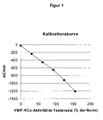
- Kalibrationskurve für die Bestimmung der VWF:RCo-Aktivität, die gemäß Beispiel 2 mit Kalibratoren erstellt wurde, die VWF:RCo-Aktivitäten von 0 % bis 5000 % der Norm enthielten.
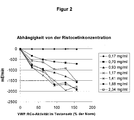
- Kalibrationskurven für die Bestimmung der VWF:RCo-Aktivität mit einer Thrombozytenkonzentration und Rührgeschwindigkeit gemäß Beispiel 2, jedoch mit unterschiedlichen Ristocetinkonzentrationen im Testansatz. Die beste Linearität wurde bei Ristocetinkonzentrationen zwischen 0,7 und 2 mg/mL im Testansatz gemessen.
- Kalibrationskurven für die Bestimmung der VWF:RCo-Aktivität mit einer Ristocetinkonzentration und Rührgeschwindigkeit gemäß Beispiel 2, jedoch mit unterschiedlichen Thrombozytenkonzentrationen im Testansatz. Die beste Linearität wurde bei Thrombozytenkonzentrationen zwischen 0,9 und 3 Millionen (Mio) Thrombozyten pro µL Testansatz gemessen.
- Kalibrationskurven für die Bestimmung der VWF:RCo-Aktivität mit einer Ristocetinkonzentration und einer Thrombozytenkonzentration gemäß Beispiel 2, jedoch mit unterschiedlichen Rührgeschwindigkeiten im Reaktionsansatz während der Messung. Die beste Linearität wurde bei Rührgeschwindigkeiten zwischen 100 und 500 Umdrehungen pro Minute (UPM) gemessen.
- Zur Herstellung eines Reagenzes zur Verwendung in dem erfindungsgemäßen Verfahren zur Bestimmung der VWF-RCo-Aktivität wurden Formaldehyd-fixierte, humane Thrombozyten in einer phosphatgepufferten Kochsalzlösung suspendiert und mit Ristocetin vermischt, so dass das Reagenz 1,8 Millionen Thrombozyten pro µL und 1,25 mg Ristocetin pro mL enthielt.
- Zur Erstellung einer Kalibrationskurve wurde Haemate® P (ZLB Behring GmbH, Deutschland), ein Faktor VIII-VWF-Konzentrat verwendet, das in unverdünntem Zustand eine VWF:RCo-Aktivität von etwa 5.000 % der Norm aufwies. Die VWF:RCo-Aktivität war mit Hilfe der Plättchenagglutinationsmethode unter Verwendung eines kommerziellen Reagenzes (Von Willebrand-Reagenz, Dade Behring Marburg GmbH, Marburg, Deutschland), das stabilisierte Thrombozyten, Ristocetin und EDTA enthielt, bestimmt worden. Das Faktor VIII-VWF-Konzentrat wurde seriell mit isotonischer Kochsalzlösung verdünnt, und es wurden jeweils 50 µL Konzentrat-Verdünnung und 50 µL der Kochsalzlösung (Leerwert) auf eine Glasplatte pipettiert. Zu jedem Tropfen wurden anschließend 50 µL Von Willebrand-Reagenz gemischt und die Agglutination vor einem dunklen Hintergrund visuell überprüft. Der Titer der Probe ist die Verdünnungsstufe, in der eine im Vergleich zum Leerwert deutliche Agglutination zu beobachten ist.
- Zur Herstellung von Kalibratoren mit unterschiedlichen VWF:RCo-Aktivitäten wurde Haemate® P mit VWF-Mangelplasma verdünnt. Auf diese Weise wurden Kalibratoren hergestellt, die folgende VWF:RCo-Aktivitäten enthielten:
Kalibrator 1 5000 % der Norm Kalibrator 2 4000 % der Norm Kalibrator 3 3030 % der Norm Kalibrator 4 2000 % der Norm Kalibrator 5 1000 % der Norm Kalibrator 6 0 % der Norm. - Kalibrator 6 enthielt kein Haemate® P und bestand ausschließlich aus VWF-Mangelplasma.
- Folgende Schritte wurden automatisch auf dem Gerinnungsmessgerät BCT® (Dade Behring Marburg GmbH, Marburg, Deutschland) durchgeführt:
- 5 µL der zu untersuchenden Plasmaprobe oder des Kalibrators (siehe Beispiel 1) wurden in ein Reaktionsgefäß gegeben, mit 5 µL VWF-Mangelplasma gemischt und für 15 Sekunden bei 37 °C inkubiert. Anschließend wurden 150 µL des Thrombozyten-Ristocetin-Reagenzes (siehe Beispiel 1) zugegeben. Die Testansätze enthielten eine Ristocetinkonzentration von 1,17 mg/mL und eine Thrombozytenkonzentration von etwa 1,68 Millionen pro µL.
- Im Falle der Kalibratoren wurden auf diese Weise folgende VWF:RCo-Aktivitäten im Testansatz erzeugt:
Tabelle 2 VWF:RCo-Aktivität des Kalibrators VWF:RCo-Aktivität im Testansatz Kalibrator 1 5000 % der Norm 156 % der Norm Kalibrator 2 4000 % der Norm 125 % der Norm Kalibrator 3 3030 % der Norm 95 % der Norm Kalibrator 4 2000 % der Norm 62,5 % der Norm Kalibrator 5 1000 % der Norm 31,3 % der Norm Kalibrator 6 0 % der Norm 0 % der Norm - Unter kontinuierlichem Rühren des Testansatzes bei 500 UpM wurde die Extinktion des Testansatzes bei 405 nm über einen Zeitraum von 90 Sekunden gemessen. Anhand der so ermittelten Kinetik der Aggregationsreaktion wurde die Extinktionsänderung (mE/Minute) bestimmt, und es wurde die maximale Extinktionsänderung (Vmax der Extinktionsabnahme) ermittelt.
- Für die Erstellung der Kalibrationskurve wurden die Vmax-Werte der verschiedenen Kalibratoren gegen die VWF:RCo-Aktivitäten der Kalibratoren (in % der Norm) aufgetragen. Mittels linearer Verbindung dieser Kalibrationskurvenpunkte wurde die Kalibrationskurve berechnet (siehe auch Figur 1).
- Die VWF:RCo-Aktivität einer Plasmaprobe wurde dadurch bestimmt, dass durch den Vergleich des Vmax-Werts der Probe mit der Kalibrationskurve die VWF:RCo-Aktivität der Probe (in % der Norm) bestimmt wurde.
Claims (8)
- Verfahren zur Bestimmung der Ristocetin-Kofaktor-Aktivität des von-Willebrand-Faktors (VWF:RCo-Aktivität) in einer Probe, bei der davon auszugehen ist, dass sie eine VWF:RCo-Aktivität zwischen 600 % und 20.000 % der Norm aufweist, wobei ein Aliquot der Probe mit Thrombozyten und mit Ristocetin zu einem Testansatz vermischt wird und die Aggregationsreaktion der Thrombozyten gemessen wird, dadurch gekennzeichnet dass
die VWF:RCo-Aktivität im Testansatz größer ist als 25 % der Norm und 200 % der Norm nicht überschreitet. - Verfahren gemäß Anspruch 1 dadurch gekennzeichnet, dass die VWF:RCo-Aktivität im Testansatz zwischen 30 und 160 % der Norm beträgt.
- Verfahren gemäß den Ansprüchen 1 und 2 dadurch gekennzeichnet, dass die verwendeten Thrombozyten stabilisiert sind.
- Verfahren gemäß den Ansprüchen 1 bis 3 dadurch gekennzeichnet, dass der Testansatz etwa 900.000 bis etwa 3,0 Millionen, bevorzugterweise 1,2 bis 2,0 Millionen Thrombozyten pro Mikroliter enthält.
- Verfahren gemäß den Ansprüchen 1 bis 4 dadurch gekennzeichnet, dass der Testansatz Ristocetin in einer Konzentration von 0,7 bis 2,0 bevorzugterweise von 0,9 bis 1,5 Milligramm pro Milliliter enthält.
- Verfahren gemäß den Ansprüchen 1 bis 5 dadurch gekennzeichnet, dass der Testansatz kontinuierlich durchmischt wird, bevorzugt durch Rühren bei einer Rührgeschwindigkeit von 100 bis 500 Umdrehungen pro Minute.
- Verfahren gemäß den Ansprüchen 1 bis 6 dadurch gekennzeichnet, dass die Probe, bei der davon auszugehen ist, dass sie eine VWF:RCo-Aktivität zwischen 600 % und 20.000 % der Norm aufweist, unverdünntes humanes Blut, Blutplasma oder Blutserum eines Donors ist, der eine akute oder chronische Entzündung, ein Polytrauma oder eine Sepsis aufweist oder sich in einem postoperativen Zustand befindet oder schwanger ist.
- Verfahren gemäß den Ansprüchen 1 bis 6 dadurch gekennzeichnet, dass die Probe, bei der davon auszugehen ist, dass sie eine VWF:RCo-Aktivität zwischen 600 % und 20.000 % der Norm aufweist, ein von-Willebrand-Faktor Konzentrat ist.
Applications Claiming Priority (1)
| Application Number | Priority Date | Filing Date | Title |
|---|---|---|---|
| DE200610019520 DE102006019520A1 (de) | 2006-04-27 | 2006-04-27 | Verfahren zur Bestimmung hoher Ristocetin-Kofaktor-Aktivitäten des von-Willebrand-Faktors |
Publications (1)
| Publication Number | Publication Date |
|---|---|
| EP1850133A1 true EP1850133A1 (de) | 2007-10-31 |
Family
ID=38326153
Family Applications (1)
| Application Number | Title | Priority Date | Filing Date |
|---|---|---|---|
| EP07007502A Withdrawn EP1850133A1 (de) | 2006-04-27 | 2007-04-12 | Verfahren zur Bestimmung hoher Ristocetin-Kofaktor-Aktivitäten des von-Willebrand-Faktors |
Country Status (2)
| Country | Link |
|---|---|
| EP (1) | EP1850133A1 (de) |
| DE (1) | DE102006019520A1 (de) |
Cited By (1)
| Publication number | Priority date | Publication date | Assignee | Title |
|---|---|---|---|---|
| EP2637024A1 (de) * | 2012-03-05 | 2013-09-11 | Siemens Healthcare Diagnostics Products GmbH | Screeningverfahren zum Auffinden von Proben mit einer Störung der Funktionalität der GPIb-Von Willebrand Faktor-Interaktion |
Citations (3)
| Publication number | Priority date | Publication date | Assignee | Title |
|---|---|---|---|---|
| EP0078451A1 (de) * | 1981-10-22 | 1983-05-11 | BEHRINGWERKE Aktiengesellschaft | Reagenz für die Bestimmung des Ristocetin-Cofaktors (v. Willibrand-Faktor) |
| US20010006773A1 (en) * | 1999-12-29 | 2001-07-05 | Dade Behring Marburg Gmbh | Ready-to-use ristocetin cofactor test reagent possessing long-term stability |
| EP1134584A1 (de) * | 2000-03-17 | 2001-09-19 | Dade Behring Marburg GmbH | Induzierte Aggregation und Agglutination von Plättchen |
Family Cites Families (2)
| Publication number | Priority date | Publication date | Assignee | Title |
|---|---|---|---|---|
| EP0186476A3 (de) * | 1984-12-21 | 1987-10-21 | Hemochek Corporation | Diagnosepackung und Verfahren zur Prüfung von Blutbestandteilen |
| US5958716A (en) * | 1996-06-06 | 1999-09-28 | Dade Behring Inc. | Blood factor assay |
-
2006
- 2006-04-27 DE DE200610019520 patent/DE102006019520A1/de not_active Ceased
-
2007
- 2007-04-12 EP EP07007502A patent/EP1850133A1/de not_active Withdrawn
Patent Citations (3)
| Publication number | Priority date | Publication date | Assignee | Title |
|---|---|---|---|---|
| EP0078451A1 (de) * | 1981-10-22 | 1983-05-11 | BEHRINGWERKE Aktiengesellschaft | Reagenz für die Bestimmung des Ristocetin-Cofaktors (v. Willibrand-Faktor) |
| US20010006773A1 (en) * | 1999-12-29 | 2001-07-05 | Dade Behring Marburg Gmbh | Ready-to-use ristocetin cofactor test reagent possessing long-term stability |
| EP1134584A1 (de) * | 2000-03-17 | 2001-09-19 | Dade Behring Marburg GmbH | Induzierte Aggregation und Agglutination von Plättchen |
Non-Patent Citations (1)
| Title |
|---|
| MACFARLANE ET AL: "A method for assaying von Willebrand factor (ristocetin cofactor)", THROMBOSIS ET DIATHESIS HAEMORRHAGICA, XX, XX, vol. 34, 1975, pages 306 - 318, XP009088038 * |
Cited By (4)
| Publication number | Priority date | Publication date | Assignee | Title |
|---|---|---|---|---|
| EP2637024A1 (de) * | 2012-03-05 | 2013-09-11 | Siemens Healthcare Diagnostics Products GmbH | Screeningverfahren zum Auffinden von Proben mit einer Störung der Funktionalität der GPIb-Von Willebrand Faktor-Interaktion |
| JP2013186124A (ja) * | 2012-03-05 | 2013-09-19 | Siemens Healthcare Diagnostics Products Gmbh | GPIb−フォン・ヴィレブランド因子相互作用の機能障害を有する試料を見出すためのスクリーニング方法 |
| EP2637025A3 (de) * | 2012-03-05 | 2013-11-20 | Siemens Healthcare Diagnostics Products GmbH | Screeningverfahren zum Auffinden von Proben mit einer Störung der Funktionalität der GPIb-Von Willebrand Faktor-Interaktion |
| US9766234B2 (en) | 2012-03-05 | 2017-09-19 | Siemens Healthcare Diagnostics Products Gmbh | Screening process for finding samples having a functionality disorder of the GPIb-von willebrand factor interaction |
Also Published As
| Publication number | Publication date |
|---|---|
| DE102006019520A1 (de) | 2007-11-08 |
Similar Documents
| Publication | Publication Date | Title |
|---|---|---|
| EP2167978B1 (de) | Verfahren zur bestimmung der von willebrand faktor-aktivität in abwesenheit von ristocetin | |
| DE69130644T2 (de) | Fibrinogenbestimmungen unter verwendung von chemischen trockenreagenzien, die magnetische teilchen enthalten | |
| DE69033033T2 (de) | Verbesserte kontrollverfahren für stabile blutkoagulation | |
| EP0137269B1 (de) | Verfahren zur gleichzeitigen Bestimmung von Fibrinogen und Fibrinogen-Spaltprodukten im Plasma | |
| DE1648999C3 (de) | Verfahren zur immunochemischen Bestimmung von Antigenen und Antikörpern | |
| Chapman et al. | A rapid, automated flow cytometric method to measure activated degranulated platelets by density determination | |
| EP1734369B1 (de) | Verfahren zur Standardisierung von Gerinnungstesten | |
| EP0912891B1 (de) | Verfahren zum durchführen von bluttests | |
| DE60032001T2 (de) | Verfahren zur stabilisierung von thrombin | |
| EP3293521B1 (de) | Herstellung lipämischer plasma- oder serumproben für die bestimmung einer lipidinterferenz | |
| DE69714568T2 (de) | Bestimmungsverfahren für einen Blutfaktor | |
| EP0039885B1 (de) | Verfahren und Reagens zum Nachweis von Fibrinmonomer | |
| EP1134584A1 (de) | Induzierte Aggregation und Agglutination von Plättchen | |
| EP1544621A1 (de) | Kontrollplasmen für Thrombinaktivitätstests | |
| EP2634584B1 (de) | Screening-Methode zum Auffinden von Proben mit Antiphospholipid-Antikörpern | |
| DE69016858T2 (de) | Verfahren und Reagenziensatz zur Bestimmung der funktionalen Aktivität von Protein S in menschlichem Plasma. | |
| EP0496723A2 (de) | Reagens zur Bestimmung von Faktor VIII-Aktivität | |
| EP3413053B1 (de) | Kalibration von lupus antikoagulans | |
| EP0826965B1 (de) | Verfahren zur Herstellung von Faktor V-Mangelplasma und ein so erhaltenes Mangelplasma | |
| EP2637025B1 (de) | Screeningverfahren zum Auffinden von Proben mit einer Störung der Funktionalität der GPIb-Von Willebrand Faktor-Interaktion | |
| DE102006019520A1 (de) | Verfahren zur Bestimmung hoher Ristocetin-Kofaktor-Aktivitäten des von-Willebrand-Faktors | |
| DE69316293T2 (de) | Methode zur Bestimmung von Fibrinogen, trockenes Reagens hierfür und Verfahren zur Herstellung desselben | |
| EP4239338A1 (de) | Globaltest zur feststellung des status des blutgerinnungssystems | |
| AT403289B (de) | Verfahren zur herstellung eines standardisierten plasmapools für diagnostische zwecke | |
| EP2486145B1 (de) | Verfahren zur Bestimmung von Faktor XIII mit Hilfe von Referenzmaterial auf Plasmabasis |
Legal Events
| Date | Code | Title | Description |
|---|---|---|---|
| PUAI | Public reference made under article 153(3) epc to a published international application that has entered the european phase |
Free format text: ORIGINAL CODE: 0009012 |
|
| AK | Designated contracting states |
Kind code of ref document: A1 Designated state(s): AT BE BG CH CY CZ DE DK EE ES FI FR GB GR HU IE IS IT LI LT LU LV MC MT NL PL PT RO SE SI SK TR |
|
| AX | Request for extension of the european patent |
Extension state: AL BA HR MK YU |
|
| AKX | Designation fees paid | ||
| RAP1 | Party data changed (applicant data changed or rights of an application transferred) |
Owner name: SIEMENS HEALTHCARE DIAGNOSTICS PRODUCTS GMBH |
|
| REG | Reference to a national code |
Ref country code: DE Ref legal event code: 8566 |
|
| STAA | Information on the status of an ep patent application or granted ep patent |
Free format text: STATUS: THE APPLICATION IS DEEMED TO BE WITHDRAWN |
|
| 18D | Application deemed to be withdrawn |
Effective date: 20080503 |