EP1850221B1 - Systèmes et procédé pour reconfigurer dynamiquement un imageur et modules de cache afin d'optimiser la performance de traitement - Google Patents
Systèmes et procédé pour reconfigurer dynamiquement un imageur et modules de cache afin d'optimiser la performance de traitement Download PDFInfo
- Publication number
- EP1850221B1 EP1850221B1 EP07106838.1A EP07106838A EP1850221B1 EP 1850221 B1 EP1850221 B1 EP 1850221B1 EP 07106838 A EP07106838 A EP 07106838A EP 1850221 B1 EP1850221 B1 EP 1850221B1
- Authority
- EP
- European Patent Office
- Prior art keywords
- statistics
- imager
- digital front
- digital
- objects
- Prior art date
- Legal status (The legal status is an assumption and is not a legal conclusion. Google has not performed a legal analysis and makes no representation as to the accuracy of the status listed.)
- Ceased
Links
Images


Classifications
-
- G—PHYSICS
- G06—COMPUTING OR CALCULATING; COUNTING
- G06F—ELECTRIC DIGITAL DATA PROCESSING
- G06F3/00—Input arrangements for transferring data to be processed into a form capable of being handled by the computer; Output arrangements for transferring data from processing unit to output unit, e.g. interface arrangements
- G06F3/12—Digital output to print unit, e.g. line printer, chain printer
- G06F3/1201—Dedicated interfaces to print systems
- G06F3/1278—Dedicated interfaces to print systems specifically adapted to adopt a particular infrastructure
- G06F3/1284—Local printer device
-
- G—PHYSICS
- G06—COMPUTING OR CALCULATING; COUNTING
- G06F—ELECTRIC DIGITAL DATA PROCESSING
- G06F3/00—Input arrangements for transferring data to be processed into a form capable of being handled by the computer; Output arrangements for transferring data from processing unit to output unit, e.g. interface arrangements
- G06F3/12—Digital output to print unit, e.g. line printer, chain printer
- G06F3/1201—Dedicated interfaces to print systems
- G06F3/1202—Dedicated interfaces to print systems specifically adapted to achieve a particular effect
- G06F3/1211—Improving printing performance
-
- G—PHYSICS
- G06—COMPUTING OR CALCULATING; COUNTING
- G06F—ELECTRIC DIGITAL DATA PROCESSING
- G06F3/00—Input arrangements for transferring data to be processed into a form capable of being handled by the computer; Output arrangements for transferring data from processing unit to output unit, e.g. interface arrangements
- G06F3/12—Digital output to print unit, e.g. line printer, chain printer
- G06F3/1201—Dedicated interfaces to print systems
- G06F3/1223—Dedicated interfaces to print systems specifically adapted to use a particular technique
- G06F3/1237—Print job management
- G06F3/1244—Job translation or job parsing, e.g. page banding
Definitions
- Embodiments are generally related to data-processing systems and methods. Embodiments also relate to image processing systems and methods. Embodiments additionally relate to image-processing systems and methods. Embodiments also relate to Digital Front End (DFE), caching modules and Raster Information Processing (RIP) systems and methods.
- DFE Digital Front End
- RIP Raster Information Processing
- EP 0806721 A1 discloses a print control system managing a print job on a job basis and on a page basis.
- a print job is interpreted, a job description file and page data for each page are created.
- the job description file contains the attributes of the entire job and a job element list.
- An item of page data is associated with the print attribute of each page including image data.
- a job control module extracts necessary image data according to the job element list and sends it to the printer.
- US 2004/196470 A1 discloses a raster image processing manager that is configured to distribute partitions of a print job to a raster image processing pipeline for raster image processing.
- Statistics gathered by a statistical analysis and scheduling module can be used to configure pipelines, and in particular to schedule raster image processing engines for inclusion within a given pipeline, and for movement between two or more pipelines.
- JP 2004192390 discloses parsing of PDL documents and adding an unique ID to each object. By caching and reusing of objects, faster rasterisation is achieved.
- a digital printer's imager and caching module can be configured prior to the start of a job and have limited capabilities to adjust the way each page is processed. Every page of a long document will possess the same parameters applied even if the parameters are not optimal. This is especially poor for variable information (VI) jobs that a print shop or print customers believe should RIP at a fast rate. There are some dynamic adjustments implemented today, but they are quite limited. For many print jobs it has been found that the original configuration is not optimum and would benefit if parameter adjustments were made. Today's configuration changes are accomplished manually between jobs, via trial-and-error printing, or as a result of a customer complaint.
- Print on demand is the printing process that delivers exactly and only what the customer wants, when the customer wants it, at the place where it is needed.
- Equipment manufacturers have made great strides to develop special technology to meet the "on demand" needs of customers.
- Traditional equipment manufacturers as well as new players or those that have adapted digital pre-press technology to printing technology are racing through product development cycles introducing new technology. Technology continues to change rapidly.
- U.S. Patent Publication No: 2005/0058481 generally describes digital printing technologies that often rely on raster image processors (RIPs or RIP engines) to convert vector image data to raster, or bit-map, data, which allows a printer to render the image as a pattern of dots or pixels.
- RIPs or RIP engines One problem with RIPs such as that disclosed in U.S. Patent Publication No: 2005/0058481 is that such technologies offer limited communications capabilities and can in some circumstances reduce the effective processing speed.
- U.S. Patent application Publication No: 2003/0076535 generally describes a method and apparatus for Variable Data Printing that adds performance requirements to a raster image processor (RIP) memory optimization and which also employs memory bands within the page composition process.
- Documents containing both recurring elements as well as non-recurring elements are sorted into element lists depending on their frequency of recurrence and their layering position. The recurring elements are retained in rasterized form, while the non-recurring elements are rasterized as they are used in output memory.
- One pass assembly in raster image processing of the elements occurs when the recurring elements are placed into memory and the variable elements are RIPped on the fly.
- RIP raster image processor
- a method of optimizing processing performance of digital printers according to the present invention comprises the features defined in claim 1.
- a system for dynamically modifying digital front ends and caching modules to optimize processing performance by digital printers according to the present invention comprises the features defined in claim 3.
- a digital front-end (DFE) interpreter-imager-caching module can be configured based on historical optimum configuration parameters.
- the configuration calls for a fast pass through the job manager where the time consuming computer intensive objects on each page are decomposed quickly into only empty box representations.
- the pages are not imaged or compressed for printing, rather, they are processed to collect and assess the object and reusable document component (RDC) markup of the pages and overall job.
- RDC object component
- the statistics collected from a capture object and cached object statistics with area and position information can be then used to modify the parameters for a re-configuration of the interpreter-imager-caching module prior to the decomposition pass with optimized interpret, RIP and assembler pass that creates compressed buffers feeding the buffer manager and marker.
- the decomposition pass also captures statistics based on collected objects and compression as the job progresses and uses such features to dynamically adjust configuration according to how the pages are processed altering methods of collecting objects, caching components and compressing and assembling components and pages.
- Optimum configuration for the job can be achieved after only a few pages or after many pages.
- the final configuration can be then utilized to confirm or modify the historical configuration to be used for subsequent jobs that are based on the optimized RIP and VI assembly utilizing feedback from historical statistics, from pre-RIP statistics and dynamic re-configuration.
- an option can be provided by using the optimized RIP, VI assembly using historical statistics and dynamic re-configuration as a job is RIPped.
- the job statistics can then be assessed to modify the configuration parameters.
- Another option is to capture the statistics and report the suggested configuration changes to the printer operator for authorization before applying them.
- the customer/operator may not want the optimizations applied and may insist any changes be authorized before being applied.
- An authorized change can be applied between jobs and/or the RIP of pages.
- configuring is authorized by a printer operator before application to a digital front end associated with the digital printer.
- authorized configurations can be applied between jobs and/or the raster image processing of document pages.
- the initial pass also captures statistics based on collected objects and compression as the job progresses and uses such features to dynamically adjust assessing cached components, collected objects, and compression statistics to feedback and modify digital front-end interpreter-imager- caching module configuration according to how the pages are processed.
- the method includes the step wherein after completion of the processing of the multiple document following modification of the digital front-end interpreter-imager-caching module, the modification information is included with historical optimum configuration parameter information for access during processing subsequent jobs.
- authorized modifications can be applied between jobs and/or the raster image processing of document pages.
- said digital front end further comprises a digital front-end interpreter-imager-caching module configured based on historical optimum configuration parameters.
- said historical optimum configuration parameters are used to modify its parameters for re-configuration of an interpreter-imager-caching module prior to decomposition pass of subsequent documents.
- the decomposition pass also captures statistics based on collected objects and compression as the job progresses and uses such features to dynamically adjust assessing cached components, collected objects, and compression statistics that can be used as feedback to modify system configuration as the job progresses.
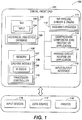
- System 100 includes a digital front end (DFE) 101 that incorporates the use of a job/RIP manager 102, which includes a graphical user interface (GUI) module 103 that can be displayed on a display device.
- DFE digital front end
- GUI graphical user interface
- the input 104 is used for inputting data from the data source 117, which includes forms with the help of input devices using a keyboard, mouse or other input devices 116.
- the database that is of a historical statistics database 105 includes data identification, data updation, data insertion and related status.
- the DFE can also include processing resources 106 that include an inbuilt memory 107 used for storing data, parsing circuit routines or application statistics and other related system oriented data for the system functionality.
- Memory 107 can be implemented using any appropriate combination of alterable, volatile or non-volatile memory or non-alterable, or fixed, memory.
- System 100 can further include a cache 108 can hold reusable document components (RDCs) within a VI cache 109.
- a variable information cache (VI) 109 can be used in reference to capture object and cached object statistics with area and position information to modify configuration parameters.
- the processor/controller 110 can be utilized for enhancing RIP performance and for controlling the functionality the system 100.
- the DFE can be configured with the RIP pipeline, circuit and engine 111 for enhancing the functionality of the assembly pass/variable data assembler VDA 112 with page assembly component analysis.
- the compression component/component module 113 and the routine or application 114 is configured with the job/RIP manager for defining the DFE RIP process. Then the parsing circuit, routine or application 114 can also be configured with the job/RIP manager for proper process development of the system.
- the input/output interface 115 is interfaced with the input device such as keyboard, mouse etc., and printer 118.
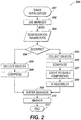
- a high-level flow chart 200 is depicted illustrating logical operational steps for outlining a current static configuration to job RIP with CDF (Common Decomposer Facility) for dynamically re-configuring the DFE imager and caching modules to optimize RIP, in accordance with a preferred embodiment.
- the system 100 of FIG. 1 can first be initialized.
- the job manager can be established as shown in Block 202.
- One or more configuration parameters can be modified by a system operator between jobs as illustrated thereafter at block 203.
- the current CDF Common Decomposer Facility
- the current CDF High-lighting the imager interprets and then, as indicated at block 205, collects page objects.
- a compression module can begin processing.
- the operation described at block 206 illustrates an assembly test operation.
- the operations described at blocks 207 or 208 can be processed depending upon the outcome of the testing operation illustrated at block 206.
- Caching reusable components can be enabled as indicated at block 207.
- a buffer manager operation can be processed.
- the VI Assembler operation indicated at block 209 can be processed. If the page objects need not to be sent to cache reusable components, it can be sent to a buffer manager, again as indicated at block 208, and then to a marker as indicated at block 210.
- the process depicted in flow chart 200 can finally terminate as indicated at block 211.
- a flow chart 300 of operations is illustrated depicting logical operational steps for dynamically re-configuring a DFE imager and caching modules to optimize RIP performance with optimized RIP and VI assembly using feedback from historical statistics, from pre-RIP statistics, and enabling dynamic re-configuration in accordance with a preferred embodiment.
- the process is initialized. Thereafter, as indicated at block 302, historical optimum configuration parameters can be established.
- the digital front-end (DFE) interpreter-imager-RDCR can be configured based on historical optimum configuration parameters established previously as depicted at block 302.
- a job decomposition operation can be established. That is, the configuration calls for a fast pass through the job where the time consuming computer intensive objects on each page are decomposed quickly into only empty box representations.
- the pages are not imaged or compressed for printing, rather, they are processed to interpret as indicated at block 306 with a condition for a VI cache as indicated at block 305 and to collect objects as depicted at block 307.
- the captured objects and cached object statistics with area and position information can be utilized to modify configuration parameters that assess the object and RDC makeup of the pages and overall job.
- This interpreter-imager-caching pass is very fast because the pages are not imaged fully or compressed for full display or printing.
- the statistics collected from GUI feedback can be provided to the operator as illustrated at block 309. Thereafter, as described at block 310, feedback can be compiled in a GUI report 310 and can then be used to modify the parameters for a re-configuration as indicated next at 311 of the interpreter-imager-cache prior to the decomposition pass operation depicted at block 312 that creates compressed buffers feeding the buffer manager as indicated at block 313 and marker as described at block 314.
- the decomposition pass also captures statistics as indicated at block 315 as the job progresses and uses these to dynamically adjust the way pages are processed.
- the optimum configuration for the job will be achieved after only a few pages or after many pages.
- the final configuration is used to confirm or modify the historical configuration as indicated at block 316 and to be used for following jobs until completion as depicted at block 317.
- a flow chart 400 is illustrated depicting logical operational steps for dynamically re-configuring the DFE imager and caching modules to optimize RIP performance with optimized RIP and VI assembly using historical statistics and execute dynamic re-configuration of the DFE in accordance with a preferred embodiment.
- the process can be initialized as indicated at block 401. Thereafter as depicted at block 402, historical optimum configuration parameters can be established.
- digital front-end (DFE) interpreter-imager-RDCR can be configured based on historical optimum configuration parameters established previously as indicated at block 402.
- the configuration calls for dynamic reconfiguration via block 410 based on the assessment of statistics collected during the interpret 405, object collection and VI caching 406, and the compression 408 stages.
- VI cache information can be sent to collected objects as indicated at block 406 through a VI assembler as illustrated at block 407 and compression. Based on the condition from VI cache information the page objects from the VI assembler and the compressed buffers as indicated at block 408 feeding the buffer manager as described at block 409 and marker as illustrated at block 411.
- dynamic re-configuration as indicated at block 410 is set up by enabling a configuration that is based on assessing cached components, collected objects, and compression statistics can be provided as feedback in order to modify the configuration as the job progresses as depicted at block 412.
- the historical configuration can be collected for subsequent jobs till execution or termination of the process as indicated at block 414.
- modules may constitute hardware modules, such as, for example, electronic components of a computer system. Such modules may also constitute software modules.
- a software module can be typically implemented as a collection of routines and data structures that performs particular tasks or implements a particular abstract data type.
- Software modules generally are composed of two parts. First, a software module may list the constants, data types, variable, routines and the like that can be accessed by other modules or routines. Second, a software module can be configured as an implementation, which can be private (i.e., accessible perhaps only to the module), and that contains the source code that actually implements the routines or subroutines upon which the module is based. The term module, as utilized herein can therefore refer to software modules or implementations thereof. Such modules can be utilized separately or together to form a program product based on instruction media residing in a computer memory that can be implemented through signal-bearing media, including transmission media and recordable media, depending upon design considerations and media distribution goals. Such instruction media can thus be retrieved from the computer memory and processed via a processing unit, such as, for example, a microprocessor.
- a processing unit such as, for example, a microprocessor.
- modules can be referred to also as "instruction modules” and may be stored within a memory of a data-processing apparatus such as memory 107 of system 100 depicted in FIGS. 1 .
- instruction modules may be implemented in the context of a resulting program product (i.e., program "code").
- program code i.e., program "code”
- module and code can be utilized interchangeably herein to refer to the same device or media.
- many of the features depicted in FIGS. 1-4 can be provided by or in the form of such modules.
Landscapes
- Engineering & Computer Science (AREA)
- Theoretical Computer Science (AREA)
- Human Computer Interaction (AREA)
- Physics & Mathematics (AREA)
- General Engineering & Computer Science (AREA)
- General Physics & Mathematics (AREA)
- Record Information Processing For Printing (AREA)
- Image Processing (AREA)
- Facsimiles In General (AREA)
Claims (3)
- Procédé d'optimisation d'une performance de traitement d'imprimantes numériques (118), comprenant :l'accès (302, 402) à des paramètres de configuration optimale historiques ;l'utilisation (303, 403) des paramètres de configuration optimale historiques pour configurer un module interpréteur-imageur-mise en antémémoire frontal numérique associé à l'imprimante numérique, le lancement (304) d'un passage de document de plusieurs pages à travers une imprimante numérique dans lequel des objets sur chaque page du document de plusieurs pages sont décomposés par un gestionnaire de tâches en des représentations de boîtes vides, dans lequel chaque page est traitée pour collecter des statistiques d'objets capturés et d'objet antémémorisé avec des informations de zone et de position ;l'emploi desdites statistiques d'objets capturés et d'objet antémémorisé avec des informations de zone et de position pour modifier des paramètres de configuration qui évaluent des objets et des marquages de composants de document réutilisables afin de reconfigurer ledit module interpréteur-imageur-mise en antémémoire frontal numérique ;le traitement (311, 412) du document de plusieurs pages à travers l'imprimante numérique (118) à la suite de la reconfiguration du module interpréteur-imageur-mise en antémémoire frontal numérique ;la capture de statistiques sur la base d'objets collectés et d'une compression au fur et à mesure que la tâche progresse ;l'utilisation desdites statistiques pour ajuster dynamiquement des statistiques évaluant des composants antémémorisés, des objets collectés et de compression pour rétro-informer et modifier la configuration de la configuration du module interpréteur-imageur-mise en antémémoire frontal numérique en fonction des modalités de traitement des pages ; etlors de l'achèvement du traitement du document de plusieurs pages, l'utilisation (315, 412) d'une configuration finale dudit module interpréteur-imageur-mise en antémémoire frontal numérique pour confirmer ou modifier lesdits paramètres de configuration optimale historiques.
- Procédé selon la revendication 1, dans lequel des statistiques desdits objet évalué et collecté et composants de document réutilisables sont fournies à un opérateur utilisant une interface utilisateur graphique (103) associée à l'imprimante numérique (118), et dans lequel une autorisation par ledit opérateur est attendue avant reconfiguration dudit module interpréteur-imageur-mise en antémémoire frontal numérique.
- Système (100) de modification dynamique de modules numériques frontaux et de modules de mise en antémémoire pour optimiser une performance de traitement par des imprimantes numériques, comprenant :une base de données (105) contenant des statistiques de traitement de documents incluant des informations de zone et de position ;un module numérique frontal incluant un imageur, des modules de mise en antémémoire (108) et un gestionnaire de processeur d'image tramée (102) pour recevoir un langage de description de page et traiter des données de document scannées ;une interface utilisateur graphique (103) pour gérer le serveur numérique frontal et les données de document ; etun dispositif de commande (110) adapté pour employer lesdites statistiques de traitement de document en tant que paramètres de configuration optimale historiques pour modifier lesdits serveur numérique frontal et modules de mise en antémémoire associés afin d'améliorer une performance de traitement d'image tramée et une fonctionnalité de commande du système ;dans lequel une modification du serveur numérique frontal en appelle aussi à un passage initial de décomposition d'un document en langage de description de page par un gestionnaire de tâches dans lequel des objets associés au document sont décomposés en représentations de boîtes vides, et dans lequel les pages sont uniquement traitées pour collecter des statistiques d'objets capturés et d'objet antémémorisé avec des informations de zone et de position, lesdites statistiques d'objets capturés et d'objet antémémorisé étant aussi utilisées pour modifier lesdits serveur numérique frontal et modules de mise en antémémoire associés ; etdans lequel ledit dispositif de commande (110) est en outre adapté pour :capturer des statistiques sur la base d'objets collectés et d'une compression au fur et à mesure que la tâche progresse ;utiliser lesdites statistiques pour ajuster dynamiquement des statistiques évaluant des composants antémémorisés, des objets collectés et de compression pour rétro-informer et modifier lesdits serveur numérique frontal et modules de mise en antémémoire associés en fonction des modalités de traitement des pages ; etutiliser une configuration finale des serveur numérique frontal et modules de mise en antémémoire associés pour confirmer ou modifier lesdites statistiques de traitement contenues dans ladite base de données.
Applications Claiming Priority (1)
| Application Number | Priority Date | Filing Date | Title |
|---|---|---|---|
| US11/411,067 US8432563B2 (en) | 2006-04-24 | 2006-04-24 | Systems and methods for dynamically re-configuring imager and caching modules to optimize raster image processing performance |
Publications (3)
| Publication Number | Publication Date |
|---|---|
| EP1850221A2 EP1850221A2 (fr) | 2007-10-31 |
| EP1850221A3 EP1850221A3 (fr) | 2010-04-14 |
| EP1850221B1 true EP1850221B1 (fr) | 2018-04-11 |
Family
ID=38310030
Family Applications (1)
| Application Number | Title | Priority Date | Filing Date |
|---|---|---|---|
| EP07106838.1A Ceased EP1850221B1 (fr) | 2006-04-24 | 2007-04-24 | Systèmes et procédé pour reconfigurer dynamiquement un imageur et modules de cache afin d'optimiser la performance de traitement |
Country Status (3)
| Country | Link |
|---|---|
| US (1) | US8432563B2 (fr) |
| EP (1) | EP1850221B1 (fr) |
| JP (1) | JP2007293854A (fr) |
Families Citing this family (5)
| Publication number | Priority date | Publication date | Assignee | Title |
|---|---|---|---|---|
| JP2012135958A (ja) * | 2010-12-27 | 2012-07-19 | Canon Inc | 印刷装置、印刷制御方法及びプログラム |
| US9001373B2 (en) | 2012-03-30 | 2015-04-07 | Xerox Corporation | Parallel printing system |
| US8817292B1 (en) * | 2013-04-16 | 2014-08-26 | Xerox Corporation | Printing systems and methods providing a raster image processing performance preflight option |
| US9928561B2 (en) | 2015-05-29 | 2018-03-27 | Digimarc Corporation | Serialized digital watermarking for variable data printing |
| WO2020131048A1 (fr) * | 2018-12-19 | 2020-06-25 | Hewlett-Packard Development Company, L.P. | Document de balayage pour identifier des éléments réutilisables pour le traitement d'images tramées (rip) |
Citations (1)
| Publication number | Priority date | Publication date | Assignee | Title |
|---|---|---|---|---|
| JP2004192390A (ja) * | 2002-12-12 | 2004-07-08 | Canon Inc | データ処理装置 |
Family Cites Families (16)
| Publication number | Priority date | Publication date | Assignee | Title |
|---|---|---|---|---|
| JPH0816801A (ja) * | 1994-06-30 | 1996-01-19 | Canon Inc | 画像処理方法及び装置 |
| JP3580060B2 (ja) | 1996-05-09 | 2004-10-20 | 富士ゼロックス株式会社 | 印刷制御装置及び方法 |
| JP3800678B2 (ja) * | 1996-08-23 | 2006-07-26 | 富士ゼロックス株式会社 | プリンタ制御装置 |
| US5848105A (en) | 1996-10-10 | 1998-12-08 | Gardner; William A. | GMSK signal processors for improved communications capacity and quality |
| JPH10161822A (ja) * | 1996-11-29 | 1998-06-19 | Fuji Xerox Co Ltd | 印刷処理装置 |
| US6049390A (en) * | 1997-11-05 | 2000-04-11 | Barco Graphics Nv | Compressed merging of raster images for high speed digital printing |
| US6867876B1 (en) * | 2000-04-24 | 2005-03-15 | International Business Machines Corporation | Remote database support in a multifunction office device |
| US7327487B2 (en) * | 2001-10-23 | 2008-02-05 | Eastman Kodak Company | Banded compositor for variable data |
| US20040066527A1 (en) * | 2002-10-02 | 2004-04-08 | Nexpress Solutions Llc | Finish verification in printing |
| US7391529B2 (en) * | 2003-01-15 | 2008-06-24 | Xerox Corporation | Apparatus and method for managing and using reusable document components during the process of dynamic document construction |
| US20040196470A1 (en) * | 2003-04-01 | 2004-10-07 | Christiansen Robert D. | Raster image processing (RIP) manager for enhanced print shop operation |
| US6929411B2 (en) * | 2003-09-03 | 2005-08-16 | Hewlett-Packard Development Company, L.P. | Selectable control of raster image processor |
| JP4371790B2 (ja) * | 2003-12-03 | 2009-11-25 | キヤノン株式会社 | 画像形成システムおよび表示制御方法およびコンピュータが読み取り可能なプログラムを格納した記憶媒体およびプログラム |
| KR100747879B1 (ko) * | 2004-06-10 | 2007-08-08 | 캐논 가부시끼가이샤 | 화상 처리 장치, 제어 방법 및 기록 매체 |
| US7685136B2 (en) * | 2005-01-12 | 2010-03-23 | International Business Machines Corporation | Method, system and program product for managing document summary information |
| US7653503B2 (en) | 2006-04-20 | 2010-01-26 | Tao Of Systems Integration, Inc. | Temperature-compensating sensor system |
-
2006
- 2006-04-24 US US11/411,067 patent/US8432563B2/en not_active Expired - Fee Related
-
2007
- 2007-04-20 JP JP2007112071A patent/JP2007293854A/ja active Pending
- 2007-04-24 EP EP07106838.1A patent/EP1850221B1/fr not_active Ceased
Patent Citations (1)
| Publication number | Priority date | Publication date | Assignee | Title |
|---|---|---|---|---|
| JP2004192390A (ja) * | 2002-12-12 | 2004-07-08 | Canon Inc | データ処理装置 |
Also Published As
| Publication number | Publication date |
|---|---|
| US8432563B2 (en) | 2013-04-30 |
| EP1850221A3 (fr) | 2010-04-14 |
| US20070247658A1 (en) | 2007-10-25 |
| EP1850221A2 (fr) | 2007-10-31 |
| JP2007293854A (ja) | 2007-11-08 |
Similar Documents
| Publication | Publication Date | Title |
|---|---|---|
| US6456388B1 (en) | Printer enclosing network computer and computer network system employing the same | |
| JP4771241B2 (ja) | バリアブル印刷システム | |
| CN101714215B (zh) | 图像处理装置及图像处理方法 | |
| US6088480A (en) | Image forming apparatus and image forming method | |
| EP1850221B1 (fr) | Systèmes et procédé pour reconfigurer dynamiquement un imageur et modules de cache afin d'optimiser la performance de traitement | |
| US20050225789A1 (en) | Print subsystem despooling backplane | |
| JPH09114611A (ja) | 印刷処理装置および方法 | |
| WO2008063622A1 (fr) | Procédés et systèmes rendant une tâche d'impression | |
| JP2011516967A (ja) | 印刷ジョブの分散処理 | |
| US7844129B2 (en) | Information processing apparatus and its control method | |
| CN102681804A (zh) | 图像处理装置及图像处理方法 | |
| US20110141508A1 (en) | Variable printing control apparatus and control program | |
| US20020051166A1 (en) | Print control apparatus and method | |
| US8493612B2 (en) | Predicting an expansion difficulty and an expansion time required to perform a rendering operation | |
| US20160078643A1 (en) | Information processing apparatus, information processing method, and program | |
| JP3492297B2 (ja) | 画像処理方法、画像処理装置および記憶媒体 | |
| EP4121844B1 (fr) | Système et procédé de conversion de fichiers graphiques en vue d'une impression | |
| US7405836B2 (en) | Job submission system and method for controlling multiple job renderings with a single master or “super” ticket | |
| US8456685B2 (en) | Image forming apparatus searching an registering objects of interest in a cache based on a criterion | |
| JP4469036B2 (ja) | ホストとプリンタとの間での繰返しオブジェクトの単一パス送信 | |
| US9052854B2 (en) | Parallel printing system | |
| US6094278A (en) | Method and apparatus for reducing printer memory | |
| US20040075859A1 (en) | Printer instruction processing | |
| US20040227976A1 (en) | Masks in image processing | |
| US20040085564A1 (en) | Image forming systems and image forming methods |
Legal Events
| Date | Code | Title | Description |
|---|---|---|---|
| PUAI | Public reference made under article 153(3) epc to a published international application that has entered the european phase |
Free format text: ORIGINAL CODE: 0009012 |
|
| AK | Designated contracting states |
Kind code of ref document: A2 Designated state(s): AT BE BG CH CY CZ DE DK EE ES FI FR GB GR HU IE IS IT LI LT LU LV MC MT NL PL PT RO SE SI SK TR |
|
| AX | Request for extension of the european patent |
Extension state: AL BA HR MK YU |
|
| PUAL | Search report despatched |
Free format text: ORIGINAL CODE: 0009013 |
|
| AK | Designated contracting states |
Kind code of ref document: A3 Designated state(s): AT BE BG CH CY CZ DE DK EE ES FI FR GB GR HU IE IS IT LI LT LU LV MC MT NL PL PT RO SE SI SK TR |
|
| AX | Request for extension of the european patent |
Extension state: AL BA HR MK RS |
|
| 17P | Request for examination filed |
Effective date: 20101014 |
|
| 17Q | First examination report despatched |
Effective date: 20101118 |
|
| AKX | Designation fees paid |
Designated state(s): DE FR GB |
|
| GRAP | Despatch of communication of intention to grant a patent |
Free format text: ORIGINAL CODE: EPIDOSNIGR1 |
|
| INTG | Intention to grant announced |
Effective date: 20180103 |
|
| GRAS | Grant fee paid |
Free format text: ORIGINAL CODE: EPIDOSNIGR3 |
|
| GRAA | (expected) grant |
Free format text: ORIGINAL CODE: 0009210 |
|
| AK | Designated contracting states |
Kind code of ref document: B1 Designated state(s): DE FR GB |
|
| REG | Reference to a national code |
Ref country code: GB Ref legal event code: FG4D |
|
| REG | Reference to a national code |
Ref country code: DE Ref legal event code: R096 Ref document number: 602007054499 Country of ref document: DE |
|
| REG | Reference to a national code |
Ref country code: FR Ref legal event code: PLFP Year of fee payment: 12 |
|
| REG | Reference to a national code |
Ref country code: DE Ref legal event code: R097 Ref document number: 602007054499 Country of ref document: DE |
|
| PLBE | No opposition filed within time limit |
Free format text: ORIGINAL CODE: 0009261 |
|
| STAA | Information on the status of an ep patent application or granted ep patent |
Free format text: STATUS: NO OPPOSITION FILED WITHIN TIME LIMIT |
|
| 26N | No opposition filed |
Effective date: 20190114 |
|
| PGFP | Annual fee paid to national office [announced via postgrant information from national office to epo] |
Ref country code: GB Payment date: 20200323 Year of fee payment: 14 |
|
| PGFP | Annual fee paid to national office [announced via postgrant information from national office to epo] |
Ref country code: FR Payment date: 20200319 Year of fee payment: 14 |
|
| PGFP | Annual fee paid to national office [announced via postgrant information from national office to epo] |
Ref country code: DE Payment date: 20200319 Year of fee payment: 14 |
|
| REG | Reference to a national code |
Ref country code: DE Ref legal event code: R119 Ref document number: 602007054499 Country of ref document: DE |
|
| GBPC | Gb: european patent ceased through non-payment of renewal fee |
Effective date: 20210424 |
|
| PG25 | Lapsed in a contracting state [announced via postgrant information from national office to epo] |
Ref country code: DE Free format text: LAPSE BECAUSE OF NON-PAYMENT OF DUE FEES Effective date: 20211103 Ref country code: FR Free format text: LAPSE BECAUSE OF NON-PAYMENT OF DUE FEES Effective date: 20210430 Ref country code: GB Free format text: LAPSE BECAUSE OF NON-PAYMENT OF DUE FEES Effective date: 20210424 |