EP1850232A2 - Simulateur - Google Patents
Simulateur Download PDFInfo
- Publication number
- EP1850232A2 EP1850232A2 EP07106143A EP07106143A EP1850232A2 EP 1850232 A2 EP1850232 A2 EP 1850232A2 EP 07106143 A EP07106143 A EP 07106143A EP 07106143 A EP07106143 A EP 07106143A EP 1850232 A2 EP1850232 A2 EP 1850232A2
- Authority
- EP
- European Patent Office
- Prior art keywords
- simulation
- mode
- simulator
- status information
- predetermined
- Prior art date
- Legal status (The legal status is an assumption and is not a legal conclusion. Google has not performed a legal analysis and makes no representation as to the accuracy of the status listed.)
- Withdrawn
Links
Images



Classifications
-
- G—PHYSICS
- G06—COMPUTING OR CALCULATING; COUNTING
- G06F—ELECTRIC DIGITAL DATA PROCESSING
- G06F11/00—Error detection; Error correction; Monitoring
- G06F11/36—Prevention of errors by analysis, debugging or testing of software
- G06F11/3698—Environments for analysis, debugging or testing of software
Definitions
- the present invention is related to a simulator which outputs simulation status information at timing corresponding to a designated mode while a simulation is carried out.
- debugging works In the case where the accomplished installation programs cannot run in accordance with the intentions of the program designers, debugging works must be performed with respect to the installation programs. When debugging works are carried out, simulations are performed many times in order to remove bugs. In such a case that long time is required to execute the simulations, long time durations are required for debugging works. To this end, such a function is employed by which all of register value s and all of contents stored in memories at certain timing while the simulations are executed are stored to be suspended. When the above-described store/suspend function is utilized, the register values and the stored contents of the memories can be restored to the suspended statuses. As a result, simulations need not be carried out from the beginning stages. Accordingly, time durations required for executing the debugging works can be shortened. Since programs which are installed in terminals such as portable telephones contain a huge number of verification items, the above-explained store/suspend function is very useful.
- Fig. 4 is a block diagram for showing an arrangement of a conventional simulator 10.
- the simulator 10 shown in Fig. 10 is equipped with a program interface unit 11, a simulation executing unit 13, a command interface unit 15, a task switching control unit 17, and a status input/output unit 19.
- the program interface unit 11 corresponds to an interface which reads a program 21 in the simulator 10.
- the simulation executing unit 13 performs a simulation of the program 21 which is read therein via the program interface unit 11. Also, the simulation executing unit 13 interrupts a simulation in response to an instruction issued from the task switching control unit 17, and outputs information (will be referred to as "simulation status information" hereinafter) related to a simulation status when the simulation is interrupted.
- the command interface unit 15 corresponds to an interface used to read a command entered from an input terminal 23 which is manipulated by a user of the simulator 10.
- the task switching control unit 17 recognizes switching of a task in response to a command read via the command interface unit 15, and controls the simulation executing unit 13 in such a manner that the simulation status information is outputted by the simulation executing unit 13 when the task is switched.
- the status input/output unit 19 acquires simulation status information outputted from the simulation executing unit 13, and stores the acquired simulation status information into an external storage apparatus 25. Also, the status input/output unit 19 inputs simulation status information acquired from the storage apparatus 25 into the simulation executing unit 13. The simulation executing unit 13 into which the simulation status information has been entered restores a simulation status which is indicated by the entered simulation status information.
- Patent Publication 1 JP-A-6-131203
- An object of the present invention is to provide a simulator capable of executing simulations in an effective manner with respect to any sorts of programs.
- the present invention provides the below-mentioned simulator: That is, the simulator is comprised of: a simulation executing unit for executing a simulation of a read program, and for producing a simulation status information while the simulation is executed; a mode recognizing unit for recognizing a mode designated from a plurality of modes related to output timing as to the simulation status information from the simulation executing unit; a simulation control unit for controlling the execution of the simulation by the simulation executing unit in response to the mode recognized by the mode recognizing unit; and a status input/output unit for acquiring the simulation status information outputted from the simulation executing unit, and for inputting the acquired simulation information to the simulation executing unit; in which output timing different from each other is set to the plurality of modes; and the simulation control unit controls the simulation executing unit to output the simulation status information at output timing which corresponds to the recognized mode.
- the simulation executing unit may restore a simulation status which is represented by the simulation status information entered from the status input/output unit.
- the simulation control unit includes a plurality of timing control units corresponding to the respective plural modes; and the plurality of timing control units may include at least two sets of: a time mode control unit corresponding to a time mode in which output timing of the simulation status information has been set at a predetermined time interval; a cycle mode control unit corresponding to a cycle mode in which output timing of the simulation status information has been set at a predetermined cycle number interval; an interrupt mode control unit corresponding to an interrupt mode in which output timing of the simulation status information has been set in a predetermined interrupt number interval; a memory access mode control unit corresponding to a memory access mode in which output timing of the simulation status information has been set in a predetermined memory access interval; a flag changing mode control unit corresponding to a flag changing mode in which output timing of the simulation status information has been set in a predetermined flag changing number interval; and a task switching mode control unit corresponding to a task switching mode in which output timing of the simulation status information has been set in a predetermined task switching number interval.
- the predetermined time interval set in the time mode, the predetermined cycle number set in the cycle mode, the predetermined interrupt number set in the interrupt mode, the memory access number set in the memory access mode, the predetermined flag changing number set in the flag changing mode, and the predetermined task switching number set in the task switching mode may be set by a user of the simulator.
- said predetermined interrupt number set in the interrupt mode may be a total interrupt number directed to all of interrupts.
- the predetermined interrupt number set in the interrupt mode may be a total interrupt number directed to interrupts designated by the user of the simulator.
- the predetermined memory access number set in the memory access mode may be a total number at which a memory of all address ranges is accessed.
- the predetermined memory access number set in the memory access mode may be a total number at which a memory of an address range designated by the user of the simulator is accessed.
- the flag changing number set in the flag changing mode may be a total number of changes of flags directed to all of the flags.
- the flag changing number set in the flag changing mode may be a total number of changes of flags directed to flags designated by the user of the simulator.
- the task switching number set in the task switching mode may be a total switching number of tasks directed to all of tasks.
- the task switching number set in the task switching mode may be a total switching number of tasks directed to tasks designated by the user of the simulator.
- the simulations can be carried out in the effective manners even for any types of programs.
- Fig. 1 is a block diagram for representing an arrangement of a simulation 100 according to an embodiment mode of the present invention.
- the simulator 100 shown in Fig. 1 is equipped with a program interface unit 101, a simulation executing unit 103, a command interface unit 105, a mode recognizing unit 107, a simulation control unit 109, and a status input/output unit 111.
- the program interface unit 101 corresponds to an interface which reads a program 121 in the simulator 100.
- the simulation executing unit 103 performs a simulation of the program 121 which is read therein via the program interface unit 101. Also, the simulation executing unit 103 interrupts a simulation in response to an instruction issued from the simulation control unit 107, and outputs information (will be referred to as "simulation status information" hereinafter) related to a simulation status when the simulation is interrupted.
- the command interface unit 105 corresponds to an interface used to read a command entered from an input terminal 123 which is manipulated by a user of the simulator 100.
- the mode recognizing unit 107 recognizes a command read via the command interface unit 105.
- the simulation control unit 109 controls an execution of a simulation by the simulation executing unit 103 in response to a mode recognized by the mode recognizing unit 107.
- the status input/output unit 111 acquires simulation status information outputted from the simulation executing unit 103, and stores the acquired simulation status information into an external storage apparatus 125. Also, the status input/output unit 111 inputs simulation status information acquired from the storage apparatus 125 into the simulation executing unit 103. At this time, the simulation executing unit 103 restores a simulation status which is indicated by the entered simulation status information.
- the status input/output unit 111 acquires such a simulation status information in response to the entered command from the storage apparatus 125.
- the simulation executing unit 103 restores a simulation status which is indicated by the entered simultaneous status information. It should also be noted that when a command for commanding that a designated simulation status is restored is inputted, it is preferable that a simulation as to a program in response to the input command is carried out in the simulation executing unit 103.
- plural sets of the below-mentioned commands have been prepared which can be entered from an input terminal.
- the plural modes of the present embodiment mode are a time mode, a cycle mode, an interrupt mode, a memory access mode, a flag changing mode, and a task switching mode.
- output timing of simulation status information has been set in a predetermined time interval (for instance, 1 time per 1 second).
- cycle mode output timing of simulation status information has been set in a predetermined cycle number interval (for example, 1 time per 100 cycles).
- interrupt mode output timing of simulation status information has been set in a predetermined interrupt number interval (for instance, 1 time per 10 times).
- memory access mode output timing of simulation status information has been set in a predetermined memory access interval (for example, 1 time per 100 cycles).
- the flag charge mode output timing of simulation status information has been set in a predetermined flag changing number interval (for example, 1 time per 10 times).
- task switching mode output timing of simulation status information has been set in a predetermined task switching number interval (for example, 1 time per 10 times).
- the simulation control unit 109 contains a plurality of timing control units in correspondence with the respective plural commands.
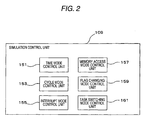
- Fig. 2 is a block diagram for showing an internal arrangement of the simulation control unit 109.
- the simulation control unit 109 contains a time mode control unit 151 corresponding to the time mode; a cycle mode control unit 153 corresponding to the cycle mode; an interrupt mode control unit 155 corresponding to the interrupt mode; a memory access mode control unit 157 corresponding to the memory access mode; a flag changing mode control unit 159 corresponding to the flag changing mode; and further, a task switching mode control unit 161 corresponding to the task switching mode.
- the simulation control unit 109 executes such a timing control unit corresponding to a mode which is recognized by the mode recognizing unit 107. It should also be understood that a time in the time mode, an interrupt number in the cycle mode, a memory access number in the memory access mode, a flag changing number in the flag changing mode; and a task switching number in the task switching mode correspond to either times on numbers which are set by the user of the simulator 100. Either a time internal or a number which is set by the user is read via the command interface unit 105, and then, is recognized by the mode recognizing unit 107, and thereafter, is set to the relevant timing control unit.
- interrupt number which is set to the interrupt mode may be defined as a total number directed to all of interrupts, or may be alternatively defined as a total number directed to interrupts designated by the user.
- the memory access number which is set to the memory access code may be defined as a total access number directed to all address range of a memory (not shown), or may be alternatively defined as a total access number directed to an address range designated by the user.
- the flag changing number which is set to the flag changing mode may be defined as a total number directed to all of flags, or may be alternatively defined as a total number of tasks designated by the user.
- task switching number which is set to the task switching mode may be defined as a total number directed to all of tasks, or may be alternatively defined as a total number of tasks designated by the user.
- the simulation executing unit 103 interrupts a simulation at timing defined in accordance with an instruction outputted by a timing control unit corresponding to a mode selected by the user, and outputs simulation status information indicative of a simulation status when this simulation is interrupted.
- Fig. 3 is a flow chart for describing the operations related to the simulator 100 of the present embodiment mode.
- the simulator 100 judges whether or not restoring of a simulation status is instructed from the user (step S101).
- the process operation is advanced to a step S103, whereas when the simulator 100 judges that restoring of the simulation status is not instructed by the user, the process operation is advanced to a step S105.
- the status input/output unit 111 acquires simulation status information from the storage apparatus 125 and inputs the acquired simulation status information into the simulation executing unit 103.
- the simulation executing unit 103 restores a simulation status based upon the inputted simulation status information.
- the simulator 100 judges whether or not a mode is selected by the user.
- the process operation is advanced to a step S107, whereas when the mode is not selected, the process operation is advanced to a step S109.
- output timing of the mode selected by the user is set to the simulation control unit 109.
- the simulation executing unit 103 performs a simulation.
- the simulation control unit 109 monitors whether or not the present timing is the set output timing (step S111). Then, when the simulation control unit 109 judges that the present timing is the output timing set in the step S111, the process operation is advanced to a step S113, whereas when the simulation control unit 109 judges that the present timing is not the output timing set in the step S111, the process operation is advanced to a step S115.
- the simulation status information outputted from the simulation executing unit 103 is stored in the storage apparatus 125.
- the simulator 100 judges whether or not the simulation is accomplished. The process operations defined from the step S111 to the step S115 are executed in a repetition manner until the simulation is accomplished.
- the simulation 100 of the present embodiment mode with respect to the timing for reproducing the failure statuses, the plurality of modes different from each other have been prepared, and the simulation status at such a timing corresponding to the selected mode is stored, while this mode is selected from the above-described plural modes by considering the quality of the program.
- a desirable simulation status can be readily restored with a short time.
- a total output time of the simulation status information is restricted. As a result, it is possible to avoid that the execution speed of the simulation is lowered. Accordingly, a total number of debugging works executed by the simulation can be reduced.
- the simulation 100 can simulate any types of programs in an effective manner.
Landscapes
- Engineering & Computer Science (AREA)
- Theoretical Computer Science (AREA)
- Computer Hardware Design (AREA)
- Quality & Reliability (AREA)
- Physics & Mathematics (AREA)
- General Engineering & Computer Science (AREA)
- General Physics & Mathematics (AREA)
- Debugging And Monitoring (AREA)
Applications Claiming Priority (1)
| Application Number | Priority Date | Filing Date | Title |
|---|---|---|---|
| JP2006123523A JP2007293771A (ja) | 2006-04-27 | 2006-04-27 | シミュレータ |
Publications (2)
| Publication Number | Publication Date |
|---|---|
| EP1850232A2 true EP1850232A2 (fr) | 2007-10-31 |
| EP1850232A3 EP1850232A3 (fr) | 2010-03-24 |
Family
ID=38375240
Family Applications (1)
| Application Number | Title | Priority Date | Filing Date |
|---|---|---|---|
| EP07106143A Withdrawn EP1850232A3 (fr) | 2006-04-27 | 2007-04-13 | Simulateur |
Country Status (4)
| Country | Link |
|---|---|
| US (1) | US20070255548A1 (fr) |
| EP (1) | EP1850232A3 (fr) |
| JP (1) | JP2007293771A (fr) |
| CN (1) | CN101063945A (fr) |
Family Cites Families (6)
| Publication number | Priority date | Publication date | Assignee | Title |
|---|---|---|---|---|
| JP2788820B2 (ja) * | 1991-08-30 | 1998-08-20 | 三菱電機株式会社 | シミュレーション装置 |
| DE69704004T2 (de) * | 1996-06-19 | 2001-06-07 | Matsushita Electric Industrial Co., Ltd. | Vorrichtung zur Programmfehlerbeseitigung |
| JPH10326203A (ja) * | 1996-06-19 | 1998-12-08 | Matsushita Electric Ind Co Ltd | 複数のハードウェア環境上においてプログラムを別々に動作させつつも、ハードウェア環境間で動作状態を継承し合うことができるデバッグ装置 |
| JP3206641B2 (ja) * | 1997-06-04 | 2001-09-10 | 日本電気株式会社 | マイコンシステムのデバッグ方法、デバッグ装置及びデバッグプログラムを記録した記録媒体 |
| US6560572B1 (en) * | 1999-04-15 | 2003-05-06 | Interactive Image Technologies, Ltd. | Multi-simulator co-simulation |
| JP2003131902A (ja) * | 2001-10-24 | 2003-05-09 | Toshiba Corp | ソフトウェアデバッガ、システムレベルデバッガ、デバッグ方法、及びデバッグプログラム |
-
2006
- 2006-04-27 JP JP2006123523A patent/JP2007293771A/ja not_active Withdrawn
-
2007
- 2007-04-13 EP EP07106143A patent/EP1850232A3/fr not_active Withdrawn
- 2007-04-25 US US11/790,331 patent/US20070255548A1/en not_active Abandoned
- 2007-04-27 CN CNA2007101019838A patent/CN101063945A/zh active Pending
Also Published As
| Publication number | Publication date |
|---|---|
| EP1850232A3 (fr) | 2010-03-24 |
| US20070255548A1 (en) | 2007-11-01 |
| CN101063945A (zh) | 2007-10-31 |
| JP2007293771A (ja) | 2007-11-08 |
Similar Documents
| Publication | Publication Date | Title |
|---|---|---|
| US5960182A (en) | Hardware-software co-simulation system, hardware-software co-simulation method, and computer-readable memory containing a hardware-software co-simulation program | |
| US5715433A (en) | Dynamic software model for emulating hardware | |
| CN107480327A (zh) | 一种仿真验证方法、装置和电子设备 | |
| EP2733613A2 (fr) | Dispositif de commande et programme | |
| CN114925516A (zh) | 一种自动建模并仿真的方法和装置 | |
| US7895575B2 (en) | Apparatus and method for generating test driver | |
| JPH0854907A (ja) | 検証支援システム | |
| JP5521889B2 (ja) | プログラム自動生成装置 | |
| CN113946481B (zh) | Risc-v内核mcu调试的下载程序方法及调试器 | |
| CN111767589A (zh) | 基于汽车安装点静刚度的批处理方法、系统、终端及存储介质 | |
| CN112306844A (zh) | 软件开发系统的接口测试方法、装置、设备及存储介质 | |
| EP1850232A2 (fr) | Simulateur | |
| JP2861962B2 (ja) | コンピュータプログラムのシミュレーション装置および方法 | |
| CN110442338B (zh) | 一种结构分析与设计语言aadl模型的仿真方法 | |
| CN118362800A (zh) | 一种智能座舱的测试方法、装置、车辆及存储介质 | |
| JP2005250937A (ja) | マイクロコンピュータソフトウェアのプログラム検証装置 | |
| CN112269740A (zh) | 自动驾驶软件的自动测试方法及装置 | |
| WO2001097035A1 (fr) | Procede et systeme d'evaluation automatique, et support de stockage d'un programme d'evaluation automatique | |
| CN116126366B (zh) | 芯片输入输出接口配置方法,装置,介质及电子设备 | |
| JPH10177590A (ja) | 論理回路モデルのデバッグ装置およびデバッグ方法 | |
| CN115098360B (zh) | 一种动态调配任务的方法、系统、任务管理器及存储介质 | |
| CN119620679A (zh) | 一种可编程逻辑调试方法及系统 | |
| CN117234493A (zh) | 基于组件化模板的文本处理装置及方法 | |
| CN117349039A (zh) | 一种半导体设备的通信方法和半导体工艺设备 | |
| JP5906800B2 (ja) | Lsiモデルの記述ファイル、シミュレーションシステム、デバッグ方法 |
Legal Events
| Date | Code | Title | Description |
|---|---|---|---|
| PUAI | Public reference made under article 153(3) epc to a published international application that has entered the european phase |
Free format text: ORIGINAL CODE: 0009012 |
|
| AK | Designated contracting states |
Kind code of ref document: A2 Designated state(s): AT BE BG CH CY CZ DE DK EE ES FI FR GB GR HU IE IS IT LI LT LU LV MC MT NL PL PT RO SE SI SK TR |
|
| AX | Request for extension of the european patent |
Extension state: AL BA HR MK YU |
|
| RAP1 | Party data changed (applicant data changed or rights of an application transferred) |
Owner name: PANASONIC CORPORATION |
|
| PUAL | Search report despatched |
Free format text: ORIGINAL CODE: 0009013 |
|
| AK | Designated contracting states |
Kind code of ref document: A3 Designated state(s): AT BE BG CH CY CZ DE DK EE ES FI FR GB GR HU IE IS IT LI LT LU LV MC MT NL PL PT RO SE SI SK TR |
|
| AX | Request for extension of the european patent |
Extension state: AL BA HR MK RS |
|
| STAA | Information on the status of an ep patent application or granted ep patent |
Free format text: STATUS: THE APPLICATION HAS BEEN WITHDRAWN |
|
| 18W | Application withdrawn |
Effective date: 20100427 |