EP1850254B1 - Procédé destiné à l'affectation d'appareils de mesure à des banques de données relatives à des personnes - Google Patents
Procédé destiné à l'affectation d'appareils de mesure à des banques de données relatives à des personnes Download PDFInfo
- Publication number
- EP1850254B1 EP1850254B1 EP06008962A EP06008962A EP1850254B1 EP 1850254 B1 EP1850254 B1 EP 1850254B1 EP 06008962 A EP06008962 A EP 06008962A EP 06008962 A EP06008962 A EP 06008962A EP 1850254 B1 EP1850254 B1 EP 1850254B1
- Authority
- EP
- European Patent Office
- Prior art keywords
- data
- network
- user
- access
- initialisation
- Prior art date
- Legal status (The legal status is an assumption and is not a legal conclusion. Google has not performed a legal analysis and makes no representation as to the accuracy of the status listed.)
- Expired - Lifetime
Links
Images

Classifications
-
- G—PHYSICS
- G06—COMPUTING OR CALCULATING; COUNTING
- G06F—ELECTRIC DIGITAL DATA PROCESSING
- G06F21/00—Security arrangements for protecting computers, components thereof, programs or data against unauthorised activity
- G06F21/60—Protecting data
- G06F21/62—Protecting access to data via a platform, e.g. using keys or access control rules
- G06F21/6218—Protecting access to data via a platform, e.g. using keys or access control rules to a system of files or objects, e.g. local or distributed file system or database
- G06F21/6245—Protecting personal data, e.g. for financial or medical purposes
Definitions
- the present invention relates to a method, a system and a computer program product for authorized access to a database and, in particular, for automatically generating access authorizations.
- authorization concepts are used, which are usually realized role-based.
- the necessary rights (Create, Retrieve, Update, Delete, CRUD) for creating, retrieving, updating or deleting entries are assigned to an editor of a database entry. If the data is recorded with a measuring device, the entry is made under a processing authorization and the identification of the relevant data record by mostly manual selection. Both the editor and the data record are thus uniquely determined during the entry.
- the processor of the database appears as the authorized person to access the file.
- the personal data record still has to be identified.
- a secure and outwardly anonymous allocation of data to corresponding user-specific data records (eg health records) of a database is a critical aspect and relies on a reliable, discrete and rapid management of access authorizations.
- WO 01/26021 A1 describes a system for remotely acquiring medical information from a patient.
- the system includes an electronic patient data collection system for locally collecting data related to a patient's medical condition.
- the collected data is transmitted to a remote network computer system via a wireless interface.
- the transmitted data include a patient identification.
- the system allows only authorized users to access data in the network computer system.
- a measuring device is preferably designed to record personal data and in particular health data of the user.
- This personal data is preferably stored by the method in the user-specific data block of the database. For this purpose, they are in particular transmitted to the database via the data network.
- it is particularly important to ensure on the one hand a clear assignment of personal data to the associated data block or record of the database and on the other to ensure the anonymity of the data transfer in the data network.
- the inventive method makes it possible, in particular, to separate the user identification, which is required for the correct assignment of personal data to the corresponding user-specific data blocks of a database, from the recorded personal data, in particular measurement data, and at the same time to ensure the uniqueness of the assignment.
- the initialization network and the data network are preferably designed as separate, in particular independent networks.
- the access data preferably does not include the user identification.
- the device authorization is preferably generated automatically.
- the identification association could also be generated by an authorized system administrator.
- the device authorization represents an assignment of at least one device identification to at least one data block or data record of the database.
- the device authorization thus preferably includes for each registered or initialized device identification a link a link to at least one associated data record or data block.
- the device identification preferably represents a device number or device address or a part thereof assigned by the device manufacturer
- Device authorization could be designed, in particular, as a reference table, which assigns the corresponding data record address to each registered device number.
- the record address is uniquely determined upon generation of the device authorization by the user identification, which is detected as part of the initialization data.
- the database is a health database and the user is a patient.
- the user-specific data block of the database preferably represents a health record of the patient or a part thereof in which personal health data about the general and / or current health status and / or therapy instructions are / are stored.
- a blood pressure measuring device, an electrocardiograph, a balance or a device for measuring the oxygen saturation could be used as the measuring device.
- the corresponding measurement data could be acquired as part of the access data via the data network together with a write command and stored in the associated data block of the database.
- the initialized or registered display device could be a PDA (personal digital assistant), from which a read command is acquired via the data network as access data.
- information from the associated data block could be transmitted over the data network for display on the PDA.
- therapy instructions from a treating physician could be communicated to a patient.
- a (one-way, two-way or multi-directional) signal connection to the data acquisition device established for acquiring the initialization data via the initialization network is interrupted before the access data are acquired via the data network.
- Such a temporal separation of user identification and transmission of access data to the database further improves the data security or the desired anonymity.
- the initialization network preferably comprises a telecommunications network, in particular a telephone network, and the detection of the user identification preferably detecting a user-selected telephone number or a part thereof.
- This embodiment of the initialization network can be implemented particularly flexibly and, in particular, is readily available. Both wired telephone networks or landline and mobile or mobile networks are suitable.
- a user registers before the initialization of a data acquisition device in the database or at the operator of the database. Then a user-specific or personal area of the database or a user-specific or personal access to the database is set up for him.
- a user-specific telephone number is assigned to him and preferably communicated confidentially.
- This telephone number thus forms a preferably unambiguous assignment of the database section to the user.
- the telephone number thus preferably represents the user identification. It would also be conceivable to couple a user identification with other data which permit unambiguous identification of the user, eg Global Positioning System (GPS) data or the like.
- GPS Global Positioning System
- the detection of the device identification preferably comprises detection of an acoustic or modulated identification signal generated by the data acquisition device and transmitted via the initialization network, in particular the telephone network.
- this identification signal is detected automatically.
- the data acquisition device is preferably uniquely identified or determined by this identification signal. For an automated generation of the device authorization is particularly easy.
- the acquired device identification is assigned permitted access operations to the user-specific data block of the database as a function of the user identification and / or the device identification.
- Such access operations may be, in particular, writing, reading or other access operations for creating, changing or deleting data.
- the access operations preferably include the operations: "Create” (C) and / or “Retrieve” (R) and / or “Update” (U) and / or “Delete” (D) and are particularly preferably set as a character string in the format (CRUD).
- C Create
- R Retrieve
- U Update
- D / or "Delete”
- the type of operations permitted preferably depends on the user identification and / or the device identification.
- the device authorization permits write access
- the access instruction includes user-specific data acquired by the data collection device and a write command.
- the method further comprises a step of writing the user-specific data into the user-specific data block of the database.
- the device authorization preferably allows a read access
- the access instruction preferably comprises a read command
- the method comprises a step of outputting user-specific data from the user-specific data block of the database to the data network for transmission to the data acquisition device of the user.
- a signal connection established for transmitting the initialization data via the initialization network to the data management system is interrupted before the access data are transmitted via the data network.
- the initialization network and the data network are therefore preferably different networks.
- the networks are based on different technologies.
- the initialization network comprises a telecommunications network
- the step of transmitting the user identification preferably comprises a step of selecting a user-specific telephone number.
- the step of transmitting the device identification comprises a step of transmitting a device-specific acoustic identification signal via the telecommunication network to the data management system.
- the device identification is preferably coded as an acoustic identification signal and thus stored in a memory chip in the data acquisition device.
- the acoustic identification signal is output by actuating an initialization element on the data acquisition device via a loudspeaker, in particular a piezo loudspeaker. The signal is then preferably detected via the handset or the microphone of a telephone and transmitted via a telephone network to the data management system.
- the data network or telematic network preferably comprises a GPRS and / or UMTS network. This makes flexible use of the data acquisition device possible.
- the data acquisition device is preferably designed portable or mobile and can therefore preferably be used while on the move. A use in a vehicle is conceivable.
- the detection of the user identification and / or the detection of the device identification comprises a recording of a record identification for unambiguous determination of the user-specific data block of the database.
- the type of measurement data could be determined by the record identification.
- the user identification and / or the device identification thus preferably comprises a plurality of identification data blocks.
- the identification data or identification data blocks could in particular be constructed in accordance with the HL7 OID specifications.
- the initialization device of the data management system is thus designed in particular, via the initialization interface as part of the initialization data acquire device identification assign a user-specific data block or record the database, the user-specific data block is determined or determined by the detected user identification.
- the initialization interface preferably comprises an interface of a telecommunications network.
- the system is designed to record a telephone number dialed by the user.
- the system also includes a service device configured to provide the user with a plurality of selectable services depending on the detected telephone number.
- the service device is preferably designed to start an initialization routine for a data acquisition device or a data acquisition system of the user in response to a corresponding selection by the user. This selection by the user is preferably done by pressing a button on the phone or by transmitting an acoustic selection signal. By starting the initialization routine, further data transmitted via the telephone network are preferably forwarded to the initialization device.
- the initialization device is preferably designed to record the telephone number detected by the initialization interface as user identification and an acoustic identification signal transmitted via the telecommunication network as a device identification.
- the data management system is preferably designed to implement an access authorization method according to the present invention or a preferred embodiment thereof.
- measurement data could be manually entered into the data acquisition device as input data.
- an automatic input or an automatic acquisition of data, in particular measurement data can also be implemented.
- information about a therapy plan could be displayed to the user as output data.
- the system preferably comprises at least one measuring device and one base device, which are designed as separate components and are in signal communication with one another via a local network.
- the measuring device and the base unit thus each have at least one local network interface or local interface, via which they couple to the local network.
- the system could also include a display device which is in signal communication via the local network for signal transmission to the base unit and / or to the meter.
- the local network is particularly preferably designed as a closed or secured network, which is preferably accessible only to the user or with the user's consent or after the user has released it.
- the local network comprises a wireless network, in particular a Bluetooth network and / or wireless local area network (WLAN).
- WLAN wireless local area network
- the system comprises a plurality of measuring devices, which are connected via the local network for signal transmission to the base unit and / or each other.
- At least one measuring device or display device and the base device each have their own initialization interface.
- each of these devices has its own device identification.
- each individual device can be initialized and replaced in the event of a defect or a new purchase independently of the other devices.
- a separate device identification is preferably coded in the at least one measuring device and in the base device.
- each of the devices preferably has an integrated memory chip in which the respective device identification is stored.
- the unique device identification is preferably already deposited during the production of the respective device and / or the respective integrated memory chip and is thus preferably assigned to the respective device already during the production of the device. It is not necessary by the method according to the invention and with the systems according to the invention that a selected device identification is assigned to a specific device before the assignment or that the assigned device identification is registered or is visibly identified on or in the device. Instead, the assignment of a device identification to a device can be random. It should only be one-unique, i. Each device identification should only be assigned to a single device, in particular be coded only in a single memory chip.
- the initialization interface comprises a loudspeaker, in particular a piezo loudspeaker.
- the data interface preferably comprises an interface to a GPRS and / or UMTS network.
- the data acquisition system is preferably configured to perform a method of authorized access to a database according to the present invention or a preferred embodiment thereof.
- the invention thus preferably provides a data organization system comprising at least one data acquisition system according to the invention and at least one data management system according to the invention, which are in signal communication at least temporarily via the initialization network or the data network.
- the present invention provides a computer program product, in particular stored on a computer readable storage medium, which, when loaded into a computer system, causes it to execute a method according to the present invention or one of its preferred embodiments described above.
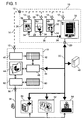
- Fig. 1 shows a schematic representation of a network for telemedical monitoring, which is realized according to a preferred embodiment of the present invention and by means of which the present invention is exemplified.
- a patient is equipped with a data acquisition system 10 in accordance with a preferred embodiment of the present invention.
- the data acquisition system 10 has an initialization interface 12 via which it can be connected to an initialization interface 16 of a data management system 18 by means of an initialization or authorization network or an initialization or authorization connection 14.
- the data acquisition system 10 has a data interface or telematics interface 20 via which it is in signal communication by means of a data network or telematics network 22 with a data interface or telematics interface 24 of the data management system.
- the data acquisition system 10 includes a plurality of individual meters or data collection devices.
- a sphygmomanometer 26, an ECG device or electrocardiograph 28 and a balance 30 are provided.
- the patient can preferably carry out measurements of their own state of health themselves, ie without medical or nursing support. These measurements can be made especially in a domestic environment.
- the patient does not have to be in a clinic.
- the devices are preferably designed mobile and can be taken in particular even in the house or outside the home. The present invention is thus particularly preferred for the care of chronically ill patients, such. Patients with chronic heart failure.
- the data acquisition system 10 preferably includes a portable computer 32, such as a personal digital assistant (PDA), preferably equipped with appropriate interfaces and software for managing and / or transmitting medical measurement data and / or diagnostic results and / or therapy instructions is.
- PDA personal digital assistant
- This PDA 32 preferably serves as a base unit of the data acquisition system 10.
- the base unit 32 has a local interface 34 via which it is connected by means of a local network 36 with the measuring devices 26, 28, 30 in (single, dual or multi-directional) signal connection ,
- the individual measuring devices 26, 28, 30 are each equipped with a local interface 34.
- the local network 36 and the local interfaces 34 could for example, based on a wireless network connection, in particular a preferably short-range radio link such as Bluetooth.
- the local network 36 could also include a wired network (eg, based on USB connections).
- Measurement data can be exchanged between the individual devices or the configuration of individual devices can be changed via the local network.
- measurement data can be transmitted from the measuring devices to the PDA 32 via the local network.
- the measurement data can be transmitted via the data interface 20 of the data acquisition system 10, which is formed in the embodiment shown on or in the base unit 32 (PDA) in the data network 22 and thus transmitted to the data management system 18.
- the data network or telematics network 22 could in particular be based on a preferably long-range radio connection, for example based on a GPRS and / or UMTS connection. Also, alternatively or additionally, wired networks can be used.
- the data network could in particular also include or be a wireless local area network (WLAN).
- WLAN wireless local area network
- all the individual devices 26, 28, 30, 32 each have an initialization interface 12.
- the individual devices can preferably be brought into signal connection independently of one another via the initialization network 14 with the initialization interface 16 of the data management system 18.
- the individual devices each have their own device identification.
- This device identification is preferably coded or assigned as a unique device number in or on the respective device.
- a clear device identification could already be reserved during the production of the respective device, in particular the measuring devices and the base device.
- This device identification could in particular be assigned to this device as a unique device number or device code.
- This unique device identification is preferably assigned by the device manufacturer or under the sovereignty of the device manufacturer for the device produced and stored in or on the device.
- the device identification could be preceded by a namespace assigned by the provider of the database.
- the device identification is particularly preferably stored in a coded device identification circuit, in particular in a memory chip (eg PROM, EPROM, EEPROM), in the respective device or the data acquisition system 10 and for the initialization of the device or data acquisition system 10 via the initialization interface 12 to the data management system 18 transfer.
- the initialization interface 12 preferably comprises a loudspeaker, in particular a piezo loudspeaker, or an audio output or an audio interface.
- the coded device identification circuit is preferably configured as a tone-dial IC and designed for controlling the loudspeaker in such a way that the loudspeaker outputs an acoustic signal corresponding to the device identification.
- the respective measuring device or the data acquisition system 10 preferably comprises an activation element 38, which can be operated in particular by the user, in the present case the patient, to output the device identification via the initialization interface 12, ie in particular the loudspeaker, and in particular to the Initialization network 14, to initiate.
- an activation element 38 which can be operated in particular by the user, in the present case the patient, to output the device identification via the initialization interface 12, ie in particular the loudspeaker, and in particular to the Initialization network 14, to initiate.
- the initialization network 14 preferably comprises a telephone network via which temporarily for the initialization of the data acquisition system 10 or a Data acquisition device 26, 28, 30, 32, the initialization connection 14 is established. Preferably, this is done by selecting a unique telephone number assigned to the user. This telephone number is preferably used for unambiguous identification of the respective user, in particular patients. Alternatively, a central number for the data management system 18, ie the database system, could also be selected. An identification of the user could then be made by entering a personal number via the keypad of the telephone or by transmitting an acoustic signal.
- the associated device identification is transmitted as an acoustic signal.
- the activation element 38 could, in particular, be a switch or pushbutton attached to the device.
- the acoustic identification signal generated on the speaker of the device is detected by the microphone or a suitable interface of the phone and transmitted as electrical or electromagnetic signal, depending on the technology of the telephone network used to the data management system.
- the device identification forms at least part of the initialization data. After the transmission of the initialization data, the initialization connection 14 is preferably disconnected again.
- the initialization can be done for all devices simultaneously or in succession, in particular independently of each other. In another preferred embodiment, it would also be conceivable that only some of the devices have an initialization interface 12.
- the base unit 32 could have an initialization interface 12, while the other devices are initialized by transmitting their respective device identification via the local network 36 to the base unit 32 and by outputting the transmitted device identification via the initialization interface 12 of the base unit.
- access data are transmitted via the data network 22.
- These access data each include a device identification and an access instruction defining an access operation to the data management system 18.
- the user identification is preferably not included in the access data.
- the identification of the user takes place only in the data management system 18.
- the data management system 18 in the preferred embodiment shown has an initialization device 40. This is designed to capture the initialization data and to generate a device authorization 42 in such a way that in the device authorization 42 each device whose device identification was detected is assigned an area or data block to a database 44 of the data management system 18 in turn determined by the detected together with the device identification user identification.
- the device authorization is preferably stored in the data management system 18 and remains after the initialization connection 14 has been disconnected.
- the assigned areas or data records of the database 44 form patient-specific health records in the embodiment shown.
- Access to the user-specific data records is controlled via an access control device 46 of the data management system 18.
- the access control device 46 is in signal connection via the data interface 24 with the data network 22.
- the access controller 46 detects access data transmitted from the data acquisition system 10. Depending on the device identifications contained therein It assigns the access data and in particular the access instructions to the corresponding user-specific data records of the database 44 in accordance with the assignment stored in the device authorization 42.
- a plurality of actors are connected to the data management system 18 via the data network 22 ,
- a plurality of patients use the health database via the data network 22 so that a plurality of data acquisition systems are connected to the data network 22.
- the data network 22 may also provide a variety of other network services 48 that are not part of the data management system 18.
- a plurality of data management systems 18, which are preferably configured in accordance with the present invention may be connected via the data network 22.
- telemedical centers 52 and general practitioners 54 are also connected to the data management system 18 via the data network 22 and can access the database 44 via the data network 22 in accordance with a stored authorization.
- the data management system particularly preferably has a care interface 56, via which particularly authorized actors, such as selected clinics 50, telemedical centers 52 or physicians 54, can access the data management system 18 and in particular the database 44 via a secured care network 58 For example, to provide diagnoses for individual patients or to deposit therapy instructions on the database 44.
- the authorizations for such accesses could be defined in particular in a caretaker authorization 60, which is stored in the data management system 18 and to which a caregiver authorization module 62 can access and / or write to control access rights.
- the present invention simplifies the initialization or authorization for accessing a database, in particular by data acquisition devices, and improves data security.
- the initialization can be performed by the user himself and the assignment of person-specific data to a specific person remains hidden from the data transmission network. An exchange of defective devices and the integration of new devices can be done very easily.
- the generation of the device authorization 42 could be automated, so that the implementation of new devices or the replacement of devices can be done quickly, inexpensively, reliably and while maintaining high data security and discretion.
- An exemplary system includes a general purpose computing device in the form of a conventional computing environment 120, such as a personal computer (PC) 120, having a processing unit 122, system memory 124, and system bus 126 which includes a variety of system components, including system memory 124 and the processor unit 122 connects.
- the processing unit 122 may perform arithmetic, logic and / or control operations by accessing the system memory 124.
- the system memory 124 may store information and / or instructions for use in combination with the processor unit 122.
- System memory 124 may include volatile and non-volatile memory, such as random access memory (RAM) 128 and read-only memory (ROM) 130.
- RAM random access memory
- ROM read-only memory
- a basic input-output system that includes the basic routines that help to transfer information between the elements within the PC 120, such as during start-up, may be stored in the ROM 130.
- the system bus 126 may be one of many bus structures, including a memory bus or memory controller, a peripheral bus, and a local bus employing a particular bus architecture from a variety of bus architectures.
- the PC 120 may further include a hard disk drive 132 for reading or writing a hard disk (not shown) and an external disk drive 134 for reading or writing a removable disk 136 or a removable medium.
- the removable disk may be a magnetic disk for a magnetic disk drive or an optical disk such as a CD for an optical disk drive.
- the hard disk drive 132 and the external disk drive 134 are each connected to the system bus 126 via a hard disk drive interface 138 and an external disk drive interface 140.
- the drives and associated computer readable media provide nonvolatile storage of computer readable instructions, data structures, program modules and other data to the PC 120.
- the data structures may include the relevant data for implementing a method as described above.
- the exemplary environment uses a hard disk (not shown) and an external disk 142, it will be apparent to those skilled in the art that other types of computer-readable media that can store computer-accessible data may be used in the exemplary work environment, such as magnetic cassettes, flash Memory cards, digital video disks, random access memory, read-only memory, etc.
- a plurality of program modules particularly an operating system (not shown), one or more application programs 144, or program modules (not shown) and program data 146 may be stored on the hard disk, external disk 142, ROM 130, or RAM 128 become.
- the application programs can perform at least some of the functionality, as in FIG. 2 shown include.
- a user may enter commands and information as described above into the PC 120 using input devices such as a keyboard 148 and a computer mouse 150.
- Other input devices may include a microphone and / or other sensors, a joystick, a game pad, a scanner, or the like.
- These or other input devices can be used with the Processor unit 122 may be connected via a serial interface 152 coupled to system 126, or may be connected to other interfaces such as a parallel interface 154, a game port, or a Universal Serial Bus (USB).
- information may be printed with a printer 156.
- the printer 156 and other parallel input / output devices may be connected to the processor unit 122 through the parallel interface 154.
- a monitor 158 or other type of display device (s) is / are connected to the system bus 126 via an interface such as a video input / output 160.
- computing environment 120 may include other peripheral output devices (not shown) such as speakers or audio outputs.
- the computing environment 120 may communicate with other electronic devices, e.g. a computer, a cordless phone, a cordless phone, a personal digital assistant (PDA), a television or the like. To communicate, computing environment 120 may operate in a networked environment using connections to one or more electronic devices.
- FIG. 10 illustrates the computing environment networked with a remote computer 162.
- the remote computer 162 may include another computing environment, such as a computer. may be a server, a router, a networked PC, a peer device or other common network node, and may include many or all of the elements described above with respect to computing environment 120.
- the logical connections as illustrated in Figure 10 include a local area network (LAN) 164 and a wide-area network (WAN) 166.
- LAN local area network
- WAN wide-area network
- Such networking environments are commonplace in offices, corporate-wide computer networks, intranets, and the Internet.
- the computing environment 120 When a computing environment 120 is used in a LAN network environment, the computing environment 120 may be connected to the LAN 164 through a network input / output 168.
- the computing environment 120 When the computing environment 120 in a WAN network environment, the computing environment 120 may include a modem 170 or other means of establishing communication over the WAN 166.
- the modem 170 which may be internal and external to the computing environment 120, is connected to the system bus 126 via the serial interface 152.
- program modules that are relative to the computing environment 120, or portions thereof may be stored in a remote storage device that is accessible to or from a remote computer 162.
- other data relevant to the method or system described above may be accessible on or from the remote computer 162.
Landscapes
- Engineering & Computer Science (AREA)
- Theoretical Computer Science (AREA)
- Bioethics (AREA)
- General Health & Medical Sciences (AREA)
- Health & Medical Sciences (AREA)
- Medical Informatics (AREA)
- Computer Hardware Design (AREA)
- Computer Security & Cryptography (AREA)
- Software Systems (AREA)
- Physics & Mathematics (AREA)
- General Engineering & Computer Science (AREA)
- General Physics & Mathematics (AREA)
- Databases & Information Systems (AREA)
- Measuring And Recording Apparatus For Diagnosis (AREA)
- Mobile Radio Communication Systems (AREA)
- Testing Or Calibration Of Command Recording Devices (AREA)
Claims (25)
- Procédé pour l'autorisation d'accès à une base de données (44) comportant les étapes suivantes :- l'établissement d'une liaison par signal vers un appareil de saisie des données (26, 28, 30, 32) d'un utilisateur par l'intermédiaire d'un réseau d'initialisation (14) ;- la saisie des données d'initialisation pour l'appareil de saisie des données (26, 28, 30, 32) par l'intermédiaire du réseau d'initialisation (14), sachant que les données d'initialisation comportent :- une identification de l'utilisateur pour l'identification sans équivoque de l'utilisateur ; et- une identification de l'appareil pour l'identification sans équivoque de l'appareil de saisie des données ;- la génération d'une autorisation de l'appareil (42) dans laquelle l'identification de l'appareil est attribuée à un bloc de données spécifique à l'utilisateur et se trouvant dans la base de données (44) en fonction de l'identification de l'utilisateur ;- l'établissement d'une liaison par signal vers l'appareil de saisie des données (26, 28, 30, 32) par l'intermédiaire d'un réseau de données (22) qui diffère du réseau d'initialisation (14) ;- la saisie des données d'accès par l'appareil de saisie des données (26, 28, 30, 32) par l'intermédiaire du réseau de données (22), sachant que les données d'accès comportent :- l'identification de l'appareil ; et- au moins une instruction d'accès afin de déterminer une opération d'accès à la base de données (44) ; et- l'exécution de l'opération d'accès au bloc de données spécifique à l'utilisateur et se trouvant dans la base de données en fonction des données d'accès saisies et de l'autorisation de l'appareil générée (42).
- Procédé selon la revendication 1, dans lequel une liaison par signal établie vers l'appareil de saisie des données (26, 28, 30, 32) pour saisir les données d'initialisation par l'intermédiaire du réseau d'initialisation (14) est interrompue avant que les données d'accès soient saisies par l'intermédiaire du réseau de données (22).
- Procédé selon l'une ou l'autre des revendications 1 et 2, dans lequel le réseau d'initialisation (14) comporte un réseau de télécommunication et dans lequel la saisie de l'identification de l'utilisateur comporte une saisie d'un numéro de téléphone composé par l'utilisateur.
- Procédé selon l'une des revendications précédentes, dans lequel la saisie de l'identification de l'appareil comporte une saisie d'un signal d'identification acoustique généré par l'appareil de saisie des données (26, 28, 30, 32) et transmis par l'intermédiaire du réseau d'initialisation (14).
- Procédé selon l'une des revendications précédentes, dans lequel des opérations d'accès permises au bloc de données spécifique à l'utilisateur et se trouvant dans la base de données (44) pendant l'étape de la génération de l'autorisation de l'appareil (42) de l'identification saisie de l'appareil sont attribuées en fonction de l'identification de l'utilisateur.
- Procédé selon l'une des revendications précédentes, dans lequel l'autorisation de l'appareil (42), laquelle comporte une instruction d'accès et des données spécifiques à l'utilisateur saisies par l'appareil de saisie des données (26, 28, 30, 32) ainsi qu'une instruction d'écriture, permet un accès d'écriture et dans lequel le procédé comporte une étape de l'écriture des données spécifiques à l'utilisateur dans le bloc de données spécifique à l'utilisateur et se trouvant dans la base de données (44).
- Procédé selon l'une des revendications précédentes, dans lequel l'autorisation de l'appareil (42), laquelle comporte une instruction d'accès et une instruction de lecture, permet un accès de lecture et dans lequel le procédé comporte une étape de la sortie des données spécifiques à l'utilisateur depuis le bloc de données spécifique à l'utilisateur et se trouvant dans la base de données (44) vers le réseau de données (22) pour la transmission à l'appareil de saisie des données (32) de l'utilisateur.
- Procédé selon l'une des revendications précédentes, dans lequel la saisie de l'identification de l'utilisateur et/ou la saisie de l'identification de l'appareil comporte une saisie de l'identification de l'enregistrement des données pour la détermination sans équivoque du bloc de données spécifique à l'utilisateur et se trouvant dans la base de données (44).
- Procédé destiné à l'accès autorisé à une base de données (44) comportant les étapes suivantes :- l'établissement d'une liaison par signal vers un système de gestion des données (18) par l'intermédiaire d'un réseau d'initialisation (14) ;- la transmission des données d'initialisation pour un appareil de saisie des données (26, 28, 30, 32) d'un utilisateur au système de gestion des données (18) par l'intermédiaire du réseau d'initialisation (14), sachant que les données d'initialisation comportent :- une identification de l'utilisateur pour l'identification sans équivoque de l'utilisateur ; et- une identification de l'appareil pour l'identification sans équivoque de l'appareil de saisie des données (26, 28, 30, 32) ;- l'établissement d'une liaison par signal vers le système de gestion des données (18) par l'intermédiaire d'un réseau de données (22) qui diffère du réseau d'initialisation (14) ; et- la transmission des données d'accès de l'appareil de saisie des données (26, 28, 30, 32) au système de gestion des données (18) par l'intermédiaire d'un réseau de données (22), sachant que les données d'accès comportent :- l'identification de l'appareil ; et- au moins une instruction d'accès qui définit une opération d'accès à la base de données (44).
- Procédé selon la revendication 9, dans lequel une liaison par signal établie pour transmettre les données d'initialisation par l'intermédiaire du réseau d'initialisation (14) vers le système de gestion des données est interrompue avant que les données d'accès soient transmises par l'intermédiaire du réseau de données (22).
- Procédé selon l'une ou l'autre des revendications 9 et 10, dans lequel le réseau d'initialisation (14) comporte un réseau de télécommunication et dans lequel l'étape de la transmission de l'identification de l'utilisateur comporte une étape consistant à composer un numéro de téléphone spécifique à l'utilisateur.
- Procédé selon l'une des revendications 9 à 11, dans lequel le réseau d'initialisation (14) comporte un réseau de télécommunication et dans lequel l'étape de la transmission de l'identification de l'appareil par l'intermédiaire du réseau d'initialisation (14) comporte une étape consistant à transférer un signal d'identification acoustique spécifique à l'appareil au système de gestion des données (18) par l'intermédiaire du réseau de télécommunication.
- Procédé selon l'une des revendications précédentes, dans lequel le réseau de données (22) comporte un réseau GPRS et/ou UMTS
- Procédé selon l'une des revendications précédentes, dans lequel la base de données (44) est une base de données concernant la santé et dans lequel l'utilisateur est un patient.
- Système de gestion des données pour l'autorisation d'accès à une base de données (44) comportant les composants suivants :- la base de données (44) avec une pluralité de blocs de données spécifiques à l'utilisateur ;- une interface d'initialisation (16) afin de saisir des données d'initialisation pour un appareil de saisie des données (26, 28, 30, 32) d'un utilisateur par l'intermédiaire d'un réseau d'initialisation (14), sachant que les données d'initialisation comportent :- une identification de l'utilisateur pour l'identification sans équivoque de l'utilisateur ; et- une identification de l'appareil pour l'identification sans équivoque de l'appareil de saisie des données ;- une interface de données (24) afin de saisir des données d'accès de l'appareil de saisie des données (26, 28, 30, 32) par l'intermédiaire d'un réseau de données (22) qui diffère du réseau d'initialisation (14), sachant que les données d'accès comportent l'identification de l'appareil et au moins une instruction d'accès afin de déterminer une opération d'accès à la base de données (44) ;- un dispositif d'initialisation (40) afin de générer une autorisation de l'appareil (42) dans laquelle l'identification de l'appareil est attribuée à un bloc de données spécifique à l'utilisateur et se trouvant dans la base de données (44) en fonction de l'identification de l'utilisateur ; et- un dispositif de commande d'accès (46) afin d'exécuter l'opération d'accès au bloc de données spécifique à l'utilisateur et se trouvant dans la base de données (44) en fonction des données d'accès saisies et de l'autorisation de l'appareil générée (42).
- Système selon la revendication 15, dans lequel l'interface d'initialisation (16) comporte une interface d'un réseau de télécommunication et dans lequel le système est conçu pour saisir un numéro de téléphone composé par l'utilisateur.
- Système selon la revendication 16, lequel comporte en outre un dispositif de service qui est conçu pour proposer à l'utilisateur une pluralité d'utilitaires de service pouvant être sélectionnés en fonction du numéro de téléphone saisi.
- Système selon l'une ou l'autre des revendications 16 et 17, dans lequel le dispositif d'initialisation (40) est conçu pour saisir le numéro de téléphone saisi par l'interface d'initialisation (16) comme identification de l'utilisateur et pour saisir un signal d'identification acoustique transféré par l'intermédiaire du réseau de télécommunication comme identification de l'appareil.
- Système de saisie des données (10) destiné à l'accès autorisé à une base de données (44) comportant les composants suivants :- au moins un appareil de saisie des données (26, 28, 30, 32) afin de saisir des données de mesure et/ou pour entrer ou sortir, en particulier afficher, des informations d'entrée ou de sortie ;- une mémoire d'identification de l'appareil dans laquelle une identification de l'appareil est mémorisée en étant codée pour l'identification sans équivoque de l'appareil de saisie des données (26, 28, 30, 32) ;- une interface d'initialisation (12) afin de transmettre l'identification de l'appareil de saisie des données (26, 28, 30, 32) à un système de gestion des données (18) par l'intermédiaire d'un réseau d'initialisation (14), lequel comporte la base de données (44) ; et- une interface de données (20) afin de transmettre des données d'accès par l'intermédiaire d'un réseau de données (22) qui diffère du réseau d'initialisation au système de gestion des données (18) de telle sorte que les données d'accès comportent l'identification de l'appareil et au moins une instruction d'accès afin de déterminer une opération d'accès à la base de données (44).
- Système selon la revendication 19, lequel comporte au moins un appareil de mesure (26, 28, 30) et un appareil de base (32) qui sont réalisés comme composants séparés et qui sont en liaison par signal l'un avec l'autre par l'intermédiaire d'un réseau local (36).
- Système selon la revendication 20, dans lequel le réseau local (36) comporte un réseau sans fil, en particulier un réseau Bluetooth et/ou un réseau WLAN (« wireless local area network »).
- Système selon l'une ou l'autre des revendications 20 et 21, dans lequel le au moins un appareil de mesure (26, 28, 30) et l'appareil de base (32) présentent respectivement une propre interface d'initialisation (12).
- Système selon l'une des revendications 19 à 22, dans lequel l'interface d'initialisation (12) comporte un haut-parleur, en particulier un haut-parleur piézoélectrique.
- Système selon l'une des revendications 15 à 23, dans lequel l'interface de données (20) comporte une interface vers un réseau GPRS ou vers un réseau UMTS.
- Produit de programme d'ordinateur qui, lorsqu'il est chargé dans un système informatique, incite celui-ci à exécuter un procédé conformément à l'une des revendications 1 à 14.
Priority Applications (3)
| Application Number | Priority Date | Filing Date | Title |
|---|---|---|---|
| DE502006002494T DE502006002494D1 (de) | 2006-04-28 | 2006-04-28 | Verfahren zur Zuordnung von Messgeräten zu personenbezogenen Datenbanken |
| EP06008962A EP1850254B1 (fr) | 2006-04-28 | 2006-04-28 | Procédé destiné à l'affectation d'appareils de mesure à des banques de données relatives à des personnes |
| AT06008962T ATE419589T1 (de) | 2006-04-28 | 2006-04-28 | Verfahren zur zuordnung von messgeräten zu personenbezogenen datenbanken |
Applications Claiming Priority (1)
| Application Number | Priority Date | Filing Date | Title |
|---|---|---|---|
| EP06008962A EP1850254B1 (fr) | 2006-04-28 | 2006-04-28 | Procédé destiné à l'affectation d'appareils de mesure à des banques de données relatives à des personnes |
Publications (2)
| Publication Number | Publication Date |
|---|---|
| EP1850254A1 EP1850254A1 (fr) | 2007-10-31 |
| EP1850254B1 true EP1850254B1 (fr) | 2008-12-31 |
Family
ID=36649747
Family Applications (1)
| Application Number | Title | Priority Date | Filing Date |
|---|---|---|---|
| EP06008962A Expired - Lifetime EP1850254B1 (fr) | 2006-04-28 | 2006-04-28 | Procédé destiné à l'affectation d'appareils de mesure à des banques de données relatives à des personnes |
Country Status (3)
| Country | Link |
|---|---|
| EP (1) | EP1850254B1 (fr) |
| AT (1) | ATE419589T1 (fr) |
| DE (1) | DE502006002494D1 (fr) |
Families Citing this family (1)
| Publication number | Priority date | Publication date | Assignee | Title |
|---|---|---|---|---|
| CN103488931B (zh) * | 2012-06-12 | 2016-04-20 | 翊洋科技股份有限公司 | 竞赛物的认证方法 |
Family Cites Families (4)
| Publication number | Priority date | Publication date | Assignee | Title |
|---|---|---|---|---|
| US5960085A (en) * | 1997-04-14 | 1999-09-28 | De La Huerga; Carlos | Security badge for automated access control and secure data gathering |
| AU7780600A (en) * | 1999-10-01 | 2001-05-10 | Glaxo Group Limited | Patient data monitoring system |
| US6732105B1 (en) * | 2001-07-27 | 2004-05-04 | Palmone, Inc. | Secure authentication proxy architecture for a web-based wireless intranet application |
| DE10156745A1 (de) * | 2001-11-19 | 2003-06-05 | Intercomponentware Ag | Datenerfassungsvorrichtung und -verfahren |
-
2006
- 2006-04-28 DE DE502006002494T patent/DE502006002494D1/de not_active Expired - Lifetime
- 2006-04-28 AT AT06008962T patent/ATE419589T1/de active
- 2006-04-28 EP EP06008962A patent/EP1850254B1/fr not_active Expired - Lifetime
Also Published As
| Publication number | Publication date |
|---|---|
| EP1850254A1 (fr) | 2007-10-31 |
| ATE419589T1 (de) | 2009-01-15 |
| DE502006002494D1 (de) | 2009-02-12 |
Similar Documents
| Publication | Publication Date | Title |
|---|---|---|
| US20090187423A1 (en) | Method for online management of medical record forms | |
| DE60210802T2 (de) | Rezeptausführungssystem und verfahren | |
| DE102008010683A1 (de) | Verfahren und Systeme zur Einbringung der klinischen Anzeige von und Suche nach medizinischen Krankenaktendaten aus einer Vielzahl von Informationssystemen | |
| DE112004000378T5 (de) | System für den Zugriff auf Patienteninformationen | |
| DE102005056081A1 (de) | Workflow-Generator für medizinisch-klinische Einrichtungen | |
| DE102004013650A1 (de) | System und Verfahren zur Verarbeitung von Information betreffend Labortests und Ergebnisse | |
| DE112005000926T5 (de) | Bilddaten- und Datenverarbeitungssystem für klinische Studien | |
| DE202019005316U1 (de) | Computerprogramm und System zum Verwalten von auf einen Patienten bezogenen Medizindaten | |
| CN104915576A (zh) | 数字化心血管风险评估系统 | |
| EP0791203B1 (fr) | Support d'integration pour la saisie, le traitement, la transmission et l'archivage de renseignements d'ordre medical accessibles concernant un individu et disponibles a tout moment sur ledit individu | |
| WO2008145309A1 (fr) | Dispositif et procédé de surveillance et/ou de commande centrales d'au moins un appareil | |
| DE112006000953T5 (de) | System zur Verwaltung medizinischer Telemetriedaten | |
| DE112021002610T5 (de) | System und Verfahren zur asynchronen Kommunikation von Infusionsinformationen und zur Erlangung von Fernhilfe für eine laufende Infusion | |
| EP1850254B1 (fr) | Procédé destiné à l'affectation d'appareils de mesure à des banques de données relatives à des personnes | |
| CN101259037B (zh) | 能够跟踪借助成像检查装置对患者的检查或治疗的方法 | |
| EP2384695B1 (fr) | Système de mesure pour la détermination d'analyte et procédé | |
| EP0723686B1 (fr) | Systeme d'integration digital pour integrer dans des systemes informatiques des appareils d'imagerie et de traitement de donnees diagnostiques | |
| DE102006046319A1 (de) | Verfahren zum Auffinden und zur Anzeige von Informationen in einem Informationssystem einer medizinischen Einrichtung | |
| WO2008077633A1 (fr) | Système d'optimisation d'un réseau d'assistance et de surveillance | |
| US20070083395A1 (en) | Method and apparatus for a patient information system and method of use | |
| EP3401816A1 (fr) | Réalisation dynamique de messages de vue d'ensemble dans le secteur de la santé | |
| CN111951917A (zh) | 数据管理方法、数据读取方法、存储介质、数据管理系统及终端设备 | |
| US9064044B2 (en) | Customizing diagnostic codes and descriptions for an ECG management system | |
| DE10307995B4 (de) | Verfahren zum Signieren von Daten | |
| DE4415818C2 (de) | Anordnung zur digitalen Integration von diagnostischen Bilderzeugungs- und Datenverarbeitungsgeräten in EDV-Systeme |
Legal Events
| Date | Code | Title | Description |
|---|---|---|---|
| PUAI | Public reference made under article 153(3) epc to a published international application that has entered the european phase |
Free format text: ORIGINAL CODE: 0009012 |
|
| 17P | Request for examination filed |
Effective date: 20070510 |
|
| AK | Designated contracting states |
Kind code of ref document: A1 Designated state(s): AT BE BG CH CY CZ DE DK EE ES FI FR GB GR HU IE IS IT LI LT LU LV MC NL PL PT RO SE SI SK TR |
|
| AX | Request for extension of the european patent |
Extension state: AL BA HR MK YU |
|
| AKX | Designation fees paid |
Designated state(s): AT BE BG CH CY CZ DE DK EE ES FI FR GB GR HU IE IS IT LI LT LU LV MC NL PL PT RO SE SI SK TR |
|
| GRAP | Despatch of communication of intention to grant a patent |
Free format text: ORIGINAL CODE: EPIDOSNIGR1 |
|
| GRAS | Grant fee paid |
Free format text: ORIGINAL CODE: EPIDOSNIGR3 |
|
| GRAA | (expected) grant |
Free format text: ORIGINAL CODE: 0009210 |
|
| AK | Designated contracting states |
Kind code of ref document: B1 Designated state(s): AT BE BG CH CY CZ DE DK EE ES FI FR GB GR HU IE IS IT LI LT LU LV MC NL PL PT RO SE SI SK TR |
|
| REG | Reference to a national code |
Ref country code: GB Ref legal event code: FG4D Free format text: NOT ENGLISH Ref country code: CH Ref legal event code: EP |
|
| REF | Corresponds to: |
Ref document number: 502006002494 Country of ref document: DE Date of ref document: 20090212 Kind code of ref document: P |
|
| REG | Reference to a national code |
Ref country code: IE Ref legal event code: FG4D Free format text: LANGUAGE OF EP DOCUMENT: GERMAN |
|
| REG | Reference to a national code |
Ref country code: CH Ref legal event code: NV Representative=s name: KATZAROV S.A. |
|
| PG25 | Lapsed in a contracting state [announced via postgrant information from national office to epo] |
Ref country code: NL Free format text: LAPSE BECAUSE OF FAILURE TO SUBMIT A TRANSLATION OF THE DESCRIPTION OR TO PAY THE FEE WITHIN THE PRESCRIBED TIME-LIMIT Effective date: 20081231 Ref country code: PL Free format text: LAPSE BECAUSE OF FAILURE TO SUBMIT A TRANSLATION OF THE DESCRIPTION OR TO PAY THE FEE WITHIN THE PRESCRIBED TIME-LIMIT Effective date: 20081231 Ref country code: SI Free format text: LAPSE BECAUSE OF FAILURE TO SUBMIT A TRANSLATION OF THE DESCRIPTION OR TO PAY THE FEE WITHIN THE PRESCRIBED TIME-LIMIT Effective date: 20081231 Ref country code: FI Free format text: LAPSE BECAUSE OF FAILURE TO SUBMIT A TRANSLATION OF THE DESCRIPTION OR TO PAY THE FEE WITHIN THE PRESCRIBED TIME-LIMIT Effective date: 20081231 Ref country code: LV Free format text: LAPSE BECAUSE OF FAILURE TO SUBMIT A TRANSLATION OF THE DESCRIPTION OR TO PAY THE FEE WITHIN THE PRESCRIBED TIME-LIMIT Effective date: 20081231 |
|
| NLV1 | Nl: lapsed or annulled due to failure to fulfill the requirements of art. 29p and 29m of the patents act | ||
| PG25 | Lapsed in a contracting state [announced via postgrant information from national office to epo] |
Ref country code: LT Free format text: LAPSE BECAUSE OF FAILURE TO SUBMIT A TRANSLATION OF THE DESCRIPTION OR TO PAY THE FEE WITHIN THE PRESCRIBED TIME-LIMIT Effective date: 20081231 Ref country code: RO Free format text: LAPSE BECAUSE OF FAILURE TO SUBMIT A TRANSLATION OF THE DESCRIPTION OR TO PAY THE FEE WITHIN THE PRESCRIBED TIME-LIMIT Effective date: 20081231 Ref country code: ES Free format text: LAPSE BECAUSE OF FAILURE TO SUBMIT A TRANSLATION OF THE DESCRIPTION OR TO PAY THE FEE WITHIN THE PRESCRIBED TIME-LIMIT Effective date: 20090411 Ref country code: EE Free format text: LAPSE BECAUSE OF FAILURE TO SUBMIT A TRANSLATION OF THE DESCRIPTION OR TO PAY THE FEE WITHIN THE PRESCRIBED TIME-LIMIT Effective date: 20081231 |
|
| REG | Reference to a national code |
Ref country code: IE Ref legal event code: FD4D |
|
| PG25 | Lapsed in a contracting state [announced via postgrant information from national office to epo] |
Ref country code: PT Free format text: LAPSE BECAUSE OF FAILURE TO SUBMIT A TRANSLATION OF THE DESCRIPTION OR TO PAY THE FEE WITHIN THE PRESCRIBED TIME-LIMIT Effective date: 20090601 Ref country code: IS Free format text: LAPSE BECAUSE OF FAILURE TO SUBMIT A TRANSLATION OF THE DESCRIPTION OR TO PAY THE FEE WITHIN THE PRESCRIBED TIME-LIMIT Effective date: 20090430 Ref country code: SE Free format text: LAPSE BECAUSE OF FAILURE TO SUBMIT A TRANSLATION OF THE DESCRIPTION OR TO PAY THE FEE WITHIN THE PRESCRIBED TIME-LIMIT Effective date: 20090331 Ref country code: CZ Free format text: LAPSE BECAUSE OF FAILURE TO SUBMIT A TRANSLATION OF THE DESCRIPTION OR TO PAY THE FEE WITHIN THE PRESCRIBED TIME-LIMIT Effective date: 20081231 |
|
| PG25 | Lapsed in a contracting state [announced via postgrant information from national office to epo] |
Ref country code: SK Free format text: LAPSE BECAUSE OF FAILURE TO SUBMIT A TRANSLATION OF THE DESCRIPTION OR TO PAY THE FEE WITHIN THE PRESCRIBED TIME-LIMIT Effective date: 20081231 |
|
| PG25 | Lapsed in a contracting state [announced via postgrant information from national office to epo] |
Ref country code: IE Free format text: LAPSE BECAUSE OF FAILURE TO SUBMIT A TRANSLATION OF THE DESCRIPTION OR TO PAY THE FEE WITHIN THE PRESCRIBED TIME-LIMIT Effective date: 20081231 Ref country code: DK Free format text: LAPSE BECAUSE OF FAILURE TO SUBMIT A TRANSLATION OF THE DESCRIPTION OR TO PAY THE FEE WITHIN THE PRESCRIBED TIME-LIMIT Effective date: 20081231 |
|
| BERE | Be: lapsed |
Owner name: INTERCOMPONENTWARE A.G. Effective date: 20090430 |
|
| PLBE | No opposition filed within time limit |
Free format text: ORIGINAL CODE: 0009261 |
|
| STAA | Information on the status of an ep patent application or granted ep patent |
Free format text: STATUS: NO OPPOSITION FILED WITHIN TIME LIMIT |
|
| 26N | No opposition filed |
Effective date: 20091001 |
|
| PG25 | Lapsed in a contracting state [announced via postgrant information from national office to epo] |
Ref country code: BG Free format text: LAPSE BECAUSE OF FAILURE TO SUBMIT A TRANSLATION OF THE DESCRIPTION OR TO PAY THE FEE WITHIN THE PRESCRIBED TIME-LIMIT Effective date: 20090331 |
|
| PG25 | Lapsed in a contracting state [announced via postgrant information from national office to epo] |
Ref country code: MC Free format text: LAPSE BECAUSE OF NON-PAYMENT OF DUE FEES Effective date: 20090430 |
|
| PG25 | Lapsed in a contracting state [announced via postgrant information from national office to epo] |
Ref country code: BE Free format text: LAPSE BECAUSE OF NON-PAYMENT OF DUE FEES Effective date: 20090430 |
|
| PG25 | Lapsed in a contracting state [announced via postgrant information from national office to epo] |
Ref country code: GR Free format text: LAPSE BECAUSE OF FAILURE TO SUBMIT A TRANSLATION OF THE DESCRIPTION OR TO PAY THE FEE WITHIN THE PRESCRIBED TIME-LIMIT Effective date: 20090401 |
|
| PG25 | Lapsed in a contracting state [announced via postgrant information from national office to epo] |
Ref country code: IT Free format text: LAPSE BECAUSE OF FAILURE TO SUBMIT A TRANSLATION OF THE DESCRIPTION OR TO PAY THE FEE WITHIN THE PRESCRIBED TIME-LIMIT Effective date: 20081231 |
|
| PG25 | Lapsed in a contracting state [announced via postgrant information from national office to epo] |
Ref country code: LU Free format text: LAPSE BECAUSE OF NON-PAYMENT OF DUE FEES Effective date: 20090428 |
|
| PG25 | Lapsed in a contracting state [announced via postgrant information from national office to epo] |
Ref country code: HU Free format text: LAPSE BECAUSE OF FAILURE TO SUBMIT A TRANSLATION OF THE DESCRIPTION OR TO PAY THE FEE WITHIN THE PRESCRIBED TIME-LIMIT Effective date: 20090701 |
|
| PG25 | Lapsed in a contracting state [announced via postgrant information from national office to epo] |
Ref country code: TR Free format text: LAPSE BECAUSE OF FAILURE TO SUBMIT A TRANSLATION OF THE DESCRIPTION OR TO PAY THE FEE WITHIN THE PRESCRIBED TIME-LIMIT Effective date: 20081231 |
|
| PG25 | Lapsed in a contracting state [announced via postgrant information from national office to epo] |
Ref country code: CY Free format text: LAPSE BECAUSE OF FAILURE TO SUBMIT A TRANSLATION OF THE DESCRIPTION OR TO PAY THE FEE WITHIN THE PRESCRIBED TIME-LIMIT Effective date: 20081231 |
|
| PGFP | Annual fee paid to national office [announced via postgrant information from national office to epo] |
Ref country code: GB Payment date: 20150202 Year of fee payment: 10 |
|
| REG | Reference to a national code |
Ref country code: FR Ref legal event code: PLFP Year of fee payment: 11 |
|
| GBPC | Gb: european patent ceased through non-payment of renewal fee |
Effective date: 20160428 |
|
| PG25 | Lapsed in a contracting state [announced via postgrant information from national office to epo] |
Ref country code: GB Free format text: LAPSE BECAUSE OF NON-PAYMENT OF DUE FEES Effective date: 20160428 |
|
| REG | Reference to a national code |
Ref country code: FR Ref legal event code: PLFP Year of fee payment: 12 |
|
| PGFP | Annual fee paid to national office [announced via postgrant information from national office to epo] |
Ref country code: FR Payment date: 20170316 Year of fee payment: 12 |
|
| PGFP | Annual fee paid to national office [announced via postgrant information from national office to epo] |
Ref country code: AT Payment date: 20170407 Year of fee payment: 12 |
|
| REG | Reference to a national code |
Ref country code: CH Ref legal event code: PCAR Free format text: NEW ADDRESS: AVENUE DES MORGINES 12, 1213 PETIT-LANCY (CH) |
|
| REG | Reference to a national code |
Ref country code: AT Ref legal event code: MM01 Ref document number: 419589 Country of ref document: AT Kind code of ref document: T Effective date: 20180428 |
|
| PG25 | Lapsed in a contracting state [announced via postgrant information from national office to epo] |
Ref country code: AT Free format text: LAPSE BECAUSE OF NON-PAYMENT OF DUE FEES Effective date: 20180428 |
|
| PG25 | Lapsed in a contracting state [announced via postgrant information from national office to epo] |
Ref country code: FR Free format text: LAPSE BECAUSE OF NON-PAYMENT OF DUE FEES Effective date: 20180430 |
|
| PGFP | Annual fee paid to national office [announced via postgrant information from national office to epo] |
Ref country code: DE Payment date: 20200318 Year of fee payment: 15 Ref country code: CH Payment date: 20200423 Year of fee payment: 15 |
|
| REG | Reference to a national code |
Ref country code: DE Ref legal event code: R119 Ref document number: 502006002494 Country of ref document: DE |
|
| PG25 | Lapsed in a contracting state [announced via postgrant information from national office to epo] |
Ref country code: LI Free format text: LAPSE BECAUSE OF NON-PAYMENT OF DUE FEES Effective date: 20210430 Ref country code: CH Free format text: LAPSE BECAUSE OF NON-PAYMENT OF DUE FEES Effective date: 20210430 Ref country code: DE Free format text: LAPSE BECAUSE OF NON-PAYMENT OF DUE FEES Effective date: 20211103 |