EP1850487A1 - Fehlerkorrekturgerät, Kodierer, Dekodierer, Verfahren, und Datenspeichergerät - Google Patents
Fehlerkorrekturgerät, Kodierer, Dekodierer, Verfahren, und Datenspeichergerät Download PDFInfo
- Publication number
- EP1850487A1 EP1850487A1 EP06254714A EP06254714A EP1850487A1 EP 1850487 A1 EP1850487 A1 EP 1850487A1 EP 06254714 A EP06254714 A EP 06254714A EP 06254714 A EP06254714 A EP 06254714A EP 1850487 A1 EP1850487 A1 EP 1850487A1
- Authority
- EP
- European Patent Office
- Prior art keywords
- data
- parity
- error
- blocks
- encoding
- Prior art date
- Legal status (The legal status is an assumption and is not a legal conclusion. Google has not performed a legal analysis and makes no representation as to the accuracy of the status listed.)
- Withdrawn
Links
Images





Classifications
-
- G—PHYSICS
- G11—INFORMATION STORAGE
- G11B—INFORMATION STORAGE BASED ON RELATIVE MOVEMENT BETWEEN RECORD CARRIER AND TRANSDUCER
- G11B20/00—Signal processing not specific to the method of recording or reproducing; Circuits therefor
- G11B20/10—Digital recording or reproducing
- G11B20/18—Error detection or correction; Testing, e.g. of drop-outs
-
- H—ELECTRICITY
- H03—ELECTRONIC CIRCUITRY
- H03M—CODING; DECODING; CODE CONVERSION IN GENERAL
- H03M13/00—Coding, decoding or code conversion, for error detection or error correction; Coding theory basic assumptions; Coding bounds; Error probability evaluation methods; Channel models; Simulation or testing of codes
- H03M13/03—Error detection or forward error correction by redundancy in data representation, i.e. code words containing more digits than the source words
- H03M13/05—Error detection or forward error correction by redundancy in data representation, i.e. code words containing more digits than the source words using block codes, i.e. a predetermined number of check bits joined to a predetermined number of information bits
- H03M13/11—Error detection or forward error correction by redundancy in data representation, i.e. code words containing more digits than the source words using block codes, i.e. a predetermined number of check bits joined to a predetermined number of information bits using multiple parity bits
- H03M13/1102—Codes on graphs and decoding on graphs, e.g. low-density parity check [LDPC] codes
-
- H—ELECTRICITY
- H03—ELECTRONIC CIRCUITRY
- H03M—CODING; DECODING; CODE CONVERSION IN GENERAL
- H03M13/00—Coding, decoding or code conversion, for error detection or error correction; Coding theory basic assumptions; Coding bounds; Error probability evaluation methods; Channel models; Simulation or testing of codes
- H03M13/03—Error detection or forward error correction by redundancy in data representation, i.e. code words containing more digits than the source words
- H03M13/05—Error detection or forward error correction by redundancy in data representation, i.e. code words containing more digits than the source words using block codes, i.e. a predetermined number of check bits joined to a predetermined number of information bits
- H03M13/13—Linear codes
- H03M13/19—Single error correction without using particular properties of the cyclic codes, e.g. Hamming codes, extended or generalised Hamming codes
-
- H—ELECTRICITY
- H03—ELECTRONIC CIRCUITRY
- H03M—CODING; DECODING; CODE CONVERSION IN GENERAL
- H03M13/00—Coding, decoding or code conversion, for error detection or error correction; Coding theory basic assumptions; Coding bounds; Error probability evaluation methods; Channel models; Simulation or testing of codes
- H03M13/29—Coding, decoding or code conversion, for error detection or error correction; Coding theory basic assumptions; Coding bounds; Error probability evaluation methods; Channel models; Simulation or testing of codes combining two or more codes or code structures, e.g. product codes, generalised product codes, concatenated codes, inner and outer codes
-
- H—ELECTRICITY
- H03—ELECTRONIC CIRCUITRY
- H03M—CODING; DECODING; CODE CONVERSION IN GENERAL
- H03M13/00—Coding, decoding or code conversion, for error detection or error correction; Coding theory basic assumptions; Coding bounds; Error probability evaluation methods; Channel models; Simulation or testing of codes
- H03M13/29—Coding, decoding or code conversion, for error detection or error correction; Coding theory basic assumptions; Coding bounds; Error probability evaluation methods; Channel models; Simulation or testing of codes combining two or more codes or code structures, e.g. product codes, generalised product codes, concatenated codes, inner and outer codes
- H03M13/2906—Coding, decoding or code conversion, for error detection or error correction; Coding theory basic assumptions; Coding bounds; Error probability evaluation methods; Channel models; Simulation or testing of codes combining two or more codes or code structures, e.g. product codes, generalised product codes, concatenated codes, inner and outer codes using block codes
- H03M13/2918—Coding, decoding or code conversion, for error detection or error correction; Coding theory basic assumptions; Coding bounds; Error probability evaluation methods; Channel models; Simulation or testing of codes combining two or more codes or code structures, e.g. product codes, generalised product codes, concatenated codes, inner and outer codes using block codes with error correction codes in three or more dimensions, e.g. 3-dimensional product code where the bits are arranged in a cube
-
- H—ELECTRICITY
- H03—ELECTRONIC CIRCUITRY
- H03M—CODING; DECODING; CODE CONVERSION IN GENERAL
- H03M13/00—Coding, decoding or code conversion, for error detection or error correction; Coding theory basic assumptions; Coding bounds; Error probability evaluation methods; Channel models; Simulation or testing of codes
- H03M13/29—Coding, decoding or code conversion, for error detection or error correction; Coding theory basic assumptions; Coding bounds; Error probability evaluation methods; Channel models; Simulation or testing of codes combining two or more codes or code structures, e.g. product codes, generalised product codes, concatenated codes, inner and outer codes
- H03M13/2906—Coding, decoding or code conversion, for error detection or error correction; Coding theory basic assumptions; Coding bounds; Error probability evaluation methods; Channel models; Simulation or testing of codes combining two or more codes or code structures, e.g. product codes, generalised product codes, concatenated codes, inner and outer codes using block codes
- H03M13/2927—Decoding strategies
-
- H—ELECTRICITY
- H03—ELECTRONIC CIRCUITRY
- H03M—CODING; DECODING; CODE CONVERSION IN GENERAL
- H03M13/00—Coding, decoding or code conversion, for error detection or error correction; Coding theory basic assumptions; Coding bounds; Error probability evaluation methods; Channel models; Simulation or testing of codes
- H03M13/29—Coding, decoding or code conversion, for error detection or error correction; Coding theory basic assumptions; Coding bounds; Error probability evaluation methods; Channel models; Simulation or testing of codes combining two or more codes or code structures, e.g. product codes, generalised product codes, concatenated codes, inner and outer codes
- H03M13/2906—Coding, decoding or code conversion, for error detection or error correction; Coding theory basic assumptions; Coding bounds; Error probability evaluation methods; Channel models; Simulation or testing of codes combining two or more codes or code structures, e.g. product codes, generalised product codes, concatenated codes, inner and outer codes using block codes
- H03M13/2927—Decoding strategies
- H03M13/293—Decoding strategies with erasure setting
-
- H—ELECTRICITY
- H03—ELECTRONIC CIRCUITRY
- H03M—CODING; DECODING; CODE CONVERSION IN GENERAL
- H03M7/00—Conversion of a code where information is represented by a given sequence or number of digits to a code where the same, similar or subset of information is represented by a different sequence or number of digits
- H03M7/30—Compression; Expansion; Suppression of unnecessary data, e.g. redundancy reduction
-
- H—ELECTRICITY
- H03—ELECTRONIC CIRCUITRY
- H03M—CODING; DECODING; CODE CONVERSION IN GENERAL
- H03M13/00—Coding, decoding or code conversion, for error detection or error correction; Coding theory basic assumptions; Coding bounds; Error probability evaluation methods; Channel models; Simulation or testing of codes
- H03M13/03—Error detection or forward error correction by redundancy in data representation, i.e. code words containing more digits than the source words
- H03M13/05—Error detection or forward error correction by redundancy in data representation, i.e. code words containing more digits than the source words using block codes, i.e. a predetermined number of check bits joined to a predetermined number of information bits
- H03M13/13—Linear codes
- H03M13/15—Cyclic codes, i.e. cyclic shifts of codewords produce other codewords, e.g. codes defined by a generator polynomial, Bose-Chaudhuri-Hocquenghem [BCH] codes
- H03M13/151—Cyclic codes, i.e. cyclic shifts of codewords produce other codewords, e.g. codes defined by a generator polynomial, Bose-Chaudhuri-Hocquenghem [BCH] codes using error location or error correction polynomials
- H03M13/1515—Reed-Solomon codes
Definitions
- the present invention relates to an error correction device, an encoder, a decoder, a method, and an information storage device for correcting errors in data which is to be transmitted in an m-bit-error-dominant sequence, and particularly relates to an error correction device, an encoder, a decoder, a method, and an information storage device for correcting errors in data which is to be transmitted in a 1-bit error-dominant recording/reproducing system such as a magnetic disk apparatus.
- a Reed Solomon code (RS code) has been used as an ECC code, which is an error correcting code, in a magnetic disk apparatus or an optical disk apparatus.
- ECC code Error Correction Code
- the Reed Solomon code can be assumed as an optimal error correcting code.
- a low-density parity check code i.e., LDPC code attracts attention as an error correcting technique of the next generation in magnetic disk apparatuses, and LDPC codes for magnetic disk apparatuses are actively studied.
- the LDPC code is remarkably excellent in the performance of correcting random errors.
- the LDPC code involves a problem of, for example, error floor, error correction by an ECC code is required after decoding by the LDPC code.
- the error floor is referred to as a phenomenon in which, in an error correcting code, while the decoding error rate is rapidly improved in a low SNR (signal-to-noise power ratio) region along with decrease of noise power, the error rate is scarcely improved in a high SNR region even though the noise power is reduced.
- SNR signal-to-noise power ratio
- an error correction device an encoder, a decoder, a method, and an information storage device which enable error correction suitable for a sequence having many 1-bit errors such as the LDPC code.
- the present invention provides an error correction device (ECC device).
- ECC device is an error correction device having an encoder and a decoder for correcting errors in data which is to be transmitted in a recording/reproducing system including a 1-bit-error-dominant recording medium, the error correction device characterized in that the encoder has an input unit that inputs unit length data to be recorded to the recording medium, a first encoding unit that subjects the unit length data to Reed Solomon encoding so as to generate a first RS parity, a second encoding unit that divides the data in which the first RS parity is adjacently connected to the unit length data into a predetermined number n of blocks and subjecting each of the blocks to Hamming encoding so as to generate Hamming parities, a third encoding unit that subjects data in which the Hamming parities are aligned in a row to Reed Solomon encoding so as to generate a second RS parity, and an output unit that outputs encoded data in which the first RS parity and the second
- the third encoding unit of the encoder divides the data into a plurality of pieces of data and subjects each of the divided pieces of the data to Reed Solomon encoding so as to generate a plurality of second RS parities; and the output unit of the encoder outputs encoded data in which the first RS parity and the plurality of second RS parities are adjacently connected to the unit length data.
- the first error correcting unit of the decoder divides the data, in which the Hamming parities are aligned in a row, corresponding to the plurality of second RS parities and subjects each of the divided pieces of data to Reed Solomon decoding together with the corresponding second RS parity so as to correct an error in the Hamming parities of the blocks.
- the present invention provides an encoder.
- the present invention is an encoder for performing encoding for error correction of data which is to be transmitted in a recording/reproducing system including a 1-bit-error-dominant recording medium, the encoder characterized by having an input unit that inputs unit length data to be recorded to the recording medium, a first encoding unit that subjects the unit length data to Reed Solomon encoding so as to generate a first RS parity, a second encoding unit that divides the data in which the first RS parity is adjacently connected to the unit length data into a predetermined number n of blocks and subjecting each of the blocks to Hamming encoding so as to generate Hamming parities, a third encoding unit that subjects data in which the Hamming parities are aligned in a row to Reed Solomon encoding so as to generate a second RS parity, and an output unit that outputs encoded data in which the first RS parity and the second RS parity are adjacently connected to the unit length data.
- the present invention provides a decoder.
- the present invention is a decoder for decoding encoded data encoded for error correction of data which is to be transmitted in a recording/reproducing system including a 1-bit-error-dominant recording medium, the decoder characterized by having an input unit that inputs the encoded data which is read from the recording medium and in which the first RS parity and the second RS parity are adjacently connected to the unit length data, a Hamming encoding unit that divides the data in which the first RS parity is adjacently connected to the unit length data into the predetermined number n of blocks and subjecting each of the blocks to Hamming encoding so as to generate Hamming parities, a first error correcting unit that subjects the data in which the Hamming parities are aligned in a row to Reed Solomon decoding together with the second RS parity so as to correct an error in the Hamming parities of the blocks, a second error correcting unit that subjects each of the blocks to cyclic Hamming de
- the present invention provides an error correction device having an encoder and a decoder for correcting errors in data which is to be transmitted in an m-bit-error-dominant sequence.
- Such error correction device of the present invention is characterized in that the encoder has an input unit that inputs unit length data, a first encoding unit that subjects the unit length data to Reed Solomon encoding so as to generate a first RS parity, a second encoding unit that divides the data in which the first RS parity is adjacently connected to the unit length data into a predetermined number n of blocks and generating an m-bit correcting parity for each of the blocks by an m-bit error correcting code, a third encoding unit that subjects the data in which the m-bit correcting parities are aligned in a row to Reed Solomon encoding so as to generate a second RS parity, and an output unit that outputs encoded data in which the first RS parity and the second RS parity are adjacently connected to the unit length data; and
- the present invention provides an error correction method.
- the present invention is an error correction method having an encoding step and a decoding step for correcting errors in data which is to be transmitted in a recording/reproducing system including a 1-bit-error-dominant recording medium, the error correction method characterized in that the encoding step includes an input step of inputting unit length data to be recorded to the recording medium, a first encoding step of subjecting the unit length data to Reed Solomon encoding so as to generate a first RS parity, a second encoding step of dividing the data in which the first RS parity is adjacently connected to the unit length data into a predetermined number n of blocks and subjecting each of the blocks to Hamming encoding so as to generate Hamming parities, a third encoding step of subjecting the data in which the Hamming parities are aligned in a row to Reed Solomon encoding so as to generate a second RS parity, and an output step of outputting encoded data in which the first RS parity
- the present invention is an error correction method including an encoding step and a decoding step for correcting errors in data which is to be transmitted in an m-bit-error-dominant sequence, the error correction method characterized in that the encoding step includes an input step of inputting unit length data, a first encoding step of subjecting the unit length data to Reed Solomon encoding so as to generate a first RS parity, a second encoding step of dividing the data in which the first RS parity is adjacently connected to the unit length data into a predetermined number n of blocks and generating an m-bit correcting parity for each of the blocks by an m-bit error correcting code, a third encoding step of subjecting the data in which the m-bit correcting parities are aligned in a row to Reed Solomon encoding so as to generate a second RS parity, and an output step of outputting encoded data in which the first RS parity and the second RS parity are adjacently connected to the unit length data; and the
- the present invention provides an information storage device.
- the present invention is an information storage device having a recording/reproducing system including a 1-bit-error-dominant recording medium and an error correction device having an encoder and a decoder for correcting errors in data which is to be transmitted in the recording/reproducing system, the information storage device characterized in that the encoder has an input unit that inputs unit length data to be recorded to the recording medium, a first encoding unit that subjects the unit length data to Reed Solomon encoding so as to generate a first RS parity, a second encoding unit that divides the data in which the first RS parity is adjacently connected to the unit length data into a predetermined number n of blocks and subjecting each of the blocks to cyclic Hamming encoding so as to generate Hamming parities, a third encoding unit that subjects the data in which the Hamming parities are aligned in a row to Reed Solomon encoding so as to generate a second RS parity, and an output unit that outputs encoded
- a sequence of a recording/reproducing system such as an LDPC code having many 1-bit errors
- a connected code in which both a Reed Solomon code for correcting errors other than those of 1 bit and a Hamming code for correcting 1-bit errors are combined
- the number of corrected 1-bit errors can be increased by the Reed Solomon code, and efficient error correction can be performed for 1-bit errors which frequently occur in decode output by means of a LDPC code.
- FIG. 1 is a block diagram of a magnetic disk apparatus to which the present invention is applied.
- the magnetic disk apparatus 10 known as a hard disk drive (HDD) comprises a disk enclosure 12 and a control board 14.
- a spindle motor 16 is provided in the disk enclosure 12, and magnetic disks (storage media) 20-1 and 20-2 are attached to a rotation shaft of the spindle motor 16 which is rotated at constant revolutions such as 4200 rpm.
- a voice coil motor 18 is provided in the disk enclosure 12.
- the voice coil motor 18 has heads 22-1 to 22-4 mounted at arm leading ends of a head actuator and performs positioning of the heads relative to the recording faces of the magnetic disks 20-1 and 20-2.
- Write head elements and read head elements are integrally mounted on the heads 22-1 to 22-2.
- the magnetic recording method used by the heads 22-1 to 22-4 with respect to the magnetic disks 20-1 and 20-2 may be either a longitudinal recording method or a perpendicular recording method.
- the heads 22-1 and 22-2 are connected to a head IC 24 (also referred to as "preamplifier") via signal lines.
- the head IC 24 selects one of the heads in accordance with a head select signal based on a write command or a read command from the host serving as an upper-level device, thereby performing a write or a read.
- An MPU 26 is provided in the control board 14, and a memory 30 storing a control program using a RAM and control data and a non-volatile memory 32 storing a control program using FROM or the like are provided for the bus 28 of the MPU 26.
- a host interface control unit 34 for controlling a buffer memory 38, a hard disk controller 40 serving as a formatter, a read channel 42 serving as a write modulating unit and a read modulating unit, and a motor drive control unit 44 for controlling the voice coil motor 18 and the spindle motor 16 are provided.
- the magnetic disk apparatus 10 performs write processing and read processing based on commands from the host. Normal operations in the magnetic disk apparatus will be described below.
- the host interface control unit 34 receives a write command and write data from the host, the write command is decoded by the MPU 26, and the received write data is stored in the buffer memory 38 in accordance with needs.
- the host interface control unit 34 receives a read command from the host, the read command is decoded by the MPU 26, and a read signal read from the read head which is selected in head selection of the head IC 24 is amplified by an amplifier. Then, it is input to the read modulation system of the read channel 42, the read data is demodulated by channel decoding and LDPC decoding, and errors are detected and corrected by performing ECC decoding processing in the hard disk controller 40. Then, it is buffered to the buffer memory 38, and the read data is transferred from the host interface control unit 34 to the host.
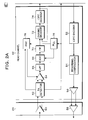
- FIGs. 2A and 2B are block diagrams showing a configuration of the recording/reproducing systems in the hard disk controller, the read channel, and the head IC of FIG. 1.
- the recording/reproducing systems of the magnetic disk apparatus comprise the hard disk controller 40, the read channel 42, and the head IC 24.
- the recording system comprises a CRC encoder 46, an MTR encoder 48, and an ECC encoder 50 to which the present embodiment is applied of the hard disk controller 40; an LDPC encoder 52, a recording compensator 54, and a driver 56 provided in the read channel 42; and a driver 58 of the head IC 24.
- Write data is separated into sector data which is unit length data through format processing in the hard disk controller 40, and the sector data is subjected to CRC encoding in the CRC encoder 46 and then converted into a data sequence which satisfies restriction conditions through MTR encoding by the MTR encoder 48. Subsequently, a parity is added thereto through an encoding process by the ECC encoder 50 serving as an embodiment of the present invention, and it is transmitted to the read channel 42. In the read channel 42, after LDPC encoding is performed by the LDPC encoder 52, a compensation process in which switching intervals are slightly expanded at the adjacent portions of switched magnetization by the recording compensator 54.
- the reproducing system comprises an amplifier 60 of the head IC 24; a TA (thermal asperity) detector 62, a variable gain amplifier 64, a low-pass filter 66, an AD converter 68, an FIR filter 70, a channel decoder 72, and an LDPC decoder 74 provided in the read channel 42; and an ECC decoder 80 serving as an embodiment of the present invention, an MTR decoder 82, and a CRC decoder 84 provided in the hard disk controller 40.
- TA thermal asperity
- a PLL circuit 76 and an automatic gain controller 78 are provided in the reproducing system of the read channel 42.
- the analog read voltage signal read from the magnetic disk by the reading element is amplified in the amplifier 60 of the head IC 24 first, and then, transmitted to the read channel 42.
- the read channel 42 after a detection process of thermal asperity is performed by the TA detector 62, it is converted into a digital signal via the variable gain amplifier 64, the low-pass filter 66, and the AD converter 68. Subsequently, after waveform equalization is performed by the FIR filter 70, iterative decoding is performed by the channel decoder 72 and the LDPC decoder 74.
- the PLL circuit 76 controls the timing for sampling the signal by the AD converter 68.
- the automatic gain controller 78 controls the gain such that the output level of the variable gain amplifier 64 attains a constant level.
- the digital signal from the read channel 42 is transmitted to the hard disk controller 40, and error correction by the ECC decoder 80 serving as an embodiment of the present invention is performed. Then, after MTR decoding by the MTR decoder 82 and CRC decoding by the CRC decoder 84, it is output as reproduced data.
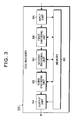
- FIG. 3 is a block diagram of a functional configuration showing the embodiment of the ECC encoder of FIGs. 2A and 2B.
- the ECC encoder 50 comprises an input unit 86, a first encoding unit 88, a second encoding unit 90, a third encoding unit 92, and an output unit 94.
- the procedure of the encoding process by the ECC encoder 50 includes the following three processes.
- the input unit 86 inputs sector data as unit length data to be recorded to the magnetic disk and saves it in the memory 96.
- the first encoding unit 88 subjects the sector data to Reed Solomon encoding, thereby generating a first RS parity.
- the second encoding unit 90 divides the data in which the sector data is continuous with the first RS parity into blocks of a predetermined number n and subjects each of the blocks to cyclic Hamming encoding, thereby generating Hamming parities.
- the third encoding unit 92 generates a second RS parity by subjecting the data in which the hamming parities generated by the second encoding unit 90 are aligned in a row to Reed Solomon encoding.
- the output unit 94 outputs the encoded data (code word) in which the first RS parity generated by the first encoding unit 88 and the second RS parity generated by the third encoding unit 92 are continuous to the sector data saved in the memory 96.
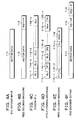
- FIGs. 4A to 4F are explanatory diagrams showing details of the encoding process performed by the ECC encoder 50 of FIG. 3.
- FIG. 4A shows sector data 110 corresponding to one sector which is to be input to the ECC encoder 50, and it has a data length of, for example, 4100 bits.
- the sector data 110 of FIG. 4A is subjected to Reed Solomon encoding as shown in FIG.4B by the first encoding unit 88, and a first RS parity 112 represented by "RS1-P" generated by this encoding is disposed in front of the sector data 110.
- the data in which the first RS parity 112 is disposed at the top of the sector data 110 of FIG. 4B is divided into n pieces of blocks 114-1 to 114-n by the second encoding unit 90.
- cyclic Hamming encoding is performed for each of the divided data 114-1 to 114-n, and Hamming parities 116-1 to 116-n represented by symbols "p1 to pn" obtained by the cyclic Hamming encoding are disposed at the top side of the blocks 114-1 to 114-n.
- the cyclic Hamming encoding for the blocks 114-1 to 114-n of FIGs. 4C and 4D divided by n can be expressed as "cyclic Hamming encoding of (code length n', information length k')".
- the information length is 70 symbols
- the parity is 56 symbols
- the total is 126 symbols.
- the code length (126 symbols) in which the generated second RS parity 118 is disposed at the top of the sequence of the Hamming parities 116-1 to 116-n equals to the maximum code length (126 symbols) of the Reed Solomon code of "GF(2 7 )".
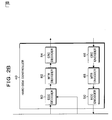
- the code length in which the generated second RS parity 118 is disposed at the top of the sequence of the Hamming parities 116-1 to 116-n in the manner shown in FIG. 4E exceeds the maximum code length of the Reed Solomon code of "GF(2 7 )", as shown in FIG. 5, the Hamming parities 116-1 to 116-n are divided into, for example, k pieces of data, and each piece of the divided data is subjected to Reed Solomon encoding of "GF(2 7 )" to generate it.
- the output unit 94 finally disposes the first RS parity 112 generated by the first encoding unit 88 and the second RS parity 118 generated by the third encoding unit 92 at the top of the sector data 110 as shown in FIG. 4F and outputs it as encoded data (code word).
- the Hamming parities 116-1 to 116-n obtained in the Cyclic Hamming encoding are not added to the sector data 110 and output, but they are output as the second RS parity 118 which is obtained by further subjecting the Hamming parities 116-1 to 116-n to Reed Solomon encoding; therefore, redundant bits can be reduced, and the code rate by the ECC encoder can be improved.
- FIGs. 6A and 6B are flow charts of the encoding process performed by the ECC encoder 50 of FIGs. 4A to 4F.
- the input unit 86 reads the sector data in step S1
- the first encoding unit 88 subjects the sector data to Reed Solomon encoding to generate the first RS parity in step S2.
- the second encoding unit 90 divides the sector data and the first RS parity into the n pieces of blocks in step S3, and generates the Hamming parities by subjecting each of the divided blocks to cyclic Hamming encoding in step S4.
- step S6 the third encoding unit 92 aligns the Hamming parities obtained in the Hamming encoding in a row in step S5, and then, generates the second RS parity by subjecting the aligned parities to Reed Solomon encoding in step S6.
- step S7 the output unit 96 adds the first RS parity and the second RS parity to the sector data and outputs it as encoded data.
- steps S1 to S7 are repeated until all sectors of the read data are finished in step S8. If the aligned parities and the second RS parity exceed the maximum code length of the second RS, step S6' is executed instead of step S6.
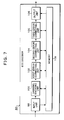
- FIG. 7 is a block diagram showing a functional configuration of the embodiment showing details of the ECC decoder 80 of FIGs. 2A and 2B.
- the ECC decoder 80 comprises an input unit 98, a Hamming encoding unit 100, a first error correcting unit 102, a second error correcting unit 104, a third error correcting unit 105, and an output unit 106.
- the input unit 98 inputs the encoded data which is read from the magnetic disk and output from the read channel, that is, the encoded data in which the first RS parity and the second RS parity are adjacently connected at the top of the sector data, and saves it in a memory 108.
- the Hamming encoding unit 100 divides the data, in which the first RS parity is adjacently connected to the sector data, into n pieces of blocks and performs cyclic Hamming encoding in each of the blocks so as to generate Hamming parities.
- the first error correcting unit 102 subjects the data, in which the Hamming parities generated by the Hamming encoding unit 100 are aligned in a row, to Reed Solomon decoding together with the second RS parity, and, if errors are present in the Hamming parities of the blocks, corrects the errors in the Hamming parities.
- the second error correcting unit 104 corrects 1 bit errors present in the blocks by performing cyclic Hamming decoding for each of the blocks which have undergone error correction for the Hamming parities.
- the third error correcting unit 105 aligns the blocks of which 1 bit errors have been corrected and subjects them to Reed Solomon decoding together with the first RS parity so as to correct errors other than those of 1 bit present in the blocks, that is, errors of two or more bits.
- the output unit 106 outputs the sector data which has undergone error correction as read data.
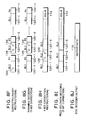
- FIGs. 8A to 8J are explanatory diagrams showing details of the decoding process performed by the ECC decoder of FIG. 7.
- the encoded data shown in FIG. 8A which is read from the magnetic disk and demodulated is input by the input unit 98 and saved in the memory 108.
- the encoded data comprises the sector data 110, the first RS parity 112, and the second RS parity 118.
- the Hamming encoding unit 100 divides the sector data 110 and the first RS parity 112 of the input encoded data into n pieces of blocks 120-1 to 120-n as shown in FIG. 8B.
- the Hamming encoding unit 100 subjects the n-divided blocks 120-1 to 120-n to cyclic Hamming encoding as shown in FIG. 8C and respectively disposes the generated Hamming parities 122-1 to 122-n as shown in FIG. 8C.
- the Hamming parities 122-1 to 122-n obtained thorough the cyclic Hamming encoding are equal to the Hamming parities 116 - 1 to 116-n (FIGs . 4A to 4F) calculated in the ECC encoder 50 side as shown in FIG.
- the first error correcting unit 102 aligns the Hamming parities 122-1 to 122-n including the erroneous parities 130 and 132 generated through the cyclic Hamming encoding in a row like FIG.
- the 1-bit error 124 present in the block 120-1 is corrected by the cyclic Hamming decoding.
- decoding of the two-bit error consisting of the two 1-bit errors 126 and 128 present in the block 120-2 fails.
- 1-bit errors are vast majority. Therefore, in order to prevent failure of decoding of the frequently-occurred 1-bit errors in LDPC decoding, satisfactorily increasing the value of the number t2 of corrected symbols of Reed Solomon decoding of the second RS parity 118 is important in the present embodiment.
- the third error correcting unit 105 aligns the blocks 120-1 to 120-n which have undergone 1-bit error correction as shown in FIG. 8H, and subjects them to Reed Solomon decoding of "GF(2 10 )" together with the first RS parity 112 so as to correct errors of two or more bits.
- the two-bit error consisting of 1-bit errors 126 and 128 remaining in the block 120-2 is corrected by the Reed Solomon decoding.
- the output unit 106 outputs the sector data 110 of which 1-bit errors and 2-bit errors contained in the input encoded data have been corrected is output from the ECC decoder 80 as shown FIG. 81.
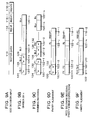
- FIGs. 9A to 9I are explanatory diagrams of a decoding process for the encoded data which is accompanied by an interleave configuration of FIG. 5.
- the encoded data which is accompanied by the interleave configuration as shown in the ECC decoder input of FIG. 9A, in addition to the first RS parity 112, for example, two second RS parities 118 - 1 and 118-2 are added in the front side of the sector data 110. Therefore, the points that, after the data including the sector data 110 and the first RS parity 112 which is adjacently connected thereto is divided into the blocks 120-1 to 120-n by n division as shown in FIG.
- each of the blocks 120-1 to 120-n is subjected to cyclic Hamming decoding so as to generate the Hamming parities 122-1 to 122-n as shown in FIG. 9C are same as FIGs. 8A to 8J.
- the Hamming parities 122-1 to 122-n obtained in the Hamming decoding are divided into two, that is, into Hamming parities 122-1 to 122-j of FIG. 9D and Hamming parities 122-j+1 to 122-n of FIG. 9F, and they are respectively combined with the second RS parities 118-1 and 118-2 and subjected to second RS decoding as shown in FIG. 9E and FIG.
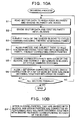
- FIGs. 10A and 10B are flow charts of the decoding process performed by the ECC decoder of FIG. 7. If there is one second RS parity, in the decoding process of FIGS. 10A and 10B, the input unit 98 reads the decoded data (after decoding) in which the first RS parity is added to the sector data in step S1, the sector data and the first RS parity is divided into n pieces of blocks in step S2, and each of the divided blocks is subjected to cyclic Hamming encoding so as to generate Hamming parities in step S3. Then, the Hamming parities are aligned and subjected to Reed Solomon decoding together with the second RS parity so as to correct the parities.
- the input unit 98 reads the decoded data (after decoding) in which the first RS parity is added to the sector data in step S1, the sector data and the first RS parity is divided into n pieces of blocks in step S2, and each of the divided blocks is subjected to cyclic
- step S5 the corrected parities are combined with the respective blocks, and 1-bit errors in the blocks are corrected by cyclic Hamming decoding. Furthermore, in step S8, the blocks of which 1-bit errors have been corrected are aligned, and they are subjected to Reed Solomon decoding together with the first RS parity so as to perform correction of two or more bits. Such processes of steps S1 to S6 are repeated until the processes of all the sectors to be read is finished in step S7.
- step S4' is performed, wherein, after the Hamming parities are aligned, they are divided into a plurality of blocks corresponding to the number of second RS parities, and they are subjected to Reed Solomon decoding together with the second RS parities corresponding to the blocks so as to correct the parities.
- the error correction process performed by the ECC encoder 50 and the ECC decoder 80 of the present embodiment are compared with a conventional error correction process performed merely by the Reed Solomon code below.
- the present invention also provides an encoding program and a decoding program executed by the ECC encoder 50 and the ECC decoder 80 shown in FIG. 3 and FIG. 7, and the contents of the programs are the contents shown in the flow charts of FIG. 6A, FIG. 6B, FIG. 10A and FIG. 10B.
- the ECC encoder 50 and the ECC decoder 80 of the present embodiment is realized by a built-in-type computer having a hardware configuration having a CPU, a memory, input/output interfaces.
- the functions of the ECC encoder 50 and the ECC decoder 80 can be realized.
- the present embodiment employs, as an example, error correction in recording/reproducing systems of a magnetic disk apparatus; however, the present invention is not limited thereto and can be similarly applied to sequences using LDPC codes where 1-bit errors frequently occur, for example, to storage devices such as optical disks and communication devices.
- the input sector data and input code are once saved in the memories, and then, subjected to the encoding process and the decoding process; however, a so-called on-the-fly processing configuration for performing encoding and decoding while transferring data to respective units without using memories may be employed.
- the present invention is not limited to the above described embodiments, includes arbitrary modifications that do not impair the object and advantages thereof, and is not limited by the numerical values shown in the above described embodiments.
Landscapes
- Engineering & Computer Science (AREA)
- Theoretical Computer Science (AREA)
- Physics & Mathematics (AREA)
- Probability & Statistics with Applications (AREA)
- Signal Processing (AREA)
- Error Detection And Correction (AREA)
- Detection And Prevention Of Errors In Transmission (AREA)
- Detection And Correction Of Errors (AREA)
Applications Claiming Priority (1)
| Application Number | Priority Date | Filing Date | Title |
|---|---|---|---|
| JP2006124801A JP4662278B2 (ja) | 2006-04-28 | 2006-04-28 | エラー訂正装置、符号器、復号器、方法及び情報記憶装置 |
Publications (1)
| Publication Number | Publication Date |
|---|---|
| EP1850487A1 true EP1850487A1 (de) | 2007-10-31 |
Family
ID=37137410
Family Applications (1)
| Application Number | Title | Priority Date | Filing Date |
|---|---|---|---|
| EP06254714A Withdrawn EP1850487A1 (de) | 2006-04-28 | 2006-09-11 | Fehlerkorrekturgerät, Kodierer, Dekodierer, Verfahren, und Datenspeichergerät |
Country Status (5)
| Country | Link |
|---|---|
| US (1) | US7644337B2 (de) |
| EP (1) | EP1850487A1 (de) |
| JP (1) | JP4662278B2 (de) |
| KR (1) | KR100766354B1 (de) |
| CN (1) | CN101064162A (de) |
Cited By (1)
| Publication number | Priority date | Publication date | Assignee | Title |
|---|---|---|---|---|
| EP2086114A3 (de) * | 2008-01-31 | 2012-09-12 | Fujitsu Limited | Verkettete Codes aus Reed-Solomon Codes, LDPC Codes and Parity Codes für Encodierungs-/Decodierungsapparate |
Families Citing this family (34)
| Publication number | Priority date | Publication date | Assignee | Title |
|---|---|---|---|---|
| KR101300810B1 (ko) * | 2006-04-03 | 2013-08-26 | 삼성전자주식회사 | 데이터 인코딩 및 디코딩 방법과 그 장치, 저장 매체, 및저장 매체 구동 시스템 |
| JP5045242B2 (ja) * | 2007-05-30 | 2012-10-10 | 富士通セミコンダクター株式会社 | 半導体メモリ、半導体メモリの動作方法およびシステム |
| JP4564520B2 (ja) | 2007-08-31 | 2010-10-20 | 株式会社東芝 | 半導体記憶装置およびその制御方法 |
| US8370711B2 (en) | 2008-06-23 | 2013-02-05 | Ramot At Tel Aviv University Ltd. | Interruption criteria for block decoding |
| TWI430585B (zh) | 2008-09-30 | 2014-03-11 | Realtek Semiconductor Corp | 區塊碼解碼方法與裝置 |
| JP5638956B2 (ja) * | 2008-10-23 | 2014-12-10 | パナソニック インテレクチュアル プロパティ コーポレーション オブアメリカPanasonic Intellectual Property Corporation of America | 無線送信装置、無線受信装置、符号化データ送信方法、及び符号化データ受信方法 |
| CN101777919B (zh) * | 2009-01-12 | 2014-07-16 | 瑞昱半导体股份有限公司 | 区块码解码方法 |
| US8413029B2 (en) * | 2009-01-16 | 2013-04-02 | Lsi Corporation | Error correction capability adjustment of LDPC codes for storage device testing |
| US8276039B2 (en) * | 2009-02-27 | 2012-09-25 | Globalfoundries Inc. | Error detection device and methods thereof |
| KR101570472B1 (ko) | 2009-03-10 | 2015-11-23 | 삼성전자주식회사 | 연접 부호화 및 복호화 구조를 갖는 데이터 처리 시스템 |
| US8291277B2 (en) * | 2009-10-29 | 2012-10-16 | Cleversafe, Inc. | Data distribution utilizing unique write parameters in a dispersed storage system |
| JP5117593B2 (ja) * | 2011-04-26 | 2013-01-16 | 株式会社東芝 | 符号化・復号化装置、データ記憶装置、及び方法 |
| US8667360B2 (en) * | 2011-07-01 | 2014-03-04 | Intel Corporation | Apparatus, system, and method for generating and decoding a longer linear block codeword using a shorter block length |
| US8578241B2 (en) * | 2011-10-10 | 2013-11-05 | Lsi Corporation | Systems and methods for parity sharing data processing |
| US8762820B1 (en) * | 2011-12-22 | 2014-06-24 | Landis+Gyr Technologies, Llc | Data communications via power line |
| US8760780B1 (en) * | 2012-03-22 | 2014-06-24 | Amazon Technologies, Inc. | System and method for disk sector failure prediction |
| KR101457192B1 (ko) | 2012-12-03 | 2014-10-31 | 서울대학교산학협력단 | 오류정정 회로, 이를 포함하는 비휘발성 메모리 장치 및 오류정정 방법 |
| US9160369B1 (en) * | 2013-03-01 | 2015-10-13 | Proton Digital Systems, Inc. | Method for iterative error correction with designed error floor performance |
| CN105393481B (zh) * | 2013-07-30 | 2019-06-18 | 索尼公司 | 信息处理装置和信息处理方法 |
| CN105431905B (zh) | 2013-09-24 | 2019-05-07 | 拉姆伯斯公司 | 具有内部读取-修改-写入操作的存储部件 |
| US9397706B1 (en) * | 2013-10-09 | 2016-07-19 | Avago Technologies General Ip (Singapore) Pte. Ltd. | System and method for irregular multiple dimension decoding and encoding |
| KR20150084560A (ko) * | 2014-01-14 | 2015-07-22 | 에스케이하이닉스 주식회사 | 인코딩 장치, 디코딩 장치 및 그 동작 방법 |
| CN105787388B (zh) * | 2014-12-23 | 2019-11-05 | 中兴通讯股份有限公司 | 控制黑匣子的方法和装置 |
| CN106961602B (zh) * | 2017-03-30 | 2019-10-18 | 北卡科技有限公司 | 一种基于rs和汉明码的跨平台抗压缩彩色图像信息隐藏算法 |
| US10998922B2 (en) * | 2017-07-28 | 2021-05-04 | Mitsubishi Electric Research Laboratories, Inc. | Turbo product polar coding with hard decision cleaning |
| CN108281160B (zh) * | 2018-01-12 | 2020-06-19 | 南阳师范学院 | Dvd纠错码的设计方法 |
| US10817372B2 (en) * | 2018-06-13 | 2020-10-27 | Innogrit Technologies Co., Ltd | Systems and methods for ultra fast ECC with parity |
| CN110489269B (zh) * | 2019-08-16 | 2023-08-15 | 西安紫光国芯半导体有限公司 | 检测纠正三位错误的编码解码方法、编码解码器及处理器 |
| US10944435B1 (en) * | 2020-03-27 | 2021-03-09 | Nxp B.V. | Tearing save encoding |
| US11159170B1 (en) * | 2020-10-22 | 2021-10-26 | Texas Instruments Incorporated | Differential converter with offset cancelation |
| CN113422612B (zh) * | 2021-07-02 | 2023-11-03 | 海光信息技术股份有限公司 | 编码方法、译码方法及相关装置、电子设备和存储介质 |
| US12189949B2 (en) * | 2022-06-01 | 2025-01-07 | Micron Technology, Inc. | Bit error management in memory devices |
| CN116028260B (zh) * | 2023-01-09 | 2024-02-27 | 海光信息技术股份有限公司 | 数据的处理方法、处理装置以及存储系统 |
| CN117650870B (zh) * | 2023-12-06 | 2024-07-23 | 北京荷智科技有限公司 | 一种基于纵向编码纠错的通信方法、系统、设备及介质 |
Citations (3)
| Publication number | Priority date | Publication date | Assignee | Title |
|---|---|---|---|---|
| US5206864A (en) * | 1990-12-04 | 1993-04-27 | Motorola Inc. | Concatenated coding method and apparatus with errors and erasures decoding |
| WO1997000559A1 (en) * | 1995-06-14 | 1997-01-03 | Quantum Corporation | Dedicated alu architecture for 10-bit reed-solomon error correction module |
| US20040093549A1 (en) * | 2002-11-07 | 2004-05-13 | Hongwei Song | Encoding method using a low density parity check code with a column weight of two |
Family Cites Families (14)
| Publication number | Priority date | Publication date | Assignee | Title |
|---|---|---|---|---|
| JP2000067531A (ja) * | 1998-08-18 | 2000-03-03 | Hitachi Ltd | 誤り訂正符号化/復号化方式及び誤り訂正符号化/復号化装置 |
| KR100277764B1 (ko) * | 1998-12-10 | 2001-01-15 | 윤종용 | 통신시스템에서직렬쇄상구조를가지는부호화및복호화장치 |
| US6374382B1 (en) * | 1998-12-15 | 2002-04-16 | Hughes Electronics Corporation | Short block code for concatenated coding system |
| JP2000269824A (ja) * | 1999-01-12 | 2000-09-29 | Matsushita Electric Ind Co Ltd | データ符号化装置及びデータ復号化装置 |
| CN1235342C (zh) | 1999-12-24 | 2006-01-04 | 通信集合公司 | 级联式信道编码的方法和设备 |
| US7032154B2 (en) * | 2000-06-05 | 2006-04-18 | Tyco Telecommunications (Us) Inc. | Concatenated forward error correction decoder |
| US6622277B1 (en) * | 2000-06-05 | 2003-09-16 | Tyco Telecommunications(Us)Inc. | Concatenated forward error correction decoder |
| US6938196B2 (en) | 2001-06-15 | 2005-08-30 | Flarion Technologies, Inc. | Node processors for use in parity check decoders |
| US7146553B2 (en) * | 2001-11-21 | 2006-12-05 | Infinera Corporation | Error correction improvement for concatenated codes |
| JP3808769B2 (ja) | 2001-12-27 | 2006-08-16 | 三菱電機株式会社 | Ldpc符号用検査行列生成方法 |
| JP2004193727A (ja) * | 2002-12-09 | 2004-07-08 | Hitachi Ltd | 信号処理方法及び信号処理回路 |
| JP2004253017A (ja) * | 2003-02-18 | 2004-09-09 | Fujitsu Ltd | 記録媒体再生装置、記録媒体再生方法およびハードディスクコントローラ |
| JP4294407B2 (ja) * | 2003-08-18 | 2009-07-15 | 株式会社日立グローバルストレージテクノロジーズ | 信号処理方法及び信号処理回路 |
| JP4444755B2 (ja) * | 2004-08-17 | 2010-03-31 | Kddi株式会社 | 連接符号システムおよび連接符号処理方法、復号装置 |
-
2006
- 2006-04-28 JP JP2006124801A patent/JP4662278B2/ja not_active Expired - Fee Related
- 2006-08-31 US US11/514,041 patent/US7644337B2/en not_active Expired - Fee Related
- 2006-09-11 EP EP06254714A patent/EP1850487A1/de not_active Withdrawn
- 2006-09-27 KR KR1020060093895A patent/KR100766354B1/ko not_active Expired - Fee Related
- 2006-10-31 CN CNA2006101427955A patent/CN101064162A/zh active Pending
Patent Citations (3)
| Publication number | Priority date | Publication date | Assignee | Title |
|---|---|---|---|---|
| US5206864A (en) * | 1990-12-04 | 1993-04-27 | Motorola Inc. | Concatenated coding method and apparatus with errors and erasures decoding |
| WO1997000559A1 (en) * | 1995-06-14 | 1997-01-03 | Quantum Corporation | Dedicated alu architecture for 10-bit reed-solomon error correction module |
| US20040093549A1 (en) * | 2002-11-07 | 2004-05-13 | Hongwei Song | Encoding method using a low density parity check code with a column weight of two |
Cited By (1)
| Publication number | Priority date | Publication date | Assignee | Title |
|---|---|---|---|---|
| EP2086114A3 (de) * | 2008-01-31 | 2012-09-12 | Fujitsu Limited | Verkettete Codes aus Reed-Solomon Codes, LDPC Codes and Parity Codes für Encodierungs-/Decodierungsapparate |
Also Published As
| Publication number | Publication date |
|---|---|
| JP4662278B2 (ja) | 2011-03-30 |
| CN101064162A (zh) | 2007-10-31 |
| KR100766354B1 (ko) | 2007-10-15 |
| US20070266300A1 (en) | 2007-11-15 |
| US7644337B2 (en) | 2010-01-05 |
| JP2007299449A (ja) | 2007-11-15 |
Similar Documents
| Publication | Publication Date | Title |
|---|---|---|
| EP1850487A1 (de) | Fehlerkorrekturgerät, Kodierer, Dekodierer, Verfahren, und Datenspeichergerät | |
| US8810940B2 (en) | Systems and methods for off track error recovery | |
| US7734981B2 (en) | Signal decoder, a signal decoding method and a storage system | |
| US10437674B1 (en) | Variable parity sectors | |
| CN101501784A (zh) | 用于利用乘积码来纠正非易失性存储器中的错误的系统和方法 | |
| US9837115B1 (en) | Unequal error correction code in multi-track recording | |
| US20090300466A1 (en) | Error correction method and error correction circuit | |
| US11042439B1 (en) | Efficient read and recovery with outer code | |
| JP4660612B2 (ja) | 情報再生装置及び情報再生方法 | |
| US20170322844A1 (en) | Super-parity block layout for multi-reader drives | |
| US8020079B2 (en) | Decoder device, decoding method and magnetic disk device | |
| US7536625B2 (en) | Maintaining data integrity in a data storage system | |
| US20100290151A1 (en) | Disk controller, disk drive device, and disk control method | |
| US9047205B1 (en) | Data storage device employing orthogonal equalization and sequence detection to compensate for two-dimensional intersymbol interference | |
| US8826110B2 (en) | Systems and methods for defect scanning | |
| US8908307B1 (en) | Systems and methods for hard disk drive region based data encoding | |
| TW201419273A (zh) | 用於硬式決定基礎的軌道間干擾消除之系統與方法 | |
| US20130007556A1 (en) | Multiuse Data Channel | |
| US7322003B2 (en) | Information storage device | |
| TW201406071A (zh) | 用於雙二進位及非二進位解碼處理的系統及方法 | |
| JP4290688B2 (ja) | データ書込装置および記憶システム | |
| US20040030737A1 (en) | Algebraic decoder and method for correcting an arbitrary mixture of burst and random errors | |
| JP2012160229A (ja) | 情報再生装置及び情報再生方法 | |
| KR101652452B1 (ko) | 디코더와 상기 디코더를 포함하는 장치들 | |
| US7924522B2 (en) | Apparatus and method of detecting error symbol, and disk drive apparatus using the same |
Legal Events
| Date | Code | Title | Description |
|---|---|---|---|
| PUAI | Public reference made under article 153(3) epc to a published international application that has entered the european phase |
Free format text: ORIGINAL CODE: 0009012 |
|
| AK | Designated contracting states |
Kind code of ref document: A1 Designated state(s): AT BE BG CH CY CZ DE DK EE ES FI FR GB GR HU IE IS IT LI LT LU LV MC NL PL PT RO SE SI SK TR |
|
| AX | Request for extension of the european patent |
Extension state: AL BA HR MK YU |
|
| 17P | Request for examination filed |
Effective date: 20080328 |
|
| AKX | Designation fees paid |
Designated state(s): DE FR GB |
|
| 17Q | First examination report despatched |
Effective date: 20080923 |
|
| STAA | Information on the status of an ep patent application or granted ep patent |
Free format text: STATUS: THE APPLICATION IS DEEMED TO BE WITHDRAWN |
|
| 18D | Application deemed to be withdrawn |
Effective date: 20090405 |