EP1850512A2 - Verfahren zur Herstellung der Synchronisation einer Mobilstation in einem mobilen Kommunikationssystem - Google Patents
Verfahren zur Herstellung der Synchronisation einer Mobilstation in einem mobilen Kommunikationssystem Download PDFInfo
- Publication number
- EP1850512A2 EP1850512A2 EP07075616A EP07075616A EP1850512A2 EP 1850512 A2 EP1850512 A2 EP 1850512A2 EP 07075616 A EP07075616 A EP 07075616A EP 07075616 A EP07075616 A EP 07075616A EP 1850512 A2 EP1850512 A2 EP 1850512A2
- Authority
- EP
- European Patent Office
- Prior art keywords
- correlation values
- averaging
- powerized
- establishing method
- synchronization
- Prior art date
- Legal status (The legal status is an assumption and is not a legal conclusion. Google has not performed a legal analysis and makes no representation as to the accuracy of the status listed.)
- Withdrawn
Links
Images







Classifications
-
- H—ELECTRICITY
- H04—ELECTRIC COMMUNICATION TECHNIQUE
- H04W—WIRELESS COMMUNICATION NETWORKS
- H04W56/00—Synchronisation arrangements
- H04W56/0055—Synchronisation arrangements determining timing error of reception due to propagation delay
- H04W56/0065—Synchronisation arrangements determining timing error of reception due to propagation delay using measurement of signal travel time
- H04W56/007—Open loop measurement
- H04W56/0075—Open loop measurement based on arrival time vs. expected arrival time
- H04W56/0085—Open loop measurement based on arrival time vs. expected arrival time detecting a given structure in the signal
-
- H—ELECTRICITY
- H04—ELECTRIC COMMUNICATION TECHNIQUE
- H04W—WIRELESS COMMUNICATION NETWORKS
- H04W92/00—Interfaces specially adapted for wireless communication networks
- H04W92/04—Interfaces between hierarchically different network devices
- H04W92/10—Interfaces between hierarchically different network devices between terminal device and access point, i.e. wireless air interface
Definitions
- the present invention relates to a synchronization establishing method of a mobile station in a mobile communication system, and more particularly to a synchronization establishing method of a mobile station in a mobile communication system for carrying out peak detection by averaging the synchronization channel in phase in complex numbers.
- a synchronization channel is multiplexed onto a downlink signal transmitted from a base station to a mobile station to enable the mobile station to carry out synchronization establishment by detecting the downlink signal (see, 3GPP Technical Specification 25.211).
- the SCH is transmitted to the mobile station at a known frequency, in known time slots, in a known code and symbol pattern.
- the mobile station performs correlation detection at the frequency, in the time slots and in the code and symbol pattern, thereby determining the most likely timing as the timing of the SCH.
- Fig. 1 is a diagram showing a commonly used power averaging method.
- the reference numeral 201 designates the output from a correlator of a mobile station, that is, correlation values of a synchronization channel transmitted from a base station for initial synchronization.
- the reference numeral 203 designates an equipment to powerize for calculating a square sum of the correlation values of the synchronization channel; and 205 designates a peak detector for detecting a peak of the correlation values in each period of the synchronization channel.
- the SCH is repeatedly transmitted at predetermined intervals (at intervals that will give peak values of the output). It is assumed in the following description that the interval is one slot.
- the mobile station averages the correlation values of the SCH over a plurality of slots. Conventionally, the mobile station carries out the averaging after powerizing the output of the correlator slot by slot (power average).
- commonly used power averaging method carries out averaging of the output of the correlator of the mobile station using an equipment to powerize for converting correlation values of the synchronization channel transmitted from the base station into power dimension for establishing the initial synchronization, and a peak detector for detecting the peak of the correlation values in each period of the synchronization channel.
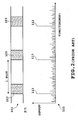
- Fig. 2 shows a structure of the SCH.
- synchronization channels 103 are assigned periodically to a channel set 101 and are transmitted to the mobile station at known frequency and time slots in known code and symbol pattern.
- the pilot symbols are also used for measuring received signal power.
- the reference numeral 111 designates a graph representing correlation outputs of the synchronization channel versus time (timings).
- the SCH is transmitted to the mobile station at known frequency and time slots in known code and symbol pattern.
- the SCH is transmitted at every one slot interval.
- the peak detector 205 of the mobile station detects the timings (peaks) 113 at which the correlation values take a maximum value from the correlation values by the correlator at all possible timings.
- the averaging is carried out after powerizing the output of the correlators slot by slot as shown in Fig. 1.
- Propagation paths of the mobile communication have interference or noise, and the signal-to-noise (S/N) ratio of the SCH for the mobile station is usually very small.
- the SCH is one of control channels that do not transmit user information, it is preferable that the transmission power and transmission duration of the SCH be as small as possible from the viewpoint of the system capacity.
- the averaging period must be lengthened. However, an increasing averaging period will lengthen the time required to carry out the synchronization establishment. As a result, it will provide a problem of increasing the power consumption of the mobile station, and lengthening the time taken by cell switching control (handover) involved in the movement of the mobile station across cells during communication.
- mobile communication systems sometimes employ time switched transmit diversity (TSTD) that installs two antennas on a base station and transmits the signal alternately in a prescribed pattern at every predetermined interval to reduce the effect of received level fluctuations due to fading.
- TSTD time switched transmit diversity
- the base station can transmit the SCH alternately in a prescribed pattern at every slot interval from the two antennas (see, 3GPP Technical Specification 25.211).
- the phases of the signals transmitted from the two antennas usually differ from each other, it is difficult to average them in phase.
- an object of the present invention is to provide a synchronization establishing method of a mobile station in a mobile communication system that can achieve synchronization establishment at higher accuracy by reducing the effect of noise or interference by averaging the SCH in phase, and that can reduce the time period taken to carry out the synchronization establishment.
- a synchronization establishing method of a mobile station in a mobile communication system in which a synchronization channel is periodically sent in a downlink signal so that the mobile station, which detects the downlink signal sent from a base station, can establish synchronization to the downlink signal
- the synchronization establishing method comprising: an averaging step of averaging first correlation values in phase in complex number over a plurality of periods of the synchronization channel, and of outputting first averaged correlation values; a powerizing step of powerizing the first averaged correlation values individually, and of outputting a first powerized correlation values; and a peak detecting step of detecting a peak of the first powerized correlation values output.
- the averaging step may average the first correlation values within an averaging window over a plurality of periods of the synchronization channel.
- the synchronization establishing method may further comprise a step of averaging the first powerized correlation values, and of outputting first power averaged correlation values, wherein the peak detecting step may detect a peak of the first power averaged correlation values.
- the number of periods of the first correlation values, over which the averaging is carried out in the averaging window may be equal to a moving unit of the averaging window.
- the averaging step may assign weights at every period of the first correlation values in the averaging window.
- the averaging step may carry out averaging using an exponential weighting averaging method.
- the averaging step may make phase correction of one of the first correlation values by using the first correlation values in a period previous to the period of the one of the first correlation values.
- the averaging step may assign weights to every period of the first correlation values to which the phase correction is applied.
- the powerizing step may output real parts of the first correlation values to which the phase correction is applied.
- the averaging step may average second correlation values that are estimated to be transmitted from a same antenna, and output second averaged correlation values; and the powerizing step may detect power of the second averaged correlation values to output second powerized correlation values.
- the averaging step may average the first correlation values and the second correlation values separately, and the powerizing step may detect power of the first averaged correlation values and power of the second averaged correlation values, and select one of two sets of the first powerized correlation values and the second powerized correlation values.
- the averaging step may average the first correlation values and the second correlation values separately, and the powerizing step may detect power of the first averaged correlation values and power of the second averaged correlation values, and assign weights to the first powerized correlation values and the second powerized correlation values at individual timings, followed by summing them up, respectively.
- the powerizing step may assign weights to a maximum value of the first powerized correlation values and to a maximum of the second powerized correlation values, and select the powerized correlation values that will give a greater maximum value.
- the powerizing step may select one of two sets of the first powerized correlation values and the second powerized correlation values such that the selected one differs from the powerized correlation values selected previously.
- the powerizing step may make a decision as to which one of two sets of the first powerized correlation values and the second powerized correlation values is to be selected in accordance with a number of times the two sets of the powerized correlation values are selected.
- the powerizing step may successively select one of two sets of the first powerized correlation values and the second powerized correlation values by a predetermined number of times, and when synchronization is not established, it may select the other set of the powerized correlation values.
- the synchronization establishing method may further comprise a step of selecting the correlation values to be averaged, wherein the averaging step may average one of two sets of the first correlation values and the second correlation values selected.
- the step of selecting may calculate correlation between correlation values in a given period to be averaged and correlation values in a period adjacent to the given period.
- the step of selecting may select the correlation values to be averaged in response to a control signal transmitted from the base station.
- the averaging step may carry out the averaging over a plurality of first averaging periods that are different from each other, and the powerizing step may assign weights to the plurality of powerized correlation values at individual timings, followed by summing them up.
- the averaging step may carry out the averaging over a plurality of first averaging periods that are different from each other, and the powerizing step may select a maximum value from the plurality of powerized correlation values.
- the averaging step may carry out the averaging over a second averaging period that adaptively varies.
- the second averaging period may be varied in response to a moving speed of the mobile station.
- the averaging step may carry out the averaging over a third averaging period that is varied depending on a state of the mobile station, which includes a power up state, an idle state and a traffic state of the mobile station.
- the synchronization establishing method may further comprise a step of outputting, when the mobile station is at power up, second power averaged correlation values by detecting powers of the correlation values of the synchronization channel first, and by averaging the powers thereafter, wherein the peak detecting step may detect a peak of the second power averaged correlation values.
- the averaging step may carry out the averaging over a fourth averaging period that varies depending on the idle state and the traffic state of the mobile station.
- the synchronization establishing method may further comprise a step of outputting, when the mobile station is in one of the power up and idle state, third power averaged correlation values by detecting powers of the correlation values of the synchronization channel first, and by averaging the powers thereafter, wherein the peak detecting step may detect a peak of the third power averaged correlation values.
- the correlation values calculated at respective periods are averaged in phase in complex numbers, followed by 5 power detection. After the power detection, the peak detection is carried out.
- the TSTD Time Switched Transmit Diversity
- a configuration that will bring about most ) effective in-phase averaging is taken.
- an appropriate synchronization establishing method is selected to 5 carry out effective synchronization establishing operation. This makes it possible to save the time taken to carry out synchronization establishment, and to improve the detection accuracy.
- the output of the correlator of the mobile station that receives the synchronization channel undergoes in-phase averaging.
- This makes it possible to implement higher averaging effect against the noise or interference than the conventional power averaging, thereby increasing the detection probability of the correlation detection and reducing time required for the detection.
- the transmission power of the synchronization channel of the base station can be reduced with maintaining the detection probability at a fixed value.
- the present invention can achieve highly accurate synchronization establishing operation of the mobile station in the mobile communication system with reducing the effect of the noise and interference.
- the in-phase averaging is applicable to any of the following cases: when the base station applies the transmit diversity to the synchronization channel or when it does not; and when it is not known whether the transmit diversity is applied or not as in the case where the application of the transmit diversity is selectable.
- more effective in-phase averaging can be implemented by selecting optimum averaging period(s) in response to the moving speed of the mobile station or the like.
- selecting appropriate averaging method or in-phase averaging period in response to the state of the mobile station can increase the accuracy of the synchronization establishment, and reduce the time taken to carry out the synchronization establishment.
- Fig. 3 shows an in-phase averaging method used for carrying out synchronization establishment in the present embodiment.
- the output of the correlator is averaged in-phase in complex numbers, followed by powerizing the average by a power detector 207.
- the in-phase averaging has higher averaging effect against noise and interference than the power averaging.
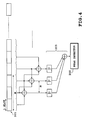
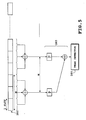
- Figs. 4 and 5 illustrate in-phase averaging utilizing averaging windows. It is usually difficult to estimate the phase of the output of the correlator because of sharp fluctuations in the phase of a signal on a propagation path of the mobile communication. The phase fluctuations, however, are small during an interval short enough as compared with the speed of the phase fluctuations due to fading on the propagation path. Accordingly, in-phase averaging in short intervals will bring about averaging effect higher than the conventional power averaging method.
- the averaging window range N for averaging the correlation values 201 is three slots
- the moving step M of the averaging windows is one slot.
- the output of the correlator is averaged in phase in complex number. After that, to eliminate the effect of the phase fluctuations between the windows, the powerizing is carried out, followed by further averaging between the windows, thereby producing a result with higher reliability.
- the example of Fig. 4 requires the buffer size of three slots for the in-phase averaging
- the example of Fig. 5 requires the buffer size of only one slot.
- Fig. 6 shows an example of carrying out the in-phase averaging with assigning weights within each averaging window in the in-phase averaging utilizing averaging windows as shown in Fig. 4.
- w 0 , w 1 and W 2 designate weight factors of the averaging. Decreasing the weight factors toward the ends of each averaging window can reduce the effect of the phase fluctuations of the correlation values due to fading.
- Fig. 7 shows an example of exponential weighting in-phase averaging.
- ⁇ is a weight factor taking a value between zero and one.
- the averaging period becomes shorter.
- the averaging period is increased because the number of the past correlation values to be considered is increased in this case.
- the M can be increased when the calculation amount must be reduced because of hardware management.
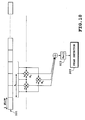
- Figs. 8 and 9 each show an example of differentially coherent detection type in-phase averaging.
- the phase of the correlation value in a given slot is corrected using the ) correlation values of previous L slots as a reference signal (returning the phases to zero). Such phase correction can align the phases of the correlation values.
- Averaging these values in the complex numbers, and powerizing the result (that is, extracting the real part of the result) by an operator 803 make it possible to carry out highly reliable correlation detection.
- Fig. 10 shows a method of assigning weights in the differentially coherent detection type in-phase averaging as shown in Fig. 9. As the L increases (that is, the time difference from the reference 5 signal is large), the effect of the phase fluctuations of the correlation values due to fading can be reduced by decreasing the weight factors.
- Fig. 11 shows an example of the in-phase averaging utilizing corresponding averaging windows, when TSTD is applied to the SCH, that is, when TSTD-ON.
- the mobile station has buffers for signals sent from respective antennas of a base station, and carries out in-phase averaging of the correlation values of the SCH that is assumed to be sent from the same antenna. In other words, the in-phase averaging is carried out every other slot.
- the mobile station can carry out the in-phase averaging every other slot not only when using the averaging windows, but also when performing the exponential weighting in-phase averaging or differentially coherent detection type in-phase averaging.
- the mobile station may recognize whether the TSTD is applied to the mobile communication system or not. In the mobile communication system in which each base station can select the application of the TSTD, the mobile station cannot recognize whether the TSTD is applied or not at least when the mobile station is turned on. When TSTD-OFF/ON is unknown, the mobile station can carry out one of the following three methods as the synchronization establishment operation.
- a first method assumes both TSTD-OFF and TSTD-ON, and combines or selects the averaging results of the two corresponding methods.
- Fig. 12 shows an example of a system for implementing the synchronization establishing method according to the first method.
- an averaging circuit 1203 assuming the TSTD-OFF and an averaging circuit 1205 assuming the TSTD-ON are connected to a correlator 1201, and the correlation output is produced by combining or selection using a correlation value combiner/selector 1207.
- the combining of the correlation values can be achieved by assigning predetermined weights to the outputs of the two averaging circuits, followed by summing them up.
- the selection of the correlation values can be achieved by assigning predetermined weights to maximum correlation values obtained by the two averaging methods, followed by comparing them, and by selecting the output result of the averaging circuit that will provide a greater correlation value.
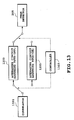
- a second method switches between an averaging method assuming the TSTD-OFF and an averaging method assuming the TSTD-ON.
- Fig. 13 shows a system for implementing the second synchronization establishing method.
- the reference numeral 1303 designates a controller for controlling the selection of one of the averaging circuits by switching the connection between a correlator 1301 and the two averaging circuits.
- a switching control method there is a switching method of the averaging circuits according to the number of selections of the averaging circuits.
- the averaging by the averaging circuit 1203 assuming the TSTD-OFF is carried out, whereas when it is even, the averaging by the averaging circuit 1205 assuming the TSTD-ON is carried out so as to obtain an averaged result.
- the averaging assuming the TSTD-OFF is carried out, and if the synchronization is not established up to the end of the N consecutive trials, a decision is made that TSTD-ON.
- the averaging assuming the TSTD-ON is carried out from the (N+1)th trial onward, enabling the method to try the TSTD-OFF in-phase averaging with higher effect, first.
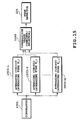
- a third method comprises a TSTD decision section 1403 for deciding the TSTD-OFF/ON between a correlator 1401 and a controller 1405 as shown in Fig. 14, makes a TSTD-OFF/ON decision before the averaging, and carries out switching of the averaging method in response to the decision result.
- the controller 1405 decides as to which one of the averaging circuits is to be used according to the decision result of the TSTD decision section 1403.
- the TSTD-OFF/ON decision method such a method can be adopted that calculates correlation between correlation values of adjacent slots, makes a decision as the TSTD-ON when the correlation value is larger than a predetermined value, and as the TSTD-OFF when the correlation value is smaller.
- the visited location cell notifies the TSTD decision section 1403 of the TSTD-OFF/ON by means of a control signal or the like when the mobile station is in the idle state or traffic state.
- a first method carries out n ways of averaging of the output of the correlator 1501 over n different averaging periods To - T n-1 using n averaging circuits 1503-1 - 1503-n as illustrated in Fig. 15, and combines or selects the results by a correlation value combiner/selector 1505 to supply the peak detection circuit 205 with the result.
- a combining method a method can be adopted that assigns weights to the outputs of the averaging circuits 1503 at respective timings, followed by summing them up.
- a selection method there is a method that assigns weights to maximum correlation values of the averaging circuits 1503-1 - 1503-n, followed by comparing them and selecting the output of the averaging circuit that gives the maximum correlation value as the result of the comparison.
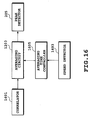
- a second method adaptively varies the averaging period over which the output of the correlator 1601 is averaged. More specifically, it detects the speed of the mobile station by a speed detector 1603 as shown in Fig. 16. In response to the detection result, it controls the averaging period by an averaging period controller 1605 of the averaging circuit 1203.
- the state of the mobile station carrying out the synchronization establishment can be roughly divided into three states: a power up state, an idle state, and a traffic state. These states will vary conditions involved in the synchronization establishing operation such as the intensity of the received signal and the magnitude of the frequency drift at the base station with which the mobile station tries to establish synchronization. Therefore, selecting the appropriate synchronization establishing method depending on the state, the mobile station can achieve the synchronization establishment at higher reliability, in a shorter time. Thus, it is generally effective to control the averaging period of the in-phase averaging according to the states.
- the mobile station At power up, it is usually difficult for the mobile station to carry out the in-phase averaging because it receives no signal from the base station, and its frequency stability is generally low. In such a case, it is effective for the mobile station to take power average during power up, and to carry out in-phase averaging in the idle state or traffic state. Even during the idle state, the frequency stability of the mobile station can be low because of the power saving. In such a case, it is preferable for mobile station to use power average during the power up and idle state, and to carry out the in-phase averaging only in the traffic state.
- the mobile station since the mobile station tries to establish synchronization with a signal sent from a base station other than the base station in the traffic state in the synchronization establishing operation during the traffic state, the signal from the base station in the traffic state becomes interference, and hence the S/N becomes small of the signal from the base station with which the mobile station tries to establish synchronization. Therefore, it is effective for the mobile station to employ the in-phase averaging only during the traffic state, and to use the rather simple power averaging method during the power up and idle state considering to simplify hardware configuration of the mobile station or to promote the power saving.
Landscapes
- Engineering & Computer Science (AREA)
- Computer Networks & Wireless Communication (AREA)
- Signal Processing (AREA)
- Mobile Radio Communication Systems (AREA)
- Synchronisation In Digital Transmission Systems (AREA)
Applications Claiming Priority (2)
| Application Number | Priority Date | Filing Date | Title |
|---|---|---|---|
| JP2000178747A JP4255601B2 (ja) | 2000-06-14 | 2000-06-14 | 移動通信システムにおける移動局の同期確立方法 |
| EP01305159A EP1164722B1 (de) | 2000-06-14 | 2001-06-13 | Verfahren zur Herstellung der Synchronisation einer Mobilstation in einem mobilen Kommunikationssystem |
Related Parent Applications (1)
| Application Number | Title | Priority Date | Filing Date |
|---|---|---|---|
| EP01305159A Division EP1164722B1 (de) | 2000-06-14 | 2001-06-13 | Verfahren zur Herstellung der Synchronisation einer Mobilstation in einem mobilen Kommunikationssystem |
Publications (2)
| Publication Number | Publication Date |
|---|---|
| EP1850512A2 true EP1850512A2 (de) | 2007-10-31 |
| EP1850512A3 EP1850512A3 (de) | 2008-05-07 |
Family
ID=18680131
Family Applications (2)
| Application Number | Title | Priority Date | Filing Date |
|---|---|---|---|
| EP07075616A Withdrawn EP1850512A3 (de) | 2000-06-14 | 2001-06-13 | Verfahren zur Herstellung der Synchronisation einer Mobilstation in einem mobilen Kommunikationssystem |
| EP01305159A Expired - Lifetime EP1164722B1 (de) | 2000-06-14 | 2001-06-13 | Verfahren zur Herstellung der Synchronisation einer Mobilstation in einem mobilen Kommunikationssystem |
Family Applications After (1)
| Application Number | Title | Priority Date | Filing Date |
|---|---|---|---|
| EP01305159A Expired - Lifetime EP1164722B1 (de) | 2000-06-14 | 2001-06-13 | Verfahren zur Herstellung der Synchronisation einer Mobilstation in einem mobilen Kommunikationssystem |
Country Status (4)
| Country | Link |
|---|---|
| US (1) | US6950455B2 (de) |
| EP (2) | EP1850512A3 (de) |
| JP (1) | JP4255601B2 (de) |
| CN (1) | CN1181630C (de) |
Families Citing this family (10)
| Publication number | Priority date | Publication date | Assignee | Title |
|---|---|---|---|---|
| DE10046575B4 (de) * | 2000-09-20 | 2005-03-10 | Siemens Ag | Verfahren zur Frequenzakquisition, insbesondere zur Initialfrequenzakquisition, einer mobilen Kommunikationseinrichtung |
| JP3607605B2 (ja) * | 2000-12-04 | 2005-01-05 | 埼玉日本電気株式会社 | Wcdma無線基地局 |
| JP2004289191A (ja) * | 2001-01-19 | 2004-10-14 | Yozan Inc | Ds−cdmaシステムにおけるパスサーチ方法および受信装置 |
| FR2841407B1 (fr) * | 2002-06-20 | 2004-08-13 | Nec Technologies Uk Ltd | Procede d'optimisation de la recherche de cellules dans un reseau de telecommunication mobile |
| US20060112141A1 (en) * | 2004-11-24 | 2006-05-25 | Morris Robert P | System for automatically creating a metadata repository for multimedia |
| US8780884B2 (en) * | 2007-04-05 | 2014-07-15 | Intel Mobile Communications GmbH | Mobile radio device synchronization |
| ES2579778T3 (es) * | 2007-10-15 | 2016-08-16 | Telefonaktiebolaget Lm Ericsson (Publ) | Dispositivo y método de comunicación |
| JP5115397B2 (ja) * | 2008-08-25 | 2013-01-09 | 富士通株式会社 | 遅延プロファイル取得方法及び装置 |
| CN101383634B (zh) * | 2008-10-16 | 2012-03-28 | 北京天碁科技有限公司 | 一种搜索下行同步序列的方法及装置 |
| EP2981134B1 (de) * | 2014-07-30 | 2017-06-21 | Panasonic Intellectual Property Corporation of America | Zellauswahl und -neuauswahl in normalem und verbessertem Abdeckungsmodus |
Citations (1)
| Publication number | Priority date | Publication date | Assignee | Title |
|---|---|---|---|---|
| EP1109325A2 (de) | 1999-12-15 | 2001-06-20 | Samsung Electronics Co., Ltd. | Vorrichtung zur Erfassung von asynchronen Breitbandigen CDMA-Signalen |
Family Cites Families (18)
| Publication number | Priority date | Publication date | Assignee | Title |
|---|---|---|---|---|
| JPH07140224A (ja) | 1993-11-16 | 1995-06-02 | Nippondenso Co Ltd | スペクトル拡散信号捕捉装置 |
| JP2689890B2 (ja) | 1993-12-30 | 1997-12-10 | 日本電気株式会社 | スペクトラム拡散受信機 |
| JP3142222B2 (ja) * | 1994-08-22 | 2001-03-07 | 松下電器産業株式会社 | スペクトル拡散通信同期方法とその回路装置 |
| JPH10112672A (ja) | 1996-10-05 | 1998-04-28 | Toyota Central Res & Dev Lab Inc | スペクトラム拡散通信用受信機 |
| JP2760352B1 (ja) * | 1996-11-29 | 1998-05-28 | 日本電気株式会社 | Cdma用セルサーチ回路 |
| FI105959B (fi) * | 1997-01-29 | 2000-10-31 | Nokia Networks Oy | Menetelmä interferenssin vähentämiseksi ja radiojärjestelmä |
| JP2850959B2 (ja) | 1997-05-12 | 1999-01-27 | 日本電気株式会社 | スペクトラム拡散通信同期捕捉復調装置 |
| JP3204925B2 (ja) | 1997-06-18 | 2001-09-04 | 株式会社エヌ・ティ・ティ・ドコモ | Cdma通信システムにおける信号受信装置 |
| US6185244B1 (en) | 1997-08-29 | 2001-02-06 | Telefonaktiebolaget Lm Ericsson | Cell searching in a CDMA communications system |
| US6134286A (en) * | 1997-10-14 | 2000-10-17 | Ericsson Inc. | Synchronization techniques and systems for radiocommunication |
| KR100433901B1 (ko) * | 1998-02-21 | 2004-11-06 | 삼성전자주식회사 | 이동통신시스템의시간스위칭송신다이버시티장치 |
| DE19824218C1 (de) * | 1998-05-29 | 2000-03-23 | Ericsson Telefon Ab L M | Multipfad-Ausbreitungsverzögerungs-Bestimmungsvorrichtung unter Verwendung von periodisch eingefügten Pilotsymbolen |
| JP3260716B2 (ja) * | 1998-06-05 | 2002-02-25 | 松下電器産業株式会社 | 送信装置及びそれを用いた基地局装置 |
| US6304619B1 (en) * | 1998-07-01 | 2001-10-16 | Zenith Electronics Corporation | Receiver synchronizer |
| BR9906705A (pt) * | 1998-08-20 | 2000-09-05 | Samsung Electronics Co Ltd | Processo e dispositivo de comunicação de canal para um sistema de comunicação móvel usando diversidade de antena de transmissão, processo para selecionar, em uma estação móvel, uma antena de transmissão em uma estação base em um sistema de comunicação móvel usando diversidade de antena de transmissão, e, dispositivo de estação base |
| EP0996237B1 (de) * | 1998-10-19 | 2004-02-04 | Lucent Technologies Inc. | Zeitabschätzung für GSM-Bursts auf Grundlage zuvor ermittelter Durchschnittswerte |
| US6785350B1 (en) * | 1999-10-14 | 2004-08-31 | Nokia Corporation | Apparatus, and associated method, for detecting a symbol sequence |
| EP1130793A1 (de) * | 2000-03-03 | 2001-09-05 | Alcatel | Verfahren zur Synchronisierung eines Funkendgerät eines Funkübertragungsnetzwerkes und entsprechendes Funkendgerät |
-
2000
- 2000-06-14 JP JP2000178747A patent/JP4255601B2/ja not_active Expired - Fee Related
-
2001
- 2001-06-13 EP EP07075616A patent/EP1850512A3/de not_active Withdrawn
- 2001-06-13 EP EP01305159A patent/EP1164722B1/de not_active Expired - Lifetime
- 2001-06-13 US US09/880,453 patent/US6950455B2/en not_active Expired - Fee Related
- 2001-06-14 CN CNB011212810A patent/CN1181630C/zh not_active Expired - Fee Related
Patent Citations (1)
| Publication number | Priority date | Publication date | Assignee | Title |
|---|---|---|---|---|
| EP1109325A2 (de) | 1999-12-15 | 2001-06-20 | Samsung Electronics Co., Ltd. | Vorrichtung zur Erfassung von asynchronen Breitbandigen CDMA-Signalen |
Also Published As
| Publication number | Publication date |
|---|---|
| JP2001358635A (ja) | 2001-12-26 |
| JP4255601B2 (ja) | 2009-04-15 |
| EP1850512A3 (de) | 2008-05-07 |
| EP1164722A3 (de) | 2004-12-22 |
| EP1164722A2 (de) | 2001-12-19 |
| CN1181630C (zh) | 2004-12-22 |
| US6950455B2 (en) | 2005-09-27 |
| EP1164722B1 (de) | 2011-08-31 |
| US20010053191A1 (en) | 2001-12-20 |
| CN1347212A (zh) | 2002-05-01 |
Similar Documents
| Publication | Publication Date | Title |
|---|---|---|
| US6064338A (en) | Array antenna system of wireless base station | |
| AU685523B2 (en) | Method for eliminating mutliple-access interference and a mobile station | |
| KR100413096B1 (ko) | Cdma 시스템에서의 통신 품질 측정 장치 및 방법 | |
| KR100335689B1 (ko) | 통신 단말 장치 및 무선 수신 방법 | |
| EP1094679B1 (de) | Übertragungsverfahren eines Abwartspilotkanals in einem CDMA-Mobilkommunikationssystem, und CDMA-Kommunikationssystem | |
| US20040162021A1 (en) | Transmitting deversity system | |
| RU2193289C2 (ru) | Канальное устройство связи и способ для системы подвижной связи, использующей разнесение передающих антенн | |
| EP0991197A1 (de) | Verfahren und schaltung zum funkempfang | |
| JPH11187450A (ja) | セルサーチ方法及び移動局装置 | |
| KR19990008317A (ko) | 이동 통신 시스템에서의 신호 전송 방법, 송신기, 수신기 및 확산 코드 동기 방법 | |
| KR19980064714A (ko) | 씨디엠에이 셀룰러 무선전송 시스템 | |
| KR100443327B1 (ko) | 기지국 장치 및 무선 통신 방법 | |
| EP1401120B1 (de) | Basisstation für mobiles Kommunikationssystem | |
| US6950455B2 (en) | Synchronization establishing method of mobile station in mobile communication system | |
| EP1424791A1 (de) | Interferenzwellenleistungsmessvorrichtung, sendeleistungssteuervorrichtung und verfahren | |
| EP1001558A2 (de) | Übertragungsendgerät und Funkübertragungsverfahren mit Sendesdiversität | |
| US20060068790A1 (en) | Wireless base station device and path search method | |
| EP1170880A1 (de) | Funkbasisstationsgerät und verfahren zur funkkommunikation | |
| EP0964529A2 (de) | Einrichtung zur Kanalschätzung und Übertragungsendgerät | |
| EP1225707A1 (de) | Cdma-empfänger und empfangsverfahren | |
| US7187667B1 (en) | Receiving device for use in CDMA communications | |
| US20040259517A1 (en) | Apparatus and method for reception | |
| JP3955608B2 (ja) | 移動通信システムにおける移動局の同期確立方法 | |
| JP2002084568A (ja) | Cdma移動通信方式における移動局のセルサーチ方法、並びに、cdma移動通信システム | |
| JP2003087153A (ja) | 直接スペクトル拡散通信のパスサーチ方法及び回路 |
Legal Events
| Date | Code | Title | Description |
|---|---|---|---|
| PUAI | Public reference made under article 153(3) epc to a published international application that has entered the european phase |
Free format text: ORIGINAL CODE: 0009012 |
|
| AC | Divisional application: reference to earlier application |
Ref document number: 1164722 Country of ref document: EP Kind code of ref document: P |
|
| AK | Designated contracting states |
Kind code of ref document: A2 Designated state(s): AT BE CH CY DE DK ES FI FR GB GR IE IT LI LU MC NL PT SE TR |
|
| AX | Request for extension of the european patent |
Extension state: AL LT LV MK RO SI |
|
| PUAL | Search report despatched |
Free format text: ORIGINAL CODE: 0009013 |
|
| AK | Designated contracting states |
Kind code of ref document: A3 Designated state(s): AT BE CH CY DE DK ES FI FR GB GR IE IT LI LU MC NL PT SE TR |
|
| AX | Request for extension of the european patent |
Extension state: AL LT LV MK RO SI |
|
| RIC1 | Information provided on ipc code assigned before grant |
Ipc: H04B 1/707 20060101ALI20080403BHEP Ipc: H04B 7/26 20060101AFI20070926BHEP |
|
| 17P | Request for examination filed |
Effective date: 20081106 |
|
| AKX | Designation fees paid |
Designated state(s): DE GB |
|
| STAA | Information on the status of an ep patent application or granted ep patent |
Free format text: STATUS: THE APPLICATION HAS BEEN WITHDRAWN |
|
| RIC1 | Information provided on ipc code assigned before grant |
Ipc: H04W 56/00 20090101AFI20130206BHEP |
|
| 18W | Application withdrawn |
Effective date: 20130219 |