EP1850590A2 - Conversion spatiale ascendente d'image vidéo compensée en mouvement - Google Patents
Conversion spatiale ascendente d'image vidéo compensée en mouvement Download PDFInfo
- Publication number
- EP1850590A2 EP1850590A2 EP07106950A EP07106950A EP1850590A2 EP 1850590 A2 EP1850590 A2 EP 1850590A2 EP 07106950 A EP07106950 A EP 07106950A EP 07106950 A EP07106950 A EP 07106950A EP 1850590 A2 EP1850590 A2 EP 1850590A2
- Authority
- EP
- European Patent Office
- Prior art keywords
- video
- spatial
- conversion
- samples
- motion compensated
- Prior art date
- Legal status (The legal status is an assumption and is not a legal conclusion. Google has not performed a legal analysis and makes no representation as to the accuracy of the status listed.)
- Withdrawn
Links
Images



Classifications
-
- H—ELECTRICITY
- H04—ELECTRIC COMMUNICATION TECHNIQUE
- H04N—PICTORIAL COMMUNICATION, e.g. TELEVISION
- H04N7/00—Television systems
- H04N7/01—Conversion of standards, e.g. involving analogue television standards or digital television standards processed at pixel level
-
- H—ELECTRICITY
- H04—ELECTRIC COMMUNICATION TECHNIQUE
- H04N—PICTORIAL COMMUNICATION, e.g. TELEVISION
- H04N7/00—Television systems
- H04N7/01—Conversion of standards, e.g. involving analogue television standards or digital television standards processed at pixel level
- H04N7/0117—Conversion of standards, e.g. involving analogue television standards or digital television standards processed at pixel level involving conversion of the spatial resolution of the incoming video signal
- H04N7/012—Conversion between an interlaced and a progressive signal
-
- G—PHYSICS
- G06—COMPUTING OR CALCULATING; COUNTING
- G06T—IMAGE DATA PROCESSING OR GENERATION, IN GENERAL
- G06T3/00—Geometric image transformations in the plane of the image
- G06T3/40—Scaling of whole images or parts thereof, e.g. expanding or contracting
- G06T3/4007—Scaling of whole images or parts thereof, e.g. expanding or contracting based on interpolation, e.g. bilinear interpolation
-
- H—ELECTRICITY
- H04—ELECTRIC COMMUNICATION TECHNIQUE
- H04N—PICTORIAL COMMUNICATION, e.g. TELEVISION
- H04N19/00—Methods or arrangements for coding, decoding, compressing or decompressing digital video signals
- H04N19/50—Methods or arrangements for coding, decoding, compressing or decompressing digital video signals using predictive coding
- H04N19/59—Methods or arrangements for coding, decoding, compressing or decompressing digital video signals using predictive coding involving spatial sub-sampling or interpolation, e.g. alteration of picture size or resolution
-
- H—ELECTRICITY
- H04—ELECTRIC COMMUNICATION TECHNIQUE
- H04N—PICTORIAL COMMUNICATION, e.g. TELEVISION
- H04N7/00—Television systems
- H04N7/01—Conversion of standards, e.g. involving analogue television standards or digital television standards processed at pixel level
- H04N7/0135—Conversion of standards, e.g. involving analogue television standards or digital television standards processed at pixel level involving interpolation processes
- H04N7/014—Conversion of standards, e.g. involving analogue television standards or digital television standards processed at pixel level involving interpolation processes involving the use of motion vectors
-
- H—ELECTRICITY
- H04—ELECTRIC COMMUNICATION TECHNIQUE
- H04N—PICTORIAL COMMUNICATION, e.g. TELEVISION
- H04N5/00—Details of television systems
- H04N5/14—Picture signal circuitry for video frequency region
- H04N5/144—Movement detection
- H04N5/145—Movement estimation
Definitions
- the present invention relates generally to video processing. More particularly, the present invention relates to video spatial-up conversion using motion compensation in video processing.
- Video spatial up-conversion is also known as video resolution enhancement.
- V-SUC is used to enhance the spatial resolution of an arbitrary video sequence through both horizontal and vertical spatial interpolation.
- Video spatial up-conversion is one aspect of video format conversion (VFC), in which video signals are converted from one format to another.
- VFC video format conversion
- Two typical aspects of VFC are video deinterlacing, also known as video scan rate up-conversion and video picture rate up-conversion.
- Deinterlacing involves enhancing the spatial resolution of a video signal through interpolation in the vertical direction.
- Video picture rate up-conversion enhances the picture rate (also known as frame rate) of a video signal through temporal interpolation.
- Video spatial up-conversion is required for TV-out of mobile phone captured videos.
- Typical spatial resolutions of NTSC TV are 640x480 or 800x576.
- videos captured by conventional mobile telephones have a spatial resolution typically as SIF (320x240), CIF (352x288), or QCIF (176x144). Therefore, the spatial resolution needs to be enhanced before mobile telephone-captured videos are displayed in a regular TV device.
- Another example of video spatial up-conversion involves the display of standard definition TV (SDTV) signals in a high definition TV (HDTV) device.
- SDTV standard definition TV
- HDTV high definition TV
- Video spatial up-conversion mainly needs to fulfill two tasks in the process of spatial resolution enhancement: anti-aliasing and high spatial frequency generation to overcome the over-smoothness artifact.
- a digital video signal is obtained through three-dimensional (3D) sampling of the original continuous video signal.
- ⁇ x , ⁇ y , and T can denote the sampling distances in the horizontal direction, the vertical direction, and the temporal direction, respectively, which specify a 3D sampling grid.
- the replication centered at the coordinates (0,0,0) is referred to as the baseband spectrum.
- the baseband spectrum is referred to as the baseband spectrum.
- f max x , f max y and f max t respectively.
- the continuous signal can be completely recovered from its 3D samples.
- Ideal interpolation filtering then corresponds to all-pass the baseband spectrum and the other replications are zeroed-out. If the above constraints are violated, then adjacent spectral replications will overlap with each other, resulting in aliasing.
- aliasing is usually present in the f y - f t frequency space, as shown in Figure 1. In the f y - f t frequency space, the extent of the spectrum support is determined by the vertical details of the scene, while the spectrum orientation is determined by the vertical motions.
- an ideal interpolation filter When a digital video signal is upsampled, an ideal interpolation filter should all-pass the baseband spectrum, without aliasing, while suppressing the aliasing portion as much as possible. As shown in Figure 1(b), if a vertical motion is present, an ideal low pass filter for interpolation should be motion-compensated to effectively extract the baseband spectrum without aliasing.
- FIR filtering Spatial interpolation using finite impulse response (FIR) filtering is the most commonly used technique, where image independent FIR filters are applied in both the horizontal direction and vertical direction of a still image.
- Various interpolation FIR filters have been designed, with typical examples as bilinear filter, bicubic filter, bicubic spline filter, Gaussian filter, and Lanczos filter. These FIR filters are differentiated from each other mainly by different passband and stopband frequencies, as well as the length of the filter kernels.
- the design of these FIR filters mainly aims to all-pass the baseband spectrum containing no alias, suppress the aliasing spectrum component, and boost high frequencies to preserve image details such as edges.
- proper anti-aliasing is usually applied prior to horizontal sampling but not in vertical sampling, it is suggested that different filters be used for horizontal interpolation and for vertical interpolation.
- Image content-dependent filters have also been developed for image spatial interpolation.
- Wiener filter which is a linear filter with a target at the least mean square error (MSE).
- MSE least mean square error
- the coefficients of these types of filters are derived from the local image content, thus adapting to the local image characteristics.
- Other image spatial interpolation techniques are also conventionally known. These techniques include New Edge-Directed Interpolation (NEDI), which uses the geometrical duality across different resolutions of the image content, and Adaptive Quadratic (AQua) image interpolation, which is based upon the optimal recovery theory and can be used to permit the interpolation of images by arbitrary factors. It has been shown that longer FIR filter kernels or image dependent filters are often preferred.
- the present invention involves the designing of effective motion compensated video up-conversion techniques by taking advantage of the connection between video spatial up-conversion and video deinterlacing. Specifically, the present invention involves the idea that interpolation in the two spatial directions for video spatial up-conversion be treated differently, and motion compensated techniques be used for the interpolation in the vertical direction.
- the present invention addresses the two primary tasks involved in the process of spatial resolution enhancement for video spatial up-conversion.
- the present invention addresses both anti-aliasing and high spatial frequency generation, which serves to overcome the over-smoothness artifact that would otherwise exist using conventional approaches.
- video resolution is enhanced by a scaling parameter of 2 in both the horizontal and the vertical directions.
- a unique and significant characteristic of video signals is motion. Considering the correlation along the motion trajectory in the task of video spatial resolution enhancement is beneficial. Motion compensated video spatial up-conversion techniques, however, is even more advantageous than the consideration of such a correlation without using temporal correlations in constructing a spatial resolution enhanced video with a superior quality. This fact is supported by the advantages of motion compensation in video deinterlacing and the close connection between video spatial up-conversion and video deinterlacing.
- the present invention involves the concept of designing effective motion compensated video up-conversion techniques by taking advantage of the connection between video spatial up-conversion and video deinterlacing. Specifically, the present invention involves the idea that interpolation in the two spatial directions for video spatial up-conversion be treated differently, and motion compensated techniques be used for the interpolation in the vertical direction.
- Video spatial up-conversion is required for TV-out of mobile visual content. With the rapid evolution in the merging of the mobile visual content service and the traditional TV business, effective video spatial up-conversion is becoming more demanding in the consumer electronics market.
- motion compensated video spatial up-conversion accurate motion vectors are required. It should be noted that the motion for video predictive coding is different from the motion for video format conversion (VFC). In video predictive coding, the motion vectors of one block do not have to be correlated to that of adjacent blocks. For video format conversion, on the other hand, the true motion is supposed to be identified, where the motion vectors of adjacent blocks that belong to one object should be correlated to each other. Such motions can be obtained for video spatial up-conversion in a similar manner as the motion estimation operation implemented for video deinterlacing or video frame rate up-conversion. Motion compensated video spatial up-conversion techniques require more computational resources than non-motion compensated techniques due to the requirement of motion estimation. However, motion estimators are conventionally known and can be used for video deinterlacing. Therefore, the additional cost for motion estimation in video spatial up-conversion is limited.
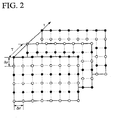
- video deinterlacing is used to enhance the video vertical resolution, as shown in Figure 2.
- video spatial up-conversion is used to enhance the video resolution both horizontally and vertically. This is represented in Figure 3.
- the interpolation of vertical samples for video spatial up-conversion in Figure 3 can be realized in a similar manner, except that the "original" vertical sampling lines in adjacent frames are located in the same positions for video spatial up-conversion, instead of being interlaced for the scenario of video deinterlacing. Therefore, a close connection between video spatial up-conversion and video deinterlacing is established from the 3D sampling grid perspective.
- Motion compensated deinterlacing techniques take the motion compensated samples from the previous frame (or from both the previous and the successive frames) as a candidate for the interpolated samples of the current frame. It should be noted that, although the examples discussed herein refer specifically to frames, a variety of different types of fields, which may comprise frames, portions of frames, or other collections of information, may also be used in conjunction with the present invention. Due to the connection between video spatial up-conversion and video deinterlacing, a motion compensated video deinterlacing technique of the present invention should be able to be modified and extended for the use of video spatial up-conversion.
- methods for motion compensated video spatial up-conversion can be implemented through two steps.
- the first step involves interpolating the horizontal samples using a wide variety of spatial interpolation techniques.
- the second step involves interpolating the vertical sampling through the use of a motion compensated deinterlacing-like technique.
- the use of different methods for spatial interpolation in the horizontal direction and in the vertical direction is permissible because horizontal sampling is implemented after the image acquisition procedure, while vertical sampling is realized as a part of the image acquisition process by the cameras.
- the success of motion compensation in video deinterlacing, and the close connection between the two aspects of video format conversion (VFC), imply the success of motion compensation in video spatial up-conversion.
- two video deinterlacing methods are selected. These methods have demonstrated particularly strong deinterlaced video quality. These methods are used to develop two motion compensated video spatial up-conversion techniques.
- Algorithm I Adaptively Recursive Motion Compensated Video Spatial Up-Conversion.
- F ( x ,n ) denotes the original sample
- F init ( x , n ) denotes the initially interpolated sample
- ( ⁇ ) T denotes the transpose of a vector/matrix.
- Any spatial interpolation technique can be used for generating the initially interpolated samples F init ( x , n ) at locations B, C, and D.
- Different FIR filters can be selected for the interpolation of horizontal samples (B) and vertical samples (C and D).
- CLIP m 1 ⁇ a ⁇ m 2 ⁇ a m 1 ⁇ a ⁇ m 2 m 1 a ⁇ m 1 m 2 a > m 2 and c is scalar.
- Algorithm II Adaptively Recursive Video Spatial Up-Conversion Using a Generalized Sampling Theorem (GST).
- GST Generalized Sampling Theorem
- the "disjointness" refers to a shift in the time/spatial domain or equivalently, a phase difference in the frequency domain.
- ARMC-GST Adaptive Recursive Motion Compensated scheme using GST
- ARMC-GST is a two-step algorithm. The first step involves horizontal interpolation. An Optimized FIR filter is designed for the interpolation in the horizontal direction, which is a 1D interpolation problem that conventionally understood. Through horizontal interpolation, samples at B positions are obtained. The second step involves vertical interpolation.
- Equation (7) h 1 ( k, d y ( x , n )) and h 2 ( m , d y ( x , n )) , k, m ⁇ Z , are two FIR filters in the vertical direction as a function of the vertical component of the motion vector.
- the FIR filters can be designed in exactly the same way as their design in video deinterlacing using GST.
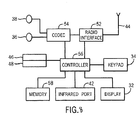
- Figures 7 and 8 show one representative electronic device 12 upon which the present invention may be implemented.
- the electronic device 12 shown in Figures 7 and 8 comprises a mobile telephone.
- the present invention is not limited to any type of electronic device and could be incorporated into devices such as personal digital assistants, personal computers, integrated messaging devices, and a wide variety of other devices. It should be understood that the present invention could be incorporated on a wide variety of electronic device 12.
- the electronic device 12 of Figures 7 and 8 includes a housing 30, a display 32 in the form of a liquid crystal display, a keypad 34, a microphone 36, an ear-piece 38, a battery 40, an infrared port 42, an antenna 44, a smart card 46 in the form of a universal integrated circuit card (UICC) according to one embodiment of the invention, a card reader 48, radio interface circuitry 52, codec circuitry 54, a controller 56 and a memory 58.
- the controller 56 can be the same unit or a different unit than the camera processor 116.
- the memory 58 may or may not be the same component as the primary memory unit 114 in various embodiments of the present invention. Individual circuits and elements are all of a type well known in the art, for example in the Nokia range of mobile telephones.
- the present invention can be implemented as a part of a TV-out system for mobile terminals. Such a system can permit a user to display videos captured by a handset in a separate TV device.
- the present invention is described in the general context of method steps, which may be implemented in one embodiment by a program product including computer-executable instructions, such as program code, executed by computers in networked environments.
- program modules include routines, programs, objects, components, data structures, etc. that perform particular tasks or implement particular abstract data types.
- Computer-executable instructions, associated data structures, and program modules represent examples of program code for executing steps of the methods disclosed herein. The particular sequence of such executable instructions or associated data structures represents examples of corresponding acts for implementing the functions described in such steps.
Landscapes
- Engineering & Computer Science (AREA)
- Multimedia (AREA)
- Signal Processing (AREA)
- Computer Graphics (AREA)
- Physics & Mathematics (AREA)
- General Physics & Mathematics (AREA)
- Theoretical Computer Science (AREA)
- Television Systems (AREA)
- Compression Or Coding Systems Of Tv Signals (AREA)
- Television Signal Processing For Recording (AREA)
Applications Claiming Priority (1)
| Application Number | Priority Date | Filing Date | Title |
|---|---|---|---|
| US11/411,700 US7701509B2 (en) | 2006-04-25 | 2006-04-25 | Motion compensated video spatial up-conversion |
Publications (2)
| Publication Number | Publication Date |
|---|---|
| EP1850590A2 true EP1850590A2 (fr) | 2007-10-31 |
| EP1850590A3 EP1850590A3 (fr) | 2009-07-29 |
Family
ID=38283244
Family Applications (1)
| Application Number | Title | Priority Date | Filing Date |
|---|---|---|---|
| EP07106950A Withdrawn EP1850590A3 (fr) | 2006-04-25 | 2007-04-25 | Conversion spatiale ascendente d'image vidéo compensée en mouvement |
Country Status (6)
| Country | Link |
|---|---|
| US (1) | US7701509B2 (fr) |
| EP (1) | EP1850590A3 (fr) |
| JP (3) | JP5414519B2 (fr) |
| KR (1) | KR20090035473A (fr) |
| CN (1) | CN101433093B (fr) |
| WO (1) | WO2007122589A2 (fr) |
Families Citing this family (15)
| Publication number | Priority date | Publication date | Assignee | Title |
|---|---|---|---|---|
| GB2431801A (en) * | 2005-10-31 | 2007-05-02 | Sony Uk Ltd | Interpolation using motion vectors |
| GB2431795A (en) * | 2005-10-31 | 2007-05-02 | Sony Uk Ltd | Motion vector selection based on integrity |
| GB2431798A (en) * | 2005-10-31 | 2007-05-02 | Sony Uk Ltd | Motion vector selection based on integrity |
| US8929434B2 (en) * | 2006-10-14 | 2015-01-06 | Ubiquity Broadcasting Corporation | Video enhancement internet media experience in converting high definition formats to video formats |
| EP1931136B1 (fr) * | 2006-12-08 | 2016-04-20 | Panasonic Intellectual Property Corporation of America | Algorithme de combinaison de lignes basé sur les blocs pour le désentrelacement |
| WO2008073416A1 (fr) * | 2006-12-11 | 2008-06-19 | Cinnafilm, Inc. | Utilisation d'effets cinématographiques en temps réel sur des vidéo numériques |
| KR20090065006A (ko) * | 2007-12-17 | 2009-06-22 | 삼성전자주식회사 | 전개형 스피커를 갖는 휴대단말 |
| US8208065B2 (en) * | 2008-07-30 | 2012-06-26 | Cinnafilm, Inc. | Method, apparatus, and computer software for digital video scan rate conversions with minimization of artifacts |
| US8520736B2 (en) * | 2009-04-14 | 2013-08-27 | Fastvdo, Llc | Real-time superresolution and video transmission |
| US8571355B2 (en) * | 2009-08-13 | 2013-10-29 | Samsung Electronics Co., Ltd. | Method and apparatus for reconstructing a high-resolution image by using multi-layer low-resolution images |
| KR101634562B1 (ko) * | 2009-09-22 | 2016-06-30 | 삼성전자주식회사 | 저해상도 비디오로부터 고해상도 비디오를 생성하는 방법 |
| US20110109794A1 (en) * | 2009-11-06 | 2011-05-12 | Paul Wiercienski | Caching structure and apparatus for use in block based video |
| CN102045531A (zh) * | 2010-12-31 | 2011-05-04 | 福州瑞芯微电子有限公司 | 一种移动终端的去交错视频显示的实现方法 |
| US8948248B2 (en) * | 2011-07-21 | 2015-02-03 | Luca Rossato | Tiered signal decoding and signal reconstruction |
| US9819900B2 (en) * | 2015-12-30 | 2017-11-14 | Spreadtrum Communications (Shanghai) Co., Ltd. | Method and apparatus for de-interlacing television signal |
Citations (1)
| Publication number | Priority date | Publication date | Assignee | Title |
|---|---|---|---|---|
| GB2410392A (en) | 2004-01-20 | 2005-07-27 | Samsung Electronics Co Ltd | Hybrid sequential scanning using edge detection and motion compensation |
Family Cites Families (16)
| Publication number | Priority date | Publication date | Assignee | Title |
|---|---|---|---|---|
| GB8814822D0 (en) | 1988-06-22 | 1988-07-27 | British Broadcasting Corp | Bandwidth reduction system for television |
| JPH05260446A (ja) * | 1992-03-13 | 1993-10-08 | Nec Corp | 走査変換方式 |
| JP3480011B2 (ja) * | 1993-09-28 | 2003-12-15 | ソニー株式会社 | 画像情報変換装置 |
| EP0735747B1 (fr) | 1995-03-31 | 1999-11-03 | THOMSON multimedia | Méthode et appareil pour la conversion vers le haut de la fréquence trame compensée en mouvement |
| JP4140091B2 (ja) | 1998-09-14 | 2008-08-27 | ソニー株式会社 | 画像情報変換装置および画像情報変換方法 |
| JP2000156846A (ja) * | 1998-11-19 | 2000-06-06 | Victor Co Of Japan Ltd | 動画像フォーマット変換装置及びその方法 |
| US6192080B1 (en) | 1998-12-04 | 2001-02-20 | Mitsubishi Electric Research Laboratories, Inc. | Motion compensated digital video signal processing |
| JP2000244877A (ja) * | 1999-02-24 | 2000-09-08 | Hitachi Ltd | 画像信号の動き補正倍速変換回路及びテレビジョン装置 |
| JP2000308021A (ja) * | 1999-04-20 | 2000-11-02 | Niigata Seimitsu Kk | 画像処理回路 |
| JP4610692B2 (ja) * | 2000-05-18 | 2011-01-12 | パナソニック株式会社 | 画像変換装置及び画像変換方法 |
| KR20020070501A (ko) | 2000-11-22 | 2002-09-09 | 코닌클리케 필립스 일렉트로닉스 엔.브이. | 압축 인코딩된 비디오의 압축 해제 |
| JP2002209191A (ja) * | 2001-01-04 | 2002-07-26 | Matsushita Electric Ind Co Ltd | 映像信号変換装置 |
| JP4016646B2 (ja) * | 2001-11-30 | 2007-12-05 | 日本ビクター株式会社 | 順次走査変換装置及び順次走査変換方法 |
| US7345708B2 (en) * | 2003-12-23 | 2008-03-18 | Lsi Logic Corporation | Method and apparatus for video deinterlacing and format conversion |
| KR101127220B1 (ko) * | 2004-07-28 | 2012-04-12 | 세종대학교산학협력단 | 움직임 보상 적응형 순차주사화 장치 및 그 방법 |
| US7542095B2 (en) * | 2005-01-20 | 2009-06-02 | Samsung Electronics Co., Ltd. | Method and system of noise-adaptive motion detection in an interlaced video sequence |
-
2006
- 2006-04-25 US US11/411,700 patent/US7701509B2/en active Active
-
2007
- 2007-04-24 KR KR1020087027242A patent/KR20090035473A/ko not_active Ceased
- 2007-04-24 WO PCT/IB2007/051516 patent/WO2007122589A2/fr not_active Ceased
- 2007-04-24 CN CN200780014851XA patent/CN101433093B/zh active Active
- 2007-04-24 JP JP2009507228A patent/JP5414519B2/ja not_active Expired - Fee Related
- 2007-04-25 EP EP07106950A patent/EP1850590A3/fr not_active Withdrawn
-
2013
- 2013-02-12 JP JP2013024748A patent/JP5667650B2/ja not_active Expired - Fee Related
-
2014
- 2014-04-23 JP JP2014089031A patent/JP2014161093A/ja active Pending
Patent Citations (1)
| Publication number | Priority date | Publication date | Assignee | Title |
|---|---|---|---|---|
| GB2410392A (en) | 2004-01-20 | 2005-07-27 | Samsung Electronics Co Ltd | Hybrid sequential scanning using edge detection and motion compensation |
Non-Patent Citations (1)
| Title |
|---|
| CALINA CIUHU AND GERARD DE HAAN: "A two-dimensional generalized sampling theory and application to de-interlacing", VISUAL COMMUNICATIONS AND IMAGE PROCESSING; 20-1-2004 - 20-1-2004; SAN JOSE,, 20 January 2004 (2004-01-20), XP030081332 * |
Also Published As
| Publication number | Publication date |
|---|---|
| JP5414519B2 (ja) | 2014-02-12 |
| JP2014161093A (ja) | 2014-09-04 |
| WO2007122589A2 (fr) | 2007-11-01 |
| JP2009535886A (ja) | 2009-10-01 |
| EP1850590A3 (fr) | 2009-07-29 |
| KR20090035473A (ko) | 2009-04-09 |
| CN101433093A (zh) | 2009-05-13 |
| CN101433093B (zh) | 2010-12-22 |
| US7701509B2 (en) | 2010-04-20 |
| US20070247547A1 (en) | 2007-10-25 |
| JP5667650B2 (ja) | 2015-02-12 |
| WO2007122589A3 (fr) | 2008-01-24 |
| JP2013102538A (ja) | 2013-05-23 |
Similar Documents
| Publication | Publication Date | Title |
|---|---|---|
| EP1850590A2 (fr) | Conversion spatiale ascendente d'image vidéo compensée en mouvement | |
| US8340185B2 (en) | Systems and methods for a motion compensated picture rate converter | |
| Jeon et al. | Coarse-to-fine frame interpolation for frame rate up-conversion using pyramid structure | |
| Patti et al. | Robust methods for high-quality stills from interlaced video in the presence of dominant motion | |
| EP1164792A2 (fr) | Convertisseur de format utilisant des vecteurs de mouvement bidirectionnels et méthode correspondante | |
| JP2000056743A (ja) | 適応走査ラスタ変換方法及び装置 | |
| CN102187664A (zh) | 影像信号变换系统 | |
| CN101647292B (zh) | 色度视频信号的运动自适应上采样 | |
| US7679676B2 (en) | Spatial signal conversion | |
| EP1540593B1 (fr) | Unite et procede de conversion d'images | |
| Zhao et al. | Making the best of legacy video on modern displays | |
| Leitao et al. | Content-adaptive video up-scaling for high definition displays | |
| US20050030424A1 (en) | Post-processing of interpolated images | |
| EP1334613B1 (fr) | Conversion-elevation a compensation de mouvements pour conversion de frequence de balayage video | |
| EP1636987B1 (fr) | Conversion spatiale de signaux | |
| Park et al. | Covariance-based adaptive deinterlacing method using edge map | |
| Dubois et al. | Video sampling and interpolation | |
| US20060038918A1 (en) | Unit for and method of image conversion | |
| Chung et al. | Generalized motion and edge adaptive interpolation de-interlacing algorithm | |
| JP2007504741A (ja) | ビデオ信号の頑強なデインタレース | |
| Hui et al. | An adaptive motion estimation algorithm based on evolution strategies with correlated mutations | |
| Suyambukesan | Adaptive image interpolation video de-interlacing and frame rate conversion using wavelet transform | |
| Wong et al. | Motion and edge adaptive interpolation de-interlacing algorithm | |
| CN101283588A (zh) | 视频处理 |
Legal Events
| Date | Code | Title | Description |
|---|---|---|---|
| PUAI | Public reference made under article 153(3) epc to a published international application that has entered the european phase |
Free format text: ORIGINAL CODE: 0009012 |
|
| AK | Designated contracting states |
Kind code of ref document: A2 Designated state(s): AT BE BG CH CY CZ DE DK EE ES FI FR GB GR HU IE IS IT LI LT LU LV MC MT NL PL PT RO SE SI SK TR |
|
| AX | Request for extension of the european patent |
Extension state: AL BA HR MK YU |
|
| PUAL | Search report despatched |
Free format text: ORIGINAL CODE: 0009013 |
|
| AK | Designated contracting states |
Kind code of ref document: A3 Designated state(s): AT BE BG CH CY CZ DE DK EE ES FI FR GB GR HU IE IS IT LI LT LU LV MC MT NL PL PT RO SE SI SK TR |
|
| AX | Request for extension of the european patent |
Extension state: AL BA HR MK RS |
|
| RIC1 | Information provided on ipc code assigned before grant |
Ipc: H04N 5/44 20060101ALI20090622BHEP Ipc: G06T 3/40 20060101ALI20090622BHEP Ipc: H04N 7/01 20060101AFI20070731BHEP |
|
| 17P | Request for examination filed |
Effective date: 20091028 |
|
| AKX | Designation fees paid |
Designated state(s): AT BE BG CH CY CZ DE DK EE ES FI FR GB GR HU IE IS IT LI LT LU LV MC MT NL PL PT RO SE SI SK TR |
|
| 17Q | First examination report despatched |
Effective date: 20100426 |
|
| STAA | Information on the status of an ep patent application or granted ep patent |
Free format text: STATUS: THE APPLICATION IS DEEMED TO BE WITHDRAWN |
|
| 18D | Application deemed to be withdrawn |
Effective date: 20101109 |