EP1851046B1 - Milieux filtrants pour filtrer des particules de flux gazeux - Google Patents
Milieux filtrants pour filtrer des particules de flux gazeux Download PDFInfo
- Publication number
- EP1851046B1 EP1851046B1 EP05855890.9A EP05855890A EP1851046B1 EP 1851046 B1 EP1851046 B1 EP 1851046B1 EP 05855890 A EP05855890 A EP 05855890A EP 1851046 B1 EP1851046 B1 EP 1851046B1
- Authority
- EP
- European Patent Office
- Prior art keywords
- fibers
- nanofiber
- solvent
- web
- support web
- Prior art date
- Legal status (The legal status is an assumption and is not a legal conclusion. Google has not performed a legal analysis and makes no representation as to the accuracy of the status listed.)
- Expired - Lifetime
Links
Images
Classifications
-
- D—TEXTILES; PAPER
- D04—BRAIDING; LACE-MAKING; KNITTING; TRIMMINGS; NON-WOVEN FABRICS
- D04H—MAKING TEXTILE FABRICS, e.g. FROM FIBRES OR FILAMENTARY MATERIAL; FABRICS MADE BY SUCH PROCESSES OR APPARATUS, e.g. FELTS, NON-WOVEN FABRICS; COTTON-WOOL; WADDING ; NON-WOVEN FABRICS FROM STAPLE FIBRES, FILAMENTS OR YARNS, BONDED WITH AT LEAST ONE WEB-LIKE MATERIAL DURING THEIR CONSOLIDATION
- D04H3/00—Non-woven fabrics formed wholly or mainly of yarns or like filamentary material of substantial length
- D04H3/08—Non-woven fabrics formed wholly or mainly of yarns or like filamentary material of substantial length characterised by the method of strengthening or consolidating
- D04H3/16—Non-woven fabrics formed wholly or mainly of yarns or like filamentary material of substantial length characterised by the method of strengthening or consolidating with bonds between thermoplastic filaments produced in association with filament formation, e.g. immediately following extrusion
-
- B—PERFORMING OPERATIONS; TRANSPORTING
- B01—PHYSICAL OR CHEMICAL PROCESSES OR APPARATUS IN GENERAL
- B01D—SEPARATION
- B01D39/00—Filtering material for liquid or gaseous fluids
- B01D39/14—Other self-supporting filtering material ; Other filtering material
- B01D39/16—Other self-supporting filtering material ; Other filtering material of organic material, e.g. synthetic fibres
- B01D39/1607—Other self-supporting filtering material ; Other filtering material of organic material, e.g. synthetic fibres the material being fibrous
- B01D39/1615—Other self-supporting filtering material ; Other filtering material of organic material, e.g. synthetic fibres the material being fibrous of natural origin
-
- B—PERFORMING OPERATIONS; TRANSPORTING
- B01—PHYSICAL OR CHEMICAL PROCESSES OR APPARATUS IN GENERAL
- B01D—SEPARATION
- B01D39/00—Filtering material for liquid or gaseous fluids
- B01D39/14—Other self-supporting filtering material ; Other filtering material
- B01D39/16—Other self-supporting filtering material ; Other filtering material of organic material, e.g. synthetic fibres
- B01D39/1607—Other self-supporting filtering material ; Other filtering material of organic material, e.g. synthetic fibres the material being fibrous
- B01D39/1623—Other self-supporting filtering material ; Other filtering material of organic material, e.g. synthetic fibres the material being fibrous of synthetic origin
- B01D39/163—Other self-supporting filtering material ; Other filtering material of organic material, e.g. synthetic fibres the material being fibrous of synthetic origin sintered or bonded
-
- B—PERFORMING OPERATIONS; TRANSPORTING
- B01—PHYSICAL OR CHEMICAL PROCESSES OR APPARATUS IN GENERAL
- B01D—SEPARATION
- B01D39/00—Filtering material for liquid or gaseous fluids
- B01D39/14—Other self-supporting filtering material ; Other filtering material
- B01D39/16—Other self-supporting filtering material ; Other filtering material of organic material, e.g. synthetic fibres
- B01D39/18—Other self-supporting filtering material ; Other filtering material of organic material, e.g. synthetic fibres the material being cellulose or derivatives thereof
-
- B—PERFORMING OPERATIONS; TRANSPORTING
- B01—PHYSICAL OR CHEMICAL PROCESSES OR APPARATUS IN GENERAL
- B01D—SEPARATION
- B01D46/00—Filters or filtering processes specially modified for separating dispersed particles from gases or vapours
- B01D46/18—Particle separators, e.g. dust precipitators, using filtering belts
- B01D46/22—Particle separators, e.g. dust precipitators, using filtering belts the belts travelling during filtering
-
- B—PERFORMING OPERATIONS; TRANSPORTING
- B01—PHYSICAL OR CHEMICAL PROCESSES OR APPARATUS IN GENERAL
- B01D—SEPARATION
- B01D46/00—Filters or filtering processes specially modified for separating dispersed particles from gases or vapours
- B01D46/52—Particle separators, e.g. dust precipitators, using filters embodying folded corrugated or wound sheet material
- B01D46/521—Particle separators, e.g. dust precipitators, using filters embodying folded corrugated or wound sheet material using folded, pleated material
-
- B—PERFORMING OPERATIONS; TRANSPORTING
- B01—PHYSICAL OR CHEMICAL PROCESSES OR APPARATUS IN GENERAL
- B01D—SEPARATION
- B01D46/00—Filters or filtering processes specially modified for separating dispersed particles from gases or vapours
- B01D46/54—Particle separators, e.g. dust precipitators, using ultra-fine filter sheets or diaphragms
- B01D46/546—Particle separators, e.g. dust precipitators, using ultra-fine filter sheets or diaphragms using nano- or microfibres
-
- B—PERFORMING OPERATIONS; TRANSPORTING
- B32—LAYERED PRODUCTS
- B32B—LAYERED PRODUCTS, i.e. PRODUCTS BUILT-UP OF STRATA OF FLAT OR NON-FLAT, e.g. CELLULAR OR HONEYCOMB, FORM
- B32B5/00—Layered products characterised by the non- homogeneity or physical structure, i.e. comprising a fibrous, filamentary, particulate or foam layer; Layered products characterised by having a layer differing constitutionally or physically in different parts
- B32B5/02—Layered products characterised by the non- homogeneity or physical structure, i.e. comprising a fibrous, filamentary, particulate or foam layer; Layered products characterised by having a layer differing constitutionally or physically in different parts characterised by structural features of a fibrous or filamentary layer
- B32B5/022—Non-woven fabric
-
- B—PERFORMING OPERATIONS; TRANSPORTING
- B32—LAYERED PRODUCTS
- B32B—LAYERED PRODUCTS, i.e. PRODUCTS BUILT-UP OF STRATA OF FLAT OR NON-FLAT, e.g. CELLULAR OR HONEYCOMB, FORM
- B32B5/00—Layered products characterised by the non- homogeneity or physical structure, i.e. comprising a fibrous, filamentary, particulate or foam layer; Layered products characterised by having a layer differing constitutionally or physically in different parts
- B32B5/02—Layered products characterised by the non- homogeneity or physical structure, i.e. comprising a fibrous, filamentary, particulate or foam layer; Layered products characterised by having a layer differing constitutionally or physically in different parts characterised by structural features of a fibrous or filamentary layer
- B32B5/024—Woven fabric
-
- B—PERFORMING OPERATIONS; TRANSPORTING
- B32—LAYERED PRODUCTS
- B32B—LAYERED PRODUCTS, i.e. PRODUCTS BUILT-UP OF STRATA OF FLAT OR NON-FLAT, e.g. CELLULAR OR HONEYCOMB, FORM
- B32B5/00—Layered products characterised by the non- homogeneity or physical structure, i.e. comprising a fibrous, filamentary, particulate or foam layer; Layered products characterised by having a layer differing constitutionally or physically in different parts
- B32B5/22—Layered products characterised by the non- homogeneity or physical structure, i.e. comprising a fibrous, filamentary, particulate or foam layer; Layered products characterised by having a layer differing constitutionally or physically in different parts characterised by the presence of two or more layers which are next to each other and are fibrous, filamentary, formed of particles or foamed
- B32B5/24—Layered products characterised by the non- homogeneity or physical structure, i.e. comprising a fibrous, filamentary, particulate or foam layer; Layered products characterised by having a layer differing constitutionally or physically in different parts characterised by the presence of two or more layers which are next to each other and are fibrous, filamentary, formed of particles or foamed one layer being a fibrous or filamentary layer
- B32B5/26—Layered products characterised by the non- homogeneity or physical structure, i.e. comprising a fibrous, filamentary, particulate or foam layer; Layered products characterised by having a layer differing constitutionally or physically in different parts characterised by the presence of two or more layers which are next to each other and are fibrous, filamentary, formed of particles or foamed one layer being a fibrous or filamentary layer another layer next to it also being fibrous or filamentary
-
- D—TEXTILES; PAPER
- D04—BRAIDING; LACE-MAKING; KNITTING; TRIMMINGS; NON-WOVEN FABRICS
- D04H—MAKING TEXTILE FABRICS, e.g. FROM FIBRES OR FILAMENTARY MATERIAL; FABRICS MADE BY SUCH PROCESSES OR APPARATUS, e.g. FELTS, NON-WOVEN FABRICS; COTTON-WOOL; WADDING ; NON-WOVEN FABRICS FROM STAPLE FIBRES, FILAMENTS OR YARNS, BONDED WITH AT LEAST ONE WEB-LIKE MATERIAL DURING THEIR CONSOLIDATION
- D04H1/00—Non-woven fabrics formed wholly or mainly of staple fibres or like relatively short fibres
- D04H1/40—Non-woven fabrics formed wholly or mainly of staple fibres or like relatively short fibres from fleeces or layers composed of fibres without existing or potential cohesive properties
- D04H1/42—Non-woven fabrics formed wholly or mainly of staple fibres or like relatively short fibres from fleeces or layers composed of fibres without existing or potential cohesive properties characterised by the use of certain kinds of fibres insofar as this use has no preponderant influence on the consolidation of the fleece
- D04H1/4374—Non-woven fabrics formed wholly or mainly of staple fibres or like relatively short fibres from fleeces or layers composed of fibres without existing or potential cohesive properties characterised by the use of certain kinds of fibres insofar as this use has no preponderant influence on the consolidation of the fleece using different kinds of webs, e.g. by layering webs
-
- D—TEXTILES; PAPER
- D04—BRAIDING; LACE-MAKING; KNITTING; TRIMMINGS; NON-WOVEN FABRICS
- D04H—MAKING TEXTILE FABRICS, e.g. FROM FIBRES OR FILAMENTARY MATERIAL; FABRICS MADE BY SUCH PROCESSES OR APPARATUS, e.g. FELTS, NON-WOVEN FABRICS; COTTON-WOOL; WADDING ; NON-WOVEN FABRICS FROM STAPLE FIBRES, FILAMENTS OR YARNS, BONDED WITH AT LEAST ONE WEB-LIKE MATERIAL DURING THEIR CONSOLIDATION
- D04H1/00—Non-woven fabrics formed wholly or mainly of staple fibres or like relatively short fibres
- D04H1/40—Non-woven fabrics formed wholly or mainly of staple fibres or like relatively short fibres from fleeces or layers composed of fibres without existing or potential cohesive properties
- D04H1/54—Non-woven fabrics formed wholly or mainly of staple fibres or like relatively short fibres from fleeces or layers composed of fibres without existing or potential cohesive properties by welding together the fibres, e.g. by partially melting or dissolving
- D04H1/559—Non-woven fabrics formed wholly or mainly of staple fibres or like relatively short fibres from fleeces or layers composed of fibres without existing or potential cohesive properties by welding together the fibres, e.g. by partially melting or dissolving the fibres being within layered webs
-
- D—TEXTILES; PAPER
- D04—BRAIDING; LACE-MAKING; KNITTING; TRIMMINGS; NON-WOVEN FABRICS
- D04H—MAKING TEXTILE FABRICS, e.g. FROM FIBRES OR FILAMENTARY MATERIAL; FABRICS MADE BY SUCH PROCESSES OR APPARATUS, e.g. FELTS, NON-WOVEN FABRICS; COTTON-WOOL; WADDING ; NON-WOVEN FABRICS FROM STAPLE FIBRES, FILAMENTS OR YARNS, BONDED WITH AT LEAST ONE WEB-LIKE MATERIAL DURING THEIR CONSOLIDATION
- D04H1/00—Non-woven fabrics formed wholly or mainly of staple fibres or like relatively short fibres
- D04H1/70—Non-woven fabrics formed wholly or mainly of staple fibres or like relatively short fibres characterised by the method of forming fleeces or layers, e.g. reorientation of fibres
- D04H1/72—Non-woven fabrics formed wholly or mainly of staple fibres or like relatively short fibres characterised by the method of forming fleeces or layers, e.g. reorientation of fibres the fibres being randomly arranged
- D04H1/728—Non-woven fabrics formed wholly or mainly of staple fibres or like relatively short fibres characterised by the method of forming fleeces or layers, e.g. reorientation of fibres the fibres being randomly arranged by electro-spinning
-
- D—TEXTILES; PAPER
- D04—BRAIDING; LACE-MAKING; KNITTING; TRIMMINGS; NON-WOVEN FABRICS
- D04H—MAKING TEXTILE FABRICS, e.g. FROM FIBRES OR FILAMENTARY MATERIAL; FABRICS MADE BY SUCH PROCESSES OR APPARATUS, e.g. FELTS, NON-WOVEN FABRICS; COTTON-WOOL; WADDING ; NON-WOVEN FABRICS FROM STAPLE FIBRES, FILAMENTS OR YARNS, BONDED WITH AT LEAST ONE WEB-LIKE MATERIAL DURING THEIR CONSOLIDATION
- D04H13/00—Other non-woven fabrics
-
- D—TEXTILES; PAPER
- D04—BRAIDING; LACE-MAKING; KNITTING; TRIMMINGS; NON-WOVEN FABRICS
- D04H—MAKING TEXTILE FABRICS, e.g. FROM FIBRES OR FILAMENTARY MATERIAL; FABRICS MADE BY SUCH PROCESSES OR APPARATUS, e.g. FELTS, NON-WOVEN FABRICS; COTTON-WOOL; WADDING ; NON-WOVEN FABRICS FROM STAPLE FIBRES, FILAMENTS OR YARNS, BONDED WITH AT LEAST ONE WEB-LIKE MATERIAL DURING THEIR CONSOLIDATION
- D04H13/00—Other non-woven fabrics
- D04H13/001—Making non-woven fabrics from staple fibres, filaments or yarns, bonded to at least one web-like material, e.g. woven, knitted non-woven fabric, paper, leather, during consolidation
- D04H13/002—Making non-woven fabrics from staple fibres, filaments or yarns, bonded to at least one web-like material, e.g. woven, knitted non-woven fabric, paper, leather, during consolidation characterised by the disposition or nature of their elements
-
- D—TEXTILES; PAPER
- D04—BRAIDING; LACE-MAKING; KNITTING; TRIMMINGS; NON-WOVEN FABRICS
- D04H—MAKING TEXTILE FABRICS, e.g. FROM FIBRES OR FILAMENTARY MATERIAL; FABRICS MADE BY SUCH PROCESSES OR APPARATUS, e.g. FELTS, NON-WOVEN FABRICS; COTTON-WOOL; WADDING ; NON-WOVEN FABRICS FROM STAPLE FIBRES, FILAMENTS OR YARNS, BONDED WITH AT LEAST ONE WEB-LIKE MATERIAL DURING THEIR CONSOLIDATION
- D04H13/00—Other non-woven fabrics
- D04H13/001—Making non-woven fabrics from staple fibres, filaments or yarns, bonded to at least one web-like material, e.g. woven, knitted non-woven fabric, paper, leather, during consolidation
- D04H13/007—Making non-woven fabrics from staple fibres, filaments or yarns, bonded to at least one web-like material, e.g. woven, knitted non-woven fabric, paper, leather, during consolidation strengthened or consolidated by welding together the various components
-
- B—PERFORMING OPERATIONS; TRANSPORTING
- B01—PHYSICAL OR CHEMICAL PROCESSES OR APPARATUS IN GENERAL
- B01D—SEPARATION
- B01D2239/00—Aspects relating to filtering material for liquid or gaseous fluids
- B01D2239/02—Types of fibres, filaments or particles, self-supporting or supported materials
- B01D2239/025—Types of fibres, filaments or particles, self-supporting or supported materials comprising nanofibres
-
- B—PERFORMING OPERATIONS; TRANSPORTING
- B01—PHYSICAL OR CHEMICAL PROCESSES OR APPARATUS IN GENERAL
- B01D—SEPARATION
- B01D2239/00—Aspects relating to filtering material for liquid or gaseous fluids
- B01D2239/06—Filter cloth, e.g. knitted, woven non-woven; self-supported material
- B01D2239/065—More than one layer present in the filtering material
- B01D2239/0681—The layers being joined by gluing
-
- B—PERFORMING OPERATIONS; TRANSPORTING
- B01—PHYSICAL OR CHEMICAL PROCESSES OR APPARATUS IN GENERAL
- B01D—SEPARATION
- B01D2239/00—Aspects relating to filtering material for liquid or gaseous fluids
- B01D2239/10—Filtering material manufacturing
-
- B—PERFORMING OPERATIONS; TRANSPORTING
- B01—PHYSICAL OR CHEMICAL PROCESSES OR APPARATUS IN GENERAL
- B01D—SEPARATION
- B01D2273/00—Operation of filters specially adapted for separating dispersed particles from gases or vapours
- B01D2273/28—Making use of vacuum or underpressure
-
- B—PERFORMING OPERATIONS; TRANSPORTING
- B01—PHYSICAL OR CHEMICAL PROCESSES OR APPARATUS IN GENERAL
- B01D—SEPARATION
- B01D2275/00—Filter media structures for filters specially adapted for separating dispersed particles from gases or vapours
- B01D2275/10—Multiple layers
-
- B—PERFORMING OPERATIONS; TRANSPORTING
- B32—LAYERED PRODUCTS
- B32B—LAYERED PRODUCTS, i.e. PRODUCTS BUILT-UP OF STRATA OF FLAT OR NON-FLAT, e.g. CELLULAR OR HONEYCOMB, FORM
- B32B2250/00—Layers arrangement
- B32B2250/20—All layers being fibrous or filamentary
-
- B—PERFORMING OPERATIONS; TRANSPORTING
- B32—LAYERED PRODUCTS
- B32B—LAYERED PRODUCTS, i.e. PRODUCTS BUILT-UP OF STRATA OF FLAT OR NON-FLAT, e.g. CELLULAR OR HONEYCOMB, FORM
- B32B2262/00—Composition or structural features of fibres which form a fibrous or filamentary layer or are present as additives
- B32B2262/02—Synthetic macromolecular fibres
- B32B2262/0261—Polyamide fibres
-
- B—PERFORMING OPERATIONS; TRANSPORTING
- B32—LAYERED PRODUCTS
- B32B—LAYERED PRODUCTS, i.e. PRODUCTS BUILT-UP OF STRATA OF FLAT OR NON-FLAT, e.g. CELLULAR OR HONEYCOMB, FORM
- B32B2307/00—Properties of the layers or laminate
- B32B2307/50—Properties of the layers or laminate having particular mechanical properties
- B32B2307/544—Torsion strength; Torsion stiffness
-
- B—PERFORMING OPERATIONS; TRANSPORTING
- B32—LAYERED PRODUCTS
- B32B—LAYERED PRODUCTS, i.e. PRODUCTS BUILT-UP OF STRATA OF FLAT OR NON-FLAT, e.g. CELLULAR OR HONEYCOMB, FORM
- B32B2307/00—Properties of the layers or laminate
- B32B2307/50—Properties of the layers or laminate having particular mechanical properties
- B32B2307/546—Flexural strength; Flexion stiffness
-
- B—PERFORMING OPERATIONS; TRANSPORTING
- B32—LAYERED PRODUCTS
- B32B—LAYERED PRODUCTS, i.e. PRODUCTS BUILT-UP OF STRATA OF FLAT OR NON-FLAT, e.g. CELLULAR OR HONEYCOMB, FORM
- B32B2459/00—Nets, e.g. camouflage nets
Definitions
- the present invention relates to composite nonwoven fabrics suitable for use as air filtration media, for filtering particulate material from fluid streams.
- Filter media typically utilized for HVAC air filters that perform at efficiencies less than 99.97% at a 0.3 micron challenge are either glass, cellulose or polymer based. Filters made with media in this performance range are typically referred to as "ASHRAE filters" since the American Society of Heating, Refrigerating and Air-Conditioning Engineers writes standards for the performance of filter media in such applications.
- Polymer based filter media are typically spunbond or meltblown nonwovens that are often electrostatically enhanced to provide higher filtration efficiency at lower pressure drop when compared to glass or cellulose media manufactured by a wet laid paper-making process.
- Electrostatically enhanced air filter media and media manufactured by the wet laid process more specifically with the use of glass fibers, currently have limitations.
- Electrostatically treated meltblown filter media as described in U.S. Patent Nos. 4,874,659 and 4,178,157 , perform well initially, but quickly lose filtration efficiency in use due to dust loading as the media begin to capture particles and the electrostatic charge thus becomes insulated.
- the performance of such filters is greatly influenced by air humidity, causing charge dissipation.
- Filtration media utilizing microglass fibers and blends containing microglass fibers typically contain small diameter glass fibers arranged in either a woven or nonwoven structure, having substantial resistance to chemical attack and relatively small pore size.
- Such glass fiber media are disclosed in the following U.S. Patents: Smith et al., U.S. Pat. No. 2,797,163 ; Waggoner, U.S. Pat. No. 3,228,825 ; Raczek, U.S. Pat. No. 3,240,663 ; Young et al., U.S. Pat. No. 3,249,491 ; Bodendorfet al., U.S. Pat. No. 3,253,978 ; Adams, U.S. Pat. No.
- Microglass fibers and blends containing microglass fibers are typically relatively brittle, and thus when pleated, break resulting in undesirable yield losses. Broken microglass fibers can also be released into the air by filters containing microglass fibers, creating a potential health hazard if the microglass were to be inhaled.
- the present invention is directed to a composite fabric comprising a web of electroblown polymeric nanofibers solvent-bonded to a first support web comprising fibers of larger average diameter than the nanofibers spun from a material compatible with said nanofibers, in the absence of an adhesive between the webs.
- Another embodiment of the present invention is directed to a process for forming a composite fabric, comprising electroblowing a web of polymeric nanofibers and a solvent therefor onto a moving support web comprising larger fibers spun from a material which is compatible with said nanofiber polymer, and applying a vacuum pressure between about 4 mm H 2 O and 170 mm H 2 O to the combined webs to solvent-bond the nanofiber web to the support web.
- nanofibers refers to fibers having average diameters of less than 1,000 nanometers.
- filter media refers to a material or collection of materials through which a particulate-carrying fluid passes, with a concomitant and at least temporary deposition of the particulate material in or on the media.
- ASHRAE filter refers to any filter suitable for use in heating, ventilation and air conditioning systems for filtering particles from air.
- SN structure refers to a multilayer nonwoven material containing a support or “scrim” (S) layer and a nanofiber (N) layer.
- SNS structure refers to a multilayer nonwoven material containing a nanofiber layer sandwiched between two support layers.
- the invention relates to a composite nonwoven fabric suitable for use as a filter medium, comprising at least one nanofiber layer and at least one scrim layer.
- the nanofiber layer comprises a collection of substantially continuous organic polymeric nanofibers having diameters less than about 1 ⁇ m or 1000 nm.
- Such filter media can be used in filtration applications for removing particulate material from a fluid stream, in particular, particulate material from a gaseous stream such as air.
- Filtration media suitable for use in air filtration applications can be made by layering one or more nanofiber layer(s) with a scrim layer to form an SN x structure, or by sandwiching one or more nanofiber layers between two scrim layers to form a SN x S structure, where x is at least one.
- Each nanofiber layer has a basis weight of at least about 2.5 g/m 2 , and the total basis weight of the nanofiber layers is about 25 g/m 2 or more.
- the nanofiber layer has a thickness of less than about 100 ⁇ m; advantageously the thickness of the nanofiber layer is greater than 5 ⁇ m and less than 100 ⁇ m.
- the thickness of the nanofiber layer can vary depending on the density of the nanofiber polymer.
- the thickness of the nanofiber layer can be reduced without substantial reduction in efficiency or other filter properties if the solids volume fraction of the nanofiber layer is increased, such as by calendering or by collecting the nanofiber layer under high vacuum. Increasing the solidity, at constant layer thickness, reduces pore size and increases filtration efficiency.
- the nanofiber layer in the present invention may be made in accordance with the barrier webs disclosed in U.S. Published Patent Application No. 2004/0116028 A1 , which is incorporated herein by reference.
- the nanofiber layer is made up of substantially continuous polymeric fibers having diameters less than 1000 nm, advantageously between about 100 nm and about 700 nm, or even between about 200 nm and about 650 nm, or even between about 200 nm and about 500 nm, or even between about 300 nm and 400 nm.
- the continuous polymeric fibers of the nanofiber layer can be formed by the electroblowing process disclosed in PCT Patent Publication Number WO 03/080905A (corresponding to U.S. Serial No. 10/477,882, filed November 20, 2002 ), which is incorporated herein by reference.
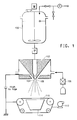
- WO 03/080905A discloses an apparatus and method for producing a nanofiber web, the apparatus essentially as illustrated in Figure 1 .
- the method comprises feeding a stream of polymeric solution comprising a polymer and a solvent from a storage tank 100 to a series of spinning nozzles 104 within a spinneret 102 to which a high voltage is applied through which the polymeric solution is discharged. Meanwhile, compressed air that is optionally heated in air heater 108 is issued from air nozzles 106 disposed in the sides or the periphery of spinning nozzle 104. The air is directed generally downward as a blowing gas stream which envelopes and forwards the newly issued polymeric solution and aids in the formation of the fibrous web, which is collected on a grounded porous collection belt 110 above a vacuum chamber 114, which has vacuum applied from the inlet of air blower 112.
- the nanofiber layers deposited by the electroblowing process invariably have a significant quantity of the process solvent entrained therein.
- a nanofiber layer was first deposited, and with the aid of vacuum chamber 114, most of the entrained processing solvent was removed prior to collecting the nanofiber layer into a roll. Then the nanofiber layer was manually combined with a scrim layer by adhesive bonding to form a composite SN or SNS fabric.
- compatible polymers are those which are freely soluble in the processing solvent, or where the scrim polymer is at least partially soluble in or swellable with the processing solvent, or where the nanofiber and scrim polymers have relative polarities which are not so dissimilar that the polymers will not adhere to one another in the absence of a separate adhesive.
- solvent-bonding of the present invention occurs due to a range of solvent/polymer interactions, discussed below.
- Suitable polymer/solvent combinations for electroblowing are described in WO 03/080905A , and include polyamide/formic acid.
- the use of a scrim containing a discrete layer of polymer fibers that are compatible with the electroblown fibers will be optimal in obtaining a good solvent-bond.
- "compatible" polymers means that the different polymer fibers are made from polymers having substantially similar chemical make-ups, i.e. made from similar combinations of monomers.
- nylon-6 fibers can be successfully solvent-bonded to nylon-6,6 fibers with a suitable electroblowing solvent for either one of them.
- the nanofiber polymer can be chemically different from the scrim fiber polymer, so long as the scrim fiber polymer is compatible with the nanofiber polymer, such as where the scrim fiber polymer is at least partially soluble in or swellable with the electroblowing solvent.
- the nanofiber and scrim fibers are made from the same polymer, or polymers which are soluble in the same solvent, a solvent-weld bond can be formed between the two layers, when adjacent portions of the polymer fibers co-dissolve in the electroblowing solvent, which is subsequently removed.
- the scrim polymer is not freely soluble in the processing solvent, so long as it is swellable by said solvent, a suitable solvent-bond can be obtained.
- the scrim fiber material is not soluble or swellable in the electroblowing solvent, sufficient "solvent-bonding" can be obtained due to the tackiness of the solvent-swollen nanofibers adhering to the scrim fibers prior to solvent removal, so long as the two polymers have compatible relative polarities, i.e. are not too dissimilar in polarity.
- the scrim fibers can be polymers, combinations of polymer fibers and natural fibers, such as cellulose, rayon, cotton and the like, or even all natural fibers, so long as the tacky, as-spun nanofibers can successfully adhere to at least some of the scrim fibers.
- polyamide nanofibers electroblown in formic acid can be successfully solvent-bonded to a polyester fiber scrim according to the present invention, even though polyester is only marginally soluble, if at all, in formic acid.
- polyamide nanofibers electroblown in formic acid do not adequately adhere or bond to fibers in a polypropylene scrim, which is highly non-polar (Comparative Example B, below).
- nanofibers formed from relatively polar polymers are not "compatible" with highly non-polar polymer scrim fibers, such as polyolefins, within the meaning of the present invention.
- electroblown polymeric nanofibers can be successfully "solvent-bonded” to scrims containing at least a portion of fibers made from natural materials, such as cellulose fibers, rayon fibers, cotton fibers and the like. Such natural fiber materials are "compatible" within the meaning of the present invention.
- suitably compatible combinations of polymers/solvents include, but are not limited to polyamides, such as nylon-6, nylon-6,6, nylon-6,10 in formic acid, meta-aramid in DMAc (dimethyl acetamide) and para-aramid in sulfuric acid, polyesters, such as PET (polyethylene terephthalate), PBT (polybutylene terephthalate) and PPT (polypropylene terephthalate) in trifluoroacetic acid/methylene chloride or N-methyl-2-pyrrolidone (NMP), PAN (polyacrylonitrile) in DMF (dimethyl formamide) or DMAc, PVA (polyvinylalcohol) in water, polyurethanes in DMAc, and PVdF in DMAc or DMF.
- polyamides such as nylon-6, nylon-6,6, nylon-6,10 in formic acid, meta-aramid in DMAc (dimethyl acetamide) and para-aramid in sulfuric acid
- scrim layers having relatively rough surfaces will provide better bonding to the nanofiber layers than scrim layers having smooth surfaces, such as smooth bonded scrims.
- a composite fabric is made by solvent-bonding the nanofiber layer to the scrim by electroblowing a nanofiber layer in combination with the entrained processing solvent directly onto the substantially continuous scrim layer which is supported by the moving collection belt 110, to form an SN structure ( Fig. 1 ).
- the composite fabric of the invention can be made by forming a nanofiber layer onto the scrim in a single pass or by building up the nanofiber layer to the desired thickness or basis weight using multiple passes, e.g., in an electroblowing process.
- the electroblowing process allows a nanofiber layer of suitable basis weight for use in an air filter medium to be formed in a single pass because a higher polymer solution throughput is possible than previously known in the production of nanofibers.
- single nanofiber layers having basis weights of between about 2.5 g/m 2 and even up to 25 g/m 2 can be formed in a single pass. The benefits in efficiency of such a new process are obvious to the skilled artisan.
- the nanofiber layer By forming the nanofiber layer in one pass according to the present invention, less handling is required, reducing the opportunity for defects to be introduced in the final filter medium and enabling the nanofiber layer to be solvent-bonded directly to the scrim layer without interrupting the process flow.
- multiple electroblowing beams to deposit multiple nanofiber layers of at least about 2.5 g/m 2 in succession, in order to build-up the total nanofiber layer basis weight to as much as about 25 g/m 2 or more.
- Variations in the spinning conditions to modify the nanofiber laydown rate, and therefore the basis weight of a single nanofiber layer can be made in the collection belt speed, polymer solution flow rate and even by varying the concentration of the polymer in the solution.
- SNS composite fabrics can be formed and bonded in a continuous operation.
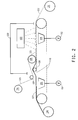
- a substantially continuous support or scrim layer 122 is supplied from supply roll 121 onto a moving collection belt 110 and is directed into spin cell 120 and under one or more electroblowing beams 102 to deposit one or more layers of nanofibers containing solvent onto the moving scrim, under moderate vacuum, to form an SN structure 123.
- the vacuum level of vacuum chamber 114 is maintained from about 4 mm H 2 O up to about 30 mm H 2 O with a vacuum blower 112, so as to aid in collection of the nanofiber layer, but not so high as to remove significant amounts of the processing solvent.
- a second scrim 125 which can be the same or different from the support scrim 122, is supplied from top scrim supply roll 124 and directed past a first tensioning roll 118, around consolidation roll 126 and deposited on top of the nanofiber layer(s) with light compression from the consolidation roll to form the multi-layered SNS composite fabric 127.
- the light compression acts to ensure full contact between the adjacent fabric layers to permit the solvent remaining in the nanofiber layer to soften and weld the fibers of the various layers together.
- the compression pressure is preferably maintained so as to ensure adequate contact and bonding between the layers, but not so high as to deform the individual fibers or to significantly reduce the overall permeability of the fabrics.
- the solvent-bonded SNS composite fabric 127 is directed over another tensioning roll 118, then over a second vacuum chamber 115, operating at higher vacuum levels to remove the remaining solvent and wound on wind up roll 130.
- both vacuum chamber 114 and vacuum chamber 115 will depend largely upon the polymer/solvent combinations used in the electroblowing and bonding processes. For example, a more volatile solvent may require less vacuum in either or both stages to achieve the solvent-bonding and removal functions disclosed herein.
- the scrim layers are spunbond (SB) nonwoven layers, but the scrim layers can be carded, wet laid, meltblown or otherwise formed and consolidated webs of nonwoven polymeric and/or natural fibers, woven polymeric and/or natural fiber fabrics and the like.
- the scrim layers require sufficient stiffness to hold pleats and dead folds.
- the stiffness of a single scrim layer is advantageously at least 10 g, as measured by a Handle-o-meter instrument, described below. Particularly high stiffness can be achieved by using an acrylic bonded carded or wet laid scrim comprising coarse staple fibers.
- the scrim layers may be multi-layered fabrics, such as laminates of layers of carded poly(ethylene terephthalate) (PET) fibers and carded nylon fibers, or other such multilayer fabrics.
- PET poly(ethylene terephthalate)
- the filtration medium of the invention has a total Handle-o-meter stiffness of at least 45 g, and a structure of SN x S, in which at least two scrim layers contribute to the stiffness, and the number of nanofiber layers, x, is at least one.
- the two scrim layers can be the same, or can differ as to basis weight, fiber composition or formation technique.
- the support scrim can be a spunbond polyamide nonwoven web, onto which is deposited a polyamide nanofiber layer, and the top scrim can be a woven, carded or spunbond layer made of a third polymer, so long as the third polymer is compatible with the nanofiber polymer.
- Another advantageous combination of layers is an electroblown polyamide nanofiber layer solvent-bonded to a wet laid nonwoven scrim made from PET fibers, cellulose fibers, or even blends of PET and cellulose fibers.
- Another advantageous combination of layers is electroblown polyvinyl alcohol fibers bonded to a composite wet laid layer of PVA and rayon fibers.
- the composite fabric of the invention can be fabricated into any desired filter format such as cartridges, flat disks, canisters, panels, bags and pouches.
- the media can be substantially pleated, rolled or otherwise positioned on support structures.
- the filtration medium of the invention can be used in virtually any conventional structure including flat panel filters, oval filters, cartridge filters, spiral wound filter structures and can be used in pleated, Z-filter, V-bank or other geometric configurations involving the formation of the medium to useful shapes or profiles.
- Advantageous geometries include pleated and cylindrical patterns.
- the initial pressure drop (also referred to herein as "pressure drop” or “pressure differential”) of the filter medium is advantageously less than about 30 mm H 2 O, more advantageously less than about 24 mm H 2 O.
- the pressure drop across a filter increases over time during use, as particulates plug the filter. Assuming other variables to be held constant, the higher the pressure drop across a filter, the shorter the filter life.
- a filter typically is determined to be in need of replacement when a selected limiting pressure drop across the filter is met.
- the limiting pressure drop varies depending on the application. Since this buildup of pressure is a result of dust (or particulate) load, for systems of equal efficiency, a longer life is typically directly associated with higher load capacity.
- Efficiency is the propensity of the medium to trap, rather than to pass, particulates.
- the more efficient filter media are at removing particulates from a fluid flow stream the more rapidly the filter media will approach the "lifetime" pressure differential, assuming other variables to be held constant.
- the solvent-bonded composite fabrics of the present invention provide an unusual combination of fluid permeability and efficiency as compared both to conventional wet laid microglass media for air filtration application and to the adhesive bonded composites of US Provisional Application No. 60/639771 .
- the filter medium of the present invention has an efficiency of at least about 20%, meaning that the medium is capable of filtering out at least about 20% of particles having a diameter of 0.3 ⁇ m in air flowing at a face velocity of 5.33 cm/sec.
- the medium of the invention is capable of filtering out at least about 30% and up to about 99.97% of 0.3 ⁇ m particles in air flowing at a face velocity of 5.33 cm/sec.
- the Frazier air permeability of the filter medium of the invention is at least about 0.91 m 3 /min/m 2 , and typically up to about 48 m 3 /min/m 2 .
- the filter medium of the present invention is advantageously substantially electrically neutral and therefore is much less affected by air humidity as compared with the filters disclosed in U.S. Pat. Nos. 4,874,659 and 4,178,157 , described above, which owe their performances to the charges associated therewith.
- substantially electrically neutral is meant that the medium does not carry a detectable electrical charge.
- Filtration Efficiency was determined by a Fractional Efficiency Filter Tester Model 3160 commercially available from TSI Incorporated (St. Paul, Minnesota). The desired particle sizes of the challenge aerosol particles were entered into the software of the tester, and the desired filter flow rate was set. A volumetric airflow rate of 32.4 liters/min and a face velocity of 5.33 cm/sec were used. The test continued automatically until the filter was challenged with every selected particle size. A report was then printed containing filter efficiency data for each particle size with pressure drop. Efficiencies reported in the data below are for 0.3 micrometer particle challenge only.
- Thickness was determined by ASTM D177-64, which is hereby incorporated by reference, and is reported in micrometers.
- Fiber Diameter was determined as follows. Ten scanning electron microscope (SEM) images at 5,000x magnification were taken of each nanofiber layer sample. The diameter of eleven (11) clearly distinguishable nanofibers were measured from the photographs and recorded. Defects were not included (i.e., lumps of nanofibers, polymer drops, intersections of nanofibers). The average fiber diameter for each sample was calculated.
- Stiffness was measured using a "Handle-o-meter” instrument manufactured by Thwing Albert Instrument Co. (Philadelphia, Pennsylvania). The Handle-o-meter measures in grams the resistance that a blade encounters when forcing a specimen of material into a slot of parallel edges. This is an indication of the stiffness of the material, which has an inverse relationship with the flexibility of the material. The stiffness is measured in both the longitudinal direction (machine direction) of the material and the transverse direction (cross-machine direction).
- Frazier Permeability is a measure of air permeability of porous materials and is reported in units of ft 3 /min/ft 2 . It measures the volume of air flow through a material at a differential pressure of 0.5 inches (12.7 mm) water. An orifice is mounted in a vacuum system to restrict flow of air through sample to a measurable amount. The size of the orifice depends on the porosity of the material. Frazier permeability is measured in units of ft 3 /min/ft 2 using a Sherman W. Frazier Co. dual manometer with calibrated orifice, and converted to units of m 3 /min/m 2 .
- Nanofiber layers were made by electroblowing a solution of nylon-6,6 polymer having a density of 1.14 g/cc (available from E. I. du Pont de Nemours and Company, Wilmington, Delaware) at 24 weight percent in formic acid at 99% purity (available from Kemira Oyj, Helsinki, Finland).
- the polymer and solvent were fed into a solution mix tank, the solution transferred into a reservoir and metered through a gear pump to an electroblowing spin pack having spinning nozzles, as described in PCT Patent Publication No. WO 03/080905 .
- the spin pack was 0.75 meter wide and had 76 spinning nozzles.
- the pack was at room temperature with the pressure of the solution in the spinning nozzles at 10 bar.
- the spinneret was electrically insulated and applied with a voltage of 75 kV. Compressed air at a temperature of 44°C was injected through air nozzles into the spin pack at a rate of 7.5 m 3 /minute and a pressure of 660 mm H 2 O. The solution exited the spinning nozzles into air at atmospheric pressure, a relative humidity of 65-70% and a temperature of 29°C. The polymer solution throughput of the nanofiber-forming process was about 2 cm 3 /min/hole. The fibers formed were laid down 310 mm below the exit of the pack onto a porous scrim on top of a porous belt moving at 5-12 m/minute.
- the scrim had a stiffness of 35 g in the longitudinal direction and 55 g in the transverse direction.
- the SN structure produced was challenged at various particle sizes for filtration efficiency and pressure drop using a TSI tester 3160, and the results are given in Table 1.
- a filtration medium having an SN structure was formed as in Example 1 by depositing a nylon nanofiber layer containing solvent, having a basis weight of about 3 g/m 2 on a Finon C 3070 spunbond PET scrim having a basis weight of about 70 g/m 2 .
- the average diameter of the nanofibers was about 400 nm.
- the nanofiber web was collected on the scrim under a collector vacuum pressure of 60 mm H 2 O to form the composite SN fabric, and the composite fabric was passed through a dryer at 110°C and at a vacuum pressure of 20 mm H 2 O.
- the composite fabric was pleated to form a pleated filter medium.
- a filtration medium was formed as in Example 3, with the exception that the nanofiber layer was collected on the scrim under a collector vacuum pressure of 80 mm H 2 O.
- the composite fabric was pleated to form a pleated filter medium.
- the solvent-bonding process resulted in a good bond of the nanofiber web to the scrim with no delamination and fair abrasion resistance to hand rubbing of the nanofiber layer of the pleated medium.
- the pressure drop and efficiency of the filtration medium before and after pleating are listed in Table 2.
- a filtration medium was formed as in Example 3, with the exception that the nanofiber layer was collected on the scrim under a collector vacuum pressure of 40 mm H 2 O.
- the composite fabric was pleated to form a pleated filter medium.
- the solvent-bonding process resulted in a good bond of the nanofiber web to the scrim with no delamination, but the nanofiber layer was easily abraded by hand rubbing of the pleated medium.
- the pressure drop and efficiency of the filtration medium before and after pleating are listed in Table 2.
- a filtration medium was formed as in Example 3, with the exception that the nanofiber layer was collected on a spunbond PP scrim. No bonding was evident.
- a filtration medium was formed by depositing a nylon nanofiber layer containing solvent, having a basis weight of about 3 g/m 2 onto a Finon C 3070 spunbond PET scrim from Kolon Company.
- the nanofiber layer was collected on the scrim under a vacuum pressure of 4 mm H 2 O, and a top scrim of a two-layer carded fabric (HDK Industries, Inc., Greenville, S.C.) was applied.
- the carded fabric had a layer of carded nylon fibers and a layer of carded PET fibers.
- the carded nylon fiber layer was directed into contact with the nylon nanofiber layer, to form a composite SNS fabric.
- the composite SNS fabric was passed through a consolidation nip to effect solvent-bonding of the nanofiber layer to both top and bottom scrim layers. Subsequently, the solvent-bonded composite was passed through a dryer at a temperature of 90°C and a vacuum pressure of 20 mm H 2 O. The composite fabric was pleated to form a pleated filter medium. The solvent-bonding process resulted in a good bond of the nanofiber web to the scrims with no delamination on handling, and only slight delamination by rubbing two layers of the pleated medium together. The pressure drop and efficiency of the filtration medium before and after pleating are listed in Table 2.
- a filtration medium was formed as in Example 5, except that the basis weight of the nanofiber layer was 5 g/m 2 .
- the composite fabric was pleated to form a pleated filter medium.
- the solvent-bonding process resulted in a good bond of the nanofiber web to the scrims with no delamination on handling, and no delamination by rubbing two layers of the pleated medium together.
- the pressure drop and efficiency of the filtration medium before and after pleating are listed in Table 2.
- a filtration medium was formed as in Example 5, except that the bottom scrim was a Finon F 5070 spunbond PET scrim and the collector vacuum pressure was 5 mm H 2 O.
- the composite fabric was pleated to form a pleated filter medium.
- the solvent-bonding process resulted in a good bond of the nanofiber web to the scrims with no delamination on handling, and only slight delamination by rubbing two layers of the pleated medium together.
- the pressure drop and efficiency of the filtration medium before and after pleating are listed in Table 2.
- a filtration medium was formed as in Example 7, except that the collector vacuum pressure was 10 mm H 2 O.
- the composite fabric was pleated to form a pleated filter medium.
- the solvent-bonding process resulted in a good bond of the nanofiber web to the scrims with no delamination on handling, and no delamination by rubbing two layers of the pleated medium together.
- the pressure drop and efficiency of the filtration medium before and after pleating are listed in Table 2.
- a filtration medium was formed as in Example 7, except that the collector vacuum pressure was 20 mm H 2 O.
- the composite fabric was pleated to form a pleated filter medium.
- the solvent-bonding process resulted in a good bond of the nanofiber web to the scrims with no delamination on handling, and only slight delamination by rubbing two layers of the pleated medium together.
- the pressure drop and efficiency of the filtration medium before and after pleating are listed in Table 2.
- a filtration medium was formed by depositing a 3 g/m 2 layer of polyamide nanofibers on a 30 g/m 2 spunbond PET base scrim (Finon C 3040) according to the present invention, and a preformed 70 g/m 2 spunbond PET top scrim (Finon C 3040) was adhesive laminated to the nanofiber layer to form an SNS structure.
- the pressure drop and efficiency of the filtration medium before pleating is listed in Table 2.
- a filtration medium was formed by depositing a 3 g/m 2 layer of polyamide nanofibers on a 70 g/m 2 spunbond PET base scrim (Finon C 3040) and a 30 g/m 2 spunbond PET top scrim (Finon C 3040) was deposited on the nanofiber layer according to the in-line solvent-bonding process of the present invention, to form an SNS structure.
- the pressure drop and efficiency of the filtration medium before pleating is listed in Table 2. Table 2 Ex. No.
- Comparative Example A which was deposited under only 40 mm H 2 O vacuum, had insufficient resistance to abrasion, in contrast to Examples 3 and 4 of this invention, which demonstrated fair to good abrasion resistance. Comparative Example B that utilized a highly non-polar PP spunbond scrim could not achieve sufficient bonding of the scrim and nanofiber layers for use as a filtration medium.
- Comparative Example C which was adhesive laminated, demonstrated reduced efficiency and increased pressure drop, as compared to the identical SNS structure of Example 10, formed according to the in-line solvent-bonding lamination process of the present invention.
Landscapes
- Engineering & Computer Science (AREA)
- Chemical & Material Sciences (AREA)
- Textile Engineering (AREA)
- Chemical Kinetics & Catalysis (AREA)
- Nanotechnology (AREA)
- Filtering Materials (AREA)
- Nonwoven Fabrics (AREA)
- Woven Fabrics (AREA)
- Manufacturing Of Multi-Layer Textile Fabrics (AREA)
Claims (19)
- Procédé de formation d'un textile composite, comprenant l'électrosoufflage d'un voile de nanofibres polymères et d'un solvant pour celles-ci sur un voile mobile formant support comprenant de plus grandes fibres filées à partir d'une matière qui est compatible avec ledit polymère des nanofibres, et l'application d'une pression sous vide entre 4 mm H2O et 170 mm H2O aux voiles combinés pour lier au solvant le voile de nanofibres au voile formant support, lesdites nanofibres ayant des diamètres moyens inférieurs à 1 000 nanomètres, et une matière étant compatible avec lesdites nanofibres si elle est librement ou partiellement soluble dans, ou gonflable avec, ledit solvant d'électrosoufflage ou qu'elle n'est pas dissemblable des nanofibres en termes de polarité au point que l'adhérence en l'absence d'adhésif séparé soit évitée.
- Procédé selon la revendication 1, la pression sous vide appliquée étant comprise entre 60 mm H2O et 170 mm H2O, pour former un textile composite lié au solvant de voile de nanofibres/voile formant support.
- Procédé selon la revendication 1, la pression sous vide appliquée étant comprise entre 4 mm H2O et 30 mm H2O, et comprenant en outre le dépôt d'un second voile formant support comprenant de plus grandies fibres filées à partir d'une matière qui est compatible avec ledit polymère des nanofibres sur ledit voile de nanofibres, pour former un textile composite de voile formant support/voile de nanofibres/voile formant support, et le passage dudit textile composite à travers un resserrement de consolidation, pour lier le composite par solvant.
- Procédé selon la revendication 3, comprenant en outre le séchage du textile composite lié au solvant sous vide pour retirer le solvant.
- Procédé selon la revendication 1, le polymère de nanofibres étant sélectionné dans le groupe constitué des polyamides, des polyesters, des polyuréthannes, du poly(fluorure de vinylidène) et du poly(alcool de vinyle), et le voile formant support comprenant des fibres sélectionnées dans le groupe constitué des polyamides, des polyesters, des polyuréthanes, du poly(fluorure de vinylidène), du poly(alcool de vinyle), des fibres naturelles et de leurs combinaisons.
- Procédé selon la revendication 1, le matériau composite étant polymère.
- Procédé selon la revendication 5, à la fois les nanofibres et les fibres du voile formant support étant des polyamides.
- Procédé selon la revendication 6, le polymère des nanofibres et les fibres polymères dudit voile formant support étant des polymères différents.
- Procédé selon la revendication 6, le voile formant support comprenant une combinaison de diverses fibres polymères.
- Procédé selon la revendication 9, le voile formant support comprenant des couches multiples de diverses fibres polymères.
- Procédé selon la revendication 1, le voile formant support étant un textile tissé ou un textile non-tissé.
- Procédé selon la revendication 11, le voile formant support étant un voile non-tissé sélectionné parmi le groupe constitué des fibres filées-liées, des fibres de soufflage à l'état fondu, des fibres cardées, des fibres déposées à l'état humide et de leurs combinaisons.
- Procédé selon la revendication 1, le voile de nanofibres comprenant des nanofibres de polyamide ayant des diamètres moyens de fibre compris entre 200 nm et 500 nm, ayant un poids de base d'au moins 2,5 g/m2, et le voile formant support comprenant au moins une couche de fibres filées-liées.
- Procédé selon la revendication 1, le voile de nanofibres comprenant des nanofibres de polyamide ayant des diamètres moyens de fibre compris entre 200 nm et 500 nm, ayant un poids de base d'au moins 2,5 g/m2, et le voile formant support comprenant une structure bicouche de fibres cardées de polyamide et de fibres cardées de polyester, et le voile de nanofibres étant lié au solvant à la couche de fibres cardées de polyamide.
- Procédé selon la revendication 5, lesdites nanofibres étant du polyamide et le voile formant support comprenant une mélange de fibres PET et d'origine naturelle.
- Procédé selon la revendication 15, lesdites fibres naturelles étant de la cellulose.
- Procédé selon la revendication 5, lesdites nanofibres étant du polyamide et les fibres du voile formant support étant toutes des fibres naturelles.
- Procédé selon la revendication 17, lesdites fibres d'origine naturelle étant de la cellulose.
- Procédé selon la revendication 5, lesdites nanofibres étant du poly(alcool de vinyle) et ledit voile formant support comprenant un mélange de fibres de poly(alcool de vinyle) et de fibres de rayonne.
Applications Claiming Priority (2)
| Application Number | Priority Date | Filing Date | Title |
|---|---|---|---|
| US63977104P | 2004-12-28 | 2004-12-28 | |
| PCT/US2005/047399 WO2006071979A1 (fr) | 2004-12-28 | 2005-12-28 | Milieux filtrants pour filtrer des particules de flux gazeux |
Publications (2)
| Publication Number | Publication Date |
|---|---|
| EP1851046A1 EP1851046A1 (fr) | 2007-11-07 |
| EP1851046B1 true EP1851046B1 (fr) | 2015-07-08 |
Family
ID=36177902
Family Applications (2)
| Application Number | Title | Priority Date | Filing Date |
|---|---|---|---|
| EP05855892.5A Expired - Lifetime EP1848582B1 (fr) | 2004-12-28 | 2005-12-28 | Matiere filtrante permettant de fitlrer une matiere particulaire de flux gazeux |
| EP05855890.9A Expired - Lifetime EP1851046B1 (fr) | 2004-12-28 | 2005-12-28 | Milieux filtrants pour filtrer des particules de flux gazeux |
Family Applications Before (1)
| Application Number | Title | Priority Date | Filing Date |
|---|---|---|---|
| EP05855892.5A Expired - Lifetime EP1848582B1 (fr) | 2004-12-28 | 2005-12-28 | Matiere filtrante permettant de fitlrer une matiere particulaire de flux gazeux |
Country Status (7)
| Country | Link |
|---|---|
| US (2) | US20060137317A1 (fr) |
| EP (2) | EP1848582B1 (fr) |
| JP (2) | JP2008525195A (fr) |
| KR (2) | KR101281864B1 (fr) |
| CN (3) | CN101132907A (fr) |
| BR (2) | BRPI0517573B1 (fr) |
| WO (2) | WO2006071980A1 (fr) |
Families Citing this family (138)
| Publication number | Priority date | Publication date | Assignee | Title |
|---|---|---|---|---|
| US7789930B2 (en) * | 2006-11-13 | 2010-09-07 | Research Triangle Institute | Particle filter system incorporating nanofibers |
| US12172111B2 (en) | 2004-11-05 | 2024-12-24 | Donaldson Company, Inc. | Filter medium and breather filter structure |
| US8021457B2 (en) | 2004-11-05 | 2011-09-20 | Donaldson Company, Inc. | Filter media and structure |
| US8057567B2 (en) | 2004-11-05 | 2011-11-15 | Donaldson Company, Inc. | Filter medium and breather filter structure |
| EP1827649B1 (fr) * | 2004-11-05 | 2013-02-27 | Donaldson Company, Inc. | Milieu filtre et structure de filtre |
| US20060137317A1 (en) * | 2004-12-28 | 2006-06-29 | Bryner Michael A | Filtration media for filtering particulate material from gas streams |
| US8177875B2 (en) | 2005-02-04 | 2012-05-15 | Donaldson Company, Inc. | Aerosol separator; and method |
| US7717975B2 (en) * | 2005-02-16 | 2010-05-18 | Donaldson Company, Inc. | Reduced solidity web comprising fiber and fiber spacer or separation means |
| WO2006091594A1 (fr) | 2005-02-22 | 2006-08-31 | Donaldson Company, Inc. | Separateur d’aerosol |
| US20060292947A1 (en) * | 2005-06-24 | 2006-12-28 | Lavietes Daniel | Polyester fiber scrim and method for making same |
| US20070074628A1 (en) | 2005-09-30 | 2007-04-05 | Jones David C | Coalescing filtration medium and process |
| CZ297697B6 (cs) * | 2005-11-10 | 2007-03-07 | Elmarco, S. R. O. | Filtr pro odstranování fyzikálních a/nebo biologických necistot |
| US20080017038A1 (en) * | 2006-07-21 | 2008-01-24 | 3M Innovative Properties Company | High efficiency hvac filter |
| DE602007003379D1 (de) * | 2006-07-31 | 2009-12-31 | Du Pont | Polyarenazol-mikrofilamente und verfahren zu ihrer herstellung |
| US20080070463A1 (en) * | 2006-09-20 | 2008-03-20 | Pankaj Arora | Nanowebs |
| JP2008095266A (ja) * | 2006-10-12 | 2008-04-24 | Hodai Lee | ナノ素材を用いた複合繊維フィルター、ナノ素材を用いた複合繊維フィルターの製造装置及びナノ素材を用いた複合繊維フィルターの製造方法 |
| US20080113575A1 (en) * | 2006-11-09 | 2008-05-15 | Davis Michael C | Solvent stripping process |
| US8361180B2 (en) * | 2006-11-27 | 2013-01-29 | E I Du Pont De Nemours And Company | Durable nanoweb scrim laminates |
| US8361365B2 (en) * | 2006-12-20 | 2013-01-29 | E I Du Pont De Nemours And Company | Process for electroblowing a multiple layered sheet |
| JP4697135B2 (ja) * | 2006-12-26 | 2011-06-08 | トヨタ紡織株式会社 | エアフィルタ用濾材 |
| EP1953286A1 (fr) * | 2007-02-01 | 2008-08-06 | Nisshinbo Industries, Inc. | Tissu et masque |
| EP2117674A1 (fr) | 2007-02-22 | 2009-11-18 | Donaldson Company, Inc. | Élément filtrant et procédé associé |
| WO2008103821A2 (fr) | 2007-02-23 | 2008-08-28 | Donaldson Company, Inc. | Élément de filtre formé |
| US20090071114A1 (en) * | 2007-03-05 | 2009-03-19 | Alan Smithies | Gas turbine inlet air filtration filter element |
| US20080217241A1 (en) * | 2007-03-05 | 2008-09-11 | Alan Smithies | Composite filter media and methods of manufacture |
| US7927540B2 (en) * | 2007-03-05 | 2011-04-19 | Bha Group, Inc. | Method of manufacturing a composite filter media |
| US8308834B2 (en) * | 2007-03-05 | 2012-11-13 | Bha Group, Inc. | Composite filter media |
| US7942948B2 (en) * | 2007-03-05 | 2011-05-17 | Bha Group, Inc. | Filter element including a composite filter media |
| US20080315465A1 (en) * | 2007-03-05 | 2008-12-25 | Alan Smithies | Method of manufacturing composite filter media |
| US20080220676A1 (en) * | 2007-03-08 | 2008-09-11 | Robert Anthony Marin | Liquid water resistant and water vapor permeable garments |
| CZ2007179A3 (cs) * | 2007-03-08 | 2008-09-17 | Elmarco S. R. O. | Lineární vlákenný útvar obsahující polymerní nanovlákna, zpusob výroby a zarízení k výrobe takovéhoútvaru |
| US8303693B2 (en) * | 2007-04-26 | 2012-11-06 | The Hong Kong Polytechnic University | Nanofiber filter facemasks and cabin filters |
| JP2010529313A (ja) | 2007-05-30 | 2010-08-26 | ダウ グローバル テクノロジーズ インコーポレイティド | 高生産性溶媒系電界紡糸 |
| US8679216B2 (en) * | 2007-06-07 | 2014-03-25 | E I Du Pont De Nemours And Company | Process for forming a laminate of a nanoweb and a substrate and filters using the laminate |
| JP4953939B2 (ja) * | 2007-06-27 | 2012-06-13 | 日本バイリーン株式会社 | 不織布の製造方法 |
| KR100931407B1 (ko) | 2007-07-12 | 2009-12-11 | 벤텍스 주식회사 | 항균마스크용 원단 및 이의 제조방법 |
| US8679217B2 (en) * | 2007-09-07 | 2014-03-25 | E I Du Pont De Nemours And Company | Pleated nanoweb structures |
| JP4947715B2 (ja) * | 2007-10-17 | 2012-06-06 | 日本バイリーン株式会社 | 積層シートの製造方法 |
| CN101854997A (zh) * | 2007-11-09 | 2010-10-06 | 纳幕尔杜邦公司 | 热稳定型袋式过滤器和介质 |
| CN107126764A (zh) * | 2007-11-09 | 2017-09-05 | 霍林斯沃思和沃斯有限公司 | 熔喷过滤介质 |
| US8986432B2 (en) * | 2007-11-09 | 2015-03-24 | Hollingsworth & Vose Company | Meltblown filter medium, related applications and uses |
| BRPI0821434A2 (pt) * | 2007-12-28 | 2015-06-16 | 3M Innovative Properties Co | Mantas fibrosas não-tecidas compósitas e métodos de preparo e utilização das mesmas |
| BRPI0821677A2 (pt) * | 2007-12-31 | 2015-06-16 | 3M Innovative Properties Co | Mantas fibrosas não-tecidas compósitas que têm fase particulada contínua e métodos de preparo e uso das mesmas |
| EP2242726B1 (fr) * | 2007-12-31 | 2018-08-15 | 3M Innovative Properties Company | Articles de filtration de fluides et procédés de fabrication et d'utilisation de ceux-ci |
| EP2231391B1 (fr) * | 2008-01-08 | 2016-01-06 | E. I. du Pont de Nemours and Company | Vêtements résistants à l'eau et perméables à la vapeur d'eau comprenant un non-tissé hydrophobe traitée obtenu à partir de nanofibres |
| JP5268730B2 (ja) * | 2008-03-28 | 2013-08-21 | グンゼ株式会社 | 複合ファブリック |
| US8282712B2 (en) | 2008-04-07 | 2012-10-09 | E I Du Pont De Nemours And Company | Air filtration medium with improved dust loading capacity and improved resistance to high humidity environment |
| JP5368154B2 (ja) * | 2008-04-25 | 2013-12-18 | 日本合成化学工業株式会社 | 不織布積層構造体およびその製法 |
| JP2009263818A (ja) * | 2008-04-25 | 2009-11-12 | Nippon Synthetic Chem Ind Co Ltd:The | 不織布積層構造体およびその製法 |
| US8673040B2 (en) * | 2008-06-13 | 2014-03-18 | Donaldson Company, Inc. | Filter construction for use with air in-take for gas turbine and methods |
| US8512432B2 (en) * | 2008-08-01 | 2013-08-20 | David Charles Jones | Composite filter media |
| US7922959B2 (en) | 2008-08-01 | 2011-04-12 | E. I. Du Pont De Nemours And Company | Method of manufacturing a composite filter media |
| NL2002036C (nl) * | 2008-09-29 | 2010-03-30 | Filo Engineering | Werkwijze en systeem voor het produceren van textielmateriaal. |
| US8590712B2 (en) | 2008-10-08 | 2013-11-26 | Cummins Filtration Ip Inc. | Modular filter elements for use in a filter-in-filter cartridge |
| US8517185B2 (en) * | 2008-10-08 | 2013-08-27 | Cummins Filtration Ip, Inc. | Two stage fuel water separator and particulate filter utilizing pleated nanofiber filter material |
| US8728401B2 (en) | 2008-10-27 | 2014-05-20 | Sefar BDH, Inc. | Filter bag, pleatable filtration material therefore, and process of making same |
| US8357220B2 (en) * | 2008-11-07 | 2013-01-22 | Hollingsworth & Vose Company | Multi-phase filter medium |
| US8267681B2 (en) | 2009-01-28 | 2012-09-18 | Donaldson Company, Inc. | Method and apparatus for forming a fibrous media |
| US8939295B2 (en) * | 2009-02-17 | 2015-01-27 | Essentra Porous Technologies Corp. | Multi-layer, fluid transmissive fiber structures containing nanofibers and a method of manufacturing such structures |
| US20100212272A1 (en) * | 2009-02-24 | 2010-08-26 | Hollingsworth & Vose Company | Filter media suitable for ashrae applications |
| US8206481B2 (en) * | 2009-02-27 | 2012-06-26 | Bha Group, Inc. | HEPA (H-10) performance synthetic nonwoven and nanofiber composite filter media |
| EP2408482A1 (fr) | 2009-03-19 | 2012-01-25 | Millipore Corporation | Élimination de micro-organismes dans des échantillons de fluide en utilisant des milieux de filtration à nanofibres |
| US8950587B2 (en) * | 2009-04-03 | 2015-02-10 | Hollingsworth & Vose Company | Filter media suitable for hydraulic applications |
| US8523971B2 (en) | 2009-05-07 | 2013-09-03 | The Hong Kong Polytechnic University | Multilayer nanofiber filter |
| WO2010132785A2 (fr) * | 2009-05-15 | 2010-11-18 | Cummins Filtration Ip, Inc. | Coalesceur de surface |
| US8083828B2 (en) * | 2009-06-19 | 2011-12-27 | Hollingsworth & Vose Company | Fiber web having a high stiffness |
| CN102498592B (zh) * | 2009-09-16 | 2014-10-22 | 株式会社可乐丽 | 非水类电池用隔板及使用其的非水类电池以及非水类电池用隔板的制造方法 |
| US20110210061A1 (en) * | 2010-02-26 | 2011-09-01 | Clarcor Inc. | Compressed nanofiber composite media |
| ES2704033T3 (es) * | 2010-03-04 | 2019-03-13 | Hydac Filtertechnik Gmbh | Filtro, así como elemento de filtro proporcionado para el mismo |
| US8679218B2 (en) | 2010-04-27 | 2014-03-25 | Hollingsworth & Vose Company | Filter media with a multi-layer structure |
| DE112011102094B4 (de) * | 2010-06-22 | 2024-12-19 | Cummins Filtration Ip, Inc. | Eine Filterpatrone und Verwendung einer Filterpatrone |
| WO2012002754A2 (fr) * | 2010-06-30 | 2012-01-05 | 주식회사 아모그린텍 | Couche filtrante destinée à un filtre de liquide utilisant un voile de nanofibres électrofilées, procédé de fabrication de celle-ci et filtre de liquide utilisant celle-ci |
| SG185659A1 (en) | 2010-08-10 | 2012-12-28 | Emd Millipore Corp | Method for retrovirus removal |
| WO2012048201A2 (fr) * | 2010-10-08 | 2012-04-12 | Nano Terra Inc. | Lubrifiants contenant des nanofibres |
| US10155186B2 (en) | 2010-12-17 | 2018-12-18 | Hollingsworth & Vose Company | Fine fiber filter media and processes |
| US20120152821A1 (en) | 2010-12-17 | 2012-06-21 | Hollingsworth & Vose Company | Fine fiber filter media and processes |
| US20120318752A1 (en) * | 2010-12-20 | 2012-12-20 | E.I. Du Pont De Nemours And Company | High porosity high basis weight filter media |
| JP5886320B2 (ja) * | 2011-01-04 | 2016-03-16 | テイジン・アラミド・ビー.ブイ. | 電気絶縁紙 |
| WO2012133631A1 (fr) * | 2011-03-30 | 2012-10-04 | 株式会社クラレ | Élément filtrant pour filtre et appareil de filtration d'eau comprenant l'élément filtrant |
| CN105413480B (zh) | 2011-04-01 | 2019-03-29 | Emd密理博公司 | 含有纳米纤维的复合材料结构 |
| CN102416718B (zh) * | 2011-07-22 | 2014-01-01 | 湖南亚太实业有限公司 | 团簇状纤维热塑性复合片材 |
| CN102505357A (zh) * | 2011-09-22 | 2012-06-20 | 东华大学 | 一种血液过滤用静电纺熔喷复合非织造材料及其制备方法 |
| CN103732302B (zh) * | 2011-10-03 | 2016-07-06 | 松下知识产权经营株式会社 | 空气过滤器过滤件、空气过滤器、安装有该空气过滤器的空气净化装置和带加湿功能的空气净化装置 |
| JP5908709B2 (ja) * | 2011-12-09 | 2016-04-26 | 帝人株式会社 | フィルター用不織布およびその製造方法およびフィルター |
| MX359078B (es) | 2012-01-05 | 2018-09-13 | Bha Altair Llc | Medio a prueba de agua y repelente de sal, y filtro. |
| KR101448912B1 (ko) * | 2012-03-06 | 2014-10-13 | 주식회사 아모그린텍 | 무광 필름 및 그 제조방법 |
| BR112014024443B1 (pt) * | 2012-04-02 | 2020-11-03 | Johnson Matthey Public Limited Company | reator estrutural empilhável |
| FI126055B (en) * | 2012-05-14 | 2016-06-15 | Upm Kymmene Corp | A method of making a film from fibril pulp and a fibril pulp film |
| US10058808B2 (en) | 2012-10-22 | 2018-08-28 | Cummins Filtration Ip, Inc. | Composite filter media utilizing bicomponent fibers |
| US11090590B2 (en) | 2012-11-13 | 2021-08-17 | Hollingsworth & Vose Company | Pre-coalescing multi-layered filter media |
| US9149749B2 (en) * | 2012-11-13 | 2015-10-06 | Hollingsworth & Vose Company | Pre-coalescing multi-layered filter media |
| US9149748B2 (en) | 2012-11-13 | 2015-10-06 | Hollingsworth & Vose Company | Multi-layered filter media |
| US20140190137A1 (en) * | 2013-01-10 | 2014-07-10 | Tdc Filter Manufacturing, Inc. | Media and Filter for Coastal and High Humidity Areas |
| EP3738659A1 (fr) * | 2013-02-25 | 2020-11-18 | Hollingsworth & Vose Company | Milieu filtrant multicouche |
| US9694306B2 (en) | 2013-05-24 | 2017-07-04 | Hollingsworth & Vose Company | Filter media including polymer compositions and blends |
| EP3029191A4 (fr) * | 2013-08-01 | 2016-08-17 | Finetex Ene Inc | Milieu filtrant à nanofibres multicouche utilisant un électro-soufflage, un soufflage par fusion ou une électrofilature, et son procédé de fabrication |
| DE112014003579B4 (de) | 2013-08-02 | 2024-05-29 | Cummins Filtration Ip, Inc. | Ein Verbundmaterial-Filtermedium und ein Verfahren zur Herstellung desselben |
| KR101601175B1 (ko) * | 2013-08-06 | 2016-03-08 | 주식회사 아모그린텍 | 주름 필터 및 그 제조 방법 |
| US9624605B2 (en) * | 2013-08-29 | 2017-04-18 | Mahle International Gmbh | Filter material, filter element, and method and device for producing a filter material |
| JP6554462B2 (ja) | 2013-10-21 | 2019-07-31 | イー・アイ・デュポン・ドウ・ヌムール・アンド・カンパニーE.I.Du Pont De Nemours And Company | 空気濾過媒体としてのエレクトレットナノファイバーウェブ |
| US20160289865A1 (en) * | 2013-11-21 | 2016-10-06 | Finetex Ene, Inc. | Electrospinning Device For Manufacturing Nanofiber |
| JP2015178092A (ja) * | 2014-02-25 | 2015-10-08 | パナソニックIpマネジメント株式会社 | エアフィルタと、このエアフィルタを備えた空気清浄装置、およびエアフィルタの製造方法 |
| WO2015140355A1 (fr) | 2014-03-21 | 2015-09-24 | Vito Nv (Vlaamse Instelling Voor Technologisch Onderzoek Nv) | Membranes de filtration supportées et procédés de fabrication |
| JP6489750B2 (ja) * | 2014-03-26 | 2019-03-27 | キヤノン株式会社 | ポリマーナノファイバ構造体の製造方法 |
| US10195542B2 (en) | 2014-05-15 | 2019-02-05 | Hollingsworth & Vose Company | Surface modified filter media |
| US10399024B2 (en) | 2014-05-15 | 2019-09-03 | Hollingsworth & Vose Company | Surface modified filter media |
| KR20190011838A (ko) | 2014-06-26 | 2019-02-07 | 이엠디 밀리포어 코포레이션 | 개선된 먼지 포집 능력을 갖는 필터 구조 |
| CN104474808B (zh) * | 2014-12-06 | 2017-02-01 | 江苏三鼎环境科技有限公司 | 一种纳米微孔空气净化网及其制造方法 |
| US10343095B2 (en) | 2014-12-19 | 2019-07-09 | Hollingsworth & Vose Company | Filter media comprising a pre-filter layer |
| DE102015002672A1 (de) * | 2015-03-03 | 2016-09-08 | Mann + Hummel Gmbh | Filtermedium und Filterelement mit einem Filtermedium |
| US10828587B2 (en) | 2015-04-17 | 2020-11-10 | Hollingsworth & Vose Company | Stable filter media including nanofibers |
| KR102206959B1 (ko) | 2015-04-17 | 2021-01-25 | 이엠디 밀리포어 코포레이션 | 접선방향 유동 여과 모드에서 작동되는 나노섬유 한외여과막을 사용하여 샘플에서 목적하는 생물학적 물질을 정제하는 방법 |
| KR101615683B1 (ko) * | 2015-07-24 | 2016-04-27 | (주)에프티이앤이 | 폴리우레탄 - 폴리비닐리덴 플루오라이드 나노섬유를 포함하는 필터 및 이의 제조방법 |
| DE102015010843A1 (de) * | 2015-08-19 | 2017-02-23 | Mann + Hummel Gmbh | Verfahren zur Herstellung eines Filtermediums und ein Filtermedium |
| FI20165589A (fi) * | 2015-08-22 | 2017-02-23 | Ahlstroem Oy | Partikkelien poistosuodatinmateriaali, jolla on parannettu teho partikkelien poistamiseksi polttoaineesta |
| JP6655971B2 (ja) * | 2015-12-11 | 2020-03-04 | 株式会社堀場製作所 | 分析装置、分析方法、及びプログラム |
| US10252200B2 (en) | 2016-02-17 | 2019-04-09 | Hollingsworth & Vose Company | Filter media including a filtration layer comprising synthetic fibers |
| US11014030B2 (en) | 2016-02-17 | 2021-05-25 | Hollingsworth & Vose Company | Filter media including flame retardant fibers |
| CN105854451B (zh) * | 2016-05-16 | 2017-11-10 | 福建省利邦环境工程有限公司 | 过滤介质为m形的废气过滤器 |
| US10625196B2 (en) | 2016-05-31 | 2020-04-21 | Hollingsworth & Vose Company | Coalescing filter media |
| US12420221B2 (en) | 2016-07-01 | 2025-09-23 | Hollingsworth & Vose Company | Multi-layered electret-containing filtration media |
| WO2018011347A1 (fr) | 2016-07-14 | 2018-01-18 | Ahlstrom-Munksjö Oyj | Milieu filtrant ayant une efficacité améliorée pour l'élimination des particules de carburant |
| CN121222126A (zh) | 2016-07-19 | 2025-12-30 | 安美世滤清系统知识产权公司 | 穿孔层聚结器 |
| EP3336231A1 (fr) * | 2016-12-13 | 2018-06-20 | Nanomed LLC | Adhérence de nanofibres à des supports polymères par flambage à haute température |
| US10898838B2 (en) | 2016-12-15 | 2021-01-26 | Hollingsworth & Vose Company | Filter media including adhesives |
| US10543441B2 (en) | 2016-12-15 | 2020-01-28 | Hollingsworth & Vose Company | Filter media including adhesives and/or oleophobic properties |
| EP3655142B1 (fr) | 2017-07-21 | 2026-02-25 | Merck Millipore Ltd | Membranes de fibres non tissées |
| MY205530A (en) * | 2017-09-22 | 2024-10-24 | Nitto Denko Corp | Filter medium for air filter, filter pleat pack, and air filter unit |
| CN107551676A (zh) * | 2017-09-26 | 2018-01-09 | 安徽凤凰滤清器股份有限公司 | 空调滤芯和车用空调 |
| KR20200090897A (ko) * | 2017-12-07 | 2020-07-29 | 4씨 에어 인코퍼레이티드 | 자기-접착성 섬유성 매체를 형성하기 위한 시스템 및 방법 |
| WO2019213107A1 (fr) | 2018-05-03 | 2019-11-07 | Cummins Filtration Ip, Inc. | Couches filtrantes composites à structures fibreuses multiples comprenant des nanofibres |
| BR112021020113A2 (pt) * | 2019-04-12 | 2021-12-07 | Ascend Performance Mat Operations Llc | Estruturas de múltiplas camadas não tecidas, tendo camadas de nanofibra |
| CN114938636A (zh) | 2019-10-08 | 2022-08-23 | 唐纳森公司 | 包括混合直径细纤维的过滤介质层 |
| CN110592803B (zh) * | 2019-10-10 | 2020-09-04 | 上海盈兹无纺布有限公司 | 一种热风无纺布热压成型设备及其制备无纺布的方法 |
| JP7738556B2 (ja) | 2020-04-03 | 2025-09-12 | ドナルドソン カンパニー,インコーポレイティド | 濾過媒体 |
| US20210354063A1 (en) * | 2020-05-15 | 2021-11-18 | Hobbs Bonded Fibers Na, Llc | Convoluted Dual Density Filter Material |
| IT202100019997A1 (it) * | 2021-07-27 | 2023-01-27 | Saati Spa | Mezzo filtrante composito e metodo per la sua produzione |
| KR102760960B1 (ko) * | 2021-12-20 | 2025-02-03 | 엘지전자 주식회사 | 나노섬유 필터 제조방법 |
Citations (3)
| Publication number | Priority date | Publication date | Assignee | Title |
|---|---|---|---|---|
| US5672399A (en) * | 1995-11-17 | 1997-09-30 | Donaldson Company, Inc. | Filter material construction and method |
| DE10137161A1 (de) * | 2001-07-30 | 2003-02-20 | Sandler Helmut Helsa Werke | Filterelement |
| US20040038014A1 (en) * | 2002-08-20 | 2004-02-26 | Donaldson Company, Inc. | Fiber containing filter media |
Family Cites Families (48)
| Publication number | Priority date | Publication date | Assignee | Title |
|---|---|---|---|---|
| US2797163A (en) | 1952-11-22 | 1957-06-25 | Walter J Smith | Method of making filter media |
| US3251475A (en) * | 1955-04-18 | 1966-05-17 | Fmc Corp | Fibrous filter body |
| US3253978A (en) | 1961-07-19 | 1966-05-31 | C H Dexter & Sons Inc | Method of forming an inorganic waterlaid sheet containing colloidal silica and cationic starch |
| US3228825A (en) | 1961-08-15 | 1966-01-11 | Owens Corning Fiberglass Corp | Method of forming fibrous structures from a combination of glass fibers and cellulosic fibers |
| NL292776A (fr) | 1962-10-01 | |||
| DE1494897B2 (de) | 1963-05-29 | 1971-11-11 | J P Stevens & Co Ine , New York, N Y (V St A) | Verfahren zum reinigen von schlichte aufweisendem glasfaser material |
| US3249491A (en) | 1963-07-15 | 1966-05-03 | James A Young | Process for molding a glass fiber aerosol filter |
| US3882135A (en) | 1972-08-31 | 1975-05-06 | Dow Chemical Co | Process for the preparation of aminopyridines |
| NL181632C (nl) * | 1976-12-23 | 1987-10-01 | Minnesota Mining & Mfg | Electreetfilter en werkwijze voor het vervaardigen daarvan. |
| JPS5735920A (en) * | 1980-08-14 | 1982-02-26 | Yoshimi Oshitari | Filter medium for air |
| DE3036814C2 (de) * | 1980-09-30 | 1984-10-04 | Fa. Carl Freudenberg, 6940 Weinheim | Wundkompresse und Verfahren zu ihrer Herstellung |
| JPS58109113A (ja) * | 1981-12-21 | 1983-06-29 | Japan Vilene Co Ltd | 「あ」材の製造方法 |
| DE3437183C2 (de) * | 1984-10-10 | 1986-09-11 | Fa. Carl Freudenberg, 6940 Weinheim | Mikroporöser Mehrschichtvliesstoff für medizinische Anwendungszwecke und Verfahren zu dessen Herstellung |
| US4874659A (en) * | 1984-10-24 | 1989-10-17 | Toray Industries | Electret fiber sheet and method of producing same |
| US4650506A (en) * | 1986-02-25 | 1987-03-17 | Donaldson Company, Inc. | Multi-layered microfiltration medium |
| DE3707691A1 (de) * | 1987-03-11 | 1988-09-22 | Basf Ag | Mit einer gehaerteten harzmischung gebundene mineral- und textil-vliese |
| US6165572A (en) * | 1995-11-17 | 2000-12-26 | Donaldson Company, Inc. | Filter material construction and method |
| US6171684B1 (en) * | 1995-11-17 | 2001-01-09 | Donaldson Company, Inc. | Filter material construction and method |
| US5820645A (en) * | 1997-05-23 | 1998-10-13 | Reemay, Inc. | Pleatable nonwoven composite article for gas filter media |
| US6315806B1 (en) * | 1997-09-23 | 2001-11-13 | Leonard Torobin | Method and apparatus for producing high efficiency fibrous media incorporating discontinuous sub-micron diameter fibers, and web media formed thereby |
| US6723669B1 (en) * | 1999-12-17 | 2004-04-20 | Kimberly-Clark Worldwide, Inc. | Fine multicomponent fiber webs and laminates thereof |
| DE19919809C2 (de) * | 1999-04-30 | 2003-02-06 | Fibermark Gessner Gmbh & Co | Staubfilterbeutel, enthaltend Nanofaservlies |
| DE60041154D1 (de) * | 1999-10-29 | 2009-01-29 | Hollingsworth & Vose Co | Filtermaterial |
| DE10013315C2 (de) * | 2000-03-17 | 2002-06-06 | Freudenberg Carl Kg | Plissiertes Filter aus einem mehrlagigen Filtermedium |
| JP4512242B2 (ja) | 2000-08-23 | 2010-07-28 | タピルス株式会社 | 空気清浄用フィルター |
| US20020092423A1 (en) * | 2000-09-05 | 2002-07-18 | Gillingham Gary R. | Methods for filtering air for a gas turbine system |
| US6743273B2 (en) * | 2000-09-05 | 2004-06-01 | Donaldson Company, Inc. | Polymer, polymer microfiber, polymer nanofiber and applications including filter structures |
| US6746517B2 (en) * | 2000-09-05 | 2004-06-08 | Donaldson Company, Inc. | Filter structure with two or more layers of fine fiber having extended useful service life |
| US6740142B2 (en) * | 2000-09-05 | 2004-05-25 | Donaldson Company, Inc. | Industrial bag house elements |
| DE10051186B4 (de) * | 2000-10-16 | 2005-04-07 | Fibermark Gessner Gmbh & Co. Ohg | Staubfilterbeutel mit hochporöser Trägermateriallage |
| KR20020063020A (ko) * | 2001-01-26 | 2002-08-01 | 한국과학기술연구원 | 미세 섬유상 고분자웹의 제조 방법 |
| WO2003004735A1 (fr) | 2001-07-04 | 2003-01-16 | Hag-Yong Kim | Appareil a filer electronique et procede de preparation d'un tissu non tisse utilisant celui-ci |
| US6872311B2 (en) * | 2002-01-31 | 2005-03-29 | Koslow Technologies Corporation | Nanofiber filter media |
| KR100549140B1 (ko) | 2002-03-26 | 2006-02-03 | 이 아이 듀폰 디 네모아 앤드 캄파니 | 일렉트로-브로운 방사법에 의한 초극세 나노섬유 웹제조방법 |
| DE50211962D1 (de) * | 2002-05-28 | 2008-05-08 | Hollingsworth & Vose Gmbh | Filtermedium |
| DE60329922D1 (de) * | 2002-09-17 | 2009-12-17 | Du Pont | Extrem flüssigkeitsundurchlässiges gewebe |
| JP2006500247A (ja) * | 2002-09-19 | 2006-01-05 | ポリマー・グループ・インコーポレーテツド | 改善された障壁特性をもつ産業用不織繊維布 |
| US6875249B2 (en) * | 2002-10-08 | 2005-04-05 | Donaldson Company, Inc. | Motor vehicle filter structure having visual indicator of useful life |
| US20040092185A1 (en) * | 2002-11-13 | 2004-05-13 | Grafe Timothy H. | Wipe material with nanofiber layer |
| US7097684B2 (en) * | 2002-12-12 | 2006-08-29 | Aaf-Mcquay, Inc. | Method of forming combined pleated scrim and filter media materials and product of same |
| US20040116025A1 (en) * | 2002-12-17 | 2004-06-17 | Gogins Mark A. | Air permeable garment and fabric with integral aerosol filtration |
| US8877316B2 (en) * | 2002-12-20 | 2014-11-04 | The Procter & Gamble Company | Cloth-like personal care articles |
| US7008465B2 (en) * | 2003-06-19 | 2006-03-07 | Donaldson Company, Inc. | Cleanable high efficiency filter media structure and applications for use |
| DE10336380B4 (de) * | 2003-08-06 | 2005-08-25 | Carl Freudenberg Kg | Ultradünner, poröser und mechanisch stabiler Vliesstoff und dessen Verwendung |
| JP4379797B2 (ja) | 2004-05-12 | 2009-12-09 | 株式会社小糸製作所 | 放電ランプ用アークチューブにおけるシュラウドガラス管の溶着方法および溶着装置。 |
| US7235122B2 (en) | 2004-11-08 | 2007-06-26 | E. I. Du Pont De Nemours And Company | Filtration media for filtering particulate material from gas streams |
| US20060137317A1 (en) * | 2004-12-28 | 2006-06-29 | Bryner Michael A | Filtration media for filtering particulate material from gas streams |
| US7618702B2 (en) * | 2006-01-17 | 2009-11-17 | Cornell Research Foundation, Inc. | Cellulosic/polyamide composite |
-
2005
- 2005-12-07 US US11/295,861 patent/US20060137317A1/en not_active Abandoned
- 2005-12-07 US US11/295,864 patent/US8092566B2/en active Active
- 2005-12-28 EP EP05855892.5A patent/EP1848582B1/fr not_active Expired - Lifetime
- 2005-12-28 JP JP2007549633A patent/JP2008525195A/ja active Pending
- 2005-12-28 EP EP05855890.9A patent/EP1851046B1/fr not_active Expired - Lifetime
- 2005-12-28 BR BRPI0517573A patent/BRPI0517573B1/pt not_active IP Right Cessation
- 2005-12-28 CN CNA2005800488156A patent/CN101132907A/zh active Pending
- 2005-12-28 CN CN201410453108.6A patent/CN104260445A/zh active Pending
- 2005-12-28 KR KR1020077017414A patent/KR101281864B1/ko not_active Expired - Lifetime
- 2005-12-28 JP JP2007549631A patent/JP4871883B2/ja not_active Expired - Lifetime
- 2005-12-28 KR KR1020077017411A patent/KR101315000B1/ko not_active Expired - Lifetime
- 2005-12-28 WO PCT/US2005/047401 patent/WO2006071980A1/fr not_active Ceased
- 2005-12-28 CN CNA2005800487863A patent/CN101132906A/zh active Pending
- 2005-12-28 BR BRPI0517587A patent/BRPI0517587B1/pt not_active IP Right Cessation
- 2005-12-28 WO PCT/US2005/047399 patent/WO2006071979A1/fr not_active Ceased
Patent Citations (3)
| Publication number | Priority date | Publication date | Assignee | Title |
|---|---|---|---|---|
| US5672399A (en) * | 1995-11-17 | 1997-09-30 | Donaldson Company, Inc. | Filter material construction and method |
| DE10137161A1 (de) * | 2001-07-30 | 2003-02-20 | Sandler Helmut Helsa Werke | Filterelement |
| US20040038014A1 (en) * | 2002-08-20 | 2004-02-26 | Donaldson Company, Inc. | Fiber containing filter media |
Also Published As
| Publication number | Publication date |
|---|---|
| BRPI0517587B1 (pt) | 2016-12-13 |
| KR101281864B1 (ko) | 2013-07-03 |
| CN104260445A (zh) | 2015-01-07 |
| US20060137317A1 (en) | 2006-06-29 |
| WO2006071980A1 (fr) | 2006-07-06 |
| KR20070115873A (ko) | 2007-12-06 |
| JP2008525195A (ja) | 2008-07-17 |
| WO2006071979A1 (fr) | 2006-07-06 |
| KR101315000B1 (ko) | 2013-10-04 |
| EP1848582A1 (fr) | 2007-10-31 |
| CN101132906A (zh) | 2008-02-27 |
| BRPI0517573A (pt) | 2008-10-14 |
| BRPI0517573B1 (pt) | 2016-12-13 |
| EP1848582B1 (fr) | 2013-05-01 |
| JP2008525671A (ja) | 2008-07-17 |
| CN101132907A (zh) | 2008-02-27 |
| EP1851046A1 (fr) | 2007-11-07 |
| US20060137318A1 (en) | 2006-06-29 |
| JP4871883B2 (ja) | 2012-02-08 |
| KR20070104370A (ko) | 2007-10-25 |
| BRPI0517587A (pt) | 2008-10-14 |
| US8092566B2 (en) | 2012-01-10 |
Similar Documents
| Publication | Publication Date | Title |
|---|---|---|
| EP1851046B1 (fr) | Milieux filtrants pour filtrer des particules de flux gazeux | |
| US8187354B2 (en) | Filtration media for filtering particulate material from gas streams | |
| JP4785928B2 (ja) | 凝集ろ材および方法 | |
| EP1819414B1 (fr) | Milieux de filtration pour filtrer une matiere particulaire provenant de courants gazeux | |
| US8172092B2 (en) | Filter having melt-blown and electrospun fibers | |
| CN101674873B (zh) | 袋式过滤器及介质 | |
| CN101983097B (zh) | 具有改善的容尘量和改善的高湿度环境抗性的空气过滤介质 | |
| KR101752019B1 (ko) | 개선된 먼지 로딩 용량 및 다습 환경에 대한 개선된 저항을 갖는 공기 여과 매체 | |
| TWI758722B (zh) | 包含聚醯胺奈米纖維層的過濾器介質 |
Legal Events
| Date | Code | Title | Description |
|---|---|---|---|
| PUAI | Public reference made under article 153(3) epc to a published international application that has entered the european phase |
Free format text: ORIGINAL CODE: 0009012 |
|
| 17P | Request for examination filed |
Effective date: 20070712 |
|
| AK | Designated contracting states |
Kind code of ref document: A1 Designated state(s): DE FR GB |
|
| RIN1 | Information on inventor provided before grant (corrected) |
Inventor name: SUH, HAGEUN Inventor name: WISEMAN, B., LYNNE Inventor name: LIM, HYUN, SUNG |
|
| RBV | Designated contracting states (corrected) |
Designated state(s): DE FR GB |
|
| DAX | Request for extension of the european patent (deleted) | ||
| 17Q | First examination report despatched |
Effective date: 20100505 |
|
| GRAJ | Information related to disapproval of communication of intention to grant by the applicant or resumption of examination proceedings by the epo deleted |
Free format text: ORIGINAL CODE: EPIDOSDIGR1 |
|
| GRAP | Despatch of communication of intention to grant a patent |
Free format text: ORIGINAL CODE: EPIDOSNIGR1 |
|
| INTG | Intention to grant announced |
Effective date: 20150123 |
|
| GRAS | Grant fee paid |
Free format text: ORIGINAL CODE: EPIDOSNIGR3 |
|
| GRAA | (expected) grant |
Free format text: ORIGINAL CODE: 0009210 |
|
| AK | Designated contracting states |
Kind code of ref document: B1 Designated state(s): DE FR GB |
|
| REG | Reference to a national code |
Ref country code: GB Ref legal event code: FG4D |
|
| REG | Reference to a national code |
Ref country code: DE Ref legal event code: R096 Ref document number: 602005046939 Country of ref document: DE |
|
| REG | Reference to a national code |
Ref country code: FR Ref legal event code: PLFP Year of fee payment: 11 |
|
| REG | Reference to a national code |
Ref country code: DE Ref legal event code: R097 Ref document number: 602005046939 Country of ref document: DE |
|
| PLBE | No opposition filed within time limit |
Free format text: ORIGINAL CODE: 0009261 |
|
| STAA | Information on the status of an ep patent application or granted ep patent |
Free format text: STATUS: NO OPPOSITION FILED WITHIN TIME LIMIT |
|
| 26N | No opposition filed |
Effective date: 20160411 |
|
| REG | Reference to a national code |
Ref country code: FR Ref legal event code: PLFP Year of fee payment: 12 |
|
| REG | Reference to a national code |
Ref country code: FR Ref legal event code: PLFP Year of fee payment: 13 |
|
| REG | Reference to a national code |
Ref country code: DE Ref legal event code: R081 Ref document number: 602005046939 Country of ref document: DE Owner name: DUPONT SAFETY & CONSTRUCTION, INC., WILMINGTON, US Free format text: FORMER OWNER: E.I. DU PONT DE NEMOURS AND CO., WILMINGTON, DEL., US |
|
| REG | Reference to a national code |
Ref country code: GB Ref legal event code: 732E Free format text: REGISTERED BETWEEN 20221027 AND 20221102 |
|
| P01 | Opt-out of the competence of the unified patent court (upc) registered |
Effective date: 20230528 |
|
| PGFP | Annual fee paid to national office [announced via postgrant information from national office to epo] |
Ref country code: DE Payment date: 20241105 Year of fee payment: 20 |
|
| PGFP | Annual fee paid to national office [announced via postgrant information from national office to epo] |
Ref country code: GB Payment date: 20241107 Year of fee payment: 20 |
|
| PGFP | Annual fee paid to national office [announced via postgrant information from national office to epo] |
Ref country code: FR Payment date: 20241111 Year of fee payment: 20 |
|
| REG | Reference to a national code |
Ref country code: DE Ref legal event code: R071 Ref document number: 602005046939 Country of ref document: DE |
|
| REG | Reference to a national code |
Ref country code: GB Ref legal event code: PE20 Expiry date: 20251227 |