EP1852554A2 - Fischpassage - Google Patents
Fischpassage Download PDFInfo
- Publication number
- EP1852554A2 EP1852554A2 EP07075293A EP07075293A EP1852554A2 EP 1852554 A2 EP1852554 A2 EP 1852554A2 EP 07075293 A EP07075293 A EP 07075293A EP 07075293 A EP07075293 A EP 07075293A EP 1852554 A2 EP1852554 A2 EP 1852554A2
- Authority
- EP
- European Patent Office
- Prior art keywords
- fish
- fish pass
- water body
- gutter
- dam
- Prior art date
- Legal status (The legal status is an assumption and is not a legal conclusion. Google has not performed a legal analysis and makes no representation as to the accuracy of the status listed.)
- Withdrawn
Links
Images


Classifications
-
- E—FIXED CONSTRUCTIONS
- E02—HYDRAULIC ENGINEERING; FOUNDATIONS; SOIL SHIFTING
- E02B—HYDRAULIC ENGINEERING
- E02B8/00—Details of barrages or weirs ; Energy dissipating devices carried by lock or dry-dock gates
- E02B8/08—Fish passes or other means providing for migration of fish; Passages for rafts or boats
- E02B8/085—Devices allowing fish migration, e.g. fish traps
-
- Y—GENERAL TAGGING OF NEW TECHNOLOGICAL DEVELOPMENTS; GENERAL TAGGING OF CROSS-SECTIONAL TECHNOLOGIES SPANNING OVER SEVERAL SECTIONS OF THE IPC; TECHNICAL SUBJECTS COVERED BY FORMER USPC CROSS-REFERENCE ART COLLECTIONS [XRACs] AND DIGESTS
- Y02—TECHNOLOGIES OR APPLICATIONS FOR MITIGATION OR ADAPTATION AGAINST CLIMATE CHANGE
- Y02A—TECHNOLOGIES FOR ADAPTATION TO CLIMATE CHANGE
- Y02A40/00—Adaptation technologies in agriculture, forestry, livestock or agroalimentary production
- Y02A40/60—Ecological corridors or buffer zones
Definitions
- the present invention relates to a fish pass to be placed between a first, lower water body and a second, higher water body, for example at a dam, through which pass fish can swim from the first water body to the second water body, comprising a gutter positioned between a fish inlet provided with an outflow opening, which is to be placed in the first water body and a fish outlet provided with an inflow opening, which is to be placed in the second water body, as well as floating means to enable one end of the gutter to float when placed in one of the two water bodies.
- fish inlet as used in the present document refers to that part of a fish pass via which a fish swimming upstream can enter a fish pass.
- fish outlet refers to that part of a fish pass via which a fish swimming upstream can leave a fish pass. It is also possible for fish to swim through a fish pass in downstream direction, of course. In that case the fish outlet and the fish inlet function as a fish inlet and a fish outlet, respectively (according to the terminology used herein).
- Such a fish pass is known from FR 2 653 795 A1 .
- the lower part of an inclined surface of the gutter is attached to the bottom of the first, lower water body.
- the gutter with the inclined surface extends through a wall that separates the first water body from the second water body.
- Floats are attached to the upper end of the gutter, which floats, in use, float on or in the water of the second water body.
- the inclination of the gutter will increase, because the floats will maintain substantially the same level relative to the water surface of the second water body.
- the fish outlet will move slightly in the direction of the dividing wall.
- a guide is mounted to the inclined surface, which guide can move in vertical direction in an opening in a valve in the wall.
- the construction of the guide, the valve and the gutter with the inclined surface is fairly complicated, on the one hand in order to enable the guiding movement and on the other hand in order to prevent leakage.
- a change in the level of the second, higher water level is caused by an intentionally effected change in the setting of the dam.
- a change in the water level of the first, lower water body will as a rule not be caused by an intentional action, but rather by a difference between the amount of water supplied to and the amount of water discharged from the first, lower water body. It is more important for the fish pass to adapt itself automatically in the case of such naturally occurring circumstances than in the case of a consciously changed setting. In the latter case the routine of changing the setting may include an adjustment of the setting of the fish pass.
- the floating means are provided at or near the outflow opening.
- the first end of the gutter will be oriented at substantially the same depth below the water surface of the first water body at all times, irrespective of the difference between the water level of the first, lower water body and the inflow opening in the dividing wall, so that fish swimming upstream will be able to swim into the gutter at all times.
- the fish pass is provided with connecting means for connecting the fish pass to a fixed structure. This makes it easier to position the fish pass that is (to be) placed between the two water bodies.
- the connecting means are adapted for pivotally connecting the gutter to a fixed structure. This makes it easier to automatically orient the gutter relative to the water levels of the water bodies and prevents any friction that might occur if the difference between the water level of the first, lower water body and the dividing wall should change (too) much.
- the gutter is pivotable relative to the fish outlet. This obviates the need to provide a pivotable connection of the fish pass to a fixed structure. It facilitates the placement of the fish pass in a waterway.
- the fixing means are preferably provided at or near the inflow opening. This makes it possible to connect the fish outlet of the fish pass to a fixed structure at a fixed orientation point, whilst the other end of the fish pass provided with the fish inlet is oriented in the first water body in such a manner as to float freely therein, and that such that the fish inlet will be positioned at a specific depth below the water surface at all times.
- the fish pass is adapted for connection to a dam that is adjustable for height.
- This provides a freedom of movement of the fish pass that allows comparatively large differences in the water levels of the two water bodies, because adjustment of the angle of inclination of the gutter between the fish inlet and the fish outlet is made readily possible by the pivotable connecting means.
- This renders the gutter suitable for use with dams that are adjustable for height.
- the fish pass will remain correctly oriented in the lower water body irrespective of the vertical movement of the dams.
- a difference in height is offset in that the floating first end provided with the fish inlet moves towards the dividing wall or away from the dividing wall, resulting in an adjustment of the angle of inclination of the gutter.
- the fish pass When the water level of the upper water body rises or falls, the fish pass can be moved upwards or downwards, respectively, along with the dam. This prevents the fish pass from flooding or "running dry” as a result of the higher or lower water level of the upper water body. It is furthermore important to control the flow through the fish pass in order to ensure that a so-called “lure flow” that guides the fish towards the fish inlet is created at the bottom of the fish pass.
- the fish pass is preferably adapted for detachable placement between the first and the second water body. This makes the pass comparatively easy to place and to remove, so that a mobile fish pass is obtained, as it were. During periods in which there is no need for a fish pass to enable fish to swim upstream, the fish pass can be removed temporarily in that case, for example for maintenance or to prevent damage thereto.
- the fish pass comprises a dam valve for opening and closing an opening in a dam to which the fish pass is (to be) connected. This makes it possible and a closing valve in the dam in one operation.
- the gutter comprises an upper wall, so that the gutter forms a tube, as it were.
- the upper wall makes the construction stronger, whilst on the other hand its functionality as a fish pass is not adversely affected.
- the upper wall is preferably in the form of a removable cover. This makes it easier to carry out cleaning and maintenance operations on the gutter.
- the bottom of the gutter is furthermore preferably provided with means for regulating the water flow. This makes it possible to adjust the water flow to such an extent that it will be easier for fish to swim to the second higher water body against the flow in the fish pass than in the situation in which no regulating means are present.
- the bottom and/or a wall of the gutter is (are) provided with means for regulating the water flow in steps. This makes it possible to create a zone in which the flow is relatively low in each of the steps, making it easier for the fish to reach the higher water body through the fish pass.
- the means for regulating the water flow comprise baffles extending over at least part of the width of the gutter.
- Baffles are simple and inexpensive means for regulating the water flow. If the baffles extend across the entire width of the gutter, water flowing downwards will flow over the baffles.
- baffles arranged adjacently to each other are provided with a window at mutually staggered positions, through which fish can pass the baffle in question. If the baffles extend over only part of the width, for example, a passage in the form of a window for water flowing from the higher water body to the lower water body is created at the places where a baffle is interrupted. By arranging the windows at mutually staggered positions, the water flow is blocked by a blind wall of the next baffle after having flown through a window, so that the water flow is decelerated.
- Another embodiment of the fish pass according to the invention is provided with an extension at or near the fish inlet, which extension, in use, extends towards the bottom of the first water body.
- the extension functions to guide so-called bottom fish towards the fish inlet.
- Said extension preferably consists of a flexible mat, which hangs from the bottom side of the fish pass.
- a flexible mat will automatically adapt itself when the fish inlet is being positioned closer to or further away from the bottom of the first water body as a result of a change in the water level, and consequently it provides a good guidance irrespective of the water level.
- the fish pass is provided with support means near the fish inlet, via which the fish inlet can be supported on the bottom of the first, lower water body when the water level is low. If the water level of the first water body drops to such an extent that the bottom side of the fish pass touches the bottom of the first water body, the support means provide an adequate support to ensure that the fish pass is supported on the bottom in a desired manner, so that damage to the fish pass is prevented.
- the present invention further relates to a dam provided with a fish pass of the above-described kind. In this way a possibility is provided for fish to bridge a difference in height between the first, lower water body and the second, higher water body near a dam.
- the dam is adjustable for height.
- a fish pass according to the invention is in particular attractive for use with dams where the difference in height between the two water levels varies, because the fish pass can automatically adjust itself to the various situations without further human intervention in case of changes in the level of the dividing wall and the water level of the first, lower water body.
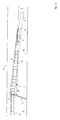
- FIG 1 there is shown a higher water body 3 and a lower water body 4 with a dam to which a fish pass 1 is connected.
- the fish pass 1 is provided with a fish inlet 8, from which a rubber mat 1 is suspended, and which provides access to an inclined gutter 6, in which baffles 9 provided with openings 13 are present.
- Present at the bottom of the inclined gutter 6 are floating bodies 7 (only one of which is shown in figure 1).
- the rubber mat 11 extends towards the bottom 12 of the lower water body 4.
- the fish pass is connected to the dam 2 on either side of the inclined gutter 6 via pivot points 10 and terminates in a fish outlet 5, which is provided with a valve 15 for regulating a water flow from the a higher water body 3 to the lower water body 4, whilst a rubber mat is provided, which hangs from the upper end of the inclined gutter 6.
- the fish pass 1 comprises a fish inlet 8, which is present below the water surface of the lower water body 4.
- a floating body 7 is provided near the fish inlet 8.
- a fish outlet 5 is positioned - at least partially so - below the water surface of the higher water body 3.
- An inclined part of a gutter 6 that is pivotally connected (about the axis 10) to the fish outlet extends between the fish inlet 8 and the fish outlet 5.
- a rubber mat 11 is suspended near the fish inlet 8, which mat extends in the direction of the bottom 12 of the lower water body 4, whilst a rubber mat 11 hangs from the fish outlet 5 in the higher water body 3.
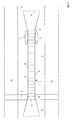
- FIG 3 there is shown in a plan view of the higher water body 3, the lower water body 4, the dam 2 and the fish pass 1.
- the fish pass 1 is shown without an upper wall for the sake of clarity.
- the baffles 9, which extend across the width of the gutter 6, are provided with an opening 13, at a different position for each baffle 6, so as to provide a passage for water flowing through the fish pass from the fish outlet 5 in the higher water body 3, via the valve 15, to the lower water body 4 and for fish swimming through the fish pass.
- the floating bodies 7, the fish inlet 8 and the rubber mat 11 that hangs towards the bottom 12 of the lower water body are illustrated in dotted lines to indicate that said parts are positioned below the water surface of the lower water body 4.
- the two water bodies 3, 4 are bounded by embankments 14, between which the dam 2 extends.
- Figure 4 schematically shows the operation of a fish pass 1, with the full lines showing the fish pass 1 in the case of a "high” water level in the lower water body 3 and the dotted lines showing the fish pass in the case of a "low” water level in the lower water body 4.
- the figure shows two alternative degrees of inclination of the inclined gutter 6 from the pivot point 10 at which the fish pass 1 is connected to the dam for allowing water to flow from the higher water body 3 to the lower water body 4 via the fish outlet 5.
- FIGs 1, 2 and 3 show the orientation of a fish pass 1 according to the present invention relative to the two water bodies 3, 4, which are bounded by an embankment 14 on either side and which are separated by a dam 2.
- the fish pass is pivotally connected to the dam 2 via a pivot point 10 at the fish outlet 5, in which dam an opening is present at the connection of the fish pass 1, which opening can be closed and opened by means of a valve 15.
- the valve 15 When the valve 15 is closed, no water will flow through the fish pass 1 and fish cannot make use of the fish pass 1.
- the valve 15 When the valve 15 is open, however, water will flow through the gutter 6 from the higher water body 3 to the lower water body via the fish outlet 5.
- the baffles 9 function to reduce the velocity of the water flow in the fish pass 1 in comparison with a situation in which no baffles would be present in the gutter 6.
- the floating bodies 7 keep the fish inlet 8 below the water surface of the lower water body 4, so that fish (not shown) can enter the fish inlet 8 at all times, at least when water is flowing through the fish pass 1, and swim to the higher water body 3 against the water flow. Since the baffles 9 reduce the flow velocity of the water, it will be easier for fish swimming upstream to reach the higher water body 3.
- the staggered openings 13 create areas where the flow velocity is comparatively low.
- the rubber mat 11 that hangs towards the bottom 12 of the lower water body near the fish inlet 8 helps to guide fish swimming upstream towards the fish inlet 8.
- the floating bodies (not shown in figure 4) will keep the fish inlet 8 at substantially the same level relative to the water surface of the lower water body 4 when the level of the lower water body 4 drops.
- the fish inlet 8 will thus move along with the water level in the direction indicated by the arrow A1. This is possible in part because the gutter 6 is connected to the dam 2 at the pivot point 10 with its upper side.
- the fish inlet 8 will be supported on the bottom. If the water level drops even further, the fish pass will not adapt itself any further.
- the fish pass 1 will move up in the direction indicated by the arrow A2 at the location of the fish inlet 8.
- the dam 2 is of the vertically adjustable type or comprises a vertically adjustable part
- the fish inlet 8 will likewise remain oriented at the same level relative to the level of the lower water body 4, and the inclination of the pass will again be adapted as a result of the pivoted connection 10.
- the fish pass 1 according to the invention automatically adjusts itself to the changing circumstances, without human interference, when the height of the dam 2 or the level of the lower water body 4 changes.
- the fish pass 1 according to the present invention since the fish pass 1 according to the present invention only needs to be connected to the dam 2, the fish pass 1 can be dismounted and be removed in a comparatively simple manner, providing the right connecting means have been used.
- a very flexible system is provided to enable fish to get across barriers that would otherwise be impassable.
- the dam or at least a part thereof, may be adjustable for height.
Landscapes
- Engineering & Computer Science (AREA)
- General Engineering & Computer Science (AREA)
- Life Sciences & Earth Sciences (AREA)
- Marine Sciences & Fisheries (AREA)
- Mechanical Engineering (AREA)
- Civil Engineering (AREA)
- Structural Engineering (AREA)
- Farming Of Fish And Shellfish (AREA)
- Table Equipment (AREA)
Applications Claiming Priority (1)
| Application Number | Priority Date | Filing Date | Title |
|---|---|---|---|
| NL1031738A NL1031738C1 (nl) | 2006-05-03 | 2006-05-03 | Vispassage. |
Publications (2)
| Publication Number | Publication Date |
|---|---|
| EP1852554A2 true EP1852554A2 (de) | 2007-11-07 |
| EP1852554A3 EP1852554A3 (de) | 2012-08-08 |
Family
ID=38269029
Family Applications (1)
| Application Number | Title | Priority Date | Filing Date |
|---|---|---|---|
| EP07075293A Withdrawn EP1852554A3 (de) | 2006-05-03 | 2007-04-18 | Fischpassage |
Country Status (2)
| Country | Link |
|---|---|
| EP (1) | EP1852554A3 (de) |
| NL (1) | NL1031738C1 (de) |
Cited By (4)
| Publication number | Priority date | Publication date | Assignee | Title |
|---|---|---|---|---|
| EP2116652A3 (de) * | 2008-05-10 | 2010-06-16 | Bruce Don | Fischpass |
| FR3003582A1 (fr) * | 2013-03-21 | 2014-09-26 | Christian Jacquemin | Passe a poissons flottante. |
| US12060687B2 (en) * | 2022-02-02 | 2024-08-13 | Kalasydän Oy | Floating river |
| US12188194B2 (en) * | 2021-07-08 | 2025-01-07 | Littoral Power Systems, Inc. | Zero-ascend omnispecies (ZAO) prefabricated fish passage attraction system |
Families Citing this family (2)
| Publication number | Priority date | Publication date | Assignee | Title |
|---|---|---|---|---|
| NL2006894C2 (nl) | 2011-06-03 | 2012-12-04 | A R P Weg En Waterbouw | Stuw voor het regelen van het peil in een watergang. |
| NL2006893C2 (nl) | 2011-06-03 | 2012-12-04 | A R P Weg En Waterbouw | Stuw voor het regelen van het peil in een watergang. |
Family Cites Families (2)
| Publication number | Priority date | Publication date | Assignee | Title |
|---|---|---|---|---|
| FR2653795B1 (fr) * | 1989-10-31 | 1993-03-12 | Legault Antoine | Passe a anguilles a niveau reglable. |
| GB2299920A (en) * | 1995-04-20 | 1996-10-23 | Water Power Dev Ltd | Floating fish pass |
-
2006
- 2006-05-03 NL NL1031738A patent/NL1031738C1/nl not_active IP Right Cessation
-
2007
- 2007-04-18 EP EP07075293A patent/EP1852554A3/de not_active Withdrawn
Cited By (5)
| Publication number | Priority date | Publication date | Assignee | Title |
|---|---|---|---|---|
| EP2116652A3 (de) * | 2008-05-10 | 2010-06-16 | Bruce Don | Fischpass |
| GB2460028B (en) * | 2008-05-10 | 2012-07-18 | Bruce Don | An eel pass |
| FR3003582A1 (fr) * | 2013-03-21 | 2014-09-26 | Christian Jacquemin | Passe a poissons flottante. |
| US12188194B2 (en) * | 2021-07-08 | 2025-01-07 | Littoral Power Systems, Inc. | Zero-ascend omnispecies (ZAO) prefabricated fish passage attraction system |
| US12060687B2 (en) * | 2022-02-02 | 2024-08-13 | Kalasydän Oy | Floating river |
Also Published As
| Publication number | Publication date |
|---|---|
| EP1852554A3 (de) | 2012-08-08 |
| NL1031738C1 (nl) | 2007-11-06 |
Similar Documents
| Publication | Publication Date | Title |
|---|---|---|
| CA2045139C (en) | Automatic swing fishway apparatus | |
| EP1852554A2 (de) | Fischpassage | |
| KR20110116100A (ko) | 보의 상류 측 수중에 위치하여 수위 변동시에도 어류의 이동이 연중 가능한 어도 | |
| US4657434A (en) | River control structures | |
| KR101471888B1 (ko) | 고정보용 어도장치 | |
| JP3395033B2 (ja) | 水位調整水門 | |
| JP2552616B2 (ja) | 魚道装置の制御ゲートおよびその集魚装置 | |
| JP3500116B2 (ja) | 自動可動式魚道水路設備 | |
| KR102405914B1 (ko) | 사이펀 여수로를 이용한 수위 조절장치 | |
| US4494257A (en) | Flow control device | |
| JP3030803B2 (ja) | 流量応答ゲート | |
| JP2935699B1 (ja) | 浮力利用の自動越流堰 | |
| JP2514841B2 (ja) | 自動水位制御ゲ―ト | |
| KR20060000366A (ko) | 어도의 유량 및 유속을 조절하는 방법 및 그 장치 | |
| JP3956070B2 (ja) | 自動魚道ゲート | |
| JP2004162393A (ja) | 逆流防止ゲートの土砂排出構造 | |
| JP3125654U (ja) | 水田用水位調整枡 | |
| JP4055057B2 (ja) | 下流水位制御装置 | |
| KR100778151B1 (ko) | 부력식 어도 | |
| JP3632000B2 (ja) | 水質改善用流入調整フェンス | |
| NL8001070A (nl) | Niet vibrerende, neerlaatbare dam. | |
| JP2514866B2 (ja) | 用水路用流量応答ゲ―ト | |
| JPH0355308A (ja) | 自動水位調節開閉ゲート装置 | |
| JP6837250B2 (ja) | 交換型フラップゲートおよび交換型フラップゲートの設置方法 | |
| JP4258764B2 (ja) | 水位調整ゲート |
Legal Events
| Date | Code | Title | Description |
|---|---|---|---|
| PUAI | Public reference made under article 153(3) epc to a published international application that has entered the european phase |
Free format text: ORIGINAL CODE: 0009012 |
|
| AK | Designated contracting states |
Kind code of ref document: A2 Designated state(s): AT BE BG CH CY CZ DE DK EE ES FI FR GB GR HU IE IS IT LI LT LU LV MC MT NL PL PT RO SE SI SK TR |
|
| AX | Request for extension of the european patent |
Extension state: AL BA HR MK YU |
|
| PUAL | Search report despatched |
Free format text: ORIGINAL CODE: 0009013 |
|
| AK | Designated contracting states |
Kind code of ref document: A3 Designated state(s): AT BE BG CH CY CZ DE DK EE ES FI FR GB GR HU IE IS IT LI LT LU LV MC MT NL PL PT RO SE SI SK TR |
|
| AX | Request for extension of the european patent |
Extension state: AL BA HR MK RS |
|
| RIC1 | Information provided on ipc code assigned before grant |
Ipc: E02B 8/08 20060101AFI20120702BHEP |
|
| AKY | No designation fees paid | ||
| REG | Reference to a national code |
Ref country code: DE Ref legal event code: R108 |
|
| REG | Reference to a national code |
Ref country code: DE Ref legal event code: R108 Effective date: 20130417 |
|
| STAA | Information on the status of an ep patent application or granted ep patent |
Free format text: STATUS: THE APPLICATION IS DEEMED TO BE WITHDRAWN |
|
| 18D | Application deemed to be withdrawn |
Effective date: 20130209 |