EP1852777A2 - Computergestützte Parallelisierung von Berechnungsgraphen - Google Patents
Computergestützte Parallelisierung von Berechnungsgraphen Download PDFInfo
- Publication number
- EP1852777A2 EP1852777A2 EP07015490A EP07015490A EP1852777A2 EP 1852777 A2 EP1852777 A2 EP 1852777A2 EP 07015490 A EP07015490 A EP 07015490A EP 07015490 A EP07015490 A EP 07015490A EP 1852777 A2 EP1852777 A2 EP 1852777A2
- Authority
- EP
- European Patent Office
- Prior art keywords
- component
- flows
- graph
- sort
- input
- Prior art date
- Legal status (The legal status is an assumption and is not a legal conclusion. Google has not performed a legal analysis and makes no representation as to the accuracy of the status listed.)
- Ceased
Links
Images

Classifications
-
- G—PHYSICS
- G06—COMPUTING OR CALCULATING; COUNTING
- G06F—ELECTRIC DIGITAL DATA PROCESSING
- G06F8/00—Arrangements for software engineering
- G06F8/40—Transformation of program code
- G06F8/41—Compilation
- G06F8/45—Exploiting coarse grain parallelism in compilation, i.e. parallelism between groups of instructions
Definitions
- This invention relates to parallel processing of data and more particularly to computer-aided specification of parallel computation graphs.
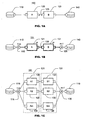
- an example of a computation graph 100 includes an input file 110 and an output file 140.
- Input file 110 is the source of a series of work elements, such as data records each associated 11with a separate transaction in a transaction processing system. Each work element is first processed by a component A 120, passed over a serial link 125, and then processed by a component B 130. The outputs of component B are stored in output file 140.
- a specification of a parallelized computation graph 101 includes input file 110 and output file 140 as in the serial computation graph 100.
- a parallel component A 121 represents m instances of component A 120 arranged in parallel
- a parallel component B 131 represents m instances of component B 130 represented in parallel.
- a parallel link 126 joins parallel component A 121 and parallel component B 131.
- parallel components are indicated using bold lines, and optional indicators of the degrees of parallelism (e.g., "m" in FIG.1B) adjacent to the components.
- parallelized computation graph 101 is represented in explicit serial form, with m instances of component A 120 (labelled A1 through Am) arranged in parallel.
- a 1: m partition element 115 is inserted between input file 110 and the m instances of component A that make parallel component A 121, which includes the m instances of component A 120.
- Partition element 115 takes work elements on one input, and sends each input to one of the m outputs, for example, in a round-robin manner.
- a m :1 gather element 135 takes the outputs of the m component Bs 120 on m input lines and merges the inputs, for example according to their arrival times, for output to output file 140.
- Parallel link 126 is represented in this example as a parallel combination of serial links joining corresponding instances of component A and component B.
- the invention features an approach to implementing flows of data that are sorted according to a sort order in which, in addition to the sorted data, one or more indicators related to the sort order are passed on the flows. At least some of the indicators identify a place in the sort order for the data such that subsequent data on the flow occurs no earlier that the identified place in the sort order.
- a serial computation graph can be parallelized without any, or with limited, input from a user, thereby simplifying the process of designing a parallelized computation graph.
- the automated procedure is less error prone because the automated system can verify the input requirements of components in the graph are satisfied rather than relying on a user to satisfy the input requirements.
- aspects of the invention involve technical considerations related to guaranteeing the functional equivalence of a parallel computation graph and an initial serial (or parallel) computation graph.
- a technical effect is that the computations specified by a serial computation graph can be distributed for parallel execution on a number of separate processors, thereby increasing the throughput of the parallel execution as compared to serial execution.
- FIG. 1A is a serial computation graph.
- FIG. 1B is a parallelized computation graph.
- FIG. 1C is a serial representation of the parallelized computation graph shown in FIG. 1B.
- FIG. 2A is a portion of a parallelized computation graph.
- FIG. 2B is a portion of a parallelized computation graph with elements represented on an inter-component link.
- FIG. 2C is a serial representation of the portion of the parallelized computation graph shown in FIG. 2B.
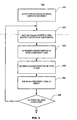
- FIG. 3 is a flowchart of an automatic parallelizing procedure.
- serial computation graph 100 shown in FIG. 1A which is an example of a simple computation graph, can in some circumstances be implemented as parallel computation graph 101 shown in FIGS. 1B-1C.
- parallel computation graph 101 For example, if each work element from input file 110 can be processed independently of all other work elements, then a parallel computation graph 101 will perform the same computations as serial computation graph 100. Note that although the same computations are performed the order of the work elements received by output file 140 is not necessarily the same in serial graph 100 as in parallel graph 101. In this example, the order of output work elements is not critical to the function of the computation network.
- a particular type of partition element 115 may be required to divide up the input elements for processing in the various instances of component A. For example, if computation graph 100 is for processing transaction records that are each associated with a particular account, then in order that the parallel computation graph be functionally equivalent to the serial graph, it may be required that all records for any particular account be processed by a common instance of component A 120. Such a requirement is satisfied in serial graph 100 because there is only one instance of component A 120. In parallel graph 101, the requirement that all records for a particular account go to a common instance of component A is not guaranteed for some forms of 1: m partition element 115, such a for a round-robin partition element.
- a suitable partition element 115 maps the value of the account field in each record according to a hash function into m different values, each associated with one on the outputs of partition element 115. Records that yield any particular hash value are all sent to the same output, and therefore are processed by a common instance of component A 120 in parallel graph 101.
- Such a 1: m partition element 115 is referred to as a hash partition element.
- the hash function is designed so that on average, a balanced number of records are sent to each of the outputs of partition element 115.
- a user transforms a specification of the serial graph to preserve a desired function of the serial graph.
- the user can specify the degree of parallelism (m) for components A 120 and B 120 (in this example both have the same degree of parallelism), add partition element 115 and gather element 135 into the graph, and specify the characteristics of the added elements. For example, if component A 120 requires records partitioned according to an account number, the user recognizes the requirements of component A 120 and manually configures partition element 115 to divide the records according to a hash value of the account number.
- partition element 115 may choose among various types of partition elements. These types of partition elements include, but are not necessarily limited to:
- the user specifying parallel graph 101 may also have to specify the characteristics of gather element 135.
- the input work elements may be sorted according to a key value of the work elements, such as the account number in transaction records.
- a key value of the work elements such as the account number in transaction records.
- that order would be preserved.
- parallel graph 101 that order may be disturbed if the different branches process their outputs at even slightly different rates. Therefore, if the order in the resulting output file 140 is to match that detained using serial graph 100, the user can specify that gather element 135 should sort its inputs according to a particular key, such as the account number, in the work elements it receives from the various branches.
- the user specifying the parallel graph chooses a type of gather element.
- the available types of gather elements include, but are not limited to:
- FIG. 2A shows a portion of a parallel graph 200 that includes parallel components A 210.and B 240, which are linked by an inter-component link (ICL) 205.
- ICL inter-component link
- ICL 205 depend on factors which can include the requirements (e.g., partitioning or ordering requirements) of the inputs of the serial instances of parallel component B 240 and/or characteristics (e.g., partitioning or sorting characteristics) of the outputs of the serial instances of parallel component A 210.
- a second parallel graph 201 represents ICL 205 as a network of interconnected elements.
- This network provides a link between parallel component A 121 and parallel component B 131 and performs a suitable "shuffling" of work elements between the serial components that make up the parallel components such that the overall function of the graph correct.
- the network representation of ICL 205 performs such shuffling using a parallel partition element 221, which takes the output of parallel component A 121, an interconnection network 225, and a parallel gather element 231, whose outputs provide the inputs to parallel component B 131.
- parallel component A 210 has a degree of parallelism of m
- parallel component B 240 has a parallel degree of parallelism n, which is not necessarily the same as m.
- the parallel link between parallel component A 121 and parallel partition element 221 represents m serial links.
- the output of parallel partition element 221 represents mn ( m times n) serial links.
- Interconnection network 225 has mn inputs and mn outputs.
- Parallel gather element 231 has mn inputs and n outputs.
- parallel partition element 221 is implemented by m instances of a partition element 220. Each of these partition elements is a 1: n partition element that is similar to the partition element 115 shown in FIGS. 1B-1C.
- Parallel gather element 231 is implemented by n instances of a gather element 230. Each of these gather elements is a m :1 gather element that is similar to gather element 135 in FIGS. 1B-1C.
- Interconnection network 225 is implemented as a cross-connection of serial links in which every instance of partition element 220 is connected to every instance of gather element 230.
- a single symbol or icon is used to represent the combination of partition element 221 and interconnection network 225, and this combination is also referred to as "partition element".
- a user specifying a network representation of ICL 205 which links parallel component A 121 and parallel component B 131 as shown in FIG. 2B specifies the characteristics of parallel partition element 221 and parallel gather element 231 (together with interconnection network 225 forming inter-component link (ICL) 205).
- the user chooses these characteristics based on recognizing requirements of the downstream component B 130, and on any assumptions that the user can make about the characteristics of the outputs of the instances of component A 120 that make up the upstream parallel component A 121.
- inter-component link 205 As an example of specification of the characteristics of inter-component link 205, suppose that component A 210 requires work elements to be partitioned according to an account number, while component B 240 requires the outputs to be partitioned according to a postal zip code. Assuming that the inputs to components A were suitably partitioned, then the outputs of components A will also be partitioned in the same way. That is, in this example, the outputs of components A 210 in FIG. 2B will be partitioned according to account number.
- Each of 1: n partition elements 220 of the inter-component link is a hash partition element that uses a zip code key within each word element determine to which output to pass the work element.
- An automated or computer-assisted approach to parallelizing a serial graph determines the network representation of ICL 205 and the characteristics of the overall link and the elements (e.g., partition elements) of the network representation.
- a user uses a graph representation as shown in FIG. 2A without necessarily considering the network structure of ICL 205 as shown in FIG. 2B.
- the approach adds the elements of inter-component links to accomplish essentially the same result as the approach described above without requiring a user to explicitly insert the partition, interconnect, and gather elements of the network representation of the inter-component links.
- One aspect of this automated or computer-assisted approach relates to the use of information that characterizes the requirements of inputs of some or all of the components in a computation graph and a way of determining characteristics of outputs of some or all of the components.
- the information needed for this is stored as metadata associated with the components. This metadata is used by the automated parallelization procedures.
- One or more components in an serial graph each includes metadata related to characteristics of each of the inputs that are required by the component. For example, if a particular input of the component is required to be partitioned in a particular way, the input metadata for that input may include an indicator according to which the key or field the work elements must be partitioned. If a component has multiple inputs, each input has separate metadata associated with it. For example, one input may indicate that copies of all work elements must be delivered to the input, while another input may indicate that the work elements must be partitioned by the account number of each work element.
- Another characterization of one or more of the components relates to characteristics of each output flow based on the characteristics of the input flows of the component and characteristics of the component itself.
- One example of such a characterization is for a component that processes each work element it receives on its input flow in order. For such a component, if the input work elements are sorted according to a particular key, then because there is no re-ordering within the component, the output work elements are also sorted according to that same key. Similarly, if a component receives work elements that have been partitioned according to a particular key, if the value of that key is not modified by the component, then the output work elements will remain partitioned according to that key. (Note that if the component modifies the value of the key, then the output will not longer necessarily be partitioned according to the modified value of the key.)
- this characterization defines a component-specific mapping function that accepts the characteristics of each of the input flows of the components, and produces characteristics for each of the output flows.
- Characterizations of flows are similar to characterizations of requirements of inputs for components.
- a characterization of a flow can include:
- mapping can be explicitly encoded in procedural statements associated with the component.
- Another way of encoding the mapping is based on indicators of which key values in work elements may be modified by the component, thereby potentially disturbing sort orders or partitioning based on that key, as well as explicit indicators regarding sorting, reordering, or partitioning that are explicitly implemented by that component.
- the mapping is then based on the input characteristics and these indications, for instance using a set of generic or component-specific rules. Examples of such mapping rules include the following:
- Some components may rename fields in work elements.
- the metadata for such a component identifies such renaming, and the output characteristics are expressed in terms of the new named variables. For example, if the input is partitioned according to an "account” key, and the "account” field is renamed as the "customer” field, then the output is characterized as being partitioned according to the "customer” field.
- an automated procedure 300 for specifying a parallel computation graph from a serial computation graph begins with accepting a specification of the serial graph to be parallelized (step 310).
- This specification includes a specification of the structure of the graph, also referred to as the topology of the graph, which specifies which outputs of each component are connected by flows to each input of another component.
- the specification also includes the metadata for each component described above: the input requirements, if any, for each input of one or more component, and the mappings between input characteristics and output characteristics for the components or other characterization of the outputs of the component. Note that this metadata is optional in that some components may not specify any input requirements, and some components may not provide a mapping that yields the characteristics of their output flows. If a component does not specify any input characteristics, the procedure does not necessarily enforce any particular characteristics for its input flows. If a component does not provide a mapping that yields characteristics of its output flows, then the procedure does not necessarily make any assumptions regarding those characteristics.
- the user specifies the desired degree of parallelism for each of the components in the computation graph.
- the simple serial computation graph 100 shown in FIG. 1A.
- input file 110 and output file 140 have a parallel degree of 1, representing physical files that support serial access.
- the procedure determines the characteristics of an inter-component link (i.e., a partition element, interconnection network, and gather element) to implement the serial link in the parallel computation graph.
- the procedure cycles between four phases:
- an equivalent serial computation graph is formed by expanding each of the parallel components.
- characteristics of the one or more output flows from generally less than all of the components are calculated. For instance, on the initial iteration, the characteristics of the flows from components that have no inputs can be computed. In subsequent iterations, the mapping for any component for which the input characteristics have been computed for all the input flows for that component is used to determine the characteristics of the output flows of that component.
- the characteristics of the partition and gather elements of one or more inter-component links are determined based on the degree of parallelism of the upstream component (m) and of the downstream component ( n ) of that link, the characteristics of the output flow from the upstream component, and the requirements of the input flow of the downstream component.
- partition and gather elements can also be used.
- corresponding upstream and downstream components can be connected by an inter-component link having only a one-input/one-output "gather" element that performs the required sort. Note that the input to the inter-component link maintains the partitioning and the inter-component link adds the sorted characteristic.
- the characteristics of input flows of the downstream components are determined from the characteristics of the output flows of the upstream components and the characteristics of the intervening inter-component link. Note that, in general, at least the required characteristics for the input will be present on those flows. Additional characteristics, which may be reflected in characteristics of output flows of the component, may also be present. For example, in the case where the flow was partitioned according to one key and the downstream component requires its input to be sorted on another key, the resulting flow is both partitioned and sorted, even though only sorting is required.
- step 350 the elements of the network representation of the inter-component link are added to the graph.
- steps 320-350 At the end of each iteration of the cycle (steps 320-350), characteristics of additional input flows to components are computed.
- this procedure terminates when all the links in the initial graph have been processed.
- An approach to restarting the procedure if all links have not been processed, for instance if the characteristics of the output flow of the upstream component have not been computed, is to make no assumptions regarding the characteristics of the flow in determining the characteristics of the inter-component link.
- Such a restarting may be required in computation graphs that are not acyclic, or in graphs in which metadata is not available for some components. For example, even though the flow was already in fact partitioned, a redundant partition element may be inserted in the inter-component link. Although possibly inefficient, the correct functioning of the parallel graph would still be preserved.
- the insertion of the components of the inter-component links may be explicitly indicated to the user.
- the user does not have to be aware of the nature of the inter-component links that are introduced on each of the links of the original serial computation graph.
- a user interface can hide these partition and gather elements, or provide for an optional display of these elements controlled by the user, rather than displaying the network representation of the inter-component links by default.
- a computer-assisted (e.g., partially automated) mode the user guides the procedure by explicitly introducing some of the partition and gather elements. For instance, the user may specify that a particular partition and gather element, or some other form of element, be used on a parallel link before the automated procedure is applied, thereby overriding the automatic procedure for that link.
- the user can examine the result of the automated processing, and may modify the partition and gather elements of an inter-component link. Note that after the user has modified the link, the automated procedure optionally propagates the flow characteristics downstream from that link, and downstream changes may result in new specifications of downstream inter-component links.
- an automated procedure verifies that input requirements of each component are satisfied, and notifies the user if that is not the case.
- the user can then introduce elements to meet the input requirements, and then the system can automatically re-check the refined design.
- the system may suggest modifications of the graph (for example, possible insertions of partition or gather elements on inter-component links) in order to meet the input requirements, and the user either confirms that the suggested modification be used, or provides an alternative modification (e.g., insertion of a different element, or specification of different characteristics for an inserted element).
- the user chooses the specific degrees of parallelism for each of the components before applying the automatic procedure.
- the user only identifies which components will be parallelized, or variables associated with their degrees of parallelism, but does not necessarily specific the numerical degree of parallelism that is desired.
- the result is a "generic" parallel computation graph in which the characteristics of each inter-component link determined, but like the parallel components, specific realizations of the parallel elements in the network representation of the inter-component link have not yet been determined.
- the generic graph is realized in a specific parallelized form.
- flow characteristics are propagated in what is essentially a "flooding" approach that is, the characteristics of the data flows propagate "downstream" in the same direction as the data flows themselves.
- Alternative approaches can be used.
- upstream propagation may be used.
- a simple example of such upstream propagation can be used when there is a series of two components, A and B. If both A and B have the same degree of parallelism, and B requires partitioning according to a key, and A does not require any particular partitioning, then the partitioning requirement can be propagated upstream so that A will also require the same partitioning as B. In this way, it may be possible to use direct links between corresponding instances of A and B without introducing explicit partition and gather elements between A and B.
- a component of a serial graph may also represent an entire serial subnetwork.
- One approach to the automatic parallelizing approach is to parallelize the subnetwork as if the serial subnetwork were fully expanded within its host graph.
- the serial subnetwork is parallelized independently of the network in which it is hosted.
- Metadata characterizing the subnetwork as a whole, including an overall mapping of flow characteristics through the subnetwork, are computed for use during the parallelizing procedure for the host network based on the metadata for the components within the subgraph.
- a sorted merge element assumes that the work elements on each of its inputs are sorted according to a particular sort order and that the sorted merge element must produce an overall merged output according to the same sort order.
- the basic procedure that is followed by such a sorted merge element is to consider each work element that is pending at each of its inputs, and to pass through the next work element according to the sort order, as an output.
- the sorted merge cannot pass any work elements because it does not know whether a later arriving work element on that input will occur earlier in the sort order than the already pending inputs.
- the work elements would then be held up until an end-of-flow indicator is received on the link, at which time the sorted merge element can assume that no more work elements will arrive on that flow.
- a way of avoiding this situation is for a hash partition element that receives a sorted input to repeatedly send a sort value indicator on each of its output links to indicate a value in the sort order that has been reached by at least one of its outputs.
- This sort value indicator signals a downstream component that no work element with an earlier value in the sort order will be provided over this link.
- a sorted merge element that receives such a sort value indicator uses the indicator to determine whether it can pass a pending work element from another of its inputs, for example, because it has a sort value that precedes the value in the received sort value indicator.
- a sort value indicator can be sent as often as possible based on the flow of work elements through a component, or can be sent less frequently, for example, periodically according to the number of work elements processed or according to time. Sort value indicators can be sent on any sorted flow that may be partitioned, and such indicators are broadcast on the outputs of partition elements that receive the indicators.
- Another solution to the problem of blocking downstream sorted merge elements is to scramble the inputs of the upstream hash partition elements so that in general, at least some work elements are passed on each of the outputs of the hash partition elements.
- the automatic approach described above can be implemented using software for execution on a computer.
- the software forms procedures in one or more computer programs that execute on one or more programmed or programmable computer systems (which may be of various architectures such as distributed, client/server, or grid) each including at least one processor, at least one data storage system (including volatile and non-volatile memory and/or storage elements), at least one input device or port, and at least one output device or port.
- the software may form one or more modules of a larger program, for example, that provides other services related to the design and configuration of computation graphs.
- the software may be provided on a medium, such as a CD-ROM, readable by a general or special purpose programmable computer or delivered (encoded in a propagated signal) over a network to the computer where it is executed. All of the functions may be performed on a special purpose computer, or using special-purpose hardware, such as coprocessors.
- the software may be implemented in a distributed manner in which different parts of the computation specified by the software are performed by different computers.
- Each such computer program is preferably stored on or downloaded to a storage media or device (e.g., solid state memory or media, or magnetic or optical media) readable by a general or special purpose programmable computer, for configuring and operating the computer when the storage media or device is read by the computer system to perform the procedures described herein.
- the inventive system may also be considered to be implemented as a computer-readable storage medium, configured with a computer program, where the storage medium so configured causes a computer system to operate in a specific and predefined manner to perform the functions described herein.
Landscapes
- Engineering & Computer Science (AREA)
- General Engineering & Computer Science (AREA)
- Theoretical Computer Science (AREA)
- Software Systems (AREA)
- Physics & Mathematics (AREA)
- General Physics & Mathematics (AREA)
- Information Retrieval, Db Structures And Fs Structures Therefor (AREA)
- Image Generation (AREA)
Applications Claiming Priority (2)
| Application Number | Priority Date | Filing Date | Title |
|---|---|---|---|
| US48239103P | 2003-06-25 | 2003-06-25 | |
| EP04777236A EP1636699A2 (de) | 2003-06-25 | 2004-06-22 | Rechnergestütze parallelisierung von berechnungsgraphen |
Related Parent Applications (1)
| Application Number | Title | Priority Date | Filing Date |
|---|---|---|---|
| EP04777236A Division EP1636699A2 (de) | 2003-06-25 | 2004-06-22 | Rechnergestütze parallelisierung von berechnungsgraphen |
Publications (2)
| Publication Number | Publication Date |
|---|---|
| EP1852777A2 true EP1852777A2 (de) | 2007-11-07 |
| EP1852777A3 EP1852777A3 (de) | 2009-05-27 |
Family
ID=37887937
Family Applications (2)
| Application Number | Title | Priority Date | Filing Date |
|---|---|---|---|
| EP07075046A Withdrawn EP1777619A3 (de) | 2003-06-25 | 2004-06-22 | Rechnergestütze Parallelisierung von Berechnungsgraphen |
| EP07015490A Ceased EP1852777A3 (de) | 2003-06-25 | 2004-06-22 | Computergestützte Parallelisierung von Berechnungsgraphen |
Family Applications Before (1)
| Application Number | Title | Priority Date | Filing Date |
|---|---|---|---|
| EP07075046A Withdrawn EP1777619A3 (de) | 2003-06-25 | 2004-06-22 | Rechnergestütze Parallelisierung von Berechnungsgraphen |
Country Status (1)
| Country | Link |
|---|---|
| EP (2) | EP1777619A3 (de) |
Family Cites Families (7)
| Publication number | Priority date | Publication date | Assignee | Title |
|---|---|---|---|---|
| US5117489A (en) * | 1987-04-22 | 1992-05-26 | Mitsubishi Denki Kabushiki Kaisha | Data-driven processor having an internal tag-generating system for generating a distinct tagged information and assembling with un-tagged information of an input/output data packet |
| US5394524A (en) * | 1992-08-07 | 1995-02-28 | International Business Machines Corporation | Method and apparatus for processing two graphics data streams in parallel |
| JP3442192B2 (ja) * | 1995-05-31 | 2003-09-02 | シャープ株式会社 | データ駆動型情報処理装置 |
| US5819021A (en) * | 1995-12-11 | 1998-10-06 | Ab Initio Software Corporation | Overpartitioning system and method for increasing checkpoints in component-based parallel applications |
| US6311265B1 (en) * | 1996-03-25 | 2001-10-30 | Torrent Systems, Inc. | Apparatuses and methods for programming parallel computers |
| US5999729A (en) * | 1997-03-06 | 1999-12-07 | Continuum Software, Inc. | System and method for developing computer programs for execution on parallel processing systems |
| US6480876B2 (en) * | 1998-05-28 | 2002-11-12 | Compaq Information Technologies Group, L.P. | System for integrating task and data parallelism in dynamic applications |
-
2004
- 2004-06-22 EP EP07075046A patent/EP1777619A3/de not_active Withdrawn
- 2004-06-22 EP EP07015490A patent/EP1852777A3/de not_active Ceased
Non-Patent Citations (1)
| Title |
|---|
| None |
Also Published As
| Publication number | Publication date |
|---|---|
| EP1852777A3 (de) | 2009-05-27 |
| EP1777619A3 (de) | 2007-05-02 |
| EP1777619A2 (de) | 2007-04-25 |
Similar Documents
| Publication | Publication Date | Title |
|---|---|---|
| US9569189B2 (en) | Computer-aided parallelizing of computation graphs | |
| WO2005001687A9 (en) | Computer-aided parallelizing of computation graphs | |
| JP2014059914A5 (de) | ||
| AU2021230348A1 (en) | Generation of optimized logic from a schema | |
| EP3673369A1 (de) | Verfahren zur ausführung eines tupelgraphprogramms über ein netzwerk | |
| EP3616057A1 (de) | Verfahren zur intrasubgraphoptimierung in tupelgraphprogrammen | |
| WO2019040140A1 (en) | TYPE INFERENCE SYSTEM FOR N-UPLET GRAPH PROGRAMS, METHODS FOR EXECUTING A N-UPLET GRAPH PROGRAM THROUGH A NETWORK | |
| EP1852777A2 (de) | Computergestützte Parallelisierung von Berechnungsgraphen | |
| HK1107854A (en) | Computer-aided parallelizing of computation graphs | |
| Radivojevic et al. | Symbolic techniques for optimal scheduling | |
| Falk et al. | Integrated modeling using finite state machines and dataflow graphs | |
| WO1998019249A1 (en) | Data distribution and arrangement determination method for parallel computers and apparatus for the method | |
| Theoharis et al. | FlexParDB-An RDBMS Employing Mtra-qiiery And Operator Parallelism | |
| KR20220014230A (ko) | 인공지능 기반 워크플로우 프로세스 시스템 및 장치 | |
| Jayasinghe et al. | An array processor design methodology for hard real-time systems | |
| Jerraya et al. | VHDL Modeling for Behavioral Synthesis | |
| Theoharis et al. | FlexParDB-an RDBMS employing intra-query and operator parallelism | |
| HK1231979A1 (en) | Managing interfaces for dataflow graphs composed of sub-graphs | |
| HK1231979B (zh) | 管理包括子图的数据流图所用的接口 |
Legal Events
| Date | Code | Title | Description |
|---|---|---|---|
| PUAI | Public reference made under article 153(3) epc to a published international application that has entered the european phase |
Free format text: ORIGINAL CODE: 0009012 |
|
| 17P | Request for examination filed |
Effective date: 20070821 |
|
| AC | Divisional application: reference to earlier application |
Ref document number: 1636699 Country of ref document: EP Kind code of ref document: P |
|
| AK | Designated contracting states |
Kind code of ref document: A2 Designated state(s): AT BE BG CH CY CZ DE DK EE ES FI FR GB GR HU IE IT LI LU MC NL PL PT RO SE SI SK TR |
|
| REG | Reference to a national code |
Ref country code: HK Ref legal event code: DE Ref document number: 1107854 Country of ref document: HK |
|
| PUAL | Search report despatched |
Free format text: ORIGINAL CODE: 0009013 |
|
| AK | Designated contracting states |
Kind code of ref document: A3 Designated state(s): AT BE BG CH CY CZ DE DK EE ES FI FR GB GR HU IE IT LI LU MC NL PL PT RO SE SI SK TR |
|
| RAP1 | Party data changed (applicant data changed or rights of an application transferred) |
Owner name: AB INITIO TECHNOLOGY LLC |
|
| AKX | Designation fees paid |
Designated state(s): AT BE BG CH CY CZ DE DK EE ES FI FR GB GR HU IE IT LI LU MC NL PL PT RO SE SI SK TR |
|
| RAP1 | Party data changed (applicant data changed or rights of an application transferred) |
Owner name: AB INITIO TECHNOLOGY LLC |
|
| 17Q | First examination report despatched |
Effective date: 20120903 |
|
| APBK | Appeal reference recorded |
Free format text: ORIGINAL CODE: EPIDOSNREFNE |
|
| APBN | Date of receipt of notice of appeal recorded |
Free format text: ORIGINAL CODE: EPIDOSNNOA2E |
|
| APBR | Date of receipt of statement of grounds of appeal recorded |
Free format text: ORIGINAL CODE: EPIDOSNNOA3E |
|
| APAF | Appeal reference modified |
Free format text: ORIGINAL CODE: EPIDOSCREFNE |
|
| APBT | Appeal procedure closed |
Free format text: ORIGINAL CODE: EPIDOSNNOA9E |
|
| STAA | Information on the status of an ep patent application or granted ep patent |
Free format text: STATUS: THE APPLICATION HAS BEEN REFUSED |
|
| 18R | Application refused |
Effective date: 20190402 |
|
| REG | Reference to a national code |
Ref country code: HK Ref legal event code: WD Ref document number: 1107854 Country of ref document: HK |
|
| P01 | Opt-out of the competence of the unified patent court (upc) registered |
Effective date: 20230510 |