EP1853680B1 - Compositions d'etancheite pour puits de petrole, comprenant du latex gonflant en pressence d'alcalis - Google Patents
Compositions d'etancheite pour puits de petrole, comprenant du latex gonflant en pressence d'alcalis Download PDFInfo
- Publication number
- EP1853680B1 EP1853680B1 EP05807415A EP05807415A EP1853680B1 EP 1853680 B1 EP1853680 B1 EP 1853680B1 EP 05807415 A EP05807415 A EP 05807415A EP 05807415 A EP05807415 A EP 05807415A EP 1853680 B1 EP1853680 B1 EP 1853680B1
- Authority
- EP
- European Patent Office
- Prior art keywords
- sealant composition
- alkali
- cement
- composition according
- latex
- Prior art date
- Legal status (The legal status is an assumption and is not a legal conclusion. Google has not performed a legal analysis and makes no representation as to the accuracy of the status listed.)
- Expired - Lifetime
Links
Images


Classifications
-
- C—CHEMISTRY; METALLURGY
- C09—DYES; PAINTS; POLISHES; NATURAL RESINS; ADHESIVES; COMPOSITIONS NOT OTHERWISE PROVIDED FOR; APPLICATIONS OF MATERIALS NOT OTHERWISE PROVIDED FOR
- C09K—MATERIALS FOR MISCELLANEOUS APPLICATIONS, NOT PROVIDED FOR ELSEWHERE
- C09K8/00—Compositions for drilling of boreholes or wells; Compositions for treating boreholes or wells, e.g. for completion or for remedial operations
- C09K8/50—Compositions for plastering borehole walls, i.e. compositions for temporary consolidation of borehole walls
- C09K8/504—Compositions based on water or polar solvents
- C09K8/5045—Compositions based on water or polar solvents containing inorganic compounds
-
- C—CHEMISTRY; METALLURGY
- C09—DYES; PAINTS; POLISHES; NATURAL RESINS; ADHESIVES; COMPOSITIONS NOT OTHERWISE PROVIDED FOR; APPLICATIONS OF MATERIALS NOT OTHERWISE PROVIDED FOR
- C09K—MATERIALS FOR MISCELLANEOUS APPLICATIONS, NOT PROVIDED FOR ELSEWHERE
- C09K8/00—Compositions for drilling of boreholes or wells; Compositions for treating boreholes or wells, e.g. for completion or for remedial operations
- C09K8/50—Compositions for plastering borehole walls, i.e. compositions for temporary consolidation of borehole walls
- C09K8/504—Compositions based on water or polar solvents
- C09K8/506—Compositions based on water or polar solvents containing organic compounds
-
- C—CHEMISTRY; METALLURGY
- C09—DYES; PAINTS; POLISHES; NATURAL RESINS; ADHESIVES; COMPOSITIONS NOT OTHERWISE PROVIDED FOR; APPLICATIONS OF MATERIALS NOT OTHERWISE PROVIDED FOR
- C09K—MATERIALS FOR MISCELLANEOUS APPLICATIONS, NOT PROVIDED FOR ELSEWHERE
- C09K8/00—Compositions for drilling of boreholes or wells; Compositions for treating boreholes or wells, e.g. for completion or for remedial operations
- C09K8/50—Compositions for plastering borehole walls, i.e. compositions for temporary consolidation of borehole walls
- C09K8/504—Compositions based on water or polar solvents
- C09K8/506—Compositions based on water or polar solvents containing organic compounds
- C09K8/508—Compositions based on water or polar solvents containing organic compounds macromolecular compounds
Definitions
- This invention relates to the field of sealant compositions and more specifically to sealant compositions comprising alkali swellable latex and a pH increasing material as well as methods for using such compositions to service a wellbore.
- Natural resources such as gas, oil, and water residing in a subterranean formation or zone are usually recovered by drilling a wellbore down to the subterranean formation while circulating a drilling fluid in the wellbore.
- a string of pipe e.g., casing
- the drilling fluid is then usually circulated downward through the interior of the pipe and upward through the annulus, which is located between the exterior of the pipe and the walls of the wellbore.
- primary cementing is typically performed whereby a cement slurry is placed in the annulus and permitted to set into a hard mass (e.g., sheath) to thereby attach the string of pipe to the walls of the wellbore and seal the annulus.
- a hard mass e.g., sheath
- Secondary cementing operations may also be performed.
- a secondary cementing operation is squeeze cementing whereby a cement slurry is employed to plug and seal off undesirable flow passages in the cement sheath and/or the casing. While a cement slurry is one type of sealant composition used in primary and secondary cementing operations, other non-cement containing sealant compositions may also be employed
- Latex emulsions which contain a stable water-insoluble, polymeric colloidal suspension in an aqueous solution, are commonly used in sealant compositions to improve the properties of those compositions.
- latex emulsions are used in cement compositions to reduce the loss of fluid therefrom and to reduce the gas flow potential of the composition as the compositions are being pumped to the annulus.
- Latex emulsions are also employed to reduce the brittleness of the sealant compositions; otherwise, the compositions may shatter under the impacts and shocks generated by drilling and other well operations.
- Such sealant compositions may be used for sealing the junction of multilateral wells.
- latex emulsions are used to improve the flexibility of sealant compositions.
- latex emulsions are also mixed with drilling fluids, particularly the non-aqueous type, near loss-circulation zones such as natural or induced fractures, thereby forming solid masses for sealing those zones to prevent the drilling fluids from being lost during drilling.
- a method of servicing a wellbore in contact with a subterranean formation comprises placing an alkali swellable latex and a pH increasing material in the wellbore to form a sealant composition.
- the method comprises contacting the subterranean formation with sealant compositions comprising alkali swellable latex.
- a method of increasing the viscosity of a sealant composition comprises introducing an alkali swellable latex and a pH increasing material to a wellbore.
- the method comprises contacting the alkali swellable latex with the pH increasing material to form the sealant composition.
- the pH increasing material increases the viscosity of the sealant composition by reacting with the alkali swellable latex.
- a sealant composition for use in a wellbore.
- the sealant composition comprises an alkali swellable latex and a pH increasing material.
- the sealant composition has a pH of from about 7 to about 14.
- the pH increasing material comprises a base-producing material that is capable of increasing the pH of an aqueous solution above about 7.
- the base-producing material can include alkali and alkali earth metal carbonates, alkali and alkali earth metal bicarbonates, alkali and Alkali earth metal hydroxides, alkali and alkali earth metal oxides, alkali and alkali earth metal phosphates, alkali and alkali earth metal hydrogen phosphates, alkali and alkaline earth metal sulphides, alkali and alkaline earth metal salts of silicates, alkali and alkaline earth metal salts of aluminates, water soluble or water dispersible organic amines, polymeric amines, amino alcohols, hydraulic cements such as Portland cements or combinations thereof.
- Further embodiments include a sealant composition having a pH of from about 8 to about 13.
- the sealant composition comprising an alkali swellable latex and a pH increasing material overcomes problems in the art such as lack of sufficient strength and elasticity with conventional plugging compositions. For instance, the sealant composition can withstand higher downhole pressures than conventional plugging compositions.
- a sealant composition having an increased pH comprises alkali swellable latex and at least one pH increasing material.
- the sealant composition is a mixture that can viscosify in wellbore zones where a fluid (e.g., drilling fluid) is being lost. For instance, the sealant composition may viscosify in a loss-circulation zone and thereby restore circulation.
- the viscosified mixture can set into a flexible, resilient and tough material, which may prevent further fluid losses when circulation is resumed.
- the pH increasing material is a compound capable of increasing the pH of the sealant composition to about 7 or higher.
- the pH increasing material can be a base-producing material, a cement, or combinations thereof.
- the pH increasing material reacts with acidic groups in the alkali swellable latex and thereby increases its viscosity along with that of the resulting sealant composition
- the pH of the sealant composition is increased at a desired time by using an encapsulated base having a suitable coating composition for delayed release, which may be triggered by conditions such as changes in temperature, mechanical stresses or the chemical makeup of the final downhole mixture.
- the sealant composition can further comprise additives for improving or changing its properties.
- suitable additives include fluid absorbing materials, particulate materials, superabsorbers, viscosifying agents, non-alkali swellable latexes, or combinations thereof.
- the sealant composition is a compressible sealant composition comprising foaming surfactants and foam stabilizing surfactants.
- the sealant composition is for use in a wellbore that penetrates a subterranean formation. It is to be understood that "subterranean formation" encompasses both areas below exposed earth and areas below earth covered by water such as ocean or fresh water.
- the sealant composition can be used for any purpose. For instance, the sealant composition can be used to service the wellbore.
- servicing the wellbore includes positioning the sealant composition in the wellbore to isolate the subterranean formation from a portion of the wellbore; to support a conduit in the wellbore; to plug a void or crack in the conduit; to plug a void or crack in a cement sheath disposed in an annulus of the wellbore; to plug an opening between the cement sheath and the conduit; to prevent the loss of aqueous or non-aqueous drilling fluids into loss circulation zones such as a void, vugular zone, or fracture; to be used as a fluid in front of cement slurry in cementing operations; and to seal an annulus between the wellbore and an expandable pipe or pipe string.
- Alkali swellable latex is defined as a latex emulsion that, when exposed to pH increasing materials, may swell and exhibit an increase in viscosity. Such pH increasing materials may be present and/or added to the latex emulsion. Alkali swellable latexes typically contain, in addition to the typical latex forming monomers, monomers having acidic groups capable of reacting with pH increasing materials thereby forming anionic pendant groups on the polymer back bone.
- Alkali swellable latex emulsions due to the presence of acidic groups, have a pH in the range of from about 2 to about 8 and are predominantly low viscosity fluids with viscosities less than about 100 centipoise for an emulsion containing 30% solids.
- the pH is increased by the addition of a pH increasing material, the viscosity increase may be in the range of from about five times to more than about a million times for a 30% emulsion.
- the conventional latex emulsion does not significantly increase in viscosity upon the addition of a pH increasing material.
- the latex emulsion may be cross-linked during the polymerization phase of the monomers.
- Examples of typical latex forming monomers that may be used to make Alkali swellable latexes include, without limitation, vinyl aromatic monomers (e.g., styrene based monomers), ethylene, butadiene, vinylnitrile (e.g., acrylonitrile), olefinically unsaturated esters of C 1 -C 8 alcohol, or combinations thereof.
- non-ionic monomers that exhibit steric effects and that contain long ethoxylate or hydrocarbon tails may also be present
- the monomers containing acid groups capable of reacting with pH increasing materials include ethylenically unsaturated monomers containing at least one carboxylic acid functional group.
- Such carboxylic acid containing monomers may be present in the range of from about 5 to about 30% by weight of the total monomer composition used in preparing the alkali swellable latex.
- examples of such carboxylic acid containing groups include acrylic acid, alkyl acrylic acids, such as methacrylic acid and ethacrylic acid, alpha-chloro-acrylic acid, alpha-cyano acrylic acid, alpha-chloro-methacrylic acid, alpha-cyano methacrylic acid, crotonic acid, alpha-phenyl acrylic acid, beta-acryloxy propionic acid, sorbic acid, alpha-chloro sorbic acid, angelic acid, cinnamic acid, p-chloro cinnamic acid, beta-styryl acrylic acid (1-carboxy-4-phenyl butadiene-1,3), itaconic acid, maleic acid, citraconic acid, mesaconic acid, glutaconic acid, aconitic acid, fuma
- the sealant composition includes an alkali swellable latex comprising a styrene/butadiene/acrylic or itaconic acid terpolymer latex emulsion prepared by emulsion polymerization.
- the emulsion can be a colloidal dispersion of the copolymer.
- the colloidal dispersion includes water from about 40 to about 70% by weight of the emulsion.
- the as swellable latex may include an emulsifier, polymerization catalysts, chain modifying agents, emulsion stabilizing agents, resins, crosslinking agents, and the like.
- alkali swellable latexes include TYCHEM 68710 of Dow Reichhold Specialty Latex LLC; ACRYSOL TT 615 of Rohm and Haas; SN THICKENERs 920, 922, 924, 634 and 636 of San Napco Limited, Sanyo Chemical Industry, Japan; ALCOGUM SL-120 of Alco Chemical, a National Starch Company; HEUR-ASE P206 of Dow Chemical Company; ADCOTE 37-220 of Rohm and Haas Company; and JETSIZE AE-75 of Eka Chemicals.
- TYCHEM 68710 is a carboxylated serene/butadiene copolymer suspended in a 45% to 55% by weight aqueous emulsion.
- JETSIZB AE-75 is a styrene acrylate emulsion.
- the alkali swellable latex may contain crosslinking agents that are suitable for facilitating the formation of a resilient rubbery mass, which may be used during the polymerization stage of the monomers or added to the latex prior to use (for example to the sealant composition).
- crosslinking agents including vulcanizing agents such as sulfur, 2,2'-dithiobisbenzothiazolo, organic peroxides, azo compounds, alkylthiuram disulfides, selenium phenolic derivatives and the like; vulcanization accelerators such as fatty acids (e.g,.
- stearic acid metallic oxides (e.g., zinc oxide), aldehyde amine compounds, guanidine compounds, disulfide thiuram compounds, and the like; vulcanization retarders such as salicylic acid, sodium acetate, phthalic anhydride and N-cyclohexyl thiophthalimide; defoamers; or combinations thereof may be added just prior to use, for instance to a sealant composition.
- vulcanization retarders such as salicylic acid, sodium acetate, phthalic anhydride and N-cyclohexyl thiophthalimide
- defoamers or combinations thereof may be added just prior to use, for instance to a sealant composition.
- Such compositions are discussed in U.S. Patent No. 5,293,938 .
- crosslinking agent may be a multifunctional monomer with more than one polymerizable group for example divinylbenzene, trimethylolpropane triacrylate, tetraethyleneglycol diacrylate, methylene bisacrylamide and the like.
- the alkali swellable latex may comprise from about 0.1 to about 5 wt% crosslinking agents by weight of the monomers, alternatively from about 0.2 to about 1 wt.% crosslinking agents by weight of the monomers.
- a base-producing material includes any compound capable of generating hydroxyl ions (OH - ) in water to react with or neutralize an acid to from a salt.
- the base-producing material has at least partial solubility in water, for example a solubility of 1 % or greater in water.
- suitable base-producing materials include without limitation ammonium, alkali and alkali earth metal carbonates and bicarbonates, alkali and alkali earth metal hydroxides, alkali and alkali earth metal oxides, Alkali and alkali earth metal phosphates and hydrogen phosphates, alkali and alkaline earth metal sulphides, alkali and alkaline earth metal salts of silicates and aluminates, water soluble or water dispersible organic amines, polymeric amines, amino alcohols, or combinations thereof.
- alkali and alkali earth metal carbonates and bicarbonates include Na 2 CO 3 , K 2 CO 3 , CaCO 3 , MgCO 3 , NaHCO 3 KHCO3, ethanolamine and triethanolamine. It is to be understood that when carbonate and bicarbonate salts are used as base-producing material, a byproduct may be carbon dioxide, which may enhance the mechanical properties of the non-cement based sealant composition.
- suitable alkali and alkali earth metal hydroxides include without limitation NaOH, NH 4 OH, KOH, LiOH, and Mg(OH) 2 .
- suitable alkali and alkali earth metal oxides include without limitation BaO, SrO, Li 2 O, CaO, Na 2 O, K 2 O, and MgO.
- suitable alkali and alkali earth metal phosphates and hydrogen phosphates include without limitation Na 3 PO 4 , Ca 3 (PO 4 ) 2 , CaHPO 4 , and KH 2 PO 4 .
- suitable alkali and alkaline earth metal sulphides include without limitation Na 2 S, CaS, SrS, and the like.
- Suitable silicate salts include without limitation sodium silicate, potassium silicate and sodium metasilicate.
- suitable aluminate salts include without limitations sodium aluminate and calcium aluminate.
- Examples of commercial silicates include FLO-CHECK and ECONOLITE available from Halliburton Energy Services, Inc.
- Examples of commercial alkali metal aluminates include sodium aluminate available as VERSASET from Halliburton Energy Services, Inc.
- Examples of organic amines include without limitation polymeric amines, monomeric amines containing one or more amine groups, and oligomeric amines. The organic amines may be completely or partially soluble in water. The organic amines may also be dissolved in an organic fluid such as those used as base oils in non-aqueous drilling fluids such as hydrocarbons and esters.
- Suitable water soluble or water dispersible amines include triethylamine, aniline, dimethylaniline, ethylenediamine, diethylene triamine, cyclohexylamine, diethyltoluene diamine, 2,4,6-tri-dimethylaminomethylphenol, isophoroneamine, and the like.
- organic amines include STRATALOCK D, STRATALOCK E and STRATALOCK B from Halliburton Energy Services, Inc.; JEFFAMINE from Huntsman Corp., Austin, Texas; and EH-101, EH-102, EH-103 and EH-104 from Applied Poleramic, Bernicia, CA.
- the organic amine is dissolved in a non-aqueous fluid, for example a drilling fluid, and contacted with the composition containing the alkali swellable latex.
- suitable polymeric amines include chitosan, polylysine, poly(dimethylaminoethylmethacrylate), poly(ethyleneimine), poly(vinylamine-co-vinylalcohol), poly(vinylamine) and the like.
- Commercial examples of poly(ethyleneimine) include LUPAMIN products from BASF AG Corporation, Ludwigshafen, Germany.
- Commercial examples of chitosan include CHITOCLEAR of Primex/Vanson Halosource, Redmond, VA.
- Formylated poly(vinylamine)s are commercially available from BASF AG Corporation as LUPAMIN, for example LUPAMIN 1500.
- amino alcohols include ethanolamine, triethanolamine, tripropanolamine and the like.
- a sufficient amount of the base-producing material can be contacted with the alkali swellable latex to provide a sealant composition having a pH of from about 7 to about 14.
- the base-producing material can be contacted with the alkali swellable latex to provide a sealant composition having a pH of from about 8 to about 13.
- the base-producing material can be contacted with the alkali swellable latex to provide a sealant composition having a pH of from about 9 to about 13.
- the base-producing material can include chemicals that produce a base when reacted together. Without limitation, examples include reaction of an oxide with water.
- NaOH can be produced by the following reaction: Na 2 O + H 2 O ⁇ 2NaOH.
- the base-producing material is a drilling fluid with a suitable pH in the range of from about 7 to about 14.
- An example of a high pH drilling fluid is a silicate salt-based drilling fluid.
- the base-producing material may comprise a resin such as thermosetting resins.
- suitable thermosetting resins include but are not limited to amino resins such as melamine-formaldehyde resins and urea-formaldehyde resins, phenolic resins such as phenol formaldehyde resins, furfural resins, or combinations thereof.
- amino resins such as melamine-formaldehyde resins and urea-formaldehyde resins
- phenolic resins such as phenol formaldehyde resins, furfural resins, or combinations thereof.
- acid catalysts such as ammonium salts or organic acids such as p-toluene sulfonic acids may be used.
- the amino resin can function as a base-producing material to swell the latex and in the process become polymerized to form a thermoset polymer, thus imparting additional strength to the sealant composition for example in loss-circulation treatments.
- the latex and amino resin are pumped separately and allowed to contact in the desired zone downhole.
- the resin compositions with traditional latexes and methods are discussed in U.S. Patent No. 6,508,306 .
- catalyst may be added to the composition containing the alkali-swellable latex to control the cure rate.
- Acidic or basic catalysts may be used to cure the phenolic resins depending on the resin compositions.
- phenolic resin compositions (“Novalac Resins”) require acid catalysts
- the alkali swellable latex may function as the acid catalyst and become neutralized in the process resulting in the formation swollen latex mass.
- the phenolic resins require basic catalysts (“Resole Resins”) for cure, the pH increasing may allow the latex to swell as well as catalyze the cure of the phenolic resins.
- the curing of phenolic resins to form hard thermoset polymers is discussed in the " Encyclopedia of Polymer Science and Engineering", Second Edition (1998), John Wiley and Sons Publishers, pp-45-95 .
- the furfural resins are typically acid catalyzed and may be catalyzed by the acidic alkali swellable latex or with acid catalysts including but not limited to organic and inorganic acid anhydrides, ammonium salts, sodium bisulfate, hydrolyzable esters such as butyl acetate, furfuryl acetate, organic acids such as maleic acid, fumaric acid, inorganic acids such as phosphoric or sulfonic acid, or combinations thereof.
- the acid catalysts include organic acids, sodium bisulfate, or combinations thereof.
- the acid catalysts include sodium bisulfate.
- the amount of such curing agents in a sealant composition ranges from about 0.01% to about 10% by weight of the sealant composition, alternatively from about 1% to about 3% by weight of the sealant concentration
- Phenol formaldehyde resins and furfural resins are commercially available from several sources, for example Durez Corporation of Dallas, Texas.
- the resins, the alkali swellable latex, and the associated catalysts are allowed to contact in the zone of interest so that viscosification and curing takes place in the desired location downhole.
- the resins and latex may be crosslinked with each other, for instance when amino resins such as melamine- or urea - formaldehyde are used under the cure conditions employed.
- the pH increasing material such as a base-producing compound can be encapsulated with at least one encapsulating material.
- the base-producing compound may be encapsulated to delay its reaction with the alkali swellable latex and to postpone the formation of a higher viscosity swollen latex product
- the base-producing material can be a liquid for example an aqueous solution or an organic liquid, or a solid If the base-producing material comprises an aqueous solution, it may be encapsulated in a particulate porous solid material.
- the particulate porous solid material comprises any suitable material that remains dry and free flowing after absorbing the aqueous solution and through which the aqueous solution slowly diffuses.
- particulate porous solid materials include but are not limited to diatomaceous earth, zeolites, silica, expanded perlite, alumina, metal salts of alumino-silicates, clays, hydrotalcite, styrene divinylbenzene based materials, cross-linked polyalkylacrylate esters, cross-linked modified starches, natural and synthetic hollow fibers, porous beads such as perlite beads, or combinations thereof.
- the base producing material is an organic liquid, it may also be encapsulated in hydrophobically modified porous silica in addition to the afore-mentioned absorbents.
- encapsulation further includes an external coating of a polymer material through which an aqueous solution diffuses and that is placed on the particulate porous solid material.
- the external coating can be added to further delay the reaction.
- external coatings include but are not limited to EDPM rubber, polyvinyldichloride, nylon, waxes, polyurethanes, cross-linked partially hydrolyzed acrylics, cross-linked latex, styrene-butadiene rubber, cross-linked polyurethane and combinations thereof. Encapsulation is described in U.S. Patent Nos. 5,373,901 ; 6,527,051 ; 6,554,071 ; and 6,209,646 .
- the base-producing compound when it comprises a solid, it can be encapsulated by spray coating a variety of materials thereon, including but not limited to a wax, a drying oil such as tung oil and linseed oil, a polyurethane, a crosslinked partially hydrolyzed polyaorylic, a styrene-butadiene latex, a water degradable compound or polymer, or combinations thereof.
- a wax such as tung oil and linseed oil
- a polyurethane a crosslinked partially hydrolyzed polyaorylic
- styrene-butadiene latex a water degradable compound or polymer, or combinations thereof.
- the cement composition can include hydraulic cements.
- the hydraulic cements set and harden by reaction with water.
- the hydraulic cements can be composed of calcium, aluminum, silicon, oxygen, sulfur, or combinations thereof.
- suitable hydraulic cements include Portland cements (e.g., classes A, C, G, and H Portland cements), pozzolana cement, gypsum cements, phosphate cements, high alumina content cements, silica cements, high alkalinity cements, Magnesia cements, and combinations thereof.
- Suitable median cement particle sizes are in the 1 to 200 microns range, alternatively 5 to 150 microns, and alternatively 10 to 120 microns range.
- a sufficient amount of fluid is added to the cement to form a pumpable cement composition slurry.
- the fluid may be fresh water or salt water, e.g., an unsaturated aqueous salt solution or a saturated aqueous salt solution such as brine or seawater, or a non-aqueous fluid
- the cement composition can be contacted with the alkali swellable latex in sufficient amounts to produce a sealant composition having a pH of from about 7 to about 14.
- the cement composition can be contacted with the alkali swellable latex in sufficient amounts to produce a sealant composition having a pH of from about 8 to about 13.
- the cement composition can be contacted with the alkali swellable latex in sufficient amounts to produce a sealant composition having a pH of from about 9 to about 13.
- cement surfactants may be used in suitable amounts to assist in the water wetting and hydration of the cement particles upon exposure to water.
- suitable cement surfactant systems include imidazole fatty acid condensates and salts of dodecybenzene sulfonic acid
- suitable cement surfactants are available from Halliburton Energy Services, Inc. of Duncan, Oklahoma, as MOC-ONE and DOC-3.
- Such cement slurries in non-aqueous fluids are allowed to contact an aqueous fluid containing the alkali swellable latex downhole in the zone of interest, for example a loss circulation zone.
- the cement in the non-aqueous fluid upon contact with the aqueous fluid hydrates quickly as well as increases the pH of the aqueous fluid, thus swelling the latex to form a sealant composition with improved viscosity and strength to the sealant composition.
- the pH increasing material comprises a low pH cement composition (for example a high alumina cement) and a base-producing material.
- an effective amount of cement composition and base-producing material can be contacted with the alkali swellable latex to increase the pH of the sealant composition.
- the cement composition and base-producing material can be contacted with the alkali swellable latex in sufficient amounts to form a sealant composition having a pH of from about 7 to about 14.
- the cement composition and base-producing material can be contacted with the alkali swellable latex in sufficient amounts to form a sealant composition having a pH of from about 8 to about 13.
- the cement composition and base-producing material can be contacted with the alkali swellable latex in sufficient amounts to form a sealant composition having a pH of from about 9 to about 13.
- the alkali swellable latex may provide control of fluid loss from the cement composition into the formation. Otherwise, such fluid loss may result in less water than desired for cement hydration
- the cement composition may contain from about 0.3 to about 2 wt.% solid latex.
- alkali swellable latex may be added to cement formulations to reduce the brittleness of the set cement and otherwise to improve mechanical properties of the set cement to be able to withstand cyclical changes in pressure and temperature during the life of the well.
- an amount of alkali swellable latex suitable for improving mechanical properties of cement may be from about 0.5 to about 15% solid latex equivalent by weight of cement.
- improved mechanical properties include without limitation increased tensile strength, reduced elastic modulus and reduced brittleness.
- the water may be removed from the latex, and the dry solid latex mixed with cement and water to form the slurry.
- Surfactants may also be used when alkali swellable latex is added to cement compositions. Without being limited by theory, surfactants may be added to prevent premature gelation of cement slurries, which may render them unpumpable. Such surfactants include ethoxylated nonylphenolsulfonate salts available as STABILIZER 434B and STABILIZER 434C from Halliburton Energy Services, Inc. Other additives that may be added to cement compositions comprising alkali swellable latex include, but are not limited to, densifying materials, light weight additives such as hollow glass or ceramic beads, fly ashes, fumed silica, defoamers, set retarders, set accelerators, and combinations thereof
- the sealant composition may comprise fluid absorbing materials such as organophilic clay, water swellable clay, a water absorbing mineral, an oil absorbing mineral, or combinations thereof.
- the fluid absorbing materials react with fluids to increase the viscosity of the sealant composition.
- organophilic clays include alkyl quaternary ammonium bentonite clay, vermiculite, and hydrophobically modified porous precipitated silica.
- the amount of organophilic clay present in the sealant composition may be in a range of from about 0.3% to about 30% by weight of the composition
- suitable water swellable clays include but are not limited to montmorillonite clays such as bentonite, attapulgite, Fuller's earth, porous precipitated silica, expanded perlite and vermiculite and combinations thereof.
- the amount of water swellable clay present in the sealant composition may be in a range of from about 5% to about 60% by weight of the composition
- suitable water or oil absorbing minerals include without limitation perlite, vermiculite, and combinations thereof.
- oil absorbing organophilic clays are CLAYTONE products from Southern Clays, Gonzales, TX, and commercial examples of hydrophobically modified porous silica include SIPERNAT D13 from Degussa Corporation, Frankfurt, Germany.
- the sealant composition comprises particulate materials.
- particulate material(s) refers to any particles having the physical shape of platelets, shavings, fibers, flakes, ribbons, rods, strips, spheroids, toroids, pellets, tablets, or any other physical shape.
- the particulate materials may be included in the sealant composition to improve its mechanical properties such as tensile strength, compressive strength, resilience, rigidity, flexibility, and the like.
- suitable particulate materials include, but are not limited to, mineral particles, thermoset polymer laminate particles, graphitic carbon-based particles, ground battery casings, ground tires, ground nut shells (e.g., walnut shells, peanut shells, and almond shells), sized-calcium carbonate particles, petroleum coke particles, vitrified shale particles, calcium clay particles, glass particles, mica particles, ceramic particles, polymeric beads, synthetic fibers (e.g., polypropylene fibers), glass fibers, mineral fibers (e.g., basalt, wollastonite, and sepiolite), and combinations thereof.
- at least a portion of the thermoset polymer laminate particles are platelets.
- the particulate materials include thermoset polymer laminate particles, graphitic-carbon based particles, sized-calcium carbonate particles and combinations thereof.
- particulates providing a multimodal particulate material distribution are added to a fluid, for example a drilling fluid, containing PH increasing material and allowed to mix with a second fluid containing the alkali swellable latex and the two fluids are allowed to mix in the zone of interest downhole.
- the particulates providing the multimodal distribution are added to the fluid containing the alkali swellable latex and allowed to mix with a second fluid, for example a drilling fluid, containing the pH increasing material.
- the sealant composition has a multimodal particulate material distribution.
- the sealant compositions having a multimodal particle size distribution may have a bimodal particle size distribution, trimodal particle size distribution, or other suitable particle size distribution as desired by one of ordinary skill in the art based, inter alia, on the particular application.
- the sealant composition comprises a first portion of particulate material having a weight mean particle size of less than about 20 microns; a second portion of particulate material having a weight mean particle size in the range of from about 25 microns to about 400 microns, and a third portion of particulate material having a weight mean particle size in the range of from about 450 microns to about 1,500 microns.
- At least about 20% by weight of the sealant composition may be resilient particles, thermoset polymer laminate particles, or combinations thereof. In an embodiment, at least a portion of the thermoset polymer laminate particles are platelets.
- suitable sized-calcium carbonate particles having a weight mean particle size in the range of from about 25 microns to about 400 microns include BARACARB 25 sized-calcium carbonate, BARACARB 50 sized-calcium carbonate, and BARACARB 150 sized-calcium carbonate, which are commercially available from Halliburton Energy Services, Inc.
- the graphitic carbon-based particles may comprise graphite and a carbon matrix
- the graphite may be present in the graphitic carbon-based materials in an amount of at least about 20% by weight and, in other embodiments, in an amount of from about 80% to about 95% by weight
- suitable thermoset polymer laminate particles include those that comprise melamine formaldehyde or urea-formaldehyde type of thermoset polymers.
- Commercial examples of melamine-formaldehyde type of thermoset polymer laminates include FORMICA from Formica Corporation and PHENOSEAL ground laminate from Forta Corporation. PHENOSEAL ground laminate is available in Fine, Medium, and Coarse grades.
- the Fine Grade material about 55% by weight of which passes through a 250 micron (60 mesh) screen, is used.
- the appropriate type and amount of each portion of particles to include in the sealant composition may vary dependent upon a variety of factors known to those skilled in the art, including formation characteristics and conditions, such as circulation loss rates, fracture geometry, and the like. A listing of the materials and their particle size distributions are included in Table I below.
- the first, the second or the third portion of particulate materials may comprise resilient particles.
- a desired portion of particles may comprise a resilient graphitic carbon-based material.
- Graphitic carbon-based materials generally are considered resilient if they have a resiliency of at least about 20% after compression at 10,000 psi.
- An exemplary resiliency test procedure is described in U.S. Patent No. 5,826,669 .
- suitable resilient carbon-based materials having a weight mean particle size in the range of from about 25 microns to about 400 microns include STEELSEAL carbon additive and STEELSEAL FINE carbon additive, which are commercially available from Halliburton Energy Services, Inc.
- at least about 30% by weight of the desired portion of particles is resilient particles, thermoset polymer laminate particles, or a combination thereof.
- suitable fibers include but are not limited to mineral fibers such as WOLLASTOCOAT mineral fibers commercially available from NYCO Minerals, Inc. of Willsboro, New York and BAROFIBRE from Halliburton Energy Services, Inc. and glass fibers such as commercially available CEM FIL fibers available from Saint Gobain, Vetrotex of Madrid, Spain.
- mineral fibers such as WOLLASTOCOAT mineral fibers commercially available from NYCO Minerals, Inc. of Willsboro, New York and BAROFIBRE from Halliburton Energy Services, Inc.
- glass fibers such as commercially available CEM FIL fibers available from Saint Gobain, Vetrotex of Madrid, Spain.
- particulate materials may be added to the sealant composition to improve the effectiveness of the sealant composition in reducing or preventing circulation losses and withstanding increased pressures.
- the particulate materials may be present in the sealant composition in amounts between about 5% to 35% by weight of the sealant composition.
- the sealant composition includes superabsorbers.
- the superabsorbers are introduced to the wellbore with the pH increasing material and an oil-based drilling fluid
- Superabsorbers are commonly used in absorbent products such as horticulture products, diapers, training pants, and feminine care products.
- Superabsorbers are swellable, crosslinked polymers that, by forming a gel, have the ability to absorb and store many times their own weight of aqueous liquids.
- Superabsorbers retain the liquid that they absorb and typically do not release the absorbed liquid, even under pressure.
- Examples of superabsorbers include sodium acrylate-based polymers having three dimensional, network-like molecular structures.
- the polymer chains are formed by the reaction/joining of millions of identical units of acrylic acid monomer, which have been substantially neutralized with sodium hydroxide (caustic soda).
- Crosslinking chemicals tie the chains together to form a three-dimensional network, which enable the superabsorbers to absorb water or water-based solutions into the spaces in the molecular network and thus form a gel that locks up the liquid.
- suitable superabsorbers include but are not limited to crosslinked polyacrylamide; crosslinked polyacrylate; crosslinked hydrolyzed polyacrylonitrile; salts of carboxyalkyl starch, for example, salts of carboxymethyl starch; salts of carboxyalkyl cellulose, for example, salts of carboxymethyl cellulose; salts of any crosslinked carboxyalkyl polysaccharide; crosslinked copolymers of acrylamide and acrylate monomers; starch grafted with acrylonitrile and acrylate monomers; crosslinked polymers of two or more of allylsulfonate, 2-acrylamido-2-methyl-1-propanesulfonic acid, 3-allyloxy-2-hydroxy-1-propane-sulfonic acid, acrylamide, and acrylic acid monomers; or combinations thereof.
- the superabsorber absorbs not only many times its weight of water but also increases in volume upon absorption of water many times the volume of the dry material.
- the superabsorber is a dehydrated, crystalline (e.g., solid) polymer.
- the crystalline polymer is a crosslinked polymer.
- the superabsorber is a crosslinked polyacrylamide in the form of a hard crystal.
- a suitable crosslinked polyacrylamide is the DIAMOND SEAL polymer available from Baroid Drilling Fluids, Inc., a Halliburton Company.
- the DIAMOND SEAL polymer is available in grind sizes of 1 mm, 4 mm, and 14 mm.
- the DIAMOND SEAL polymer possesses certain qualities that make it a suitable superabsorber.
- the DIAMOND SEAL polymer is water-insoluble and is resistant to deterioration by carbon dioxide, bacteria, and subterranean minerals. Further, the DIAMOND SEAL polymer can withstand temperatures up to at least 250°F without experiencing breakdown and thus may be used in the majority of locations where oil reservoirs are found
- An example of a biodegradable starch backbone grafted with acrylonitrile and acrylate is commercially available from Grain Processing Corporation of Muscantine, Iowa under the tradename WATER LOCK.
- the superabsorber absorbs water and is thus physically attracted to water molecules.
- the swelling agent is a crystalline crosslinked polymer
- the polymer chain solvates and surrounds the water molecules during water absorption.
- the polymer undergoes a change from that of a dehydrated crystal to that of a hydrated gel as it absorbs water.
- the gel Once fully hydrated, the gel usually exhibits a high resistance to the migration of water due to its polymer chain entanglement and its relatively high viscosity.
- the gel can plug permeable zones and flow pathways because it can withstand substantial amounts of pressure without being dislodged or extruded.
- the superabsorber has a particle size (i.e., diameter) of greater than or equal to about 0.01 mm, alternatively greater than or equal to about 0.25 mm, alternatively less than or equal to about 14 mm, before it absorbs water (i.e., in its solid form).
- a superabsorber having this particle size provides a superabsorber that is less likely to migrate deep into the subterranean formation before being contacted with an aqueous solution containing the alkali swellable latex, which may cause it to swell.
- the flow pathways in the formation thus can be plugged near the surface of the formation more efficiently.
- the larger particle size of the superabsorber allows it to be paced in permeable zones in the wellbore, which are typically greater than about 1 mm in diameter.
- its physical size increases by about 10 to 800 times its original weight.
- the resulting size of the superabsorber is thus of sufficient size to plug flow pathways in the formation and permeable zones in the wellbore so that fluids cannot undesirably migrate therethrough.
- the amount and rate by which the superabsorber increases in size may vary depending upon temperature, grain size, and the ionic strength of the carrier fluid
- the temperature of a well typically increases from top to bottom such that the rate of swelling increases as the superabsorber passes downhole.
- the rate of swelling also increases as the particle size of the superabsorber decreases and as the ionic strength of the carrier fluid, as controlled by salts such as sodium chloride or calcium chloride, decreases and vice versa.
- the swell time of the superabsorber may be in a range of from less than 5 minutes to about 16 hours, alternatively in a range of from about 1 hour to about 6 hours.
- a viscosifying agent is added to the sealant composition to further increase its viscosity and to prevent solid settling.
- suitable viscosifying agents include without limitation hydroxyethyl cellulose, hydrophobically modified hydroxyethyl cellulose, guar gum, xanthan gum and the like.
- the sealant composition may include a non-alkali swellable latex.
- non-alkali swellable latexes include a latex comprising a styrene/butadiene copolymer latex emulsion or suitable elastomeric polymers in aqueous latex form, i.e., aqueous dispersions or emulsions.
- suitable elastomeric polymers include natural rubber (cis-1,4-polyisoprene), modified types thereof, synthetic polymers, and blends thereof.
- suitable synthetic polymers include ethylene-acrylic acid ionomers.
- the ratio of alkali swellable to non-alkali swellable latex may be in the weight ratio of from about 5:95 to about 95:5.
- Additives such as defoamers may be added to prevent foaming during mixing. Additives for achieving the desired density such as hollow beads or high density materials such as haemetite and barium sulfate may also be added to the sealant composition.
- Particulate dispersants such as sulfonated naphthalene formaldehyde condensate (e.g., CFR-2 from Halliburton Energy Services, Inc.), sulfite adducts of acetone-formaldehyde condensate (e.g., CFR-3 from Halliburton Energy Services, Inc.) or sulfonated melamine formaldehyde condensate may also be added.
- the sealant composition is a compressible sealant composition comprising alkali swellable latex, a pH increasing material comprising hydraulic cement, a gas, at least one foaming surfactant, and at least one foam stabilizing surfactant.
- the pH increasing material further comprises a base-producing material.
- the sealant composition is used to seal an expandable pipe or pipe string in a wellbore. Using conventional compressible hydraulic cement sealant compositions to seal expandable pipes is disclosed in U.S. Patent Nos. 6,722,433 and 6,668,928 .
- the compressible sealant composition is placed in the annulus between the wellbore and the expandable pipe or pipe string.
- the foamed sealant composition is allowed to harden.
- the foamed sealant composition compresses upon expanding of the expandable pipe or pipe string.
- the alkali swellable latex and pH increasing material are displaced into the wellbore via separate flowpaths.
- the pH increasing material, mixed in with the drilling fluid or in a separate inert carrier fluid (e.g., water), can be pumped down the drill pipe, and the alkali swellable latex can be pumped down the annular wellbore space outside the drill pipe in a separate stream. The two streams are allowed to mix downhole at a desired location and form the sealant composition
- the pH increasing material, mixed in with the drilling fluid or in a separate inert carrier fluid e.g., water
- the alkali swellable latex can be pumped down the drill pipe.
- drilling fluid includes any suitable drilling fluid such as oil based, water based, water, and the like.
- the sealant composition is introduced to the wellbore to prevent the loss of aqueous or non-aqueous drilling fluids into loss-circulation zones such as voids, vugular zones, and natural or induced fractures while drilling.
- the drilling fluid and pH increasing material are pumped into the wellbore separately from the alkali swellable latex and allowed to mix with the alkali swellable latex downhole near the loss-circulation zone.
- the pH increasing material causes the pH of the alkali swellable latex to increase and thereby increase its viscosity. In one embodiment, it is often desired to hasten the viscosification reaction for swift plugging of the voids.
- the desired fluid time can be achieved by adding encapsulated pH increasing material to the fluid that does not contain the alkali swellable latex.
- the sealant composition is formed and provides a relatively viscous mass inside the loss-circulation zone.
- the sealant composition can also form a non-flowing, intact mass inside the loss-circulation zone. This mass plugs the zone and inhibits loss of subsequently pumped drilling fluid, which allows for further drilling.
- Additives can also be added to the drilling fluid and pumped into the wellbore with the pH increasing material.
- fluid absorbing materials, particulate materials, resins, superabsorbers, viscosifying agents, dispersing agents, and combinations thereof can be pumped with the drilling fluid and pH increasing material. Viscosifying agents, dispersing agents, or both, can also be introduced to the wellbore with the alkali swellable latex
- the drilling fluid may include a non-aqueous fluid such as a diesel, a mineral oil, an internal olefin, a linear alphaolefin, an ester, or combinations thereof.
- the pH increasing material may be a cement slurry comprising for example, Portland cement.
- sealant compositions that include alkali swellable latex and the pH increasing material may be employed in well completion operations such as primary and secondary cementing operations.
- the alkali swellable latex and pH increasing material are introduced to the wellbore in the same flowpath, with the pH increasing material encapsulated.
- the encapsulation allows the pH increasing material to be time released.
- the pH increasing material is suitably encapsulated to time its release and contact with the alkali swellable latex at the desired wellbore location.
- the pH increasing material is not encapsulated.
- the alkali swellable latex and pH increasing material can be introduced sequentially (e.g., to prevent premature alkali swellable latex viscosification) or together into the wellbore.
- the alkali swellable latex is pumped through the drill pipe followed by a spacer fluid such as weighted viscosified aqueous fluid or weighted non-aqueous fluid.
- the pH increasing material is then pumped through the drill pipe.
- the pH increasing material can be pumped first and the alkali swellable latex last.
- such a sealant composition may be displaced into an annulus of the wellbore and allowed to set such that it isolates the subterranean formation from a different portion of the wellbore.
- the sealant composition thus forms a barrier that prevents fluids in that subterranean formation from migrating into other subterranean formations.
- the sealant composition also serves to support a conduit, e.g., casing, in the wellbore.
- the wellbore in which the sealant composition is positioned belongs to a multilateral wellbore configuration. It is to be understood that a multilateral wellbore configuration includes at least two principal wellbores connected by one or more ancillary wellbores.
- the sealant composition may be strategically positioned in the wellbore to plug a void or crack in the conduit, to plug a void or crack in the hardened sealant (e.g., cement sheath) residing in the annulus, to plug a relatively small opening known as a microannulus between the hardened sealant and the conduit, and so forth.
- the set cement may serve as the pH increasing material thus involving injecting with pressure a stream comprising the latex without the base producing material.
- the sealant composition containing alkali swellable latex and a pH increasing material but no cementitious material may be used in well completion operations such as primary operations.
- the alkali swellable latex and pH increasing material are introduced to the wellbore in the same stream, with the pH increasing material encapsulated.
- the pH increasing material is not encapsulated.
- the alkali swellable latex and pH increasing material can be introduced sequentially or together into the wellbore. As an example, they may be placed behind expandable casings or used for consolidating gravel packs or incompetent formation.
- sealant compositions may be used in remedial operations such as sealing leaks, cracks, or voids and forming temporary plugs for the purpose of isolating zones to divert subsequent fluids and the like. Additional disclosure regarding the use of cementless sealant compositions for such applications can be found in U.S. Patent Nos. 5,159,980 and 6,668,928 .
- additives are also pumped into the wellbore with the pH increasing material and alkali swellable latex.
- fluid absorbing materials, particulate materials, resins, superabsorbers, viscosifying agents, dispersing agents, and combinations thereof can be pumped in the stream with the drilling fluid and pH increasing material.
- Tests were conducted using various sample loss circulation treatment fluids and a Hassler sleeve test cell containing a synthetic core.
- Synthetic cores having a length of 10.6cm (4.2 inches) and a diameter of 2.5 cm (1 inch) were prepared by mixing different grades of sand (5% 12/20 mesh sand; 25% 20/40 mesh sand; 70% Oklahoma No. 1 sand) with a resin mixture.
- the resin mixture for a single synthetic core comprised a bisphenol-A epoxide resin (ER-1 of Applied Poleramic Inc., 4 ml), a gamma-aminopropyl tri-alkoxy silane coupling agent (PLASTIC FIXER of Halliburton Energy Services, Inc., 0.3 ml), and a diamine hardener (for example EH-102 of Applied Poleramic Inc., 4 ml).
- the mixture was charged into a TEFLON tube containing, in the center of the tube, a TEFLON rectangular stick or a stainless steel stick that had been machined to have the desired tapering width along the length of the stick.
- the height of the stick was 12 mm.
- the synthetic core was formed with a simulated fracture therein where the width of the simulated fracture was based on the tapering of the stick
- synthetic cores were formed having a wider end of about 3 mm and a narrower end ranging from about 1 mm to about 3 mm, depending on the tapering of the stick.
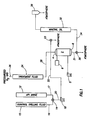
- FIG. 1 the test equipment used in this example is illustrated.
- a synthetic core prepared as described above, was fitted into a rubber sleeve (not shown), inserted into a metal receptacle (not shown), and mounted in a Hassler sleeve test cell 2, having one end thereof designated as the well bore side 4 and one end thereof designated as the formation side 6.
- the synthetic core was mounted so that the wider end of the simulated fracture faced well bore side 4.
- the pressure on well bore side 4 of test cell 2 was measured by a pressure transducer 8 mounted on well bore side 4 of test cell 2.
- the metal cylinder containing the core inside the rubber sleeve was connected to a pump 5 with which a desired pressure was applied on the rubber sleeve to achieve an impermeable fit between the core and the rubber sleeve.
- the test cell 2 also was connected to a thermostat (not shown) to control the temperature during testing.
- a drilling fluid reservoir 10 and a brine reservoir 12 were provided, and the bottoms of these two reservoirs were connected to a three-way valve 14 by conduits 16 and 17, respectively.
- Drilling fluid reservoir 10 contained a control drilling fluid
- brine reservoir 12 contained an API brine.
- the outlet of three-way valve 14 was connected to the inlet of a pump 18 by conduit 20.
- Pump 18 had a programmable flow rate and pressure.
- the outlet of pump 18 was connected to the entrance of well bore side 4 of test cell 2 by a conduit 22.
- conduit 22 was connected to valve 23, which was connected to atmosphere.
- sample reservoir 24 was also provided, and the top of sample reservoir 24 was connected to a source of pressurized nitrogen, generally designated by numeral 26.
- Sample reservoir 24 contained a sample loss circulation treatment fluid
- the bottom outlet of sample reservoir 24 was optionally connected to the top of the entrance of well bore side 4 of test cell 2 by a conduit 28.
- Test cell 2 had a three-way design to connect sample reservoir 24 to test cell 2 by conduit 28 without having to disconnect conduit 22.
- the exit of formation side 6 of test cell 2 was connected to a three-way valve 30 by conduit 31.
- One outlet connection of three-way valve 30 was connected to atmosphere.
- the other outlet connection of three-way valve 30 was connected to the bottom of an oil reservoir 32 that contained a mineral oil by conduit 34.
- the top of oil reservoir 32 was connected to a back pressure regulator 36, the pressure of which was adjusted with nitrogen pressure.
- the other side of back pressure regulator 36 was connected to atmosphere.
- the test procedure was designed to determine the ability of a loss circulation composition to withhold pressure applied from a drilling fluid when applied on the wider end of the simulated fracture, as described in the Forward Flow Procedure listed below. Additionally, if the loss circulation composition withstood the pressure during the forward flow procedure, the ability of the loss circulation composition to withstand pressure applied from formation fluids was determined, as described in the Reverse Flow Procedure listed below.
- pump 18 was used to pass the control drilling fluid from drilling fluid reservoir 10 through the synthetic core within test sleeve 2, from well bore side 4 to formation side 6.
- Three-way valve 30 was open to atmosphere. Once the synthetic core was wet with the control drilling fluid, the pump 18 was stopped, and the three-way design into test cell 2 at well bore side 4 was altered to allow for drilling fluid flow from conduit 28 through which the sample reservoir 24 was connected to test cell 2. The three-way design restricted flow back into conduit 22.
- the sample loss circulation treatment fluid (sealant composition) was then prepared by adding the components thereof into a separate beaker (directly into sample reservoir 24 if it the fluid viscosified too quickly) and was stirred for about one minute with a spatula.
- sample loss circulation treatment fluid was charged into sample reservoir 24.
- pressure from the source of pressurized nitrogen 26 was used to push the loss circulation treatment fluid through the synthetic core within test sleeve 2, from well bore side 4 to formation side 6.
- the loss circulation treatment fluid was pushed through the synthetic core until it extruded though the formation side 6 of test cell 2.
- the loss circulation composition within the sample loss circulation treatment fluid plugged the simulated fracture of the synthetic core, which was indicated by stoppage of fluid drainage with minimum applied pressure of about 3.4 x 10 6 Nm -2 (500 psi).
- test cell 2 was disconnected from conduit 28 and conduit 31, and any solid on the face or bottom of the synthetic core or any conduits was cleaned. Once cleaned, test cell 2 was reconnected to conduit 31 and conduit 22 so that the outlet of pump 18 was connected to test cell 2.
- pump 18 was used to pump the control drilling fluid from drilling fluid reservoir 10 to fill conduit 22 with the control drilling fluid. Also, conduit 31 and conduit 34 were filled with mineral oil from oil reservoirs 32 by controlling three-way valve 30, after which three-way valve 30 was closed to atmosphere.
- the drilling fluid in drilling fluid reservoir 10 and test cell 2 were heated to 71° (160° F). After a desired time, usually 90 minutes, at 71°C (160° F), pump 18 was set at a flow rate of 2 milliliters per minute (ml/min) and a pressure of 6.8 x 10 5 Nm -2 (100 psi). In addition, a back pressure of 6.8 x 10 5 Nm -2 (100 psi) was applied to back pressure regulator 36 with nitrogen gas.
- pump 5 was used to apply a pressure on the rubber sleeve of 2.1 x 10 6 nM -2 (300 psi) to about 4.1 x 10 6 Nm -2 (600 psi) higher than the pressure applied by pump on well bore side 4.
- the pressure at the face of the synthetic core on well bore side 4 of test cell 2 was measured using pressure transducer 8. If the loss circulation composition withstood the initial pressure, the pressure applied to well bore side 4 (using pump 18) and the pressure applied to the rubber sleeve (using pump 5) were steadily increased in 6.8 x 10 5 Nm -2 (100 psi) increments up to the maximum operating pressure of test cell 2 while observing the flow rate of oil dripping through back pressure regulator 36.
- test cell 2 was reversed within the system, as shown in Figure 2 . Accordingly, pump 18 was connected to the formation side 6 of test cell 2 by conduit 22. Likewise, well bore side 4 was connected to three-way valve 30 by conduit 31. Also, pressure transducer 8 was positioned to measure the pressure on formation side 6 of test cell 2.
- pump 18 was used to flush any of the control drilling fluid in conduit 22 through valve 23 to atmosphere.
- pump 18 was set to provide the API brine to the formation side 6 of test cell 2 at a flow rate of 2 ml/min and a pressure of 6.8 x 10 5 Nm -2 (100 psi). In some tests, pump 18 provided the control drilling fluid. Because test cell 2 was reversed, the pressure from the API brine was applied to the narrow end of the simulated fracture in the synthetic core. In addition, 6.8 x 10 5 Nm -2 (100 psi) was applied to back pressure regulator 36 with nitrogen gas.
- pump 5 was used to apply a pressure on the rubber sleeve of 2.1 x 10 6 Nm -2 (300 psi) to 4.1 x 10 6 Nm -2 (600 psi) higher than that applied by pump 18' on formation side 6.
- the pressure at the face of the synthetic core on formation side 6 of test cell 2 was measured using pressure transducer 8. If the loss circulation composition withstood the initial pressure, the pressure applied to it by the API brine (using pump 18) and the pressure applied to the rubber sleeve (using pump 5) were steadily increased in 6.8 x 10 5 Nm -2 (100 psi) increments up to the maximum operating pressure of test cell 2 while the flow rate of oil dripping through back pressure regulator 36 was observed.
- tests were performed on a variety of sample lost circulation treatment fluids comprising a drilling fluid and particulates using the procedure described above.
- the control drilling fluid was a synthetic oil-based drilling fluid that is commercially available under the trademark PETROFREE fluid from Baroid Drilling Fluids, Houston, Texas. Additionally, an oil wetting lecithin-based agent was added to the control drilling fluid in an amount of 7.6 grams per litre (2 pounds per barrel) of the drilling fluid.
- the oil wetting lecithin-based agent is commercially available as DRILTREAT additive from Baroid Drilling Fluids, Houston, Texas.
- An additional additive is an emulsifier that is commercially available as EZ MUL NT from Baroid Drilling Fluids, Houston, Texas, which was also added to the control drilling fluid in an amount of 22.8 grams per litre (6 pounds per barrel) of the drilling fluid to improve the oil wetting ability of the control drilling fluid.
- the control drilling fluid prepared as described above, was mixed with particles of the type and amount shown in Table H. Referring now to Figure 3 , a graphical illustration of the percent volume change per unit particle size increase versus particle size is shown for the control drilling mud, Sample Lost Circulation Treatment Fluid No. 2, and Sample Lost Circulation Treatment Fluid No. 3. TABLE II Component Control Drilling Fluid Sample Lost Circulation Treatment Fluid No.
- results illustrate that varying the particle size distribution within a lost circulation treatment fluid may improve the ability of the lost circulation treatment fluid to prevent Circulation losses to different degrees but may be inadequate to withstand imposed pressures due to the fluid pressures from the wellbore or the formation.
- control drilling fluid was a synthetic oil-based drilling fluid of 1.44 kg per litre (12 ppg) that is commercially available as PETROFREE fluid from Baroid Drilling Fluids, Houston, Texas.
- PETROFREE fluid commercially available as PETROFREE fluid from Baroid Drilling Fluids, Houston, Texas.
- the control drilling fluid prepared as described above, was mixed with particles of the type and amount shown in Table IV. TABLE IV Component Control Drilling Fluid Sample Lost Circulation Treatment Fluid No. 3 1 No. 4 2 No.
- tests were performed to compare the effectiveness of the latex compositions for their ability to provide not only loss circulation prevention but for their ability to withstand applied pressures.
- the tests compared the pressure sustainability of a conventional composition comprising latex (LATEX 2000, a styrene-butadiene latex available from Halliburton Energy Services, Inc.) and drilling mud (Runs 1 and 2), with sealant compositions having an increased viscosity comprising alkali swellable latex and drilling fluid (Runs 3-5).
- Run 3 was prepared with an inadequate amount of pH increasing material, which was 1.4g of sodium carbonate.
- Run 4 was prepared with a sufficient amount of pH increasing material, which was 10 g of sodium phosphate.
- Run 5 was prepared with a sufficient amount of pH increasing material, which was 4g of sodium phosphate, and particulate additions.
- the tests simulated the mixing downhole of a latex stream with a drilling fluid plus pH increasing material stream to form the composition of each Run by mixing the two fluids before treating the fracture, as described in detail below.
- the particulates were added to the drilling fluid to simulate addition of incorporating particulates in the drilling fluid prior to contacting with the fluid containing the alkali swellable latex.
- the formulations for the sealant compositions Run 1 through Run 5 are in Table VI.
- the drilling fluid stream used for each Run comprised of clay-free synthetic based ACCOLADE plus 5% by weight REV DUST, commercially available from Baroid Drilling Fluids, Houston, Texas.
- REV DUST commercially available from Baroid Drilling Fluids, Houston, Texas.
- an equal volume of 35 cc drilling fluid and 35 cc latex based fluid was mixed in forming the final composition.
- the composition of each Run was provided to treat a fracture of 3 mm on the wellbore side and either 1 mm (Runs 1, 3, and 4) or 2 mm (Runs 2 and 5) on the formation side.
- the procedures of Example 1 were followed to determine the maximum pressure to dislodge the final composition.
- the results are in Table VI.
- the Runs using conventional latex provided lower pressure containment pressures than sealant compositions with sufficient or optimal amounts of pH increasing material (Runs 4 and 3).
- increasing the viscosity of alkali swellable latex with pH increasing material allowed for higher sustainable pressures in the wellbore than that of alkali swellable latex with an insufficient amount of pH increasing material (Run 3), which shows that if there is an insufficient amount of pH increasing material then the alkali swellable latex may not have the ability to viscosity, conglomerate, and form a seal in the fracture.
- a combination of particulates of suitable particle size distribution and alkali swellable latex are effective in providing improved pressure sustainability for wider fractures.
- Example II provided a comparison of sealant material strength for different amounts of pH increasing material (sodium carbonate). Each formulation provided an aqueous fluid, drilling fluid, and an observed sealant material strength. Table VII shows the composition of the aqueous fluid and drilling fluid and also the observed results. The strength of the sealant material was estimated by hand stretching and squeezing of the material.
- Tests were conducted to study the effectiveness of a variety of organic, inorganic and polymeric pH increasing materials. Their effectiveness was compared by manually testing the viscous product for its physical strength. The results are summarized in Tables VIII and IX.
- the pH increasing materials indicated in Tables VIII and IX were added to the mixture and briefly stirred with a spatula. The mixture was kept in an oven at 71°C (160°F) for 3 hrs, and the resulting material was manually tested for its physical properties.
- a 1870 g/L (15.6 pounds per gallon) clement slurry was prepared with Class A cement, water (44% water by weight of cement) and TYCHEM 68710 latex (0.30 gallons per sack of cement or 1.1% solid latex polymer content by weight of cement) according to American Petroleum Institute (API) Recommended Practice 10B, 22nd Edition 1997 .
- the fluid loss of the slurry was determined at room temperature according to API 10 procedure described in the preceding reference. The fluid loss was measured as 42 ml/10 sec, which is calculated to be 1170 ml/30 min.
- a control slurry with cement and water typically showed a calculated API fluid loss of 1600 ml/30 min.
- the mechanical property modification of cement compositions by the alkali swellable latex was measured by comparing the mechanical properties of a control slurry prepared using Class H cement and water with those containing the latex materials.
- the control slurry was prepared by API Specification mentioned in Example IV.
- the latex slurry was prepared by adding a defoamer, DAIR 3000L, the stabilizing surfactant STABILIZER 434C (10% by volume of the latex) and the latex to the mix water followed by addition of cement with agitation at 1,000 rpm for 45 seconds.
- the slurries were poured into tensile dog-bone shaped briquettes according to the procedure described for the test CRD-C260-01 in the U.S.
- the slurry was also poured into 2"x5" cylindrical brass molds to perform load versus displacement studies under unconfined conditions using MTS load frame equipment manufactured by MTS Systems Corporation of Eden Prairies, Minnesota according to ASTM D3148-02 (Standard Test Method for Elastic Moduli of Intact Rock Core in Uniaxial Compression).
- the cylindrical samples and the tensile briquettes were cured in an autoclave at 87.7°C (190°F) under a pressure of 2.1 x 10 7 Nm -2 (3,000 psi) for 72 hrs.
- the tensile strengths were measured on a Tinius Olsen Strength Tester equipment. The results are presented in Table X.
Landscapes
- Chemical & Material Sciences (AREA)
- Life Sciences & Earth Sciences (AREA)
- General Life Sciences & Earth Sciences (AREA)
- Engineering & Computer Science (AREA)
- Materials Engineering (AREA)
- Organic Chemistry (AREA)
- Inorganic Chemistry (AREA)
- Sealing Material Composition (AREA)
Claims (43)
- Composition d'étanchéité à utiliser dans un puits, comprenant : un latex gonflable alcalin et un matériau augmentant le pH, dans laquelle la composition d'étanchéité a un pH de 7 à 14.
- Composition d'étanchéité selon la revendication 1, dans laquelle la composition d'étanchéité comprend un pH de 8 à 13.
- Composition d'étanchéité selon la revendication 1, dans laquelle la composition d'étanchéité comprend un pH de 9 à 13.
- Composition d'étanchéité selon la revendication 1, dans laquelle le latex gonflable alcalin comprend en outre un monomère éthyléniquement insaturé, contenant au moins un groupe fonctionnel d'acide carboxylique.
- Composition d'étanchéité selon la revendication 4, dans laquelle le monomère éthyléniquement insaturé, contenant au moins un groupe fonctionnel carboxylique, est présent dans la composition d'étanchéité dans une quantité de 5 à 30% en poids des monomères utilisés dans la préparation du latex gonflable alcalin.
- Composition d'étanchéité selon la revendication 1, dans laquelle le latex gonflable alcalin comprend un monomère aromatique de vinyle, un éthylène, un butadiène, un vinylnitrile, un ester oléfiniquement insaturé d'alcool en C1-C8, ou des combinaisons de ceux-ci.
- Composition d'étanchéité selon la revendication 1, dans laquelle le latex gonflable alcalin comprend un agent de réticulation.
- Composition d'étanchéité selon la revendication 7, dans laquelle les agents de réticulation comprennent des agents de vulcanisation, des accélérateurs de vulcanisation, des retardateurs de vulcanisation, des agents anti-mousse, ou des combinaisons de ceux-ci.
- Composition d'étanchéité selon la revendication 1, dans laquelle le latex gonflable alcalin comprend de 0,1 à 5% en poids d'un agent de réticulation en poids de monomère.
- Composition d'étanchéité selon la revendication 1, dans laquelle le latex gonflable alcalin est préparé par polymérisation par émulsion.
- Composition d'étanchéité selon la revendication 1, dans laquelle le matériau augmentant le pH comprend un matériau producteur de base, un ciment, ou des combinaisons de ceux-ci.
- Composition d'étanchéité selon la revendication 1, dans laquelle le matériau augmentant le pH comprend un matériau producteur de base, et dans laquelle le matériau producteur de base comprend des carbonates de métal alcalin et alcalino-terreux, des bicarbonates de métal alcalin et alcalino-terreux, des hydroxydes de métal alcalin et alcalino-terreux, des oxydes de métal alcalin et alcalino-terreux, des phosphates de métal alcalin et alcalino-terreux, des phosphates d'hydrogène de métal alcalin et alcalino-terreux, des sulfures de métal alcalin et alcalino-terreux, des sels de silicates de métal alcalin et alcalino-terreux, des sels d'aluminates de métal alcalin et alcalino-terreux, des amines organiques dispersibles dans l'eau ou solubles dans l'eau, des amines polymères, des amino-alcools, ou des combinaisons de ceux-ci.
- Composition d'étanchéité selon la revendication 1, dans laquelle la composition d'étanchéité comprend une résine thermodurcissable.
- Composition d'étanchéité selon la revendication 13, dans laquelle la résine thermodurcissable comprend une résine amino, une résine phénolique, une résine de furfural, ou des combinaisons de celles-ci.
- Composition d'étanchéité selon la revendication 1, dans laquelle la composition d'étanchéité comprend en outre un tensioactif.
- Composition d'étanchéité selon la revendication 1, dans laquelle la composition d'étanchéité comprend en outre un agent anti-mousse.
- Composition d'étanchéité selon la revendication 1, dans laquelle le matériau augmentant le pH comprend un ciment, et dans laquelle le ciment comprend un ciment hydraulique.
- Composition d'étanchéité selon la revendication 17, dans laquelle le ciment hydraulique comprend un ciment Portland, un ciment de pouzzolane, un ciment de gypse, un ciment de phosphate, un ciment à forte teneur en alumine, un ciment de silice, un ciment fortement alcalin, un ciment de magnésie, ou des combinaisons de ceux-ci.
- Composition d'étanchéité selon la revendication 1, comprenant en outre une réduction de la perte de fluide du ciment.
- Composition d'étanchéité selon la revendication 1, comprenant en outre l'augmentation de la résistance à la traction, la réduction du module d'élasticité du ciment, la réduction de la fragilité du ciment, ou des combinaisons de celles-ci.
- Composition d'étanchéité selon la revendication 1, dans laquelle la composition d'étanchéité comprend en outre un matériau absorbant un fluide, un matériau particulaire, un super-absorbant, un agent de viscosification, un latex gonflable non-alcalin, ou des combinaisons de ceux-ci.
- Composition d'étanchéité selon la revendication 1, dans laquelle la composition d'étanchéité comprend en outre un matériau absorbeur de fluide et dans laquelle le matériau absorbeur de fluide comprend une argile organophile, une argile gonflable dans l'eau, un minéral absorbant l'eau, un minéral absorbant l'huile ou des combinaisons de ceux-ci.
- Composition d'étanchéité selon la revendication 1, dans laquelle la composition d'étanchéité comprend en outre du matériau particulaire et en outre dans laquelle la composition d'étanchéité comprend une première partie de matériau particulaire ayant une taille de particules moyenne en poids inférieure à 20 microns, une seconde partie de matériau particulaire ayant une taille de particule moyenne en poids comprise entre 25 microns et 400 microns et une troisième partie de matériau particulaire ayant une taille de particules moyenne en poids comprise entre 450 microns et 1500 microns.
- Composition d'étanchéité selon la revendication 23, dans laquelle au moins 20% en poids de la composition d'étanchéité comprend du matériau particulaire comprenant des particules élastiques, des particules laminées de polymère thermodurci, ou des combinaisons de celles-ci.
- Composition d'étanchéité selon la revendication 1, dans laquelle la composition d'étanchéité comprend des matériaux particulaires dans une quantité comprise entre 5 et 35% en poids de la composition d'étanchéité.
- Composition d'étanchéité selon la revendication 1, dans laquelle la composition d'étanchéité comprend un super-absorbant, et dans laquelle le super-absorbant comprend un polyacrylamide réticulé ; un polyacrylate réticulé ; un polyacrylonitrile hydrolysé réticulé ; un sel d'amidon de carboxyalkyle ; un sel de carboxyalkylcellulose ; un sel de n'importe quel polysaccharide de carboxyalkyle réticulé ; un copolymère réticulé de monomères d'acrylamide et d'acrylate ; un amidon greffé avec des monomères d'acrylonitrile et d'acrylate ; un polymère réticulé de deux éléments ou plus parmi l'allylsulfonate, l'acide 2-acrylamido-2-méthyl-1-propanesulfonique, l'acide 3-allyloxy-2-hydroxyl-1-propane-sulfonique, l'acrylamide, et les monomères d'acide acrylique ; ou des combinaisons de ceux-ci.
- Composition d'étanchéité selon la revendication 1, dans laquelle la composition d'étanchéité comprend en outre un agent de viscosification.
- Composition d'étanchéité selon la revendication 1, dans laquelle la composition d'étanchéité comprend en outre un latex gonflable non-alcalin.
- Composition d'étanchéité selon la revendication 1, comprenant en outre un fluide de forage.
- Procédé d'entretien d'un puits en contact avec une formation souterraine, comprenant : le placement d'un latex gonflable alcalin et d'un matériau augmentant le pH dans le puits pour former une composition d'étanchéité.
- Procédé selon la revendication 30, dans lequel la composition d'étanchéité est comme définie dans l'une quelconque des revendications 1 à 29.
- Procédé selon la revendication 30 ou 31, dans lequel la composition d'étanchéité est positionnée dans le puits, de façon à isoler la formation souterraine d'une partie du puits, pour supporter un conduit dans le puits, pour boucher un vide ou une craquelure dans le conduit, pour boucher un vide ou une craquelure dans une gaine de ciment disposée dans une couronne du puits, pour boucher une ouverture entre la gaine de ciment et le conduit, pour atténuer une perte de fluides de forage aqueux ou non-aqueux, dans des zones de circulation à perte, pour être utilisée comme fluide face à une pâte de ciment, ou pour sceller une couronne entre le puits et un conduit ou une chaîne de conduit extensible.
- Procédé selon les revendications 30 ou 31, comprenant en outre la combinaison du latex gonflable alcalin et du matériau augmentant le pH près d'une zone de circulation de perte, pour former la composition d'étanchéité dans la zone de circulation de perte.
- Procédé selon les revendications 30 ou 31, comprenant en outre l'introduction du matériau augmentant le pH et un fluide de forage ou un fluide de support inerte séparé dans le puits dans un chemin d'écoulement séparé du latex gonflable alcalin.
- Procédé selon les revendications 30 ou 31, comprenant en outre l'introduction du matériau augmentant le pH et du latex gonflable alcalin dans le puits dans un chemin d'écoulement.
- Procédé selon la revendication 33, comprenant en outre l'encapsulation du matériau augmentant le pH.
- Procédé selon la revendication 30, comprenant en outre la mise en contact du latex gonflable alcalin avec le matériau augmentant le pH pour former la composition d'étanchéité, dans lequel le matériau augmentant le pH augmente la viscosité de la composition d'étanchéité.
- Procédé selon la revendication 37, dans lequel une quantité suffisante de matériau augmentant le pH est mise en contact avec le latex gonflable alcalin pour augmenter la viscosité du latex gonflable alcalin.
- Procédé selon la revendication 37, dans lequel une quantité suffisante du matériau augmentant le pH est mise en contact avec le latex gonflable alcalin pour fournir la composition d'étanchéité ayant un pH d'environ 7 à environ 14.
- Procédé selon la revendication 37, dans lequel une quantité suffisante du matériau augmentant le pH est mise en contact avec le latex gonflable alcalin pour fournir la composition d'étanchéité ayant un pH d'environ 8 à environ 13.
- Procédé selon la revendication 37, comprenant en outre l'introduction de latex gonflable alcalin et le matériau augmentant le pH dans le puits dans des chemins d'écoulement séparés.
- Procédé selon la revendication 37, comprenant en outre l'introduction du latex gonflable alcalin et du matériau augmentant le pH dans le puits dans un chemin d'écoulement.
- Procédé selon la revendication 42, dans lequel le matériau augmentant le pH est encapsulé.
Applications Claiming Priority (2)
| Application Number | Priority Date | Filing Date | Title |
|---|---|---|---|
| US11/010,117 US7488705B2 (en) | 2004-12-08 | 2004-12-08 | Oilwell sealant compositions comprising alkali swellable latex |
| PCT/GB2005/004455 WO2006061561A1 (fr) | 2004-12-08 | 2005-11-18 | Compositions d’etancheite pour puits de petrole, comprenant du latex gonflant en presence d’alcalis |
Publications (2)
| Publication Number | Publication Date |
|---|---|
| EP1853680A1 EP1853680A1 (fr) | 2007-11-14 |
| EP1853680B1 true EP1853680B1 (fr) | 2010-04-07 |
Family
ID=36096176
Family Applications (1)
| Application Number | Title | Priority Date | Filing Date |
|---|---|---|---|
| EP05807415A Expired - Lifetime EP1853680B1 (fr) | 2004-12-08 | 2005-11-18 | Compositions d'etancheite pour puits de petrole, comprenant du latex gonflant en pressence d'alcalis |
Country Status (7)
| Country | Link |
|---|---|
| US (2) | US7488705B2 (fr) |
| EP (1) | EP1853680B1 (fr) |
| BR (1) | BRPI0517496A (fr) |
| CA (1) | CA2590169C (fr) |
| DE (1) | DE602005020518D1 (fr) |
| MX (1) | MX2007006891A (fr) |
| WO (1) | WO2006061561A1 (fr) |
Cited By (6)
| Publication number | Priority date | Publication date | Assignee | Title |
|---|---|---|---|---|
| RU2491315C1 (ru) * | 2012-02-08 | 2013-08-27 | Открытое акционерное общество "Татнефть" имени В.Д. Шашина | Состав для изоляции вод в скважине |
| US8557036B1 (en) | 2012-11-09 | 2013-10-15 | Halliburton Energy Services, Inc. | Settable compositions comprising wollastonite and pumice and methods of use |
| US9006155B2 (en) | 2005-09-09 | 2015-04-14 | Halliburton Energy Services, Inc. | Placing a fluid comprising kiln dust in a wellbore through a bottom hole assembly |
| US9051505B2 (en) | 2005-09-09 | 2015-06-09 | Halliburton Energy Services, Inc. | Placing a fluid comprising kiln dust in a wellbore through a bottom hole assembly |
| US9150773B2 (en) | 2005-09-09 | 2015-10-06 | Halliburton Energy Services, Inc. | Compositions comprising kiln dust and wollastonite and methods of use in subterranean formations |
| US9376609B2 (en) | 2010-12-21 | 2016-06-28 | Halliburton Energy Services, Inc. | Settable compositions comprising interground perlite and hydraulic cement |
Families Citing this family (185)
| Publication number | Priority date | Publication date | Assignee | Title |
|---|---|---|---|---|
| US6951250B2 (en) | 2003-05-13 | 2005-10-04 | Halliburton Energy Services, Inc. | Sealant compositions and methods of using the same to isolate a subterranean zone from a disposal well |
| US7607482B2 (en) | 2005-09-09 | 2009-10-27 | Halliburton Energy Services, Inc. | Settable compositions comprising cement kiln dust and swellable particles |
| US7607483B2 (en) | 2004-04-19 | 2009-10-27 | Halliburton Energy Services, Inc. | Sealant compositions comprising colloidally stabilized latex and methods of using the same |
| US7488705B2 (en) | 2004-12-08 | 2009-02-10 | Halliburton Energy Services, Inc. | Oilwell sealant compositions comprising alkali swellable latex |
| US20070111900A1 (en) * | 2005-11-11 | 2007-05-17 | Reddy B R | Sealant compositions comprising solid latex |
| US20070111901A1 (en) | 2005-11-11 | 2007-05-17 | Reddy B R | Method of servicing a wellbore with a sealant composition comprising solid latex |
| US8703659B2 (en) * | 2005-01-24 | 2014-04-22 | Halliburton Energy Services, Inc. | Sealant composition comprising a gel system and a reduced amount of cement for a permeable zone downhole |
| US7267174B2 (en) * | 2005-01-24 | 2007-09-11 | Halliburton Energy Services, Inc. | Methods of plugging a permeable zone downhole using a sealant composition comprising a crosslinkable material and a reduced amount of cement |
| US7350573B2 (en) * | 2005-02-09 | 2008-04-01 | Halliburton Energy Services, Inc. | Servicing a wellbore with wellbore fluids comprising perlite |
| US7316275B2 (en) * | 2005-03-17 | 2008-01-08 | Bj Services Company | Well treating compositions containing water superabsorbent material and method of using the same |
| US7905287B2 (en) * | 2005-04-19 | 2011-03-15 | Halliburton Energy Services Inc. | Methods of using a polymeric precipitate to reduce the loss of fluid to a subterranean formation |
| US7943555B2 (en) * | 2005-04-19 | 2011-05-17 | Halliburton Energy Services Inc. | Wellbore treatment kits for forming a polymeric precipitate to reduce the loss of fluid to a subterranean formation |
| GB2427630B (en) * | 2005-06-30 | 2007-11-07 | Schlumberger Holdings | Methods and materials for zonal isolation |
| US7833945B2 (en) * | 2005-07-15 | 2010-11-16 | Halliburton Energy Services Inc. | Treatment fluids with improved shale inhibition and methods of use in subterranean operations |
| US7607484B2 (en) | 2005-09-09 | 2009-10-27 | Halliburton Energy Services, Inc. | Foamed cement compositions comprising oil-swellable particles and methods of use |
| US7617870B1 (en) | 2008-05-14 | 2009-11-17 | Halliburton Energy Services, Inc. | Extended cement compositions comprising oil-swellable particles and associated methods |
| US7650940B2 (en) * | 2005-12-29 | 2010-01-26 | Halliburton Energy Services Inc. | Cement compositions comprising particulate carboxylated elastomers and associated methods |
| US7645817B2 (en) * | 2005-12-29 | 2010-01-12 | Halliburton Energy Services, Inc. | Cement compositions comprising particulate carboxylated elastomers and associated methods |
| US8235119B2 (en) * | 2006-03-30 | 2012-08-07 | Canadian Energy Services, Lp | Drilling fluid and method for reducing lost circulation |
| US20070227728A1 (en) * | 2006-03-30 | 2007-10-04 | Chambers Don E | Method and lightweight composition for sealing pipe and wellbores |
| US7520327B2 (en) * | 2006-07-20 | 2009-04-21 | Halliburton Energy Services, Inc. | Methods and materials for subterranean fluid forming barriers in materials surrounding wells |
| RU2324811C1 (ru) * | 2006-09-22 | 2008-05-20 | Шлюмберже Текнолоджи Б.В. | Способ повышения продуктивности скважин (варианты) |
| US7665538B2 (en) * | 2006-12-13 | 2010-02-23 | Schlumberger Technology Corporation | Swellable polymeric materials |
| GB2445285B (en) * | 2006-12-27 | 2010-09-15 | Schlumberger Holdings | Rheology modifier for cement slurries |
| US7763572B2 (en) * | 2007-01-11 | 2010-07-27 | Halliburton Energy Services, Inc. | Compositions comprising quaternary material and sorel cements |
| US7431086B2 (en) * | 2007-01-11 | 2008-10-07 | Halliburton Energy Services, Inc. | Methods of servicing a wellbore with compositions comprising quaternary material and sorel cements |
| US7893011B2 (en) * | 2007-01-11 | 2011-02-22 | Halliburton Energy Services Inc. | Compositions comprising Sorel cements and oil based fluids |
| EP2102130B1 (fr) * | 2007-01-11 | 2015-03-18 | Halliburton Energy Services, Inc. | Compositions comprenant des ciments sorel et des liquides à base d'huile et procédé d'entretien de puits de forage faisant appel à ces derniers |
| ATE474031T1 (de) * | 2007-04-06 | 2010-07-15 | Schlumberger Services Petrol | Verfahren und zusammensetzung zur zonenisolierung eines bohrlochs |
| US9393602B2 (en) * | 2007-05-04 | 2016-07-19 | Solutions-Ies Inc. | In situ PH adjustment for soil and groundwater remediation |
| US9206344B2 (en) | 2007-05-10 | 2015-12-08 | Halliburton Energy Services, Inc. | Sealant compositions and methods utilizing nano-particles |
| US8685903B2 (en) | 2007-05-10 | 2014-04-01 | Halliburton Energy Services, Inc. | Lost circulation compositions and associated methods |
| US9199879B2 (en) | 2007-05-10 | 2015-12-01 | Halliburton Energy Serives, Inc. | Well treatment compositions and methods utilizing nano-particles |
| US8586512B2 (en) | 2007-05-10 | 2013-11-19 | Halliburton Energy Services, Inc. | Cement compositions and methods utilizing nano-clay |
| US8476203B2 (en) | 2007-05-10 | 2013-07-02 | Halliburton Energy Services, Inc. | Cement compositions comprising sub-micron alumina and associated methods |
| US9512351B2 (en) | 2007-05-10 | 2016-12-06 | Halliburton Energy Services, Inc. | Well treatment fluids and methods utilizing nano-particles |
| US8728989B2 (en) | 2007-06-19 | 2014-05-20 | Clearwater International | Oil based concentrated slurries and methods for making and using same |
| WO2009006731A1 (fr) * | 2007-07-06 | 2009-01-15 | Canadian Energy Services L.P. | Additif de fluide de forage destiné à réduire les pertes de circulation dans une opération de forage |
| WO2009019471A1 (fr) * | 2007-08-08 | 2009-02-12 | Halliburton Energy Services, Inc. | Compositions d'étanchéité et procédés d'utilisation |
| AU2013204279B2 (en) * | 2007-08-08 | 2014-11-13 | Halliburton Energy Services, Inc. | Sealant compositions and methods of use |
| US20090038801A1 (en) * | 2007-08-08 | 2009-02-12 | Ravi Krishna M | Sealant Compositions and Methods of Use |
| US8276666B2 (en) * | 2007-08-08 | 2012-10-02 | Halliburton Energy Services Inc. | Sealant compositions and methods of use |
| US8851178B2 (en) * | 2007-10-12 | 2014-10-07 | Schlumberger Technology Corporation | System and method for fracturing while drilling |
| EP2071003A1 (fr) * | 2007-12-12 | 2009-06-17 | Services Pétroliers Schlumberger | Composition de compression pour la restauration d'isolation |
| CN100535076C (zh) * | 2008-01-17 | 2009-09-02 | 中国矿业大学 | 一种钻孔密封材料 |
| US7530396B1 (en) | 2008-01-24 | 2009-05-12 | Halliburton Energy Services, Inc. | Self repairing cement compositions and methods of using same |
| US7740066B2 (en) * | 2008-01-25 | 2010-06-22 | Halliburton Energy Services, Inc. | Additives for high alumina cements and associated methods |
| DE102008010795A1 (de) * | 2008-02-23 | 2009-08-27 | Basf Construction Polymers Gmbh | Additiv zum Zementieren von Bohrlöchern |
| US8043997B2 (en) * | 2008-02-29 | 2011-10-25 | Halliburton Energy Services Inc. | Lost circulation material formulation and method of use |
| RU2511444C2 (ru) * | 2008-04-21 | 2014-04-10 | Налко Компани | Композиция и способ отвода закачиваемых флюидов для достижения улучшенной добычи углеводородных флюидов |
| WO2009138889A1 (fr) * | 2008-05-15 | 2009-11-19 | Schlumberger Canada Limited | Réparation de puits à l'aide d'un matériau gonflable dans une matrice de réparation |
| CA2752352C (fr) * | 2008-06-03 | 2017-06-27 | Relborgn Pty Ltd; And Triomviri Pty Ltd Trading As The Grobler Partnership | Procede et composition pour etancheifier des passages |
| CN101659861B (zh) * | 2008-08-29 | 2012-12-12 | 中国石油天然气股份有限公司 | 一种石油磺酸盐驱油剂的制备方法 |
| EP2192094A1 (fr) * | 2008-11-27 | 2010-06-02 | Services Pétroliers Schlumberger | Compositions de résine aqueuses et procédés de réparation du ciment |
| GB2478096B (en) | 2008-12-19 | 2013-03-20 | Schlumberger Holdings | Drilling apparatus |
| US20100184630A1 (en) * | 2009-01-16 | 2010-07-22 | Sullivan Philip F | Breaking the rheology of a wellbore fluid by creating phase separation |
| US7762329B1 (en) | 2009-01-27 | 2010-07-27 | Halliburton Energy Services, Inc. | Methods for servicing well bores with hardenable resin compositions |
| MX2011008001A (es) * | 2009-01-30 | 2011-09-15 | Mi Llc | Pildoras desfluidizantes para perdida de circulacion. |
| US7934554B2 (en) * | 2009-02-03 | 2011-05-03 | Halliburton Energy Services, Inc. | Methods and compositions comprising a dual oil/water-swellable particle |
| US20100270016A1 (en) * | 2009-04-27 | 2010-10-28 | Clara Carelli | Compositions and Methods for Servicing Subterranean Wells |
| US7792250B1 (en) | 2009-04-30 | 2010-09-07 | Halliburton Energy Services Inc. | Method of selecting a wellbore cement having desirable characteristics |
| US7923413B2 (en) | 2009-05-19 | 2011-04-12 | Schlumberger Technology Corporation | Lost circulation material for oilfield use |
| US20100300928A1 (en) * | 2009-05-29 | 2010-12-02 | Dow Global Technologies Inc. | Aqueous compositions for enhanced hydrocarbon fluid recovery and methods of their use |
| CN101649193B (zh) * | 2009-06-18 | 2012-03-14 | 东营泰尔石油技术有限公司 | 可压缩高弹性堵漏剂 |
| EP2298848B1 (fr) | 2009-08-28 | 2017-10-11 | Services Pétroliers Schlumberger | Procédé d'entretien de puits souterrains |
| US8157009B2 (en) | 2009-09-03 | 2012-04-17 | Halliburton Energy Services Inc. | Cement compositions and associated methods comprising sub-micron calcium carbonate and latex |
| US8408303B2 (en) * | 2009-09-24 | 2013-04-02 | Halliburton Energy Services, Inc. | Compositions for improving thermal conductivity of cement systems |
| US9708523B2 (en) * | 2009-10-27 | 2017-07-18 | Halliburton Energy Services, Inc. | Swellable spacer fluids and associated methods |
| US8905136B2 (en) | 2010-06-11 | 2014-12-09 | Halliburton Energy Services, Inc. | Far field diversion technique for treating subterranean formation |
| US8720568B2 (en) | 2010-06-11 | 2014-05-13 | Halliburton Energy Services, Inc. | Swellable/degradable “sand” plug system for horizontal wells |
| US9441147B2 (en) | 2010-07-09 | 2016-09-13 | Halliburton Energy Services, Inc. | Hybrid cement set-on-command compositions |
| US8770291B2 (en) * | 2010-07-09 | 2014-07-08 | Halliburton Energy Services, Inc. | Hybrid cement set-on-command compositions and methods of use |
| EP2407524A1 (fr) * | 2010-07-15 | 2012-01-18 | Services Pétroliers Schlumberger | Compositions et procédés pour faire la maintenance des puits souterrains |
| US8157010B2 (en) * | 2010-09-21 | 2012-04-17 | Polymer Ventures, Inc. | Treatment of subterranean formations |
| US20120090857A1 (en) * | 2010-10-15 | 2012-04-19 | Baker Hughes Incorporated | Swellable Member, Swell Controlling Arrangement and Method of Controlling Swelling of a Swellable Member |
| RU2467156C2 (ru) * | 2010-10-29 | 2012-11-20 | Общество с ограниченной ответственностью "Дельта-пром инновации" | Способ крепления призабойной зоны скважины |
| US8584753B2 (en) | 2010-11-03 | 2013-11-19 | Halliburton Energy Services, Inc. | Method and apparatus for creating an annular barrier in a subterranean wellbore |
| US8490707B2 (en) | 2011-01-11 | 2013-07-23 | Schlumberger Technology Corporation | Oilfield apparatus and method comprising swellable elastomers |
| US9004169B2 (en) * | 2011-03-31 | 2015-04-14 | Baker Hughes Incorporated | Method of isolating and completing multiple zones within a wellbore |
| US8662173B2 (en) | 2011-04-11 | 2014-03-04 | Saudi Arabian Oil Company | Plugging thief zones and fractures by in-situ and in-depth crystallization for improving water sweep efficiency of sandstone and carbonate reservoirs |
| US20120279707A1 (en) * | 2011-05-05 | 2012-11-08 | Halliburton Energy Services, Inc. | Thermally-Activated, High-Temperature Cement Suspending Agent |
| US8887806B2 (en) | 2011-05-26 | 2014-11-18 | Halliburton Energy Services, Inc. | Method for quantifying cement blend components |
| US20130000900A1 (en) * | 2011-07-01 | 2013-01-03 | Halliburton Energy Services, Inc. | Down-hole placement of water-swellable polymers |
| US20130043026A1 (en) * | 2011-08-15 | 2013-02-21 | Schlumberger Technology Corporation | Compositions And Methods For Servicing Subterranean Wells |
| WO2013040597A1 (fr) * | 2011-09-16 | 2013-03-21 | Altarock Energy, Inc. | Procédé et système d'introduction d'un agent d'étanchéité provisoire dans une formation |
| US8695705B2 (en) | 2011-10-05 | 2014-04-15 | Halliburton Energy Services, Inc. | Composite formulations and methods of making and using same |
| US9758658B2 (en) * | 2011-10-06 | 2017-09-12 | Weatherford/Lamb, Inc. | Enhanced oilfield swellable elastomers and methods for making and using same |
| US8887808B2 (en) | 2011-11-09 | 2014-11-18 | Halliburton Energy Services, Inc. | Engineered methods and materials for wellbore strengthening in subterranean operations |
| US9090812B2 (en) * | 2011-12-09 | 2015-07-28 | Baker Hughes Incorporated | Self-inhibited swell packer compound |
| EP2623578A1 (fr) * | 2011-12-13 | 2013-08-07 | Services Pétroliers Schlumberger | Compositions et procédés permettant d'abaisser le moment de force dans un procédé de cimentation de puits |
| US20130233546A1 (en) * | 2012-03-07 | 2013-09-12 | Halliburton Energy Services, Inc. | Degradable Fluid Sealing Compositions Having an Adjustable Degradation Rate and Methods for Use Thereof |
| JP6216370B2 (ja) * | 2012-05-23 | 2017-10-18 | リボーガン ピーティワイ リミテッドRelborgn Pty Ltd | 液体及び気体の流入を制限するためマトリックスの透過性を制限する方法 |
| US9701881B2 (en) * | 2012-06-20 | 2017-07-11 | Halliburton Energy Services, Inc. | Oil absorbent oilfield materials as additives in oil-based drilling fluid applications |
| US20140024561A1 (en) * | 2012-07-18 | 2014-01-23 | Halliburton Energy Services, Inc. | Absorbent Polymers, and Related Methods of Making and Using the Same |
| AR092255A1 (es) * | 2012-08-29 | 2015-04-08 | Halliburton Energy Services Inc | Composiciones de selladores a base de resina que comprenden polvo de horno de cemento y sus metodos de uso |
| US9809736B2 (en) | 2012-08-31 | 2017-11-07 | Halliburton Energy Services, Inc. | Wellbore servicing compositions and methods of making and using same |
| US8746339B2 (en) | 2012-09-27 | 2014-06-10 | Halliburton Energy Services, Inc. | Triggerable lost circulation material and method of use |
| WO2014062408A1 (fr) * | 2012-10-15 | 2014-04-24 | Apache Corporation | Ciments à prise rapide pour abandon de puits |
| US9410076B2 (en) * | 2012-10-25 | 2016-08-09 | Halliburton Energy Services, Inc. | Wellbore servicing methods and compositions comprising degradable polymers |
| US20140162910A1 (en) | 2012-12-10 | 2014-06-12 | Halliburton Energy Services, Inc. | Wellbore Servicing Compositions and Methods of Making and Using Same |
| US9388685B2 (en) | 2012-12-22 | 2016-07-12 | Halliburton Energy Services, Inc. | Downhole fluid tracking with distributed acoustic sensing |
| RU2530153C2 (ru) * | 2013-01-16 | 2014-10-10 | Федеральное государственное бюджетное образовательное учреждение высшего профессионального образования "Кубанский государственный аграрный университет" | Тампонажный состав для цементирования скважин с низким пластовым давлением |
| US8617309B1 (en) * | 2013-02-08 | 2013-12-31 | Superior Graphite Co. | Cement compositions including resilient graphitic carbon fraction |
| US8631868B1 (en) | 2013-02-27 | 2014-01-21 | Polymer Ventures Inc. | Treatment of subterranean formations |
| US8739872B1 (en) * | 2013-03-01 | 2014-06-03 | Halliburton Energy Services, Inc. | Lost circulation composition for fracture sealing |
| US9328280B2 (en) | 2013-05-08 | 2016-05-03 | Chevron Phillips Chemical Company Lp | Additives for oil-based drilling fluids |
| CN103275683B (zh) * | 2013-05-14 | 2016-06-08 | 中国石油天然气股份有限公司 | 废旧尿不湿制备的油井冲砂暂堵剂及其制备方法和应用 |
| US9688901B2 (en) * | 2013-07-05 | 2017-06-27 | James Blair Fontenot | Lost circulation drilling fluids comprising elastomeric rubber particles and a method for decreasing whole mud loss using such composition |
| CN103409130B (zh) * | 2013-09-02 | 2015-09-30 | 重庆科技学院 | 多组分酸压暂堵剂及其制备方法 |
| CA2926195C (fr) * | 2013-10-30 | 2018-06-05 | Halliburton Energy Services, Inc. | Compositions composites particulaires pouvant gonfler a l'huile et a l'eau vulcanisees |
| US8985212B1 (en) | 2013-10-30 | 2015-03-24 | Halliburton Energy Services, Inc. | Wellbore servicing compositions and methods of making and using same |
| WO2015065384A1 (fr) * | 2013-10-30 | 2015-05-07 | Halliburton Energy Services, Inc. | Compositions d'entretien de puits de forage et leurs procédés de fabrication et d'utilisation |
| CA2929576C (fr) * | 2013-12-12 | 2019-03-05 | Halliburton Energy Services, Inc. | Compositions durcissables comprenant de la poussiere de four a ciment et procedes d'utilisation |
| US9284477B2 (en) | 2013-12-16 | 2016-03-15 | Schlumberger Technology Corporation | Compositions and methods for maintaining zonal isolation in a subterranean well |
| WO2015126364A1 (fr) * | 2014-02-18 | 2015-08-27 | Halliburton Energy Services, Inc. | Procédés pour améliorer la distribution d'une composition d'étanchéité dans un trou de forage et fluides de traitement ayant le même effet |
| US10035941B2 (en) * | 2014-02-18 | 2018-07-31 | Halliburton Energy Services, Inc. | Multi-modal particle size distribution lost circulation material |
| CA2931747C (fr) * | 2014-02-20 | 2018-06-19 | Halliburton Energy Services, Inc. | Polymeres pouvant gonfler en presence de dioxyde de carbone fluore et leur procede d'utilisation |
| CA2938625C (fr) * | 2014-02-26 | 2019-01-08 | Halliburton Energy Services, Inc. | Compositions durcissables et leurs utilisations |
| MX391099B (es) | 2014-03-31 | 2025-03-21 | Mi Llc | Filtrado inteligente para refuerzo de formaciones. |
| CA3217936A1 (fr) * | 2014-10-27 | 2016-05-06 | Blue Nose Usa Llc | Fluides industriels presentant une resistance a la dilution et une viscosite ajustable et procedes de fabrication et d'utilisation des fluides industriels |
| US20180002590A1 (en) * | 2015-02-25 | 2018-01-04 | Halliburton Energy Services, Inc. | In situ swelling of water-swellable polymers downhole |
| US20160264840A1 (en) * | 2015-03-10 | 2016-09-15 | Baker Hughes Incorporated | Cement slurry compositions, methods of making and methods of use |
| US20170015899A1 (en) * | 2015-03-11 | 2017-01-19 | Trican Well Service, Ltd. | Controlling solid suspension in fluids |
| US10137393B2 (en) * | 2015-05-18 | 2018-11-27 | Saeed Golshokooh | Methods for fabricating porous media with controllable characteristics |
| WO2017007472A1 (fr) * | 2015-07-08 | 2017-01-12 | Halliburton Energy Services, Inc. | Particules de verre gonflables pour réduire l'écoulement de fluide dans des formations souterraines |
| MX395420B (es) * | 2015-07-08 | 2025-03-25 | Halliburton Energy Services Inc | Activacion controlada de composiciones de cemento con vida util prolongada. |
| CA2994102A1 (fr) | 2015-09-25 | 2017-03-30 | Halliburton Energy Services, Inc. | Technologie gonflable pour detection de fluides de fond |
| US10457846B2 (en) | 2015-11-17 | 2019-10-29 | Saudi Arabian Oil Company | Date palm seed-based lost circulation material (LCM) |
| US10023781B2 (en) | 2016-04-13 | 2018-07-17 | Saudi Arabian Oil Company | Rapidly dehydrating lost circulation material (LCM) |
| US11434404B2 (en) | 2016-04-13 | 2022-09-06 | Saudi Arabian Oil Company | Rapidly dehydrating lost circulation material (LCM) |
| US10544345B2 (en) | 2016-06-30 | 2020-01-28 | Saudi Arabian Oil Company | Flaky date fruit CAP for moderate to severe loss control |
| US10800959B2 (en) | 2016-06-30 | 2020-10-13 | Saudi Arabian Oil Company | Date tree waste-based compound fibrous LCMs |
| US11713407B2 (en) | 2016-06-30 | 2023-08-01 | Saudi Arabian Oil Company | Date tree waste-based compound fibrous LCMs |
| US10479918B2 (en) | 2016-07-06 | 2019-11-19 | Saudi Arabian Oil Company | Two-component lost circulation pill for seepage to moderate loss control |
| US10259982B2 (en) | 2016-07-12 | 2019-04-16 | Saudi Arabian Oil Company | Date seed-based multi-modal particulate admixture for moderate to severe loss control |
| US10392549B2 (en) | 2016-08-31 | 2019-08-27 | Saudi Arabian Oil Company | Date tree trunk-based fibrous loss circulation materials |
| US10800960B2 (en) | 2016-09-27 | 2020-10-13 | Saudi Arabian Oil Company | Date tree leaflet-based flaky lost circulation material |
| US10487253B2 (en) | 2016-11-08 | 2019-11-26 | Saudi Arabian Oil Company | Date tree spikelet-based additive for mechanical reinforcement of weak and unstable lost circulation material (LCM) seals/plugs |
| US10336930B2 (en) | 2016-12-19 | 2019-07-02 | Saudi Arabian Oil Company | Date tree waste-based binary fibrous mix for moderate to severe loss control |
| US10233372B2 (en) * | 2016-12-20 | 2019-03-19 | Saudi Arabian Oil Company | Loss circulation material for seepage to moderate loss control |
| WO2018160264A1 (fr) * | 2017-03-03 | 2018-09-07 | Halliburton Energy Services, Inc. | Procédé de mélange et de distribution de boue pour perte de circulation |
| US10513905B2 (en) | 2017-03-07 | 2019-12-24 | Saudi Arabian Oil Company | Wellbore cement having spent polymer capsule shells |
| US10081756B1 (en) * | 2017-05-17 | 2018-09-25 | Saudi Arabian Oil Company | Loss circulation material composition comprising oil-swellable and desolvated polymer gels |
| US10619432B2 (en) | 2017-05-17 | 2020-04-14 | Saudi Arabian Oil Company | Oil-swellable, surface-treated elastomeric polymer and methods of using the same for controlling losses of non-aqueous wellbore treatment fluids to the subterranean formation |
| CA3005556A1 (fr) | 2017-05-24 | 2018-11-24 | Relborgn Pty Ltd | Methode de limitation de la permeabilite d'une matrice pour limiter l'entree de liquide ou de gaz |
| US10479920B2 (en) | 2017-05-30 | 2019-11-19 | Saudi Arabian Oil Company | Date tree trunk and rachis-based superfine fibrous materials for seepage loss control |
| CN107523281B (zh) * | 2017-10-11 | 2020-11-10 | 成都瑞吉星化工有限责任公司 | 一种钻井液用油基泥浆堵漏剂 |
| US10266742B1 (en) | 2018-02-06 | 2019-04-23 | Saudi Arabian Oil Company | ARC hybrid particle mix for seal and plug quality enhancement |
| EP3762473B1 (fr) | 2018-03-05 | 2025-07-23 | Relborgn Pty Ltd and Triomviri Pty Ltd | Procédé et composition pour limiter la perméabilité d'une matrice en vue de limiter un flux entrant de liquide et/ou de gaz |
| US10240411B1 (en) | 2018-03-22 | 2019-03-26 | Saudi Arabian Oil Company | Trimodal hybrid loss prevention material (LPM) for preventative and curative loss control |
| CN109061101B (zh) * | 2018-06-29 | 2021-02-19 | 东北大学 | 浓密机底流浓度、泥层高度、内部矿量软测量装置和方法 |
| CN110003867A (zh) * | 2019-05-06 | 2019-07-12 | 王正军 | 一种速溶工程用化学泥浆 |
| US11535785B2 (en) | 2019-06-24 | 2022-12-27 | Saudi Arabian Oil Company | Drilling fluids that include water-soluble acid catalyst precursors or reaction products of such and uses for such drilling fluids |
| US11078398B2 (en) | 2019-06-24 | 2021-08-03 | Saudi Arabian Oil Company | Drilling fluids that include water-insoluble acid catalyst precursors |
| US11591507B2 (en) | 2019-06-24 | 2023-02-28 | Saudi Arabian Oil Company | Drilling fluids that include water-soluble acid catalysts and uses for such |
| US11111753B2 (en) * | 2019-06-25 | 2021-09-07 | Saudi Arabian Oil Company | Polymer gel compositions for treating aqueous zones in subterranean formations and methods of treating the aqueous zones |
| US11136849B2 (en) | 2019-11-05 | 2021-10-05 | Saudi Arabian Oil Company | Dual string fluid management devices for oil and gas applications |
| US11230904B2 (en) | 2019-11-11 | 2022-01-25 | Saudi Arabian Oil Company | Setting and unsetting a production packer |
| WO2021113406A1 (fr) | 2019-12-04 | 2021-06-10 | Saudi Arabian Oil Company | Tourteau hybride statique contre les pertes de circulation activé in situ |
| US11156052B2 (en) | 2019-12-30 | 2021-10-26 | Saudi Arabian Oil Company | Wellbore tool assembly to open collapsed tubing |
| US11260351B2 (en) | 2020-02-14 | 2022-03-01 | Saudi Arabian Oil Company | Thin film composite hollow fiber membranes fabrication systems |
| US11136487B2 (en) | 2020-02-25 | 2021-10-05 | Saudi Arabian Oil Company | Date seed-based chips lost circulation material |
| CN111351046B (zh) * | 2020-03-29 | 2021-11-09 | 浙江红狮环保股份有限公司 | 一种固体废物焚烧飞灰与旁路放风收尘灰联合处理工艺及应用 |
| US11041347B1 (en) | 2020-04-07 | 2021-06-22 | Saudi Arabian Oil Company | Composition and method of manufacturing of whole and ground date palm seed lost circulation material (LCM) |
| US11359125B2 (en) | 2020-04-27 | 2022-06-14 | Saudi Arabian Oil Company | Invert-emulsion drilling fluids and methods for reducing lost circulation in a subterranean formation using the invert-emulsion drilling fluids |
| US11253819B2 (en) | 2020-05-14 | 2022-02-22 | Saudi Arabian Oil Company | Production of thin film composite hollow fiber membranes |
| US11254851B2 (en) | 2020-06-25 | 2022-02-22 | Saudi Arabian Oil Company | Vulcanized rubber and date tree based lost circulation material (LCM) blend |
| US11655685B2 (en) | 2020-08-10 | 2023-05-23 | Saudi Arabian Oil Company | Downhole welding tools and related methods |
| WO2022093059A1 (fr) * | 2020-11-02 | 2022-05-05 | Schlumberger Canada Limited | Procédé de régulation de perte de fluide comportant deux fluides de traitement |
| US12049586B2 (en) | 2020-12-01 | 2024-07-30 | Schlumberger Technology Corporation | Cement compositions and methods |
| US11549329B2 (en) | 2020-12-22 | 2023-01-10 | Saudi Arabian Oil Company | Downhole casing-casing annulus sealant injection |
| US11828128B2 (en) | 2021-01-04 | 2023-11-28 | Saudi Arabian Oil Company | Convertible bell nipple for wellbore operations |
| US11598178B2 (en) | 2021-01-08 | 2023-03-07 | Saudi Arabian Oil Company | Wellbore mud pit safety system |
| US12054999B2 (en) | 2021-03-01 | 2024-08-06 | Saudi Arabian Oil Company | Maintaining and inspecting a wellbore |
| US11448026B1 (en) | 2021-05-03 | 2022-09-20 | Saudi Arabian Oil Company | Cable head for a wireline tool |
| US11859815B2 (en) | 2021-05-18 | 2024-01-02 | Saudi Arabian Oil Company | Flare control at well sites |
| EP4367198A4 (fr) * | 2021-07-09 | 2025-08-27 | Services Petroliers Schlumberger | Compositions géopolymères et procédés |
| US11905791B2 (en) | 2021-08-18 | 2024-02-20 | Saudi Arabian Oil Company | Float valve for drilling and workover operations |
| US11913298B2 (en) | 2021-10-25 | 2024-02-27 | Saudi Arabian Oil Company | Downhole milling system |
| US12116326B2 (en) | 2021-11-22 | 2024-10-15 | Saudi Arabian Oil Company | Conversion of hydrogen sulfide and carbon dioxide into hydrocarbons using non-thermal plasma and a catalyst |
| CN114621741B (zh) * | 2021-12-08 | 2023-08-11 | 中国石油天然气集团有限公司 | 固化堵漏黏结剂及其制备方法 |
| US12276190B2 (en) | 2022-02-16 | 2025-04-15 | Saudi Arabian Oil Company | Ultrasonic flow check systems for wellbores |
| US11993992B2 (en) | 2022-08-29 | 2024-05-28 | Saudi Arabian Oil Company | Modified cement retainer with milling assembly |
| US12077710B2 (en) * | 2022-12-14 | 2024-09-03 | Halliburton Energy Services, Inc. | Thixotropic slurry with enhanced reliability for use in a wellbore |
| CN120819359B (zh) * | 2025-07-23 | 2026-02-06 | 中国石油大学(北京) | 原始漏失压力与堵漏后漏失压力室内评价装置及方法 |
Family Cites Families (119)
| Publication number | Priority date | Publication date | Assignee | Title |
|---|---|---|---|---|
| US3123158A (en) * | 1964-03-03 | sealing porous sukfaces | ||
| US2876841A (en) * | 1952-12-29 | 1959-03-10 | Phillips Petroleum Co | Hydraulic cements having an extended thickening time, methods of making the same, and processes employing the same |
| US3042608A (en) * | 1961-04-17 | 1962-07-03 | George R Morris | Additive for a well servicing composition |
| US3359225A (en) * | 1963-08-26 | 1967-12-19 | Charles F Weisend | Cement additives containing polyvinylpyrrolidone and a condensate of sodium naphthalene sulfonate with formaldehyde |
| US3487038A (en) * | 1966-06-13 | 1969-12-30 | Standard Oil Co | Elastomeric sealant compositions |
| US3622127A (en) * | 1968-10-15 | 1971-11-23 | Burke Oliver W Jun | Aqueous latices of high-polymer compositions and processes and means for the production thereof |
| US3857918A (en) * | 1971-09-20 | 1974-12-31 | Dow Chemical Co | Method for preparing brick panels |
| BE792074A (fr) * | 1971-12-01 | 1973-03-16 | Nippon Catalytic Chem Ind | Procede de preparation du copolymeres greffes |
| US3793244A (en) * | 1972-08-17 | 1974-02-19 | J Megee | Water-retaining latexes of styrene-butadiene-itaconic acid terpolymers |
| US3917771A (en) * | 1974-01-09 | 1975-11-04 | Mario J Basile | Sealant filler for small volumes containing an acrylic latex, sand, bentonite, portland cement and a polyhydric alcohol |
| US3979303A (en) | 1974-01-21 | 1976-09-07 | Merck & Co., Inc. | Oil well drilling fluid |
| FR2278644A1 (fr) * | 1974-05-24 | 1976-02-13 | Inst Francais Du Petrole | Nouveau procede de fabrication de betons, mortiers et coulis hydrauliques possedant des proprietes ameliorees |
| US4182677A (en) * | 1975-04-03 | 1980-01-08 | Institut Francais Du Petrole | Modified rubber, its use as hydrocarbon absorber |
| JPS5265597A (en) * | 1975-11-27 | 1977-05-31 | Sumitomo Chem Co Ltd | Preparation of high polimeric materials with improved water absorption |
| US4486316A (en) * | 1979-02-02 | 1984-12-04 | Nl Industries, Inc. | Borehole drilling fluid and method |
| US4301016A (en) * | 1979-02-02 | 1981-11-17 | Nl Industries, Inc. | Borehole drilling fluid and method |
| US4384096A (en) * | 1979-08-27 | 1983-05-17 | The Dow Chemical Company | Liquid emulsion polymers useful as pH responsive thickeners for aqueous systems |
| US4412017A (en) | 1980-02-15 | 1983-10-25 | Monsanto Company | Compositions for bonding fibrous substrates |
| US4391643A (en) * | 1981-05-21 | 1983-07-05 | Halliburton Company | Rapidly dissolvable silicates and methods of using the same |
| NO162810C (no) * | 1982-04-06 | 1992-08-13 | Schlumberger Cie Dowell | Sementoppslemming og fremgangsmaate for sementering av oljebroenner og geotermiske broenner. |
| DE3344291A1 (de) * | 1983-12-07 | 1985-06-13 | Skw Trostberg Ag, 8223 Trostberg | Dispergiermittel fuer salzhaltige systeme |
| GB8412423D0 (en) * | 1984-05-16 | 1984-06-20 | Allied Colloids Ltd | Polymeric compositions |
| FR2573064B1 (fr) | 1984-11-15 | 1991-10-25 | Schlumberger Cie Dowell | Composition amelioree de laitier de ciment allege pour cimentation de puits petroliers et de gaz |
| FR2576591B1 (fr) * | 1985-01-29 | 1992-04-17 | Schlumberger Cie Dowell | Compositions de ciments pour cimentation de puits permettant de lutter contre le cheminement de gaz sous pression dans l'annulaire cimente par prise " a angle droit " |
| US4849018A (en) | 1985-02-19 | 1989-07-18 | Construction Products Research, Inc. | Utilization of latexes with aluminous cement and gypsum composition |
| US4664816A (en) * | 1985-05-28 | 1987-05-12 | Texaco Inc. | Encapsulated water absorbent polymers as lost circulation additives for aqueous drilling fluids |
| US4677158A (en) | 1985-11-12 | 1987-06-30 | United Catalysts Inc. | Paint thickener |
| US5171802A (en) | 1985-11-25 | 1992-12-15 | The Goodyear Tire & Rubber Company | Self-emulsifiable resin powder from acrylic acid polymer |
| US4861822A (en) * | 1988-01-22 | 1989-08-29 | The Dow Chemical Company | Latexes as binders for cast ceiling tiles |
| US5296627A (en) * | 1988-06-20 | 1994-03-22 | Ppg Industries, Inc. | Ethylenically unsaturated poly(alkyleneoxy) surfactants |
| DE3907392A1 (de) * | 1989-03-08 | 1990-09-13 | Henkel Kgaa | Ester von carbonsaeuren mittlerer kettenlaenge als bestnadteil der oelphase in invert-bohrspuelschlaemmen |
| US5135577A (en) * | 1990-11-05 | 1992-08-04 | Halliburton Company | Composition and method for inhibiting thermal thinning of cement |
| US5238064A (en) * | 1991-01-08 | 1993-08-24 | Halliburton Company | Squeeze cementing |
| US5244304A (en) * | 1991-03-13 | 1993-09-14 | American Stone-Mix, Inc. | Cement based patching composition for asphalt pavement |
| FR2675165B1 (fr) * | 1991-04-15 | 1993-08-06 | Rhone Poulenc Chimie | Composition aqueuse pour couchage de papier comportant un latex alcaligonflant sensiblement insoluble. |
| US5151203A (en) * | 1991-06-21 | 1992-09-29 | Halliburton Company | Composition and method for cementing a well |
| US5159980A (en) * | 1991-06-27 | 1992-11-03 | Halliburton Company | Well completion and remedial methods utilizing rubber latex compositions |
| TW210994B (fr) * | 1991-09-03 | 1993-08-11 | Hoechst Ag | |
| US5290356A (en) * | 1992-04-23 | 1994-03-01 | Tiremix Corporation | Rubber crumb-reinforced cement concrete |
| GB2271350B (en) | 1992-09-04 | 1996-04-03 | American Cyanamid Co | Cement and polymer composition for increasing the shear strength of process wastes used for tip building and underground consolidation |
| US5389706A (en) * | 1992-10-09 | 1995-02-14 | Halliburton Company | Well cement compositions having improved properties and methods |
| US5346012A (en) * | 1993-02-01 | 1994-09-13 | Halliburton Company | Fine particle size cement compositions and methods |
| US5373901A (en) * | 1993-07-27 | 1994-12-20 | Halliburton Company | Encapsulated breakers and method for use in treating subterranean formations |
| US5456751A (en) * | 1993-09-03 | 1995-10-10 | Trustees Of The University Of Pennsylvania | Particulate rubber included concrete compositions |
| US5874495A (en) * | 1994-10-03 | 1999-02-23 | Rhodia Inc. | Polymers useful as PH responsive thickeners and monomers therefor |
| US5588488A (en) * | 1995-08-22 | 1996-12-31 | Halliburton Company | Cementing multi-lateral wells |
| US5830934A (en) * | 1995-10-27 | 1998-11-03 | Reichhold Chemicals, Inc. | Colloidally stabilized emulsion polymer |
| EG21132A (en) * | 1995-12-15 | 2000-11-29 | Super Graphite Co | Drilling fluid loss prevention and lubrication additive |
| US5688844A (en) * | 1996-07-01 | 1997-11-18 | Halliburton Company | Resilient well cement compositions and methods |
| US5795924A (en) * | 1996-07-01 | 1998-08-18 | Halliburton Company | Resilient well cement compositions and methods |
| GB2317896B (en) * | 1996-10-03 | 2001-02-28 | Sofitech Nv | Setting composition for well operations |
| US6258757B1 (en) * | 1997-03-14 | 2001-07-10 | Halliburton Energy Services, Inc. | Water based compositions for sealing subterranean zones and methods |
| US5913364A (en) * | 1997-03-14 | 1999-06-22 | Halliburton Energy Services, Inc. | Methods of sealing subterranean zones |
| US6060434A (en) * | 1997-03-14 | 2000-05-09 | Halliburton Energy Services, Inc. | Oil based compositions for sealing subterranean zones and methods |
| US5968879A (en) * | 1997-05-12 | 1999-10-19 | Halliburton Energy Services, Inc. | Polymeric well completion and remedial compositions and methods |
| US5900451A (en) * | 1997-05-15 | 1999-05-04 | Reichhold Chemicals, Inc. | Collaidally stabilized butadiene emulsions |
| US5780369A (en) * | 1997-06-30 | 1998-07-14 | Kimberly-Clark Worldwide, Inc. | Saturated cellulosic substrate |
| US5897699A (en) | 1997-07-23 | 1999-04-27 | Halliburton Energy Services, Inc. | Foamed well cement compositions, additives and methods |
| US5779787A (en) * | 1997-08-15 | 1998-07-14 | Halliburton Energy Services, Inc. | Well cement compositions containing rubber particles and methods of cementing subterranean zones |
| US5873413A (en) * | 1997-08-18 | 1999-02-23 | Halliburton Energy Services, Inc. | Methods of modifying subterranean strata properties |
| US5964293A (en) * | 1997-09-25 | 1999-10-12 | Halliburton Energy Services, Inc. | Well completion methods using rubber latex compositions in subterranean formations containing salt zones |
| FR2780752A1 (fr) | 1998-07-03 | 2000-01-07 | Inst Francais Du Petrole | Methode pour colmater des formations souterraines par destabilisation de dispersions de particules colloidales |
| US6098711A (en) * | 1998-08-18 | 2000-08-08 | Halliburton Energy Services, Inc. | Compositions and methods for sealing pipe in well bores |
| FR2784095B1 (fr) * | 1998-10-06 | 2001-09-21 | Dowell Schlumberger Services | Compositions de cimentation et application de ces compositions pour la cimentation des puits petroliers ou analogues |
| FR2787441B1 (fr) * | 1998-12-21 | 2001-01-12 | Dowell Schlumberger Services | Compositions de cimentation et application de ces compositions pour la cimentation des puits petroliers ou analogues |
| US6297202B1 (en) * | 1999-01-04 | 2001-10-02 | Halliburton Energy Services, Inc. | Defoaming compositions and methods |
| US6271181B1 (en) * | 1999-02-04 | 2001-08-07 | Halliburton Energy Services, Inc. | Sealing subterranean zones |
| US6328106B1 (en) | 1999-02-04 | 2001-12-11 | Halliburton Energy Services, Inc. | Sealing subterranean zones |
| US6234251B1 (en) * | 1999-02-22 | 2001-05-22 | Halliburton Energy Services, Inc. | Resilient well cement compositions and methods |
| US6063738A (en) | 1999-04-19 | 2000-05-16 | Halliburton Energy Services, Inc. | Foamed well cement slurries, additives and methods |
| US6209646B1 (en) * | 1999-04-21 | 2001-04-03 | Halliburton Energy Services, Inc. | Controlling the release of chemical additives in well treating fluids |
| US6581701B2 (en) * | 1999-05-14 | 2003-06-24 | Broadleaf Industries Inc. | Methods for reducing lost circulation in wellbores |
| US6534449B1 (en) | 1999-05-27 | 2003-03-18 | Schlumberger Technology Corp. | Removal of wellbore residues |
| GB2351986B (en) * | 1999-07-13 | 2002-12-24 | Sofitech Nv | Latex additive for water-based drilling fluids |
| CA2318703A1 (fr) * | 1999-09-16 | 2001-03-16 | Bj Services Company | Compositions et methodes de cimentation utilisant des particules elastiques |
| FR2799458B1 (fr) * | 1999-10-07 | 2001-12-21 | Dowell Schlumberger Services | Compositions de cimentation et application de ces compositions pour la cimentation des puits petroliers ou analogues |
| JP2001146457A (ja) | 1999-11-17 | 2001-05-29 | Denki Kagaku Kogyo Kk | セメント混和材、セメント組成物、及びそれを用いたコンクリートの施工方法 |
| AU2270601A (en) * | 1999-12-15 | 2001-06-25 | James R. Collins | Low-solids, high-strength multi-use gelled adhesives and adhesive mastics |
| US6518224B2 (en) | 2000-01-24 | 2003-02-11 | Robert R. Wood | Drilling fluids |
| US6444316B1 (en) * | 2000-05-05 | 2002-09-03 | Halliburton Energy Services, Inc. | Encapsulated chemicals for use in controlled time release applications and methods |
| US6703351B2 (en) * | 2000-06-13 | 2004-03-09 | Baker Hughes Incorporated | Water-based drilling fluids using latex additives |
| US6367550B1 (en) | 2000-10-25 | 2002-04-09 | Halliburton Energy Service, Inc. | Foamed well cement slurries, additives and methods |
| US6887832B2 (en) * | 2000-12-29 | 2005-05-03 | Halliburton Energy Service,S Inc. | Method of formulating and using a drilling mud with fragile gels |
| US20030036484A1 (en) * | 2001-08-14 | 2003-02-20 | Jeff Kirsner | Blends of esters with isomerized olefins and other hydrocarbons as base oils for invert emulsion oil muds |
| CA2370875A1 (fr) | 2001-02-15 | 2002-08-15 | B.J. Services Company | Composes cimentaires souples haute temperature et methodes pour les utiliser |
| US6561273B2 (en) | 2001-06-19 | 2003-05-13 | Halliburton Energy Services, Inc. | Oil based compositions and method for temporarily sealing subterranean zones |
| US6508306B1 (en) | 2001-11-15 | 2003-01-21 | Halliburton Energy Services, Inc. | Compositions for solving lost circulation problems |
| US6668928B2 (en) * | 2001-12-04 | 2003-12-30 | Halliburton Energy Services, Inc. | Resilient cement |
| US6976537B1 (en) * | 2002-01-30 | 2005-12-20 | Turbo-Chem International, Inc. | Method for decreasing lost circulation during well operation |
| US20030141062A1 (en) * | 2002-01-30 | 2003-07-31 | Cowan Jack C. | Method for decreasing lost circulation during well operations using water absorbent polymers |
| US6926081B2 (en) | 2002-02-25 | 2005-08-09 | Halliburton Energy Services, Inc. | Methods of discovering and correcting subterranean formation integrity problems during drilling |
| US6702044B2 (en) * | 2002-06-13 | 2004-03-09 | Halliburton Energy Services, Inc. | Methods of consolidating formations or forming chemical casing or both while drilling |
| US6722433B2 (en) * | 2002-06-21 | 2004-04-20 | Halliburton Energy Services, Inc. | Methods of sealing expandable pipe in well bores and sealing compositions |
| US6516884B1 (en) * | 2002-07-23 | 2003-02-11 | Halliburton Energy Services, Inc. | Stable well cementing methods and compositions |
| US6832651B2 (en) * | 2002-08-29 | 2004-12-21 | Halliburton Energy Services, Inc. | Cement composition exhibiting improved resilience/toughness and method for using same |
| US20040055748A1 (en) * | 2002-09-19 | 2004-03-25 | Reddy B. Raghava | Elastomeric admixtures for improving cement elasticity |
| US6702021B1 (en) * | 2002-11-15 | 2004-03-09 | Halliburton Energy Services, Inc. | Methods and drilling fluids for drilling well bores and sealing pipe strings therein |
| US7482309B2 (en) | 2003-11-24 | 2009-01-27 | Halliburton Energy Services, Inc. | Methods of drilling wellbores using variable density fluids comprising coated elastic particles |
| US20040171499A1 (en) * | 2003-01-24 | 2004-09-02 | Halliburton Energy Services, Inc. | Cement compositions with improved mechanical properties and methods of cementing in a subterranean formation |
| US7543642B2 (en) | 2003-01-24 | 2009-06-09 | Halliburton Energy Services, Inc. | Cement compositions containing flexible, compressible beads and methods of cementing in subterranean formations |
| US6962201B2 (en) | 2003-02-25 | 2005-11-08 | Halliburton Energy Services, Inc. | Cement compositions with improved mechanical properties and methods of cementing in subterranean formations |
| US6983799B2 (en) * | 2003-02-27 | 2006-01-10 | Halliburton Energy Services, Inc. | Method of using a swelling agent to prevent a cement slurry from being lost to a subterranean formation |
| US6889766B2 (en) * | 2003-02-27 | 2005-05-10 | Halliburton Energy Services, Inc. | Methods for passing a swelling agent into a reservoir to block undesirable flow paths during oil production |
| US7866394B2 (en) * | 2003-02-27 | 2011-01-11 | Halliburton Energy Services Inc. | Compositions and methods of cementing in subterranean formations using a swelling agent to inhibit the influx of water into a cement slurry |
| US7026272B2 (en) | 2003-03-11 | 2006-04-11 | Halliburton Energy Services, Inc. | Methods and compositions for sealing oil containing subterranean zones |
| US6957702B2 (en) | 2003-04-16 | 2005-10-25 | Halliburton Energy Services, Inc. | Cement compositions with improved mechanical properties and methods of cementing in a subterranean formation |
| US20070204765A1 (en) | 2003-05-14 | 2007-09-06 | Sylvaine Le Roy-Delage | Self-Adaptive Cement Systems |
| CN1303034C (zh) | 2003-06-05 | 2007-03-07 | 同济大学 | 聚合物水泥基快速修补材料及其制备方法 |
| US6902001B2 (en) | 2003-06-10 | 2005-06-07 | Schlumberger Technology Corporation | Cementing compositions and application of such compositions for cementing oil wells or the like |
| US20050080176A1 (en) * | 2003-10-08 | 2005-04-14 | Robb Ian D. | Crosslinked polymer gels for filter cake formation |
| US7143828B2 (en) | 2004-01-29 | 2006-12-05 | Halliburton Energy Services, Inc. | Emulsion admixtures for improving cement elasticity |
| US7172022B2 (en) | 2004-03-17 | 2007-02-06 | Halliburton Energy Services, Inc. | Cement compositions containing degradable materials and methods of cementing in subterranean formations |
| US7607483B2 (en) | 2004-04-19 | 2009-10-27 | Halliburton Energy Services, Inc. | Sealant compositions comprising colloidally stabilized latex and methods of using the same |
| US20070111900A1 (en) | 2005-11-11 | 2007-05-17 | Reddy B R | Sealant compositions comprising solid latex |
| US20070111901A1 (en) * | 2005-11-11 | 2007-05-17 | Reddy B R | Method of servicing a wellbore with a sealant composition comprising solid latex |
| US7488705B2 (en) | 2004-12-08 | 2009-02-10 | Halliburton Energy Services, Inc. | Oilwell sealant compositions comprising alkali swellable latex |
| US7290614B2 (en) | 2005-06-23 | 2007-11-06 | Halliburton Energy Services, Inc. | Methods for effecting controlled break in pH dependent foamed fracturing fluid |
| US7789150B2 (en) * | 2005-09-09 | 2010-09-07 | Halliburton Energy Services Inc. | Latex compositions comprising pozzolan and/or cement kiln dust and methods of use |
| US8322421B2 (en) * | 2010-03-03 | 2012-12-04 | Halliburton Energy Services, Inc. | Lewis acid as gelation retarder for crosslinkable polymer compositions |
-
2004
- 2004-12-08 US US11/010,117 patent/US7488705B2/en not_active Expired - Fee Related
-
2005
- 2005-11-18 CA CA2590169A patent/CA2590169C/fr not_active Expired - Fee Related
- 2005-11-18 DE DE602005020518T patent/DE602005020518D1/de not_active Expired - Lifetime
- 2005-11-18 WO PCT/GB2005/004455 patent/WO2006061561A1/fr not_active Ceased
- 2005-11-18 BR BRPI0517496-1A patent/BRPI0517496A/pt active Search and Examination
- 2005-11-18 EP EP05807415A patent/EP1853680B1/fr not_active Expired - Lifetime
- 2005-11-18 MX MX2007006891A patent/MX2007006891A/es active IP Right Grant
-
2009
- 2009-01-21 US US12/357,335 patent/US8383558B2/en not_active Expired - Fee Related
Cited By (8)
| Publication number | Priority date | Publication date | Assignee | Title |
|---|---|---|---|---|
| US9006155B2 (en) | 2005-09-09 | 2015-04-14 | Halliburton Energy Services, Inc. | Placing a fluid comprising kiln dust in a wellbore through a bottom hole assembly |
| US9051505B2 (en) | 2005-09-09 | 2015-06-09 | Halliburton Energy Services, Inc. | Placing a fluid comprising kiln dust in a wellbore through a bottom hole assembly |
| US9150773B2 (en) | 2005-09-09 | 2015-10-06 | Halliburton Energy Services, Inc. | Compositions comprising kiln dust and wollastonite and methods of use in subterranean formations |
| US9157020B2 (en) | 2005-09-09 | 2015-10-13 | Halliburton Energy Services, Inc. | Compositions comprising kiln dust and wollastonite and methods of use in subterranean formations |
| US9376609B2 (en) | 2010-12-21 | 2016-06-28 | Halliburton Energy Services, Inc. | Settable compositions comprising interground perlite and hydraulic cement |
| RU2491315C1 (ru) * | 2012-02-08 | 2013-08-27 | Открытое акционерное общество "Татнефть" имени В.Д. Шашина | Состав для изоляции вод в скважине |
| US8557036B1 (en) | 2012-11-09 | 2013-10-15 | Halliburton Energy Services, Inc. | Settable compositions comprising wollastonite and pumice and methods of use |
| US8741057B1 (en) | 2012-11-09 | 2014-06-03 | Halliburton Energy Services, Inc. | Settable compositions comprising wollastonite and pumice and methods of use |
Also Published As
| Publication number | Publication date |
|---|---|
| CA2590169C (fr) | 2010-08-03 |
| EP1853680A1 (fr) | 2007-11-14 |
| US8383558B2 (en) | 2013-02-26 |
| CA2590169A1 (fr) | 2006-06-15 |
| US20090137431A1 (en) | 2009-05-28 |
| MX2007006891A (es) | 2008-01-21 |
| US20060122071A1 (en) | 2006-06-08 |
| US7488705B2 (en) | 2009-02-10 |
| DE602005020518D1 (de) | 2010-05-20 |
| BRPI0517496A (pt) | 2008-10-07 |
| WO2006061561A1 (fr) | 2006-06-15 |
Similar Documents
| Publication | Publication Date | Title |
|---|---|---|
| US8383558B2 (en) | Oilwell sealant compositions comprising alkali swellable latex | |
| US8703659B2 (en) | Sealant composition comprising a gel system and a reduced amount of cement for a permeable zone downhole | |
| CA2938625C (fr) | Compositions durcissables et leurs utilisations | |
| US8100180B2 (en) | Method of servicing a wellbore with a sealant composition comprising solid latex | |
| US7576042B2 (en) | Salt water stable latex cement slurries | |
| CA2708482C (fr) | Composition d'esquiche pour retablir l'isolation | |
| CA2908118A1 (fr) | Compositions correctives contenant de la ponce et procedes d'utilisation | |
| US9994757B2 (en) | Methods and compositions for treating a subterranean formation with salt-tolerant cement slurries | |
| NO20170019A1 (en) | Cement Slurries With Salt-Tolerant Fluid Loss Additives and Methods Relating Thereto | |
| CA2639917C (fr) | Compositions de perte de circulation et procedes les utilisant | |
| US20250368883A1 (en) | Composite cement compositions and methods of cementing and/or treating wells drilled with water-based drilling fluids | |
| WO2016144641A1 (fr) | Compositions de laitier de ciment, procédés de préparation et procédés d'utilisation | |
| US20070111900A1 (en) | Sealant compositions comprising solid latex | |
| US11453816B2 (en) | Accelerated cement compositions and methods for treating lost circulation zones |
Legal Events
| Date | Code | Title | Description |
|---|---|---|---|
| PUAI | Public reference made under article 153(3) epc to a published international application that has entered the european phase |
Free format text: ORIGINAL CODE: 0009012 |
|
| 17P | Request for examination filed |
Effective date: 20070703 |
|
| AK | Designated contracting states |
Kind code of ref document: A1 Designated state(s): DE FR GB IT NL |
|
| DAX | Request for extension of the european patent (deleted) | ||
| DAX | Request for extension of the european patent (deleted) | ||
| RBV | Designated contracting states (corrected) |
Designated state(s): DE FR GB IT NL |
|
| 17Q | First examination report despatched |
Effective date: 20081009 |
|
| GRAP | Despatch of communication of intention to grant a patent |
Free format text: ORIGINAL CODE: EPIDOSNIGR1 |
|
| GRAS | Grant fee paid |
Free format text: ORIGINAL CODE: EPIDOSNIGR3 |
|
| GRAA | (expected) grant |
Free format text: ORIGINAL CODE: 0009210 |
|
| AK | Designated contracting states |
Kind code of ref document: B1 Designated state(s): DE FR GB IT NL |
|
| REG | Reference to a national code |
Ref country code: GB Ref legal event code: FG4D |
|
| REF | Corresponds to: |
Ref document number: 602005020518 Country of ref document: DE Date of ref document: 20100520 Kind code of ref document: P |
|
| REG | Reference to a national code |
Ref country code: NL Ref legal event code: VDEP Effective date: 20100407 |
|
| PG25 | Lapsed in a contracting state [announced via postgrant information from national office to epo] |
Ref country code: NL Free format text: LAPSE BECAUSE OF FAILURE TO SUBMIT A TRANSLATION OF THE DESCRIPTION OR TO PAY THE FEE WITHIN THE PRESCRIBED TIME-LIMIT Effective date: 20100407 |
|
| PLBE | No opposition filed within time limit |
Free format text: ORIGINAL CODE: 0009261 |
|
| STAA | Information on the status of an ep patent application or granted ep patent |
Free format text: STATUS: NO OPPOSITION FILED WITHIN TIME LIMIT |
|
| 26N | No opposition filed |
Effective date: 20110110 |
|
| PG25 | Lapsed in a contracting state [announced via postgrant information from national office to epo] |
Ref country code: IT Free format text: LAPSE BECAUSE OF FAILURE TO SUBMIT A TRANSLATION OF THE DESCRIPTION OR TO PAY THE FEE WITHIN THE PRESCRIBED TIME-LIMIT Effective date: 20100407 |
|
| REG | Reference to a national code |
Ref country code: FR Ref legal event code: ST Effective date: 20110801 |
|
| REG | Reference to a national code |
Ref country code: DE Ref legal event code: R119 Ref document number: 602005020518 Country of ref document: DE Effective date: 20110601 Ref country code: DE Ref legal event code: R119 Ref document number: 602005020518 Country of ref document: DE Effective date: 20110531 |
|
| PG25 | Lapsed in a contracting state [announced via postgrant information from national office to epo] |
Ref country code: FR Free format text: LAPSE BECAUSE OF NON-PAYMENT OF DUE FEES Effective date: 20101130 |
|
| PG25 | Lapsed in a contracting state [announced via postgrant information from national office to epo] |
Ref country code: DE Free format text: LAPSE BECAUSE OF NON-PAYMENT OF DUE FEES Effective date: 20110531 |
|
| PGFP | Annual fee paid to national office [announced via postgrant information from national office to epo] |
Ref country code: GB Payment date: 20151027 Year of fee payment: 11 |
|
| GBPC | Gb: european patent ceased through non-payment of renewal fee |
Effective date: 20161118 |
|
| PG25 | Lapsed in a contracting state [announced via postgrant information from national office to epo] |
Ref country code: GB Free format text: LAPSE BECAUSE OF NON-PAYMENT OF DUE FEES Effective date: 20161118 |