EP1854448A2 - Mittel zur Behandlung keratinischer Fasern mit Farbindikation der optimalen Behandlungszeit - Google Patents
Mittel zur Behandlung keratinischer Fasern mit Farbindikation der optimalen Behandlungszeit Download PDFInfo
- Publication number
- EP1854448A2 EP1854448A2 EP07002161A EP07002161A EP1854448A2 EP 1854448 A2 EP1854448 A2 EP 1854448A2 EP 07002161 A EP07002161 A EP 07002161A EP 07002161 A EP07002161 A EP 07002161A EP 1854448 A2 EP1854448 A2 EP 1854448A2
- Authority
- EP
- European Patent Office
- Prior art keywords
- acid
- und
- agent
- der
- alkyl
- Prior art date
- Legal status (The legal status is an assumption and is not a legal conclusion. Google has not performed a legal analysis and makes no representation as to the accuracy of the status listed.)
- Withdrawn
Links
- 0 CCC1*=CC(C)C1 Chemical compound CCC1*=CC(C)C1 0.000 description 1
Classifications
-
- A—HUMAN NECESSITIES
- A61—MEDICAL OR VETERINARY SCIENCE; HYGIENE
- A61K—PREPARATIONS FOR MEDICAL, DENTAL OR TOILETRY PURPOSES
- A61K8/00—Cosmetics or similar toiletry preparations
- A61K8/18—Cosmetics or similar toiletry preparations characterised by the composition
- A61K8/72—Cosmetics or similar toiletry preparations characterised by the composition containing organic macromolecular compounds
- A61K8/84—Cosmetics or similar toiletry preparations characterised by the composition containing organic macromolecular compounds obtained by reactions otherwise than those involving only carbon-carbon unsaturated bonds
- A61K8/86—Polyethers
-
- A—HUMAN NECESSITIES
- A61—MEDICAL OR VETERINARY SCIENCE; HYGIENE
- A61K—PREPARATIONS FOR MEDICAL, DENTAL OR TOILETRY PURPOSES
- A61K8/00—Cosmetics or similar toiletry preparations
- A61K8/02—Cosmetics or similar toiletry preparations characterised by special physical form
- A61K8/11—Encapsulated compositions
-
- A—HUMAN NECESSITIES
- A61—MEDICAL OR VETERINARY SCIENCE; HYGIENE
- A61K—PREPARATIONS FOR MEDICAL, DENTAL OR TOILETRY PURPOSES
- A61K8/00—Cosmetics or similar toiletry preparations
- A61K8/18—Cosmetics or similar toiletry preparations characterised by the composition
- A61K8/30—Cosmetics or similar toiletry preparations characterised by the composition containing organic compounds
- A61K8/33—Cosmetics or similar toiletry preparations characterised by the composition containing organic compounds containing oxygen
- A61K8/34—Alcohols
- A61K8/342—Alcohols having more than seven atoms in an unbroken chain
-
- A—HUMAN NECESSITIES
- A61—MEDICAL OR VETERINARY SCIENCE; HYGIENE
- A61K—PREPARATIONS FOR MEDICAL, DENTAL OR TOILETRY PURPOSES
- A61K8/00—Cosmetics or similar toiletry preparations
- A61K8/18—Cosmetics or similar toiletry preparations characterised by the composition
- A61K8/30—Cosmetics or similar toiletry preparations characterised by the composition containing organic compounds
- A61K8/40—Cosmetics or similar toiletry preparations characterised by the composition containing organic compounds containing nitrogen
- A61K8/41—Amines
- A61K8/416—Quaternary ammonium compounds
-
- A—HUMAN NECESSITIES
- A61—MEDICAL OR VETERINARY SCIENCE; HYGIENE
- A61K—PREPARATIONS FOR MEDICAL, DENTAL OR TOILETRY PURPOSES
- A61K8/00—Cosmetics or similar toiletry preparations
- A61K8/18—Cosmetics or similar toiletry preparations characterised by the composition
- A61K8/30—Cosmetics or similar toiletry preparations characterised by the composition containing organic compounds
- A61K8/46—Cosmetics or similar toiletry preparations characterised by the composition containing organic compounds containing sulfur
- A61K8/463—Cosmetics or similar toiletry preparations characterised by the composition containing organic compounds containing sulfur containing sulfuric acid derivatives, e.g. sodium lauryl sulfate
-
- A—HUMAN NECESSITIES
- A61—MEDICAL OR VETERINARY SCIENCE; HYGIENE
- A61K—PREPARATIONS FOR MEDICAL, DENTAL OR TOILETRY PURPOSES
- A61K8/00—Cosmetics or similar toiletry preparations
- A61K8/18—Cosmetics or similar toiletry preparations characterised by the composition
- A61K8/30—Cosmetics or similar toiletry preparations characterised by the composition containing organic compounds
- A61K8/49—Cosmetics or similar toiletry preparations characterised by the composition containing organic compounds containing heterocyclic compounds
- A61K8/494—Cosmetics or similar toiletry preparations characterised by the composition containing organic compounds containing heterocyclic compounds with more than one nitrogen as the only hetero atom
-
- A—HUMAN NECESSITIES
- A61—MEDICAL OR VETERINARY SCIENCE; HYGIENE
- A61Q—SPECIFIC USE OF COSMETICS OR SIMILAR TOILETRY PREPARATIONS
- A61Q5/00—Preparations for care of the hair
-
- A—HUMAN NECESSITIES
- A61—MEDICAL OR VETERINARY SCIENCE; HYGIENE
- A61K—PREPARATIONS FOR MEDICAL, DENTAL OR TOILETRY PURPOSES
- A61K2800/00—Properties of cosmetic compositions or active ingredients thereof or formulation aids used therein and process related aspects
- A61K2800/40—Chemical, physico-chemical or functional or structural properties of particular ingredients
- A61K2800/41—Particular ingredients further characterized by their size
- A61K2800/412—Microsized, i.e. having sizes between 0.1 and 100 microns
-
- A—HUMAN NECESSITIES
- A61—MEDICAL OR VETERINARY SCIENCE; HYGIENE
- A61K—PREPARATIONS FOR MEDICAL, DENTAL OR TOILETRY PURPOSES
- A61K2800/00—Properties of cosmetic compositions or active ingredients thereof or formulation aids used therein and process related aspects
- A61K2800/40—Chemical, physico-chemical or functional or structural properties of particular ingredients
- A61K2800/42—Colour properties
-
- A—HUMAN NECESSITIES
- A61—MEDICAL OR VETERINARY SCIENCE; HYGIENE
- A61K—PREPARATIONS FOR MEDICAL, DENTAL OR TOILETRY PURPOSES
- A61K2800/00—Properties of cosmetic compositions or active ingredients thereof or formulation aids used therein and process related aspects
- A61K2800/80—Process related aspects concerning the preparation of the cosmetic composition or the storage or application thereof
- A61K2800/88—Two- or multipart kits
Definitions
- the present invention relates to agents for the treatment of keratinic fibers, in particular shampoos and conditioners containing an indicator system for indicating the optimal treatment time.
- keratinic fibers in principle, all animal hair, e.g. Wool, horsehair, angora hair, furs, feathers and products or textiles made from them.
- animal hair e.g. Wool, horsehair, angora hair, furs, feathers and products or textiles made from them.
- the keratinic fibers are human hairs.
- EP 0 298 839 A1 describes toothpastes whose color changes during use.
- the toothpastes contain methylene blue and powdered sodium ascorbate. By reacting these components, the initially colored toothpaste decolorizes when brushing your teeth.
- toothpastes which contain microcapsules, which in turn contain substances that can change the color or taste of the toothpastes.
- the object of the present invention was therefore to provide a means of treating keratinous fibers, which allows the user to maintain the optimal treatment time in a simple and reliable manner.
- the indicator system comprises as a first constituent at least a first dye and as a second constituent at least one second substance, wherein dye and second material interact and thereby cause the change in the color of the agent.
- the second material is selected from further, different from the first dye dyes, reducing agents, oxidizing agents, acids and bases.
- the two components are coordinated so that they interact and there is a noticeable change in color.
- both components of the indicator system are dyes
- the dyes are selected so that the color produced by the interaction of the two dyes can be distinguished from the color produced by the individual dyes.
- a blue and a yellow dye can be used, so that the interaction of the dyes results in a green color.
- all dyes which do not dye the treated keratin fibers at the concentration used are suitable.
- food colorants can be used.
- the dyes are each preferably in an amount of 0.001 to 1 wt .-%, more preferably in an amount of 0.001 to 0.1 wt .-% and particularly preferably in an amount of 0.001 to 0.05 wt .-%, respectively based on the total mean used.
- the total amount of dye is preferably 0.001 to 2 wt .-%, particularly preferably 0.005 to 0.1 wt .-%, each based on the total agent.
- the indicator system comprises, in addition to a first dye, as a second substance a reducing agent, an oxidizing agent, an acid or a base, those dyes are suitable which change or lose their color by reaction with the second substance.
- a colorless dye precursor which reacts only on contact with the second material to form a dye.
- the agent appears colorless or white before use and develops a recognizable color only in the course of the action time.
- a suitable indicator system of this type comprises, for example, as the first constituent the cationic dye Basic Blue 9, which is also known as methylene blue, and as the second constituent a reducing agent, preferably sodium ascorbate.
- Another suitable indicator system of this kind comprises chlorophenol red as a first constituent, a dye which has a color change from yellow to purple in the pH range from 4.6 to 7.0, and as second constituent an acid or a base or a compound which releases an acid or base.
- the change in the color of the agent occurs according to the invention 0.5 to 15 minutes after application of the agent to the keratinic fibers.
- the desired treatment time which is indicated by the color change, depends essentially on the type of agent. If the agent is a shampoo, for example, the color change is preferably carried out after 0.5 to 2 minutes, more preferably after 0.5 to 1 minute. If the agent is a care agent, for example a hair conditioner, the color change is preferably carried out after 1 to 15 minutes, more preferably after 1 to 10 minutes.
- the indicator system there is at least one component of the indicator system, preferably a first dye and / or a second substance, selected from further dyes differing from the first dye, reducing agents, oxidizing agents, acids and bases, in microencapsulated form.
- the microcapsules preferably have an insoluble, in particular water-insoluble, shell in the particular agent.
- the agent i. the application of the agent to the keratin fibers, distribution and optionally massaging
- the microcapsules are exposed to mechanical stress. They burst and release the trapped component of the indicator system, which can now interact with the second component. It is sufficient to use only one component of the indicator system in the form of microcapsules, but of course it is readily possible to use all ingredients in microencapsulated form. In the second case, it goes without saying that the individual constituents must be present separately in different microcapsules.
- the agent is a multicomponent agent, wherein a first component contains a first component of the indicator system and a second component contains a second component of the indicator system, and the components are stored physically separate from one another until application of the agent
- the separate storage can for example be such that the two components in two different packaging, such as tubes, jars or bottles, are packaged.
- the packaging is taken from the required amount of the respective component, mixed together and applied to the keratinic fiber.
- the separate storage is preferably carried out in a multi-chamber packaging, wherein the components in different chambers of the Packaging are housed.
- Corresponding multi-chamber packaging such as two-chamber tubes or two-chamber dispensers are known. This has the advantage that the consumer does not have to handle several packages and also ensures that the components are removed in the correct mixing ratio.
- At least one component of the indicator system in microencapsulated form can be used, for example, to delay the time between application of the agent and change in the color of the agent, even if the indicator system contains components that would in principle very quickly interact with each other after mixing.
- a component in the form of microcapsules may be used, the shell of which dissolves slowly in the application mixture of the agent but is stable in the unmixed component containing these microcapsules prior to use.
- water-soluble shell microcapsules containing the first component of the indicator system may be incorporated into an anhydrous first component which is introduced into a chamber of a multi-compartment package, while another chamber may contain a second aqueous component containing the second component of the indicator system. contains.
- the individual components are mixed together so that the microcapsules come into contact with an aqueous system, thereby dissolving the shell of the capsules.
- a suitable, water-soluble capsule material is, for example, cyclodextrin.
- the agents according to the invention also contain at least one surfactant.
- surfactants is understood as meaning surface-active substances which form adsorption layers on the upper and boundary surfaces or which can aggregate in volume phases to give micelle colloids or lyotropic mesophases.
- anionic surfactants consisting of a hydrophobic radical and a negatively charged hydrophilic head group
- amphoteric surfactants which carry both a negative and a compensating positive charge
- cationic surfactants which, in addition to a hydrophobic radical, have a positively charged hydrophilic group
- nonionic surfactants which have no charges but strong dipole moments and are highly hydrated in aqueous solution.
- the surfactants (E) are generally in a total amount of 0.1 to 45 wt.%, Preferably 0.5 to 30 wt.% And most preferably from 0.5 to 25 wt.%, Based on the total inventive Medium, used.
- the amount of surfactant used depends on the type of the particular surfactant and, in particular, on the purpose for which the particular agent is to be used. Thus, detergents naturally contain comparatively much surfactant, while agents which primarily serve to care for the treated keratin fiber have a comparatively low surfactant content.
- the agent according to the invention is a shampoo, wherein the surfactant is used in an amount of 0.1 to 45% by weight, preferably 1 to 30% by weight and very particularly preferably 5 to 25% by weight. %, based on the total mean.
- the agent according to the invention is a care agent, wherein the surfactant is used in an amount of 0.1 to 25 wt.%, Preferably 0.1 to 20 wt.% And most preferably of 0.1 - 15 wt.%, Based on the total mean, is included.
- Preferred anionic surfactants are alkyl sulfates, alkyl polyglycol ether sulfates and ether carboxylic acids having 10 to 18 carbon atoms in the alkyl group and up to 12 glycol ether groups in the molecule, sulfosuccinic acid mono- and dialkyl esters having 8 to 18 carbon atoms in the alkyl group and sulfosuccinic monoalkylpolyoxyethyl esters having 8 to 18 C atoms in the alkyl group and 1 to 6 oxyethyl groups, Monoglycerdisulfate, alkyl and Alkenyletherphosphate and Eiweissfettkladensate.
- Zwitterionic surfactants are those surface-active compounds which carry at least one quaternary ammonium group and at least one -COO (-) or -SO 3 (-) group in the molecule.
- Particularly suitable zwitterionic surfactants are the so-called betaines such as N-alkyl-N, N-dimethylammonium glycinates, for example cocoalkyl dimethylammonium glycinate, N-acylaminopropyl N, N-dimethylammonium glycinates, for example cocoacylaminopropyl-dimethylammonium glycinate, and 2-alkyl 3-carboxymethyl-3-hydroxyethyl-imidazolines having in each case 8 to 18 carbon atoms in the alkyl or acyl group and the Kokosacylaminoethylhydroxyethylcarboxymethylglycinat.
- a preferred zwitterionic surfactant is the fatty acid amide derivative known by the INC
- Ampholytic surfactants (E3) are understood as meaning those surface-active compounds which contain, in addition to a C 8 -C 24 -alkyl or -acyl group, at least one free amino group and at least one -COOH or -SO 3 H group in the molecule and for forming internal Salts are capable.
- ampholytic surfactants are N-alkylglycines, N-alkylpropionic acids, N-alkylaminobutyric acids, N-alkyliminodipropionic acids, N-hydroxyethyl-N-alkylamidopropylglycines, N-alkyltaurines, N-alkylsarcosines, 2-alkylaminopropionic acids and alkylaminoacetic acids each having about 8 to 24 C Atoms in the alkyl group.
- Particularly preferred ampholytic surfactants are N-cocoalkylaminopropionate, cocoacylaminoethylaminopropionate and C 12 -C 18 acylsarcosine.
- the preferred nonionic surfactants are the alkylene oxide addition products of saturated linear fatty alcohols and fatty acids having in each case 2 to 30 moles of ethylene oxide per mole of fatty alcohol or fatty acid. Preparations having excellent properties are also obtained if they contain fatty acid esters of ethoxylated glycerol as nonionic surfactants.
- the alkyl radical R contains 6 to 22 carbon atoms and may be both linear and branched. Preference is given to primary linear and methyl-branched in the 2-position aliphatic radicals.
- Such alkyl radicals are, for example, 1-octyl, 1-decyl, 1-lauryl, 1-myristyl, 1-cetyl and 1-stearyl. Particularly preferred are 1-octyl, 1-decyl, 1-lauryl, 1-myristyl.
- oxo-alcohols compounds with an odd number of carbon atoms in the alkyl chain predominate.
- nonionic surfactants are the sugar surfactants. These may preferably be present in the agents used according to the invention in amounts of from 0.1 to 20% by weight, based on the total agent. Amounts of 0.5-15% by weight are preferred, and most preferred are amounts of 0.5-7.5% by weight.
- the compounds used as surfactant with alkyl groups may each be uniform substances. However, it is usually preferred to start with the production of these substances from native plant or animal raw materials, so that one Substance mixtures with different, depending on the particular raw material alkyl chain lengths obtained.
- both products with a "normal” homolog distribution and those with a narrow homolog distribution can be used.
- "normal” homolog distribution are meant mixtures of homologs obtained in the reaction of fatty alcohol and alkylene oxide using alkali metals, alkali metal hydroxides or alkali metal alcoholates as catalysts. Narrowed homolog distributions are obtained when, for example, hydrotalcites, alkaline earth metal salts of ether carboxylic acids, alkaline earth metal oxides, hydroxides or alkoxides are used as catalysts. The use of products with narrow homolog distribution may be preferred.
- quaternary ammonium compounds are ammonium halides, especially chlorides and bromides, such as alkyltrimethylammonium chlorides, dialkyldimethylammonium chlorides and trialkylmethylammonium chlorides, e.g.
- cetyltrimethylammonium chloride stearyltrimethylammonium chloride, distearyldimethylammonium chloride, lauryldimethylammonium chloride, lauryldimethylbenzylammonium chloride and tricetylmethylammonium chloride, and the imidazolium compounds known under the INCI names Quaternium-27 and Quaternium-83.
- the long alkyl chains of the above-mentioned surfactants preferably have 10 to 18 carbon atoms.
- Esterquats are known substances which contain both at least one ester function and at least one quaternary ammonium group as a structural element.
- Preferred ester quats are quaternized ester salts of fatty acids with triethanolamine, quaternized ester salts of fatty acids with diethanolalkylamines and quaternized ester salts of fatty acids with 1,2-dihydroxypropyldialkylamines.
- Such products are marketed under the trade names Stepantex® ®, Dehyquart® and Armocare® ®.
- the alkylamidoamines are usually prepared by amidation of natural or synthetic fatty acids and fatty acid cuts with dialkylaminoamines.
- An inventively particularly suitable compound from this group of substances under the name Tegoamid ® S 18 commercial stearamidopropyl dimethylamine is.
- the cationic surfactants (E5) are contained in the agents used according to the invention preferably in amounts of 0.05 to 10 wt .-%, based on the total agent. Amounts of 0.1 to 5 wt .-% are particularly preferred.
- Anionic, nonionic, zwitterionic and / or amphoteric surfactants and mixtures thereof may be preferred according to the invention.
- compositions according to the invention may furthermore contain at least one care substance. If the agent is a care product, this further ingredient is naturally necessarily included in the agent, but also if the agent is a shampoo having purifying properties, the addition of at least one conditioner is preferred.
- a first group of suitable care substances are protein hydrolysates and / or derivatives thereof.
- Protein hydrolysates are product mixtures obtained by acid, alkaline or enzymatically catalyzed degradation of proteins (proteins).
- the term protein hydrolyzates also means total hydrolyzates as well as individual amino acids and their derivatives as well as mixtures of different amino acids.
- polymers made up of amino acids and amino acid derivatives are understood by the term protein hydrolyzates. The latter include, for example, polyalanine, polyasparagine, polyserine, etc.
- Further examples of compounds which can be used according to the invention are L-alanyl-L-proline, polyglycine, glycyl-L-glutamine or D / L-methionine-S-methylsulfonium chloride.
- ⁇ -amino acids and their derivatives such as ⁇ -alanine, anthranilic acid or hippuric acid can also be used according to the invention.
- the molecular weight of the protein hydrolysates which can be used according to the invention is between 75, the molecular weight for glycine, and 200,000, preferably the molecular weight is 75 to 50,000 and very particularly preferably 75 to 20,000 daltons.
- protein hydrolysates of both vegetable and animal or marine or synthetic origin can be used.
- Animal protein hydrolysates are, for example, elastin, collagen, keratin, silk and milk protein protein hydrolysates, which may also be present in the form of salts.
- Such products are, for example, under the trademarks Dehylan ® (Cognis), Promois® ® (Interorgana) Collapuron ® (Cognis), Nutrilan® ® (Cognis), Gelita-Sol ® (German Gelatinefabriken Stoess & Co), Lexein ® (Inolex) sericin (Pentapharm) and kerasol tm ® (Croda) sold.
- silk protein hydrolysates By silk one understands the fibers of the cocoon of the mulberry silkworm (Bombyx mori L.).
- the raw silk fiber consists of a double thread fibroin.
- sericin holds this double thread together.
- Silk consists of 70-80% by weight of fibroin, 19-28% by weight of sericin, 0.5-1% by weight of fat and 0.5-1% by weight of dyes and mineral constituents.
- the essential components of sericin are with about 46 wt.% Hydroxyamino acids.
- the sericin consists of a group of 5 to 6 proteins.
- the essential amino acids of sericin are serine (Ser, 37% by weight), aspartate (Asp, 26% by weight), glycine (Gly, 17% by weight), alanine (Ala), leucine (Leu) and tyrosine (Tyr) ,
- the water-insoluble fibroin is to be counted among the scleroproteins with long-chain molecular structure.
- the main components of the fibroin are glycine (44% by weight), alanine (26% by weight), and tyrosine (13% by weight).
- Another important structural feature of the fibroin is the hexapeptide sequence Ser-Gly-Ala-Gly-Ala-Gly.
- an active substance complex consisting of the active ingredient (A1) selected from sericin, sericin hydrolysates and / or derivatives thereof, and mixtures thereof, and an active ingredient (A2) selected from fibroin, and / or Fibroinhydrolysaten and / or derivatives thereof and / or mixtures thereof.
- the active ingredient complex (A) used according to the invention significantly synergistically improves the above-described essential internal and external structural features and the strength and elasticity of human hair.
- the two active compounds (A1) and (A2) in the ratio of 10:90 to 70:30, in particular 15:85 to 50:50 and very particularly 20:80 to 40:60, based on their respective Contents of active substance in the products of the invention can be used.
- the derivatives of sericin and fibroin hydrolysates include both anionic and cationized protein hydrolysates.
- the protein hydrolyzates of sericin and fibroin and the derivatives prepared therefrom can be obtained from the corresponding proteins by chemical, in particular alkaline or acid hydrolysis, by enzymatic hydrolysis and / or a combination of both types of hydrolysis.
- the hydrolysis of proteins usually results in a protein hydrolyzate having a molecular weight distribution of about 100 daltons up to several thousand daltons. Preference is given to those protein hydrolysates of sericin and fibroin and / or derivatives thereof, whose underlying protein content has a molecular weight of 100 to 25,000 daltons, preferably 250 to 10,000 daltons.
- cationic protein hydrolysates of sericin and fibroin also mean quaternized amino acids and mixtures thereof.
- the quaternization of the protein hydrolysates or amino acids is often carried out using quaternary ammonium salts such as N, N-dimethyl-N- (n-alkyl) -N- (2-hydroxy-3-chloro-n-propyl) ammonium halides.
- the cationic protein hydrolysates may also be further derivatized.
- cationic protein hydrolyzates and derivatives which can be used according to the invention, those mentioned under the INCI names in the " International Cosmetic Ingredient Dictionary and Handbook ", (seventh edition 1997, The Cosmetic, Toiletry and Fragrance Association 1101 17th Street, NW, Suite 300, Washington, DC 20036-4702 Cocodimonium Hydroxypropyl Hydrolyzed Silk, Cocodimonium Hydroxypropyl Silk Amino Acids, Hydroxyproypltrimonium Hydrolyzed Silk, Lauryldimonium Hydroxypropyl Hydrolyzed Silk, Steardimonium Hydroxypropyl Hydrolyzed Silk, Quaternium-79 Hydrolyzed Silk.
- anionic protein hydrolysates and -derivatives those listed under the INCI names " International Cosmetic Ingredient Dictionary and Handbook ", (seventh edition 1997, The Cosmetic, Toiletry and Fragrance Association 1101 17th Street, NW, Suite 300, Washington, DC 20036-4702 ) and commercially available products: Potassium Cocoyl Hydrolyzed Silk, Sodium Lauroyl Hydrolyzed Silk or Sodium Stearoyl Hydrolyzed Silk.
- the effect of the active ingredient complex (A) can be further increased by the addition of fatty substances.
- Fatty substances are to be understood as meaning fatty acids, fatty alcohols, natural and synthetic waxes, which may be in solid form as well as liquid in aqueous dispersion, and natural and synthetic cosmetic oil components.
- Protein hydrolysates of vegetable origin eg. As soybean, almond, pea, potato and wheat protein hydrolysates are, for example, under the trademarks Gluadin ® (Cognis), DiaMin ® (Diamalt), Lexein ® (Inolex), Hydrosoy ® (Croda), Hydrolupin ® (Croda) , hydro Sesame ® (Croda), Hydro tritium ® (Croda) and Crotein ® (Croda) available.
- protein hydrolysates Although the use of the protein hydrolysates is preferred as such, amino acid mixtures otherwise obtained may be used in their place, if appropriate. Also possible is the use of derivatives of protein hydrolysates, for example in the form of their fatty acid condensation products. Such products are marketed for example under the names Lamepon ® (Cognis), Lexein ® (Inolex), Crolastin ® (Croda), Crosilk ® (Croda) or Crotein ® (Croda).
- the protein hydrolysates are present in the agents according to the invention, for example, in concentrations of from 0.01% by weight to 20% by weight, preferably from 0.05% by weight up to 15% by weight and very particularly preferably in amounts of 0.05% by weight. % up to 5% by weight, in each case based on the total application preparation.
- the agent according to the invention contains as protein hydrolyzate a Kertainhydrolysat, wherein a Kertainhydrolysat with a molecular weight of 2 to 6 kDa, preferably from 3 to 4 kDa, determined by size exclusion HPLC, is preferred.
- the agent preferably contains the Kertainhydrolysat in an amount of 0.01 to 1 wt .-%, particularly preferably from 0.02 to 0.8 wt .-%, each based on the total agent.
- silicones preferably silicone oils and / or silicone gums.
- Suitable silicone oils or silicone gums are, in particular, dialkyl and alkylaryl siloxanes, for example dimethylpolysiloxane and methylphenylpolysiloxane, and also their alkoxylated, quaternized or else anionic derivatives. Preference is given to cyclic and linear polydialkylsiloxanes, their alkoxylated and / or aminated derivatives, dihydroxypolydimethylsiloxanes and polyphenylalkylsiloxanes.
- Silicone oils cause a wide variety of effects. For example, at the same time they influence the dry and wet combability, the grip of dry and wet hair and the shine.
- the term silicone oils is understood by the person skilled in the art as meaning several structures of silicon-organic compounds. Initially, these are understood to mean the dimethiconols (S1). These may be both linear and branched as well as cyclic or cyclic and branched. Linear dimethiconols can be represented by the following structural formula (S1-I): (HOSiR 1 2 ) -O- (SiR 2 2 -O-) x - (SiR 1 2 OH) (S1-I)
- Branched dimethiconols can be represented by the structural formula (S1-II):
- the radicals R 1 and R 2 are each independently hydrogen, a methyl radical, a C 2 to C 30 linear, saturated or unsaturated hydrocarbon radical, a phenyl radical and / or an aryl radical.
- the groups represented by R 1 and R 2 include alkyl groups such as methyl, ethyl, propyl, isopropyl, butyl, isobutyl, pentyl, isopentyl, neopentyl, amyl, isoamyl, hexyl, isohexyl and the like; Alkenyl radicals such as vinyl, halovinyl, alkylvinyl, allyl, haloallyl, alkylallyl; Cycloalkyl radicals such as cyclobutyl, cyclopentyl, cyclohexyl and the like; Phenyl radicals, benzyl radicals, halohydrocarbon radicals such as 3-chloropropyl, 4-
- the numbers x, y and z are integers and are running each independently from 0 to 50,000.
- the molecular weights of the dimethiconols are between 1000 D and 10,000,000 D.
- the viscosities are between 100 and 10,000,000 cPs measured at 25 ° C. with the aid of a glass capillary viscometer according to the Dow Corning Corporate Test Method CTM 0004 of 20 July 1970.
- Preferred viscosities are between 1,000 and 5,000,000 cPs, most preferred viscosities are between 10,000 and 3,000,000 cps. The most preferred range is between 50,000 and 2,000,000 cps.
- Examples of such products include the following commercial products: Botanisil NU-150M (Botanigenics), Dow Coming 1-1254 Fluid, Dow Corning 2-9023 Fluid, Dow Corning 2-9026 Fluid, Ultrapure Dimethiconol (Ultra Chemical), Unisil SF- R (Universal Preserve), X-21-5619 (Shin-Etsu Chemical Co.), Abil OSW 5 (Degussa Care Specialties), ACC DL-9430 Emulsion (Taylor Chemical Company), AEC Dimethiconol & Sodium Dodecylbenzenesulfonate (A & E Connock (Perfumery & Cosmetics) Ltd.), BC Dimethiconol Emulsion 95 (Basildon Chemical Company, Ltd.), Cosmetic Fluid 1401, Cosmetic Fluid 1403, Cosmetic Fluid 1501, Cosmetic Fluid 1401 DC (all aforementioned Chemsil Silicones, Inc.), Dow Corning 1401 Fluid, Dow Corning 1403 Fluid, Dow Corning 1501 Fluid, Dow Corning 1784 HVF
- Dimethicones form the second group of silicones which may be present according to the invention. These may be both linear and branched as well as cyclic or cyclic and branched. Linear dimethicones can be represented by the following structural formula (S2 - 1): (SiR 1 3 ) -O- (SiR 1 R 2 -O-) x - (SiR 1 3 ) (S2-I)
- Branched dimethicones can be represented by the structural formula (S2 - II):
- the radicals R 1 and R 2 are each independently hydrogen, a methyl radical, a C 2 to C 30 linear, saturated or unsaturated hydrocarbon radical, a phenyl radical and / or an aryl radical.
- the groups represented by R 1 and R 2 include alkyl groups such as methyl, ethyl, propyl, isopropyl, butyl, isobutyl, pentyl, isopentyl, neopentyl, amyl, isoamyl, hexyl, isohexyl and the like; Alkenyl radicals such as vinyl, halovinyl, alkylvinyl, allyl, haloallyl, alkylallyl; Cycloalkyl radicals such as cyclobutyl, cyclopentyl, cyclohexyl and the like; Phenyl radicals, benzyl radicals, halohydrocarbon radicals such as 3-chloropropyl, 4-
- the numbers x, y and z are integers and each run independently from 0 to 50,000.
- the molecular weights of the dimethicones are between 1000 D and 10,000,000 D.
- the viscosities are between 100 and 10,000,000 cPs measured at 25 ° C. with the aid of a glass capillary viscometer according to the Dow Corning Corporate Test Method CTM 0004 of 20 July 1970.
- Preferred viscosities are between 1,000 and 5,000,000 cPs, particularly preferred viscosities are between 10,000 and 3,000,000 cps. Most preferably, the viscosity is in the range between 50,000 and 200,000 cps.
- Dimethicone copolyols form another group of silicones that are suitable. Dimethicone copolyols can be represented by the following structural formulas: (SiR 1 3 ) -O- (SiR 2 2 -O-) x - (SiR 2 PE-O-) y - (SiR 1 3 ) (S3-I), PE- (SiR 1 2 ) -O- (SiR 2 2 -O-) x - (SiR 1 2 ) -PE (S3-II)
- Branched dimethicone copolyols can be represented by the structural formula (S3-III): or by the structural formula (S3 - IV):
- the radicals R 1 and R 2 are each independently hydrogen, a methyl radical, a C 2 to C 30 linear, saturated or unsaturated hydrocarbon radical, a phenyl radical and / or an aryl radical.
- the groups represented by R 1 and R 2 include alkyl groups such as methyl, ethyl, propyl, isopropyl, butyl, isobutyl, pentyl, isopentyl, neopentyl, amyl, isoamyl, hexyl, isohexyl and the like; Alkenyl radicals such as vinyl, halovinyl, alkylvinyl, allyl, haloallyl, alkylallyl; Cycloalkyl radicals such as cyclobutyl, cyclopentyl, cyclohexyl and the like; Phenyl radicals, benzyl radicals, halohydrocarbon radicals such as 3-chloropropyl, 4-
- PE stands for a polyoxyalkylene radical.
- Preferred polyoxyalkylene radicals are derived from ethylene oxide, propylene oxide and glycerol.
- the numbers x, y and z are integers and each run independently from 0 to 50,000.
- the molecular weights of the dimethicones are between 1000 D and 10,000,000 D.
- the viscosities are between 100 and 10,000,000 cPs measured at 25 ° C. with the aid of a glass capillary viscometer according to the Dow Corning Corporate Test Method CTM 0004 of 20 July 1970.
- Preferred viscosities are between 1,000 and 5,000,000 cps, most preferred viscosities are between 10,000 and 3,000,000 cps. The most preferred range is between 50,000 and 2,000,000 cps.
- dimethicone copolyols are commercially available and are sold, for example, by Dow Corning under the name Dow Corning® 5330 Fluid.
- the teaching according to the invention also encompasses the fact that the dimethiconols, dimethicones and / or dimethicone copolymers can already be present as an emulsion.
- the corresponding emulsion of dimethiconols, dimethicones and / or dimethicone copolyols can be prepared both after the preparation of the corresponding dimethiconols, dimethicones and / or dimethicone copolyols from these and the conventional methods of emulsification known to the person skilled in the art.
- both cationic, anionic, nonionic or zwitterionic surfactants and emulsifiers can be used as auxiliaries for the preparation of the corresponding emulsions.
- Emulsions of dimethiconols, dimethicones and / or dimethicone copolyols can also be prepared directly by an emulsion polymerization process.
- Such methods are also well known to the person skilled in the art. For example, refer to the " Encyclopedia of Polymer Science and Engineering, Volume 15, Second Edition, pages 204 to 308, John Wiley & Sons, Inc. 1989 , This reference is expressly incorporated by reference.
- the droplet size of the emulsified particles is according to the invention 0.01 to 10000 microns, preferably 0.01 to 100 .mu.m, more preferably 0.01 to 20 microns and most preferably 0 , 01 to 10 ⁇ m.
- the particle size is determined by the method of light scattering.
- branched dimethiconols, dimethicones and / or dimethicone copolyols are used, it is to be understood that the branching is greater than a random branching, which occurs randomly due to impurities of the respective monomers.
- branched dimethiconols, dimethicones and / or dimethicone copolyols are therefore to be understood as meaning that the degree of branching is greater than 0.01%.
- a degree of branching is greater than 0.1%, and most preferably greater than 0.5%.
- the degree of branching is determined from the ratio of the unbranched monomers to the branching monomers, that is, the amount of tri- and tetrafunctional siloxanes. According to the invention, both low-branched and highly branched dimethiconols, dimethicones and / or dimethicone copolyols can be very particularly preferred.
- Suitable silicones are furthermore amino-functional silicones (S4), in particular the silicones which are grouped under the INCI name amodimethicones. These are silicones which have at least one, optionally substituted, amino group.
- Such silicones can be represented, for example, by the formula (S4-I) M (R a Q b SiO (4-ab) / 2) ) x (R c SiO (4-c) / 2) ) y M) (S4-I) wherein R in the above formula is a hydrocarbon or a hydrocarbon group having from 1 to about 6 carbon atoms, Q is a polar group of the general formula -R 1 Z wherein R 1 is a divalent linking group attached to hydrogen and Z is an organic, amino-functional radical containing at least one amino-functional group, carbon and hydrogen atoms, carbon, hydrogen and oxygen atoms or carbon, hydrogen and nitrogen atoms; "a” assumes values in the range of about 0 to about 2, "b” assumes values in the range of about 1 to about 3, "a” + “b” is less than or equal to 3, and "c” is a number in the range from about 1 to is about 3, and x is a number in the range of 1 to about 2,000, preferably from about
- Non-limiting examples of the groups represented by R include alkyl groups such as methyl, ethyl, propyl, isopropyl, butyl, isobutyl, amyl, isoamyl, hexyl, isohexyl and the like; Alkenyl radicals such as vinyl, halovinyl, alkylvinyl, allyl, haloallyl, alkylallyl; Cycloalkyl radicals such as cyclobutyl, cyclopentyl, cyclohexyl and the like; Phenyl radicals, benzyl radicals, halohydrocarbon radicals such as 3-chloropropyl, 4-bromobutyl, 3,3,3-trifluoropropyl, chlorocyclohexyl, bromophenyl, chlorophenyl and the like, and sulfur-containing radicals such as mercaptoethyl, mercaptopropyl, mercaptohexy
- R 1 examples include methylene, ethylene, propylene, hexamethylene, decamethylene, -CH 2 CH (CH 3 ) CH 2 -, phenylene, naphthylene, -CH 2 CH 2 SCH 2 CH 2 -, - CH 2 CH 2 OCH 2 - , -OCH 2 CH 2 -, -OCH 2 CH 2 CH 2 -, -CH 2 CH (CH 3 ) C (O) OCH 2 -, - (CH 2 ) 3 C (O) OCH 2 CH 2 -, - C 6 H 4 C 6 H 4 -, -C 6 H 4 CH 2 C 6 H 4 -; and - (CH 2 ) 3 C (O) SCH 2 CH 2 -.
- Z is an organic, amino-functional radical containing at least one functional amino group.
- a possible formula for Z is NH (CH 2 ) z NH 2 , where z is an integer from 1 to 50.
- Another possible formula for Z is -NH (CH 2 ) z NH (CH 2 ) zz , in which both z and zz independently of one another represent an integer from 1 to 50, this structure comprising diamino ring structures, such as piperazinyl.
- Z is particularly preferably a -NHCH 2 CH 2 NH 2 radical.
- Z is -N (CH 2 ) z NX 1 X 2 or -NX 1 X 2 , wherein each of X 1 and X 2 is independently selected from hydrogen and a hydrocarbon radical having 1 to about 6 carbon atoms.
- Q is a polar, amine-functional radical of the formula -CH 2 CH 2 CH 2 NHCH 2 CH 2 NH 2 .
- the molar ratio of the R a Q b SiO ( 4-ab) / 2 units to the R c SiO (4-c) / 2 units is in the range of about 1: 2 to 1:65, preferably about 1: From 5 to about 1:65, and more preferably from about 1:15 to about 1:20.
- the various variable substituents in the above formula may be present on the various silicone components present in the silicone blend are, be different.
- Particularly preferred amino-functional silicones correspond to the formula (S4 - III) wherein m and n are numbers whose sum (m + n) is between 1 and 2000, preferably between 50 and 150, where n is preferably values from 0 to 1999 and in particular from 49 to 149 and m preferably values from 1 to 2000, in particular from 1 to 10.
- silicones are referred to as trimethylsilylamodimethicones according to the INCI declaration.
- amino-functional silicones of the formula (S4-IV) wherein R is -OH, -O-CH 3 or a -CH 3 group and m, n1 and n2 are numbers whose sum (m + n1 + n2) is between 1 and 2,000, preferably between 50 and 150, wherein the sum (n1 + n2) preferably assumes values from 0 to 1999 and in particular from 49 to 149 and m preferably values from 1 to 2000, in particular from 1 to 10.
- silicones are referred to as amodimethicone according to the INCI nomenclature and are available for example in the form of an emulsion as a commercial product Dow Corning ® 949 in a mixture with a cationic and a nonionic surfactant.
- those amino-functional silicones are used which have an amine number above 0.25 meq / g, preferably above 0.3 meq / g and especially preferably above 0.4 meq / g.
- the amine number stands for the milliequivalents of amine per gram of the amino-functional silicone. It can be determined by titration and also expressed in mg KOH / g.
- the agent according to the invention comprises at least two different silicone derivatives, more preferably a combination of a volatile and a nonvolatile silicone.
- Volatile silicones are understood as meaning those silicones which have a volatility which is equal to or greater than the volatility of the cyclic, pentameric dimethylsiloxane.
- Such combinations are also available as commercial products (eg, Dow Corning® 1401, Dow Corning® 1403, and Dow Corning® 1501, each containing mixtures of a cyclomethicone and a dimethiconol).
- Preferred mixtures of different silicones are, for example, dimethicones and dimethiconols, linear dimethicones and cyclic dimethiconols.
- a very particularly preferred Mixture of silicones consists of at least one cyclic dimethiconol and / or dimethicone, at least one further non-cyclic dimethicone and / or dimethiconol and at least one amino-functional silicone.
- the mixing ratio is largely variable. However, all the silicones used for mixing are preferably used in a ratio of 5: 1 to 1: 5 in the case of a binary mixture. A ratio of 3: 1 to 1: 3 is particularly preferred. Very particularly preferred mixtures contain all the silicones contained in the mixture largely in a ratio of about 1: 1, in each case based on the amounts used in wt .-%.
- the agents preferably contain the silicones in amounts of from 1 to 25% by weight, more preferably from 5 to 20% by weight and especially preferably from 7 to 15% by weight, based on the total agent.
- Another group of care substances are the cationic surfactants which have already been described above as surfactants E5. Accordingly, these compounds have both the function of a surfactant and the function of a care substance.
- Another group of suitable care substances are nourishing polymers.
- a first group of caring polymers are the cationic polymers.
- Cationic polymers are to be understood as meaning polymers which have a group in the main and / or side chain which may be “temporary” or “permanent” cationic.
- “permanently cationic” refers to those polymers which have a cationic group, irrespective of the pH of the agent. These are usually polymers containing a quaternary nitrogen atom, for example in the form of an ammonium group.
- Preferred cationic groups are quaternary ammonium groups.
- those polymers in which the quaternary ammonium group is bonded via a C 1-4 hydrocarbon group to a polymer main chain constructed from acrylic acid, methacrylic acid or derivatives thereof have proven to be particularly suitable.
- Suitable physiologically compatible counterions X - are, for example, halide ions, sulfate ions, phosphate ions, methosulfate ions and organic ions such as lactate, citrate, tartrate and acetate ions. Preference is given to halide ions, in particular chloride.
- a particularly suitable homopolymer is, if desired, crosslinked, poly (methacryloyloxyethyltrimethylammonium chloride) with the INCI name Polyquaternium-37.
- the crosslinking can be carried out with the aid of poly olefinically unsaturated compounds, for example divinylbenzene, tetraallyloxyethane, methylenebisacrylamide, diallyl ether, polyallylpolyglyceryl ethers, or allyl ethers of sugars or sugar derivatives such as erythritol, pentaerythritol, arabitol, mannitol, sorbitol, sucrose or glucose.
- Methylenebisacrylamide is a preferred crosslinking agent.
- the homopolymer is preferably used in the form of a nonaqueous polymer dispersion, which should have a polymer content of not less than 30% by weight.
- Such polymer dispersions are (under the names Salcare ® SC 95 about 50% polymer content, additional components: mineral oil (INCI name: Mineral Oil) and tridecyl-polyoxypropylene-polyoxyethylene-ether (INCI name: PPG-1 trideceth-6) ) and Salcare ® SC 96 (about 50% polymer content, additional components: mixture of diesters of propylene glycol with a mixture of caprylic and capric acid (INCI name: propylene glycol Dicaprylate / Dicaprate) and tridecyl-polyoxypropylene-polyoxyethylene-ether (INCI Designation: PPG-1-trideceth-6)) are commercially available.
- Copolymers having monomer units of the formula (G1-I) contain as nonionic monomer units preferably acrylamide, methacrylamide, acrylic acid-C 1-4 -alkyl esters and methacrylic acid-C 1-4 -alkyl esters. Among these nonionic monomers, the acrylamide is particularly preferred. These copolymers can also be crosslinked, as described above in the case of the homopolymers. A copolymer preferred according to the invention is the crosslinked acrylamide-methacryloyloxyethyltrimethylammonium chloride copolymer. Such copolymers, in where the monomers are present in a weight ratio of about 20:80, strength non-aqueous polymer dispersion under the name Salcare ® SC 92 are commercially available as approximately 50%.
- Can be used as cationic polymers are sold under the names Polyquaternium-24 (commercial product z. B. Quatrisoft ® LM 200), known polymers. Also usable according to the invention are the copolymers of vinylpyrrolidone, as they are known as Commercial products Copolymer 845 (manufacturer: ISP), Gaffix ® VC 713 (manufacturer: ISP), Gafquat ® ASCP 1011, Gafquat ® HS 110 Luviquat.RTM ® 8155 and Luviquat.RTM ® MS are available 370th
- cationic polymers which can be used according to the invention are the so-called "temporary cationic" polymers. These polymers usually contain an amino group which, at certain pH values, is present as quaternary ammonium group and thus cationic.
- temporary cationic polymers usually contain an amino group which, at certain pH values, is present as quaternary ammonium group and thus cationic.
- chitosan and its derivatives are preferred as Hydagen CMF ®, Hydagen HCMF ®, Kytamer ® PC and Chitolam ® NB / 101 are freely available commercially, for example under the trade names.
- cationic polymers are cationic cellulose derivatives and chitosan and its derivatives, in particular the commercial products Polymer ® JR 400, Hydagen ® HCMF and Kytamer ® PC, cationic guar derivatives, cationic honey derivatives, in particular the commercial product Honeyquat ® 50, cationic Alkyl polyglycodides according to the DE-PS 44 13 686 and polyquaternium-37 type polymers.
- cationized protein hydrolyzates are to be counted among the cationic polymers, wherein the underlying protein hydrolyzate from the animal, for example from collagen, milk or keratin, from the plant, for example from wheat, corn, rice, potatoes, soy or almonds, marine life forms, for example from fish collagen or algae, or biotechnologically derived protein hydrolysates.
- the protein hydrolyzates on which the cationic derivatives according to the invention are based can be obtained from the corresponding proteins by chemical, in particular alkaline or acid hydrolysis, by enzymatic hydrolysis and / or a combination of both types of hydrolysis.
- cationic protein hydrolyzates are to be understood as meaning quaternized amino acids and mixtures thereof.
- the quaternization of the protein hydrolyzates or amino acids is often carried out using quaternary ammonium salts such as N, N-dimethyl-N- (n-alkyl) -N- (2-hydroxy-3-chloro-n-propyl) ammonium halides.
- the cationic protein hydrolysates may also be further derivatized.
- the cationic protein hydrolyzates and derivatives according to the invention those listed under the INCI names in the " International Cosmetic Ingredient Dictionary and Handbook ", (seventh edition 1997, The Cosmetic, Toiletry and Fragrance Association 1101 17th Street, NW, Suite 300, Washington, DC 20036-4702 Cocodimonium Hydroxypropyl Hydrolyzed Collagen, Cocodimonium Hydroxypropyl Hydrolyzed Casein, Cocodimonium Hydroxypropyl Hydrolyzed Collagen, Cocodimonium Hydroxypropyl Hydrolyzed Hair Keratin, Cocodimonium Hydroxypropyl Hydrolyzed Keratin, Cocodimonium Hydroxypropyl Hydrolyzed Rice Protein, Cocodimonium Hydroxypropyl Hydrolyzed Soy Protein, Cocodimonium Hydroxypropyl Hydrolyzed Wheat Protein, Hydroxypropyl Arginine Lauryl / Myristyl Ether
- the content of nourishing, cationic and / or amphoteric polymers is preferably 0.01 to 5 wt .-%, in particular 0.1 to 2 wt .-%, each based on the total application preparation.
- the agent according to the invention may further contain at least one vitamin, one pro-vitamin, one vitamin precursor and / or one of their derivatives.
- vitamins, pro-vitamins and vitamin precursors are preferred, which are usually assigned to groups A, B, C, E, F and H.
- the group of substances called vitamin A includes retinol (vitamin A 1 ) and 3,4-didehydroretinol (vitamin A 2 ).
- the ⁇ -carotene is the pro-vitamin of retinol.
- vitamin A component according to the invention for example, vitamin A acid and its esters, vitamin A aldehyde and vitamin A alcohol and its esters such as the palmitate and the acetate into consideration.
- the agents preferably contain the vitamin A component in amounts of 0.05-1% by weight, based on the total application preparation.
- Vitamin C (ascorbic acid). Vitamin C is used in the compositions according to the invention preferably in amounts of 0.1 to 3 wt .-%, based on the total application preparation. Use in the form of palmitic acid ester, glucosides or phosphates may be preferred. The use in combination with tocopherols may also be preferred.
- Vitamin E tocopherols, especially ⁇ -tocopherol.
- Tocopherol and its derivatives which include in particular the esters such as acetate, nicotinate, phosphate and succinate, are preferably present in the compositions according to the invention in amounts of 0.05-1% by weight, based on the total application preparation.
- Vitamin F is usually understood as meaning essential fatty acids, in particular linoleic acid, linolenic acid and arachidonic acid.
- Vitamin H is the compound (3aS, 4S, 6aR) -2-oxohexahydrothienol [3,4-d] -imidazole-4-valeric acid, for which, however, the trivial name biotin has meanwhile become established.
- Biotin is preferably present in the compositions according to the invention in amounts of from 0.0001 to 1.0% by weight, in particular in amounts of from 0.001 to 0.01% by weight, in each case based on the total application preparation.
- the agents according to the invention preferably contain vitamins, pro-vitamins and vitamin precursors from groups A, B, C, E and H.
- Panthenol, pantolactone, pyridoxine and its derivatives as well as nicotinic acid amide and biotin are particularly preferred.
- compositions according to the invention may further contain at least one plant extract.
- extracts are produced by extraction of the whole plant. However, in individual cases it may also be preferred to prepare the extracts exclusively from flowers and / or leaves of the plant.
- extracts of green tea, almond, aloe vera, coconut, mango, apricot, lime, wheat, kiwi and melon are especially suitable.
- alcohols and mixtures thereof can be used as extraction agent for the preparation of said plant extracts water.
- the alcohols are lower alcohols such as ethanol and isopropanol, but especially polyhydric alcohols such as ethylene glycol and propylene glycol, both as sole extractant and in admixture with water, are preferred.
- Plant extracts based on water / propylene glycol in a ratio of 1:10 to 10: 1 have proven to be particularly suitable.
- the plant extracts can be used according to the invention both in pure and in diluted form. If they are used in diluted form, they usually contain about 2 to 80 wt .-% of active substance and as a solvent used in their extraction agent or extractant mixture.
- compositions according to the invention mixtures of several, especially two, different plant extracts.
- short-chain carboxylic acids may in particular be advantageous.
- Short-chain carboxylic acids and their derivatives in the context of the invention are understood to mean carboxylic acids which may be saturated or unsaturated and / or straight-chain or branched or cyclic and / or aromatic and / or heterocyclic and have a molecular weight of less than 750.
- preference may be given to saturated or unsaturated straight-chain or branched carboxylic acids having a chain length of from 1 to 16 C atoms in the chain, very particular preference being given to those having a chain length of from 1 to 12 C atoms in the chain.
- the short-chain carboxylic acids according to the invention may have one, two, three or more carboxy groups.
- carboxylic acids having a plurality of carboxy groups in particular di- and tricarboxylic acids.
- the carboxy groups may be wholly or partly present as esters, acid anhydride, lactone, amide, imidic acid, lactam, lactim, dicarboximide, carbohydrazide, hydrazone, hydroxam, hydroxime, amidine, amidoxime, nitrile, phosphonic or phosphate ester.
- the carboxylic acids which can be used according to the invention may of course be substituted along the carbon chain or the ring skeleton.
- the substituents of the carboxylic acids which can be used according to the invention include, for example, C 1 -C 8 -alkyl, C 2 -C 8 -alkenyl, aryl, aralkyl and aralkenyl, hydroxymethyl, C 2 -C 8 -hydroxyalkyl, C 2 -C 8 hydroxyalkenyl, aminomethyl, C 2 -C 8 aminoalkyl, cyano, formyl, oxo, thioxo, hydroxy, mercapto, amino, carboxy or imino groups.
- Preferred substituents are C 1 -C 8 alkyl, hydroxymethyl, hydroxy, amino and carboxy groups. Particular preference is given to substituents in the ⁇ position.
- substituents are hydroxy, alkoxy and amino groups, where the amino function may optionally be further substituted by alkyl, aryl, aralkyl and / or alkenyl radicals.
- preferred carboxylic acid derivatives are the phosphonic and phosphate esters.
- carboxylic acids which can be used according to the invention include formic acid, acetic acid, propionic acid, butyric acid, isobutyric acid, valeric acid, isovaleric acid, pivalic acid, oxalic acid, malonic acid, succinic acid, glutaric acid, glyceric acid, glyoxylic acid, adipic acid, pimelic acid, suberic acid, azelaic acid, sebacic acid, propiolic acid, crotonic acid, Isocrotonic acid, elaidic acid, maleic acid, fumaric acid, muconic acid, citraconic acid, mesaconic acid, camphoric acid, benzoic acid, o, m, p-phthalic acid, naphthoic acid, toluoic acid, hydratropic acid, atropic acid, cinnamic acid, isonicotinic acid, nicotinic acid, bicarbamic acid, 4,4'-
- Dicarboxylic acids of the formula (NI) are known in the literature. This is for example US-A 3,753,968 to take a manufacturing process.
- the dicarboxylic acids of the formula (N-I) can be prepared, for example, by reacting polyunsaturated dicarboxylic acids with unsaturated monocarboxylic acids in the form of a Diels-Alder cyclization.
- a polyunsaturated fatty acid as the dicarboxylic acid component.
- Preferred is the linoleic acid obtainable from natural fats and oils.
- the monocarboxylic acid component in particular, acrylic acid, but also e.g. Methacrylic acid and crotonic acid are preferred.
- isomer mixtures in which one component is present in excess are formed. These isomer mixtures can be used according to the invention as well as the pure compounds.
- those dicarboxylic acids which differ from the compounds according to formula (NI) by 1 to 3 methyl or ethyl substituents on the cyclohexyl ring or from these are also usable according to the invention.
- Compounds are formally formed by addition of one molecule of water to the double bond of the cyclohexene ring.
- the dicarboxylic acid (mixture), which is obtained by reacting linoleic acid with acrylic acid, has proved to be particularly effective according to the invention. It is a mixture of 5- and 6-carboxy-4-hexyl-2-cyclohexene-1-octanoic acid.
- Such compounds are commercially available under the designations Westvaco Diacid 1550 Westvaco Diacid ® ® 1595 (manufacturer: Westvaco).
- salts are the alkali metal salts, alkaline earth metal salts and zinc salts, as well as ammonium salts, which in the context of the present application also includes the mono-, di- and trimethyl-, -ethyl- and -hydroxyethyl ammonium salts.
- neutralized acids can very particularly preferably be used with alkaline-reacting amino acids, such as, for example, arginine, lysine, ornithine and histidine.
- 2-pyrrolidinone-5-carboxylic acid and derivatives thereof are inventively preferred as the carboxylic acid.
- Particularly preferred are the sodium, potassium, calcium, magnesium or ammonium salts in which the ammonium ion in addition to hydrogen carries one to three C 1 - to C 4 alkyl groups.
- the sodium salt is most preferred.
- the amounts used in the products according to the invention are preferably from 0.05 to 10% by weight, based on the total application preparation, particularly preferably from 0.1 to 5% by weight, and particularly preferably from 0.1 to 3% by weight.
- hydroxycarboxylic acids and here again in particular the dihydroxy, trihydroxy and polyhydroxycarboxylic acids as well as the dihydroxy, trihydroxy and polyhydroxy di-, tri- and polycarboxylic acids. It has been found that, in addition to the hydroxycarboxylic acids, the hydroxycarboxylic acid esters and the mixtures of hydroxycarboxylic acids and their esters as well as polymeric hydroxycarboxylic acids and their esters can be very particularly preferred.
- Preferred hydroxycarboxylic acid esters are, for example, full esters of glycolic acid, lactic acid, malic acid, tartaric acid or citric acid.
- hydroxycarboxylic esters are esters of ⁇ -hydroxypropionic acid, tartronic acid, D-gluconic acid, sugar acid, mucic acid or glucuronic acid.
- Suitable alcohol components of these esters are primary, linear or branched aliphatic alcohols having 8-22 C atoms, ie, for example, fatty alcohols or synthetic fatty alcohols.
- the esters of C 12 -C 15 fatty alcohols are particularly preferred. Ester this Type are commercially available, eg under the trademark Cosmacol® ® EniChem, Augusta Industriale.
- Particularly preferred polyhydroxypolycarboxylic acids are polylactic acid and polyuric acid and their esters.
- Ectoin or ectoine derivatives, allantoin, taurine and / or bisabolol are also suitable as care substances.
- ectoine and ectoine derivatives compounds of the formula (IV) and / or their physiologically acceptable salts and / or isomeric or stereoisomeric form, wherein R 10 represents a hydrogen atom, a branched or unbranched C 1 -C 4 -alkyl radical or a C 2 -C 4 -hydroxyalkyl radical, R 11 represents a hydrogen atom, a grouping -COOR 14 or a grouping-CO (NH) R 14 , where R 14 may be a hydrogen atom, a C 1 -C 4 -alkyl radical, an amino acid radical, a dipeptide or a tripeptide radical .
- R 12 and R 13 independently of one another represent a hydrogen atom, a C 1 -C 4 -alkyl radical or a hydroxy group, with the proviso that both radicals may not simultaneously be a hydroxy group, and n stands for an integer from 1 to 3.
- Suitable physiologically tolerable salts of the general compounds of the formula (IVa) or (IVb) are, for example, the alkali metal, alkaline earth metal, ammonium, triethylamine or tris (2-hydroxyethyl) amine salts and those resulting from the reaction of compounds according to the formula (IVa) or (IVb) with inorganic and organic acids such as hydrochloric acid, phosphoric acid, sulfuric acid, branched or unbranched, substituted or unsubstituted (for example by one or more hydroxy groups) C 1 - C 4 - mono- or dicarboxylic acids, aromatic carboxylic acids and sulfonic acids such as acetic acid, citric acid, benzoic acid, maleic acid, fumaric acid, tartaric acid and p-toluenesulfonic acid.
- inorganic and organic acids such as hydrochloric acid, phosphoric acid, sulfuric acid, branched or unbranched, substituted or unsubsti
- physiologically acceptable salts are the Na, K, Mg and Ca and ammonium salts of the compounds according to the formula (IVa) or (IVb), and the salts which are themselves by reaction of compounds of the formula (IVa) or (IVb) with hydrochloric acid, acetic acid, citric acid and benzoic acid.
- Isomeric or stereoisomeric forms of the compounds of the formula (IVa) or (IVb) are understood according to the invention to mean all occurring optical isomers, diastereomers, racemates, zwitterions, cations or mixtures thereof.
- the short notation of the amino acids was carried out according to the usual notation.
- the di- or tripeptide radicals are acid amides in their chemical nature and decompose on hydrolysis in 2 or 3 amino acids.
- the amino acids in the di- or tripeptide moiety are linked together by amide bonds.
- C 1 -C 4 -alkyl groups in the compounds of the formula (IV) are methyl, ethyl, n-propyl, isopropyl, n-butyl, isobutyl and tert-butyl.
- Preferred alkyl groups are methyl and ethyl, methyl is a particularly preferred alkyl group.
- Preferred C 2 -C 4 -hydroxyalkyl groups are the groups 2-hydroxyethyl, 3-hydroxypropyl or 4-hydroxybutyl; 2-hydroxyethyl is a particularly preferred hydroxyalkyl group.
- compositions of the invention contain these care substances preferably in amounts of 0.001 to 2, in particular from 0.01 to 0.5 wt .-%, each based on the total application preparation.
- Saccharides can also be used as a care substance in the compositions according to the invention.
- monosaccharides and oligosaccharides such as, for example, cane sugar, lactose and raffinose
- monosaccharides such as, for example, cane sugar, lactose and raffinose
- monosaccharides are preferred according to the invention.
- monosaccharides those compounds which contain 5 or 6 carbon atoms are preferred.
- Suitable pentoses and hexoses are, for example, ribose, arabinose, xylose, lyxose, allose, altrose, glucose, mannose, gulose, idose, galactose, talose, fucose and fructose.
- Arabinose, glucose, galactose and fructose are preferred carbohydrates. Very particular preference is given to using glucose which is suitable both in the D - (+) or L - (-) configuration or as a racemate.
- sugars are gluconic acid, glucuronic acid, sugar acid, mannose and mucic acid.
- Preferred sugar alcohols are sorbitol, mannitol and dulcitol.
- Preferred glycosides are the methylglucosides.
- the monosaccharides or oligosaccharides used are usually obtained from natural raw materials such as starch, they usually have the configurations corresponding to these raw materials (for example D-glucose, D-fructose and D-galactose).
- the mono- or oligosaccharides are contained in the hair treatment compositions according to the invention preferably in an amount of 0.1 to 8 wt .-%, particularly preferably 1 to 5 wt .-%, based on the total application preparation.
- the agent may further contain at least one lipid as a care substance.
- Lipids suitable according to the invention are phospholipids, for example soya lecithin, egg lecithin and cephalins, and also the substances known under the INCI names linoleic amidopropyl PG-dimonium chlorides phosphates, cocamidopropyl PG-dimonium chlorides phosphates and stearamidopropyl PG-dimonium chlorides phosphates. These are sold, for example, by the company Mona under the trade names Phospholipid EFA® , Phospholipid PTC® and Phospholipid SV® .
- the agents according to the invention preferably contain the lipids in amounts of from 0.01 to 10% by weight, in particular from 0.1 to 5% by weight, based on the total application preparation.
- oil bodies are suitable as a care substance.
- the amount of natural and synthetic cosmetic oil bodies used in the compositions according to the invention is preferably 0.1 to 30% by weight, based on the total application preparation, more preferably 0.1 to 20% by weight, and especially preferably 0.1 to 15% by weight .-%.
- enzymes are selected from a group which is formed from proteases, lipases, transglutaminase, oxidases and peroxidases.
- Pearl extracts are also suitable as a conditioner.
- Beads of mussels consist essentially of inorganic and organic calcium salts, trace elements and proteins. Pearls can be easily obtained from cultivated mussels. The cultivation of the mussels can be done in fresh water as well as in sea water. This can affect the ingredients of the beads. According to the invention, preference is given to a pearl extract which originates from shells cultivated in marine or salt water. The pearls consist to a large extent of aragonite (calcium carbonate), conchiolin and an albuminoid. The latter components are proteins. Also included in beads are magnesium and sodium salts, inorganic silicon compounds, and phosphates.
- the beads are pulverized. Thereafter, the pulverized beads are extracted by the usual methods.
- extraction agent for the preparation of the pearl extracts water, alcohols and mixtures thereof can be used. Underwater are understood to mean both demineralized water and seawater.
- the alcohols are lower alcohols such as ethanol and isopropanol, but especially polyhydric alcohols such as glycerol, diglycerol, triglycerol, polyglycerol, ethylene glycol, propylene glycol and butylene glycol, both as sole extractant and in admixture with demineralized water or sea water, preferably.
- Pearl extracts based on water / glycerine mixtures have proven to be particularly suitable.
- the pearl proteins can be largely in the native state or already partially or largely present as protein hydrolysates. Preference is given to a pearl extract in which conchiolin and albuminoid are already partially hydrolyzed.
- the essential amino acids of these proteins are glutamic acid, serine, alanine, glycine, aspartic acid and phenylalanine.
- the pearl extract is additionally enriched with at least one or more of these amino acids.
- the pearl extract is enriched with glutamic acid, serine and leucine.
- a preferred extract contains organic and / or inorganic calcium salts as well as magnesium and sodium salts, inorganic silicon compounds and / or phosphates.
- a most preferred pearl extract contains at least 75%, preferably 85%, more preferably 90% and most preferably 95% of all ingredients of the naturally occurring pearls. Examples of pearl extracts usable according to the invention are the commercial products Pearl Protein Extract BG ® or Crodarom ® Pearl.
- the above-described pearl extracts are preferably contained in an amount of at least 0.01 to 20% by weight. Preference is given to amounts of the extract of from 0.01 to 10% by weight, most preferably used amounts of 0.01 to 5 wt.% Based on the total two-component agent.
- the agent according to the invention is present in a cosmetically acceptable carrier. It is preferably an aqueous, an alcoholic or an aqueous-alcoholic medium with preferably at least 10 percent by weight of water, based on the total preparation.
- a cosmetically acceptable carrier is water.
- the preparation can be carried out for example in the form of liquids of different viscosity, creams, emulsions, gels or surfactant-containing foaming solutions or other preparations which are suitable for use on the hair.
- the preparations preferably have a pH of from 2 to 11.
- the pH range between 2 and 8 is particularly preferred.
- the pH value in the context of this document refers to the pH at 25 ° C., unless otherwise stated.
- additional co-solvents may be included organic solvents or a mixture of solvents having a boiling point below 400 ° C in an amount of 0.1 to 15 weight percent, preferably from 1 to 10 weight percent based on the total preparation.
- Particularly suitable as additional co-solvents are unbranched or branched hydrocarbons such as pentane, hexane, isopentane and cyclic hydrocarbons such as cyclopentane and cyclohexane.
- particularly preferred water-soluble solvents are glycerol, ethylene glycol and propylene glycol in an amount of up to 30 percent by weight based on the total preparation.
- UV filters are not subject to any general restrictions with regard to their structure and their physical properties. On the contrary, all UV filters which can be used in the cosmetics sector and whose absorption maximum lies in the UVA (315-400 nm), in the UVB (280-315 nm) or in the UVC ( ⁇ 280 nm) range are suitable. UV filters with an absorption maximum in the UVB range, in particular in the range from about 280 to about 300 nm, are particularly preferred.
- the UV filters preferred according to the invention can be selected, for example, from substituted benzophenones, p-aminobenzoic acid esters, diphenylacrylic acid esters, cinnamic acid esters, salicylic acid esters, benzimidazoles and o-aminobenzoic acid esters.
- UV filters which can be used according to the invention are 4-aminobenzoic acid, N, N, N-trimethyl-4- (2-oxoborn-3-ylidenemethyl) aniline methylsulfate, 3,3,5-trimethylcyclohexyl salicylate (homosalates), 2-hydroxy-4-methoxy-benzophenone (benzophenone-3; Uvinul ® M 40, Uvasorb MET ®, ® Neo Heliopan BB, Eusolex ® 4360), 2-phenylbenzimidazole-5-sulfonic acid and potassium, sodium and triethanolamine salts ( Phenylbenzimidazole Sulfonic Acid; Parsol ® HS; Neo Heliopan Hydro ®), 3,3 '- (1,4-phenylenedimethylene) -bis (7,7-dimethyl-2-oxo-bicyclo [2.2.1] hept-1- yl-methane sulfonic acid) and salts thereof, 1- (4-tert-
- water-insoluble in the teaching of the invention has the higher effect compared to such water-soluble compounds that differ from it by one or more additional ionic groups.
- water-insoluble are to be understood as meaning those UV filters which dissolve in water at 20 ° C. to not more than 1% by weight, in particular not more than 0.1% by weight.
- these compounds should be soluble in common cosmetic oil components at room temperature to at least 0.1, in particular at least 1 wt .-%. The use of water-insoluble UV filters may therefore be preferred according to the invention.
- UV filters which have a cationic group, in particular a quaternary ammonium group.
- UV filters have the general structure U - Q.
- the structural part U stands for a UV-absorbing group.
- This group can in principle be derived from the known UV filters which can be used in the cosmetics sector, in which a group, generally a hydrogen atom, of the UV filter is replaced by a cationic group Q, in particular having a quaternary amino function ,
- Structural parts U which are derived from cinnamic acid amide or from N, N-dimethylaminobenzoic acid amide are preferred according to the invention.
- the structural parts U can in principle be selected so that the absorption maximum of the UV filters can be both in the UVA (315-400 nm) and in the UVB (280-315 nm) or in the UVC ( ⁇ 280 nm) range. UV filters with an absorption maximum in the UVB range, in particular in the range from about 280 to about 300 nm, are particularly preferred.
- the structural part U also as a function of structural part Q, is preferably selected so that the molar extinction coefficient of the UV filter at the absorption maximum is above 15,000, in particular above 20,000.
- the structural part Q preferably contains, as a cationic group, a quaternary ammonium group.
- This quaternary ammonium group can in principle be connected directly to the structural part U, so that the structural part U represents one of the four substituents of the positively charged nitrogen atom.
- one of the four substituents on the positively charged nitrogen atom is a group, especially an alkylene group of 2 to 6 carbon atoms, which functions as a compound between the structural portion U and the positively charged nitrogen atom.
- the group Q has the general structure - (CH 2 ) x -N + R 1 R 2 R 3 X - , in which x is an integer from 1 to 4, R 1 and R 2 independently of one another are C 1 -4 alkyl groups, R 3 is a C 1-22 alkyl group or a benzyl group and X - is a physiologically acceptable anion.
- x preferably represents the number 3
- R 1 and R 2 each represent a methyl group and R 3 represents either a methyl group or a saturated or unsaturated, linear or branched hydrocarbon chain having 8 to 22, in particular 10 to 18, carbon atoms ,
- Physiologically acceptable anions are, for example, inorganic anions such as halides, in particular chloride, bromide and fluoride, sulfate ions and phosphate ions and organic anions such as lactate, citrate, acetate, tartrate, methosulfate and tosylate.
- inorganic anions such as halides, in particular chloride, bromide and fluoride, sulfate ions and phosphate ions and organic anions such as lactate, citrate, acetate, tartrate, methosulfate and tosylate.
- UV filters with cationic groups are the commercially available compounds cinnamic acid trimethyl ammonium chloride (Incroquat ® UV-283) and dodecyl tosylate (Escalol ® HP 610).
- the teaching of the invention also includes the use of a combination of several UV filters.
- the combination of at least one water-insoluble UV filter with at least one UV filter with a cationic group is preferred.
- the UV filters are usually contained in amounts of 0.01-5 wt .-%, based on the total application preparation. Amounts of 0.1-2.5 wt .-% are preferred.
- the agents may furthermore contain all active ingredients, additives and auxiliaries known for such preparations.
- a second object of the invention is a method for the treatment of keratinic fibers, wherein an agent according to the invention is applied to the optionally previously moistened keratinic fibers, left there at least until a change in the color of the agent can be determined, and finally rinsed out.
- the agent applied to the keratinic fibers is massaged in for at least 10 seconds.
- this procedure is recommended, since this ensures that the component is released to a sufficient extent by the mechanical stress of the microcapsules.
Landscapes
- Health & Medical Sciences (AREA)
- Life Sciences & Earth Sciences (AREA)
- Animal Behavior & Ethology (AREA)
- General Health & Medical Sciences (AREA)
- Public Health (AREA)
- Veterinary Medicine (AREA)
- Birds (AREA)
- Epidemiology (AREA)
- Emergency Medicine (AREA)
- Cosmetics (AREA)
Abstract
Description
- Die vorliegende Erfindung betrifft Mittel zur Behandlung keratinischer Fasern, insbesondere Shampoos und Pflegemittel, die ein Indikatorsystem zur Anzeige der optimalen Behandlungszeit enthalten.
- Unter keratinischen Fasern werden prinzipiell alle tierischen Haare, z.B. Wolle, Rosshaar, Angorahaar, Pelze, Federn und daraus gefertigte Produkte oder Textilien verstanden. Vorzugsweise handelt es sich bei den keratinischen Fasern jedoch um menschliche Haare.
- Haare werden heute regelmäßig mit Mitteln behandelt, die der Reinigung und/oder Pflege der Haare dienen. Es kommen verschiedenste Produkttypen, wie beispielsweise Shampoos, Haarspülungen, Haarlotionen, Haarbalsam oder Haarkuren zum Einsatz. In der Regel werden die Produkte auf das feuchte Haar aufgebracht und nach einer gewissen Einwirkzeit wieder ausgespült. Die optimale Einwirkzeit ist von Produkt zu Produkt unterschiedlich und hängt wesentlich von den Inhaltsstoffen des Produkts und der angestrebten Wirkung ab. So genügt bei Shampoos, die lediglich der Reinigung dienen sollen und keine pflegenden Inhaltsstoffe enthalten, eine vergleichsweise kurze Einwirkzeit. Pflegeprodukte benötigen zum Erreichen der optimalen Wirkung in der Regel deutlich längere Einwirkzeiten, die insbesondere bei Produkten, die Pflegekomponenten enthalten, die ins Haarinnere eindringen sollen, durchaus bis zu 10 Minuten und darüber betragen können.
- Für den Anwender ist es schwierig abzuschätzen, wann die optimale Behandlungszeit erreicht ist, so dass die Gefahr besteht, dass das Mittel zu früh ausgespült wird und dadurch der gewünschte Effekt nicht vollständig erreicht werden kann, oder dass das Mittel unnötig lange im Haar verbleibt und der Anwender die Anwendung des Mittels wegen des hohen Zeitaufwands als lästig empfindet.
- Auf dem Gebiet der Mund- und Zahnhygiene wurden bereits Systeme entwickelt, die das Erreichen der optimalen Behandlungszeit anzeigen.
- So offenbart
US 6,419,902 B1 eine Zahnpaste, die durch einen Farbwechsel das Erreichen der empfohlenen Zahnputzzeit signalisiert. Die Zahnpaste enthält zwei verschiedene Farbstoffe, die miteinander wechselwirken und innerhalb von 20 bis 40 Sekunden der Zahnpaste eine neue Farbe verleihen. - Auch
EP 0 298 839 A1 beschreibt Zahnpasten, deren Farbe sich im Laufe der Anwendung ändert. In diesem Fall enthalten die Zahnpasten Methylenblau und pulverförmiges Natriumascorbat. Durch Reaktion dieser Komponenten entfärbt sich die zunächst farbige Zahnpaste beim Zähneputzen. - Aus
FR 2 591 102 A1 - Mittel zur Behandlung keratinischer Fasern, die das Erreichen der optimalen Behandlungszeit anzeigen, sind hingegen nicht bekannt.
- Aufgabe der vorliegenden Erfindung war es daher, ein Mittel zur Behandlung keratinischer Fasern zur Verfügung zu stellen, das es dem Anwender erlaubt, die optimale Behandlungszeit auf einfache und zuverlässige Weise einzuhalten.
- Ein erster Gegenstand der vorliegenden Erfindung ist daher ein Mittel zur Behandlung keratinischer Fasern, enthaltend in einem kosmetisch akzeptablen Träger
- mindestens ein Tensid und
- mindestens ein Indikatorsystem, das mindestens zwei Bestandteile umfasst, und das 0,5 bis 15 Minuten nach Aufbringen des Mittels auf die keratinischen Fasern eine Änderung der Farbe des Mittels bewirkt.
- In einer bevorzugten Ausführungsform umfasst das Indikatorsystem als ersten Bestandteil mindestens einen ersten Farbstoff und als zweiten Bestandteil mindestens einen zweiten Stoff, wobei Farbstoff und zweiter Stoff wechselwirken und dabei die Änderung der Farbe des Mittels bewirken.
- Vorzugsweise ist der zweite Stoff ausgewählt aus weiteren, vom ersten Farbstoff unterschiedlichen Farbstoffen, Reduktionsmitteln, Oxidationsmitteln, Säuren und Basen.
- Die beiden Bestandteile sind so aufeinander abgestimmt, dass sie in Wechselwirkung treten und dabei eine deutlich erkennbare Änderung der Farbe auftritt.
- Handelt es sich bei beiden Bestandteilen des Indikatorsystems um Farbstoffe, so werden die Farbstoffe so ausgewählt, dass die Färbung, die durch das Wechselwirken der beiden Farbstoffe erzeugt wird, von der Färbung, die durch die einzelnen Farbstoffe bewirkt wird, unterschieden werden kann. Beispielsweise können ein blauer und ein gelber Farbstoff eingesetzt werden, so dass durch das Zusammenspiel der Farbstoffe eine grüne Färbung resultiert. Geeignet sind prinzipiell alle Farbstoffe, die in der eingesetzten Konzentration die behandelten keratinischen Fasern nicht färben. Insbesondere können Lebensmittelfarbstoffe eingesetzt werden. Beispielhaft seien FD&C Blue 1 (Cl 42090), Acid Yellow 23 (Cl 19140), FD&C Yellow 6 (Cl 15985), FD&C Red 40 (Cl 16035), FD&C Red 4 (Cl 14700) und FD&C Green 3 (Cl 42053) genannt. Die Farbstoffe werden jeweils vorzugsweise in einer Menge von 0,001 bis 1 Gew.-%, besonders bevorzugt in einer Menge von 0,001 bis 0,1 Gew.-% und insbesondere bevorzugt in einer Menge von 0,001 bis 0,05 Gew.-%, jeweils bezogen auf das gesamte Mittel, eingesetzt. Die Gesamtmenge an Farbstoff beträgt vorzugsweise 0,001 bis 2 Gew.-%, besonders bevorzugt 0,005 bis 0,1 Gew.-%, jeweils bezogen auf das gesamte Mittel.
- Umfasst das Indikatorsystem neben einem ersten Farbstoff, als zweiten Stoff ein Reduktionsmittel, ein Oxidationsmittel, eine Säure oder eine Base, so sind solche Farbstoffe geeignet, die durch Umsetzung mit dem zweiten Stoff ihre Farbe ändern oder verlieren. Natürlich ist es auch möglich, als ersten Bestandteil ein farbloses Farbstoffvorprodukt einzusetzen, das sich erst bei Kontakt mit dem zweiten Stoff zu einem Farbstoff umsetzt. In letzterem Fall erscheint das Mittel je nach konkreter Zusammensetzung vor der Anwendung farblos oder weiß und entwickelt erst im Laufe der Einwirkzeit eine erkennbare Färbung. Ein geeignetes Indikatorsystem dieser Art umfasst beispielsweise als ersten Bestandteil den kationischen Farbstoff Basic Blue 9, der auch unter der Bezeichnung Methylenblau bekannt ist, und als zweiten Bestandteil ein Reduktionsmittel, vorzugsweise Natriumascorbat. Werden die beiden Bestandteile vermischt, so tritt innerhalb von etwa 3 Minuten eine Entfärbung des zunächst blauen Mittels ein. Ein weiteres geeignetes Indikatorsystem dieser Art umfasst als ersten Bestandteil Chlorphenolrot, einen Farbstoff, der im pH-Bereich von 4,6 bis 7,0 einen Farbumschlag von Gelb nach Purpur aufweist, und als zweiten Bestandteil eine Säure oder eine Base oder eine Verbindung, die eine Säure oder Base freisetzt.
- Die Änderung der Farbe des Mittels tritt erfindungsgemäß 0,5 bis 15 Minuten nach Aufbringen des Mittels auf die keratinischen Fasern auf. Die gewünschte Behandlungszeit, die durch die Farbänderung angezeigt wird, hängt im Wesentlichen von der Art des Mittels ab. Handelt es sich bei dem Mittel etwa um ein Shampoo, erfolgt die Farbänderung vorzugsweise nach 0,5 bis 2 Minuten, besonders bevorzugt nach 0,5 bis 1 Minuten. Handelt es sich bei dem Mittel um ein Pflegemittel, beispielsweise eine Haarkur, erfolgt die Farbänderung vorzugsweise nach 1 bis 15 Minuten, besonders bevorzugt nach 1 bis 10 Minuten.
- Es kann erforderlich sein, besondere Vorkehrungen zu treffen, um zu verhindern, dass die Bestandteile des Indikatorsystems vorzeitig, im schlimmsten Fall bereits vor der Anwendung des Mittels, wechselwirken. Dies kann beispielsweise dadurch geschehen, dass mindestens ein Bestandteil des Indikatorsystems in mikroverkapselter Form vorliegt oder dass die Bestandteile bis zur Anwendung des Mittels physisch getrennt voneinander aufbewahrt werden.
- In einer besonderen Ausführungsform der Erfindung liegt daher mindestens ein Bestandteil des Indikatorsystems, vorzugsweise ein erster Farbstoff und/oder ein zweiter Stoff, ausgewählt aus weiteren, vom ersten Farbstoff unterschiedlichen Farbstoffen, Reduktionsmitteln, Oxidationsmitteln, Säuren und Basen, in mikroverkapselter Form vor.
- Vorzugsweise weisen die Mikrokapseln eine in dem jeweiligen Mittel unlösliche, insbesondere wasserunlösliche Hülle auf. Bei der Anwendung des Mittels, d.h. dem Aufbringen des Mittels auf die keratinischen Fasern, Verteilen und gegebenenfalls Einmassieren, sind die Mikrokapseln mechanischer Belastung ausgesetzt. Sie platzen auf und setzen den eingeschlossenen Bestandteil des Indikatorsystems frei, der nun mit dem zweiten Bestandteil in Wechselwirkung treten kann. Es ist ausreichend, nur einen Bestandteil des Indikatorsystems in Form von Mikrokapseln einzusetzen, aber natürlich ohne weiteres möglich, alle Bestandteile in mikroverkapselter Form zu verwenden. In zweitem Fall ist es selbstverständlich, dass die einzelnen Bestandteile getrennt voneinander in unterschiedlichen Mikrokapseln vorliegen müssen.
- Die Mikroverkapselung von Stoffen ist bekannt und in zahlreichen Veröffentlichungen beschrieben. Diesbezüglich sei beispielhaft auf Römpp, Chemie Lexikon, 9. Auflage, 1995, Bd. 4, S.2784-2785, Thieme Verlag, Stichwort Mikroverkapselung, und die darin genannte weiterführende Literatur verwiesen.
- In einer weiteren besonderen Ausführungsform der Erfindung handelt es sich bei dem Mittel um ein Mehrkomponentenmittel, wobei eine erste Komponente einen ersten Bestandteil des Indikatorsystems und eine zweite Komponente einen zweiten Bestandteil des Indikatorsystems enthält, und die Komponenten bis zur Anwendung des Mittels physisch getrennt voneinander aufbewahrt werden. Die getrennte Aufbewahrung kann beispielsweise dergestalt erfolgen, dass die beiden Komponenten in zwei unterschiedlichen Verpackungen, etwa Tuben, Tiegeln oder Flaschen, abgepackt sind. Zur Anwendung wird den Verpackungen die benötigte Menge der jeweiligen Komponente entnommen, miteinander vermischt und auf die keratinische Faser aufgebracht. Bevorzugt erfolgt die getrennte Aufbewahrung jedoch in einer Mehrkammerverpackung, wobei die Komponenten in unterschiedlichen Kammern der Verpackung untergebracht sind. Entsprechende Mehrkammerverpackungen, etwa Zweikammertuben oder Zweikammerspender sind bekannt. Dies hat den Vorteil, dass der Verbraucher nicht mit mehreren Verpackungen hantieren muss und zudem sichergestellt wird, dass die Komponenten im richtigen Mischungsverhältnis entnommen werden.
- Natürlich ist es auch in dieser Ausführungsform möglich, mindestens einen Bestandteil des Indikatorsystems in mikroverkapselter Form einzusetzen. Dies kann beispielsweise dazu genutzt werden, die Zeit zwischen Auftrag des Mittels und Änderung der Farbe des Mittels zu verzögern, selbst wenn das Indikatorsystem Bestandteile enthält, die prinzipiell nach dem Vermischen sehr schnell miteinander wechelswirken würden. Beispielsweise kann dazu ein Bestandteil in Form von Mikrokapseln eingesetzt werden, deren Hülle sich in der Anwendungsmischung des Mittels langsam auflöst, in der ungemischten Komponente, die diese Mikrokapseln vor der Anwendung enthält, jedoch beständig ist. So können etwa Mikrokapseln mit wasserlöslicher Hülle, die den ersten Bestandteil des Indikatorsystems enthalten, in eine wasserfreie erste Komponente eingearbeitet werden, die in eine Kammer einer Mehrkammerverpackung eingebracht wird, während eine weitere Kammer eine zweite, wässrige Komponente, enthaltend den zweiten Bestandteil des Indikatorsystems, enthält. Bei der Entnahme des Mehrkomponentenmittels aus der Mehrkammerverpackung werden die einzelnen Komponenten miteinander vermischt, so dass die Mikrokapseln mit einem wässrigen System in Kontakt kommen und dadurch die Hülle der Kapseln aufgelöst wird. Ein geeignetes, wasserlösliches Kapselmaterial ist beispielsweise Cyclodextrin.
- Neben dem Indikatorsystem enthalten die erfindungsgemäßen Mittel weiterhin mindestens ein Tensid. Unter dem Begriff Tenside werden grenzflächenaktive Substanzen, die an Ober- und Grenzflächen Adsorptionsschichten bilden oder in Volumenphasen zu Mizellkolloiden oder lyotropen Mesophasen aggregieren können, verstanden. Man unterscheidet Aniontenside bestehend aus einem hydrophoben Rest und einer negativ geladenen hydrophilen Kopfgruppe, amphotere Tenside, welche sowohl eine negative als auch eine kompensierende positive Ladung tragen, kationische Tenside, welche neben einem hydrophoben Rest eine positiv geladene hydrophile Gruppe aufweisen, und nichtionische Tenside, welche keine Ladungen sondern starke Dipolmomente aufweisen und in wäßriger Lösung stark hydratisiert sind. Weitergehende Definitionen und Eigenschaften von Tensiden finden sich in "H.-D.Dörfler, Grenzflächen- und Kolloidchemie, VCH Verlagsgesellschaft mbH. Weinheim, 1994". Die zuvor wiedergegebene Begriffsbestimmung findet sich ab S. 190 in dieser Druckschrift.
- Die Tenside (E) werden in der Regel in einer Gesamtmenge von 0,1 - 45 Gew.%, bevorzugt 0,5 - 30 Gew.% und ganz besonders bevorzugt von 0,5 - 25 Gew.%, bezogen auf das gesamte erfindungsgemäße Mittel, eingesetzt.
- Dabei richtet sich die eingesetzte Menge an Tensid nach der Art des jeweiligen Tensids und vor allem nach dem Zweck, für den das jeweilige Mittel eingesetzt werden soll. So enthalten Reinigungsmittel naturgemäß vergleichsweise viel Tensid, während Mittel, die vornehmlich der Pflege der behandelten keratinischen Faser dienen, einen vergleichsweise geringen Tensidgehalt aufweisen.
- In einer ersten bevorzugten Ausführungsform handelt es sich bei dem erfindungsgemäßen Mittel um ein Shampoo, wobei das Tensid in einer Menge von 0,1 bis 45 Gew.-%, bevorzugt 1 - 30 Gew.% und ganz besonders bevorzugt von 5 - 25 Gew.%, bezogen auf das gesamte Mittel, enthalten ist.
- In einer zweiten bevorzugten Ausführungsform handelt es sich bei dem erfindungsgemäßen Mittel um ein Pflegemittel, wobei das Tensid in einer Menge von 0,1 bis 25 Gew.-%, bevorzugt 0,1 - 20 Gew.% und ganz besonders bevorzugt von 0,1 - 15 Gew.%, bezogen auf das gesamte Mittel, enthalten ist.
- Als anionische Tenside (E1) eignen sich in erfindungsgemäßen Zubereitungen alle für die Verwendung am menschlichen Körper geeigneten anionischen oberflächenaktiven Stoffe. Diese sind gekennzeichnet durch eine wasserlöslich machende, anionische Gruppe wie z. B. eine Carboxylat-, Sulfat-, Sulfonat- oder Phosphat-Gruppe und eine lipophile Alkylgruppe mit etwa 8 bis 30 C-Atomen. Zusätzlich können im Molekül Glykol- oder Polyglykolether-Gruppen, Ester-, Ether- und Amidgruppen sowie Hydroxylgruppen enthalten sein. Beispiele für geeignete anionische Tenside sind, jeweils in Form der Natrium-, Kalium- und Ammonium- sowie der Mono-, Di- und Trialkanolammoniumsalze mit 2 bis 4 C-Atomen in der Alkanolgruppe,
- lineare und verzweigte Fettsäuren mit 8 bis 30 C-Atomen (Seifen),
- Ethercarbonsäuren der Formel R-O-(CH2-CH2O)X CH2-COOH, in der R eine lineare Alkylgruppe mit 8 bis 30 C-Atomen und x = 0 oder 1 bis 16 ist,
- Acylsarcoside mit 8 bis 24 C-Atomen in der Acylgruppe,
- Acyltauride mit 8 bis 24 C-Atomen in der Acylgruppe,
- Acylisethionate mit 8 bis 24 C-Atomen in der Acylgruppe,
- Sulfobernsteinsäuremono- und -dialkylester mit 8 bis 24 C-Atomen in der Alkylgruppe und Sulfobernsteinsäuremono-alkylpolyoxyethylester mit 8 bis 24 C-Atomen in der Alkylgruppe und 1 bis 6 Oxyethylgruppen,
- lineare Alkansulfonate mit 8 bis 24 C-Atomen,
- lineare Alpha-Olefinsulfonate mit 8 bis 24 C-Atomen,
- Alpha-Sulfofettsäuremethylester von Fettsäuren mit 8 bis 30 C-Atomen,
- Alkylsulfate und Alkylpolyglykolethersulfate der Formel R-O(CH2-CH2O)x-OSO3H, in der R eine bevorzugt lineare Alkylgruppe mit 8 bis 30 C-Atomen und x = 0 oder 1 bis 12 ist,
- Gemische oberflächenaktiver Hydroxysulfonate gemäß
DE-A-37 25 030 , - sulfatierte Hydroxyalkylpolyethylen- und/oder Hydroxyalkylenpropylenglykolether gemäß
DE-A-37 23 354 , - Sulfonate ungesättigter Fettsäuren mit 8 bis 24 C-Atomen und 1 bis 6 Doppelbindungen gemäß
DE-A-39 26 344 , - Ester der Weinsäure und Zitronensäure mit Alkoholen, die Anlagerungsprodukte von etwa 2-15 Molekülen Ethylenoxid und/oder Propylenoxid an Fettalkohole mit 8 bis 22 C-Atomen darstellen,
- Alkyl- und/oder Alkenyletherphosphate der Formel (E1-I),

- sulfatierte Fettsäurealkylenglykolester der Formel (E1-II)
R7CO(AlkO)nSO3M (E1-II)
in der R7CO- für einen linearen oder verzweigten, aliphatischen, gesättigten und/oder ungesättigten Acylrest mit 6 bis 22 C-Atomen, Alk für CH2CH2, CHCH3CH2 und/oder CH2CHCH3, n für Zahlen von 0,5 bis 5 und M für ein Kation steht, wie sie in derDE-OS 197 36 906.5 beschrieben sind, - Monoglyceridsulfate und Monoglyceridethersulfate der Formel (E1-III)
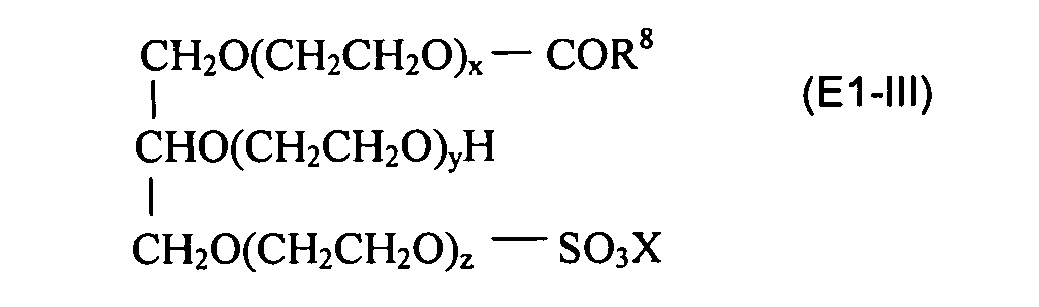
EP-B1 0 561 825 , derEP-B1 0 561 999 , derDE-A1 42 04 700 oder von A.K.Biswas et al. in J.Am.Oil.Chem.Soc. 37, 171 (1960) und F.U.Ahmed in J.Am.Oil.Chem.Soc. 67, 8 (1990) beschrieben worden sind, - Amidethercarbonsäuren wie sie in der
EP 0 690 044 beschrieben sind, - Kondensationsprodukte aus C8 - C30 - Fettalkoholen mit Proteinhydrolysaten und/oder Aminosäuren und deren Derivaten, welche dem Fachmann als Eiweissfettsäurekondensate bekannt sind, wie beispielsweise die Lamepon® - Typen, Gluadin® - Typen, Hostapon® KCG oder die Amisoft® - Typen.
- Bevorzugte anionische Tenside sind Alkylsulfate, Alkylpolyglykolethersulfate und Ethercarbonsäuren mit 10 bis 18 C-Atomen in der Alkylgruppe und bis zu 12 Glykolethergruppen im Molekül, Sulfobernsteinsäuremono- und -dialkylester mit 8 bis 18 C-Atomen in der Alkylgruppe und Sulfobernsteinsäuremono-alkylpolyoxyethylester mit 8 bis 18 C-Atomen in der Alkylgruppe und 1 bis 6 Oxyethylgruppen, Monoglycerdisulfate, Alkyl- und Alkenyletherphosphate sowie Eiweissfettsäurekondensate.
- Als zwitterionische Tenside (E2) werden solche oberflächenaktiven Verbindungen bezeichnet, die im Molekül mindestens eine quartäre Ammoniumgruppe und mindestens eine -COO(-) - oder-SO3 (-) -Gruppe tragen. Besonders geeignete zwitterionische Tenside sind die sogenannten Betaine wie die N-Alkyl-N,N-dimethylammonium-glycinate, beispielsweise das Kokosalkyl-dimethylammoniumglycinat, N-Acyl-aminopropyl-N,N-dimethylammoniumglycinate, beispielsweise das Kokosacylaminopropyl-dimethylammoniumglycinat, und 2-Alkyl-3-carboxymethyl-3-hydroxyethyl-imidazoline mit jeweils 8 bis 18 C-Atomen in der Alkyl- oder Acylgruppe sowie das Kokosacylaminoethylhydroxyethylcarboxymethylglycinat. Ein bevorzugtes zwitterionisches Tensid ist das unter der INCI-Bezeichnung Cocamidopropyl Betaine bekannte Fettsäureamid-Derivat.
- Unter ampholytischen Tensiden (E3) werden solche oberflächenaktiven Verbindungen verstanden, die außer einer C8 - C24 - Alkyl- oder -Acylgruppe im Molekül mindestens eine freie Aminogruppe und mindestens eine -COOH- oder -SO3H-Gruppe enthalten und zur Ausbildung innerer Salze befähigt sind. Beispiele für geeignete ampholytische Tenside sind N-Alkylglycine, N-Alkylpropionsäuren, N-Alkylaminobuttersäuren, N-Alkyliminodipropionsäuren, N-Hydroxyethyl-N-alkylamidopropylglycine, N-Alkyltaurine, N-Alkylsarcosine, 2-Alkylaminopropionsäuren und Alkylaminoessigsäuren mit jeweils etwa 8 bis 24 C-Atomen in der Alkylgruppe. Besonders bevorzugte ampholytische Tenside sind das N-Kokosalkylaminopropionat, das Kokosacylaminoethylaminopropionat und das C12- C18 - Acylsarcosin.
- Nichtionische Tenside (E4) enthalten als hydrophile Gruppe z.B. eine Polyolgruppe, eine Polyalkylenglykolethergruppe oder eine Kombination aus Polyol- und Polyglykolethergruppe. Solche Verbindungen sind beispielsweise
- Anlagerungsprodukte von 2 bis 50 Mol Ethylenoxid und/oder 1 bis 5 Mol Propylenoxid an lineare und verzweigte Fettalkohole mit 8 bis 30 C-Atomen, an Fettsäuren mit 8 bis 30 C-Atomen und an Alkylphenole mit 8 bis 15 C-Atomen in der Alkylgruppe,
- mit einem Methyl- oder C2 - C6 - Alkylrest endgruppenverschlossene Anlagerungsprodukte von 2 bis 50 Mol Ethylenoxid und/oder 1 bis 5 Mol Propylenoxid an lineare und verzweigte Fettalkohole mit 8 bis 30 C-Atomen, an Fettsäuren mit 8 bis 30 C-Atomen und an Alkylphenole mit 8 bis 15 C-Atomen in der Alkylgruppe, wie beispielsweise die unter den Verkaufsbezeichnungen Dehydol® LS, Dehydol® LT (Cognis) erhältlichen Typen,
- C12-C30-Fettsäuremono- und -diester von Anlagerungsprodukten von 1 bis 30 Mol Ethylenoxid an Glycerin,
- Anlagerungsprodukte von 5 bis 60 Mol Ethylenoxid an Rizinusöl und gehärtetes Rizinusöl,
- Polyolfettsäureester, wie beispielsweise das Handelsprodukt Hydagen® HSP (Cognis) oder Sovermol - Typen (Cognis),
- alkoxilierte Triglyceride,
- alkoxilierte Fettsäurealkylester der Formel (E4-l)
R1CO-(OCH2CHR2)wOR3 (E4-I)
in der R1CO für einen linearen oder verzweigten, gesättigten und/oder ungesättigten Acylrest mit 6 bis 22 Kohlenstoffatomen, R2 für Wasserstoff oder Methyl, R3 für lineare oder verzweigte Alkylreste mit 1 bis 4 Kohlenstoffatomen und w für Zahlen von 1 bis 20 steht, - Aminoxide,
- Hydroxymischether, wie sie beipielsweise in der
DE-OS 19738866 beschrieben sind, - Sorbitanfettsäureester und Anlagerungeprodukte von Ethylenoxid an Sorbitanfettsäureester wie beispielsweise die Polysorbate,
- Zuckerfettsäureester und Anlagerungsprodukte von Ethylenoxid an Zuckerfettsäureester,
- Anlagerungsprodukte von Ethylenoxid an Fettsäurealkanolamide und Fettamine,
- Zuckertenside vom Typ der Alkyl- und Alkenyloligoglykoside gemäß Formel (E4-II),
R4O-[G]p (E4-II)
in der R4 für einen Alkyl- oder Alkenylrest mit 4 bis 22 Kohlenstoffatomen, G für einen Zuckerrest mit 5 oder 6 Kohlenstoffatomen und p für Zahlen von 1 bis 10 steht. Sie können nach den einschlägigen Verfahren der präparativen organischen Chemie erhalten werden. Stellvertretend für das umfangreiche Schrifttum sei hier auf die Übersichtsarbeit von Biermann et al. in Starch/Stärke 45, 281 (1993), B. Salka in Cosm.Toil. 108, 89 (1993) sowie J. Kahre et al. in SÖFW-Journal Heft 8, 598 (1995) verwiesen.
Die Alkyl- und Alkenyloligoglykoside können sich von Aldosen bzw. Ketosen mit 5 oder 6 Kohlenstoffatomen, vorzugsweise von Glucose, ableiten. Die bevorzugten Alkyl- und/oder Alkenyloligoglykoside sind somit Alkyl- und/oder Alkenyloligoglucoside. Die Indexzahl p in der allgemeinen Formel (E4-II) gibt den Oligomerisierungsgrad (DP), d. h. die Verteilung von Mono- und Oligoglykosiden an und steht für eine Zahl zwischen 1 und 10. Während p im einzelnen Molekül stets ganzzahlig sein muß und hier vor allem die Werte p = 1 bis 6 annehmen kann, ist der Wert p für ein bestimmtes Alkyloligoglykosid eine analytisch ermittelte rechnerische Größe, die meistens eine gebrochene Zahl darstellt. Vorzugsweise werden Alkyl- und/oder Alkenyloligoglykoside mit einem mittleren Oligomerisierungsgrad p von 1,1 bis 3,0 eingesetzt. Aus anwendungstechnischer Sicht sind solche Alkyl- und/oder Alkenyloligoglykoside bevorzugt, deren Oligomerisierungsgrad kleiner als 1,7 ist und insbesondere zwischen 1,2 und 1,4 liegt. Der Alkyl- bzw. Alkenylrest R4 kann sich von primären Alkoholen mit 4 bis 11, vorzugsweise 8 bis 10 Kohlenstoffatomen ableiten. Typische Beispiele sind Butanol, Capronalkohol, Caprylalkohol, Caprinalkohol und Undecylalkohol sowie deren technische Mischungen, wie sie beispielsweise bei der Hydrierung von technischen Fettsäuremethylestern oder im Verlauf der Hydrierung von Aldehyden aus der Roelen'schen Oxosynthese erhalten werden. Bevorzugt sind Alkyloligoglucoside der Kettenlänge C8-C10 (DP = 1 bis 3), die als Vorlauf bei der destillativen Auftrennung von technischem C8-C18-Kokosfettalkohol anfallen und mit einem Anteil von weniger als 6 Gew.-% C12-Alkohol verunreinigt sein können sowie Alkyloligoglucoside auf Basis technischer C9/11-Oxoalkohole (DP = 1 bis 3). Der Alkyl- bzw. Alkenylrest R15 kann sich ferner auch von primären Alkoholen mit 12 bis 22, vorzugsweise 12 bis 14 Kohlenstoffatomen ableiten. Typische Beispiele sind Laurylalkohol, Myristylalkohol, Cetylalkohol, Palmoleylalkohol, Stearylalkohol, Isostearylalkohol, Oleylalkohol, Elaidylalkohol, Petroselinylalkohol, Arachylalkohol, Gadoleylalkohol, Behenylalkohol, Erucylalkohol, Brassidylalkohol sowie deren technische Gemische, die wie oben beschrieben erhalten werden können. Bevorzugt sind Alkyloligoglucoside auf Basis von gehärtetem C12/14-Kokosalkohol mit einem DP von 1 bis 3. - Zuckertenside vom Typ der Fettsäure-N-alkylpolyhydroxyalkylamide, ein nichtionisches Tensid der Formel (E4-III),
R5CO-NR6-[Z] (E4-III)
in der R5CO für einen aliphatischen Acylrest mit 6 bis 22 Kohlenstoffatomen, R6 für Wasserstoff, einen Alkyl- oder Hydroxyalkylrest mit 1 bis 4 Kohlenstoffatomen und [Z] für einen linearen oder verzweigten Polyhydroxyalkylrest mit 3 bis 12 Kohlenstoffatomen und 3 bis 10 Hydroxylgruppen steht. Bei den Fettsäure-N-alkylpolyhydroxyalkylamiden handelt es sich um bekannte Stoffe, die üblicherweise durch reduktive Aminierung eines reduzierenden Zuckers mit Ammoniak, einem Alkylamin oder einem Alkanolamin und nachfolgende Acylierung mit einer Fettsäure, einem Fettsäurealkylester oder einem Fettsäurechlorid erhalten werden können. Hinsichtlich der Verfahren zu ihrer Herstellung sei auf dieUS-Patentschriften US 1,985,424 ,US 2,016,962 undUS 2,703,798 sowie die Internationale PatentanmeldungWO 92/06984
R7CO-NR8-CH2-(CHOH)4-CH2OH (E4-IV)
Vorzugsweise werden als Fettsäure-N-alkylpolyhydroxyalkylamide Glucamide der Formel (E4-IV) eingesetzt, in der R8 für Wasserstoff oder eine Alkylgruppe steht und R7CO für den Acylrest der Capronsäure, Caprylsäure, Caprinsäure, Laurinsäure, Myristinsäure, Palmitinsäure, Palmoleinsäure, Stearinsäure, Isostearinsäure, Ölsäure, Elaidinsäure, Petroselinsäure, Linolsäure, Linolensäure, Arachinsäure, Gadoleinsäure, Behensäure oder Erucasäure bzw. derer technischer Mischungen steht. Besonders bevorzugt sind Fettsäure-N-alkylglucamide der Formel (E4-IV), die durch reduktive Aminierung von Glucose mit Methylamin und anschließende Acylierung mit Laurinsäure oder C12/14-Kokosfettsäure bzw. einem entsprechenden Derivat erhalten werden. Weiterhin können sich die Polyhydroxyalkylamide auch von Maltose und Palatinose ableiten. - Als bevorzugte nichtionische Tenside haben sich die Alkylenoxid-Anlagerungsprodukte an gesättigte lineare Fettalkohole und Fettsäuren mit jeweils 2 bis 30 Mol Ethylenoxid pro Mol Fettalkohol bzw. Fettsäure erwiesen. Zubereitungen mit hervorragenden Eigenschaften werden ebenfalls erhalten, wenn sie als nichtionische Tenside Fettsäureester von ethoxyliertem Glycerin enthalten.
- Diese Verbindungen sind durch die folgenden Parameter gekennzeichnet. Der Alkylrest R enthält 6 bis 22 Kohlenstoffatome und kann sowohl linear als auch verzweigt sein. Bevorzugt sind primäre lineare und in 2-Stellung methylverzweigte aliphatische Reste. Solche Alkylreste sind beispielsweise 1-Octyl, 1-Decyl, 1-Lauryl, 1-Myristyl, 1-Cetyl und 1-Stearyl. Besonders bevorzugt sind 1-Octyl, 1-Decyl, 1-Lauryl, 1-Myristyl. Bei Verwendung sogenannter "Oxo-Alkohole" als Ausgangsstoffe überwiegen Verbindungen mit einer ungeraden Anzahl von Kohlenstoffatomen in der Alkylkette.
- Weiterhin sind ganz besonders bevorzugte nichtionische Tenside die Zuckertenside. Diese können in den erfindungsgemäß verwendeten Mitteln bevorzugt in Mengen von 0,1 - 20 Gew.-%, bezogen auf das gesamte Mittel, enthalten sein. Mengen von 0,5 - 15 Gew.-% sind bevorzugt, und ganz besonders bevorzugt sind Mengen von 0,5 - 7,5 Gew.%.
- Bei den als Tensid eingesetzten Verbindungen mit Alkylgruppen kann es sich jeweils um einheitliche Substanzen handeln. Es ist jedoch in der Regel bevorzugt, bei der Herstellung dieser Stoffe von nativen pflanzlichen oder tierischen Rohstoffen auszugehen, so daß man Substanzgemische mit unterschiedlichen, vom jeweiligen Rohstoff abhängigen Alkylkettenlängen erhält.
- Bei den Tensiden, die Anlagerungsprodukte von Ethylen- und/oder Propylenoxid an Fettalkohole oder Derivate dieser Anlagerungsprodukte darstellen, können sowohl Produkte mit einer "normalen" Homologenverteilung als auch solche mit einer eingeengten Homologenverteilung verwendet werden. Unter "normaler" Homologenverteilung werden dabei Mischungen von Homologen verstanden, die man bei der Umsetzung von Fettalkohol und Alkylenoxid unter Verwendung von Alkalimetallen, Alkalimetallhydroxiden oder Alkalimetallalkoholaten als Katalysatoren erhält. Eingeengte Homologenverteilungen werden dagegen erhalten, wenn beispielsweise Hydrotalcite, Erdalkalimetallsalze von Ethercarbonsäuren, Erdalkalimetalloxide, -hydroxide oder - alkoholate als Katalysatoren verwendet werden. Die Verwendung von Produkten mit eingeengter Homologenverteilung kann bevorzugt sein.
- Erfindungsgemäß einsetzbar sind ebenfalls kationische Tenside (E5) vom Typ der quaternären Ammoniumverbindungen, der Esterquats und der Amidoamine. Bevorzugte quaternäre Ammoniumverbindungen sind Ammoniumhalogenide, insbesondere Chloride und Bromide, wie Alkyltrimethylammoniumchloride, Dialkyldimethylammoniumchloride und Trialkylmethylammoniumchloride, z. B. Cetyltrimethylammoniumchlorid, Stearyltrimethylammoniumchlorid, Distearyldimethylammoniumchlorid, Lauryldimethylammoniumchlorid, Lauryldimethylbenzylammoniumchlorid und Tricetylmethylammoniumchlorid, sowie die unter den INCI-Bezeichnungen Quaternium-27 und Quaternium-83 bekannten Imidazolium-Verbindungen. Die langen Alkylketten der oben genannten Tenside weisen bevorzugt 10 bis 18 Kohlenstoffatome auf.
- Bei Esterquats handelt es sich um bekannte Stoffe, die sowohl mindestens eine Esterfunktion als auch mindestens eine quartäre Ammoniumgruppe als Strukturelement enthalten. Bevorzugte Esterquats sind quaternierte Estersalze von Fettsäuren mit Triethanolamin, quaternierte Estersalze von Fettsäuren mit Diethanolalkylaminen und quaternierten Estersalzen von Fettsäuren mit 1,2-Dihydroxypropyldialkylaminen. Solche Produkte werden beispielsweise unter den Warenzeichen Stepantex®, Dehyquart® und Armocare® vertrieben. Die Produkte Armocare® VGH-70, ein N,N-Bis(2-Palmitoyloxyethyl)dimethylammoniumchlorid, sowie Dehyquart® F-75, Dehyquart®C-4046, Dehyquart® L80 und Dehyquart® AU-35 sind Beispiele für solche Esterquats.
- Die Alkylamidoamine werden üblicherweise durch Amidierung natürlicher oder synthetischer Fettsäuren und Fettsäureschnitte mit Dialkylaminoaminen hergestellt. Eine erfindungsgemäß besonders geeignete Verbindung aus dieser Substanzgruppe stellt das unter der Bezeichnung Tegoamid® S 18 im Handel erhältliche Stearamidopropyl-dimethylamin dar.
- Die kationischen Tenside (E5) sind in den erfindungsgemäß verwendeten Mitteln bevorzugt in Mengen von 0,05 bis 10 Gew.-%, bezogen auf das gesamte Mittel, enthalten. Mengen von 0,1 bis 5 Gew.-% sind besonders bevorzugt.
- Anionische, nichtionische, zwitterionische und/oder amphotere Tenside sowie deren Mischungen können erfindungsgemäß bevorzugt sein.
- Die erfindungsgemäßen Mittel können weiterhin mindestens einen Pflegestoff enthalten. Handelt es sich bei dem Mittel um ein Pflegemittel, ist dieser weitere Inhaltsstoff naturgemäß zwingend in dem Mittel enthaltend, aber auch, wenn es sich bei dem Mittel um ein Shampoo mit vorweigend reinigenden Eigenschaften handelt, ist der Zusatz mindestens eines Pflegestoffs bevorzugt.
- Eine erste Gruppe geeigneter Pflegestoffe sind Proteinhydrolysate und/oder deren Derivate.
- Proteinhydrolysate sind Produktgemische, die durch sauer, basisch oder enzymatisch katalysierten Abbau von Proteinen (Eiweißen) erhalten werden. Unter dem Begriff Proteinhydrolysate werden erfindungsgemäß auch Totalhydrolysate sowie einzelne Aminosäuren und deren Derivate sowie Gemische aus verschiedenen Aminosäuren verstanden. Weiterhin werden erfindungsgemäß aus Aminosäuren und Aminosäurederivaten aufgebaute Polymere unter dem Begriff Proteinhydrolysate verstanden. Zu letzteren sind beispielsweise Polyalanin, Polyasparagin, Polyserin etc. zu zählen. Weitere Beispiele für erfindungsgemäß einsetzbare Verbindungen sind L-Alanyl-L-prolin, Polyglycin, Glycyl-L-glutamin oder D/L-Methionin-S-Methylsulfoniumchlorid. Selbstverständlich können erfindungsgemäß auch β-Aminosäuren und deren Derivate wie β-Alanin, Anthranilsäure oder Hippursäure eingesetzt werden. Das Molgewicht der erfindungsgemäß einsetzbaren Proteinhydrolysate liegt zwischen 75, dem Molgewicht für Glycin, und 200.000, bevorzugt beträgt das Molgewicht 75 bis 50.000 und ganz besonders bevorzugt 75 bis 20.000 Dalton.
- Erfindungsgemäß können Proteinhydrolysate sowohl pflanzlichen als auch tierischen oder marinen oder synthetischen Ursprungs eingesetzt werden.
- Tierische Proteinhydrolysate sind beispielsweise Elastin-, Kollagen-, Keratin-, Seiden- und Milcheiweiß-Proteinhydrolysate, die auch in Form von Salzen vorliegen können. Solche Produkte werden beispielsweise unter den Warenzeichen Dehylan® (Cognis), Promois® (Interorgana), Collapuron® (Cognis), Nutrilan® (Cognis), Gelita-Sol® (Deutsche Gelatine Fabriken Stoess & Co), Lexein® (Inolex), Sericin (Pentapharm) und Kerasol® (Croda) vertrieben.
- Besonders interessant ist der Einsatz von Seiden-Proteinhydrolysaten. Unter Seide versteht man die Fasern des Kokons des Maulbeer-Seidenspinners (Bombyx mori L.). Die Rohseidenfaser besteht aus einem Doppelfaden Fibroin. Als Kittsubstanz hält Sericin diesen Doppelfaden zusammen. Seide besteht zu 70 - 80 Gew.% aus Fibroin, 19 - 28 Gew.% Sericin, 0,5 - 1 Gew.% aus Fett und 0,5 -1 1 Gew.% aus Farbstoffen und mineralischen Bestandteilen.
- Die wesentlichen Bestandteile des Sericin sind mit ca. 46 Gew.% Hydroxyaminosäuren. Das Sericin besteht aus einer Gruppe von 5 bis 6 Proteinen. Die wesentlichen Aminosäuren des Sericines sind Serin (Ser, 37 Gew.%), Aspartat (Asp, 26 Gew.%), Glycin (Gly, 17 Gew.%), Alanin (Ala), Leucin (Leu) und Tyrosin (Tyr).
- Das wasserunlösliche Fibroin ist zu den Skleroproteinen mit langkettiger Molekülstruktur zu zählen. Die Hauptbestandteile des Fibroin sind Glycin (44 Gew.%), Alanin (26 Gew.%), und Tyrosin (13 Gew.%). Ein weiteres wesentliches Strukturmerkmal des Fibroins ist die Hexapeptidsequenz Ser-Gly-Ala-Gly-Ala-Gly.
- Technisch ist es auf einfache Art und Weise möglich, die beiden Seidenproteine voneinander zu trennen. So verwundert es nicht, dass sowohl Sericin als auch Fibroin als Rohstoffe zur Verwendung in kosmetischen Produkten jeweils für sich allein bekannt sind. Weiterhin sind Proteinhydrolysate und -derivate auf der Basis der jeweils einzelnen Seidenproteine bekannte Rohstoffe in kosmetischen Mitteln. So wird beispielsweise Sericin als solches seitens der Fa. Pentapharm Ltd. als Handelsprodukt mit der Bezeichnung Sericin Code 303-02 vertrieben. Weitaus häufiger noch wird Fibroin als Proteinhydrolysat mit unterschiedlichen Molekulargewichten im Markt angeboten. Diese Hydrolysate werden insbesondere als "Seidenhydroylsate" vertrieben. So wird beispielsweise unter der Handelsbezeichnung Promois® Silk hydrolysiertes Fibroin mit mittleren Molekulargewichten zwischen 350 und 1000 vertrieben. Auch in der
DE 31 39 438 A1 werden kolloidale Fibroinlösungen als Zusatz in kosmetischen Mitteln beschrieben. - Die positiven Eigenschaften der Seidenproteinderivate aus Sericin und Fibroin sind jeweils für sich genommen in der Literatur bekannt. So beschreibt die Verkaufsbroschüre der Fa. Pentapharm die kosmetischen Effekte des Sericines auf der Haut als reizlindernd, hydratisierend und filmbildend. Die Wirkung eines Fibroinderivates wird beispielsweise in der
DE 31 39 438 A1 als pflegend und avivierend für das Haar beschrieben. GemäßDE 102 40 757 A1 lässt sich bei einer gleichzeitigen Verwendung von Sericin und Fibroin bzw. deren Derivaten und/oder Hydrolysaten darüber hinaus eine synergistische Steigerung der positiven Wirkungen der Seidenproteine und deren Derivate erzielen. - Bevorzugt wird daher im erfindungsgemäßen Mittel als Seiden-Proteinhydrolysat ein Wirkstoffkomplex (A) bestehend aus dem Wirkstoff (A1) ausgewählt aus Sericin, Sericinhydrolysaten und/oder deren Derivaten, sowie Mischungen hieraus, und einem Wirkstoff (A2) ausgewählt aus Fibroin, und/oder Fibroinhydrolysaten und/oder deren Derivaten und/oder Mischungen hieraus eingesetzt.
- Der erfindungsgemäß verwendete Wirkstoffkomplex (A) verbessert signifikant in synergistischer Weise die zuvor dargestellten wesentlichen inneren und äußeren Strukturmerkmale und die Festigkeit sowie die Elastizität von menschlichen Haaren.
- Als Wirkstoffe (A1) können im Wirkstoffkomplex (A) verwendet werden:
- natives Sericin,
- hydrolysiertes und/oder weiter derivatisiertes Sericin, wie beispielsweise Handelsprodukte mit den INCI - Bezeichnungen Sericin, Hydrolyzed Sericin, oder Hydrolyzed Silk,
- eine Mischung aus den Aminosäuren Serin, Aspartat und Glycin und/oder deren Methyl-, Propyl-, iso-Propyl-, Butyl-, iso-Butylestern, deren Salze wie beispielsweise Hydrochloride, Sulfate, Acetate, Citrate, Tartrate , wobei in dieser Mischung das Serin und/oder dessen Derivate zu 20 bis 60 Gew.%, das Aspartat und/oder dessen Derivate zu 10 - 40 Gew.% und das Glycin und/oder dessen Derivate zu 5 bis 30 Gew.% enthalten sind, mit der Maßgabe, dass sich die Mengen dieser Aminosäuren und/oder deren Derivate vorzugsweise zu 100 Gew.% ergänzen,
- sowie deren Mischungen.
- Als Wirkstoffe (A2) können im Wirkstoffkomplex (A) verwendet werden:
- natives, in eine lösliche Form überführtes Fibroin,
- hydrolysiertes und/oder weiter derivatisiertes Fibroin, besonders teilhydrolisiertes Fibroin, welches als Hauptbestandteil die Aminosäuresequenz Ser-Gly-Ala-Gly-Ala-Gly enthält,
- die Aminosäuresequenz Ser-Gly-Ala-Gly-Ala-Gly,
- eine Mischung der Aminosäuren Glycin, Alanin und Tyrosin und/oder deren Methyl-, Propyl-, iso-Propyl-, Butyl-, iso-Butylestern, deren Salze wie beispielsweise Hydrochloride, Sulfate, Acetate, Citrate, Tartrate , wobei in dieser Mischung das Glycin und/oder dessen Derivate in Mengen von 20 - 60 Gew.%, das Alanin und dessen Derivate in Mengen von 10 - 40 Gew,% und das Tyrosin und dessen Derivate in Mengen von 0 bis 25 Gew.% enthalten sind, mit der Maßgabe, dass sich die Mengen dieser Aminosäuren und/oder deren Derivate vorzugsweise zu 100 Gew.% ergänzen,
- sowie deren Mischungen.
- Besonders gute pflegende Eigenschaften können erzielt werden, wenn eine der beiden Wirkstoffkomponenten des Wirkstoffkomplexes (A) in der nativen oder allenfalls löslich gemachten Form verwendet wird. Es ist auch möglich, eine Mischung aus mehreren Wirkstoffen (A1) und/oder (A2) einzusetzen.
- Es kann bevorzugt sein, dass die beiden Wirkstoffe (A1) und (A2) im Verhältnis von 10:90 bis 70:30, insbesondere 15:85 bis 50:50 und ganz besonders 20:80 bis 40:60, bezogen auf deren jeweilige Gehalte an aktiver Wirksubstanz in den erfindungsgemäßen Produkten eingesetzt werden.
- Die Derivate der Hydrolysate von Sericin und Fibroin umfassen sowohl anionische als auch kationisierte Proteinhydrolysate. Die Proteinhydrolysate von Sericin und Fibroin sowie die daraus hergestellten Derivate können aus den entsprechenden Proteinen durch eine chemische, insbesondere alkalische oder saure Hydrolyse, durch eine enzymatische Hydrolyse und/oder einer Kombination aus beiden Hydrolysearten gewonnen werden. Die Hydrolyse von Proteinen ergibt in der Regel ein Proteinhydrolysat mit einer Molekulargewichtsverteilung von etwa 100 Dalton bis hin zu mehreren tausend Dalton. Bevorzugt sind solche Proteinhydrolysate von Sericin und Fibroin und/oder deren Derivate, deren zugrunde liegender Proteinanteil ein Molekulargewicht von 100 bis zu 25000 Dalton, bevorzugt 250 bis 10000 Dalton aufweist. Weiterhin sind unter kationischen Proteinhydrolysaten von Sericin und Fibroin auch quaternierte Aminosäuren und deren Gemische zu verstehen. Die Quaternisierung der Proteinhydrolysate oder der Aminosäuren wird häufig mittels quartärer Ammoniumsalze wie beispielsweise N,N-Dimethyl-N-(n-Alkyl)-N-(2-hydroxy-3-chloro-n-propyl)-ammoniumhalogeniden durchgeführt. Weiterhin können die kationischen Proteinhydrolysate auch noch weiter derivatisiert sein. Als typische Beispiele für die erfindungsgemäß einsetzbaren kationischen Proteinhydrolysate und - derivate seien die unter den INCI - Bezeichnungen im "International Cosmetic Ingredient Dictionary and Handbook", (seventh edition 1997, The Cosmetic, Toiletry, and Fragrance Association 1101 17th Street, N.W., Suite 300, Washington, DC 20036-4702) genannten und im Handel erhältlichen Produkte genannt: Cocodimonium Hydroxypropyl Hydrolyzed Silk, Cocodimonium Hydroxypropyl Silk Amino Acids, Hydroxyproypltrimonium Hydrolyzed Silk, Lauryldimonium Hydroxypropyl Hydrolyzed Silk, Steardimonium Hydroxypropyl Hydrolyzed Silk, Quaternium-79 Hydrolyzed Silk. Als typische Beispiele für die erfindungsgemäßen anionischen Proteinhydrolysate und -derivate seien die unter den INCI - Bezeichnungen im "International Cosmetic Ingredient Dictionary and Handbook", (seventh edition 1997, The Cosmetic, Toiletry, and Fragrance Association 1101 17th Street, N.W., Suite 300, Washington, DC 20036-4702) genannten und im Handel erhältlichen Produkte genannt: Potassium Cocoyl Hydrolyzed Silk, Sodium Lauroyl Hydrolyzed Silk oder Sodium Stearoyl Hydrolyzed Silk. Letztlich seien noch als typische Beispiele für die erfindungsgemäß einsetzbaren Derivate aus Sericin und Fibroin die unter den lNCl - Bezeichnungen im Handel erhältlichen Produkte genannt: Ethyl Ester of Hydrolyzed Silk und Hydrolyzed Silk PG-Propyl Methylsilanediol. Weiterhin erfindungsgemäß verwendbar, wenngleich nicht unbedingt bevorzugt sind die im Handel erhältlichen Produkte mit den lNCl - Bezeichnungen Palmitoyl Oligopeptide, Palmitoyl Pentapeptide-3, Palmitoyl Pentapeptide-2, Acetyl Hexapeptide-1, Acetyl Hexapeptide-3, Copper Tripeptide-1, Hexapeptide-1, Hexapeptide-2, MEA-Hydrolyzed Silk.
- Die Wirkung des Wirkstoffkomplexes (A) kann durch die Zugabe von Fettstoffen weiter gesteigert werden. Unter Fettstoffen sind zu verstehen Fettsäuren, Fettalkohole, natürliche und synthetische Wachse, welche sowohl in fester Form als auch flüssig in wässriger Dispersion vorliegen können, und natürliche und synthetische kosmetische Ölkomponenten zu verstehen.
- Proteinhydrolysate pflanzlichen Ursprungs, z. B. Soja-, Mandel-, Erbsen-, Kartoffel- und Weizenproteinhydrolysate, sind beispielsweise unter den Warenzeichen Gluadin® (Cognis), DiaMin® (Diamalt), Lexein® (Inolex), Hydrosoy® (Croda), Hydrolupin® (Croda), Hydrosesame® (Croda), Hydrotritium® (Croda) und Crotein® (Croda) erhältlich.
- Wenngleich der Einsatz der Proteinhydrolysate als solche bevorzugt ist, können an deren Stelle gegebenenfalls auch anderweitig erhaltene Aminosäuregemische eingesetzt werden. Ebenfalls möglich ist der Einsatz von Derivaten der Proteinhydrolysate, beispielsweise in Form ihrer Fettsäure-Kondensationsprodukte. Solche Produkte werden beispielsweise unter den Bezeichnungen Lamepon® (Cognis), Lexein® (Inolex), Crolastin® (Croda), Crosilk® (Croda) oder Crotein® (Croda) vertrieben.
- Selbstverständlich umfasst die erfindungsgemäße Lehre alle isomeren Formen, wie cis - trans - Isomere, Diastereomere und chirale Isomere.
- Erfindungsgemäß ist es auch möglich, eine Mischung aus mehreren Proteinhydrolysaten einzusetzen.
- Die Proteinhydrolysate sind in den erfindungsgemäßen Mitteln beispielsweise in Konzentrationen von 0,01 Gew.% bis zu 20 Gew.%, vorzugsweise von 0,05 Gew.% bis zu 15 Gew.% und ganz besonders bevorzugt in Mengen von 0,05 Gew.% bis zu 5 Gew.%, jeweils bezogen auf die gesamte Anwendungszubereitung enthalten.
- In einer besonderen Ausführungsform enthält das erfindungsgemäße Mittel als Proteinhydrolysat ein Kertainhydrolysat, wobei ein Kertainhydrolysat mit einer Molmasse von 2 bis 6 kDa, vorzugsweise von 3 bis 4 kDa, bestimmt mittels Size Exclusion HPLC, bevorzugt ist.
- Das Mittel enthält das Kertainhydrolysat vorzugsweise in einer Menge von 0,01 bis 1 Gew.-%, besonders bevorzugt von 0,02 bis 0,8 Gew.-%, jeweils bezogen auf das gesamte Mittel.
- Eine weitere Gruppe geeigneter Pflegestoffe sind die Silikone, vorzugsweise Silikonöle und/oder Silikongums.
- Geeignete Silikonöle oder Silikongums sind insbesondere Dialkyl- und Alkylarylsiloxane, wie beispielsweise Dimethylpolysiloxan und Methylphenylpolysiloxan, sowie deren alkoxylierte, quaternierte oder auch anionische Derivate. Bevorzugt sind cyclische und lineare Polydialkylsiloxane, deren alkoxylierte und/oder aminierte Derivate, Dihydroxypolydimethylsiloxane und Polyphenylalkylsiloxane.
- Silikonöle bewirken die unterschiedlichsten Effekte. So beeinflussen sie beispielsweise gleichzeitig die Trocken- und Nasskämmbarkeiten, den Griff des trockenen und nassen Haares sowie den Glanz. Unter dem Begriff Silikonöle versteht der Fachmann mehrere Strukturen Silicium-organischer Verbindungen. Zunächst werden hierunter die Dimethiconole (S1) verstanden. Diese können sowohl linear als auch verzweigt als auch cyclisch oder cyclisch und verzweigt sein. Lineare Dimethiconole können durch die folgende Strukturformel (S1 - I) dargestellt werden:
(HOSiR1 2)-O-(SiR2 2-O-)x-(SiR1 2OH) (S1-I)
- Verzweigte Dimethiconole können durch die Strukturformel (S1 - II) dargestellt werden:

- Die Reste R1 und R2 stehen unabhängig voneinander jeweils für Wasserstoff, einen Methylrest, einen C2 bis C30 linearen, gesättigten oder ungesättigten Kohlenwasserstoffrest, einen Phenylrest und/oder einen Arylrest. Nicht einschränkende Beispiele der durch R1 und R2 repräsentierten Reste schließen Alkylreste, wie Methyl, Ethyl, Propyl, Isopropyl, Butyl, Isobutyl, Pentyl, Isopentyl, Neopentyl, Amyl, Isoamyl, Hexyl, Isohexyl und ähnliche; Alkenylreste, wie Vinyl, Halogenvinyl, Alkylvinyl, Allyl, Halogenallyl, Alkylallyl; Cycloalkylreste, wie Cyclobutyl, Cyclopentyl, Cyclohexyl und ähnliche; Phenylreste, Benzylreste, Halogenkohlenwasserstoffreste, wie 3-Chlorpropyl, 4-Brombutyl, 3,3,3-Trifluorpropyl, Chlorcyclohexyl, Bromphenyl, Chlorphenyl und ähnliche sowie schwefelhaltige Reste, wie Mercaptoethyl, Mercaptopropyl, Mercaptohexyl, Mercaptophenyl und ähnliche ein; vorzugsweise ist R1 und R2 ein Alkylrest, der 1 bis etwa 6 Kohlenstoffatomen enthält, insbesondere bevorzugt ist R1 und R2 Methyl. Die Zahlen x, y und z sind ganze Zahlen und laufen jeweils unabhängig voneinander von 0 bis 50.000. Die Molgewichte der Dimethiconole liegen zwischen 1000 D und 10000000 D. Die Viskositäten liegen zwischen 100 und 10000000 cPs gemessen bei 25 °C mit Hilfe eines Glaskapillarviskosimeters nach der Dow Corning Corporate Testmethode CTM 0004 vom 20. Juli 1970. Bevorzugte Viskositäten liegen zwischen 1000 und 5000000 cPs, ganz besonders bevorzugte Viskositäten liegen zwischen 10000 und 3000000 cPs. Der bevorzugteste Bereich liegt zwischen 50000 und 2000000 cPs.
- Als Beispiele für derartige Produkte werden die folgenden Handelsprodukte genannt: Botanisil NU-150M (Botanigenics), Dow Corning 1-1254 Fluid, Dow Corning 2-9023 Fluid, Dow Corning 2-9026 Fluid, Ultrapure Dimethiconol (Ultra Chemical), Unisil SF-R (Universal Preserve), X-21-5619 (Shin-Etsu Chemical Co.), Abil OSW 5 (Degussa Care Specialties), ACC DL-9430 Emulsion (Taylor Chemical Company), AEC Dimethiconol & Sodium Dodecylbenzenesulfonate (A & E Connock (Perfumery & Cosmetics) Ltd.), B C Dimethiconol Emulsion 95 (Basildon Chemical Company, Ltd.), Cosmetic Fluid 1401, Cosmetic Fluid 1403, Cosmetic Fluid 1501, Cosmetic Fluid 1401 DC (alle zuvor genannten Chemsil Silicones, Inc.), Dow Corning 1401 Fluid, Dow Corning 1403 Fluid, Dow Corning 1501 Fluid, Dow Corning 1784 HVF Emulsion, Dow Corning 9546 Silicone Elastomer Blend (alle zuvor genannten Dow Corning Corporation), Dub Gel SI 1400 (Stearinerie Dubois Fils), HVM 4852 Emulsion (Crompton Corporation), Jeesilc 6056 (Jeen International Corporation), Lubrasil, Lubrasil DS (beide Guardian Laboratories), Nonychosine E, Nonychosine V (beide Exsymol), SanSurf Petrolatum-25, Satin Finish (beide Collaborative Laboratories, Inc.), Silatex-D30 (Cosmetic Ingredient Resources), Silsoft 148, Silsoft E-50, Silsoft E-623 (alle zuvor genannten Crompton Corporation), SM555, SM2725, SM2765, SM2785 (alle zuvor genannten GE Silicones), Taylor T-Sil CD-1, Taylor TME-4050E (alle Taylor Chemical Company), TH V 148 (Crompton Corporation), Tixogel CYD-1429 (Sud-Chemie Performance Additives), Wacker-Belsil CM 1000, Wacker-Belsil CM 3092, Wacker-Belsil CM 5040, Wacker-Belsil DM 3096, Wacker-Belsil DM 3112 VP, Wacker-Belsil DM 8005 VP, Wacker-Belsil DM 60081 VP (alle zuvor genannten Wacker-Chemie GmbH).
- Dimethicone (S2) bilden die zweite Gruppe der Silikone, welche erfindungsgemäß enthalten sein können. Diese können sowohl linear als auch verzweigt als auch cyclisch oder cyclisch und verzweigt sein. Lineare Dimethicone können durch die folgende Strukturformel (S2 - 1) dargestellt werden:
(SiR1 3)-O-(SiR1R2-O-)x-(SiR1 3) (S2-I)
- Verzweigte Dimethicone können durch die Strukturformel (S2 - II) dargestellt werden:

- Die Reste R1 und R2 stehen unabhängig voneinander jeweils für Wasserstoff, einen Methylrest, einen C2 bis C30 linearen, gesättigten oder ungesättigten Kohlenwasserstoffrest, einen Phenylrest und/oder einen Arylrest. Nicht einschränkende Beispiele der durch R1 und R2 repräsentierten Reste schließen Alkylreste, wie Methyl, Ethyl, Propyl, Isopropyl, Butyl, Isobutyl, Pentyl, Isopentyl, Neopentyl, Amyl, Isoamyl, Hexyl, Isohexyl und ähnliche; Alkenylreste, wie Vinyl, Halogenvinyl, Alkylvinyl, Allyl, Halogenallyl, Alkylallyl; Cycloalkylreste, wie Cyclobutyl, Cyclopentyl, Cyclohexyl und ähnliche; Phenylreste, Benzylreste, Halogenkohlenwasserstoffreste, wie 3-Chlorpropyl, 4-Brombutyl, 3,3,3-Trifluorpropyl, Chlorcyclohexyl, Bromphenyl, Chlorphenyl und ähnliche sowie schwefelhaltige Reste, wie Mercaptoethyl, Mercaptopropyl, Mercaptohexyl, Mercaptophenyl und ähnliche ein; vorzugsweise ist R1 und R2 ein Alkylrest, der 1 bis etwa 6 Kohlenstoffatomen enthält, und besonders bevorzugt ist R1 und R2 Methyl. Die Zahlen x, y und z sind ganze Zahlen und laufen jeweils unabhängig voneinander von 0 bis 50.000. Die Molgewichte der Dimethicone liegen zwischen 1000 D und 10000000 D. Die Viskositäten liegen zwischen 100 und 10000000 cPs gemessen bei 25 °C mit Hilfe eines Glaskapillarviskosimeters nach der Dow Corning Corporate Testmethode CTM 0004 vom 20. Juli 1970. Bevorzugte Viskositäten liegen zwischen 1000 und 5000000 cPs, besonders bevorzugte Viskositäten liegen zwischen 10000 und 3000000 cPs. Ganz besonders bevorzugt liegt die Viskosität im Bereich zwischen 50000 und 2000000 cPs.
- Dimethiconcopolyole (S3) bilden eine weitere Gruppe von Silikonen, die geeignet sind. Dimethiconcopolyole können durch die folgenden Strukturformeln dargestellt werden:
(SiR1 3)-O-(SiR2 2-O-)x-(SiR2PE-O-)y-(SiR1 3) (S3-I),
PE-(SiR1 2)-O-(SiR2 2-O-)x-(SiR1 2)-PE (S3-II)
- Verzweigte Dimethiconcopolyole können durch die Strukturformel (S3 - III) dargestellt werden:


- Die Reste R1 und R2 stehen unabhängig voneinander jeweils für Wasserstoff, einen Methylrest, einen C2 bis C30 linearen, gesättigten oder ungesättigten Kohlenwasserstoffrest, einen Phenylrest und/oder einen Arylrest. Nicht einschränkende Beispiele der durch R1 und R2 repräsentierten Reste schließen Alkylreste, wie Methyl, Ethyl, Propyl, Isopropyl, Butyl, Isobutyl, Pentyl, Isopentyl, Neopentyl, Amyl, Isoamyl, Hexyl, Isohexyl und ähnliche; Alkenylreste, wie Vinyl, Halogenvinyl, Alkylvinyl, Allyl, Halogenallyl, Alkylallyl; Cycloalkylreste, wie Cyclobutyl, Cyclopentyl, Cyclohexyl und ähnliche; Phenylreste, Benzylreste, Halogenkohlenwasserstoffreste, wie 3-Chlorpropyl, 4-Brombutyl, 3,3,3-Trifluorpropyl, Chlorcyclohexyl, Bromphenyl, Chlorphenyl und ähnliche sowie schwefelhaltige Reste, wie Mercaptoethyl, Mercaptopropyl, Mercaptohexyl, Mercaptophenyl und ähnliche ein; vorzugsweise ist R1 und R2 ein Alkylrest, der 1 bis etwa 6 Kohlenstoffatomen enthält, insbesondere bevorzugt ist R1 und R2 Methyl. PE steht für einen Polyoxyalkylenrest. Bevorzugte Polyoxyalkylenreste leiten sich ab von Ethylenoxid, Propylenoxid und Glycerin. Die Zahlen x, y und z sind ganze Zahlen und laufen jeweils unabhängig voneinander von 0 bis 50.000. Die Molgewichte der Dimethicone liegen zwischen 1000 D und 10000000 D. Die Viskositäten liegen zwischen 100 und 10000000 cPs gemessen bei 25 °C mit Hilfe eines Glaskapillarviskosimeters nach der Dow Corning Corporate Testmethode CTM 0004 vom 20. Juli 1970. Bevorzugte Viskositäten liegen zwischen 1000 und 5000000 cPs, ganz besonders bevorzugte Vsikositäten liegen zwischen 10000 und 3000000 cPs. Der bevorzugteste Bereich liegt zwischen 50000 und 2000000 cPs.
- Entsprechende Dimethiconcopolyole sind kommerziell erhältlich und werden beispielsweise von der Firma Dow Corning unter der Bezeichnung Dow Corning® 5330 Fluid vertrieben.
- Selbstverständlich umfasst die erfindungsgemäße Lehre auch, dass die Dimethiconole, Dimethicone und/oder Dimethiconcopolymere bereits als Emulsion vorliegen können. Dabei kann die entsprechende Emulsion der Dimethiconole, Dimethicone und/oder Dimethiconcopolyole sowohl nach der Herstellung der entsprechenden Dimethiconole, Dimethicone und/oder Dimethiconcopolyole aus diesen und den dem Fachmann bekannten üblichen Verfahren zur Emulgierung hergestellt werden. Hierzu können als Hilfsmittel zur Herstellung der entsprechenden Emulsionen sowohl kationische, anionische, nichtionische oder zwitterionische Tenside und Emulgatoren als Hilfsstoffe verwendet werden. Selbstverständlich können die Emulsionen der Dimethiconole, Dimethicone und/oder Dimethiconcopolyole auch direkt durch ein Emulsionspolymerisationsverfahren hergestellt werden. Auch derartige Verfahren sind dem Fachmann wohl bekannt. Hierzu sei beispielsweise verwiesen auf die "Encyclopedia of Polymer Science and Engineering, Volume 15, Second Edition, Seiten 204 bis 308, John Wiley & Sons, Inc. 1989. Auf dieses Standardwerk wird ausdrücklich Bezug genommen.
- Wenn die Dimethiconole, Dimethicone und/oder Dimethiconcopolyole als Emulsion verwendet werden, dann beträgt die Tröpfchengröße der emulgierten Teilchen erfindungsgemäß 0,01 bis 10000 µm, bevorzugt 0,01 bis 100 µm, besonders bevorzugt 0,01 bis 20 µm und ganz besonders bevorzugt 0,01 bis 10 µm. Die Teilchengröße wird dabei nach der Methode der Lichtstreuung bestimmt.
- Werden verzweigte Dimethiconole, Dimethicone und/oder Dimethiconcopolyole verwendet, so ist darunter zu verstehen, dass die Verzweigung größer ist, als eine zufällige Verzweigung, welche durch Verunreinigungen der jeweiligen Monomere zufällig entsteht. Im Sinne der vorliegenden Erfindung ist daher unter verzweigten Dimethiconolen, Dimethiconen und/oder Dimethiconcopolyolen zu verstehen, dass der Verzweigungsgrad größer als 0,01 % ist. Bevorzugt ist ein Verzweigungsgrad größer als 0,1 % und ganz besonders bevorzugt von größer als 0,5 %. Der Grad der Verzweigung wird dabei aus dem Verhältnis der unverzweigten Monomeren zu den verzweigenden Monomeren, das heißt der Menge an tri- und tetrafunktionalen Siloxanen, bestimmt. Erfindungsgemäß können sowohl niedrigverzweigte als auch hochverzweigte Dimethiconole, Dimethicone und/oder Dimethiconcopolyole ganz besonders bevorzugt sein.
- Geeignete Silikone sind weiterhin aminofunktionelle Silikone (S4), insbesondere die Silikone, die unter der INCI-Bezeichnung Amodimethicone zusammengefasst sind. Darunter sind Silikone zu verstehen, welche mindestens eine, gegebenenfalls substituierte, Aminogruppe aufweisen.
- Solche Silikone können z.B. durch die Formel (S4 - I)
M(RaQbSiO(4-a-b)/2))x(RcSiO(4-c)/2))yM) (S4-I)
beschrieben werden, wobei in der obigen Formel R ein Kohlenwasserstoff oder ein Kohlenwasserstoffrest mit 1 bis etwa 6 Kohlenstoffatomen ist, Q ein polarer Rest der allgemeinen Formel -R1Z ist, worin R1 eine zweiwertige, verbindende Gruppe ist, die an Wasserstoff und den Rest Z gebunden ist, zusammengesetzt aus Kohlenstoff- und Wasserstoffatomen, Kohlenstoff-, Wasserstoff- und Sauerstoffatomen oder Kohlenstoff-, Wasserstoff- und Stickstoffatomen, und Z ein organischer, aminofunktioneller Rest ist, der mindestens eine aminofunktionelle Gruppe enthält; "a" Werte im Bereich von etwa 0 bis etwa 2 annimmt, "b" Werte im Bereich von etwa 1 bis etwa 3 annimmt, "a" + "b" kleiner als oder gleich 3 ist, und "c" eine Zahl im Bereich von etwa 1 bis etwa 3 ist, und x eine Zahl im Bereich von 1 bis etwa 2.000, vorzugsweise von etwa 3 bis etwa 50 und am bevorzugtesten von etwa 3 bis etwa 25 ist, und y eine Zahl im Bereich von etwa 20 bis etwa 10.000, vorzugsweise von etwa 125 bis etwa 10.000 und am bevorzugtesten von etwa 150 bis etwa 1.000 ist, und M eine geeignete Silikon-Endgruppe ist, wie sie im Stand der Technik bekannt ist, vorzugsweise Trimethylsiloxy. Nicht einschränkende Beispiele der durch R repräsentierten Reste schließen Alkylreste, wie Methyl, Ethyl, Propyl, Isopropyl, Butyl, Isobutyl, Amyl, Isoamyl, Hexyl, Isohexyl und ähnliche; Alkenylreste, wie Vinyl, Halogenvinyl, Alkylvinyl, Allyl, Halogenallyl, Alkylallyl; Cycloalkylreste, wie Cyclobutyl, Cyclopentyl, Cyclohexyl und ähnliche; Phenylreste, Benzylreste, Halogenkohlenwasserstoffreste, wie 3-Chlorpropyl, 4-Brombutyl, 3,3,3-Trifluorpropyl, Chlorcyclohexyl, Bromphenyl, Chlorphenyl und ähnliche sowie schwefelhaltige Reste, wie Mercaptoethyl, Mercaptopropyl, Mercaptohexyl, Mercaptophenyl und ähnliche ein; vorzugsweise ist R ein Alkylrest, der 1 bis etwa 6 Kohlenstoffatomen enthält, und am bevorzugtesten ist R Methyl. Beispiele von R1 schließen Methylen, Ethylen, Propylen, Hexamethylen, Decamethylen, -CH2CH(CH3)CH2-, Phenylen, Naphthylen, -CH2CH2SCH2CH2-,-CH2CH2OCH2-, -OCH2CH2-, -OCH2CH2CH2-, -CH2CH(CH3)C(O)OCH2-, -(CH2)3C(O)OCH2CH2-,-C6H4C6H4-, -C6H4CH2C6H4-; und -(CH2)3C(O)SCH2CH2- ein. - Z ist ein organischer, aminofunktioneller Rest, enthaltend mindestens eine funktionelle Aminogruppe. Eine mögliche Formel für Z ist NH(CH2)zNH2, worin z für eine ganze Zahl von 1 bis 50 steht. Eine andere mögliche Formel für Z ist -NH(CH2)zNH(CH2)zz, worin sowohl z als auch zz unabhängig voneinander für eine ganze Zahl von 1 bis 50 stehen, wobei diese Struktur Diamino-Ringstrukturen umfasst, wie Piperazinyl. Z ist insbesondere bevorzugt ein -NHCH2CH2NH2-Rest. Eine andere mögliche Formel für Z ist - N(CH2)zNX1X2 oder -NX1X2, worin X1 und X2 jeweils unabhängig voneinander ausgewählt ist aus Wasserstoff und einem Kohlenwasserstoffrest mit 1 bis etwa 6 Kohlenstoffatomen.
- Ganz besonders bevorzugt steht Q für einen polaren, aminfunktionellen Rest der Formel-CH2CH2CH2NHCH2CH2NH2.
- Das molare Verhältnis der RaQb SiO(4-a-b)/2-Einheiten zu den RcSiO(4-c)/2-Einheiten liegt im Bereich von etwa 1 : 2 bis 1 : 65, vorzugsweise von etwa 1 : 5 bis etwa 1 : 65 und besonders bevorzugt von etwa 1 : 15 bis etwa 1 : 20. Werden ein oder mehrere Silikone der obigen Formel eingesetzt, dann können die verschiedenen variablen Substituenten in der obigen Formel bei den verschiedenen Silikonkomponenten, die in der Silikonmischung vorhanden sind, verschieden sein.
- Bevorzugte aminofunktionelle Silikone entsprechen der Formel (S4 - 11)
R'aG3-a-Si(OSiG2)n-(OSiGbR'2- b)m-O-SiG3-a-R'a (S4-II),
worin bedeutet: - G ist -H, eine Phenylgruppe, -OH, -O-CH3, -CH3, -CH2CH3, -CH2CH2CH3, -CH(CH3)2, -CH2CH2CH2CH3, -CH2CH(CH3)2, -CH(CH3)CH2CH3, -C(CH3)3 ;
- a steht für eine Zahl zwischen 0 und 3, insbesondere 0;
- b steht für eine Zahl zwischen 0 und 1, insbesondere 1,
- m und n sind Zahlen, deren Summe (m + n) zwischen 1 und 2000, vorzugsweise zwischen 50 und 150 beträgt, wobei n vorzugsweise Werte von 0 bis 1999 und insbesondere von 49 bis 149 und m vorzugsweise Werte von 1 bis 2000, insbesondere von 1 bis 10 annimmt,
- R' ist ein monovalenter Rest ausgewählt aus
- ο -N(R")-CH2-CH2- N(R")2
- ο -N(R")2
- ο -N+(R")3A-
- ο -N+H(R")2A-
- ο -N+H2(R")A-
- ο -N(R")-CH2-CH2-N+R"H2A-,
wobei jedes R" für gleiche oder verschiedene Reste aus der Gruppe -H, -Phenyl, -Benzyl, der C1-20-Alkylreste, vorzugsweise -CH3, -CH2CH3, -CH2CH2CH3, -CH(CH3)2, -CH2CH2CH2CH3, -CH2CH(CH3)2, -CH(CH3)CH2CH3, -C(CH3)3, steht und A- ein Anion repräsentiert, welches vorzugsweise ausgewählt ist aus Chlorid, Bromid, Iodid oder Methosulfat.
- Besonders bevorzugte aminofunktionelle Silikone entsprechen der Formel (S4 - III)

- Diese Silikone werden nach der INCI-Deklaration als Trimethylsilylamodimethicone bezeichnet.
- Besonders bevorzugt sind weiterhin aminofunktionelle Silikone der Formel (S4 - IV)

- Diese Silikone werden nach der INCI-Deklaration als Amodimethicone bezeichnet und sind beispielsweise in Form einer Emulsion als Handelsprodukt Dow Corning® 949 im Gemisch mit einem kationischen und eine nichtionischen Tensid erhältlich.
- Vorzugsweise werden solche aminofunktionellen Silikone eingesetzt, die eine Aminzahl oberhalb von 0,25 meq/g, vorzugsweise oberhalb von 0,3 meq/g und insbesondere bevorzugt oberhalb von 0,4 meq/g aufweisen. Die Aminzahl steht dabei für die Milli-Äquivalente Amin pro Gramm des aminofunktionellen Silikons. Sie kann durch Titration ermittelt und auch in der Einheit mg KOH/g angegeben werden.
- Weitere geeignete Silikone sind beispielsweise
- oligomere Polydimethylcyclosiloxane (INCl-Bezeichnung: Cyclomethicone), insbesondere die tetramere und die pentamere Verbindung, die als Handelsprodukte DC 245 Fluid, DC 344 bzw. DC 345 von Dow Corning vertrieben werden,
- Hexamethyl-Disiloxan (INCI-Bezeichnung: Hexamethyldisiloxane), z. B. das unter der Bezeichnung Abil® K 520 vertriebenen Produkt,
- Polyphenylmethylsiloxane (INCI-Bezeichnung: Phenyl Trimethicone), z. B. das Handelsprodukt DC 556 Cosmetic Grade Fluid von Dow Corning,
- Ester sowie Partialester der Silikon-Glykol-Copolymere, wie sie beispielsweise von der Firma Fanning unter der Handelsbezeichnung Fancorsil® LIM (INCI-Bezeichnung: Dimethicone Copolyol Meadowfoamate) vertrieben werden,
- anionische Silikonöle, wie beispielsweise das Produkt Dow Corning®1784.
- Gemäß einer bevorzugten Ausführungsform enthält das erfindungsgemäße Mittel mindestens zwei unterschiedliche Silikonderivate, insbesondere bevorzugt eine Kombination aus einem flüchtigen und einem nichtflüchtigen Silikon. Unter flüchtigen Silikonen werden dabei solche Silikone verstanden, die eine Flüchtigkeit aufweisen, die gleich oder größer als die Flüchtigkeit des cyclischen, pentameren Dimethylsiloxans ist. Solche Kombinationen sind auch als Handelsprodukte (z. B. Dow Corning®1401, Dow Corning®1403 und Dow Corning®1501, jeweils Mischungen aus einem Cyclomethicone und einem Dimethiconol) erhältlich.
- Bevorzugte Mischungen verschiedener Silikone sind beispielsweise Dimethicone und Dimethiconole, lineare Dimethicone und cylische Dimethiconole. Eine ganz besonders bevorzugte Mischung von Silikonen besteht aus mindestens einem cyclischen Dimethiconol und/oder Dimethicon, mindestens einem weiteren nicht cylischen Dimethicon und/oder Dimethiconol sowie mindestens einem aminofunktionellen Silikon.
- Werden unterschiedliche Silikone als Mischung verwendet, so ist das Mischungsverhältnis weitgehend variabel. Bevorzugt werden jedoch alle zur Mischung verwendeten Silikone in einem Verhältnis von 5 : 1 bis 1 : 5 im Falle einer binären Mischung eingesetzt. Ein Verhältnis von 3 : 1 bis 1 : 3 ist besonders bevorzugt. Ganz besonders bevorzugte Mischungen enthalten alle in der Mischung enthaltenen Silikone weitestgehend in einem Verhältnis von etwa 1 : 1, jeweils bezogen auf die eingesetzten Mengen in Gew.-%.
- Die Mittel enthalten die Silikone bevorzugt in Mengen von 1 - 25 Gew.-%, besonders bevorzugt von 5 - 20 Gew.-% und insbesondere bevorzugt von 7 - 15 Gew.-%, bezogen auf das gesamte Mittel.
- Eine weitere Gruppe der Pflegestoffe sind die kationischen Tenside, die bereits oben als Tenside E5 beschrieben wurden. Diesen Verbindungen kommt demnach sowohl die Funktion eines Tensids, als auch die Funktion eines Pflegestoffs zu.
- Eine weitere Gruppe geeigneter Pflegestoffe sind pflegende Polymere.
- Eine erste Gruppe der pflegenden Polymere sind die kationischen Polymere. Unter kationischen Polymeren sind Polymere zu verstehen, welche in der Haupt- und/oder Seitenkette eine Gruppe aufweisen, welche "temporär" oder "permanent" kationisch sein kann. Als "permanent kationisch" werden erfindungsgemäß solche Polymere bezeichnet, die unabhängig vom pH-Wert des Mittels eine kationische Gruppe aufweisen. Dies sind in der Regel Polymere, die ein quartäres Stickstoffatom, beispielsweise in Form einer Ammoniumgruppe, enthalten. Bevorzugte kationische Gruppen sind quartäre Ammoniumgruppen. Insbesondere solche Polymere, bei denen die quartäre Ammoniumgruppe über eine C1-4-Kohlenwasserstoffgruppe an eine aus Acrylsäure, Methacrylsäure oder deren Derivaten aufgebaute Polymerhauptkette gebunden sind, haben sich als besonders geeignet erwiesen.
- Homopolymere der allgemeinen Formel (G1-I),

- R1 steht für eine Methylgruppe
- R2, R3 und R4 stehen für Methylgruppen
- m hat den Wert 2.
- Als physiologisch verträgliche Gegenionen X- kommen beispielsweise Halogenidionen, Sulfationen, Phosphationen, Methosulfationen sowie organische Ionen wie Lactat-, Citrat-, Tartrat- und Acetationen in Betracht. Bevorzugt sind Halogenidionen, insbesondere Chlorid.
- Ein besonders geeignetes Homopolymer ist das, gewünschtenfalls vernetzte, Poly(methacryloyloxyethyltrimethylammoniumchlorid) mit der INCI-Bezeichnung Polyquaternium-37. Die Vernetzung kann gewünschtenfalls mit Hilfe mehrfach olefinisch ungesättigter Verbindungen, beispielsweise Divinylbenzol, Tetraallyloxyethan, Methylenbisacrylamid, Diallylether, Polyallylpolyglycerylether, oder Allylethern von Zuckern oder Zuckerderivaten wie Erythritol, Pentaerythritol, Arabitol, Mannitol, Sorbitol, Sucrose oder Glucose erfolgen. Methylenbisacrylamid ist ein bevorzugtes Vernetzungsagens.
- Das Homopolymer wird bevorzugt in Form einer nichtwässrigen Polymerdispersion, die einen Polymeranteil nicht unter 30 Gew.% aufweisen sollte, eingesetzt. Solche Polymerdispersionen sind unter den Bezeichnungen Salcare® SC 95 (ca. 50 % Polymeranteil, weitere Komponenten: Mineralöl (INCI-Bezeichnung: Mineral Oil) und Tridecyl-polyoxypropylen-polyoxyethylen-ether (INCI-Bezeichnung: PPG-1-Trideceth-6)) und Salcare® SC 96 (ca. 50 % Polymeranteil, weitere Komponenten: Mischung von Diestern des Propylenglykols mit einer Mischung aus Capryl- und Caprinsäure (INCI-Bezeichnung: Propylene Glycol Dicaprylate/Dicaprate) und Tridecyl-polyoxypropylen-polyoxyethylen-ether (INCI-Bezeichnung: PPG-1-Trideceth-6)) im Handel erhältlich.
- Copolymere mit Monomereinheiten gemäß Formel (G1-I) enthalten als nichtionogene Monomereinheiten bevorzugt Acrylamid, Methacrylamid, Acrylsäure-C1-4-alkylester und Methacrylsäure-C1-4-alkylester. Unter diesen nichtionogenen Monomeren ist das Acrylamid besonders bevorzugt. Auch diese Copolymere können, wie im Falle der Homopolymere oben beschrieben, vernetzt sein. Ein erfindungsgemäß bevorzugtes Copolymer ist das vernetzte Acrylamid-Methacryloyloxyethyltrimethylammoniumchlorid-Copolymer. Solche Copolymere, bei denen die Monomere in einem Gewichtsverhältnis von etwa 20:80 vorliegen, sind im Handel als ca. 50 %ige nichtwässrige Polymerdispersion unter der Bezeichnung Salcare® SC 92 erhältlich.
- Weitere bevorzugte kationische Polymere sind beispielsweise
- quaternisierte Cellulose-Derivate, wie sie unter den Bezeichnungen Celquat® und Polymer JR® im Handel erhältlich sind. Die Verbindungen Celquat® H 100, Celquat® L 200 und Polymer JR®400 sind bevorzugte quaternierte Cellulose-Derivate,
- kationische Alkylpolyglycoside gemäß der
DE-PS 44 13 686 , - kationiserter Honig, beispielsweise das Handelsprodukt Honeyquat® 50,
- kationische Guar-Derivate, wie insbesondere die unter den Handelsnamen Cosmedia®Guar und Jaguar® vertriebenen Produkte,
- Polysiloxane mit quartären Gruppen, wie beispielsweise die im Handel erhältlichen Produkte Q2-7224 (Hersteller: Dow Corning; ein stabilisiertes Trimethylsilylamodimethicon), Dow Corning® 929 Emulsion (enthaltend ein hydroxyl-amino-modifiziertes Silikon, das auch als Amodimethicone bezeichnet wird), SM-2059 (Hersteller: General Electric), SLM-55067 (Hersteller: Wacker) sowie Abil®-Quat 3270 und 3272 (Hersteller: Th. Goldschmidt), diquaternäre Polydimethylsiloxane, Quaternium-80),
- polymere Dimethyldiallylammoniumsalze und deren Copolymere mit Estern und Amiden von Acrylsäure und Methacrylsäure. Die unter den Bezeichnungen Merquat®100 (Poly(dimethyldiallylammoniumchlorid)) und Merquat®550 (Dimethyldiallylammoniumchlorid-Acrylamid-Copolymer) im Handel erhältlichen Produkte sind Beispiele für solche kationischen Polymere,
- Copolymere des Vinylpyrrolidons mit quaternierten Derivaten des Dialkylaminoalkylacrylats und -methacrylats, wie beispielsweise mit Diethylsulfat quaternierte Vinylpyrrolidon-Dimethylaminoethylmethacrylat-Copolymere. Solche Verbindungen sind unter den Bezeichnungen Gafquat®734 und Gafquat®755 im Handel erhältlich,
- Vinylpyrrolidon-Vinylimidazoliummethochlorid-Copolymere, wie sie unter den Bezeichnungen Luviquat® FC 370, FC 550, FC 905 und HM 552 angeboten werden,
- quaternierter Polyvinylalkohol,
- sowie die unter den Bezeichnungen Polyquaternium 2, Polyquaternium 17, Polyquaternium 18 und Polyquaternium 27 bekannten Polymeren mit quartären Stickstoffatomen in der Polymerhauptkette.
- Gleichfalls als kationische Polymere eingesetzt werden können die unter den Bezeichnungen Polyquaternium-24 (Handelsprodukt z. B. Quatrisoft® LM 200), bekannten Polymere. Ebenfalls erfindungsgemäß verwendbar sind die Copolymere des Vinylpyrrolidons, wie sie als Handelsprodukte Copolymer 845 (Hersteller: ISP), Gaffix® VC 713 (Hersteller: ISP), Gafquat®ASCP 1011, Gafquat®HS 110, Luviquat®8155 und Luviquat® MS 370 erhältlich sind.
- Weitere erfindungsgemäß einsetzbare kationische Polymere sind die sogenannten "temporär kationischen" Polymere. Diese Polymere enthalten üblicherweise eine Aminogruppe, die bei bestimmten pH-Werten als quartäre Ammoniumgruppe und somit kationisch vorliegt. Bevorzugt sind beispielsweise Chitosan und dessen Derivate, wie sie beispielsweise unter den Handelsbezeichnungen Hydagen® CMF, Hydagen® HCMF, Kytamer® PC und Chitolam® NB/101 im Handel frei verfügbar sind.
- Erfindungsgemäß bevorzugt eingesetzte kationische Polymere sind kationische Cellulose-Derivate und Chitosan und dessen Derivate, insbesondere die Handelsprodukte Polymer®JR 400, Hydagen® HCMF und Kytamer® PC, kationische Guar-Derivate, kationische Honig-Derivate, insbesondere das Handelsprodukt Honeyquat® 50, kationische Alkylpolyglycodside gemäß der
DE-PS 44 13 686 und Polymere vom Typ Polyquaternium-37. - Weiterhin sind kationiserte Proteinhydrolysate zu den kationischen Polymeren zu zählen, wobei das zugrunde liegende Proteinhydrolysat vom Tier, beispielsweise aus Collagen, Milch oder Keratin, von der Pflanze, beispielsweise aus Weizen, Mais, Reis, Kartoffeln, Soja oder Mandeln, von marinen Lebensformen, beispielsweise aus Fischcollagen oder Algen, oder biotechnologisch gewonnenen Proteinhydrolysaten, stammen kann. Die den erfindungsgemäßen kationischen Derivaten zugrunde liegenden Proteinhydrolysate können aus den entsprechenden Proteinen durch eine chemische, insbesondere alkalische oder saure Hydrolyse, durch eine enzymatische Hydrolyse und/oder eine Kombination aus beiden Hydrolysearten gewonnen werden. Die Hydrolyse von Proteinen ergibt in der Regel ein Proteinhydrolysat mit einer Molekulargewichtsverteilung von etwa 100 Dalton bis hin zu mehreren tausend Dalton. Bevorzugt sind solche kationischen Proteinhydrolysate, deren zugrunde liegender Proteinanteil ein Molekulargewicht von 100 bis zu 25000 Dalton, bevorzugt 250 bis 5000 Dalton aufweist. Weiterhin sind unter kationischen Proteinhydrolysaten quaternierte Aminosäuren und deren Gemische zu verstehen. Die Quaternisierung der Proteinhydrolysate oder der Aminosäuren wird häufig mittels quartären Ammoniumsalzen wie beispielsweise N,N-Dimethyl-N-(n-Alkyl)-N-(2-hydroxy-3-chloro-n-propyl)-ammoniumhalogeniden durchgeführt. Weiterhin können die kationischen Proteinhydrolysate auch noch weiter derivatisiert sein. Als typische Beispiele für die erfindungsgemäßen kationischen Proteinhydrolysate und -derivate seien die unter den INCI - Bezeichnungen im "International Cosmetic Ingredient Dictionary and Handbook", (seventh edition 1997, The Cosmetic, Toiletry, and Fragrance Association 1101 17th Street, N.W., Suite 300, Washington, DC 20036-4702) genannten und im Handel erhältlichen Produkte genannt: Cocodimonium Hydroxypropyl Hydrolyzed Collagen, Cocodimonium Hydroxypropyl Hydrolyzed Casein, Cocodimonium Hydroxypropyl Hydrolyzed Collagen, Cocodimonium Hydroxypropyl Hydrolyzed Hair Keratin, Cocodimonium Hydroxypropyl Hydrolyzed Keratin, Cocodimonium Hydroxypropyl Hydrolyzed Rice Protein, Cocodimonium Hydroxypropyl Hydrolyzed Soy Protein, Cocodimonium Hydroxypropyl Hydrolyzed Wheat Protein, Hydroxypropyl Arginine Lauryl/Myristyl Ether HCl, Hydroxypropyltrimonium Gelatin, Hydroxypropyltrimonium Hydrolyzed Casein, Hydroxypropyltrimonium Hydrolyzed Collagen, Hydroxypropyltrimonium Hydrolyzed Conchiolin Protein, Hydroxypropyltrimonium Hydrolyzed Keratin, Hydroxypropyltrimonium Hydrolyzed Rice Bran Protein, Hydroxypropyltrimonium Hydrolyzed Soy Protein, Hydroxypropyl Hydrolyzed Vegetable Protein, Hydroxypropyltrimonium Hydrolyzed Wheat Protein, Hydroxypropyltrimonium Hydrolyzed Wheat Protein/Siloxysilicate, Laurdimonium Hydroxypropyl Hydrolyzed Soy Protein, Laurdimonium Hydroxypropyl Hydrolyzed Wheat Protein, Laurdimonium Hydroxypropyl Hydrolyzed Wheat Protein/Siloxysilicate, Lauryldimonium Hydroxypropyl Hydrolyzed Casein, Lauryldimonium Hydroxypropyl Hydrolyzed Collagen, Lauryldimonium Hydroxypropyl Hydrolyzed Keratin, Lauryldimonium Hydroxypropyl Hydrolyzed Soy Protein, Steardimonium Hydroxypropyl Hydrolyzed Casein, Steardimonium Hydroxypropyl Hydrolyzed Collagen, Steardimonium Hydroxypropyl Hydrolyzed Keratin, Steardimonium Hydroxypropyl Hydrolyzed Rice Protein, Steardimonium Hydroxypropyl Hydrolyzed Soy Protein, Steardimonium Hydroxypropyl Hydrolyzed Vegetable Protein, Steardimonium Hydroxypropyl Hydrolyzed Wheat Protein, Steartrimonium Hydroxyethyl Hydrolyzed Collagen, Quaternium-76 Hydrolyzed Collagen, Quaternium-79 Hydrolyzed Collagen, Quaternium-79 Hydrolyzed Keratin, Quaternium-79 Hydrolyzed Milk Protein, Quaternium-79 Hydrolyzed Soy Protein, Quaternium-79 Hydrolyzed Wheat Protein.
- Ganz besonders bevorzugt sind die kationischen Proteinhydrolysate und -derivate auf pflanzlicher Basis.
- Eine weitere Gruppe der pflegenden Polymere sind die amphoteren Polymere. Bevorzugt eingesetzte amphotere Polymere sind solche Polymerisate, die sich im wesentlichen zusammensetzen aus
- (a) Monomeren mit quartären Ammoniumgruppen der allgemeinen Formel (II),
R1-CH=CR2-CO-Z-(CnH2n)-N(+)R3R4R5 A(-) (II)
in der R1 und R2 unabhängig voneinander stehen für Wasserstoff oder eine Methylgruppe und R3, R4 und R5 jeweils unabhängig voneinander für eine Alkylgruppe mit 1 bis 4 Kohlenstoffatomen, Z eine NH-Gruppe oder ein Sauerstoffatom, n eine ganze Zahl von 2 bis 5 und A(-) das Anion einer organischen oder anorganischen Säure ist, und - (b) monomeren Carbonsäuren der allgemeinen Formel (III),
R6-CH=CR7-COOH (III)
in denen R6 und R7 unabhängig voneinander für Wasserstoff oder eine Methylgruppe stehen. - Diese Verbindungen können sowohl direkt als auch in Salzform, die durch Neutralisation der Polymerisate, beispielsweise mit einem Alkalihydroxid, erhalten wird, erfindungsgemäß eingesetzt werden. Bezüglich der Einzelheiten der Herstellung dieser Polymerisate wird ausdrücklich auf den Inhalt der
deutschen Offenlegungsschrift 39 29 973 Bezug genommen. Ganz besonders bevorzugt sind solche Polymerisate, bei denen Monomere des Typs (a) eingesetzt werden, bei denen R3, R4 und R5 Methylgruppen sind, Z eine NH-Gruppe und A(-) ein Halogenid-, Methoxysulfat- oder Ethoxysulfat-Ion ist; Acrylamidopropyltrimethyl-ammoniumchlorid ist ein besonders bevorzugtes Monomeres (a). Als Monomeres (b) für die genannten Polymerisate wird bevorzugt Acrylsäure verwendet. - Der Gehalt an pflegenden, kationischen und/oder amphoteren Polymeren beträgt vorzugsweise 0,01 bis 5 Gew.-%, insbesondere 0,1 bis 2 Gew.-%, jeweils bezogen auf die gesamte Anwendungszubereitung.
- Als Pflegestoff kann das erfindungsgemäße Mittel weiterhin mindestens ein Vitamin, ein Pro-Vitamin, eine Vitaminvorstufe und/oder eines derer Derivate enthalten.
- Dabei sind erfindungsgemäß solche Vitamine, Pro-Vitamine und Vitaminvorstufen bevorzugt, die üblicherweise den Gruppen A, B, C, E, F und H zugeordnet werden.
- Zur Gruppe der als Vitamin A bezeichneten Substanzen gehören das Retinol (Vitamin A1) sowie das 3,4-Didehydroretinol (Vitamin A2). Das β-Carotin ist das Pro-Vitamin des Retinols. Als Vitamin A-Komponente kommen erfindungsgemäß beispielsweise Vitamin A-Säure und deren Ester, Vitamin A-Aldehyd und Vitamin A-Alkohol sowie dessen Ester wie das Palmitat und das Acetat in Betracht. Die Mittel enthalten die Vitamin A-Komponente bevorzugt in Mengen von 0,05-1 Gew.-%, bezogen auf die gesamte Anwendungszubereitung.
- Zur Vitamin B-Gruppe oder zu dem Vitamin B-Komplex gehören u. a.
- Vitamin B1 (Thiamin)
- Vitamin B2 (Riboflavin)
- Vitamin B3. Unter dieser Bezeichnung werden häufig die Verbindungen Nicotinsäure und Nicotinsäureamid (Niacinamid) geführt. Erfindungsgemäß bevorzugt ist das Nicotinsäureamid, das in den erfindungsgemäßen Mitteln bevorzugt in Mengen von 0,05 bis 1 Gew.-%, bezogen auf die gesamte Anwendungszubereitung, enthalten ist.
- Vitamin B5 (Pantothensäure, Panthenol und Pantolacton). Im Rahmen dieser Gruppe wird bevorzugt das Panthenol und/oder Pantolacton eingesetzt. Erfindungsgemäß einsetzbare Derivate des Panthenols sind insbesondere die Ester und Ether des Panthenols sowie kationisch derivatisierte Panthenole. Einzelne Vertreter sind beispielsweise das Panthenoltriacetat, der Panthenolmonoethylether und dessen Monoacetat sowie die in der
WO 92/13829 - Vitamin B6 (Pyridoxin sowie Pyridoxamin und Pyridoxal). Die genannten Verbindungen des Vitamin B6-Typs sind in den erfindungsgemäßen Mitteln bevorzugt in Mengen von 0,01 - 5 Gew.-%, bezogen auf die gesamte Anwendungszubereitung, enthalten. Mengen von 0,05 - 1 Gew.-% sind besonders bevorzugt.
- Vitamin C (Ascorbinsäure). Vitamin C wird in den erfindungsgemäß verwendeten Mitteln bevorzugt in Mengen von 0,1 bis 3 Gew.-%, bezogen auf die gesamte Anwendungszubereitung eingesetzt. Die Verwendung in Form des Palmitinsäureesters, der Glucoside oder Phosphate kann bevorzugt sein. Die Verwendung in Kombination mit Tocopherolen kann ebenfalls bevorzugt sein.
- Vitamin E (Tocopherole, insbesondere α-Tocopherol). Tocopherol und seine Derivate, worunter insbesondere die Ester wie das Acetat, das Nicotinat, das Phosphat und das Succinat fallen, sind in den erfindungsgemäßen Mitteln bevorzugt in Mengen von 0,05-1 Gew.-%, bezogen auf die gesamte Anwendungszubereitung, enthalten.
- Vitamin F. Unter dem Begriff "Vitamin F" werden üblicherweise essentielle Fettsäuren, insbesondere Linolsäure, Linolensäure und Arachidonsäure, verstanden.
- Vitamin H. Als Vitamin H wird die Verbindung (3aS,4S, 6aR)-2-Oxohexahydrothienol[3,4-d]-imidazol-4-valeriansäure bezeichnet, für die sich aber inzwischen der Trivialname Biotin durchgesetzt hat. Biotin ist in den erfindungsgemäßen Mitteln bevorzugt in Mengen von 0,0001 bis 1,0 Gew.-%, insbesondere in Mengen von 0,001 bis 0,01 Gew.-%, jeweils bezogen auf die gesamte Anwendungszubereitung enthalten.
- Bevorzugt enthalten die erfindungsgemäßen Mittel Vitamine, Pro-Vitamine und Vitaminvorstufen aus den Gruppen A, B, C, E und H.
- Panthenol, Pantolacton, Pyridoxin und seine Derivate sowie Nicotinsäureamid und Biotin sind besonders bevorzugt.
- Ganz besonders bevorzugt wird als Pflegestoff D-Panthenol, gegebenenfalls in Kombination mit mindestens einem der oben genannten Silikonderivate eingesetzt.
- Als Pflegestoff können die erfindungsgemäßen Mittel weiterhin mindestens einen Pflanzenextrakt enthalten.
- Üblicherweise werden diese Extrakte durch Extraktion der gesamten Pflanze hergestellt. Es kann aber in einzelnen Fällen auch bevorzugt sein, die Extrakte ausschließlich aus Blüten und/oder Blättern der Pflanze herzustellen.
- Hinsichtlich der erfindungsgemäß bevorzugten Pflanzenextrakte wird insbesondere auf die Extrakte hingewiesen, die in der auf Seite 44 der 3. Auflage des Leitfadens zur Inhaltsstoffdeklaration kosmetischer Mittel, herausgegeben vom Industrieverband Körperpflege- und Waschmittel e.V. (lKW), Frankfurt, beginnenden Tabelle aufgeführt sind.
- Erfindungsgemäß sind vor allem die Extrakte aus Grünem Tee, Eichenrinde, Brennnessel, Hamamelis, Hopfen, Henna, Kamille, Klettenwurzel, Schachtelhalm, Weißdorn, Lindenblüten, Mandel, Aloe Vera, Fichtennadel, Rosskastanie, Sandelholz, Wacholder, Kokosnuss, Mango, Aprikose, Limone, Weizen, Kiwi, Melone, Orange, Grapefruit, Salbei, Rosmarin, Birke, Malve, Wiesenschaumkraut, Quendel, Schafgarbe, Thymian, Melisse, Hauhechel, Huflattich, Eibisch, Meristem, Ginseng und Ingwerwurzel bevorzugt.
- Besonders bevorzugt sind die Extrakte aus Grünem Tee, Eichenrinde, Brennnessel, Hamamelis, Hopfen, Kamille, Klettenwurzel, Schachtelhalm, Lindenblüten, Mandel, Aloe Vera, Kokosnuss, Mango, Aprikose, Limone, Weizen, Kiwi, Melone, Orange, Grapefruit, Salbei, Rosmarin, Birke, Wiesenschaumkraut, Quendel, Schafgarbe, Hauhechel, Meristem, Ginseng und Ingwerwurzel.
- Ganz besonders geeignet sind die Extrakte aus Grünem Tee, Mandel, Aloe Vera, Kokosnuss, Mango, Aprikose, Limone, Weizen, Kiwi und Melone.
- Als Extraktionsmittel zur Herstellung der genannten Pflanzenextrakte können Wasser, Alkohole sowie deren Mischungen verwendet werden. Unter den Alkoholen sind dabei niedere Alkohole wie Ethanol und Isopropanol, insbesondere aber mehrwertige Alkohole wie Ethylenglykol und Propylenglykol, sowohl als alleiniges Extraktionsmittel als auch in Mischung mit Wasser, bevorzugt. Pflanzenextrakte auf Basis von Wasser/Propylenglykol im Verhältnis 1:10 bis 10:1 haben sich als besonders geeignet erwiesen.
- Die Pflanzenextrakte können erfindungsgemäß sowohl in reiner als auch in verdünnter Form eingesetzt werden. Sofern sie in verdünnter Form eingesetzt werden, enthalten sie üblicherweise ca. 2 - 80 Gew.-% Aktivsubstanz und als Lösungsmittel das bei ihrer Gewinnung eingesetzte Extraktionsmittel oder Extraktionsmittelgemisch.
- Weiterhin kann es bevorzugt sein, in den erfindungsgemäßen Mitteln Mischungen aus mehreren, insbesondere aus zwei, verschiedenen Pflanzenextrakten einzusetzen.
- Als Pflegestoff eignet sich weiterhin eine Reihe von Carbonsäuren.
- Vorteilhaft im Sinne der Erfindung können insbesondere kurzkettige Carbonsäuren sein. Unter kurzkettigen Carbonsäuren und deren Derivaten im Sinne der Erfindung werden Carbonsäuren verstanden, welche gesättigt oder ungesättigt und/oder geradkettig oder verzweigt oder cyclisch und/oder aromatisch und/oder heterocyclisch sein können und ein Molekulargewicht kleiner 750 aufweisen. Bevorzugt im Sinne der Erfindung können gesättigte oder ungesättigte geradkettigte oder verzweigte Carbonsäuren mit einer Kettenlänge von 1 bis zu 16 C-Atomen in der Kette sein, ganz besonders bevorzugt sind solche mit einer Kettenlänge von 1 bis zu 12 C - Atomen in der Kette.
- Die kurzkettigen Carbonsäuren im Sinne der Erfindung können ein, zwei, drei oder mehr Carboxygruppen aufweisen. Bevorzugt im Sinne der Erfindung sind Carbonsäuren mit mehreren Carboxygruppen, insbesondere Di- und Tricarbonsäuren. Die Carboxygruppen können ganz oder teilweise als Ester, Säureanhydrid, Lacton, Amid, Imidsäure, Lactam, Lactim, Dicarboximid, Carbohydrazid, Hydrazon, Hydroxam, Hydroxim, Amidin, Amidoxim, Nitril, Phosphon- oder Phosphatester vorliegen. Die erfindungsgemäß einsetzbaren Carbonsäuren können selbstverständlich entlang der Kohlenstoffkette oder des Ringgerüstes substituiert sein. Zu den Substituenten der erfindungsgemäß einsetzbaren Carbonsäuren sind beispielsweise zu zählen C1-C8-Alkyl-, C2-C8-Alkenyl-, Aryl-, Aralkyl- und Aralkenyl-, Hydroxymethyl-, C2-C8-Hydroxyalkyl-,C2-C8-Hydroxyalkenyl-, Aminomethyl-, C2-C8-Aminoalkyl-, Cyano-, Formyl-, Oxo-, Thioxo-, Hydroxy-, Mercapto-, Amino-, Carboxy- oder Iminogruppen. Bevorzugte Substituenten sind C1-C8-Alkyl-, Hydroxymethyl-, Hydroxy-, Amino- und Carboxygruppen. Besonders bevorzugt sind Substituenten in α- Stellung. Ganz besonders bevorzugte Substituenten sind Hydroxy-, Alkoxy- und Aminogruppen, wobei die Aminofunktion gegebenenfalls durch Alkyl-, Aryl-, Aralkyl- und/oder Alkenylreste weiter substituiert sein kann. Weiterhin sind ebenfalls bevorzugte Carbonsäurederivate die Phosphon- und Phosphatester.
- Als Beispiele für erfindungsgemäß einsetzbare Carbonsäuren seien genannt Ameisensäure, Essigsäure, Propionsäure, Buttersäure, Isobuttersäure, Valeriansäure, Isovaleriansäure, Pivalinsäure, Oxalsäure, Malonsäure, Bernsteinsäure, Glutarsäure, Glycerinsäure, Glyoxylsäure, Adipinsäure, Pimelinsäure, Korksäure, Azelainsäure, Sebacinsäure, Propiolsäure, Crotonsäure, Isocrotonsäure, Elaidinsäure, Maleinsäure, Fumarsäure, Muconsäure, Citraconsäure, Mesaconsäure, Camphersäure, Benzoesäure, o,m,p-Phthalsäure, Naphthoesäure, Toluoylsäure, Hydratropasäure, Atropasäure, Zimtsäure, Isonicotinsäure, Nicotinsäure, Bicarbaminsäure, 4,4'-Dicyano-6,6'-binicotinsäure, 8-Carbamoyloctansäure, 1,2,4-Pentantricarbonsäure, 2-Pyrrolcarbonsäure, 1,2,4,6,7-Napthalinpentaessigsäure, Malonaldehydsäure, 4-Hydroxyphthalamidsäure, 1-Pyrazolcarbonsäure, Gallussäure oder Propantricarbonsäure, eine Dicarbonsäure ausgewählt aus der Gruppe, die gebildet wird durch Verbindungen der allgemeinen Formel (N-I),
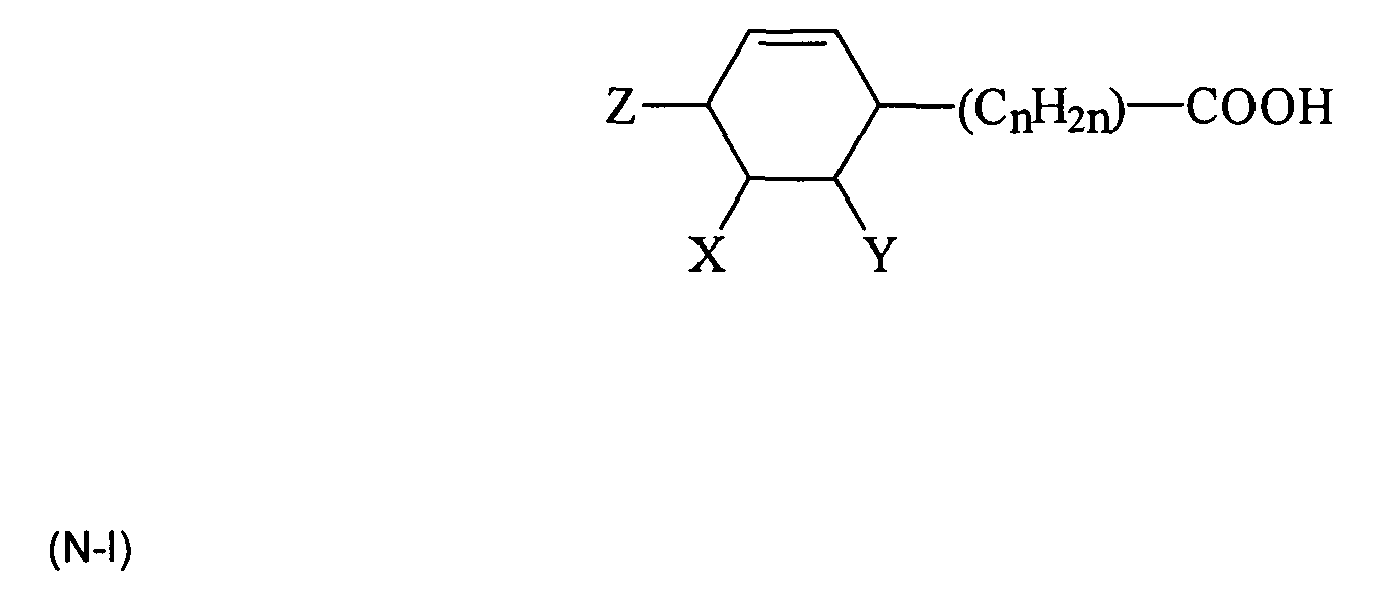
- Dicarbonsäuren der Formel (N-I) sind in der Literatur bekannt. So ist beispielweise
US-A 3,753,968 ein Herstellungsverfahren zu entnehmen. - Die Dicarbonsäuren der Formel (N-I) können beispielsweise durch Umsetzung von mehrfach ungesättigten Dicarbonsäuren mit ungesättigten Monocarbonsäuren in Form einer Diels-Alder-Cyclisierung hergestellt werden. Üblicherweise wird man von einer mehrfach ungesättigten Fettsäure als Dicarbonsäurekomponente ausgehen. Bevorzugt ist die aus natürlichen Fetten und Ölen zugängliche Linolsäure. Als Monocarbonsäurekomponente sind insbesondere Acrylsäure, aber auch z.B. Methacrylsäure und Crotonsäure bevorzugt. Üblicherweise entstehen bei Reaktionen nach Diels-Alder Isomerengemische, bei denen eine Komponente im Überschuss vorliegt. Diese Isomerengemische können erfindungsgemäß ebenso wie die reinen Verbindungen eingesetzt werden.
- Erfindungsgemäß einsetzbar neben den bevorzugten Dicarbonsäuren gemäß Formel (N-I) sind auch solche Dicarbonsäuren, die sich von den Verbindungen gemäß Formel (N-I) durch 1 bis 3 Methyl- oder Ethyl-Substituenten am Cyclohexylring unterscheiden oder aus diesen Verbindungen formal durch Anlagerung von einem Molekül Wasser an die Doppelbindung des Cyclohexenrings gebildet werden.
- Als erfindungsgemäß besonders wirksam hat sich die Dicarbonsäure(-mischung) erwiesen, die durch Umsetzung von Linolsäure mit Acrylsäure entsteht. Es handelt sich dabei um eine Mischung aus 5- und 6-Carboxy-4-hexyl-2-cyclohexen-1-octansäure. Solche Verbindungen sind kommerziell unter den Bezeichnungen Westvaco Diacid® 1550 und Westvaco Diacid® 1595 (Hersteller: Westvaco) erhältlich.
- Neben den zuvor beispielhaft aufgeführten kurzkettigen Carbonsäuren selbst können auch deren physiologisch verträgliche Salze erfindungsgemäß eingesetzt werden. Beispiele für solche Salze sind die Alkali-, Erdalkali- und Zinksalze, sowie Ammoniumsalze, worunter im Rahmen der vorliegenden Anmeldung auch die Mono-, Di- und Trimethyl-, -ethyl- und -hydroxyethyl-Ammoniumsalze zu verstehen sind. Ganz besonders bevorzugt können im Rahmen der Erfindung jedoch mit alkalisch reagierenden Aminosäuren, wie beispielsweise Arginin, Lysin, Ornithin und Histidin, neutralisierte Säuren eingesetzt werden. Weiterhin kann es aus Formulierungsgründen bevorzugt sein, die Carbonsäure aus den wasserlöslichen Vertretern, insbesondere den wasserlöslichen Salzen, auszuwählen.
- Weiterhin ist es erfindungsgemäß bevorzugt 2-Pyrrolidinon-5-carbonsäure und deren Derivate als Carbonsäure einzusetzen. Besonders bevorzugt sind die Natrium-, Kalium-, Calcium-, Magnesium- oder Ammoniumsalze, bei denen das Ammoniumion neben Wasserstoff eine bis drei C1- bis C4-Alkylgruppen trägt. Das Natriumsalz ist ganz besonders bevorzugt. Die eingesetzten Mengen in den erfindungsgemäßen Produkten betragen vorzugsweise 0,05 bis 10 Gew.%, bezogen auf die gesamte Anwendungszubereitung, besonders bevorzugt 0,1 bis 5 Gew.%, und insbesondere bevorzugt 0,1 bis 3 Gew.%.
- Weiterhin ist es erfindungsgemäß bevorzugt, Hydroxycarbonsäuren und hierbei wiederum insbesondere die Dihydroxy-, Trihydroxy- und Polyhydroxycarbonsäuren sowie die Dihydroxy-, Trihydroxy- und Polyhydroxy- di-, tri- und polycarbonsäuren einzusetzen. Hierbei hat sich gezeigt, dass neben den Hydroxycarbonsäuren auch die Hydroxycarbonsäureester sowie die Mischungen aus Hydroxycarbonsäuren und deren Estern als auch polymere Hydroxycarbonsäuren und deren Ester ganz besonders bevorzugt sein können. Bevorzugte Hydroxycarbonsäureester sind beispielsweise Vollester der Glycolsäure, Milchsäure, Äpfelsäure, Weinsäure oder Citronensäure. Weitere grundsätzlich geeigneten Hydroxycarbonsäureester sind Ester der β-Hydroxypropionsäure, der Tartronsäure, der D-Gluconsäure, der Zuckersäure, der Schleimsäure oder der Glucuronsäure. Als Alkoholkomponente dieser Ester eignen sich primäre, lineare oder verzweigte aliphatische Alkohole mit 8 - 22 C-Atomen, also z.B. Fettalkohole oder synthetische Fettalkohole. Dabei sind die Ester von C12-C15-Fettalkoholen besonders bevorzugt. Ester dieses Typs sind im Handel erhältlich, z.B. unter dem Warenzeichen Cosmacol® der EniChem, Augusta Industriale. Besonders bevorzugte Polyhydroxypolycarbonsäuren sind Polymilchsäure und Polyweinsäure sowie deren Ester.
- Als Pflegestoff eignen sich weiterhin Ectoin oder Ectoinderivate, Allantoin, Taurin und/oder Bisabolol.
- Erfindungsgemäß werden unter den Begriffen "Ectoin und Ectoinderivate" Verbindungen der Formel (IV)

R10 steht für ein Wasserstoffatom, einen verzweigten oder unverzweigten C1 - C4-Alkylrest oder einen C2 - C4-Hydroxyalkylrest,
R11 steht für ein Wasserstoffatom, eine Gruppierung -COOR14 oder eine Gruppierung-CO(NH)R14, wobei R14 für ein Wasserstoffatom, einen C1 - C4-Alkylrest, einen Aminosäurerest, einen Dipeptid- oder einen Tripeptidrest stehen kann,
R12 und R13 stehen unabhängig voneinander für ein Wasserstoffatom, einen C1 - C4-Alkylrest oder eine Hydroxygruppe mit der Maßgabe, dass nicht beide Reste gleichzeitig für eine Hydroxygruppe stehen dürfen, und
n steht für eine ganze Zahl von 1 bis 3. - Geeignete physiologisch verträgliche Salze der allgemeinen Verbindungen gemäß der Formel (IVa) oder (IVb) sind beispielsweise die Alkali-, Erdalkali-, Ammonium-, Triethylamin- oder Tris-(2-hydroxyethyl)aminsalze sowie solche, die sich aus der Umsetzung von Verbindungen gemäß der Formel (IVa) oder (IVb) mit anorganischen und organischen Säuren wie Salzsäure, Phosphorsäure, Schwefelsäure, verzweigten oder unverzweigten, substituierten oder unsubstituierten (beispielsweise durch eine oder mehrere Hydroxygruppen) C1 - C4- Mono- oder Dicarbonsäuren, aromatische Carbonsäuren und Sulfonsäuren wie Essigsäure, Citronensäure, Benzoesäure, Maleinsäure, Fumarsäure, Weinsäure und p-Toluolsulfonsäure ergeben. Beispiele für besonders bevorzugte physiologisch verträgliche Salze sind die Na-, K-, Mg- und Ca- und Ammoniumsalze der Verbindungen gemäß der Formel (IVa) oder (IVb), sowie die Salze, die sich durch Umsetzung von Verbindungen gemäß der Formel (IVa) oder (IVb) mit Salzsäure, Essigsäure, Citronensäure und Benzoesäure ergeben.
- Unter isomeren oder stereoisomeren Formen der Verbindungen gemäß Formel (IVa) oder (IVb) werden erfindungsgemäß alle auftretenden optischen Isomere, Diastereomere, Racemate, Zwitterionen, Kationen oder Gemische davon verstanden.
- Unter dem Begriff Aminosäure werden die stereoisomeren Formen, z.B. D- und L-Formen, folgender Verbindungen verstanden:
- Asparagin, Arginin, Asparaginsäure, Glutamin, Glutaminsäure, β-Alanin, γ-Aminobutyrat, Nε-Acetyllysin, Nδ-Acetylornitin, Nγ-Acetyldiaminobutyrat, Nα-Acetyldiaminobutyrat, Histidin, Isoleucin, Leucin, Methionin, Phenylalanin, Serin, Threonin und Tyrosin.
- L-Aminosäuren sind bevorzugt. Aminosäurereste leiten sich von den entsprechenden Aminosäuren ab. Die folgenden Aminosäurereste sind bevorzugt:
- Gly, Ala, Ser, Thr, Val, β-Ala, γ-Aminobutyrat, Asp, Glu, Asn, Aln, Nε-Acetyllysin, Nδ-Acetylornithin, Nγ-Acetyldiaminobutyrat, Nα-Acetyldiaminobutyrat.
- Die Kurzschreibweise der Aminosäuren erfolgte nach der allgemein üblichen Schreibweise. Die Di- oder Tripeptidreste sind in ihrer chemischen Natur nach Säureamide und zerfallen bei der Hydrolyse in 2 oder 3 Aminosäuren. Die Aminosäuren in dem Di- oder Tripeptidrest sind durch Amidbindungen miteinander verbunden.
- Bezüglich der Herstellung der Di- und Tripeptidreste wird ausdrücklich auf die
EP 0 671 161 A1 der Firma Marbert verwiesen. Auch Beispiele für Di- und Tripeptidreste sind der Offenbarung derEP 0 671 161 A1 zu entnehmen. - Beispiele für C1 - C4-Alkylgruppen in den Verbindungen der Formel (IV) sind Methyl, Ethyl, n-Propyl, Isopropyl, n-Butyl, Isobutyl und tert.-Butyl. Bevorzugte Alkylgruppen sind Methyl und Ethyl, Methyl ist eine besonders bevorzugte Alkylgruppe. Bevorzugte C2 - C4-Hydroxyalkylgruppen sind die Gruppen 2-Hydroxyethyl, 3-Hydroxypropyl oder 4-Hydroxybutyl; 2-Hydroxyethyl ist eine besonders bevorzugte Hydroxyalkylgruppe.
- Die erfindungsgemäßen Mittel enthalten diese Pflegestoffe bevorzugt in Mengen von 0,001 bis 2, insbesondere von 0,01 bis 0,5 Gew.-%, jeweils bezogen auf die gesamte Anwendungszubereitung.
- Auch Saccharide können als Pflegestoff in den erfindungsgemäßen Mitteln eingesetzt werden.
- Es können sowohl Monosaccharide als auch Oligosaccharide, wie beispielweise Rohrzucker, Milchzucker und Raffinose, eingesetzt werden. Die Verwendung von Monosacchariden ist erfindungsgemäß bevorzugt. Unter den Monosacchariden sind wiederum solche Verbindungen bevorzugt, die 5 oder 6 Kohlenstoffatome enthalten.
- Geeignete Pentosen und Hexosen sind beispielsweise Ribose, Arabinose, Xylose, Lyxose, Allose, Altrose, Glucose, Mannose, Gulose, Idose, Galactose, Talose, Fucose und Fructose. Arabinose, Glucose, Galactose und Fructose sind bevorzugt eingesetzte Kohlenhydrate. Ganz besonders bevorzugt eingesetzt wird Glucose, die sowohl in der D-(+)- oder L-(-)- Konfiguration oder als Racemat geeignet ist.
- Weiterhin können auch Derivate dieser Pentosen und Hexosen, wie die entsprechenden On- und Uronsäuren (Zuckersäuren), Zuckeralkohole und Glykoside, erfindungsgemäß eingesetzt werden. Bevorzugte Zuckersäuren sind die Gluconsäure, die Glucuronsäure, die Zuckersäure, die Mannozuckersäure und die Schleimsäure. Bevorzugte Zuckeralkohole sind Sorbit, Mannit und Dulcit. Bevorzugte Glykoside sind die Methylglucoside.
- Da die eingesetzten Mono- bzw. Oligosaccharide üblicherweise aus natürlichen Rohstoffen wie Stärke gewonnen werden, weisen sie in der Regel die diesen Rohstoffen entsprechenden Konfigurationen auf (z.B. D-Glucose, D-Fructose und D-Galactose).
- Die Mono- bzw. Oligosaccharide sind in den erfindungsgemäßen Haarbehandlungsmitteln bevorzugt in einer Menge von 0,1 bis 8 Gew.-%, insbesondere bevorzugt 1 bis 5 Gew.-%, bezogen auf die gesamte Anwendungszubereitung, enthalten.
- Das Mittel kann weiterhin mindestens ein Lipid als Pflegestoff enthalten.
- Erfindungsgemäß geeignete Lipide sind Phospholipide, beispielsweise Sojalecithin, Ei-Lecithin und Kephaline sowie die unter den INCI-Bezeichnungen Linoleamidopropyl PG-Dimonium Chloride Phosphate, Cocamidopropyl PG-Dimonium Chloride Phosphate und Stearamidopropyl PG-Dimonium Chloride Phosphate bekannten Substanzen. Diese werden beispielsweise von der Firma Mona unter den Handelsbezeichnungen Phospholipid EFA®, Phospholipid PTC® sowie Phospholipid SV® vertrieben.
- Die erfindungsgemäßen Mittel enthalten die Lipide bevorzugt in Mengen von 0,01 - 10 Gew.-%, insbesondere 0,1 - 5 Gew.-%, bezogen auf die gesamte Anwendungszubereitung.
- Weiterhin sind als Pflegestoff Ölkörper geeignet.
- Zu den natürlichen und synthetischen kosmetischen Ölkörpern sind beispielsweise zu zählen:
- pflanzliche Öle. Beispiele für solche Öle sind Sonnenblumenöl, Olivenöl, Sojaöl, Rapsöl, Mandelöl, Jojobaöl, Orangenöl, Weizenkeimöl, Pfirsichkernöl und die flüssigen Anteile des Kokosöls. Geeignet sind aber auch andere Triglyceridöle wie die flüssigen Anteile des Rindertalgs sowie synthetische Triglyceridöle.
- flüssige Paraffinöle, Isoparaffinöle und synthetische Kohlenwasserstoffe sowie Di-n-alkylether mit insgesamt zwischen 12 bis 36 C-Atomen, insbesondere 12 bis 24 C-Atomen, wie beispielsweise Di-n-octylether, Di-n-decylether, Di-n-nonylether, Di-n-undecylether, Di-n-dodecylether, n-Hexyl-n-octylether, n-Octyl-n-decylether, n-Decyl-n-undecylether, n-Undecyln-dodecylether und n-Hexyl-n-Undecylether sowie Di-tert-butylether, Di-iso-pentylether, Di-3-ethyldecylether, tert.-Butyl-n-octylether, iso-Pentyl-n-octylether und 2-Methyl-pentyl-n-octylether. Die als Handelsprodukte erhältlichen Verbindungen 1,3-Di-(2-ethyl-hexyl)-cyclohexan (Cetiol® S) und Di-n-octylether (Cetiol®OE) können bevorzugt sein.
- Esteröle. Unter Esterölen sind zu verstehen die Ester von C6-C30-Fettsäuren mit C2-C30-Fettalkoholen. Bevorzugt sind die Monoester der Fettsäuren mit Alkoholen mit 2 bis 24 C-Atomen. Beispiele für eingesetzte Fettsäurenanteile in den Estern sind Capronsäure, Caprylsäure, 2-Ethylhexansäure, Caprinsäure, Laurinsäure, Isotridecansäure, Myristinsäure, Palmitinsäure, Palmitoleinsäure, Stearinsäure, Isostearinsäure, Ölsäure, Elaidinsäure, Petroselinsäure, Linolsäure, Linolensäure, Elaeostearinsäure, Arachinsäure, Gadoleinsäure, Behensäure und Erucasäure sowie deren technische Mischungen, die z.B. bei der Druckspaltung von natürlichen Fetten und Ölen, bei der Oxidation von Aldehyden aus der Roelen'schen Oxosynthese oder der Dimerisierung von ungesättigten Fettsäuren anfallen. Beispiele für die Fettalkoholanteile in den Esterölen sind Isopropylalkohol, Capronalkohol, Caprylalkohol, 2-Ethylhexylalkohol, Caprinalkohol, Laurylalkohol, Isotridecylalkohol, Myristylalkohol, Cetylalkohol, Palmoleylalkohol, Stearylalkohol, Isostearylalkohol, Oleylalkohol, Elaidylalkohol, Petroselinylalkohol, Linolylalkohol, Linolenylalkohol, Elaeostearylalkohol, Arachylalkohol, Gadoleylalkohol, Behenylalkohol, Erucylalkohol und Brassidylalkohol sowie deren technische Mischungen, die z.B. bei der Hochdruckhydrierung von technischen Methylestern auf Basis von Fetten und Ölen oder Aldehyden aus der Roelen'schen Oxosynthese sowie als Monomerfraktion bei der Dimerisierung von ungesättigten Fettalkoholen anfallen. Erfindungsgemäß besonders bevorzugt sind Isopropylmyristat (Rilanit®IPM), lsononansäure-C16-18-alkylester (Cetiol® SN), 2-Ethylhexylpalmitat (Cegesoft®24), Stearinsäure-2-ethylhexylester (Cetiol®868), Cetyloleat, Glycerintricaprylat, Kokosfettalkoholcaprinat/-caprylat (Cetiol®LC), n-Butylstearat, Oleylerucat (Cetiol®J 600), Isopropylpalmitat (Rilanit®IPP), Oleyl Oleate (Cetiol®), Laurinsäurehexylester (Cetiol®A), Di-n-butyladipat (Cetiol® B), Myristylmyristat (Cetiol® MM), Cetearyl Isononanoate (Cetiol®SN), Ölsäuredecylester (Cetiol®V).
- Dicarbonsäureester wie Di-n-butyladipat, Di-(2-ethylhexyl)-adipat, Di-(2-ethylhexyl)-succinat und Di-isotridecylacelaat sowie Diolester wie Ethylenglykol-dioleat, Ethylenglykol-diisotridecanoat, Propylenglykol-di(2-ethylhexanoat), Propylenglykol-di-isostearat, Propylenglykol-di-pelargonat, Butandiol-di-isostearat, Neopentylglykoldicaprylat,
- symmetrische, unsymmetrische oder cyclische Ester der Kohlensäure mit Fettalkoholen, beispielsweise beschrieben in der
DE-OS 197 56 454 , Glycerincarbonat oder Dicaprylylcarbonat (Cetiol® CC), - Trifettsäureester von gesättigten und/oder ungesättigten linearen und/oder verzweigten Fettsäuren mit Glycerin,
- Fettsäurepartialglyceride, worunter Monoglyceride, Diglyceride und deren technische Gemische zu verstehen sind. Bei der Verwendung technischer Produkte können herstellungsbedingt noch geringe Mengen Triglyceride enthalten sein. Die Partialglyceride folgen vorzugsweise der Formel (D4-I),

- Die Einsatzmenge der natürlichen und synthetischen kosmetischen Ölkörper in den erfindungsgemäßen Mitteln beträgt vorzugsweise 0,1 - 30 Gew.%, bezogen auf die gesamte Anwendungszubereitung, besonders bevorzugt 0,1 - 20 Gew.-%, und insbesondere bevorzugt 0,1 - 15 Gew.-%.
- Weitere geeignete Pflegestoffe sind Enzyme. Erfindungsgemäß besonders bevorzugte Enzyme sind ausgewählt aus einer Gruppe, die gebildet wird aus Proteasen, Lipasen, Transglutaminase, Oxidasen und Peroxidasen.
- Auch Perlenextrakte sind als Pflegestoff geeignet.
- Perlen von Muscheln bestehen im wesentlichen aus anorganischen und organischen Calciumsalzen, Spurenelementen und Proteinen. Perlen lassen sich auf einfache Weise aus kultivierten Muscheln gewinnen. Die Kultivierung der Muscheln kann sowohl in Süßwasser als auch in Meereswasser erfolgen. Dies kann sich auf die Inhaltsstoffe der Perlen auswirken. Erfindungsgemäß bevorzugt ist ein Perlenextrakt, welcher von in Meeres- bzw. Salzwasser kultivierten Muscheln stammt. Die Perlen bestehen zu einem großen Teil aus Aragonit (Calciumcarbonat), Conchiolin und einem Albuminoid. Letztere Bestandteile sind Proteine. Weiterhin sind in Perlen noch Magnesium- und Natriumsalze, anorganische Siliciumverbindungen sowie Phosphate enthalten.
- Zur Herstellung des Perlenextraktes werden die Perlen pulverisiert. Danach werden die pulverisierten Perlen mit den üblichen Methoden extrahiert. Als Extraktionsmittel zur Herstellung der Perlenextrakte können Wasser, Alkohole sowie deren Mischungen verwendet werden. Unter Wasser sind dabei sowohl demineralisiertes Wasser, als auch Meereswasser zu verstehen. Unter den Alkoholen sind dabei niedere Alkohole wie Ethanol und Isopropanol, insbesondere aber mehrwertige Alkohole wie Glycerin, Diglycerin, Triglycerin, Polyglycerin, Ethylenglykol, Propylenglykol und Butylenglykol, sowohl als alleiniges Extraktionsmittel als auch in Mischung mit demineralisiertem Wasser oder Meereswasser, bevorzugt. Perlenextrakte auf Basis von Wasser/Glyceringemischen haben sich als besonders geeignet erwiesen. Je nach Extraktionsbedingungen können die Perlenproteine (Conchiloin und Albuminoid) weitestgehend in nativem Zustand oder bereits teilweise oder weitestgehend als Proteinhydrolysate vorliegen. Bevorzugt ist ein Perlenextrakt, in welchem Conchiolin und Albuminoid bereits teilweise hydrolysiert vorliegen. Die wesentlichen Aminosäuren dieser Proteine sind Glutaminsäure, Serin, Alanin, Glycin, Asparaginsäure und Phenylalanin. In einer weiteren besonders bevorzugten Ausgestaltung kann es vorteilhaft sein, wenn der Perlenextrakt zusätzlich mit mindestens einer oder mehreren dieser Aminosäuren angereichert wird. In der bevorzugtesten Ausführungsform ist der Perlenextrakt angereichert mit Glutaminsäure, Serin und Leucin. Weiterhin findet sich je nach Extraktionsbedingungen, insbesondere in Abhängigkeit von der Wahl des Extraktionsmittels ein mehr oder weniger großer Anteil an Mineralien und Spurenelementen im Extrakt wieder. Ein bevorzugter Extrakt enthält organische und/oder anorganische Calciumsalze sowie Magnesium- und Natriumsalze, anorganische Siliciumverbindungen und/oder Phosphate. Ein ganz besonders bevorzugter Perlenextrakt enthält mindestens 75 %, bevorzugt 85 %, besonders bevorzugt 90 % und ganz besonders bevorzugt 95 % aller Inhaltsstoffe der natürlich vorkommenden Perlen. Beispiele für erfindungsgemäß einsetzbare Perlenextrakte sind die Handelsprodukte Pearl Protein Extract BG® oder Crodarom® Pearl.
- Die zuvor beschriebenen Perlenextrakte sind vorzugsweise in einer Menge von mindestens 0,01 bis zu 20 Gew.% enthalten. Bevorzugt werden Mengen des Extraktes von 0,01 bis zu 10 Gew.%, ganz besonders bevorzugt Mengen von 0,01 bis 5 Gew.% bezogen auf das gesamte Zweikomponentenmittel verwendet.
- Obwohl jeder der genannten Pflegestoffe für sich alleine bereits ein zufrieden stellendes Resultat ergibt, sind im Rahmen der vorliegenden Erfindung auch alle Ausführungsformen umfasst, in denen das Mittel mehrere Pflegestoffe auch aus verschiedenen Gruppen enthält.
- Das erfindungsgemäße Mittel liegt in einem kosmetisch akzeptablen Träger vor. Dabei handelt es sich bevorzugt um ein wässriges, ein alkoholisches oder ein wässrigalkoholisches Medium mit vorzugsweise mindestens 10 Gewichtsprozent Wasser bezogen auf die gesamte Zubereitung. Als Alkohole können insbesondere die für kosmetische Zwecke üblicherweise verwendeten niederen Alkohole mit 1 bis 4 Kohlenstoffatomen wie zum Beispiel Ethanol und Isopropanol enthalten sein. Besonders bevorzugt handelt es sich bei dem kosmetisch akzeptablen Träger um Wasser.
- Die Konfektionierung kann beispielsweise in Form von Flüssigkeiten unterschiedlicher Viskosität, Cremes, Emulsionen, Gelen oder auch tensidhaltigen schäumenden Lösungen oder anderen Zubereitungen erfolgen, die für die Anwendung auf dem Haar geeignet sind. Die Zubereitungen weisen bevorzugt einen pH-Wert von 2 bis 11 auf. Besonders bevorzugt ist der pH-Bereich zwischen 2 und 8. Die Angaben zum pH-Wert beziehen sich dabei im Sinne dieser Schrift auf den pH-Wert bei 25°C sofern nichts anderes vermerkt ist.
- Als zusätzliche Co-Solventien können organische Lösungsmittel oder ein Gemisch aus Lösungsmitteln mit einem Siedepunkt unter 400°C in einer Menge von 0,1 bis 15 Gewichtsprozent bevorzugt von 1 bis 10 Gewichtsprozent bezogen auf die gesamte Zubereitung enthalten sein. Besonders geeignet als zusätzliche Co-Solventien sind unverzweigte oder verzweigte Kohlenwasserstoffe wie Pentan, Hexan, Isopentan und cyclische Kohlenwasserstoffe wie Cyclopentan und Cyclohexan. Weitere, besonders bevorzugte wasserlösliche Lösungsmittel sind Glycerin, Ethylenglykol und Propylenglykol in einer Menge bis 30 Gewichtsprozent bezogen auf die gesamte Zubereitung.
- Durch Zugabe eines UV-Filters können sowohl die Mittel selbst, als auch die behandelten Fasern vor schädlichen Einflüssen von UV-Strahlung geschützt werden. Vorzugsweise wird daher dem Mittel mindestens ein UV-Filter zugegeben. Die geeigneten UV-Filter unterliegen hinsichtlich ihrer Struktur und ihrer physikalischen Eigenschaften keinen generellen Einschränkungen. Vielmehr eignen sich alle im Kosmetikbereich einsetzbaren UV-Filter, deren Absorptionsmaximum im UVA(315-400 nm)-, im UVB(280-315nm)- oder im UVC(<280 nm)-Bereich liegt. UV-Filter mit einem Absorptionsmaximum im UVB-Bereich, insbesondere im Bereich von etwa 280 bis etwa 300 nm, sind besonders bevorzugt.
- Die erfindungsgemäß bevorzugten UV-Filter können beispielsweise ausgewählt werden aus substituierten Benzophenonen, p-Aminobenzoesäureestern, Diphenylacrylsäureestern, Zimtsäureestern, Salicylsäureestern, Benzimidazolen und o-Aminobenzoesäureestern.
- Beispiele für erfindungsgemäß verwendbare UV-Filter sind 4-Amino-benzoesäure, N,N,N-Trimethyl-4-(2-oxoborn-3-ylidenmethyl)anilin-methylsulfat, 3,3,5-Trimethyl-cyclohexylsalicylat (Homosalate), 2-Hydroxy-4-methoxy-benzophenon (Benzophenone-3; Uvinul®M 40, Uvasorb®MET, Neo Heliopan®BB, Eusolex®4360), 2-Phenylbenzimidazol-5-sulfonsäure und deren Kalium-, Natrium- und Triethanolaminsalze (Phenylbenzimidazole sulfonic acid; Parsol®HS; Neo Heliopan®Hydro), 3,3'-(1,4-Phenylendimethylen)-bis(7,7-dimethyl-2-oxo-bicyclo-[2.2.1]hept-1-yl-methan-sulfonsäure) und deren Salze, 1-(4-tert.-Butylphenyl)-3-(4-methoxyphenyl)-propan-1,3-dion (Butyl methoxydibenzoylmethane; Parsol®1789, Eusolex®9020), α-(2-Oxoborn-3-yliden)-toluol-4-sulfonsäure und deren Salze, ethoxylierte 4-Aminobenzoesäure-ethylester (PEG-25 PABA; Uvinul®P 25), 4-Dimethylaminobenzoesäure-2-ethylhexylester (Octyl Dimethyl PABA; Uvasorb®DMO, Escalol®507, Eusolex®6007), Salicylsäure-2-ethylhexylester (Octyl Salicylat; Escalol®587, Neo Heliopan®OS, Uvinul®O18), 4-Methoxyzimtsäure-isopentylester (Isoamyl p-Methoxycinnamate; Neo Heliopan®E 1000), 4-Methoxyzimtsäure-2-ethylhexyl-ester (Octyl Methoxycinnamate; Parsol®MCX, Escalol®557, Neo Heliopan®AV), 2-Hydroxy-4-methoxy-benzophenon-5-sulfonsäure und deren Natriumsalz (Benzophenone-4; Uvinul®MS 40; Uvasorb®S 5), 3-(4'-Methylbenzyliden)-D,L-Campher (4-Methylbenzylidene camphor; Parsol®5000, Eusolex®6300), 3-Benzyliden-campher (3-Benzylidene camphor), 4-Isopropylbenzylsalicylat, 2,4,6- Trianilino-(p-carbo-2'-ethylhexyl-1 '-oxi)-1,3,5-triazin, 3-Imidazol-4-yl-acrylsäure und deren Ethylester, Polymere des N-{(2 und 4)-[2-oxoborn-3-ylidenmethyl]benzyl}-acrylamids, 2,4-Dihydroxybenzophenon (Benzophenone-1; Uvasorb®20 H, Uvinul®400), 1,1'-Diphenylacrylonitrilsäure-2-ethylhexyl-ester (Octocrylene; Eusolex®OCR, Neo Heliopan®Type 303, Uvinul®N 539 SG), o-Aminobenzoesäure-menthylester (Menthyl Anthranilate; Neo Heliopan®MA), 2,2',4,4'-Tetrahydroxybenzophenon (Benzophenone-2; Uvinul®D-50), 2,2'-Dihydroxy-4,4'-dimethoxybenzophenon (Benzophenone-6), 2,2'-Dihydroxy-4,4'-dimethoxybenzophenon-5-natriumsulfonat und 2-Cyano-3,3-diphenylacrylsäure-2'-ethylhexylester. Bevorzugt sind 4-Amino-benzoesäure, N,N,N-Trimethyl-4-(2-oxoborn-3-ylidenmethyl)anilin-methylsulfat, 3,3,5-Trimethyl-cyclohexylsalicylat, 2-Hydroxy-4-methoxy-benzophenon, 2-Phenylbenzimidazol-5-sulfonsäure und deren Kalium-, Natrium- und Triethanolaminsalze, 3,3'-(1,4-Phenylendimethylen)-bis(7,7-dimethyl-2-oxo-bicyclo-[2.2.1]hept-1-yl-methan-sulfonsäure) und deren Salze, 1-(4-tert.-Butylphenyl)-3-(4-methoxyphenyl)-propan-1,3-dion, α-(2-Oxoborn-3-yliden)-toluol-4-sulfonsäure und deren Salze, ethoxylierte 4-Aminobenzoesäure-ethylester, 4-Dimethylaminobenzoesäure-2-ethylhexylester, Salicylsäure-2-ethylhexylester, 4-Methoxyzimtsäure-isopentylester, 4-Methoxyzimtsäure-2-ethylhexyl-ester, 2-Hydroxy-4-methoxybenzophenon-5-sulfonsäure und deren Natriumsalz, 3-(4'-Methylbenzyliden)-D,L-Campher, 3-Benzyliden-campher, 4-Isopropylbenzylsalicylat, 2,4,6-Tri-anilino-(p-carbo-2'-ethylhexyl-1'-oxi)-1,3,5-triazin, 3-lmidazol-4-yl-acrylsäure und deren Ethylester, Polymere des N-{(2 und 4)-[2-oxoborn-3-ylidenmethyl]benzyl}-acrylamid. Erfindungsgemäß ganz besonders bevorzugt sind 2-Hydroxy-4-methoxy-benzophenon, 2-Phenylbenzimidazol-5-sulfonsäure und deren Kalium-, Natrium- und Triethanolaminsalze, 1-(4-tert.-Butylphenyl)-3-(4-methoxyphenyl)-propan-1,3-dion, 4-Methoxyzimtsäure-2-ethylhexyl-ester und 3-(4'-Methyl-benzyliden)-D,L-Campher.
- Bevorzugt sind solche UV-Filter, deren molarer Extinktionskoeffizient am Absorptionsmaximum oberhalb von 15 000, insbesondere oberhalb von 20 000, liegt.
- Weiterhin wurde gefunden, dass bei strukturell ähnlichen UV-Filtern in vielen Fällen die wasserunlösliche Verbindung im Rahmen der erfindungsgemäßen Lehre die höhere Wirkung gegenüber solchen wasserlöslichen Verbindungen aufweist, die sich von ihr durch eine oder mehrere zusätzlich ionische Gruppen unterscheiden. Als wasserunlöslich sind im Rahmen der Erfindung solche UV-Filter zu verstehen, die sich bei 20 °C zu nicht mehr als 1 Gew.-%, insbesondere zu nicht mehr als 0,1 Gew.-%, in Wasser lösen. Weiterhin sollten diese Verbindungen in üblichen kosmetischen Ölkomponenten bei Raumtemperatur zu mindestens 0,1, insbesondere zu mindestens 1 Gew.-% löslich sein. Die Verwendung wasserunlöslicher UV-Filter kann daher erfindungsgemäß bevorzugt sein.
- Gemäß einer weiteren Ausführungsform der Erfindung sind solche UV-Filter bevorzugt, die eine kationische Gruppe, insbesondere eine quartäre Ammoniumgruppe, aufweisen.
- Diese UV-Filter weisen die allgemeine Struktur U - Q auf.
- Der Strukturteil U steht dabei für eine UV-Strahlen absorbierende Gruppe. Diese Gruppe kann sich im Prinzip von den bekannten, im Kosmetikbereich einsetzbaren, oben genannten UV-Filtern ableiten, in dem eine Gruppe, in der Regel ein Wasserstoffatom, des UV-Filters durch eine kationische Gruppe Q, insbesondere mit einer quartären Aminofunktion, ersetzt wird.
- Verbindungen, von denen sich der Strukturteil U ableiten kann, sind beispielsweise
- substituierte Benzophenone,
- p-Aminobenzoesäureester,
- Diphenylacrylsäureester,
- Zimtsäureester,
- Salicylsäureester,
- Benzimidazole und
- o-Aminobenzoesäureester.
- Strukturteile U, die sich vom Zimtsäureamid oder vom N,N-Dimethylaminobenzoesäureamid ableiten, sind erfindungsgemäß bevorzugt.
- Die Strukturteile U können prinzipiell so gewählt werden, dass das Absorptionsmaximum der UV-Filter sowohl im UVA(315-400 nm)-, als auch im UVB(280-315nm)- oder im UVC(<280 nm)-Bereich liegen kann. UV-Filter mit einem Absorptionsmaximum im UVB-Bereich, insbesondere im Bereich von etwa 280 bis etwa 300 nm, sind besonders bevorzugt.
- Weiterhin wird der Strukturteil U, auch in Abhängigkeit von Strukturteil Q, bevorzugt so gewählt, dass der molare Extinktionskoeffizient des UV-Filters am Absorptionsmaximum oberhalb von 15 000, insbesondere oberhalb von 20 000, liegt.
- Der Strukturteil Q enthält als kationische Gruppe bevorzugt eine quartäre Ammoniumgruppe. Diese quartäre Ammoniumgruppe kann prinzipiell direkt mit dem Strukturteil U verbunden sein, so dass der Strukturteil U einen der vier Substituenten des positiv geladenen Stickstoffatomes darstellt. Bevorzugt ist jedoch einer der vier Substituenten am positiv geladenen Stickstoffatom eine Gruppe, insbesondere eine Alkylengruppe mit 2 bis 6 Kohlenstoffatomen, die als Verbindung zwischen dem Strukturteil U und dem positiv geladenen Stickstoffatom fungiert.
- Vorteilhafterweise hat die Gruppe Q die allgemeine Struktur -(CH2)x-N+R1R2R3 X-, in der x steht für eine ganze Zahl von 1 bis 4, R1 und R2 unabhängig voneinander stehen für C1-4-Alkylgruppen, R3 steht für eine C1-22-Alkylgruppe oder eine Benzylgruppe und X- für ein physiologisch verträgliches Anion. Im Rahmen dieser allgemeinen Struktur steht x bevorzugt für die Zahl 3, R1 und R2 jeweils für eine Methylgruppe und R3 entweder für eine Methylgruppe oder eine gesättigte oder ungesättigte, lineare oder verzweigte Kohlenwasserstoffkette mit 8 bis 22, insbesondere 10 bis 18, Kohlenstoffatomen.
- Physiologisch verträgliche Anionen sind beispielsweise anorganische Anionen wie Halogenide, insbesondere Chlorid, Bromid und Fluorid, Sulfationen und Phosphationen sowie organische Anionen wie Lactat, Citrat, Acetat, Tartrat, Methosulfat und Tosylat.
- Zwei bevorzugte UV-Filter mit kationischen Gruppen sind die als Handelsprodukte erhältlichen Verbindungen Zimtsäureamidopropyl-trimethylammoniumchlorid (Incroquat®UV-283) und Dodecyl-dimethylaminobenzamidopropyl-dimethylammoniumtosylat (Escalol® HP 610).
- Selbstverständlich umfasst die erfindungsgemäße Lehre auch die Verwendung einer Kombination von mehreren UV-Filtern. Im Rahmen dieser Ausführungsform ist die Kombination mindestens eines wasserunlöslichen UV-Filters mit mindestens einem UV-Filter mit einer kationischen Gruppe bevorzugt.
- Die UV-Filter sind üblicherweise in Mengen von 0,01-5 Gew.-%, bezogen auf die gesamte Anwendungszubereitung, enthalten. Mengen von 0,1-2,5 Gew.-% sind bevorzugt.
- Die Mittel können neben den genannten Komponenten weiterhin alle für solche Zubereitungen bekannten Wirk-, Zusatz- und Hilfsstoffe enthalten.
- Weitere Wirk-, Hilfs- und Zusatzstoffe, sind beispielsweise
- Verdickungsmittel wie Agar-Agar, Guar-Gum, Alginate, Xanthan-Gum, Gummi arabicum, Karaya-Gummi, Johannisbrotkernmehl, Leinsamengummen, Dextrane, Cellulose-Derivate, z. B. Methylcellulose, Hydroxyalkylcellulose und Carboxymethylcellulose, Stärke-Fraktionen und Derivate wie Amylose, Amylopektin und Dextrine, Tone wie z. B. Bentonit oder vollsynthetische Hydrokolloide wie z.B. Polyvinylalkohol,
- Strukturanten wie Maleinsäure und Milchsäure,
- Parfümöle, Dimethylisosorbid und Cyclodextrine,
- Lösungsmittel und -vermittler wie Ethanol, Isopropanol, Ethylenglykol, Propylenglykol, Glycerin und Diethylenglykol,
- quaternierte Amine wie Methyl-1-alkylamidoethyl-2-alkylimidazolinium-methosulfat
- Entschäumer wie Silikone,
- Farbstoffe zum Anfärben des Mittels,
- Antischuppenwirkstoffe wie Piroctone Olamine, Zink Omadine und Climbazol,
- Substanzen zur Einstellung des pH-Wertes, wie beispielsweise übliche Säuren, insbesondere Genusssäuren und Basen,
- Cholesterin,
- Konsistenzgeber wie Zuckerester, Polyolester oder Polyolalkylether,
- Fette und Wachse wie Walrat, Bienenwachs, Montanwachs und Paraffine,
- Fettsäurealkanolamide,
- Komplexbildner wie EDTA, NTA, β-Alanindiessigsäure und Phosphonsäuren,
- Quell- und Penetrationsstoffe wie Glycerin, Propylenglykolmonoethylether, Carbonate, Hydrogencarbonate, Guanidine, Harnstoffe sowie primäre, sekundäre und tertiäre Phosphate,
- Trübungsmittel wie Latex, Styrol/PVP- und Styrol/Acrylamid-Copolymere
- Perlglanzmittel wie Ethylenglykolmono- und -distearat sowie PEG-3-distearat,
- Konservierungsmittel,
- Stabilisierungsmittel für Wasserstoffperoxid und andere Oxidationsmittel,
- Treibmittel wie Propan-Butan-Gemische, N2O, Dimethylether, CO2 und Luft,
- Antioxidantien.
- Bezüglich weiterer fakultativer Komponenten sowie die eingesetzten Mengen dieser Komponenten wird ausdrücklich auf die dem Fachmann bekannten einschlägigen Handbücher, z. B.
- Kh. Schrader, Grundlagen und Rezepturen der Kosmetika, 2. Auflage, Hüthig Buch Verlag, Heidelberg, 1989, verwiesen.
- Ein zweiter Gegenstand der Erfindung ist ein Verfahren zur Behandlung keratinischer Fasern, wobei ein erfindungsgemäßes Mittel auf die gegebenenfalls zuvor angefeuchteten keratinischen Fasern aufgebracht, dort mindestens solange belassen, bis eine Änderung der Farbe des Mittels festgestellt werden kann, und schließlich ausgespült wird.
- Vorzugsweise wird das auf die keratinischen Fasern aufgebrachte Mittel für mindestens 10 Sekunden einmassiert. Insbesondere wenn mindestens ein Bestandteil des Indikatorsystems in mikroverkapselter Form vorliegt, empfiehlt sich dieses Vorgehen, da dadurch gewährleistet wird, dass der Bestandteil durch die mechanische Beanspruchung der Mikrokapseln in ausreichendem Maße freigesetzt wird.
- Die nachfolgenden Beispiele sollen den Gegenstand der vorliegenden Erfindung erläutern ohne ihn in irgendeiner Weise zu beschränken.
- Es wurden die folgenden Rezepturen hergestellt. Die Mengenangaben verstehen sich - soweit nichts anderes vermerkt ist - in Gewichtsprozent.
1 Pflegespülung Rohstoffe Lanette® O1 5,0 Eumulgin® B1 2 0,3 Dehyquart® A-CA3 1,8 Gluadin® W204 0,5 Indikatorsystem5 0,1 Methylparaben 0,2 Phenoxyethanol 0,4 Parfüm 0,15 Wasser, entsalzt ad 100 1 C16-18-Fettalkohol (INCI-Bezeichnung: Cetearyl Alcohol) (Cognis)
2 Cetylstearylalkohol mit ca. 12-EO-Einheiten (INCI-Bezeichnung: Ceteareth-12) (Cognis)
3 Trimethylhexadecylammoniumchlorid (ca. 24 -26 % Aktivsubstanz; INCI-Bezeichnung: Aqua (Water), Cetrimonium Chloride) (Cognis)
4 Weizenproteinhydrolysat (mind. 20% Festkörper; INCI-Bezeichnung: Aqua (Water), Hydrolyzed Wheat Protein, Sodium Benzoate, Phenoxyethanol, Methylparaben, Propylparaben) (Cognis)
5 Erster Bestandteil: 30 % FD&C Blue 1 (Cl 42090) in mikroverkapselter Form; zweiter Bestandteil 70 % Acid Yellow 23 (Cl 19140)2 Haarkur Rohstoffe Lanette® O1 2,5 Eumulgin® B1 2 0,3 Dehyquart® A-CA3 1,0 Gluadin® W204 1,0 Promois® Silk 10006 0,5 Indikatorsystem5 0,1 Methylparaben 0,2 Phenoxyethanol 0,4 Parfüm 0,2 Wasser, entsalzt ad 100 6 Seidenproteinhydrolysat (ca. 5-8% Festkörper; lNCl-Bezeichnung: Hydrolyzed Silk) (Interorgana)
Claims (10)
- Mittel zur Behandlung keratinischer Fasern, enthaltend in einem kosmetisch akzeptablen Träger- mindestens ein Tensid und- mindestens ein Indikatorsystem, das mindestens zwei Bestandteile umfasst, und das 0,5 bis 15 Minuten nach Aufbringen des Mittels auf die keratinischen Fasern eine Änderung der Farbe des Mittels bewirkt.
- Mittel nach Anspruch 1, dadurch gekennzeichnet, dass das Indikatorsystem als ersten Bestandteil mindestens einen ersten Farbstoff und als zweiten Bestandteil mindestens einen zweiten Stoff umfasst, wobei Farbstoff und zweiter Stoff wechselwirken und dabei die Änderung der Farbe des Mittels bewirken.
- Mittel nach Anspruch 2, dadurch gekennzeichnet, dass der zweite Stoff ausgewählt ist aus weiteren, vom ersten Farbstoff unterschiedlichen Farbstoffen, Reduktionsmitteln, Oxidationsmitteln, Säuren und Basen.
- Mittel nach einem der Ansprüche 2 bis 3, dadurch gekennzeichnet, dass der erste Farbstoff und/oder der zweite Stoff in mikroverkapselter Form vorliegt.
- Mittel nach Anspruch 4, dadurch gekennzeichnet, dass die Mikrokapseln eine wasserunlösliche Hülle aufweisen.
- Mittel nach einem der Ansprüche 1 bis 5, dadurch gekennzeichnet, dass es sich um ein Mehrkomponentenmittel handelt, wobei eine erste Komponente einen ersten Bestandteil des Indikatorsystems und eine zweite Komponente einen zweiten Bestandteil des Indikatorsystems enthält.
- Mittel nach einem der Ansprüche 1 bis 6, dadurch gekennzeichnet, dass es sich um ein Shampoo handelt, wobei das Tensid in einer Menge von 0,1 bis 45 Gew.-%, bezogen auf das gesamte Mittel, enthalten ist.
- Mittel nach einem der Ansprüche 1 bis 6, dadurch gekennzeichnet, dass es sich um ein Pflegemittel handelt, wobei das Tensid in einer Menge von 0,1 bis 25 Gew.-%, bezogen auf das gesamte Mittel, enthalten ist, und das Mittel weiterhin mindestens einen Pflegestoff enthält.
- Verfahren zur Behandlung keratinischer Fasern, dadurch gekennzeichnet, dass ein Mittel gemäß mindestens eines der Ansprüche 1 bis 8 auf die gegebenenfalls zuvor angefeuchteten keratinischen Fasern aufgebracht, dort mindestens solange belassen, bis eine Änderung der Farbe des Mittels festgestellt werden kann, und schließlich ausgespült wird.
- Verfahren nach Anspruch 9, dadurch gekennzeichnet, dass das auf die keratinischen Fasern aufgebrachte Mittel für mindestens 10 Sekunden einmassiert wird.
Applications Claiming Priority (1)
| Application Number | Priority Date | Filing Date | Title |
|---|---|---|---|
| DE200610020620 DE102006020620A1 (de) | 2006-05-02 | 2006-05-02 | Mittel zur Behandlung keratinischer Fasern mit Farbindikation der optimalen Behandlungszeit |
Publications (2)
| Publication Number | Publication Date |
|---|---|
| EP1854448A2 true EP1854448A2 (de) | 2007-11-14 |
| EP1854448A3 EP1854448A3 (de) | 2009-04-29 |
Family
ID=38328255
Family Applications (1)
| Application Number | Title | Priority Date | Filing Date |
|---|---|---|---|
| EP07002161A Withdrawn EP1854448A3 (de) | 2006-05-02 | 2007-02-01 | Mittel zur Behandlung keratinischer Fasern mit Farbindikation der optimalen Behandlungszeit |
Country Status (2)
| Country | Link |
|---|---|
| EP (1) | EP1854448A3 (de) |
| DE (1) | DE102006020620A1 (de) |
Cited By (4)
| Publication number | Priority date | Publication date | Assignee | Title |
|---|---|---|---|---|
| FR3089795A1 (fr) * | 2018-12-18 | 2020-06-19 | Henkel Ag & Co. Kgaa | Agent de soin capillaire à deux constituants, procédé de préparation d’un agent cosmétique et utilisation de l’agent de soin capillaire à deux constituants |
| WO2020127070A1 (en) * | 2018-12-19 | 2020-06-25 | Unilever Plc | Deposition system for hair |
| US20220396701A1 (en) * | 2021-06-11 | 2022-12-15 | Day-Glo Color Corp. | Hybrid pigments and methods of making same |
| US12458574B2 (en) | 2018-12-19 | 2025-11-04 | Conopco, Inc. | Deposition system for hair |
Family Cites Families (7)
| Publication number | Priority date | Publication date | Assignee | Title |
|---|---|---|---|---|
| JPS6040401B2 (ja) * | 1979-08-13 | 1985-09-11 | ライオン株式会社 | 変色性化粧品組成物 |
| FR2717184B1 (fr) * | 1994-03-14 | 1996-04-26 | Gabriel Rothan | Savon antiseptique d'usage médical changeant de couleur après une certaine durée de lavage des mains. |
| WO2001012150A1 (en) * | 1999-08-13 | 2001-02-22 | Unilever Plc | Cosmetic compositions with thermochromic color change substances and an agent for inducing a temperature change |
| US6569415B1 (en) * | 2000-07-28 | 2003-05-27 | Warner-Lambert Company | Indicating shaving preparations |
| DE10146350A1 (de) * | 2001-09-20 | 2003-04-17 | Wella Ag | Zweikomponenten-Mittel mit zeitlichem pH-Gradienten und Verfahren zur Behandlung von Haaren |
| AU2003295384A1 (en) * | 2002-11-02 | 2004-06-07 | Venture Management Alliance, Llc | Aqueous activated components conveyed in a non-aqueous carrier system |
| WO2006023736A2 (en) * | 2004-08-19 | 2006-03-02 | Omniventions, Llc | Cleansing system and method |
-
2006
- 2006-05-02 DE DE200610020620 patent/DE102006020620A1/de not_active Withdrawn
-
2007
- 2007-02-01 EP EP07002161A patent/EP1854448A3/de not_active Withdrawn
Cited By (11)
| Publication number | Priority date | Publication date | Assignee | Title |
|---|---|---|---|---|
| FR3089795A1 (fr) * | 2018-12-18 | 2020-06-19 | Henkel Ag & Co. Kgaa | Agent de soin capillaire à deux constituants, procédé de préparation d’un agent cosmétique et utilisation de l’agent de soin capillaire à deux constituants |
| US11931440B2 (en) | 2018-12-18 | 2024-03-19 | Henkel Ag & Co. Kgaa | Two-component hair care agent, method for the production of a cosmetic agent and use of the two-component hair care agent |
| WO2020127070A1 (en) * | 2018-12-19 | 2020-06-25 | Unilever Plc | Deposition system for hair |
| CN113194918A (zh) * | 2018-12-19 | 2021-07-30 | 联合利华知识产权控股有限公司 | 用于毛发的沉积体系 |
| CN113194918B (zh) * | 2018-12-19 | 2024-02-02 | 联合利华知识产权控股有限公司 | 用于毛发的沉积体系 |
| US12285507B2 (en) | 2018-12-19 | 2025-04-29 | Conopco, Inc. | Deposition system for hair |
| US12458574B2 (en) | 2018-12-19 | 2025-11-04 | Conopco, Inc. | Deposition system for hair |
| US20220396701A1 (en) * | 2021-06-11 | 2022-12-15 | Day-Glo Color Corp. | Hybrid pigments and methods of making same |
| WO2022261439A1 (en) * | 2021-06-11 | 2022-12-15 | Day-Glo Color Corp. | Hybrid pigments and methods of making same |
| CN117616087A (zh) * | 2021-06-11 | 2024-02-27 | 得高色彩公司 | 杂化颜料及其制备方法 |
| US12043745B2 (en) * | 2021-06-11 | 2024-07-23 | Day-Glo Color Corp. | Hybrid pigments and methods of making same |
Also Published As
| Publication number | Publication date |
|---|---|
| DE102006020620A1 (de) | 2007-11-08 |
| EP1854448A3 (de) | 2009-04-29 |
Similar Documents
| Publication | Publication Date | Title |
|---|---|---|
| EP2059228B1 (de) | Kosmetisches mittel | |
| EP2054020B1 (de) | Kosmetisches mittel enthaltend purin und/oder ein purinderivat und taurin | |
| DE102007047687A1 (de) | Haarbehandlungsmittel, insbesondere Stylingmittel, enthaltend zwei Copolymere | |
| DE102008038105A1 (de) | Mittel für keratinhaltige Fasern, enthaltend mindestens ein spezielles amphiphiles, kationisches Polymer und mindestens ein spezielles amphiphiles, anionisches Polymer | |
| EP2205210A2 (de) | Stylingmittel mit hohem haltegrad bei feuchtigkeit v | |
| EP2054022B1 (de) | Stylingmittel mit hohem haltegrad | |
| EP2205207A2 (de) | Stylingmittel mit hohem haltegrad bei feuchtigkeit ii | |
| WO2009059815A2 (de) | Stylingmittel mit hohem haltegrad bei feuchtigkeit iv | |
| EP2205211A2 (de) | Stylingmittel mit hohem haltegrad bei feuchtigkeit | |
| DE102008038110A1 (de) | Mittel für keratinhaltige Fasern, enthaltend mindestens ein spezielles amphiphiles kationisches Polymer und mindestens ein spezielles, zusätzliches filmbildendes nichtionisches und/oder festigendes nichtionisches Polymer | |
| EP2054023A1 (de) | Stylingmittel mit hohem haltegrad | |
| DE102008038107A1 (de) | Mittel für keratinhaltige Fasern, enthaltend mindestens ein spezielles amphiphiles kationisches Polymer und mindestens ein zusätzliches filmbildendes und/oder festigendes Polymer ausgewählt aus Chitosan und dessen Derivaten | |
| EP2054024A1 (de) | Stylingmittel mit hohem haltegrad | |
| DE102008038106A1 (de) | Mittel für keratinhaltige Fasern, enthaltend mindestens ein spezielles amphiphiles kationisches Polymer und mindestens ein spezielles, zusätzliches filmbildendes anionisches und/oder festigendes anionisches Polymer | |
| DE102008036952A1 (de) | Blondiermittel mit Mischungsindikation | |
| DE102006020620A1 (de) | Mittel zur Behandlung keratinischer Fasern mit Farbindikation der optimalen Behandlungszeit | |
| EP2205208A2 (de) | Stylingmittel mit hohem haltegrad bei feuchtigkeit iii | |
| DE102008059480A1 (de) | Mittel für keratinhaltige Fasern, enthaltend mindestens ein spezielles amphiphiles kationisches Polymer, mindestens ein davon verschiedenes kationisches Stylingpolymer und mindestens ein filmbildendes nichtionisches und/oder festigendes nichtionisches Polymer | |
| EP2214624A2 (de) | Stylingmittel | |
| DE102007060534A1 (de) | Kosmetisches Mittel enthaltend Purin und/oder ein Purinderivat und Wasserstoffperoxid | |
| DE102008059479A1 (de) | Mittel für keratinhaltige Fasern, enthaltend mindestens ein spezielles amphiphiles kationisches Polymer und mindestens zwei weitere zusätzliche filmbildende kationische und/oder festigende kationische Polymere | |
| DE102008038109A1 (de) | Mittel für keratinhaltige Fasern, enthaltend mindestens ein spezielles amphiphiles kationisches Polymer und mindestens ein weiteres zusätzliches filmbildendes kationisches und/oder festigendes Polymer |
Legal Events
| Date | Code | Title | Description |
|---|---|---|---|
| PUAI | Public reference made under article 153(3) epc to a published international application that has entered the european phase |
Free format text: ORIGINAL CODE: 0009012 |
|
| 17P | Request for examination filed |
Effective date: 20070201 |
|
| AK | Designated contracting states |
Kind code of ref document: A2 Designated state(s): AT BE BG CH CY CZ DE DK EE ES FI FR GB GR HU IE IS IT LI LT LU LV MC NL PL PT RO SE SI SK TR |
|
| AX | Request for extension of the european patent |
Extension state: AL BA HR MK YU |
|
| RAP1 | Party data changed (applicant data changed or rights of an application transferred) |
Owner name: HENKEL AG & CO. KGAA |
|
| PUAL | Search report despatched |
Free format text: ORIGINAL CODE: 0009013 |
|
| AK | Designated contracting states |
Kind code of ref document: A3 Designated state(s): AT BE BG CH CY CZ DE DK EE ES FI FR GB GR HU IE IS IT LI LT LU LV MC NL PL PT RO SE SI SK TR |
|
| AX | Request for extension of the european patent |
Extension state: AL BA HR MK RS |
|
| 17Q | First examination report despatched |
Effective date: 20090629 |
|
| AKX | Designation fees paid |
Designated state(s): AT BE BG CH CY CZ DE DK EE ES FI FR GB GR HU IE IS IT LI LT LU LV MC NL PL PT RO SE SI SK TR |
|
| STAA | Information on the status of an ep patent application or granted ep patent |
Free format text: STATUS: THE APPLICATION IS DEEMED TO BE WITHDRAWN |
|
| 18D | Application deemed to be withdrawn |
Effective date: 20091110 |