EP1855284A2 - Vorrichtung zum Schreiben von Daten und Redundanzdaten auf einem Speichermedium - Google Patents
Vorrichtung zum Schreiben von Daten und Redundanzdaten auf einem Speichermedium Download PDFInfo
- Publication number
- EP1855284A2 EP1855284A2 EP07007619A EP07007619A EP1855284A2 EP 1855284 A2 EP1855284 A2 EP 1855284A2 EP 07007619 A EP07007619 A EP 07007619A EP 07007619 A EP07007619 A EP 07007619A EP 1855284 A2 EP1855284 A2 EP 1855284A2
- Authority
- EP
- European Patent Office
- Prior art keywords
- data
- redundancy
- storage medium
- reading
- redundancy data
- Prior art date
- Legal status (The legal status is an assumption and is not a legal conclusion. Google has not performed a legal analysis and makes no representation as to the accuracy of the status listed.)
- Withdrawn
Links
Images




Classifications
-
- G—PHYSICS
- G11—INFORMATION STORAGE
- G11B—INFORMATION STORAGE BASED ON RELATIVE MOVEMENT BETWEEN RECORD CARRIER AND TRANSDUCER
- G11B20/00—Signal processing not specific to the method of recording or reproducing; Circuits therefor
- G11B20/00086—Circuits for prevention of unauthorised reproduction or copying, e.g. piracy
-
- G—PHYSICS
- G06—COMPUTING OR CALCULATING; COUNTING
- G06F—ELECTRIC DIGITAL DATA PROCESSING
- G06F11/00—Error detection; Error correction; Monitoring
- G06F11/07—Responding to the occurrence of a fault, e.g. fault tolerance
- G06F11/08—Error detection or correction by redundancy in data representation, e.g. by using checking codes
- G06F11/10—Adding special bits or symbols to the coded information, e.g. parity check, casting out 9's or 11's
- G06F11/1076—Parity data used in redundant arrays of independent storages, e.g. in RAID systems
-
- G—PHYSICS
- G06—COMPUTING OR CALCULATING; COUNTING
- G06F—ELECTRIC DIGITAL DATA PROCESSING
- G06F21/00—Security arrangements for protecting computers, components thereof, programs or data against unauthorised activity
- G06F21/60—Protecting data
- G06F21/64—Protecting data integrity, e.g. using checksums, certificates or signatures
-
- G—PHYSICS
- G06—COMPUTING OR CALCULATING; COUNTING
- G06F—ELECTRIC DIGITAL DATA PROCESSING
- G06F21/00—Security arrangements for protecting computers, components thereof, programs or data against unauthorised activity
- G06F21/70—Protecting specific internal or peripheral components, in which the protection of a component leads to protection of the entire computer
- G06F21/78—Protecting specific internal or peripheral components, in which the protection of a component leads to protection of the entire computer to assure secure storage of data
- G06F21/80—Protecting specific internal or peripheral components, in which the protection of a component leads to protection of the entire computer to assure secure storage of data in storage media based on magnetic or optical technology, e.g. disks with sectors
-
- G—PHYSICS
- G11—INFORMATION STORAGE
- G11B—INFORMATION STORAGE BASED ON RELATIVE MOVEMENT BETWEEN RECORD CARRIER AND TRANSDUCER
- G11B20/00—Signal processing not specific to the method of recording or reproducing; Circuits therefor
- G11B20/00086—Circuits for prevention of unauthorised reproduction or copying, e.g. piracy
- G11B20/00094—Circuits for prevention of unauthorised reproduction or copying, e.g. piracy involving measures which result in a restriction to authorised record carriers
- G11B20/00123—Circuits for prevention of unauthorised reproduction or copying, e.g. piracy involving measures which result in a restriction to authorised record carriers the record carrier being identified by recognising some of its unique characteristics, e.g. a unique defect pattern serving as a physical signature of the record carrier
-
- G—PHYSICS
- G11—INFORMATION STORAGE
- G11B—INFORMATION STORAGE BASED ON RELATIVE MOVEMENT BETWEEN RECORD CARRIER AND TRANSDUCER
- G11B20/00—Signal processing not specific to the method of recording or reproducing; Circuits therefor
- G11B20/10—Digital recording or reproducing
- G11B20/18—Error detection or correction; Testing, e.g. of drop-outs
Definitions
- Data safety and data security is a known problem, and widely combat through large numbers of data backups.
- a common method is to backup data on a regular time basis and to store different backups in different locations.
- CD Compact Disk
- DVD DVD
- CD Compact Disk
- they are often only available as a single copy, i.e. a user would usually only buy a single piece.
- data gets lost either through time or through physical force as, for example, scratches on the surface of the a CD.
- conventional copy protection mechanisms it is not always possible to make private backups as vendors try to prevent product piracy.
- Vendors of digital media often copy protect the media, which they offer their products on. This complicates data protection for a user or customer only having a single copy at their disposal, which can be very sensitive to physical impacts. Often data carriers react with data loss or data degradation if for instance scratches occur on a CD or DVD. Vendors of digital media may therefore be in a conflict between preventing product piracy and maintaining user satisfaction.
- the object is achieved by an apparatus for writing, according to claim 1, a method for writing according to claim 9, an apparatus for reading according to claim 11, a method for reading according to claim 18, and an optical disc drive according to claim 20.
- an apparatus for writing data and redundancy data on a storage medium having a defined geometrical structure, comprising a writer for writing data and redundancy data onto the storage medium such that a geometrical distance between the data and the redundancy data is larger than a predefined distance, and for generating and writing redundancy location data identifying a location of the redundancy data on the storage medium.
- an apparatus for reading a data set from a storage medium which comprises a means for reading control information from the storage medium, the control information having information on the location of redundancy data on the storage medium and a means for reading data from the storage medium and for indicating, if a subset of the data was read incorrectly.
- the apparatus further comprises a means for reading redundancy data based on the information on the location of the redundancy data in response to the indication of the subset of data having been read incorrectly.
- the apparatus further comprises a means for combining the data and the redundancy data to obtain the data set.
- the present invention is based on the finding, that enhanced data security and reliability can be obtained, by taking into account geometrical properties of a storage medium.
- data and redundancy data is written to an optical disc. If data and redundancy data are written close to each other, i.e. without having a geometrical gap in between on e.g. an optical disc, it is likely that if a physical disruption occurs, for example through a scratch that redundancy data and data are affected.
- a minimum geometrical distance is achieved between data and redundancy on when written for example on an optical disc.
- Embodiments therewith reduce the risk of permanent data loss by using an optimizing function assigning each sector on a disc to a certain redundancy group.
- a redundancy group is a group of data blocks or data segments, in which a certain number of members of the group can be lost, without losing the data content.
- the assignment of sectors on a disc is chosen such that the probability of two or more sectors belonging to the same redundancy group to be defective is minimized, according to one embodiment. This, can for example be achieved by evaluating the probabilities of other data blocks to be damaged, depending on their geometrical position on the disc, if a certain datablock is known to be damaged.
- an assignment function can be identified by a reader, e.g. by an identifier also stored on the storage medium, or a reader could determine redundancy blocks available from the storage medium by scanning the storage medium for redundancy data and identify the geometrical locations of the redundancy datablocks.
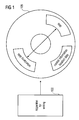
- Fig. 1 shows an apparatus 100 for writing data and redundancy data on a storage medium 105.
- the storage medium 105 has a defined geometrical structure, the embodiment in Fig. 1 shows, for example, an optical disc as a CD, DVD or blue ray disc.
- the apparatus 100 comprises a writer for writing data and redundancy data onto the storage medium 105, such that a geometrical distance between the data and the redundancy data is larger than a predefined distance, and for generating and writing redundancy location data or control information identifying a location of the redundancy data on the storage medium 105.
- the predefined geometrical distance may be less than, for example, 5 cm, 1 cm or 1 mm.
- the writer may be adapted for using optical storage media, however in another embodiment, the writer may be adapted for using magnetic or opto-magnetic media.
- the writer may be adapted for distributing the data and the redundancy data segments evenly on the geometrical surface of an optical disc.
- the writer may be adapted for providing redundancy location data in terms of a table having logical sector numbers of the data or the redundancy data.
- the writer may also be adapted for writing the data and the redundancy data according to a sorting scheme, which may be adapted to the geometrical structure of the storage medium 105.
- the writer may write the data and redundancy data in one session, i.e. composing a complete data stream fitting the storage medium 105.
- a sorting scheme may then arrange the data and redundancy data, as well as the location data within the data stream in a way, such that the geometrical distance between redundancy data and data on the storage medium 105 is larger than the predefined distance.
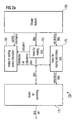
- Fig. 2a shows an embodiment of an apparatus 150 for reading a data set from a storage medium 155.
- the apparatus 150 comprises a means 160 for reading control information from the storage medium 155, the control information having information on redundancy data on the storage medium 155.
- the apparatus 150 comprises a means 165 for reading data from the storage medium 155 and for indicating if a subset of the data has been read incorrectly.
- the apparatus 150 comprises a means 170 for reading redundancy data based on the information on the redundancy data in response to the indication of the subset of data having been read incorrectly and a means 175 for combining the data and the redundancy data to obtain the data sets.
- the means 170 for reading the redundancy data may be adapted for reading redundancy data for which data subsets have been read incorrectly from a location on which information is comprised in the control information.
- the means 175 for combining can be adapted for combining the redundancy data and the data according to an XOR or Reed Solomon combiner 180, as shown in Fig. 2b.
- an optical disc drive may comprise an apparatus for writing and an apparatus for reading according to the above embodiments.
- Fig. 3 shows a storage medium 300, which is exemplified as an optical disc.
- the optical disc 300 comprises data 310 and redundancy data 320, 325 and 330.
- Fig. 3 illustrates that extra redundancy data 320, 325 and 330 can be used to enhance data reliability. If, due to any physical destruction the data section 310 of the disc 300 can no longer be read, there are still the three redundancy data sections 320, 325 and 330, of which a single one would be enough in order to restore the data.
- Fig. 4 shows a basic SecurDisc technology anchor structure
- BTAS Basic SecurDisc Technology Anchor Structure
- RBP Relative Byte Position
- FFIT File Fragment Information Table
- Fig. 4 shows an embodiment of an exemplified BTAS.
- ASCII American Standard Code for Information Interchange
- ARBLSN Application Revocation Lock
- ARB Application Revocation Lock
- ARB specifies the logical sector number of ARB as a 64-bit Big-Endian value, or a field filled with zeros, if no ARB is present.
- the ARB is required in the embodiments for all media that use copy protection or pass phrase protection features of SecurDisc.
- An ARB is a revocation block, which can be used to revoke compromised applications.
- Fig. 4 further shows a "Backup DSILSN"-, a "Backup FFITLSN”- and a “Backup ARBLSN”-field, which specify the logical sector numbers of the respective backup structures.
- the FFIT contains information about each contiguous area of the disc that is managed by SecurDisc, such contiguous areas may include files that are copy protected or pass phrase protected, as well as files protected by checksums.
- the FFIT is stored after all other files on the disc, to allow checksums to be generated on-the-fly during the recording process.
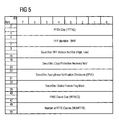
- the location of the FFIT is flexible, the FFIT is referenced by the BTAS. It begins with a header and an embodiment of a structure is shown in Fig. 5.
- Fig. 5 shows a SecurDisc FFIT version number, which specifies a version number of the structure.
- the first byte contains a high version number the second byte contains a low version number.
- the high version number is 01h in one embodiment.
- Fig. 5 shows a "SecurDisc Copy Protection Recovery"-field, which comprises the 128-bit disc unique ID encrypted with a 128-bit AES key value derived from a special copy protection recovery pass phase calculated as described above. There may be no pass phrase verification checksum for this value in another embodiment. If no copy protection recovery pass phrase has been specified during the authoring process all bytes of this field may be set to zero.
- Fig. 5 shows a SecurDisc pass phrase verification checksum, which comprises an 128-bit checksum that can be used to verify the correctness of the pass phrase entered by a user.
- the pass phrase verification checksum has a fixed value PVC, which can be encrypted using the key contribution derived from the user pass phrase, as it was described above.
- the FFITH may grow as additional fields are added in further embodiments.
- FFITE are stored in ascending order of their fragments' LSN.
- FIG. 6 shows an "LSN of File Fragment"-field, which specifies the LSN of the file fragment managed by the FFITE. Moreover, a field is dedicated to the size of the file fragment in logical sectors, specifying the size of the file fragment managed by the FFITE in logical sectors.
- a logical sector is the smallest logical unit for SecurDisc. If a sector is not used completely, the remaining space can be filled with zeros in this embodiment.
- a pass phrase protected field "PP" comprises a flag, also being part of the SecurDisc feature flag mask. If true, the file fragment managed by this FFIT is pass phrase protected. The "CS"-field is also part of the SecurDisc feature flag mask. If true, the content of the file fragment managed by this FFITE can be verified using the "File Fragment Checksum"-field stored in this FFITE.
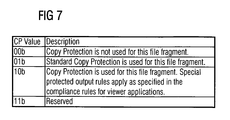
- the "CP"-field is part of the SecurDisc feature flag mask. It can assume four distinct conditions regarding copy protection for the file fragment managed by this FFITE as specified in the Table in Fig. 7.
- Fig. 7 shows an embodiment of the copy protection values, indicating whether copy protection is used or not for this file fragment, and whether special protected output rules apply.
- Fig. 6 further shows the file fragment checksum in case the CS flag is true, this field may contain a AES-128 cryptographic hash of the file fragment managed by this FFITE. If the CS flag is false, this field may contain all zeros. Moreover, Fig. 6 shows in row 6, a space that can be reserved for SecurDisc feature flag mask extensions.
- the disc security information structure stores global information about disc security. It is stored after all other files on the disc to allow digital signatures to be generated on-the-fly.
- the location of the DSI may be referenced by the BTAS as mentioned above.
- the DSI can be stored in a contiguous area of the disc.
- a backup DSI may be referenced by the BTAS in an embodiment. Its location may be freely selected. However, to achieve maximum reliability, the backup DSI should be physically distant from the first DSI copy. As a minimum requirement, the backup DSI should be stored in a different packet than the primary DSI in an embodiment.
- RSA Initials of Surnames of Inventors, Rivest, Shamir and Adleman.
- the DSI structure may store up to 65535 redundancy map references in embodiments. This allows for a very fine-grained configuration of redundancy mapping.
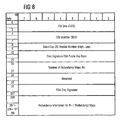
- Fig. 8 shows an embodiment of a DSI structure.
- the "DSI Size"-field specifies the size of the structure in bytes, as a Big-Endian value. In this embodiment, the size is 120+(N+1)x1Ch.
- the DSI identifier can be a 4 byte identifier, identifying the structure as a DSI structure. This identifier may contain the ASCII representation of "BDSI".
- a SecurDisc DSI version number specifies the version number of the structure.
- the first byte may contain the higher version number and the second byte may contain the lower version number in this embodiment.
- the higher version number may be 01h for this embodiment, the low version number may be 00h.
- An implementation may only rely on the layout of the remaining information of DSI if the higher version number is 01h. If only the low version number is higher than the version number the implementation supports, the implementation may still rely on the structures that have been defined in a previous version.
- the number of redundancy maps N specifies the number of redundancy maps referenced by the structure as a 16-bit Big-Endian value.
- the minimum number of redundancy maps may be 1 in an embodiment, so the actual number of redundancy maps can be N+1.
- all bytes may be set to zero.
- the redundancy information contains information about redundancy maps on the SecurDisc media. It is used when data is stored redundantly to allow recovery from fatal read errors, and corresponds to control information, specifying location and presence of redundancy data, according to an embodiment.
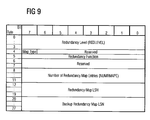
- FIG. 9 A more detailed embodiment of a redundancy information structure is shown in Fig. 9.
- the structure shown in Fig. 9 may repeat N+1 times, so one entry can be present for each redundancy map defined in the DSI structure explained above.
- the "Map Type"-field is set to false, the "Redundancy Level”-field specifies how many packets may form a redundancy group. The value may be in the range from 1 through (2 32 -1) with 1 being the highest security level. If the "Map Type"-field is set to true, the redundancy level may specify how many redundancy packets are written for a single user data packet. The value can be in the range from 1 to (2 32 -1) with 2 32 -1 being the highest security level. In one embodiment setting this field to zero may serve as switching off the enhanced data security feature.
- the "Map Type"-field may specify the type of mapping between redundancy packets and user data packets, i.e. between data and redundancy data. If this bit is set to true, the mapping between user data packets and redundancy packets may be 1:N. This means that for a single user data packet, at least one redundancy packet exists. The exact number may be specified by a "Redundancy Level”-field. If the bit is set to false, the mapping between user data packets and redundancy packets may be N:1. This means that at least one user data packet may be mapped to a single redundancy packet. The exact number of user data packets mapped to a single redundancy packet may be specified by the "Redundancy Level"-field. In the "Reserved”-field, all bits are set to zero as mentioned above.
- a "Redundancy Function"-field can specify the redundancy function used.
- a value of 00h may indicate that enhanced data security is not used.
- a value of 01h may indicate that an XOR redundancy grouping scheme is used. In this scheme, two data packets are processed using an XOR operation, of which a redundancy packet results. Any two of the then three packets allow to restore the two data packets.
- the "Redundancy Function"-field may specify other redundancy functions as, for example, the usage of Reed Solomon encoding, a convolutional coding scheme or even enable the usage of turbo codes.
- a “Number of Redundancy Map Entries”-field may specify the number of redundancy map entries as a Big-Endian DWORD value.
- the "Redundancy Map LSN”-field specifies the LSN of the redundancy map as a Big-Endian 64-bit value or zero if the enhanced data security feature is not used.
- a “Backup Redundancy Map LSN”-field may specify the LSN of the backup redundancy map as a Big-Endian 64-bit value or zero, when the feature is not used.
- the redundancy map information structure provides a 1:N or N:1 mapping between user data packets and redundancy packets. Which mapping mode is in use for a particular disc may be determined by the "Map Type"-field specified in the "Redundancy Information"-field of the DSI structure. If the "Map Type"-field is set to false, a unique packet corresponds to a redundancy packet and a mapped packet corresponds to a user data packet according to the structure depicted in Fig. 10. If the "Map Type"-field is set to true, a unique packet corresponds to a user data packet and a mapped packet corresponds to a redundancy packet in Fig. 10. Therewith, different code rates are enabled, which are literally 1:N, respectively N:1.
- the redundancy map comprises entries according to the structure depicted in Fig. 10. Redundancy map entries are sorted in ascending order of their unique packet number in this embodiment.
- a backup of the redundancy map information is referenced by the DSI structure. Its location may be freely selected. However, to achieve maximum reliability, the backup redundancy map should by physically distant from the first copy. As a minimum requirement, the backup redundancy should be stored in a different packet than the primary in an embodiment.
- a "Unique Packet Number"-field may specify a packet number of the unique packet with the meaning specified above.
- the packet number of a "Mapped Packet#N"-field may specify a REDLEVEL entry following the unique packet number. They specify the mapped packets with the meaning specified above.
- Embodiments take advantage of, for example, optical media not being completely written when used for transferring data from one person to another. Capacity overhead of media is used by embodiments to redundantly store data that has been written to the media. If parts of e.g. a disc are damaged, the data can be reconstructed from the redundant information stored in the otherwise unused areas of the disc. This is also true for backups where the user is able to trade in reliability for capacity.
- a more sophisticated method of combining the members of the redundancy group is to use Reed Solomon checksums or codes, which allow for more than a single data block within a group to be restored.
- both the "Redundancy Level"- and the “Redundancy Function”-fields of the DSI structure are set to a value different from zero for the first redundancy map entry, some of the media space may be used to provide redundant storage of user payloads.
- ECC Error Tracking and Correction
- the hash ECC block content may be calculated from the ECC block belonging to the same redundancy groups through a redundancy function.
- a redundancy function supported is XOR.
- the redundancy level determines separately for each redundancy map, how many ECC blocks are assigned to a single redundancy group, thus determining the level of safety that should be accomplished.
- the more ECC blocks are assigned to the same ECC group the more likely a defection of two or more ECC block, which constitutes a situation in which restoring the defective ECC blocks becomes impossible with e.g. the XOR redundancy function.
- a reader can for example read the information stored in the DSI structure and find the corresponding entry in the redundancy map and read all other packets that belong to the same redundancy group, i.e. read the corresponding redundancy packets, and calculate the restored content of the defective ECC block as follows:
- RESTORED_PACKET PACKET# ⁇ 1 XOR PACKET# ⁇ 2 XOR ... ⁇ XOR PACKET#REDLEVEL - 1 XOR RPACK
- RESTORED_PACKET is the content of the restored packet
- PACKET#x is the content of packet x
- REDLEVEL is the number of packets pre redundancy group
- RPACK is the content of the redundancy packet.
- the reader implementation may repeat this process with all remaining redundancy maps until the packet could be restored.
- the inventive methods can be implemented in hardware or in software.
- the implementation can be performed using a digital storage medium, in particular, a disc, DVD or a CD having an electronically readable control signals stored thereon, which co-operate with a programmable computer system, such that the inventive methods are performed.
- the present invention is, therefore, a computer program product with a program code stored on a machine-readable carrier, the program code being operated for performing the inventive methods when the computer program product runs on a computer.
- the inventive methods are, therefore, a computer program having a program code for performing at least one of the inventive methods when the computer program runs on a computer.
Landscapes
- Engineering & Computer Science (AREA)
- Computer Security & Cryptography (AREA)
- Theoretical Computer Science (AREA)
- General Engineering & Computer Science (AREA)
- Computer Hardware Design (AREA)
- Physics & Mathematics (AREA)
- General Physics & Mathematics (AREA)
- Signal Processing (AREA)
- Software Systems (AREA)
- Bioethics (AREA)
- General Health & Medical Sciences (AREA)
- Health & Medical Sciences (AREA)
- Quality & Reliability (AREA)
- Signal Processing For Digital Recording And Reproducing (AREA)
- Storage Device Security (AREA)
Priority Applications (2)
| Application Number | Priority Date | Filing Date | Title |
|---|---|---|---|
| PCT/EP2007/003654 WO2007128416A1 (en) | 2006-05-10 | 2007-04-25 | Apparatus for writing data and redundancy data on a storage medium |
| US11/831,647 US20080253256A1 (en) | 2007-04-13 | 2007-07-31 | Apparatus for writing data and redundancy data on a storage medium |
Applications Claiming Priority (2)
| Application Number | Priority Date | Filing Date | Title |
|---|---|---|---|
| US74696406P | 2006-05-10 | 2006-05-10 | |
| US74736306P | 2006-05-16 | 2006-05-16 |
Publications (1)
| Publication Number | Publication Date |
|---|---|
| EP1855284A2 true EP1855284A2 (de) | 2007-11-14 |
Family
ID=38470130
Family Applications (4)
| Application Number | Title | Priority Date | Filing Date |
|---|---|---|---|
| EP07007647.6A Active EP1855281B1 (de) | 2006-05-10 | 2007-04-13 | Vorrichtung zum Schreiben von Daten auf ein Medium |
| EP07007620A Withdrawn EP1855285A2 (de) | 2006-05-10 | 2007-04-13 | Vorrichtung zum Schreiben von Daten mit einer Datenmenge auf einem Speichermedium |
| EP20070007621 Withdrawn EP1855280A3 (de) | 2006-05-10 | 2007-04-13 | Vorrichtung zum Schreiben von Information auf einem Dateninhalt auf einem Speichermedium |
| EP07007619A Withdrawn EP1855284A2 (de) | 2006-05-10 | 2007-04-13 | Vorrichtung zum Schreiben von Daten und Redundanzdaten auf einem Speichermedium |
Family Applications Before (3)
| Application Number | Title | Priority Date | Filing Date |
|---|---|---|---|
| EP07007647.6A Active EP1855281B1 (de) | 2006-05-10 | 2007-04-13 | Vorrichtung zum Schreiben von Daten auf ein Medium |
| EP07007620A Withdrawn EP1855285A2 (de) | 2006-05-10 | 2007-04-13 | Vorrichtung zum Schreiben von Daten mit einer Datenmenge auf einem Speichermedium |
| EP20070007621 Withdrawn EP1855280A3 (de) | 2006-05-10 | 2007-04-13 | Vorrichtung zum Schreiben von Information auf einem Dateninhalt auf einem Speichermedium |
Country Status (3)
| Country | Link |
|---|---|
| US (1) | US20080320314A1 (de) |
| EP (4) | EP1855281B1 (de) |
| TW (1) | TW200822066A (de) |
Cited By (1)
| Publication number | Priority date | Publication date | Assignee | Title |
|---|---|---|---|---|
| EP2105928A1 (de) * | 2008-03-27 | 2009-09-30 | Deutsche Thomson OHG | Verfahren und Vorrichtung zum Speichern von Daten auf einem Speichermedium, Verfahren und Vorrichtung zum Korrigieren von Fehlern beim Lesen von Daten von einem Speichermedium sowie Speichermedium |
Families Citing this family (20)
| Publication number | Priority date | Publication date | Assignee | Title |
|---|---|---|---|---|
| US20110197076A1 (en) * | 2005-06-28 | 2011-08-11 | Darin Crites | Total computer security |
| US8108692B1 (en) | 2006-06-27 | 2012-01-31 | Siliconsystems, Inc. | Solid-state storage subsystem security solution |
| US8214647B2 (en) * | 2006-06-30 | 2012-07-03 | Nec Corporation | Distributed information generator and restoring device |
| US8565436B2 (en) * | 2008-12-15 | 2013-10-22 | Ebay Inc. | Secure self managed data (SSMD) |
| US8356184B1 (en) | 2009-06-25 | 2013-01-15 | Western Digital Technologies, Inc. | Data storage device comprising a secure processor for maintaining plaintext access to an LBA table |
| TWI394155B (zh) * | 2009-09-22 | 2013-04-21 | Ko Cheng Fang | Methods for preventing disc transcription |
| KR101954215B1 (ko) * | 2011-07-12 | 2019-06-07 | 삼성전자주식회사 | 비휘발성 저장 장치의 이용 방법 및 장치 |
| US9305142B1 (en) | 2011-12-19 | 2016-04-05 | Western Digital Technologies, Inc. | Buffer memory protection unit |
| US20140207901A1 (en) * | 2013-01-18 | 2014-07-24 | Richard Lesser | Media rendering system |
| US9531547B2 (en) * | 2015-04-06 | 2016-12-27 | Vmware, Inc. | Host-based digital signature verification for guest components |
| US10706106B2 (en) | 2017-02-09 | 2020-07-07 | Micron Technology, Inc. | Merge tree modifications for maintenance operations |
| US10706105B2 (en) | 2017-02-09 | 2020-07-07 | Micron Technology, Inc. | Merge tree garbage metrics |
| US10725988B2 (en) * | 2017-02-09 | 2020-07-28 | Micron Technology, Inc. | KVS tree |
| US10719495B2 (en) | 2017-02-09 | 2020-07-21 | Micron Technology, Inc. | Stream selection for multi-stream storage devices |
| US10915546B2 (en) | 2018-10-10 | 2021-02-09 | Micron Technology, Inc. | Counter-based compaction of key-value store tree data block |
| US11100071B2 (en) | 2018-10-10 | 2021-08-24 | Micron Technology, Inc. | Key-value store tree data block spill with compaction |
| US11048755B2 (en) | 2018-12-14 | 2021-06-29 | Micron Technology, Inc. | Key-value store tree with selective use of key portion |
| US10852978B2 (en) | 2018-12-14 | 2020-12-01 | Micron Technology, Inc. | Key-value store using journaling with selective data storage format |
| US10936661B2 (en) | 2018-12-26 | 2021-03-02 | Micron Technology, Inc. | Data tree with order-based node traversal |
| CN115983964B (zh) * | 2022-12-31 | 2024-09-13 | 东信和平科技股份有限公司 | Ic数据预处理的方法、控制器、设备以及介质 |
Family Cites Families (40)
| Publication number | Priority date | Publication date | Assignee | Title |
|---|---|---|---|---|
| JP3073590B2 (ja) * | 1992-03-16 | 2000-08-07 | 富士通株式会社 | 電子化データ保護システム、使用許諾者側装置および使用者側装置 |
| US5544083A (en) * | 1992-04-27 | 1996-08-06 | Kabushiki Kaisha Toshiba | Password management method and apparatus |
| US5596639A (en) * | 1993-07-26 | 1997-01-21 | Elonex Ip Holdings Ltd. | Cd-prom |
| JPH0944993A (ja) | 1995-07-31 | 1997-02-14 | Pioneer Electron Corp | 情報記録方法及び装置、関数記録方法及び装置並びに情報再生方法及び装置 |
| DE69613156T2 (de) | 1995-10-09 | 2001-10-25 | Matsushita Electric Industrial Co., Ltd. | Optisches Wiedergabegerät zur Wiedergabe verschlüsselter Informationen |
| US5940854A (en) | 1996-01-16 | 1999-08-17 | International Business Machines Corporation | Unique identifier for optical media |
| JPH1049986A (ja) * | 1996-08-05 | 1998-02-20 | Sony Corp | 記録媒体、記録又は再生装置、記録又は再生方法 |
| KR100403270B1 (ko) * | 1997-12-29 | 2004-03-20 | 삼성전자주식회사 | 디지털기록매체의저작권을보호하는방법및장치,그리고,그디지털기록매체 |
| US6188659B1 (en) | 1998-01-20 | 2001-02-13 | Eastman Kodak Company | Method for insuring uniqueness of an original CD |
| EP1072143B1 (de) | 1998-04-17 | 2004-06-23 | Iomega Corporation | System um geschützte, verschlüsselte elektronische daten zu einem speziellen speichermedium zu senden und um unberechtigtes kopieren zu verhindern |
| JP3931435B2 (ja) * | 1998-06-26 | 2007-06-13 | ソニー株式会社 | 情報記録媒体、情報再生装置および方法、並びに記録媒体 |
| EP0984346A1 (de) | 1998-09-02 | 2000-03-08 | Hitachi Europe Limited | Kopierschutzverfahren und -vorrichtung |
| FR2784830A1 (fr) | 1998-10-19 | 2000-04-21 | Thomson Multimedia Sa | Methode de copie evitant la duplication non-autorisee de donnees numeriques et dispositif de lecture pour la mise en oeuvre de la methode |
| US7213005B2 (en) * | 1999-12-09 | 2007-05-01 | International Business Machines Corporation | Digital content distribution using web broadcasting services |
| JP2001209583A (ja) * | 2000-01-26 | 2001-08-03 | Sony Corp | データ記録再生器およびセーブデータ処理方法、並びにプログラム提供媒体 |
| US7152047B1 (en) * | 2000-05-24 | 2006-12-19 | Esecure.Biz, Inc. | System and method for production and authentication of original documents |
| TWI239447B (en) | 2000-06-02 | 2005-09-11 | Koninkl Philips Electronics Nv | Recordable storage medium with protected data area |
| JP2001357001A (ja) | 2000-06-12 | 2001-12-26 | Pioneer Electronic Corp | 情報出力装置及び情報出力方法、情報記録装置及び情報記録方法、情報出力記録システム並びに情報記録媒体 |
| US6578164B1 (en) * | 2000-07-12 | 2003-06-10 | Iomega Corporation | Method for detecting transient write errors in a disk drive having a dual transducer slider |
| JP4352600B2 (ja) | 2000-09-01 | 2009-10-28 | ソニー株式会社 | データ改竄チェック装置および方法、ならびに、記録媒体 |
| JP4609683B2 (ja) * | 2000-11-30 | 2011-01-12 | ソニー株式会社 | 情報処理装置および方法、並びにプログラム格納媒体 |
| US6978376B2 (en) * | 2000-12-15 | 2005-12-20 | Authentica, Inc. | Information security architecture for encrypting documents for remote access while maintaining access control |
| US7057993B2 (en) * | 2001-01-29 | 2006-06-06 | Eastman Kodak Company | Copy protection using multiple security levels on a programmable CD-ROM |
| GB2374718A (en) | 2001-04-11 | 2002-10-23 | Hewlett Packard Co | Data authentication |
| US20030046592A1 (en) * | 2001-08-28 | 2003-03-06 | Woodruff Wayne D. | Personal video recorder with secure recording, storage and playback control |
| US7117422B2 (en) * | 2002-01-22 | 2006-10-03 | Sun Microsystems, Inc. | Error detection in storage data |
| KR100554788B1 (ko) * | 2002-10-15 | 2006-02-22 | 엘지전자 주식회사 | 광디스크 장치에서의 패스워드 관리방법 |
| CN1748256A (zh) | 2003-02-12 | 2006-03-15 | 索尼株式会社 | 数据记录/再现方法以及记录/再现装置 |
| WO2004086368A1 (ja) * | 2003-03-24 | 2004-10-07 | Fujitsu Limited | 記憶装置、及び記憶媒体破壊プログラム |
| GB2404487A (en) * | 2003-07-31 | 2005-02-02 | Sony Uk Ltd | Access control for digital storage medium content |
| GB2404538A (en) * | 2003-07-31 | 2005-02-02 | Sony Uk Ltd | Access control for digital content |
| GB2404489A (en) * | 2003-07-31 | 2005-02-02 | Sony Uk Ltd | Access control for digital storage medium content |
| US20050152251A1 (en) | 2004-01-08 | 2005-07-14 | Victor Company Of Japan, Ltd. | Method and apparatus for recording check data of file system on recording medium |
| JP4198628B2 (ja) | 2004-04-08 | 2008-12-17 | 株式会社リコー | 情報記録装置、その記録動作制御方法及び記録動作制御用プログラム |
| JP2005332526A (ja) * | 2004-05-21 | 2005-12-02 | Funai Electric Co Ltd | 光ディスク装置 |
| KR100612215B1 (ko) | 2004-07-24 | 2006-08-16 | 삼성전자주식회사 | 비밀번호를 이용하는 데이터 기록/재생 장치 및 그 방법 |
| JPWO2006022349A1 (ja) * | 2004-08-26 | 2008-05-08 | 松下電器産業株式会社 | データ記録再生装置および方法 |
| KR100636228B1 (ko) * | 2005-02-07 | 2006-10-19 | 삼성전자주식회사 | 계층적인 노드 토폴로지를 이용한 키 관리 방법 및 이를이용한 사용자 등록 및 등록해제 방법 |
| KR20070105031A (ko) * | 2006-04-25 | 2007-10-30 | 엘지전자 주식회사 | 녹화 방지 프로그램의 녹화 제어 방법 |
| US8356178B2 (en) * | 2006-11-13 | 2013-01-15 | Seagate Technology Llc | Method and apparatus for authenticated data storage |
-
2007
- 2007-04-13 EP EP07007647.6A patent/EP1855281B1/de active Active
- 2007-04-13 EP EP07007620A patent/EP1855285A2/de not_active Withdrawn
- 2007-04-13 EP EP20070007621 patent/EP1855280A3/de not_active Withdrawn
- 2007-04-13 EP EP07007619A patent/EP1855284A2/de not_active Withdrawn
- 2007-05-09 TW TW096116559A patent/TW200822066A/zh unknown
- 2007-07-27 US US11/829,827 patent/US20080320314A1/en not_active Abandoned
Cited By (2)
| Publication number | Priority date | Publication date | Assignee | Title |
|---|---|---|---|---|
| EP2105928A1 (de) * | 2008-03-27 | 2009-09-30 | Deutsche Thomson OHG | Verfahren und Vorrichtung zum Speichern von Daten auf einem Speichermedium, Verfahren und Vorrichtung zum Korrigieren von Fehlern beim Lesen von Daten von einem Speichermedium sowie Speichermedium |
| WO2009118252A1 (en) * | 2008-03-27 | 2009-10-01 | Thomson Licensing | Method and apparatus for storing data to a storage medium, method and apparatus for correcting errors occurring while data is read from a storage medium, and storage medium |
Also Published As
| Publication number | Publication date |
|---|---|
| EP1855285A2 (de) | 2007-11-14 |
| US20080320314A1 (en) | 2008-12-25 |
| TW200822066A (en) | 2008-05-16 |
| EP1855280A2 (de) | 2007-11-14 |
| EP1855280A3 (de) | 2012-08-15 |
| EP1855281B1 (de) | 2019-06-12 |
| EP1855281A3 (de) | 2012-08-15 |
| EP1855281A2 (de) | 2007-11-14 |
Similar Documents
| Publication | Publication Date | Title |
|---|---|---|
| EP1855285A2 (de) | Vorrichtung zum Schreiben von Daten mit einer Datenmenge auf einem Speichermedium | |
| CN101635158B (zh) | 编码和/或解码系统数据的方法、装置、系统和体系结构 | |
| US8145977B2 (en) | Methods and apparatus for providing error correction to unwritten pages and for identifying unwritten pages in flash memory | |
| JP4709485B2 (ja) | オンドライブ統合化セクタ・フォーマットraidの誤り訂正符号システムおよび方法 | |
| EP1125294B1 (de) | Mehrstufige fehlererkennungs- und korrekturtechnik für datenspeicher-aufzeichnungsvorrichtung | |
| US20050028067A1 (en) | Data with multiple sets of error correction codes | |
| US8055983B2 (en) | Data writing method for flash memory and error correction encoding/decoding method thereof | |
| AU2011241319B2 (en) | Method for generating physical identifier in storage device and machine-readable storage medium | |
| US8606764B2 (en) | Write failure protection for hierarchical integrity schemes | |
| CN101379563A (zh) | 纠错块、产生纠错块的设备和方法以及纠错方法 | |
| US8301906B2 (en) | Apparatus for writing information on a data content on a storage medium | |
| US20080126841A1 (en) | Methods and systems for recovering meta-data in a cache memory after a corruption event | |
| US7181672B2 (en) | Method, system, and apparatus for supporting power loss recovery in ECC enabled memory devices | |
| US20080253256A1 (en) | Apparatus for writing data and redundancy data on a storage medium | |
| KR101698211B1 (ko) | 저장 장치의 인증 방법, 기계로 읽을 수 있는 저장 매체 및 호스트 장치 | |
| US20060095687A1 (en) | System and method for achieving reliable worm storage using WMRM storage | |
| US20070291611A1 (en) | Apparatus for writing data having a data amount on a storage medium | |
| CN112286550A (zh) | 一种嵌入式设备系统升级的安全性签名算法 | |
| US10902154B2 (en) | Data security | |
| WO2007128416A1 (en) | Apparatus for writing data and redundancy data on a storage medium | |
| US20060259975A1 (en) | Method and system for protecting digital media from illegal copying | |
| WO2007128419A1 (en) | Apparatus for writing information on a data content on a storage medium | |
| JP7671759B2 (ja) | 記憶システム内のデータ回復のためのエンコーディング | |
| US20070150652A1 (en) | Method and apparatus for storing a data to memory devices |
Legal Events
| Date | Code | Title | Description |
|---|---|---|---|
| PUAI | Public reference made under article 153(3) epc to a published international application that has entered the european phase |
Free format text: ORIGINAL CODE: 0009012 |
|
| AK | Designated contracting states |
Kind code of ref document: A2 Designated state(s): AT BE BG CH CY CZ DE DK EE ES FI FR GB GR HU IE IS IT LI LT LU LV MC MT NL PL PT RO SE SI SK TR |
|
| AX | Request for extension of the european patent |
Extension state: AL BA HR MK YU |
|
| STAA | Information on the status of an ep patent application or granted ep patent |
Free format text: STATUS: THE APPLICATION HAS BEEN WITHDRAWN |
|
| 18W | Application withdrawn |
Effective date: 20081104 |