EP1857291A2 - Erwärmung eines magnetisch ausrichtbaren Pigments in einem Druckverfahren - Google Patents
Erwärmung eines magnetisch ausrichtbaren Pigments in einem Druckverfahren Download PDFInfo
- Publication number
- EP1857291A2 EP1857291A2 EP07251995A EP07251995A EP1857291A2 EP 1857291 A2 EP1857291 A2 EP 1857291A2 EP 07251995 A EP07251995 A EP 07251995A EP 07251995 A EP07251995 A EP 07251995A EP 1857291 A2 EP1857291 A2 EP 1857291A2
- Authority
- EP
- European Patent Office
- Prior art keywords
- flakes
- ink
- paste
- wavelengths
- band
- Prior art date
- Legal status (The legal status is an assumption and is not a legal conclusion. Google has not performed a legal analysis and makes no representation as to the accuracy of the status listed.)
- Withdrawn
Links
- 238000007639 printing Methods 0.000 title claims abstract description 60
- 238000000034 method Methods 0.000 title claims abstract description 40
- 230000008569 process Effects 0.000 title claims description 13
- 239000000049 pigment Substances 0.000 title description 23
- 238000010438 heat treatment Methods 0.000 title description 14
- 230000005291 magnetic effect Effects 0.000 claims abstract description 53
- 230000003287 optical effect Effects 0.000 claims abstract description 41
- 239000000758 substrate Substances 0.000 claims abstract description 34
- 238000010521 absorption reaction Methods 0.000 claims abstract description 27
- 230000000694 effects Effects 0.000 claims abstract description 11
- 230000001678 irradiating effect Effects 0.000 claims abstract description 11
- 239000011248 coating agent Substances 0.000 claims abstract description 8
- 238000000576 coating method Methods 0.000 claims abstract description 8
- 239000000463 material Substances 0.000 claims description 6
- 239000000203 mixture Substances 0.000 claims 1
- 239000000976 ink Substances 0.000 description 89
- 239000003570 air Substances 0.000 description 8
- 239000010410 layer Substances 0.000 description 8
- 239000002245 particle Substances 0.000 description 6
- 230000008901 benefit Effects 0.000 description 4
- 238000009826 distribution Methods 0.000 description 4
- 230000003595 spectral effect Effects 0.000 description 4
- 238000001816 cooling Methods 0.000 description 3
- 230000006378 damage Effects 0.000 description 3
- 238000010586 diagram Methods 0.000 description 3
- 230000005684 electric field Effects 0.000 description 3
- 239000012530 fluid Substances 0.000 description 3
- 238000000862 absorption spectrum Methods 0.000 description 2
- 239000012080 ambient air Substances 0.000 description 2
- 238000001035 drying Methods 0.000 description 2
- 239000006249 magnetic particle Substances 0.000 description 2
- 229920000642 polymer Polymers 0.000 description 2
- 230000009467 reduction Effects 0.000 description 2
- 238000000985 reflectance spectrum Methods 0.000 description 2
- 239000000126 substance Substances 0.000 description 2
- 239000006096 absorbing agent Substances 0.000 description 1
- 238000003491 array Methods 0.000 description 1
- QVGXLLKOCUKJST-UHFFFAOYSA-N atomic oxygen Chemical compound [O] QVGXLLKOCUKJST-UHFFFAOYSA-N 0.000 description 1
- 238000007664 blowing Methods 0.000 description 1
- 230000008859 change Effects 0.000 description 1
- 238000006243 chemical reaction Methods 0.000 description 1
- 239000010634 clove oil Substances 0.000 description 1
- 239000003086 colorant Substances 0.000 description 1
- 230000001419 dependent effect Effects 0.000 description 1
- 238000010894 electron beam technology Methods 0.000 description 1
- 230000004907 flux Effects 0.000 description 1
- 238000007646 gravure printing Methods 0.000 description 1
- 231100001261 hazardous Toxicity 0.000 description 1
- 238000011065 in-situ storage Methods 0.000 description 1
- 238000007641 inkjet printing Methods 0.000 description 1
- 239000007788 liquid Substances 0.000 description 1
- 239000000696 magnetic material Substances 0.000 description 1
- 238000004519 manufacturing process Methods 0.000 description 1
- 229910052751 metal Inorganic materials 0.000 description 1
- 238000007645 offset printing Methods 0.000 description 1
- 230000003647 oxidation Effects 0.000 description 1
- 238000007254 oxidation reaction Methods 0.000 description 1
- 230000001590 oxidative effect Effects 0.000 description 1
- 229910052760 oxygen Inorganic materials 0.000 description 1
- 239000001301 oxygen Substances 0.000 description 1
- 239000003973 paint Substances 0.000 description 1
- 230000005855 radiation Effects 0.000 description 1
- 230000004044 response Effects 0.000 description 1
- 238000005096 rolling process Methods 0.000 description 1
- 238000000926 separation method Methods 0.000 description 1
- 239000002356 single layer Substances 0.000 description 1
- 239000007787 solid Substances 0.000 description 1
- 239000002904 solvent Substances 0.000 description 1
- 230000003685 thermal hair damage Effects 0.000 description 1
- 230000007704 transition Effects 0.000 description 1
- 238000001429 visible spectrum Methods 0.000 description 1
Images


Classifications
-
- B—PERFORMING OPERATIONS; TRANSPORTING
- B41—PRINTING; LINING MACHINES; TYPEWRITERS; STAMPS
- B41M—PRINTING, DUPLICATING, MARKING, OR COPYING PROCESSES; COLOUR PRINTING
- B41M7/00—After-treatment of prints, e.g. heating, irradiating, setting of the ink, protection of the printed stock
- B41M7/009—After-treatment of prints, e.g. heating, irradiating, setting of the ink, protection of the printed stock using thermal means, e.g. infrared radiation, heat
-
- B—PERFORMING OPERATIONS; TRANSPORTING
- B05—SPRAYING OR ATOMISING IN GENERAL; APPLYING FLUENT MATERIALS TO SURFACES, IN GENERAL
- B05D—PROCESSES FOR APPLYING FLUENT MATERIALS TO SURFACES, IN GENERAL
- B05D3/00—Pretreatment of surfaces to which liquids or other fluent materials are to be applied; After-treatment of applied coatings, e.g. intermediate treating of an applied coating preparatory to subsequent applications of liquids or other fluent materials
- B05D3/14—Pretreatment of surfaces to which liquids or other fluent materials are to be applied; After-treatment of applied coatings, e.g. intermediate treating of an applied coating preparatory to subsequent applications of liquids or other fluent materials by electrical means
-
- B—PERFORMING OPERATIONS; TRANSPORTING
- B05—SPRAYING OR ATOMISING IN GENERAL; APPLYING FLUENT MATERIALS TO SURFACES, IN GENERAL
- B05D—PROCESSES FOR APPLYING FLUENT MATERIALS TO SURFACES, IN GENERAL
- B05D3/00—Pretreatment of surfaces to which liquids or other fluent materials are to be applied; After-treatment of applied coatings, e.g. intermediate treating of an applied coating preparatory to subsequent applications of liquids or other fluent materials
- B05D3/20—Pretreatment of surfaces to which liquids or other fluent materials are to be applied; After-treatment of applied coatings, e.g. intermediate treating of an applied coating preparatory to subsequent applications of liquids or other fluent materials by magnetic fields
- B05D3/207—Pretreatment of surfaces to which liquids or other fluent materials are to be applied; After-treatment of applied coatings, e.g. intermediate treating of an applied coating preparatory to subsequent applications of liquids or other fluent materials by magnetic fields post-treatment by magnetic fields
-
- B—PERFORMING OPERATIONS; TRANSPORTING
- B05—SPRAYING OR ATOMISING IN GENERAL; APPLYING FLUENT MATERIALS TO SURFACES, IN GENERAL
- B05D—PROCESSES FOR APPLYING FLUENT MATERIALS TO SURFACES, IN GENERAL
- B05D5/00—Processes for applying liquids or other fluent materials to surfaces to obtain special surface effects, finishes or structures
- B05D5/06—Processes for applying liquids or other fluent materials to surfaces to obtain special surface effects, finishes or structures to obtain multicolour or other optical effects
-
- B—PERFORMING OPERATIONS; TRANSPORTING
- B41—PRINTING; LINING MACHINES; TYPEWRITERS; STAMPS
- B41M—PRINTING, DUPLICATING, MARKING, OR COPYING PROCESSES; COLOUR PRINTING
- B41M7/00—After-treatment of prints, e.g. heating, irradiating, setting of the ink, protection of the printed stock
- B41M7/0027—After-treatment of prints, e.g. heating, irradiating, setting of the ink, protection of the printed stock using protective coatings or layers by lamination or by fusion of the coatings or layers
-
- B—PERFORMING OPERATIONS; TRANSPORTING
- B05—SPRAYING OR ATOMISING IN GENERAL; APPLYING FLUENT MATERIALS TO SURFACES, IN GENERAL
- B05D—PROCESSES FOR APPLYING FLUENT MATERIALS TO SURFACES, IN GENERAL
- B05D3/00—Pretreatment of surfaces to which liquids or other fluent materials are to be applied; After-treatment of applied coatings, e.g. intermediate treating of an applied coating preparatory to subsequent applications of liquids or other fluent materials
- B05D3/06—Pretreatment of surfaces to which liquids or other fluent materials are to be applied; After-treatment of applied coatings, e.g. intermediate treating of an applied coating preparatory to subsequent applications of liquids or other fluent materials by exposure to radiation
-
- B—PERFORMING OPERATIONS; TRANSPORTING
- B05—SPRAYING OR ATOMISING IN GENERAL; APPLYING FLUENT MATERIALS TO SURFACES, IN GENERAL
- B05D—PROCESSES FOR APPLYING FLUENT MATERIALS TO SURFACES, IN GENERAL
- B05D3/00—Pretreatment of surfaces to which liquids or other fluent materials are to be applied; After-treatment of applied coatings, e.g. intermediate treating of an applied coating preparatory to subsequent applications of liquids or other fluent materials
- B05D3/06—Pretreatment of surfaces to which liquids or other fluent materials are to be applied; After-treatment of applied coatings, e.g. intermediate treating of an applied coating preparatory to subsequent applications of liquids or other fluent materials by exposure to radiation
- B05D3/061—Pretreatment of surfaces to which liquids or other fluent materials are to be applied; After-treatment of applied coatings, e.g. intermediate treating of an applied coating preparatory to subsequent applications of liquids or other fluent materials by exposure to radiation using U.V.
- B05D3/065—After-treatment
- B05D3/067—Curing or cross-linking the coating
Definitions
- This invention relates to a method and device for selectively heating pigment contained in an inked coating to lessen the viscosity of a viscous ink medium.
- Intaglio printing is a well known printing method using a printing plate having recesses formed in printing image areas with respect to non-printing image areas. After the entire intaglio printing plate is filled with a highly viscous ink, the ink on the non-printing image areas is wiped off to leave the ink only in the printing image areas. Thereafter, a web or substrate such as a paper sheet is forced directly to the printing plate under heavy pressure to transfer the ink remaining in the printing image areas onto the paper.
- Line-engraved intaglio printing is typically used for printing security documents, such as banknotes, and uses printing cylinders having engravings therein in which intaglio printing inks have been deposited.
- the highly viscous paste-like intaglio inks used in such printing are substantially different in nature from inks used in other forms of printing such as gravure, offset and ink-jet printing.
- attempts have been made to improve the dispersibility and chemical resistance of the paste-like intaglio inks; for example U.S. Pat. No. 6,833,395 in the name of Rygas et al. assigned to the Canadian Bank Note Company, Limited (Ottawa, Calif.) attempts to provide a solution to this problem.
- Optically variable prints for other security documents and currencies are often printed on sheet-fed intaglio presses.
- the printing process involves enormous pressures (tons/sq-in) on the paper in the ink transfer from the plate, high press speeds (200-500 ft/min), ultra viscous nature of the ink, and fast kinetics of the surface drying.
- Intaglio printing of security insignias is employed because of the unique properties that can be attained.
- the achievement of these special properties places strict requirements on the ink, the engraved plate, and the process conditions employed.
- the conventional steps of printing and curing and the new steps of aligning must still provide the same physical, chemical, and mechanical properties to the cured ink while at the same time enabling the accurate reproduction of the engraved image and predetermined position of magnetic particles.
- the concomitant requirements of stringently maintaining the correct visco-elastic properties of the paste-like ink while enabling a sequence of new and added steps to cause alignment of magnetic flakes presented a tremendous challenge to those skilled in the art.
- the achievement of printed and cured insignias encompassing magnetic flakes that have been aligned in a desired and predetermined manner requires a solution that overcomes a difficult set of constraints.
- the paste-like ink must be able to provide not only the normal drop and rise in viscosity that results from the printing step but must also be capable of surviving a second drop and rise in viscosity during the new alignment step.
- the second viscosity spike takes place after application of ink to substrate rather than in the fluid state.
- the printed but uncured ink must provide this viscosity drop-rise quickly so as not to slow down the line speed of the press.
- the magnetic flakes In the high-speed example, the magnetic flakes must orient quickly in the dwell time provided by the magnet apparatus, sometimes in less than one second. Once in the desired position, the flakes must freeze in place and avoid the natural relaxation that will occur unless the proper steps are followed. This fixing of the flake position must be permanent and must survive the lifetime of the security document--a period of years in the case of a circulating banknote.
- the process is additionally constrained.
- the energy when energy is applied to the ink to reduce viscosity, the energy must be applied in a manner and with amplitude sufficient to cause the desired change to the ink without damaging the materials involved with the process.
- the heat or other energy must not scorch or damage the ink or the substrate; usually paper or polymer.
- the added energy must not damage the printing press.
- the type of energy must be compatible with the mechanical hardware in the alignment zone. For example, application of microwave energy to a press zone containing metallic elements could be hazardous.
- At at least 45% of the optical power of the one or more beams of light is in the absorption band of the flakes.
- the flakes of the paste-like ink are at least 50% absorbing over a band of wavelengths W a1 to W a2 , and wherein the one or more beams of light provide optical energy in a band of wavelengths included within W a1 to W a2 so as to heat the flakes or ink vehicle or both, and thereby lessen the viscosity of the paste-like ink such that the flakes can be reoriented in the applied field, wherein the field is a magnetic field.
- the flakes of the paste-like ink are at least 70% reflective over a band of wavelengths W r1 to W r2 and wherein said flakes are at least 70% absorbing over a band of wavelengths W a1 to W a2 , wherein the step of lessening the viscosity of the paste like ink by adding optical energy includes utilizing an optical source having sufficient energy between the wavelengths W a1 and W a2 .
- the optical source includes one or more laser diodes having at least 80% of their optical energy within a band of wavelengths between W a1 and W a2 .
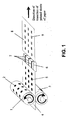
- Fig. 1 is a schematic diagram illustrating an intaglio printing process, wherein a magnetic field is disposed adjacent a print roller and wherein a heat source is provided to temporarily lessen the viscosity of the ink prior to alignment of flakes within the ink.
- Fig. 2 is a schematic diagram illustrating an intaglio printing process in accordance with this invention, wherein a magnetic field is disposed adjacent a print roller and wherein a diode array light source is provided to temporarily lessen the viscosity of the ink prior to alignment of flakes within the ink.
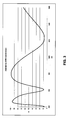
- Fig. 3 is a graph illustrating the absorption and reflectance spectrum of optically variable gold-to-green magnetic pigment.
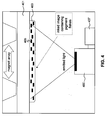
- Fig. 4 is a detailed schematic diagram illustrating a coated paper substrate disposed between a laser diode array and an array of magnets for aligning flakes within the coating.
- Fig. 5 is a schematic side view of an apparatus for high speed printing of magnetically aligned images in accordance with this invention wherein a substrate is carried by a moving conveyor belt or web.
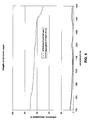
- Fig. 6 shows a spectral scan of cured intaglio vehicle on banknote paper.
- a novel process is provided for the printing of securities and high-value documents which allows paste-like ink having magnetic platelets or flakes dispersed therein to be oriented in a magnetic field.
- the paste-like viscous ink preferably comprises flakes of optical interference pigment, or flakes of a reflective pigment, or single layer or multi layer diffractive pigment flakes having magnetic properties.
- This invention similarly lends itself to any alignment method wherein flakes can be aligned in a preferred orientation using any forces that are practicable. For example, particles movable in electric or magnetic fields that can force the special effect flakes in a desired orientation, may benefit from this invention, wherein paste-like printing inks having flakes therein can be temporarily made less viscous during alignment.
- the interference pigment is an optically variable pigment that contains a thin layer of magnetic material adjacent thereto.
- the pigment is dispersed in a high-viscosity carrier that may contain additional solvents or a cure retarder to keep the ink layer fluid during transition of the print through the magnetic zone; preferably in the range of 4-40 Pas at the temperature of 40 degrees C or more.
- Printing of the image with magnetic paste-like ink occurs in the press where magnets are either embedded into the impression cylinder or located along the pass line of the substrate as close as practicable to the impression cylinders.
- the ideal environment for an illusionary optical effect, generated in an applied magnetic field is the one that maximizes the dwell time of a "fluid" ink layer in a region of high magnetic flux concentration, coupled with a vehicle system that has the correct visco-elastic properties to allow for magnetically permeable flakes to orient during the time spent in the magnetic zone.
- Fig 1 illustrates an embodiment wherein a printing press is equipped with magnetic hardware for providing an illusionary optical effect.
- illusionary optical effects are achieved by alignment of flakes dispersed in a liquid ink vehicle along lines of an applied magnetic field in a predetermined, varying manner, for example such that some of the flakes are purposely oriented differently than others. For example, some flakes may be standing on their edges, while others may be lying flat, and, or, some flakes may be tilted to varying degrees between flat lying and edge standing flakes.
- the hardware is placed directly down the web as is shown in Fig. 1 and as close to the printing and impression cylinders as possible.
- Sheets of freshly printed optically variable ink are conveyed over the magnetic lines, with a vertical separation between the magnet surface and the ink surface no greater than about 1 inch.
- the freshly deposited ink is fluidized by the application of sufficient heat energy applied from heated rollers to lessen the viscosity of the ink coating upon a web to allow the magnetic pigment particles, dispersed in the ink vehicle, to align themselves parallel to the applied field lines.
- the printing roller 1 has number of engravings 2 in the shape of a desired image on the printing plate wrapping the roller. Printing roller 1 and impression roller 3 touch each other and rotate in opposite directions. A web in the form of a sheet of paper 4, inserted between the rollers, moves from the left to the right.
- the web could alternatively take the form of a continuous roll of paper, film, or polymer.
- the image 5 shown in the picture is a solid filled rectangle.
- the previously printed sheet of paper 8 moves over the top of linear magnetic assembly 6 with permanent magnets 7 immediately after completion of the printing.
- Designs of hardware for linear magnetic effects have been described in the aforementioned patents. According to these patents and patent applications, when passed through the magnetic field, the magnetic particles become aligned in the direction of the lines of a magnetic field. As a result, in one example a linear "rolling bar" optical effect 9 appears in the print. This is shown and described in United States Patent application 20050106367 , in the name of Raksha et al., filed Dec. 22, 2004 incorporated herein by reference.
- the thick paste like Intaglio ink vehicle requires heating in order to allow "leafing" or orientation of the optically variable pigment flakes to occur.
- This is seen in ordinary intaglio printing, such as is now used on US banknotes, where elevated temperature and pressure on the printing press are needed to enhance the optically variable feature. These temperature and pressure conditions are created in the contact zone where the substrate moves between printing plate and impression roller.
- the Intaglio optically variable magnetic ink (OVMI) is no longer within the press contact zone.
- the inked image is still uncured, but is transported along the printing line to an alignment device that applies the external magnetic or electric field.
- the inked image must be heated just prior to or during field orientation to reduce the intaglio vehicle viscosity.
- the ink is heated in a novel manner as is shown in Fig. 2 by irradiating the ink with light from a diode array 100 that is relatively matched in wavelength to a wavelength at which the flakes within the OVMI paste like ink are highly absorbing, so as to heat the flakes, which by way of conduction heats the paste-like ink vehicle to lessen the viscosity of the paste-like ink.
- the diode array is shown in situ within the printing apparatus in Figs. 2 and 4.
- Using diodes in this manner is found to be advantageous over using heated rollers or utilizing heated air blown onto the paper substrate that bears the inked image.
- heated air heat is transferred to the vehicle (allowing its viscosity to decrease) by convective transfer from the heated air to the paper substrate and to the vehicle as well as by conduction from the paper substrate into the vehicle.
- the heated air is very effective at transferring heat to the paper substrate, so much so that the paper must be kept moving through the heated zone to prevent its browning or charring.
- the paper is subject to heat damage and the paper outside the inked image is heated needlessly.
- a significant advantage of utilizing an optical source having a wavelength substantially matched to an absorption spectrum of the magnetic flakes is that the flakes are targeted in a highly controllable manner. In this way the paste is essentially heated from the inside, relatively uniformly as the flakes are relatively uniformly distributed within the paste like ink, without damaging the substrate.
- blowing heated air as tantamount to holding a blow torch a distance away from the object to be heated and moving the object and the torch relatively so as to prevent scorching.
- this invention essentially provides a plurality of heat sources buried within the ink vehicle itself which obtain their heat energy from a particular wavelength of light irradiating the particles within the ink in their absorption band, which together generate the required heat to lessen the viscosity of the paste like carrier.
- Another advantage of using the diode array is that the array can be positioned near, at, or over the magnetic alignment stage so as to minimize cooling that would otherwise occur, for example when using heated rollers distal from the magnetic alignment stage.
- a cure retarder such as clove oil and others provides additional methods to prevent the ink surface from skinning over prior to the sheet reaching the magnet apparatus.
- a UV light source or electron beam unit may be mounted opposite to the alignment magnets and is switched on after the flakes are aligned.
- the UV light source can be positioned near the magnetic stage 7.
- curing can be effected through an "oxidative" method where simple exposure to the oxygen in ambient air provides oxidation sufficient to cure and crosslink the ink vehicle.
- Optically variable magnetic pigment similarly to optically variable pigment (OVP), develops its color effect by selective reflection of different wavelengths (colors) of light within the visible spectrum.
- the "peaks" in the reflectance spectrum are interspersed with “valleys” of low reflectance at wavelengths where the layer structure is an extremely efficient absorber of optical energy.
- Fig. 2 shows the calculated reflectance of Gold-to-Green OVMP in the VIS and NIR spectral regions at an angle of 8 degrees.
- the interference structure has high reflectance peaks at about 405 nm, 605 nm, and 1235 nm and valleys at about 470 nm and 805 nm.
- the reflectance "valley” at 805 nm has a maximum absorptance of 90% but the absorptance is still very high at wavelengths nearby, thereby being relatively high in a band of wavelengths about this maximum.
- Fig. 3 shows the absorptance of Gold-to-Green OVMP.
- the layer structure is opaque so the absorptance can be approximated as (100% - R). If optical energy at or near 805 nm is presented to the interference stack it will be converted into heat.
- laser diodes are available for a variety of wavelengths primarily in the NIR. These laser diodes are distinguished from lasers by having a wider wavelength distribution of emitted radiation, a wider angular distribution, and a higher noise content in emitted optical power (typically measured from 2 Hz to 2 MHz). Laser diodes can be combined into "bar" structures where several such diodes are ganged together with common electrical power distribution and cooling to obtain substantial optical power.
- a laser diode array 400 is disposed a predetermined distance from the inked paper substrate 401 having a coating 403 of magnetically alignable flakes thereon. As the flakes 405 within the coating are heated sufficiently they begin to move due to the force of the magnetic field. The alignment of the flakes is dependent upon the shape of the magnetic field.
- a control circuit 407 is electrically coupled to the diode array for controlling the output power of the laser diodes.
- the spectral power distribution of the diodes is contained within +/- 5 nm bandwidth.
- the beam divergence is greater than 15 degrees.
- flakes are selectively heated by irradiating the flakes with a wavelength of light that is substantially matched to an absorption band of wavelengths of the flakes.
- the ink vehicle itself can be heated by irradiating the ink vehicle with a wavelength of light that is matched to the vehicle's absorption band.
- heating will be selective due only to the geometric factors of the beam output.
- one or more diode arrays are selectively positioned in such a fashion so as to heat only the absorbing ink vehicle in the areas where the viscosity is to be reduced. In this instance the flake properties do not matter since the vehicle is absorbing the optical energy.
- diodes are selectively positioned to heat selective regions of the coated substrate and the diodes can be controlled by a suitable programmed controller having a processor to rapidly ramp up and increase and ramp down and decrease the optical power to the diodes so that the un-inked portions of the paper, along the line of travel, are not heated.
- Fig. 6 shows a spectral scan of cured intaglio vehicle on banknote paper. The absorptance from the intaglio vehicle was calculated from reflectance scans made before and after the application of vehicle. It is evident not only that the banknote paper is highly reflective (about 70% near 810 nm) but also that the intaglio vehicle has very little absorption (about 5%) in that wavelength range.
- the invention provides numerous advantages over the prior art.
- the invention provides spatially-selective heating wherein only the fraction of substrate surface is exposed to the light beam. This will often take the form of a strip some tens of mm wide.
- the invention provides material-selective heating wherein only the pigment flakes with a high absorptance for the heating wavelength will absorb energy. Being dispersed in and wetted by the ink vehicle, the flakes transfer heat to the vehicle by conduction and heat the vehicle adjacent to the flakes first.
- the laser diode array controlled by a suitably programmed controller controlling the power to the diode array can supply power modulated over a wide dynamic range from threshold output (just above zero) to maximum output.
- Printing presses are typically started at a minimum speed and ramped to full production speed.
- the laser diode array controller can be programmed to supply power at a level matched to the press speed to maintain proper heating at a variety of speeds. Modulating may include modulating the drive current to the laser diode array, so as to maintain a constant power input corresponding to increase or decrease in press speed.
- Modulation can accommodate press rapid shutdown: In the event of equipment failure or rapid operator-requested shutdown ("E-STOP") the power to the laser diode, and thus the substrate heating, can be terminated immediately. In a rapid shutdown situation it is possible that paper substrate could be left in the orienting apparatus. In the prior art system the substrate would be at risk of thermal damage or, in the worst case, a fire hazard. Rapid termination of laser power mitigates or eliminates this risk. Compared to the prior art method of air heating or using heated rollers this invention allows for a lowered "thermal mass" of parts held at elevated temperature and allows a more rapid thermal response to changing operational requirements. Advantageously this invention also lends itself to improved safety properties by limiting the number and extent of heated parts to which a press operator could potentially be exposed.
- E-STOP rapid operator-requested shutdown
- modulation can be controlled in a manner wherein there is synchrony with inked images on paper.
- the power to the laser diode array can be modulated rapidly so that the maximum power is delivered only to the part of the substrate corresponding to an inked image, i.e. typically approximately 10% of the note's height with 8 to 10 note images being in the machine direction of the press.
- FIG. 5 a schematic side view of an apparatus for high speed printing of magnetically aligned images in accordance with this invention is wherein a substrate 500 is carried by a moving conveyor belt or web 503.
- a diode laser heater 505 is shown above the substrate 500 and a magnetic assembly 507 is shown positioned below the substrate sequentially after the diode laser heater 505.
- Various rollers are shown which support and direct the conveyer belt along its path.
- At an input end of the apparatus is a pair of in-feed roller presses 508 which ink the substrate 500.
- this invention provides a relatively low powered energy source to precisely heat target particles within a viscous ink so that the particles can be aligned in a magnetic or electric field.
- the low powered energy source in the form of laser diodes can be well controlled so that heating or terminating of heating can be done very rapidly as needed. As was mentioned heretofore, it is important to control switching on the power source and switching off the power source with rapidity for rapid heat and rapid cooling. This invention provides a method and means for achieving this.
Landscapes
- Physics & Mathematics (AREA)
- Health & Medical Sciences (AREA)
- General Health & Medical Sciences (AREA)
- Thermal Sciences (AREA)
- Toxicology (AREA)
- Printing Methods (AREA)
- Inks, Pencil-Leads, Or Crayons (AREA)
- Pigments, Carbon Blacks, Or Wood Stains (AREA)
Applications Claiming Priority (1)
| Application Number | Priority Date | Filing Date | Title |
|---|---|---|---|
| US80165206P | 2006-05-19 | 2006-05-19 |
Publications (2)
| Publication Number | Publication Date |
|---|---|
| EP1857291A2 true EP1857291A2 (de) | 2007-11-21 |
| EP1857291A3 EP1857291A3 (de) | 2010-07-07 |
Family
ID=38358045
Family Applications (1)
| Application Number | Title | Priority Date | Filing Date |
|---|---|---|---|
| EP07251995A Withdrawn EP1857291A3 (de) | 2006-05-19 | 2007-05-15 | Erwärmung eines magnetisch ausrichtbaren Pigments in einem Druckverfahren |
Country Status (5)
| Country | Link |
|---|---|
| US (1) | US20070268349A1 (de) |
| EP (1) | EP1857291A3 (de) |
| CN (1) | CN101073958B (de) |
| AU (1) | AU2007202166A1 (de) |
| CA (1) | CA2590018A1 (de) |
Cited By (3)
| Publication number | Priority date | Publication date | Assignee | Title |
|---|---|---|---|---|
| WO2013024297A1 (en) * | 2011-08-16 | 2013-02-21 | Intrinsiq Materials Ltd | Curing system |
| EP3170566A1 (de) * | 2010-12-27 | 2017-05-24 | Viavi Solutions Inc. | Verfahren und vorrichtung zur bildung eines bildes auf einem substrat |
| EP3904102A4 (de) * | 2018-12-29 | 2022-01-05 | Xianyang Homa Optoelectronic Technology Co., Ltd. | Sicherheitsmuster, in das variable codierte informationen geschrieben werden können, sowie herstellungsverfahren und vorrichtung dafür |
Families Citing this family (16)
| Publication number | Priority date | Publication date | Assignee | Title |
|---|---|---|---|---|
| US9508475B2 (en) | 2010-06-30 | 2016-11-29 | Viavi Solutions Inc. | Magnetic multilayer pigment flake and coating composition |
| US20120001116A1 (en) | 2010-06-30 | 2012-01-05 | Jds Uniphase Corporation | Magnetic multilayer pigment flake and coating composition |
| CN102490448B (zh) * | 2011-10-20 | 2014-01-15 | 惠州市华阳光学技术有限公司 | 磁性印刷母版及其制造方法以及制造设备 |
| US20140245908A1 (en) * | 2013-03-04 | 2014-09-04 | Uni-Pixel Displays, Inc. | Method of printing intersecting lines with angle effect |
| CN103192591B (zh) * | 2013-04-10 | 2015-10-21 | 中国人民银行印制科学技术研究所 | 磁定向滚筒及印刷机 |
| CN103950280B (zh) * | 2014-05-15 | 2016-01-20 | 常德金鹏印务有限公司 | 一种可实现磁定向组合的印刷设备 |
| CN104309289A (zh) * | 2014-11-05 | 2015-01-28 | 广东乐佳印刷有限公司 | 一种磁性油墨的栏栅状定向印刷装置和方法 |
| JP2018001556A (ja) * | 2016-06-30 | 2018-01-11 | 富士ゼロックス株式会社 | 乾燥装置、乾燥プログラム、及び画像形成装置 |
| WO2018099413A1 (zh) * | 2016-12-01 | 2018-06-07 | 任磊 | 光磁双场形成安全图案的系统 |
| CN108583024B (zh) * | 2018-07-05 | 2024-04-30 | 浙江大学 | 基于仿生设计的大规模可编程主动转印印章及转印方法 |
| CN109334225B (zh) * | 2018-09-21 | 2020-09-01 | 惠州市嘉信达科技有限公司 | 一种磁性颜料的印刷设备及印刷方法 |
| CN115958885A (zh) * | 2019-05-24 | 2023-04-14 | 甄欣 | 一种安全图案的制备系统 |
| CN112476486B (zh) * | 2020-11-20 | 2021-11-02 | 华中科技大学 | 一种基于粘性转印的软体机器人的异质集成方法 |
| CN114701250B (zh) * | 2022-03-18 | 2023-05-26 | 山东泰宝信息科技集团有限公司 | 磁性3d光变定磁设备 |
| DE102022115536A1 (de) * | 2022-06-22 | 2023-12-28 | Koenig & Bauer Ag | Druckeinheit mit Ausrichteinrichtung, Non Impact Druckstelle sowie Aushärteeinrichtung |
| CN115447266B (zh) * | 2022-09-19 | 2024-11-15 | 浙江宇狮包装材料有限公司 | 一种基于激光转印的运动式彩色烫印设备与方法 |
Citations (5)
| Publication number | Priority date | Publication date | Assignee | Title |
|---|---|---|---|---|
| US20040051297A1 (en) | 2002-07-15 | 2004-03-18 | Flex Products, Inc., A Jds Uniphase Company | Method and apparatus for orienting magnetic flakes |
| US6808806B2 (en) | 2001-05-07 | 2004-10-26 | Flex Products, Inc. | Methods for producing imaged coated articles by using magnetic pigments |
| US6815065B2 (en) | 2002-05-31 | 2004-11-09 | Flex Products, Inc. | All-dielectric optical diffractive pigments |
| US6833395B2 (en) | 1999-12-07 | 2004-12-21 | Canadian Bank Note Company, Limited | Intaglio printing inks having improved dispersibility and chemical resistance |
| US6902807B1 (en) | 2002-09-13 | 2005-06-07 | Flex Products, Inc. | Alignable diffractive pigment flakes |
Family Cites Families (9)
| Publication number | Priority date | Publication date | Assignee | Title |
|---|---|---|---|---|
| US5766738A (en) * | 1979-12-28 | 1998-06-16 | Flex Products, Inc. | Paired optically variable article with paired optically variable structures and ink, paint and foil incorporating the same and method |
| JPH0519306A (ja) * | 1991-07-16 | 1993-01-29 | Nippon Sheet Glass Co Ltd | 全固体調光装置およびそれを用いた調光方法 |
| EP0556449B1 (de) * | 1992-02-21 | 1997-03-26 | Hashimoto Forming Industry Co., Ltd. | Lackierung mit magnetisch hergestelltem Muster und lackiertes Produkt mit magnetisch hergestelltem Muster |
| US7517578B2 (en) * | 2002-07-15 | 2009-04-14 | Jds Uniphase Corporation | Method and apparatus for orienting magnetic flakes |
| US6572784B1 (en) * | 2000-11-17 | 2003-06-03 | Flex Products, Inc. | Luminescent pigments and foils with color-shifting properties |
| US20020160194A1 (en) * | 2001-04-27 | 2002-10-31 | Flex Products, Inc. | Multi-layered magnetic pigments and foils |
| US7258900B2 (en) * | 2002-07-15 | 2007-08-21 | Jds Uniphase Corporation | Magnetic planarization of pigment flakes |
| EP1493590A1 (de) * | 2003-07-03 | 2005-01-05 | Sicpa Holding S.A. | Verfahren und Mittel für die Herstellung eines magnetisch-induziertes Bildes in einer Beschichtung die magnetische Teilchen enthält |
| CA2523648C (en) * | 2004-10-20 | 2014-05-13 | Jds Uniphase Corporation | Alignment of paste-like ink having magnetic particles therein, and the printing of optical effects |
-
2007
- 2007-05-15 AU AU2007202166A patent/AU2007202166A1/en not_active Abandoned
- 2007-05-15 EP EP07251995A patent/EP1857291A3/de not_active Withdrawn
- 2007-05-16 US US11/749,300 patent/US20070268349A1/en not_active Abandoned
- 2007-05-17 CA CA002590018A patent/CA2590018A1/en not_active Abandoned
- 2007-05-21 CN CN2007101075575A patent/CN101073958B/zh not_active Expired - Fee Related
Patent Citations (5)
| Publication number | Priority date | Publication date | Assignee | Title |
|---|---|---|---|---|
| US6833395B2 (en) | 1999-12-07 | 2004-12-21 | Canadian Bank Note Company, Limited | Intaglio printing inks having improved dispersibility and chemical resistance |
| US6808806B2 (en) | 2001-05-07 | 2004-10-26 | Flex Products, Inc. | Methods for producing imaged coated articles by using magnetic pigments |
| US6815065B2 (en) | 2002-05-31 | 2004-11-09 | Flex Products, Inc. | All-dielectric optical diffractive pigments |
| US20040051297A1 (en) | 2002-07-15 | 2004-03-18 | Flex Products, Inc., A Jds Uniphase Company | Method and apparatus for orienting magnetic flakes |
| US6902807B1 (en) | 2002-09-13 | 2005-06-07 | Flex Products, Inc. | Alignable diffractive pigment flakes |
Cited By (7)
| Publication number | Priority date | Publication date | Assignee | Title |
|---|---|---|---|---|
| EP3170566A1 (de) * | 2010-12-27 | 2017-05-24 | Viavi Solutions Inc. | Verfahren und vorrichtung zur bildung eines bildes auf einem substrat |
| US10226790B2 (en) | 2010-12-27 | 2019-03-12 | Viavi Solutions Inc. | System and method for forming an image on a substrate |
| US10500611B2 (en) | 2010-12-27 | 2019-12-10 | Viavi Solutions Inc. | System and method for forming an image on a substrate |
| US11084060B2 (en) | 2010-12-27 | 2021-08-10 | Viavi Solutions Inc. | System and method for forming an image on a substrate |
| US12138655B2 (en) | 2010-12-27 | 2024-11-12 | Viavi Solutions Inc. | System and method for forming an image on a substrate |
| WO2013024297A1 (en) * | 2011-08-16 | 2013-02-21 | Intrinsiq Materials Ltd | Curing system |
| EP3904102A4 (de) * | 2018-12-29 | 2022-01-05 | Xianyang Homa Optoelectronic Technology Co., Ltd. | Sicherheitsmuster, in das variable codierte informationen geschrieben werden können, sowie herstellungsverfahren und vorrichtung dafür |
Also Published As
| Publication number | Publication date |
|---|---|
| CN101073958A (zh) | 2007-11-21 |
| AU2007202166A1 (en) | 2007-12-06 |
| EP1857291A3 (de) | 2010-07-07 |
| CA2590018A1 (en) | 2007-11-19 |
| CN101073958B (zh) | 2011-05-25 |
| US20070268349A1 (en) | 2007-11-22 |
Similar Documents
| Publication | Publication Date | Title |
|---|---|---|
| EP1857291A2 (de) | Erwärmung eines magnetisch ausrichtbaren Pigments in einem Druckverfahren | |
| EP1650042B1 (de) | Verfahren zum Ausrichten von Magnetteilchen in einer pastösen Farbe und bedrucken von optischen Effekte | |
| JP6720691B2 (ja) | 乾燥装置、印刷装置 | |
| US10562292B2 (en) | Method and device for applying a film | |
| KR101782167B1 (ko) | 인쇄시 기재상에 이미지를 형성하는 장치 및 방법 | |
| EP3170566B1 (de) | Verfahren und vorrichtung zur bildung eines bildes auf einem substrat | |
| US10507675B2 (en) | Printing method, printing device, and printing system | |
| CN111132845B (zh) | 用于装饰物体的设备和方法 | |
| KR101782166B1 (ko) | 인쇄시 기재상에 이미지를 형성하는 장치 및 방법 | |
| CN108472980A (zh) | 用于将薄膜的转印层施加到基质上的方法和施加设备 | |
| JP2005199718A (ja) | 印刷製品のコーティングを形成するための印刷機の装置 | |
| KR20140004068A (ko) | 자기적으로 유도된 시각 효과를 생성하는 장치, 시스템 및 방법 | |
| JP6849015B2 (ja) | 乾燥装置、印刷装置 | |
| US8628177B2 (en) | Methods, apparatus, and systems for spreading radiation curable gel ink | |
| US20130316091A1 (en) | Multi-layer printing process | |
| US20130194366A1 (en) | Systems and methods for digital raised printing | |
| JP4546122B2 (ja) | 被印刷体の上の印刷インキを乾燥させる方法、およびこの方法を実施するのに適した印刷ユニット | |
| JP2019513574A (ja) | 熱的に安定な印刷物を含むフレキシブル包装基材 | |
| US20250346047A1 (en) | Digital printing system and method for printing on a radiation transparent substrate | |
| HK1238201B (en) | Method and apparatus for forming an image on a substrate | |
| CN112055661A (zh) | 染料-升华打印 | |
| BR112017019662B1 (pt) | Processo e dispositivo para aplicação de uma camada de transferência de um filme sobre um substrato e dispositivo de impressão | |
| HK1070862A (en) | Method for drying a printing ink on a printing substrate, and print unit suited for implementing the method |
Legal Events
| Date | Code | Title | Description |
|---|---|---|---|
| PUAI | Public reference made under article 153(3) epc to a published international application that has entered the european phase |
Free format text: ORIGINAL CODE: 0009012 |
|
| AK | Designated contracting states |
Kind code of ref document: A2 Designated state(s): AT BE BG CH CY CZ DE DK EE ES FI FR GB GR HU IE IS IT LI LT LU LV MC MT NL PL PT RO SE SI SK TR |
|
| AX | Request for extension of the european patent |
Extension state: AL BA HR MK YU |
|
| PUAL | Search report despatched |
Free format text: ORIGINAL CODE: 0009013 |
|
| AK | Designated contracting states |
Kind code of ref document: A3 Designated state(s): AT BE BG CH CY CZ DE DK EE ES FI FR GB GR HU IE IS IT LI LT LU LV MC MT NL PL PT RO SE SI SK TR |
|
| AX | Request for extension of the european patent |
Extension state: AL BA HR MK RS |
|
| AKY | No designation fees paid | ||
| REG | Reference to a national code |
Ref country code: DE Ref legal event code: R108 Effective date: 20110215 Ref country code: DE Ref legal event code: 8566 |
|
| STAA | Information on the status of an ep patent application or granted ep patent |
Free format text: STATUS: THE APPLICATION IS DEEMED TO BE WITHDRAWN |
|
| 18D | Application deemed to be withdrawn |
Effective date: 20110108 |