EP1859253B1 - Procédé de détermination de l indice kappa de pulpe chimique par spectrométrie visible-proche de l infrarouge, et moyens pour ceci - Google Patents
Procédé de détermination de l indice kappa de pulpe chimique par spectrométrie visible-proche de l infrarouge, et moyens pour ceci Download PDFInfo
- Publication number
- EP1859253B1 EP1859253B1 EP06705248A EP06705248A EP1859253B1 EP 1859253 B1 EP1859253 B1 EP 1859253B1 EP 06705248 A EP06705248 A EP 06705248A EP 06705248 A EP06705248 A EP 06705248A EP 1859253 B1 EP1859253 B1 EP 1859253B1
- Authority
- EP
- European Patent Office
- Prior art keywords
- pulp
- fibres
- property
- light
- kappa number
- Prior art date
- Legal status (The legal status is an assumption and is not a legal conclusion. Google has not performed a legal analysis and makes no representation as to the accuracy of the status listed.)
- Expired - Lifetime
Links
Images



Classifications
-
- D—TEXTILES; PAPER
- D21—PAPER-MAKING; PRODUCTION OF CELLULOSE
- D21C—PRODUCTION OF CELLULOSE BY REMOVING NON-CELLULOSE SUBSTANCES FROM CELLULOSE-CONTAINING MATERIALS; REGENERATION OF PULPING LIQUORS; APPARATUS THEREFOR
- D21C3/00—Pulping cellulose-containing materials
- D21C3/22—Other features of pulping processes
- D21C3/228—Automation of the pulping processes
-
- G—PHYSICS
- G01—MEASURING; TESTING
- G01N—INVESTIGATING OR ANALYSING MATERIALS BY DETERMINING THEIR CHEMICAL OR PHYSICAL PROPERTIES
- G01N21/00—Investigating or analysing materials by the use of optical means, i.e. using sub-millimetre waves, infrared, visible or ultraviolet light
- G01N21/17—Systems in which incident light is modified in accordance with the properties of the material investigated
- G01N21/25—Colour; Spectral properties, i.e. comparison of effect of material on the light at two or more different wavelengths or wavelength bands
- G01N21/31—Investigating relative effect of material at wavelengths characteristic of specific elements or molecules, e.g. atomic absorption spectrometry
- G01N21/35—Investigating relative effect of material at wavelengths characteristic of specific elements or molecules, e.g. atomic absorption spectrometry using infrared light
- G01N21/3563—Investigating relative effect of material at wavelengths characteristic of specific elements or molecules, e.g. atomic absorption spectrometry using infrared light for analysing solids; Preparation of samples therefor
-
- G—PHYSICS
- G01—MEASURING; TESTING
- G01N—INVESTIGATING OR ANALYSING MATERIALS BY DETERMINING THEIR CHEMICAL OR PHYSICAL PROPERTIES
- G01N21/00—Investigating or analysing materials by the use of optical means, i.e. using sub-millimetre waves, infrared, visible or ultraviolet light
- G01N21/17—Systems in which incident light is modified in accordance with the properties of the material investigated
- G01N21/25—Colour; Spectral properties, i.e. comparison of effect of material on the light at two or more different wavelengths or wavelength bands
- G01N21/31—Investigating relative effect of material at wavelengths characteristic of specific elements or molecules, e.g. atomic absorption spectrometry
- G01N21/35—Investigating relative effect of material at wavelengths characteristic of specific elements or molecules, e.g. atomic absorption spectrometry using infrared light
- G01N21/359—Investigating relative effect of material at wavelengths characteristic of specific elements or molecules, e.g. atomic absorption spectrometry using infrared light using near infrared light
-
- G—PHYSICS
- G01—MEASURING; TESTING
- G01N—INVESTIGATING OR ANALYSING MATERIALS BY DETERMINING THEIR CHEMICAL OR PHYSICAL PROPERTIES
- G01N33/00—Investigating or analysing materials by specific methods not covered by groups G01N1/00 - G01N31/00
- G01N33/34—Paper
- G01N33/343—Paper pulp
-
- D—TEXTILES; PAPER
- D21—PAPER-MAKING; PRODUCTION OF CELLULOSE
- D21C—PRODUCTION OF CELLULOSE BY REMOVING NON-CELLULOSE SUBSTANCES FROM CELLULOSE-CONTAINING MATERIALS; REGENERATION OF PULPING LIQUORS; APPARATUS THEREFOR
- D21C9/00—After-treatment of cellulose pulp, e.g. of wood pulp, or cotton linters ; Treatment of dilute or dewatered pulp or process improvement taking place after obtaining the raw cellulosic material and not provided for elsewhere
- D21C9/10—Bleaching ; Apparatus therefor
- D21C9/1026—Other features in bleaching processes
- D21C9/1036—Use of compounds accelerating or improving the efficiency of the processes
-
- D—TEXTILES; PAPER
- D21—PAPER-MAKING; PRODUCTION OF CELLULOSE
- D21C—PRODUCTION OF CELLULOSE BY REMOVING NON-CELLULOSE SUBSTANCES FROM CELLULOSE-CONTAINING MATERIALS; REGENERATION OF PULPING LIQUORS; APPARATUS THEREFOR
- D21C9/00—After-treatment of cellulose pulp, e.g. of wood pulp, or cotton linters ; Treatment of dilute or dewatered pulp or process improvement taking place after obtaining the raw cellulosic material and not provided for elsewhere
- D21C9/10—Bleaching ; Apparatus therefor
- D21C9/1026—Other features in bleaching processes
- D21C9/1052—Controlling the process
-
- G—PHYSICS
- G01—MEASURING; TESTING
- G01N—INVESTIGATING OR ANALYSING MATERIALS BY DETERMINING THEIR CHEMICAL OR PHYSICAL PROPERTIES
- G01N21/00—Investigating or analysing materials by the use of optical means, i.e. using sub-millimetre waves, infrared, visible or ultraviolet light
- G01N21/17—Systems in which incident light is modified in accordance with the properties of the material investigated
- G01N21/25—Colour; Spectral properties, i.e. comparison of effect of material on the light at two or more different wavelengths or wavelength bands
- G01N21/31—Investigating relative effect of material at wavelengths characteristic of specific elements or molecules, e.g. atomic absorption spectrometry
- G01N21/314—Investigating relative effect of material at wavelengths characteristic of specific elements or molecules, e.g. atomic absorption spectrometry with comparison of measurements at specific and non-specific wavelengths
- G01N2021/3155—Measuring in two spectral ranges, e.g. UV and visible
Definitions
- the instant invention relates to a novel method of measuring fibre properties, particularly residual lignin content of chemical pulp, with the aid of a fast scanning spectrometer in the combined visible and near infrared spectral regions.
- Manganese dioxide precipitation is prevented and thus residual permanganate can be analysed without spectral interference from MnO 2 and allowing the UV-visible spectrometry technique to be more accurate than by titration.
- this method still requires sample preparation, a number of reagents and a chemical reaction which takes between three to five minutes to complete. The time delay limits the utility of this method for feedback control of the digester and for feed-forward control of the bleach plant.
- Calibrations are prepared by characterising the relationship between the three types of measurement at a given optimal consistency, and are reported to be satisfactory for bleach-plant samples, single-species furnishes and stable, well characterised mixed furnishes of constant composition as per KUBULNIEKS, E., LUNDQVIST, S.-O., PETTERSSON, T., "The STFI OPTI-Kappa Analyser-Applications and Accuracy", Tappi J., 70(11): 38-42 (1987 ).
- Lignin chemists have been using vibrational spectroscopy for nearly fifty years to characterise wood and pulp samples. Marton and Sparks, in MARTON, J., SPARKS, H.E., "Determination of Lignin in Pulp and Paper by Infrared Multiple Internal Reflectance", Tappi J., 50 (7): 363-368 (1967 ), have determined the Kappa number of pulps by using the area beneath the lignin peak at 1510 cm -1 and the cellulose peak at 1100 cm -1 as an internal standard. The lignin/cellulose peak-area ratio was found to be insensitive to variations in basis weight. Similarly, Berben et al, in BERBEN, S. A., RADEMACHER, J.
- US Patent No. 4,743,339 illustrates a method for determining pulp properties, including Kappa number using FT-IR in the spectral range of 6300 nm to 7800 nm.
- a spectrum acquired with 200 co-add averages, needs to be baseline corrected by first determining the water content and fibre content (consistency).
- This method is extremely sensitive to consistency since it must be determined so as to provide an accurate baseline correction.
- Another short-coming of this method is that it is sensitive to species and must be recalibrated with changes in digester furnish.
- the number of scans limits this measurement technique as an online analyser since it takes over 15 minutes for each spectral acquisition, not including the sample preparation time, and must be performed at room temperature.
- Hose-washed and filtered - unacceptable (error -11.8 to +4.3), 4. Hosed-washed + blended + filtered + pressed - unacceptable (error -0.3 to -15.2), 5. Hose-washed + blended + dried (handsheet) - acceptable (error ⁇ 2.0 Kappa).
- US Patent No. 5,536,942 describes a method and apparatus for the measurement of properties, including Kappa number, of fibres in a fibre suspension with the aid of an NIR spectrometer.
- the invention details the steps and apparatus for extracting the samples from the process stream, repeated washing in a chamber, and pumping the diluted solution to a cell which incorporates a screen whereby the fibres are concentrated and monitored at 950 nm to an absorbance of 2.0 to 4.5 absorbance unit (A.U.) to obtain the preferred consistency (3%), and registering with the detector to obtain a transmission NIR spectrum in the range of 850 nm to 1050 nm.
- the sample is then re-homogenized by backflushing the cell and re-concentrating the fibres on the screens then repeating the acquisition.
- PCT publication WO 01/79816 describes a method for the determination of physical properties of fibre suspensions such as viscosity, tensile strength, fibre lengths, density, burst index, coarseness, opacity, beating requirement, light scattering, zero span as well as chemical compositions such as lignin and hexanuronic acid.
- the sample is withdrawn from the process and is washed to provide clean pulp which is diluted to two streams with one partial flow to be dewatered and dried and used for spectroscopic analysis while the second partial flow is used for analysis of physical fibre data by means of image analysis.
- the two data sets are combined with multivariate data processing for predictions of physical fibre properties.
- the method states that the correlation is improved with the combination of data from the FibreMaster and NIR data.
- Spectroscopic measurement is made in the NIR range from 780 nm to 2500 nm.
- the diluted sample needs to be dried to a solids content of at least 50%, preferably 70%, which is accomplished by filtering and forced air drying preferably by means of direct contact with compressed air.
- the method further states that the drying process takes time, but the image analysis also takes time and this allows for the synchronization between the two techniques. As such, the throughput of the stated method can only reach four analyses per hour, and as described is unsuitable for an on-line application. Also, no data for Kappa number was presented.
- US Patent 5,953,111 describes the use of a continuous in-line kappa measurement system whereby light from an excitation source is injected into a flowing conduit carrying pulp. Reflected light is collected with two detectors, one at near-proximity and one at far-proximity along with a light-source feed back as a reference. The reflected light collected at the near-proximity and far-proximity detectors are normalized with the reference and used for calculations of kappa number.
- the illumination light is made up of individual specific wavelengths in the visible spectral consisting of a wavelength in the blue region, green region, amber, and red region (page 6, paragraph 4, line 7-10).
- this system mainly relies on the lignin absorbance in the visible region of single wavelength, as in a filtometer or filter-based visible spectrometer.
- filter-based systems are relatively inexpensive and can be configured with many different wavelengths, filter-based system suffer from wavelength accuracy from filter-to-filter due to manufacturing processes as well as calibration drifts and the extensive calibration requirements due to system to system differences.
- Birkett, M.D. Birkett, M.D.
- US 6551451 proposes the use of visible-excitation Raman spectrometry for measuring lignin in pulp. Even though this method overcomes some of the limitations associated with laser-induced fluorescence, this method requires the preparation of a high-consistency sample (15 to 30 %) and a relatively long acquisition time (5 to 10 minutes), primarily because of the inherent weakness of the Raman signal produced by the small illumination spot used in the application. The small illumination spot limits the amount of pulp being sampled through poor sub-sampling, thereby increasing the likelihood of getting a non-representative sample for analysis. This will increase the uncertainty of the measurement since Kappa number is known to vary significantly from fibre-to-fibre, within a cook.
- PCT Publication WO 95/31710 describes the use of spectrophotometric methods, particularly Near Infrared and Infrared spectrometry for measurements of quality and strength parameters from trees to lumber, chips, saw dust, and pulp and paper. In these methods the pulp samples must be specifically dried and ground before analysis. Spectis between 400 and 2500 nm or betwen 1100 and 2500 nm are detected for this purpose.
- US Patent 5,680,321 describes the use of near infrared spectroscopy as a method of quantifying the properties of paper using UV-VIS-NIR and/or IR spectrometer and the use of Cbemometric methodology for the development of calibration and monitoring of fluff pulp paper properties. No example of kappa number measurement is provided, and all the examples provided were measured on dried paper samples only.
- US Patent 4,013,506 discloses a method for controlling the pulp bleaching process for achieving desired viscosity and brightness by means of a feed forward or feedback strategy in combination of an optical device utilizing reflectance of one or two wavelengths, as measured on pulp slurries.
- US Patent 5,953,111 discloses a method for continuously monitoring of kappa number in the delignification process whereby light energy of having at least the blue, green, amber, and infrared are emitted by the light source. The light is collected by two detector (near and far), is normalized with a light source feedback as a reference. The collected light is then used to calculate kappa number. In both these prior patents specific discrete wavelengths only are analysed and used, and these methods can be improved.
- the prior art clearly teaches away from the use of NIR spectrometry for determining Kappa number on wet pulp samples, especially if one wishes to perform any rapid, on-line quantitative analysis.
- the instant invention provides a very rapid method for the quantitative determination of lignin content or Kappa number in wet pulp samples.
- NIR spectrometry is repeatedly described in the prior art as being quite sensitive to moisture content, this further teaches those skilled in the art of pulp analysis, away from applying NIR spectrometry for the measurement of lignin content or Kappa number.
- None of the methods cited in the prior art is capable of determining lignin content with sufficient accuracy and detail to yield a useful measurement for process and/or quality control. In the following, we disclose such a method.
- the instant invention overcomes the limitations described above by performing measurements on a large amount of pulp, and, unlike the prior art, can also tolerate moderate variations in consistency.
- the object of the instant invention is to provide a method for determining the properties of chemical pulp fibres, particularly, but not limited to, the residual lignin content of chemical pulps, in which the shortcomings of the prior art are overcome and to provide true online process monitoring on the order of seconds without sample preparation such as drying and consistency measurement
- a method for determining a pulp property of chemical pulp fibres (44), the property being selected from lignin content, Kappa number and ISO brightness comprising: a) exposing pulp fibres (44) derived from at least partially digested wood chips (10) to light covering a range in the visible region of 350 nm to 750 nm and a range in the near-infrared (NIR) region of 1100 to 2400 nm, and allowing the pulp fibres to reflect the light; b) collecting light reflected from said fibres (44); c) establishing a spectrum of the reflected light (52), wherein slight in the region of between 750 nm and 1100 nm is blocked out; d) comparing said spectrum with a spectrum of chemical pulp fibres (44) for which the pulp property is known; and e) ovaluating the pulp property from the comparison in d).
- a means for determining a pulp property of pulp fibres for use in a pulp fibre manufacture line having a digester (12) for cooking wood chips (10), aud pulp washing (16, 20) and bleaching stations (18), said means comprising: i) a light source (24, 46) adapted to expose said pulp fibres (44), at at-least one location in said line to light covering a range in the visible region of 350 nm to 750 nm and a range in the near-infrared (NIR) region of 1100 to 2400 nm; ii) a spectrometer (34, 48) to collect light reflected (52) from pulp fibres (44) exposed to said light source (24, 46) and establish a spectrum of the reflected light (52) wherein light in the region between 750 nm and 1100 nm is blocked out; and iii) comparison means (38, 50) for comparing
- the means for determining the pulp property is the line downstream of the digester.
- a pulp manufacture line comprising a digester (12) for cooking wood chips (10), a pulp washing station (16, 20), a bleaching station (18), and a means for determining a pulp property of fibres according to the invention.
- a method for the determination of cellulosic-fibre properties such as that, but not limited to, residual lignin content of chemical pulp with the aid of a spectroscopic technique obtained over a range in the electromagnetic radiation region covering the visible (350 to 750 nm) and the near-infrared (NIR) (1100 to 2400 nm), comprising the steps of obtaining the fibres from the process, removing excess water, illuminating the fibres, or fibre clusters with a large beam excitation source, optionally moving the sample at a constant speed, collecting the diffused reflected light with a fibre-optic probe, registering said reflected light with one or more detectors, for example three detectors, for a predetermined time, and logging the spectrum and correlating the spectral data with the aid of a computer and a previously prepared calibration model, and determining the pulp properties of said sample.
- NIR near-infrared
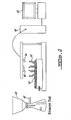
- wood chips 10 are introduced into a digester 12 and mixed with cooking chemicals to release the lignin from the woody matrix to yield pulp fibres. Pulp fibres are then blown into a blow tank 14 to which water is added and the stock is pumped to brownstock washers 16. The stock is washed through multiple washers 16 and then bleached in multiple towers 18 and washers 20 before being sent to a paper machine 22.
- An arrangement, and preferably, as well as other variants thereof, for online measurement with the instant invention includes the mounting of an excitation light source 24 and a fibre-optic probe 26 along the various locations of the kraft pulping process and bleaching process, such as at the brownstock washer drum 28, and bleach plant washer drum 30, just before the doctor blade 32, connected to a fast scanning spectrometer 34, via fibre optic cables 36, with a computer 38 sequencing spectral acquisitions and correlating the resulting spectrum against a predetermined calibration, and logging the results.
- pulp samples are collected from the desired process lines, brought to the lab and washed to remove black liquor (if required) by filtering through a Buchner funnel 40, allowing most of the excess water to be removed with vacuum flask 42, and presenting pulp fibres 44 to an excitation source 46 for spectral data collection.
- a high speed scanning spectrometer 48 controlled by a personal computer 50, registers diffusedly reflected light 52 through fibre-optic probe 54, records a spectrum, and calculates the residual lignin concentration from said spectrum.
- Spectral data is collected in the range of 350 nm to 2500 nm. Within this range, the spectral regions of 350 nm to 750 nm and 1100 nm to 2400 nm are used for calibration.
- the region of 400 nm to 750 nm is more preferred.
- the region below 400 nm i.e. between 350 nm and 400 nm. displays spectra which are noisy and thus is less valuable in the information that it provides.
- the spectrum produced is a continuous spectrum from 350 nm to 2500 nm, preferably 400 nm to 2400 nm, however, the region of between 750 nm and 1100 nm is blocked out, and better results are obtained when this latter region is blocked out.
- the spectrum is established based on the chemical composition of the pulp, for example, the residual lignin content.
- the excitation light interacts with the pulp exposed to the light and at various specific frequencies, absorption, for example lignin absorption, occurs and the changes in intensity associated with such lignin absorptions are recorded as a measure of residual lignin content of the pulp.
- Calibration for use in the instant invention is developed with the aid of multivariate analysis techniques such as partial least squares, principal component analysis and variants of such.
- the model developed contains any variations that can be anticipated in the process streams, including extreme swings in the fibre properties, to allow for robustness.
- Variations to be included in the MVA calibration include consistency (5% to 30%), wood species and Kappa numbers (0.5 to 110 Kappa). More details of MVA can be found elsewhere.
- a vacuum is provided to remove excessive water.
- the spectral data is acquired while the drums are in motion to provide good representation of the pulp samples.
- the instant invention removes the requirement of sampling devices and provides instant and continuous Kappa results for process control.
- the pulp fibres have a consistency of 8 to 30%; if necessary, excess water may be removed from the pulp fibres prior to exposing them to the light, for the determination of the desired pulp property.
- the pulp fibres may suitably be mobile during the determination steps, and conveniently may be housed in a chamber which is rotated at a constant rate of revolution, during the steps of exposing the pulp fibres to the light, and collecting the reflected light.
- the collecting of reflected light may be carried out in a predetermined period of time which is short compared to time periods required in prior procedures, more especially less than 60 seconds, and still more especially less than 10 seconds.
- the sample can be stationary or moving and no difference in results have been observed when measuring the sample when stationary and when moving at up to 10 fl/sec. Sample movement and data collection results in an averaging effect, and as the sample moves faster more averaging is observed so that results for the bulk material remain accurate.
- the method of the invention can be applied to the determination of the pulp property at different stages of the pulp manufacture, whereby, for example, continuous measurement of Kappa number is provided for feedforward and feedback control of the working and bleaching process in pulp production, to provide a pulp product of desired Kappa number.
- the instant invention which utilizes a combination of more preferred spectral regions (350 nm to 750 nm and 1100 mn to 2400 nm), features a large illuminated spot and sub-sampling to provide clear advantages over prior art. From the individual and combined teaching of the prior art, which teaches away from analyzing wet samples and to use non-optimized spectral regions, and which is further complicated by the requirement for extracting, washing, concentrating, and homogenizing, the present invention has overcome all of these limitations of previous teachings and can instantaneously provide continuous residual lignin determination.
- the method can also be applied to pulp fibres before digestion is completed, i.e. during the digestion phase.
- the pulp fibres are of partially digested wood chips. This provides a means of monitoring the digestion.
- the method is applied to pulp fibres after completion of the digestion, i.e. downstream of the digester in the pulp manufacture line.
- the instant invention thus provides a method for determining the properties of chemical pulp fibres, particularly, but not limited to, the residual lignin content of chemical pulps, in which the shortcomings of the prior art are overcome and provides true online process monitoring in the order of seconds without sample preparation, such as drying and consistency measurement.
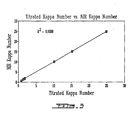
- FIG. 3 shows the results obtained for hemlock pulp sampled at the final brownstock washer and throughout the various washers of the bleach plant.
- FIG. 3 is a plot of titrated Kappa number versus NIR number. Correlation between standard analysis technique for titrated Kappa number versus the NIR determined Kappa number of instant invention. Partial least squares multivariate calibration is used to generate the calibration using a combination of preferred spectral regions 350 nm to 750 nm and 1100 nm to 2400 nm. Six factors were used to generate the model shown yielding an R 2 of 0.9999.
- FIG. 4 shows the results generated with the same dataset as above, but the calibration region is chosen to span only the NIR range of 1100 nm to 2500 nm, as indicated by the prior art.
- FIG. 4 is a plot of laboratory Kappa number versus NIR Kappa number (1100-2500 nm). Correlation between laboratory titrated Kappa number versus NIR determined Kappa number using the teaching of one prior art. Note the large spread of the data, especially for the fully bleached pulp fibres with low Kappa number. The results show inferior data, with a prediction error of ⁇ 2 Kappa which is much higher than in the results obtained in the present invention.
- FIG. 5 shows the results obtained with the same dataset above, but calibrated in a spectral range of another prior art teaching, namely 850 nm to 1050 nm.
- FIG. 5 is a plot of laboratory Kappa number versus NIR Kappa number (850-1050 nm). Correlation between lab. titrated Kappa number versus NIR determined Kappa number using the teaching of one prior art (850-1050 nm). Note the large spread of the data resulting errors of ⁇ 5 or more. As a result, this technique is inferior to instant invention and would be of limited use for online process control of digester and bleach plant operations. As shown, the result obtained with the prior teaching again teaches away from the current invention since the errors in the predictions are in the order of ⁇ 4 Kappa.
- FIG. 6 shows the results of the instant invention for residual lignin determination obtained for pulp fibres from various wood species, including, but not limited to, Douglas fir, hemlock, spruce, Jack pine, balsam fir, and western red cedar.
- FIG. 6 is a plot of titrated Kappa number versus NIR Kappa number for varying wood species pulp. Correlation between NIR Kappa number determined by instant invention versus titrated Kappa. Result shows that instant invention is not dependent on wood species: shown here are correlations for, but not limited to, Douglas fir, Jack pine, and western red cedar. As shown, excellent correlation is obtained and a single calibration is applicable to all softwood species, indicating that the instant invention is not affected by furnish variations. Similar results were obtained as a separate calibration for hardwood pulp fibres (not shown) with instant invention.
- FIG. 7 illustrates the kappa number results obtained from mill installation of present invention, as obtained with mill technical staffs and operators.
- FIG. 7 is a plot of mill installation results showing the correlations between instant invention and laboratory titrated results for kappa number. Excellent correlations were obtained between present invention and mill personnel, indicating utility of instant invention. Data were collected over a two week period whereby mill personnel obtained samples from the process line and perform laboratory tests for comparison between present invention and laboratory standard method. Results show that instant invention can provide kappa number measurements from brown stock to that of fully bleached pulp of high market brightness. It is not known of any such system that can provide kappa measurements down to kappa number of below 1-unit. Note that present invention can provide kappa number measurements to sub 1-unit kappa number. This is unexpected as no other technique is capable of providing such low detection limits.
- FIGS. 8-10 further illustrate the utility of present invention.
- the method of the invention was carried out in mill installations having varying grade changes and species mixes. Correlations between the present invention and standard laboratory analyses for A-mill, B-mill, and C-mill, which produces pulp of three different grades, grade-A, grade-B, and grade-C, are shown. Each process line pulps different species, mainly Western Red Cedar, Douglas Fir, hemlock, and other spruce-pine-fir (SPF) mixtures.
- SPF spruce-pine-fir
- the species composition for grade-A consists of 60% hemlock, 20% cedar, and 20% SPF
- grade-B consists of 80% hemlock, and 20% SPF
- grade-C consists of 80% Douglas fir and 20% SPF.
- Data show that instant invention can be applied to real pulp process with sufficient accuracy for process control and optimization and can span varies species mix and grade changes.
- FIG. 8 is a plot of mill installation results obtained in mill with three different furnishes/grades, specifically of grade A with species composition of 40% hemlock, 20% cedar, 40% SPF, showing excellent correlation between present invention and laboratory titration with standard laboratory analyses.
- FIG. 9 is a plot of mill installation results obtained in mill with three different furnishes/grades, specifically of grade B with species composition of 80% hemlock and 20% SPF, showing excellent correlation between present invention and laboratory titration with standard laboratory analyses.
- FIG. 10 is a plot of mill installation results obtained in mill with three different furnishes/grades, specifically of grade C with species composition of 80% cedar and 20% SPF, showing excellent correlation between present invention and laboratory titration with standard laboratory analyses. Mill installation results validate the utility of instant invention for process manufacturing application with varying species mix.
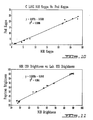
- FIG. 11 compares the mill installation results achieved with the method of the invention with that of laboratory standard technique for ISO brightness.
- FIG. 11 is a plot of mill installation results illustrating the use of instant invention to measure, as an option, the ISO brightness of the pulp.
- the method can provide ISO brightness simultaneously for further control ability of the pulp washing and bleaching processes.
- instant invention though not claimed, can provide simultaneous kappa number as well as ISO brightness determination within seconds.
Landscapes
- Physics & Mathematics (AREA)
- Spectroscopy & Molecular Physics (AREA)
- Health & Medical Sciences (AREA)
- Life Sciences & Earth Sciences (AREA)
- Chemical & Material Sciences (AREA)
- Analytical Chemistry (AREA)
- Biochemistry (AREA)
- General Health & Medical Sciences (AREA)
- General Physics & Mathematics (AREA)
- Immunology (AREA)
- Pathology (AREA)
- Engineering & Computer Science (AREA)
- Food Science & Technology (AREA)
- Medicinal Chemistry (AREA)
- Investigating Or Analysing Materials By Optical Means (AREA)
- Paper (AREA)
Claims (16)
- Procédé de détermination d'une propriété papetière de fibres de pâte chimique (44), la propriété étant sélectionnée parmi la teneur en lignine, l'indice Kappa et la blancheur ISO, ledit procédé comprenant les étapes qui consistent :a) à exposer des fibres de pâte (44) dérivées de copeaux de bois au moins partiellement digérés (10) à la lumière sur une gamme couvrant la région du visible qui va de 350 nm à 750 nm et la région du proche infrarouge (PIR) qui va de 1 100 à 2 400 nm et à laisser les fibres de pâte réfléchir la lumière ;b) à recueillir la lumière réfléchie par lesdites fibres (44) ;c) à établir un spectre de la lumière réfléchie (52), où la lumière dans la région qui va de 750 nm à 1 100 nm est bloquée ;d) à comparer ledit spectre à un spectre de fibres de pâte chimique (44) pour lesquelles la propriété papetière est connue ; ete) à évaluer la propriété papetière à partir de la comparaison effectuée à l'étape d).
- Procédé selon la revendication 1, où ladite lumière dans la région du visible est dans une gamme qui va de 400 nm à 750 nm.
- Procédé selon la revendication 1 ou 2, où lesdites fibres de pâte (44) ont une consistance comprise entre 8 % et 30 %.
- Procédé selon l'une quelconque des revendications 1 à 3, où lesdites fibres de pâte (44) sont mobiles durant les étapes a) et b).
- Procédé selon la revendication 4, où lesdites fibres de pâte se trouvent dans une enceinte (28, 30) durant les étapes a) et b), ladite enceinte (28, 30) étant soumise à une rotation à une vitesse de révolution constante.
- Procédé selon l'une quelconque des revendications 1 à 5, où ledit recueil à l'étape b) est effectué sur une période de temps prédéterminée.
- Procédé selon la revendication 6, où ladite période de temps est inférieure à 60 secondes.
- Procédé selon la revendication 7, où ladite période de temps est inférieure à 10 secondes.
- Procédé selon l'une quelconque des revendications 1 à 8, où lesdites fibres de pâte (44) à l'étape a) sont dans une chaîne de fabrication de la pâte.
- Procédé selon la revendication 9, où ladite étape a) est effectuée sur des fibres de pâte (44) en une pluralité de points (28, 30) le long de la chaîne de fabrication.
- Procédé selon la revendication 10, où ladite pluralité de points (28, 30) est en aval de la digestion des copeaux de bois (10) à partir desquels les fibres de pâte (44) sont obtenues.
- Moyen de détermination d'une propriété papetière de fibres de pâte, la propriété étant sélectionnée parmi la teneur en lignine, l'indice Kappa et la blancheur ISO, conçu pour être utilisé dans une chaîne de fabrication de fibres de pâte comprenant un lessiveur (12) permettant d'effectuer la cuisson de copeaux de bois (10) et des stations de lavage (16, 20) et de blanchissement (18) de la pâte, ledit moyen comprenant :i) une source de lumière (24, 46) adaptée à l'exposition desdites fibres de pâte (44), en au moins un point de ladite chaîne, à la lumière sur une gamme couvrant la région du visible qui va de 350 nm à 750 nm et la région du proche infrarouge (PIR) qui va de 1 100 à 2 400 nm ;ii) un spectrophotomètre (34, 48) permettant de recueillir la lumière réfléchie (52) à partir des fibres de pâte (44) exposées à ladite source de lumière (24, 46) et d'établir un spectre de la lumière réfléchie (52), où la lumière dans la région qui va de 750 nm à 1 100 nm est bloquée ; etiii) un moyen de comparaison (38, 50) permettant de comparer le spectre établi en ii) à un spectre de fibres de pâte (44) pour lesquelles la propriété papetière est connue et à partir duquel la propriété des fibres de pâte en i) peut être déterminée.
- Moyen de détermination d'une propriété papetière de fibres de pâte selon la revendication 12, où ladite source de lumière (24, 56) est adaptée pour produire une lumière avec laquelle la région du visible est dans une gamme qui va de 400 nm à 750 nm.
- Moyen de détermination d'une propriété papetière de fibres de pâte selon la revendication 12, où ledit moyen de détermination d'une propriété papetière est en aval du lessiveur (12).
- Moyen de détermination d'une propriété papetière de fibres de pâte selon la revendication 14, où ledit moyen est situé en une pluralité de points en aval du lessiveur (12).
- Chaîne de fabrication de pâte comprenant un lessiveur (12) permettant d'effectuer la cuisson de copeaux de bois (10), des stations de lavage (16, 20) et de blanchissement (18) de la pâte et un moyen de détermination d'une propriété papetière de fibres selon l'une quelconque des revendications 12 à 15.
Applications Claiming Priority (2)
| Application Number | Priority Date | Filing Date | Title |
|---|---|---|---|
| US65818305P | 2005-03-04 | 2005-03-04 | |
| PCT/CA2006/000294 WO2006092045A1 (fr) | 2005-03-04 | 2006-02-28 | Procédé de détermination de l’indice kappa de pulpe chimique par spectrométrie visible-proche de l’infrarouge |
Publications (3)
| Publication Number | Publication Date |
|---|---|
| EP1859253A1 EP1859253A1 (fr) | 2007-11-28 |
| EP1859253A4 EP1859253A4 (fr) | 2010-12-01 |
| EP1859253B1 true EP1859253B1 (fr) | 2012-09-12 |
Family
ID=36940806
Family Applications (1)
| Application Number | Title | Priority Date | Filing Date |
|---|---|---|---|
| EP06705248A Expired - Lifetime EP1859253B1 (fr) | 2005-03-04 | 2006-02-28 | Procédé de détermination de l indice kappa de pulpe chimique par spectrométrie visible-proche de l infrarouge, et moyens pour ceci |
Country Status (9)
| Country | Link |
|---|---|
| US (1) | US7604712B2 (fr) |
| EP (1) | EP1859253B1 (fr) |
| JP (1) | JP2008532021A (fr) |
| CN (1) | CN100538337C (fr) |
| BR (1) | BRPI0607744B1 (fr) |
| CA (1) | CA2599033C (fr) |
| NO (1) | NO338171B1 (fr) |
| RU (1) | RU2390760C2 (fr) |
| WO (1) | WO2006092045A1 (fr) |
Families Citing this family (30)
| Publication number | Priority date | Publication date | Assignee | Title |
|---|---|---|---|---|
| AU2013203145B2 (en) * | 2009-02-11 | 2015-05-14 | Xyleco, Inc. | Processing biomass |
| KR101818408B1 (ko) * | 2009-02-11 | 2018-01-12 | 질레코 인코포레이티드 | 바이오매스의 가공처리방법 |
| CN101581665A (zh) * | 2009-03-20 | 2009-11-18 | 北京林业大学 | 一种直接预测植物纤维原料制浆适应性的方法 |
| US8524037B2 (en) * | 2010-02-01 | 2013-09-03 | Canfor Pulp And Paper Sales Ltd. | Continuous digestion of chip blends containing a western red cedar chip furnish |
| CN102288569A (zh) * | 2010-06-21 | 2011-12-21 | 中国科学院上海生命科学研究院 | 一种纤维生物质的快速分析方法 |
| CN101957315B (zh) * | 2010-09-11 | 2012-02-15 | 大连工业大学 | 一种测定黑液中木素含量的方法 |
| WO2013156147A1 (fr) * | 2012-04-16 | 2013-10-24 | Stora Enso Oyj | Procédé permettant de déterminer automatiquement les niveaux d'adhésivité dans un processus de fibres recyclées |
| CA2885401A1 (fr) | 2012-10-10 | 2014-04-17 | Xyleco, Inc. | Traitement de biomasse |
| PH12018500546A1 (en) | 2012-10-10 | 2019-04-01 | Xyleco Inc | Equipment protecting enclosures |
| US9282693B2 (en) | 2013-02-20 | 2016-03-15 | Deere & Company | Data encoding with planting attributes |
| US11212962B2 (en) | 2013-02-20 | 2022-01-04 | Deere & Company | Field condition determination |
| US9066465B2 (en) | 2013-02-20 | 2015-06-30 | Deere & Company | Soil compaction reduction system and method |
| US10178828B2 (en) | 2013-02-20 | 2019-01-15 | Deere & Company | Per plant crop sensing resolution |
| US9693503B2 (en) | 2013-02-20 | 2017-07-04 | Deere & Company | Crop sensing |
| US9668420B2 (en) | 2013-02-20 | 2017-06-06 | Deere & Company | Crop sensing display |
| NZ743055A (en) | 2013-03-08 | 2020-03-27 | Xyleco Inc | Equipment protecting enclosures |
| WO2015037647A1 (fr) * | 2013-09-11 | 2015-03-19 | 日本製紙株式会社 | Procédé de production pour une pâte kraft dissolvante |
| CN103630501B (zh) * | 2013-11-14 | 2016-01-06 | 华南理工大学 | 一种快速纸浆卡伯值测定仪及其控制方法 |
| US10450700B2 (en) | 2014-12-12 | 2019-10-22 | Canfor Pulp Ltd. | Method and apparatus for controlling a cellulosic pulp process |
| CN105223102A (zh) * | 2015-09-29 | 2016-01-06 | 中国林业科学研究院林产化学工业研究所 | 一种利用近红外光谱技术快速测定制浆材基本密度的方法 |
| FI20165270A7 (fi) | 2016-03-31 | 2017-10-01 | Kemira Oyj | Menetelmä ja järjestelmä tärkin määrittämiseksi näytteestä |
| FI127260B (en) | 2016-12-08 | 2018-02-15 | Valmet Automation Oy | Method and measuring device for measuring suspension |
| FI127733B (en) * | 2016-12-19 | 2019-01-15 | Valmet Automation Oy | Apparatus and method for optical measurement of liquid substance with liquid as medium and particles not dissolved in medium |
| US10801892B2 (en) * | 2017-05-01 | 2020-10-13 | HallStar Beauty and Personal Care Innovations Company | Methods and systems for quantitatively measuring photoprotection |
| FI128736B (en) * | 2018-03-09 | 2020-11-13 | Valmet Automation Oy | Method and measuring device for measuring the suspension |
| FI130616B (en) * | 2021-10-08 | 2023-12-14 | Andritz Ab | Method for producing cellulose in a multi-step process |
| CN113866047B (zh) * | 2021-10-21 | 2024-04-02 | 南京信息工程大学 | 一种基于机器学习的粘滞系数光学测定装置及方法 |
| WO2023230071A1 (fr) * | 2022-05-23 | 2023-11-30 | Nearwave Corp. | Commande et fonctionnement de dispositif de spectroscopie proche infrarouge |
| CN117929300A (zh) * | 2023-11-29 | 2024-04-26 | 海南金海浆纸业有限公司 | 一种纸浆卡伯值快速检测方法与装置 |
| KR102943951B1 (ko) | 2024-01-16 | 2026-03-25 | 한국섬유소재연구원 | 가시광선-근적외선을 이용한 원단의 생산관리방법 및 이를 위한 원단의 생산관리 시스템 |
Family Cites Families (18)
| Publication number | Priority date | Publication date | Assignee | Title |
|---|---|---|---|---|
| US4013506A (en) * | 1974-07-22 | 1977-03-22 | Canadian International Paper Company | Method and apparatus for automatically and simultaneously controlling solution viscosity and brightness of a pulp during multi-stage bleaching |
| CA1277110C (fr) | 1986-05-07 | 1990-12-04 | Rudolf Patt | Methode de contro le de la cuisson des lignocelluloses par spectroscopie aux irtf |
| SU1483344A1 (ru) * | 1986-12-05 | 1989-05-30 | Ленинградский институт текстильной и легкой промышленности им.С.М.Кирова | Устройство дл контрол физических параметров движущихс плоских волокнистых светопропускающих материалов |
| US5218207A (en) * | 1989-01-19 | 1993-06-08 | Futrex, Inc. | Using led harmonic wavelengths for near-infrared quantitative |
| SE507486C3 (sv) | 1991-09-12 | 1998-07-13 | Valmet Automation Kajaani Ltd | Foerfarande och anordning foer maetning av fiberegenskaper med naera-infra-roed-spektroskopi |
| US5420682A (en) * | 1993-07-02 | 1995-05-30 | Honeywell Inc. | Method and apparatus for compensating spectral data with a color sensor |
| SE9401707L (sv) * | 1994-05-18 | 1995-11-19 | Christer Bjoerklund | Spektrofotometrisk metod att mäta kvalitets och styrke parametrar hos träd, virke trävaror, flis, spån, massa och papper |
| SE9401718L (sv) * | 1994-05-18 | 1995-11-19 | Eka Nobel Ab | Sätt att bestämma parametrarna i papper |
| EP0899373A1 (fr) * | 1997-08-28 | 1999-03-03 | Ciba SC Holding AG | Procédé pour le blanchiment durant la fabrication de pâte à papier contenant de la lignine |
| US6069688A (en) * | 1997-12-11 | 2000-05-30 | Honeywell International Inc. | Method for producing continuous in-like kappa measurements for papermaking pulps |
| US5953111A (en) * | 1997-12-11 | 1999-09-14 | Honeywell Inc. | Continuous in-line kappa measurement system |
| US6797113B2 (en) * | 1999-02-24 | 2004-09-28 | Weyerhaeuser Company | Use of thinnings and other low specific gravity wood for lyocell pulps method |
| US6475339B1 (en) | 1999-06-03 | 2002-11-05 | Lnstitute Of Paper Science And Technology, Inc | Method for rapidly determining a pulp kappa number using spectrophotometry |
| US6551451B2 (en) * | 1999-12-23 | 2003-04-22 | Pulp And Paper Research Institute Of Canada | Method for determining liquid content in chemical pulps using ramen spectrometry |
| SE523308E (sv) * | 2000-03-02 | 2007-12-27 | Valmet Fibertech Ab | Förfarande för kontinuerlig bestämning av egenskaper hos ett trägiberflöde för träfiberskiveframställning |
| SE516232C2 (sv) * | 2000-04-14 | 2001-12-03 | Stora Kopparbergs Bergslags Ab | Sätt vid framställning av massa samt produkt av sättet |
| JP4022434B2 (ja) * | 2002-06-13 | 2007-12-19 | 株式会社リコー | 液濃度検出装置及び画像形成装置 |
| WO2005029541A2 (fr) * | 2003-08-14 | 2005-03-31 | Microspectral Sensing, Llc | Systeme et procede de detection et de commande integrees de processus industriels |
-
2006
- 2006-02-28 WO PCT/CA2006/000294 patent/WO2006092045A1/fr not_active Ceased
- 2006-02-28 CA CA2599033A patent/CA2599033C/fr not_active Expired - Lifetime
- 2006-02-28 CN CN200680006883.0A patent/CN100538337C/zh not_active Expired - Lifetime
- 2006-02-28 JP JP2007557298A patent/JP2008532021A/ja active Pending
- 2006-02-28 EP EP06705248A patent/EP1859253B1/fr not_active Expired - Lifetime
- 2006-02-28 BR BRPI0607744-7A patent/BRPI0607744B1/pt active IP Right Grant
- 2006-02-28 RU RU2007136715/28A patent/RU2390760C2/ru not_active IP Right Cessation
- 2006-03-01 US US11/364,275 patent/US7604712B2/en active Active
-
2007
- 2007-10-02 NO NO20074984A patent/NO338171B1/no unknown
Also Published As
| Publication number | Publication date |
|---|---|
| BRPI0607744B1 (pt) | 2018-04-17 |
| WO2006092045A1 (fr) | 2006-09-08 |
| EP1859253A4 (fr) | 2010-12-01 |
| US7604712B2 (en) | 2009-10-20 |
| CA2599033C (fr) | 2011-06-07 |
| CA2599033A1 (fr) | 2006-09-08 |
| NO338171B1 (no) | 2016-08-01 |
| NO20074984L (no) | 2007-12-04 |
| EP1859253A1 (fr) | 2007-11-28 |
| BRPI0607744A2 (pt) | 2010-03-16 |
| US20060196622A1 (en) | 2006-09-07 |
| CN100538337C (zh) | 2009-09-09 |
| RU2390760C2 (ru) | 2010-05-27 |
| CN101133315A (zh) | 2008-02-27 |
| RU2007136715A (ru) | 2009-04-10 |
| JP2008532021A (ja) | 2008-08-14 |
Similar Documents
| Publication | Publication Date | Title |
|---|---|---|
| US7604712B2 (en) | Method for determining chemical pulp kappa number with visible-near infrared spectrometry | |
| EP0786082B1 (fr) | Procede de determination de la teneur organique d'effluents provenant de fabriques de pate et de papier | |
| CA2230266C (fr) | Determination du sulfure de sodium et de la sulfidite dans les lessives vertes et les solutions de cendres | |
| US6551451B2 (en) | Method for determining liquid content in chemical pulps using ramen spectrometry | |
| US5486915A (en) | On-line measurement of lignin in wood pulp by color shift of fluorescence | |
| CA2392292C (fr) | Determination de l'indice kappa dans des pates chimiques par spectrometrie raman | |
| WO1995031710A1 (fr) | Procede spectrophotometrique pour mesurer des parametres de qualite et de resistance dans des arbres, du bois de construction, des copeaux, de la sciure de bois, de la pate et du papier | |
| Liang et al. | Predicting bleachability of Eucalyptus mechanical pulp by moisture content-dependent near-infrared spectroscopy | |
| CA2908584A1 (fr) | Procede de determination d'une propriete d'un agent heterogene | |
| EP1031023B1 (fr) | Determination de la concentration d'especes anioniques par spectroscopie infrarouge proche | |
| US6946056B2 (en) | Method for regulating the manufacturing of pulp by optically measuring the amount of hexenuronic acid | |
| Chai et al. | Online Monitoring of Alkali, Sulfide, and Dissolved Lignin during Wood Pulping by Attenuated Total Reflection− Ultraviolet Spectroscopy and Flow Injection Techniques | |
| Weinstock | 16/\jDetector/Analyzer | |
| Shen et al. | Online monitoring of kappa number during batch pulping by visible spectroscopy | |
| Fišerová et al. | Using NIR analysis for determination of hardwood kraft pulp properties | |
| CA2305201C (fr) | Determination de la concentration d'especes anioniques par spectroscopie infrarouge proche | |
| Yuan et al. | Spectroscopic methods for monitoring pulp bleaching processes | |
| Koskinen et al. | Measurement of TMP properties based on NIR spectral analysis | |
| Lightle | Application of Near Infrared Spectroscopy to Pulp Yield and Kappa Number Estimation |
Legal Events
| Date | Code | Title | Description |
|---|---|---|---|
| PUAI | Public reference made under article 153(3) epc to a published international application that has entered the european phase |
Free format text: ORIGINAL CODE: 0009012 |
|
| 17P | Request for examination filed |
Effective date: 20070918 |
|
| AK | Designated contracting states |
Kind code of ref document: A1 Designated state(s): AT BE BG CH CY CZ DE DK EE ES FI FR GB GR HU IE IS IT LI LT LU LV MC NL PL PT RO SE SI SK TR |
|
| DAX | Request for extension of the european patent (deleted) | ||
| A4 | Supplementary search report drawn up and despatched |
Effective date: 20101029 |
|
| 17Q | First examination report despatched |
Effective date: 20110712 |
|
| REG | Reference to a national code |
Ref country code: DE Ref legal event code: R079 Ref document number: 602006031934 Country of ref document: DE Free format text: PREVIOUS MAIN CLASS: G01N0021350000 Ipc: D21C0003220000 |
|
| RIC1 | Information provided on ipc code assigned before grant |
Ipc: G01N 33/34 20060101ALI20120229BHEP Ipc: D21C 3/22 20060101AFI20120229BHEP |
|
| RTI1 | Title (correction) |
Free format text: METHOD FOR DETERMINING CHEMICAL PULP KAPPA NUMBER WITH VISIBLE-NEAR INFRARED SPECTROMETRY, AND MEANS THEREFOR |
|
| GRAP | Despatch of communication of intention to grant a patent |
Free format text: ORIGINAL CODE: EPIDOSNIGR1 |
|
| GRAS | Grant fee paid |
Free format text: ORIGINAL CODE: EPIDOSNIGR3 |
|
| GRAA | (expected) grant |
Free format text: ORIGINAL CODE: 0009210 |
|
| AK | Designated contracting states |
Kind code of ref document: B1 Designated state(s): AT BE BG CH CY CZ DE DK EE ES FI FR GB GR HU IE IS IT LI LT LU LV MC NL PL PT RO SE SI SK TR |
|
| REG | Reference to a national code |
Ref country code: GB Ref legal event code: FG4D |
|
| REG | Reference to a national code |
Ref country code: CH Ref legal event code: EP |
|
| REG | Reference to a national code |
Ref country code: AT Ref legal event code: REF Ref document number: 575167 Country of ref document: AT Kind code of ref document: T Effective date: 20120915 |
|
| REG | Reference to a national code |
Ref country code: IE Ref legal event code: FG4D |
|
| REG | Reference to a national code |
Ref country code: SE Ref legal event code: TRGR |
|
| REG | Reference to a national code |
Ref country code: DE Ref legal event code: R096 Ref document number: 602006031934 Country of ref document: DE Effective date: 20121108 |
|
| PG25 | Lapsed in a contracting state [announced via postgrant information from national office to epo] |
Ref country code: LT Free format text: LAPSE BECAUSE OF FAILURE TO SUBMIT A TRANSLATION OF THE DESCRIPTION OR TO PAY THE FEE WITHIN THE PRESCRIBED TIME-LIMIT Effective date: 20120912 Ref country code: CY Free format text: LAPSE BECAUSE OF FAILURE TO SUBMIT A TRANSLATION OF THE DESCRIPTION OR TO PAY THE FEE WITHIN THE PRESCRIBED TIME-LIMIT Effective date: 20120912 |
|
| REG | Reference to a national code |
Ref country code: NL Ref legal event code: VDEP Effective date: 20120912 |
|
| REG | Reference to a national code |
Ref country code: AT Ref legal event code: MK05 Ref document number: 575167 Country of ref document: AT Kind code of ref document: T Effective date: 20120912 |
|
| REG | Reference to a national code |
Ref country code: LT Ref legal event code: MG4D Effective date: 20120912 |
|
| PG25 | Lapsed in a contracting state [announced via postgrant information from national office to epo] |
Ref country code: GR Free format text: LAPSE BECAUSE OF FAILURE TO SUBMIT A TRANSLATION OF THE DESCRIPTION OR TO PAY THE FEE WITHIN THE PRESCRIBED TIME-LIMIT Effective date: 20121213 Ref country code: SI Free format text: LAPSE BECAUSE OF FAILURE TO SUBMIT A TRANSLATION OF THE DESCRIPTION OR TO PAY THE FEE WITHIN THE PRESCRIBED TIME-LIMIT Effective date: 20120912 Ref country code: LV Free format text: LAPSE BECAUSE OF FAILURE TO SUBMIT A TRANSLATION OF THE DESCRIPTION OR TO PAY THE FEE WITHIN THE PRESCRIBED TIME-LIMIT Effective date: 20120912 |
|
| PG25 | Lapsed in a contracting state [announced via postgrant information from national office to epo] |
Ref country code: BE Free format text: LAPSE BECAUSE OF FAILURE TO SUBMIT A TRANSLATION OF THE DESCRIPTION OR TO PAY THE FEE WITHIN THE PRESCRIBED TIME-LIMIT Effective date: 20120912 Ref country code: CZ Free format text: LAPSE BECAUSE OF FAILURE TO SUBMIT A TRANSLATION OF THE DESCRIPTION OR TO PAY THE FEE WITHIN THE PRESCRIBED TIME-LIMIT Effective date: 20120912 Ref country code: NL Free format text: LAPSE BECAUSE OF FAILURE TO SUBMIT A TRANSLATION OF THE DESCRIPTION OR TO PAY THE FEE WITHIN THE PRESCRIBED TIME-LIMIT Effective date: 20120912 Ref country code: IS Free format text: LAPSE BECAUSE OF FAILURE TO SUBMIT A TRANSLATION OF THE DESCRIPTION OR TO PAY THE FEE WITHIN THE PRESCRIBED TIME-LIMIT Effective date: 20130112 Ref country code: EE Free format text: LAPSE BECAUSE OF FAILURE TO SUBMIT A TRANSLATION OF THE DESCRIPTION OR TO PAY THE FEE WITHIN THE PRESCRIBED TIME-LIMIT Effective date: 20120912 Ref country code: RO Free format text: LAPSE BECAUSE OF FAILURE TO SUBMIT A TRANSLATION OF THE DESCRIPTION OR TO PAY THE FEE WITHIN THE PRESCRIBED TIME-LIMIT Effective date: 20120912 Ref country code: ES Free format text: LAPSE BECAUSE OF FAILURE TO SUBMIT A TRANSLATION OF THE DESCRIPTION OR TO PAY THE FEE WITHIN THE PRESCRIBED TIME-LIMIT Effective date: 20121223 |
|
| PG25 | Lapsed in a contracting state [announced via postgrant information from national office to epo] |
Ref country code: PL Free format text: LAPSE BECAUSE OF FAILURE TO SUBMIT A TRANSLATION OF THE DESCRIPTION OR TO PAY THE FEE WITHIN THE PRESCRIBED TIME-LIMIT Effective date: 20120912 Ref country code: PT Free format text: LAPSE BECAUSE OF FAILURE TO SUBMIT A TRANSLATION OF THE DESCRIPTION OR TO PAY THE FEE WITHIN THE PRESCRIBED TIME-LIMIT Effective date: 20130114 Ref country code: SK Free format text: LAPSE BECAUSE OF FAILURE TO SUBMIT A TRANSLATION OF THE DESCRIPTION OR TO PAY THE FEE WITHIN THE PRESCRIBED TIME-LIMIT Effective date: 20120912 |
|
| PG25 | Lapsed in a contracting state [announced via postgrant information from national office to epo] |
Ref country code: AT Free format text: LAPSE BECAUSE OF FAILURE TO SUBMIT A TRANSLATION OF THE DESCRIPTION OR TO PAY THE FEE WITHIN THE PRESCRIBED TIME-LIMIT Effective date: 20120912 |
|
| PLBE | No opposition filed within time limit |
Free format text: ORIGINAL CODE: 0009261 |
|
| STAA | Information on the status of an ep patent application or granted ep patent |
Free format text: STATUS: NO OPPOSITION FILED WITHIN TIME LIMIT |
|
| PG25 | Lapsed in a contracting state [announced via postgrant information from national office to epo] |
Ref country code: DK Free format text: LAPSE BECAUSE OF FAILURE TO SUBMIT A TRANSLATION OF THE DESCRIPTION OR TO PAY THE FEE WITHIN THE PRESCRIBED TIME-LIMIT Effective date: 20120912 Ref country code: BG Free format text: LAPSE BECAUSE OF FAILURE TO SUBMIT A TRANSLATION OF THE DESCRIPTION OR TO PAY THE FEE WITHIN THE PRESCRIBED TIME-LIMIT Effective date: 20121212 |
|
| 26N | No opposition filed |
Effective date: 20130613 |
|
| PG25 | Lapsed in a contracting state [announced via postgrant information from national office to epo] |
Ref country code: IT Free format text: LAPSE BECAUSE OF FAILURE TO SUBMIT A TRANSLATION OF THE DESCRIPTION OR TO PAY THE FEE WITHIN THE PRESCRIBED TIME-LIMIT Effective date: 20120912 |
|
| PG25 | Lapsed in a contracting state [announced via postgrant information from national office to epo] |
Ref country code: MC Free format text: LAPSE BECAUSE OF NON-PAYMENT OF DUE FEES Effective date: 20130228 |
|
| REG | Reference to a national code |
Ref country code: CH Ref legal event code: PL |
|
| REG | Reference to a national code |
Ref country code: DE Ref legal event code: R097 Ref document number: 602006031934 Country of ref document: DE Effective date: 20130613 |
|
| GBPC | Gb: european patent ceased through non-payment of renewal fee |
Effective date: 20130228 |
|
| PG25 | Lapsed in a contracting state [announced via postgrant information from national office to epo] |
Ref country code: CH Free format text: LAPSE BECAUSE OF NON-PAYMENT OF DUE FEES Effective date: 20130228 Ref country code: LI Free format text: LAPSE BECAUSE OF NON-PAYMENT OF DUE FEES Effective date: 20130228 |
|
| REG | Reference to a national code |
Ref country code: IE Ref legal event code: MM4A |
|
| PG25 | Lapsed in a contracting state [announced via postgrant information from national office to epo] |
Ref country code: GB Free format text: LAPSE BECAUSE OF NON-PAYMENT OF DUE FEES Effective date: 20130228 Ref country code: IE Free format text: LAPSE BECAUSE OF NON-PAYMENT OF DUE FEES Effective date: 20130228 |
|
| REG | Reference to a national code |
Ref country code: DE Ref legal event code: R082 Ref document number: 602006031934 Country of ref document: DE Representative=s name: PATENTANWAELTE WEICKMANN & WEICKMANN, DE Ref country code: DE Ref legal event code: R082 Ref document number: 602006031934 Country of ref document: DE Representative=s name: WEICKMANN & WEICKMANN PATENTANWAELTE - RECHTSA, DE Ref country code: DE Ref legal event code: R082 Ref document number: 602006031934 Country of ref document: DE Representative=s name: WEICKMANN & WEICKMANN PATENT- UND RECHTSANWAEL, DE |
|
| PG25 | Lapsed in a contracting state [announced via postgrant information from national office to epo] |
Ref country code: TR Free format text: LAPSE BECAUSE OF FAILURE TO SUBMIT A TRANSLATION OF THE DESCRIPTION OR TO PAY THE FEE WITHIN THE PRESCRIBED TIME-LIMIT Effective date: 20120912 |
|
| PG25 | Lapsed in a contracting state [announced via postgrant information from national office to epo] |
Ref country code: LU Free format text: LAPSE BECAUSE OF NON-PAYMENT OF DUE FEES Effective date: 20130228 Ref country code: HU Free format text: LAPSE BECAUSE OF FAILURE TO SUBMIT A TRANSLATION OF THE DESCRIPTION OR TO PAY THE FEE WITHIN THE PRESCRIBED TIME-LIMIT; INVALID AB INITIO Effective date: 20060228 |
|
| REG | Reference to a national code |
Ref country code: FR Ref legal event code: PLFP Year of fee payment: 11 |
|
| REG | Reference to a national code |
Ref country code: FR Ref legal event code: PLFP Year of fee payment: 12 |
|
| REG | Reference to a national code |
Ref country code: FR Ref legal event code: PLFP Year of fee payment: 13 |
|
| PGFP | Annual fee paid to national office [announced via postgrant information from national office to epo] |
Ref country code: DE Payment date: 20250128 Year of fee payment: 20 |
|
| PGFP | Annual fee paid to national office [announced via postgrant information from national office to epo] |
Ref country code: FI Payment date: 20250218 Year of fee payment: 20 |
|
| PGFP | Annual fee paid to national office [announced via postgrant information from national office to epo] |
Ref country code: SE Payment date: 20250211 Year of fee payment: 20 |
|
| PGFP | Annual fee paid to national office [announced via postgrant information from national office to epo] |
Ref country code: FR Payment date: 20250210 Year of fee payment: 20 |
|
| REG | Reference to a national code |
Ref country code: DE Ref legal event code: R071 Ref document number: 602006031934 Country of ref document: DE |