EP1859933B1 - Film multicouche blanc ameliorant l'adherence - Google Patents
Film multicouche blanc ameliorant l'adherence Download PDFInfo
- Publication number
- EP1859933B1 EP1859933B1 EP20070009662 EP07009662A EP1859933B1 EP 1859933 B1 EP1859933 B1 EP 1859933B1 EP 20070009662 EP20070009662 EP 20070009662 EP 07009662 A EP07009662 A EP 07009662A EP 1859933 B1 EP1859933 B1 EP 1859933B1
- Authority
- EP
- European Patent Office
- Prior art keywords
- film
- polyester film
- layer
- adhesion
- polyester
- Prior art date
- Legal status (The legal status is an assumption and is not a legal conclusion. Google has not performed a legal analysis and makes no representation as to the accuracy of the status listed.)
- Ceased
Links
Images
Classifications
-
- G—PHYSICS
- G09—EDUCATION; CRYPTOGRAPHY; DISPLAY; ADVERTISING; SEALS
- G09F—DISPLAYING; ADVERTISING; SIGNS; LABELS OR NAME-PLATES; SEALS
- G09F3/00—Labels, tag tickets, or similar identification or indication means; Seals; Postage or like stamps
- G09F3/02—Forms or constructions
-
- B—PERFORMING OPERATIONS; TRANSPORTING
- B32—LAYERED PRODUCTS
- B32B—LAYERED PRODUCTS, i.e. PRODUCTS BUILT-UP OF STRATA OF FLAT OR NON-FLAT, e.g. CELLULAR OR HONEYCOMB, FORM
- B32B27/00—Layered products comprising a layer of synthetic resin
- B32B27/16—Layered products comprising a layer of synthetic resin specially treated, e.g. irradiated
-
- B—PERFORMING OPERATIONS; TRANSPORTING
- B32—LAYERED PRODUCTS
- B32B—LAYERED PRODUCTS, i.e. PRODUCTS BUILT-UP OF STRATA OF FLAT OR NON-FLAT, e.g. CELLULAR OR HONEYCOMB, FORM
- B32B27/00—Layered products comprising a layer of synthetic resin
- B32B27/18—Layered products comprising a layer of synthetic resin characterised by the use of special additives
- B32B27/20—Layered products comprising a layer of synthetic resin characterised by the use of special additives using fillers, pigments, thixotroping agents
-
- B—PERFORMING OPERATIONS; TRANSPORTING
- B32—LAYERED PRODUCTS
- B32B—LAYERED PRODUCTS, i.e. PRODUCTS BUILT-UP OF STRATA OF FLAT OR NON-FLAT, e.g. CELLULAR OR HONEYCOMB, FORM
- B32B27/00—Layered products comprising a layer of synthetic resin
- B32B27/30—Layered products comprising a layer of synthetic resin comprising vinyl (co)polymers; comprising acrylic (co)polymers
- B32B27/308—Layered products comprising a layer of synthetic resin comprising vinyl (co)polymers; comprising acrylic (co)polymers comprising acrylic (co)polymers
-
- B—PERFORMING OPERATIONS; TRANSPORTING
- B32—LAYERED PRODUCTS
- B32B—LAYERED PRODUCTS, i.e. PRODUCTS BUILT-UP OF STRATA OF FLAT OR NON-FLAT, e.g. CELLULAR OR HONEYCOMB, FORM
- B32B27/00—Layered products comprising a layer of synthetic resin
- B32B27/36—Layered products comprising a layer of synthetic resin comprising polyesters
-
- G—PHYSICS
- G03—PHOTOGRAPHY; CINEMATOGRAPHY; ANALOGOUS TECHNIQUES USING WAVES OTHER THAN OPTICAL WAVES; ELECTROGRAPHY; HOLOGRAPHY
- G03C—PHOTOSENSITIVE MATERIALS FOR PHOTOGRAPHIC PURPOSES; PHOTOGRAPHIC PROCESSES, e.g. CINE, X-RAY, COLOUR, STEREO-PHOTOGRAPHIC PROCESSES; AUXILIARY PROCESSES IN PHOTOGRAPHY
- G03C1/00—Photosensitive materials
- G03C1/76—Photosensitive materials characterised by the base or auxiliary layers
- G03C1/795—Photosensitive materials characterised by the base or auxiliary layers the base being of macromolecular substances
- G03C1/7954—Polyesters
-
- G—PHYSICS
- G03—PHOTOGRAPHY; CINEMATOGRAPHY; ANALOGOUS TECHNIQUES USING WAVES OTHER THAN OPTICAL WAVES; ELECTROGRAPHY; HOLOGRAPHY
- G03C—PHOTOSENSITIVE MATERIALS FOR PHOTOGRAPHIC PURPOSES; PHOTOGRAPHIC PROCESSES, e.g. CINE, X-RAY, COLOUR, STEREO-PHOTOGRAPHIC PROCESSES; AUXILIARY PROCESSES IN PHOTOGRAPHY
- G03C1/00—Photosensitive materials
- G03C1/76—Photosensitive materials characterised by the base or auxiliary layers
- G03C1/91—Photosensitive materials characterised by the base or auxiliary layers characterised by subbing layers or subbing means
-
- G—PHYSICS
- G03—PHOTOGRAPHY; CINEMATOGRAPHY; ANALOGOUS TECHNIQUES USING WAVES OTHER THAN OPTICAL WAVES; ELECTROGRAPHY; HOLOGRAPHY
- G03C—PHOTOSENSITIVE MATERIALS FOR PHOTOGRAPHIC PURPOSES; PHOTOGRAPHIC PROCESSES, e.g. CINE, X-RAY, COLOUR, STEREO-PHOTOGRAPHIC PROCESSES; AUXILIARY PROCESSES IN PHOTOGRAPHY
- G03C1/00—Photosensitive materials
- G03C1/76—Photosensitive materials characterised by the base or auxiliary layers
- G03C1/95—Photosensitive materials characterised by the base or auxiliary layers rendered opaque or writable, e.g. with inert particulate additives
-
- B—PERFORMING OPERATIONS; TRANSPORTING
- B32—LAYERED PRODUCTS
- B32B—LAYERED PRODUCTS, i.e. PRODUCTS BUILT-UP OF STRATA OF FLAT OR NON-FLAT, e.g. CELLULAR OR HONEYCOMB, FORM
- B32B2250/00—Layers arrangement
- B32B2250/24—All layers being polymeric
-
- B—PERFORMING OPERATIONS; TRANSPORTING
- B32—LAYERED PRODUCTS
- B32B—LAYERED PRODUCTS, i.e. PRODUCTS BUILT-UP OF STRATA OF FLAT OR NON-FLAT, e.g. CELLULAR OR HONEYCOMB, FORM
- B32B2250/00—Layers arrangement
- B32B2250/40—Symmetrical or sandwich layers, e.g. ABA, ABCBA, ABCCBA
-
- B—PERFORMING OPERATIONS; TRANSPORTING
- B32—LAYERED PRODUCTS
- B32B—LAYERED PRODUCTS, i.e. PRODUCTS BUILT-UP OF STRATA OF FLAT OR NON-FLAT, e.g. CELLULAR OR HONEYCOMB, FORM
- B32B2307/00—Properties of the layers or laminate
- B32B2307/40—Properties of the layers or laminate having particular optical properties
- B32B2307/402—Coloured
- B32B2307/4026—Coloured within the layer by addition of a colorant, e.g. pigments, dyes
-
- B—PERFORMING OPERATIONS; TRANSPORTING
- B32—LAYERED PRODUCTS
- B32B—LAYERED PRODUCTS, i.e. PRODUCTS BUILT-UP OF STRATA OF FLAT OR NON-FLAT, e.g. CELLULAR OR HONEYCOMB, FORM
- B32B2307/00—Properties of the layers or laminate
- B32B2307/50—Properties of the layers or laminate having particular mechanical properties
- B32B2307/514—Oriented
- B32B2307/518—Oriented bi-axially
-
- B—PERFORMING OPERATIONS; TRANSPORTING
- B32—LAYERED PRODUCTS
- B32B—LAYERED PRODUCTS, i.e. PRODUCTS BUILT-UP OF STRATA OF FLAT OR NON-FLAT, e.g. CELLULAR OR HONEYCOMB, FORM
- B32B2439/00—Containers; Receptacles
- B32B2439/70—Food packaging
-
- B—PERFORMING OPERATIONS; TRANSPORTING
- B32—LAYERED PRODUCTS
- B32B—LAYERED PRODUCTS, i.e. PRODUCTS BUILT-UP OF STRATA OF FLAT OR NON-FLAT, e.g. CELLULAR OR HONEYCOMB, FORM
- B32B2439/00—Containers; Receptacles
- B32B2439/80—Medical packaging
-
- G—PHYSICS
- G03—PHOTOGRAPHY; CINEMATOGRAPHY; ANALOGOUS TECHNIQUES USING WAVES OTHER THAN OPTICAL WAVES; ELECTROGRAPHY; HOLOGRAPHY
- G03C—PHOTOSENSITIVE MATERIALS FOR PHOTOGRAPHIC PURPOSES; PHOTOGRAPHIC PROCESSES, e.g. CINE, X-RAY, COLOUR, STEREO-PHOTOGRAPHIC PROCESSES; AUXILIARY PROCESSES IN PHOTOGRAPHY
- G03C1/00—Photosensitive materials
- G03C1/76—Photosensitive materials characterised by the base or auxiliary layers
- G03C1/825—Photosensitive materials characterised by the base or auxiliary layers characterised by antireflection means or visible-light filtering means, e.g. antihalation
-
- G—PHYSICS
- G03—PHOTOGRAPHY; CINEMATOGRAPHY; ANALOGOUS TECHNIQUES USING WAVES OTHER THAN OPTICAL WAVES; ELECTROGRAPHY; HOLOGRAPHY
- G03C—PHOTOSENSITIVE MATERIALS FOR PHOTOGRAPHIC PURPOSES; PHOTOGRAPHIC PROCESSES, e.g. CINE, X-RAY, COLOUR, STEREO-PHOTOGRAPHIC PROCESSES; AUXILIARY PROCESSES IN PHOTOGRAPHY
- G03C1/00—Photosensitive materials
- G03C1/76—Photosensitive materials characterised by the base or auxiliary layers
- G03C1/91—Photosensitive materials characterised by the base or auxiliary layers characterised by subbing layers or subbing means
- G03C1/915—Photosensitive materials characterised by the base or auxiliary layers characterised by subbing layers or subbing means using mechanical or physical means therefor, e.g. corona
Definitions
- the invention relates to a multilayer, white, biaxially oriented polyester film comprising a base layer (B) which contains a thermoplastic polyester and barium sulfate as the sole white pigment, and at least one cover layer (A).
- the outer layer (A) contains, in addition to the sole white pigment barium sulfate, an antiblocking agent in a predetermined size and concentration.
- the film according to the invention has at least one surface which has good adhesion to other polymer or metal layers or printing inks. For this purpose, this surface is coated, for example, with a water-soluble adhesion-promoting layer in-line.
- the invention further relates to a process for the production of the film and its use.
- the DE-C-26 47 713 describes a photographic, biaxially oriented opaque layer support which consists of a linear polyester and contains as the sole particulate pigment barium sulfate in an amount of 5 to 50 wt .-%.
- the barium sulfate particles have an average particle size of 0.5 to 10 microns, wherein 99.9% of the particles does not exceed the actual particle size of 50 microns.
- the photographic, biaxially oriented opaque substrate is characterized by a particularly high degree of whiteness and by a particularly high opacity, without the substrate being discolored during production by additives contained in it. In addition, it has a low density, a good specular gloss and a low total light transmittance. However, the film still has deficits in its production (not optimal role presentation) and in the optical properties.
- the EP-A-1 125 966 describes a white-opaque film having a thickness in the range of 10 to 500 .mu.m, which contains a crystallizable thermoplastic as the main component, the film at least barium sulfate as a white pigment, at least one UV stabilizer as a light stabilizer, at least one flame retardant and at least one optical brightener contains.
- the proportion of barium sulfate in the film is in a range of 0.2 to 40 wt .-%, the UV stabilizer as a light stabilizer in a range of 0.01 to 5 wt .-%, the flame retardant in a range of 0.5 to 30.0 wt .-% and the optical brightener in a range of 10 to 50,000 ppm, based on the weight of the thermoplastic. Due to the diverse combination of properties, the film is suitable for various applications, for example for interior trim, for trade fair construction and trade fair products, for displays and signs, for labels, for protective glazing of machines and vehicles, in shop and shelf construction, as promotional items, laminating medium and in food applications. However, the film still has deficits in its production (not optimal role presentation) and in the optical properties.
- the EP-A-1 125 967 relates to a white-opaque film with low transparency of a crystallizable thermoplastic whose thickness is in the range of 10 to 500 microns.
- the film contains at least barium sulfate as a white pigment and an optical brightener and is characterized by a good drawability, low transparency and very good optical and mechanical properties.
- the barium sulfate and / or the optical brightener are either incorporated directly into the thermoplastics at the raw material manufacturer or metered in as masterbatch during the film production.
- the film is due to their combination of properties for similar applications as in the EP-A-1 125 966 described suitable. However, the film has deficits in its production (not optimal role presentation) and in the optical properties.
- the white, biaxially oriented film according to the present invention has at least two layers. It then consists of the base layer (B) and the cover layer (A) applied thereto by coextrusion, both layers containing barium sulfate as the sole whitish-coloring pigment and the cover layer (A) an additional, for the production of the film (winding) and the improvement the optical properties conducive anti-blocking agent contains.
- the film according to the invention is provided with adhesion-promoting action on at least one film surface and has, for example, an adhesion-promoting layer which is applied to the film as an aqueous dispersion.
- the film is three or more than three layers, for example, four or five layers constructed.
- the film consists of the base layer (B), the cover layer (A) and a cover layer (C) opposite the cover layer (A) - layer structure ABC.
- Particularly preferred here is the symmetrical three-layer structure (ABA), in which the layers (A) and (C) are to be regarded as equal within the framework of production-related fluctuations.
- This film structure brings with regard to proper processing of the film the best conditions.
- unsymmetrical film structures such as (ABC) or, in particular, the (AB) structure have a certain curling, which is undesirable.
- the film is characterized by a particularly high whiteness and by a particularly high opacity and, moreover, less prone to tearing and delamination.
- the addition of the barium sulfate is preferably carried out in the production of raw materials, the barium sulfate particles usually being added to the glycol from which the polyester is produced.
- the addition of the barium sulfate particles via the masterbatch technology is also possible in principle, but has the disadvantage that the film then deteriorates in the degree of yellowing.
- the base layer (B) of the film is preferably at least 80 wt .-%, in particular at least 85 wt .-% and particularly preferably at least 90 wt .-% of a thermoplastic polyester. Suitable for this are z.
- polyesters which consist of at least 90 mol%, in particular at least 95 mol%, of ethylene glycol and terephthalic acid units or of ethylene glycol and naphthalene-2,6-dicarboxylic acid units.
- the remaining Monomer units are then derived from other aliphatic, cycloaliphatic or aromatic diols or other dicarboxylic acids.
- the base layer consists of polyethylene terephthalate.
- Suitable other aliphatic diols are, for example, diethylene glycol, triethylene glycol, aliphatic glycols of the general formula HO- (CH 2 ) n -OH, where n is an integer from 3 to 6, (in particular propane-1,3-diol, butane-1, 4-diol, pentane-1,5-diol and hexane-1,6-diol) or branched aliphatic glycols having up to 6 carbon atoms.
- cycloaliphatic diols mention may be made of cyclohexanediols (in particular cyclohexane-1,4-diol).
- Suitable other aromatic diols correspond for example to the formula HO-C 6 H 4 -XC 6 H 4 -OH, where X is -CH 2 -, -C (CH 3 ) 2 -, -C (CF 3 ) 2 -, -O -, -S- or -SO 2 - stands.
- bisphenols of the formula HO-C 6 H 4 -C 6H 4 -OH are also very suitable.
- aromatic dicarboxylic acids are preferably benzenedicarboxylic acids, naphthalenedicarboxylic acids (for example, naphthalene-1,4- or 1,6-dicarboxylic acid), biphenyl-x, x'-dicarboxylic acids (especially biphenyl-4,4'-dicarboxylic acid), diphenylacetylene-x, x '-dicarboxylic acids (especially diphenylacetylene-4,4'-dicarboxylic acid) or stilbene-x, x'-dicarboxylic acids.
- naphthalenedicarboxylic acids for example, naphthalene-1,4- or 1,6-dicarboxylic acid
- biphenyl-x for example, naphthalene-1,4- or 1,6-dicarboxylic acid
- x'-dicarboxylic acids especially biphenyl-4,4'-dicarboxylic acid
- cycloaliphatic dicarboxylic acids mention may be made of cyclohexanedicarboxylic acids (in particular cyclohexane-1,4-dicarboxylic acid).
- aliphatic dicarboxylic acids the (C 3 -C 19 ) alkanedioic acids are particularly suitable, it being possible for the alkane moiety to be straight-chain or branched.
- the preparation of the polyester may, for. B. carried out according to the known transesterification. It starts from dicarboxylic acid esters and diols, which are reacted with the usual transesterification catalysts such as zinc, calcium, lithium, magnesium and manganese salts. The intermediates are then polycondensed in the presence of commonly used polycondensation catalysts such as antimony trioxide or titanium salts.
- the preparation can also be carried out by the direct esterification process in the presence of polycondensation catalysts. It starts directly from the dicarboxylic acids and diols.
- cover layer (A) for a possible further cover layer (C) and for any interlayers (D) and (E), preferably the same polymers are used as were previously indicated for the base layer (B).
- base layer and the further layers contain identical polymers (polyesters).
- the necessary white pigment is incorporated into the base layer (B) and at least in a cover layer (A), but possibly also in other existing layers.
- the film contains barium sulfate as the sole white pigment, the amount of barium sulfate being in the range from 5.0 to 25.0% by weight, based on the weight of the crystallizable thermoplastic.
- the barium sulfate is metered in the production of raw materials, the barium sulfate particles are usually added to the glycol from which the polyester is prepared.
- precipitated barium sulfate types are used.
- Precipitated barium sulphate is obtained from barium salts and sulphates or sulfuric acid as finely divided colorless powder whose grain size can be controlled by the precipitation conditions.
- Precipitated barium sulphates may be prepared by the usual methods described in U.S. Pat Plastic Journal 8, No. 10, 30-36 , and No. 11, 36-31 (1974 ), are produced.
- the base layer (B) is highly filled according to the invention.
- the amount of barium sulfate to achieve the desired low transparency is according to the invention 5.0 to 25.0 wt .-%, preferably 10.0 to 25.0 wt .-% and particularly preferably 15.0 to 25.0 wt .-% , based on the total weight of the layer containing them.
- the mean particle size of the barium sulfate is relatively small and is preferably in the range of 0.1 to 5.0 microns, more preferably in the range of 0.2 to 3 microns.
- suitable optical brighteners may be added to the base layer and / or the other layers to further increase the whiteness.
- Suitable optical brighteners are, for example, Hostalux® KS from Clariant or Eastobrite® OB-1 from Eastman.
- the outer layer (A), optionally also the further outer layer (C) and optionally further intermediate layers (D) and (E), contains as sole white pigment barium sulfate of 5.0 to 25.0% by weight.
- the concentration of the white pigment is chosen so that the degree of whiteness (according to Berger) of the film is greater than 70.
- the film is less suitable for the preferred application (e.g., photographic support, wrap-around label, medical application) because of its optical properties because it is too translucent.
- the covering layer (A) contains a white pigment in which the concentration of the whitening pigment is less than 5.0% by weight, the brilliant white character of the film is lost and the subsequently applied pressure on this page appears to be erroneous to the observer. If, on the other hand, the top layer (A) contains a white-dyeing pigment system in which the concentration of the white-coloring pigment is greater than 25.0% by weight, there is a great risk that the white pigment will chalk out.
- cover layer (A) and optionally also the further cover layer (C) contain an antiblocking agent. It was found that in particular the average particle diameter d 50 and the concentration of the antiblocking agent used in the cover layer (A) for good windability and good processability of the film are of importance.
- At least the outer layer (A) contains an antiblocking agent in which the average diameter (d 50 value) is in the range of 2.0 to 8.0 microns.
- the cover layer (A) contains an antiblocking agent in which the average diameter is in the range of 2.1 to 7.0 microns, and in the most preferred embodiment, the overcoat layer (A) contains an antiblocking agent in which the medial diameter Diameter in the range of 2.2 to 6.0 microns.
- the covering layer (A) contains an antiblocking agent in which the average diameter is outside the preferred range, this has a negative effect on the winding, the processability and on the optical properties of the film.
- the covering layer (A) contains an antiblocking agent in which the average diameter is larger than 8.0 ⁇ m, the optical properties and the winding of the film become worse. If, on the other hand, the cover layer (A) of the film contains an antiblocking agent in which the average diameter is less than 2.0 ⁇ m, the winding of the film and thus the roll presentation becomes worse.
- the cover layer (A) and optionally also the further cover layer (C) are filled to improve the winding behavior and the processability comparatively high with antiblocking agent.
- concentration of the antiblocking agent in the outer layer (A) and optionally also in the further outer layer (C) in the preferred embodiment is between 0.05 and 3.5% by weight and in the particularly preferred embodiment between 0.1 and 3, 0 wt .-% and depends essentially on the optical properties to be achieved and the windability of the film to be achieved.
- Typical antiblocking agents are inorganic and / or organic particles, for example calcium carbonate, amorphous silica, talc, magnesium carbonate, barium carbonate, calcium sulfate, Lithium phosphate, calcium phosphate, magnesium phosphate, aluminum oxide, lithium fluoride, calcium, barium, zinc or manganese salts of the dicarboxylic acids used, kaolin or crosslinked polystyrene or acrylate particles.
- antiblocking agent it is also possible to choose mixtures of two or more different antiblocking agents or mixtures of antiblocking agents of the same composition but different particle size.
- the particles can the individual layers in the respective advantageous concentrations, eg. B. as a glycolic dispersion during the polycondensation or masterbatches in the extrusion, are added.
- the addition of antiblocking agent in the concentration according to the invention in the outer layer (A) also has the desired positive effect on the roughness and the coefficient of friction of the outer layer (A).
- the concentration of the antiblocking agent should be selected such that the following values are obtained for the roughness and for the coefficient of friction:
- the friction coefficient (COF) of the side (A) against itself should be less than or equal to 0.4, otherwise the winding behavior and the further processing of the film are unsatisfactory.
- the roughness of the cover layer (A), expressed as R a should be greater than or equal to 40 nm and less than or equal to 150 nm. Lower R a values than 40 nm have negative effects on the winding and processing behavior of the film, and R a values greater than 150 nm impair the optical properties (gloss) of the film.
- the base layer and the outer layers A and C contain as the sole whitish-coloring pigment barium sulfate, the concentration of which is identical in all layers.
- Identical particles, in particular silicon dioxide, are also preferably used as antiblocking agents in the outer layers.
- the thickness of the cover layer (A) and / or (C) is generally in the range of 0.4 .mu.m to 6.0 .mu.m, preferably in the range of 0.5 to 5.0 .mu.m and more preferably in the range from 0.6 to 4.0 ⁇ m.
- the thickness of the polyester film of the present invention may vary within wide limits. It is preferably 5 to 500 .mu.m, in particular 8 to 400 .mu.m and particularly preferably 10 to 300 .mu.m, wherein the base layer has a proportion of preferably 50 to 95% of the total thickness.
- At least one film surface is treated in such a way that the contact angle to water is ⁇ 64 °, preferably ⁇ 62 °, particularly preferably ⁇ 60 °.
- the film is coated on one (or both) surface (s) with a functional coating, such that the coating on the finished film has a thickness of 5 to 2000 nm, preferably 20 to 500, in particular 30 to 200 nm.
- the coating is preferably applied in-line, ie during the film production process, expediently before the transverse extension. Particularly preferred is the application by means of the "reverse gravure-roll coating" process, in which the coating can be applied very homogeneously in layer thicknesses up to 200 nm.
- the coatings are preferred as solutions, suspensions or dispersions, more preferably as an aqueous solution, suspension or dispersion.
- the coatings mentioned give the film surface an additional function, for example, the film is thereby sealable, printable, metallizable, sterilizable, antistatic, or improve z. As the aroma barrier or allow adhesion to materials that would otherwise not adhere to the film surface.
- substances / compositions which impart additional functionality are: acrylates, as described, for example, in US Pat WO 94/13476 , Ethylene vinyl alcohols, PVDC, water glass (Na 2 SiO 4 ), hydrophilic polyester (5-Na-sulfoisophthal Acid restroomr PET / IPA polyester such as are described in the EP-A-0 144 878 .
- the substances / compositions mentioned are applied as dilute solution, emulsion or dispersion, preferably as aqueous solution, emulsion or dispersion, to one or both surfaces of the film and then the solvent is volatilized.
- the heat treatment is usually sufficient in transverse stretching followed by heat-fixing to volatilize the solvent and to dry the coating.
- a copolyester coating is used to achieve better adhesion.
- the preferred coating copolyesters are prepared by polycondensation of ( ⁇ ) isophthalic acid, ( ⁇ ) an aliphatic dicarboxylic acid having the formula HOOC (CH 2 ) n COOH, wherein n is in the range of 1 to 11, ( ⁇ ) a sulfomonomer containing an alkali metal sulfonate group on the aromatic moiety of an aromatic dicarboxylic acid and ( ⁇ ) at least one aliphatic or cycloaliphatic alkylene glycol of 2 to 11, preferably 2 to 8, more preferably 2 to 6 Carbon atoms produced.
- the total present Acid equivalents should correspond on a molar basis substantially to the total glycol equivalents present.
- component ( ⁇ ), ( ⁇ ), ( ⁇ ) and ( ⁇ ) used to prepare the preferred copolyester coatings are critical to achieving a coated film having satisfactory adhesion.
- component ( ⁇ ) isophthalic acid (component ⁇ ) to be present at least about 65 mol% as the acid component.
- component ( ⁇ ) is pure isophthalic acid present in an amount of about 70 to 95 mole%.
- any acid having the formula mentioned gives satisfactory results, with adipic acid, azelaic acid, sebacic acid, malonic acid, succinic acid, glutaric acid and mixtures of these acids being preferred.
- the target amount within the given range is preferably 1 to 20 mol% based on the acid components of the copolyester when the component ( ⁇ ) is contained in the composition.
- the monomer constituting component ( ⁇ ) of the preferred copolyester coating should preferably be contained in an amount of at least 5 mol% in this system in order to render the primer water-dispersible. More preferably, the amount of monomer of the component ( ⁇ ) is 6.5 to 12 mol%.
- the glycol component ( ⁇ ) is present in approximately stoichiometric amount.
- an acrylate coating is used to achieve better adhesion.
- the acrylic copolymers preferably used consist essentially of at least 50 wt .-% of one or more polymerized acrylic and / or methacrylic monomers and 1 to 15 wt .-% of a copolymerizable comonomer in the copolymerized state under the action of elevated temperature, optionally without the addition of a separate resinous crosslinking agent capable of forming intermolecular crosslinks.
- the acrylic component of the adhesion promoter copolymers is preferably present in an amount of from 50 to 99% by weight and preferably consists of an ester of methacrylic acid, in particular an alkyl ester whose alkyl group contains up to ten carbon atoms, such as.
- an alkyl ester whose alkyl group contains up to ten carbon atoms, such as.
- Acrylic copolymers derived from a lower alkyl acrylate (C1 to C4), especially ethyl acrylate, together with a lower alkyl methacrylate give particularly good adhesion between the polyester film and reprographic coatings and matte coatings applied thereon.
- adhesion promoter copolymers of an alkyl acrylate eg. Ethyl acrylate or butyl acrylate
- an alkyl methacrylate e.g. As methyl methacrylate, in particular in equal molar proportions and in a total amount of 70 to 95 wt .-%, used.
- the acrylate comonomer of such acrylic / methacrylic combinations is preferably present at a level of from 15 to 65 mole percent and the methacrylate comonomer is preferably present at a level generally greater than 5 to 20 mole percent greater than the proportion of acrylate comonomer.
- the methacrylate is preferably contained in a proportion of 35 to 85 mol% in the combination.
- suitable comonomers may optionally be used to form crosslinks such as. N-methylolacrylamide, N-methylolmethacrylamide and the corresponding ethers; Epoxy materials such. Glycidyl acrylate, glycidyl methacrylate and allyl glycidyl ether; Carboxyl-containing monomers such. Crotonic acid, itaconic acid or acrylic acid; Anhydrides such. Maleic anhydride or itaconic anhydride; Hydroxyl-containing monomers such. Allyl alcohol and hydroxyethyl or hydroxypropyl acrylate or methacrylate; Amides such as As acrylamide, methacrylamide or maleic acid amide and isocyanates such.
- N-methylolacrylamide and N-methylolmethacrylamide are preferred, primarily because copolymer chains containing one of these monomers, under the action of elevated temperatures, allow condensation with one another and thus formation of the desired intermolecular crosslinks are.
- the optionally desired solvent resistance of the preferred acrylate coating can also by the Presence of a foreign crosslinking agent such. As a melamine or urea-formaldehyde condensation product can be achieved. If no solvent resistance is required, then crosslinking agents can be dispensed with.
- the preferred acrylate coating can be applied to the film on one or both sides. However, it is also possible to provide only one side of the film with the coating according to the invention and to apply another coating to the opposite side.
- the coating formulation may contain known additives such. As antistatic agents, wetting agents, surfactants, pH regulators, antioxidants, dyes, pigments, antiblocking agents such. For example, colloidal SiO 2, etc. It is usually convenient to incorporate a surfactant to enhance the ability of the aqueous coating to wet the polyester support sheet.
- the aromatic copolyesters (I-1 and I-2) are selected from aromatic dicarboxylic acids such as terephthalic acid, 2,6-naphthalene dicarboxylic acid or isophthalic acid, optionally branched or fused aliphatic diols such as.
- aromatic dicarboxylic acids such as terephthalic acid, 2,6-naphthalene dicarboxylic acid or isophthalic acid, optionally branched or fused aliphatic diols such as.
- Example ethylene glycol, diethylene glycol, 2-methylpropanol or 2,2-dimethylpropanol and an ester-forming compound which carries a water-dispersible functional group produced.
- the functional Groups are: hydroxyl, carboxyl, sulfonic acid or phosphoric acid groups or salts thereof. Preference is given to sulfonic acid and carboxylic acid salts.
- any polyvinyl alcohol which is water-soluble and can be produced by normal polymerization techniques can be used.
- such polyvinyl alcohols are produced by saponification of polyvinyl acetates.
- the saponification degree should preferably be at least 70%, but better still 80 to 99.9%.
- polyglycerol polyglycidyl ether (II-2) reaction products of glycerol and epichlorohydrin having molecular weights between about 250 and 1200 g / mol are used.
- the aqueous polyurethane (I-3) is made of a polyol such.
- Polyester with glycol end groups polyoxyethylene glycol, polyoxypropylene glycol, polyoxytetramethylene glycol or acrylic polyols, and a diisocyanate such as xylene diisocyanate, hexamethylene diisocyanate, 4,4'-dicyclohexylmethane diisocyanate, toluidine diisocyanate, phenylene diisocyanate, 4,4'-diphenylmethane diisocyanate and 1,5- Naphthalene diisocyanate produced.
- a diisocyanate such as xylene diisocyanate, hexamethylene diisocyanate, 4,4'-dicyclohexylmethane diisocyanate, toluidine diisocyanate, phenylene diisocyanate, 4,4'-diphenylmethane diisocyanate and 1,5- Naphthalene diisocyanate produced.
- the adhesion-promoting layer consists of an amino-functional silane which renders the film steam sterilisable (the laminate eg of film, coating, adhesive or applied metallic and ceramic layers then does not delaminate) and moreover for direct extrusion coating with polymers receptive.
- the amino-functional silane which is used for the adhesion-promoting layer in the sense of the invention is described by the following formula in its non-hydrolyzed form: (R 1 ) a Si (R 2 ) b (R 3 ) c , wherein R 1 is a functional group having at least one primary amino group.
- R 2 is a hydrolyzable group such as. B. a smaller (1-5 C-atoms) alkoxy group, an acetoxy group or a halide.
- R 3 is unreactive, not hydrolyzable and is z. B.
- the amino-functional silane is hydrolyzed in water and applied to one or more surfaces of the oriented polyester film by conventional methods such as spray or roll coating. Once the silane coating is dried, the thus primed polyester film is steam sterilizable and receptive for direct extrusion with other polymers.
- the extrusion coating can be carried out by a conventional process.
- aminosilanes conforming to this formula are N-2- (aminoethyl) -3-aminopropyltrimethoxysilane, 3-aminopropyltrimethoxysilane, 4-aminobutyltriethoxysilane, 4-aminobutyldimethylmethoxysilane, and p-aminophenyltrimethoxysilane.
- the preferred silane is N-2- (aminoethyl) -3-aminopropyltrimethoxysilane having the following formula: H 2 N (CH 2 ) 2 NH (CH 2 ) 3 Si (OCH 3 ) 3 ,
- the hydrolyzed aminosilane may, in principle, be applied at any time during the production of the film, ie before or during the stretching process, or it may also be applied to the finished film (eg) prior to reeling.
- Silanes are water-soluble after hydrolysis or can be dispersed in water, with amino-functional silanes being particularly readily soluble in water. It has been found that aminosilanes have good adhesion to paints, adhesives, primers and metallic and ceramic layers even after steam sterilization and also have good adhesion to extrusion coated polymers without the polyester film having an additional adhesion promoting layer or undergoing corona treatment has been. The blend of polyester film with aminosilane coating can be regenerated.
- the adhesion promoting layer is prepared by mixing aminosilane with water in a range of 0.2 to 6 wt%.
- a weak acid such as. Acetic acid may be added to promote hydrolysis.
- At least one of the hydrolyzable groups of the silane is hydrolyzed to a silanol group (SiOH). It is believed that the hydrolysis product of the aminosilane has a partially hydrolyzed cyclic structure, where the amino group is likely to form ionic bonds to the silicon portion of the molecule.
- the term "hydrolyzed" used herein may also refer to these partially hydrolyzed structures.
- the preferred copolyester, acrylate, silane and hydrophilic coatings may further contain other known additives such as e.g. As antistatic agents, wetting agents, surfactants, pH regulators, antioxidants, dyes, pigments, anti-blocking agents such. B. colloidal SiO 2, etc.
- the polymer or the polymer mixture of the individual layers is compressed in each case in an extruder and liquefied.
- the melts are simultaneously pressed over each other through a slot die and the extruded multilayer film drawn off on one or more take-off rolls, where it cools and solidifies.
- the stretching in the longitudinal direction can be carried out with the help of two different speeds according to the desired stretch ratio rolling. For cross-stretching you generally use a corresponding clip frame.
- the temperature at which the biaxial orientation, in particular of PET, can generally be carried out may vary within a relatively wide range and depends on the desired properties of the film.
- the longitudinal stretching is generally carried out at about 80 to 140 ° C and the transverse extension at about 80 to 150 ° C.
- the longitudinal stretch ratio ⁇ MD is preferably in the range of 2.0: 1.0 to 5.0: 1.0.
- the transverse stretch ratio ⁇ TD is generally in the range of 2.5: 1 to 5.0: 1.
- one or both surfaces of the film according to the invention are coated in-line according to the known methods.
- the in-line coating can be used, for example, for improved adhesion of a metal layer or any later to be applied ink, but also for improving the antistatic behavior or the processing behavior.
- the film is held for about 0.1 to 10 seconds at a temperature of about 150 to 250 ° C. Subsequently, the film is wound in the usual manner.
- one or both surfaces of the film are additionally corona or flame treated by one of the known methods.
- the treatment intensity is generally over 50 mN / m 2 .
- the film of the invention shows a very good handling, very good winding properties and a very good processing behavior.
- the film of the invention is suitable as a packaging material for food and beverages, as a photographic support, as wrap-around labels or for medical applications.
- the film of the present invention has excellent optical properties, excellent handling properties, and excellent roll appearance. Due to its very good handling and its very good processing properties, the film is particularly suitable for use on high-speed machines. In addition, the film has an excellent whiteness, which gives the film in addition to a very attractive, promotional effect.
- the extrusion can be fed again, without affecting the physical properties of the film significantly negatively affected.
- the transparency is measured on the basis of ASTM-D 1003-00.
- the arithmetic mean roughness R a was determined according to DIN 4762.
- the degree of whiteness is determined by Berger, with more than 20 layers of film usually being stacked on top of each other.
- the whiteness is determined with the aid of the ELREPHO electric remission photometer from Zeiss, Oberkochem (DE), standard illuminant C, 2 ° normal observer.
- a white standard a compact of barium sulfate (DIN 5033, Part 9) is used. A detailed description is z. In Hans Loos, color measurement, publishing profession and school, Itzehoe (1989 ).
- the standard viscosity SV (DCE) is measured, based on DIN 53726, at 25 ° C. in dichloroacetic acid.
- the friction was determined according to DIN 53375. The coefficient of sliding friction was measured 14 days after production.
- the gloss was determined according to DIN 67530.
- the reflector value was measured as an optical parameter for the surface of a film. Based on the standards ASTM-D 523-78 and ISO 2813, the angle of incidence was set at 20 °. A light beam strikes the flat test surface under the set angle of incidence and is reflected or scattered by it. The light rays incident on the photoelectronic receiver are displayed as a proportional electrical quantity. The measured value is dimensionless.
- the determination of the mean diameter d 50 was carried out by laser on a Malvern Master Sizer according to the standard method (other measuring devices are for example Horiba LA 500 or Sympathec Helos, which use the same measuring principle).
- the samples were placed in a cuvette with water and then placed in the meter.
- the measuring process is automatic and includes the mathematical determination of the d 50 value.
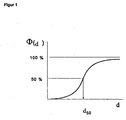
- the d 50 value is determined from the (relative) cumulative curve of the particle size distribution: the point of intersection of the 50% ordinate value with the cumulative curve immediately gives the desired d 50 value on the abscissa axis. How to understand this will be in FIG. 1 clarified in more detail.
- the polarity of the surface was determined by a contact angle measurement of distilled water. The measurement took place at 23 ° C and 50% r. F. held. By means of a metering syringe, a 1 to 2 mm wide drop of distilled water is applied to the film surface. Since the measurement is time-dependent due to the illumination of the illumination (evaporation), charging or spreading behavior, the needle remains in the drop, so that the drop is carefully enlarged during the measurement and then the contact angle is read off immediately using a goniometer eyepiece (measurement of the progression angle). From 5 measurements the mean value is formed.
- Chips of polyethylene terephthalate containing barium sulfate as a white pigment were dried and fed to the extruder for the base layer (B). Also chips of polyethylene terephthalate containing barium sulfate as a white pigment and an antiblocking agent were dried and fed to the extruder for the two (same) outer layers (A).
- a white, three-layer film with ABA structure and a total thickness of 60 microns was prepared.
- the thickness of the two outer layers was 2 ⁇ m in each case.
- Base layer (B): 100% by weight Polyethylene terephthalate with 20 wt .-% barium sulfate (Blanc fixed XR-HX, Sachtleben chemistry) as a white pigment and an SV value of 800 Covering layer (A), mixture of: 85% by weight Polyethylene terephthalate with 20 wt .-% barium sulfate (Blanc fixed XR-HX, Sachtleben chemistry) as a white pigment and an SV value of 800 15% by weight Masterbatch of 97.5% by weight of polyethylene terephthalate (SV value of 800) and 2.5% by weight of Sylobloc® 44 H (synthetic SiO 2 from Grace, average diameter 2.5 ⁇ m)
- the film was made as in Example 1, but without corona treatment after biaxial stretching.
- a 4.5% by weight solids latex consisting of a copolymer of 60% by weight of methyl methacrylate, 35% by weight of ethyl acrylate and 5% by weight of N-methylolacrylamide and a surfactant was prepared according to the following procedure as a primer coating the C-layer of the polyester film applied:
- the elongated film was corona treated (8 kW / m) and then coated by reverse gravure coating on the C layer with the above-described latex.
- the biaxially stretched film was heat-set at 230 ° C.
- the dry weight of the coating was about 0.035 g / m at a coating thickness of about 40 nm.
- the properties of the film are as in Example 1.
- the contact angle to water was 63.8 °.
- the film was tested for its reprographic adhesion and gave good adhesion.
- Two samples of the monosheet coated film thus prepared were placed in a vacuum lab coater, such that one was coated with the coated one and the other with the uncoated side.
- the vacuum chamber was evacuated to below 10 torr, and from a tungsten filament, about 500 ANG of aluminum was vapor deposited on both the uncoated side and the coated sample.
- each sample was tested for "metal debris".
- a cotton fleece with the same number of strokes and approximately the same pressure was rubbed lightly over the metal surface on each sample tested.
- the "abrasion behavior" of the coated side of the film was rated as good.
- the film was made as in Example 1, but without corona treatment after biaxial stretching.
- the elongated film was coated by reverse gravure coating with the copolyester dispersion described above.
- the dry weight of the coating was about 0.040 g / m at a coating thickness of about 0.05 ⁇ m.
- the contact angle to water was 49.8 °:
- an aqueous polyvinyl acetal solution (S-Lec KX-1, manufactured by Sekisui Chemical Co., Ltd., hereinafter referred to as KX-1) was applied to the coated film and dried.
- the coating solution had a concentration of 8% by weight and was applied with a Baker type applicator with a layer thickness of 127 ⁇ m.
- the coated film was immediately placed in an oven for drying at 100 ° C for 4 minutes.
- a black square (area: 12 x 12 cm) was printed on the surface of the dried KX-1 coating with an ink-jet printer (BJC-600J, Canon Inc.) and held at 23 ° C and 50% relative for 12 hours Air humidity dried under air.
- An adhesive tape (cello-tape, Nichiban Inc. width: 18 mm) was glued to the printed surface and peeled off quickly. The degree of the printed surface separated with the adhesive tape was visually determined.
- the coated film showed good adhesion properties.
- a film as in Example 1 was prepared, but without corona treatment.
- the contact angle to water was 65.5 ° and the adhesion to metal was poor.
Landscapes
- Physics & Mathematics (AREA)
- Engineering & Computer Science (AREA)
- General Physics & Mathematics (AREA)
- Chemical & Material Sciences (AREA)
- Materials Engineering (AREA)
- Spectroscopy & Molecular Physics (AREA)
- Theoretical Computer Science (AREA)
- Laminated Bodies (AREA)
Claims (21)
- Feuille polyester blanche, co-extrudée et orientée de manière biaxiale, qui présente une couche de base (B) et au moins une couche superficielle (A) ; dans laquellea) la couche de base (B) contient du sulfate de baryum en une concentration de 5,0 à 25,0 % en poids (par rapport au poids de la couche de base (B)) en tant que pigment colorant blanc unique etb) la couche superficielle (A) contient du sulfate de baryum en une concentration de 5,0 à 25,0 % en poids en tant que pigment colorant blanc unique et présente de manière supplémentaire 0,01 à 4 % en poids d'un agent anti-adhérent avec un diamètre moyen (valeur d50) dans la plage de 2,0 à 8,0 µm (données en % en poids par rapport au poids de la couche superficielle (A)) etc) au moins une des deux surfaces de feuille est apprêtée de manière à favoriser l'adhérence.
- Feuille polyester selon la revendication 1, caractérisée en ce que le pigment colorant blanc est un sulfate de baryum précipité.
- Feuille polyester selon la revendication 1 ou 2, caractérisée en ce que l'agent anti-adhérent présent dans la couche superficielle (A) est un pigment qui ne colore pas en blanc.
- Feuille polyester selon l'une quelconque des revendications 1 à 3, caractérisée en ce que l'agent anti-adhérent présent dans la couche superficielle (A) est du dioxyde de silicium.
- Feuille polyester selon l'une quelconque des revendications 1 à 4, caractérisée en ce que la couche de base (B) est constituée pour au moins 80 % en poids d'un polyester thermoplastique.
- Feuille polyester selon l'une quelconque des revendications 1 à 5, caractérisée en ce que le polyester thermoplastique de la couche de base (B) présente des unités constituées d'éthylèneglycol et d'acide téréphtalique et/ou des unités constituées d'éthylèneglycol et d'acide naphtaline-2,6-dicarboxylique.
- Feuille polyester selon l'une quelconque des revendications 1 à 6, caractérisée en ce que le polyester thermoplastique de la couche de base (B) est du polyéthylènetéréphtalate.
- Feuille polyester selon l'une quelconque des revendications 1 à 7, caractérisée en ce que le polyester thermoplastique de la couche de base (B) et le polyester thermoplastique de la couche superficielle (A) sont identiques.
- Feuille polyester selon l'une quelconque des revendications 1 à 8, caractérisée en ce que la feuille polyester possède une structure de couche ABC, dans laquelle les couches superficielles (A) et (C) sont identiques ou différentes.
- Feuille polyester selon l'une quelconque des revendications 1 à 9, caractérisée en ce que la feuille polyester possède une structure de couche ABA.
- Feuille polyester selon l'une quelconque des revendications 1 à 10, caractérisée en ce que la couche superficielle (A) de la feuille présente une rugosité moyenne de 40 à 150 nm.
- Feuille polyester selon l'une quelconque des revendications 1 à 11, caractérisée en ce que la valeur d'abrasion de la couche superficielle (A) contre la couche superficielle (A) est inférieure ou égale à 0,4.
- Feuille polyester selon l'une quelconque des revendications 1 à 12, caractérisée en ce que le degré de blanc de la feuille est supérieur à 70 selon Berger.
- Feuille polyester selon l'une quelconque des revendications 1 à 13, caractérisée en ce que la surface, apprêtée de manière à favoriser l'adhérence, de la feuille est traitée par traitement Corona.
- Feuille polyester selon l'une quelconque des revendications 1 à 14, caractérisée en ce que la surface de feuille apprêtée de manière à favoriser l'adhérence supporte une couche de favorisation d'adhérence.
- Feuille polyester selon la revendication 15, caractérisée en ce que la couche de favorisation d'adhérence contient un copolyester.
- Feuille polyester selon la revendication 15, caractérisée en ce que la feuille de favorisation d'adhérence est un revêtement d'acrylate.
- Feuille polyester selon la revendication 15, caractérisée en ce que la couche de favorisation d'adhérence est un revêtement hydrophile.
- Feuille polyester selon l'une quelconque des revendications 1 à 18, caractérisée en ce que la surface de feuille apprêtée de manière à favoriser l'adhérence présente un angle de contact par rapport à l'eau inférieur ou égal à 64°.
- Procédé de fabrication d'une feuille polyester selon l'une quelconque des revendications 1 à 19, comprenant les étapes consistant à :a) fabriquer une feuille multicouche par coextrusion et moulage de la masse fondue pour donner des films fondus plats,b) étirer la feuille de manière biaxiale,c) traiter au moins une surface de feuille par traitement Corona ou flamme et/ou recouvrir la feuille d'un revêtement hydrosoluble, favorisant l'adhérence avant, pendant ou après l'étirage biaxial de la feuille etd) thermofixer la feuille étirée.
- Utilisation d'une feuille polyester selon l'une quelconque des revendications 1 à 19 sous forme de matériau d'emballage pour des produits alimentaires et denrées de luxe, sous forme d'étiquette, sous forme de carte, et pour la technologie médicale.
Applications Claiming Priority (1)
| Application Number | Priority Date | Filing Date | Title |
|---|---|---|---|
| DE200610024323 DE102006024323A1 (de) | 2006-05-24 | 2006-05-24 | Mehrschichtige haftvermittelnde, weiße biaxial orientierte Polyesterfolie |
Publications (2)
| Publication Number | Publication Date |
|---|---|
| EP1859933A1 EP1859933A1 (fr) | 2007-11-28 |
| EP1859933B1 true EP1859933B1 (fr) | 2010-01-06 |
Family
ID=38189008
Family Applications (1)
| Application Number | Title | Priority Date | Filing Date |
|---|---|---|---|
| EP20070009662 Ceased EP1859933B1 (fr) | 2006-05-24 | 2007-05-15 | Film multicouche blanc ameliorant l'adherence |
Country Status (2)
| Country | Link |
|---|---|
| EP (1) | EP1859933B1 (fr) |
| DE (2) | DE102006024323A1 (fr) |
Cited By (1)
| Publication number | Priority date | Publication date | Assignee | Title |
|---|---|---|---|---|
| US12503615B2 (en) | 2022-04-18 | 2025-12-23 | Xerox Corporation | White aqueous inkjet ink |
Families Citing this family (1)
| Publication number | Priority date | Publication date | Assignee | Title |
|---|---|---|---|---|
| DE102008056870A1 (de) * | 2008-11-12 | 2010-05-20 | Mitsubishi Polyester Film Gmbh | Mehrschichtige, weiße, biaxial orientierte Polyesterfolie mit metallisch glänzender Deckschicht |
Family Cites Families (2)
| Publication number | Priority date | Publication date | Assignee | Title |
|---|---|---|---|---|
| DE10007729A1 (de) * | 2000-02-19 | 2001-08-23 | Mitsubishi Polyester Film Gmbh | Weiße, siegelfähige, UV-stabilisierte und flammhemmend ausgerüstete, biaxial orientierte Polyesterfolie, Verfahren zu ihrer Herstellung und ihre Verwendung |
| DE10026166A1 (de) * | 2000-05-26 | 2001-11-29 | Mitsubishi Polyester Film Gmbh | Weiße, pigmentierte, hochglänzende Polyesterfolie enthaltend Cycloolefincopolymer (COC), Verfahren zu ihrer Herstellung und ihre Verwendung |
-
2006
- 2006-05-24 DE DE200610024323 patent/DE102006024323A1/de not_active Withdrawn
-
2007
- 2007-05-15 DE DE200750002526 patent/DE502007002526D1/de active Active
- 2007-05-15 EP EP20070009662 patent/EP1859933B1/fr not_active Ceased
Cited By (1)
| Publication number | Priority date | Publication date | Assignee | Title |
|---|---|---|---|---|
| US12503615B2 (en) | 2022-04-18 | 2025-12-23 | Xerox Corporation | White aqueous inkjet ink |
Also Published As
| Publication number | Publication date |
|---|---|
| DE502007002526D1 (de) | 2010-02-25 |
| EP1859933A1 (fr) | 2007-11-28 |
| DE102006024323A1 (de) | 2007-11-29 |
Similar Documents
| Publication | Publication Date | Title |
|---|---|---|
| EP0976548B1 (fr) | Feuille polyester coextrudée mate, son procédé de fabrication et son utilisation | |
| EP1842663B1 (fr) | Film multicouche blanc | |
| EP1442876B1 (fr) | Feuille en polyester biaxialement orientée présentant une surface mate et des propriétés de rétraction caractéristiques, son procédé de fabrication et utilisation | |
| EP1309651B1 (fr) | Feuille polyester opaque comprenant un copolymere cycloolefinique (coc), ayant une bonne adherence de surface, son procede de realisation et son utilisation | |
| EP1529798A1 (fr) | Film thermoscellable et pelable en polyester à adhésivité améliorée, procédé pour sa préparation et son usage | |
| EP1457319B1 (fr) | Feuille multicouche et transparente en polyester biaxialement orientée, son procédé de fabrication et utilisation | |
| EP1380414A1 (fr) | Feuille polyester multicouche, transparente, scellable à chaud et orientée biaxialement, ainsi que son procédé de fabrication et son utilisation | |
| EP1806225A1 (fr) | Feuille de polyester multicouches, blanche, biaxialement étirée | |
| EP1410904B1 (fr) | Film de polyester stratifié orienté biaxialement, méthode pour sa production et son utilisation | |
| EP1900515B1 (fr) | Feuille de polyester blanche, mate sur un côté, orientée de manière biaxiale, son procédé de fabrication et d'utilisation | |
| EP1777249B1 (fr) | Utilisation d'un film de polyester à orientation biaxiale ayant une couche primaire pour machines d'impression numériques | |
| EP3613592A1 (fr) | Feuille de polyester à revêtement | |
| EP1410905B1 (fr) | Film de polyester stratifié orienté biaxialement, méthode pour sa production et son utilisation | |
| EP1442875B1 (fr) | Feuille en polyester biaxialement orientée présentant une surface mate, son procédé de fabrication et utilisation | |
| EP1902839B1 (fr) | Feuille de polyester blanche, mate sur une face, scellable, biaxialement étirée | |
| EP1859933B1 (fr) | Film multicouche blanc ameliorant l'adherence | |
| EP3569646A1 (fr) | Feuille blanche en polyester orientée biaxialement à coefficient de friction élevé | |
| EP1900775B1 (fr) | Feuille de polyester pelable à base de polyester catalysé au titane | |
| DE102007051241A1 (de) | Mehrschichtige, weiß-opake, einseitig matte, biaxial orientierte Polyesterfolie | |
| DE102005058915A1 (de) | Mehrschichtige, haftvermittelnde, weiße, biaxial orientierte Polyesterfolie | |
| EP2740597B1 (fr) | Feuille de polyester blanche, orientée de manière biaxiale, mate sur un côté au moins et stable aux intempéries, son procédé de fabrication et son utilisation | |
| EP1916096B1 (fr) | Feuille de polyester pouvant être estampée à chaud | |
| DE102005058916A1 (de) | Weiße und zumindest einseitig matte, biaxial orientierte Polyesterfolie | |
| DE10035322A1 (de) | Opake Polyesterfolie enthaltend Cycloolefincopolymer (COC) mit hohem Weißgrad, guter Oberflächenhaftung, Verfahren zu ihrer Herstellung und ihre Verwendung | |
| DE102005058917A1 (de) | Mehrschichtige, weiße, biaxial orientierte Polyesterfolie |
Legal Events
| Date | Code | Title | Description |
|---|---|---|---|
| PUAI | Public reference made under article 153(3) epc to a published international application that has entered the european phase |
Free format text: ORIGINAL CODE: 0009012 |
|
| AK | Designated contracting states |
Kind code of ref document: A1 Designated state(s): AT BE BG CH CY CZ DE DK EE ES FI FR GB GR HU IE IS IT LI LT LU LV MC MT NL PL PT RO SE SI SK TR |
|
| AX | Request for extension of the european patent |
Extension state: AL BA HR MK YU |
|
| 17P | Request for examination filed |
Effective date: 20080528 |
|
| 17Q | First examination report despatched |
Effective date: 20080630 |
|
| AKX | Designation fees paid |
Designated state(s): AT BE BG CH CY CZ DE DK EE ES FI FR GB GR HU IE IS IT LI LT LU LV MC MT NL PL PT RO SE SI SK TR |
|
| GRAP | Despatch of communication of intention to grant a patent |
Free format text: ORIGINAL CODE: EPIDOSNIGR1 |
|
| GRAS | Grant fee paid |
Free format text: ORIGINAL CODE: EPIDOSNIGR3 |
|
| GRAA | (expected) grant |
Free format text: ORIGINAL CODE: 0009210 |
|
| AK | Designated contracting states |
Kind code of ref document: B1 Designated state(s): DE FR GB LU |
|
| REG | Reference to a national code |
Ref country code: GB Ref legal event code: FG4D Free format text: NOT ENGLISH |
|
| REF | Corresponds to: |
Ref document number: 502007002526 Country of ref document: DE Date of ref document: 20100225 Kind code of ref document: P |
|
| REG | Reference to a national code |
Ref country code: DE Ref legal event code: R096 Ref document number: 502007002526 Country of ref document: DE Effective date: 20100225 |
|
| PLBE | No opposition filed within time limit |
Free format text: ORIGINAL CODE: 0009261 |
|
| STAA | Information on the status of an ep patent application or granted ep patent |
Free format text: STATUS: NO OPPOSITION FILED WITHIN TIME LIMIT |
|
| 26N | No opposition filed |
Effective date: 20101007 |
|
| REG | Reference to a national code |
Ref country code: DE Ref legal event code: R097 Ref document number: 502007002526 Country of ref document: DE Effective date: 20101007 |
|
| REG | Reference to a national code |
Ref country code: FR Ref legal event code: PLFP Year of fee payment: 10 |
|
| REG | Reference to a national code |
Ref country code: FR Ref legal event code: PLFP Year of fee payment: 11 |
|
| REG | Reference to a national code |
Ref country code: FR Ref legal event code: PLFP Year of fee payment: 12 |
|
| P01 | Opt-out of the competence of the unified patent court (upc) registered |
Effective date: 20230515 |
|
| PGFP | Annual fee paid to national office [announced via postgrant information from national office to epo] |
Ref country code: LU Payment date: 20240527 Year of fee payment: 18 |
|
| PGFP | Annual fee paid to national office [announced via postgrant information from national office to epo] |
Ref country code: GB Payment date: 20240529 Year of fee payment: 18 |
|
| PGFP | Annual fee paid to national office [announced via postgrant information from national office to epo] |
Ref country code: FR Payment date: 20240529 Year of fee payment: 18 |
|
| PGFP | Annual fee paid to national office [announced via postgrant information from national office to epo] |
Ref country code: DE Payment date: 20240730 Year of fee payment: 18 |
|
| REG | Reference to a national code |
Ref country code: DE Ref legal event code: R119 Ref document number: 502007002526 Country of ref document: DE |
|
| PG25 | Lapsed in a contracting state [announced via postgrant information from national office to epo] |
Ref country code: LU Free format text: LAPSE BECAUSE OF NON-PAYMENT OF DUE FEES Effective date: 20250515 |
|
| GBPC | Gb: european patent ceased through non-payment of renewal fee |
Effective date: 20250515 |
|
| PG25 | Lapsed in a contracting state [announced via postgrant information from national office to epo] |
Ref country code: GB Free format text: LAPSE BECAUSE OF NON-PAYMENT OF DUE FEES Effective date: 20250515 |
|
| PG25 | Lapsed in a contracting state [announced via postgrant information from national office to epo] |
Ref country code: DE Free format text: LAPSE BECAUSE OF NON-PAYMENT OF DUE FEES Effective date: 20251202 |
|
| PG25 | Lapsed in a contracting state [announced via postgrant information from national office to epo] |
Ref country code: FR Free format text: LAPSE BECAUSE OF NON-PAYMENT OF DUE FEES Effective date: 20250531 |