EP1860585A1 - Verfahren, Darstellungsvorrichtung und mobile Vorrichtung zur Verhinderung von unbefugtem Zugriff auf digitale Inhalte - Google Patents
Verfahren, Darstellungsvorrichtung und mobile Vorrichtung zur Verhinderung von unbefugtem Zugriff auf digitale Inhalte Download PDFInfo
- Publication number
- EP1860585A1 EP1860585A1 EP06010263A EP06010263A EP1860585A1 EP 1860585 A1 EP1860585 A1 EP 1860585A1 EP 06010263 A EP06010263 A EP 06010263A EP 06010263 A EP06010263 A EP 06010263A EP 1860585 A1 EP1860585 A1 EP 1860585A1
- Authority
- EP
- European Patent Office
- Prior art keywords
- mobile device
- rendering
- license
- rendering device
- content
- Prior art date
- Legal status (The legal status is an assumption and is not a legal conclusion. Google has not performed a legal analysis and makes no representation as to the accuracy of the status listed.)
- Ceased
Links
Images
Classifications
-
- G—PHYSICS
- G06—COMPUTING OR CALCULATING; COUNTING
- G06F—ELECTRIC DIGITAL DATA PROCESSING
- G06F21/00—Security arrangements for protecting computers, components thereof, programs or data against unauthorised activity
- G06F21/10—Protecting distributed programs or content, e.g. vending or licensing of copyrighted material ; Digital rights management [DRM]
Definitions
- the present invention relates to a method, a rendering device and a mobile device for preventing unauthorized use of digital content.
- DRM Digital Rights Management
- CCS Content Scrambeling System
- This system for example in combination with Region Coding, allows the limitation of the use of content to a predefined area.
- the known DRM solutions restrict the fair use of content, which in particular is the creation of compilations or full quality reproductions for the use as safe copies, in the car or for children.
- rendering devices such as computers, which would in general be capable of displaying content, would not be able to render content protected by CSS.
- the problem to be solved by the present invention is hence to provide a solution, wherein both the right of the copyright owner and the right of the authorized user are observed in a reliable fashion.
- the present invention is based on the finding that this problem can be solved by providing a system wherein the user's position is being considered when determining, whether the use of the content is to be allowed.
- a rendering device receives protected digital content and initiates a connection for communication to at least one mobile device in the proximity of the rendering device for requesting information from the mobile device.
- the rendering device can be any device for displaying, presenting, playing-back or otherwise making the digital content available to a user.
- the rendering device can for example be a DVD-player, a CD-player, a computer or suchlike devices.
- the digital content may comprise pictures, movies, music and/or programs.
- the content can be received at the rendering device by providing a physical media such as a DVD or over a connection to a content source.
- the protected content may also for example be downloaded from a remote server on the Internet.
- the protection of the content can be realized in different ways.
- the content may for example be encrypted with an encryption key which makes rendering without the decryption key impossible at any time and/or the content may be bound to a license which allows rendering at preset time conditions or state conditions. Licenses with time conditions may for example allow rendering only until a preset date is reached, whereas licenses with state conditions may for example allow rendering only for a preset amount of times.
- the connection which is initialized or established by the rendering device may be a wireless connection, wherein the standard for information transfer over the connection may be for example a NFC, Bluetooth, WLAN, Zigbee.
- the connection may be established over any short range radio channel which the rendering device can use to contact the mobile device, in particular a SIM card inside a mobile phone.
- Infrared connections may be used.
- the mobile device to be contacted by the rendering device may be known to the rendering device by an initial registration step, wherein the rendering device generates a request to the user to swipe his mobile device so that the rendering device can establish a more permanent connection with the mobile device, in particular a hardware token such as a SIM card of a mobile phone.
- a connection between the rendering device and the mobile device via cable is covered by the present invention.
- the mobile device with which the rendering device tries to establish connection, can be any mobile device, which is capable of communicating with the rendering device. ln particular the mobile device will preferably be a mobile phone, a PDA, a laptop or suchlike devices.
- the level of security against misuse and fraud can be increased.
- the usage of a separate mobile device also provides the possibility to use information in the protection of the digital content which would not be available at the rendering device, but which can be obtained by the mobile device. Since the connection is in addition established to a mobile device in the proximity of the rendering device, additional security features can be realized. In particular the rendering of the content can only be carried out if a mobile device associated to an authorized user is close to the rendering device.
- Any request for information from the rendering device to the mobile device may include an identification of the content to be rendered. This is particularly preferable, if license information is requested from the rendering device. ln cases where only license parameter values are requested the identification of the content may not be included in the request.
- the license by which the usage of digital content is governed, according to the present invention preferably comprises a key for decrypting encrypted content and a license policy for using the key and or the content.
- the rendering device requests license information from the mobile device.
- license information may be license policies of a license, and/or a key for decrypting the protected content.
- license parameter values can be requested from the mobile device.
- the term license parameter values is hereinafter used for values or data that can be compared to preset parameters in license policies in order to verify the compliance with a license policy.
- the rendering device will request license information according to one embodiment of the method, in that case no license information has to be available at the rendering device, when the protected content is received.
- the rendering device will merely determine that rendering is not possible and will produce a request for respective license information to a mobile device close by.
- the processing power of the rendering device can thus be lower as the verification of a license and license policies may be performed remotely on the mobile device and only a decryption key will be transmitted to the rendering device for decryption.
- the license is already on the rendering device- obtained from the mobile device or in a different way. In that case the verification may be performed on the rendering device and thus the reaction time in accordance with the results of the verification can be minimized.
- the rendering device may request position information of the mobile device from the mobile device. This request will be done implicitly. If a rendering device is not able to establish a communication connection to a predetermined mobile device, the rendering device obtains the information that the mobile device is not within the proximity of the rendering device. The range of proximity is determined by the sort of communication connection used. With the information that a mobile device is not within the proximity of the rendering device license policies, which require the presence of a user, can be enforced.
- Location information in particular relates to geographical location information. This information can be obtained by identifying the cell that a mobile device is registered in, in a cellular network, or by using a positioning system, such as GPS. With this information also license policies that only allow the usage in a specific territory, e.g. country, can be verified and enforced.
- authentication information of the user can be requested by the rendering device from the mobile device.
- the authentication may be done by the use of a token, in particular a hardware token such as a SIM card of a mobile phone.
- the authentication can comprise biometric authentication, wherein for example the fingerprint of the user is checked at the mobile device.
- biometric authentication such as a PIN (personal identification number) or a password can be used. The user will be prompted by the mobile device to enter such identification information.
- PIN personal identification number
- the additional usage of authentication information provides for increased security. With the rendering device possibly checking the availability of a mobile device, its location and the identity of the user fraud can be avoided.
- the rendering device will establish a connection to a mobile device, if the attempt to render content fails. This failure may be due to encryption. In that case the rendering device may not have any information on license policies at the time of the attempted rendering. The rendering device will request this information or the decryption key from the mobile device. It is, however, also possible that the rendering device has license information available. The license associated to the content to be rendered may prescribe that rendering shall only be allowed if a mobile device of the authorized user for the content is close by. In that case the rendering device will initiates the connection to the mobile device in accordance with license information received at the rendering device.
- the rendering device may compare received license information and/or license parameter values to data available on the rendering device.
- the license information and/or license parameter may be received from the mobile device in response to one of the above mentioned requests.
- the data available on the rendering device may be a license that was received together with the content, e.g. on a DVD, or that was previously received from the mobile device.
- license parameter values are received, e.g. the country in which the mobile device is presently located, the rendering device may compare this value against preset license parameters, e.g. the content is only to be rendered in Germany and the UK. This comparison can also be referred to as the verification of the license and the license policy.
- the protected content may be encrypted.
- the rendering device may receive the decryption key from the mobile device and decrypt the content for rendering. ln that case the verification of the license will be carried out on the mobile device. The mobile device will compare actual values against license information and policies and upon verification of the license will transfer the key to the rendering device.
- the initiation of a connection to the mobile device and requesting of information from the mobile device is preferably performed before the rendering of the content. It is, however, also possible to also perform these steps during the rendering of the content.
- the requesting of information from the mobile device can be carried out during the rendering of the content. This enables the rendering device and/or the mobile device to monitor the conditions during the rendering and thereby increases the level of security, as the license requirements have to be maintained during the rendering.
- the mobile device receives a request for license parameter values, in particular position information, from the rendering device, obtains the license parameter values, in particular position information, and transfers the obtained values to the rendering device.
- the license parameter value may be obtained from a positioning system such as GPS.
- the rendering device performs the verification of the license, which includes policies relating to the position of the mobile device.
- the mobile device receives a request for license information from the rendering device, compares license information stored on the mobile device with the request and transfers the license information to the rendering device. ln this case the mobile device receives the license from a license source and may store it on the mobile device. Upon receipt of the request, the mobile device will screen the stored information to identify if a license for the content to be rendered is available and will transfer the respective information to the rendering device. It may be provided that the mobile device transfers the license as a whole to the rendering device. In that case further rendering of the content on other rendering devices will not be possible, as the license would be removed from the mobile device. It is, however, also possible to for the mobile device to only transfer the decryption key to the rendering device. In that case further rendering actions may be performed simultaneously.
- a rendering device for rendering digital content comprises a communication unit for establishing bi-directional communication connection to a mobile device.
- the rendering device comprises a communication unit for establishing bi-directional communication connection to a mobile device.
- some known rendering devices are provided with a communication unit for receiving content, e.g. via a cable plugged into the rendering device, these rendering devices do in general not allow for a bi-directional communication.
- the content in the prior art is being pushed onto the rendering device.
- the inventive rendering device and the bi-directional communication connection to a mobile device information can be requested from the mobile device. In particular information which is necessary to render protected digital content can be requested from and received at the rendering device.
- the rendering device comprises a security unit for processing license information.
- a security unit for processing license information.
- the provision of such a security unit enables the rendering device for example to identify any information that is necessary for the rendering of the content.
- the security unit may identify values that are necessary for the verification of license policies. The thus identified values may be requested from the mobile device.
- the rendering device may comprise a comparison unit for comparing license parameter values with license parameters.
- the license parameter values may be received from the mobile device.
- the rendering device will be able to verify license policies that require license parameters to be within specific value ranges. These value ranges may for example be country lists.
- the rendering device may comprise a decryption unit for decrypting protected content.
- the decryption will preferably be carried out with a decryption key received from the mobile device or made usable by verification of license requirements on the rendering device.
- a mobile device for use in combination with a rendering device for rendering protected digital content.
- the mobile device is characterized in that it comprises a processing unit for processing requests from the rendering device.
- the mobile device can interact with the rendering device rather than merely push content to the rendering device.
- the processing of the request from the rendering device in the processing unit may comprise the identification of values or information to be obtained and initializing respective actions. For example a display prompting the user to enter a PIN or to provide a finger print may be generated. Also information relating to the geographical location can be obtained by the processing unit. This can be realized by reading values from storage in the mobile phone or by obtaining these values using a positioning system.
- the mobile device comprises a storage unit for storing license information relating to digital content.
- the mobile device can serve for several rendering devices to verify and/or provide a license for the respective content.
- the mobile device comprises a token for authentication of a user of digital content.
- This token can for example be a SIM card.
- the SIM card can serve as an authentication for the use of digital content for that specific user.
- the mobile device may further comprise a comparator unit for comparing parameter values with license parameters.
- a comparator unit for comparing parameter values with license parameters.
- the mobile device will be able to verify the compliance with license policies. In that case the mobile device will only transfer the verification result to the rendering device. If the license could be verified, the mobile device may transfer for example a decryption key to the rendering device for decryption of the content.
- the described units of the rendering device and the mobile device may be realised in physical units or as programs.
- the present invention it is possible to include new usage rules in licenses protecting digital content.
- the user presence may be enforced, wherein this enforcement may be based on physical tokens or other identification means such as a PIN and biometrics.
- the user's location may be used as a content usage rule within the policy of a license.
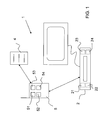
- FIG 1 a setup for the inventive method is shown. ln this setup or system 1 a rendering device, in this case a DVD-player 2, is connected to a TV 3. Also another rendering device in the form of a stereo system 4 is shown.
- the DVD player 2 and the stereo system 4 as rendering devices may at least temporarily have a communication connection to a mobile device, which is depicted in Figure 1 as a mobile phone 5.
- the communication connection to the mobile phone 5 may for example be a connection via Infrared, NFC, Zigbee or Bluetooth.
- the mobile phone 5 to be contacted by the DVD player 2 may be known to the DVD player 2 by an initial registration step, wherein the DVD player 2 generates a request to the user to swipe his mobile phone 5 so that the DVD player 2 can establish a more permanent connection with the mobile phone 5.
- the connection between the DVD player 2 and the mobile phone 5 may also be established via a cable.
- the DVD player 2 comprises a communication unit 21 for establishing bi-directional communication connection to the mobile phone 5. Furthermore a security unit 22 for processing license information, a comparison unit 23 for comparing license parameter values with license parameters and a decryption unit 24 for decrypting protected content are shown as parts of the DVD-player 2.
- the mobile phone 5 comprises a processing unit 51 for processing requests from the DVD player 2 a storage unit 52 for storing license information relating to digital content, a token 53, in the form of a SIM card, for authentication of a user of digital content and a comparator unit 54 for comparing parameter values with license parameters.
- a user may purchase digital content which is protected.
- the purchase may be done by buying a physical media, such as a DVD, or by connecting the DVD player to the Internet and downloading the digital content. ln either case the digital content will be protected, in order to ensure fair usage thereof.
- This protection is in general realised by a license, which assigns the right to use of the content to a specific user and/or specific conditions and enforces the fair usage by encryption of the content.
- Some content can be released in a geographic area and is not intended to be used elsewhere. Common examples for this are movies. A movie may be released in the USA six month before it is released in Europe. Sometimes in addition to this geographic requirement a content provider may want to implement a rule, where the user is only allowed to play his purchased content on any device, provided he is present in the proximity of the device at the time of actual rendering.
- the DVD player 2 will try to render the content, e.g. play-back the movie.
- the DVD player 2 will require the Rights to render or play the content.
- the DVD player 2 obtains the Rights or license to play the content including the parameters determining under which conditions the content can be played.
- This license can be obtained by purchasing and delivering the license to the DVD player over the internet.
- the bearer used is not crucial.
- the license may also be delivered to the DVD player via the physical media, i.e. the DVD.
- the license may be send to the mobile phone, for example via SMS.
- the license may remain on the mobile phone or, upon request from the DVD player, may be transferred to the DVD player.
- the DVD player recognizes that content shall be played. If no license to render the content is available on the DVD player or a license with special license policies exists on the DVD player or on the medium, i.e. DVD, the DVD will perform prescribed steps.
- the license comprises presence parameters as part of the Rights to play the content. These presence parameters will preferably specify the user, who is authorized to use the content.
- the DVD player will start to try and discover mobile devices, in particular mobile phones, within its proximity. If a communication with the mobile phone can be established, the DVD player will confirm that the mobile phone is associated to the particular user, who purchased the license for the content to be rendered. This confirmation can be done by the DVD player invoking the mobile phone to obtain a user identity, which is required to allow the content to be rendered.
- the identity could be represented by a MSISDN, IMSI or a DRM specific identifier for the user. Such information may be available on the mobile phone on the SIM card, which acts as a token.
- the discovery and connection to the mobile device can be done by using Bluetooth, NFC or similar connection standards.
- the mobile phone may have an identification of the DVD stored, so that such a connection will be allowed. It is, however, also possible to request authentication at the DVD player.
- the DVD player will repeat at pre-defined intervals the presence of the mobile phone containing the correct SIM, for example by reading the IMSI of the SIM.
- the license parameters extend to not only check the user identifier but also request additional authentication information such as biometric data (e.g. fingerprint or a PIN/password), the DVD player will interact with an application on the mobile phone or SIM card that handles the interaction with the user to fetch the requested additional information.
- biometric data e.g. fingerprint or a PIN/password
- the license further comprises user location parameters as part of the Rights to play the content, the following routines will be followed.
- the DVD player will also start to try and discover mobile devices, in particular mobile phones, within its proximity. If a communication with the mobile phone can be established, the DVD player will confirm that the mobile phone is associated to the particular user, who purchased the license for the content to be rendered. This confirmation can be done by the DVD player invoking the mobile phone to obtain a user identity required to allow the content to be rendered.
- the DVD player When the phone is found, the DVD player will invoke the phone to obtain location information.
- Location information may comprise country, home zone, aluid, cell lD or SIM originating country. This location information can for example be obtained by GPS at the mobile phone. It is, however, also possible, that the location information is obtained by using a RFID-tag to indicate the current location. The information will be transferred to the DVD player and subsequently the rendering device will verify the conditions to allow or not allow rendering of the content.
- the mobile phone performs all the Rights or license verification.
- the decryption key will only be forwarded to the DVD player, if the correct conditions are fulfilled.
- the DVD player obtains encrypted content, e.g. downloaded over broadband or on a physical media such as a DVD.
- the DVD player will also start to try and discover another device associated with a particular user in its proximity.
- the phone either has the necessary license stored already or obtains the license or Rights to play the content including the parameters determining under what conditions the content can be played.
- This license or those Rights can be purchased and delivered to the mobile phone over Internet regardless of the bearer used or alternatively send to the mobile phone using SMS.
- the mobile phone checks the user identity required to allow the content to be rendered.
- the present invention provides a combination of a mobile presence / location system with a Digital Rights Management system, wherein the licence can include presence parameters to be fulfilled before a device can render content and possibly continue the user's presence/location monitoring whilst rendering the content.
- the parameters used are in particular a geographical location from a broad accuracy range, e.g. per country or to a GPS location, biometric authentication (template verification) of a real person, checking the availability of a hardware token associated with the user whilst rendering the content, e.g. a SIM and/or a person being enforced by the system to reveal some secret only the user knows, e.g. a PIN.
- the DRM can be performed on the rendering device and/or a mobile device such as a mobile phone.
Landscapes
- Engineering & Computer Science (AREA)
- Software Systems (AREA)
- Theoretical Computer Science (AREA)
- Multimedia (AREA)
- Technology Law (AREA)
- Computer Hardware Design (AREA)
- Computer Security & Cryptography (AREA)
- Physics & Mathematics (AREA)
- General Engineering & Computer Science (AREA)
- General Physics & Mathematics (AREA)
- Storage Device Security (AREA)
- Management, Administration, Business Operations System, And Electronic Commerce (AREA)
Priority Applications (1)
| Application Number | Priority Date | Filing Date | Title |
|---|---|---|---|
| EP06010263A EP1860585A1 (de) | 2006-05-18 | 2006-05-18 | Verfahren, Darstellungsvorrichtung und mobile Vorrichtung zur Verhinderung von unbefugtem Zugriff auf digitale Inhalte |
Applications Claiming Priority (1)
| Application Number | Priority Date | Filing Date | Title |
|---|---|---|---|
| EP06010263A EP1860585A1 (de) | 2006-05-18 | 2006-05-18 | Verfahren, Darstellungsvorrichtung und mobile Vorrichtung zur Verhinderung von unbefugtem Zugriff auf digitale Inhalte |
Publications (1)
| Publication Number | Publication Date |
|---|---|
| EP1860585A1 true EP1860585A1 (de) | 2007-11-28 |
Family
ID=37635857
Family Applications (1)
| Application Number | Title | Priority Date | Filing Date |
|---|---|---|---|
| EP06010263A Ceased EP1860585A1 (de) | 2006-05-18 | 2006-05-18 | Verfahren, Darstellungsvorrichtung und mobile Vorrichtung zur Verhinderung von unbefugtem Zugriff auf digitale Inhalte |
Country Status (1)
| Country | Link |
|---|---|
| EP (1) | EP1860585A1 (de) |
Citations (7)
| Publication number | Priority date | Publication date | Assignee | Title |
|---|---|---|---|---|
| US20030018491A1 (en) * | 2001-07-17 | 2003-01-23 | Tohru Nakahara | Content usage device and network system, and license information acquisition method |
| US20030167392A1 (en) * | 2000-06-16 | 2003-09-04 | Fransdonk Robert W. | Method and system to secure content for distribution via a network |
| WO2003092264A1 (en) * | 2002-04-26 | 2003-11-06 | Koninklijke Philips Electronics N.V. | Security modules for conditional access with restrictions |
| US20030226012A1 (en) | 2002-05-30 | 2003-12-04 | N. Asokan | System and method for dynamically enforcing digital rights management rules |
| EP1526432A2 (de) * | 2003-10-22 | 2005-04-27 | Samsung Electronics Co., Ltd. | Verfahren und Vorrichtung für das Handhaben der digitalen Rechte mit portabler Speichervorrichtung |
| US20050234735A1 (en) | 2003-11-26 | 2005-10-20 | Williams Jim C | Digital rights management using proximity testing |
| WO2006048804A1 (en) | 2004-11-01 | 2006-05-11 | Koninklijke Philips Electronics N.V. | Improved access to domain |
-
2006
- 2006-05-18 EP EP06010263A patent/EP1860585A1/de not_active Ceased
Patent Citations (7)
| Publication number | Priority date | Publication date | Assignee | Title |
|---|---|---|---|---|
| US20030167392A1 (en) * | 2000-06-16 | 2003-09-04 | Fransdonk Robert W. | Method and system to secure content for distribution via a network |
| US20030018491A1 (en) * | 2001-07-17 | 2003-01-23 | Tohru Nakahara | Content usage device and network system, and license information acquisition method |
| WO2003092264A1 (en) * | 2002-04-26 | 2003-11-06 | Koninklijke Philips Electronics N.V. | Security modules for conditional access with restrictions |
| US20030226012A1 (en) | 2002-05-30 | 2003-12-04 | N. Asokan | System and method for dynamically enforcing digital rights management rules |
| EP1526432A2 (de) * | 2003-10-22 | 2005-04-27 | Samsung Electronics Co., Ltd. | Verfahren und Vorrichtung für das Handhaben der digitalen Rechte mit portabler Speichervorrichtung |
| US20050234735A1 (en) | 2003-11-26 | 2005-10-20 | Williams Jim C | Digital rights management using proximity testing |
| WO2006048804A1 (en) | 2004-11-01 | 2006-05-11 | Koninklijke Philips Electronics N.V. | Improved access to domain |
Similar Documents
| Publication | Publication Date | Title |
|---|---|---|
| KR101086574B1 (ko) | 위치 기반 라이센싱 | |
| JP4981921B2 (ja) | 移動ディジタル著作権管理ネットワークにおけるライセンス作成のための方法および装置 | |
| US20040266395A1 (en) | Process for securing a mobile terminal and applications of the process for executing applications requiring a high degree of security | |
| CN101682501B (zh) | 用于执行认证协议的方法和便携式存储设备 | |
| CN100483296C (zh) | 数字权限管理系统的数字权限管理单元 | |
| CN113132404B (zh) | 身份认证方法、终端及存储介质 | |
| JP4095051B2 (ja) | 自動所有権認証が可能なホームネットワーク装置と、ホームネットワークシステム及びその方法 | |
| US20100250389A1 (en) | Method, system, license server for providing a license to a user for accessing a protected content on a user device and software module | |
| KR20130022846A (ko) | 클라우드 환경에서 nfc를 이용한 콘텐츠 공유 시스템 및 방법 | |
| JP2005080315A (ja) | サービスを提供するためのシステムおよび方法 | |
| KR101033337B1 (ko) | 단말기 사용자의 본인확인을 강화한 보안 인증방법 | |
| JP4999936B2 (ja) | 移動電話の近距離無線通信モジュールにおける少なくとも1の機能の実行を制御するための方法と装置 | |
| KR20070050712A (ko) | Srm의 디지털 저작권 관리 방법 및 장치 | |
| JP2004062870A (ja) | データ配信システム | |
| CN103390122B (zh) | 应用程序发送方法、应用程序运行方法、服务器和终端 | |
| US20040172369A1 (en) | Method and arrangement in a database | |
| CN107145769A (zh) | 一种数字版权管理drm方法、设备及系统 | |
| KR20050006159A (ko) | 데이터 분배 시스템 | |
| CN110770800A (zh) | 用于授予访问权限的方法 | |
| KR101066693B1 (ko) | 전자 인증서의 보안 및 확인 방법 | |
| KR101212510B1 (ko) | 위치기반의 서비스 보안 시스템 및 그 방법 | |
| EP1842136A1 (de) | Verfahren und vorrichtung zum verkauf gebrauchter inhalte | |
| KR20120058199A (ko) | 위치정보를 이용한 사용자 인증방법 | |
| CN100412743C (zh) | 用于数字权限管理的方法和装置 | |
| EP1860586A1 (de) | Methode und Verwaltungseinheit zum Verwalten der Benutzung von Digitalen Inhalten, Anzeigevorrichtung |
Legal Events
| Date | Code | Title | Description |
|---|---|---|---|
| PUAI | Public reference made under article 153(3) epc to a published international application that has entered the european phase |
Free format text: ORIGINAL CODE: 0009012 |
|
| AK | Designated contracting states |
Kind code of ref document: A1 Designated state(s): AT BE BG CH CY CZ DE DK EE ES FI FR GB GR HU IE IS IT LI LT LU LV MC NL PL PT RO SE SI SK TR |
|
| AX | Request for extension of the european patent |
Extension state: AL BA HR MK YU |
|
| 17P | Request for examination filed |
Effective date: 20080129 |
|
| 17Q | First examination report despatched |
Effective date: 20080228 |
|
| AKX | Designation fees paid |
Designated state(s): AT BE BG CH CY CZ DE DK EE ES FI FR GB GR HU IE IS IT LI LT LU LV MC NL PL PT RO SE SI SK TR |
|
| STAA | Information on the status of an ep patent application or granted ep patent |
Free format text: STATUS: THE APPLICATION HAS BEEN REFUSED |
|
| 18R | Application refused |
Effective date: 20120306 |