EP1860616A1 - Système de surveillance et administration d'une installation de parking - Google Patents
Système de surveillance et administration d'une installation de parking Download PDFInfo
- Publication number
- EP1860616A1 EP1860616A1 EP06010512A EP06010512A EP1860616A1 EP 1860616 A1 EP1860616 A1 EP 1860616A1 EP 06010512 A EP06010512 A EP 06010512A EP 06010512 A EP06010512 A EP 06010512A EP 1860616 A1 EP1860616 A1 EP 1860616A1
- Authority
- EP
- European Patent Office
- Prior art keywords
- vehicle
- unit
- parking
- facility
- registration
- Prior art date
- Legal status (The legal status is an assumption and is not a legal conclusion. Google has not performed a legal analysis and makes no representation as to the accuracy of the status listed.)
- Withdrawn
Links
- 238000012544 monitoring process Methods 0.000 title claims abstract description 14
- 238000010200 validation analysis Methods 0.000 claims abstract description 112
- 238000004891 communication Methods 0.000 claims abstract description 70
- 238000007689 inspection Methods 0.000 claims abstract description 15
- 230000005540 biological transmission Effects 0.000 claims abstract description 5
- 239000000446 fuel Substances 0.000 claims description 13
- 238000012546 transfer Methods 0.000 claims description 11
- 238000001514 detection method Methods 0.000 claims description 7
- 235000013305 food Nutrition 0.000 claims description 7
- 238000013475 authorization Methods 0.000 description 15
- 238000000034 method Methods 0.000 description 11
- 230000009471 action Effects 0.000 description 8
- 238000007726 management method Methods 0.000 description 8
- 230000008901 benefit Effects 0.000 description 4
- 230000005855 radiation Effects 0.000 description 4
- 238000013459 approach Methods 0.000 description 3
- 230000000694 effects Effects 0.000 description 3
- 230000003203 everyday effect Effects 0.000 description 3
- 230000003993 interaction Effects 0.000 description 3
- 230000003287 optical effect Effects 0.000 description 3
- 230000001413 cellular effect Effects 0.000 description 2
- 239000002283 diesel fuel Substances 0.000 description 2
- 230000001976 improved effect Effects 0.000 description 2
- 230000001939 inductive effect Effects 0.000 description 2
- 238000012545 processing Methods 0.000 description 2
- 230000003213 activating effect Effects 0.000 description 1
- 230000004888 barrier function Effects 0.000 description 1
- 235000009508 confectionery Nutrition 0.000 description 1
- 230000002708 enhancing effect Effects 0.000 description 1
- 230000006872 improvement Effects 0.000 description 1
- 230000000977 initiatory effect Effects 0.000 description 1
- 230000004807 localization Effects 0.000 description 1
- 230000007774 longterm Effects 0.000 description 1
- 238000012423 maintenance Methods 0.000 description 1
- 238000005259 measurement Methods 0.000 description 1
- 230000011664 signaling Effects 0.000 description 1
- 230000036962 time dependent Effects 0.000 description 1
- 230000000007 visual effect Effects 0.000 description 1
Images



Classifications
-
- G—PHYSICS
- G07—CHECKING-DEVICES
- G07B—TICKET-ISSUING APPARATUS; FARE-REGISTERING APPARATUS; FRANKING APPARATUS
- G07B15/00—Arrangements or apparatus for collecting fares, tolls or entrance fees at one or more control points
- G07B15/02—Arrangements or apparatus for collecting fares, tolls or entrance fees at one or more control points taking into account a variable factor such as distance or time, e.g. for passenger transport, parking systems or car rental systems
-
- G—PHYSICS
- G07—CHECKING-DEVICES
- G07C—TIME OR ATTENDANCE REGISTERS; REGISTERING OR INDICATING THE WORKING OF MACHINES; GENERATING RANDOM NUMBERS; VOTING OR LOTTERY APPARATUS; ARRANGEMENTS, SYSTEMS OR APPARATUS FOR CHECKING NOT PROVIDED FOR ELSEWHERE
- G07C1/00—Registering, indicating or recording the time of events or elapsed time, e.g. time-recorders for work people
- G07C1/30—Parking meters
Definitions
- the invention relates to a system for monitoring and administration of a parking facility, wherein said parking facility comprises one or more parking spaces and at least one entrance.
- the invention also relates to a validation unit system for monitoring and administration of access to one or more service facilities.
- Systems for managing parking facilities are known in a multitude of varieties, ranging from systems, where vehicles are admitted free of charge, but where certain limits such as time limitations must be observed, over systems, where only certain vehicles are allowed access, e.g. vehicles of residents, to systems involving payment for the parking and where numerous systems are provided for facilitating such payments, including e.g. systems involving the payment of a specific amount allowing a predefined parking time, and systems, where a parking ticket is given to the user of a vehicle upon entering the parking facility and where the user pays for the lapsed parking time when leaving the parking facility, etc. Also systems involving the use of credit cards for payment and mobile telephone account payments are known.
- WO 94/07206 A1 discloses an electronic parking management method and apparatus for a restricted access area having an entrance and an exit, at each of which a base transceiver is located.
- the base transceiver can communicate with a plurality of vehicle borne transponders and a management computer.
- data is interchanged between the two units, e.g. a unique code identifying the parking facility is transmitted to the vehicle borne transponder and a unique code identifying the vehicle is transmitted to the base transceiver.
- the number of parking credits, which the transponder has available for the specific parking facility is transmitted to the base transceiver.
- the base transceiver determines whether the transponder contains a sufficient number of parking credits, and if this is the case, the base transceiver transmits information of the current date and time to the transponder, and further the entrance gate is opened.
- information packets are exchanged, including the vehicle identification code, the elapsed time since arrival, a request for a total parking fee calculated by the transponder, etc.
- the exit base transceiver transmits a signal releasing the vehicle through the exit gate, e.g. lifting the gate. Further, the central management computer is updated in order to accurately reflect which vehicles remain in the parking facility.
- a customer may purchase additional parking credits from the manager of the parking facility, which additional parking credits may be programmed into the transponder via the central management computer.
- this prior art system allows for the directing of a vehicle to specific parking spaces, e.g. short/long term parking spaces or available parking spaces, by means of information provided by the central management computer and displayed on a visual display on the transponder.
- the system may perform a polling by means of the entrance and exit base transceivers and possibly by means of additional transceivers in order to update the central computer's inventory record of vehicles in the parking facility and in order to determine if any vehicles have depleted their internally store parking credit account. If this is the case, a signal may be transmitted to facility attendants in order for these to take appropriate action. However, no further information is given as to the action taken by these attendants.
- this prior art system allows the management of a parking facility to be performed in an automatic manner.
- this prior art system requires that the entrances and the exits are provided with gates that has to be opened and closed, controlled by a central computer.
- a prior art system requires such equipment to be installed and therefore it also requires maintenance of such mechanically operated equipment to be performed, e.g. at regular intervals and/or when damaged and/or malfunctioning.
- such a prior art system has the drawback that if a vehicle enters the entrance area without a transponder system corresponding to the system used by the specific parking facility, for example if the vehicle operator is of the impression that the parking facility is a common payment parking facility, the vehicle is not allowed to enter the parking facility and may thus be required to leave the area, which may cause disturbances to other customers and dissatisfaction to the vehicle operator in question. Similar problems arise if a vehicle is trying to leave the parking facility after a period of time superseding the time allowed by the parking credits contained in its transponder. In such a case the entrance gate will not be released, again creating disturbances to other customers and presumably requiring action to be taken by parking attendants.
- this prior art system has the drawback that if a vehicle is parked for longer than the parking credits stored in its transponder allows, it may be difficult and time-consuming to locate the vehicle, even if the system has alerted facility attendants, since these have no or little information as to which vehicle is concerned and no information as to where the vehicle in question is parked.
- US 2002/0084915 A1 discloses a parking facility system, which according to a particular embodiment utilizes smart cards for use authorization.
- the smart card can function as a prepaid credit card that can be used until depleted, with the option of purchasing additional credits, or as a debit card which automatically deducts funds from an account when it is used.
- the smart cards can be produced with a predetermined value, which cards can be purchased by the users and discarded when depleted.
- the card may contain information such as a user identification and level of parking privilege authorization.
- the parking facility may comprise different parking areas, e.g. with different levels of security, a VIP parking areas etc., and by means of the information contained in the smart card the user may gain access to the specific area(s), which the user is allowed to enter.
- the user gains access to the parking facility by interfacing the smart card with a system processor via a user interface located at the entrance to the specific parking area, e.g. a level I or a level II parking area and corresponding user interface.
- the user interface comprises an input device in the form of a magnetic strip reader, a card reader, a keyboard, a keypad, a bar code scanner a touch screen or the like and the user interface may also comprise an output device in the form of a display, a printer etc.
- the parking facility usage can be debited from the smart card.
- this prior art system requires that the user enters the smart card in a reader or the like situated at the entrance in order to gain access, and it is obvious that the parking facility is equipped with gate facilities, i.e. facilities hindering a vehicle in entering the facility if the user has not been authorized, i.e. by means of a valid smart card.
- this prior art system has the drawback that a wireless authorization and administration is not provided and that the system requires gates to be used thereby leading to the drawbacks associated with such gates.
- CA 2 507 611 A1 A method for managing parking spaces using electronic parking tickets is described in CA 2 507 611 A1 .
- the electronic parking ticket containing a transponder can be purchased at a terminal in a conventional manner, e.g. by inserting coins or by debiting a payment card at the terminal, and the issued ticket will bear the authorized parking time limit, corresponding to the payment.
- the electronic parking ticket takes the place of a conventional parking ticket and the user thus places the electronic parking ticket behind the windshield of the vehicle.
- a parking enforcement officer can check the parked vehicle by means of a portable reader, which can read the information carried by the electronic parking ticket through the windshield by means of radio signals. Thus, the integrity, authenticity and validity of the parking ticket can be verified.
- the portable reader has functions for printing out fines or for sending parking data to a remote dedicated server over a mobile telephone network.
- this method for managing parking spaces is not related to an automated monitoring and administration of a parking facility, and further, the method is not related to restricted access parking facilities, but to pay parking spaces, e.g. individual parking spaces, in particular on-road parking spaces.
- WO 02/01485 A1 describes a travel related smart card system including a smart card payment processing facility for automated payments of fares, tolls and parking fees.
- the smart card comprises a contactless interface for communicating by means of radio-frequency signals with payment processors, including parking fee processors.
- payment processors including parking fee processors.
- parking systems as such and the administration or monitoring hereof is not described in this prior art document.
- the invention relates to a system for monitoring and administration of a parking facility, wherein said parking facility comprises one or more parking spaces and at least one entrance, and wherein said system comprises
- a vehicle being equipped with a validation unit can validly and in an authorized manner, but in spite hereof in a quick and efficient manner, gain access to the parking facility when communication has taken place between the validation unit and the registration transceiver comprised in the registration unit located at the entrance, where said communication can comprise the transmittal of data borne by the validation unit, e.g. an identity code, and possibly the identity of the parking facility, the time of arrival and/or other type of information.
- the communication takes place while the vehicle is in the vicinity of the registration transceiver, possibly while the vehicle is slowly passing the registration unit.
- a user may enter the parking facility in a relatively quick and effortless manner, i.e.
- a vehicle that is provided with a validation unit in accordance with the invention, can enter the facility in a manner not giving rise to the transmittal of an alert signal to e.g. a parking attendant, and thus not giving rise to any administrative additional work, for example manual operation on the part of the e.g. parking attendant, and further providing the user with parking space and service in an efficient and in particular cost-efficient manner as also explained above.
- the system according to the invention may find use in connection with a wide variety of parking facilities, e.g. not only in connection with payment parking facilities, but also in connection with other types of parking facilities.
- the system may be used in connection with a parking facility that may be used free of charge, but where limitations are put on the use, for example the parking time.
- data such as the identity of the vehicle, the entrance time, etc are registered. If the vehicle is not registered as having left the parking facility within the prescribed tile limit, e.g. two hours, an alert signal is transmitted to the e.g.
- a parking attendant for example to a cellular phone, a pager, a portable inspection unit or another receiver in the possession of the parking attendant, who then takes action as described above, e.g. by locating the vehicle and issuing a parking fine etc.
- the administration of such a parking facility is also made more efficient in comparison with prior art systems that mostly rely on parking attendants that must check that the parking restrictions are not violated.
- prior art systems require a substantial amount of manpower, if the parking facility has to be checked continuously or regularly, whereas in accordance with the invention, the amount of manpower can be reduced to a minimum while still achieving that substantially all vehicles that violate the parking restrictions, are given a fine.
- the wireless communication may take place using techniques that are readily available and according to different protocols, etc., using for example electromagnetic communication, e.g. radio frequency radiation (rf), infrared communication (IR), ultraviolet radiation (UV) etc. which will be apparent to a person skilled in the art.
- electromagnetic communication e.g. radio frequency radiation (rf), infrared communication (IR), ultraviolet radiation (UV) etc. which will be apparent to a person skilled in the art.
- said validation unit may comprise an electronic chip, for example comprised in an electronic ticket, a smart card or the like,
- the validation unit may be provided using a readily available technique and possibly the validation unit may be one or a number of different e.g. smart cards that have been issued by other operators and already used by customers for other applications than parking transactions, Furthermore, the validation unit may function as a prepaid credit card that can be used until depleted, with the option of purchasing additional credits, or as a debit card which automatically deducts funds from an account when it is used. Still further, the validation units in the form of e.g. smart cards can be produced with a predetermined value, which cards can be purchased by the users and discarded when depleted.
- said system may comprise a control system, said control system comprising means for storing and/or retransmitting of information relating to said at least one validation unit allocated to a vehicle, and wherein said control system further comprises means for performing a time registration, such as registering a time of arrival, a time of departure and/or lapsed time.
- the payment for usage of the parking facility can take place in a time dependent manner, e.g. whereby the payment can be taken care of when the vehicle leaves the parking facility where the exit will be registered by a registration unit, which may register the time of departure and/or the lapsed time.
- the actual payment may be performed in a number of varieties, for example if the validation unit is a prepaid card, the actual parking fee can be deducted from the sum, or if the validation unit is related to a debit or credit card, the parking fee can be paid in a conventional manner, e.g. by performing a transaction via the control system and a transmission channel to e.g. the credit card operator.
- said predefined criteria may relate to at least one of the detection of a validation unit, the detection of a predefined parameter for said validation unit and the non-detection of a validation unit.
- the registration unit detects that a validation unit is present in a passing vehicle, the vehicle is determined as being a vehicle that is allowed to use the facility. Further, it may be predefined that at least one parameter read from the validation unit must fulfil a certain criterion, for example that an identity code is recognized by the system, that a parking credit sum is present and supersedes a certain value and/or that the lapsed time supersedes a parking time limitation.
- an alert signal may immediately be transmitted in the prescribed manner, where after a parking attendant can take care of the matter.
- the system may be adapted for e.g. cancelling an alert signal or transmitting a new signal to the parking attendant that he/she need not take action, if a vehicle that has given rise to an alert signal, is registered as leaving the parking facility again within a predetermined short period, e.g. five minutes.
- a vehicle may have entered the facility due to a fault and when the driver becomes aware of this, the parking facility is left immediately.
- the parking attendant need not take any action, e.g, try to locate the vehicle, and thereby the efficiency of the system is enhanced.
- said at least one entrance of said parking facility may comprise a registration unit for registering vehicles entering the parking facility and a registration unit for registering vehicles leaving the parking facility.
- the system may comprise designated registration units, for example placed at designated entrances and designated exits or placed at one and the same gateway to a parking facility, but at different locations, e.g. at each side of the gateway in order to detect only entering and leaving vehicles, respectively.
- the registration units may be designated for performing different jobs, or they may be similar or even identical, in which case the system may be configured for detecting whether a vehicle is entering or leaving the system, e.g. for example by storing the registrations and processing these.
- said parking facility may comprise at least one entrance and at least one exit, each comprising a registration unit.
- said entrance and/or said exit of said parking facility may be freely passable.
- said entrance and/or said exit of said parking facility may comprise sensor means for sensing the presence of an object such as a vehicle, said sensor means preferably being integrated with said registration unit.
- the registration unit e.g. registration transceiver may be configured for initiating a communication only when it is detected by the sensor means that a vehicle is present in the predetermined location, which location may for example be an area corresponding to the length of a standard vehicle or a larger area, e.g. an area corresponding to a standard length and/or width plus a predetermined percentage of a standard length and/or width in order to allow for larger vehicles, vehicles with a trailer, vehicles which approach the drive-in at an awkward position, e.g. near the far side of the entrance, etc.
- the registration unit may be optimized as regards power consumption and that errors caused by for example false detection of e.g.
- the sensor system may be designed for not only activating the communication system, but also for providing measurements of the passing vehicles, for example the length of the vehicle, which may be used for deciding the parking fee, if length is a deciding parameter, and/or for indicating a suitable parking place in case the parking facility comprises means for directing a vehicle to a suitable free parking place and if the parking facility comprises parking places of different lengths and/or heights for accommodating differently sized vehicles.
- the sensor means may in addition be used for detecting the direction, in which a vehicle is moving, e.g. whether a vehicle is entering or leaving a parking facility.
- the sensor units may for example optical sensors, but sensors operating by other means may be used as well, e.g. by acoustic, inductive, capacitive, infrared techniques or the like or by a combination of these.
- said portable receiver unit may be a portable inspection unit, which is adapted for facilitating communication with said validation unit allocated to a vehicle.
- a parking attendant which has been alerted of a passing vehicle which has not fulfilled the predetermined criteria, may in a relatively simple manner identify such a vehicle, for example a vehicle that is not equipped with an appropriate validation unit
- the attendant may determine whether a vehicle is equipped with a validation unit, for example by pointing the inspection unit towards e.g. the windshield of a car, in which case the inspection unit may indicate whether or not a validation unit is present.
- the inspection unit may be configured for communicating with a validation unit, for example controlled by the parking attendant, in order to establish whether or not a specific validation unit fulfils criteria such as a suitable amount of parking credit etc.
- the actual localization of a vehicle may be performed efficiently in case the parking facility comprises means for directing a vehicle to a specific parking space or for monitoring the parking space, in which case such information may be transmitted to the parking attendant, for example with the alert signal.
- the portable unit may preferably be designed for communicating with the validation unit in a manner corresponding to the manner, in which the wireless communication between the registration unit and the validation unit takes place at the entrance and/or the exit.
- other manners of performing this communication are possible, as it will be apparent to a skilled person.
- said portable inspection unit may comprise means for registering data relating to a specific vehicle, such as for example a picture, the time of occurrence, vehicle registration number and/or the like.
- such data may be registered and/or transmitted to e.g. a central control system for use as documentation of a parking offence etc. in addition to data that have been read from the validation unit.
- the portable registration unit may be readily adapted for printing out e.g. parking fines etc. as well.
- said portable inspection unit may comprise means for transmitting data relating to a specific vehicle to e.g. a central communication unit, either directly or indirectly.
- data regarding a vehicle that has entered the parking facility without e.g. a validation unit or data regarding a vehicle which is equipped with a validation unit but which erroneously has not been registered as such may be transmitted to the e.g. central control system for e.g. corrective action or the like.
- said at least one validation unit allocated to a vehicle m ay be accommodated by an adapter placed in the vehicle, said adapter comprising a validation unit reader and possibly antenna means placed on the exterior of the vehicle.
- a validation unit may be detected and read by the registration unit with a very large degree of certainty as compared to a validation unit which has been placed inside a vehicle behind the windshield, or worse, at another location in the vehicle, where communication by means of e.g. radio signals is restricted.
- the reliability of the system may be enhanced in this manner.
- options may be provided for using different validation units, e.g. different smart cards, electronic tickets, etc. for example designed for different applications, etc.
- such an adapter may comprise interface facilities such as a display, a keypad or the like, acoustical means for providing e.g. messages to the user etc. which will enhance the optional advantages of this embodiment, as it will be explained in further detail below.
- said at least one validation unit allocated to a vehicle may be adapted for facilitating a transfer of data with at least one service facility transceiver, said transfer of data being performed in order to gain access to a service facility.
- a user which is in possession of a validation unit, e.g, a smart card in accordance with the invention, may use such a validation unit not only for gaining access to a parking facility, e.g. payment parking facility, but also for acquiring other types of services in particular services, which are naturally related to the activity of driving a vehicle or the like.
- a validation unit in accordance with the invention, the user may quickly and efficiently gain access to other services, that may be services requiring payment, authorization and/or may be services in dependence of other types of restriction. Since the validation unit in accordance with the invention already provides an authorization, such authorization may also be made valid for other service providers, e.g.
- said transfer of data with at least one service facility transceiver may involve and/or may be complemented with a user key code, for example a key code provided via input means such as a keypad.
- an enhanced security can be achieved, which is of particular importance when economical transactions, e.g. payments, are comprised in the interaction, since an e.g. personal code key, e.g. a PIN code or the like must be inputted by the user, before the authorization is completed and the service in question is released.
- a personal code key e.g. a PIN code or the like must be inputted by the user, before the authorization is completed and the service in question is released.
- the service facility is a petrol station
- a vehicle comprising a validation unit approaching the petrol station, will when passing a service facility transceiver initiate a communication between the validation unit and the service facility transceiver, which, if it is completed successfully, will result in that the validation unit is recognized as a unit giving access to the service.
- a key code has to be communicated to the service facility transceiver as well, which may be performed by having the user manipulate a keyboard, keypad or the like on the service facility transceiver, on a chosen petrol stand or the like, in which case the code is processed by the system in order to give the final validation and authorization.
- the key code may be inputted via a keypad on a validation unit adapter or the like placed in the vehicle, which transmits the code to the e.g. service facility transceiver, possibly in encrypted form to enhance the security.
- a plurality of users may each have a validation unit and have corresponding key codes.
- the users may also share one and the same validation unit, e.g. smart card dedicated to a specific vehicle, but the users may have different, personal key codes, in which case the security is enhanced, e.g. abuse can be avoided, and the individually consumed services can be allocated to the persons responsible here fore.
- said service facility may be at least one of
- a user which is in possession of a validation unit, e.g. a smart card in accordance with the invention, may use such a validation unit for gaining access to one or more service facilities representing in particular services, which are naturally related to the activity of driving a vehicle or the like.
- a validation unit e.g. a smart card in accordance with the invention
- the user may quickly and efficiently gain access to such services that may be services requiring payment, authorization and/or may be services in dependence of other types of restriction.
- an authorization may be provided, which may be valid for a number of service providers, e.g. private or public service provider companies that are given or purchase an agreement with a system provider to participate in the system operational facilities.
- payments for such services may be taken care of in the above-described manner, thereby further alleviating e.g. everyday procedures and matters for drivers etc.
- said transfer of data with at least one service facility transceiver may involve and/or may be complemented with a user key code, for example a key code provided via input means such as a keypad.
- an enhanced security can be achieved, which is of particular importance when economical transactions, e.g. payments, are comprised in the interaction, since an e.g. personal code key, e.g. a PIN code or the like must be inputted by the user before the authorization is completed and the service in question is released.
- a personal code key e.g. a PIN code or the like
- the service facility is a petrol station
- a vehicle comprising a validation unit and approaching the petrol station will, when passing a service facility transceiver initiate a communication between the validation unit and the service facility transceiver, which, if it is completed successfully, will result in that the validation unit is recognized as a unit giving access to the service.
- a key code has to be communicated to the service facility transceiver as well, which may be performed by having the user manipulate a keyboard, keypad or the like on the service facility transceiver, on e.g. a chosen petrol stand or the like, in which case the code is processed by the system in order to give the final validation and authorization.
- the key code may be inputted via a keypad on a validation unit adapter or the like placed in the vehicle, which transmits the code to the e.g, service facility transceiver, possibly in encrypted form to enhance the security.
- said service facility may be at least one of
- Fig. 1 illustrates a car park, a parking lot, a multi-storey car park 1 or the like with a plurality of parking spaces 10 for motorized vehicles 2.
- the car park may have one or more shar ed entrance and exit facilities 20 as well as one or more separate entrance facilities 30 and/or exits facilities 40.
- the car park comprises a parking system for registering a vehicle 2 when it is entering and leaving the car park 1, by means of one or more entrance registration units 50 and one or more exit registration units 60, placed at the entrances and exits of the car park 1.
- the shared entrance and exit facility 20 comprises a separate entrance registration unit 50 and a separate exit registration unit 60, each placed at a position where the registration of a passing vehicle 2 may take place in an optimal manner.
- the entrance and exit registration units may be integrated in one and the same e.g. housing, that they may share components etc. and that such a combined unit may be placed at a suitable location, allowing the unit to monitor entering as well as leaving vehicles.
- each vehicle 2 has a validation unit in the form of e.g. an electronic parking ticket or a label, containing a chip (not shown in fig 1), placed for example behind the windshield or the like of the vehicle 2.
- the chip of such a validation unit is adapted for containing data concerning for example expiry date (day, week, month, quarter, year), total available parking time and/or value, registration data (e.g.
- chip number the registration number of the car, customer number, or the like
- whether the ticket is a permanent pass or if the paying should be done per time unit or the like and/or other data, including data such as information, concerning which parking spaces the chip gives access to (one parking space, a number of parking spaces, all of the parking spaces, or the like).
- the registration units 50, 60 each contain a chip reader for wirelessly reading data stored in the chip.
- the registration units 50, 60 further contain means for sending and/ or receiving data from a central unit (not shown in fig. 1), a portable unit (not shown in fig. 1) or the like.
- a central unit not shown in fig. 1
- a portable unit not shown in fig. 1
- the wireless communication may take place using techniques that are readily available and according to different protocols, etc., using for example electromagnetic communication, e.g. radio frequency radiation (rf), infrared communication (IR), ultraviolet radiation (UV) etc. which will be apparent to a person skilled in the art.
- the parking system is used in a very big parking lot, in a multi-storey car park with a plurality of floors or in other parking facilities comprising a number of sections, it may be difficult to find a specific vehicle, e.g. a vehicle without an electronic parking ticket. Therefore, according to a further embodiment of the invention, it is possible to place a registration unit at one or more entrances at a new floor, at one or more entrances to a new area in a big parking lot or the like, or in other words, at passageways between adjacent sections.
- These registration units only have to contain means for registering whether or not the vehicle passing contains a valid electronic parking ticket, and means to send information to e.g. a central unit, if the vehicle does not have a valid ticket. This provides the possibility of making a more effective search for a vehicle without a (valid) parking ticket.
- Fig. 2 illustrates, corresponding to fig. 1, a car park, parking lot, multi-storey car park 1 or the like, where the earlier mentioned registration units in accordance with a modified embodiment are divided into a sensor units 52 and 62, respectively, and communication units 54 and 64, respectively.
- the sensor units 52 and 62 may in this embodiment of the invention be optical sensors, but in other embodiments of the invention the sensing of a vehicle may be done by acoustically, inductively, capacitively, infrared sensing means or the like or by a combination of these.
- the sensor units 52 and 62 perform the task of checking if there is a vehicle present.
- the communication unit 54, 64 is communicating with the electronic parking ticket placed in the vehicle (not shown in fig. 2), by means of electromagnetic waves, radio frequency waves, infrared signals or the like.
- the communication unit 54 at the entrance is transmitting a signal to a portable unit, a central unit, a mobile phone, a pager or the like (not shown in fig 2), which is described further below. Thereby it is possible for the user of the portable unit, the pager or the mobile phone, to know if an unauthorized vehicle has entered the car park. If a vehicle 2 without an electronic parking ticket is leaving the parking facility within e.g. three minutes, five minutes, or the like, the communication unit at the exit 64 is sending a signal telling that a car without an electronic parking ticket has left the park.
- the system according to the invention may find use in connection with a wide variety of parking facilities, e.g. not only in connection with payment parking facilities, but also in connection with other types of parking facilities.
- the system may be used in connection with a parking facility 1 that may be used free of charge, but where limitations are put on the use, for example the parking time.
- a vehicle 2 comprising a validation unit in accordance with the invention enters the parking facility, data such as the identity of the vehicle, the entrance time, etc are registered. If the vehicle is not registered as having left the parking facility within the prescribed tile limit, e.g. two hours, an alert signal is transmitted to the e.g. parking attendant, for example to a cellular phone, a pager, a portable inspection unit or another receiver in the possession of the parking attendant, who then takes action, e.g. by locating the vehicle and issuing a parking fine etc.
- Fig. 3a illustrates a vehicle 2 with a validation unit, e.g. an electronic parking ticket 90 placed behind the windshield.
- the parking ticket may be a smart card, a small chip or the like, which in this particular embodiment of the invention may comprise the option of getting "refilled” when it is empty, but in another embodiment of the invention the parking ticket 90 may be discarded when empty.
- the refilling of the ticket 90 could be done on the internet or automatically, as well as in a gas station, a kiosk, individually on a PC, or the like.
- the registration unit 50 may according to this embodiment be divided into two units, a sensor unit 52 and a communication unit 54, respectively, giving a two step detecting.
- the sensor unit 52 detects whether or not a vehicle is present, and if there is a vehicle present, the sensor unit 52 at the entrance communicates with the communication unit at the entrance 54, telling the communication unit 54 to seek for a parking ticket 90.
- the communication unit thereby sends a signal looking for an electronic parking ticket, and if there is a parking ticket present, the communication unit 54 receives data from the electronic parking ticket,
- the parking ticket 90 can be powered by the power supply in the vehicle, it can be powered by the signal from the communication unit 54, or it can be powered by other means that are generally known to a person skilled in the art.
- the registration unit 50 comprises the possibility of communicating with means for determination of the dimensions of the vehicle, e.g. the length and/or height of the vehicle, whereby it is possible to determine which parking spaces that are suitable for the vehicle 2. It is possible to place more than one sensor around the vehicle, which could give a more precise and reliable dimension-determination. Further the registration unit may comprise means for controlling a bar, gate or the like.
- the system further has the opportunity of being capable of determining/evaluating how many vehicles 2 that are located in the parking facility 1, giving the possibility of determining the number of free parking spaces 10, the type of free parking spaces, and the like.
- This may be accomplished for example by having a central control system or a system allocated to for example an entrance or an exit registration unit keeping count of the vehicles in the parking facility, e.g. by having a register and adding to the register, when a vehicle enters the parking facility, and by subtracting from the register, when a vehicle leaves the parking facility.
- further features may be used for e.g. keeping a correct register, for example by keeping a register of the identities of the vehicles, e.g. in order to avoid that if by fault an exit has not been correctly registered, this will not lead to that this specific vehicle will be counted as a parked vehicle for en indefinite time.
- the number of available parking spaces may be displayed to the user, for example on a display at the entrance registration unit and/or transmitted to and displayed at e.g. a validation adapter or reader located in a vehicle.
- the sensors 58 may for example be optical sensors, but the sensors may also apply acoustic, inductive, capacitive, infrared sensing means or the like or a combination of these, which will be apparent to a skilled person.
- sensing by means of a vision system including a three dimensional vision system may be applied.
- the communication unit 54 and 64 further comprise a display 56 capable of showing at which floor, area, car park or the like the vehicle should be parked, based on the dimensions of the vehicle, if there is free parking spaces available in the car park suited for the vehicle, customer number, registration number or the like. Further, the display 56 may be capable of visualizing a welcome message based on the customer number, registration number of the vehicle or the like. The display is as well capable of showing other information's relevant to the driver of the vehicle, if the communication unit does not register a parking ticket 90, or the like. The display 56 could also be placed in the registration units 50, 60. The above-described information may also or instead be displayed at a display in the vehicle, for example on an adapter or card reader, which will be described in further detail below.
- Fig 3b illustrates a vehicle 2 passing an entrance facility 50 or exit facility 60, comprising one or more sensors 58, capable of detecting if there is a vehicle 2 present.
- the sensor or sensors 58 are not necessarily placed at the locations illustrated in the figures, but may as well be placed in the ceiling, in the ground or the like, as well as a combination of these.
- the sensors 58 may be placed at different heights, at different locations along the e.g. entrance and/or exit and at different locations in a transverse direction, thereby also providing information, if desired or needed, regarding the length, the height, the width and/or the profile of a specific vehicle.
- Fig. 4 illustrates an example of the communication between different units.
- the communication units 54 and 64 as well as the central unit 106 comprise means for transmitting information to e.g. the parking company, containing for example: The data from the electronic parking ticket 90 (not shown in fig. 4), identification of the possible assigned parking space, arrival and exit times and/or the like.
- the communication unit 54, and/or the central unit 106 is capable of communicating with a mobile phone 100, a pager 102, a portable handheld unit 104, other communication units 64 or a combination of these, whereby it is possible to monitor a plurality of entrances and exits in the car park, and even monitor more than one car park. Not all of the possible communication lines between the units are illustrated by arrows.
- the communication between the portable handheld unit 104 or mobile phone 100, and the parking company could take place in more than one step. For example, first the portable handheld unit 104 or mobile phone 100 sends its data to the central unit 106 or the communication unit 54 or 84, and these units then send the data to the parking company. Another possibility is that the portable handheld unit 104 or mobile phone 100 communicates directly with the parking company.
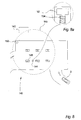
- Fig. 5 illustrates a parking attendant/officer 12 using a hand held portable unit 104, used for detecting an electronic parking ticket 90 in a vehicle 2.
- the handheld portable unit 104 comprise means for communication with the ticket 90, thereby receiving data from the ticket 90.
- the hand held unit 104 comprises means for communicating with a communication unit 54, 64, 74, 84 (not shown in fig. 5), a central unit 106 (not shown in fig. 5) and/or the parking company, whereby it is possible to forward information about a vehicle without a parking ticket, such as: Parking place identification, car park identification, the registration number of the vehicle, type of vehicle, colour of the vehicle, time/date/month/year of observation, identification of the parking officer, number/type of the offence, individual remarks and so on. It is further possible to forward the data received from the parking ticket 90.
- a communication unit 54, 64, 74, 84 not shown in fig. 5
- a central unit 106 not shown in fig. 5
- the parking company whereby it is possible to forward information about a vehicle without a parking ticket, such as: Parking place identification, car park identification, the registration number of the vehicle, type of vehicle, colour of the vehicle, time/date/month/year of observation, identification of the parking officer, number/type of the off
- the portable unit 104 may comprise a digital camera, and the camera is capable of taking pictures that could be forwarded together with other information or data, e.g. in order to provide documentation for an illegal and/or invalid parking, for example a time-stamped picture showing a car and in particular its number plate, parked in a specific parking space.
- the handheld portable unit 104 could be a mobile phone with means for communicating with the ticket 90, as well as it could be a specially designed portable unit.
- Fig. 6 illustrates a system with more than one parking lot 1, a central communication unit 108 and a parking attendant/officer 12 with a portable hand held unit 104.
- the system gives the opportunity of having one or more parking attendants 12 to control more than one parking facility.
- the central communication unit 108 receives communication signals from the communication units (not shown in Fig. 6), the central units (not shown in Fig. 6) or the like, from the more than one parking facility, administers the signals and sends signals to the parking attendant/officer 12, containing information about which parking lot a vehicle has entered without a valid parking ticket.
- the central communication unit 108 controls to which of the attendants/officers the signal is dedicated, e.g. by choosing the attendant/officer nearest to the facility. It is also a possibility that the internal systems in each facility are communicating between each others, so that the central communication unit 108 may not be necessary. Further, it is a possibility that there are no central units (not shown in fig. 6) in the individual parking spaces, but the units in each parking station is communicating directly with the central communication unit 108. The same system could be used in a very big parking lot, a multi-storey car park with a plurality of floors, or the like.
- Fig. 7 illustrates a vehicle 2 with a parking ticket reader or adapter 120.
- the parking ticket reader 120 comprises means for reading data from the parking ticket 90, and for sending this information by request from e.g. a registration unit or a communication unit (not shown in fig. 7).
- the reader 120 could be connected to the radio system and the antenna 130 on the vehicle 2, whereby it is possible to make the system work in a bigger area, caused by the improved communication facilities.
- the reader 120 in other places than the windshield, e.g. in the glove compartment, in the dashboard or the like, while the reader 120 is connected to the antenna.
- the parking system further comprises the possibility of being used in a plurality of other payment systems, e.g. gas stations (described later on), giving the possibility of paying for gas or car wash directly and wireless, payment roads, bridge toll and the like.
- gas stations e.g. gas stations (described later on)
- the reader or adapter 120 further gives the opportunity to have more than one user driving the same vehicle, and each of them having their own parking ticket 90, giving the opportunity of controlling the expenses for each user driving the vehicle 2. Further the reader 120 could be connected to the ignition of the vehicle 2, giving the possibility of only allowing specific users to use the vehicle.
- the reader 120 may as shown comprise a display 124, whereby it is possible to see for example the data stored on the parking ticket 90 (e.g. remaining time units on the parking ticket) and other information received from a plurality of registration means 50, 60, communication means 54, 64, handheld units 104, or the like. Further the reader 120 is capable of containing acoustic means, capable of sending out one or more different sounds, according to different states, received signals, transmitted signals, when a new parking ticket 104 is inserted and validated, or the like.
- the reader 120 is capable of containing a number of keys 122, a touch screen (not shown) or the like for inputting and/or storing data on the card, and/or for making a validation between the ticket 90 and the reader 120, e.g. by making it necessary to enter a code using the keys 122, every time a card 90 is placed in the reader 120. This is giving the benefit of an improved amount of security.
- messages may be provided to users of the system, for example presented to the user via the display 124 on the adapter or reader 120 or via other display means.
- such messages may relate to the number of available parking spaces, a direction to an available parking space, the available parking time available on the electronic ticket or the like, the parking time limitation, in case the parking facility is a free-of-charge parking facility, which messages may be transmitted via e.g. the entrance registration unit, when entering the parking facility.
- Other messages may be received by e.g. the validation unit adapter 120 and shown on a display, which messages may be transmitted from other transmitters such as service facility transmitters.
- a service transmitter may be present which will interact with the validation unit, e.g. 90 in the vehicle, thereby registering that the vehicle is using the validation unit in accordance with the invention.
- service messages may be sent to the validation unit and presented to the user via e.g. the display 124, e.g. a message informing the user that the total parking time is restricted to for example two hours, that the vehicle must leave the premises at the latest at a specified time, etc. Further messages may be provided according to this aspect of the invention.
- Fig. 8 illustrates a gas station 140 comprising a number of gas pumps 146, a car wash 142, a gas administering unit 144, a car wash administering unit 150 and a registration zone 148.
- a vehicle 2 is located in the registration zone 148, and the user of the vehicle is entering a code on the gas administering unit 144 or the car wash administering unit 150, the user is gaining access to usage of either the gas pumps or the car wash, depending on the administering unit used.
- the administering units are capable of containing a display 152, capable of visualising information, messages etc., and a number of keys 154, used for entering a pin code or the like as shown in the enlarged detailed view in fig. 8a.
- This provides the possibility of paying for e.g. gas or car wash directly and wirelessly. It is noted that it is a possibility to gain access to other kinds of products, e.g. windshield wash, slot machines comprising oil, vehicle fuses, candy, sandwiches or the like, by entering a code, as described above. It is further a possibility that there is only one registration unit with means for choosing between the available products in the gas station. The registration units further have the possibility of containing means for refilling the parking ticket 90 with parking credits etc.
- information e.g. messages may also be presented to the user via e.g. the display 124 on a validation unit adapter 120 in the vehicle, for example regarding the type of service facilities that are available at the actual station, regarding e.g. fuel prices, special offers, for example offers available only to holders of a validation unit in accordance with the invention, etc.
- Fig 9 illustrates in a manner corresponding to fig. 8 a gas station 140 comprising a number of gas pumps 146, a car wash 142, a gas administering unit 144, a car wash administering unit 150, entrance registration units 50 and exit registration units 60.
- a vehicle 2 enters the gas station 140, so that when the vehicle 2 has entered the gas station 140, and is validated by the entrance registration unit 50, the driver of the vehicle 2 or the passengers of the vehicle 2 can gain entrance to all the products available in the gas station 140 in a predetermined time interval, and/or until the vehicle 2 is leaving the gas station, as described above.
- the details and functionality which have been explained above in connection with figs.8 and 8a, may also apply to the embodiment presented in fig. 9, for example regarding the key code input means, the message services, etc.
- a user who is in possession of a validation unit, e.g. a smart card in accordance with the invention, may use such a validation unit for gaining access to one or more service facilities, comprising in particular services, which are naturally related to the activity of driving a vehicle or the like as exemplified above.
- a validation unit e.g. a smart card in accordance with the invention
- the user may quickly and efficiently gain access to such services that may be services requiring payment, authorization and/or may be services in dependence of other types of restriction.
- an authorization may be provided, which may be valid for a number of service providers, e.g.
- the transfer of data with a service facility transceiver may involve and/or may be complemented with a user key code, for example a key code provided via input means such as a keypad.
- a user key code for example a key code provided via input means such as a keypad.
- a vehicle comprising a validation unit and approaching the petrol station will, when passing a service facility transceiver initiate a communication between the validation unit and the service facility transceiver, which, if it is completed successfully, will result in that the validation unit is recognized as a unit giving access to the service.
- a key code has to be communicated to the service facility transceiver as well, which may be performed by having the user manipulate a keyboard, keypad or the like on the service facility transceiver, on e.g. a chosen petrol stand or the like, in which case the code is processed by the system in order to give the final validation and authorization,
- the key code may be inputted via a keypad on a validation unit adapter or the like placed in the vehicle, which transmits the code to the e.g. service facility transceiver, possibly in encrypted form to enhance the security.
- the types and numbers of services available to the user are numerous and may for example be fuel/gas service stations, a parking facilities in general, a bridge and/or road payment facilities, toll gates in general, entrances to for example entertainment facilities or the like.
Landscapes
- Physics & Mathematics (AREA)
- General Physics & Mathematics (AREA)
- Business, Economics & Management (AREA)
- Finance (AREA)
- Devices For Checking Fares Or Tickets At Control Points (AREA)
Priority Applications (2)
| Application Number | Priority Date | Filing Date | Title |
|---|---|---|---|
| EP06010512A EP1860616A1 (fr) | 2006-05-22 | 2006-05-22 | Système de surveillance et administration d'une installation de parking |
| PCT/DK2007/000240 WO2007134606A1 (fr) | 2006-05-22 | 2007-05-22 | Système de surveillance et d'administration d'un parking |
Applications Claiming Priority (1)
| Application Number | Priority Date | Filing Date | Title |
|---|---|---|---|
| EP06010512A EP1860616A1 (fr) | 2006-05-22 | 2006-05-22 | Système de surveillance et administration d'une installation de parking |
Publications (1)
| Publication Number | Publication Date |
|---|---|
| EP1860616A1 true EP1860616A1 (fr) | 2007-11-28 |
Family
ID=36997643
Family Applications (1)
| Application Number | Title | Priority Date | Filing Date |
|---|---|---|---|
| EP06010512A Withdrawn EP1860616A1 (fr) | 2006-05-22 | 2006-05-22 | Système de surveillance et administration d'une installation de parking |
Country Status (2)
| Country | Link |
|---|---|
| EP (1) | EP1860616A1 (fr) |
| WO (1) | WO2007134606A1 (fr) |
Cited By (4)
| Publication number | Priority date | Publication date | Assignee | Title |
|---|---|---|---|---|
| WO2015078553A1 (fr) * | 2013-11-29 | 2015-06-04 | Deutsche Telekom Ag | Procédé et système de gestion de zones de trafic payantes |
| CN107944980A (zh) * | 2017-12-25 | 2018-04-20 | 吴东辉 | 共享单车管理方法及系统 |
| WO2021114440A1 (fr) * | 2019-12-09 | 2021-06-17 | 刘健 | Système de base de données de verrou intelligent reposant sur une position d'id unique et la longitude et la latitude de cette dernière |
| US11605294B2 (en) * | 2017-06-15 | 2023-03-14 | Ubipark Pty Ltd | Computer-implemented systems for locating a vehicular parking space and controlling access thereto |
Families Citing this family (4)
| Publication number | Priority date | Publication date | Assignee | Title |
|---|---|---|---|---|
| US11455838B2 (en) | 2016-01-13 | 2022-09-27 | Parkhub, Inc. | System for monitoring arrival of a vehicle at a given location and associated methods |
| US11386780B2 (en) * | 2016-01-13 | 2022-07-12 | Parkhub, Inc. | System for monitoring arrival of a vehicle at a given location and associated methods |
| JP6644621B2 (ja) * | 2016-03-31 | 2020-02-12 | 三菱重工機械システム株式会社 | 駐車管理システムおよび駐車管理方法 |
| DE112017007002T5 (de) * | 2017-03-03 | 2020-01-02 | Ford Global Technologies, Llc | Fahrzeugparkplatzkontrolle |
Citations (4)
| Publication number | Priority date | Publication date | Assignee | Title |
|---|---|---|---|---|
| WO1994007206A1 (fr) * | 1992-09-16 | 1994-03-31 | At/Comm Incorporated | Procede et appareil de gestion electronique de stationnement et de repartition |
| WO1995008162A1 (fr) * | 1993-09-16 | 1995-03-23 | Saab-Scania Combitech Aktiebolag | Dispositif de comptage de taxes pour vehicules |
| WO2003019485A1 (fr) * | 2001-08-31 | 2003-03-06 | John David Bell | Systeme de paiement et de controle electroniques de taxes |
| WO2004055751A1 (fr) * | 2002-12-17 | 2004-07-01 | Gianfranco Zanotti | Systeme automatique de controle et de gestion de l'admission a des places de stationnement |
-
2006
- 2006-05-22 EP EP06010512A patent/EP1860616A1/fr not_active Withdrawn
-
2007
- 2007-05-22 WO PCT/DK2007/000240 patent/WO2007134606A1/fr not_active Ceased
Patent Citations (4)
| Publication number | Priority date | Publication date | Assignee | Title |
|---|---|---|---|---|
| WO1994007206A1 (fr) * | 1992-09-16 | 1994-03-31 | At/Comm Incorporated | Procede et appareil de gestion electronique de stationnement et de repartition |
| WO1995008162A1 (fr) * | 1993-09-16 | 1995-03-23 | Saab-Scania Combitech Aktiebolag | Dispositif de comptage de taxes pour vehicules |
| WO2003019485A1 (fr) * | 2001-08-31 | 2003-03-06 | John David Bell | Systeme de paiement et de controle electroniques de taxes |
| WO2004055751A1 (fr) * | 2002-12-17 | 2004-07-01 | Gianfranco Zanotti | Systeme automatique de controle et de gestion de l'admission a des places de stationnement |
Cited By (4)
| Publication number | Priority date | Publication date | Assignee | Title |
|---|---|---|---|---|
| WO2015078553A1 (fr) * | 2013-11-29 | 2015-06-04 | Deutsche Telekom Ag | Procédé et système de gestion de zones de trafic payantes |
| US11605294B2 (en) * | 2017-06-15 | 2023-03-14 | Ubipark Pty Ltd | Computer-implemented systems for locating a vehicular parking space and controlling access thereto |
| CN107944980A (zh) * | 2017-12-25 | 2018-04-20 | 吴东辉 | 共享单车管理方法及系统 |
| WO2021114440A1 (fr) * | 2019-12-09 | 2021-06-17 | 刘健 | Système de base de données de verrou intelligent reposant sur une position d'id unique et la longitude et la latitude de cette dernière |
Also Published As
| Publication number | Publication date |
|---|---|
| WO2007134606A1 (fr) | 2007-11-29 |
Similar Documents
| Publication | Publication Date | Title |
|---|---|---|
| US12249187B1 (en) | Parking meter system | |
| US6344806B1 (en) | Parking status control system and method | |
| CA2472086C (fr) | Parcometre perfectionne mettant en oeuvre une technique d'identification de l'utilisateur | |
| US10121172B2 (en) | Parking lot monitoring system | |
| US6559776B2 (en) | Parking status control system and method | |
| US7104447B1 (en) | Parking meters, systems and methods of parking enforcement | |
| EP3895089B1 (fr) | Système de stationnement intelligent | |
| US20060212344A1 (en) | Automated parking lot system, method, and computer program product | |
| US20170249625A1 (en) | Dynamic vehicle parking management platform | |
| WO2007134606A1 (fr) | Système de surveillance et d'administration d'un parking | |
| EP2973434B1 (fr) | Système de surveillance pour parc de stationnement | |
| US20040006512A1 (en) | Method of paying for a service | |
| EP0193320A2 (fr) | Dispositif de mesure de temps électronique | |
| WO2007000011A1 (fr) | Systeme d'acces notamment a un systeme de stationnement et procedes associes | |
| WO2015047198A1 (fr) | Système et procédé permettant d'obtenir et d'afficher des informations en temps réel sur une place de stationnement libre | |
| US7722454B2 (en) | Revenue generating system and associated methods | |
| EP3255622A1 (fr) | Équipement électronique de commande et régulation de places de stationnement | |
| JP7256013B2 (ja) | 駐車場管理システム | |
| EP4202870A1 (fr) | Système de paiement de stationnement | |
| JPH0454559Y2 (fr) | ||
| JP2002032801A (ja) | 路上有料駐車用のパーキングメータおよび路上有料駐車監視システム | |
| KR20080020849A (ko) | 차량번호인식과 바코드를 이용한 주차요금 자동정산 시스템및 그 방법. | |
| KR20020047591A (ko) | 무선통신 단말기를 이용한 유료도로의 통행료 징수시스템및 그 방법 | |
| GB2424744A (en) | A system for controlling metered parking |
Legal Events
| Date | Code | Title | Description |
|---|---|---|---|
| PUAI | Public reference made under article 153(3) epc to a published international application that has entered the european phase |
Free format text: ORIGINAL CODE: 0009012 |
|
| AK | Designated contracting states |
Kind code of ref document: A1 Designated state(s): AT BE BG CH CY CZ DE DK EE ES FI FR GB GR HU IE IS IT LI LT LU LV MC NL PL PT RO SE SI SK TR |
|
| AX | Request for extension of the european patent |
Extension state: AL BA HR MK YU |
|
| 17P | Request for examination filed |
Effective date: 20080319 |
|
| 17Q | First examination report despatched |
Effective date: 20080609 |
|
| AKX | Designation fees paid |
Designated state(s): AT BE BG CH CY CZ DE DK EE ES FI FR GB GR HU IE IS IT LI LT LU LV MC NL PL PT RO SE SI SK TR |
|
| STAA | Information on the status of an ep patent application or granted ep patent |
Free format text: STATUS: THE APPLICATION IS DEEMED TO BE WITHDRAWN |
|
| 18D | Application deemed to be withdrawn |
Effective date: 20090428 |